Category: Politics

  • Suppressing the News: The Real Cost of the Wall Street Bailout

    No one really knows what a politician will do once elected. George “No New Taxes” Bush (George I to us commoners) was neither the first nor will he be the last politician to lie to the public in order to get elected.  It takes increasing amounts of money to get elected. Total spending by Presidential candidates in 1988 was $210.7 million; in 2000 it was $343.1 million and in 2008, presidential candidates spent $1.3 billion. Even without adjusting for inflation, it’s pretty obvious that it takes A LOT MORE MONEY now. For those readers who are from the Show Me state, $210.7 million in 1988 is equivalent to roughly one-third of the buying power used by Presidential Candidates in 2008.

    When Texas Governor and presidential hopeful Rick Perry told Iowan voters in early November, “I happen to think Wall Street and Washington, D.C., have been in bed together way too long,” it made headlines for Reuters and ABC . But that’s not news; that’s advertising. News, according to Sir Harold Evans, is what somebody somewhere wants to suppress. News Flash: The average member of Congress who voted in favor of the 2008 Bank Bailout received 51 percent more campaign money from Wall Street than those who voted no – Republicans and Democrats alike. That’s according to research by Center for Responsive Politics and was reported as news by the OpenSecrets.org blog on September 29, 2008.

    In other news fit to be suppressed, the Federal Reserve "provided more than $16 trillion in total financial assistance to some of the largest financial institutions and corporations in the United States and throughout the world." This was revealed in an audit of the Federal Reserve released in July 2011 by the Government Accountability Office. All the goods and services produced in the United States in the last twelve months are worth about $14 trillion – Ben Bernanke and Timothy Geithner spent more than that to bailout Wall Street in twelve months! This is news, news that Bloomberg and Fox Business Network had to file lawsuits to get access to and that Bernanke and Geithner want to suppress.

    The answer to the differences in the value of the bailouts – it was “only $1.2 trillion” according to Bernanke – can be found in the GAO’s audits.  The latest audit of the TARP, released November 10, 2011 makes it clear: “In valuing TARP …, [Office of Financial Stability] management considered and selected assumptions and data that it believed provided a reasonable basis for the estimated subsidy costs …. However, these assumptions and estimates are inherently subject to substantial uncertainty arising from the likelihood of future changes in general economic, regulatory, and market conditions.” [emphasis added]. TARP is under Treasury – which is run by Geithner – and is headed up by Timothy Massad, formerly of Cravath, Swaine & Moore LLP in New York …[still following this?]…, who represents Goldman Sachs, Morgan Stanley, etc. as underwriters for (among other things) European public debt. Cravath, Swaine & Moore advised Citigroup on their repayment of TARP funds and Merrill Lynch in their orchestrated takeover by Bank of America.

    The dispute about the cost of the bailout is not the stuff of conspiracy theories. This is basic finance and economics,  not accounting. In accounting, debits and credits balance at the end of the day; in finance, you get to assume rates of return, costs of capital, etc., etc. – a lot of stuff that has much room for judgment. It is in the area of judgment that Bernanke and Geithner are able to make their numbers look smaller than those added up by Bloomberg and Fox. The GAO, on the other hand, should have no dog in this fight and therefore should (we live and hope) give us the right stuff to work with. GAO says (in a nice way) that Geithner has been fiddling with the numbers.

    The GAO had been recommending to Congress that they get audit authority over the Federal Reserve System at least since 1973. They finally got that authority in the Wall Street Reform Act of 2010 – about the only piece of that legislation that has so far resulted in anything of substance. The Center for Responsive politics also did an analysis of the campaign contributions for Senators who opposed the financial regulatory reform bill in 2010. Those opposing the reforms got 65 percent more money from Wall Street banks than those voting for the bill.

    For politicians, it doesn’t matter who votes for them. They will figure out what they need to say to get the money to get the votes to get elected. What they need most – and what makes them Wall Streetwalkers – is the money. The big donors don’t care who they give to, as long as the one they give to gets elected. According to Federal Election Commission data, Warren Buffett gives money almost exclusively to Democrats; Donald Trump likes to spread it around between the parties, as do Goldman Sachs employees. But that’s only the money that can be traced back to a source, unlike the opaque donations given to PACs and SuperPACs.

    The revolving door between Wall Street and Washington swings both ways. When John Corzine departed Goldman Sachs he left Hank Paulson in charge in 1999. Investment Dealers’ Digest reported that Corzine left Goldman “against a backdrop of fixed-income trading losses.” Corzine won a Senate seat in 2000 (D-NJ).  He was then elected Governor of New Jersey in November 2005, where he put forth Bradley Abelow for state Treasurer. Abelow worked with Corzine at Goldman and was a former Board member at the Depository Trust and Clearing Corporation, the world’s largest self-regulatory financial institution. Together, Corzine and Abelow later went on to run MF Global into bankruptcy. Both have been invited back to Washington, the first time a former Congressman has been called to testify before a Congressional Committee. Wherever they get started, Washington and Wall Street tend to end up in bed together.

    It’s this kind of knowledge that makes me question why I should vote at all. Congressmen from both parties are generally for sale. Even with self-described liberals in Congress, right-wing conservatives could get approval for everything they want – free-for-all-banking and the US military engaged in active combat.  It’s the taxpayers – the mothers, fathers and families of service men – who suffer. Sure, Barack Obama took more money from Wall Street than John McCain – but it was only $2 million more, hardly enough to run one ad campaign in a big state.

    Then I pause and remember what my mentor, Rose Kaufman, from the League of Women Voters of Santa Monica told me: if you don’t vote, you open the door for someone to take away your right to vote.  The benefit of living in a democracy with freedom of the press is that you can find out all those things that Washington and Wall Street “want to suppress.” Whether or not we have good choices among the presidential candidates, we have choices.  It’s better than nothing.

    Susanne Trimbath, Ph.D. is CEO and Chief Economist of STP Advisory Services. Her training in finance and economics began with editing briefing documents for the Economic Research Department of the Federal Reserve Bank of San Francisco. She worked in operations at depository trust and clearing corporations in San Francisco and New York, including Depository Trust Company, a subsidiary of DTCC; formerly, she was a Senior Research Economist studying capital markets at the Milken Institute. Her PhD in economics is from New York University. In addition to teaching economics and finance at New York University and University of Southern California (Marshall School of Business), Trimbath is co-author of Beyond Junk Bonds: Expanding High Yield Markets. She participated in an Infrastructure Index Project Workshop Series throughout 2010.

    Follow Susanne on Twitter @SusanneTrimbath
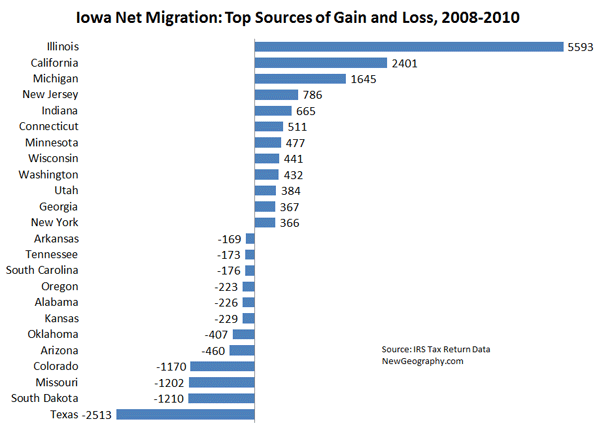
    Photo by Kay Chernush for the U.S. State Department

  • The Troubled Future of the California High-Speed Rail Project

    A congressional oversight hearing, focused on the concerns surrounding the troubled California high-speed rail project, cast new doubts on the likelihood of the project’s political survival.

    The December 15 hearing was the second of two hearings called by the House Transportation and Infrastructure Committee to examine the Administration’s "missteps" in handling the high-speed rail program. Before a largely skeptical groups of committee members — Reps Mica (R-FL), Shuster (R-PA), Denham (R-CA), Miller (R-CA), Napolitano (D-CA), and Harris (R-MD)— two panels of witnesses offered a mixture of support and criticism concerning the project’s impact, financial feasibility and prospects for the future. The first panel comprised six California congressmen — three testifying against the project (Reps. Nunes (R), McCarthy (R) and Rohrabacher (R)), three in support of it (Reps. Cardoza (D), Costa (D) and Sanchez (D).) The second panel consisted of FRA Administrator Joseph Szabo, California Rail Authority CEO, Roelof Van Ark, local elected officials and representatives of citizen groups.

    A Brief Project Overview

    The proposed high-speed line, from Sacramento and San Francisco to Los Angeles and San Diego, was originally estimated to cost $43 billion in 2008 when the state’s voters approved a $9.95 billion bond measure (Proposition 1A) to help finance the project.  Since then, the total cost estimate for the project has more than doubled to $98.5 billion and the completion date has been pushed back by 13 years to 2033.

    The "initial construction section" of 140 miles is proposed to be built in the sparsely populated Central Valley from south of Merced to north of Bakersfield. The $6 billion project is to be financed with a $3.3 billion federal contribution and $2.7 billion worth of state Proposition 1A bonds. Construction is to begin in 2012. However, to qualify as an "Initial Operating Segment" as required by the authorizing bond measure and capable of running high-speed trains, the line has to be extended by another 290 miles to San Jose (or 300 miles to the San Fernando Valley), at an additional cost of $24.7 billion.

    To finance the latter construction, the California Rail Authority’s business plan calls for $4.9 billion in Proposition 1A bonds and assumes a $19.8 billion federal contribution – $7.4 billion in federal grants and $12.4 billion in the yet to be created Qualified Tax Credit Bonds (QTCB). The latter assumption came in for sharp committee criticism as wishful thinking. The bill authorizing QTCB (or TRIP) bonds, proposed by Sen. Wyden (D-OR), is not given much chance of passing in the House. Even if passed, it would only offer $1 billion for the California HSR project rather than $12.4 billion as claimed in the Authority’s business plan. Further federal high-speed rail grants are equally uncertain given the bipartisan congressional refusal to appropriate funds for high-speed rail two years in a row. In other words, the funding for the Initial Operating Segment hinges on highly questionable assumptions as to continuing federal aid.

    Even more conjectural are the Authority’s funding assumptions for the subsequent phases of the project— a line extension from San Jose to the San Fernando Valley and a southern connection, to Los Angeles and Anaheim. That phase of construction according to the Authority’s business plan, would require a further federal contribution of $42.5 billion between 2021 and 2033 (plus $11 billion in private investment).

    Left unstated in the Authority’s business plan, one informed observer speculated, is the secretly entertained hope that by 2015 (when the additional federal funding will be needed), the economic circumstances — and perhaps political circumstances as well — will have changed, allowing a resumption of generous federal support.

    A "Boondoggle" or a "Compelling Opportunity for Our State"?

    Witnesses testifying before the committee aligned along predictable fault lines. Critics of the rail project (mostly, but not all, Republicans) tended to focus on the specific weaknesses of the project: its unrealistic assumptions concerning future funding; the quixotic choice of location for the initial line section ("in a cow patch," as several lawmakers remarked); a lack of evidence of any private investor interest in the project; the eroding public support for the project (nearly two-thirds of Californians would now oppose the project if given the chance, according to a recent poll); the "devastating" impact of the proposed line on local communities and farmers; and the unrealistic and out-of-date ridership forecasts (with more passengers in 2030 predicted to board trains in Merced, a small farming community in Central Valley, than in New York’s Penn Station). Other witnesses asserted that the current project is vastly different from the one Californian voters approved in 2008; and that it is lacking proper management oversight (it is a project "of the consultants, by the consultants and for the consultants" one witness remarked).

    Defenders of the project (mostly, but not all, Democrats) resorted largely to abstract arguments about the merits of building a high-speed rail system in California. They saw the project as a compelling long-term vision, as a travel alternative to congested highways and air lanes, as a way to reduce greenhouse gas emissions, and as a means of creating thousands of jobs. They argued about the difficulty and prohibitive costs of the alternative of building more highways and airports to accommodate future population growth.

    Federal officials are fond of reminding us that construction of the interstate highway system also began "in a cow patch " — in that particular case, a wheat field in the middle of Kansas. But they ignore a fundamental difference between the two decisions: the interstate highway system was backed from the very start by a dedicated source of funds, thus ensuring that construction of the system would continue beyond the initial highway segment "in the middle of nowhere." 

    The California project has no such financial assurance. Should money for the rest of the system never materialize— as is likely to happen— the state will be stuck with a rail segment unconnected to major urban areas and unable to generate sufficient ridership to operate without a significant state subsidy. The Central Valley rail line would literally become a "Train to Nowhere" — a white elephant and a monument to wasteful government spending.
     
    ~~~~~~~~~~~~~~~~~~~~

    Note: the NewsBriefs can also be accessed at www.infrastructureUSA.org

    A listing of all recent NewsBriefs can be found at www.innobriefs.com

  • Iowa: Not Just the Elderly Waiting to Die

    Stephen Bloom, a journalism professor at the University of Iowa, created quite a stir in Iowa this week with a piece in The Atlantic describing his unique observations on rural Iowa as evidence that it doesn’t deserve its decidedly powerful hand in the vote for the president. After the article appeared last Friday both his colleagues and the massive student body of the state he so harshly criticizes are returning the favor.

    Mr. Bloom’s writing is not offensive because it contains no truths, but because has over-generalized our collective character as unfalteringly Christian, complacent, ignorant, and uncultured.  He continually describes a sense of delusion that is rampant in the Iowa populace. And, of course, since we’re from Iowa we must have met a meth head before, right?

    When I was a four year old, my parents picked up everything they had and transplanted their lives from Phoenix all the way to Northwest Iowa. I was young, but I can still remember the farm that we originally settled in– it was the kind of farm you see in a painting: a one-level home, a big red barn, two silos for storage, a small thicket grove with a number of deer, and even a fenced-in area for hogs. I was living the rural Iowa dream.

    Eventually, when I was around seven, our next settlement of choice was a (very) small town only a couple of miles from the farmhouse. The city’s population had around 200 people, the vast majority of them at least 50 years old, and a main street littered with old buildings and storefronts of yesterday that had been abandoned over the years since their mid-century inceptions. People didn’t move to this town; instead those living in it would die from old age, or, in my case, move away in hopes of seeing something bigger.

    I’m well aware of the stereotypes of Iowans: we’re wannabe hicks, we’re uncultured, we hunt, we tend to our rolling hills of corn and beans, we all drive Ford trucks because they “ride better” than anything else. I’ve grown up with people that fulfill these stereotypes here and there and I am no stranger to small town life, but not every soul that I have met in this state fits the profile as Professor Bloom posits. Far from it.

    Expectedly, Bloom’s portrayal of Iowans hasn’t exactly had a warm reception. On Tuesday, the Daily Iowan’s front page had perhaps the most outrageous quote that Bloom’s article included, labeling rural Iowans as nothing more than “the elderly waiting to die, those too timid (or lacking in educated [sic]) to peer around the bend for better opportunities, an assortment of waste-toids and meth addicts with pale skin and rotted teeth, or those who quixotically believe, like Little Orphan Annie, that ‘The sun’ll come out tomorrow.’”

    Yesterday, Sally Mason, the president of the University of Iowa, sent out a campus-wide letter reminding the students that she “disagrees strongly with and was offended by Professor Bloom’s portrayal of Iowa and Iowans”. She reminds us of the generosity that Iowans famously possess and of our “pragmatic and balanced” lifestyles. She also goes on to speak about Dubuque’s recent revitalization, the kinds of companies Iowa has attracted (namely Rockwell Collins in Cedar Rapids and Google in Council Bluffs), and the fact that Iowa City, at times called the “Athens of the Midwest”, is designated as the only “City of Literature” in the United States. It seems like Bloom forgot to take any of this into account.

    He even goes so far as to berate and categorize Iowa’s Mississippi River cities as “some of the skuzziest cities” that he’s ever visited. Cities such as Burlington, Keokuk, Muscatine, and Davenport all seem to be more degraded, violent, and worse-off than some of the cities he’s used to having seen growing up in New Jersey, a place with cities that are labeled time and time again for their overall “skuzziness.” Has he ever driven to Newark?

    It seems that Bloom’s laughable interpretation of his years in Iowa have a few rings of truth that I’ve definitely witnessed, but to completely overgeneralize a people into one category assuming it’s only an “Iowa thing” is inappropriate and crude. Is he correct about anything at all? The numbers show that he is off base about the state as a whole.

    The Mississippi River cities’ so-called blight is similar to many other hard hit industrial cities in the Midwest, perhaps on a similar scale to areas in Michigan (which was the only state in the past Census to actually lose population) where Bloom has holed up most recently as a visiting professor for the University of Michigan. Even so, Iowa has the 11th lowest household poverty rate in the nation. So much for widespread blight.

    The state’s brain drain is always a topic of discussion. There has been a very noticeable population shift of rural to urban in the past half-century which was especially fueled by the farming crisis in the 80s, but this trend holds out empirically for all Midwestern states. The problem is that a look at the numbers doesn’t confirm major outmigration. Iowa saw a net gain from other states according to IRS tax return data from 2008-2010. In fact, the net gain from the top 12 source states ­­– states like Illinois, California, and Michigan – in the last three years is 40% higher than the net loss to the top destinations. If Iowans are “fleeing” anywhere, it’s to places like Texas, the largest gainer, and second placed South Dakota which the professor would no doubt like even less.

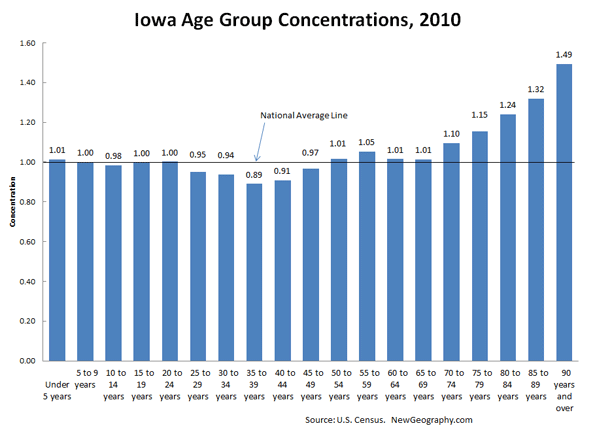
    Iowa does have high concentrations of people over age 70, but that group makes up about 10% of the total population, not enough to skew the other age groups much from the national average. Iowa has an average number of children, and it lags the most in 35-44 year olds: about 10%. This older group skews the state’s educational attainment numbers as well. Iowa’s young workforce is well educated, ranking 11th of all states in residents with at least an associate’s degree. Bloom’s claim that the state is uneducated is simply not true.

    The median age of those living in rural areas is 41.2 while urbanites are relatively young at 35.8. To further add to these negative trends, rural areas have a job growth rate of -6% in the past three years, these numbers mainly fueled by the recession. But overall state jobs are is down 2.8% since January 2008, better than 35 other states. Clearly Iowans are not lazy and giving up.

    Four Iowa cities were even included on CNN Money’s Best Cities to Live in 2011. (This includes the Mississippi River city of Bettendorf.) The state and its cities are also a great place to do business, according to Forbes. In 2010, Des Moines was ranked first, with Cedar Rapids at 13th beating out even a few Texan heavyweights, including Houston, Dallas, and Fort Worth that have been lauded for having a plethora of jobs. The 2011 list puts Des Moines in second place and Cedar Rapids in 11th. It seems Iowa isn’t as economically distraught as Bloom leads us to believe.

    Bloom comes off as nothing more than an ignorant, smug “city-slicker” (a word that Iowans apparently use to describe Obama) who sees the state through an apparently very blurry window. He claims to have seen all 99 counties of Iowa, but how can he possibly paint a portrait of the state that is so absurdly misguided after living here for so long?  If this is what they teach in journalism school, perhaps our skepticism of the media may be better placed than even we suspect.

    Jacob Langenfeld is a senior undergraduate at the University of Iowa studying economics and geography.

    Mark Schill contributed demographic analysis to this piece.

    Des Moines photo courtesty of BigStockPhoto.com.


  • Let’s Level the Inter-generational Playing Field

    With President Obama’s speech in Osawatomie, Kansas decrying the growing economic inequality and lack of upward mobility in America, the issue has finally arrived at the center of this year’s campaign debates. While most discussions of this growing inequality focus on the gap between America’s poorest and richest citizens, a recent report by the Pew Foundation highlights how the same economic trends over the last two and a half decades have also widened the wealth gap between the oldest and youngest Americans to the highest levels in history.

    In a time of great political unrest and economic anxiety, this inter-generational wealth gap has the potential to throw gasoline on an already white hot fire. Only by understanding the sources of this increasing disparity can the country develop policies that will help to close the gap and create a fairer, less economically stratified society.

    Drawing on data provided by the U.S. Census Bureau’s Survey of Income and Program Participation (SIPP), Pew documents the tectonic shifts that have occurred in households’ net worth based upon age between 1985 and 2009. During this time, the average net worth of households headed by those under 35 fell from $11,521 to just $3,662, a drop of 68%.  During the same period, the net wealth of households, as measured by adding up the value of all assets owned minus liabilities such as mortgages or credit card debt associated with those assets, headed by those over 65 increased by 42%, from $120,457 to $170,494 (all figures are expressed in 2010 dollars).

    Of course younger households have always been less wealthy than older ones, since the heads of those households haven’t had a lifetime to acquire wealth. In 1984, this effect of age on household wealth meant that senior citizen households had, on average, ten times the wealth of those headed by people younger than 35. However, the enormous generational shift in household wealth that occurred in the intervening twenty-five years meant that, by 2009, the net worth of senior citizen households was 47 times greater than younger households. The resulting disparities in economic well-being are reflected in each generation’s perception of its own economic situation.  

    Those Americans over 65 in 2009 are members of what generational historians call the Silent Generation. Only 25% of Silents expressed any dissatisfaction with their personal financial situation that year, a percentage that did not increase in the next two years of the Great Recession.

    By contrast, 36% of people under 35 in 2009 – mostly members of the Millennial Generation – expressed dissatisfaction with their individual finances in 2009, a number that rose to 39% in 2011. But the biggest jump in dissatisfaction with personal finances between 2009 and 2011 occurred among the next older cohort, who are considered to be members of Generation X. In 2009, only 30% of Xers felt dissatisfied, a number that shot up to 42% in 2011.  Finally, 32% of the Baby Boom generation, born from 1946 to 1964 and approaching their retirement years in 2009, were dissatisfied with their personal financial situation, a number that rose only to 39% by 2011.

    One of the reasons behind this disparity of financial and economic concern among generations lies with the different impact the nation’s housing market has had on each generation between 1985 and 2009.  The great housing price collapse that began in 2008 had little impact on Millennials, only 18% of whom currently own their own home. By comparison, 57% of Gen Xers own their own home. Three-fourths of them bought after 2000 when housing prices began to soar. As a result, about one in five members of Gen X now say their home mortgage is under water, with the balance owed greater than the value of the house. By comparison, only 13% of Boomers and a miniscule 4% of Silents, most of whom bought homes well before the crash, report having under water mortgages. In fact, if it weren’t for the overall rise in housing prices since 1984 that Silents were able to take advantage of, that generation’s net worth would have fallen by a third in the twenty-five years since, instead of rising by 42%. Clearly, to improve Gen X’s attitudes toward the economy and reduce the inter-generational wealth gap, something must be done to fix the nation’s housing market.

    For older generations – Boomers facing retirement and Silents already enjoying their new life – housing is not an especially large concern. Retirement savings based on stock market valuations and/or interest rates and the certainty of pension payments are clearly a much bigger issue with these generations. Almost two-thirds of Boomers believe they may have to defer their retirement beyond 65 because of the decline in their savings and net worth, with about one in four now expecting to work until at least 70. While the stock market has almost fully recovered from the 2008 crash, for those counting on a more interest-oriented set of retirement payouts from bonds or CDs, years of rock bottom interest rates, designed by the Federal Reserve to stimulate the housing market and help the economy recover, have made these investments problematic at best. In some ways, economic policies that are designed to help Gen X with their housing challenges offer older generations scant comfort, and in certain instances actually exacerbate their concerns over their personal finances.

    Millennials diminished sense of economic opportunity remains focused almost entirely on the job market. About two-thirds of Millennials are employed but only slightly half of those are working full-time. Almost two-thirds of Millennials without a job are looking for work. Unemployment among 16-24 year olds rose to 19.1% by the fourth quarter of 2009, a full eight points higher than in 2007 before the crash. For all other generations, unemployment has gone up on average by only 5 points during the same time period. It seems too obvious to be worth stating, but the best way to increase Millennials’ wealth is to create an economy where they can all find jobs.

    Anxiety that the nation’s economy is only working for the wealthiest drives much of  the overall feeling of fear, uncertainty and doubt that pervades the nation’s political debate.  But an examination of household wealth suggests the remedy to this disease varies by generation.

    Senior citizens turned out in record numbers in the 2010 election to decry the policies of the Obama administration, but it would appear from both the economic and attitudinal data that most of them are more interested in fighting to hang on to what they have or in resisting other societal changes than in expressing any dissatisfaction with their own personal financial situation. Boomers complain about what has happened to their plans for retirement, but it is hard to see how fixing entitlements by raising the retirement age, or cutting the overly generous pensions of public employees will do anything to impact their own retirement prospects directly. To really close the generational wealth gap, policies should be adopted which raise the economic well being of America’s two youngest generations, rather than focusing on those who are already relatively better off. 

    To bring up the least wealthy of the nation’s households to levels closer to those more fortunate would require taking much more aggressive steps than Washington has so far been willing to consider.  This might require expanding the scope and size of government, something older generations especially are steadfastly resisting. This inter-generational debate over the nation’s “civic ethos,” driven by the differing economic circumstances of each generation, will be and ought to be the fundamental issue of the campaign – precisely where President Obama’s speech in Osawatomie, Kansas placed it.

    Morley Winograd and Michael D. Hais are co-authors of the newly published Millennial Momentum: How a New Generation is Remaking America and Millennial Makeover: MySpace, YouTube, and the Future of American Politics and fellows of NDN and the New Policy Institute.

  • The High-Speed Rail Program Under Congressional Scrutiny

    A combative and clearly agitated Transportation Secretary Ray LaHood defended the Administration’s high-speed rail program at a December 6 oversight hearing of the House Transportation and Infrastructure Committee to discuss congressional concerns with the program’s direction and focus. "We will not be dissuaded by the naysayers and the critics," LaHood said heatedly.

    But he convinced few skeptical committee members who believe that the Administration has bungled the program by spreading the money too thinly all over the country and on projects that are not truly high-speed. Average speeds after the $10 billion worth of improvements, the Committee was told, will range from 60 to 70 mph. In Europe and Japan, high speed trains maintain average speeds of 150 mph and higher (average speed is considered a more accurate measure of performance and service quality than top speed for it reflects trip duration.) "The President’s vision of providing 80 percent of Americans with access to high-speed rail service is unnecessary and isn’t going to happen," said Railroads Subcommittee Chairman Bill Shuster (R-PA).

    "We need one high-speed rail success, and our country‘s best opportunity to achieve high-speed rail is in the Northeast Corridor," Committee Chairman John Mica (R-FL) told the Secretary. This sentiment was echoed by a panel of experts who followed LaHood’s testimony. The panel consisted of Joan McDonald, N.Y. DOT Commissioner and Chairman of the NE Corridor Advisory Commission, Richard Geddes, associate professor at Cornell University, Ross Capon, President of the National Association of Railroad Passengers and NewsBriefs editor Ken Orski. "The Northeast is a compelling market for high-speed rail service," said McDonald. It is probably the only corridor that has all the attributes necessary for viable high-speed rail service, and where passenger trains do not have to share track — and thus are not slowed by— freight trains," added Orski. An abbreviated version of Ken Orski’s testimony follows below. 

    ###

    Let me state at the outset that I do not question the merits or the need for intercity passenger rail service. Railroads have been an integral part of the nation’s transportation system for a century and a half and they continue to play a vital role in the economy. Nor do I question the desirability of high-speed rail— a technology that I believe we ought to pursue in this country.
    What I do question is the manner in which the Administration has gone about implementing its ten billion dollar rail initiative— or what the White House expansively calls "President Obama’s bold vision for a national high-speed rail network."

    Misleading Representations
    The Administration’s first misstep, in my judgment, has been to misleadingly represent its program as "high-speed rail," thus, conjuring up an image of bullet trains cruising at 200 mph, just as they do in Western Europe and the Far East. It further raised false expectations by claiming that "within 25 years 80 percent of Americans will have access to high-speed rail." In reality the Administration’s high-speed rail program will do no such thing. A close examination of the grant announcements shows that, with one exception, the program consists of a collection of planning, engineering and construction grants that seek incremental improvements in the existing facilities of Class One freight railroads, in selected corridors used by Amtrak trains.

    While some of the projects funded with HSR dollars may result in modest increases in speed, frequency and reliability of Amtrak services, none of the awards, except for the California grant, will lead to construction of new rail beds in dedicated rights-of-way. As any railroad operator will tell you, dedicated track reserved exclusively for passenger trains is essential to the operation of true high-speed rail service— such as the service offered by the French TGV, the German ICE and the Japanese Shinkansen trains, that run at top speeds of 200 miles per hour and higher.

    Lately, the Administration has toned down its rhetoric. It no longer claims that high-speed rail is "just around the corner" (Sec. LaHood’s own words of some time ago) but rather that the HSR grants are "laying the foundation for high-speed rail corridors." But even that claim seems overblown. While track upgrades will allow Amtrak trains to reach top speeds of 110 mph in some cases, average speeds— which is a more accurate measure of performance and service quality, for it determines trip duration — will increase only moderately.

    For example, while a $1.1 billion program of track upgrades between Chicago and St. Louis will enable Amtrak trains to increase top speeds to 110 mph, average speeds between those two cities —slowed by frequent stops and the need of Amtrak trains to share track with freight traffic — will rise only 10 miles per hour, from 53 to 63 mph. Travel time will be cut by 48 minutes, to 4 hours 32 minutes (Illinois DOT announcement, December 22, 2010)

    In France, TGV trains between Paris and Lyon, cover approximately the same distance (290 miles) in a little under two hours, at an average speed of 150 mph. Yet, federal officials did not hesitate proclaiming the Chicago-St. Louis project as "historic" and hailing it as "one giant step closer to achieving high-speed passenger service."

    Had the Administration candidly represented its HSR initiative for what it really is — an effort to introduce useful but modest enhancements in existing intercity Amtrak services— it would have earned some plaudits for its good intentions to improve train travel. But by pretending to have launched a "high-speed renaissance," when all evidence points to only small incremental improvements in speed and trip duration, the Administration, I believe, has suffered a serious loss of credibility. Its pledge to "bring high-speed rail to 80 percent of Americans" is not taken seriously any more.

    Lack of a focus
    The Administration’s second mistake, in my opinion, has been to fail to pursue its objective in a focused manner. Instead of identifying a corridor that would offer the best chance of successfully deploying the technology of high-speed rail, and concentrating resources on that project, the Administration has scattered nine billion dollars on 145 projects in 32 states, and in all regions of the country. (A complete list can be found here). Only a few of these awards (CA, IL, NC, WA, NEC) are of a sufficient scale to produce any appreciable service improvements. The remaining grants will support minor facility upgrades, preliminary engineering, and planning and environmental studies. Indeed, the program bears more resemblance to an attempt at revenue sharing than to a focused effort to pioneer a new transportation technology.

    The Northeast Corridor
    Ironically, the Northeast corridor, where high-speed rail has the best chance of succeeding, has received scant attention. And yet, this corridor is probably the only one in the nation that has all the attributes necessary for effective and economical high-speed rail service. It also is the only rail corridor in the nation where passenger trains do not have to share track — and thus are not slowed by— freight trains.

    In sum, no other travel corridor in the nation offers better conditions for successful implementation of high-speed rail service, or a more compelling case for moving forward with an ambitious investment program.

    To its credit, the Administration has belatedly recognized the deployment potential of the Northeast Corridor and tried to make up for its past neglect by awarding two major grants for track and catenary improvements in the Corridor. These grants are a small beginning in what will hopefully become a redirected HSR program, with a focus on the Northeast corridor. Its goal should be to raise average speeds between city pairs to 150 mph—the generally accepted standard for high-speed rail service.

    The need to involve the private sector
    In view of the constraints on the federal budget, any such program will of necessity require substantial participation of the private sector. The density of travel in the NE Corridor and its continued growth should, in principle, generate a sufficient stream of revenue to attract private capital and create opportunities for public-private partnerships.

    However, this is still an untested hypothesis. We simply do not have enough experience with public-private partnerships in the passenger rail sector to make confident predictions about the response of the private investment community— its assessment of the risk, rewards and expected rate of return on investment in such an enterprise.

    Thus, I believe that an early step in the process should focus on thoroughly exploring the potential of private financing and ascertaining the private investors’ interest in this venture— both domestically and internationally. This should include an examination of the lessons learned from the Channel Tunnel project — the largest rail infrastructure project in the world totally financed by the private sector.

    ###

    While the Administration’s handling of the high-speed rail program has— understandably and justifiably— made Congress reluctant to support this initiative any further, I do hope that under the Committee’s leadership, and with the help of the NEC Advisory Commission, Amtrak and the several participating states, a reformulated high-speed rail initiative— focused on the NE Corridor and involving a public-private partnership— will soon begin taking shape.

    One often hears these days that we, as a nation, have lost the will to think big— that we no longer have the ambition and imagination to mount "bold new endeavors" that capture the public imagination— the kind of motivation that caused our parents’ and grandparents’ generation to build the Hoover Dam, the Golden Gate Bridge and the Interstate Highway System. Launching a multi-year public-private venture to usher in true high-speed rail service in the Northeast Corridor, a project of truly national significance, offers us an opportunity to prove the skeptics wrong.

    Ken Orski has worked professionally in the field of transportation for over 30 years.
     
    Photo courtesy of BigStockPhoto.com

    ~~~~~~~~~~~~~~~~~~~~

    Note: the NewsBriefs can also be accessed at www.infrastructureUSA.org

    A listing of all recent NewsBriefs can be found at www.innobriefs.com

  • Durban, Reducing Emissions and the Dimensions of Sustainability

    The Durban climate change conference has come to an end, with the nations of the world approving the "Durban Platform," (Note 1) an agreement to agree later on binding greenhouse gas (GHG) reduction targets by 2020. The New York Times reported: "Observers and delegates said that the actions taken at the meeting, while sufficient to keep the negotiating process alive, would not have a significant impact on climate change."

    Not surprisingly, not all are pleased by the largely toothless agreement. Nnimmo Bassey, chair of Friends of the Earth international, told The Guardian:"Delaying real action till 2020 is a crime of global proportions." Todd Stern, the United States representative, signed on to the deal but noted that "there is plenty the US is not thrilled about."

    There is general agreement that any program to reduce GHG emissions must do so in the most efficient (least expensive) manner. The United Nations Intergovernmental Panel on Climate Change (IPCC) has concluded that sufficient emissions reductions can be achieved for between $20 and $50 per ton. Any cost above that must be considered wasteful and likely to reduce economic growth, while increasing poverty.

    Yet, researchers often leap from identifying a strategy to reduce GHG emissions to recommending its implementation, without ever examining the cost.

    Often  missed for instance, is that reductions in some sectors may prove less expensive than in others. The European Conference of Ministers of Transport has noted that "It is important to achieve the required emissions reductions at the lowest overall cost to avoid damaging welfare and economic growth." Across-the-board targets would misallocate resources, unnecessarily reducing economic growth and increasing poverty. This is particularly important in transport, because IPCC data indicates the potential for cost effectively reducing GHG emissions from this sector is considerably less than its contribution to emissions.

    GHG Emissions from Automobiles: In the United States and other high income nations, however, mandates are being pursued that would impose far higher costs. Our new report, published by the Reason Foundation, Reducing Greenhouse Gas Emissions from Automobiles reviews two general approaches. The first is behavioral approaches, the favorite of policymakers, that would force people to leave the suburbs to live in higher densities ("compact city" or "smart growth" policies) and discourage personal mobility. The second is facilitative approaches, which would reduce GHG emissions through technological advances, minimizing the necessity for command and control mandates over people’s lives.

    Behavioral Approaches: In what passes for the conventional wisdom, current thinking would require densification for virtually all new development, while trying to force people out of cars to travel by transit, bicycle or walking, all characterized as "sustainable" transport modes. Further, these strategies would seriously impede personal mobility by increasing travel times and reducing access to employment. This reduction in accessibility to jobs would be a backward step for any nation interesting in longer term economic growth (Note 2).

    The behavioral strategies are described in two principal US reports: Driving and the Built Environment which was produced by the National Research Council and Moving Cooler, by a consortium of organizations led by the Urban Land Institute and Cambridge Systematics. Each of these reports provides detailed estimates of the GHG emission reductions to be expected from land-use and mass transit strategies by 2050 in the United States.

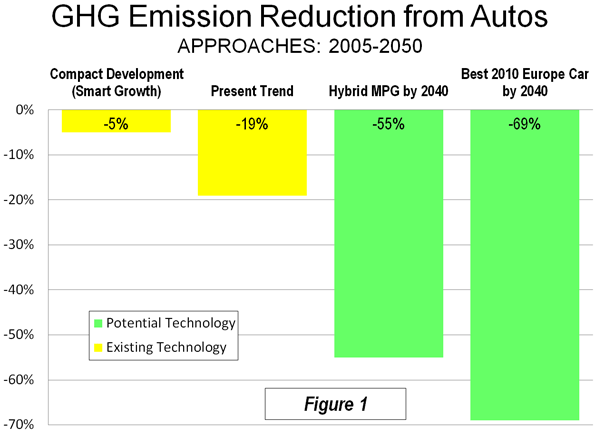
    The reductions are relatively modest, averaging less than 5% from the early 2000s to 2050 .  Driving and the Built Environment indicates that the drafters did not agree its most aggressive scenario was achievable. Moving Cooler was soundly criticized by the American Association of State Highway and Transportation Officials and on these pages by leading transport consultant Alan E. Pisarski (see: ULI Moving Cooler Report: Greenhouse Gases, Exaggerations and Misdirections).

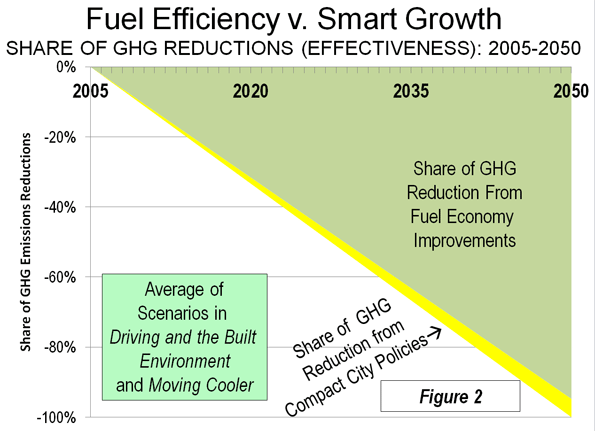
    These proscriptive policies focus on housing and land use even thought nearly all of the improvement in GHG emissions would result from automobile fuel economy improvements, not compact city policies. Depending upon the scenario, between 89% and 99% of the reduction in GHG emissions from cars by 2050 (Figure 1) would be the result of fuel economy improvements, rather than from compact city policies (based on comparison base year, early 2000s, fuel economy).

    Moreover, even the modest 1% to 11% reduction (5% average) in GHG emissions due to compact city policies are likely high because of greater traffic congestion, which neither report considers. Higher density urban areas, such as compact city policies would require, would spark greater traffic congestion. This means that cars travel slower and in more erratic traffic conditions. This, ironically, increases fuel consumption and GHG emissions per mile or kilometer. Thus, as noted here before, under these policies, GHG emissions from cars could actually increase.

    Neither Driving and the Built Environment nor Moving Cooler report considers the economic impact of compact city land rationing, which drives up housing prices and could thus be expected to impose higher costs on households. The economic literature is virtually unanimous in associating higher land and thus house prices with smart growth type land rationing policies. The increased costs could be many times the IPCC $20 to $50 per ton of GHG emissions removed.

    Even the popular assumption that suburban housing produces materially greater GHG emissions is questionable. Most US research fails to capture the common GHG emissions from elevators, heating, air conditioning, lighting, etc. in larger multi-unit housing, which are costs attributed to the building itself (landlord or condominium building) as opposed to  household energy bills (simply because there are no data). Yet, research in Australia indicates that common GHG emissions render higher density multifamily housing more GHG intensive than either townhouses or detached housing. Also escaping many researchers is the fact that carbon neutral housing is being developed, which could remove any GHG emissions differences between housing types.

    Compact city or smart growth policies have little potential to reduce GHG emissions and would do so at exorbitant costs that are well beyond those identified by the IPCC. This is not surprising, since compact city and smart growth policies have been widely touted long before the general concern over climate change. Denser cities have been pushed as a means to improve “community,” spur economic efficiency,   reduce air pollution and deal with such ephemeral – given recent massive energy finds – notions of “peak oil”.

    Facilitative Approaches: Any achievable program to reduce GHG emissions must be multi-dimensional and focus primarily on achieving that goal in the most economically and socially beneficial manner and not be based upon tired policies designed long ago to serve other agendas. There is no need for expensive and draconian compact city approaches. A report by McKinsey and the Conference Board concluded that substantial and cost effective GHG emission reductions were possible, “while maintaining comparable levels of consumer utility,” which was defined as “no change in thermostat settings or appliance use, no downsizing of vehicles, home or commercial space and traveling the same mileage.” In other words, there is no need to interfere with people’s lives or preferences (Note 3).

    The most promising approaches involve improvements in fuel economy. For example, Volkswagen has developed a two-seater car that achieves 235 miles per gallon (US) of gasoline or petrol (1 liter per 100 kilometers). With current fuel economy averaging little over 20 miles per gallon (12 liters per 100 kilometers) in the United States, the frontiers of fuel economy improvement have barely been approached.

    Moreover, substantial GHG emissions reductions can be achieved at levels far below 235 miles per gallon. The United States Department of Energy, Energy Information Administration (EIA) forecasts that even if driving increases 29% from 2005 to 2025, GHG emissions from cars would be reduced by 7% (Note 4). If, as is demonstrably possible, the EIA forecast fuel efficiency improvements were to continue to 2050, the reduction would be 19%, despite an increase in driving of more than 60%. At a slower driving growth rate more consistent with more recent trends, the reduction could be 33% (Figure 2).

    Further, if the US light vehicle fleet (cars and sport utility vehicles) were to achieve the current fuel economy performance of the best hybrid vehicles, the reduction in GHG emissions would be between 55% and 64% by 2050. Matching European performance forecasts would reduce GHG emissions even more.

    A substantial increase in the fastest growing sector of commuting, working at home (often telecommuting), could also help. Nothing can cut emissions more thoroughly than working at home, which produces zero GHG emissions. Yet, this innovation – which already surpasses transit use in most American metropolitan areas – inexplicably receives little or no attention from planners intent on herding people into higher densities and travel modes that take longer.

    The great advantage of facilitative approaches is that, as the McKinsey-Conference Board report indicates, people are permitted to live their lives as they prefer even as emissions are reduced.

    The Dimensions of Sustainability: Perhaps the greatest problem with behavioral approaches is that they may not be sustainable at all. Sustainability is multi-dimensional. Compact city and smart growth policies lack financial sustainability because they spend far too much per ton of GHG emissions. They lack economic sustainability because they would impose substantially higher costs, especially on housing prices. Ultimately, unless humans radically change their demonstrated preferences, compact city and smart growth policies may not be politically sustainable because people are likely to resist them either at the ballot box, or by moving – as demonstrated in the latest census – even further out from the urban core or to smaller, less regulated and less dense regions. All three dimensions of sustainability, financial, economic and political, must be prerequisites to material GHG emissions reductions.

    Notes:

    (1) Reuters provides an early summary of the Durban Platform.

    (2) The strong connection between economic growth and minimizing urban travel times is identified in research such as by Prud’homme and Lee at the University of Paris and Hartgen and Fields at the University of North Carolina, Charlotte.

    (3) The McKinsey-Conference Board report was co-sponsored by Shell, National Grid, DTE Energy and Honeywell, as well as environmental advocacy organizations, the Environmental Defense Fund, the Natural Resources Defense Council (NRDC),

    (4) Proponents of compact city policies sometimes claim that fuel efficiency improvements cannot reduce GHG emissions because the increase in driving neutralizes their impact. EIA projections indicate otherwise, as is shown here.

    Wendell Cox is a Visiting Professor, Conservatoire National des Arts et Metiers, Paris and the author of “War on the Dream: How Anti-Sprawl Policy Threatens the Quality of Life

    Photograph from BigStockPhoto.com

  • An Obituary for the Occupation in New York

    I came to report on the occupation of Zuccotti Park expecting it would pass in a matter of days, like the stillborn movements before it.

    In spite of its self-celebrated cosmopolitanism, New York after 9/11 has become an arid environment for protest under Mayor Michael Bloomberg and Police Commissioner Ray Kelly. The press and the public yawned through the massive anti–Iraq War march in 2003 and the excessive police response to the 2004 RNC protesters (the city is still dealing with those lawsuits). Even after the Wall Street meltdown, an eerie silence prevailed.

    Zuccotti was something else: a physical presence, symbolically charged by its location a stone’s throw from both Ground Zero and Wall Street, with no end date to wait out and no demand to be placated.

    While the act of occupation had little to do with the broader complaint—at the core, unhealthy economic distribution perpetuated by increasingly unresponsive elected “representatives”—it proved a dramatic setting for airing them, and for bringing participants together. For one season the park took on a life of its own, before reverting to a place for “passive recreation.”

    In the course of that season, though, the scene aged badly. With a big push from the Bloomberg administration and tabloid coverage fixated on civic order, Zuccotti Park descended from a new public commons to a fever dream.

    I surveyed the scene for the first time about a week after it started. In that first of what became many such visits, I stayed from early afternoon through the next morning, listening to professors, students, union members, veterans, homeless women, eccentrics, lunatics, librarians, old colleagues from other newspapers, members of various working groups and even a neighbor from Brooklyn there to take it in.

    Occupy Wall Street had yet to draw the high-profile NYPD abuses and errors—the pepper spraying and Brooklyn Bridge arrests—that would give them a shape and purpose they couldn’t sustain themselves. But amid the drum circles and music festival “model society” absurdity of the park, people who’d been at a loss until now about how to express an array of concerns sensed an opening.

    I was less interested in the protest itself than in the creation within Zuccotti of the sort of freewheeling commons New York City has lost under this mayor, even as the Internet and mobile devices eroded what was left of a shared café culture.

    That shift is epitomized by the increasing commercialization of public spaces like the generator-powered gift market at Union Square. But it left a hole that the occupiers briefly filled.

    The handmade cardboard signs, the conversations with engaging strangers, the library, even the General Assembly all seemed like flashes of the participant city that’s hunkered down to wait out an unpopular mayor. Bloomberg has built an ever-expanding safe space for the very well-off at the expense of the rest of us, using his private fortune to encourage New Yorkers to simply leave the city’s civic life in his hands.

    Problems in Zucotti stemmed in no small part from the massively disproportionate police response, intended in part to limit the size and scope of the protests by warning the economically marginal, the physically frail, and the meek about the bad things that might happen to those who participated.

    That tactic backfired. As the occupation grew, the would-be political participants found themselves starved for space, overwhelmed by their own tents and by an excess of hangers-on, panhandlers and carnival-goers unsober in all senses. They were ringed by barricades and police officers, blinded by spotlights aimed into the park at all hours, and eyed at all times by dozens of NYPD cameras carried by officers and atop a 20-foot pole on an unmarked police truck.

    “Just because you’re paranoid,” one Occupier said, sweeping her arm across the park, “doesn’t mean they’re not out to get you.”

    The NYPD response was a far more significant disruption to the life of the city than the protesters themselves—for the first time since 9/11 penning off streets to those without IDs to prove they “belonged” there, erecting barricades that starved businesses of customers, sending so many officers to “protect” the demonstrably nonviolent marches that crime rates went up elsewhere.

    In turn, the occupiers became fixated on the police department. At each march, rumors would swirl about brutality, arrests and reports that “they’re taking the park.” Crowds would at times work themselves into mobs, facing off with the NYPD as though they were in Oakland or Egypt. Yet they failed to notice—let alone respond to—the tactics used to manage them, like complicated penning schemes that broke bigger groups into smaller ones or tricked protesters into separating themselves from the rest of the city instead of showing they were just like everyone else.

    After I reported that the police were exacerbating a split between participants and nonparticipants in Zuccotti by encouraging drunks and rowdies to head down there, the NYPD’s main mouthpiece issued a tepid denial. “Not true,” he said, without specifying what exactly wasn’t true, adding that those types would of course find their way there.

    Explaining his decision to finally clear the park, Bloomberg pointed to the EMT who broke his leg on the sidewalk just outside the park (but inside the barriers separating the police from the protesters) a week earlier, in the middle of the night.

    I was the only reporter on the scene when that happened. My colleagues had dispersed around the park to track a spate of seemingly contagious violent incidents on an especially ugly night.

    Two very large OWS “community watch” members were patiently working to calm down and eject from the park a crazed 20-year-old, Joshua Ehrenberg, who I was told had punched his girlfriend in the face earlier that night. Just outside the barriers separating the sidewalk from the street, officers watched the crowd swelling around the scene.

    The police ignored requests to move on as Ehrenberg kept playing to them, spitting out slogans of the occupation: “The process is being disrespected” since “the community hasn’t consented to this,” trying to get friends to form a human chain with him. As ever, the gawkers accused each other of being infiltrators and police agents.

    As that scene played out, two huge men in still another fight emerged behind us, inside the park, throwing ineffective haymakers at each other, nearly toppling tents. One of the OWS security members left to try to handle that, while his partner finally asked the police, watching from outside the barriers, to come in and remove Ehrenberg.

    Despite the invitation, the crowd swarmed around the entering officers, yelling “Pig!” and the like as the police carried the struggling, still slogan-shouting would-be Occupier out by his arms and legs.

    An EMT there to take him for a psychiatric evaluation, walking backward just ahead of the swollen group of police, protesters and park campers, put his foot through the rungs of a ladder that for some reason was leaning against the sidewalk.

    As he wailed in agony, the crowd gave no space—even as the police calmly asked them to give him room, pushing those who wouldn’t listen back with measured force.

    In press reports about the incident, a city spokesperson incorrectly claimed that the EMT was shoved or assaulted, while Occupation sources peddled the line that this was just one of those things, an unavoidable accident unrelated to the occupation.

    Did he fall or was he pushed? Yes.

    Would the Occupation movement—really, a moment—have collapsed under its own weight without the city’s heavy-handed help? Thanks to that help, we’ll never know.

    This piece first appeared at City and State New York.

  • Blago’s Historic Sentencing: Organized Crime in Illinois

    Former Illinois Governor Rod Blagojevich was sentenced today to 14 years in prison. Illinois will now have the dubious distinction of having two back-to-back Governors in jail at the same time. Could a more vigilant press have stopped the amazing political career of Rod Blagojevich? When you look into the background of the former Governor the tentacles of organized crime can’t be ignored.

    Rod Blagojevich has been identified as a former associate of the Elmwood Park street crew of the Chicago Mob by Justice Department informant Robert Cooley. The allegations concern Blagojevich paying street tax to the Chicago Mob to operate a bookmaking operation. Former senior FBI agent James Wagner confirmed that Cooley told the FBI about Blagojevich in the 1980s. The Chicago Sun-Times and Chicago Tribune still haven’t reported on the Cooley allegations concerning Blagojevich. WLS-TV reporter Chuck Goudie has been most vocal in reporting on Blagojevich’s background.

    Blagojevich was tried in room 2525 of the Dirkson Federal Building, the same room used for the massive Family Secrets Chicago Mob trial. It’s odd that Judge James Zagel was the federal judge in both cases. But, there’s more in common than the media has emphasized.

    Blagojevich can’t help but be a little bitter. Former friend Eric Holder was supposed to help Blagojevich land a valuable casino in Rosemont, Il. Congressman Jesse Jackson Jr. is under an ethics cloud but is not going to be indicted for the Obama Senate seat deal. While Barack Obama claims to know nothing about Chicago corruption, as Joel Kotkin said recently: Illinois is a state of embarrassment.

  • Illinois: State Of Embarrassment

    Most critics of Barack Obama’s desultory performance the past three years trace it to his supposedly leftist ideology, lack of experience and even his personality quirks. But it would perhaps be more useful to look at the geography — of Chicago and the state of Illinois — that nurtured his career and shaped his approach to politics. Like with George W. Bush and Texas, this is a case where you can’t separate the man from the place.

    The Chicago imprint on Obama is unmistakable. His closest advisors are almost all products of the Windy City’s machine politic: ConsigliereValerie Jarrett; his first chief of staff, now Chicago Mayor, Rahm Emanuel; and his current chief of staff, longtime Chicago hackster William Daley, scion of the Windy City’s longtime ruling family.

    All these figures arose from a Chicago where corruption is so commonplace that it elicits winks, nods and even a kind of admiration. Since 1973, for example, 27 Chicago Aldermen have been convicted by U.S. Attorney of the Northern District of Illinois.

    That culture of corruption affects the rest of the state as well. Both Gov. George Ryan (who served from 1999 to 2003 and  and his successor Ron Blagojevich have been convicted a major crimes. So have four of the state’s last eight governors. Blagojevich’s felonies are part and parcel of a political climate that also includes the also newly convicted  Antonin “Tony” Rezko, a real estate speculator and early key Obama backer, sentenced late last month to a ten-year prison sentence.

    Crony capitalism constitutes the essential element of what the legendary columnist John Kass of the Chicago Tribune has labeled both the “Chicago way” and the “Illinois Combine”, not primarily an ideology-driven movement. The political system, he notes, “knows no party, only appetites.”

    Just look at the special favors granted to vested interests while the state has imposed a 65% boost in income taxes for middle class citizens. Companies like Boeing and United, which have head offices in Chicago, get tax breaks and incentives, while everyone else pays the full fare. This game is still afoot.  Even as the state deficit persists, other big players such as the CME group, which operates the Chicago Mercantile Exchange, the Chicago Board of Options and Sears are threatening to leave unless their taxes are also lowered.

    Thus it’s not surprising then that cronyism has become a hallmark of the Obama administration. Wall Street grandees, a key source of Obama campaign funders in 2008 and again now, have been treated to bailouts as well as monetary policies that have assured massive profits to the “too big to fail” crowed while devastating consumers and smaller banks.

    The evolving scandal over “green jobs” — with huge loans handed out to faithful campaign contributors — epitomizes the special dealing that has become an art form in the system of Chicago and Illinois politics.  Beneficiaries include longtime Obama backers such as Goldman Sachs, Morgan Stanley and Google. Another scandal is building up around the telecom company LightSquared. This company, financed largely by key Obama donors, appears to have gained a leg up for a huge Pentagon contract due to White House pressure.

    If the Chicago system had proven an economic success, perhaps we could excuse Obama for bringing it to the rest of us. Most of us would put up with a bit of corruption and special dealing if the results were strong economic and employment growth.

    But the bare demographic and economic facts for both Chicago and Illinois reveal a stunning legacy of failure. Over the past decade, Illinois suffered the third highest loss of STEM (science, technology, engineering and math-related) jobs in the nation, barely beating out Delaware and Michigan. The rest of the job picture is also dismal: Over the past ten years, Illinois suffered the third largest loss of jobs of any state, losing over six percent of its employment.

    The state’s demographic picture also is dismal. In the last decade, Illinois lost population not only to sunbelt states such as Texas and Florida but actually managed to have negative migration even with places like California and New York, net losers to virtually everywhere else. In fact, Illinois had a positive net migration with only one major state, Michigan.

    Chicago and its Daley dictatorship has been much celebrated in the media – particularly after Obama’s election in everything from the liberal New Yorker to Fast Company, which named Chicago “city of the year” in 2008. The following year, the Windy City was deemed the best city for men by Askmen.com, for offering what it claimed was “the perfect balance between cosmopolitan and comfortable, combining all of the culture, entertainment and sophistication of an internationally renowned destination with an affordable lifestyle and down-to-earth work hard/play hard character.”

    Well, you can make that case, unless you happen to be searching for a job. Over the past decade, “the Chicago way” has proven more adept at getting good coverage than creating employment for its residents. In NewGeography’s last cities rankings greater Chicago ranked 41st out of the 51 largest metropolitan areas. Between 2001 and 2011 it actually lost jobs. Since 2007 the region has lost more jobs than Detroit, and more than twice as many as New York. It has lost about as many jobs – 250,000 – as up and comer Houston has gained.  In NewGeography’s recent survey of high-tech growth, the Chicago region stood at a dismal 47th among the nation’s 51 largest metropolitan areas.

    Overall, Chicago Loop Alliance reports that private sector employment in the Loop, the core of the Chicago downtown area, fell from 338,000 to 275,000 between 2000 and 2010. Chicago’s core has fallen further behind, in capturing high end employment than its traditional rival, New York.

    This weak hand is also evident in the region’s strongly negative migration. According to the last Census, Chicago lost more than 200,000 people during the last decade. People are leaving the Chicago area not only for Sun Belt havens but to rising Midwest competitors like Indianapolis and Minneapolis, which offer better business climates, lower housing prices and cleaner governments, says local urban analyst Aaron Renn. Even perennial losers like Los Angeles and New York are net gainers with Chicago.

    Given this economic and demographic track record, it’s no big surprise that the City of Chicago and the State of Illinois face enormous fiscal pressures. The city is facing a deficit of about $650 million and the state’s unfunded future liabilities are upwards of $160 billion. The  new taxes are on tap for state residents, according to Illinois Public Policy Institute, will cost the average Illinoisan a whole week’s earnings.

    One might hope this disastrous record might make President Obama consider taking a different path to governing our country.  Yet sadly it appears that acknowledgement of failure is not part of the “Chicago way” — a denial that may cost us dearly in the years ahead.

    This piece first appeared at Forbes.com.

    Joel Kotkin is executive editor of NewGeography.com and is a distinguished presidential fellow in urban futures at Chapman University, and an adjunct fellow of the Legatum Institute in London. He is author of The City: A Global History. His newest book is The Next Hundred Million: America in 2050, released in February, 2010.

    Official White House Photo by Pete Souza.

  • Wall Street Plays Occupy White House

    Wall Street is disdained in the court of public opinion — detested by the tea party on the right and the Occupy movement on the left. The public blames financial plutocrats for America’s economic plight more than either President Barack Obama or former President George W. Bush. Less than a quarter of all Americans, according to Gallup, have confidence in the banks, which vie for the lowest spot with Big Business and Congress.

    But these angry voters are unlikely to get satisfaction in next year’s presidential election. In fact, things are looking up for the financial elite — which donated more to Washington politicians than almost any other sector of the economy over the past two decades. Wall Street can look forward to a bank-friendly administration if Obama is reelected — and perhaps even better conditions if either of the two leading GOP contenders, Newt Gingrich and Mitt Romney, wins the White House.

    Despite his occasional remarks that decry “fat cat”’ bankers, Obama has effectively serviced the financial bigwigs. Bank prosecutions have declined markedly under Obama — to levels not seen for more than 25 years. Obama has even tried to derail aggressive bank prosecutions pursued by state attorneys general, most of them liberal Democrats.

    This is remarkable since a considerable number of people on Wall Street should likely be in the dock — or in jail — for systematically ruining the national, and even global, economy. Instead, financial powers have enjoyed several big bonus years and have been on a spending binge at overpriced New York restaurants and tony boutiques. Struggling homeowners of middle America may be happy to know that the Manhattan luxury apartment market is running low on inventory.

    Even while trying to exploit the Occupy Wall Street movement for political purposes, Obama still leads in financial sector donations, according to the Center for Responsive Politics. He has secured more cash from the financial elite, at this point, than all the GOP candidates combined. He has even raised twice as much as they have from Bain Capital, the venture firm co-founded by Romney. Why not give up on the white working class when you can sew up the Harvard and Wharton business school constituency?

    Nor can we expect this pro-Wall Street tilt to shift in a second term. Obama’s virtual toadying to Wall Street is long-standing. He was the finance industry’s favorite against Hillary Clinton and then-GOP nominee Sen. John McCain (R-Ariz.). He may call them “fat cat” bankers, but Obama has been a kitten when dealing with financiers.

    The president might not have much interest in conventional energy, manufacturing and industry — economic sectors that really create wealth and high-paying blue-collar jobs — but he has performed wonders to make sure the financial elite does well.

    With his enablers, Treasury Secretary Timothy Geithner and Federal Reserve Chairman Ben Bernanke, Obama has pursued low interest rates and easy money, policies favorable to large financial institutions. They get essentially free cash, which they then lend to the government and others at substantially higher rates. Now, to save the European banks, we hand out more money — not so much to save the old continent or our industries but our banks’ exposure to them.

    Yet even Obama’s record of largely obsequious behavior is not enough for some Wall Street powers. Many financiers are now signing on with Romney. No doubt, the former investment banker seems a safe choice. He is, if you will, to the manor born and is expected to view things as the ultra-rich prefer. To him, the Occupy Wall Street movement has been largely looking for “scapegoats.”

    Romney is a strong defender of the Troubled Asset Relief Program and the financial bailouts. He has even talked about lowering capital gains — though for only the smaller investor. Wall Street would likely be safe with Romney in the White House.

    Gingrich is, as usual, harder to categorize — having said and done so many often contradictory things over the past few decades. Typically, after decrying the TARP bailout as “socialism,” Gingrich supported the bailout legislation. He also received compensation of more than $1.6 million in consulting fees from Freddie Mac, one of the big Washington institutions at the core of the financial crisis.

    As a congressman, Gingrich consistently supported another key source of the meltdown — the wholesale deregulation of the financial industry. He has continued to play to Wall Street’s tune, opposing more stringent regulations. Gingrich symbolizes, as much as anyone, the interplay of the financial elite, Washington lobbying and politics.

    More radical Republican challengers — those perhaps more likely to break the Wall Street consensus — seem to have self-destructed. The shifting tea party favorites — Rep. Michele Bachmann (R-Minn.) and Texas Gov. Rick Perry — have been undermined by their own demonstrated ignorance and a fatal attraction to the far-right social conservative agenda.

    On the left, no one is likely to run against Obama. Politicians are perhaps unwilling to challenge the first African-American president — though many Democrats have grave misgivings about his gentry-friendly economic policy.

    Next November, populists on both the left and the right are unlikely to get satisfaction from whoever wins the White House. In contrast, one faction or another of Wall Street is likely to win big.

    The more traditionalist financial wing favors the GOP policies of greater deregulation, which allow for ever increasing risk-taking and agglomeration of assets. The “progressive faction” — which includes many Silicon Valley venture capitalists — tends toward Obama, who has favored its members with more than $14 billion in subsidies for green ventures and supports their status as arbiters of the future economy.

    Yet those who seek a radical shift in economic policy, whether on the right or left, should not give up. Eighty-one percent of Americans are dissatisfied with the status quo, according to Gallup. Their trust in large economic and political institutions stands at the lowest ebb in a generation.

    This anger could fuel a prairie fire that would force the restoration of competition to capitalism and reduce the power of the bipartisan patrician caste.

    What is needed is some sort of tacit agreement among Americans — independents, tea partiers or Occupy Wall Street — for a break with the Wall Street-first policies of the political leaders of both parties. One crucial component could be a reform of the tax system — with flatter rates and capital gains equalized with income taxes, a policy that now overwhelmingly benefits the top 0.1 percent.

    This does not necessarily mean more regulations — which the financial industry can easily game, in any case. We must instead make bankers more accountable for their failures. Let them feel the pain, and not allow them to prevail with the help of bailouts or to slip into their golden parachutes.

    The whole concept of “too big to fail” — which puts smaller community-oriented banks at a severe disadvantage — should be eliminated. We also need to curb all the cozy special deals concocted for banks, energy companies, green ventures and other well-connected businesses.

    Sadly, such reformist impulses won’t get any more support from a President Romney or Gingrich than from Obama. A break with the bipartisan Wall Street consensus will have to be forced on the unwilling financial plutocrats by a public fed up with the financial hegemon’s overweening power and destructive influence.

    This piece first appeared at Politico.com.

    Joel Kotkin is executive editor of NewGeography.com and is a distinguished presidential fellow in urban futures at Chapman University, and an adjunct fellow of the Legatum Institute in London. He is author of The City: A Global History. His newest book is The Next Hundred Million: America in 2050, released in February, 2010.

    Photo by BigStockPhoto.com.