Category: Politics

  • The Texas Story Is Real

    Texas Governor Rick Perry entered the Republican presidential nomination race bragging about the job creation record of Texas during his term as his primary pitch to a nation starved for jobs. This triggered a flurry of debate on whether or not Texas is really all Perry claims for it. But while there is certainly nuance in numbers, and Texas doesn’t win on every single measure, on the whole it seems indisputable that Texas did very, very well during the 2000s.

    This may or may not be the doing of Perry. Nor are the national struggles clearly the fault of Obama. The  man at the top always reaps the credit for the blame for what happens on his watch, but the realities of the modern economy are quite complex and there’s only so much influence a governor or president has – and that usually comes with a lag. Nevertheless, the Texas story can’t simply be discounted.

    Let’s take a look at the top level data. While reviewing, keep in mind that the data for the US as a whole actually includes Texas. If you stripped the Texas data out of the US total, the comparisons would generally get even better for the Lone Star State.

    Population

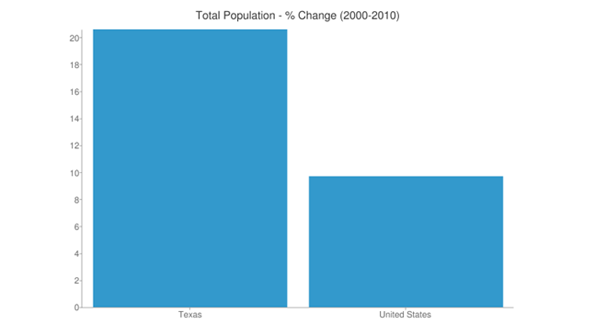
    The root of the Texas story is in its massive population growth during the last decade. While historic growth champions like California stumbled, Texas powered ahead, adding 4.3 million new residents for a growth rate of 20.6% – double that of the 9.7% US average.


    Unemployment

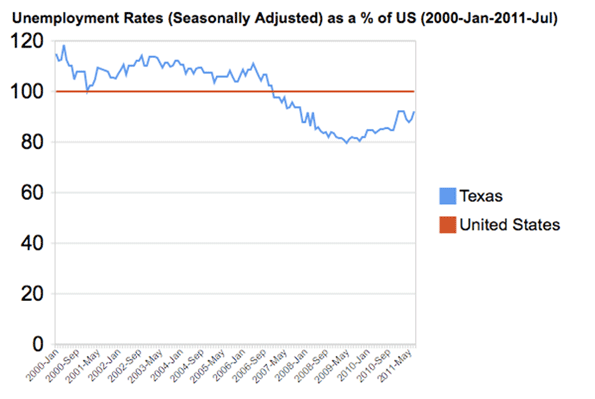
    Despite challenging times at both the beginning and end of the decade, Texas actually managed to keep those people busy at work too.  While it started out the decade with an unemployment rate above the US average, by decade’s end, with population growth and all, it was well below it:

    Jobs

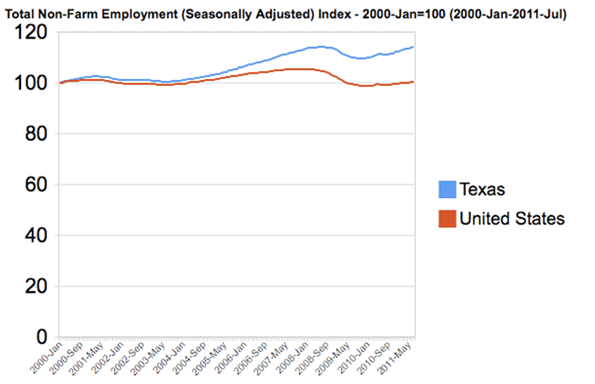
    One reason Texas was able to keep its unemployment rate under control is that it added jobs – nearly a million between 2000 and 2010 in a nation that lost jobs during that period.  The chart below, rendering the US and Texas on the same base, shows that the two moved closely in tandem during the first half of the decade, followed by an ever-widening gap in Texas’ favor.


    Gross Domestic Product

    It’s not enough, perhaps, to merely ask if there are more jobs. Are these jobs that are producing significant economic output, as measured by statistics like GDP?  Looking at the data, we see that Texas again outperformed.
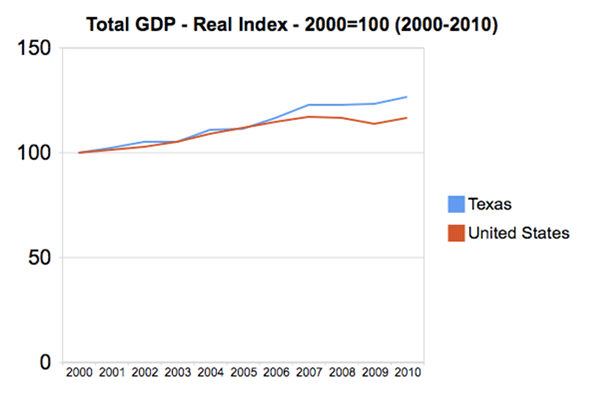


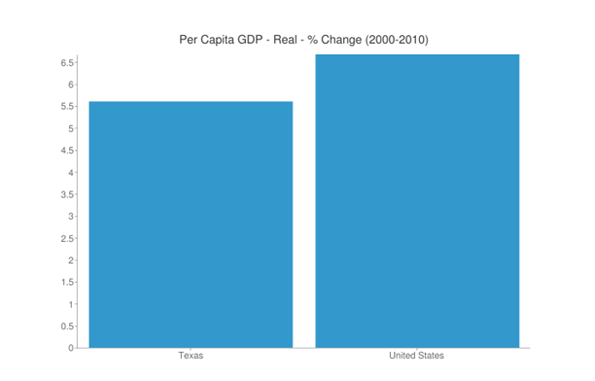
    This one, however, can mislead if looked at alone. With all that population and job growth, of course Texas’ GDP would go up. When considering the average output, GDP per job or GDP per capita is a better measure. The latter is reported by the US government, and shows that Texas actually fell short on boosting this figure. Texas GDP per capita is slightly higher than the US average, but it fell during the decade from 104.7% of the US to 103.7%.


    Personal Income

    Another way to look at this is by examining personal income. As with GDP, the total values are highly correlated with population and job growth. The per capitas tell the story. In this case we see a mirror image of GDP, with Texas somewhat trailing the average, but growing faster than the nation as a whole, improving from 94.0% of the US average to 97.3%.
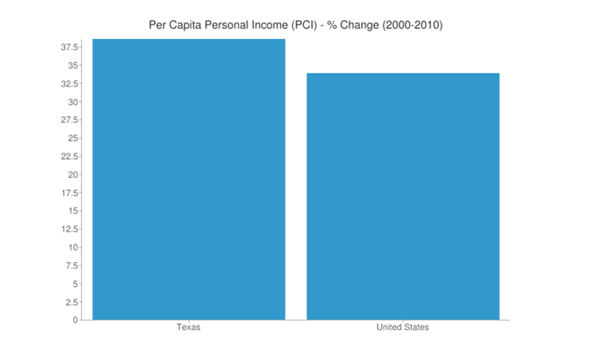


    Interestingly, the portion of personal income attributable to earnings is higher in Texas than in the US, on both a percentage and per capita basis. Texas trails the US average because it lags in investment income and transfer payments, which have nothing to do with the quality of jobs.

    Household Income

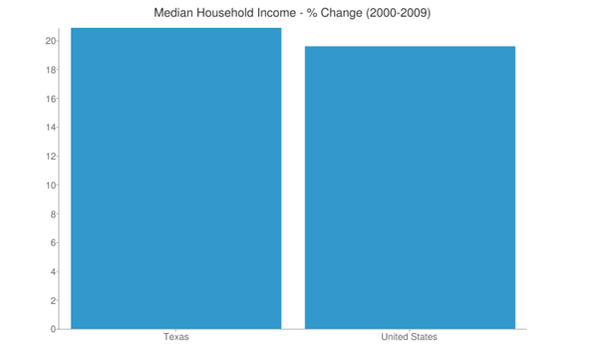
    Household income gives an almost identical tale.  Texas is below average but caught up during the 90s, going from 95.1% of the US average to 96.1%


    Wages

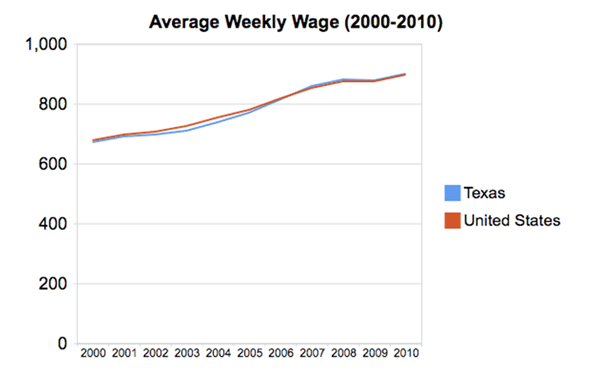
    More directly, we can look at the wages being paid in Texas, which flipped from lower to higher than the US average during the 2000s, though tracking extremely closely the entire way:


    Poverty

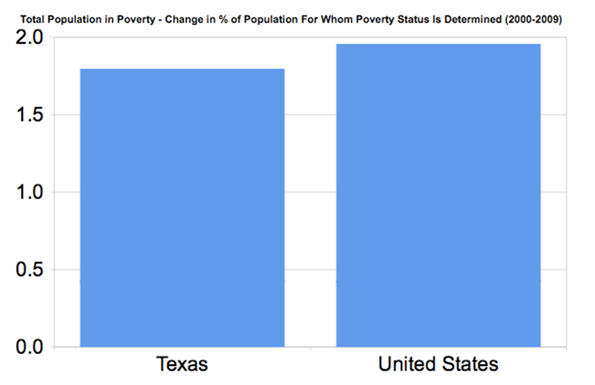
    Lastly, the poverty rate is higher in Texas than in the US as a whole – 17.2% vs. 14.3%, not a small difference. However, the gap actually narrowed between the two during the 2000s, as the chart below in the percentage point change in the poverty rate illustrates.


    Conclusion

    While every statistic isn’t a winner for Texas, most of them are, notably on the jobs front. And if nothing else, it does not appear that Texas purchased job growth at the expense of job quality, at least not at the aggregate level.  There are certainly deeper places one might drill into and find areas of concern or underperformance, but that’s true of everywhere.  And these top line statistics are commonly used to compare cities and states. Unless Texas critics are ready to retire these measures from their own arsenal, it seems clear that Texas is a winner.  The Texas story is real.

    Aaron M. Renn is an independent writer on urban affairs based in the Midwest. His writings appear at The Urbanophile, where this piece originally appeared. Telestrian was used to analyze data and to create charts for this piece.

    Photo from Governor Rick Perry’s flickr photo stream.

  • Declining Birthrates, Expanded Bureaucracy: Is U.S. Going European?

    To President Barack Obama and many other Democrats, Europe continues to exercise something of a fatal attraction.  The “European dream” embraced by these politicians — as well as by many pundits, academics and policy analysts — usually consists of an America governed by an expanded bureaucracy, connected by high-speed trains and following a tough green energy policy.

    One hopes that the current crisis gripping the E.U. will give even the most devoted Europhiles pause about the wisdom of such mimicry. Yet the deadliest European disease the U.S. must avoid is that of persistent demographic decline.

    The gravity of Europe’s demographic situation became clear at a conference I attended in Singapore last year. Dieter Salomon, the green mayor of the environmentally correct Freiburg, Germany, was speaking about the future of cities. When asked what Germany’s future would be like in 30 years, he answered, with a little smile,  ”There won’t be a future.”

    Herr Mayor was not exaggerating. For decades, Europe has experienced some of the world’s slowest population growth rates. Fertility rates have dropped well below replacement rates, and are roughly 50% lower than those in the U.S. Over time these demographic trends will have catastrophic economic consequences. By 2050, Europe, now home to 730 million people, will shrink by 75 million to 100 million and its workforce will be 25% smaller than in 2000.

    The fiscal costs of this process are already evident. Countries like Spain, Italy and Greece, which rank among the most rapidly aging populations in the world, are teetering on the verge of bankruptcy. One reason has to do with the lack enough productive workers to pay for generous pensions and other welfare-state provisions.

    Germany, the über-economy of the continent, has little hope of avoiding the demographic winter either.  By 2030 Germany will have about 53 retirees for every 100 people in its workforce; by comparison the U.S. ratio will be closer to 30. As a result, Germany will face a giant debt crisis, as social costs for the aging eat away its currently frugal and productive economy. According to the American Enterprise Institute’s Nick Eberstadt, by 2020 Germany debt service compared to GDP will rise to twice that currently suffered by Greece.

    Europe, of course, is not alone in the hyper-aging phenomena. Japan, South Korea, Taiwan and Singapore face a similar scenario of rapid aging, a declining workforce and gradual depopulation.

    In the past, it seemed likely America would be spared the worst of this mass aging. But there are worrisome signs that our demographic exceptionalism could be threatened. One cause for concern is rapid   decline in immigration, both legal and illegal.  Although few nativist firebrands have noticed, the number of unauthorized immigrants living in the U.S. has decreased by 1 million from 2007.   Legal immigration is also down.  Meanwhile, the number of Mexicans annually leaving Mexico for the U.S. declined from more than 1 million in 2006 to 404,000 in 2010 — a 60% reduction.

    More troubling still, fewer immigrants are becoming naturalized residents.   In 2008, there were over 1 million naturalizations; last year there were barely 600,000, a remarkable 40% drop.

    The drop-off includes most key sending countries, including Mexico, which accounts for 30% of all immigrants. Since 2008 naturalizations have dropped by 65% from North America, 24% from Asia and 28% for Europe.  In fact the only place from which naturalizations are on the rise appears to be Africa, with an 18% increase.

    This drop off, if continued, will have severe consequences. Since 1990 immigrants have accounted for some 45% of all our labor force growth and have increased their share from 9.3% to 15.7% of all workers. These immigrants, and their children, have been one key reason why the U.S. has avoided the deadly demography of Europe and much of east Asia.

    This decline can be traced, in part, by rapid decreases in birthrates among such traditional sources of immigrants such as China, India, Mexico and the rest of Latin America. Mexico’s birthrate, for example, has declined from 6.8 children per woman in 1970 to roughly 2 children per woman in 2011. This drop-off has reduced the number of Mexicans entering the workforce from 1 million annually in the 1990s to about 800,000 today. By 2030, that number will drop to 300,000.

    A second major cause lies with the improved economy in many developing countries like Mexico. According to economist Robert Newell, per-capita  Mexico’s GDP and family income have both climbed by more than 45% over the last 10 years  . Not only are there less children to emigrate, but there’s more opportunity for those who chose to remain.

    Asia not only has lower birthrates, and, for the most part, better performing economies. As a result, immigrants — many of them well educated and entrepreneurially oriented — who in earlier years might have felt the need to come to the U.S. now can find ample opportunities at home. Many educated immigrants and graduate  students, notably from Asia, are not staying after graduation. America’s loss is Asia’s gain.

    Finally the weak U.S. economy is also depressing birthrates to levels well below those of the last decade — birthrates that could soon reach its lowest levels in a century. Generally, people have children when they feel more confident about the future. Confidence in the American future is about as low now as any time since the 1930s.

    Other factors could further depress birthrate. High housing costs and a lack of opportunities to purchase dwellings appropriate for raising children have contributed to the growth of childless households in countries as diverse as Italy and Taiwan. Until now, American home prices — including those for single-family units — were relatively affordable outside of a few large metropolitan areas.

    But now many local and state governments — often with strong support from the Obama Administration — are implementing European-style “smart growth” ideas that would severely restrict the number of single-family houses and drive people into small apartments. For decades, areas with affordable low-density development (such as Houston, Dallas, Nashville, Raleigh and Austin) have attracted the most families. If we become a nation of apartment-dwelling renters, birthrates are likely to slide even further.

    What does this suggest for the American future? History has much to tell us about the relationship between demographics and national destiny. The declines of states — from Ancient Rome to Renaissance Italy and early modern Holland — coincided with drops in birthrates and population.

    To many in Europe our entrance to the ranks of hyper-aging countries would be a welcome development. It would also cheer many academics and greens, and likely some members of the Obama Administration, who might see fewer children as an ideal way to reduce our carbon footprint. Perhaps happiest of all: the authoritarian Mandarins in Beijing who can send their most talented sons and daughters to American graduate schools, increasingly confident they will return home to rule the world.

    This piece originally appeared at Forbes.com.

    Joel Kotkin is executive editor of NewGeography.com and is a distinguished presidential fellow in urban futures at Chapman University, and an adjunct fellow of the Legatum Institute in London. He is author of The City: A Global History. His newest book is The Next Hundred Million: America in 2050, released in February, 2010.

    Photo by flickr user Sigs24141

  • The Crisis of the “Gentry Presidency”

    The Obama administration’s belated attempt to address the looming employment crisis — after three years focused largely on reviving Wall Street, redoing health care and creating a “green” economy — reflects not only ineptitude but a deeper crisis of what is best understood as the “gentry presidency.”

    Unlike previous Democratic presidents, including John F. Kennedy and Bill Clinton, President Barack Obama’s base primarily lies not with the working and middle classes, who would have demanded effective job action, but with the rising power of the post-industrial castes, who have largely continued to flourish even through the current economic maelstrom.

    From the beginning, Obama has been nurtured and supported by an array of influential leaders in finance, technology and real estate who supported his rise. In the run-up to his nomination, he attracted more money from Wall Street than Hillary Clinton, New York’s senator. Later, he pummeled the Republican nominee, Sen. John McCain (R-Ariz.), by a wide margin among financiers.

    To be sure, Obama’s ground game relied on organized labor, particularly public-sector unions, African-Americans, Latinos and progressive activists. But these groups have not emerged stronger from his three years in office.

    Instead, the major winners of the Obama years have been the big nonprofits, venture capitalists and, most obviously, the financial aristocracy. These have all benefited from the Ben Bernanke-Timothy Geithner — previously the Bernanke-Henry Paulson — policy of cheap money and near zero-interest rates, which have depressed the savings of the middle classes but served as a major boon to Wall Street. This has benefited mostly the wealthiest 1 percent, which owns some 40 percent of equities and 60 percent of financial securities.

    This Wall Street-first approach makes Reaganite “trickle down” look like a populist torrent. Glimmers of reality are beginning to dawn on more perceptive progressive analysts, like Kevin Drum of Mother Jones, who accuses the Democrats under Obama of abandoning “the middle class in favor of the rich.” The Democrats, grouses the reliably partisan but perceptive Harold Meyerson, should be known as “Bankers R Us.”

    To be sure, some parts of the old progressive coalition, such as African-Americans, whose prospects have declined markedly under Obama, will most likely remain loyal to the president. Many other working- and middle-class voters, including Latinos and young people, groups particularly hard hit, may not be ready to bolt en masse for the GOP. But their lessened enthusiasm to participate in either the campaign or to vote could threaten the White House next year.

    These developments, as Marxists might put it, reflect the fundamental contradictions of gentry liberalism. Essentially, gentry liberalism reflects the coalescing interests among the financial, technological and academic upper strata. For these people, the Great Recession was brief and ended long ago. All depend heavily on high stock prices to maintain their wealth. Their interest in the overall U.S. economy — particularly the Main Street grass roots — has become ever more tenuous with their increasing ability to shift assets to East Asia and other developing country hot spots.

    These prerogatives have been neatly protected under Obama. In the past, administrations let corporate scofflaws, like the savings and loan companies, collapse. Some were sent to jail.

    But this time, the Wall Street elites have been allowed to skate through their own self-created crisis with astounding agility. Not only have they stayed out of the slammer, but they have been enjoying the best of times.

    This may have also been good news for Manhattan and San Francisco real estate and luxury retail — Tiffany profits were up 25 percent in the past quarter. Silicon Valley venture capitalists, in particular, have been lavished with access to cheap government loans and incentives — as demonstrated by the recent revelations about solar manufacturer Solyndra — to promote their attempted expansion into the ballyhooed “green economy.”

    The essential problem of gentryism, however, is that it fails to address the fundamental economic needs of the vast majority. It is also tied to policy prescriptions that either fail to spur broad-based growth or, in some cases, hinder it.

    For one thing, by concentrating wealth at the top, the gentry approach has depressed entrepreneurialism among the vast middle and working classes. In contrast to past “recoveries,” the rate of new start-ups has slowed considerably. The health of existing small business remains feeble, notes the National Federation of Independent Business.

    Other initiatives have slowed potential growth, particularly the threat of new draconian environmental regulations. Fossil-fuel development, for example, represents one of the best opportunities for new, high-wage employment for blue- and white-collar workers. In contrast, the massive expenditures of public money on “green jobs” has turned out to be less than effective in creating blue-collar employment.

    Equally revealing has been the pathetic performance of states that most fully embraced gentryism. California, an epicenter of the gentry economy, suffers the second-worst unemployment and lowest new business formation rates among all the states. Illinois lost more jobs in August than any other state. The bluest places — New York City and California — also tend to be the most unequal — and places where the middle class is fleeing.

    Whatever the failings of ungentrified Texas — ranging from a too-tattered social safety net and too many low-paying jobs — the rate of employment growth, including the high-tech sector, dwarfs that of key blue states, including California. Denizens of California, New York and other Obama bastions are voting for the Lone Star state with their feet.

    You don’t have to be a fan of Gov. Rick Perry to acknowledge Texas’s relative success compared with the gentry bastions.

    Overall, gentry rule has fostered a sense throughout the American public of national decline and diminishing personal expectations. Small property ownership, the key to a democratic capitalist society, is fraying. Wall Street’s Morgan Stanley, for example, having helped create the housing crisis, now talks boldly of a “rentership” society.

    This would extend the dominion of Wall Street and large landowners, like feudal lords, over the last redoubts of small property owners.

    Clearly, as even many on the left now acknowledge, we need a bold and radical break with gentry politics. Bernanke-ism is absurd — given that, under today’s conditions, a federally sponsored Wall Street boom does not assure prosperity for most. Perhaps it is time to focus instead on how to shift capital and incentives to the grass-roots economy.

    One possible reform would be a flat, or flatter, income tax that eliminates the patently unjust lower rates for capital gains and eliminates dodges for the ultra-rich, while creating greater incentives to individual grass-roots wealth creation. The Obama payroll tax cut represents a small, grudging step in this direction, but may well be too little, too late.

    Such a radical break would most likely cause mass consternation in Washington — as both parties rally to save their friends on Wall Street and a host of special tax breaks that enrich their campaign coffers. Many big money conservatives would shoot back with capitalist indignation while Democrats like Wall Street’s consigliere Sen. Chuck Schumer (D-N.Y.) would come up with more elegant reasons to protect their Wall Street backers.

    But such a suggestion from Obama might show his willingness to end a vassalage to the patrician class that is sinking both the economy and his own reelection chances.

    This piece originally appeared at Politico.

    Joel Kotkin is executive editor of NewGeography.com and is a distinguished presidential fellow in urban futures at Chapman University, and an adjunct fellow of the Legatum Institute in London. He is author of The City: A Global History. His newest book is The Next Hundred Million: America in 2050, released in February, 2010.

    Photo by flickr user Uggaboy

  • Obama’s New $50 Billion Infrastructure Stimulus — Old Wine in New Bottles

    President Obama’s new $50 billion infrastructure initiative — part of his $447 billion American Jobs Act (AJA)—offered no surprises. It’s almost an exact replica of his FY 2012 budget request which included a sum of $50 billion for transportation to “jump start” a proposed $556 billion six-year surface transportation reauthorization.

    The rhetoric may have changed — Obama avoided using the terms “stimulus” and “infrastructure” in presenting his AJA initiative to Congress—but the substance of the two initiatives is remarkably similar. Both proposals would fund an identical mix of programs (highways, transit, Amtrak, high-speed rail, aviation and the TIFIA credit program) and both would establish a National Infrastructure Bank.

    The FY 2012 transportation budget request failed to obtain congressional approval for two reasons: (1) the Administration failed to show how the proposed $50 billion program would be paid for; and (2) there was no convincing evidence that the program would promptly create new jobs. Indeed, all evidence pointed in the opposite direction. The $48 billion in Recovery Act funds for transportation had failed to create the millions of jobs promised by the Administration. The money earmarked for highways had been spent largely on short term roadway maintenance-type contracts and had produced only temporary jobs. Nor was there much to show for in terms of an improved condition or performance of the nation’s transportation system. As for the Infrastructure Bank, it is widely believed that at least one or two years could pass before the Bank would become operational and in a position to begin financing large-scale job-creating infrastructure projects.

    The same reasons that led Congress to ignore the Administration’s FY 2012 transportation budget request will likely cause the lawmakers to reject the new transportation initiative. They are skeptical that a fresh infusion of funds will succeeed where the first stimulus failed. Doing the same thing over and over again and expecting different results may not be exacly insanity but it does suggest a certain denial to look facts in the face.

    The President said that “everything in this bill will be paid for” and that he will call on the Joint Deficit Committee to come up with additional deficit reductions necessary to pay for the American Jobs Act. But by proposing to end tax breaks for people making more than $200,000 and for oil and gas companies, the White House is setting itself up again for a fight with the Congress which already once before rejected this approach to “revenue enhancement.” It remains to be seen if the independent congressional committee will do Obama’s bidding. With the President’s approval ratings at an all time low, they just might be emboldened to ignore his plea.

    Note: the NewsBriefs can also be accessed at www.infrastructureUSA.org
    A listing of all recent NewsBriefs can be found at www.innobriefs.com

  • Ground Zero Tolerance: With No Politician Willing to Take Charge, the 9/11 Recovery has Dragged on Far Too Long

    This piece originally appeared in the Village Voice.

    A decade into its unhappy and unexpectedly long life, Ground Zero has undergone its annual if short-lived transformation from New York politicos’ red-headed stepchild to belle of the ball, at least until September 12.

    Governors Cuomo and Christie, among other politicians, have been reportedly jockeying with the mayor for pride of place at the Bloomberg-run anniversary ceremony to score valuable camera time at a charged event that’s valuable to politicians precisely because of its aura of being outside of politics—much as the 40-plus TV specials, complete with “investigations” of twins lost in the twin towers and endless ads featuring terror porn of the planes striking the towers are somehow supposed to be in the “public interest.” The “sacred” site has doubled nicely as a profitable one, as detailed by Graham Rayman in last week’s Voice.

    In a sense, the politicians who will pay tribute this week are benefiting from their own neglect: Except for one week a year, New York’s elected leaders try to have as little as possible to do with Ground Zero. And that’s the main reason why 10 years later and despite a booming real estate market for most of it, there’s still a Ground Zero for them to make pilgrimage to and offer on-air genuflections. The question remains: Once the annual ritual has passed, is there a politician willing to take ownership of Ground Zero?

    In part, the problem has been Giuliani’s big shadow. “American’s Mayor,” who has profited immensely from the unlikely title in the years since, emerged as such a potent symbol in his final days in office that the area’s political leaders turned their attention elsewhere—and let a series of unelected, unresponsive, and unproductive special authorities (read: bureaucrats) take control of the site. Mayor Bloomberg turned his attention to his Far West Side Olympics dream, while a succession of weak governors in New York and New Jersey never managed to leave a mark despite their control of the Port Authority, which owns the site. Bloomberg, whose star has of late been dimmed by two strong new governors, has emerged as the closest thing to a de facto spokesman for the site, while still maintaining some distance from it.

    Absent an elected leader willing to stake his office to the site, a dangerous gamble no one has taken so far—Ground Zero has “progressed” through a series of ill-conceived “master plans”—the Freedom Tower, the Libeskind Master Plan, the insanely pricey Calatrava PATH station, the ever-more-pricey memorial that will finally open on September 11, 2011—that kept the private market from rebuilding even as demand boomed in the low-interest bubble the Fed inflated after the attack in part to dampen its economic impact. It’s no coincidence that the only completed structure at the 16-acre site is private developer Larry Silverstein’s 7 World Trade Center and that the other towers have managed to draw future tenants only through highly subsidized leases for “needy” tenants such as Goldman Sachs. The most glaring example of the absence of leadership, though, was the August 2007 Deutsche Bank fire, which killed two firefighters and seriously injured dozens more after city Housing and Fire inspectors missed glaring violations in the structure, which, at that point, had been awaiting teardown for nearly six years. (It finally took more than nine to take it down.) Neither Bloomberg nor any other politician took much heat for a needless tragedy that cost the lives of additional first responders.

    Years of public frustration with the impossibly slow pace of rebuilding finally manifested in last year’s ugly fight over the so-called “Ground Zero mosque.” Although liberal New Yorkers tried to pretend Republicans had hijacked a local issue to score cheap points nationally, polls showed New Yorkers overwhelmingly opposed the Muslim community center, which, in fact, would be located several blocks from the site. Margaret and Peter Steinfels, co-directors of the Fordham Center on Religion and Culture, recalled hearing a Catholic priest speculate that the surprising outburst of anti-Muslim sentiment, which was largely absent from the city after the attack itself, wouldn’t have happened if the site had been rebuilt. “The priest,” the Steinfelses said, “felt that this void left a lot free-floating emotion that had been displaced to opposition to the Islamic center.”

    The absence of local accountability extends to the events of 9/11, as well as the site. The brave uniformed officials who ran into the cloud as others fled now find themselves reduced to actuarial table figures. The Victims Compensation Fund Special Master Sheila L. Birnbaum, another politically insulated appointee, isn’t covering cancer-related medical costs, arguing a causal link hasn’t yet been proved.

    Chris Ward, the Port Authority executive director appointed by Governor Paterson in 2008, who has had success in pushing construction forward ahead of the anniversary, when national attention will briefly refocus on the site, albeit at a steep price tag, delivered a powerful speech last week that seemed to be a parting shot amid reports that Governor Cuomo wants to bring in his own man after the anniversary to finish the job.

    Calling the September 11, 2011, opening a moment to “begin the important process of weaving this memorial at the heart of the site into the fabric of New York City,” Ward said the PA had “stepped back from a difficult conversation about what the World Trade Center should be, and stripped the site of what I call monumentalism, and focused on construction, of what it could be.”

    If Cuomo manages, with Ward or a replacement, to finally heal the open wound that’s bedeviled the city for a decade, New Yorkers will remember. If he fiddles around as his predecessors have, we’ll remember that, too. Any change at the Port Authority needs to come with a credible plan and time frame on which to judge the results and the governor.

    It’s late, but it might not be too late.

    Contact Harry Siegel at hsiegel@villagevoice.com

    Photo courtesy of bbcworldservice

  • Obama’s Economic Trifecta: How The President Helped Kill Progressivism, Capitalism And Moderation

    President Barack Obama‘s “pivot” on jobs this week shows that the president has finally — if belatedly — acknowledged the real misery caused by the Great Recession. However, it does not shed his complicity in the ever deepening employment crisis. Unemployment remains high, exceeding 9% — 16% if you include part-time workers. The percentage of adults in the workforce is bouncing near a 30-year low. And according to a recent Gallup Poll, barely one-fourth of the American public approve of the president’s economic policies.

    Over the past three years, President Obama has done a remarkable job of undermining three very different ideals: progressivism, capitalism and moderation. Progressivism, his own brand, has taken the biggest blow, which may be why so many progressives — particularly environmentalists — have been so critical of their chosen candidate.

    Progressivism’s golden day seemed to have arrived with Obama’s election. But the progressivism embraced by the president was not the middle-class-oriented, growth-inducing kind associated with previous Democrats. Instead, Obama’s progressivism was shaped by his fellow academics, who have enjoyed unprecedented influence in this administration, as well as closely aligned classes such as affluent greens, urban land interests, venture capitalists and the mainstream media.

    Expressing the world view of the well-heeled, Obama’s progressivism did not focus on class mobility and economic growth. The old progressivism’s program was bold and opportunity-oriented: increasing energy supplies (think Tennessee Valley Authority) and encouraging industrial growth through building critical new infrastructure.

    Obama’s stimulus did not seek to increase productivity capacity or create good blue-collar jobs. It largely missed the recession’s biggest victims: minorities, the working class and the young who are well represented of the 1 in 5 Americans now not working.  The president instead chose to service the needs of organized constituencies such as public sector unions, large research universities and “green capitalists.”

    The tragedy is that Obama could have done things differently. A new variation of the Works Progress Administration, for example, would create hundreds of thousands of jobs for the currently unemployed, particularly those under the age of 25. At the same time, it would have created a legacy of tree-planting and road, port and bridge construction, which would have impressed voters of all kinds by actually producing tangible results. Think of all the bridges, public facilities and art bequeathed to us by WPA.

    Instead Obama’s regressive progressivism strangled blue-collar sectors of the economy. Many of his key policy initiatives, particularly in the health and environmental areas, scared businesses from expanding their operations.

    Sadly, the one infrastructure project embraced by the administration — high speed rail — reflected trendy urbanist theory more than common sense. At very best high-speed rail would have served, at an exorbitant cost, a small cadre of tourists and businessmen now capable of getting to the same places by car, plane or Megabus. HSR’s ever rising costs have even led some leftists, such as Mother Jones’ Kevin Drum, to denounce it as “boondoggly.” As Drum sensibly put it, “We have way better uses for the dough.”

    Similarly, Obama’s much ballyhooed “green jobs” have proved an expensive bust. Environmentalists Ted Nordhaus and Michael Shellenberger note there are fewer “green jobs” in Silicon Valley, the industry’s supposed hot bed, today than in 2003. The recent bankruptcy of California-based solar-panel maker Solyndra — recipient of a $500 million federally guaranteed loan — represents just the first of a series of government-backed failures.

    The traditional left is also increasingly persuaded that Obama’s policies have been better for the silk stocking set than the lunch pail crowd. Banks and high-end finance capital have been the biggest beneficiaries of Obama, a peculiar accomplishment for a nominally progressive administration. Wall Street’s subsidized ride to profits — courtesy of TARP and the Bernanke-Geithner fiscal policies — has helped a relative handful of investors and brokers  to enjoy record pay in 2009 and 2010.

    These failures have downgraded the chances for another big stimulus — the prescription most favored on the left — to all but impossible. But left-wing ideology hasn’t been Obama’s only victim; he has also delivered a body blow to the ethos of capitalism itself. For decades conservatives have preached that if we made capital available through a soaring stock market, business would then spend its bounty by reinvesting in the country’s productive capacity. Yet even as the market boomed over the past two years, very little has reached Main Street businesses faced with middle-income customers too skittish to buy their goods and services.

    Obama’s most recent fetish, moderation, also is proving something of a bust. Anxious not to be labeled anti-business, he has surrounded himself not with entrepreneurs but consummate crony capitalists — chief of staff Bill Daley (scion of the Chicago machine family), General Electric‘s Jeffrey Immelt and proposed Commerce Chief John Bryson, who has spent much time as a master manipulator for a large regulated utility. These figures have little or no credibility among grassroots businesspeople. They are seen as being more adept at working the system than succeeding in the free market. If this is what moderation is about, the public has good reason not to trust it.

    So having downgraded progressivism, capitalism and even moderation, Obama’s remaining hope lies in two things: the intrinsic strengths of the U.S. economy and the well-demonstrated ineptitude of his political rivals. He may have helped his cause — to the consternation of his green base — by restraining EPA emissions rules and opening some areas for oil exploration. This could help supercharge the nation’s energy industry, which has added 250,000 new, high-paying jobs since Obama’s election, mostly across the energy belt from Texas to the Dakotas.

    Unencumbered by some of the more draconian EPA rules, America’s increasingly competitive manufacturers should be able to continue boosting exports. The U.S. also retains a big edge in industries from agriculture to software. Just do less egregious harm, and perhaps the economy will come back some on its own.

    And then there’s the gift that keeps giving: the Republican Party. The GOP has no real economic strategy except to cut government and stop higher taxes. Its record on enhancing class mobility, particularly under the Bushes, is less than exemplary; wages barely moved over the George W.’s first five years in office.

    To win this year, the GOP needs to convince enough middle- and working-class voters that it offers something other than a less refined version of the same old insider game, albeit without the annoying professorial rhetoric. In this sense, the recent rush of some former pro-Obama hedge funds to the GOP may represent more of a curse than a blessing since no one, short of Mitt Romney, wants to associate themselves too much with Wall Street.

    The party base’s obsession with antediluvian social views also works to the president’s advantage,  since it distracts from a more  economic focus that would work against Obama’s reelection  . Overt religiosity and social-issue litmus tests are not the best way to win over suburban voters who turned so decisively on the Democrats in 2010.

    For three years President Obama has accomplished a hat trick of economic ineptitude that has downgraded the street cred of progressivism, capitalism and even reason. By all rights, he should be thinking about his profitable future as a post-presidential celebrity. But, for reasons having little to do with his own record, he’ll likely be entering a re-election campaign with a decent chance for another chance to screw up even worse.

    This piece originally appeared at Forbes.com.

    Joel Kotkin is executive editor of NewGeography.com and is a distinguished presidential fellow in urban futures at Chapman University, and an adjunct fellow of the Legatum Institute in London. He is author of The City: A Global History. His newest book is The Next Hundred Million: America in 2050, released in February, 2010.

    Photo courtesy of Barack Obama’s Photostream.

  • The Golden State Is Crumbling

    The recent announcement that California’s unemployment again nudged up to 12 percent—second worst in the nation behind its evil twin, Nevada—should have come as a surprise but frankly did not. From the beginning of the recession, the Golden State has been stuck bringing up a humbled nation’s rear and seems mired in that less-than-illustrious position.

    What has happened to my adopted home state of over last decade is a tragedy, both for Californians and for America. For most of the past century, California has been “golden” not only in name but in every kind of superlative—a global leader in agriculture, energy, entertainment, technology, and most important of all, human aspiration.

    In its modern origins California was paean to progress in the best sense of the word. In 1872, the second president of the University of California, Daniel Coit Gilman, said science was “the mother of California.” Today, California may worship at the altar of science, but increasingly in the most regressive, hysterical, and reactionary way.

    California’s dominant ruling class—consisting of public-employee unions, green jihadis, and Democratic machine politicians—has no real use for science as Gilman saw it: as a way to create prosperity for its citizens. Instead, the prevailing credo of the state has been how to do everything possible to return to its pre-settlement condition, with little regard for what that means to the average Californian.

    Nowhere was California’s old technological ethos more pronounced than in agriculture, where great Californians such as William Mulholland, creator of the Los Angeles Aqueduct, and Pat Brown, who forged the state water project, created the greatest water-delivery system since the Roman Empire. Their effort brought water from the ice-bound Sierra Nevada mountains down to the state’s dry but fertile valleys and to the great desert metropolis of Southern California. Now, largely at the behest of greens, California agriculture is being systematically cut down by regulation. In an attempt to protect a small fish called the Delta smelt, upward of 200,000 acres of prime farmland have been idled, according to the state’s Department of Conservation. Even in the current “wet” cycle, California’s agricultural industry, which exports roughly $14 billion annually, is slowly being decimated. Unemployment in some Central Valley towns tops 30 percent, and in cases even 40 percent.

    And now, notes my friend, Salinas Mayor Dennis Donohue, green regulators are imposing new groundwater regulations that may force the shutdown of production even in areas like his that have their own ample water supplies.

    Salinas was the home town of John Steinbeck, author of The Grapes of Wrath and great chronicler of Depression-era California. Today for many in hardscrabble, majority-Latino Salinas, home to 150,000 people, The Grapes of Wrath is less lyrical than real. “California,” notes Donohue, a lifelong Democrat, “remains intent on job destruction and continued hyper-regulation.”

    California’s pain is not restricted to farming towns. The state’s regulatory vigilantes have erected a labyrinth of rules that increasingly makes doing almost anything that might contribute to increased carbon emissions—manufacturing, conventional energy, home construction—extraordinarily onerous. Not surprisingly, the state has not gained middle-skilled jobs (those requiring two years of college or more) for a decade, while the nation boosted them by 5 percent and archrival Texas by a stunning 16 percent over the same time period.

    There is little chance that the jobs lost in these fields will ever be recovered under the current regime. As decent blue-collar and midlevel jobs disappear, California has gone from a rate of inequality about the national average in 1970, to among the most unequal in terms of income. The supposed solution to this—Gov. Jerry Brown’s promise of 500,000 “green jobs”—is being shown for what it really is, the kind of fantasy you tell young children so they will go to sleep.

    Many Californians who aren’t slumbering are moving out of the state—and not only the pathetic remains of the old Reaganite majority. According to the most recent census, those leaving the state include old boomers, middle-aged families, and increasingly, many Latinos as well. Outmigration rates from places like Los Angeles and the Bay Area now rival those of such cities as Detroit. In the last decade, California’s population grew only 10 percent, about the national average, largely due to immigrants and their offspring. Population increases in the Bay Area were less than half that rate, while the City of Los Angeles gained fewer new residents—less than 100,000—than in any decade since the turn of the last century!

    Increasingly, California no longer beckons ambitious newcomers, except for a handful of the most affluent, best educated, and well connected. Through the 1980s and even through the late ’90s, the aspirational classes came to California. Now they head to other, more opportunity-friendly places like Austin, Houston, Dallas, Raleigh-Durham, even former “dust bowl” burghs like Des Moines, Omaha, and Oklahoma City. Meanwhile, Golden California, particularly its expensive, ultragreen coast, gets older and older. Marin County, the onetime home of the Grateful Dead and countless former hippies, is now one of the grayest urban counties in the country, with a median age of 44.

    Of course, the self-described “progressive” mafia that runs California will point to Silicon Valley and its impressive array of startups. But for the most part, firms like Google, Twitter, and Facebook employ only a small cadre of highly educated workers. Overall, during the past decade the state’s high-tech employment fell by almost 4 percent, while Texas’s science-based employment grew by a healthy 11 percent. The sad reality is that turning T-shirt-wearing kids like Mark Zuckerberg into multibillionaires doesn’t do much to reduce unemployment, which even in San Jose—the largely blue-collar “capital” of Silicon Valley—now hovers around 10 percent.

    Magazine cover stories and movies cannot obscure the fact that entrepreneurial growth—the state’s most critical economic asset—has now stalled. In fact, according to a study by Economic Modeling Specialists Inc., last year the Golden State ranked 50th among the states in creating new businesses.

    California remains rich in promise, home to spectacular scenery; a great Pacific location; leading firms like Apple and Disney; and a still-impressive residue of talented, diverse, entrepreneurial, and ingenious people. But the state will never return until the success of the current crop of puerile billionaires can be extended to enrich the wider citizenry. Until the current regime is toppled, California’s decline—in moral as well as economic terms—will continue, to the consternation of those of us who embraced it as our home for so many years.

    This piece originally appeared at The Daily Beast.

    Joel Kotkin is executive editor of NewGeography.com and is a distinguished presidential fellow in urban futures at Chapman University, and an adjunct fellow of the Legatum Institute in London. He is author of The City: A Global History. His newest book is The Next Hundred Million: America in 2050, released in February, 2010.

    Photo by wstera2.

  • Whatever Happened to ‘The Vision Thing’? Part II

    More than two years ago (March 2009, to be precise), New Geography published an article I wrote, entitled Whatever Happened to ‘The Vision Thing’?. It began:

    When I was in elementary school, I remember reading about the remarkable transformations that the future would bring: Flying cars, manned colonies on the moon, humanoid robotic servants. Almost half a century later, none of these promises of the future – and many, many more – have come to pass. Yet, in many respects, these visions from the future served their purpose in allowing us to imagine a world far more wondrous than the one we were in at the time, to aspire to something greater.

    I am reminded of these early childhood memories not because I lament the loss of my flying car (although it would come in handy every now-and-again in fighting the Washington, D.C. rush hour gridlock) but because, with all of the rhetoric about change and hope, the Obama Administration has failed to articulate a strong, singular vision for what the future of America and the world can and should be. While some would argue that now is not the time for grand visions for the future but, rather, for hunkering down and muddling through these desperate economic travails, the fact of the matter is that at least part of the cause of continuing economic decline in this country, and in many other developed nations as well, is a lack of confidence in the future.

    I am now deeply troubled, as I always am when I have had such an epiphany, to report that clearly no one listened to me. As of August 2011, fourteen months away from what promises to be perhaps the most polarizing Presidential election in our Nation’s history, we are farther away than we have ever been from having a shared national vision for the future of our country.

    The current crises impacting the United States — record-high, persistent unemployment; a potentially ruinous national debt as a percentage of our Gross Domestic Product; extreme volatility in the equity markets; a growing gulf between the “haves” and the “have-nots”; etc.; etc; etc.— are as much reflective of a crisis of confidence as they are of structural problems with our economy. And the increasingly toxic discourse between opposing factions within Congress, fueled by pundits and talking heads on cable news programs, talk radio, and the blogosphere, is in part a reflection of the axiom that nature abhors a vacuum. However, everyone is talking about treating the symptomology rather than making the patient better. No one wants to acknowledge the elephant in the room: That we are wandering aimlessly through an increasingly competitive world economy.

    So, what do we want to be when we grow up, America? We are, hopefully, coming out of the downside of an unsustainable economic model, premised on unrelenting, annual growth in the value of all asset classes, which fueled unfettered consumer behavior (“consumer confidence on steroids,” one could argue), and the misguided belief that we are and will always be the greatest nation on earth no matter what. Consequently, we need to decide what kind of America we envision for our future.

    We used to be builders of things, and did that better than any other industrialized democracy. Now we have to compete with the manufacturing juggernaut that is China, unfettered by our democratic and human rights principles and the inherent limitations of a free, capitalistic society. We want to maintain what is still (at least arguably) the highest standard of living in the world, but we don’t want to pay for it through the price of goods produced on our own shores. We are clinging for dear life to the outdated notion that we can enjoy inexpensive goods made by people who live on one-tenth or less what the average American earns, and still continue to have job and income growth. So we need to make the transition from being the largest consumer of goods in the world to once again being a country that does things; big things. The question is: What things? I guess if I could answer that question, I’d appear in an incredibly unflattering picture on the cover of Time magazine right now. But I can at least pose it.

    The political arguments that were brought into sharp focus in the debates over the federal budget and raising the debt ceiling might have perhaps brought more light than heat to bear on our economic problems had they been conducted within the framework of how our future as a nation should be shaped. The appropriate size of the federal government, for example, can only be reasonably determined once we’ve agreed as a nation about what role we want government to play in shaping our future.

    Runaway capitalism — which conferred benefits very selectively, albeit very handsomely, on a small percentage of our population—has proven to be both a very destructive force (e.g. the mortgage meltdown; the Deepwater Horizon environmental disaster; etc.), as well as one that requires governmental intervention when it goes awry (e.g. the TARP program; the Federal Reserve Bank’s interventions in the marketplace; various federal foreclosure prevention programs; the takeover of Fannie Mae and Freddie Mac; etc.; etc.; etc. ad nauseum). Absent such a framework for the future, the national debate has been the victim of an increasingly acute form of intellectual paralysis: The short-term mindsets of our elected officials and the voters — tied to the two-year election cycle — force debate on inherently inadequate, short-term solutions to substantial, long-term problems. Because we have no shared vision of the country’s future, against which short-term solutions might be measured, there are no metrics for productive discourse. Hence, our so-called “leaders” argue in reliance on their “principles,” rather than with a broader view toward implementing the future we want to see.

    Things will only continue to grow worse, and much more polarized (although that’s truly frightening to imagine), unless and until we agree, as a nation, that there are some fundamental issues about our future that need to be addressed… and resolved. Creating jobs in a vacuum is a fool’s errand; so is cutting spending on existing programs when we should be deciding what kind of programs we want and need. The appropriate size of the federal government, how much money needs to be raised in terms of revenue (and from whom), and how those revenues should be efficiently spent, can only be determined with certitude in the context of where we want to go — and how we want to grow — from here.

    I no longer harbor any quixotic notions, as I did two-and-a-half years ago, about the President stepping forward to articulate a bold vision for America’s future: But somebody sure needs to … and soon.

    Photo by Severin St. Martin(Sev!): “Kes has a Vision”; North Shore, Lake Superior

    Peter Smirniotopoulos is a national expert in urban redevelopment, housing policy, and project and public finance. He is the founder and principal of petersgroup consulting, a real estate development and finance consulting practice based in the Washington, D.C. area, which serves the public, private, and non-profit sectors throughout the U.S. He is a former Faculty Member in the Masters of Science in Real Estate program at Johns Hopkins University.

  • Millennials Have the Answer to the Country’s Fear, Uncertainty and Doubt

    America is about to enter a presidential campaign that promises to be filled with divisive rhetoric and sharp differences over which direction the nominees want to take the country. This will be the fourth time in American history that the country has been sharply divided over the question of what the size and scope of government should be. Each time the issue was propelled by vast differences in beliefs between generations that caused the country to experience long periods of Fear, Uncertainty and Doubt (FUD), before ultimately resolving the issue in accord with the ideas and beliefs of a new generation.

    Every eighty years America engages in this rancorous, sometimes violent, debate about our civic ethos. The first occurred during and after the Revolutionary War and resulted in the most fundamental documents of our democracy: the Declaration of Independence, the Constitution, and the Bill of Rights.

    The second took place during the Civil War. The 13th, 14th, and 15th Amendments codified the outcome of that debate — this time in favor of the federal government asserting its power over state laws when it came to fundamental questions of personal liberty and civil rights.  It took the Civil War and a massive increase in Washington’s power to accomplish the end of slavery, although it would be another century until the rights of freedom and equality were fully extended to African-Americans. 

    And in the 1930s, the economic deprivations experienced by most Americans from the excesses of the Industrial Revolution, and the collapse of corporate capitalism, led to support for a “New Deal” for the forgotten man that placed the responsibility for economic growth and opportunity squarely on the federal government. The government demanded by the GI Generation (born 1901-1924) greatly surpassed the conventional views of earlier generations.

    In each case, the resolution of these debates depended on the emergence of a rising, young civic-oriented generation that thought the nation’s dominant political belief system   should contain a strong role for government, overturning the more conservative and limited-government views of the older generations then in power.

    Now, as previously, the highly charged ideological arguments on both sides of the issue generate great agitation and anger among older generations, especially Baby Boomers, who have driven our political life towards ever wider polarization. As a result, the resolution of today’s debate over the nation’s civic ethos is not likely to come from older Americans who seem incapable of and unwilling to compromise their deeply held values and beliefs.

    This time around, the largest generation in American history, Millennials, (born 1982- 2003), that  will comprise more than one in three adult Americans by the end of this decade, are destined to play a decisive role in finding a consensus answer to this critical question.   If the United States is to emerge from this most recent period of FUD, it will have to look to the newest civic-oriented generation, Millennials, for both the behavior and the ideas that will bridge the current ideological divide and spur the country into making the changes necessary to succeed in the future.

    Millennials believe that collective action, most often at the local level, is the best way to solve national problems. Using social media, Millennials are organizing groups like the Roosevelt Institute’s Campus Network, to present a very different vision of America’s future. In this Millennialist future, the idea of top down solutions developed by experts in closed discussions will give way to bottom up, action-oriented movements. This will topple institutions as dramatically as Napster upended the recording industry, or the Arab Spring changed the Middle East.  Just as their parents set the rules within which Millennials were free to exercise their creative energies when they were growing up, the new generation will continue to look to the federal government to set national goals or guidelines, as has long been the view of Boomer progressives.   However, the way in which these guidelines are implemented will not be determined in remote and opaque bureaucracies, but by individuals in local communities across the country. In this way, Millennials will embrace progressive values, but with approaches that may be welcomed by many conservatives.

    In the midst of the country’s current period of FUD, it is easy to despair that the nation will be unable to resolve its divisions and come to consensus about a new civic ethos. But throughout its history, when America has been equally fearful of the future, a new civic generation has risen to foster the necessary transition. In the end, this emerging generation served both itself and the country well. Now it is the Millennial Generation’s turn to serve the nation and move America to a less fearful and less divided future.  

    Morley Winograd and Michael D. Hais are fellows of NDN and the New Policy Institute and co-authors of the newly published Millennial Momentum: How a New Generation Is Remaking America and Millennial Makeover: MySpace, YouTube, and the Future of American Politics.

    Photo by kevindooley.

  • Infrastructure Bank: Losing Favor with the White House?

    Eighteen months ago, on January 20, 2010, a group of influential politicians, accompanied by a large coterie of representatives of the Washington transportation community, gathered at the Capitol to urge Congress and the Obama Administration to create a “National Infrastructure Bank” to help finance infrastructure investments. The speakers included all the well-known advocates of the Bank: Pennsylvania’s Governor Ed Rendell, Senator Chris Dodd (D-CT), Rep. Rosa DeLauro (D-CT), author of an Infrastructure Bank bill (H.R. 2521), former House Majority Leader Dick Gephardt (D-MO) and Felix Rohatyn, the spiritual godfather of the movement. Standing beside them, in a gesture of support and solidarity, was a large group of executives representing the transportation industry, labor unions and advocacy groups.

    For a while, it seemed like their plea would be answered. A proposal for a $30 billion infrastructure bank focused on transportation-related investments was included in the President’s FY 2011 budget proposal unveiled last September. As recently as last month, Mr. Obama was mentioning the Infrastructure Bank as part of his job stimulus plan to be unveiled after Labor Day.

    But today, the idea is on life support. Neither the Senate nor the House have seen fit to include the Bank in their proposed transportation bills. Congressional Democrats and Republicans alike are in agreement that decisionmaking control over major federal investments should not be ceded to a group of “unelected bureaucrats.” Rather than creating a new federal bureaucracy, they think the focus should be placed on expanding federal credit assistance tools already in place, such as the Transportation Infrastructure Finance and Innovation Act (TIFIA) and the Railroad Rehabilitation & Improvement Financing Program (RRIF).

    There are other reasons for congressional skepticism. House Republicans are suspicious that the Obama-proposed Bank is nothing more than a vehicle for more stimulus spending, disguised as “capital investment.” They want the Administration to be more specific about its proposal: how the Bank would be funded, what kind of investments it would fund and how the $30 billion capital would be repaid. “If this is more of the same stimulus spending, we won’t support it,” Kevin Smith, spokesman for House Speaker John Boehner (R-OH) has been quoted as saying.

    House Transportation and Infrastructure Committee chairman John Mica (R-FL) thinks state-level infrastructure banks would be a more appropriate means of financing major transportation projects at the state and local level. Decentralized infrastructure financing would “keep the federal financing bureaucracy at a minimum and maximize states’ financial capabilities,” according to the House transportation reauthorization proposal.

    Senate Democrats, while not necessarily opposed to another fiscal stimulus, want quick results. They fear that a centralized Infrastructure Bank, with its complex governance structure and layers of bureaucratic conditions, requirements and approvals would be far too slow and cumbersome to be an effective job generator. One or two years could pass before large-scale projects appropriate for Bank financing would get evaluated, selected, approved and under construction, one Senate aide told us.

    What is more, there is a lack of agreement on how the proposed Infrastructure Bank should function. The Administration wants a mechanism that would serve several different purposes. In the words of Undersecretary for Transportation Policy Roy Kienitz who testified at a September 21, 2010 hearing of the Senate Banking Committee, “We need a financing institution that can provide a range of financing options— grants for projects that by their nature cannot generate revenue, and loans and loan guarantees for projects that can pay for their construction costs out of a revenue stream. In short, we need the Infrastructure Bank that the President has proposed.”

    But, “banks don’t give out grants, they give out loans. There is already a mechanism for giving out federal transportation grants — it’s called the highway bill,” countered Sen. James Inhofe (R-OK), ranking member of the Senate Environment and Public Works (EPW) Committee.

    If the proposed entity is to be a true bank – as proposed in a recent bill sponsored by Senators John Kerry (D-MA) and Kay Bailey Hutchison (R-TX) and endorsed by the AFL-CIO and the U.S. Chamber of Commerce– its scope would be confined to projects that can repay interest and principal on their loans with a dedicated stream of revenue — in other words, the Bank could finance only income-generating facilities such as toll roads and bridges. By all estimates, such projects will constitute only a small fraction of the overall inventory of transportation improvements needed to be financed in the years ahead, the bulk of which will be reconstruction of existing toll-free Interstate highways. Hence, a true Infrastructure Bank would be of limited help in creating jobs and reviving the economy, critics argue.

    “A national infrastructure bank must garner broad bipartisan support to move forward,” says Michael Likosky, Director of NYU’s Center on Law & Public Finance and author of a recent book, Obama’s Bank:Financing a Durable New Deal. “This means no grants, a multi-sector reach and a realistic idea of what projects will benefit straight away.”

    President Obama was expected to include the infrastructure bank among his recommended stimulus measures when he lays out his new job-creation plan before the congressional deficit reduction committee in early September. But lately, he seems to have put the idea on the back burner and turned his attention to more traditional “shovel-ready” highway investments using existing financing programs. His advisers may have concluded that the Bank will do little to stimulate immediate job creation— and that the proposal will find little support among congressional Democrats and Republicans alike. If so, check off the Infrastructure Bank as an idea whose time had come and gone.

    ~~~~~~~~~~~~~~~~~~~~

    Note: the NewsBriefs can also be accessed at www.infrastructureUSA.org

    A listing of all recent NewsBriefs can be found at www.innobriefs.com