Category: Politics

  • How to Save Chicago

    The title raises the obvious question: Does Chicago need saving?

    I guess the answer is clear. Aaron Renn published a reviewofthe 2010 census, and for Chicago it was not pretty. Since 2000 the city lost over 200,000 people: nearly 7.5% of its Black residents, and almost 6% on non-Hispanic Whites. Only the Hispanic population grew, but at an anemic 3.4%. Even the metro area writ large isn’t doing all that well, growing by only 3.9% (against the nation’s 10%).

    Los Angeles, described as “a city in secular decline" appealed to the schadenfreude in my heart. As a Chicago booster, the decline of an arch-rival is emotionally (if irrationally) satisfying. But sadly, many of LA’s problems are Chicago’s issues as well: a decline of the central business district, an exodus of major businesses, the disproportionate influence of real estate on local politics, and ethnic politics. Add to that a still vibrant Outfit (mob), a lousy climate, and apart from Lake Michigan, little in the way of natural distinction, and you don’t have a pretty picture.

    Even some gentrification seems to be wearing thin. Walking along Clark St. there are plenty of empty store fronts. It’s beginning to look a little dreary (though still far from a slum).

    That all sounds pretty desperate. But there is some good news as well.

    • My wife and I inadvertently got off the Skyway one exit too soon and wound up driving down 87th St. to Stony Island. This is a thriving, middle-class Black neighborhood. Every storefront was occupied, and there was no graffiti! (Unlike graffiti-scarred Rome, which we also recently visited.)
    • Public transport is alive and well in Chicago. Trains and buses are clean, graffiti-free, and the passengers are civilized.
    • There is lots of affordable housing. Plenty of “luxury apartments” are for rent along Clark St. One can buy a perfectly nice condo for $100K or less. Many neighborhoods have been redeveloped and are really nice; Logan Square is a good example. This is the good side of the real estate bust, and gives the city a huge advantage over, say, New York or San Francisco.
    • Lakeshore Drive, Michigan Avenue, Wacker Drive, and even State Street are as fabulous as ever, especially in nice weather.

    So there is hope, but the patient is sick, and if things don’t change then Chicago could go the way of St. Louis or Detroit.

    So how can Chicago be saved? Here is my advice to Rahm Emanuel, the new Mayor.

    • Forget about the old business model – the world has changed. The days of small-time manufacturing or major banking centers are over. The notion that The Loop is going to be the home of large corporations is past. So concentrate on the new world: what can Chicago do well? I count three things: Residential, Retail, and Tourism. And Chicago has (quite inadvertently) done the residential part right. It’s the other stuff that needs attention.
    • Remember why Sears Roebuck started in Chicago: it was the center of the country. The Windy City is still is the center of the country. It should have the World’s Busiest Airport. It still is the railroad capital of America. It could be the retail capital of America. Chicago – The Loop, Michigan Avenue, Woodfield Mall, all of it – can be where America comes to shop. If relative pipsqueak Minneapolis can make a success of the Mall of America, just think what Chicago can do.
    • So – first step – lower sales taxes! We paid over 10% tax at a restaurant on Rush St. That’s crazy! Reduce sales taxes to 4% (or eliminate them entirely). Perhaps this will mean a decline in government revenue, but so what? It will create thousands of jobs and billions in business. (If politicians were really interested in their constituents rather than their own perks, this would be a no-brainer.)
    • Maintain the neighborhoods. I know the stockyards are long gone, but where is that really good steakhouse in Bridgeport? Likewise, I’m happy to drive to 87th and Stony Island for dinner and good music, but you need to ensure my safety. The city doesn’t need more real estate – it needs more cops, public transit, art, advertising, and street lights.
    • Free parking on Sundays. I know the city has taken a lot of flak for parking, but in principle it works. I parked within a couple of blocks of a fancy restaurant on Rush St. on a Friday night ($6). I parked within a block of Clark & Diversey so my wife could go shopping ($2). Before the new meters I would have had to drive around for an hour to find a place to park, and then it’d be many blocks away. Now it’s easy, and (compared to wasting time and gas) not expensive.

    But free parking on Sundays would bring them in from the suburbs in droves! New York does that, and that’s the only day we drive down to the City. Cut folks a break – it’s good business.

    • Improve public transit. That doesn’t mean new trains, but it does mean more safety. Let me take the train to Chinatown at night and have it be an enjoyable experience. Where is the convenient bus to Hyde Park? Why can’t I buy a tourist day-pass or a weekend pass for the CTA at my local station? And why do the ticket vending machines not accept credit cards? Oh, and if you do have an extra train or two, why not run A and B express trains on the Red Line? They did that 25 years ago.
    • Keep the cows. I don’t mean the stockyards, I mean the art. Of course the actual street-corner cows are passe, but Marilyn Monroe isn’t – she works. Use your architecture, your waterfront, your grand vistas. Use your imagination.

    Here is the key:  for Mayor Emanuel and for all politicians. The citizens have to earn money before you can tax it. Exorbitant sales taxes just spoil it for everybody. Yes, I know you need to spend money on schools and welfare and public-employee pensions. But you can’t do that if the money isn’t there in the first place.

    So get Chicago open for business. Lower sales taxes. Ensure public safety downtown and in the neighborhoods. Invest a little in mass transit. Give up just a bit of the parking revenue. Chicago is a great tourist and shopping destination, better than Rome in every way except ruins. Allow your citizens to cash in before Chicago itself becomes a ruin.

    Daniel Jelski is Dean of Science & Engineering State University of New York at New Paltz.

    Photo by smik67.

  • Iowa Getting Off Bus Speed Rail?

    Iowa Governor Terry Branstad has refused to pay $15,000 in annual dues to the Midwest High-Speed Rail Association. This comes after the state legislature declined to fund intercity rail programs in the 2012 budget. Various public agencies had offered to pay the $15,000 on behalf of the state, however Branstad declined the money, with a spokesperson saying that the Legislature had "made their will crystal-clear" about funding membership in the organization.

    The Midwest High-Speed Rail Association has been promoting an intercity rail system that would serve Chicago from other major metropolitan areas, operating at substantially below international high-speed rail standards. In the case of the Iowa route, travel to Chicago would be slower than the present bus service, which does not require public subsidy and which provides free high-speed Internet. This issue is described in greater detail in an earlier article.

    The proposed national high-speed rail system has run into considerable difficulty at the state level. In addition to the reluctance of Iowa to participate, the states of Florida, Wisconsin and Ohio have refused federal funding. In the case of Florida, the genuine high-speed rail system was canceled by Governor Scott out of fear that the cost overruns, which have occurred in 90 percent of cases, would be the responsibility of state taxpayers. The California system could be nearly $60 billion short of its funding requirements for the first phase and is running into serious difficulties from citizens along the route. The Missouri legislature declined to include funding for part of the Midwest system earlier this year. Finally, the North Carolina legislature has placed requirements for its own review of any future federal grants for high-speed rail.

  • What Does Rick Perry Have To Do With Texas’ Success?

    You don’t have to like Rick Perry or his sometimes scary neo-confederate politics to admire what has been happening in Texas over the past decade. Rather than trashing the state in order to demean its governor, perhaps the mainstream media should be thinking about what the Lone Star’s success story means for the rest of the country.

    Texas has done what most of other states — notably the blue coastal ones — have failed to do: create jobs. Over the past decade Texas has created 2.1 million jobs — while New York, California, Massachusetts and Illinois have all lost jobs.

    Its relative performance since 2009 has been even more stellar, producing nearly 40% of all new jobs in the U.S. Its unemployment rate stands at 8.2, well below the national average of 9.1 — an outstanding feat given the fact that the state grew 20%, twice the national average, over the decade. Texas is creating jobs for a growing workforce, while other states like New York or Massachusetts struggle to keep up with stagnant or even declining ones.

    Some self-proclaimed progressives like Paul Krugman attribute Texas’ success to population growth and the attraction of low-wage jobs for rapacious employers.

    “It is interesting how, suddenly, not having a job is better than working at a low-paying one,” notes architect and developer Tim Cisneros. True, many of the new jobs in Texas, as elsewhere, pay low wages and do not offer health benefits. But, says Cisneros, insisting that all the new jobs in Texas are low-paying is just not credible. “When you see the new hospitals and the new headquarters being built by Exxon here in Houston you can see there are lots of different opportunities,” Cisneros says.

    As Cisneros points out, people are not flocking to Texas for the privilege of being exploited any more than they come for the 100 degree summer heat. Many — and not only low-skilled campesinos — come for opportunities, including well-paying ones, that are not as readily available elsewhere.

    According to research conducted by the Praxis Strategy group, Texas has boosted mid-skill jobs — those that require two years or more of post-secondary education — by 16% in the past decade, That’s the third-highest rate in the nation (after much smaller Wyoming and Utah) and three times the national average. In contrast, New York has grown such positions by less than 5%, while California and Massachusetts have expanded them by less than 2%. Illinois, President Barack Obama’s home turf, was among the few states to actually lose mid-skill jobs.

    This pattern also applies to the high-tech and science-based industries. Over the past decade Texas’ number of STEM (science, technology, engineering and math-related) jobs has surged by 11%, one of the fastest rates among the states and four times the national average. California, Massachusetts and Illinois all lost positions in these fields.

    Another reason people go to Texas is their wages get them more there than in the big blue metros. For example, houses in Dallas, Austin or Houston cost three times the median income in these areas — or less. That ratio is twice as high, or higher, in places like New York, San Francisco or Los Angeles.

    These factors — job growth and lower costs — may not matter much to “trustifarians” or tenured professors who increasingly dominate the politics of the American left. But they have made Texas cities irresistible for almost every demographic in America, from boomers to the “young and restless” to families. For good measure, the state’s high-tech mecca, Austin, ranked third in attracting college-educated residents — well ahead hip centers like San Francisco, Boston, New York or Los Angeles.

    To be sure, Texas has benefited from higher energy prices, as Perry’s detractors point out.  According to an analysis by the EMSI economic forecasting group, the energy sector jumped from over 230,000 jobs in 2001 to just under 490,000 in 2011. That’s roughly 10% of all the state’s overall job gains. This parallels job growth in other states that have experienced surges in energy-related employment — such as North Dakota and Wyoming.

    But some of this has to do with making your own “luck.” Energy-rich California has all but declared war on its fossil fuel industry, once one of the nation’s most important. Instead, the state has placed lavish bets on renewable fuel and the much ballyhooed notion that “green jobs” could provide a massive base for new employment — something even the green-friendly New York Times has called “a pipe dream.”  In fact, employment in this field has actually started to tick down, and the prospect of ever higher energy prices associated with “clean” fuels could prove another nail in California’s economic coffin.

    So how much of Texas’ relative success is due to Perry and his fiscal policies? Some — but not too much. Perry has faced budget shortfalls based in part on an expanding state government that has grown through the recession: Texas, notes EMSI’s Joshua Wright, is one of only 10 states where state and local government jobs have grown since 2009, rising by almost 30,000 positions. “These numbers don’t exactly bolster Perry’s small-government agenda claims,”says Wright. Free-marketers also point out that Perry clearly favored, sometimes with state funds, people who had the foresight to back his political career.

    But Perry has won business support for things other than naked cronyism. Jim DeCosmo, CEO of the Austin-based Forestar Group, credits Perry with maintaining a business-friendly regulatory regime and with important steps for tort reform. These, he feels, both encourage Texas businesses to expand in the state and for out-of-state companies to move in.

    Most of the credit for Texas’ success lies primarily in the state’s economic culture. Rice University urban scholar Michael Emerson notes that Texas’ pro-business tilt started well before Perry, and is not restricted to the GOP. Many of the state’s most prominent Democrats — including the man Perry beat for governor last year, former Houston Mayor  Bill White — have been strong advocates of economic growth and across-the-board energy development.

    “I do not feel Perry has   much to do with Texas’ success,” says Houston real estate mogul David Wolff , who last year backed both a GOP challenger to Perry and, later, White. “But at least you can say that he has not appeared to hinder it.”

    In fact, Texas’ current and, more so, future prosperity might be better served  if a pragmatist like White ruled the Lone Star State. Perry’s ideological rigidity on spending and social issues may not be the best fit for a state facing massive ethnic change, including a future Latino majority. And as the state becomes more high-tech oriented, education of its surging workforce will grow as a concern, something that Perry does not seem to see as a priority.

    Yet despite the state’s shortcomings — and those of its current governor –  Texas’ success remains remarkable, particularly in comparison with that of the other major states. Rigid adherence to low taxes and light regulation may  not be the panacea for all economic problems but the opposite approach of ever higher taxes and debilitating regulation clearly has failed in terms of creating jobs and opportunities.

    Rather than demean the Lone Star state, perhaps progressives should begin demonstrating an alternative approach for American prosperity that might actually work someplace other than in the fevered imaginations of academics and pundits.

    This piece originally appeared at Forbes.com.

    Joel Kotkin is executive editor of NewGeography.com and is a distinguished presidential fellow in urban futures at Chapman University, and an adjunct fellow of the Legatum Institute in London. He is author of The City: A Global History. His newest book is The Next Hundred Million: America in 2050, released in February, 2010.

    Photo by Gage Skidmore.

  • Sizing Up Texas’ Job Growth Under Rick Perry

    Now that Texas Gov. Rick Perry is officially in the running for the Republican presidential nomination, journalists and econ bloggers from almost every national news outlet have examined the Texas’ economy in excruciating detail. The fact that Texas has produced nearly 40% of all new jobs in the US since 2009 has been regurgitated over and over again, and the state’s remarkable population spike has repeatedly been cited as a reason for the big employment growth.

    But more than those shared story lines, writers have offered another strikingly similar theme in their Texas critiques: many have pointed to the wave of oil and gas jobs as the key driver of the state’s economic boom.

    To be sure, energy employment is part of Texas’ growth, as EMSI highlighted in June. But it’s far from the biggest part. CNNMoney did a nice job laying out the super-sectors that have done well in the Lone Star State, and we’re going to drill down even further using EMSI’s detailed data to see which specific industries are fueling the state’s growth.

    How Texas Stacks Up

    It’s true that Texas has accounted for a large share of new jobs in the US, and that’s not just the case since 2009. Going back to 2001, Texas has added more than 2.1 million jobs, according to EMSI’s latest complete dataset, while the rest of the nation has combined for 6.2 million new jobs.

    But Texas is a massive state, of course, with a population of more than 24 million. So to even the playing field, let’s look at percentage job growth.

    As it turns out, there are only four states that have grown from 2001 to 2011 and from 2009 to 2011.

    Like Texas, Wyoming and Utah have also had 18% growth since 2001, but no state has performed better since 2009 than North Dakota. Its employment base has grown 5% in the last two years, compared to 2% for Texas. But because North Dakota has a much smaller population — and workforce — than Texas, its growth typically doesn’t get mentioned in discussions like these.

    Energy is a Big Player — But Not the Biggest One

    Oil and gas extraction employment in Texas has more than doubled in the last 10 years, and support industries for drilling have also boomed. Altogether, the mining, quarrying, and oil and gas extraction sector has jumped from over 230,000 jobs in 2001 to just under 490,000 in 2011.

    But that’s only a fraction of the 14.2 million jobs in the state, and the oil and gas growth accounts for slightly more than 10% of all new jobs in the state since 2001.

    What have been the biggest job gainers? Health care and social assistance (421,000-plus) and government (nearly 282,000) have made the largest additions to their payrolls in the last decade. It should be noted, however, that government jobs have declined in the last year — and were growing stagnant before then.

    Yet once you extract federal government jobs, it’s clear that state and local government employment is doing considerably better in Texas than other states. Texas is one of 10 states that have seen increases in state and local government jobs since 2009, and its growth (29,287) is nearly nine times that of the state with the second-most growth, Kentucky (3,327).

    These numbers don’t exactly bolster Perry’s small-government agenda claims.

    State and Local Government Job Change (2009-11)

    In terms of detailed sub-sectors, temporary health services, crude petroleum/natural gas extraction, and home health services have been the strongest performers in Texas since 2009. Overall, 19 industries have added at least 5,000 jobs since ’09, of which electric power distribution has had by far the largest percent growth (111%).

    NAICS Code Description 2009 Jobs 2011 Jobs Change % Change
    561320 Temporary Help Services 171,096 204,456 33,360 19%
    211111 Crude Petroleum and Natural Gas Extraction 290,638 317,388 26,750 9%
    621610 Home Health Care Services 240,018 263,099 23,081 10%
    930000 Local government 1,240,713 1,261,970 21,257 2%
    213112 Support Activities for Oil and Gas Operations 89,179 108,765 19,586 22%
    221122 Electric Power Distribution 11,840 25,038 13,198 111%
    722110 Full-Service Restaurants 371,893 385,081 13,188 4%
    814110 Private Households 113,106 125,148 12,042 11%
    621111 Offices of Physicians (except Mental Health Specialists) 198,795 210,077 11,282 6%
    622110 General Medical and Surgical Hospitals 265,013 274,810 9,797 4%
    920000 State government 354,190 362,219 8,029 2%
    551114 Corporate, Subsidiary, and Regional Managing Offices 90,157 98,159 8,002 9%
    213111 Drilling Oil and Gas Wells 34,826 42,562 7,736 22%
    425120 Wholesale Trade Agents and Brokers 58,575 64,461 5,886 10%
    452112 Discount Department Stores 63,272 69,137 5,865 9%
    561720 Janitorial Services 152,316 157,919 5,603 4%
    623110 Nursing Care Facilities 99,246 104,651 5,405 5%
    561110 Office Administrative Services 88,376 93,599 5,223 6%
    522110 Commercial Banking 112,482 117,698 5,216 5%

    Key Regional Industries

    We also looked at the most concentrated industries in Texas, as compared to national employment concentration, to see which industries are unique to the state and tend to be export-oriented. Oil and gas extraction — and the production of equipment for extraction — figure prominently among this group of industries.

    Crude petroleum/natural gas extraction is more than 4.5 times more concentrated in Texas than the nation, and it accounts for more than 300,000 jobs. Other industries with high LQs and large employment bases: support activities for oil and gas operations; engineering services; and office administrative services.


    For more on Texas’ economy, be sure to read Tyler Cowen’s post at Marginal Revolution. And for more on Texas’ growth, check out this piece on the top cities in the US.

    Illustration by Mark Beauchamp

  • Urban Violence Abroad: An Arab Spring and a British Autumn?

    Treating urbanisation as some sort of homogeneous movement, a driver of an increasingly interdependent world of shared values, behaviour, and prosperity is to oversimplify.  There may be some common drivers, but urbanisation in the 21st century is likely to be quite different from urbanisation in the 20th century.  Suggesting a universal approaches to governing, managing and planning cities is providing answers without knowing the questions. 

    The role of the city has to be considered in recent outbreaks of localised or national violence.  In this post I raise the issue of urban violence with reference to urbanisation in North Africa and the Middle East, and explore possible parallels with recent riots in Britain.

    Violence and language

    Language, like planning, can be employed to make order out of chaos.  The American invasion of Iraq in 2005 was widely seen as the beginning of an Arab Spring, a label suggesting that people in other Arab nations might rise up in some universal quest for democratic deliverance from oppressive regimes following the expulsion of Saddam Hussein. 

    In keeping with this representation, today’s images of protest and violence in the streets of Egypt, Libya, and Syria are presented as signs of culture change leading inevitably to western-style democracy.  But it would be premature to assume that out of the current movements will come the end of autocracy, a displacement of authoritarian regimes with multi-party democracy, or a cessation of sectarian conflict. 

    Despite deep cultural difference that mean western expectations for Arab outcomes are likely to be flawed, there are parallels between what is happening in North Africa and urban violence in Britain.  Only there, the language is quite different.  The politicians and press are not lauding the people on the streets of London or Birmingham, and the reporting is a lot less optimistic. 

    Cities and revolution

    Have you noticed how the images of North African protests against autocratic governments are male-dominated, and urban? This is hardly new: think Paris at the end of the 18th century or in 1848.

    But today’s turmoil does raise a couple of thoughts.  First, let’s remember there is an enduring tradition of inter-tribal struggle for power and long-standing feuds among sects in the Middle East.  Internecine violence predates the colonial borders and post-colonial regimes that seem to be unraveling now.  Despite the increased trappings of modernisation, little may have changed by way of physical struggles for power in a traditionally male domain.

    But what is interesting is the way uprisings are playing out today as predominantly urban movements.  Urbanisation appears to play an important part in focusing discontent and making disenfranchisement visible.  Growing cities provide gathering places for growing protest.  They are the terrain for harassment, the platform for violence, and the stage for claim and counterclaim.  The march from city to city, whether in defiance or defence, tracks the progress of civil unrest, suppression, and revolution. 

    Social media – uniting or dividing?

    Much has been made of the role of social media in mobilising civilians to a common cause, but it can only really give form to popular protest in an urban setting.  Urbanisation may encourage unity among diverse groups opposing a common tyranny. But such unity is likely be transitory, lasting only to the fall of the first tyrant.

    Within fast growing cities of the Arab world sectarian divisions still run deep and social media may simply reinforce them, calling brothers to arms to settle old enmities once new protests have finished.

    The demographics of growing cities

    It might pay to look more closely at urbanisation to better understand the character of today’s protests.  Look at the underlying demographics of countries at the heart of unrest and regime change in North Africa, and compare them with, say, the US and the UK.  They:

    (1)    Are urbanising rapidly – Syria and Iraq stand out;
    (2)    Have large shares of their populations aged under 30 years – 67% in Iraq and 65% in Syria;
    (3)    Have higher unemployment – quite possibly much higher given the difficulty of measuring this figure in a consistent way.  Libya appears to lead the way, although some of the unemployment figures are little better than informed guesses.

    Syria

    Iraq

    Libya

    Tunisia

    Egypt

    US

    UK

    % Urban

    55.7%

    66.2%

    77.9%

    67.3%

    43.4%

    82.3%

    79.6%

    Urban Growth

    101.5%

    65.2%

    54.3%

    46.6%

    45.9%

    36.2%

    10.2%

    % Aged<30

    65.2%

    66.7%

    60.2%

    49.2%

    59.9%

    39.3%

    36.2%

    % Aged <30 Male

    51.0%

    50.7%

    51.1%

    50.1%

    50.9%

    49.8%

    50.1%

    Unemployment

    12.6%

    15.3%

    30.0%

    13.0%

    11.9%

    9.1%

    7.7%

    Sources: US Census Bureau; TradingEconomics.com; CIA World Fact Book, national statistical offices


    How far, it might be asked, is the Arab spring founded on the frustrations of Arab youth?  And can we really expect revolution in the streets to resolve issues of deprivation, dispossession, and boredom, without the revolutionaries first finding fulfilment and making real material (or spiritual) progress even if the short term ends of overthrowing incumbent rulers are met?

    The road to this Damascus is likely to be long and divided

    The mix of rapid urbanisation, youthful populations, and high unemployment is a volatile one.  Add strong religious, cultural or ethnic divisions and inequality within increasingly urbanised societies and the prospect is for prolonged unrest and sporadic violence. 

    While globalising communications and the accessibility of social media may feed visions of liberal democratic regimes and the illusion of increasingly connected societies, the result in North Africa and the Middle East may be quite different from any western ideal.  Revolution here may lead to ways of sharing and exercising power other than those associated with orderly, liberal democracies; or it may simply reinforce the fractured nature of these societies.

    The road ahead is not clear, nor it is likely to be smooth.

    Lessons for the west?

    Are the industrialised – and post-industrial – cities of the west insulated from the frustrations of youth?  Recent British experience suggests not.  The numbers are smaller, and the middle aged and middle class more likely to resist, but urban conditions of alienation and relative deprivation are significant, particularly among young people in large urban areas. 

    Deprivation is most conspicuous in cities, especially when economic growth is less assured and the fruits less dispersed.  Almost inevitably, the costs of stagnation are distributed disproportionately along ethnic and generational lines when the economy slows and business and governments consolidate. 

    Who’s rioting in Britain?

    In February 2011 it was reported that youth (16-24 years) unemployment in Britain hit a record 20.5%, compared with a general rate of 7.9%.  The majority of young unemployed are concentrated in urban areas: according to a 2009 Centre for Cities publication, the 63 largest British cities and towns contain 59% the country’s youth population, but 64% of the young who are on benefits.  Not only that, but a 2010 publication by the Institute for Public Policy Research suggests that half of Britain’s unemployed youth are black.

    The television images of British urban riots show a high proportion of youth, and a disproportionate representation of black youth.   While the riots were characterised by the level of damage to property and theft, attributing them simply to criminality (or moral weakness) misses the role of divisions within large cities.  When distinctive groups of people within cities sit outside prevailing economic and political structures, their collective lack of respect for property – or lives – should not be so surprising.

    There are obvious differences between the urban domain in Britain and that of North Africa, though.  For a start, dispossessed youth are a minority in Britain, where a strong middle-aged middle class will rally to support government efforts — or even to advance their own — to quell disorder.

    So, in urban settings that are figuratively a world apart a common contributor to street violence is an alienated youth.  But perhaps that’s as far as commonality goes.  In the Arab world, youth is a near or even absolute majority; in the western world it is minority.  In the Arab world it appears to be seeking a share of the power in rapidly urbanising communities; in the western world it is seeking its share of the good life in a long-urbanised society. 

    Phil McDermott is a Director of CityScope Consultants in Auckland, New Zealand, and Adjunct Professor of Regional and Urban Development at Auckland University of Technology.  He works in urban, economic and transport development throughout New Zealand and in Australia, Asia, and the Pacific.  He was formerly Head of the School of Resource and Environmental Planning at Massey University and General Manager of the Centre for Asia Pacific Aviation in Sydney. This piece originally appeared at is blog: Cities Matter.

    Photo by Syria-Frames-of-Freedom

  • World High-Speed Cost Increase Record

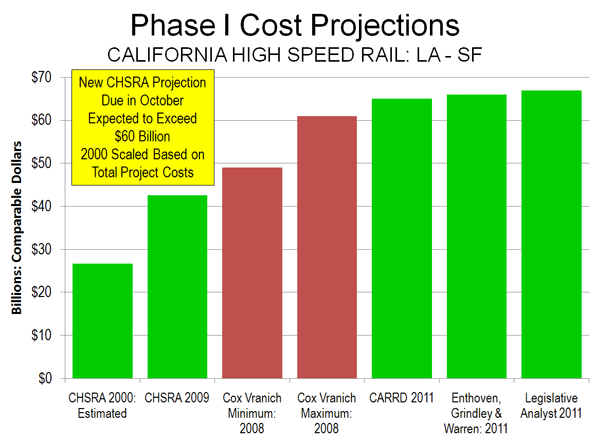
    California’s high-speed rail project is setting speed records, not on tracks, but rather in cost escalation. Last week, the California High Speed Rail Authority (CHSRA) announced that the Bakersfield to Merced section, part of which will comprise the first part of the system to be built, will cost between $10.0 and $13.9 billion. This is an increase of approximately 40 percent to 100 percent over the previous estimate of $7.1 billion, an estimate itself less than two years old.

    This "flatter than Kansas" section should be the least expensive part of the system. It can only be imagined how much costs might rise where construction is more challenging, such as tunneling through the Tehachapi Mountains and for the route across the environmentally sensitive Pacheco Pass that leads to the Silicon Valley. CHSRA officials admit that the present $43 billion cost estimate to complete the Los Angeles (Anaheim) to San Francisco first phase will rise substantially. This estimate was also less than two years old.

    Today only the most ardent supporters believed that initial estimate figure any longer. Early in the year, CARRD (Californians Advocating Responsible Rail Design) looked closely at CHSRA documentation and estimated that Phase I would instead cost $65 billion. In May, the California Legislative Analyst’s Office indicated that based upon the cost escalation already taking place, the cost of Phase I could reach $67 billion.   Alain Enthoven of Stanford University, William Grindley, formerly of the World Bank and William Warren, a former Silicon Valley CEO project a $66 billion figure (see Figure) and also estimate that costs for the complete project, with extensions to San Diego and Sacramento could be up to $116 billion (Note 1). This is triple the 2000 CHSRA projection (inflation adjusted).

    Megan McArdle of The Atlantic characterized the obsolete $43 billion estimate as "giddily optimistic," while Reihan Salam of National Review Online called the cost escalation "a national embarrassment." In fact, even the $43 billion represented substantial cost escalation. Over the previous decade, the project cost had escalated more than 50 percent after adjustment for inflation.

    Any one of the new cost projection figures would put the California High Speed Rail project on track for a world high speed record in cost escalation. Available data indicates that no transportation infrastructure project in the history of the world has experienced such a large cost increase in so little time.

    Cox/Vranich Projection Low: In 2008, Joseph Vranich and I authored the Reason Foundation’s The California High Speed Rail Proposal: A Due – Diligence Report. Based upon the cost escalation we predicted in that report, our cost escalation estimate for Phase I would have been between $49 billion and $61 billion (Note 2). Little did we expect that our maximum cost escalation figure would turn out to be too conservative and be exceeded even before the first shovel had been turned.

    Rippling to Florida: There has already been a ripple effect from California’s record cost escalation. My Reason Foundation report on the Florida high speed rail project (The Tampa to Orlando High Speed Rail Project: A Florida Taxpayer Assessment) used a comparison to the first segment of the California system to produce a maximum cost overrun estimate of $3 billion for the Florida system. Had the new cost estimates been available at the time, we would have projected even higher cost overruns. Of course, Governor Rick Scott canceled that project to shield the taxpayers of the state from obligations not only for cost overruns but also for operating subsidies.

    Citizen Opposition: Meanwhile, the California project has encountered other difficulties. Strong community opposition to the project has developed along the route through the generally Democratic voting peninsula cities between San Jose and San Francisco. CHSRA had intended to expand the existing commuter rail and freight rail right-of-way from 2 to 4 tracks either elevated or to put it in a trench. Residents fear that an elevated system would be a virtual "Berlin Wall" dividing their communities and that a trench would be little better. Vigorous opposition has also developed in the Central Valley (San Joaquin Valley), which is one of the world’s leading agricultural areas.

    There is also a dispute on routing, as CHSRA considers crossing the "Grapevine" parallel to Interstate 5 between Los Angeles and Bakersfield, rather than the adopted, longer route through the Antelope Valley (the Lancaster-Palmdale urban area, which is likely to have 500,000 people by 2020 when the train is supposed to begin operating).

    Slowing Down the Trains: The peninsula residents have been successful in obtaining strong political support in Sacramento and Washington. There are indications that a "blended" alternative might be developed instead of the elevated or trench alternatives. This would involve mixing high-speed trains on the same two tracks is the present Cal Train commuter service. Of course, this means that the high speed trains could not run very fast. This could add up to 50 minutes to the schedule between Los Angeles and San Francisco, which would make it impossible for the trains to reach the travel time mandated in state law of 2:40. Instead, the trains could take up to 3:30.

    Our Due Diligence Report expressed doubts about the ability of CHSRA to deliver on the legislatively mandated travel times. We predicted that the fastest non-stop trains would take 3:41 between Los Angeles and San Francisco, not much more than the 3:30 that could result from the "blended" alternative. Even that time might not be achievable should citizen opposition develop along other parts of the line. California would, as a result, get the look, but not the substance of high speed rail.

    A Shortage of Funding: Perhaps the final blow will come from financial reality, a commodity often in short supply in recent California history.   At this point, the project has received less than $4 billion in federal grants, which together with a matching $4 billion from the state bonds authorized by taxpayers could be spent. However, given the Republican control of the House of Representatives and the tight federal budget, the prospect for additional federal funding seems dim. High-speed rail was deleted from the federal budget in the agreement between Congress and the President in April. The 2012 budget passed by the House of Representatives does not contain money for high-speed rail.

    CHSRA is optimistic about receiving private investment to fund a major part of the construction. Although there is no shortage of companies looking to be paid to do work on the high-speed rail project, the room empties out when firms are asked to risk billions of their own capital on the project. CHSRA’s own documents indicate that investors are likely to require revenue guarantees, which would appear to violate provisions of the state law that placed the bond issue on the ballot in 2008.

    The Prospects:  At this point there seem to be three potential outcomes. The first, and least likely, is that CHSRA will obtain sufficient funding to build Phase I. Alternatively, CHSRA could build only some portion of the line in the Central Valley, and high speed rail would likely not operate in this far less densely traveled corridor. This would leave California with the most extravagant Amtrak segment in the nation. The third potential outcome is, of course, that the system will never be built.

    Bipartisan concerns are now being expressed in Sacramento, where some Democrats worry that high-speed rail could divert money from more critical, and politically influential, uses. Senator Alan Lowenthal (D-Long Beach), who chairs a committee overseeing the project may have spoken for many after the events of the week: "This is really very serious and needs to stop in its tracks. We can’t just be acting as if someone’s out there giving us wheelbarrows full of money, and it’s just coming. This is not the way we should be operating."

    —-

    Note 1: Enthoven, Grindley and Warren also note that if the California high speed rail project were to equal the worst level of cost escalation yet in California (the San Francisco Bay Bridge project, which is now underway), the costs would rise to as much as $213 billion (Cited in The Wall Street Journal editorial, "Runaway Trains").

    Note 2: Our estimates have been adjusted to "year-of-expenditure" dollars, the method currently used by CHSRA in its cost estimates.

    Photo: California’s Central Valley (where first segment is to be built)

    Wendell Cox is a Visiting Professor, Conservatoire National des Arts et Metiers, Paris and the author of “War on the Dream: How Anti-Sprawl Policy Threatens the Quality of Life

  • The U.K. Riots And The Coming Global Class War

    The riots that hit London and other English cities last week have the potential to spread beyond the British Isles. Class rage isn’t unique to England; in fact, it represents part of a growing global class chasm that threatens to undermine capitalism itself.

    The hardening of class divisions    has been building for a generation, first in the West but increasingly in fast-developing countries such as China. The growing chasm between the classes has its roots in globalization, which has taken jobs from blue-collar and now even white-collar employees; technology, which has allowed the fleetest and richest companies and individuals to shift operations at rapid speed to any locale; and the secularization of society, which has undermined the traditional values about work and family that have underpinned grassroots capitalism from its very origins.

    All these factors can be seen in the British riots. Race and police relations played a role, but the rioters included far more than minorities or gangsters. As British historian James Heartfield has suggested, the rioters reflected a broader breakdown in “the British social system,” particularly in “the system of work and reward.”

    In the earlier decades of the 20th century working class youths could look forward to jobs in Britain’s vibrant industrial economy and, later, in the growing public sector largely financed by both the earnings of the City of London and credit. Today the industrial sector has shrunk beyond recognition. The global financial crisis has undermined credit and the government’s ability to pay for the welfare state.

    With meaningful and worthwhile work harder to come by — particularly in the private sector — the prospects for success among Britain working classes have been reduced to largely fantastical careers in entertainment, sport or all too often crime. Meanwhile, Prime Minister David Cameron’s supporters in the City of London may have benefited from financial bailouts arranged by the Bank of England, but opportunities for even modest social uplift for most other people have faded.

    The great British notion of idea of working hard and succeeding through sheer pluck — an idea also embedded in the U.K.’s former colonies, such as the U.S. — has been largely devalued.  Dick Hobbs, a scholar at the London School of Economics, says this demoralization  has particularly affected white Londoners. Many immigrants have thrived doing engineering and construction work as well as in trades providing service to the capital’s affluent elites.

    A native of east London himself, Hobbs  maintains that the industrial ethos, despite its failings, had great advantages. It centered first on production and rewarded both the accumulation of skills. In contrast, by some estimates, the pub and club industry has been post-industrial London’s largest source of private-sector employment growth, a phenomena even more marked in less prosperous regions. “There are parts of London where the pubs are the only economy,” he notes.

    Hobbs claims that the current “pub and club,” with its “violent potential and instrumental physicality,” simply celebrates consumption often to the point of excess. Perhaps it’s no surprise that looting drove the unrest.

    What’s the lesson to be drawn?  The ideologues don’t seem to have the answers. A crackdown on criminals — the favored response of the British right — is necessary but does not address the fundamental problems of joblessness and devalued work. Similarly the left’s favorite panacea, a revival of the welfare state, fails to address the central problem of shrinking opportunities for social advancement.  There are now at least 1 million unemployed young people in the U.K., more than at any time in a generation, while child poverty in inner London, even during the regime of former Mayor “red Ken” Livingstone last decade, stood at 50% and may well be worse now.

    This fundamental class issue is not only present in Britain. There have been numerous outbreaks of street violence across Europe, including in France and Greece. One can expect more in countries like Italy, Spain and Portugal, which will now have to impose the same sort of austerity measures applied by the Cameron government in London.

    And how about the United States? Many of the same forces are at play here. Teen unemployment currently exceeds 20%; in the nation’s capital it stands at over 50%. Particularly vulnerable are expensive cities such as Los Angeles and New York, which have become increasingly bifurcated between rich and poor. Cutbacks in social programs, however necessary, could make things worse, both for the middle class minorities who run such efforts as well as their poor charges.

    A possible harbinger of this dislocation, observes author Walter Russell Mead, may be the recent rise of  random criminality, often racially tinged, taking place in American cities such as Chicago, Milwaukee and Philadelphia.

    Still, with over 14 million unemployed nationwide, prospects are not necessarily great for white working- and middle-class Americans. This pain is broadly felt, particularly by younger workers. According to a Pew Research survey,  almost 2 in 5 Americans aged 18 to 19 are unemployed or out the workforce, the highest percentage in three decades.

    Diminished prospects — what many pundits praise as the “new normal” — now confront a vast proportion of the population. One indication: The expectation of earning more money next year has fallen to the lowest level in 25 years. Wages have been falling not only for non-college graduates but  for those with four-year degree as well.   Over 43% of non-college-educated whites complain they are downwardly mobile.

    Given this, it’s hard to see how class resentment in this country can do anything but grow in the years. Federal Reserve Chairman Ben Bernanke claimed as early as 2007 that he was worried about growing inequality in this country, but his Wall Street and corporate-friendly policies have failed to improve the grassroots economy.

    The prospects for a widening class conflict are clear even in China, where social inequality is now among the world’s worse . Not surprisingly, one survey conducted  the Zhejiang Academy of Social Sciences   found that 96% of respondents “resent the rich.”  While Tea Partiers and leftists in the U.S. decry the colluding capitalism of the Bush-Obama-Bernanke regime, Chinese working and middle classes confront a hegemonic ruling class consisting of public officials and wealthy capitalists. That this takes place under the aegis of a supposedly “Marxist-Leninist regime” is both ironic and obscene.

    This expanding class war creates more intense political conflicts. On the right the Tea Party — as well as rising grassroots European protest parties in such unlikely locales as Finland, Sweden and the Netherlands — grows in large part out of the conviction that the power structure, corporate and government, work together to screw the broad middle class. Left-wing militancy also has a class twist, with progressives increasingly alienated by the gentry politics of the Obama Administration.

    Many conservatives here, as well as abroad, reject the huge role of class.  To them, wealth and poverty still reflect levels of virtue — and societal barriers to upward mobility, just a mild inhibitor. But modern society cannot run according to the individualist credo of Ayn Rand; economic systems, to be credible and socially sustainable, must deliver results to the vast majority of citizens. If capitalism cannot do that expect more outbreaks of violence and greater levels of political alienation — not only in Britain but across most of the world’s leading countries, including the U.S.

    This piece originally appeared at Forbes.com.

    Joel Kotkin is executive editor of NewGeography.com and is a distinguished presidential fellow in urban futures at Chapman University, and an adjunct fellow of the Legatum Institute in London. He is author of The City: A Global History. His newest book is The Next Hundred Million: America in 2050, released in February, 2010.

    Photo by Beacon Radio.

  • Britain Needs a Better Way to Get Rich Than Looting

    Mark Duggan, father of four, was armed with a Bruni BBM semi-automatic pistol when he was shot dead by armed police on 4 August. Despite initial reports Duggan did not fire on the officers from the Trident Police Unit, an armed force dedicated to dealing with “gun related murders within London’s black communities”.

    Duggan’s family were not told by police that he had died from his injuries but learned it from the news, in a report designed to deflect blame for the killing onto the victim. The vigil that Duggan’s friends and family held outside the Tottenham police station was a spark that set off rioting across Britain for the last week, and at the time of writing is still not under control.

    Any political character to the initial rioting – as a protest against police brutality – quickly gave way to looting.

    Looting broke out in urban centres, mostly those with a large black community – Tottenham, Enfield, Dalston and Croydon in London. The looters were for the most part young, and of all races, and they sought out popular clothing stores, like foot locker, jewellers and department stores. Some people were attacked in their homes. The “Gay’s the Word” bookshop in Marchmont Street was attacked on 8 August.

    Later, looting spread to Leeds, Birmingham, Manchester and Nottingham – where a police station was firebombed.

    One feature of the looting was the use of mobile phones, blackberries and Twitter accounts to rally looters to sites where, they rightly predicted, the police could be outmanoeuvred.

    Still, it is worth pointing out that as rioting goes this recent outbreak, though widespread, has not been all that violent. Instead it has been more of a Feast of Fools, with the mob enjoying the humiliation of the authorities, as it raids the supermarkets for booze and clothes.

    The Prime Minister, David Cameron has cut short his holiday in Tuscany to recall Parliament, and the London Mayor has come back too. The Drama Queen Cameron, sensing his big moment, promises tough measures to stop the rioting, issuing rubber bullets and water cannon to the police.  London courts processed 167 prisoners in unprecedented overnight sittings on 9-10 of August.

    The cause of the riots has been identified by the Prime Minister and the London Mayor as a breakdown in authority – and they have a point. It is the British social system as a whole that has lost its way, with a collapse in authority in every level, from the police, the political system, school and parental authority but most severely in the system of work and reward.

    Britain’s police force has most decidedly lost authority in recent times. The force used to have an authoritarian culture that was thuggish and racist under reactionary Chief Constables like Sir James Anderton in Manchester and Sir Kenneth Newman in London. But investigations into the police’s “institutional racism” have opened the way to a newer layer of technocratic leaders who were more interested in process than upholding a particular vision of public order.

    Nobody would want to see the return of the old authoritarian policing, but the cadre that replaced them have lacked a guiding esprit de corps. The police have been seen as being corrupted by payments from News International’s investigators for personal information and designed to sideline an investigation into phone hacking.

    Nor has the force’s new face stopped the problem of police brutality. Uncertain of how to deal with the public order challenges of middle class protest (environmental, or more recently student-based), the police have swung irrationally from a hands-off approach that only encouraged greater disorder to excessive force when that failed. The fear of Islamic terrorism has also led to police overreaction.

    The killings of Jean Charles De Menezes (in a terrorism panic), Ian Tomlinson (at a G20 protest) and the vicious assault on Alfie Meadows at a student demonstration have all undermined respect for the police.

    Political leaders have pointedly failed to engage with younger and less well-off groups in society, too. After more than a decade in power the Labour Party is a shell of its former self, but the coalition that replaced it is a bodged compromise whose most attractive radical figure, mould-breaking Liberal Democrat Nick Clegg, managed to turn himself overnight into the most hated man in Britain by joining the government and voting for an increase in student fees (the very thing he had campaigned against). All in all, the political class are stiff, besuited, and incapable of talking in ordinary English, preferring a weird gabble of municipal-speak.

    Lower down the scale teachers, parents and youth leaders have seen their authority undermined by a culture that disparages discipline, and sees “abuse” everywhere. Teachers’ unions have pointed out that changes in the law mean that a substantial minority are being investigated for allegations of abuse made by students at any time, meaning that they are reluctant to uphold discipline in the classroom. At the same time, teachers and social workers challenge parental discipline at every opportunity.

    Perhaps most disturbingly British society has broken the link between hard work and success. Once the “workshop of the world” Britain has a shrinking manufacturing base (around ten percent of all employment). As the analyst Andrew Smithers pointed out, the City of London’s specialisation in financial intermediation took up the slack left by her shrinking industrial sector, but now that is looking like having all your eggs in the wrong basket.

    For a decade or more booming markets and a credit-fuelled economy covered up the weaknesses. Trainers, clothes and electronic devices shipped in from China and paid for on credit kept Britons happy, while a growth in government jobs and the educational maintenance allowance to keep 16-19 year olds in school kept unemployment down.

    The British system of rewards is far from being straightforward. How do you get rich in Britain in 2011?

    • Sir Paul Stephenson, the disgraced chief of the Metropolitan Police retired this July with full pension and benefits on a final salary of £250,000 – having been exposed for taking favours from journalists under investigation for hacking phones.
    • Susan Boyle grabbed the public’s affection on a TV talent show and made £10 million.
    • Beresfords Law firm skimmed £30 million from the Miners Industrial Injury Compensation scheme.
    • Geordie singer turned X-factor judge Cheryl Cole became Britain’s highest paid TV star.
    • Independent consultants raided the National Health Service’s budget of £4.3 billion to build a national database which still does not work.
    • City chiefs like Barclays Bob Diamond and HSBC’s Bob Duggan were awarded bonuses of £6.5 and £9 million last year, from funds boosted by the government’s £200 billion quantitative easing policy.

    The link between work and reward is not easy to fathom. Young people dream unrealistically of success in the world of entertainment, as the most compelling example to them. The more astute know that law and the other professions have done better at securing their incomes – and for them higher education is the route.

    Now the British system of rewards is threatened by the pressure on credit and on government spending. Nervous teenagers and parents see a much higher cost for higher education threatened (though the small print, surprisingly, is more generous than the headline fees). The consumer goods sector has been the one point of connection between younger people and wider society that worked – but recent financial difficulties make many fear that it will soon be out of reach.

    Britain’s radical leaders have in recent times failed to speak to the material aspirations of the greater mass of people. Trade union wage claims are not the fighting point they once were. Left wingers are more likely to be hostile to consumerism than supportive. On the other side, conservatives have abandoned their narrative of hard work to earn well, thinking it too judgmental and mean-spirited.

    Anxiety about the route to material betterment, along with a failure of political answers to that problem and a falling respect for authority have led to disorder. Earlier this year the middle classes rioted on student protests over rising fees. Now some amongst the inner city poor are rioting and looting, in search of a less deferred gratification.

    The looters have taken advantage of the crisis of public authority to make their own short-cut to material success, but it is a self-defeating one. A looted Debenhams or Footlocker will think twice about re-stocking – or at least until they have improved security. Worse still, many family firms and communities have been wrecked by rioters.

    Mark Duggan’s family needs a good answer to why he was shot, and why they had to learn that he had died through the media. Britain needs a less crazed answer to the question of how to meet people’s wants, and it needs a stronger restatement of the value of social solidarity.

    James Heartfield’s latest book The Aborigines’ Protection Society: Humanitarian Imperialism in Australia, New Zealand, Fiji, Canada, South Africa, and the Congo, 1836-1909 is published by Columbia University Press, and Hurst Books in the UK.

    Photo “Tottenham riots” by Nico Hogg

  • The 2012 Vote: A Newly Diverse Center

    Demographic transformations are changing how the American people vote. In 2010, only 15 per cent of Americans claimed to be completely unaffiliated independent voters, while 48 per cent identified with the Democratic Party and 37 per cent with the Republican Party. Back in the 1990s, party identification was at 44 per cent each.

    The Democrats’ advantage is due in large part to Millennial voters, recognised as the biggest and most important new voting cohort in America politics. Sometimes referred to as the ‘youth vote’, Millennials are generally born between 1982 and 2003. The Democratic advantage can also be attributed to an increase in Hispanic voters, who identify as Democrats over Republicans by a 2:1 margin.

    According to a study released in May by the Pew Research Center, of those registered voters in America who identify as Republicans, 14 per cent hold conservative views on most issues, 14 per cent are moderates with liberal views on most social issues, 11 per cent are staunch Tea Party conservatives, 11 per cent are disaffected down-sizers and 10 per cent are free market, small government libertarians. Of those registered voters who identify as Democrats, 16 per cent are solid Democrats (liberal on all issues), another 15 per cent are hard pressed (religious, and financially struggling),and 9 per cent are New Coalition Democrats (positive, minority-rights oriented).

    Many American voters are choosing not to identify with either political party. Unlike the Australian Independent voter, those Americans who reject the major parties, rather than moving towards the fringes, are flocking to the centre of the political spectrum. This has resulted in the centre becoming increasingly diverse.

    Surprisingly, the two independent members of the Senate, Bernie Sanders (Vermont) and former Democrat Joe Lieberman (Connecticut), rather than being centrists, hold strong ideological positions on issues such as the role of government, immigration, and the environment. Their election defies liberal or conservative orthodoxy and challenges the idea of the centering of the American voter.

    Evidence from the Pew report suggests that voters on the Right are polarising. Staunch conservatives are clearly identifiable in polling. These voters take extremely conservative positions on nearly all issues, from the size and role of government to economics, foreign policy and domestic social issues. Most are aligned with Tea Party Republicans in their disapproval of Barack Obama. There still exists a core group of Main Street Republicans, however, they are becoming less identifiable in opinion polls and in national polling.

    On the Left, not surprisingly, Solid Liberals express diametrically opposing views from the Staunch Conservatives on virtually every issue. While Solid Liberals are predominantly white, minorities make up greater shares of New Coalition Democrats, who are distinguished by their upbeat attitudes in the face of economic struggles. This group includes nearly equal numbers of whites, African Americans and Hispanics. Hard-Pressed Democrats are about a third African American. Unlike Solid Liberals, both of these last two groups are highly religious and socially conservative.

    Some American voters like to be considered Libertarians and Post-Moderns. Both groups are largely white, well-educated and affluent. They tend to be secular and are pro-homosexuality and abortion. Republican-oriented Libertarians, however, are far more critical of government, less supportive of environmental regulations, and more supportive of business.

    A survey conducted for the progressive think tank NDN found that a majority of Americans — 54 per cent — favor a government that actively tries to solve societal and economic problems, rather than one that takes a hands-off approach.

    Staunch Conservatives and Main Street Republicans share similar views on the positive role of religion in society (90 and 91 per cent respectively), and that immigrants are a burden on American society (68 and 60 per cent). Staunch Conservatives more strongly believe that governments can no longer afford to help the needy (87 per cent) than Main Street Republicans (75 per cent). In relation to the economy and the environment there are significant differences. Staunch Conservatives very strongly believe environmental laws cost too many jobs and hurt the economy (92 per cent), a view not held by Main Street Republicans (only 22 per cent support the claim). Most Main Street Republicans think business corporations make too much profit (58 Per cent). This view is rejected by Staunch Republicans. Only 13 per cent of this group believes corporations make too much profit.

    Democratic voters, according to the Pew study, are divided over immigration. Solid Liberals overwhelming agree that immigrants strengthen American society. This is a view held by the very few Hard Pressed Democrats (13 per cent). New Coalition Democrats are more in line with Solid Democrats on the question of immigration (70 per cent think immigrants make a positive contribution). Democrats favor diplomacy as the way to peace: Hard Pressed by 56 per cent), Solid Liberals by 89 per cent. There are also significant differences on gay rights and environmental laws. Over 90 per cent of Solid Liberals support gay rights and environmental protections. Among Hard Pressed Democrats, 43 per cent support gay rights and 22 per cent see environmental laws as hurting the economy and costing jobs. Each of the three Democratic voter groups share similar views on the need for improvements to ensure equal rights for African Americans.

    Age is a factor in partisanship and political values. Younger people are more numerous on the Left, and older people on the Right. Staunch Republicans over 50 years of age are the most highly engaged in following government and public affairs (75 per cent).

    How do American voters rank Barack Obama? It’s not surprising that Republicans disapprove of Obama’s job performance and health care plan. The problem for Obama is that he does not have enough support among Democrat voters to counter Staunch Republicans: Among Solid Liberals, only 64 per cent strongly approve of Obama’s job performance.

    Obama’s personal image is positive among American voters, but his job approval rating is low. Doubts raised by ‘birthers’ continue to get traction in American politics. More than one-in-five Americans (23 per cent) say, incorrectly, that Obama was born outside the United States.

    This new portrait of the American voter will challenge both Democrats and Republicans in the lead-up to the 2012 presidential election. For politicians on both sides, the challenge is to appease the ideological and moderate wings, each with competing goals and aspirations, and at the same time to ensure that each wing does not break out into disagreements with the other over core principles. The Tea Party Conservatives and Republicans have recently gone to the brink, but managed to pull back ‘for the sake of the Party’.

    Perhaps the answer is in Bertolt Brecht’s quip: “Would it not be easier for the government to dissolve the people and elect another?”

    Dr Scott Denton completed a PhD on Australian elections in 2010. He is an academic at the University of New South Wales, Sydney, who regularly writes on Australian and American elections and electoral history.

    Photo by Ho John Lee (HJL): Vote!

  • How Los Angeles Lost Its Mojo

    Los Angeles today is a city in secular decline. Its current political leadership seems determined to turn the sprawling capitalist dynamo into a faux New York. But they are more likely to leave behind a dense, government-dominated, bankrupt, dysfunctional, Athens by the Pacific.

    The greatness of Los Angeles stemmed from its willingness to be different. Unlike Chicago or Denver or New York, the Los Angeles metro area was designed not around a central core but on a series of centers, connected first by railcars and later by the freeways. The result was a dispersed metropolis where most people occupied single-family houses in middle-class neighborhoods.

    Lured by the pleasant climate and a business-dominated political economy, industries and entrepreneurs flocked to the region. Initially, the growth came largely from oil and agriculture, followed by the movie industry. Defense and aerospace during World War II and the postwar era fostered a vast industrial base, and by the 1980s Los Angeles had surpassed New York as the nation’s largest port, and Chicago as the nation’s leading industrial center.

    The region hit a rough spot as the end of the Cold War led to massive federal cutbacks in aerospace. Los Angeles County lost nearly 500,000 jobs between 1990 and 1993. But it bounced back, adding nearly 400,000 jobs between 1993 and 1999. Aerospace never fully recovered, but other parts of the industrial belt—including the port and the apparel and entertainment industries—grew. An entrepreneurial class of immigrants—Middle Eastern, Korean, Chinese, Latino—launched new businesses in everything from textiles and ethnic food to computers. The pro-business mayoralty of Richard Riordan and the governorship of Pete Wilson restored confidence among the city’s beleaguered companies.

    Then progress stalled. Employment stayed relatively flat from 2001 until 2005, when Mayor Antonio Villaraigosa was elected, and then started to drop. As of this March, over the entire L.A. metropolitan area, which includes adjacent Orange County, unemployment was 11.4%—the third-highest unemployment rate of the nation’s 20 largest metro areas.

    Why has Los Angeles lost its mojo? A big reason is a decline in the power and mettle of the city’s once-vibrant business community. Between the late 1980s and the end of the millennium, many of L.A.’s largest and most influential firms—ARCO, Security Pacific, First Interstate, Union Oil, Sun America—disappeared in a host of mergers that saw their management shift to cities like London, New York and San Francisco. Meanwhile, says David Abel, a Democratic Party activist and publisher of the influential Planning Report, once-powerful groups like the Los Angeles Chamber of Commerce and the Los Angeles County Economic Development Corporation lost influence.

    The machine that now controls Los Angeles by default consists of an alliance between labor and the political leadership of the Latino community, the area’s largest ethnic population. But since politicians serve at the whim of labor interests, they seldom speak up for homeowners and small businesses.

    Mayor Villaraigosa, a former labor organizer, has little understanding of private-sector economic development beyond well-connected real-estate interests whom he has courted and which have supported him. He has been a strong backer of L.A. Live, a downtown ports and entertainment complex, and other projects that have benefited from favorable tax treatment and major public infrastructure investments. He’s currently supporting a push to build a new downtown football stadium, though L.A. has no professional football team. His biggest priority is to build the so-called subway to the sea, a $40 billion train line to connect downtown with the Pacific.

    But L.A.’s downtown employs a mere 2.5% of the region’s work force; New York’s central business districts, by contrast, employ roughly 20%. “To put the entire focus of development on downtown L.A.,” says Ali Modarres, chairman of the geography department at Cal State Los Angeles, “is to ignore the historical, cultural, economic [and] social forces that have shaped the larger geography of this metropolitan area.”

    Moreover, the mayor’s accent downtown is on housing, not manufacturing. And as Cecilia Estolano, former head of the Community Redevelopment Agency, points out, “downtown housing simply doesn’t create the jobs that small manufacturers do.”

    Meantime, business-strangling regulations proliferate, often with support from a powerful and well-heeled environmental movement, which Mr. Villaraigosa counts on for political support and media validation. There are draconian moves to control emissions at the port from ships and trucks. Also harmful are the city’s efforts to expand the unions’ presence from the docks to the entire network of trucks serving the port—essentially forcing out independent carriers, many of them Latino entrepreneurs, in favor of larger firms using Teamster drivers.

    Such policies could backfire, says economist John Husing, leading shippers to transfer their business to cheaper and less heavily regulated ports such as Charleston, Houston, Savannah and other growth-oriented southern cities. This is particularly dangerous given the planned 2014 widening of the Panama Canal, which will make Southeastern ports far more competitive for Asia-based trade. Mr. Husing notes that L.A.’s port is the largest generator of blue-collar employment in the region.

    Even some liberal Democrats are beginning to realize that the current system isn’t sustainable. Writing recently in the Los Angeles Business Journal, Roderick Wright, a Democratic state senator from south Los Angeles, compared the state and local governments with the Mafia. The “vig” that government takes from local businesses, Mr. Wright argued—both in taxes and in the cost of regulation—has undermined job creation, particularly in working-class districts like his. He also warned that renewable-energy mandates recently imposed by the state would boost the cost of energy in the region, already 53% above the national average, by an additional 20% to 25%.

    Who will challenge the machine and its ruinous economic policy? It’s not likely to be the city’s enervated business sector. But the city’s working and middle classes might, says Ron Kaye, former editor of the San Fernando Valley–based Daily News. He points to the city’s remaining middle-class homeowners, who are concentrated in the San Fernando Valley but also occupy a number of diverse neighborhoods. “These are the places that reflect the whole idea of L.A., as opposed to the Villaraigosa vision of a city of apartment dwellers,” Mr. Kaye says.

    It is uncertain if Los Angeles will experience the Sunshine Revolution it so desperately needs. What is certain is that only when the machine and its masters no longer dictate L.A.’s fate can this diverse and dynamic region resume its ascent toward greatness.

    This piece originally appeared in the Wall Street Journal and is adapted from the Summer 2011 edition of The City Journal.

    Joel Kotkin is executive editor of NewGeography.com and is a distinguished presidential fellow in urban futures at Chapman University, and an adjunct fellow of the Legatum Institute in London. He is author of The City: A Global History. His newest book is The Next Hundred Million: America in 2050, released in February, 2010.

    Photo by pinchof