Category: Politics

  • Understanding the Egyptian Protests: Headwaters of the Arab Spring

    On Tuesday, January 25, 2011, the leaders of the Egyptian protest group, April 6 Youth Movement (A6Y), led hundreds of thousands of protesters chanting, “Bread, Freedom, Human Rights” into Cairo’s Tahrir Square. The events that followed completely surprised the economic elites gathering for the annual World Economic Forum meeting in Davos, Switzerland. Few put much stock in the importance of the actions of young people in Egypt until the protests overturned that country’s entrenched power structure in a matter of weeks.

    Why were the leaders of the global economy so surprised by the events that have come to be known as the Arab Spring, and why did they feel so threatened by them? Why did the protester’s demands spread so quickly throughout the Arab world after decades of suppression by autocratic regimes? 

    The answer to these questions lies in an understanding of the complex interaction between technological and generational change, fueled by a hunger for a better future, that continues to be the underlying source of the institutional instability and that will reshape the entire region. In a new Kindle Single, Headwaters of the Arab Spring, NDN fellows Morley Winograd and Mike Hais explain how these intertwined forces are destined to undermine institutions and leaders in every corner of the world.  

  • Goodbye, New York State Residents are Rushing for the Exits

    For more than 15 years, New York State has led the country in domestic outmigration: for every American who comes to New York, roughly two depart for other states. This outmigration slowed briefly following the onset of the Great Recession. But a new Marist poll released last week suggests that the rate is likely to increase: 36 percent of New Yorkers under 30 are planning to leave over the next five years. Why are all these people fleeing?

    For one thing, according to a recent survey in Chief Executive, New York State has the second-worst business climate in the country. (Only California ranks lower.) People go where the jobs are, so when a state repels businesses, it repels residents, too. It’s also telling that in the Marist poll, 62 percent of New Yorkers planning to leave cited economic factors—including cost of living (30 percent), taxes (19 percent), and the job environment (10 percent)—as the primary reason.

    In upstate New York, a big part of the problem is extraordinarily high property taxes. New York has the 15 highest-taxed counties in the country, including Nassau and Westchester, which rank first and second nationwide. Most of the property tax goes toward paying the state’s Medicaid bill—which is unlikely to diminish, since the state’s most powerful lobby, the political cartel created by the alliance of the hospital workers’ union and hospital management, has gone unchallenged by new governor Andrew Cuomo.

    New York City doesn’t suffer from outmigration to the extent that the state does; in fact, the city grew slightly over the past decade, thanks to immigration. And there’s more work in Gotham than in the state as a whole. The problem is that the kind of work available shows that the city accommodates new immigrants much better than it supports middle-class aspirations. A recent report from the Drum Major Institute helps make sense of the Marist numbers: “The two fastest-growing industries in New York are also the lowest paid. More than half of the city’s employment growth over the past year has been in retail, hospitality, and food services, all of which pay their workers less than half of the city’s average wage.” Worse yet, more than 80 percent of the new jobs are in the city’s five lowest-paying sectors. Parts of the country are seeing a revival of manufacturing—traditionally a source of upward mobility for immigrants—but not New York City, whose manufacturing continues to decline. The culprits here include the city’s zoning policies, business taxes, and declining physical infrastructure.

    Then there’s the cost of living in New York City. A 2009 report by the Center for an Urban Future found that “a New Yorker would have to make $123,322 a year to have the same standard of living as someone making $50,000 in Houston. In Manhattan, a $60,000 salary is equivalent to someone making $26,092 in Atlanta.” Even Queens, the report found, was the fifth most expensive urban area in the country.

    The implications of Gotham’s hourglass economy—with all the action on the top and bottom, and not much in the middle—are daunting. The Drum Major report, which noted that 31 percent of the adults employed in New York work at low-wage labor, came with a political agenda. The institute wants the city to subsidize new categories of work by expanding the scope of “living-wage” laws, which require higher pay than minimum-wage laws do, to all businesses that receive city funds or contracts. But that would mean higher taxes for the middle class and a further narrowing of the hourglass’s midsection.

    Governor Cuomo is calling for a property-tax cap, but without “mandate relief” for localities—for example, relaxing state laws that require localities to pay out exorbitant pension benefits. Mayor Michael Bloomberg has pledged not to increase local taxes, but even at their current level, city taxes and regulations will keep serving as an exit sign for aspiring twentysomething workers. In short, we can expect New York to lead the country in outmigration for the near future.

    This piece first appeared in the City Journal.

    Fred Siegel is a contributing editor of City Journal, a senior fellow at the Manhattan Institute, and a scholar in residence at St. Francis College in Brooklyn.

    Photo by Christopher Schoenbohm

  • Transit: The 4 Percent Solution

    A new Brookings Institution report provides an unprecedented glimpse into the lack of potential for transit to make a more meaningful contribution to mobility in the nation’s metropolitan areas. The report, entitled Missed Opportunity: Transit and Jobs in Metropolitan America, provides estimates of the percentage of jobs that can be accessed by transit in 45, 60 or 90 minutes, one-way, by residents of the 100 largest US metropolitan areas. The report is unusual in not evaluating the performance of metropolitan transit systems, but rather, as co-author Alan Berube put it, "what they are capable of." Moreover, the Brookings access indicators go well beyond analyses that presume having a bus or rail stop nearby is enough, missing the point the availability of transit does not mean that it can take you where you need to go in a reasonable period of time.

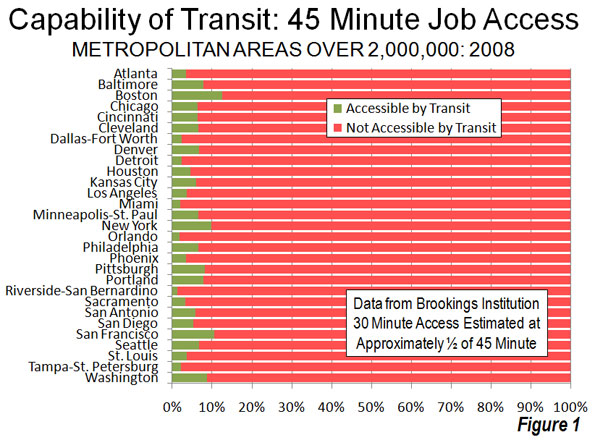
    Transit: Generally Not Accessible: It may come as a surprise that, according to Brookings, only seven percent of jobs in the nation’s largest metropolitan areas can be reached by residents in 45 minutes during the morning peak period (when transit service is the most intense). Among the 29 metropolitan areas with more than 2,000,000 population, the 45 minute job access average was 5.6 percent, ranging from 12.6 percent in Boston to 1.3 percent in Riverside-San Bernardino. The New York’s metropolitan area’s 45 minute job access figure was 9.8 percent (Figure 1).

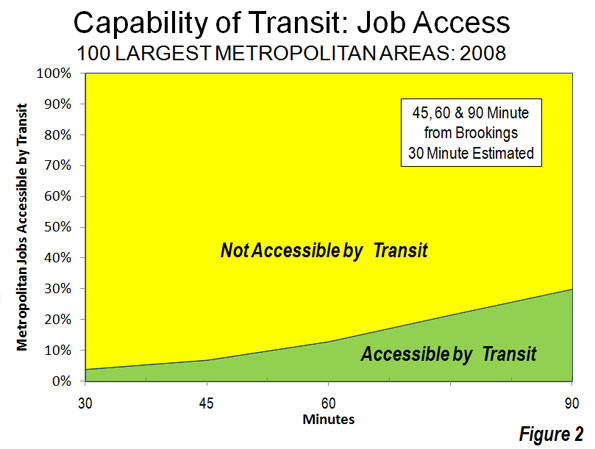
    Brookings did not examine a 30 minute transit work trip time. However, a bit of triangulation (Note 1) suggests that the 30 minute access figure would be in the range of 3 to 4 percent, at most about 4,000,000 jobs out of the more than 100 million in these metropolitan areas.   At least 96 percent of jobs in the largest metropolitan areas would be inaccessible by transit in 30 minutes for the average resident (Figure 2).

    The Brookings report also indicates that indicates that 13 percent of employment is accessible within 60 minutes by transit and 30 percent within 90 minutes (Note 2). Brookings focuses principally on the 90 minutes job accessibility data. However, the reality is that few people desire a 45 minute commute, much less one of 90 minutes.

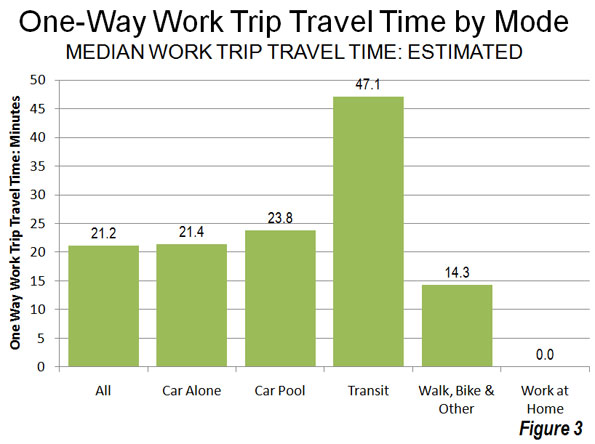
    In 2009, in fact, the median one way work trip travel time in the United States was 21 minutes (Note 3). Approximately 68 percent of non-transit commuters (principally driving alone, but also car pools, working at home, walking, bicycles, taxicabs and other modes) were able to reach work in less than 30 minutes. The overwhelming majority, 87 percent, were able to reach work in 45 minutes or less, many times transit’s seven percent. Transit’s overall median work trip travel time was more than double that of driving alone (Figure 3).

    A mode of transport incapable of accessing 96 percent of jobs within a normal commute period simply does not meet the needs of most people. This makes somewhat dubious claims that transit can materially reduce congestion or congestion costs throughout metropolitan areas. The Brookings estimates simply confirm the reality that has been evident in US Census Bureau and US Department of Transportation surveys for decades: that transit is generally not time-competitive with the automobile. It is no wonder that the vast majority of commuters in the United States (and even in Europe) travel to work by car.

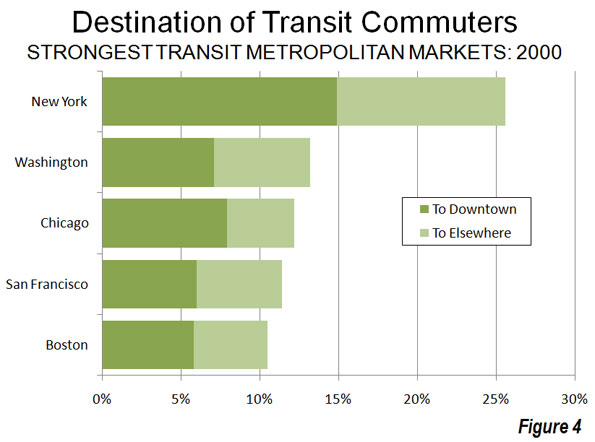
    Much of the reason for transit’s diminished effectiveness lies in the fact that downtowns — the usual destination for transit — represent a small share of overall employment. Downtown areas have only 10 percent of urban area employment, yet account for nearly 50 percent of transit commuting in the nation’s largest urban areas (Figure 4).

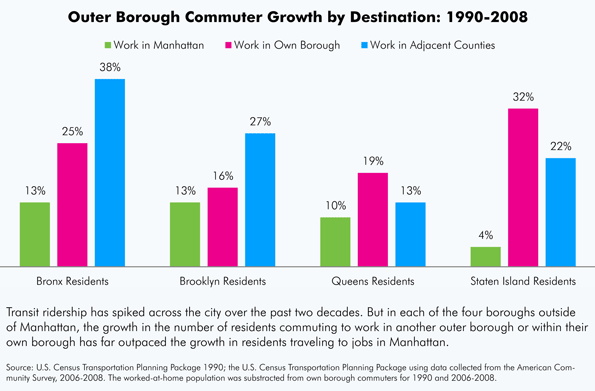
    Meanwhile, core areas, including downtown areas, represent a decreasing share of the employment market as employment dispersion has continued. Since 2001, metropolitan areas as different as Philadelphia, Portland, Dallas-Fort Worth, Salt Lake City, Denver and St. Louis, saw suburban areas gain employment share. Even in the city of New York, outer borough residents are commuting more to places other than the Manhattan central business district (link to chart).

    Transit: The Long Road Home: Transit problem stems largely from its relative inconvenience.    In 2009, 35 percent of transit commuters had work trips of more than 60 minutes. Only six percent of drivers had one way commutes of more than 60 minutes. For all of the media obsession about long commutes, more than twice as many drivers got to work in less than 10 minutes than the number who took more than an hour. In the case of transit, more than 25 times as many commuters took more than 60 minutes to get to work as those who took less than 10 minutes.

    Economists Peter Gordon and Harry W. Richardson have shown that the continuing dispersion of jobs (along with residences) has kept traffic congestion under control in the United States. Available data indicates that work trips in the United States generally take less time than in similar sized urban areas in Europe, Japan, Canada and Australia.

    Transit Access is Better for Low Income Citizens: The Brookings report also indicated that job accessibility was better for low income citizens than for the populace in general. Approximately 36 percent of jobs were accessible to low-income residents in 90 minutes, compared to the overall average of 30 minutes. This, of course, is because low income citizens are more concentrated in the central areas of metropolitan areas where transit service is better. But even this may be changing. For example, Portland’s aggressive gentrification and transit-oriented development programs are leading to lower income citizens, especially African-Americans, being forced out of better served areas in the core to more dispersed areas where there is less transit. Nikole Hannah Jones of The Oregonian noted:

    "And those who left didn’t move to nicer areas. Pushed out by gentrification, most settled on the city’s eastern edges, according to the census data, where the sidewalks, grocery stores and parks grow sparse, and access to public transit is limited." 

    Realistic Expectations: More money cannot significantly increase transit access to jobs. Since 1980, transit spending (inflation adjusted) has risen five times as fast as transit ridership. A modest goal of doubling 30 minute job access to between 6 and 8 percent would require much more than double the $50 billion being spent on transit today.

    Moreover, there is no point to pretending that traffic will get so bad that people will abandon their cars for transit (they haven’t anywhere) or that high gas prices will force people to switch to transit. No one switches to transit for trips to places transit doesn’t go or where it takes too long.

    Nonetheless, transit performs an important niche role for commuters to some of the nation’s largest downtown areas, such in New York, Chicago, Boston, San Francisco, and Philadelphia. Approximately half or more of commuters to these downtowns travel there by transit and they account for nearly 40 percent of all transit commuters in the 50 largest urban areas.   

    Yet for 90 percent of employment outside downtown areas, transit is generally not the answer, and it cannot be made to be for any conceivable amount of money. If it were otherwise, comprehensive visions would already have been advanced to make transit competitive with cars across most of, not just a small part of metropolitan areas.  

    All of this is particularly important in light of the connection between economic growth and minimizing the time required to travel  to jobs throughout the metropolitan area.

    The new transit job access is important information for a Congress, elected officials, and a political system seeking ways out of an unprecedented fiscal crisis.

    A four percent solution may solve 4 percent of the problem, but is incapable of solving the much larger 96 percent.

    Notes:

    1. For example at difference between transit commuters reaching work in less than 30 minutes and 45 minutes, Brookings employment access estimate of 7 percent at 45 minutes would become 3 percent at 30 minutes.

    2. The Brookings travel time assumptions appear to be generally consistent with data from the Census Bureau’s American Community Survey (ACS) and the US Department of Transportation’s National Household Transportation Survey (NHTS). Brookings, ACS includes the time spent walking to transit in work trip travel times (For example, the ACS questionnaire asks respondents how long it takes to get from home to work and thus includes the time necessary to walk to transit).

    3. Median travel times are estimated from American Community Survey data for 2009 and includes working at home. The "median" is the point at which one half of commuters take more time and one-half of commuters take less time to reach work and is different from the more frequently cited "average" travel time, which was 25.5 minutes in 2008.

    4. Is Transit Better in Smaller Metropolitan Areas? It is generally assumed that transit service is better in larger metropolitan areas than in smaller metropolitan areas. Yet, the Brookings data seems to indicate the opposite. Larger metropolitan areas tended to have less job access by transit than smaller metropolitan areas. In the largest 20 percent (quintile) of metropolitan areas, only 5.5 percent of employment was accessible within 45 minutes. This was the smallest quintile accessibility score, and well below the middle quintile at 9.2 percent and the bottom quintile at 8.3 percent. The top quintile included metropolitan areas with 2.6 million or more people, the middle quintile included metropolitan areas with 825,000 to 1,275,000 population and the bottom quintile included metropolitan areas between 500,000 and 640,000 (Figure 1). This stronger showing by smaller metropolitan areas probably occurs because it is far less expensive for transit to serve a smaller area. Further, smaller metropolitan areas can have more concentration in core employment.  Even so, smaller metropolitan areas tend to have considerably smaller transit market shares than larger metropolitan areas.

    Wendell Cox is a Visiting Professor, Conservatoire National des Arts et Metiers, Paris and the author of “War on the Dream: How Anti-Sprawl Policy Threatens the Quality of Life

    Photo: Suburban employment: St. Louis (by author)

  • Why Outsiders Have Wound Up Running So Much of L.A.

    When I was young and my brother was a little older, we would be in bed before dark on mid-summer evenings. (The times were different then.) We would lay in our separate beds, but only an arm’s length apart as shadows lengthened up the far wall of our room, until the dial of the Zenith radio on top of the dresser was the only light left. The Dodgers’ game would be on. Vin Scully was calling the plays.

    The consolations in the tenor murmur of that voice came with a price. But my brother and I did not know it. We knew vaguely that the Dodgers had broken Brooklyn hearts, but we believed, as we drifted between the last pitch and sleep, that the Dodgers could never again break other boys’ hearts so deliberately. The Dodgers had come here, to this almost perfect place, to be with us.

    My brother and I were wrong. The Dodgers’ arrival in Los Angeles in 1958 was a historic break in the way sports loyalties worked. Until then, a baseball team and most of its fans expected to share a highly specific sense of place. After that – and with increasing callousness – a team’s connection to a place would lag behind corporate values. My brother and I listened to Vin as a boyhood gift, but his voice was (and is) just another opportunity for branding a commodity. From the beginning, the Dodgers’ arrival in L.A. wasn’t an embrace. It was a deal.

    The sale of the team in 1998 to Fox Entertainment Group, owned by Rupert Murdoch’s Australia-based News Corp., was a $311-million deal Murdoch needed to anchor Fox’s cable sports network. It was equally a deal that team owner Peter O’Malley needed to manage the tax implications of inheriting the Dodgers. When Fox sold the team to Boston parking lot entrepreneurs Frank and Jamie McCourt in 2004 for $420 million, the deal was eagerly blessed by MLB Commissioner Bud Selig as a business favor to Fox, holder of baseball’s television broadcast rights. Apparently, everyone inside baseball knew how much that deal stank, how overleveraged the McCourts really were. By taking the Dodgers into receivership last week, Selig is trying to engineer another deal. That probably won’t have much to do with us or Los Angeles either.

    When I was young, on the morning after a game, over the plate of two fried eggs and four strips of bacon my mother made us every school day, I would read Jim Murray’s column in the sports section of the Los Angeles Times, but not for his thoughts on the Dodgers. I read Murray for the sound of the voice in his columns, the same way I read Matt Weinstock, Jack Smith, Art Seidenbaum, and Charles Champlin in the Times. I learned from all of them the centrality of place in an imaginative life, a hunger for the stories, and the power of having a voice. But those are boyhood values that are gone for deals, too.

    Like the arrival of the Dodgers in Los Angeles, the sale of the Times to the Chicago-based Tribune Company in 2000 was a deal that sounded good to Angeleños. Instead of bitter Chandler family members, real journalists would run the paper, even if nearly all of them were out of town. And like the sale of the Dodgers to the McCourts, which floated on so much borrowed money that the franchise is now $525 million in debt, the leveraged sale of the Tribune Company in 2007 to developer Sam Zell turned out to be a cynical farce. Another fast-talking out-of-towner took control of an iconic L.A. institution for cents on the dollar and with no idea of Los Angeles. What mattered was getting the deals done. The deals had nothing to do with this place or our story.

    The deals still do not. The Delaware bankruptcy court overseeing the dismantling of Zell’s empire of paper is only interested in getting its assets sold. Commissioner Selig’s takeover of the Dodgers was only a last-ditch maneuver to prevent the McCourts from saving their borrowed lifestyle by mortgaging the Dodgers’ future broadcast rights.

    Something narrow and coarse in the imaginations of the McCourts and Zell and Selig and their business partners squeezed out any moral dimension to their deals or any feeling for Los Angeles. But to question how they acquired so much of our place so cheaply is uncomfortable for Angeleños. Better to grumble about indifferent outsiders. Seen from their perspective, Los Angeles has only market value, the sort of value that sold Los Angeles to the world as one of the most successful lifestyle products of the 20th century.

    Not anymore. Too many deals have soured; too much of the city has been taken into receivership. Even our citizenship – already problematic – has been foreclosed. Deals under duress have taken too many of our civic institutions from local control and put them in the hands of monitors and special masters, raising another question we would prefer to duck: Do we have the capacity to govern ourselves?

    In 1992, retired Superior Court Judge James Kolts, picked by the county Board of Supervisors to investigate systemic abuses in the Los Angeles Sheriff’s Department, hired attorney Merrick Bobb to review excessive force complaints against deputies. Bobb continues to monitor the LASD’s performance.

    From 1996 to 2006, the Metropolitan Transportation Authority operated under federal supervision, after religious and civil rights organizations charged the MTA with “transit racism.” A special master was appointed by the federal court to oversee the MTA’s bus service under a consent decree to insure that buses would meet demand in low-income neighborhoods.

    Complaints in the early 1990s that special education students were being systematically underserved by the Los Angeles Unified School District led to a civil rights suit and another consent decree under which an Office of the Independent Monitor evaluates the district’s compliance with court orders and federal law. The OIM was supposed to complete its work by 2006, but the district has yet to meet all twelve of the goals set by the consent decree.

    In the aftermath of the Rampart CRASH scandal, in which members of an anti-gang police unit were charged with widespread corruption and unprovoked violence in late 2000, the Los Angeles Police Department entered into a consent decree that made the federal Department of Justice arbiter of virtually every aspect of the department, its officers, and their interactions with suspects. The consent decree ended in 2009 – after the department was turned around by a police chief imported from New York – but a transition agreement compels the LAPD to continue demonstrating compliance to the DOJ.

    Grudging compliance to special masters and appointed monitors may be the best we have to give in a city fragmented by institutional barriers and so distracted from civic concerns. Few of us want to see Los Angeles as it is or what it should be; we’ve let others do it for us. This city’s unaccountable political structure, its conception of power merely as the means to another deal, and the city’s air of disconnected neutrality have let thugs police its streets, unfeeling technocrats run its services, and the McCourts loot its most-loved institution. And when those faults became intolerable, others – not us – imposed their solutions. We’ve come to expect this – and worse – from Los Angeles and ourselves. “Forget it, Jake. It’s Chinatown.” might as well be the motto on the city seal.

    Los Angeles succeeded once, less as a place and more as a succession of slick real estate deals that have reached the limits of our landscape. Truthfully, we never needed a shared moral imagination until now, when so many desertions from the common good have shown us how little loyalty the once powerful had for this place. And no deal, no special master, no court-ordered monitor can supply what we lack.

    D. J. Waldie is a contributing editor at the Los Angeles Times and a contributing writer for Los Angeles magazine. He is the author most recently of California Romantica with Diane Keaton. He blogs for KCET TV at http://www.kcet.org/user/profile/djwaldie.

    Photo by johnwilliamsphd

  • Pickles Plans a Pogrom

    Pogróm is a word with Yiddish origin, and is a Russian word meaning “to wreak havoc, to demolish violently, to destroy, or to devastate a town."

    Eric Pickles, British Secretary of State for Communities and Local Government, is planning to demolish, destroy, and devastate half of Dale Farm, on Oak Lane, Crays Hill, near Billericay. Situated to the North of the now established "plotlands" around the post-war New Town of Basildon in Essex, Dale Farm is home to around 1000 people. It is not a farm. It is a 5 hectare former scrapyard off the A127, outside the M25, owned by the Gypsies and Travellers themselves. They have built their own chalet homes in around 100 plots, large enough to include caravan pitches for their families and friends. The problem they have is that the Local Authority has changed it’s attitude to letting Gypsies and Travellers stay to make something of this redundant Brownfield site. Today the Local Authority is mostly against the residents of Dale Farm. But it was not always so in this part of Essex with a long history of "plotlands".

    In the 1960s there were fewer than 10 plots on Oak Lane. Over time the Local Authority, Basildon Council, granted planning permission for around 40 additional plots. Then attitudes hardened in 2000. The Local Authority decided that the Dale Farm plots could not be added to, and that having allowed earlier building on the scrapyard was a mistake. Residents faced opposition to new building on their own land, and the 50 or so homes that were built in the twenty-first century were never going to be granted planning permission by the Local Authority that now wished none of them were there. Half the homes are legal. The other half have had to be built on land the residents legally own, but which the Local Authority now sees as "Green Belt". The Gypsies and Travellers face a Local Authority that, despite Basildon’s history of "plotlands", has nastily turned against them.

    For more information see http://dalefarm.wordpress.com

    Plotlands as a measure of affordability 75 years on 05.04.2009

    Googling plotlands at 10 to 30 homes a hectare 22.04.2009

    On Google Earth look for the rectangle of family housing built in poor quality Green Belt land at Dale Farm, Oak Lane, Crays Hill, Billericay, Essex, CM11 2YJ. The Dale Farm Gypsies and Travellers have shown how people can meet their own housing needs, if only the Local Authority will give them planning permission. Now Basildon Council is planning to spend £8.0 million in demolishing their homes, plus the cost of policing the action. The Daily Mail claimed that Essex Police has asked the Home Office for £10.0 million to cover that policing cost. (1) What kind of crazy planning tyranny is it when people – just like you and I – are prevented from planning and building a field of family houses for themselves?

    Faced with a challenge to 1947 legislation the planning system is acting desperately in forcing the demolition of the Dale Farm homes. The Coalition government has pledged up to £1.2 million to help Basildon Council clear the Gypsies and Travellers away. (2) Basildon Council had asked the department for Communities and Local Government for £3.0 million to help fund an eviction. (3) It’s not the money, but the bigger principle that bothers Eric Pickles, who is now going further. He promises that the CLG will be consulting on new planning guidelines intended to strengthen the hand of Local Authorities in dealing with "unauthorised developments". Dale Farm may be unauthorised, but it is the Local Authority, the CLG, and ultimately Eric Pickles as Secretary of State, who refuse to grant planning approval. If planning approval was likely this conflict would not exist, and 1000 people would be left in peace.

    Pickles is determined to clear the Gypsies and Travellers away. He told the Evening Standard that ‘… we are giving councils the power and discretion to protect the environment and help rebuild community relations’. (2) What he means, of course, is that he sees no place in the local community for Gypsies and Travellers. He is blaming them for any strained local relationships when all they want is to be left alone. He appeals to green ideologues, when the Green Belt that engulfs Dale Farm is waste land. James Heartfield made that point on Spiked! in 2009, when the Dale Farm residents were, once again, unable to overcome the planning legal system. The Dale Farm residents face eco-elitism:

    ‘The law that the Basildon Council is upholding is the law that protects the so-called "Green Belt", which is supposed to stop our towns and cities from sprawling over the unspoilt countryside. Sheridan and his fellow travellers have not taken anyone else’s land; they have built their own homes on their own land. But they are being punished because they have sinned against the sacred cow that is the English Countryside.’ (4)

    Even Pickles will probably admit that vast swathes of the Green Belt, and particularly in Essex, is poor quality, but like New Labour before him, he will not let it be used to live in, and particularly not by working people. He sees an opportunity to get the "law abiding" working people of Basildon to turn on the hard working and independent Gypsies and Travellers for breaking the stupid planning law, and challenging the very idea of an ecology in need of his protection. So Pickles is now going deeper into the green prejudice that people are sprawling over the countryside, and need to be contained. At Dale Farm he is tapping into the prejudice amongst environmentalists that large families are a problem. Many Gypsies and Travellers like to have large families, and look after each other, but their sociable culture is evidently at odds with the anti-human idea amongst greens that population growth is threatening the planet.

    The anti-human prejudice is common to environmentalists, but is being directed by Pickles as he pushes the planning system towards a legal presumption in favour of "sustainable development". Pickles is saying that Gypsies and Travellers building homes represents the unsustainable development his National Planning Policy Framework aims to stop.

    Large families flouting the planning law, and building on the Green Belt in ways that government defines as unsustainable are unacceptable to Pickles. He encourages the local community to organise to move them on, and to use the police to forcibly clear their homes from their own land. Pickles plans a pogrom against Gypsies and Travellers in 2011. As even The Guardian recognised, anticipating "The Battle of Basildon", Pickles ‘… is fast turning his personal track record of vehement opposition to unauthorised Traveller sites into government policy’. (5)

    Pogróm originally meant attacks on Jews in the Russian Empire. The first was anti-Jewish rioting in Odessa in 1821. The term "pogrom" gained common use with anti-Jewish riots across the Ukraine and southern Russia between 1881 and 1884, after Narodnaya Volya terrorists assassinated Tsar Alexander II in St. Petersburg. The "People’s Will" anarchists were responsible, but the reaction to the assassination took the form of anti-semitic attacks, lootings, evictions, and expulsions. The perpetrators were organized locally, often with government and police encouragement. Between 1903 and 1906 there were further pogroms, while the 1917 Bolshevik Revolution was widely denounced as a Jewish conspiracy. The British "Khaki" General Election after the First World War returned David Lloyd George as Prime Minister in December 1918, and Winston Churchill became War Minister and Air Secretary. No strangers to anti-semitism, and fearing a spread of mutinous internationalism throughout Europe, they sent the British Expeditionary Forces to help the Tsarist "White" Russians attack the Bolsheviks in the Soviet Union.

    Nationalists and the Tsarist Army, backed by Expeditionary Forces from Britain, France, and the United States of America, engaged in pogroms in Ukraine, Poland, Belarus, Romania, and Western Russia, killing tens of thousands of Jews between 1918 and 1920. Pogroms continued in Romania to 1921. Anti-semitism went systematically with racism against Gypsies across Europe between the wars, and did not end with the massacre of the Gypsy Camp at Auschwitz-Birkenau on 2 August 1944.

    Eric PicklesEric Pickles is a socially divisive nationalist, but he is no fascist, and would probably hate to be thought of as racist. He believes he is working to protect the planet, while talking about a "Big Society" to businessmen, (6) but he really wants a sustainable Little Britain that makes a virtue out of parochial intolerance. Pickles is adept at exploiting political division. This is of course not a new dispute, nor one limited in consequence to Dale Farm. Much depends on the outcome. The residents were ordered to leave in February 2007 when Ruth Kelly was running the CLG, but they appealed against the decision. (7) The Dale Farm case has gone on since 2001. The leader of Basildon Council Tony Ball insists that ‘… wrong is wrong and there can’t be one rule for one group, and one for another. The law of the land must be upheld’. (8) He knows that the planning law stops everyone from building on their own land unless the Local Authority accepts their design. Ball knows that if the Dale Farm Gypsies and Travellers are not made an example of, then there are plenty of other people around Basildon, Essex, and Britain who would like to build on their own land. Councillors like him would no longer have the power of refusal and demolition that Eric Pickles expects to be exercised on behalf of national government. Ball can’t imagine a planning system based on pursuasion rather than a universal denial of development rights:

    ‘Look at the alternatives. If a council turns a blind eye to law-breaking what moral right do we have to enforce against anybody else who breaches planning laws? Green belt is there for a reason. It is to stop urban sprawl’. (9)

    If the Dale Farm residents win, the denial of the Right to Build can be challenged by many more people around Britain than there are Gypsies and Travellers. Planners would need to win support for something positive to be built by freeholders, having lost the power to say "No".

    Basildon Council Leader Tony Ball defended the eviction plan on 15 March 2011 in a television interview, posted on www.bbc.co.uk.

    Tony BallBall no doubt wants the Dale Farm residents to move on. He seems willing to allow at least a limited window of opportunity for residents to find alternative locations. (10) Yet Ball also appears utterly insensitive to the fact that the Dale Farm residents want the freedom of choice to stay on their own land, at Oak Lane, Crays Hill. Until Secretary of State Pickles intervened it seemed that the 28-day notice of eviction might not be delivered to residents quickly. However Pickles is publicly recommending that all Local Authorities watch for movements of Gypsies and Travellers over the Spring holiday. Rosa Prince, writing for The Telegraph, was not slow to repeat the pre-holiday alarm from Pickles, when she screamed:

    ‘Travellers have been known in the past to take advantage of bank holidays to launch “land grabs,” setting up home on land which they do not have authorisation to camp on, and applying for retrospective planning permission once the council offices reopen… Councils are also being allowed to resist retrospective planning applications submitted by gipsies and other home builders, and give more rights to enforce removal notice against those who act illegally’. (11)

    This eco-anxiety is getting to the truth of the matter. Pickles is blaming Gypsies and Travellers for their independence, but is really worried about "other home builders" who might break the planning law on their own land. ‘It’s time for fair play in the planning system’, he said, ‘… standing up for those who play by the rules and tougher action for those who abuse and play the system’. (12) Gypsies and Travellers know the planning system is not fair. It is stacked against them, and if they try to do anything to solve their own housing predicament the planning system will be used by "the wider community" to demolish, destroy, and devastate their homes. Locals who are not Gypsies and Travellers are asking "Why don’t we all start building extra houses, if they can get away with it?" As James Heartfield has observed, ‘… people usually mean it rhetorically. But actually, it is the right question, just put the wrong way around’. (4) If many more people broke the planning law, and argued to be free to build on their own land as a point of principle, Britain would not have a housing shortage. If Pickles persisted with evictions he would be exposed for his intolerance of Gypsies and Travellers, which in this impending pogrom is hard not to see as an expression of racism.

    It seems clear that eco-elitism can very easily slip into racism, and the ambition of "Localism" seems reduced to mobilising parochial hatreds.

    Talking up "Localism", Pickles told the Conservative Home blog readers that ‘… it’s up to you. Be as ambitious as you can. Be as radical as you like. Be as bold as you want. I’m not going to stand in anyone’s way’. (13) Pickles doesn’t mean Gypsies and Travellers. He will do more than stand in their way, and is whipping up racism against Gypsies and Travellers. Not everyone in Basildon will support what he is doing, but the problem is that locally, and nationally, the disparate working people who support the Gypsies and Travellers are not yet sufficiently organised to effectively stop Pickles. That need not remain a political weakness.

    Pickles will obstruct everyone challenging the 1947 planning law, but he will be viscious against Gypsies and Travellers. He wants "the wider community" to be involved in discussions in determining the number of traveller sites to be provided. (11) Gypsies and Travellers should be free to live on their own land without this sort of government backed locally perpetrated "community" discipline. Don’t be fooled by all the talk from this Coalition about "Big Society" or ending the "dependency culture".

    Britain can’t so easily stop the Dependency Culture 31.10.2010

    The Dale Farm Gypsies and Travellers are clearly being singled out for having the strength to demonstrate their desire for independence. In fact it is Pickles and his burdensome planning law that wants to keep them in a state of dependency. As James Heartfield argued in 2008, we should all applaud and follow the example of Britain’s Gypsies and Travellers:

    Forget Eco-towns – Let’s follow the example of Britain’s Gypsies 15.04.2008

    More urgently, the Dale Farm Gypsies and Travellers need to be defended against the destructive and socially divisive pogrom that Eric Pickles is planning. These family chalet homes should not be demolished. ‘We’re not wanted anywhere. We’re not wanted in the countryside. We’re not wanted in the town’, Candy Sheridan told The Guardian. An Irish Traveller, and Vice Chair of the Gypsy Council 2010, founded in 1966, she is busy trying to help others through the planning system. ‘Councillors don’t want to see us’, but ‘… we are part of the countryside and we have been for 600 years. We have more right to be there than they do’. (14) There is plenty of space for everyone in the 90 per cent of Britain that is not built on.

    Dale Farm Residents - courtesy of Mary Turner

    Britain should be pushing for a universal freedom to build, not forced demolitions, targeted against the few. Don’t be fooled by the awesome mendacity of Eric Pickles. He’s got it in for Gypsies and Travellers, and they threaten his planning system. For Pickles this is a long run battle.

    The awesome mendacity of Eric Pickles 31.03.2011

    Every planning initiative from this government and from the last one is in tatters. Pickles has no plan to build housing, only punish Gypsies and Travellers who refuse to wait around for the planning system to allow house building. They won’t go easily, and they should be supported. (15)

    The CLG looks to be about to demolish more homes built by Gypsies and Travellers than they have managed to deliver through the entire failed Eco-Towns programme. The CLG should be ashamed of their record, and of what Pickles is doing in the name of the planning system.

    Zero Eco-Towns 28.03.2011

    Grattan Puxon representing the Dale Farm Residents Association wrote an open letter to Pickles on the http://lolodiklo.blogspot.com, an organization dedicated to raising awareness about the history, culture and true lives of Romani people. Puxon told Pickles that ‘… forced eviction is always an ugly action but when it’s being taken against ninety families of one community and those families belong to a ethnic minority, then there must be cause for concern, alarm and shame’. (16) But Pickles is shameless. He says he is acting for the environment and the community of Basildon. In reality he is acting on his own prejudices from within a Coalition government sustained in power by Liberal Democrats.

    It is time to stand in the way of Eric Pickles as he plans a pogrom in 2011

    Ian Abley, Project Manager for audacity, an experienced site Architect, and a Research Engineer at the Centre for Innovative and Collaborative Engineering, Loughborough University. He is co-author of Why is construction so backward? (2004) and co-editor of Manmade Modular Megastructures. (2006) He is planning 250 new British towns.

    Notes:

    1. ‘Essex travellers facing eviction threaten Big Fat Gypsy War on the authorities’, 13 March 2011, Daily Mail, posted on www.dailymail.co.uk

    2. ‘Travellers face bank holiday crackdown’, 13 April 2011, Evening Standard

    3. ‘Not evicting gypsies will set "very bad precedent" ‘, 10 March 2011, This is Total Essex, Essex Chronicle

    4. James Heartfield, ‘Dale Farm rebellion against eco-elitism’, 26 January 2009, Spiked Online, posted here

    5. Patrick Barkham, ‘Dale Farm Travellers eviction: the battle of Basildon’, 25 March 2011, The Guardian

    6. Eric Pickles, speech to the ‘Home Builders Federation "One Year On" Conference’, London, 31 March 2011

    7. Andrew Levy, ‘Travellers build a £12,000 hall at illegal camp – with taxpayers’ cash, and without planning permission’, 1 May 2008, Daily Mail

    8. Joshua Farrington, ‘Basildon: Council votes for eviction despite travellers’ protests’, 16 March 2011, This is Total Essex, Essex Chronicle

    9. Tony Ball, quoted by Patrick Barkham, ‘Dale Farm Travellers eviction: the battle of Basildon’, 25 March 2011, The Guardian

    10. ‘Basildon Council votes to evict Dale Farm’, 16 March 2011, Travellers’ Times

    11. Rosa Prince, ‘Eric Pickles: gipsies could take advantage of Royal Wedding bank holiday to set up illegal camps’, 13 April 2011, The Telegraph

    12. Eric Pickles, quoted by Rosa Prince, ‘Eric Pickles: gipsies could take advantage of Royal Wedding bank holiday to set up illegal camps’, 13 April 2011, The Telegraph

    13. Eric Pickles, ‘It’s the local economy, stupid’, 30 July 2010, Conservative Home Blog

    14. Candy Sheridan, quoted by Patrick Barkham, ‘Dale Farm Travellers eviction: the battle of Basildon’, 25 March 2011, The Guardian

    15. Rachel Stevenson, ‘Dale Farm Travellers: ‘We won’t just get up and leave’, 27 July 2010, The Guardian

    16. Grattan Puxon, open letter to Eric Pickles, Secretary of State for Communities and Local Government, ‘UN calls for halt to UK Gypsy Evictions’, 22 July 2010, Lolo Diklo
  • California: Club Med Meets Third World?

    On March 25th, the Bureau of Labor statistics released a report that showed that California jobs had increased by 96,000 in February.  The state’s cheerleaders jumped into action. Never mind that the state still has a 12.2 percent unemployment rate, and part of the decline from 12.4 percent is because just under 32,000 discouraged workers left California’s labor force in February. 

    Unfortunately, the cheerleaders are likely to once again be disappointed.  It is unwise to build a case on one data point.  Data are volatile and subject to all sorts of technical issues.  For example, the estimate of California’s job growth is seasonally adjusted data and subject to revision.

    More importantly, even if California did see 96,000 new jobs in February, that pace is unlikely to be maintained.  California’s economy is just too burdened by the State’s DURT: Delay, Uncertainty, Regulation, and Taxes.  Instead of enjoying the truly vibrant recovery one would expect given its climate, location, natural resources, university network, workforce, and natural and manmade amenities, California’s economy will grow far below its potential, burdened by its DURT. 

    People often ask me to identify the most important impediment to California’s economic growth, but there isn’t just one.  Every business is different.  One may be most impacted by regulation, another by taxes.  Instead, it is the total cost of the DURT.

    Taxes are certainly one component of DURT.  The Tax Foundation ranked California 49th in business taxes and Kiplinger ranks California worst in retiree’s taxes, which serves as a good proxy for individual tax burdens.  No doubt, California’s taxes are high, but that alone wouldn’t be too big a problem.  People happily pay to live in California.  Higher taxes and home costs are just the beginning.

    California is in its own class when it comes to regulation; nothing is unimaginable in a state where bulk of the executive leadership comes from the San Francisco-Oakland area.  Today, there are two regulations that are particularly hurting California’s economy, AB32 and SB375.  AB32 is California’s attempt to unilaterally solve the planet’s global warming problem.  It will have serious implications, all of them detrimental to economic activity.  SB375 attempts to advance its global warming  goals through regional planning mandates.  Here’s a sympathetic analysis of SB375 from a smart guy.

    Those are just the most onerous regulations.  California has thousands of regulations and more come daily.  California had 725 new laws come into effect on January 1, 2011, and the state has over 500 constitutional amendments, averaging over four new constitutional amendments a year.

    Which brings us to uncertainty.

    Uncertainty about the future regulatory environment is detrimental to economic activity.  It is extraordinarily difficult to plan when the regulatory environment is in such a state of flux, and nothing is unimaginable.

    Regulatory uncertainty is far from California’s only source of uncertainty.  California’s local governments are notoriously fickle, particularly in the generally affluent coastal areas.  I know of one project that spent four years in planning, only to be denied by the City Council, even though the project was supported by the planning department.  That’s just expensive.  Developers spend hundreds of thousands of dollars on architects, engineers, and planning consultants while jumping through the hoops set up by the planning department, neighborhood groups, environmentalists, and other special interest groups.

    This type of story is all too common in Coastal California.  Some California communities, such as Santa Monica, require that prior to building a new house, you must use two by fours, string, and flags to provide the outline of the proposed structure for up to 90 days.  This is to facilitate neighbor complaints before the project is built.

    The previous story also relates to delay.  Delay in California is legendary, a result of regulatory hurdles, demand for studies, and legal action.  California newspapers often describe projects as controversial, but this is redundant.  Every project is controversial in California. 

    Want to rebuild an aging bridge?  Someone will sue you and claim the old bridge is a historical landmark.  Want to put in a solar farm?  Someone will sue you because the land is home to endangered rats, turtles, salamanders, toads, fairy shrimp, or something.  Endangered species are everywhere in California.  Want to put a condominium project in a depressed part of town?  Someone will sue you because it doesn’t match the neighborhood.  Want to build a house?  Someone will sue you because it will block their view.

    All these things and more happen in California.  It’s no surprise that businesses find California a very challenging place to be profitable.  California’s markets are huge.  No doubt about it.  So, some business will operate in the state.  California’s location on the Pacific Rim and it ports also compel some business to be in California, even if costs are high.  California is a fantastic place to live.  So, people who can afford to will live here.  Some business owners will locate businesses where the owner wants to live.  But, most businesses are too competitive to give up profits to live in California.  Many keep their headquarter s here while shipping their new jobs to other states, or abroad.

    Even so, California is unlikely to become Detroit.  It, sadly, is also unlikely to achieve its potential or regain its previous economic vigor.  The cost of California DURT is just too high.  Instead, the place will become increasingly divided.  Coastal regions, for the foreseeable future, will become even more affluent, heavily white and increasingly Asian.  Hosts of unseen, less fortunate people support them, often commuting from more hardscrabble interior locations.

    Considerable poverty will coexist uncomfortably in California’s coastal paradise.  Working class families already crowd into housing units designed for one family, and this will likely only get worse. 

    What Coastal California won’t have is much of a middle class.  Lack of opportunity and high housing costs makes the most pleasant parts of California an unattractive place for people who define quality of life by opportunity and affordable housing, young families.  Domestic migration is likely to continue to be negative.

    For its part, inland California is already depressed, 27 counties have unemployment rates over 15 percent.  Eight have unemployment rates above 20 percent.  Even during the boom, many of California’s inland areas had extraordinarily high unemployment rates.  Central California’s poverty and blight will only get worse.

    All this is courtesy of expensive California DURT.  Because of it, California’s economy will lag.  More importantly, California seems to be morphing into almost a Hollywood caricature.  The self-absorbed hedonistic wealthy live side by side with the poor, like  a combination of a Club Med and Leisure Village in a third-world country.

    Bill Watkins is a professor at California Lutheran University and runs the Center for Economic Research and Forecasting, which can be found at clucerf.org.

    Photo by chavez25

  • Bus Versus Train: A Dying Debate

    The Los Angeles Metropolitan Transportation Authority’s cutbacks on its bus line, eliminating about 12% bus service, illuminate the problems of mass transit in LA, specifically the relative inefficiency of trains in the city. This 12% is a further reduction after the 4% cutbacks six months ago, sparking anger from the Bus Riders Union. Metro Chief Executive Art Leahy says that his decision to decrease spending is a result of the low ridership, yet city trains, which are also underperforming, remain relatively untouched.

    Leahy argues that buses are easier to eliminate, re-route, and reschedule than rail lines are. However, he also says that the cutting back on lesser-used bus lines will free up the resources to enhance the ones in higher demand. Many bus riders feel that they are getting a raw deal seeing as bus lines, which transport 80% of the MTA’s passengers, only get 35% of the operating budget to begin with. This being true, how much is the other 65% really helping the rail lines then?

    The Bus Riders Union thinks that the MTA’s preference for trains over buses is an unfair reflection of class interests. Because rich people do not take the bus, there is no incentive to keep it running. As is becoming increasingly clear, especially with the current high-speed rail discussions, rich people don’t want to ride the train anymore either. This local debate, therefore, is not an argument of whether to cutback on buses or trains; it is an argument about how to deal with the general decline in mass transit.

  • Vancouver Olympic Villiage Scandal Gets Worse

    The Vancouver Olympic Village scandal continues to worsen.  During construction, the City of Vancouver was forced to take over financing of the project, as the developer’s initial lender backed out due to cost overruns.  At the end of last August, the developer fell behind its payment schedule, and the City placed the property into receivership in November.  The development has been a spectacular failure, with fewer than half of the 737 units being sold.  The outstanding debt to the city is $743 million.  To make things worse, a quarter of the tenants are now suing the City. 

    One might expect that a billion dollar development for Olympic athletes would be pretty posh.  Prices ranged from $530,900 for a 566 square foot studio, to $4.8 million for three bedroom units.  Even in unaffordable Vancouver, you’d expect that to come with a bedroom big enough to fit a bed.   According to tenants, they didn’t even get that.  What they did get was bizarre leaks, cracking ceilings, and inadequate heating.  The project sounds like something out of Arrested Development, or as the tenants’ legal counsel put it, “It’s like they were sold a BMW and they got a broken Toyota. And even if they manage to fix everything, it’s still a Toyota.”  The units are far from the luxury accommodations buyers were lead to believe they were getting.

    In short, the lawsuits seem perfectly legitimate, and are likely to cost the City another $50 million dollars.  It’s also hard to imagine this quagmire will help the value of the units on the market.  Even before the horrendous conditions of the condo units were made public, reports claimed that the development was worth $150-200 million less than what was owed to the city.  It is hard to imagine a scenario where the city isn’t stuck with hundreds of millions of dollars of losses. 

    Of course, none of this should come as a surprise.  Government housing projects generally fail.  And if governments can’t build adequate housing for the poor, it’s hard to imagine them building upscale housing at a price that the market will bear.  Hence the shoddy work.  The lesson here is a simple one, that history proves again and again: governments make bad landlords.

  • Chicago’s Unique Population Loss of the 1 Million Plus Cities

    There are only 9 cities in the United States with populations over 1 million. The list includes New York, Los Angeles, San Diego, Philadelphia, Chicago, Phoenix, Houston, San Antonio, and Dallas. With this afternoon’s release of Census 2010 numbers for New York City, the final 2010 data is in.

    Of these 1 million or more cities, only Chicago lost population over the last decade, yet the media seems to be in love with Mayor Daley.  The New Yorker called Mayor Daley “America’s most successful mayor.” Newsweek is equally “impressed” with Daley’s performance, saying “Daley also leaves behind a glittering metropolis that Chicagoans rightly love and outsiders can only envy.”

    Chicago’s 200,000 person loss shows Mayor Daley’s failed legacy as Mayor. Daley leaves office with a smaller population than when he took office in 1989. Numbers are stubborn things. There was no Chicago comeback of the middle class to experience bad public schools, high taxes, and corruption.  Almost no one predicted Philadelphia would gain population while Chicago declined. Mayor Daley’s legacy appears to be built on smoke and mirrors. A fawning media of urban reporters puffed up Daley for years. According to the numbers, Mayor Daley is America’s worst Mayor leaving Rahm Emanuel with intractable problems. Is it more accurate to call Mayor Daley the white man’s Coleman Young?

  • Home Ownership and the American Dream

    What defines the American Dream? A new poll by Big Builder reveals that one answer to this enduring question may be home ownership. A major portion of the American population (59%) believes that they are living the American Dream. Respondents distinguished owning a home as the second most important factor of the American Dream, just behind raising a family.

    Another statistic in this poll seem to suggest that this trend may be more stifled as the younger generation of Americans (18-29 year olds) come to the crucial decision of buying a home. Still, 49% see home ownership as a “sound investment,” while 49% of this age group call it “too risky.” Perhaps the effect of the weak economy has been especially evident in this age group.

    Some interesting contradictions also arise in these statistics. For instance, 58% of those who believe the housing crisis is a chronic problem also recommend buying a home. Furthermore, 75% of respondents claim to not have benefited from any federal program to assist in ownership (such as mortgage interest deduction), yet 71% confessed to taking the deduction. The pollsters have considered that perhaps the government’s assistance in home ownership may be unclear for many Americans.

    A final statistic worth mentioning is that 58% of Americans believe that fulfilling the American Dream is influenced mostly by their own skills and hard work than by the current state of the economy. The ubiquitous American Dream still runs on hard work and the pressing notion of owning a home, it would seem.