Category: Politics

  • The Deconstruction of Barack Obama

    The first two years of the Obama Administration have been historic and eventful. The first openly liberal president in a generation has dramatically increased government spending and intervention in the nation’s economy. The federal deficit soared to $1.65 trillion dollars and 35% of Americans now receive some type of government assistance.

    The President seems to view the American economy through the prism of an academician. His vision of America held that his New Economy would be supported by the troika of plentiful Green jobs, new federal employment, and a revitalized and robust union based economy.

    Give him credit. President Obama has held true to his vision even if the economy, and the American people, did not.

    The “Green Jobs” of Mr. Obama’s new economy have not materialized despite huge government incentives. The president’s New Energy for America plan called for a federal investment of $150 billion over the next decade to catalyze the private sector to build a clean energy future.

    Obama’s plan is to:

    • Provide short-term relief to American families facing pain at the pump
    • Help create five million new jobs by strategically investing $150 billion over the next ten years to catalyze private efforts to build a clean energy future.          
    • Within 10 years save more oil than we currently import from the Middle East and Venezuela combined    
    • Put 1 million Plug-In Hybrid cars – cars that can get up to 150 miles per gallon – on the road by 2015, cars that we will work to make sure are built here in America
    • Ensure 10 percent of our electricity comes from renewable sources by 2012, and 25 percent by 2025
    • Implement an economy-wide cap‐and‐trade program to reduce greenhouse gas emissions 80 percent by 2050

    The President’s plan called for renewable energy to supply 10% of the nation’s electricity by 2012, rising to 25% by 2025. The problem with his vision was that America was already generating 11.4% of its electricity from renewable sources when he delivered his speech. Ironically, most renewable energy comes from hydro-power, a source disdained by many greens. (US Energy Information Administration, Electric Power Monthly, June 2010.). T. Boone Pickens’s plan to build wind farms across the Great Plains was the most publicized private response to Obama’s vision never materialized. The U.S. Chamber of Commerce reported on March 10th that 351 “shovel ready” energy projects were stalled nationally due to “a tangle of state and local regulations”. These 351 projects were to create 1.9 million jobs and infuse the economy with “a $1.1 trillion short-term shot in the arm”. William Kovacs, senior vice-president of the chamber said, “In fact, there weren’t any shovel ready projects.”

    In the end, the outpouring of new technologies and jobs in the new “green” economy simply never materialized. 

    Indeed, despite the grand vision of a Green economy, America remains deeply dependent on others for its energy.
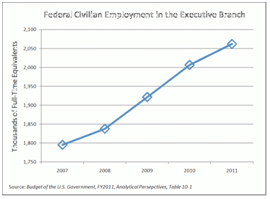
    The second leg of Obama’s troika was new government employment. He was successful in signing his health care reform into law but delayed implementation to 2014. The 2010 election that changed 63 House seats to the Republicans, has acted to unwind much of this legislation. If not repealed outright, Obamacare will likely face starvation from Republican cuts in funding necessary to implement the 2,900 page law with its hundreds of new federal regulations. Federal civilian employment in the president’s 2012 budget, will be 15 percent higher in 2011 than it was in 2007. This effort is also likely to be stymied.

    Union workers, the third leg of Obama’s troika, were well served in the first two years of the Obama Administration. The United Auto Workers inherited ownership in General Motors and Chrysler, and obtained federal protection of their relatively high wages and Cadillac health care benefits.  Had GM and Chrysler been allowed to enter Chapter 11 bankruptcy, it’s likely both would have been drastically reduced. Under the health reform act, union workers received exemptions from taxation for their Cadillac health care plans – unlike those of private companies.

    According to the most recent Employer Costs for Employee Compensation survey from the U.S. Bureau of Labor Statistics, as of December 2009, state and local government employees earned total compensation of $39.60 an hour, compared to $27.42 an hour for private industry workers – a difference of over 44 percent. This includes 35 percent higher wages and nearly 69 percent greater benefits. (Adam Summers Reason Foundation – Comparing Private Sector and Government Worker Salaries May 10, 2010).

    Will union members be able to hold their ground or be forced into major concessions during the coming deconstruction? State governors like Christie (NJ), Daniels (IN), Kasich (OH), and now Governor Walker of Wisconsin are taking on the unions head-on for the first time in generations. New conservative majorities in state house around the country are deconstructing collective bargaining agreements, above market wage gains, and Cadillac fringe benefits. Labor’s gains, and political clout, may have peaked in 2008. 

    Will President Obama adhere to his academician’s vision of the New Economy or will he be forced to succumb to the realities of the coming Great Deconstruction? Congress is arguing whether it can afford $4 billion in cuts to a $3 trillion budget in order to avoid an imminent government shutdown.

    Overlooked and more momentous is that for the first time since World War II, both houses of Congress – and some in both parties – are debating how to enact massive cuts in government spending. This is the beginning of the Great Deconstruction. Like the proverbial snowball rolling downhill, the $4 billion cuts of March 2011 could eventually canonball into hundreds of billions of actual spending reductions as the federal government deconstructs.

    The Government Accounting Office released a report on March 1st entitled ‘Opportunities to Reduce Potential Duplication in Government Programs, Save Tax Dollars, and Enhance Revenue.’ The report identified $200 billion in annual waste from duplicative federal programs. The agency found 82 federal programs to improve teacher quality; 80 to help disadvantaged people with transportation; 47 for job training and employment; and 56 to help people understand finances. Finding ways to cut billions in federal spending is not be the problem. Finding politicians with the political will to withstand the barrage of criticism from impacted constituents is another matter.

    The Great Deconstruction has already begun. Will President Obama, clearly a savvy politician, recognize this inexorable reality of this gathering force, leap in front of it, and claim ownership? Or will he stick to his academician’s vision and allow the snowball of deconstruction to roll over him? 

    Robert J Cristiano PhD is the Real Estate Professional in Residence at Chapman University in Orange, CA and Head of Real Estate for the international investment firm, L88 Investments LLC. He has been a successful real estate developer in Newport Beach California for thirty years.

    Other works in The Great Deconstruction series for New Geography
    Deconstruction: The Fate of America? – March 2010
    The Great Deconstruction – First in a New Series – April 11, 2010
    An Awakening: The Beginning of the Great Deconstruction – June 12, 2010
    The Great Deconstruction :An American History Post 2010 – June 1, 2010
    A Tsunami Approaches – Beginning of the Great Deconstruction – August 2010
    The Tea Party and the Great Deconstruction – September 2010
    The Great Deconstruction – Competing Visions of the Future – October 2010
    The Post Election Deconstructors – Mid-term Election Accelerates Federal Deconstruction – November 2010
    The State Government Deconstructors – November 2010
  • The High Speed Rail Battle of Britain

    A high speed rail battle is brewing in Great Britain, not unlike the controversies that have lit up the political switchboard in the United States over the past six months.

    The Department for Transport has announced a plan to build a "Y" shaped high speed rail route that would connect Leeds and Manchester, to Birmingham, with a shared line on to London and London’s Heathrow Airport.

    The government places the construction cost at £32 billion and makes familiar claims that the economic benefits would be 2.6 times the cost.

    These apparently impressive benefits relative to costs are not convincing to George Monbiot, the well-known environmental columnist for The Guardian. He points out that much of the purported benefit is a mere conversion of time savings into currency, which hardly produces "investment grade" projections.

    Monbiot further observes that these monetized time savings benefits largely will not be returned to the taxpayers who pay for the system. This raises a fundamental question. If the time savings benefits are so great to the users, why shouldn’t they pay for the whole system instead of the projected (and perhaps unreliable) 60 percent? Why should taxpayers be required to pay 40 percent (or probably more)?

    As in the United States, the critics get little respect. The Financial Times refers to the Taxpayers Alliance, which opposes the high speed rail program as an "anti-public spending group." In fact, like taxpayers organizations around the world, the Taxpayers Alliance does not oppose public spending but rather opposes wasteful public spending. The Transport Secretary himself, Philip Hammond employs a form of populist character assassination, calling opponents of the high speed rail line "truck importers and climate change deniers," echoing similar sentiments from this side of the Atlantic where promoters would have you believe that anyone who questions high speed rail is best described as an enemy of the people. Demonization should not be used as a substitute for debate.

    In the above referenced article, the Financial Times notes that 69 business people signed a letter favoring the project. FT refers specifically to executives of three companies, including Seimens, without mentioning that the firm is among the world’s biggest builders and promoters of high speed trains.

    Meanwhile, as in the United States, the government and much of the British media have accepted cost, ridership and revenue projections as produced by the consultants as if they were holy writ. Given the experience of Britain on this very corridor, this makes "child-like faith" look like ultimate truth.

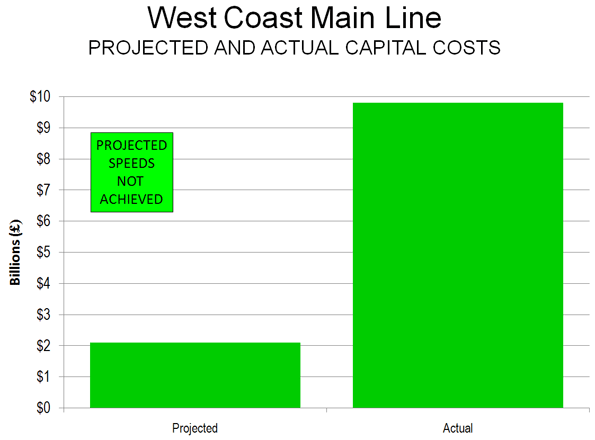
    Much of the proposed high speed rail line would be built parallel to the West Coast Main Line (which runs from London, through Birmingham and Manchester to Glasgow). Nothing short of a dog’s breakfast has been made of West Coast Main Line projects. In the 1980s, the tilting Advanced Passenger Train was developed to increase speeds to 155 miles per hour along the West Coast Main Line. The project was scrapped and all of the expenditure lost. Then there was the West Coast Main Line upgrade in the late 1990s and 2000s, to increase speeds to 140 miles per hour, which was to have cost £2 billion. The trains never exceeded 125 miles per hour, but the costs exceeded projections approached £10 billion instead, a world record cost blowout of Big Dig proportions (Figure).

    This should not be a surprise. The international record of high-speed rail projections is nothing short of horrific.Not only have costs proven far higher, but ridership and revenue have been less than projected. All of this means that taxpayers end up paying more.

    Again, Britain is a prime example. The Eurostar London to Brussels and Paris continues to attract at least 50 percent less ridership originally projected. High speed rail systems in Taiwan and Korea have had similar ridership shortfalls.

    As in Britain, costs have been higher as well. In Korea, the high speed rail line costs rose three times projections. Costs in California have increased 50 percent in two years and doubled over a decade even before the first shovel has been turned (inflation adjusted).  The cost escalation has already equaled the high end of the range predicted by Joe Vranich and me in our Reason Foundation Due Diligence Report on the California system in 2008.  

    If the proposed high speed rail project were simply to miss its cost and revenue targets by the international average (which is far better than the British experience), the benefits to users would fall below £1.00 for each £1.00 of cost. Both the strategic case and the business case for high speed rail would be blown apart. The spectre of cost overruns was a major factor in Governor Scott’s cancellation of the Florida high speed rail project.

    Not surprisingly, there is rising concern about high speed rail in Britain.A group of 21 officials, including former Chancellor of the Exchequer (minister of the treasury, finance and economics) Nigel Lawson, signed a letter to the Daily Telegraph calling the project "an extremely expensive white elephant isn’t what the economy needs. If the government wants to encourage growth there are better ways to get Britain growing and make us more competitive than getting each family to pay over £1,000 for a vanity project we cannot afford." The signatories also included Mark J. Littlewood, Director-General of the Institute of Economic Affairs, one of Great Britain’s leading free-market think tanks.

    Further, as in the United States there is also strong opposition from neighborhood groups concerned about the impact of trains operating at more than 200 miles per hour or faster through their neighborhoods. Eventually, up to 18 trains per hour are projected in each direction. This means that a 1,300 foot long train will pass houses and other adjacent development every one minute and forty seconds.

    There are the usual claims that the high speed rail line will reduce greenhouse gas emissions. However, as in California, the reality dissipates quickly, like steam into the air. Areport prepared for the Department for Transport by Booz Allen Hamilton concluded that the busiest section of the line, from London to Manchester would result in a net increase in greenhouse gas emissions when construction emissions are included (over a 60 year time analysis). Perhaps the intention is to begin reducing greenhouse gas emissions sometime after 2075?

    Monbiot further dismantles the environmental case, looking into the government reports to find that 92% of the passengers would switch to high-speed rail from alternatives that produce lower levels of greenhouse gas emissions (including conventional train, new travel and air).

    In Britain, as opposed to the United States, the proposed high speed rail system would relieve congestion on a passenger rail line. In contrast, US high speed rail lines would be built in corridors where there are few, if any rail passengers, much less passenger rail congestion.

    Even so, there are disagreements in Britain over whether high speed rail is the least costly way to address the problem, or indeed, whether there is a "problem" of sufficient magnitude to justify the public expenditure.

    The huge ridership increases projected may well be "over the top" given Britain’s less than population replacement fertility rate. As in the United States, some question the wisdom of high speed rail subsidies at a time that the government is (or in the case of the United States, should be) committed to an unprecedented austerity program that is falling heavily on middle income people who will not be the principal beneficiaries of high speed rail.

    In the final analysis, the questions will come down to who rides, how far and how fast. Will riders, in this third iteration, ride as fast as promised?  More likely it’s Britain’s beleaguered taxpayers who will be taken for a ride, with costs low-balled and ridership exaggerated as before.

    Revised on 3/22/2011. The original version had inappropritately refered to George Monbiot in the sentence about Transport Secretary Hammond. This was due to an editing error.

    Wendell Cox is a Visiting Professor, Conservatoire National des Arts et Metiers, Paris and the author of “War on the Dream: How Anti-Sprawl Policy Threatens the Quality of Life

    Photo by Jon Curnow

  • Energy Policy Reset: Forget Nuclear Reactors and Mideast Oil

    The two largest crises today — the Japanese nuclear disaster and the widening unrest in the Middle East — prove it’s time to de-fetishize energy policy. These serious problems also demonstrate why we must expand the nation’s ample oil and gas supplies — urgently.

    The worsening Japanese nuclear crisis means, for all intents and purposes, that atomic power is, if not dead, certainly on a respirator.

    Some experts may still make the case that nuclear power remains relatively safe. Some green advocates still tout its virtues for emitting virtually no greenhouse gases.

    But the strongest case against nuclear power is now rooted in grave public fears about radiation. Imagine trying to site or revamp a nuclear plant today anywhere remotely close to an earthquake fault or a major city.

    Germany has already begun shutting down some reactors. Opposition throughout Europe and in the United States is likely to grow exponentially as Japan’s tragedy unfolds.

    At the best of times, nukes were a hard sell. Even with support from Energy Secretary Steven Chu, a Nobel Prize-winning physicist who talks tough about fossil fuels, the obstacles to new nuclear construction were steep. Now, no amount of Obama administration green or corporate lobbying can overcome images of horrific fires and the terror, even if exaggerated, of radiation leaks.

    The other shoe dropping relates to the growing chaos in the Middle East, from North Africa to the Gulf. The price of oil is likely to continue climbing, unless the world economy slides back into recession — and perhaps even then. The governments that emerge from the current Mideast upheavals are likely to be far less pliable to Western interests than the authoritarian potentates that Washington long supported. Disruptions in supply, higher energy taxes and emergent environmental movements could constrain markets for months, even years, to come.

    These realities upset all the “best” obsessions of our rival political classes. Much of the progressive community, for example, had embraced nuclear fuel as key to ultimately replacing fossil fuels as a source of electricity — including the long-awaited electric cars. Green advocates often overestimated the readiness of renewable fuels — still far more expensive than fossil fuels and highly dependent on subsidies.

    Wind power, for example, produces, at best, some 2.3 percent of the nation’s electricity. But in addition to wiping out whole flocks of birds, it receives subsidies many times higher per megawatt hour than fossil fuels. In contrast, the dirtiest fuel, coal, still produces close to 50 percent of the nation’s electricity.

    Meanwhile, solar panel production, touted as a wellspring of job creation, seems to be shifting inexorably to China. Algae-based biofuels and other types look promising — but could take decades to become practical.

    Many conservatives, on the other hand, have espoused the nuclear option — in part, because the industry has powerful corporate backing, which is always an influential factor to Republicans. But even red-state denizens are probably looking at the scenes of Fukushima with understandable horror.

    So if the “best” agendas of both parties are flawed, it may be time to look at the “good.” The pragmatic way out of this emerging energy mess means focusing on our increasingly abundant supplies of oil and gas.

    “Peak oil” enthusiasts may not have noticed, but recent discoveries and improvements in technology have greatly expanded the scope of U.S. energy resources. New finds are occurring around the world, but some of the biggest are in the United States.

    Shale oil deposits in the northern Great Plains, Texas, California and Colorado could yield more oil annually by 2015 than the Gulf of Mexico. Within 10 years, these finds have the potential to reduce U.S. oil imports by more than half.

    Even more promising, from the environmental standpoint, are huge natural gas finds. Discoveries in Texas, Arkansas and Pennsylvania could satisfy 100 years of use at current demand levels.

    Natural gas is already muscling out coal as the primary source for new power plants. It can also be converted into transportation fuel, particularly for buses, trucks and taxis. In terms of pollutants and greenhouse gases, natural gas is much cleaner to burn than oil and significantly more so than coal.

    Exploring these resources is, of course, still likely to pose considerable environmental risks. But compared with the existential threat of nuclear radiation, even potential oil spills and damage to water supplies from fracking shale might be regarded as tolerable risks for which we have considerable experience and technology managing with enhanced regulation.

    In contrast, a nuclear meltdown, such as could be happening in Japan, poses a far more immediate threat than the scenarios proposed about climate change. Similarly, ceding even more power to an increasingly unstable Middle East represents a clear threat to both our economic and military security.

    Focusing on near- and medium-term fossil fuel development also has the virtue of fitting into the here-and-now realities of global economic conditions — largely the growing demand for energy in developing countries — and all but guarantees long-term high prices that encourage private investors to assume the risk. The likely demise of “clean” nuclear energy, sadly, makes such bets even more appealing.

    Producing domestic energy also creates the potential for hundreds of thousands of new U.S. jobs — everything from engineering to high-paying blue-collar work in the fields.

    A new gas-led energy boom would also spark increases in demand for manufactured goods like oil rig equipment, tractors, pipelines and refineries. And those are sectors that the United States still dominates.

    Would we rather this economic growth take place in Iran, Saudi Arabia or, for that matter, Vladimir Putin’s Russia?

    The time has come for both political parties to give up their “best” energy options for the good. A green economy that produces millions of new jobs is a laudable goal. But the renewable sector cannot develop rapidly without massive expenditures of scarce public dollars. To fully develop these technologies, we need lots of money and time.

    Republicans, too, need to give up their “bests” — including the notion that no policy is always the best, usually a convenient cover for the narrow interests of large energy corporations. Allowing private corporations to unilaterally determine our energy policy makes little sense. After all, most of our key competitors — China, Brazil and India — approach energy not as an ideological hobby horse but as a national priority.

    This new energy policy can be accomplished at far lower cost than either increasing dependence or waiting for the green Godot. It could also be far less expensive in terms of our soldiers’ lives — which would otherwise be spent protecting oil rights of corrupt Middle East regimes.

    It’s time to demand that our deluded, and self-interested, political class develops an energy policy based not ideology but on how to best guarantee prosperity for future generations of Americans.

    This piece originally appeared in Politico.

    Joel Kotkin is executive editor of NewGeography.com and is a distinguished presidential fellow in urban futures at Chapman University, and an adjunct fellow of the Legatum Institute in London. He is author of The City: A Global History. His newest book is The Next Hundred Million: America in 2050, released in February, 2010.

    Photo by gfpeck

  • Why We Can’t Shun Manufacturing for the Service Sector

    There’s been a lot of talk lately about the shift in the US economy away from production and increasingly into services. Consider the employment data from the US: In 1950, 30% of all US jobs were in manufacturing while 63% were in services. In 2011, 9% of total employment remains in manufacturing, 86% in services.

    So does this signify a shift in consumers’ tastes from manufactured goods to services? The short answer is no; if anything, we consume more “things.” The difference is that things are manufactured with far less labor, and they are increasingly made somewhere else. The manufacturing industries still remaining in the US have seen tremendous improvements in productivity. Less-skilled work continues to flow out of the US, but the work that remains is higher-skilled, and more productive. Accordingly, the manufacturing jobs that remain in the US pay well.

    Some look to the loss of US manufacturing jobs without concern: the future (they argue) is in service industries. As jobs disappear in manufacturing, others open in services like health care and retail. The problem is that as more manufacturing jobs leave, more productivity leaves as well.

    Consider this: Classical economists saw productivity as the key in determining relative wages — the more productive the laborer, the higher his/her wages. Unlike manufacturing, service-sector jobs have strict limits in terms of productivity. For example, a live performance of Beethoven’s 5th requires the same amount of performers/employees as when it was performed early in the 19th century. Compare that with the production of almost anything manufactured — the number of workers now required to produce a bolt of fabric, for example.

    So how is it that workers in service sectors, where productivity has relatively little growth, maintain wages competitive with workers in manufacturing, where productivity has done nothing but increase?

    At least part of the answer lies in what modern economists have dubbed the “Baumol Effect,” after influential economist William Baumol. The Baumol Effect states that lower productivity notwithstanding, service industries have to pay wages comparable to manufacturing in order to get the workers it needs: it’s a simple matter of labor market competition.

    So let’s put a little data behind this. The following table lists the 2010 national sales and employment numbers for 2-digit NAICS industry sectors, ranked in terms of total sales.

    Industry
    Name
    Sales (Millions)
    Jobs 
    Employment Rank
    31-33
    Manufacturing $4,444,349 12,116,153
    4
    90
    Government $3,055,594 23,931,184
    1
    52
    Finance and Insurance $2,335,933 9,276,170
    8
    62
    Health Care and Social Assistance $1,671,158 18,983,244
    2
    54
    Professional, Scientific, and Technical Services $1,482,841 11,711,344
    6
    53
    Real Estate and Rental and Leasing $1,391,188 7,374,135
    11
    44-45
    Retail Trade $1,194,951 17,369,914
    3
    51
    Information $1,135,475 3,252,198
    18
    23
    Construction $1,123,601 8,886,854
    9
    42
    Wholesale Trade $993,673 6,071,136
    13
    48-49
    Transportation and Warehousing $770,350 6,084,630
    12
    72
    Accommodation and Food Services $691,475 11,872,079
    5
    56
    Administrative and Support and Waste Management and Remediation Services $601,900 10,138,827
    7
    81
    Other Services (except Public Administration) $502,463 8,872,041
    10
    22
    Utilities $377,695 595,031
    21
    55
    Management of Companies and Enterprises $376,055 1,935,179
    19
    11
    Agriculture, Forestry, Fishing and Hunting $360,521 3,456,096
    17
    21
    Mining, Quarrying, and Oil and Gas Extraction $355,246 1,410,588
    20
    61
    Educational Services $260,555 4,080,407
    14
    71
    Arts, Entertainment, and Recreation $208,984 3,780,900
    16
    Total $23,334,007 171,198,110
    Source: EMSI Complete Employment, 4th Quarter 2010

    When considering what industry sectors to prioritize for workforce and economic development efforts it is important to look beyond basic employment numbers. This is because, while a sector might have a lot of jobs, it might not actually be producing a lot of income for the region, which is also very important for overall economic health and vitality.

    Sectors that generate more income per worker tend to have much bigger ripple effects, which means that a lot more people are impacted as a result of direct and indirect spending. The following table is organized by sales per worker, derived by dividing the total sales for an industry by total employment for a particular year.

    Industry Sector
    Sales Per Worker
    Utilities
    630K
    Manufacturing
    370K
    Information
    350K
    Finance and Insurance
    250K
    Mining, Quarrying, and Oil and Gas Extraction
    250K
    Real Estate and Rental and Leasing
    190K
    Management of Companies and Enterprises
    190K
    Wholesale Trade
    160K
    Government
    130K
    Professional, Scientific, and Technical Services
    130K
    Construction
    130K
    Transportation and Warehousing
    130K
    Agriculture, Forestry, Fishing and Hunting
    100K
    Health Care and Social Assistance
    90K
    Retail Trade
    70K
    Accommodation and Food Services
    60K
    Administrative and Support and Waste Management and Remediation Services
    60K
    Other Services (except Public Administration)
    60K
    Educational Services
    60K
    Arts, Entertainment, and Recreation
    60K
    Source: EMSI Complete Employment, 4th Quarter 2010

    Here’s our take on manufacturing and a few other basic observations that help to illustrate the difference between production and service sectors.

    When it Comes to Income Manufacturing is Still King

    At $4.4 trillion in total sales, manufacturing is by far the biggest income generator in our nation, despite a fairly rapid decline in employment (manufacturing has slipped to fourth in overall employment). Despite these trends, manufacturing still manages to far outperform all other industries in terms of pure income creation. Each individual that works in manufacturing generates roughly $370,000 per year. This is a very important fact to consider in a day and age when many folks advocate for improving the service sectors. 

    Again, here’s the thing to note: sectors like manufacturing that generate more income per worker have much bigger ripple effects, creating much more impact in a region while helping to raise wages in lower-productivity service sectors. 

    Government Services: High on Employment but Low on Productivity

    The government sector is twice the size of the manufacturing sector (in terms of employment) but only produces $3 trillion in earnings or $130K in income per worker. Government is a bit trickier to analyze using the sales per worker criteria because the government is essentially capturing tax dollars and spending them on various services (education, military, infrastructure). Government can provide a lot of stability to regional economies, but it’s not really a growth industry (unless you’re in DC!).

    Utilities and Finance – Low Employment but High Sales/Job Ratios

    The utility and finance sectors have lower employment (ranked 8th and 21st, respectively) but rather large sales to job ratios (250K per worker and 650K per worker, respectively). Keep in mind, the utility sector has a lot of overhead and equipment that factor into the equation. There is a huge amount of capital in play in this sector that requires a relatively small workforce. Finance and insurance can generate very large amounts of capital, and they have much less overhead.

    Health Care is Not a ‘Growth Industry’

    Health care, the ultimate service sector, has become the second-largest employment sector in the country, yet it produces only $90K in sales per worker, which is pretty low compared to manufacturing, information, or finance. Basically, the health care sector is important for obvious reasons and it can be a source of good jobs for a local region, but it’s not really an “economic driver” that is going to propel our nation into greater prosperity.

    Retail Trade vs. Information

    The retail trade and information industry sectors have similar income generation ($1.19 trillion and $1.13 trillion, respectively), however, retail trade is five times the size of information in terms of employment. This is why every economic developer is looking for “the next Facebook” and not “the next Napa Auto Parts.” Retail trade only generates $70K per worker while information generates $350K per worker.

    So what’s wrong with a service-based economy? It shrinks manufacturing employment as well as the manufacturing sector’s ability to prop up wages. A labor market that loses wage pressures of high-productivity manufacturing industries will settle at wage rates lower than markets where this wage-boosting effect is present. Economic development policy makers should be careful about shunning manufacturing or other production sectors in favor of service sectors.

    Dr. Robison is EMSI’s co-founder and senior economist with 30 years of international and domestic experience. He is recognized for theoretical work blending regional input-output and spatial trade theory and for development of community-level input-output modeling. Dr. Robison specializes in economic impact analysis, regional data development, and custom crafted community and broader area input-output models. Contact Rob Sentz with questions about this analysis.

    Illustration by Mark Beauchamp

  • USDOT Rail Grants to Obligate Taxpayers

    The US Department of Transportation has announced a competitive grant program to reallocate funding that was refused by Florida for a proposed high speed rail line from Tampa to Orlando. The line was cancelled by Governor Rick Scott because of the prospect for billions of dollars of unplanned obligations that could have become the responsibility of the state’s taxpayers.

    Eligibility: Eligible applicants are states, groups of states, Amtrak or other government agencies that authorized to "provide intercity or high-speed rail service on behalf of states or a group of states. The grant program requires recipients of grants (read "taxpayers") to provide financial support to intercity and high speed rail passenger rail programs in the event that cost and ridership projections are optimistic (a routine occurrence).

    Obligation to Pay for Cost Overruns: As in the program announced in 2009. the state, group of states, government agency will be required to demonstrate its financial capacity (that is, the capacity of their taxpayers) to pay for cost overruns (page 9). This open-ended liability led Governor Chris Christie of New Jersey to cancel a new transit-Hudson River rail tunnel, which had costs that were escalating out of control that would be the obligation of the state’s taxpayers. Governor Christie and Governor Scott were both aware of the disastrous record of major infrastructure cost overruns, such as in the Boston Big Dig project, the Korean high-speed rail program and the overwhelming majority of passenger rail projects in North America and Europe, according to a team led by Oxford University Professor Bent Flyvbjerg.

    Obligation to Pay Operating Costs: Moreover, inaccurate passenger and revenue forecasts have been pervasive in high-speed rail systems, as has been documented by Flybjerg, who found that cost overruns occurred in nine out of ten projects:

    … we conclude that the traffic estimates used in decision making for rail infrastructure development are highly, systematically and significantly misleading.

    This is illustrated by the fact that even a decade and one-half after the Eurostar London to Paris and London service was opened, ridership remains 60 percent below projection. Ridership on the Taiwan and Korea high speed rail systems has been one-half or more below projections. Our analysis of the Tampa to Orlando line revealed exceedingly high ridership projections, which were inexplicably raised even higher in a new report just released. Failure to achieve ridership projections increases the likelihood that a line will need operating subsidies, which would be the ultimate responsibility of taxpayers under the USDOT program.

    Federal Grant Repayment Obligation: Moreover, taxpayers of any grant recipient would be required to repay part or all of the federal grant if a sufficient level of service is not maintained for a period of 20 years (page 41). The operation of this provision is illustrated by recent Florida experience. Tri-Rail, the Miami area’s commuter rail service only narrowly escaped having to repay $250 million when its service level was deemed to not meet requirements of a federal grant by early in the Obama presidency. Tri-Rail was rescued by a state subsidy of nearly $15 million annually, which restored an artificially high level of service.

    Intercity and High Speed Rail Program: The federal intercity and high-speed rail program is largely limited to upgrades of Amtrak-type service. Before Governor Scott’s decision, only two of the programs (Florida and California) would have achieved international standard high speed rail speeds.  

  • From the Great Moderation to the Great Stagnation

    For much of the past decade, I was a proponent of the thesis that that the American economy had entered a “great moderation,” where expansions lasted longer and recessions were fewer, shorter and milder. Productivity had seemingly reached a permanently high plateau; inflation seemed tamed. The spreading of financial risk, across institutions and around the world, seemed to have reduced the odds of a crisis.

    Events of the past 30 months have put that thesis to rest.  I gave my mea culpa in Growth Strategies #1039 (October 2009), and also explained why we would instead be experiencing slow growth, high unemployment, low productivity growth, and higher taxes for the foreseeable future. That future has come to pass, and will continue to play out for years to come.

    Where does the economy go from here? Profits are up, the markets are up. Inflation and interest rates are still tame. How to reconcile rising profits, a robust stock market, and other positive indicators with unprecedented bankruptcies, foreclosures, underwater mortgages, business failures, unemployment and underemployment? The “working” economy has decided to move ahead and do fine and just leave millions behind. The future would be bright for many, okay for some and dark for many, and recommend being in the first group. 

    What about the overhang of debt and toxic assets? We seem to have opted for a long and slow process of rationalization, rather than a short, sharp and fast one. That means years of mixed messages and mixed trends: the good, bad and ugly.

    The Shattered American Dream

    A national survey of workers who lost their jobs during the Great Recession, conducted by two professors at Rutgers University, paints a gloomy view of the economic prospects for ordinary Americans.

    More than 15 million Americans are officially classified as jobless. The professors at the John J. Heldrich Center for Workforce Development at Rutgers have been following their representative sample of workers since the summer of 2009. The report on their latest survey, just out this month, is titled: “The Shattered American Dream: Unemployed Workers Lose Ground, Hope, and Faith in Their Futures.”

    Over the 15 months that the surveys have been conducted, just one-quarter of the workers have found full-time jobs, nearly all of them for less pay and with fewer or no benefits. As the report states: “The recession has been a cataclysm that will have an enduring effect. It is hard to overstate the dire shape of the unemployed.”

    Nearly two-thirds of the unemployed workers who were surveyed have been out of work for a year or more. More than a third have been jobless for two years. With their savings exhausted, many have borrowed money from relatives or friends, sold possessions to make ends meet and decided against medical examinations or treatments they previously would have considered essential.

    Older workers who are jobless are caught in a particularly precarious state of affairs. As the report put it:

    We are witnessing the birth of a new class — the involuntarily retired. Many of those over age 50 believe they will not work again at a full-time “real” job commensurate with their education and training. More than one-quarter say they expect to retire earlier than they want, which has long-term consequences for themselves and society. Many will file for Social Security as soon as they are eligible, despite the fact that they would receive greater benefits if they were able to delay retiring for a few years.

    There is a fundamental disconnect between economic indicators pointing in a positive direction and the experience of millions of American families fighting desperately to fend off destitution. Some three out of every four Americans have been personally touched by the recession — either they’ve lost a job or a relative or close friend has. And the outlook, despite the spin being put on the latest data, is not promising.

    No one is forecasting a substantial reduction in unemployment rates next year.
    Carl Van Horn, the director of the Heldrich Center and one of the two professors (the other is Cliff Zukin) conducting the survey, said he was struck by how pessimistic some of the respondents have become — not just about their own situation but about the nation’s future. The survey found that workers in general are increasingly accepting the notion that the effects of the recession will be permanent, that they are the result of fundamental changes in the national economy.

    Fundamental Changes

    Fundamental changes in the American workforce are taking place, and they hold tremendous implications for employers and employees alike. According to an Annual Workforce Trends Study commissioned by Yoh, a human resources firm, 80% of employers expect the size of their non-employee workforce (defined as consultants, independent contractors, temporary employees, and project teams) to stay the same or increase within the next year, even as the economy regains its footing.

    This new, temporary workforce presents issues for employers who will need to manage, compensate, and motivate workers who no longer view themselves as employees committed to a single employer. At the same time, for employees, this new workforce ushers in a new era of free agency, and holds vast implications for how they will build careers in a flexible work environment, where knowledge and skill trump seniority and security.

    Employers’ protracted reliance on a non-employee workforce as the US emerges from a severe recession represents a marked change from past economic recoveries when employers would add temporary talent before transitioning to full-time employees. Historically, temporary employment has served as a bellwether for permanent hiring, but these findings suggest that something much more substantial is occurring to overall workforce composition. Employers are saying that the recent recession has fundamentally changed their employment strategies and led to a “just-in-time” hiring strategy that will make temporary employees an even greater pillar of the American economy.

    The transformation of the workforce composition will have significant implications for both employers and employees. Employers now have the flexibility to quickly adjust the size of their workforce depending on project load.

    Employees, meanwhile, will have to overcome the stigma associated with “temporary talent.” Now that it’s here to stay, “temporary” workers might find themselves engaged in projects for longer periods of time, frequently transitioning into new opportunities and gaining access to jobs that were perhaps previously filled with full-time employees.

    The Great Stagnation

    Tyler Cowen of George Mason University is author of the e-book The Great Stagnation: How America Ate All The Low-Hanging Fruit of Modern History, Got Sick, and Will (Eventually) Feel Better. Cowen argues that in the last four decades, the growth in prosperity for the average family has slowed dramatically in the United States relative to earlier decades and time periods. Cowen argues that this is the result of a natural slowing in innovation, and does not expect a return to prosperity until new areas of research dramatically improve productivity growth.

    Part of Cowen’s core point is that up until sometime around 1974, the American economy was able to experience rapid growth by harvesting low-hanging fruit. There was cheap land to be exploited. There was the tremendous increase in education levels during the postwar world. There were technological revolutions occasioned by the spread of electricity, plastics and the car.

    But that low-hanging fruit is exhausted, Cowen continues, and since 1974, the United States has experienced slower growth, slower increases in median income, slower job creation, slower productivity gains, slower life-expectancy improvements and slower rates of technological change. Cowen argues that our society, for the moment, has hit a technological plateau.

    Is Cowen right? In my view he overlooks the growth of government over the last 40 years as an economic drag. Creative individuals and companies would be a lot more innovative if taxes were lower, regulations fewer, and the system of patents more reasonable.

    If stagnation is to be the new normal, we just can’t afford it. We are a nation, an economy, a society, based on growth. America needs to grow   We must therefore constantly replace, replenish, invent, create, innovate.

    For a long time I have been worried that the US was going the way of Europe: slow growth, high taxes, overregulation, high unemployment and underemployment, debt, deficits and little prospect of change. But perhaps we may have to worry instead is going the way of South America: an oligarchy of prosperous elites, and a great mass of the undereducated, under-skilled and underemployed, with little prospect of hope, change or opportunity.

    If you think I overstate the case, consider the disconnect between the people and governing classes. Only a minority of Americans express confidence in major institutions, according to Gallup. Only a minority of Americans believe that the federal government has the consent of the governed (Rasmussen).  In my view this disconnect may be an even bigger issue than stagnation.

    Dr. Roger Selbert is a trend analyst, researcher, writer and speaker. Growth Strategies is his newsletter on economic, social and demographic trends. Roger is economic analyst, North American representative and Principal for the US Consumer Demand Index, a monthly survey of American households’ buying intentions.

    Photo by Martin Deutsch

  • High-Speed Rail vs. Modal Neutrality

    Isn’t it curious that an Administration devoted to the principle of multi-modalism is so obsessively determined to promote a single mode of its own preference — that of high-speed rail? All three governors who rejected the federal HSR grants — Govs. Walker, Kasich and Scott — told Sec. LaHood that their states could badly use that money for more urgent needs of fixing roads, bridges and transit systems and, in the case of Gov. Scott, rebuilding Florida’s ports in anticipation of the Panama Canal expansion.

    Yet Sec. LaHood turned a deaf ear to those requests, insisting that the stimulus money must be spent on high-speed rail — even though money spent on other modes could have been just as effective in creating jobs. After justly condemning “stove pipe” mentality and modal biases in federal decision making it is ironic to find the Administration ignoring its own principles of modal neutrality in such a blatant manner.

  • Can Common Sense, and maybe Mickey, Save Orlando’s Transit Mess?

    The week’s debate about high-speed rail has once again polarized our populace, inflamed irrationality, and sent everyone back to their familiar corners.  Little constructive debate is possible when major newspapers are flailing the governor for rejecting money and the seemingly global revolutionary fervor is gripping local citizens who rallied in protest Wednesday night around downtown Orlando’s Lake Eola.  None of this will do any good for the service workers trying to get to their jobs in the theme parks or for downtown cube dwellers streaming to scattered office parks. With or without light rail the city inches closer and closer to the traffic hell of Atlanta, or worse even, DC. After all, both cities already have large rail transit systems.

    What will do some good is a creative discussion of some real change that can occur to improve our commute.

    We must recognize that we are stuck with our cars.  They aren’t going away.  We can’t wish them away. We have to make them better fast, because with changes blowin’ in the wind and with oil jumping back up over $100 a barrel.

    The high-speed bullet train – a sort of latter-day interstate highway program – sounded like a great idea at first, a welcome alternative to the ardor of air travel and the gas-sucking monotony of driving.  It has shortcomings, however, it will likely prove obscenely expensive, and once one gets to the destination, one is typically relegated to more driving.

    Nor is this some form of effective industrial policy.  The things will be built overseas – Germany, Japan or most likely China –  a great jobs program for someone else.  And tourists, who vastly prefer the freedom of car rental and driving, aren’t likely to use it except as a novelty for one of their visits to our wonderful place.  Perhaps the bitterest part of the bullet train pill: it will indebt our children and grandchildren to pay off landowners giving up their land in eminent domain – which produces nothing – and the cost of complex machines made overseas. The bullet train ends up being a clumsy solution imposed from above, rather than a grassroots solution to our real problems. 

    Any frequent driver on Interstate 4 between Orlando and Tampa can tell you there are four basic kinds of traffic: tourists in buses or cars; freight, in the form of tractor-trailers: business travelers (who need the flexibility of a car on the other end): and personal travelers.  Instead of targeting an expensive solution at just the smallest form of traffic, personal travel, a 4-part solution is suggested, all of which would add up to far less than $2 billion that minimally the high-speed line would have cost.

    1.  Trains can be good – for freight.  There are already freight lines running between Tampa and Orlando.  Getting the freight off of tractor-trailers and onto these freight lines, where it is vastly cheaper to move goods, should be a no-brainer for the state.  Use some of the DOT money to modernize freight depots along the pathway, incentivize freight customers to move their goods onto trains, and this will vastly improve the situation.
    2. Tourists can drive – at a price.  Our state should be treat itself with higher regard and also encourage a culture of sustainability for those visiting us.  Higher taxes on rental cars should be charged, and the taxes placed in an environmental fund to remove some of the unsightly development that has defaced our region, and return it to the special place it once was.
    3. Give business travelers an alternative.  If there were an affordable air shuttle between Tampa and Orlando, at the right price it would be full.  Little Embraers (made in Melbourne, by the way) taking off from FBOs at Orlando Executive Airport, Sanford Airport, and Orlando International Airport and landing in Tampa airfields would be worth $100 a seat, if the time/cost tradeoff were analyzed.  Ybor City for lunch, anyone?
    4. Give personal drivers an alternative.  For the cost of less than 50 miles of new road, a totally independent alternative to I-4 is waiting out there.  The first link of this road would connect Tampa’s Crosstown Express to Lakeland’s Western Beltway.  The next link of this road would connect the Western Beltway to the Greenway at Celebration.   Drivers will be able to go from downtown Tampa to downtown Orlando without their wheels touching I-4 even once.  Nice.

    And now, for the big one.  Right smack in the middle of the white-hot I-4 corridor lays a large, private entity, Disney, has been operating a private, train-based mass transit system for the last 40 years.  High labor costs?  Yes.  Fossil fuel driven?  Yes.  This entity has been strangely silent over the entire debate.

    If this entity were to wake up and seize the opportunity before it, one might see a true train that works.  First of all, the monorail was planned with some sense: it connects dense areas together.   If Disney were to offer to build, as a private development, extensions of its monorail reaching out to Tampa on one side and Orlando on the other, the air rights for this system could be along government-owned I-4 (no imminent domain costs).  This entity is also highly encouraged to charge market rate and to make a profitable venture out of operating this system. And the taxpayers would not be stuck with the bill.

    A vision for transit between Tampa and Orlando needs to be truly holistic, taking into account all types of traffic connecting the two regions.  This vision also needs to be locally driven, taking advantage of local strengths and assets already in place.  The high speed bullet train does none of this.  Instead, a multi-faceted solution that provides flexibility at both ends, leverages our current strengths, and partners with the strongest player in the region has a chance of truly making a difference in the present tense and likely future budget climate  This is what sustainability is truly about, and is what our future generations deserve.

    Richard Reep is an Architect and artist living in Winter Park, Florida. His practice has centered around hospitality-driven mixed use, and has contributed in various capacities to urban mixed-use projects, both nationally and internationally, for the last 25 years.

    Photo by Joe Penniston

  • Sputnik Moments, Spending Cuts, and (Remember These?) Jobs

    The stand-off in Washington over spending reductions has pushed aside serious discussion about a far more pressing issue:  job creation.

    Granted, the country is long overdue for action on spending cuts. There is much that our government does that we can live without. Bureaucracies’ programmatic lassitude and congressional appropriators’ adolescent-like lack of discipline have contributed to our nation’s fiscal imbalance.

    To be sure, the federal deficit is heading into a crisis zone the likes of which the United States has never seen, and a fairly dramatic policy response is needed to fix it. But one overlooked way to improve the fiscal picture would be to spark economic growth. This is precisely what worked well in the 1990s, something for which both a Republican Congress and Democratic President could legitimately claim credit.

    But the focus on jobs and economic growth has been lost.

    Democratic leadership chooses to focus on a narrow, government-driven idea of job growth, deluding themselves – against the huge weight of evidence – that government can lead the job growth agenda through stimulus. Republicans have made spending cuts the backbone of their jobs growth strategy, and they have embarked on a campaign to convince voters that if we cut enough spending, investor confidence will return, employers will hire more people, and jobs will return.

    President Obama’s Sputnik moment was truly the stuff of science fiction, or at least the Truman Show, in which we all drive our Priuses from our homes to the train station down the street on our way to work or the gym in a carefully planned world that will – voila! – create millions of jobs.  Republicans, for their part, have been primarily focused on non-defense discretionary spending – that part of the federal budget that accounts for only a little more than a third of all spending and which, if you removed all of it, would still leave the entitlement programs intact that add most to our debt and deficit. After the work of the scalpel is done, Republican theory goes, enough space will be cleared up in the economy for Adam Smith’s invisible hand to start generating jobs in an Austrian school-like spontaneous order, which will generate jobs…and so on.

    Now, to their credit, Republicans have begun talking more seriously about introducing entitlement reforms this year that would address the more serious deficit issues. Given the bipartisan nature of President Obama’s debt commission, the plan should get the support of at least some Democratic members, even if the President and Democratic congressional leadership shove it aside.

    But however much GOP congressional leaders might be wising up on addressing the deficit through fiscal restraint, they are AWOL on addressing it through job creation and growth, without which deficit reduction is much, much more painful.

    Voters know this at some level. In a poll of self-identified conservative Republicans at ConservativeHome.com, a site I edit, respondents are eager to see deep spending cuts, but they also give Republican lawmakers low marks on job creation and economic growth. In a poll we conducted last week, nearly half (49 percent) of respondents said they thought Republicans had been doing a good job of pushing for spending reductions, but 69 percent said Republicans were not doing a good job of explaining what they were doing to create jobs. The party of growth and opportunity has not even convinced its most ardent supporters what it is doing on the economy.

    Meanwhile, Gallup’s numbers this past week painted a troubling picture amidst slightly good news. While their survey showed an unemployment drop from 10.9 percent to 9.8 percent in the past year, this came mostly from gains among the most and least educated. Middle America remains pretty much stuck where it was. And then, as if to pour salt in a wound, Gallup released numbers three days later showing deterioration in jobs numbers in February compared to January.

    We can’t keep going on pretending stimulus, on the one hand, and spending cuts, on the other, are a viable economic growth strategy. There needs to be a realistic plan put forward and the party whose candidate figures this out will win the White House in 2012.

    The plan should consist of at least the following:

    First, tax reform. The President’s debt commission put forward some really good ideas. The best idea winning the most bipartisan support is reforming the corporate tax code. Rather than being a giveaway to big business, lowering America’s ridiculously high rate is the most proven way to create jobs. The OECD, not some right wing group, has concluded this after studying the issue across a number of countries. Also, simplifying the tax code by getting rid of costly deductions would help.

    Second, make it clear what being too big to fail means so investors will know, and start putting more capital into businesses that will create jobs. Luigi Zingales at the University of Chicago has a good idea about clarifying the current financial reform bill along these lines.

    Third, make energy the central component of a growth strategy. The U.S. has the capacity to become a net exporter of natural gas and to re-start a generation of nuclear power production that would make us less dependent on nonrenewable energy. We would also be greener in terms of carbon emission and would create jobs.

    Fourth, build more roads. Forget about those train tracks. We should be scraping together every unused stimulus dollar and wasteful penny of DOT funding to add lanes of highway to our most congested areas. Facilitating commerce and reducing lost revenue due to traffic congestion will also have the benefit of creating needed jobs.

    This would be a start. Whether anyone will take up the challenge is another issue.

    Ryan Streeter is Editor of www.ConservativeHome.com.

    Official White House photo by Pete Souza.

  • The Millennial Mosaic

    Esperanza Spalding, winner of the best new artist award at this year’s Grammys, personifies the ethnic trends reshaping America.  She is a fresh-faced 27-year old jazz bassist whose very name portrays her mixed ethnic and racial heritage as the daughter of an African-American father and a Hispanic, Welsh, Native American mother. Spalding first gained her deep interest in music watching French-born Chinese American classical cellist Yo Yo Ma on “Sesame Street,” a TV program that has perhaps contributed to ethnic acculturation in the U.S. as much as any other institution. Spalding’s formal musical training was originally classical, but at age 15 she decided that her passion was jazz, itself a quintessentially American 20th Century fusion of black rhythms and the melodies of European immigrants.

    The United States has gradually been becoming more diverse for decades, but Esperanza Spalding’s Millennial Generation (born 1982-2003) is most radically altering the nature of that diversity.  The entirely senior citizen Silent Generation (born 1925-1945) is 90% white. Baby Boomers (born 1946-1964) and Generation X (born 1965-1981) are a bit more diverse: 17% and 25% non-white respectively.  In contrast, four in ten adult Millennials are either African-American, Hispanic, Asian, or of mixed race. Among all Millennials of high school age or younger, about half now come from what was once called a minority group. Moreover, according to the 2009 Census population estimates, the under 18 population of Arizona, California, Hawaii, Maryland, Nevada, New Mexico, and Texas is majority-minority with Florida, Georgia, Mississippi, New Jersey, and New York poised on the brink of that benchmark.

    In 2008 the Census Bureau made these demographic trends “official” by forecasting that the United States will become a majority-minority country around 2040. By 2050, with an estimated 46% of the population, non-Hispanic whites will still remain the country’s single largest racial group, but Hispanics (30%), African-Americans (15%) and Asians (9%) will together comprise a majority of the U.S. population.

    Generational theory, first developed by William Strauss and Neil Howe, offers important historical insights on what this new majority-minority America might look like.    As we point out in our forthcoming book, Millennial Momentum: How a New Generation is Remaking America, we are in the midst of what Strauss and Howe have defined as a “fourth turning.” These periods have invariably been associated with the most intense social and political stress in US history: the American Revolution, the Civil War, and the Great Depression. Civic generations, heavily populated by the children of large waves of immigrants, are more ethnically diverse than older generations, contributing to the ethnic and racial tensions that have existed during each of these time periods. At the same time, because civic generations are comprised of group- and team-oriented, conventional and institution building individuals, ethnic absorption and acculturation also increases during and just after fourth turnings as each civic generation matures. This is in sharp contrast to “idealist” generations, such as the Baby Boomers, that reject the mainstream culture and often form movements promoting ethnic separatism.

    Ethnic tensions during previous similar generational changes rivaled those the country is experiencing today.  In the run-up to the Civil War, the rabidly anti-immigrant and anti-Catholic American or Know-Nothing Party captured close to a quarter of the national popular vote in the 1856 presidential election,and more than a third of the vote that year in all of the states that eventually comprised the Confederacy. In the 1930s, as the civic GI Generation children of the Eastern, Central, and Southern Europeans who comprised America’s last previous great wave of immigrants came of age to help elect Franklin D. Roosevelt, his most virulent opponents claimed that the president was really a Jew named “Rosenfeld” and derided his program as the “Jew Deal.”

    We see similar language in today’s discourse, at least on the fringes. Some extreme opponents of President Barack Obama accuse him of being foreign-born and a crypto-Muslim. In a more obscure way, if one searches Google for the seemingly innocuous phrase, “US majority nonwhite 2040,” two of the first three listings are from racist groups decrying this change and the third is from a liberal group advising the need to “understand” the fears of white people in a rapidly changing America.

    Fortunately civic generation Millennials have many characteristics that lead to ethnic acculturation and absorption The Civil War generation was critical to absorbing the Irish into the American mainstream, in part through the role played by Irish detachments in the Union Army, something that helped the Irish overcome the charge that they were an alien Papist force set on undermining a free Protestant nation.  Similarly, the GI Generation’s Poles, Italians, and Jews became acculturated during and after World War II, in part through their service in the armed forces or in the domestic war effort.  In sharp contrast to the anti-Semitic charges leveled against FDR, commentators on all sides of the political spectrum describe America as a “Judeo-Christian Nation.” Foods like bagels and pizza, once available only in urban ethnic enclaves, became commonplace, sold by pizza chains started by Irishmen and Greeks, or bagels marketed by brands such as Pepperidge Farm.

    In the current fourth turning, America’s newest ethnic minorities will also become acculturated and, in turn, shape the nation’s culture. A 2007 Pew survey indicates that while only 23% of first generation Hispanics speaks English “very well,” that percentage rises to 88% among those in the second generation and 94% within the third. At the same time, researchers at the University of California-Irvine and Princeton found that Latinos tend to “lose” their Spanish the longer they are in this country. This research indicates that although first generation Hispanics bring Spanish with them, by the second generation only a third of Latinos speak Spanish “very well.” By the third generation, that number drops to 17% among those with three or four foreign-born grandparents and to only 5% among those with just one or two foreign-born grandparents. ()  

    And, so as the United States endures the tensions and rancor of another generational fourth turning, it is important to realize that this too shall pass.  Millennials will, as have other civic generations before them, redefine what it means to be an American in ways both more diverse and inclusive than older generations may be able to imagine or appreciate.

    Morley Winograd and Michael D. Hais are fellows of NDN and the New Policy Institute and co-authors of “Millennial Makeover: MySpace, YouTube, and the Future of American Politics” and the upcoming “Millennial Momentum: How a New Generation is Remaking America.”

    Esperanza Spaulding photo by Andrea Mancini.