Category: Politics

  • Rahm Emanuel Wins The Right to Confront Chicago’s Problems

    Rahm Emanuel has won Chicago’s Mayoral election. He now must confront Chicago’s massive problems. The Chicago Sun-Times is already grim:

    Rahm Emanuel’s Round One victory gives him a running start on confronting problems so severe, the painful solutions could seal his fate as a one-termer.

    Whether Emanuel can avoid a one-and-done scenario — assuming he even wants to serve more than four years — will largely depend on how he tackles the biggest financial crisis in Chicago history.
    The city is literally on the brink of bankruptcy with a structural deficit approaching $1 billion when under-funded employee pensions are factored in.

    Mayor Daley borrowed to the hilt, sold off revenue-generating assets and spent most of the money to hold the line on taxes in his last two budgets. The city even borrowed $254 million to cover back pay raises long anticipated for police officers and firefighters.

    Last night’s election results could be a preview of Emanuel’s coming conflict with Chicago’s city workforce. Emanuel lost in some important wards where powerful city workers live. The government unions feel Emanuel might be too willing to cut their benefits and pensions. Alderman Ed Burke, Chairman of Chicago’s Finance Committee, will now be Emanuel’s biggest short-term problem (Burke’s 14th Ward didn’t support Emanuel). Does Emanuel have the votes in City Council to remove Alderman Ed Burke from his committee post? It’s too early to tell. Will Emanuel and Burke cut a deal?

    The new census numbers showed Chicago with population loss of 200,000 from 2000 to 2010. These Detroit style numbers show Rahm Emanuel will need all the help he can get. Chicago is in decline.

  • Britain’s Housing Crisis: Causes and Solutions

    British house construction has remained at a low level for a decade.   Total new house and flat completions for all tenures last year were 113,670 for England, 17,470 for Scotland, and 6,170 for Wales. Excluding Northern Ireland that is 137,310 for Britain. Under 140,000 homes a year is low for a nation of 60 million.

    We are nearly at the lowest level of housing production since reliable records began in the 1920s. (Note 1)  

    Anyone expecting British house building to pick up soon will be disappointed, even as the housing market inflates into another bubble. Grant Shapps,  the Coalition government’s Housing and Local Government Minister, is also hoping that house price inflation will not return to make the present housing predicament worse.  
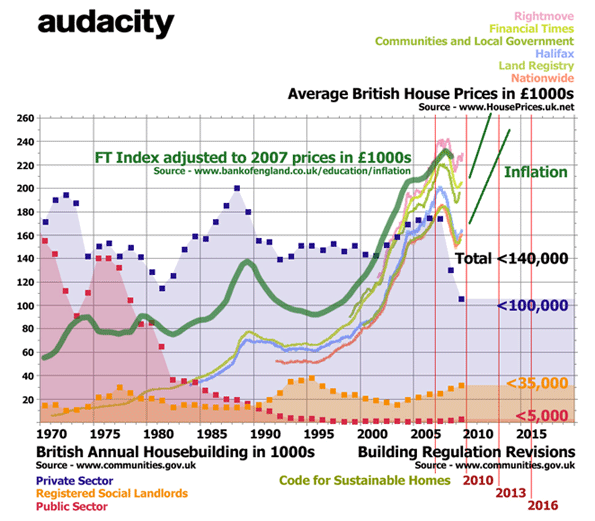
    He will be disappointed, too. Shapps wants modest deflation and more houses to be built. However, he is powerless to make that happen while his government sustains the national denial of Freehold development rights that in Britain defines the planning system. By denying landowners the right to build on any land they own, the system works against significant levels of housing production.

    The renewal of house price inflation

    The low level of production all but guarantees renewed house price inflation. According to estate agency Savills, inflation-adjusted house prices grew by 68 per cent in the decade up to 2010, even after the British housing market finished wobbling during the sub-prime mortgage finance crisis. Savills told readers of The Telegraph that house prices will inflate by 40 per cent in real terms over the next decade.  

    Britain’s vast majority of home owners will be relieved. Most people have felt uneasy with financial dependency on the debt and equity in their home. For most British households wages and pensions are insufficient.

    At the root of the problem lies the peculiar nature of Freehold in Britain. The government enjoys an effective national instrument in their effort to protect the housing market. An old innovation of the post-war planning system, this ensures cheap farm land can never come onto the market to allow the building of low cost homes in great volume, sufficient to precipitate a housing market crash worth having. Planning as a denial of development rights works very well to protect the members of the Council of Mortgage Lenders.

    This keeps house building volume low.   Britain’s former volume house builders have begun to make the painful adjustment to work within the Coalition’s planning system. It will not be easy for them.

    The national denial of development rights is sustained, and in many ways the problem is worse under the Conservative-led coalition than under New Labour.

    The house builders have been stripped of New Labour’s national target of 240,000 net additional homes a year, but that was an unmet and inadequate target.   Even more troubled are plans to develop 50 proposed “eco towns” also proposed by Labour, itself a small, even deluded, enterprise that is pathetic compared to development elsewhere in the world.

    Urban expansion and new settlements – whether in Britain or elsewhere – require land. And Britain, contrary to popular belief has land aplenty. The restraints placed on builders can best to described in the words of Sir Peter Hall, as a “Land Fetish”.   

    The planning system also is host to an eco-fetish that the Coalition appears willing to sustain regardless of housing need.

    Inevitably some house builders will have subscribed to the idea that the environment is too precious to allow much land to be developed, but not all.  This leaves no centralised attempt to satisfy the demand for new household formation following from population growth, the needs of immigrants, or to encourage the replacement of the worst housing stock. For greens of the more misanthropic persuasion, opposition to both population and production makes sense. They don’t want humanity to reproduce either biologically or industrially. They don’t want a world that is always about advancing human interests through industry.

    Yet the need for new homes won’t so easily go away.

    A three sided predicament

    This contemporary British housing trilemma will not be easily resolved. The country seems to accept expensive, inadequate housing and mortgage debt as a fact of life.  

    Yet this leaves us with no solution for future needs.

    Something needs to change.  Hugh Pavletich and Wendell Cox publish as Demographia have found – for the seventh year running – increasing unaffordability of British housing.  

    The Solution: 250 New Towns

    The only reasonable solution is to tear down the current planning structure. What we need is an audacious move to build some 250 new towns.

    This movement would try to replicate past successes. In the brief inter-war period, 1918 to 1938, popular owner occupation flourished, with economically struggling farmers keen to sell their Freehold land to house builders.  

    How long will Britain live with low levels of construction, increasingly higher prices and consistently low levels of affordability? The increasing drag of house price inflation on household incomes and the acceptance of poor quality British housing in short supply cannot be sustained indefinitely.  

    How long will Britain sustain housing unaffordability as a financial opportunity, protected by a weak government?  

    The British collective obsession with inflating house prices must end sometime, unless we are to lose all sense of housing primarily as somewhere useful to live.  

    The freedom to build on your own land will deflate the housing market, dramatically in some locations.  Giving all landowners their Freehold right to build will liberate the commercial construction industry from the burden of inflated land prices, allowing disruptive advances in industrial production.  

    If Britain faces the house price inflation projected by Savills in the next 10 years there are many home owners dependent on housing equity who will not object. Neither will the house builders object too much as they build a low number of luxury eco-homes, to the undoubted applause of the architectural press. They may enjoy the praise for their greenness. Farmers might subsist as environmentalists. Greens will be sufficiently deluded to imagine there was some point to all this. The City will make a healthy return.

    The green zealots are conspicuous, and need to be confronted by industrialists with a sense of humanity. Now is no time to let them get away with their anti-humanism.

    Britain certainly is capable of more than is currently being discussed. National housing output had peaked in 1968 at 413,714, more than twice the current rate.

    We have to answer the question: Who will organise to better explain and end the housing predicament in low wage industrial Britain? We are hoping the 250 new towns club can start the ball rolling.

    —-

    Note 1 – Marian Bowley, ‘Table 2, Numbers of Houses Built in England and Wales between January 1, 1919 and March 31, 1939’, in Housing and the State 1919-1944, London, George Allen & Unwin, 1945, p 271

    Ian Abley, Project Manager for audacity, an experienced site Architect, and a Research Engineer at the Centre for Innovative and Collaborative Engineering, Loughborough University. He is co-author of Why is construction so backward? (2004) and co-editor of Manmade Modular Megastructures. (2006) He is planning 250 new British towns.

  • Obama’s High-Speed Rail Obsession

    Perhaps nothing so illustrates President Obama’s occasional disconnect with reality than his fervent advocacy of high-speed rail. Amid mounting pressure for budget cuts that affect existing programs, including those for the inner city, the president has made his $53 billion proposal to create a national high-speed rail network as among his top priorities.

    Our President may be an intelligent and usually level-headed man, but this represents a serious case of  policy delusion. As Robert Samuelson pointed out in Newsweek, high-speed rail is not an appropriate fit for a country like the U.S. Except for a few areas, notably along the Northeast Corridor, the U.S. just lacks the density that would make such a system work. Samuelson calls the whole idea “a triumph of fancy over fact.”

    Arguably the biggest problem with high-speed rail is its extraordinary costs, which would require massive subsidies to keep operating. Unlike the Federal Highway Program, largely financed by the gas tax, high-speed rail lacks any credible source of funding besides taxpayer dollars.

    Part of the pitch for high-speed rail is nationalistic. To be a 21st century super power, we must emulate current No. 2 China. But this is a poor reason to indulge in a hugely expensive program when the U.S. already has the world’s most evolved highway, freight rail and airline system.

    Also, if the U.S. were to follow the Chinese model, as some have suggested, perhaps it should impose rule from a Washington version of a centralized authoritarian government. After all, dictatorships are often quite adept at “getting things done.”  But in a democracy “getting things done” means balancing interests and efficiencies, not following orders from above.

    In China high-speed rail is so costly that the trains are too expensive for the average citizen. Furthermore, construction costs are so high the Chinese Academy of Sciences has already warned that its debts may not be payable. This experience with ballooning costs and far lower fare revenues have raised taxpayer obligations in Taiwan and Korea and added to heavily to the national debt in Japan.

    The prospect of mounting and uncontrollable costs has led governors to abandon high-speed projects  in Ohio, Wisconsin and most recently Florida, where a battle to save the Tampa-Orlando line has begun . In times of budget stress, the idea of building something new, and historically difficult to contain by costs, becomes a hard sell.

    Oddly, the leaders of California, faced with one of the worst fiscal positions in the country, are determined to spend several billions on what Sacramento Bee columnist Dan Walters has dubbed a “train to nowhere” for 54 miles between Madera and Corcoran — two unremarkable and remote Central Valley towns. The proposal makes the former Alaska Sen. Ted Stevens’ notorious ”bridges to nowhere” project seem like frugal public policy.

    California’s train to nowhere has been justified as part of wider project to construct a statewide system. But the whole idea makes little financial sense: The University of California’s Institute for Transportation describes the high-speed proposal as based on an “inconsistent model” whose ridership projections are simply not “reliable.”

    Equally suspect are cost estimates, which have doubled (after adjustment for inflation) from 1999 to $42.6 billion last year and. A new study says that the project could currently cost close to $65 billion. Costs for a ticket from Los Angeles to San Francisco, originally pegged at $55 one way, had nearly doubled by 2009, and now some estimates place it at about to at least a $100 or perhaps much as $190 — considerably more than an advanced-purchase ticket on far faster Southwest Airlines.

    There’s growing political opposition to the system as well, and not just among penny-pinching right-wingers. Residents and local officials in the San Francisco Peninsula, a wealthy and reliably liberal portion of Silicon Valley, largely oppose plans to route the line through their communities. This includes some prominent liberal legislators, such as San Mateo’s Assembly Jerry Hill, who has threatened to put high-speed rail back on the ballot if costs start to surpass initial estimates. Another Democrat, California Treasurer Bill Lockyer has doubts that the rail authority will be able to sell the deal to potential bond-buyers   due in part to a lack of consistent estimates in ridership or cost.

    So why is Obama still so determined to push the high-speed boondoggle? Largely it’s a deadly combination of theology and money. Powerful rail construction interests, notably the German giant Siemens, are spreading cash like mustard on a bratwurst to promote the scheme. Add to that construction unions and the ever voracious investment banks who would love to pocket fees for arranging to sell the bonds and you have interests capable of influencing either party.

    Then there’s what might be called the “density lobby” — big city mayors, construction firms  and the urban land owners. These magnates, who frequently extort huge public subsidies for their projects, no doubt think it grand to spend billions of public funds on something that might also increase the value of their real estate.

    And finally there are the true believers, notably planners, academics, green activists and an army of rail fans. These are people who believe America should be more like Europe — denser, more concentrated in big cities and tied to the rails. “High speed rail is not really about efficient transport,” notes California transit expert and accountant Tom Rubin. “It’s all about shaping cities for a certain agenda.”

    Yet despite their power, these forces face mounting obstacles. As transportation expert Ken Orski points out, the balance of power in the House now lies with suburban and rural legislators, whose constituents would not benefit much from high-speed rail. And then there are governors, increasingly Republican and conservative, very anxious not to add potentially huge obligations to their already stressed budgets.

    The most decisive opposition, however, could come from those who favor transit spending but understand to the need to prioritize.  High-speed rail is far more expensive than such things as fixing current commuter rail and subways or expanding both public and private bus service. Indeed, the money that goes to urban rail often ends up being diverted from other, more cost-effective systems, notably buses.

    The choice between high-speed rail and more conventional, less expensive transit has already been presaged in the fight against expanding LA’s expensive rail system by organizations representing bus riders. These activists contend that rail swallows funds that could be spent on buses

    Much the same case is being made the San Francisco peninsula. The opponents of high-speed rail on the San Francisco Peninsula are outraged that the state would spend billions on a chancy potential boondoggle when the popular Caltrain commuter rail service is slated to be curtailed or even eliminated.

    One can of course expect that anti-spending conservatives will be the biggest cheerleaders for high-speed rail’s decline. But transit advocates may be forced to join the chorus of opposition, in order to steer   transit spending towards more basic priorities as buses in Los Angeles, subways in New York or commuter rail in the San Francisco Bay Area.

    In an era of tough budgets, and proposed cutbacks on basic services, setting sensible transportation priorities is crucial. Spending billions on a conveyance that will benefit a relative handful of people and places is not just illogical. It’s obscene.

    This piece originally appeared in Forbes.

    Joel Kotkin is executive editor of NewGeography.com and is a distinguished presidential fellow in urban futures at Chapman University, and an adjunct fellow of the Legatum Institute in London. He is author of The City: A Global History. His newest book is The Next Hundred Million: America in 2050, released in February, 2010.

    Photo: Center for Neighborhood Technology

  • Tampa to Orlando High Speed Rail: The Risk to Local Taxpayers

    No sooner had Florida Gov. Rick Scott rejected federal funding for the Tampa to Orlando high-speed rail line, than proponents both in Washington and Tallahassee set about to find ways to circumvent his decision. While an approach has not been finalized, a frequently suggested alternative is to grant the federal money to a local government, such as a city or county or even to a transit agency.

    Eliminating State Taxpayer Risks, Creating Local? In an announcing his decision, Governor Scott cited the substantial risks to Florida taxpayers from cost overruns, the ongoing obligation under the federal grant to subsidize operations and the fact that under certain circumstances Florida might even have to repay the $2.4 billion in federal grants. Any local government accepting the federal money would expose itself to the financial risks from which Florida taxpayers have been exempted by Governor Scott’s action.

    None of these risks is an idle threat.

    (1) Capital Cost Overruns: Based upon the international experience, the eventual construction cost overruns for the Tampa to Orlando high-speed rail line could easily run to $3 billion, more than doubling the price of the project (Note on Extent of Taxpayer Liability, below). In light of the recently reported 50 percent increase in California high-speed rail construction costs, even the $3 billion estimate could turn out to be conservative. The problem is that any local federal grant recipient (city, county or transit district) would be responsible for these cost overruns.

    (2) Ongoing Operating Subsidies: The ridership projections for the Tampa to Orlando high-speed rail line are exceedingly optimistic. This could well lead to a situation in which substantial subsidies are necessary to operate the trains, despite claims of proponents to the contrary. These subsidies would be the responsibility of any city, county or transit district that becomes a grant recipient.

    (3) Federal Pay-Back: If, for any reason, the eventual high-speed rail service levels are not sufficiently high because of lower than projected ridership or if service is canceled, any city, county or transit district could be required to return the $2.4 billion in federal grants. Florida is already paying millions annually for a similar "transgression." In 2009, service reductions on the Tri-Rail Commuter Rail System in the Miami area led the Obama Administration’s Department of Transportation to demand repayment of one quarter billion dollars in grants. Tri-Rail was saved from this obligation only by a multimillion dollar Tallahassee bailout. Proponents have claimed that this rail obligation could be negotiated away for high-speed rail. Why was the Tri-Rail obligation not negotiated away in 2009?

    By rejecting the federal funding, Gov. Scott has inoculated Florida taxpayers against these risks.

    However, there would be no inoculation for any local jurisdiction whose commissioners or city council accepted the expensive "gift" of federal funding for the high speed rail line. Their taxpayers would have to pay. The very financial viability of any such jurisdiction could be at risk.

    The Risk Could Revert to State Taxpayers: Eventually, the risk could be again be visited upon state taxpayers as a local government facing virtual bankruptcy would doubtless seek a bailout in Tallahassee, repeating the Tri-Rail experience, though much more expensively. Moreover, canceling a half built project, which might be tempting as costs escalate above projections, would simply not be viable. The political pressure to complete the project, at whatever cost, could prove to be overwhelming.

    Delusions About Private Responsibility for Cost Overruns: Some proponents claim that these huge obligations can be somehow transferred to the private builder/operator that is selected for the project. Nothing like this has ever happened in public-private partnerships around the world, and for good reason. Companies do not stash away billions of dollars for cost overruns.

    Further, the winning bidder will be a consortium of other companies, established with limited liability by larger companies. The consortium would abandon a project it could not afford sooner rather than later. Any bankruptcy of the builder/operator would be limited to the consortium and would not extend to the parent companies, leaving the local taxpayers to pay.

    There is no escaping the fact that the taxpayers of any city or county accepting the federal money would be providing financial guarantees to an international infrastructure industry that has left a "train" of huge and unanticipated financial obligations around the world in its wake (Note on Cost Escalation, below).

    Believing in Santa Claus? Public officials, and most recently Orlando Mayor Teresa Jacobs, have indicated support for high-speed rail if private and federal funds pay for it, and state and local taxpayers aren’t exposed to liability. This is a wise position, but untenable. Expect Santa Claus to arrive in the midst of a Florida summer before that, with a sleigh full of billions.

    —-

    Note on Extent of Taxpayer Liability: This $3 billion is in addition to the already committed $280 million of taxpayer funding. Proponents of the high-speed rail line have assumed that the $280 million would be the limit of taxpayer obligations. As this article shows, the $280 million could be a "drop in the bucket" compared to the likely eventual taxpayer liability.

    Note on Cost Escalation: An international team of researchers led by Oxford University Professor Bent Flyvbjerg has found in Megaprojects and Risks: An Anatomy of Ambitionthat similar projects routinely cost far more than taxpayers and other funders are told. They also attract fewer riders and generate less revenue (which can require operating subsidies). The Flyvbjerg team implies that these "lowball" (our term) projections are not accidental but all are the result of "strategic misrepresentation," (their term) which project promoters employ to increase the potential that projects will be approved. The researchers also refer to "strategic misrepresentation" as "lying," which is an exceedingly strong term for academic research and is reflective of the strength of the conclusions.

  • Debt Ceiling or Spending Limit?

    We’re seeing a lot of debate in Washington about what is commonly referred to as the "national debt ceiling." This post is an attempt to shed some light – and provide some good resources for further information – on what this really means. National debt is not the total future obligations of the federal government to pay. It is basically all the public debt (like Treasury bills) plus money we owe to other governments – in other words this ceiling only puts a limit on how much the federal government can borrow, not on how much they can spend.

    The national debt number is available "to the penny" at the Treasury Direct website. There are only a few categories of debt that are not subject to the limit, mostly having to do with the way that Treasury Bills are issued to pay all the interest up front (discounted) and the way that payment is handled in accounting terms. Raising the National Debt Ceiling involves raising the limit on the public debt ceiling.

    There is a bigger number that most other countries use to define “debt”. The official definition for “debt” used in the European Union, for example, includes obligations to Social Security, Medicare, etc. at the national level, plus regional and local government debt. (Thanks to Yannick for initiating a discussion of the distinction with his comment to my 2009 piece on Public Debt Crisis.) In the U.S., the larger number is usually referred to as "total indebtedness". There is no limit set on the promises of the US government to spend money — for example, the almost $13 trillion committed to the post-crisis bailouts and stimulus was not subject to the debt limit despite that number being almost equal to the total national debt. The limit only applies to how much the Treasury can borrow to meet its obligations. So if the question is “should the ceiling be raised?” then my answer is “it doesn’t really matter.” Congress can keep spending without it.

    When politicians say they are against raising the debt ceiling it’s usually referred to as “Grandstanding” – which Merriam-Webster explains is to act so as to impress onlookers.

  • The Rest of the Story on Krugman and the Economy

    Paul Krugman really doesn’t like the possibility that there is a structural shift in employment, because it weakens the argument for the massive Keynesian spending spree he’d like to see the government initiate.  To that end, he published this piece on his blog February 13th.

    Before we go on, some readers may wonder what a structural shift is and why it weakens the argument for Keynesian spending.  A structural shift is when employment permanently shifts (well, as much as anything is permanent in economics) from one economic sector to another, say from construction to healthcare.

    The reason that a structural shift weakens the Keynesian’s argument is that moving workers from one sector to another takes time.  They may need retrained.  They may need to move to another location.  Think of our construction worker moving to health care.  He or she probably doesn’t have the skills to be immediately employable in health care.  Some sort of education or training has to happen first.

    This poses a problem for Keynesian expansionists, because their argument is that the only problem is a drop in aggregate demand (consumer spending) brought about by….well, animal spirits.  Since there is no real problem, government can increase spending (it doesn’t matter what you spend the money on.  You could dig holes and fill them back up), fool the consumer into thinking she is better off, and voilá, aggregate demand goes up with the government spending.

    Problem solved.  It’s a beautiful thing.

    However, spending can’t solve the problem of unemployment brought about by a structural shift.  It takes time to retrain the affected workers.  There are things government can do to speed the process, but spending willy-nilly is not one of them.

    Hope that clears things up.  Let’s get back to Krugman’s piece.

    He claims that unemployment in every sector has just about doubled since the recession began, and that this is proof that no structural shift is going on.  He has a nice chart to show the increase in unemployment by sector.

    There is a problem though.  The Bureau of Labor Statistics—the same source that Krugman claims originated his data—reports that construction jobs fell by 2 million, or 26.7 percent, from December 2007 through December 2010, while education and healthcare jobs grew by1.2 million, or 6.5 percent.

    This appears to contradict Krugman’s data, but it is possible that both sets of data are true.  If they are both true, then Krugman is being no less dishonest than if he created his numbers out of thin air.
    If Krugman is telling the truth when he presents a graph showing that unemployment approximately doubled from 2007 to 2010 in both the construction and the education and healthcare sector, then is must be that large numbers of unemployed construction workers migrated to being unemployed education and healthcare workers.

    There is no other possible explanation.

    This, of course, completely contradicts Krugman’s argument.  If his data are true, he’s using data that confirms a structural shift to argue that there is no structural shift, by neglecting to disclose the jobs data I’ve disclosed above.

    Krugman is not a dumb guy.  He has a well-deserved Nobel Prize for his work on international economics.  He has a career of looking at data, in depth and with insight.  His failure to provide the entire story has to be considered something besides an oversight.  We have to conclude that he’s purposely being deceitful.

    I don’t know why a guy with all of Krugman’s gifts and accomplishments would use data deceitfully.  It is a shame, though, that an economist at the top of his profession and with the New York Times bullhorn uses that bullhorn to confuse instead of to enlighten.

  • A More Objective Attitude Toward the Suburbs (Almost)

    It is always encouraging to see greater objectivity in the treatment of the suburbs. In fact, the urban form includes not only the urban core, but also the suburbs and economically connected rural areas and exurban areas that are beyond the urban footprint. This fact has often been missed by some urbanologists who imagine no city extends beyond the view on the foggiest day from a central city office tower.

    William Upski Wimsatt, author of Bomb the Suburbs, has now published an update called Please Don’t Bomb the Suburbs. The title of Wimsatt’s original book, focusing on grafitti and hip-hop culture, has a ring reflective of the irrational and ideological condemnation that has been far too typical of some of the urban planning community.

    Wimsatt cites five myths about suburbs in a Washington Post opinion piece. To be charitable, he gets as many as four of them right. These include his discovery that suburbs are not white middle-class enclaves, that they can be "cool," that they are not necessarily politically conservative, and that suburbanites care about the environment.

    However, Wimsatt still has some distance to go. His last myth suggests that suburbs are not the result of the free market. This general proposition is tenable, for example, given large lot zoning requirements, which have caused many urban areas to consume far more land than they would have if the market had been allowed to operate. The problem with Wimsatt’s free-market analysis is his acceptance of three additional myths.

    Myth 1: Smart Growth Reduced Property Taxes in Portland: Wimsatt cites an analysis indicating that property taxes in Portland dropped between the mid-1980s and the mid-1990s while property taxes in Atlanta increased. He uses this "factoid" to imply that Portland’s more restrictive land use planning regime ("compact development" or "smart growth") is superior to the more liberal Atlanta approach. Wimsatt does not note that during this period the voters of Oregon implemented their own Proposition 13 type property tax reduction (Measure 5), which lowered property taxes even as per capita revenue rose at a greater rate in Oregon than in Georgia. To be fair, Wimsatt cannot be blamed for this oversight, since the Sierra Club source he cited omitted this detail. We refuted a larger analysis by Arthur C. (Chris) Nelson that included this claim 10 years ago, in a paper for the Georgia Public Policy Foundation entitled American Dream Boundaries: Urban Containment and its Consequences.

    Myth 2: Suburban Infrastructure is More Costly: Wimsatt claims that the cost of infrastructure and public services is higher in suburbs than in the urban core. Joshua Utt and I put this myth to rest in research covering all of the reporting municipalities in the US government database, which indicated no such higher costs (The Costs of Sprawl: What the Data Really Show). The claims of higher infrastructure and service costs in the suburbs are largely based on theoretical studies, which invariably suffer from the "length of pipe" fallacy, which fails to take into consideration the substantial differences in the costs of infrastructure construction in already developed areas versus greenfield areas. In fact, labor costs tend to be less in suburban areas. Moreover, much of the cost of suburban development is paid for by home owners, who reimburse developers who have already paid much of the sewer, water and street construction costs. These are not costs to the public or to society, they are costs that buyers voluntarily pay for what they consider to be a better lifestyle. Finally, Core city infrastructure is often obsolete and not able to adequately serve the higher demand that would occur from substantial population increases.

    Myth 3: Consolidating Local Government Saves Money: Wimsatt presumes that consolidation of local governments is a way to reduce public expenditures. He cites the case of towns in New Jersey, which he would prefer to see combined. Despite the fact that ivory tower before-the-fact analysis routinely concludes that larger, consolidated local governments are spend less per capita than smaller governments, the record says exactly the opposite. Our research, using US government, New York, Pennsylvania and Illinois state databases shows a consistent relationship between larger local governments and higher expenditures per capita and higher debt per capita.

    This should not really be so surprising, since larger governments tend to be further from the people and by definition more remote from their control. Where voters are less important, as is the case with larger local governments, special interests fill the vacuum, generally to the detriment of taxpayers.

    With this diluted control by voters, larger governments tend to get into financial difficulty, and a vicious cycle of excessive spending and debt can follow. Often unable to say no to spending interests, they raise taxes. When the electorate loses tolerance for higher taxes, larger governments tend to borrow, which increases expenditures even more. Finally, when they reach high debt levels, it is not unusual for there to be proposals to consolidate these governments with their smaller neighbors, which have been more fiscally prudent. If consolidation is implemented, the new larger local government is granted a new lease on fiscal irresponsibility, and per capita expenditures and debt is likely to rise even higher.

    As if that were not enough, labor contracts and service levels are routinely "harmonized" at the highest cost, since employees will not be forced to take pay or benefit cuts and service levels will generally not be reduced for residents. This was cited by the Toronto Business Alliance after a theoretical $300 million in promised cost savings were transformed into substantially higher spending in the newly consolidated city.

    Welcome: Wimsatt graciously ends his commentary by saying "Everyone with a prejudice against the suburbs will have to get over it. Even me." Welcome, Mr. Wimsatt.

  • “Patchwork” High Speed Rail System Unraveling?

    The widely dispersed opposition to proposals for high speed rail (genuine and faux) led Secretary of Transportation Ray LaHood to say that the Administration would press forward in a patchwork fashion if necessary.

    "Patchwork" may be an overstatement. House Appropriations Committee Chairman Hal Rogers (R., Ky.) has plans to eliminate high speed rail funding in the current fiscal year. Already, holes have appeared in the high-speed rail plans with the cancellation of the Milwaukee to Madison line by Gov. Scott Walker and the cancellation of the Cincinnati to Cleveland line by Gov. John Kasich.

    Should the Republican congressional high speed rail defunding proposal survive, it will could put an end to such proposals as the Miami to Orlando high-speed rail line, which has been advertised as an $8 billion project but which international experience suggests could easily reach $16 billion.

    Further, the proposed defunding could render California’s presently planned San Joaquin Valley "train to nowhere" (Corcoran to Borden, with stops in Hanford and Fresno) as less than patchwork. The California line was already on life support, with the newest estimates indicating a 50 percent cost increase over two years (to $65 billion), bringing overall per mile cost escalation since the initial 1999 estimate to approximately 100 percent (adjusted for inflation). As these difficulties were not enough, the Community Coalition on High Speed Rail reports that agricultural interests are now raising concerns about the impact of construct in the San Joaquin Valley. Strong citizen opposition has already developed on the San Francisco peninsula and in the Los Angeles area, which may have been part of the reason that the California High Speed Rail Authority chose the "train to nowhere" route as its first segment.

    This could also make it unlikely that there will be any new funding for the Chicago to St. Louis high-speed rail line, which requires at least another $2 billion to complete the trip in four hours (at an average speed of 75 miles per hour). In fact, four hour service was promised in the US Department of Transportation documentation that accompanied the previous $1 billion grant.

    It will probably also be the end of the $12 billion (more likely $25 billion) proposal to scrap the 75 mile per hour Chicago to St. Louis system after it is completed and replace it with a completely new, faster line that would travel twice as fast.

    A number of commentators (including this author) have suggested that zeroing out high-speed rail is a litmus test of the resolve of Congress to control spending. The first steps may have been taken.

  • Why Duany is Wrong About the Importance of Public Participation

    One of the news stories circling lately is an interview with Andres Duany where he asserts that public participation requirements are too onerous to enable great work to be done.   Early in my career I worked as a public historian and historic preservation specialist, so rather than launch immediately into my opinion, let me tell you a true story.

    In the 1950s, business owners in downtowns across the country became agitated over the fact that their central business districts were facing a double challenge: increasing amounts of traffic congestion and increasing competition from new suburban shopping centers.  One of the towns feeling these challenges was Green Bay, Wisconsin, which had a very energetic and forward-thinking business leadership circle. 

    The good men of Green Bay did what most forward-thinking leaders do when faced with a fearful challenge on the horizon: they hired a consultant.  The consultant they chose was Victor Gruen, an architect who had recently gained fame designing the nation’s first enclosed shopping mall, in Edina, Minnesota.  In the couple of years that had lapsed since the Southland Mall plans hit the streets, Gruen had become a celebrity – the Andres Duany of his day. 

    In a 2006 article for the New Yorker, Malcolm Gladwell described Gruen as “short, stout, and unstoppable, with a wild head of hair and eyebrows like unpruned hedgerows.” Gladwell summed up Gruen’s impact pretty succinctly:

    Victor Gruen didn’t design a building; he designed an archetype. For a decade, he gave speeches about it and wrote books and met with one developer after another and waved his hands in the air excitedly, and over the past half century that archetype has been reproduced so faithfully on so many thousands of occasions that today virtually every suburban American goes shopping or wanders around or hangs out in a Southdale facsimile at least once or twice a month. Victor Gruen may well have been the most influential architect of the twentieth century. He invented the mall.

    Gruen asserted in Green Bay, as he did in dozens of other cities in the 1950s and 1960s, that the key to solving downtown’s competition challenge was to completely separate vehicular traffic from pedestrians.  By massively widening Main Street at the north end of the commercial district and completely enclosing the core of the existing commercial district, all of downtown’s problems would be solved.  All the plan required was money and a willingness to be unsentimental and practical.

    You don’t have to be Duany to understand what happened.  It took 20 years for Gruen’s vision to become some form of reality, and during that time the City’s business and political leadership –and its planning staff – stuck to Gruen’s plan as diligently as the real world constraints of financing and private development would allow.  

    By the time it opened in 1977, the new Port Plaza Mall and associated parking lots and garages had obliterated acres of downtown buildings, dislocated a hundred residents.  It sent dozens of businesses to liquidation or to the far edges of the newly-sprawling city where many of them are located today.  If Gruen considered the collateral damage of grand ideas at all, I wager he simply viewed them as the price of progress. 

    All of this might be tolerable from a strict economic standpoint if Gruen’s grand plan had worked.  It didn’t.  Port Plaza Mall was a money-loser from virtually day one.  By the early 1980s, Port Plaza was doing so poorly that the City took the advice of another consultant and bulldozed another full block of buildings to add the magic third anchor, which they were assured was the way to fix the mall’s ails.  By the early 2000s, that anchor was gone. 

    Green Bay, like many other cities that drank the downtown mall Kool-Aid, continues to struggle with a downtown that is dominated by a windowless, dispiriting, too-vacant hulk where its heart should be.  Meanwhile, the region’s former skid row, right across the Fox River within eyesight of the mall, has become the hottest urban neighborhood in the region, and the winner of a Great American Main Street Award. 

    This isn’t simply a story about the virtues of historic preservation.  Gruen’s idea didn’t fail because Green Bay wanted old buildings or because the people who lived and worked in those old downtown buildings did something to undermine the plan.  Like most people of that era, the majority of the City’s leadership and residents placed their faith in the expert and in the concept of progress.  Any gut misgivings they may have had were pushed aside.  The plan was made by a national expert, right?

    Gruen’s mall failed because he envisioned and sold an ideal solution without giving any attention to economic realities, and without consideration of the myriad of unforeseen factors and unintended consequences that could, and did, develop.  Gruen stood at the beginning of an era, and there was no way anyone could anticipate how the world would change in a few short decades.

    The greatest failure of Gruen’s plan was that he did not recognize or acknowledge that his Grand Vision could very well turn out all wrong.     

    We should have learned by now that our Grand Visionary Designers are not infallible. Our landscapes are littered with Grand Visionary Architecture that was supposed to fix something, or create Something Big. And so few of those grand visions ever came out the way they were promised, or managed not to create a new set of problems.  Never heard of Port Plaza?  That’s because there are Port Plazas of one flavor or another in virtually every city in the country.  Some are malls, some are stadiums, some are brutalistic, forsaken parks.  You can pick them out easily by their Grand Design ambitions and their total lack of life. 

    Our failure to learn this lesson is a blot on architecture and planning.

    This history is exactly why Duany is wrong about the importance of public participation.  Public participation is important not just to try to get people to go along with our vision, to give us a chance to yell loud enough to drown them out, or to allow us to demonstrate the superiority of our Grand Vision over their piddling little concerns.  When residents resist a new development  – even when they supposedly “don’t like change” – it doesn’t take many questions or much effort to develop a real understanding of their concerns and their point of view.   

    We fail consistently to realize that the locals are there every day and we are not. Local residents have a level of detail and a critical perspective that can make the difference between whether a proposed project supports the health of the community or creates a new burden.   Much of the time, the real concerns of the residents of an area have to do with nuts and bolts issues that can be fixed with relatively little effort or accommodation.  It’s possible that local resistors might have good reasons why the proposed change is a bad idea.  If we don’t enable and empower them to speak, we have made the same mistake as Gruen and we are likely to create a similar legacy.

    Understanding the real reasons why people oppose a project requires the willingness to do so, the humility to listen, and the internal fortitude and self-assurance to admit that possibly, oh just possibly, we don’t know everything that there is to know.   That is the real mark of wisdom.

    Duany and other marquee designer types have the privilege of maintaining a distance from the dirty work of making a project functional in real life. Don’t overlook the work of the nameless landscape architects and architects who are hired by the developers after the big name architects are paid, have gathered their glory, taken their big checks and left.  It is those highly competent, highly talented professionals who deal with the Grand Architect’s ignored steep slope under that proposed building or those planting beds that will block other drivers’ vision of the charming landscaped driveway emptying out onto a major intersection.  

    Ah, little stuff. Who cares?

    If the people who live around a proposed development oppose a development, chances are those people know something that is important to the health of their neighborhood and the larger community. If we think that we know more than to have to listen to them, then we are no better than little Napoleons in big capes, creating monuments to our hubris that our children and grandchildren will have to clean up. The lessons of the damage caused by our ignorance are all around us.