Category: Politics

  • Rise of the Hans

    When Chinese President Hu Jintao comes to Washington this week, there aren’t likely to be many surprises: Hu and Barack Obama will probably keep their conversation to a fairly regulated script, focusing on trade and North Korea and offering the expected viewpoints on both. But seen from a different angle, everything in that conversation could be predicted, not from current events but from longstanding tribal patterns.

    With China’s new prominence in global affairs, the Han race, which constitutes 90 percent of the Chinese population, is suddenly the most dominant cohesive ethnic group in the world — and it is seeking to remain that way through strategic alliances, aggressive trade policy, and attacks on racial minorities within the country’s boundaries. The less tribally cohesive, more fragmented West is, meanwhile, losing out.

    Almost 20 years ago, I wrote a book called Tribes that sought to trace the role of ethnicity, race, and religion in economic and geopolitical affairs. At the time, there was some skepticism about the continuing influence of ethnicity; some considered the work, frankly, regressive and racist. Now, however, my thesis from 1992 has really come to fruition. We are living in the age of tribes — and China is just the start.

    Such primitive racial instincts were supposed to be long ago passé: We’re supposed to be living in Thomas Friedman’s “flat” world or Kenichi Ohmae’s “borderless world.” By now, supposedly, everyone is increasingly interconnected and undifferentiated. Affairs should be managed neatly by deracinated professionals, working on their iPads from Brussels, Washington, or any of the other “global” capitals.

    But most people do not really see themselves as members of a large multinational unit, global citizens, or “mass consumers.” Instead the drivers of history remain the essentials: the desire to feed one’s family, support the health of the tribe, and shape the immediate community. The particularistic continues to trump the universalistic.

    This has only become more evident as our world becomes more multipolar. During the 19th and much of the 20th century, the world was dominated by a European capitalist mindset that glossed over many of the ethnic and racial differences simmering under the surface in the regions under its rule. Particular groups, including Chinese, Muslims, or Hindu Indians, might have harbored a sense of unique identity but, for the most part, either melded into the Euro-American mold, or, after the Russian Revolution of 1917, into the alternative Soviet one.

    Today this has changed dramatically, as once suppressed racial and ethnic groups express their power on a global level. The rise of Chinese national identity, increasingly stripped of its socialist clothing, must be seen as the driving force behind the new tribalism. The country’s re-emergence as a great world power expresses the cultural ascendency not so much of Marxism or Maoism but of the Han race, which in only a few decades could control the world’s largest economy.

    This represents a major shift in the identity of the Chinese tribe, a combination of political and economic power with a very homogeneous worldview. The best way to explain China’s economic and foreign policy is most accurately seen as a tribal expression of what Friedrich Nietzsche called a “will to power.” Essentially, the Han has become a tribal superpower that treats other groups — from China’s non-Han minority to much of the rest of the world — as a vast semi-colonial periphery. And with its growing economic and military might, Han China may soon be able to impose its will on some of these “lesser” cultures, should it desire.

    China may be setting the underlying tone of our new world, but many other groups have responded in similarly tribal fashion. Like China, Russia has abandoned internationalist communism for a kind of Leninist state-capitalism with racial overtones, as evident both in the increasingly rough treatments of darker-skinned ethnic minorities such as Chechens and an aggressive ethnic Russian retro-imperialism — once disguised in socialist trappings — toward “near abroad” countries like Georgia, Armenia, Ukraine, and Belarus.

    The state-sponsored restoration of everything from the Orthodox Church to Stalin — as well as the consolidation of state ownership over the lucrative energy sector — reflects the deeply nationalist core of the modern Russian state, which, for historical, geographical, and cultural reasons, has, with few exceptions, always bent toward authoritarianism. The end of the Soviet Union, it turns out, did not usher in a wider embrace of universal capitalism so much as engender various forms of ethnicity-based irredentism and, in Russia itself, a renewed Slavic nationalism.

    As they have modernized and globalized, other races — Persians, Arabs, Brazilians, for just a few examples — have turned out to be far less cosmopolitan and more tribal. These nationalisms, or tribalisms vary widely. Some, like China and Russia, are specifically racial in character. Others, such as Brazil, are remarkably multi-racial. In some cases historic resentments are at the base. But all are less interested in adopting globalized norms of free markets or capitalism than using state power (through sovereign wealth funds and state-controlled corporations) to increase their influence and wealth.

    The new tribalism is also increasingly evident in Europe. Just a few years ago Europhiles like French eminence grise Jacques Attali or left-wing author Jeremy Rifkin could project a utopian future European Union that would stand both as a global role model and one of the world’s great powers. Today, Rifkin’s ideal of a universalistic “European dream” is collapsing — a process accelerated by the financial crisis — as the continent is torn apart by deep-seated historical and cultural rifts.

    Europe today can best be seen as divided between three cultural tribes: Nordic-Germanic, Latin, and Slavonic. In the north, there is a vast region of prosperity, a zone of Nordic dynamism. Characterized by economies based on specialized exports, a still powerful Protestant ethic, and a culture that embraces authority, these countries — including Scandinavia, the Netherlands, Germany, and, arguably, the Baltic states — are becoming ever more aware of the cultural, fiscal, and attitudinal gulf between them and the southern countries.

    At the same time, the attempt to build a new European identity fused with immigrants appears to be failing. As Chancellor Angela Merkel noted, Germany has failed at “multi-culturalism.” Such sentiments may be reviled by the media, academics, and even business leaders in Northern Europe, but they are clearly popular at the grassroots. Once considered paragons of liberalism, countries such as Denmark and the Netherlands have incubated potent anti-immigration movements.

    In a world dominated increasingly by Asia, northern Europe cannot be anything more than a peripheral global power, which may explain its new introversion. Instead these resilient cultures more accurately represent a revival of the old Hanseatic League, a network of opportunistic and prosperous trading states that ringed the North and Baltic seas during the 13th century. This new league increasingly battles over issues of trade and fiscal policy, often with ill-disguised contempt, with the southern European countries I call “the Olive Republics”: a region typified by dire straits, with rapidly aging populations, enormous budget deficits, and declining industrial might. Southern Europe now constitutes a zone of lassitude that extends from Portugal and Spain through the south of France, Italy, the former Yugoslavia, Greece, and Bulgaria.

    The last European tribe includes the Slavic countries, centered by Russia but extending to parts of the Balkans as well, places like Ukraine, Belarus, Serbia, and Moldova that historically have looked east as well as west and are currently defined by shrinking populations and weak democratic institutions. A historic pattern of Russian domination is evident here, based in large part on a revived Slavic identity that embraces similarities in religion, culture, history, and language with countries living under Russia’s shield. In this sense the czars are back, not a great development for the rest of the world or for the fading chimera of a “common European home.”

    What does this resurgence of tribalism mean to the foreign policy community? Clearly more attention needs to be played to such issues as cultural vibrancy, birthrates, and economic “animal spirits.” In some sense, we need to return to the perspectives of ancient writers like Herodotus and Ibn Khaldun, who attributed the rise and fall of nations to the vitality of what the latter called “group feeling.”

    Tribalism will also threaten the efficacy of international organizations, which tend to assume common interests between groups. Instead we have to think of future international cooperation in more traditional terms, balancing distinct sets of tribal interest. As tribes continue to pursue their own interests ever more zealously, the idealistic rhetoric of multinational organizations will become ever more risible. The way China and other developing countries snarled up the Copenhagen climate conference reflects this shift.

    Similarly, the problems with controlling trade to Iran have to do with long-standing economic relationships that are closely linked to cultural ties. Sanctions imposed from the West cannot compete with far more long-standing trade relations between Iran and places like Dubai. In the future, the best hope may lie in more temporary, ad hoc alliances based on the self-interest of individual tribes, such as how the U.S. and Russia may cooperate in space exploration as a means to preserve their hegemony in that field against newcomers such as China.

    In essence, we need to shift from seeking labored, politically correct commonalities among cultures and work more on learning to reconcile and co-exist with people who always, inevitably, will remain strangers. This means, for example, throwing out the idea that any international model — say, the Anglo-American version — can be imposed or grafted onto other cultures.

    “What about us?” Anglo-Americans may ask. In a globalized world that speaks and writes in English, the Anglosphere retains some natural advantages. This is where the most elite colleges and universities are located, and where the top financial firms are concentrated. Equally important, the Anglosphere also controls much of what the developing countries will most need in the future — food — through the unsurpassed fecundity of the United States, Canada, Australia, and New Zealand.

    Demographics and a unique ability to absorb a wide range of immigrants make the Anglosphere economically and demographically vibrant — a point often missed by political scientists like the late Samuel Huntington and some elements on the political right. By 2050, the Anglosphere will be home to upwards of 550 million people, the largest population grouping outside China and India. English-speakers may not straddle the world like the 19th century empire-makers, but they are likely to remain first among equals well into the current century.

    Ultimately, this will depend on how the English-speaking world evolves and learns to embrace its multiracial population without losing its sense of a common identity. Ideally, the Anglosphere can offer an alternative that embraces not merely a language but a set of historically achieved values such as democracy and freedom of speech, religion, and markets. Already many of the English-speaking world’s exemplary writers, artists, industrialists, and entrepreneurs hail from a vast and ever expanding array of backgrounds. It is in the melding of many into one dynamic culture that the Anglosphere may retain a powerful influence over our emerging world of tribes.

    This piece originally appeared in Foreign Policy.

    Joel Kotkin is executive editor of NewGeography.com and is a distinguished presidential fellow in urban futures at Chapman University, and an adjunct fellow of the Legatum Institute in London. He is author of The City: A Global History. His newest book is The Next Hundred Million: America in 2050, released in February, 2010.

    Photo Peter Fuchs

  • Tampa to Orlando High-Speed Rail: Keeping Promises to Taxpayers?

    Florida’s Tampa to Orlando high-speed rail project could be barreling down the tracks toward taxpayer obligations many times the $280 million currently advertised. That is the conclusion of my Reason Foundation report, The Tampa to Orlando High-Speed Rail Project: Florida Taxpayer Risk Assessment.

    The 84 mile, purportedly $2.7 billion project is administered by Florida Rail Enterprise (a part of the Florida Department of Transportation) and would be built by a private builder/operator selected through a competitive process. There are a number of reasons to believe that there is slim prospect of limiting the obligation of Florida taxpayer to the promised $280 million.

    Capital Cost Overruns: The International Experience

    The international experience indicates that Florida taxpayers will indeed be fortunate if the bill is only $280 million. A team led by Oxford University professor Bengt Flyvbjerg found that passenger rail systems typically have cost overruns of 45 percent. Such a cost overrun would increase the bill for Florida taxpayers to $1.5 billion.

    Capital Cost Comparison to California

    However, the capital cost overrun could be even greater. The Tampa to Orlando line cost per mile is less than half that of the first segment of the California high-speed rail line, despite factors that should make the Florida line more expensive..

    In California, there is a concern that the eventual $45 billion or more required to complete the 500 mile route may not be obtained. As a result, the first segment (Borden to Corcoran in the agricultural San Joaquin Valley) is being built so that it can be used by the existing Amtrak service should the high-speed rail line not be fully completed.

    Thus the shorter $4.2 billion California segment excludes various elements that will need to be upgraded later for high-speed rail trains to operate. The $4.2 billion does not include the funding for trains, electric power infrastructure, train yards, train maintenance facilities and administrative facilities. More of the construction will be in agricultural and rural areas than in Florida which will tend to make the California project less costly. There will be only two “Amtrak” quality stations, as opposed to the five far more expensive high-speed rail stations on the Tampa to Orlando line.

    For example, Florida Rail Enterprise characterizes the potential Tampa station as having the “potential to be one of the most visible, dominant and iconic architectural features of the city.” This hardly suggests a process driven by cost control.

    The Tampa to Orlando line does have two cost advantages relative to the California line, including that right-of-way has largely already been obtained and that there will be less construction on viaducts. These factors however, seem unlikely to compensate for the elements that are excluded from the California costs.

    The Tampa Orlando high-speed rail line would cost $3 billion more if its cost per mile equals that of the California segment. All of these additional costs would be the responsibility Florida taxpayers and would raise their bill to nearly $3.3 billion (Figure).

    International Research: Subsidizing Operating Losses

    There is reason to believe that the line will suffer day to day operating losses, despite claims of Florida Rail Enterprise to the contrary.

    Just as the international research indicates costs are often understated, ridership and revenue is often overstated. Flyvbjerg’s team found that projections were, on average, 65% higher than the eventual actual ridership. If the Tampa to Orlando line were to match this average, Florida taxpayers would have pay $300 million more just over the first 10 years of operation to make up for operating losses. This would raise the bill for Florida taxpayers to $3.6 billion ($3.3 billion plus $300 million) with more likely after 10 years.

    The Tampa to Orlando Market: Operating Losses

    The Tampa to Orlando high speed rail line may not achieve even the already discounted average ridership performance evident in the international research. This would mean an even greater revenue shortfall and more in bills for Florida taxpayers.

    The Tampa to Orlando line will provide virtually no intercity travel time advantage compared to the car. It will, in fact, cost more than driving. It will cost a lot more in the likely event that an expensive taxi ride or a car rental at is required the destination. Even so, the ridership projections can be characterized as stratospheric. Florida Rail Enterprise assumes two thirds of the ridership of Amtrak’s Acela Express on the Northeast Corridor, despite the fact that the Acela market has eight times the population of the Tampa to Orlando market.

    Moreover, the Tampa to Orlando line will operate at average speeds 34 to 70 percent below that of high-speed rail trains in China, Japan and France. This is because the train will operate as a local shuttle between the Orlando International Airport, International Drive and Walt Disney World.

    The Bottom Line

    These risks combine to threaten Florida taxpayers with many times the claimed $280 million cost, like Massachusetts taxpayers, who were forced to pay much of the $16 billion in cost overruns on the “Big Dig” highway project. The risk to Florida taxpayers would be in contrast to the billions Governor Christie is saving New Jersey taxpayers by cancelling the “Access to the Regional Core” Hudson River tunnel for which costs were spiraling, consistent with the international research.

    Choices

    This would seem to be no time to saddle already overburdened taxpayers with additional and predictable obligations. Obviously, Florida taxpayers could be spared these risks by canceling the project.

    However, the lure federal funding could prove to be irresistible. If so, the state should provide ironclad provisions to limit taxpayer subsidies to the promised $280 million. The builder/operator should assume all financial risks and there should be no state financial guarantees. Further, megaprojects like the Tampa to Orlando line can be “too big to fail,” and it could be nearly impossible to stop construction once it is started, even as costs balloon. Thus, only the independently operable Orlando tourist shuttle segment (Orlando International Airport to International Drive and Walt Disney World) should be initially built. The extension to Tampa could be built later in the unlikely event that there is enough left of the $2.7 billion.

    Keeping Promises

    These decisions will soon be made by newly elected Governor Rick Scott, whose has stated that his evaluation will be driven by the impact on Florida taxpayers.

    Doc Dockery, former chairman of the now-defunct Florida High Speed Rail Authority and financier of a now repealed constitutional amendment that required building high speed rail has “pooh-poohed” the risk of cost overruns, noting that the Florida Department of Transportation “has said repeatedly” that any bidder must “give a fixed price. This means no cost overruns.” He continues, “how can this be more plainly stated?” Regrettably, the experience reveals the rhetoric to fall far short of what is required to protect taxpayers.

    If construction proceeds, the Governor and state will be exposed to an over-whelming challenge to keep the $280 million promise to taxpayers. If they succeed, it will be a first. Chances are they won’t.

    Photo: Concept for “iconic” Tampa station. Available at floridahighspeedrail.org.

    Wendell Cox is a Visiting Professor, Conservatoire National des Arts et Metiers, Paris and the author of “War on the Dream: How Anti-Sprawl Policy Threatens the Quality of Life

  • Here Comes Barack Cameron?

    President Bill Clinton and British Prime Minister Tony Blair were so “like-minded,” according to one Los Angeles Times writer, that they brought new meaning to the U.S. and England’s “special relationship.” Blair’s later embrace of George W. Bush, however, was less satisfying, leading to widespread ridicule that the PM was the Texan’s favorite “lap dog.”

    President Barack Obama shares little of his predecessors’ Anglophilia; he even unceremoniously returned Blair’s gift of a Winston Churchill bust loaned to Bush after 9-11. Yet however much Obama may detest the old Tory imperialist, he might find in Blair’s successor David Cameron a role model for his troubled administration.

    On the surface, the aristocratic, well-heeled Cameron, the son of a wealthy stockbroker and husband to an heiress (he is now estimated to be worth 30 million pounds), might seem a poor match for the self-made community organizer from Chicago. But Cameron’s philosophy — which melds liberal social and environmental concerns with fiscal conservatism — could prove useful to the U.S. president, particularly since Obama’s initial plan (massive expansion of the federal welfare state) has been made moot by the recent election. Cameron’s “One Nation” Toryism offers a model of governmental activism while accommodating anti-deficit sentiment that has grown in both countries.

    But Cameron’s politics share more with Obama’s than meets the eye.  Like the Obama, he is articulate, attractive and young — at 44 he is five years younger than the U.S. president. And he is determined to reshape his party’s image. Cameron represents a break from what we might consider rightist conservatism. Unlike Margaret Thatcher, Cameron reflects gentry, not middle-class, conservative values; much like Obama he appeals more to the well-educated segments of society. Enterprise, the breaking down of class structures and expanding opportunity and ownership do not rank among Cameron’s priorities. The Telegraph’s Simon Heffer suggests that Cameron shares some similarities with Harold MacMillan, who sought to put a more human face of Britain’s notoriously rigid class system rather than upending it entirely.

    Cameron’s Conservatives, locked in a governing alliance with the Liberal Democrats, also eschew the unattractive views, common on the continental right, about immigrants or minorities. These enlightened social attitudes reflect the class consensus of the upper echelons of post-industrial Britain — much as Obama’s social views resonate with the U.S.’ academic, media and financial sectors.

    The big banks represent the most important gentry constituency on both sides of the Atlantic. In Washington the new Chief of Staff, crony capitalist extraordinaire Bill Daley, will strongly reflect their interests. In both countries, the financial services industry has benefited more from government largesse and monetary policy than any other sector. Less than three years from helping sink the world economy, firms in the City in London and Wall Street in New York are minting money and handing out lush bonuses. In London, developers are considering building new office complexes. The restaurants and fancy shops, from the City and Mayfair to the West End, like their counterparts in swank parts of Manhattan, are thriving.

    This prosperity, of course, contrasts dramatically with conditions outside the financial sector. Like the American industrial heartland, areas outside the largely prosperous southeastern U.K. are struggling. Some of these areas, notes Conservative MP Mark Field, resemble “Stalinist Russia” in their near total dependence on government spending. Any significant cutbacks in government expenditures will hit these areas hardest.

    These areas would benefit most from expansive, pro-growth policies that encourage building new plants, research facilities and business services outside London’s swanky precincts. But Cameron, like Obama, seems more interested in promoting “hip” urbanism focused on high-end services, media and cultural exports than in rebuilding Britain’s declining middle-class job base.

    Cameron’s political “green act,” as Heffer calls it, reflects aristocratic attitudes and a keen reading of “focus groups.” Unlike the current crop of conservatives in Washington, Cameron’s Conservatives embrace the global warming agenda about as fully as their Labour predecessors. They embrace all the policies — high-speed rail, pro-density planning policies, massive subsidization of renewable fuel — that remain critical Obama policies.

    Cameron’s Conservatives have even sought to limit the construction of new runways at Heathrow, the country’s main airport, in order to stop what the government has called “binge flying.” Of course, this usually refers to middle-class people taking cheap vacations on low-cost airlines. After all, much higher airfares won’t much affect the financial sector, which can easily absorb them.

    Green land-use policy is also useful to the City, notes the pro-development group Audacity, since it serves to constrict supply and bolster the value of  mortgages by keeping prices artificially high. The U.K. suffers a perennial shortage of homes that already has reached 1 million, a number likely to double in the following decade. No surprise then that British property prices, compared to incomes, are among the highest in the world, particularly in and around London.

    The City, like Wall Street and Silicon Valley, hopes to make a killing on “cap and trade” as well as a host of renewable energy schemes. For Obama, who is anxious to repair relations with big business, green politics represents a potential windfall, bringing him accolades from both the financial hegemons and parts of his enviro-focused “progressive” base.

    Yet a combined policy of fiscal austerity and green regulations could also suppress growth across the broader economy outside the high-end financial and service sector. Opposition to new fossil fuel plants, opting instead for expensive and highly subsidized wind-energy could double U.K. energy by 2030. Faced with competition from developing countries willing to burn coal, oil and perhaps anything flammable, and lacking the hydro-resources of Scandinavia or the nuclear industry of France, British the U.K. will face ever great obstacles in the global marketplace

    Overall Cameron’s policies, notes author James Heartfield, will likely intensify class barriers in Britain. Over this cold, snowy winter as many as 25,000 people have died from exposure, in large part because they cannot afford higher energy bills. Millions of homes, schools and hospitals face winter fuel-rationing.

    Similarly, the Tory resistance to building new suburban housing will not only deprive people of the option of a decent, low-density lifestyle, but it will also strip jobs from the historically well-paying blue-collar construction trades. Under current policies, notes one recent study, prospective homeowners will face “mortgage misery” for the rest of the decade.

    Of course, these policies present political risks.  Conservative poll ratings are up slightly, but Cameron’s coalition partners, the Liberal Democrats, who appeal more to centrist voters, are fading rapidly. A year after its resounding defeat, Labour has surged to a slight lead in the polls.

    Yet given the current reality, a Cameron-like embrace of austerity coupled with green policies represents a positive strategy for the Obama Administration. Just as Cameron has sought to redefine conservativism with a humane face, Obama could concoct a modern progressivism that is both green and fiscally responsible.  By 2012, the radical community organizer could well morph into an entirely new persona: Barack Cameron.

    This piece originally appeared in Forbes.

    Joel Kotkin is executive editor of NewGeography.com and is a distinguished presidential fellow in urban futures at Chapman University, and an adjunct fellow of the Legatum Institute in London. He is author of The City: A Global History. His newest book is The Next Hundred Million: America in 2050, released in February, 2010.

    Photo Wikipedia Commons

  • One of Us

    Could these awful events in Tucson really forge a national “cooling off period?”

    Many would make the case that American tragedies are exploited by media and government elites to manipulate public sentiment.

    But even if that’s true, I believe there is an American community that grieves, celebrates and grows together.

    Despite my dedicated opposition to George Bush, for example, I was moved four years ago by his memorial speech after the Virginia Tech massacre.

    Americans look to the president for comfort.

    In November ’09 I watched President Obama’s reaction to the Fort Hood shootings and was appalled by his dispassionate affect.  I criticized him in my blog for sounding like a white house staffer reading a prepared statement.

    I want and expect Obama to console Americans over the next several days and not just to gain political advantage. 

    But to make us feel less confused.  (I was unsettled by the way cable and the internet went into overdrive seconds after the rampage: weekend tv anchors stumbling through worthless conversations with elected officials and over-the-top instant online analysis).

    This is a time for the country to rise above political differences.

    And this is an opportunity for Barack Obama to show all Americans that he is – after all – one of us.

    This first appeared at laborlou.com

  • The Heartland Rises

    The change in congressional power this week is more than an ideological shift. It ushers in a revival in the political influence of the nation’s heartland, as well as the South.

    This contrasts dramatically with the last Congress. Virtually its entire leadership — from former House Speaker Nancy Pelosi (D-Calif.) on down — represented either the urban core or affluent, close-in suburbs of large metropolitan areas. Powerful old lions like Reps. Charles Rangel (D-N.Y.) of Harlem, Henry Waxman (D-Calif.) of Los Angeles and Barney Frank (D-Mass.) of Newton, an affluent, close-in Boston suburb, roamed. The Senate was led by Sen. Harry Reid (D-Nev.), who loyally services Las Vegas casino interests while his lieutenant, Sen. Chuck Schumer (D-N.Y.), is now the top Democratic satrap of Wall Street.

    The old Senate tandem remains in place — but with greatly reduced influence. Many remaining Democrats, particularly those from the heartland, now live in justifiable fear for their political lives. But the most radical shifts in political geography are in the House.

    The new House leaders are, for the most part, from small towns, suburbs and interior cities. Most GOP pickups came from precisely these regions — particularly in the South and Midwest.

    The new speaker, Rep. John Boehner (R-Ohio), for example, represents a southern Ohio district that includes some Cincinnati suburbs. Rep. Eric Cantor (R-Va.), the majority leader, comes from suburbs west of Richmond. Rep. Paul Ryan (R-Wis.), chairman of the Budget Committee, hails from Janesville (population: 63,000).

    Power is moving within state delegations. Before the elections, California’s most influential House members hailed from coastal districts. In contrast, Rep. Kevin McCarthy, the new majority whip, represents Bakersfield, an oil-rich, largely agricultural area known as “Little Texas” — a far cry from the urbanity of Pelosi’s San Francisco.

    This change in geography also suggests a shift in the economic balance of power. The old Congress owed its allegiance largely to the “social-industrial” complex around Washington, Wall Street, public-sector unions, large universities and the emergent, highly subsidized alternative-energy industry. In contrast, the new House leaders largely represent districts tied to more traditional energy development, manufacturing and agriculture.

    The urban-centered environmental movement’s much-hyped talk of “green jobs,” so popular in Obama-dominated Washington, is now likely to be supplanted by a concern with the more than 700,000 jobs directly related to fossil fuel production. Greater emphasis may be placed on ensuring that electric power rates are low enough to keep U.S. industry competitive.

    The Obama administration’s land-use policies will also be forced to shift. Sums lavished on “smart growth” grants to regions, high-speed rail and new light-rail transit are likely to face tough obstacles in this Congress.

    Ken Orski, a former senior Transportation Department official and longtime observer of Washington land-use and transportation policy, said that no member of the GOP majority on the House Transportation and Infrastructure Committee comes from a big-city, transit-oriented district. The new committee, dominated by members from rural, suburban and interior smaller cities, represents areas that rely little on mass transit. These members are expected to steer money back to the roads and bridges their constituents rely on.

    Even more important are pending changes in energy policy. Many conservatives disdain what they consider “green pork” — subsidies for renewable fuels like solar and wind as well as the electric car and battery industry. Many firms involved in renewable fuels, already struggling to compete with cheap natural gas, could be driven out of business without continued federal nurturing.

    Another top priority for GOP leaders — and perhaps some energy-state Democrats — may be to choke off funding for the Environmental Protection Agency’s announced new regulations for greenhouse gases. Three out of four jobs in the oil and gas extraction industry are in GOP-dominated Texas, Oklahoma and Louisiana. California’s still-large oil industry includes many who work in the state’s increasingly Republican-leaning interior.

    Similarly, more than two-thirds of the nation’s coal mines, a prime EPA target, are in just three, increasingly red-leaning states — Kentucky, Pennsylvania and West Virginia, according to the Energy Information Administration.

    Yet urban areas can expect some benefits from this Congress. The recent extension of the Bush tax cuts largely benefits wealthy professionals, who cluster in a handful of expensive, liberal-oriented cities and their leafy, affluent suburbs. San Francisco, Boston and Manhattan liberals may groan about “breaks” for the rich, but many may be cursing the GOP all the way to the bank.

    Over time, the new emphasis on fiscal austerity could also play to Wall Street’s advantage — probably the last intention of most tea party activists. Reductions in public borrowing should drive more money into the private economy. This approach, adopted by Conservative British Prime Minister David Cameron, has helped create a smart recovery for London — even as the rest of Britain suffers from government cutbacks.

    The drive for austerity could also threaten traditional heartland staples like agricultural price supports and military spending. Major defense budget reductions, a necessity for any credible cut, could prove painful for military-oriented, red states like Virginia, Arizona, Alabama and Texas.

    This new regional balance of power poses a profound existential question for Democrats in states like California, New York and Illinois. The unlikely possibility of any future bailout for states or cities should help concentrate their minds on things like cutting spending and restoring their ability to create new jobs.

    Overall, it may be better for all regions to have a divided government. With President Barack Obama still in charge of the executive branch, we are not likely to see a repeat of the Bush-era excesses that favored traditional energy companies, suburban housing speculation and agribusiness.

    Optimistically, we may now see a canceling out of both parties’ regional tilts, spurring greater competition among localities for both investment and human talent. This could ultimately benefit the entire economy — taxpayers and communities — shedding an enlightened pragmatism on the current dreary landscape that is U.S. politics.

    This article first appeared at Politico.

    Joel Kotkin is executive editor of NewGeography.com and is a distinguished presidential fellow in urban futures at Chapman University, and an adjunct fellow of the Legatum Institute in London. He is author of The City: A Global History. His newest book is The Next Hundred Million: America in 2050, released in February, 2010.

    Photo by Smaku

  • Coalition of the Unwilling

    This week the UK government announced an ”end to anti-car policies” reversing the guidance to local authorities to dissuade citizens from using their cars in favour of public transport. Charges for parking will be reined in, they promise.

    It should be good news. The comically-named ”traffic calming” schemes put in place by the outgoing government were deeply unpopular. Still, we are getting used to taking our announcements from the new coalition government with a pinch of salt.

    Before the election Housing Minister Grant Shapps backed demands from the Housebuilders’ Federation for a ‘right to build’. That might seem unnecessary, but in Britain the planning laws are so prohibitive that owning land extends no right to build upon it. Instead planning authorities extend permission to build where it meets the terms of the local plan.

    The impact of Britain’s planning laws has always been a problem, but for the last thirteen years the ‘local plan’ has been hi-jacked by anti-growth campaigners from the Campaign to Protect Rural England, the Urban Taskforce and the massed ‘NIMBY’ campaigners of the Tory Shires.

    The new local government minister Eric Pickles explained that the net effect of the planning system’s strangle hold on house building was that ”we’re at rock bottom”: ”1924 was the last time we built this little number of houses”. His Labour predecessor Nick Raynsford had ”done more damage than the Luftwaffe”, said Pickles, exaggerating a little, but making his point (Sunday Times, 12 September 2010).

    So what about the changes? Grant Shapps’s published policy does include the words ”right to build” – but they are heavily hedged about:

    ”provided that [the new homes and buildings] conform to national environmental, architectural, economic and social standards, conform with the local plan, and pay a tariff that compensates the community for loss of amenity and costs of additional infrastructure’ (Open Source Planning, Page 3).

    All of which sounds pretty much as bad as it was before. What right to build, you might ask? Indeed the words ‘right to build’ feature just once in the document, as quoted above, in the executive summary. There is a question mark, too, over who it is that has the right to build. ”Communities”, according to Shapps, and the government have the right, but just how these ”communities” are defined is not clear. More likely they will be the same planning authorities as before. In that case the only developers that get a look in will be the powerful and well-connected like Tesco or Barratt Homes – those who are in a position to meet the municipal fathers’ demands for baksheesh… or ”planning gain” as it is known in the UK.

    Coalitions are new to Britain (apart from one shaky Liberal-Labour government in the seventies). But with neither David Cameron’s Conservative Party, nor the deeply demoralised Labour Party of Gordon Brown winning enough votes to command a majority in the House of Commons, Cameron had to turn to Nick Clegg’s minority Liberal Democrats.

    This arrangement seems to suit Cameron. Cameron became leader on a pledge to lose the ”nasty party” image the Conservatives had after years of office in the 1980s. His method is a mirror image of Tony Blair’s repositioning of the Labour Party as a centre party by distancing it from its socialist roots. First we had a Labour government that was against socialism. Now we have a Conservative-led government that is shy about capitalism.

    Sidelining the old-school Thatcherite, free market Tories in favour of his friends in the public relations, media and volunteer sector, Cameron seems obsessed with changing the party brand.Although this did not work in the election, the advantage of an alliance with the Liberal Democrats means that he can ditch whatever fundamentalist free market doctrines whenever convenient on the grounds that ”coalition government is compromise”.

    The net effect is a government that keeps sounding as if it is going to do something decisive, but then doesn’t.

    The greatest challenge has been the state of the public finances. Britain’s government debts are astonishing: one trillion pounds sterling, or 68.2 per cent of GDP. Since most of the debt was contracted under Labour’s watch, the coalition government has the moral high ground. The Labour coalition says that the cuts announced in the public sector put the recovery in danger because they are too far, too fast. They stand by ”counter-cyclical” spending, but Labour has little mainstream credibility in terms of the country’s finances.

    For the left, though, balancing the capitalists’ books is hardly the issue. They are looking forward to a re-run of the campaign against the Thatcher public spending cuts of the 1980s. The protests and banners all seem to reinforce the idea that the government is indeed planning to rein in public spending, but it is not. As former Tory Minister John Redwood has pointed out, the planned cuts are not even cuts at all, but a limit on spending growth.

    Cameron’s government had to sound tough on public spending, because the bond traders were in fear of Britain’s debt rating being marked down, and the wider impact of a loss of confidence. With both Greece and Ireland’s finances in trouble, the British government needed to promise stability.

    But the same city traders are just as determined that the spending party should carry on, even if the volume is turned down to avoid scaring the neighbours. For years Britain’s ”private sector” has been dependent on extraordinary boosts of government cash. Under the outgoing government’s Private Finance Initiative, public institutions like hospitals and schools were allowed to raise funds by issuing their own bonds, debt that was not reckoned in the official accounts. Then Gordon Brown’s banking bailout found government buying up failing banks like Royal Bank of Scotland.

    Despite their fawning support for austerity Britain’s City traders still expect to be looked after. The Bank of England’s emergency policy to meet the shortage of credit in the economy is called ”quantitative easing”. In practice it means that the government trades government bonds for the banks’ own toxic debts, while bond traders make money on the commission.

    Even the one controversial cut in public spending turns out to be something more like a gift to the banks. The government says that they will let universities charge fees approaching the market rate, and that students will no longer be subsidised. Since those who made the decision all got to go to university for free, the backlash was understandable – the kind of rioting Saturnalia that Britons indulge in from time to time (“off with their heads!“ shouted student rioters when they chanced upon the Prince of Wales’s limousine and mobbed it, while running from the police).

    To moderate the impact of the fees, though, the government has promised to expand the student loans scheme, where the State lends the money, and then recovers it later, through the tax system. For the banks, what could be more perfect? Here is a tranche of debt created overnight, guaranteed by a government that undertakes to recover it on their behalf: More of a subsidy to the City of London than a cut in government spending.

    Though the Conservatives are thought of as ”Thatcher’s Children”, they behave much more like their ”New Labour” predecessors. The tough talk is for show.

    Nowhere is this proto-New Labour approach clearer than on energy policy. Although Energy Minister Chris Huhne has acknowledged that Britain faces severe electricity shortages – he fails to ascribe the problem to its proximate cause, the failure to build enough coal-powered power stations.

    Huhne’s solution, though, will make things worse. Not more coal-powered stations, but a government imposed increase on tariffs for fossil-fuel generated power, and a special allowance for renewable energy. Of course, renewable energy on any normal pricing system would be uneconomic. Britain’s latest windmills even had to be heated up to stop them freezing solid this winter. The net effect of Huhne’s proposal: no fix for the energy shortage, and more expensive electricity.

    These policies have had disastrous, even lethal, results. According to the latest figures, excess winter deaths in the UK are in the region of 25 000, most of them the elderly, often hastened along by fuel poverty. With Huhne’s proposals, those numbers are set to increase, as electricity becomes something of a luxury to the poor.

    At least in this area, the Tories are “conservative”. The tradition of the poor freezing to death in wintertime is being restored, and so too may be the old class system that allows the City to enrich itself as the expense of everyone else, including the taxpayers.

    James Heartfield is the author of Let’s Build: Why we need five million new homes, a director of Audacity.org, and a member of the 250 New Towns Club.

    Photo by Chris Devers

  • California’s Third Brown Era

    Jerry Brown’s no-frills inauguration today as California governor will make headlines, but the meager celebration also marks the restoration of one of the country’s most illustrious political families. Save the Kennedys of Massachusetts no clan has dominated the political life of a major state in modern times than the Browns of California. A member of this old California Irish clan has been in statewide office for most of the past half century; by the end of Jerry Brown’s new term, his third, the family will have inhabited the California chief executive office for a remarkable two full decades since 1958.

    Brown, at 72 the oldest governor in state history, may well determine the final legacy of this remarkable family. His biggest challenge will be to reverse the state’s long-term secular decline — a stark contrast to the heady days of the first Brown era, presided over by paterfamilias Edmund “Pat” Brown.

    Pat Brown was a committed progressive who actually believed in both social and economic progress. He did not focus on re-distributing wealth or expanding bureaucratic controls; his priority was to use government to help generate greater opportunities for Californians.

    Under Pat roughly 20% of the state budget was devoted to capital outlays. He expanded wealth creating infrastructure such as freeways and the State Water Project, which created vast expanses of new, highly fertile farmland. He also increased the state’s parklands so that middle-class Californians could enjoy the state’s unmatched natural beauty.

    Pat, as historian Kevin Starr notes, also transformed California into “a mecca for education.” Inexpensive and quality training — from the elite university to the extensive network of community colleges — fostered high-tech industries across the state. Under Pat Brown, California’s share of the nation’s employment rose from some 8% to 10% as its GDP swelled by a similar percent.

    Pat, not surprisingly, remains an iconic figure for many older Californians. What ended his career was not so much his embrace of big government — although its growing scope and cost concerned many voters  – but backlash against the 1964 “free speech” riots at Berkeley and the far deadlier civil unrest in Watts the following year.  Running as the candidate of law and order, as well as fiscal conservatism, Ronald Reagan in 1966 defeated Brown’s bid for a third term.

    Yet so great was the reservoir of affection for the Pat Brown that in 1974 the voters elected his 36-year-old son as Reagan’s successor. As the late Joe Cerrell, a key operative for both Browns, put it: “If he had run as Edmund G. Green, he wouldn’t have bet on his running in the top 14.”

    Jerry Brown turned out to be of a very different political hue than his father. Sometimes he sounded more anti-government even than Reagan. He disdained his father’s traditional focus on   infrastructure spending and instead preached about amore environmentally friendly “era of limits.”  Brown cut the percentage of spending on such capital improvements from roughly 10% of state spending under Reagan to barely 5%, where it remains mired today.

    Arguably Brown’s biggest mistake was signing legislation in 1978 that allowed collective bargaining for public employee unions. This opened the door for a power grab that eventually drove the state toward semi-permanent penury. Brown’s early embrace of environmentalism also set a pattern of state green engineering that, although clearly avant garde , also tipped the state’s competitive edge.

    Brown, however, also showed a pragmatic side.   Although initially opposed to Howard Jarvis’ 1978 Proposition 13 limits on property taxes, he later embraced it  so enthusiastically that the casual voter might have mistaken him for its author. In his second term Brown also evolved into an avid cheerleader for the state’s burgeoning high-tech industry.

    He also had good fortune to govern California at a time when surging Japanese investment, the high tech boom and, perhaps most important of all, the military buildup accelerated by the 1979 Soviet invasion of Afghanistan generated a remarkable economic boom. Between 1976 and 1980 aerospace and electronics-related employment jumped by a third. California’s share of the nation’s GDP, population and jobs rose steadily, while job growth surpassed the national average.

    The third Brown era, sadly, starts with far less favorable prospects. The state’s share of the nation’s economy and employment has been shrinking for at least a decade. Per capita income has fallen in comparison with the national average by nearly 20%. Once the nation’s high tech wunderkind, California’s share of new high-tech jobs has fallen to a fraction of the national average, while other states, notably Texas, Virginia, Utah and Washington have surged ahead.

    Things have been toughest on the state’s working class. Despite an ever-expanding welfare state, California’s 36 million people suffer a rate of poverty at least one-third higher than the national average when adjusted for cost of living.  Unemployment now is higher than any major state outside Michigan.

    Meanwhile, even as state social spending has surged, reminders of the heroic period — from the state system of higher education to the power, water and freeway systems — have fallen into disrepair. The state’s finances are in even worse shape. Under the feckless Arnold Schwarzenegger, state debt jumped from $34 billion to $88 billion. California now spends twice as much on servicing its interest (more than $6 billion annually) than on the University of California.

    Brown himself recently conceded that the state budget deficit may widen to $28 billion over the next 18 months while the state’s Legislative Analyst’s Office predicts that $20 billion deficits are likely to persist at least through 2016. Not surprisingly, once golden California suffers consistently near the worst debt rating of any state. And things are not likely to turn around quickly: State and local tax revenues in the third quarter of last year rose a paltry 0.6% compared with a 5.2 % gain nationwide.

    Brown’s proven taste for austerity could make him far more effective at addressing the state fiscal crisis than the clueless Terminator. His biggest problem on fiscal matters, one close advisor confided, may lie with his own Democrats in the legislature, many of whom are little more than satraps of the public employee interests.

    Brown’s support for the state’s increasingly draconian green polices may prove more problematic.  As Attorney General, Brown played the bully in enforcing radical green measures that seek to limit developments — industrial and residential — suspected of creating greenhouses gases. Brown suggested during the campaign that such policies would help create an estimated 500,000 green jobs, but few outside the environmental lobby take this seriously. Brownsupporter Tom Hayden points out that these jobs can only be created by higher energy prices and considerable tax increases — not exactly the elixir for an already weak economy.

    More troubling still, Brown, the Democratic leadership and their media supporters continue to deny that “progressive” policies have created  ”a hostile business climate.” Until they wake up to the reality of the state’s dire economic situation, little in the way of serious reform can be expected.

    To succeed, Brown must move beyond delusions and rediscover the pro-business pragmatism that characterized his second gubernatorial term. If not, we can expect the final obliteration of Pat Brown’s great  legacy of pro-growth progressivism, in no small part due to the misjudgments of his son and heir.

    Joel Kotkin is executive editor of NewGeography.com and is a distinguished presidential fellow in urban futures at Chapman University, and an adjunct fellow of the Legatum Institute in London. He is author of The City: A Global History. His newest book is The Next Hundred Million: America in 2050, released in February, 2010.

    Photo by Thomas Hawk

  • The Poverty Of Ambition: Why The West Is Losing To China And India – The New World Order

    The last 10 years have been the worst for Western civilization since the 1930s. At the onset of the new millennium North America, Europe and Oceania stood at the cutting edge of the future, with new technologies and a lion’s share of the world’s GDP.  At its end, most of these economies limped, while economic power – and all the influence it can buy politically – had shifted to China, India and other developing countries.

    This past decade China’s economic growth rate, at 10% per annum, grew to five times that U.S.; the gap was even more disparate between China and the slower-growing  E.U.,  Yet periods of slow economic growth occur throughout history — recall the 1970s — and economies recover. The bigger problem facing Western countries, then, is a metaphysical one — a malady that the British writer Austin Williams has dubbed “the poverty of ambition.”

    This lack of ambition plagues virtually every Western country. The ability to act has become shackled by a profound pessimism that according to a recent Gallup survey contrasts with the optimism found not only in rising states like China, India and Brazil, but also deeply impoverished places like Bangladesh.

    Attitudes have consequences. The rising stars of the non-Western world — from the United Arab Emirates to Singapore and China — are building cities with startling new architecture and bold infrastructure. Their entrepreneurs are expanding their operations across the planet.

    Of course, you can chortle at the outrageous overbuilding in places like Dubai, but the Western world might do better to appreciate the scope of their ambition. Indeed, for years New York’s Empire State building, erected  during the Depression, was derided as  ”the empty state building.” Today it’s visionary developers like Iraqi-born Istabraq Janabi who are planning unlikely  new structures even  in  troubled places like Ramadi, Iraq.

    The difference in ambition can be seen clearly at airports, which now serve as the entry halls of the global economy. A traveler to John F. Kennedy Airport, Heathrow, Charles De Gualle LAX or Dulles passes through decayed remnants of fading late 20th century buildings and technology. In contrast, airports in Dubai, Hong Kong and Singapore offer clean, ultra-modern facilities with often impressive design.

    The West’s retreat from space exploration further underscores its metaphysical poverty. Today, Europe and the U.S., the world’s historic leader in the field, are cutting back on plans to explore the cosmos, which has included a manned operation to the moon. President Obama wants NASA to focus more on issues regarding climate change instead. In contrast, the rising countries of Asia, notably China and India, have begun plans for manned flights to the moon and beyond.

    This divergence is not about resources; it is about the growing conviction in the West that moving forward is an illusion or, as the British academic John Gray’s puts it, “progress is a myth.”  Victorian empire-makers and intellectuals, like their republican American successors, believed perhaps naively in the potential of humanity, economic and technological progress. Today our intellectual and political classes have gone to the other extreme.

    The West’s politics are in the grips of two profoundly retrograde mentalities. One, a small-minded conservatism, harks back to the “golden” age of the 1950s when Western power faced only a flawed Soviet challenge. The idealistic but flawed commitment to imposing democracy by force of the Bush years has faded; it has been replaced by an obsession with taming a bloated public sector. While this focus may be justified, it is fundamentally more reactive than proscriptive.

    The Left, which once portrayed itself as the bastion of scientific rationalism, increasingly embraces neo-druidism, a secular form of nature worship. This tendency’s roots can be traced back to the “Limits to Growth” ideology of the early 1970s which projected, mostly mistakenly, that the planet was about to run out of everything from food to oil. Concerns over climate change have transformed this dismal sentiment into a theology, with carbon emissions treated as a form of original sin.

    The anti-progress nature of the new Left is unmistakable. Rather than seek ways to control climate change, suggests The Guardian’s George Monbiot, environmentalism is engaged in “a battle to redefine humanity.” Monbiot believes the era of economic growth needs to come to an inevitable denouement; that “the age of heroism” will be followed by the decline of the “expanders” and the rise of the “restrainers.”

    Europe, particularly the U.K., suffers acutely from metaphysical angst.  Once touted as the new great power by its leaders and their American claque, the E.U. is quickly dissolving along cultural and historical lines; this is especially evident in the division between the  resilient countries of the north (something like the Hansa trading states of the late Middle Ages) and the weaker countries along the periphery. For the most part, Europe no longer seems capable of doing much more than finding ways to control an unaffordable welfare state without tearing about its social net. The once cherished notion of a multi-racial “new” Europe largely has dissolved as immigration has devolved from a source of demographic and cultural salvation to a widely perceived threat to the E.U.’s economic and social health as well as security.

    Such defeatism usually has less success in the United States. But America’s “progressive” left increasingly resembles its European cousins.  Obama’s science advisor, John Holdren, has been a long-time advocate of the idea of “de-development,” the purposeful slowing of growth in advanced countries in order to protect the environment. The critical infrastructure needed to accommodate upward of another  100 million Americans — new dams in the west, intelligent development of our vast natural gas reserves and building new cities, airports and ports  – are not at the center of either party’s platforms. These could be financed largely with private sources, given the right incentives.

    Fortunately the West’s decline is not at inevitable. China, India, Vietnam, Brazil, South Africa all deserve their day in the sun, but this does not mean that Americans or Europeans should cower in the shadows. Western countries still possess much of the world’s cutting-edge technology and leading companies; the combined GDP for the E.U., North America and Oceania stands at over $33 trillion, almost five times that of India and China together.

    More important still, the political and cultural institutions of the West — with their liberal values — represent the best hope for a stable world of self-governing peoples. Does anyone in the West, particularly the progressives in the media and academia, really want a world run by Chinese despotism?

    The current financial crisis should serve as both a warning and a spur for a new focus on economic expansion. But this can only occur if the West can restore its belief in its future. This does not necessitate a return to the colonial attitudes of the past, but rather a keener appreciation of our unique human, physical and political advantages.

    Only the United States – by far the richest, largest and most populous Western nation — can lead such a revival. For one thing, the U.S. remains the world’s leading immigrant magnet and most diverse large country, all of which makes it the natural center of an evolving global society. Although immigrants pose some serious issues, University of Chicago scholar Tito Sananji notes that the U.S., along with Canada and Australia, seems to be doing a better job educating their newcomers than the continental European states.

    The U.S., Canada and Australia also possess resources, most critically food, that could benefit from growing demand in developing countries. Both North America and some European nations — notably the new Hansa of the Netherlands, Germany and Scandinavia – remain world leaders in scores of industrial endeavors, as well as technology- and culture-based industries.

    Together these Western countries can do much more to shape the global future than is commonly understood. But to do so this century they will need how to recover the animal spirits that drove their remarkable rise in the last.

    Joel Kotkin is executive editor of NewGeography.com and is a distinguished presidential fellow in urban futures at Chapman University, and an adjunct fellow of the Legatum Institute in London. He is author of The City: A Global History. His newest book is The Next Hundred Million: America in 2050, released in February, 2010.

    Photo by Wally Gobetz

  • Toronto: Three Cities in More than One Way

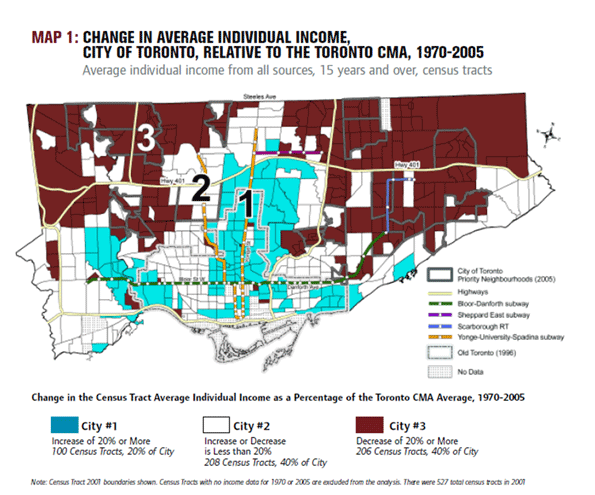
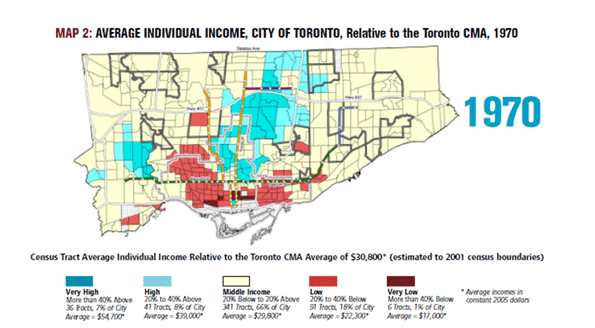
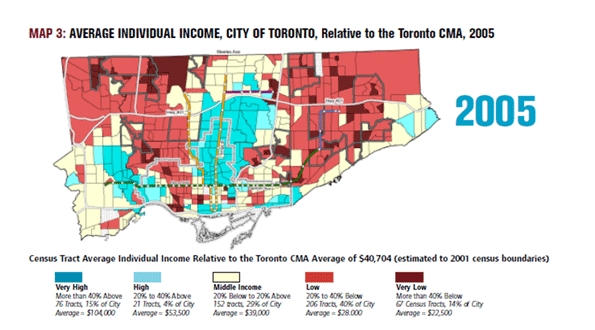
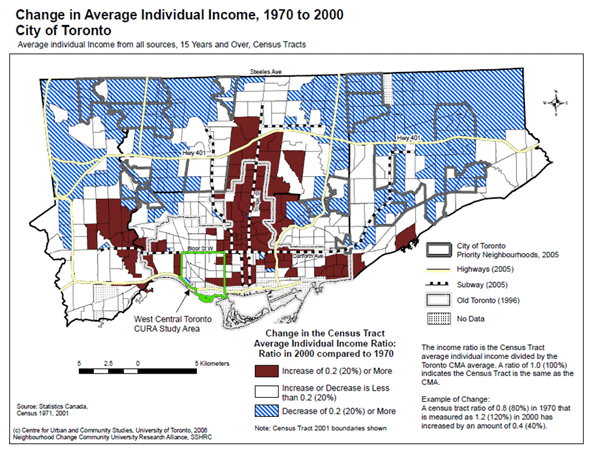
    The issue of income disparity in Toronto has once again been brought into the public eye by a December 15th report by University of Toronto Professor David Hulchanski. The report, “The Three Cities Within Toronto,” points to a growing disparity in incomes between Downtown Toronto, the inner suburbs, and the outer suburbs of the city. The report demonstrates that between 1970 and 2005 the residents of the once prosperous outer suburbs have been losing ground compared to the now wealthy downtown core. The results for the inner suburbs have been mixed.

    In 1970, 66% of city neighbourhoods were considered middle income. Only 15% were considered high or very high, and 19% were low or very low. In 2005, only 29% of neighbourhoods were considered middle income. The number of high or very high income neighbourhoods rose to 19%, while low and very low income neighbourhoods made up a staggering 54% of neighbourhoods.


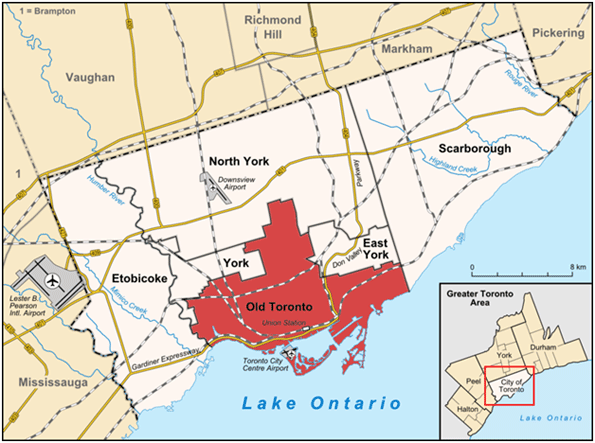
    The news isn’t all bad. After all, the downtown core is now one of the most desirable places to live in North America, and many of the formerly low income neighbourhoods have gentrified, or are in the process of doing so. However, many of the city’s traditional suburbs have been decimated. The former cities of Etobicoke and Scarborough used to be middle class. Not so much anymore.

    In real dollar terms, even the majority of the very low income areas have become wealthier. The trouble with poverty statistics is that they focus on relative poverty, rather than absolute poverty. This means that if Etobicoke’s average income doubled tomorrow, the downtown core would all of a sudden be considered poor. This is a major limitation. Toronto isn’t exactly turning into a Canadian Detroit.

    The report rightly points to the need for greater mobility in the outer suburbs. Given that the most lucrative jobs are typically downtown, many young professionals and recent graduates living outside of the core need to be able to get downtown cheaply and quickly in order to build their careers. Where the report goes wrong is that it recommends stricter land use regulations, stronger rent controls, and the revival of the flawed Transit City plan that Mayor Ford vigorously campaigned against in the recent election.

    It is easy for academics to blame a lack of social welfare spending, or suburbanization for the problem. The real problem is the loss of local policy making power resulting from amalgamation. For the most part, the areas losing ground the fastest are the formerly middle class suburbs amalgamated into the city. In contrast the “exurbs” just outside of city boundaries have thrived. This is no coincidence. The real takeaway from this study is that the suburbs have different needs than the central core. By attempting to accommodate the needs of both, the megacity has benefitted neither. Short of de-amalgamation, the only hope for the city is to substantially decentralize policy making. No amount of spending can make up for the loss of local autonomy.

    Policies have different effects in different types of cities. Take the treatment of automobiles. It might make sense to discourage automobile usage in downtown Toronto, but the benefits of doing so in Vaughan or Pickering would be questionable at best. Similarly, mandating that every commercial establishment have a public washroom probably makes sense as a public health measure in downtown, where public urination is an issue, but not so much in suburban Markham, or Richmond Hill.

    Making sensible regulations for a small, relatively homogenous area isn’t all that difficult. Applying these regulations to a large, demographically diverse area can help some areas and hurt others. It’s not that regulations need to be a zero sum game. People in Etobicoke wouldn’t be affected if, say, maximum parking allotments were tightened in the downtown core. They would be affected if they were tightened throughout the entire megacity. Similarly, increasing maximum parking allotments might hurt the core and help the suburbs. The current one size fits all approach sometimes benefits the core and sometimes benefits the suburbs, but ever both.

    Perhaps more important than city wide regulations is the centralization of taxing power. Since the merger, the city now sets tax rates across the entire megacity. This also allows the city to control the ratio of residential to non-residential taxes. The city of Toronto has the highest ratio of non-residential to residential taxes in Ontario. This means that businesses carry a higher share of the tax load in the city than anywhere else in the province. The combination of tax and regulatory policies in the city have lead the Canadian Federation of Independent Businesses to rank Toronto as the second least business friendly city in Canada. On a scale of 1-100, Toronto came in at 33, slightly ahead of Vancouver’s 31. Meanwhile, the rest of the (Greater Toronto Area) GTA is near the top, at 61. Neighbouring Oshawa took the top spot in Ontario with 69.

    GTA Area Cities by CFIB Entrepreneurial Cities Policy Score

    Rank (Ontario)

    City

    Score

    Driving Distance to Yonge and Bloor

    1

    Oshawa

    69

    0:45

    6

    GTA (Excluding Toronto)

    61


        Mississauga

    61

    0:27


        Brampton

    61

    0:41


        Richmond Hill

    61

    0:32


        Markham

    61

    0:32


        Vaughan

    61

    0:32

    16

    Hamilton

    55

    0:58

    19

    Guelph

    54

    1:15

    24

    Barrie

    52

    1:16

    27

    Brantford

    51

    1:20

    30

    Kitchener

    48

    1:23

    33

    Toronto

    33


        Etobicoke

    33

    0:20


        Scarborough

    33

    0:21

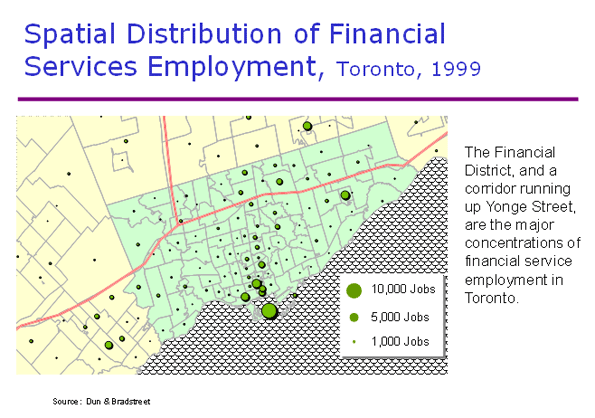
    Now the share of non-residential to residential taxes in Toronto may actually make sense downtown. The core is home to the third biggest financial sector in North America. These jobs are heavily concentrated in the downtown core.

    Downtown Toronto isn’t competing with low tax Vaughan or Barrie for these jobs. They are competing with high tax cities like New York and Chicago. This means that employment in the core is not as easily chased off by taxes and regulations than in the suburbs. But in industries like wholesale and manufacturing, which are far more important outside of the core, employment can easily relocate to Barrie, Mississauga, Oshawa, and so forth. Indeed, jobs have been leaving the city since before the recession hit.

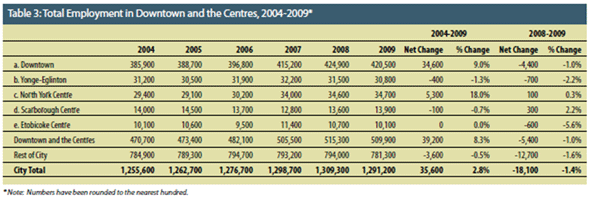
    Since 2004 Downtown and North York have prospered but the rest of the city has lost jobs. This should make the results of the Professor Hulchanski’s report unsurprising. The financial sector isn’t enough to keep the entire city employed or lift wages in the city-controlled suburban rings. As a a result despite the thriving financial sector, Toronto was dead last in the GTA in terms of median incomes.

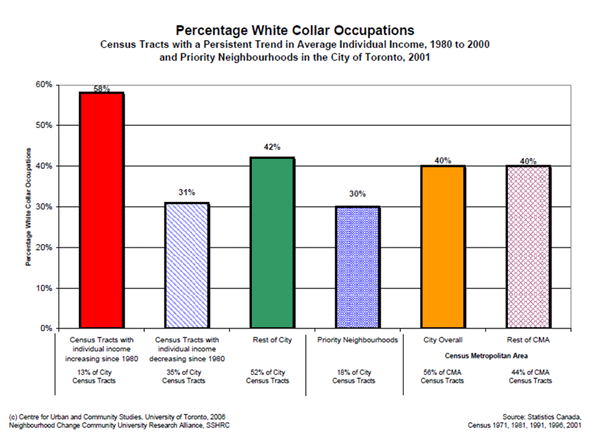
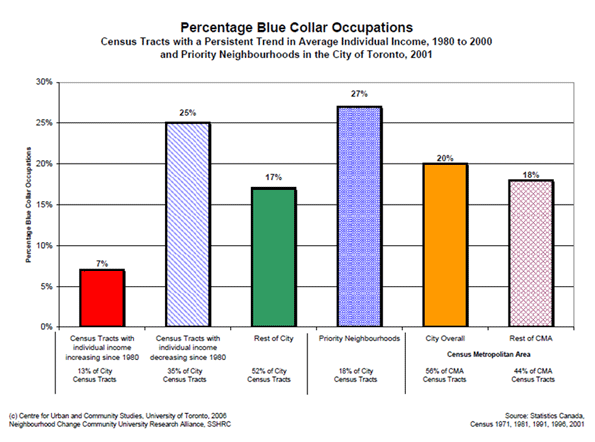
    To turn this around, the city must decentralize decision making power so the suburban communities can come up with their own economic development strategies. No matter how much the city improves transit to the outer suburbs, they will not be able to significantly increase median incomes without creating more jobs. The financial sector will continue to grow, but many of jobs created in this sector require specialized training, and thus go to people from outside of the city. This doesn’t do much for former manufacturing workers in Scarborough and Etobicoke. Growth of the financial sector combined with the dispearance of blue collar jobs together guarantee continuing income disparities in the city.

    Below is previously published data from Professor Hulchanski that highlights how badly blue collar sections of the city have been hit.


    Fundamentally, a strong focus on financial and other so-called “creative class” jobs will do little for these areas. The above map was created by Richard Florida’s Martin Prosperity Institute. It shows that most creative class jobs are clustered around the subway, but this doesn’t mean that expanding rail transit will expand creative class employment. Building a light rail line through a neighbourhood doesn’t suddenly transform the residents into artists and physicians. It may attract more artists and physicians, but this could actually hurt local residents by driving up rent and property values without creating jobs for them. Below is a map of educational attainment by ward. The darker the colour, the higher the number of residents with a bachelor’s degree or higher.

    The real problem is that a focus on elite jobs creates exactly the kind of bifurcation that progressive complain about. Given that city wide business policies are tailored towards creative class type occupations, it is unlikely that price sensitive manufacturers will find any reason to locate within city boundaries, rather than setting up shop in Mississauga or Barrie.

    Indeed, for all the temptation by urbanists to point to Toronto’s suburban ring as an example of the decline of suburbia, the peripheral suburban areas outside of city limits have been booming. Here is a map of growth in the GTA between 2001-2006. While Toronto grew modestly, suburban cities Milton, Brampton, Vaughan, Richmond Hill, Markham, Ajax, and Whitby all grew by at least 20%. Even Oshawa, which was hit hard by the decline of the auto sector, has managed to survive, and indeed maintained a higher median income than Toronto during this period. Regional rival Mississauga eclipsed Toronto’s growth rate, and emerging regional player Barrie grew by over 20%.

    In short, despite its strong financial core, Toronto is losing its standing as the go-to destination in the GTA. And it could get worse. Mississauga is working hard to lure financial services and advanced manufacturing jobs from Toronto. Several other cities, such as Guelph and Waterloo are actually competing for the very creative types that Toronto’s policies are tailored to attract. Other cities, such as Barrie are working hard to cannibalize what is left of Toronto’s manufacturing and distribution sectors. Were it not for amalgamation, Etobicoke or Scarborough could just as easily have undertaken a similar strategy to attract blue collar jobs.

    The Three Cities report identifies serious regional disparities in Toronto. Unfortunately, it doesn’t provide much insight into how to fix the problem. Expanding transit options will only go so far towards this. Building more light rail may raise median incomes by attracting wealthier people to these neighbourhoods. Ironically, this will only widen the income gap. The real challenge is finding out how to create opportunities for blue collar jobs in suburban Toronto. Unfortunately, amalgamation has imposed one size fits all policies that may work downtown, but utterly fail in the suburbs and continue to drive people to the periphery outside the city limits. Ironically, the very policies that seek to halt “sprawl” may well end up exacerbating it.

    Toronto Skyline photo by Smaku

    Steve Lafleur is a public policy analyst and political consultant based out of Calgary, Alberta. For more detail, see his blog.

  • Washington Opens The Virtual Office Door

    On December 9, President Obama signed into law the Telework Enhancement Act, a bill designed to increase telework among federal employees. Sponsored by Representatives John Sarbanes (D-MD), Frank Wolf (R-VA) and Gerry Connolly (D-VA), the legislation gives federal agencies six months to establish a telework policy, determine which employees are eligible to telework, and notify employees of their eligibility. Agency managers and employees are required to enter written telework agreements detailing their work arrangements and to receive telework training. Under the Act, teleworkers and non-teleworkers must be treated equally when it comes to performance appraisals, work requirements, promotions and other management issues. Each agency must designate a Telework Managing Officer, and must incorporate telework into its continuity of operations plan.

    Supporters of the measure, including the National Treasury Employees Union and the Telecommunications Industry Association, rightly tout its potential to improve the productivity of federal employees, reduce the government’s overhead expenses, decrease energy consumption and cut carbon emissions. Indeed, the Telework Research Network estimates that if the eligible federal workers who wanted to telecommute did so once a week, agencies would increase productivity “by over $4.6 billion each year” and save “$850 million in annual real estate, electricity, and related costs.” The country would save nearly six million barrels of foreign oil and reduce greenhouse gas emissions by one million tons per year. The bill would enable agencies to continue functioning during emergencies (federal telecommuters saved the government an estimated $30 million per day when D.C.-area snow storms shut down offices last winter), and it would decrease traffic congestion.

    Increasing the number of federal telecommuters is a good first step towards empowering the nation to tap telework’s many benefits. However, a diverse group of advocates would like to see telework become widely available for all workers. The Obama Administration endorses this goal. Proponents of broad access to telework include champions for small businesses and for energy independence, transportation alternatives, work/life balance, homeowners, environmental protection, disabled Americans, and rural economic development. To maximize telework’s promise — including its potential to open employment opportunities for 17.5 million people — Congress must enact comprehensive legislation offering employers, workers and other stakeholders in both the public and private sectors a wide array of cogent reasons to expand the practice.

    Comprehensive legislation would need to offer either carrots or sticks to constituencies that may resist telework’s growth: organizations with telework-shy managers; commercial landlords worried about telework-induced vacancies; and cities and states afraid that reducing the number of commuters will decrease their revenue. A few key elements:

    Remove Regulatory Barriers
    Perhaps the single greatest regulatory barrier to telework is the threat interstate, part-time telecommuters face of being taxed twice at the state level on the wages they earn at home: once by their home state and then again by their employer’s state. New York has been especially aggressive in taxing nonresidents on the wages they earn at home even though their home states can tax those wages, too. The double tax risk makes telework unaffordable for many Americans.

    Proposed federal legislation called the Telecommuter Tax Fairness Act would eliminate this roadblock to telework, prohibiting states from taxing the income nonresidents earn in their home states. This bill, introduced in the 111th Congress by Representatives Jim Himes (D-CT) and Frank Wolf, enjoys bi-partisan support from lawmakers representing states across the country. It must be included in any package intended to accelerate telework’s adoption.

    Simplify the Home Office Deduction
    The complexity of the current home office deduction discourages home-based workers from taking advantage of it. Potent telework legislation would give both home-based business owners and telecommuting employees the option to take a standard home office deduction.

    Offer Incentives To Employers
    Employers should be allowed to treat as nontaxable income the dollar savings they realize as a result of telework. Alternatively, they should receive a tax credit based either on the cost they incur for equipping employees to telecommute or on the percentage of workers who telecommute. They should receive a payroll tax break when they hire new teleworkers

    Because managerial resistance is a significant obstacle to telework’s growth, and because managers who telecommute themselves may have a more positive view of telework than their office-based colleagues, businesses should receive added incentives to allow managers to telecommute.

    Offer Incentives To Workers
    Workers should be allowed a tax credit based on the amount of time they spend telecommuting or on the cost they incur to purchase equipment and services necessary for telecommuting. They should have the option to treat the value of all equipment and services the employer provides to facilitate telework as a fringe benefit excludable from their taxable income, even when personal use of the tools is also permitted.

    Officer Incentives To Insurers
    Insurers covering losses that telework can minimize should be recruited to promote telework with tax advantages. Because experienced teleworkers enable their companies to continue operating even when emergencies render the main office unusable, business continuity insurers can limit their exposure by increasing the number of their policyholders that maintain strong, well-designed telework programs. They should receive incentives to do so.

    Automobile insurers should also be enlisted. The less frequently people drive, the fewer accidents occur and the less liability car insurers face. To motivate these insurers, Congress should offer them tax advantages based on 1) the proportion of their corporate policyholders that have both significant telework programs and aggressive policies to replace work-related driving with Web-based or telephone conferencing; and 2) the proportion of their individual policyholders who telecommute regularly.

    Offer Incentives To Commercial Property Owners
    Because businesses with dispersed workers need less office space, commercial landlords may wince at decentralization. However, the landlords able to fill their buildings with a greater number of tenants requiring less space – rather than fewer tenants requiring more – can thrive. In addition to operating greener and more cost-efficient sites, these landlords can reduce their risk of loss: Because each tenant represents a smaller proportion of a landlord’s total revenues, a single tenant’s default or decision to relocate is less likely to deal the landlord an insurmountable blow.

    To entice commercial property owners to encourage their tenants to adopt telework, Congress should offer the owners tax incentives based on the proportion of their tenants that have either vigorous telework programs or well-enforced policies requiring employees to replace business travel with remote conferencing.

    Make State and Local Efforts To Promote Telework A Condition Of Federal Transportation Funding
    By reducing the demand for roads and mass transit, telecommuting minimizes the cost of repair, maintenance and expansion of such infrastructure. Before the federal government subsidizes state and local transportation investments, the funding recipients should be compelled to mitigate costs by promoting telework.

    One step that states receiving federal aid should be required to take is to eliminate tax barriers to interstate telework. For example, they should be prohibited from subjecting a nonresident company to business activity taxes when the company’s sole connection to the state is its employment of a few in-state telecommuters. States could also allow car insurers to offer pay-as-you-drive policies.

    States and municipalities could require their agencies to develop telework programs for their own workers and to engage only those contractors that make the maximum possible use of telework. They could require agencies seeking funds to increase their car fleets or facilities to submit an assessment of whether telework could eliminate or reduce the need. They could compel their employees who seek approval for business travel to demonstrate that remote conferencing would not be an adequate substitute. They could authorize agencies to retain the funds the agencies save as a result of telework.

    States could create offices that promote telework and provide technical/legal support for both public and private employers developing telework programs; designate high traffic and pollution days as telework days and publicize them; and conduct public awareness campaigns to encourage telework, including campaigns specifically targeting businesses. Municipalities could eliminate telework-hostile zoning rules.

    All of these proposals would go a long way towards minimizing needless travel. Some would cost the federal government nothing or save it money. Others require a federal investment, but the investment would be made via business and individual tax breaks — welcome incentives for many members of the incoming Congress. Together, these suggestions would create jobs and strengthen the nation’s energy security. They would reduce traffic, carbon emissions and transportation costs; enable workers to meet conflicting job and family responsibilities; help businesses lower expenses, and drive profits. These are fundamentally important goals with bi-partisan support. Congress should act quickly and forcefully to unleash telework’s potential to meet them.

    Photo by By Rae Allen, “My portable home office on the back deck”

    Nicole Belson Goluboff is a lawyer in New York who writes extensively on the legal consequences of telework. She is the author of The Law of Telecommuting (ALI-ABA 2001 with 2004 Supplement), Telecommuting for Lawyers (ABA 1998) and numerous articles on telework. She is also an Advisory Board member of the Telework Coalition.