Category: Politics

  • The Financial Crisis Continues to be an Inside Job

    Over the weekend I saw the documentary movie Inside Job with a friend who is not a financial markets expert. After the show, I told her I was relieved to see that the movie covered the majority of the causes of the collapse of the financial markets in 2008. Part of my relief was from thinking that everything would be better now that “everyone” knows the facts. Then my friend pointed out that there were only six people in the audience – obviously “everyone” wasn’t seeing this movie!

    The movie did a good job of covering virtually everything I’ve been writing about at NewGeography since 2008. They did leave out the part where Goldman Sachs and other Wall Street banks were issuing mortgage-backed bond without writing mortgages. This is totally understandable. It’s very difficult to show what doesn’t exist in video. It’s easy enough to show homes in foreclosure — but what pictures and video can you use to show that there aren’t any mortgages behind bonds, especially when the bonds that aren’t even printed on paper? The pictures of hookers, strippers and cocaine make the movie ominous enough and have a certain visual appeal that producers look for in a story.

    Inside Job included lots of stuff on who is funding the academic studies being used to justify wrecking the financial markets. They present more on the serious academic fraud in the crisis than I was aware of. I first posted Tweets about Duke University back in June 2009. A couple of Duke University professors published a research report about a model they developed that justifies manipulating stock prices and corporate votes. What I Tweeted was: “It should be illegal to write this crap.” Duke University’s research center is funded by a wide selection of the bailed out financial institutions. Your tax dollars at work!

    The point I try to raise — perhaps loudly because it’s a little self-interested coming from me — is that the perpetrators of the financial crisis are funneling billions of dollars to the academics who will write anything they are told for the sake of continued funding. In the meantime, those who are willing to take the adverse position are relegated to the Daily Show (no offense, Jon).

    Then I sat through Inside Job and I saw this segment on former Federal Reserve Board of Governors member and current professor at Columbia University Business School Frederic Mishkin. Before the crisis, Mishkin took money from the Chamber of Commerce in Iceland to write a report about the “Stability” of their banking system. The source of the funding was not disclosed in the published report (an academic no-no). Then, after Iceland’s banks completely collapsed, Mishkin changed the name of the paper on his resume to the “Instability” of Iceland’s banking system. This was shocking to me, as I didn’t realize how deeply the desire to deceive ran among these guys. Mishkin resigned from the Federal Reserve Board in the middle of the crisis – yes, even the rats will abandon a sinking ship.

    Last week, Mishkin was on CNBC’s Squawk Box (a chuckle-head fest about how to make money on the day’s stock trades) pontificating about Fed monetary policy. CNBC is no stranger to corrupting academics to support their bad habits. Inside Job included examples of a slew of academic economists taking money from Wall Street to write papers justifying the systemic failures. Here’s an example they didn’t have. Someone recently sent me a study penned by professors at the University of Oklahoma Price Business School. The study concluded that naked short selling (the practice of selling shares you don’t own and can’t borrow) is beneficial for making financial markets more efficient. (If you don’t know what short selling is, here’s a five minute video that explains it in a light-hearted way.) Insane, right? No reasonable person would agree that it is good for markets if you can sell things that don’t exist – yet it happens every day, even in the market for US government securities. It takes fewer than 6 degrees to connect the dots. The University of Oklahoma’s Price College of Business is named for major donor Michael Price. Price is “personal friend” of CNBC personality Jim Cramer. For more on Jim Cramer’s ties to Naked Short Selling follow @deepcapture on Twitter and check out the March 12, 2009 episode of the DailyShow.com.

    I was getting very discouraged about continuing to write about the causes of the crisis, since no corrective actions are being taken. A lot of work remains to educate the public about the issues and to come up with solutions. The old political ways are too corrupt to work anymore. It seems like we keep covering the same territory without progress, but I’m inspired by the closing line of Inside Job: “Some things are worth fighting for.”

    Susanne Trimbath, Ph.D. is CEO and Chief Economist of STP Advisory Services. She will be participating in an Infrastructure Index Project Workshop Series throughout 2010. Her training in finance and economics began with editing briefing documents for the Economic Research Department of the Federal Reserve Bank of San Francisco. She worked in operations at depository trust and clearing corporations in San Francisco and New York, including Depository Trust Company, a subsidiary of DTCC; formerly, she was a Senior Research Economist studying capital markets at the Milken Institute. Her PhD in economics is from New York University. In addition to teaching economics and finance at New York University and University of Southern California (Marshall School of Business), Trimbath is co-author of Beyond Junk Bonds: Expanding High Yield Markets.

    Photo by carlossg

  • I Opt-out of California

    Like the harried traveler who made famous the expression, “Don’t touch my junk”, I have elected my own personal protest, California style. I have decided to OPT-OUT of California to protest my overgrown state government. I am tired of California legislators sticking their hands in my pants to pay for the European style social welfare state they have created. My work, my earnings and my taxes will go elsewhere.

    I am one of those evil “high-earners” in California with income over $200,000 per year. It is unimportant to state legislators that we high-earners pay most of California’s taxes. According to the Franchise Tax Board, in 2007 more than 87 percent of California capital gains taxes came from taxpayers with adjusted incomes of more than $200,000. Residents with incomes over $200,000 pay 66 percent of its income taxes even though earn just 39 percent of the state’s income. More important to California’s future, most of us are small businesses, which account for 65 percent of new job growth in the state.

    When I moved to California in 1981, California was truly the Golden State. Its budget revenues of $22.1 billion levied just $920 per person from its population of 24 million. It had great freeways, great schools and its inexpensive college/university system was the envy of the planet. By 2009, the budget revenues had grown to $86 billion, or $2,324 per person from each of its 37 million residents. But California has a $25.4 billion deficit, which means the aging “movement” activists who govern this state are spending $114 billion or $3,081 per resident. Spending is up 520% from 1981.

    The $86 billion in revenues California collected from capital gains and income taxes is not the only tax that has increased. Despite Prop 13 that capped property taxes at 1%, property taxes expanded from $6.36 billion from 1980-1981 to $43.16 billion in 2006-2007, an increase of 579%. For point of reference the CPI index increased just 133%, from 88 in 1980-1981 to 202.4 in 2006-2007.

    The Legislative Analyst’s Office says California will have an additional $6.1 billion shortfall in the current fiscal year reaching $25.4 billion next year. Legislative Analyst Mac Taylor says the state faces deficits of $20 billion each year through 2015.

    “Unless plans are put in place to begin tackling the ongoing budget problem, it will continue to be difficult for the state to address fundamental public-sector goals — such as rebuilding aging infrastructure, addressing massive retirement liabilities, maintaining service levels of high-priority government programs and improving the state’s tax system,” the report said.

    How did California voters respond to this fiscal irresponsibility in November? They rewarded the Democratic Party with every elected office from Governor to Insurance Commissioner, and returned Barbara Boxer to the US Senate. I guess California voters did not get the Tea Party memo that resulted in a “shellacking” of 64 Democrat Congressional seats in the rest of the nation. The political tsunami that hit even parts of the Eastern seaboard in 2010 totally missed California. Perhaps it ended somewhere in Nevada with the re-election of Harry Reid.

    So, in protest to the insensitive indulgent big-spenders that run Sacramento, I say, “Don’t touch my junk!!!” My beautiful California home is now on the market for $2,000,000. My next home will be in a no state income tax state like Texas or Nevada. I will not buy that new Jaguar that I was planning to purchase for $75,000. I will keep my old Cadillac and deprive Sacramento of $6,562 from its 8.75% sales tax. My next purchase for my real estate business will be an office building in Prague in the Czech Republic, a democracy that has lower taxes and fewer regulations. My income will remain either offshore or in a state that does not confiscate like the money grubbers in Sacramento. And, I will not be investing my capital to create any new jobs in California. In the digital age, my staff will be located in states that are a little more business friendly.

    Apparently, I am not alone. Migration out of California exceeds the rate of almost every other state. Why are my fellow “high-earners” leaving the Golden State? Maybe it is because California ranks nationally in the bottom two for business friendliness while placing third in state income taxes.

    We have Jerry Brown as our Governor again, meaning that he will live his entire life without a real job. The Central Valley, once agricultural wonderland of America, has Depression era unemployment, this as a result of a green-inspired court water shut-off designed to protect an Anchovy sized piece of bait called the Delta Smelt. And, our brilliant voters – including those working class voters most impacted – rejected Prop 23. That means that on January 1, 2011, California must begin to reduce our greenhouse gases by 40%. To achieve this noble goal, we seem certain to make ourselves even more uncompetitive with other countries and other states.

    If that was not enough, voters also approved Prop 25 which allows the public union dominated Democrats to pass its budget with a simple majority. They did such a good job ($20 billion shortfalls) when they were forced to obtain a 2/3rds vote for approval. They no longer will need a single Republican vote to pass their budgets.

    Margaret Thatcher remarked to Parliament on February 22, 1990, “The trouble with socialism is that you eventually run out of other people’s money.” Such will be the fate of the failed state of California and its free spending legislators, when high-earners like myself vote with their feet, and their wallets, and take their earnings elsewhere.

    **************************

    Robert J Cristiano PhD is the Real Estate Professional in Residence at Chapman University in Orange, CA and Head of Real Estate for the international investment firm, L88 Investments LLC. He has been a successful real estate developer in Newport Beach California for twenty-nine years.

    Photo by ASurroca

  • Retro Rail Alert

    The New Zealand Government recently decided to follow the example of Montreal and Toronto by amalgamating the six City councils and the single Regional Council of the Auckland Region to create a united “Super City” of 1.4 million people.

    Like similar amalgamated bodies, the new Auckland Council, which came into being on the 1st November, 2010, has fallen for the notion of regionally determined smart growth built around a huge investment in heavy rail.

    Backed by a Regional Council totally committed to Smart Growth, every decision was driven by the need to “get people out of their cars” rather than to improve mobility. Since the 1990s they have fought for densification as a means of enabling more public transport. The bus lanes linking the north shore to the CBD are for buses only. HOVs are not allowed on and nor are shuttle buses. The planners openly argue that the near empty lane is to encourage people to get out of their cars on the congested motor way lanes and take the bus. Also they are inserting bus only lanes into our already narrow urban streets. Cars are just being crowded off the streets.

    Consequently, congestion has grown progressively worse, but this was seen as only further evidence of the need to invest in rail.

    Many of us thought that the election which replaced the Labour Government with a coalition of National and Act, two conservative-leaning m parties of the Right, would put an end to this “trip backwards to the future”.

    But, as has happened elsewhere, the Right adopted the policy while the Chambers of Commerce and similar groups championed the mega-amalgamation on the grounds of efficiency. They saw huge savings to be made in having only one Mayor and one council, and one plan, and one rate, and indeed, ideally only “one of everything”.

    Yet instead of searching for a new, modern way to develop this region, Len Brown, the left of center first Mayor of the Auckland Council has backed a “Vision for Auckland” built around an extensive rail network – including a rail link to the Airport, a CBD rail loop, light rail on the surface streets, and a rail tunnel under the Waitemata harbour.

    Residents of surrounding areas may not share this Vision – especially if they have to share the costs. This is the kind of division that led to Montreal’s recent de-amalgamation.

    The Mayor supports his Vision with claims that professional analysis and expert advice will show that these projects are viable and necessary and that Government must fund them.

    One has to wonder where he gets his advice from.

    No investment in rail in New World cities since the 1980s has resulted in a reduction in congestion. In most cases congestion has increased and public transport market share has diminished because the investment into rail has diminished funds for roads, buses and High Occupancy Toll lanes, measures that actually work to increase mobility

    The Government should also be aware that the international engineering firms at come in behind these proposals for rail investment (and similar major project works) have a proven expertise in getting a foot in the door with low bids then cranking up the costs afterwards. These projects routinely come in over budget.

    Furthermore, some research reveals that Heavy Rail (as is proposed for the Auckland network) has a worse record for cost overuns than Light Rail projects. Early projects have a worse record than more recent projects, possibly because the tendering firms have gained experience over time in how to fool the public, and the population with low ball estimates of cost and exaggerated estimates of ridership.

    Megaprojects and Risks: and anatomy of ambition.” (Click on the link to read the Public Purpose review.)

    This has become a clearer pattern, as seen in projects as diverse as the English Channel Tunnel, the Great Belt rail-road bridge between Zealand and the Jutland Peninsula, and the Oresund road-rail bridge between Copenhagen and Malmo, Sweden.

    So this is not just an American problem.

    The “Chunnel” trains, for example, were projected to carry 15.9 million passengers in the first year of operation (1995) but by the sixth year (2001) ridership was 57% lower at 6.9 million. The cost overrun was 79%.

    The Flyvbjerg data set of international studies, including rail and road schemes, contained 258 projects.

    • 90% had significant overrun of costs.
    • Rail projects had the highest cost escalation (45% over)
    • Road projects had the lowest escalation (20% over)
    • The average ridership was 61% of forecast and the average cost overrun was 28%.

    The figures for rail alone were worse.

    An even more pessimistic summary of performance is contained in a power-point presentation by Lewis Workman of the Asia Development Bank, Predicted vs. Actual costs and Ridership – Urban Transport Projects, May 2010.

    This presentation notes that the problem is actually worse in developing countries. The Bangkok metro “actual ridership” fell short of the projections by 55%. The authors ask the question “Lies or Incompetence?” and their answer is “Probably Both.”

    New Zealand’s Minister of Transport, Stephen Joyce is well prepared to shout louder than the “one voice” of the new Auckland Council. In September 2009 he warned that the Government is committed to spending NZ$500m on the city’s rail electrification projects – but funding cost over-runs is not an option.

    His officials have identified up to $200m of potential cost over-runs in the NZ$1.6bn project, which is still on the drawing board.

    One of the first rail upgrade contracts demonstrates his concerns are justified.

    The Manukau Rail Link was initially estimated to cost NZ$40 million [2006] which subsequently rose to NZ$72 million [2008] and the latest figure is NZ$98 million. This is for a 1.8k link and station southwest of Manukau CBD.

    The Minister should hold fast to this position. But maybe he should also hold fast to the position that Auckland Council will not be compensated for any revenue shortfalls on account of lower than projected ridership.

    Maybe the Auckland Council would then take on board the remedies for these “foot in the door” feasibility studies, or get those who make the studies to stand behind them with some form of guarantees backed up by insurance.

    The recent experience with BART suggests that US politicians should learn to play equal hard-ball.

    Similarly the 5 km BART connection to the Oakland Airport (on the East Bay) was originally projected to cost $130 million and cater to more than 13,000 passengers daily. However, after a decade of delays, those forecasts have been changed to $484 million – a cost increase of say 250%, and 4,350 passengers a day – a ridership shortfall of say 60%.

    The crystal balls are not getting any clearer.

    Consequently, according to a study by transport planners Kittelson and Associates, each new passenger who uses the system during its estimated 35-year lifespan will be supported by a subsidy of $102 – on top of the fares they pay. This is more than 10 times the original projected subsidy of $9 per new passenger. This combination of cost overrun and ridership shortfall has had a catastrophic effect on the viability of such projects.

    But the boosters are not deterred. They say it should be built because “the community wants it”, which sounds familiar.

    The table below shows this the Oakland Airport rail link is clearly a project that should never be started. Even the “rapid transit” speed will not be delivered.

    Politicians’ Visions reward the citizens with nightmares.

    These large multi-national engineering consulting firms have become accustomed to treating Governments – both Central and Local – as giant ATM machines.

    It’s time to take away their plastic.

    Owen McShane is Director of the Centre for Resource Management Studies, New Zealand.

    Photo by bcran

  • Florida Goes Underground

    By Richard Reep

    Last year’s report that Florida had lost people marked a new low in our state’s boom-and-bust history. But this autumn’s news seems to surpass even that sorry milestone with a combination of sluggish tourism, empty state coffers, and a reputation as one of the top real estate foreclosure states. Florida just can’t seem to get out of its own way, and with the fourth highest population in the country, it could have competed with Texas to replace California as one of the best business climates in the nation. Instead, Florida, which boasts one of the lowest tax rates in the nation, continues to see businesses and citizens depart, with newly elected governor Rick Scott recommending even lower taxes as the best solution. Instead, it is high time that Florida fix its real problems of economic monoculturalism and anti-education policies that drive it further and further away from America’s future potential.

    It is no secret by now that a diverse income source is the only way to survive the Millenial Depression. States that have more than one income source, like Texas, were able to adapt policies to favor resilient businesses and industries. In Florida, despite loud and clear input to the state legislature, no change in state policies have been effected this year, once again making tourism and construction growth the focus of job creation.

    The tourism industry knows well its position as “first in, last out” when a recession hits, diversifying its products and geography, enabling at least something to run while everything else stands idle. Thus Marriott International, in the late nineteen eighties, invested in senior living facilities, which bore well through the 1990-93 recession. Regulatory burdens on this market segment eventually caused Marriott to focus on other, less regulated markets, and today its global diversity has caused the company to remain economically sustainable. Florida, with so much sunk cost in tourism, seems unaware that its former tourism dominance has been quietly replaced by such glittering destinations as Brazil, Dubai, and China.

    Agriculture is, of course, Florida’s economic mainstay: even in a recession, people must eat. This industry, however, employs a whopping 44,000 farmers, about a month’s worth of laid-off Florida workers. Clearly, the state should be looking elsewhere to create jobs.

    Governor-elect Scott’s vague promise to increase state venture capital spending while cutting taxes is amusing, in light of similar promises from past politicians. While the state’s Capital Formation Act has attracted investment in biomedical clusters, it takes a great deal of spending to sustain this fund. Similar promises created tax incentives for the film industry, which built studios in the nineteen nineties. Then, when the going got rough, these subsidies evaporated, and the studios promptly moved to New Mexico.

    The money for such schemes comes from the same place that Florida politicians seem to always find money: the education system. Florida, after struggling to get up to 27th in spending per pupil, seems about to find out what it is like to be 50th. And this is a last place finish the state should avoid.

    An educated population can adapt more easily to the changing times, can more competently choose its leaders, and can create wealth for itself. None of these qualities have been demonstrated by Floridians in recent years (think of the 2000 election) and, if the newly elected leadership has its way, none are likely to spring forth in the near future either.

    Florida’s two best hopes are to invest more in its public education system, not less, and to diversify its economy. Recent immigrants from states like Wisconsin and New Jersey, where schools are well funded and taken seriously, express shock and dismay at the public schools in Florida. While states like New York debate the worth of comprehensive assessment tests, Florida has been busy distilling its education system down to a teaching-the-test model, producing little else but test results. Regaining an educated, aware citizenry is critical if the state is to see a future as a contributor to the nation’s recovery.

    The potential to diversify its economy remains strong in Florida. Instead of lowering taxes, however, the new state leadership would do well to consider a more guided regulatory approach that favors a diverse economy. Come and gone are many industries which could return with the right incentives: aviation training, movies and television, solar energy research, and the space program. Research, manufacturing, and commercial jobs in all of these industries could contribute to a rebirth of Florida and spark investment that would produce lasting results.

    Florida’s tax climate favors business, but is oddly mismatched by its regulatory climate. The dodged a bullet with the failure of Amendment 4 – a proposal that all new development would have to face a public vote – and the state’s development industry congratulated itself heartily on this success. This proposal made the ballot because of the cumbersome development process regulated by the state’s Department of Community Affairs, which has widely been perceived to fail at its task, protecting neither nature nor the quality of life for its citizens. Whether or not the new governor gets his wish to eliminate this bloated state bureaucracy remains to be seen, but regulatory reform in the state’s development codes needs to be in the works.

    And tourism, which has been a great economic engine, has a chance to come back. Florida will always be a destination, and while other world places have leapfrogged ahead, tourism is highly competitive, as destinations age rapidly. The enduring romance with Florida will continue, but its famous beaches and theme parks will need to reinvent themselves bigger and better than ever. With a new Legoland in the design phase, and redevelopment at some of the world’s most hallowed ground in the Magic Kingdom, tourism’s long-term future bodes well.

    The smoke has cleared from the election battles. Now, more than ever, Florida’s leadership should be nurturing a more educated citizenry and reforming its regulatory system, rather than keep its tax system at ultra-low levels, to pull itself out of this nosedive. Florida’s natural advantages in climate and accessibility make it ideal for such a wide variety of businesses that very little should stand in its way to diversify the economy and create a productive, vibrant, educated workforce.

    Richard Reep is an Architect and artist living in Winter Park, Florida. His practice has centered around hospitality-driven mixed use, and has contributed in various capacities to urban mixed-use projects, both nationally and internationally, for the last 25 years.

    Photo by Captain Kimo

  • Beyond Grassroots and Into Congress: California High-Speed Rail

    While most of the substantial opposition to high-speed rail in California previously came from local government leaders and citizens, primarily in the Bay Area, Congressmen are now taking the issue to the entire country for debate. House Representative Jerry Lewis, R-Redlands, introduced H.R. 6403, also entitled the “American Recovery and Reinvestment Rescission Act,” which would allot the remaining $12 billion in uncommitted stimulus money to the US Treasury to help relieve the national deficit of $1.3 trillion. At least half of that $12 billion is set to go to various high-speed rail projects across the country.

    Although the divergence of money to the US Treasury would not have a significant impact on the national deficit, it would greatly affect California’s high-speed rail plans. The project, now estimated to cost $43 billion, relies heavily on federal money because it will only receive voter-approved state bonds on a matching basis. No federal money, no bond money. So far, it has gotten $2.25 billion from Washington, $200 million of which has already been spent on planning. The American Recovery and Reinvestment Rescission Act would halt the development of the largest high-speed rail project in the country.

    Lewis and 27 other Republicans in the House are pushing for this bill, not necessarily because they think the Democratic Senate or President Obama will let it pass, but because they want to start a movement to stop wasteful government spending. Whether or not anything comes of Lewis’ efforts, he is forcing his fellow members in Congress to consider how high-speed rail fits into national economic priorities.

    President Obama will not abandon high-speed rail anytime soon- he has invested too much into it at this point. Therefore, if the federal government is going to put any kind of controls on funding poorly planned projects like California’s high-speed rail, it will have to come from Congress.

  • Korea Conflict Shows That Borderlands Are Zones of Danger

    The current conflict between the Koreas illustrates a broader global trend toward chaos along borders separating rich and poor countries. Ultimately, this reflects the resentments of a poor neighbor against a richer one. Feeling it has little to lose, the poorer neighbor engages recklessly in the hope of gaining some sort of tribute or recognition   from the better-heeled neighbor, or at least boosting its own self-respect.

    The Korean situation epitomizes the fundamental danger when rich and poor countries live adjacent to one another. According to 2006 statistics, South Korea has a per capita income of roughly $18,000; the North’s stands at $1,300. Clearly, the threat of leveling Seoul, a wealthy and successful city, has limited South Korea’s ability to respond as it might otherwise to its nasty, militaristic neighbor, whose people live on the brink of starvation.

    Conflicts between poorer peoples and richer neighbors have been part of human history since antiquity. In ancient Mesopotamia the rough Semites attacked and eventually overcame the wealthier, more sophisticated Sumerians. This pattern was repeated throughout the ancient world, for example, pitting Chinese against the peoples of the Steppes, hurling German and Hunnish barbarian races against the Romans, and in countless upheavals throughout Meso-America.

    Although the wealthier neighbor can beat back the threat through better organization and technology, often it’s the poor neighbor who ultimately triumphs.   The Great Arab historian Ibn Khaldun, a student of Mid-east  and Mediterranean politics in the 14th  century, even developed a theory positing that the poorer, hungrier neighbor often held the long term advantage Of the more affluent countries, he writes,  “Time feasts on them, as their energy is exhausted by well-being and their vigor drained by the nature of luxury.”

    As the settled, wealthier nation becomes soft and “senile,” Khaldun observed–and ultimately either unwilling or incapable of overcoming the threat from their more savage neighbor. You can people off only so long before you drain your own treasury and self-respect. If Khaldun is right, the world is going to become a more unsafe place in the coming decade as the great unwashed seek to crash the gilded gates.

    Other changes have made borderlands more dangerous in recent decades. During the Cold War era, such conflicts were often mediated by the two great super-powers. There were clear zones of influence. But in an increasingly chaotic multi-polar world, where power is diffused and technology sometimes favors the rogue, it become increasingly difficult to manage these conflicts. In Korea we can see this in the gamesmanship of China, which further limits any strong American and South Korean response.

    But Korea is hardly the only place where borderlands have become hot zones. There are many places around the world where rich nations abut poorer ones, creating serious potential for major conflict. Among the most worrisome:

    The Saudi/Yemen border. Oil-rich Saudi Arabia boasts a per capita income over 13 times greater than that of its southern neighbor. Criminal elements, illegal immigrants and a growing al Qaeda presence, cross the porous border. These could ultimately undermine the country with the largest proven energy reserves. Over 130 Saudi soldiers have been killed this past year along this 1,100 mile long desolate border region–so desolate it was only demarcated in 2000.

    Israel and Gaza/Palestine. Ancient hatreds make this a particularly worrisome set of borders.  There are huge gaps not only in ideology and religion but income. Israel’s 2006 per capita income was just shy of $18,000, while Palestine’s was under $800 and Gaza’s under $500. Such huge gaps, as can be seen in the Koreas, tend to exacerbate already great tensions.

    Spain/Maghrebian countries. The flow of immigrants from Muslim North Africa into southern Europe has become a major international flashpoint, particularly as Spain, Italy and countries continue to experience major economic dislocation. There are well over 1 million Muslim immigrants in the country. The income difference between these two adjacent worlds can be immense; Spain’s per capita GDP is more than ten times that of Morocco, its closest Arab neighbor. The flow of immigrants and far higher fertility rates among them can be unsettling to some.   ”Tomorrow Europe might no longer be European,” Libya’s Leader Muammar Ghadafi suggested recently.

    U.S./Mexico. Although relations between the two countries have been cordial under both Presidents George W. Bush and Barack Obama, the ground level violence in Mexico–claiming 26,000 deaths since December 2006–is both driving Mexicans north and driving Americans away from the border region. With U.S. per capita incomes over six times that of Mexico, the temptation for criminals, as well as illegal immigrants, to cross the border can be overwhelming, and unsettling. Border violence is way up, leading to calls for tighter controls over immigration.

    Two recently discovered tunnels for drug smuggling near San Diego, complete with rail cars, indicate how inventive some cross-border entrepreneurs can be. But it is a mistake to see borderland as only bastions of criminality and unrest. Until recently the U.S./Mexico border constituted one of North America’s fastest-growing economic regions, marrying U.S. technology and investment with hard-working Mexican labor.

    Perhaps the most positive model of harmonious border relations can be seen along the border of Singapore and Malaysia. Although Singapore’s per capita income is more than five times that of Malaysia, there are ambitious plans to build a vast new business complex in the Iskandar section of Malaysia’s Johore State   The Malaysians envision “a strong and sustainable metropolis of international standing.” Right now the most obvious signs of mega-development in the area are somewhat oversized government buildings.

    If the cross-straits development materializes, this region would both expand the economic footprint of the predominately Chinese city-state and its largely Muslim neighbor. Instead of worrying about drugs, terrorists or illegal migrants, some well-placed Singaporeans see Johore as a base to expand its manufacturers and those of foreign firms.

    There is also a swank upscale “Leisure Farm” that offers green-tinged amenities for Singapore’s often crammed and stressed residents. Some  Singaporeans privately doubt the ability of Malaysians to compete with them in higher-value-added fields, but others wonder if their growing investment across the straits may be creating a tough competitor.

    Ultimately,   the planet’s future depends on successfully integrating the economies of rich countries and poorer ones. Aspiring countries have much to offer their rich neighbors–in terms of markets, labor and entrepreneurial energy. One hopes the world will see more of the commerce-driven model of Malaysia, and less of the kind of potentially dreadful military conflict now brewing along the Korean frontier.

    This article originally appeared at Forbes.com.

    Joel Kotkin is executive editor of NewGeography.com and is a distinguished presidential fellow in urban futures at Chapman University. He is author of The City: A Global History. His newest book is The Next Hundred Million: America in 2050, released in February, 2010.

    Photo by anja_johnson

  • Toronto Election Highlights Failure of Amalgamation

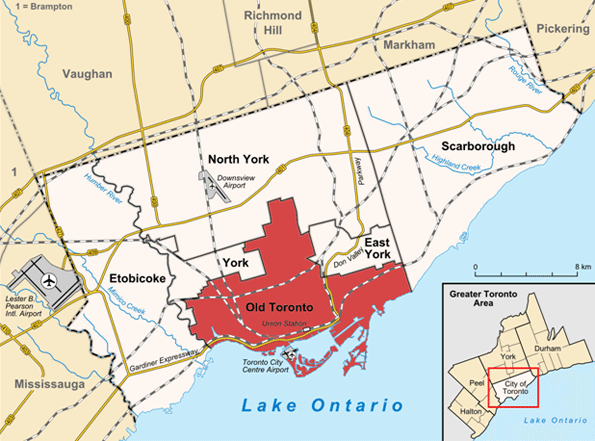
    In my pre-election piece on the Toronto election, I discussed the city’s lingering malaise. It developed slowly but its roots can be traced to the 1998 amalgamation that swallowed up five suburban municipalities. This led to a six folds expansion of city boundaries and a tripling the population base. This amalgamation was initiated by the province of Ontario as a cost saving measure and faced major local opposition. Citizens and politicians were concerned that the benefits of the alleged efficiency saving would be outweighed by the negative impact of losing local decision making powers. The recent Toronto municipal election bore out this concern.

    In the October 25th election, Torontonians were presented with two dramatically different visions. The first vision was presented by former Liberal Ontario cabinet minister George Smitherman. A self-described progressive, Smitherman appealed mainly to voters in the downtown core of Old Toronto. He stood for issues such as improved bicycle lanes, renewal of the downtown waterfront, and improving social housing conditions. The second version was presented by maverick councilor Rob Ford, who represented a ward in the former City of Etobicoke. Ford’s message was simple: it’s time to stop the “gravy train” at City Hall. While he had elaborate platforms on many issues, cutting waste at City Hall was his ubiquitous message.

    Despite Toronto’s social democratic image, Rob Ford won a crushing victory. Ford earned 47% of the vote, while Smitherman ended up with 35%. Far left candidate Joe Pantalone (known primarily for attempting to stop businesses from opening in his own ward) managed to capture 12% of the vote.

    Aside from the shock that a partisan conservative won in Toronto, there are two other significant developments. Both front runners were significantly more fiscally conservative than the current administration. Ford and Smitherman represented constituencies desperately seeking change. Smitherman’s base was frustrated with the inability of the city to provide the services that they want efficiently. Ford’s base was angry that the city is providing many of these services in the first place.

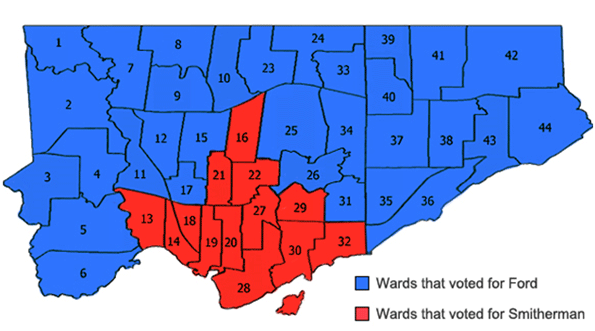
    Not surprisingly the results broke down along specific geographic lines. Ford won an outright majority of votes in every single ward outside of Old Toronto. Within the old boundaries, Smitherman won 13 of the 16 wards. The three Old Toronto wards Ford won are all on the fringes of the Old City.

    In 1997, the newly amalgamated city went to the polls for the first time. Conservative former North York Mayor Mel Lastman narrowly defeated social democratic former Old Toronto Mayor Barbara Hall. Since then, downtown oriented social democrats have controlled the city ever since.

    Clearly this result shows that the concerns expressed by the opponents of amalgamation were largely valid. Amalgamation failed to create cost savings, and has created a dysfunctional megacity. Rather than having six municipalities where voters are focusing on solving local problems, we have one gigantic city with the core and the suburbs fighting for their share of the public purse. This leads to the schizophrenic policy decisions we see today.

    Before amalgamation, there were six different versions of Toronto life that one could choose from. If you didn’t like living in high tax Toronto, you could live in Etobicoke. If Etobicoke’s bylaws and business taxes were hurting your business, you could move to North York. Now all people in the Toronto area can do is vote the bums out on election day, or get out of the area altogether. This isn’t a viable long-term solution.

    The problems are systemic, and cannot be solved so long as the megacity exists. This extends beyond the fact of the impossibility of satisfying the core and the suburbs at the same time. The megacity allows public sector unions to literally hold 2.5 million people hostage whenever they feel like it. A notorious strike last summer lead to a month without garbage collection in the entire city. The 24,000 strikers also shut down parks and recreation services, daycare, provision of municipal licenses, health inspections, animal services, and forced a 25% reduction in ambulance services. In 2008, the transit union called a last minute strike at midnight on a Friday night, grinding the city to a halt. These are just two examples of how powerful Toronto public sector unions have become. The only reason strikes aren’t more frequent is that the city typically gives them whatever they want in order to avoid chaotic strikes. De-amalgamation would not only allow more local control over policy, but would help fray the noose that the unions have tied around the city’s neck.

    Downtown progressives gripe over how Rob Ford is going to destroy their city, but they should take a minute to think about what some of their policies have been doing to suburbanites for years. They have imposed high taxes, and burdensome regulations on the amalgamated cities, as well as a myriad of new bylaws. Some of these policies make sense in Old Toronto. For instance, dissuading automobile usage in the congested core makes sense. Doing so in the suburbs does not. It might make sense to regulate trees on private property in a crowded downtown neighborhood. Not so much in a new subdivision. One-size-fits-all policies don’t work across a city as large and diverse as Metropolitan Toronto.

    Now that the suburbs have wrought their revenge on the old city, progressives need to recognize that de-amalgamation is not just a fantasy of libertarians and angry suburbanites. It is a prerequisite to restoring sound public policy reflecting the preferences of individual communities. Railing against Rob Ford won’t fix the problem. Rob Ford is what the suburbs want. As long as the megacity lives, Toronto will elect a Rob Ford type every now and then.

    The only way to stop this pattern of alternating, divergent visions is by de-amalgamation. Critics will use metaphors such as ‘unscrambling an egg’ to illustrate the difficulties of de-amalgamation. No one should believe that de-amalgamation would be easy. But there will never be a better time than now to take the necessary step of de-amalgamation. A few years of chaotic governance would be worth the long run benefit of restoring local control.

    Downtown Toronto photo by Astro Guy

    Steve Lafleur is a public policy analyst and political consultant based out of Calgary, Alberta. For more detail, see his blog.

  • The Toto Strategy: How Kansas Can Save Barack Obama’s Presidency

    Here’s an idea that could save Barack Obama’s presidency: Give up those troubling Chicago roots and get back to Kansas. If, as Dorothy observed in the Wizard of Oz, “We’re not in Kansas anymore,” get the Wizard to send you back there soon.

    Barack Obama owes much to Kansas–and the Great Plains in general–something he used to acknowledge often enough. Not only was he largely raised by products of that region (his mother and grandmother hail  from  the Sunflower State), but also his remarkable victory over Hillary Clinton during the presidential primaries was built largely by winning first in the Iowa caucuses, followed by surprising victories in Kansas, North Dakota, Minnesota and Illinois.

    But the midterm elections saw much of the central region’s Congressional Democratic contingent “annihilated,” using Ron Brownstein’s word. Stalwart senators like Byron Dorgan of North Dakota politely gave up without a fight, and the Democrats lost House seats in both of the Dakotas, Minnesota and Kansas. They lost four in Illinois. The political imperative for Obama to shift his focus to the Heartland has never been clearer.

    By embracing  his mother’s families historic heartland roots–as he did in the early part of the primary campaign–Obama could energize a listless presidency increasingly disconnected from much of mainstream America.  This would help the president and his party emerge from their coastal redoubts, college towns and big cities like Chicago–which is crucial since there aren’t enough electoral votes in these areas in win re-election, particularly after the reapportionment coming following the census.

    A Kansas–or “Toto”–strategy would provide the economic focus or bringing the country out of the recession. Illinois teeters on the edge bankruptcy, but Kansas and most Plains states remain fiscally healthy  states.  Although hardly a high flier, Kansas’ unemployment rate — a mere 6.6% — stands well below the national average; of the ten states with the lowest unemployment rates, five are in the Plains, including Kansas, Iowa, Minnesota and the Dakotas. Over the past decade, the region between Texas and the Dakotas has created more jobs per capita than the Northeast, the West Coast, the Great Lakes or the Southeast.

    Kansas and the rest of Great Plains also represent the part of America best positioned to benefit from changes in the global economy. Much is made about the “new economy” based on high-end intellectual products like software and biotechnology, venture capital and tech companies. Kansas is widely seen as falling way beyond coastal states like Massachusetts, Washington and Maryland, according to a recent survey by the Kansas City-based Kaufmann Foundation.

    But our country’s economic future may rely even more on more mundane fields, notably agriculture, manufacturing and energy, than the increasingly competitive information economy. Kansas ranks seventh among the nation’s agricultural states; Plains states Iowa, Texas, Nebraska, Illinois and Minnesota also rank in the top 10.  Growing demand for food from China, India and other developing countries places this part of the country in a fortuitous position. The U.S. agricultural trade balance jumped from roughly $5 billion in 2005 to $35 billion in 2008. This year’s corn crop, notes North Dakota State business professor Debora  Dragseth, could be the largest in the nation’s history. Overall the U.S. produces almost two-thirds of the world’s product of this much sought-after commodity.

    Of course, the Plains has its share of the large corporate farms detested among blue-state intellectuals, but most are family owned, including a growing number of smaller, specialized and organic producers. Due to strong demand from around the world, notes Creighton University economist Ernie Goss, the Plains’ “rural Main Street economy has picked up steam both in terms of jobs and income over the past year.

    The Plains also figures prominently in the country’s critical energy future.  Energy constitutes the largest component by far in our persistent trade deficit, accounting for roughly half the total. Texas has become a national leader in wind-driven energy, while the whole region has been described as “the Saudi Arabia of wind.”

    But wind, like solar power, is not a game-changer in the short run–in the Plains or anywhere else for that matter. For one it depends on huge subsidies roughly five times per kilowatt hour those for fossil fuels . More troubling still the industries associated with them–the supposed sources of miraculous numbers of “green jobs”–also are increasingly dominated by China.

    For the foreseeable future fossil fuels, which generate 84% of our power (all but 1% or 2% of the rest comes from nuclear or hydro-electrical power), will be more pertinent to our economic resurgence than renewables;  by 2035, according to federal Energy Information Administration, they will still account for roughly 75%.

    Unlike green energy, in which China and Europe remain stronger, the U.S. remains the world leader in fossil fuel technology. The industry’s global hub is in Houston, but many Plains cities, like Dallas, Oklahoma City, Tulsa and Bismarck, play important roles. Kansas ranks eighth among oil producers; Texas, Oklahoma, North Dakota and Montana also stand among the nation’s top 10 oil-producing states. More important, unlike carbon-crazed California, which still ranks third in total oil production, these states seem in favor of producing more of the gooey stuff.

    The Plains are also emerging as big players in what should be the key energy source of the next decade: natural gas. The country’s reserves of natural gas have grown rapidly; it is widely estimated we have 100 years supply of the stuff. Far cleaner than either coal or oil, our nation’s natural gas reserves are so great that energy executives in Texas are now talking about the possibility of becoming an energy exporter again.

    Kansas, for its part, is among the top 10 gas producers–along with Texas and Oklahoma. Colorado, New Mexico and Wyoming, other top ten producers, inhabit the western end of the Plains. A shift to natural gas for everything from electrical generation to fuel for trucks, cars and buses would do more to improve the country’s sagging finances than anything else on the horizon. It will also generate a lot of both high-end engineering and skilled blue collar jobs.

    Finally, the Plains are becoming the new frontier of America’s still potent manufacturing capacity. This is the region where, over the past year, goods-producing jobs have been growing fastest.   A steady, relatively well-educated workforce–North Dakota now ranks just behind Washington, D.C., and Massachusetts for percentage of people 25 and 34 with a college degree–is becoming a major lure.

    As a born-again Kansan, President Obama can rebuild his reputation and our economy. Rather than being dissed as a taciturn intellectual, he can be respected as reticent, self-controlled Plainsman, a Gary Cooper, if you will. And he wouldn’t be out of place: Kansas is far less homogeneous than when Obama’s grandparents left there. Whites are already a minority in four Kansas counties, with immigrants coming from places as diverse as Mexico, Myanmar, Ethiopia, Sudan and Somalia.

    The culture of the Plains produced the mother who bore our president, and the grandmother who raised him. He certainly owes more to Kansas than to Kenya or Indonesia–or maybe even Illinois. A revival of Obama Kansasness may not thrill all his coastal fans, but it could help the President and his party find a way out of the political wilderness.

    This article originally appeared at Forbes.com.

    Joel Kotkin is executive editor of NewGeography.com and is a distinguished presidential fellow in urban futures at Chapman University. He is author of The City: A Global History. His newest book is The Next Hundred Million: America in 2050, released in February, 2010.

    Photo by earlycj5

  • Rasputin’s Tunnel?

    First, New Jersey Governor Chris Christie cancelled the proposed intercity and suburban rail tunnel between New Jersey and Manhattan because of the financial obligations its out-of-control costs could impose on the state’s taxpayers. Then he delayed the final decision, under pressure from Secretary of Transportation Ray LaHood and other supporters of the tunnel. In the end, the proponents were unable to provide the financial guarantees necessary to keep New Jersey from having to pay more than it had committed and Christie cancelled the tunnel for good. Or so it appeared.

    Now, the tunnel may be back. Mayor Michael Bloomberg of New York City has studies underway that could lead to extending subway Line 7 from a station at 34th Street and 11th Avenue to New Jersey instead.

    Early press reports suggest the line can be built for $5.3 billion, which is approximately one-half the cost of the previous proposal. It is more likely that Governor Christie will buy the Brooklyn Bridge with tax money than this amount is in the “ball park.” The subway tunnel would be only four blocks (15 percent) shorter than the cancelled tunnel.

    The previous tunnel had the less than attractive name, “Access to the Regional Core.” Given the back and forth history of this project, a more appropriate name might be “Rasputin’s Tunnel,” after the Russian mystic whose enemies failed in multiple attempts to murder (though in the end, they succeeded).

  • Australian Local Governments Stop Forced Amalgamation

    Local government consolidations are often proposed by a wide range of interests, often out of the belief that they will produce more efficient (less costly) governments. Much of the academic literature supports this view. However, the evidence indicates that material savings routinely fail to occur from such amalgamations. The claimed $300 million annual savings in Toronto’s megacity quickly became higher costs and a larger bureaucracy.

    As in the Canadian provinces of Ontario and Quebec the Australian state governments of New South Wales (Sydney is the capital), Victoria (Melbourne is the capital) and Queensland (Brisbane is the capital) have been aggressive in forcing municipalities to merge over the last two decades. Often these attempts have met with opposition from residents. A forced amalgamation in Montreal was so unpopular that a new provincial government established mechanisms to “demerge.” Despite formidable barriers, 15 cities chose independence.

    Sometimes amalgamations are proposed for much smaller jurisdictions than 2.5 million population Toronto or even the 1990s merger that created the 90,000 population city of Melbourne, which is the core city of the Melbourne metropolitan area.

    In July, the New South Wales government announced intentions to amalgamate three jurisdictions ranging with a total population of 35,000. The city of Armidale-Dumaresque, Uralla Shire and Gyura Shire are located in the “New England” region of New South Wales, one-half way between Sydney and Brisbane. The amalgamation would have replaced the local governments with the New England Regional Council, a mega-jurisdiction of 5,000 square miles (13,000 square kilometers), a land area approximately equal in size to the area of the states of Delaware, Rhode Island and the province of Prince Edward Island (Canada) combined.

    The proposal met with determined opposition, from citizens and from the local governments. For example, the Uralla Shire Council submittal to the state Local Government Boundaries Commission, cited pitfalls of local government consolidations, relying on both Australian and international research. The Armidale Express reported that two former Guyra Shire council members mobilized that community against the amalgamation. There were substantial concerns. One was an interest in preserving historic communities, and the nearly universal aversion to moving city hall farther away. Errors were claimed in state government analyses that led to the amalgamation proposal and fiscal concerns were raised.

    In the end, the Local Government Boundaries Commission recommended against the proposed amalgamation. Minister for Local Government, Barbara Perry made the announcement on November 17. Uralla, Guyra and Armidale-Dumaresque will not be forced to amalgamate.

    The decision brought immediate positive responses from local leaders. Uralla Shire Mayor Kevin Ward said that he couldn’t be happier with the decision. Guyra Shire Mayor Hans Heitbrink said that the decision not to merge the three councils speaks volumes about the spirit of the communities who fought to save their separate local government areas. Armidale-Dumaresq Mayor, Peter Ducat, spoke of the stress that the decision will relieve for council staff and the community.

    They have reason to be pleased. Rarely, if ever, in recent decades have Australian jurisdictions retained their communities and their local democracies in the face of state amalgamation proposals.