Category: Politics

  • Will Ideology or Pragmatism Rule American Politics?

    Now that the dust from the midterm elections has settled, America remains just as divided as before on what type of governing approach it favors. As the LA Times’ Gregory Rodriguez, points out, if the United States “was a cartoon character, it would be a cheerful fellow with his head in the clouds and his feet planted squarely on the ground.”

    To win the support of the public, America’s next governing consensus must encompass the nation’s highest ideals, while presenting realistic solutions to today’s challenges. In the short run, the ideological orientation of each party’s congressional representation will push both parties toward their ideological poles. Flush with victory, top House Republicans and strategists said, they saw “little distinction between incumbent members and those who would be joining them as freshman…both benefited from the Tea Party activism that helped them trounce Democrats” and said that “the support deserved to be rewarded”. Congressional Democrats, especially in the U.S. House of Representatives, are also more ideologically uniform than previously. Virtually all of the members of the Congressional Progressive Caucus (75 of 79) were reelected in 2010, as were a clear majority (40 of 68) of the centrist New Democrats. By contrast, a majority of the conservative Blue Dog Coalition (29 of 54) were either defeated or saw their open seats won by Republicans. Together, these changes meant that, for the first time since these organizations were formed in the 1990s, the Congressional Progressive Caucus was larger than the Blue Dogs and New Democrats combined.

    The magnitude of the Republican victory was impressive, but constituted more of a continuation of the type of partisan political volatility the country experiences during periods of great generational change than a massive shift of America to the GOP and conservatism. A Pew survey taken just before the election indicated that the distribution of party identification within the electorate was little different in 2010 (49% Democratic to 39% Republican) than it was in either 2008 (51% to 36%) or 2006 (47% to 38%), two years in which Democrats won sweeping victories at the polls.

    Nor did Election Day exit polls show a clear endorsement of GOP positions on key issues. Only half of the voters (48%) called for repeal of the Democratic healthcare reform law. About the same number (47%) wanted the law left as is or even expanded. Only four in ten voters (39%) favored extending the Bush-era tax cuts to all Americans, including those with incomes greater than $250,000. By contrast, a majority endorsed either the Obama administration’s position of extending the tax cuts to only those with incomes below that level (37%), or the even more liberal position of letting the tax cuts expire for everyone (15%).

    Moreover, exit polls indicated that although the Democrats lost some ground among almost all demographics, the composition of the two party’s coalitions remained largely unchanged. The votes of Millennials (57% Democratic to 40% Republican), African-Americans (90% to 9%), and Hispanics (64% to 34%) were only slightly altered from what they had been in 2006 and 2008. The Northeast (53% to 45%), the West (49% to 48%), and the nation’s cities (56% to 41%) provided a firewall that helped the Democrats to retain control of the Senate.

    The GOP did strengthen its position within its core constituencies, winning solidly among men (56% Republican to 42% Democratic), as well as in the South, in rural areas, and among senior citizens, all of which voted Republican by about 1.5:1 margins. The Republicans were also able to split the women’s vote which they had lost in previous elections, primarily due to massive support from female senior citizens who voted 57% to 41% in favor of the GOP, even as younger women retained their Democratic allegiance. Geographically, Republican gains came predominantly in the Great Lakes watershed where the GOP won at least 25 new House seats, or about 40 percent of their pickups.

    The Republicans also made major gains in America’s suburbs, where the greatest number of Americans of all ethnicities and generations, including Democratic-leaning Millennials, African-Americans, and Hispanics, now live. Obama narrowly won the suburbs, 50% to 48%. In 2010, the GOP carried them even more decisively, 55% to 42%. Democratic losses in the suburbs were particularly great among white voters who had not completed college and were among those who had been most hurt by the Great Recession. The party able to win over suburban voters with a message that is both ideologically and pragmatically appealing will gain the strategic high ground in the battle over the nation’s political direction in 2012 and beyond.

    One of the reasons for this shift in the makeup of the 2010 electorate was a drop in the contribution from Millennials. Turnout among those 18 to 29 years of age was comparable to previous midterm elections: 21 percent of all Millennials eligible to vote did so, about the same percentage as in 2002 but less than the 24 percent turnout in the 2006 midterm elections. Those Millennials that did vote preferred Democratic candidates in almost all contested elections and approved of Barack Obama’s handling of his job as president by a 60% to 40% margin. In contrast to all other generations, Millennials remain overwhelmingly Democratic and liberal in their political orientation.

    If the 2008 election was a victory for young Millennials, the 2010 midterms represented a triumph for senior citizens. A big part of the increase in votes for Republican candidates was inspired by the Tea Party movement’s older supporters. A solid plurality (40%) of 2010 voters claimed to be Tea Party supporters and nearly nine in ten (87%) of them voted for Republican house candidates. The GOP’s clear emphasis on ideological themes, built around concerns about the nature and scope of government, inspired its frightened and frustrated base to turn out in record numbers to prevent what it perceived to be a dangerous drift toward liberal hegemony.

    In the end, however, most of those who voted in 2010 had little good to say about either party. Almost identical majorities among those who voted had an unfavorable opinion of the Democratic and Republican Parties. Reflecting the opinions of some of their Tea Party supporters, even one-fourth of Republican voters expressed a negative perception of the GOP

    So, in spite of the internal structural forces impelling both the Democrats and Republicans toward ideological uniformity, the new ruling party will be the one that most effectively integrates their party’s ideology with the country’s demands for solutions that work. That party will need to appeal both to those who embrace the ideals of individual freedom but also understand the need for a pragmatic program of collective action, integrating national purpose with individual choice. Shaped by some of the most profound demographic changes in American history, the key to future success for both the Democrats and Republicans will lie in synthesizing these two strands of America’s political DNA. The party that most effectively accomplishes that goal will be the dominant political force in the Millennial Era for the next four decades.

    Morley Winograd and Michael D. Hais are fellows of the New Democrat Network and the New Policy Institute and co-authors of Millennial Makeover: MySpace, YouTube, and the Future of American Politics (Rutgers University Press: 2008), named one of the 10 favorite books by the New York Times in 2008.

    Photo by hjl

  • How Liberalism Self-destructed

    Democrats are still looking for explanations for their stunning rejection in the midterms — citing everything from voting rights violations and Middle America’s racist orientation to Americans’ inability to perceive the underlying genius of President Barack Obama’s economic policy.

    What they have failed to consider is the albatross of contemporary liberalism.

    Liberalism once embraced the mission of fostering upward mobility and a stronger economy. But liberalism’s appeal has diminished, particularly among middle-class voters, as it has become increasingly control-oriented and economically cumbersome.

    Today, according to most recent polling, no more than one in five voters call themselves liberal.

    This contrasts with the far broader support for the familiar form of liberalism forged from the 1930s to the 1990s. Democratic presidents from Franklin D. Roosevelt to Bill Clinton focused largely on basic middle-class concerns — such as expanding economic opportunity, property ownership and growth.

    Modern-day liberalism, however, is often ambivalent about expanding the economy — preferring a mix of redistribution with redirection along green lines. Its base of political shock troops, public-employee unions, appears only tangentially interested in the health of the overall economy.

    In the short run, the diminishment of middle-of-the-road Democrats at the state and national level will probably only worsen these tendencies, leaving a rump party tied to the coastal regions, big cities and college towns. There, many voters are dependents of government, subsidized students or public employees, or wealthy creative people, college professors and business service providers.

    This process — driven in large part by the liberal attachment to economically regressive policies such as cap and trade — cost the Democrats mightily throughout the American heartland. Politicians who survived the tsunami, such as Sen. Joe Manchin in West Virginia, did so by denouncing proposals in states where green policies are regarded as hostile to productive local industries that are major employers.

    Populism, a traditional support of liberalism, has been undermined by a deep suspicion that President Barack Obama’s economic policy favors Wall Street investment bankers over those who work on Main Street. This allowed the GOP, a party long beholden to monied interests, to win virtually every income segment earning more than $50,000.

    Obama also emphasized an urban agenda that promoted nationally directed smart growth, inefficient light rail and almost ludicrous plans for a national high-speed rail network. These proposals appealed to the new urbanist cadre but had little appeal for the vast majority of Americans who live in outer-ring neighborhoods, suburbs and small towns.

    The failure of Obama-style liberalism has less to do with government activism than with how the administration defined its activism. Rather than deal with basic concerns, it appeared to endorse the notion of bringing the federal government into aspects of life — from health care to zoning — traditionally controlled at the local level.

    This approach is unpopular even among “millennials,” who, with minorities, represent the best hope for the Democratic left. As the generational chroniclers Morley Winograd and Michael Hais point out, millennials favor government action — but generally at the local level, which is seen as more effective and collaborative. Top-down solutions from “experts,” Winograd and Hais write in a forthcoming book, are as offensive to millennials as the right’s penchant for dictating lifestyles.

    Often eager to micromanage people’s lives, contemporary liberalism tends to obsess on the ephemeral while missing the substantial. Measures such as San Francisco’s recent ban on Happy Meals follow efforts to control the minutiae of daily life. This approach trivializes the serious things government should do to boost economic growth and opportunity.

    Perhaps worst of all, the new liberals suffer from what British author Austin Williams has labeled a “poverty of ambition.” FDR offered a New Deal for the middle class, President Harry S. Truman offered a Fair Deal and President John F. Kennedy pushed us to reach the moon.

    In contrast, contemporary liberals seem more concerned about controlling soda consumption and choo-chooing back to 19th-century urbanism. This poverty of ambition hurts Democrats outside the urban centers. For example, when I met with mayors from small, traditionally Democratic cities in Kentucky and asked what the stimulus had done for them, almost uniformly they said it accomplished little or nothing.

    A more traditional liberal approach might have focused on improvements that could leave tangible markers of progress across the nation. The New Deal’s major infrastructure projects — ports, airports, hydroelectric systems, road networks — transformed large parts of the country, notably in the West and South, from backwaters to thriving modern economies.

    When FDR commissioned projects such as the Tennessee Valley Authority, he literally brought light to darkened regions. The loyalty created by FDR and Truman built a base of support for liberalism that lasted for nearly a half-century.

    Today’s liberals don’t show enthusiasm for airports or dams — or anything that may kick up some dirt. Deputy Assistant Secretary of the Interior Deanna Archuleta, for example, promised a Las Vegas audience: “You will never see another federal dam.”

    Harold Ickes, FDR’s enterprising interior secretary, must be turning over in his grave.

    The administration would have done well to revive programs like the New Deal Works Progress Administration and Civilian Conservation Corps. These addressed unemployment by providing jobs that also made the country stronger and more competitive. They employed more than 3 million people building thousands of roads, educational buildings and water, sewer and other infrastructure projects.

    Why was this approach never seriously proposed for this economic crisis? Green resistance to turning dirt may have been part of it. But undoubtedly more critical was opposition from public- sector unions, which seem to fear any program that threatens their economic privileges.

    In retrospect, it’s easy to see why many great liberals — like FDR and New York City Mayor Fiorello LaGuardia — detested the idea of public-sector unions.

    Of course, green, public-sector-dominated politics can work — as it has in fiscally challenged blue havens such as California and New York. But then, a net 3 million more people — many from the middle class — have left these two states in the past 10 years.

    If this defines success, you have to wonder what constitutes failure.

    This article originally appeared in Politico.

    Joel Kotkin is executive editor of NewGeography.com and is a distinguished presidential fellow in urban futures at Chapman University and an adjunct fellow with the Legatum Institute in London. He is author of The City: A Global History. His newest book is The Next Hundred Million: America in 2050, released in February, 2010.

    Photo: Tony the Misfit

  • The Other Chambers of Commerce

    The recent political conflict between the Obama Administration and the U.S. Chamber of Commerce has thrown a new spotlight on an old communication problem. Local chambers of commerce, although they predate the U.S. Chamber by nearly a century and a half, often are assumed to be part of the U.S. Chamber, or otherwise under its direction. They aren’t. They are independent.

    During the pre-election controversy this year, it was clear that many people, including many chamber members, did not know this fact. They believe that U.S. Chamber President Tom Donohue and his colleagues on H Street directly or indirectly control all that local chambers do. But Donohue and his staff don’t exercise such control, nor do they want to.

    Few people think about what chambers do locally. For example, who knows that Elliot Tiber, president of the Bethel, N.Y., Chamber of Commerce, secured the permit for Woodstock?

    It was also a local chamber – the Business Men’s League of Atlantic City – that came up in 1920 with the idea of a festival to keep tourists in town after Labor Day. Pretty women in beachwear would turn out to be the centerpiece of the annual event. We have that business group (now called the Greater Atlantic City Chamber) to thank for the Miss America Contest.

    Was Charles Lindbergh’s plane called The Spirit of Enterprise (the U.S. Chamber’s tag line)? No, the flying bucket of bolts was, of course, The Spirit of St. Louis. The president of the St. Louis Chamber came up with the name in order to promote the great river city. And why should Lindbergh object? The chamber president also raised most of the money for the aircraft.

    And who sent out the promotional brochure that enticed the first movie producer to southern California in 1907? It was the Los Angeles Chamber of Commerce. In nearby Hollywood a chamber was later active as well, helping re-fashion the famous Hollywood sign out of a decaying advertisement for a real estate development called “Hollywoodland.”

    Moreover, there’s a guy in a suit present next to the glamorous celebrities who get their photos taken when their stars are set in the Hollywood sidewalk. Who is that business man? It’s Leron Gubler, president of the Hollywood Chamber of Commerce, which invented and maintains the Walk of Fame.

    Most of the thousands of things that local chambers have done and do are far removed from the big national issues that embroil the U.S. Chamber. Sure, most of the chambers in the country agree with and support the lion’s share of the U.S. Chamber’s positions. Although the goals are often the same, the priorities, issues, methods, leadership and, importantly, ownership are not.

    Local chambers have shown themselves perfectly able to get into fights of their own, without orders from a non-existent chamber of commerce command center.

    Was it the national chamber’s president who financed the Florida and Alabama, the ships that terrorized Union merchants during the Civil War? No, it was George Trenholm, one of the most active members of the Charleston (SC) Chamber of Commerce. As president of the chamber, Trenholm had asked for a thorough federal charting of the waterways around the Charleston harbor. The survey provided valuable navigation information that became critical when Trenholm emerged a decade later not only as privateer king of the Confederacy but also as chief sponsor of blockade runners. (Some believe he was a model for Rhett Butler in Gone with the Wind.)

    But it wasn’t as if all chambers were Confederates. It was the New York Chamber of Commerce that furnished a cash reward of $25,000 to the captain and crew of the Kearsarge, which finally sank the Alabama.

    There have been other times when local chambers have performed roles worthy of national headlines. During Prohibition, a liquor wholesaler named Al Capone was seen as bad for business by the president of the Chicago Association of Commerce, Colonel Robert Isham Randolph. In an act of some courage, Randolph personally warned Capone and created a chamber subcommittee, popularly called the “Secret Six,” that engineered Capone’s downfall. The Six hired a consultant named Alexander Jamie to gather information, especially financial information, on Capone. Jamie brought in his brother-in-law, Eliot Ness, to help. Capone later credited the Secret Six with taking him down.

    Of course the local chambers have made their share of mistakes over the years. The St. Louis Chamber of Commerce once tried to stop the first railroad bridge across the Mississippi, but was stymied in court by the common sense and careful research of a folksy lawyer named Abraham Lincoln. And the New Orleans Chamber of Commerce successfully pushed for easing the quarantine regulations on ships in its harbor, after which a yellow fever-laden ship travelled up the Mississippi and nearly wiped out Memphis in 1878.

    But if you take some water and add a chamber, the result can be a megalopolis. Starting in 1840, the Houston Chamber with single-minded determination pushed for the removal of snags and mud from the Buffalo Bayou, which trickled on a circuitous 50-mile path to the sea. In the late 1800s, rain melted the salt on a barge on the bayou, and the Galveston News cackled that Houston finally had a salt-water port. But the laughing stopped on September 8, 1900, when a hurricane flattened Galveston.

    Houston overnight became a critical port for Texas, just in time for the Spindletop oil bonanza of January 10, 1901. The chamber would continue to push for improvements on what became the Houston Ship Channel, guaranteeing decades of future growth. Today, the chamber, now called the Greater Houston Partnership, is anticipating the shipping/economic impact of the opening of the second Panama Canal.

    Some national change in the country’s economic model has sprung directly from the actions of chambers. The Chicago Board of Trade, a chamber founded in 1848, revolutionized how its members bought and sold farm commodities, becoming so successful that by 1859 it essentially left the traditional chamber business. Instead, the Board of Trade continued to plow the virgin soil of this new financial field, inventing futures contracts and modern commodities trading.

    And so it goes. The Birmingham (AL) Chamber of Commerce belatedly, but successfully, broke the power of segregationist Bull Connor and promoted integration of the downtown, while the Atlanta Chamber of Commerce president negotiated the accord that, in a celebrated speech, Martin Luther King defended by saying, “If anyone breaks this contract, let it be the white man.” Segregation, especially racial conflict and the resulting negative publicity, was bad for business, and chambers took the side of peaceful integration in many (although not all) cities throughout the South.

    So much of what we think of as America was facilitated or aided by those often forgotten, always resourceful groups known as local chambers of commerce. Whether it’s the Golden Gate Bridge, Great Smoky Mountains National Park, the statue of Vulcan over Birmingham, commission and city manager forms of government, United Way-style giving, Baltimore’s Inner Harbor, and so much more – it was local chambers that led the way. The U.S. Chamber was fighting for business and free enterprise principles in Washington, but it was local chambers working “on the ground” that helped plant so many of these seeds across the nation.

    Each of the local chambers is vastly smaller than the U.S. Chamber, but collectively they have had a large impact. As in so many things, it has been the local organizations, not merely the national ones, that have shaped this country’s enterprise culture.

    Chris Mead is senior vice president of the American Chamber of Commerce Executives. He is working on a history of local chambers of commerce in the United States.

    Photo by Rob Shenk

  • The Myth of the Sustainable Public Budget

    Nobel Laureate economist Paul Krugman caused a stir on ABC’s This Week, expressing the following view to Christina Amanpour on the recommendations by the leadership of the US Debt Reduction Commission:

    “Some years down the pike, we’re going to get the real solution, which is going to be a combination of death panels and sales taxes. It’s going to be that we’re actually going to take Medicare under control, and we’re going to have to get some additional revenue, probably from a VAT.”

    He later clarified his statement to be less provocative, noting that health care costs had to be better controlled and that there is a need for “several percent” more revenue, which might “most plausibly” come from a value added tax.

    He went on to say that “And if we do those two things, we’re most of the way toward a sustainable budget.” That is a very tall order. Any serious examination of government costs makes it clear that there is no such thing as a sustainable budget. The unit costs of government services routinely rise, frankly because in government competitive influences are largely absent. When government encounters financial difficulty, it looks for ways to cut services and raise taxes — that is, ways to reduce customer service or to charge more for what it does. Regrettably, in government, the answer to every question seems to be “more money.”

    On the other hand, when companies in competitive markets run into fiscal difficulties, their survival requires that they find ways to attract customers and look for ways to lower their prices without cutting service.

    Sustainability and government budgets are more often than not an oxymoron, except perhaps for the special interests who live off them (whether of the Right or the Left).

  • California Suggests Suicide; Texas Asks: Can I Lend You a Knife?

    In the future, historians may likely mark the 2010 midterm elections as the end of the California era and the beginning of the Texas one. In one stunning stroke, amid a national conservative tide, California voters essentially ratified a political and regulatory regime that has left much of the state unemployed and many others looking for the exits.

    California has drifted far away from the place that John Gunther described in 1946 as “the most spectacular and most diversified American state … so ripe, golden.”  Instead of a role model, California  has become a cautionary tale of mismanagement of what by all rights should be the country’s most prosperous big state. Its poverty rate is at least two points above the national average; its unemployment rate nearly three points above the national average.  On Friday Gov. Arnold Schwarzenegger was forced yet again to call an emergency session in order to deal with the state’s enormous budget problems.

    This state of crisis is likely to become the norm for the Golden State. In contrast to other hard-hit states like Pennsylvania, Ohio and Nevada, which all opted for pro-business, fiscally responsible candidates, California voters decisively handed virtually total power to a motley coalition of Democratic-machine politicians, public employee unions, green activists and rent-seeking special interests.

    In the new year, the once and again Gov. Jerry Brown, who has some conservative fiscal instincts, will be hard-pressed to convince Democratic legislators who get much of their funding from public-sector unions to trim spending. Perhaps more troubling, Brown’s own extremism on climate change policy–backed by rent-seeking Silicon Valley investors with big bets on renewable fuels–virtually assures a further tightening of a regulatory regime that will slow an economic recovery in every industry from manufacturing and agriculture to home-building.

    Texas’ trajectory, however, looks quite the opposite. California was recently ranked by Chief Executive magazine as having the worst business climate in the nation, while Texas’ was considered the best. Both Democrats and Republicans in the Lone State State generally embrace the gospel of economic growth and limited public sector expenditure. The defeated Democratic candidate for governor, the brainy former Houston Mayor Bill White, enjoyed robust business support and was widely considered more competent than the easily re-elected incumbent Rick Perry, who sometimes sounds more like a neo-Confederate crank than a serious leader.

    To be sure, Texas has its problems: a growing budget deficit, the need to expand infrastructure to service its rapid population growth and the presence of a large contingent of undereducated and uninsured poor people. But even conceding these problems, the growing chasm between the two megastates is evident in the economic and demographic numbers. Over the past decade nearly 1.5 million more people left California than stayed; only New York State lost more. In contrast, Texas gained over 800,000 new migrants. In California, foreign immigration–the one bright spot in its demography–has slowed, while that to Texas has increased markedly over the decade.

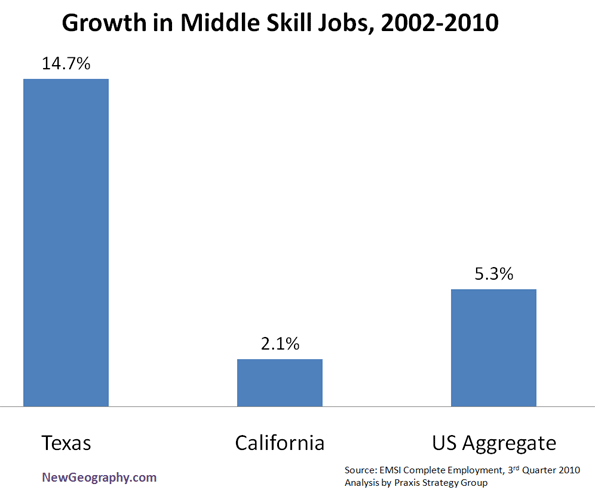
    A vast difference in economic performance is driving the demographic shifts. Since 1998, California’s economy has not produced a single new net job, notes economist John Husing. Public employment has swelled, but private jobs have declined.  Critically, as Texas grew its middle-income jobs by 16%, one of the highest rates in the nation, California, at 2.1% growth, ranked near the bottom. In the year ending September, Texas accounted for roughly half of all the new jobs created in the country.

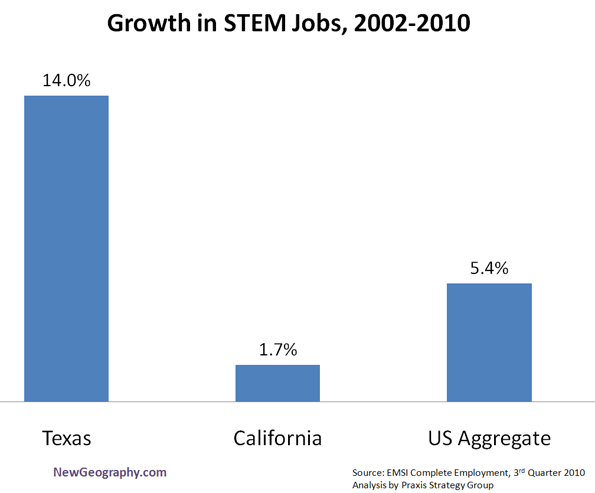
    Even more revealing is California’s diminishing preeminence in high-tech and science-based (or STEM–Science, Technology, Engineering and Mathematics) jobs. Over the past decade California’s supposed bulwark grew a mere 2%–less than half the national rate. In contrast, Texas’ tech-related employment surged 14%. Since 2002 the Lone Star state added 80,000 STEM jobs; California, a mere 17,000.

    Of course, California still possesses the nation’s largest concentrations of tech (Silicon Valley), entertainment (Hollywood) and trade (Port of Los Angeles-Long Beach). But these are all now declining. Silicon Valley’s Google era has produced lots of opportunities for investors and software mavens concentrated in affluent areas around Palo Alto, but virtually no new net jobs overall. Empty buildings and abandoned factories dot the Valley’s onetime industrial heartland around San Jose. Many of the Valley’s tech companies are expanding outside the state, largely to more business-friendly and affordable places like Salt Lake City, the Research Triangle region of North Carolina and Austin.

    Hollywood too is shifting frames, with more and more film production going to Michigan, New Mexico, New York and other states. In 2002, 82% of all film production took place in California–now it’s down to roughly 30%. And plans by Los Angeles County, the epicenter of the film industry, to double permit fees for film, television and commercial productions certainly won’t help.

    International trade, the third linchpin of the California economy, is also under assault. Tough environmental regulations and the anticipated widening in 2014 of the Panama Canal are emboldening competitors, particularly across the entire southern tier of the country, most notably in Houston. Mobile, Ala., Charleston, S.C., and Savannah, Ga., also have big plans to lure high-paid blue collar jobs away from California’s ports.

    Most worrisome of all, these telltale signs  palpable economic decline seem to escape most of the state’s top leaders. The newly minted Lieutenant Governor, San Francisco Mayor Gavin Newsom, insists “there’s nothing wrong with California” and claims other states “would love to have the problems of California.”

    But it’s not only the flaky Newsom who is out of sync with reality. Jerry Brown, a far savvier politician, maintains “green jobs,” up to 500,000 of them, will turn the state around. Theoretically, these jobs might make up for losses created by ever stronger controls on traditional productive businesses like agriculture, warehousing and manufacturing. But its highly unlikely.

    Construction will be particularly hard hit, since Brown also aims to force Californians, four-fifths of whom prefer single-family houses, into dense urban apartment districts. Over time, this approach will send home prices soaring and drive even more middle-class Californians to the exits.

    Ultimately the “green jobs” strategy, effective as a campaign plank, represents a cruel delusion. Given the likely direction of the new GOP-dominated House of Representatives in Washington, massive federal subsidies for the solar and wind industries, as well as such boondoggles as high-speed rail, are likely to be scaled back significantly.  Without subsidies, federal loans or draconian national regulations, many green-related ventures will cut as oppose to add jobs, as is already beginning to occur. The survivors, increasingly forced to compete on a market basis, will likely move to China, Arizona or even Texas, already the nation’s leader in wind energy production.

    Tom Hayden, a ’60s radical turned environmental zealot, admits that given the current national climate the only way California can maintain Brown’s “green vision” will be to impose “some combination of rate heights and tax revenues.”  Such an approach may help bail out green investors, but seems likely to drive even more businesses out of the state.

    California’s decline is particularly tragic, as it is unnecessary and largely unforced. The state still possesses the basic assets–energy, fertile land, remarkable entrepreneurial talent–to restore its luster. But given its current political trajectory, you can count on Texans, and others, to keep picking up both the state’s jobs and skilled workers. If California wishes to commit economic suicide, Texas and other competitors will gladly lend them a knife.


    This article originally appeared at Forbes.com.

    Joel Kotkin is executive editor of NewGeography.com and is a distinguished presidential fellow in urban futures at Chapman University. He is author of The City: A Global History. His newest book is The Next Hundred Million: America in 2050, released in February, 2010.

    Employment data from EMSI.

    Photo by {Guerrilla Futures | Jason Tester}

  • The State Government Deconstructors

    The results of the mid-term election of 2010 will be written over the next two years. Can the Republicans really make good on their promise of fiscal discipline? A glimpse of our future federal budget may be seen in the fiscal actions (and inaction) of America’s governors. Most states are struggling to balance budgets in troubled economic times with projected shortfalls nationwide of more than $100 billion for Fiscal Year 2012. Federal bail-outs are no longer an option. The hard choices are tax increases, reduction of services or innovative fiscal solutions like deconstruction. These bold and innovative governors, or “Deconstructors,” are what Alexander Hamilton had in mind when he wrote in The Federalist that “energy in the executive is a leading character in the definition of good government.”

    New Jersey Governor Chris Christie was the first Deconstructor to emerge. He wasted no time when he was sworn into office in January of 2010, declaring a fiscal state of emergency and freezing billions of spending. This week he announced 1,200 more public workers will get the axe come January. Governor “Wrecking Ball” is attracting plenty of national attention.

    Governor Mitch Daniels of Indiana has an approval rating today over 70%. This Deconstructor, a former U.S. Office of Management and Budget Director, inherited a $600 million deficit and within a year turned it into a $300 million surplus. Four years later, the state had a $1.3 billion surplus. In 2008, “The Blade” as he is called, ushered through the legislature a bill that cut property taxes on the average house by more than 30%, making Indiana one of the nation’s lowest property tax states.

    Along the way, Daniels decertified the public service unions. Within a year, 92% of government employees quit paying their union dues. He reduced the number of state employees by 14% to a level last seen in 1982. He leased the Indiana Toll Road to foreign investors for $3.85 billion, which he sequestered in an escrow account, where it can only be used for road construction. Today, Indiana is one of nine states with a triple-A bond rating and, it is creating jobs. Despite only 2% of the national population, Indiana generated 7% of all new jobs created in the U.S. last year.

    Mr. Daniels predicted that Americans would come to realize how much of what government now does “we can get by without.” He questions, “will the public sector be the servant, the enabler of the free economy…or will they be the master?” “Some of the anger out there now”, he said, “is directed not just at Wall Street but government employees and their unions.” In August 2010, The Economist wrote of, “his reverence for restraint and efficacy,” adding, “He is, in short, just the kind of man to relish fixing a broken state — or country.”

    Another Deconstructor is Governor Bob McDonnell of Virginia. Since taking office in 2010, Governor McDonnell converted a $1.8 billion deficit into a $200 million surplus. He overhauled Virginia’s pension system, saving $3 billion over 10 years. He imposed an immediate, statewide hiring freeze that covers all noncritical areas of state government. He saved $20 million per year by cutting and consolidating boards and agencies. State employees, who experienced a wage freeze for four years, identified $28 million is savings and will be rewarded with an $83 million bonus this year.

    Governor Haley Barbour of Mississippi inherited a budget deficit of $720 million deficit when he took office and created a surplus without raising taxes. Today Mississippi runs on less money than required two years ago, a lesson Barbour says the federal government needs to learn. Barbour championed serious tort reform. “We’ve gone from being labeled as a judicial hellhole and the center of jackpot justice to a state that now has model legislation,” says Charlie Ross, a Republican who chairs the state Senate Judiciary Committee. He increased funding for education and job training. The reward for his success is talk that Barbour may be a candidate for President in 2012.

    West Virginia Governor Joe Manchin, a Democrat, was elected to take Senator Byrd’s place in the Senate. As governor, he was routinely described as a penny-pincher and a tightwad. Manchin has been so focused on controlling state spending when an employee quit, he refused to allow new hires without his direct permission. West Virginia had a budget surplus last year while other states fired cops, fireman and teachers. The Charleston Gazette called the governor, “Penny wise and pound foolish,” but others praised his budget discipline. Conservative CATO Institute gave Manchin an A for his money management.

    What do these Deconstructors have in common? Despite the Great Recession, they each created a budget surplus. They did so by deconstructing the state government (and state deficits) they inherited. They used bold ideas (selling the toll road) and innovation (decertifying the unions) to do what others said cannot be done.

    The success of these deconstructors should offer some hope for badly managed states like California, Illinois, New York, and Michigan. The question is whether politicians in Sacramento, Springfield, Albany, or Lansing are ready to learn from these early deconstructors or will continue to bankrupt their states. Crunch time is approaching now since, thanks to the election, there is likely little appetite in Washington to bail these states out of their morass.

    **************************

    The Great Recession of 2007 – 2012 will be followed by a period during which budget deficits, unfunded obligations and credit restraints force tremendous change to the core structure of governments worldwide. This period will come to be known as THE GREAT DECONSTRUCTION.

    Robert J Cristiano PhD is the Real Estate Professional in Residence at Chapman University in Orange, CA and Head of Real Estate for the international investment firm, L88 Investments LLC. He has been a successful real estate developer in Newport Beach California for twenty-nine years.

    ¬¬¬
    Other works in The Great Deconstruction series for New Geography
    Deconstruction: The Fate of America? – March 2010
    The Great Deconstruction – First in a New Series – April 11, 2010
    An Awakening: The Beginning of the Great Deconstruction – June 12, 2010
    The Great Deconstruction :An American History Post 2010 – June 1, 2010
    A Tsunami Approaches – Beginning of the Great Deconstruction – August 2010
    The Tea Party and the Great Deconstruction – September 2010
    The Great Deconstruction – Competing Visions of the Future – October 2010The Post Election Deconstructors – Mid-term Election Accelerates Federal Deconstruction – November 2010

  • Livability and All That

    Livability is one of those once innocuous words, like sustainability, that now receive almost unquestioned acceptance in the bureaucracy, academia and the media. After all, words like sustainability and livability have no acceptable negative form. Who could be in favor of anything unlivable, insensitive, unhealthy or unsustainable?

    Back in the late seventies, when I served as Special Assistant for Information Policy in the Office of the Secretary, our shibboleth was “balanced”. Can anyone be in favor of unbalanced transportation? It didn’t matter that the word had no meaning and we couldn’t explain it to others, it still became standard in the rhetoric of secretarial officers. In an unkind moment a reporter asked the present DOT Secretary Ray LaHood what he meant by livable, given that the department had just added it to its criteria for giving away money. He replied vaguely it was something about being able to walk to work and the park and a restaurant, to a doctor and a few more things.

    Well it turns out I was living the livable life style when I was growing up in Queens, New York in the fifties and didn’t know it. Here all along I just thought we were poor.

    Aside from seeking to have the same modal shares of America in 1910, or Tajikistan today, this idea fails on both theoretical and practical grounds. Theoretically, whatever merit the idea might have, livability means very different things in a tenement in Brooklyn, or a place in Billings, Des Moines, or Peoria. I can recall being sent to the store for milk or lettuce by my Mom after school. If I didn’t get there in time the four heads of iceberg lettuce (I was 16 before I found out that there were other kinds) were gone. The milk was “milk”. Today in a supermarket the milk section is bigger than the grocery store I went to as a kid. There’s skim, 1%, 2%, whole, lactaid, acidophilus in quarts, half-gallons, and gallons and 86 kinds of lettuce. The typical market today has above 50,000 items. That means that the market shed for such stores is far broader than it was back in the day.

    We were three generations of the family in the same household and we all had the same doctor who lived two blocks away. Today I don’t have a doctor – I have half a dozen – none of them selected on the basis of distance. When one selects doctors, best, not closest, matters. Hospitals are growing in size but declining in the number of facilities per thousand population. All of this is simply representative of the immense trend towards specialization in our society – an increasing division of labor in all activities and an accompanying division of tastes and preferences in an increasingly affluent society. If you want a loaf of wonder bread there’s a 7-11 down the street; if its ciabatta with sun-dried tomatoes there’s this really great place I know a few miles off of exit 29 on the freeway.

    In today’s job market don’t we expect that people will be willing to go farther to find the job they want or can get? If the average travel time is about 25 minutes and a half-hour commute is acceptable, how long is one unemployed before the acceptable becomes 45 minutes or an hour? In this period of housing constraint in which people are even more locked into their homes by underwater mortgages, the commute will grow as people get desperate.

    In my town of College Point, Queens when the factory whistle blew a few thousand walked in the gate and out again when the whistle blew in the evening. People don’t live outside the factory gate anymore and haven’t for awhile. Again, specialization and division of labor are the main factor. Job groupings are far smaller today, and the rate of job turnover means more people won’t/can’t move every time they change jobs. Moreover, about 70% of workers live in a household with other workers – whose job will they live next to?

    More importantly, the great competitive strength of America lies in access to skilled workers. Employers will be reaching out farther and farther to find the specializations and skills they require. We should expect work trip lengths to grow not become walking trips. It won’t be inner city oriented either. The metropolis of today is of immense size because many employers need a market of hundreds of thousands of potential workers to reach the ones they need. The Atlanta region with 26 counties is not a great economic engine because it is 26 charming adjacent hamlets, but rather because the market reach of employers, suppliers, customers and job seekers spreads over several million residents.

    In this environment it takes massive transportation capability to assure that market shed. The questions are how many potential employees can I reach in half an hour; how many suppliers, how many customers? In the future more of us will be free to live where we want and work where we want. Most will not be willing to trade living floor space for a close-by sidewalk café. Americans will drive to where they want to walk.

    There remains, of course, lots of room now within the existing land use distribution to make it easier for those who wish to live closer to shops, jobs or entertainment. People also are free to go to the nearest store or nearest doctor. The fact that so few do so reflects the oft-forgotten fact that people have their own notions of what is most important. Trying to coerce them to live the way government – particularly the upper bureaucracy – thinks they should live holds many perils. The American people have no obligation to live in ways that make it convenient for government to serve them. Government isn’t smart enough to know how people should live or to order their lives in more “convenient” arrangements.

    On the practical side:

    It’s on the practical side that the concepts of livability really fail. The central failure inheres in what the Europeans call subsidiarity, proposes that any necessary activity of an authority should be conducted by that level of governance closest to the problem that can effectively address it. Having livability rise to become central principle of federal transportation investment planning is an egregious failure in our historical system of decentralized government. If sidewalks and bike paths are federal then everything is federal.

    The mayors of our cities love it. Why not? It is the closest they have come to being able to lay claim to direct federal funding, getting those pesky states and suburban communities where the majority of Americans live out of the way. They see it as finally being their turn at the money from Washington. In these times, when every government level is broke, livability and sustainability can prove a potential lifeline, and a bonanza as well to developers – often themselves subsidized – who focus on the inner city.

    The livability criterion is ultimately centralist: fed-centric. It is not up to local people if they want to densify or not, but real power will rest with a really “smart” guy behind a desk in Washington. Proposals for federal “performance measurement” degenerate into a charade that produces pre-ordained results. Now I can fund my friends, who are as right-thinking as I am!

    The problem here is a total disconnect between what people in a diverse democracy want, and what the central bureaucracy, and their academic allies, wish to impose. The livability agenda may be popular in the press and among pundits, but for most communities and people it’s neither popular nor remotely democratic.

    Alan E. Pisarski is the author of the long running Commuting in America series. A consultant in travel behavior issues and public policy, he frequently testifies before the Houses of the Congress and advises States on their investment and policy requirements.

    Photo by Mastery of Maps

  • Geography of the Election: The Philadelphia Collar Counties – A Splash of Red

    The Obama coalition of 2008 has begun to fracture with independents, women and college educated voters bolting to Republicans and the youth vote seemingly uninterested in this election. But perhaps the most critical change took place in suburbia. This was particularly evident last week in southeastern Pennsylvania, especially in the suburban Philadelphia counties.

    Historically in Pennsylvania statewide Democratic candidates won big in Philadelphia only to see their margin decimated in the traditionally heavily Republican suburban counties of Bucks, Chester, Delaware and Montgomery, known as the Philadelphia “Collar Counties.” This trend began to shift in the 1990s due in large measure to the GOP stance on abortion and other social issues.

    During the 1990s, Democratic candidates were able to claim the mantel of moderation by positioning themselves as fiscally conservative and socially moderate. Affluent, college educated, women, and younger voters from traditionally staunch Republican families joined with established Democratic constituencies including the Jewish community, working class voters from old suburban mill towns, and minority voters to form winning coalitions throughout the collar counties.

    During the 2000s, Democrats would be elected to fill Congressional seats in three of the four collar counties. Not surprisingly, no Republican at the top of the ticket would win Pennsylvania over the next 10 years. The main reason was the collar counties were voting more Democratic with each election. The table below shows the percentage of the vote won by the Republican candidate at the top of the ticket from 2000 – 2008:

    Top of Ticket

    Chester

    Bucks

    Delaware

    Montgomery

    Phila.

    Bush/Gore 2000

    53.4%

    46.3%

    42.7%

    43.8%

    18.0%

    Fisher/Rendell 2002

    41.1%

    43.6%

    33.1%

    31.4%

    14.7%

    Bush/Kerry 2004

    52.0%

    48.3%

    42.3%

    44.0%

    19.3%

    Santorum/Casey 2006

    45.0%

    41.5%

    38.3%

    38.1%

    15.9%

    McCain/Obama 2008

    45.0%

    45.1%

    38.8%

    39.2%

    16.3%


    In 2010, the trend began to favor Republicans again. The GOP picked up a net five Congressional seats including two in the southeast region. It also propelled State House Republicans to a huge victory moving from 99 seats to a projected 111 – 92 majority. Republican Tom Corbett won the governorship by 10 percentage points with 55 percent of the vote. Conservative Pat Toomey outpaced Joe Sestak for the U. S. Senate by two percentage points.

    A look at the trends shows that both statewide Republican candidates ran stronger in the collar counties than did Senator John McCain in 2008 in his bid for President:

    2010 Numbers

    Chester

    Bucks

    Delaware

    Montco

    Phila

    Toomey/Sestak

    53.4%

    53.2%

    43.6%

    45.9%

    16%

    Corbett/Ontorato

    55.9%

    55.4%

    47.0%

    48.3%

    17.1%

    McCain 2008

    45.0%

    45.1%

    38.8%

    39.2%

    16.30%

    Tom Corbett ran nearly 10 percentage points ahead of McCain in the collar counties. In fact, Corbett carried these counties by 22,370 votes as he reversed the top of the ticket trend of the past decade. Although this was not enough to offset the 274,373 he lost by in Philadelphia at least he won enough elsewhere, including in the collar countries, to win a fairly impressive victory statewide.

    Pat Toomey, a clear conservative, ran well ahead of the vote former Senator, and social conservative, Rick Santorum was able to win four years earlier, but he did not perform as well as Corbett did against McCain. This can be explained in part by the fact that his opponent, Joe Sestak, was an elected Congressman from Delaware County.

    2010 Numbers

    Chester

    Bucks

    Delaware

    Montco

    Phila

    Toomey/Sestak

    53.4%

    53.2%

    43.6%

    45.9%

    16%

    Santorum/Casey 2006

    45.0%

    41.5%

    38.3%

    38.1%

    15.9%

    Toomey would lose the collar counties by 27,195 votes. This gave him a much steeper hill to climb in the other 61 counties of Pennsylvania, but at least he was not out of the game as had been McCain, Santorum, and Fisher over the past 10 years.

    Will this change in voting pattern continue? It could if Republicans can hold Independent voters by delivering solid results at both the Federal and State levels. Republicans will now control redistricting in Pennsylvania. This should allow them to consolidate the gains made this year in Congress, but does not change the fact that the Philadelphia collar counties will continue to determine the fate of statewide candidates in Pennsylvania into the foreseeable future.

    The fight in Washington over the next two years will likely be the traditional “heart vs. head” fight of the past where Democrats push for more social programs and Republicans position on the costs of these programs.

    The 2010 election in southeastern Pennsylvania seemed to prove that a bad economy and fears of continuing increases in taxes and debt will add a splash of red to the collar counties “light blue” voters.

    Dennis M. Powell is president and CEO of Massey Powell, an issues management consulting company located in Plymouth Meeting, PA.

  • Geography of the Election: A New Era of Racial Politics

    Laura Jean Berger worked on the Congressional Campaign of Assemblyman Van Tran. This is her account of the results.

    Energy and free beer flowed through Assemblyman Van Tran’s campaign headquarters, the crowd anxiously building with anticipation each time Fox News reported another House seat for the Republicans. Every major network’s live trucks crowded the parking lot of the converted Blockbuster video store, their cameras trained on a stage set for a victory speech.

    But the crowd would be disappointed tonight. Results had Tran and incumbent Democratic Congresswoman Loretta Sanchez tied early in the evening, but she pulled ahead to a nine-point lead by midnight. And now, almost a week later, the wait is not yet over. While national press has declared Sanchez the winner yet again in central Orange County, California, neither candidate has yet conceded or declared victory.

    So why in California’s 47th district — where most have declared Sanchez the winner–will neither candidate make a declaration? Just ask the Orange County Registrar of Voters: the surprise in the ballot box is that there are still approximately 30,000 votes yet to be tallied, as reported by the Orange County Register. In a race where approximately 66,000 ballots cast have been counted thus far, one third of the vote share remains outstanding.

    The race could go either way at this point because those ballots yet to be counted are record numbers of both vote by mail and provisional ballots. If you’re Loretta Sanchez, you know that provisionals will likely break in your favor due to alleged polling place confusion in heavily Democratic Santa Ana. But if you’re Van Tran, you are hoping that the largest Vietnamese community outside Vietnam all decided to vote absentee this year.

    The Voice of OC asserts that “history has shown that absentee and provisional votes often make big differences in municipal elections involving large numbers of Vietnamese voters.” In this district, it seems that race is playing a substantial role in the election results just as it did during the campaign.

    National media attention descended when Sanchez declared on the Spanish television station Univision that the “Vietnamese and the Republicans” were trying to “take this seat…” and also remarked that Tran was very “anti-immigrant.” Her comments ignited a firestorm because Tran is, in fact, a Vietnamese immigrant himself. Sanchez was accused of bringing racial divisiveness into the campaign and later offered an apology for her comments once prompted.

    While the Vietnamese community in Orange County is certainly cohesive, they are not single-issue voters, as opposed to many Hispanics. OC Weekly columnist Gustavo Arellano stated in an interview with Southern California Public Radio, “All really that matters to the Spanish-language media right now is the question of immigration because that is the biggest question that its readership has…Everything else is secondary.” Since Tran has not defined his views on immigration precisely, he is “largely ignored” by Spanish-language media.

    Vietnamese voters, on the other hand, share the country’s priority on jobs yet also consider how either candidate–Vietnamese or not–would handle policy positions toward Vietnam. Sanchez’s work on House Resolution 334 calling for an end to Vietnam’s political imprisonment of those who supported Saigon and the South greatly helped her relationship with the Vietnamese community, approximately fifteen percent of the district’s residents.

    While that number might not seem like much, it’s important to note that the Vietnamese turn out at much higher percentages than Hispanics. Hao-Nhien Vu, managing editor of the largest Vietnamese newspaper in the US, ascribes civic involvement with the fact that “they went through so much to get here.”

    Yet the racial disparity in Orange County plays into a larger statewide picture. Voters in California supported Proposition 20 on Election Day, which gives the power of redistricting state and federal districts to a citizens’ committee as opposed to state legislators. California’s districts have been compared to “Swiss cheese,” but the district bordering the 47th to the north, the 40th, makes some rather interesting jabs around the edges.

    The Republican (and Vietnamese) stronghold of Garden Grove has been seemingly attacked by a cookie cutter, while one could argue that isolating predominantly Hispanic Anaheim and Santa Ana in the same district lumps too many Democratic votes together. Both parties are to blame for drawing illogical districts to maintain the status quo. But there’s an even greater national issue growing in this Petri dish.

    President Barack Obama’s election was seen by many as an advance in the fight against racial politics in the United States. But in light of Sanchez’s and Tran’s campaigns and supporters, when does cohesiveness cross the line? This district is a prime example of a place where there are more minority residents than whites. Therefore, it’s logical that a minority representative would be easily elected.

    But which minority?

    The answer is different for each voter. Identifying with the electorate has always worked well in politics. Sanchez identifies with the Hispanics while Tran pulls in the Vietnamese. Each has their supporters among Anglos and African-Americans. But even so, the inevitable is that one ethnic group is pitted against the other in a sense, and everyone knows it (and now admits it after Sanchez’ aforementioned Univision comments).

    The good news? The issue of race is now forced onto the table. Now that it’s no longer completely taboo, there’s a hope that different ethnic groups can come together and realize the diverse issues they all face. If this can be done, the voters will undoubtedly select the candidate that can best represent them, and that may not be a candidate with whom they identify based on race.

    However, this can only happen once an interracial dialogue is established. It won’t happen overnight. Members of minority voting blocs will and do integrate into the larger political discussion with time. Only after this is achieved will race become the non-issue that it should be in politics.

    As for California’s 47th Congressional district, the jury is still out for this year. And in 2012, who knows what the Citizens’ Redistricting Committee will change? Hopefully this year is one of the last in which race will play such a deciding role in elections. But that depends on the opening of communication channels between groups. As our country gets more diverse, and complex, we could be witnessing the beginning of a new era of racial politics in America.

    Laura Jean Berger is a senior at Chapman University studying Political Science and Communication Studies. A lifelong resident of Glendale, she is an avid classical pianist and a self-diagnosed political junkie.

    Photo by Neon Tommy

  • Currency Wars: The Yuan and The Dollar Face Off

    In the currency wars looming between the United States and China, everyone is focused on the decline of the U.S. dollar and the overvaluation of the Chinese renminbi. In the standoff, China maintains a low valuation for the yuan — the unit in which the renminbi is denominated — against the dollar, insuring that Wal-Mart can fill its aisles with goods that cost less than the patio furniture and video games made in Paducah, Kentucky.

    The Obama administration would like to “jawbone” the Chinese to relax its currency peg, so that the yuan appreciates, making it possible for Chinese consumers to buy goods from the United States. This monetary logic assumes that Chinese buyers want to own serialization rights to “The Apprentice”, or are shopping for B-1 bombers, as at the moment that may be what the U.S. economy primarily has to offer for export.

    In trying to explain the depth of the current U.S. recession, economists have latched onto the phrase “structural issues,” to indicate that the U.S. needs fewer pilates classes and more steel orders if it is to pay down its debts and create new jobs. The phrase itself is a hint that the currency wars have provoked bizarre east/west role reversals.

    While the mandarins of the Chinese politburo sound increasingly like hard-nosed American executives, the Obama administration is speaking a language that could well be lifted from Mao’s Little Red Book.

    Like the Cultural Revolution, the U.S. administration came to power pledging to get rid of the “four olds”: old thoughts, old culture, old customs, and old habits. It might well have denounced “Party formalism” or “spiritual pollution.” Yes, there would be struggle sessions and the opposition of turmoil elements. But the result of the reforms would be a Great Leap Forward, although one that evidently comes with the price tag of $2 trillion in annual deficits.

    China’s worry, meanwhile, is that its economy relies on one client with a receivable problem. Its treasury sits on $1 trillion of U.S. government bonds and securities, the peg to keep the yuan in line with the dollar, while the dollar is sinking under the weight of its GM shares, subprime loans, entitlement IOUs, and health care payouts.

    Twenty years ago it would have been a dream to imagine “capitalist roaders” running China. Now, we fear having to answer to repo men.

    Like any nervous creditor, the Chinese leadership focuses on “payout ratios,” “interest cover,” “debt-to-equity,” and “price-to-book.” Mao might have warned about “spontaneous tendencies toward capitalism,” but the new Chinese leadership thinks more about solvency and capital adequacy.

    Hence the current American hand–wringing at IMF meetings and the calls in Congress to convene what the Central Committee used to call “Grievance Redress Societies.”

    While the Chinese are working on Saturdays, the Obama administration’s jobs policy, for the moment, consists largely of hiring America’s unemployed into the Census Bureau. Maybe we can expect large posters of Uncle Sam exhorting Americans: “Do Your Economic Duty: Stand Up and Be Counted!”

    Why do Americans have trade and payment imbalances with China? The short (and nonacademic) answer might begin by saying that Americans are in love with such big box stores as Target and Costco, and can’t own enough sheets, towels, housewares, wrapping paper, sweatshirts, shoes, T-shirts, caps, kitchen appliances, televisions, recliners, electronics, iPhones, picture frames, blue jeans, and sneakers, all of which China is willing to supply at cut-rate prices.

    Consumerism in China is not the state religion that it is in the United States. Shoppers in the U.S. congregate in malls and stores that are the size of the Vatican, and they walk around in the same hushed raptures. The average shop in China, as best as I can tell from my travels there, is the size of a closet and sells bags of rice, bottled water, Hand of Buddha Tea, little pots, bird cages, and shoots of bamboo, none of which are made in those retooled New England woolen mills.

    China would buy our software, were it not already stealing it. As it is, all the Chinese want from the U.S. is a few buckets of KFC chicken, some coal plants, and the odd New York Yankees cap. Too bad they don’t want to buy AIG, the city of Las Vegas, or the Social Security system.

    Although the last thing I want to be accused of is “mountaintopism” or “right opportunism,” my fear is that the failure of the Obama administration’s currency pronouncements, combined with the rise of Tea Party nativism, will provoke the kind of protectionism that would warm the earmarks of Senator Smoot and Congressman Hawley.

    What could be easier than to impose tariffs on a variety of Chinese–made goods? The problem with protectionism is that it will further delay the economic recovery.

    In the short run, protectionism could redress the monthly U.S. trade imbalance (up to $28 billion a month with China), stimulate a few jobs, and end the “capitulationism” toward the subsidized state capitalism of the Far East.

    Longer term, protectionism puts the U.S. on a path in which its economy will be isolated from the rest of the world, with these (“renegade”) consequences: trade collapses, government debt remains high, foreign investors disappear, costs and inflation increase, unemployment goes up, savings go down, and “the carefree clique” in Washington raises taxes to pay for these “opportunist errors.”

    The currency disagreements mask the inherent imbalances in the global financial system: the West consumes too much and saves too little, and the developing world, and countries like China, spend too little and horde too much. Only economic expansion, debt reduction, and expanded trade can redress this so-called disequilibrium. Neither protectionism, nor more Fed magic will do the trick. Nor will declaring a currency war against China.

    Even the Chinese know that it’s better to be a dog in peace than a man in troubled times.

    Photo by Eric Mueller, “It’s Money, Comrade!”

    Matthew Stevenson is the author of Remembering the Twentieth Century Limited, winner of Foreword’s bronze award for best travel essays at this year’s BEA. He is also editor of Rules of the Game: The Best Sports Writing from Harper’s Magazine. He lives in Switzerland.