Category: Politics

  • California: The Republic of Climate

    To some progressives, California’s huge endorsement for the losing side for president reflects our state’s moral superiority. Some even embrace the notion that California should secede so that we don’t have to associate with the “deplorables” who tilted less enlightened places to President-elect Donald Trump. One can imagine our political leaders even inviting President Barack Obama, who reportedly now plans to move to our state, to serve as the California Republic’s first chief executive.

    As a standalone country, California could accelerate its ongoing emergence as what could be called “the Republic of Climate.” This would be true in two ways. Dominated by climate concerns, California’s political leaders will produce policies that discourage blue-collar growth and keep energy and housing prices high. This is ideal for the state’s wealthier, mostly white, coastal ruling classes. Yet, at the same time, the California gentry can enjoy what, for the most part, remains a temperate climate. Due to our open borders policies, they can also enjoy an inexhaustible supply of cheap service workers.

    Of course, most Californians, particularly in the interior, will not do so well. They will continue to experience a climate of declining social mobility due to rising costs, and businesses, particularly those employing blue-collar and middle-income workers, will continue to flee to more hospitable, if less idyllic, climes.

    California in the Trump era

    Barring a rush to independence, Californians now must adapt to a new regime in Washington that does not owe anything to the state, much less its policy agenda. Under the new regime, our high tax rates and ever-intensifying regulatory regime will become even more distinct from national norms.

    President Obama saw California’s regulatory program, particularly its obsession with climate change, as a role model leading the rest of the nation — and even the world. Trump’s victory turns this amicable situation on its head. California now must compete with other states, which can only salivate at the growing gap in costs.

    At the same time, foreign competitors, such as the Chinese, courted by Gov. Jerry Brown and others to follow its climate agenda, will be more than happy to take energy-dependent business off our hands. They will make gestures to impress what Vladimir Lenin labeled “useful idiots” in our ruling circles, but will continue to add coal-fired plants to power their job-sapping export industries.

    Read the entire piece at The Orange County Register.

    Joel Kotkin is executive editor of NewGeography.com. He is the Roger Hobbs Distinguished Fellow in Urban Studies at Chapman University and executive director of the Houston-based Center for Opportunity Urbanism. His newest book, The Human City: Urbanism for the rest of us, was published in April by Agate. He is also author of The New Class ConflictThe City: A Global History, and The Next Hundred Million: America in 2050. He lives in Orange County, CA.

    Photo: By User “Neon Tommy” (https://www.flickr.com/photos/neontommy/8117052872) [CC BY-SA 2.0], via Wikimedia Commons

  • The Quest for Food Freedom

    Mariza Ruelas currently faces up to two years in jail in California for the crime of selling ceviche through a Facebook food group. Welcome to the mad world of American food regulation. In Biting the Hands That Feed Us, Baylen Linnekin looks closely at a system that can take pride in a historically safe food supply but that also imposes too many rules that defy common sense.

    Linnekin traces the system’s origins to The Jungle, Upton Sinclair’s exposé of the appalling conditions in Chicago’s slaughterhouses, and to the New Deal’s hyper-regulation of agriculture. Such intrusiveness culminated in the case of Wickard v. Filburn, in which the Supreme Court ruled that Americans don’t even have the right to consume food they grow themselves, on their own land. Food regulation has marched steadily onward ever since.

    While working conditions and food safety improved dramatically thanks to these efforts, the move to regulate all food products according to uniform standards also produced a system with a host of strange rules—such as requiring organic skim milk that is free of additives to be labeled “Non-Grade ‘A’ Milk Product–Natural Milk Vitamins Removed.” Bans on urban agriculture have outlawed backyard chicken coops and front-yard gardens. Seemingly random changes in safety requirements force the shutdowns of businesses with no incidents of contamination or sickened customers. In some jurisdictions, it’s illegal to slice off a sample of cheese or cut the stalk off of lettuce at farmer’s markets. Microbreweries were threatened with having to register as pet-food manufacturers if they wanted to donate their spent grains for animal feed (a long-standard practice even for big breweries). In public parks, foraging of any sort—such as picking wild berries—is often banned.

    Mariza Ruelas made her ceviche at home, which is why she’s in trouble with the law: food-safety mandates have made home production of food for sale, even in small quantities, illegal. You might be in trouble, too, if, say, you contribute a pan of brownies to the bake sale at your child’s school. That’s probably illegal.

    States and localities are starting to push back at this regulatory insanity. Some states have instituted “cottage-food laws” allowing home preparation of small amounts of food for sale in limited venues, such as at farmer’s markets. Wyoming passed a comprehensive Food Freedom Act reducing regulation of food sales, so long as no middleman is involved. Some cities have legalized the raising of chickens or urban beekeeping. But there’s a long way to go.

    For Linnekin, a food-law professor, the goal is to make traditional and “sustainable” agricultural practices legal. Much of what he argues for makes good sense, but there’s another side to the issue. Because so many urban hipsters want to produce (or at least consume) artisanal food products, food law, along with zoning, often serves as their point of entry into the vast regulatory web that smothers so many American businesses. This awareness doesn’t necessarily turn urban epicures into liberty-minded activists, though. Many small-scale organic-food producers and their customers simply want to make their preferred practices legal and easier to practice—while saddling major corporate producers of food with added regulations. In general, food activists aren’t much interested in establishing better rules and then letting the market determine outcomes. Instead, they seek specific outcomes—more composting, for example—and deem any rule that fails to support such goals to be a bad one.

    Linnekin seems somewhat sympathetic to this small-is-better tendency. He wants to eliminate “ag-gag” laws that protect farmers from harassment by activists. He thinks that many food products carry antiquated grading standards and wants to see them changed. But many of these standards have solid rationales. Linnekin objects, for example, to the USDA’s “prime” grade for beef being determined by the level of fat marbling. But fat is the driver of taste, and many small producers of leaner, grass-fed beef sell products that often don’t taste very good. They don’t deserve a “prime” grading.

    While regulations hostile to industrial, mass-scale agriculture—which feeds a global population of 7 billion people—should be avoided, rationalizing archaic and protectionist regulations makes sense. So does exempting small-scale producers from many regulations and embracing a more general “food-freedom” philosophy. As Biting the Hands That Feed Us makes clear, our current food-regulatory approach is too often a theater of the absurd.

    This post original appeared in City Journal on March 15, 2017.

    Aaron M. Renn is a senior fellow at the Manhattan Institute, a contributing editor of City Journal, and an economic development columnist for Governing magazine. He focuses on ways to help America’s cities thrive in an ever more complex, competitive, globalized, and diverse twenty-first century. During Renn’s 15-year career in management and technology consulting, he was a partner at Accenture and held several technology strategy roles and directed multimillion-dollar global technology implementations. He has contributed to The Guardian, Forbes.com, and numerous other publications. Renn holds a B.S. from Indiana University, where he coauthored an early social-networking platform in 1991.

  • Can Tech Oligarchs Thrive Under Trump?

    With the first billionaire in the White House, Wall Street booming and, for the first time in almost a decade, very solid and broad based job growth, one would think America’s business elite would be beaming. But that’s not so because the country’s moguls are more divided than at any time in recent history.

    This conflict stems largely from divergent interests among rival factions of the putative ruling class. Trump’s backers tend to have links with the “real” economy, that is, those people who make things, such as energy producers, domestic manufacturers, agribusiness, suburban home-builders, and aerospace firms. These interests are increasingly concentrated in parts of America Trump painted “red”—the South, the Midwest, the Great Plains, and Appalachia.

    On the other side lies the “ascendant” ephemeral economy, based in such industries as media, entertainment, software, and social media, as well as their financial backers. These industries are less affected by environmental regulations than those in more tangible lines of business. They are also concentrated in the deep blue slivers along the coasts and in college towns, the very places where the progressive social and environmental agenda is most deeply entrenched.

    Obama’s Legacy: A New Post-industrial ruling class

    Barack Obama’s most “transformative” achievement was the consolidation of this potentially hegemonic, post-industrial ruling class. They reaped high returns from the Obama era embrace of ultra-low interest rates, nudging billions into risky tech ventures and speculative urban real estate. These increasingly oligopolistic interests  also benefited  from a Justice Department that eschewed anti-trust inquiries in such areas as smartphone operating systems, search, and social media, where the main players often control  80 and even 90 percent share globally. IT, telecommunications, and media now compose America’s most concentrated sector and is consolidating somewhat faster than older industries, such as manufacturing, property. and wholesale trade.

    In the past, Democrats received some support from business, but the GOP ruled the corporate mainstream. As William Domhoff  illustrated in his classic study Fat Cats and Democrats, Democrats drew support from outsiders, some of them less than savory, in industries from energy,  real estate, and gambling (Trump himself was a long-time Democrat). They also drew on diverse industries. As recently as the Bill Clinton years, Bill White, a savvy oil and gas attorney from Houston, served as chairman of the Democratic Party. It is doubtful now that someone with that background, even with White’s prodigious skills, will again be allowed into the party’s inner sanctum.

    Obama’s post-industrial corporate elite emerged in his first 2008 election, with Google, Microsoft, Time Warner, IBM, and General Electric (NBC) ranking among the largest business donors. During his time in office, companies like Google enjoyed unprecedented access to the White House: More than 250 people moved between jobs at Google or related firms, the federal government, and Democratic political campaigns.

    In the process,  the technology and media oligarchies became core funders of the  Democratic Party. This could prove more important in the future, as six of the ten and eight of the top 15 richest people on the planet, according to Forbes, derive their fortunes from these businesses. And this could just be the beginning: All of the 12 richest entrepreneurs under 40 come from the tech industry.

    Even Hillary Clinton, a far less appealing figure than Obama, garnered most of the big money from tech oligarchs and their employees. Open Secrets notes that among private firms the largest business donors to her campaign included tech media establishments, including Alphabet (Google’s parent company), Microsoft, Apple, Time Warner, and Comcast.

    Trump’s victory shocked this cozy alliance, and placed them in opposition. Silicon Valley, along with its idiot aunt, Hollywood, are now the most likely business constituencies to go into hysterics over the most recent inane Trump tweet, with some CEOs active participants in the anti-Trump “resistance.” Those few in Silicon Valley who backed Trump, like Peter Thiel, are now subject to campaigns to drive them from prominent boards. Uber’s Travis Kalanick, himself a rather unpleasant character, has been forced by such pressure to remove himself from any association with the current White House.

    Ideology here mixes with self-interest. Mark Zuckerberg, whose $50 billion net worth makes him easily the wealthiest American under 40, recently issued a pronunciamiento that places his company’s objective as far from Trumpian nationalism as possible. He wants to create “a global community” even though his industry has helped foster the most social isolation since people discovered caves. His vision of the future, notes Bloomberg’s Leonid Bershidsky, offers something of a “social dystopia” run by Facebook’s management, with terms of discussion powered by computer algorithms.  

    It’s clear what won’t make the cut in Zuckerberg’s “community”: Facebook is  increasingly hostile to any dissenting opinions from the right. The traditional media now wholly or partially  owned by the “ephemeral” economy oligarchs—Jeff Bezos’s Washington Post, Microsoft’s MSNBC and Carlos Slim’s New York Times—have also joined the anti-Trump “resistance,” having just previously served as claques for Obama and Hillary Clinton. Newsrooms may always have tilted somewhat to the left, but today they seem about as objective as those in Putin’s Russia or, for that matter, Fox News.

    Immigration may be the biggest hot button issue separating the oligarchs from a   White House that has fanned nativist flames. But for them, embracing immigration—most notably the odious HIB visa program—does not mean adhering to legal norms or American traditions. Instead, their immigration vision fits that of companies seeking indentured tech servants as well as a cheap and inexhaustible supply of undocumented cheap dog-walkers, toenail painters, and nannies.

    For this constituency, neither Trump’s proposed infrastructure program nor his moves to deregulate the economy have much appeal. After all, the Bay Area oligarchs seem perfectly fine with California’s regulatory insanity, and the piteously poor condition of the state’s infrastructure. Who needs roads and bridges when you have the cloud?

    Of course, not all the new ruling class can dismiss Trump so haughtily. Elon Musk, a Hillary supporter who still sits on the new president’s economic council, needs skilled tradespeople and reasonable regulation to build electric cars and rockets. He yearns to play a role in Trump’s “lunar gold rush.” Caught in the middle, Musk is trying to make nice even in the face of assaults sent to him from the “resistance.”

    Trump’s Oligarchs: Old School and Middle Class Friendly

    The Obama oligarchs, like establishmentarians everywhere, clearly missed what the Chicago sociologist Richard Longworth predicted two decades ago: that rapid globalization,   now known as Davos capitalism,  would cause a full scale “social crisis.” The middle and working classes, as the Guardian has correctly noted, have little reason to love “superstar” oligarchs who employ few of them and, according to a recent paper by the Bureau of Economic Research, are a primary reason for the growth of inequality.

    Trump’s oligarchs, for their part, reflect interests that jibe more closely with those of many middle and working class families. Trump’s so called  “cabinet of billionaires”—their  net worth is estimated at $14 billion—rightly has elicited criticism from   the Guardian and Mother Jones, which predictably also labeled them a bit too pro-Russian. And to be sure, Wall Street’s hoary hand, notably the ubiquitous Goldman Sachs, has secured  top posts at both the Treasury and the head of the National Economic Council.

    Nonetheless, these billionaires have embraced a president who trolls corporations sending jobs overseas and bullies foreign firms, like Softbank, into committing themselves to major employment in the states. Obama and his academic coterie might dismiss such behavior as unseemly, darkly nationalistic and even ahistorical, but there may well be political gold there.

    Of course, self-interest is a guiding factor, something particularly evident in the energy industry. The Trump cabinet features Rex Tillerson, former CEO of Exxon Mobil, as its secretary of State,   Rick Perry, former governor of Texas, as Energy secretary, and Oklahoma’s former attorney general, Scott Pruitt, as director of the EPA. David Wolff, one of the Houston’s largest land owners, notes  the change of administration has sparked renewed optimism across the energy belt. “It is nice to have a president who doesn’t hate your major industry,” Wolff quips.    

    Many manufacturers—at least those who build products  here—also have reason to celebrate the Trump ascension. A lot of firms felt threatened by the Democrats’ regulatory regime, which threatened to boost their energy and other costs. They also were the primary victims of globalist trading polices embraced by the grandees of both parties. The 79-year-old billionaire Wilbur Ross, the new Commerce secretary, made his fortune by buying and selling companies in such trade-impacted sectors as steel, textiles, and coal. Trade advisor Peter Navarro is well-known for pushing neo-protectionist and nationalist policies abhorred by the new oligarchs but popular in large parts of the country.

    Interregnum or Change of Direction?

    To the increasingly disconnected and increasingly concentrated blue state media, Ross and his ilk may epitomize an unhealthy attraction to “backward” sectors that need to be “disrupted” by the geniuses of Silicon Valley. Given their sense of historical inevitably, the tech oligarchs may feel that this shift is just a temporary halt in their drive, as notes Newsweek’s Michael Wolff,  to create “a more careful, regulated, and corrected world.”

    Yet many more Americans—particularly blue collar Americans—may prefer the Trump approach. Manufacturing employs some 11 million workers compared to 2.7 million in information. Both have seen their share of jobs go down since 2004, but, suggests the Bureau of Labor Statistics, industrial jobs are likely to remain six times as numerous by 2024. Throw in the mining sector, which includes energy, and the difference is expected to be roughly 9.4 million jobs compared to 2.4 million in the information sector.

    Ironically, the workforce in these industries is far more diverse than in those businesses run by the Obama oligarchs, who loudly champion the rainbow ideal but rarely in practice.   Silicon Valley  employs very few African-Americans or Hispanics; they make up barely 6 percent, for example, of Facebook’s workforce while overall leading tech firms employ barely 5 percent. In contrast,  according to 2015 data, 16.2 percent of manufacturing workers are Latinos and 9.7 percent are African-Americans. In mining, quarrying, and oil and gas extraction, Latinos make up 16.9 percent of the workforce and African-Americans 4.8 percent, while in agriculture, forestry, fishing, and hunting, nearly a quarter of the workforce—23.0 percent—is Latino and 2.7 percent African-American.

    If Trump policies can unleash a boom in these industries, he may have more staying power than many in the chattering classes admit. At least the Trumpians offer the prospect of upward mobility, greater independence, and the pride of work. In contrast, Silicon Valley’s vision, notes Greg Ferenstein, who has researched the views of the post-industrial elite, suggests a world where a “greater share of economic wealth will be generated by a smaller slice of very talented or original people”—that is, the denizens of Silicon Valley. “Everyone else,” he continues, “will increasingly subsist on some combination of part-time entrepreneurial ‘gig work’ and government aid. “

    One has to wonder whether the prospect of widespread downward mobility for all but the “best and brightest” will prove very attractive to the majority of Americans. In contrast, Trump’s outsized promises, however unrealistic, may retain surprisingly long-term appeal. 

    Trump’s business cronies may be grizzled, and even reactionary. They still may well end up as anachronisms, the last devotes of a dying industrial, largely white, America. But the Trump interregnum could become a new dominant paradigm if the Obama oligarchs fail to develop a vision that allows a better future than the jobless, socially stagnant and politically correct one now on offer.

    This piece first appeared in The Daily Beast.

    Joel Kotkin is executive editor of NewGeography.com. He is the Roger Hobbs Distinguished Fellow in Urban Studies at Chapman University and executive director of the Houston-based Center for Opportunity Urbanism. His newest book, The Human City: Urbanism for the rest of us, was published in April by Agate. He is also author of The New Class ConflictThe City: A Global History, and The Next Hundred Million: America in 2050. He lives in Orange County, CA.

    Photo: Gage SkidmoreCC License

  • Common Sense on Immigration

    No issue divides the United States more than immigration. Many Americans are resentful of the estimated 11 million undocumented immigrants, worry about their own job security, and fear the arrival of more refugees from Islamic countries could pose the greatest terrorist threat. At the other end of the spectrum are those who believe the welcoming words on the Statue of Liberty represent a national value that supersedes traditional norms of citizenship and national culture.

    What has been largely missing has been a sharp focus on the purpose of immigration. In the past, immigration was critical in meeting the demographic and economic needs of a rapidly growing nation. Simply put, the country required lots of bodies to develop its vast expanses of land and natural resources and to work in its factories.    

    The need for foreign workers remains important, but the conditions have changed. No longer a largely rural, empty country, more than 80 percent of Americans cluster in urban and suburban areas. Many routine jobs have been automated; factories, farms and offices function more efficiently with smaller workforces. Since at least 2000, notes demographer Nicholas Eberstadt, the “Great American Escalator” has stopped working.

    These changes suggest the need to rethink national immigration policies. In a country where wages for the poorest workers have been dropping for decades and incomes have stagnated for the middle class, allowing large numbers of even poorer people into the country seems more burden than balm. They often work hard, but largely in low-income service jobs and in the low end of the health care field. In California, home to an estimated 2.7 million largely Latino undocumented immigrants, approximately three in four Latino non-citizens struggle to make ends meet, as do about half of naturalized Latino citizens, according to a recent United Way study.

    Overall, our current immigrants, legal and illegal, have not advanced as quickly as in previous generations. This, along with the crisis in much of Middle America, should be our primary national concern. This doesn’t necessarily translate to mass deportations or even severe cutbacks in legal immigration, as some, including Attorney General Jeff Sessions and several congressional Republicans, have said. But it certainly does suggest taking a fresh look at how we view immigration.    

    Learning From Abroad

    So, what kind of immigration is best for America?

    Models to consider are those that put premiums on marketable skills and language proficiency rather than family reunification. The Canadian and Australian systems, as President Trump correctly noted, are more attuned to their own national needs, compared with the U.S approach, which emphasizes family re-unification. Canadian authorities allow some 60 to 70 percent of their immigrants to come for economic purposes, notes Carter Labor Secretary Ray Marshall, supporting their system mainly by “filling vacancies that are measured and demonstrated in the Canadian economy.”    

    Such a needs-based program would be a better, and fairer, way of addressing skills shortages than the odious H-IB program, which allows temporary indentured tech workers to replace American citizens. Instead, talented newcomers would be welcomed as future citizens and given the right to negotiate their own labor rates and conditions.

    This emphasis on admitting immigrants with needed skills leaves Canadians and Australians with generally more positive views about immigration than Americans. Australia is one of only three countries in the world where children of migrants do better at school than children of non-migrants. Canadian support for immigration is particularly high in Toronto, which has been transformed from a sleepy Anglo enclave to a vibrant, diverse global capital.

    But such hospitality is not limitless. A former Canadian immigration judge told me recently, in a tone of alarm, that his country’s invitation to 25,000 Syrian refugees could incubate the same sort of disorder that we see across Europe. There, in many heavily immigrant communities, poverty and isolation has persisted, sometimes for generations.    

    I doubt many Americans would want to see the kind of social unrest we see across once peaceful places like Sweden, where women now complain of being perpetually harassed, even as supposedly feminist politicians look the other way. In France, Muslims make up about 7.5 percent of the French population compared to 1 percent in the U.S., but France has been ravaged by Islamic terrorism, Muslim-fueled anti-Semitism, and a widening cultural gap between the immigrants and the indigenous French population. In France and many other European countries, we see the rise of nativist politicians that make Donald Trump seem like Mother Theresa.

    Citizenship and National Culture

    The United States could be headed to a similar devolution. America’s ideals may be universal, but our political community has always been based on U.S. citizenship. You should not have to be an Anglo to admire the Founders, or to embrace the importance of the Constitution. Yet it’s now fashionable among some progressive activists to reject established American political traditions, which constitute a fundamental reason people have come here for the last two centuries.

    Yet the “open borders” lobby on the progressive left increasingly demeans the very idea of citizenship. In some cases, they see immigration as way to achieve their desired end of “white America.” Some advocates for the undocumented, such as Jorge Bonilla of Univision, assert that America is “our county, not theirs” referring to Trump supporters. Others, like New York Mayor Bill di Blasio, refuse to differentiate between legal and illegal immigrants.

    As usual, California leads the lunacy. Gov. Jerry Brown, who famously laid out a “welcome” sign to Mexican illegal and legal immigrants, has also given them drivers’ licenses and provides financial aid for college, even while cutting aid for middle-class residents. Some Sacramento lawmakers are pressing to give undocumented immigrants’ access to state health insurance. Senate President Pro Tem Kevin de Leon recently boasted, “Half of my family would be eligible for deportation under the executive order, because they got a false Social Security card, they got a false identification.”

    The “open borders” ideology has reached its apotheosis in “sanctuary” cities which extend legal protection from deportation to criminal aliens, including those who have committed felonies. Donald Trump opportunistically emphasized this absurd and inappropriate situation—sometimes invoking the names of murdered Americans—during his 2016 campaign. The only mystery is why it would surprise the chattering class that many voters responded to his message.

    Most Americans are more practical about immigration than politicians in either party. The vast majority of us, including Republicans, oppose massive deportations of undocumented individuals with no serious criminal record. Limiting Muslim immigration appeals to barely half of Americans. Only a minority favor Trump’s famous “big beautiful wall” on the Mexico-U.S. border.

    Yet even in California, three-quarters of the population, according to a recent U.C.-Berkeley survey, oppose “sanctuary cities.” Overall, more Americans favor less immigration than more. According to a recent Pew study, most also generally approve tougher border controls and increased deportations. They also want newcomers to come legally and learn English, notes Gallup. This is not just an Anglo issue. In Texas, by some accounts roughly one-third of all Latino voters supported Trump.

    Sadly, immigration as an issue has been totally politicized. Obama deported far more undocumented aliens than his Republican predecessor, or any previous president, for that matter, without inciting mass hysteria. To be sure, Republicans face severe challenges with new generations that are more heavily Latino and Asian and generally more positive about immigration. The undocumented account for roughly one in five Mexicans and upwards of half of those from Central American countries, meaning that overly brutal approaches to their residency would be eventual political suicide for Republicans in many key states, including Arizona, Florida, Nevada, Colorado and even Georgia.

    Any new immigration policy has to be widely acceptable — both where immigrants are common as well as those generally less diverse areas where opposition to immigration is strongest. Unlike many issues, immigration cannot be devolved to local areas to accommodate differing cultural climates; it is, and will remain, a federal issue. A policy that melds a skills-based orientation, compassion, strong border enforcement, expulsion of criminals, and forcing the undocumented to the back of the citizenship line seems eminently fair.

    Economic Growth: The Secret Sauce of Immigration Policy

    Strong, broad-based economic growth remains the key to making immigration work. A weak economy, unemployment, population density, or sudden uncontrolled surges in migration, notes a recent Economic Policy Institute, drives most anti-immigration sentiment. The labor-backed think tank suggests it would be far better to bring in migrants with skills that are in short supply and avoid temporary workers, such as H-1B visa holders, who are paid lower wages, undercutting the employment prospects for Americans.

    Given the demands of competition and changes in technology, it seems foolish to allow many additional lower-skilled people enter our country. This is not elitism: Industry needs machinists, carpenters and nurses as well as computer programmers and biomedical engineers. What we don’t need to do is flood the bottom of the labor market. Again, this reality is race-neutral. Economist George Borjas suggests that the influx of low-skilled, poorly educated immigrants has reduced wages for our indigenous poor, particularly African-Americans, but also for the recent waves of immigrants, including Mexican Americans, over the past three decades.

    Like most high-income countries, America’s fertility rate is below that needed to replace the current generation. This constitutes one rationale for continued legal immigration. But our demographic shortcomings are also entwined with lack of economic opportunity, crippling student debt, and the high cost of family-friendly housing stock. In other words, one reason Millennials are putting off having children is because they can’t afford them.

    Overall immigration is a net benefit, if the economic conditions are right. An overly broad cutback in immigration would deprive the country of the labor of millions of hard-working people, many of whom are highly entrepreneurial. The foreign-born, notes the Kaufmann Foundation, are also twice as likely to start a business as native-born Americans. It’s always been thus—and these aren’t just small, ethnic, family-owned restaurants we’re talking about. More than 40 percent of Fortune 500 companies were founded by immigrants or their offspring.    

    American immigration has succeeded in the past largely due to economic expansion. The historical lesson is clear: a growing economy, more wealth and opportunity, as well as a sensible policy, are the true prerequisites for the successful integration of newcomers into our society.

    Joel Kotkin is executive editor of NewGeography.com. He is the Roger Hobbs Distinguished Fellow in Urban Studies at Chapman University and executive director of the Houston-based Center for Opportunity Urbanism. His newest book, The Human City: Urbanism for the rest of us, was published in April by Agate. He is also author of The New Class ConflictThe City: A Global History, and The Next Hundred Million: America in 2050. He lives in Orange County, CA.

    Photo: Jonathan McIntosh
  • How the Democrats can Rebuild

    Numerous commentaries from both the political left and right have expounded the parlous state of the Democratic Party. And, to be sure, the Democrats have been working on extinguishing themselves in vast parts of the country, and have even managed to make themselves less popular than the Republicans in recent polls.

    Yet, in the longer term, the demographic prospects of a Democratic resurgence remain excellent. Virtually all of the growing parts of the electorate — millennials, Latinos, Asians, single women — are tilting to the left. It is likely just a matter of time, particularly as more conservative whites from the silent and boomer generations begin to die off.

    But, in politics, like life, time can make a decisive difference. It’s been almost a decade since the Atlantic proclaimed the end of “white America,” but Anglos will continue to dominate the electorate for at least the next few electoral cycles, and they have been trending to the right. In 1992, white voters split evenly between the parties, but last year went 54 percent to 39 percent for the GOP.

    Identity politics vs. social democracy

    To win consistently in the near term, and compete in red states, Democrats need to adjust the cultural and racial agenda dominating the “resistance” to one that addresses directly the challenges faced by working- and middle-class families of all races. This notion of identity politics, as opposed to those of social class, is embraced by the progressives’ allies in the media, academia, urban speculators, Hollywood and Silicon Valley, since environmentalism, gender and race issues do not directly threaten their wealth or privileged status.

    The rise of identity politics, born in the 1960s, has weakened the party’s appeal to the broader population, as Columbia University humanities professor Mark Lilla argued in a November New York Times column. But most progressives, like pundit Matthew Yglesias, suggest that “there is no other way to do politics.” To even suggest abandoning identity politics, one progressive academic suggested, is an expression of “white supremacy,” and she compared the impeccably progressive Lilla with KKK leader David Duke.

    This hurts the Democrats as they seek to counter President Donald Trump. Americans may not be enthusiastic about mass deportations, but the Democratic embrace of open borders and sanctuary cities also is not popular — not even in California. And while most Americans might embrace choice as a basic principle, many, even millennials, are queasy about late-term abortions.

    Democrats also need to distance themselves from the anti-police rhetoric of Black Lives Matter. Among millennials, law enforcement and the military are the most trusted of all public institutions. Rabid racial politics among Democrats, notes Lee Trepanier, political science professor at Saginaw Valley State University in Michigan and editor of the VoegelinView website, is steadily turning white voters into something of a conscious racial “tribe.”

    Finally, Democrats have now embraced a form of climate change orthodoxy that, if implemented, all but guarantees that America will not have a strong, broad-based economic expansion. The economic pillars of today’s Democratic Party may thrive in a globalist, open-border society, but not many in the more decidedly blue-collar industrial, agricultural or homebuilding industries.

    This piece first appeared in The Orange County Register.

    Joel Kotkin is executive editor of NewGeography.com. He is the Roger Hobbs Distinguished Fellow in Urban Studies at Chapman University and executive director of the Houston-based Center for Opportunity Urbanism. His newest book, The Human City: Urbanism for the rest of us, was published in April by Agate. He is also author of The New Class ConflictThe City: A Global History, and The Next Hundred Million: America in 2050. He lives in Orange County, CA.

    Photo: Gage Skidmore

  • The True Legacy of Gov. Jerry Brown

    The cracks in the 50-year-old Oroville Dam, and the massive spillage and massive evacuations that followed, shed light on the true legacy of Jerry Brown. The governor, most recently in Newsweek, has cast himself as both the Subcomandante Zero of the anti-Trump resistance and savior of the planet. But when Brown finally departs Sacramento next year, he will be leaving behind a state that is in danger of falling apart both physically and socially.

    Jerry Brown’s California suffers the nation’s highest housing prices, largest percentage of people in or near poverty of any state and an exodus of middle-income, middle-aged people. Job growth is increasingly concentrated in low-wage sectors. By contrast, Brown’s father, Pat, notes his biographer, Ethan Rarick, helped make the 20th century “The California Century,” with our state providing “the template of American life.” There was then an “American Dream” across the nation, but here we called it the “California Dream.” His son is driving a stake through the heart of that very California Dream.

    California crumbling

    Nothing so illustrates the gap between the two Browns than infrastructure spending. Oroville Dam’s delayed maintenance, coupled with a lack of major new water storage facilities to serve a growing population, reflects a pattern of neglect. Just this year alone, the massive water losses at Oroville Dam and other storage overflows have almost certainly offset a significant portion of the hard-won drought water savings achieved by our state’s cities. A sensible state policy would have stored more water from before the drought, and would now be maximizing the current bounty.

    Once a national and global leader in infrastructure, according to a report last year by the Center for Budget and Policy Priorities, California now spends the least percentage of its state budget on infrastructure of any state. In the critical Sacramento-San Francisco Delta, an ancient levee and dike system is decaying, and ever more stringent environmental regulations limit key state and federal water facility operations. To be sure, Brown has supported a “water fix” — a dual tunnel through the Delta — to address some of these problems, but his efforts have only produced a mountain of paper, rather than real-world improvements. In terms of preparing for the future, California’s current penchant for endless studies and environmental hand-wringing is fostering pre-Katrina Louisiana conditions, rather than the forward-looking capital investments previously the state’s hallmark.

    This piece first appeared in The Orange County Register.

    Joel Kotkin is executive editor of NewGeography.com. He is the Roger Hobbs Distinguished Fellow in Urban Studies at Chapman University and executive director of the Houston-based Center for Opportunity Urbanism. His newest book, The Human City: Urbanism for the rest of us, was published in April by Agate. He is also author of The New Class ConflictThe City: A Global History, and The Next Hundred Million: America in 2050. He lives in Orange County, CA.

    Photo: Troy Holden

  • Neo-Stalinists Versus the Sons of Anarchy

    In one of the great scenes from the movie “Dr. Zhivago,” based on the novel by Soviet author Boris Pasternak, a young Bolshevik commander explains to the idealistic physician that “the private life is done in Russia. History has killed it.”

    In America today, it also seems increasingly impossible to separate personal life from the political. In awards shows, sports broadcasts and fashion runways — which once provided escapes from politics — we find endless passionate anti-Trump protests and denunciations. Even corporations, like Under Armour, have faced opprobrium — and even boycotts — for daring to support Trump. Nordstrom faced a possible boycott for carrying a now-canceled fashion line of his daughter, Ivanka.

    In contrast, the GOP, once a smooth-running machine, has become something akin to the motorcycle gang from the TV series “Sons of Anarchy.” Led by a screwball president, its partisans often at odds with each other, they have so far demonstrated some stupefying incompetence, not to mention a lack of policy coherence. If enforced and overwrought unanimity is the disease of today’s Democrats, chaos threatens to be the new GOP curse.

    The new cadre party

    Joseph Stalin, the dominant figure of the Soviet era, understood keenly the role of culture in politics. He once called writers “the engineers of the soul.” He would find some kindred spirits in today’s progressive cultural warriors who dominate the arts. Most of the media, outside of the Murdoch empire, have been, in the words of the Baltimore Sun’s David Zurawik, “flipping out,” losing any tie to the tradition of impartiality. Attempts to silence pro-Trump, or simply too obstreperously right-wing, supporters are also gaining currency on the progressive-controlled social media.

    Conservatives are regularly harassed and prevented from speaking on college campuses. Celebrities and law professors have even praised the idea of a coup, although it’s pretty clear who would have the guns on their side. But what they lack in firepower they have made up for with impressive organization. There has been little “spontaneous” about some of the various demonstrations that, as the Daily Beast recently reported, are produced by well-organized, and well-funded, cadres.

    The dominant groupthink of our cultural and intellectual classes increasingly runs through the bloodstream of the Democratic Party. Once a broad coalition of regional, economic and ethnic interests, the Democrats, as Will Rogers once quipped, were not an “organized party,” but rather a motley assemblage of interests.

    Enforced by the notion of “intersectionality,” activists are compelled to embrace every permutation of the politically correct ideology. Increasingly, no self-respecting Democrat can dissent on issues ranging from climate change policy to “Black Lives Matter,” an “open borders” immigration policy, transgender rights or income redistribution. The threat to the last remaining moderate Democrats, such as West Virginia Sen. Joe Manchin, seems to be of little concern; orthodoxy, if you will, trumps efficacy.

    Read the entire piece at The Orange County Register.

    Joel Kotkin is executive editor of NewGeography.com. He is the Roger Hobbs Distinguished Fellow in Urban Studies at Chapman University and executive director of the Houston-based Center for Opportunity Urbanism. His newest book, The Human City: Urbanism for the rest of us, was published in April by Agate. He is also author of The New Class ConflictThe City: A Global History, and The Next Hundred Million: America in 2050. He lives in Orange County, CA.

    Photo: James Willamor, Creative Commons

  • The Screwed Generation Turns Socialist

    Increasingly American politics are driven by generational change. The election of Donald Trump was not just a triumph of whiter, heartland America. It also confirmed the still considerable voting power of the older generation. Yet over time, as those of us who have lived long enough well know, generations decline, and die off, and new ones ascend.

    In this past election, those over 45 strongly favored Trump, while those younger than that cast their ballots for Clinton. Trump’s improbable victory, and the more significant GOP sweep across the country, demonstrated that the much-ballyhooed millennials simply are not yet sufficiently numerous or united enough to overcome the votes of the older generations.

    Yet over time, the millennials—arguably the most progressive generation since the ’30s—could drive our politics not only leftward, but towards an increasingly socialist reality, overturning many of the very things that long have defined American life. This could presage a war of generations over everything from social mores to economics and could well define our politics for the next decade. 

    To best understand the battle lines, you must know the generations and their differences, and where they will leave this increasingly fractured republic.

    The Greatest Generation

    The last “civic generation” before the advent of the millennials—a term coined by generational theorists Neil Howe and William Strauss—was forged in the Depression, fought the Second World War, and managed the ensuing cold conflict with the old USSR. Born between 1901 and 1927, members of the much admired ++“greatest generation” were civic minded, embracing the idea that government provided an ideal mechanism to address the nation’s problems.

    Like the millennials, who also follow this civic impulse, this generation was decisively Democratic. They are also, sadly, dying out, with the last remnants now in their 80s and 90s. According to generational analysts Morley Winograd and Michael Hais, this group was the only generation, besides the then small cadre of voting age millennials, to support John Kerry in 2004.  

    Under two million in 2010, per the Census, their numbers have dwindled to 750,000. Yet even so, as recently as 2014 , the remnants of the “greatest generation,” according to Pew, still favored the Democrats by 7 percentage points. Even fewer will be around in 2020 but those who remain may well remain liberal. It’s no sample, but my 93-year-old mother holds to pattern. Brought up poor in the Brownsville section of Brooklyn, she voted for the oldest and most left leaning major candidate—Bernie Sanders—in the primary and then cast her ballot for Hillary.

    The Silent Generation Slow to fade

    The “silent generation,” born between 1925 and 1942, mostly came of age in the conservative ’50s. These products of the Eisenhower era have been the prime beneficiaries of the sustained boom that took root between the end of the Second World War and the ’70s. As a result, they continue to hold a big share of America’s wealth—roughly 33 percent –even as they enter their seventies and eighties.

    Given their embrace of the normative social values of their era, and their wealth, it’s not surprising that the silents have tended to the right. These older voters went for Trump by a significant margin, and overall, note Winograd and Hais, 53 percent lean to the Republicans, compared to just 40 percent who lean Democratic.

    It would be a mistake to dismiss the silents before their time, as Democratic theorists sometimes seem to do. They still number upward of 29 million, and more than forty members of Congress hail from this generation, including, ironically, much of the  Democratic leadership. Given their extended longevity, particularly among those in the upper middle class, they may remain influential well into the next decade.

    Boomers: For Now, the Power Generation

    The largest generation in American history before the millennials, the Baby Boomers were born between 1943 and 1960 and they remain the power generation. After all, both presidential candidates last year were clearly Boomers, with sufficient evidence of the narcissism that defines this generation. They also predominate in Congress, with 270 members, roughly half the total, in 2016. Hais estimates that they number between 75 and 82 million strong. 

    Ever since the turbulence of the ’60s, the Boomers have been sharply divided. Peace protests, psychedelics, and Woodstock defined only a part of that generation. Indeed, rather than tending to the left, the Boomers over time have slowly moved to the right. In 1992, note Winograd and Hais, they leaned 49 to 42 percent Democratic; last year, they leaned 49 to 45 Republican. Overall, Boomers supported Donald Trump by a narrow margin.

    In the future, economics more than culture may define Boomer politics. Somewhat more socially liberal than the silent generation before them, they control a dominant share of the nation’s wealth—some 50 percent—and according to a recent Deloitte study will still control about 45 percent well into their seventies and eighties. This may make them naturally suspicious of the redistributionist agenda of the left Democrats, since this would naturally come from their wealth. They will also have to resist attempts by GOP reformers like Paul Ryan to meddle with Medicare, social security, and, for some, pensions. One reason Trump won over these voters—both in the primary and the general election—was by promising not to touch these holy of holies.

    Xers: Long-time outsiders but soon the next power generation

    Smaller than the boomers, and generally less privileged, the X generation—born between 1965 and 1981—gets short shrift among advertisers as well in the media, but seem poised to take power by the end of the decade. Numbering more than 65 million, they are a smaller generation than the boomers but they are slowly gaining control of politics, with 117 members in Congress compared to just five for millennials. They already dominate the leadership of the GOP. Paul Ryan is their poster boy.

    Today, the Xers, many already in their fifties, have only 14 percent of the nation’s wealth, a relative pittance compared to the boomers. But by 2030, as the boomers finally start to fade from the picture, Xers should account for 31 percent of the nation’s wealth, twice the percentage for the millennials. Critically, the heads of most companies backed by venture capital come from this generation, according to the Harvard Business Review. Raised largely during the neo-conservative heyday of Reagan, George H.W. Bush, and Bill Clinton, Xers also dominate the ranks of managers at major companies.

    Yet at the same time, they have faced a rockier economic ride than the boomers, suffering particularly in the 2007 housing crash. The percentage of Xers who own their own homes dropped far more precipitously compared to the more entrenched Boomers The impact was particularly tough on younger Xers, who often got into the market around the housing bust.

    Millennials: The Red Generation?

    The long-term hopes of the American left lie with the millennial generation. The roughly 90 million Americans born between 1984 and 2004 seem susceptible to the quasi socialist ideology of the post-Obama Democratic Party. They are also far more liberal on key social issues—gender and gay rights, immigration, marijuana legalization—than any previous generation. They comprise the most diverse adult generation in American history: some 40 percent of millennials come from minority groups, compared to some 30 percent for boomers and less than 20 percent for the silent and the greatest generations.

    Millennials’ defining political trait is their embrace of activist government. Some 54 percent of millennials, notes Pew, favor a larger government, compared to only 39 percent of older generations. One reason: Millennials face the worst economic circumstances of any generation since the Depression, including daunting challenges to home ownership. More than other generations, they have less reason to be enamored with capitalism.

    These economic realities, along with the progressive social views, has affected their voting behavior. Millennials have voted decisively Democratic since they started going to the polls, with 60 percent leaning that direction in 2012 and 55 percent last year. They helped push President Obama over the top, and Hillary Clinton got the bulk of their votes last year. But their clear favorite last year was self-described socialist Bernie Sanders, who drew more far millennial votes in the primaries than Clinton and Trump combined.

    The West is red, too? Maybe, maybe not.

    Roughly half of Millennials  have positive feelings about socialism, twice the rate of the previous generation. Indeed, despite talk about a dictatorial Trump and his deplorables, the Democratic-leaning Millennials are more likely to embrace limits on free speech and are far less committed to constitutional democracy than their elders. Some 40 percent, notes Pew, favor limiting speech deemed offensive to minorities, well above the 27 percent among the Xers, 24 among the boomers, and only 12 percent among silents. They are also far more likely to be dismissive about basic constitutional civil rights, and are even more accepting of a military coup than previous generations.

    Millennials clearly have not been well-schooled by the founders’ vision. This could augur a grim prospect, a kind of voluntary 1984 with cellphones and social media. Potential economic conflicts between millennials and boomers and Xers for scarce resources could accelerate support for a federally mandated agenda of redistribution. After all, if they have little money, own even less and have modest prospects for achieving what their parents did, why not socialism, constitutional norms be damned?

    Yet this future is not guaranteed. Already white Millennials, still 60 percent of the total youth electorate (less than the 73 Anglo share among older voters but still a large bloc), show signs of moving to the right, particularly outside the coasts. Overall, they backed Trump by 48 to 43 percent and, notes one recent Tufts University survey, they were more enthusiastic about their candidate than were the Clinton backers.

    Other factors could slow the lurch to the left. There is a growing interest in third party politics, not so much Green but libertarian; 8 percent of Millennials voted for Third Party candidates, twice the overall rate. Overall, Tufts finds that moderates slightly outpace liberals, although conservatives remain well behind. Millennials, note Winograd and Hais, also dislike “top down” solutions and may favor radical action primarily at the local level and more akin to Scandinavia than Stalinism. 

    As Millennials grow up, start families, look to buy houses, and, worst of all, start paying taxes, they may shift to the center, much as the Boomers did before them. Redistribution, notes a recent Reason survey, becomes less attractive as incomes grow to $60,000 annually and beyond. This process could push them somewhat right-ward, particularly as they move from the leftist hothouses of the urban core to the more contestable suburbs.

    Yet even given these factors, Republicans have their work cut out for them as the generational wheel turns. Certainly, to be remotely competitive, they must abandon socially conservative ideas that offend most Millennials. The GOP’s best chance lies with making capitalism work for this group, sustaining upward mobility and expanding property ownership. If we see the creation of a vast generation of property serfs with little opportunity for advancement, America’s future is almost certain to be redder, a lot less   market-oriented, and perhaps a lot more authoritarian than previous generations have ever contemplated.

    This piece first appeared in The Daily Beast.

    Joel Kotkin is executive editor of NewGeography.com. He is the Roger Hobbs Distinguished Fellow in Urban Studies at Chapman University and executive director of the Houston-based Center for Opportunity Urbanism. His newest book The Human City: Urbanism for the rest of us, was published in April by Agate. He is also author of The New Class ConflictThe City: A Global History, and The Next Hundred Million: America in 2050. He lives in Orange County, CA.

    Unemployed photo by BigStockPhoto.com.

  • The Screwed Generation Turns Socialist

    Increasingly American politics are driven by generational change. The election of Donald Trump was not just a triumph of whiter, heartland America. It also confirmed the still considerable voting power of the older generation. Yet over time, as those of us who have lived long enough well know, generations decline, and die off, and new ones ascend.

    In this past election, those over 45 strongly favored Trump, while those younger than that cast their ballots for Clinton. Trump’s improbable victory, and the more significant GOP sweep across the country, demonstrated that the much-ballyhooed millennials simply are not yet sufficiently numerous or united enough to overcome the votes of the older generations.

    Yet over time, the millennials—arguably the most progressive generation since the ’30s—could drive our politics not only leftward, but towards an increasingly socialist reality, overturning many of the very things that long have defined American life. This could presage a war of generations over everything from social mores to economics and could well define our politics for the next decade. 

    To best understand the battle lines, you must know the generations and their differences, and where they will leave this increasingly fractured republic.

    The Greatest Generation

    The last “civic generation” before the advent of the millennials—a term coined by generational theorists Neil Howe and William Strauss—was forged in the Depression, fought the Second World War, and managed the ensuing cold conflict with the old USSR. Born between 1901 and 1927, members of the much admired ++“greatest generation” were civic minded, embracing the idea that government provided an ideal mechanism to address the nation’s problems.

    Like the millennials, who also follow this civic impulse, this generation was decisively Democratic. They are also, sadly, dying out, with the last remnants now in their 80s and 90s. According to generational analysts Morley Winograd and Michael Hais, this group was the only generation, besides the then small cadre of voting age millennials, to support John Kerry in 2004.  

    Under two million in 2010, per the Census, their numbers have dwindled to 750,000. Yet even so, as recently as 2014 , the remnants of the “greatest generation,” according to Pew, still favored the Democrats by 7 percentage points. Even fewer will be around in 2020 but those who remain may well remain liberal. It’s no sample, but my 93-year-old mother holds to pattern. Brought up poor in the Brownsville section of Brooklyn, she voted for the oldest and most left leaning major candidate—Bernie Sanders—in the primary and then cast her ballot for Hillary.

    The Silent Generation Slow to fade

    The “silent generation,” born between 1925 and 1942, mostly came of age in the conservative ’50s. These products of the Eisenhower era have been the prime beneficiaries of the sustained boom that took root between the end of the Second World War and the ’70s. As a result, they continue to hold a big share of America’s wealth—roughly 33 percent –even as they enter their seventies and eighties.

    Given their embrace of the normative social values of their era, and their wealth, it’s not surprising that the silents have tended to the right. These older voters went for Trump by a significant margin, and overall, note Winograd and Hais, 53 percent lean to the Republicans, compared to just 40 percent who lean Democratic.

    It would be a mistake to dismiss the silents before their time, as Democratic theorists sometimes seem to do. They still number upward of 29 million, and more than forty members of Congress hail from this generation, including, ironically, much of the  Democratic leadership. Given their extended longevity, particularly among those in the upper middle class, they may remain influential well into the next decade.

    Boomers: For Now, the Power Generation

    The largest generation in American history before the millennials, the Baby Boomers were born between 1943 and 1960 and they remain the power generation. After all, both presidential candidates last year were clearly Boomers, with sufficient evidence of the narcissism that defines this generation. They also predominate in Congress, with 270 members, roughly half the total, in 2016. Hais estimates that they number between 75 and 82 million strong. 

    Ever since the turbulence of the ’60s, the Boomers have been sharply divided. Peace protests, psychedelics, and Woodstock defined only a part of that generation. Indeed, rather than tending to the left, the Boomers over time have slowly moved to the right. In 1992, note Winograd and Hais, they leaned 49 to 42 percent Democratic; last year, they leaned 49 to 45 Republican. Overall, Boomers supported Donald Trump by a narrow margin.

    In the future, economics more than culture may define Boomer politics. Somewhat more socially liberal than the silent generation before them, they control a dominant share of the nation’s wealth—some 50 percent—and according to a recent Deloitte study will still control about 45 percent well into their seventies and eighties. This may make them naturally suspicious of the redistributionist agenda of the left Democrats, since this would naturally come from their wealth. They will also have to resist attempts by GOP reformers like Paul Ryan to meddle with Medicare, social security, and, for some, pensions. One reason Trump won over these voters—both in the primary and the general election—was by promising not to touch these holy of holies.

    Xers: Long-time outsiders but soon the next power generation

    Smaller than the boomers, and generally less privileged, the X generation—born between 1965 and 1981—gets short shrift among advertisers as well in the media, but seem poised to take power by the end of the decade. Numbering more than 65 million, they are a smaller generation than the boomers but they are slowly gaining control of politics, with 117 members in Congress compared to just five for millennials. They already dominate the leadership of the GOP. Paul Ryan is their poster boy.

    Today, the Xers, many already in their fifties, have only 14 percent of the nation’s wealth, a relative pittance compared to the boomers. But by 2030, as the boomers finally start to fade from the picture, Xers should account for 31 percent of the nation’s wealth, twice the percentage for the millennials. Critically, the heads of most companies backed by venture capital come from this generation, according to the Harvard Business Review. Raised largely during the neo-conservative heyday of Reagan, George H.W. Bush, and Bill Clinton, Xers also dominate the ranks of managers at major companies.

    Yet at the same time, they have faced a rockier economic ride than the boomers, suffering particularly in the 2007 housing crash. The percentage of Xers who own their own homes dropped far more precipitously compared to the more entrenched Boomers The impact was particularly tough on younger Xers, who often got into the market around the housing bust.

    Millennials: The Red Generation?

    The long-term hopes of the American left lie with the millennial generation. The roughly 90 million Americans born between 1984 and 2004 seem susceptible to the quasi socialist ideology of the post-Obama Democratic Party. They are also far more liberal on key social issues—gender and gay rights, immigration, marijuana legalization—than any previous generation. They comprise the most diverse adult generation in American history: some 40 percent of millennials come from minority groups, compared to some 30 percent for boomers and less than 20 percent for the silent and the greatest generations.

    Millennials’ defining political trait is their embrace of activist government. Some 54 percent of millennials, notes Pew, favor a larger government, compared to only 39 percent of older generations. One reason: Millennials face the worst economic circumstances of any generation since the Depression, including daunting challenges to home ownership. More than other generations, they have less reason to be enamored with capitalism.

    These economic realities, along with the progressive social views, has affected their voting behavior. Millennials have voted decisively Democratic since they started going to the polls, with 60 percent leaning that direction in 2012 and 55 percent last year. They helped push President Obama over the top, and Hillary Clinton got the bulk of their votes last year. But their clear favorite last year was self-described socialist Bernie Sanders, who drew more far millennial votes in the primaries than Clinton and Trump combined.

    The West is red, too? Maybe, maybe not.

    Roughly half of Millennials  have positive feelings about socialism, twice the rate of the previous generation. Indeed, despite talk about a dictatorial Trump and his deplorables, the Democratic-leaning Millennials are more likely to embrace limits on free speech and are far less committed to constitutional democracy than their elders. Some 40 percent, notes Pew, favor limiting speech deemed offensive to minorities, well above the 27 percent among the Xers, 24 among the boomers, and only 12 percent among silents. They are also far more likely to be dismissive about basic constitutional civil rights, and are even more accepting of a military coup than previous generations.

    Millennials clearly have not been well-schooled by the founders’ vision. This could augur a grim prospect, a kind of voluntary 1984 with cellphones and social media. Potential economic conflicts between millennials and boomers and Xers for scarce resources could accelerate support for a federally mandated agenda of redistribution. After all, if they have little money, own even less and have modest prospects for achieving what their parents did, why not socialism, constitutional norms be damned?

    Yet this future is not guaranteed. Already white Millennials, still 60 percent of the total youth electorate (less than the 73 Anglo share among older voters but still a large bloc), show signs of moving to the right, particularly outside the coasts. Overall, they backed Trump by 48 to 43 percent and, notes one recent Tufts University survey, they were more enthusiastic about their candidate than were the Clinton backers.

    Other factors could slow the lurch to the left. There is a growing interest in third party politics, not so much Green but libertarian; 8 percent of Millennials voted for Third Party candidates, twice the overall rate. Overall, Tufts finds that moderates slightly outpace liberals, although conservatives remain well behind. Millennials, note Winograd and Hais, also dislike “top down” solutions and may favor radical action primarily at the local level and more akin to Scandinavia than Stalinism. 

    As Millennials grow up, start families, look to buy houses, and, worst of all, start paying taxes, they may shift to the center, much as the Boomers did before them. Redistribution, notes a recent Reason survey, becomes less attractive as incomes grow to $60,000 annually and beyond. This process could push them somewhat right-ward, particularly as they move from the leftist hothouses of the urban core to the more contestable suburbs.

    Yet even given these factors, Republicans have their work cut out for them as the generational wheel turns. Certainly, to be remotely competitive, they must abandon socially conservative ideas that offend most Millennials. The GOP’s best chance lies with making capitalism work for this group, sustaining upward mobility and expanding property ownership. If we see the creation of a vast generation of property serfs with little opportunity for advancement, America’s future is almost certain to be redder, a lot less   market-oriented, and perhaps a lot more authoritarian than previous generations have ever contemplated.

    This piece first appeared in The Daily Beast.

    Joel Kotkin is executive editor of NewGeography.com. He is the Roger Hobbs Distinguished Fellow in Urban Studies at Chapman University and executive director of the Houston-based Center for Opportunity Urbanism. His newest book The Human City: Urbanism for the rest of us, was published in April by Agate. He is also author of The New Class ConflictThe City: A Global History, and The Next Hundred Million: America in 2050. He lives in Orange County, CA.

    Unemployed photo by BigStockPhoto.com.

  • TruMpISSION: Impossible – Border Wall

    While running for office, President Trump said the border wall would cost about $8 billion, a figure widely recognized as an unreasonably low estimate”. This week, the Department of Homeland Security (DHS) estimated the cost of construction at $21.6 billion. Figuring out what the wall would cost has been a source of debate for longer than the last election cycle. In 2013, the bipartisan “Gang of Eight” senators set aside $1.5 billion for a plan to add 700 miles of wall – also a completely unrealistic budget.

    In this edition of TruMpISSION: Impossible we examine the numbers behind building a wall along the U.S.- Mexico border. There are five main reasons why this mission is impossible.

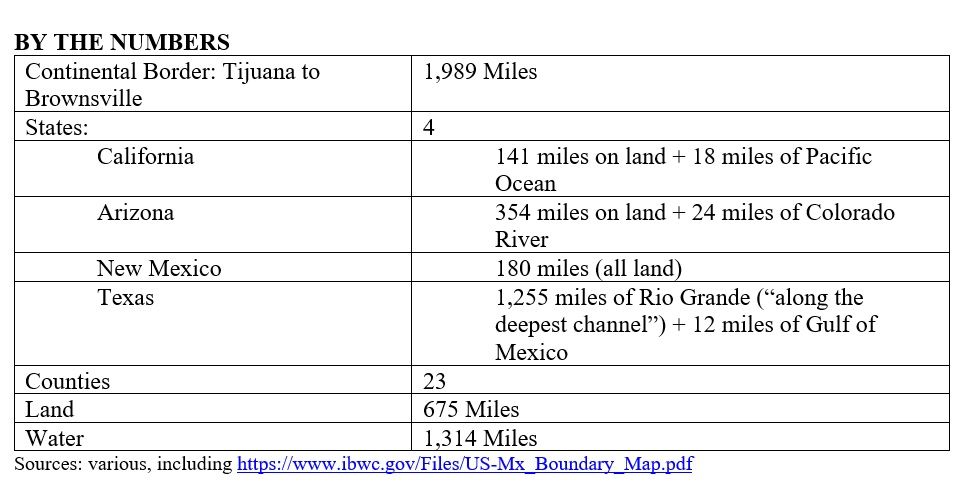
    1. It will be hideously expensive. The un-walled portion of the border covers the most difficult terrain, a lot of which could cost $17 million per mile. Historically, building on flat land cost about $4 million per mile. The government spent $2.4 billion between 2006 and 2009 to build a stretch of wall along 670 miles of easy terrain (Secure Fence Act of 2006). A 2009 attempt to build along one rugged stretch of the border was budgeted at $58 million for just 3.5 miles.

    Since most of the easier stuff is already built, I calculated that the cost for the next 1.289 miles could easily run $19.3 billion – I think the new DHS estimate is close to the mark. To put the number into perspective, the cost will be about seven times the entire 2016 budget of the U.S. Border Portal. Construction isn’t the only expense. Section 10 of the Executive Order basically “deputizes” local law enforcement – at the expense of local taxpayers – to act as immigration officers for carrying out deportations.

    2. More than 1,000 of the open border is under water. Building a wall in the water would be wildly expensive and would have to be replaced frequently. In February 2012, construction began to extend began to extend an 18-foot high border fence 300 feet into the Pacific Ocean to seal off the gap that opened at the beach between Tijuana and San Diego during low tide. The private contractor who built it (Granite Construction Company, NYSE:GVA) gave the government a 30-year warranty. The budget for that Surf Fence Project was $4.3 million (I did not find the final cost in any public source). Based on that budget, the cost of building the wall in water could run $75.9 million per mile or about 4.5 times the cost of building on rugged land and nearly 20 times the cost of building the parts on more level ground. Building a fence on the water part of the border would cost close to $9 billion alone.

    3. Maybe Trump does not really mean to build on the border that lies underwater. The Executive Order defines the “Southern border” as only the “land border”. To avoid the extra expense of building in the ocean, the gulf, and two rivers, we can build on the land outside the flood-plain/tidal-zone. It is likely the Mexican president Enrique Peña Nieto has heard of the “adverse possession”. Along the border, state laws transfer rights to abandoned property to the possessor in 5 to 10 years. Building just one half mile from the rivers means the United States could relinquish at least 657 square miles to Mexico. Are we prepared to cede to Mexico an area 1.5 times the size of Los Angeles?

    Fox News has noted that “[w]hile 1,254 miles of [the] borders is in Texas, the state has only 100 miles of wall”. At least 65 miles of the 100 mile route proposed through Texas in 2008 sat a half mile from the border. In some places, like the McAllen area of Texas, the proposed track separated a water reservoir from the pumping stations that bring water to US citizens. Building up to a mile into the US side has already stranded the property of US citizens on the Mexico side of the wall.

    4. The border land that is not under water or already fenced is mostly in private hands. In a January 2016 story Fox News recognized that finishing the wall along the border in Texas could require hundreds of lawsuits by the federal government. The Washington Post also reported going into the 2009 expansion of the wall that much of the planned route would slice through private property. Private property adds an average of $61,491 per mile (based on actual costs in 2012). During the 2009 expansion, 135 private landowners refused to let surveyors onto their property. Seventy percent of the landowners who held out were in Texas. Anybody remember Jade Helm 15 when part of Texas was labeled “hostile territory” during military exercises? The Governor ordered the Texas State Guard to monitor the exercises. What do you think will happen if bulldozers show up uninvited to begin claiming 1,000 miles of Texan’s private property? The federal government can use eminent domain, but it is costly, takes a long time and holds an uncertain outcome.

    5. There may not be enough brick and mortar to build a wall along the US/Mexico border, especially if Trump keeps talking it up. During the 2009 expansion of the wall, cost estimates ballooned as a Border States construction boom led to labor shortages and rising costs for construction materials (e.g., steel and cement). Try building more than 1,000 miles of border wall while re-building transportation infrastructure, the strain will be beyond the global peak in prices seen when shovel-ready projects were initiated under post-financial-crisis stimulus spending.

    The Executive Order gave DHS 180 days (until about the second anniversary of Jade 15) to come up with a plan. DHS also has to figure out how to return deportable aliens “to the territory from which they came” – imagine millions of aliens lined up along the US/Mexico border. DHS has less time (until March 26) to figure out how to pay for the wall by withholding “all bilateral and multilateral development aid, economic assistance, humanitarian aid, and military aid” that the US may be planning to send to Mexico. That sounds like it could actually work to balance the budget outlay. Except that it won’t actually work. Total U.S. foreign aid to Mexico disbursed from all agencies in 2015 was $338.5 million (that’s “million” with an “m”). At that rate, it will take 54 years to recover the cost!

    Aid to Mexico includes $215 million for international drug and law enforcement plus $50 million more for in-country drug enforcement. The other hundred million or so was for justice projects, legal reform, crime prevention and military support. According to former Secretary of Homeland Security Jeh Johnson, “…experience teaches that border security alone cannot overcome the powerful push factors of poverty and violence that exist in Central America. Ultimately, the solution is long-term investment in Central America to address the underlying push factors in the region.”

    [After I calculate the costs for several more truMpISSIONs, I will calculate the cost of financing with debt. Just because something is impossible, doesn’t mean Trump won’t spend your money on it.]

    Susanne Trimbath, Ph.D. is CEO and Chief Economist of STP Advisory Services. Dr. Trimbath’s credits include appearances on national television and radio programs and the Emmy® Award nominated Bloomberg report Phantom Shares. She appears in four documentaries on the financial crisis, including Stock Shock: the Rise of Sirius XM and Collapse of Wall Street Ethics and the newly released Wall Street Conspiracy. Her newest book, Lessons Not Learned: 10 Steps to Stable Financial Markets, was published in November by Spiramus Press (UK). Dr. Trimbath teaches graduate and undergraduate finance and economics.

    Photo: ourfunnyfarm, CC License