Category: Politics

  • Portland’s Runaway Debt Train

    Tri-Met, the operator of Portland’s (Oregon) bus and light rail system has been in the news lately, and in less than auspicious ways. For decades, the Portland area’s media – as well as much of the national press – has been filled with stories about the national model that Tri-Met has created, especially with its five light rail lines.

    The reality is less impressive. After spending an extra $5 billion over the past quarter century, public transit’s share of work trip travel in Portland is less than it was before. Moreover, the Portland has now become the 38th of the major metropolitan areas (over 1,000,000 population) in which more people work at home (such as telecommuting) than ride transit to work.

    Tri-Met’s more recent notoriety also reveals some serious concerns about financial management . Auditors recently finished their annual report, and it indicates that that Tri-Met has run up some rather large bills that it may be hard-pressed to pay.

    Unfunded Pension Liabilities: Unfunded liabilities on Tri-met’s employee pension funds have grown to more than $260 million. This deficit has developed because Tri-Met can not meet its obligation to pay into the pension funds on a current basis. Indeed, at the rate Tri-Met paid the pension funds for fiscal year 2010 (ended June 30), they would be more than eight years delinquent. Overall, the pension funds are nearly 50 percent under funded.

    Other Post-Employee Benefits: “Other Post-Employee Benefits” (OPEB), made up principally of retiree health care, pose a much bigger problem. As of the end of the fiscal year, the unfunded liability for these benefits was $817 million, up $185 million in just one year. Underfunding is an even greater problem. The retiree benefits are 100 percent under funded. Tri-Met has simply put no money aside for these benefits. Tri-Met has achieved world class status in underfunding its OPEB. The Los Angeles MTA, which carries nearly five times as much travel volume as Tri-Met had unfunded OPEB liabilities of only $730 million (still a huge figure) in 2009, which is the last data available.

    When challenged on the huge unfunded liability and its growth, Tri-Met General Manager Neil McFarlane responded to KATU-TV: “That’s adding apples, oranges and grapefruits together to get a completely unreasonable number.” One wonders what kind of complications the chief executive office of a publicly traded Fortune 500 company would face for similarly dismissing inconvenient data in its annual report (whether from the Securities and Exchange Commission, the board of directors or the stockholders).

    The auditor, Moss-Adams, LLP appended a standard opinion, to the effect that “… the financial statements … present fairly, in all material respects, the financial position of the District as of June 30, 2010…” At another point the auditors note their obligation to perform the audit to “obtain reasonable assurance about whether the financial statements are free of material misstatement.” As far as McFarlane is concerned, there may be some disagreement on whether the financial statements are “free of material misstatement, “given that they include a “completely unreasonable number.”

    A Train of Debt: Other Tri-Met woes come from its frequent bonds issues, which to date have been approved with little oppostion. The present bonded indebtedness is more than $250 million. The agency is asking the electorate for approval of another $125 million in bonds at the November 2 election. The Oregonian, which has been a friend to nearly everything Tri-Met has done, is recommending a “no” vote on the bonds, pointing out that they would not be necessary if Tri-Met had saved sufficiently for vehicle replacement. Further, Tri-Met is searching hard for more money to fund a deficit in its proposed light rail line to suburban Milwaukie in Clackamas County, which seems a questionable project given the agency’s inability to keep fares under control and maintain service levels.

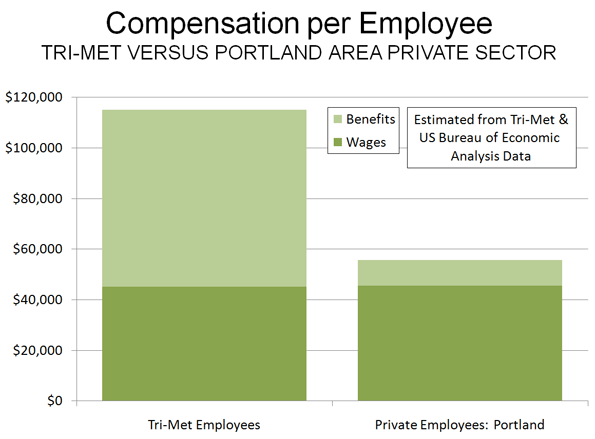
    Bloated Benefits: John Charles, President of the Cascade Policy Institute raised eyebrows when he noted that Tri-Met’s employee benefits expense is by far the highest in the nation. Charles looked at 20 large transit agencies and found that employee benefits were equal to 152 percent of the wage bill, approaching double that of the next highest, San Francisco’s Bay Area Rapid Transit District and Washington’s Metropolitan Transit Authority. With their above 80 percent employer-paid benefits ratios, albeit lower than Tri-Met’s 152 percent, these agencies have nothing to be proud of. In the private sector, employer-paid benefits tend to be less than 25 percent of wages. Tri-Met’s 152 percent is six times that.

    Bloated Compensation: With a benefits ratio of 152 percent, payroll expense per employee is a stratospheric $115,000 annually (assumes the 2008 staffing ratio, later data not identified). In contrast, the average private sector employee in the Portland metropolitan area is compensated at approximately $55,000 annually, which includes wages and a 22 percent extra for benefits (Figure 1).

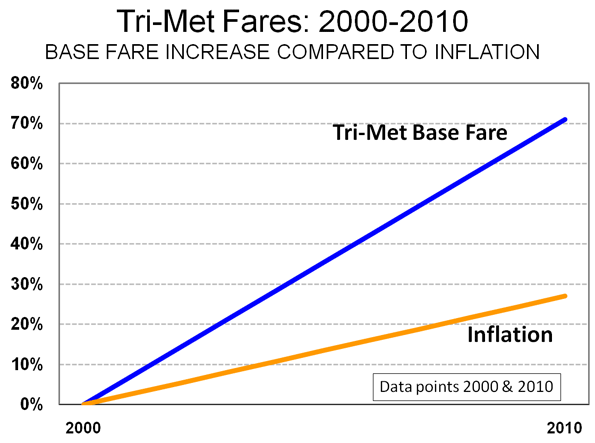
    Employees Ahead of Customers: Tri-Met implemented a fare increase in September and reduced bus service by 5.8 percent and light rail service by 3.5 percent. In the last 10 years, the basic bus fare has risen 71 percent, well above the 27 percent inflation rate (Figure 2). The fare increases and service cuts are imposing substantial hardship on many Tri-Met riders, who have limited incomes and no access to cars. The above inflationary fare increases represent a financial management failure of fundamental proportions.

    Yet while it was raising fares, Tri-Met also increased union employee compensation by three percent and covered increases of 7.5 percent to 22.5 percent on two employee health care programs. Tri-Met has admitted that these increases were not legal obligations (could this be a gift of public funds?). The cost of the non-obligatory wage increase was more than double the amount Tri-Met expects to raise from the September fare increase. Some discontinued service could have been financed with the rest of the wage increase money and the non-obligatory health care premium increases.

    Rising Costs: The question for Portland and Tri-Met remains whether this financial house of cards is sustainable. Operating and capital costs have, not surprisingly, skyrocketed. In fiscal year 2010, it is estimated that costs per passenger mile rose to more than $1.35. This is a full 40 percent above the the national transit average. This is more than five times the per passenger mile – full cost of cars and sport utility vehicles including all user costs and the portion of road expenditures (principally local streets) paid for by taxes – of less than $0.25.

    Fiscal Imprudence: Past and Future: There is some too-little, too-late good news for riders. Tri-Met has told the union that it will not cover health care benefits increases in 2011, nor will there be another non-obligatory wage increase. In its editorial opposing approval of the bond issue The Oregonian spoke of “past fiscal imprudence.” In appears that the mecca of transit is becoming less a role model and more a cautionary tale.

    Wendell Cox is a Visiting Professor, Conservatoire National des Arts et Metiers, Paris and the author of “War on the Dream: How Anti-Sprawl Policy Threatens the Quality of Life

    Photo: Mount Hood in exurban Portland (by author)

  • A Price on Carbon: the New Greenmail

    Hidden from view during the Australian election, a carbon price is back on the political agenda. This comes as no surprise. Anyone following the debate, however, will see that it has nothing to do with the environment. For some time we have been urged to “act now”, but the grounds keep shifting and changing. Early on it was the drought. Then the Great Barrier Reef. After that the Bali Conference. Then the election of Barack Obama. Next came the Copenhagen Conference. Then being “left behind” in clean technology. Now, apparently, “inaction will cost more in the end”. All have come and gone – including the drought which was supposed to be with us forever.

    Even so, we are assured that a price on carbon is “inevitable”.

    The frantic search for a rationale is driven by the plain fact that there is no environmental reason for Australia to have a carbon price. In tandem with efforts to manufacture urgency, there has been an equally devious campaign to misrepresent the process of climate change, or at least the IPCC’s “consensus” version. Crucial has been the cynical manipulation of words like “pollution” and “clean”. “Carbon pollution” is a scientifically absurd term designed to distort the basic issue. If the “consensus” science is right, the problem is with the concentrations of carbon dioxide, not the natural, clean, life-giving gas itself. Most of the public associate “pollution” with “dirty” emissions such as exhaust fumes and particulate matter. By definition, reducing such pollution is good. Many, if not most, still believe this is what climate action is about, thanks to obscurantist Greens and others. In the same way, “clean” energy is seen as the antidote to “dirty” or “polluting” gases. Who can be against cleanliness? Derivative terms like “the big polluters” are also deceptive.

    Greens, activists and others with a stake in climate action live in mortal dread of the public grasping the truth. Since the concentrations are the issue, rather than carbon dioxide as such, Australia can do nothing about climate change. Our share of global emissions is too small. Nor do the world’s highest emitters show any sign of caring about what we do.

    No Australian Prime Minister did, or could have done, more to push climate onto the world’s agenda than Kevin Rudd. Asked about the Copenhagen fiasco in the dying days of his prime ministership, Rudd delivered this famous outburst: “There was no government in the world like the Australian Government which threw its every energy at bringing about a deal, a global deal, on climate change. Penny Wong and I sat up for three days and three nights with 20 leaders from around the world to try and frame a global agreement.” The UN assigned Rudd a special role drafting the text of the prospective protocol. Ultimately, he was rebuffed by large and small emitters alike. The face-saving accord was cobbled together without him.

    Australia can’t combat climate change directly by reducing its own emissions, or indirectly by encouraging larger emitters to reduce theirs. If we lack the power to prevent adverse climate effects, should they eventuate, we can’t avoid any higher costs of delayed action. Forget the constant bleating about China “doing its part.” Now the world’s largest emitter, China’s official policy is to reduce the “carbon intensity” of its economy (the carbon emitted per unit of GDP), not to cut emissions. This means emissions will continue to rise, although (possibly) at a diminishing rate. The point is this “action” is way short of what the IPCC considers necessary to make a difference. Greens keep asking the wrong question. It’s not whether China does “something” that matters, but whether that something is relevant. India does even less. As for the second largest emitter, opinion polls suggest a carbon price will remain dead in the United States after the November mid-term elections.

    So why must Australia have a carbon price? One thing is for sure: it has nothing to do with climate. In his early interviews as Minister for Climate Change, Greg Combet referred to it, repeatedly, as “a very important economic reform”. Calling it an environmental measure would raise too many awkward questions. Certainly, a carbon price has serious economic impacts, but gracing it with the label “economic reform” is disingenuous. The word “reform” connotes improvement. Economic reform is designed to spur growth by improving productivity and efficiency. In contrast, a carbon price damages productivity, by raising cost inputs, and hampers efficient resource allocation. It isn’t economic reform. It’s an environmental measure, but utterly futile.

    Climate activists were elated when Marius Kloppers, the boss of BHP Billiton, recently declared that a global carbon price is inevitable, so Australia should get in early. His grounds for this belief are a mystery. All the evidence suggests that a global price on carbon will be as elusive as world peace. He would have been on firmer ground to restrict his prediction to Australia. Still, environmental factors were far from Kloppers’s mind. As the arguments for a carbon price fall in succession, one lingers on. Endless speculation is undermining investor confidence, so the argument runs, and producing uncertainty in industries with long investment lead times, like the capital-intensive energy industry. This can only be ended with the swift introduction of a carbon price. Of course the argument is entirely circular. The activists, politicians and journalists who push this line are themselves instrumental in generating the speculation, uncertainty and paralysis, and for obvious reasons.

    Back in the 1980s, “greenmail”, an amalgam of blackmail and greenback, referred to the practice of buying enough shares in a company to threaten a takeover, thereby forcing the company to buy the shares back at a premium. As the practise and word have since faded away, perhaps it’s time to revive the term “greenmail” and invest it with new meaning. Greenmail occurs when officials and activists with media power disrupt stability and certainty in a particular industry, maintaining pressure and an air of crisis, to intimidate business leaders holding out against some senseless green measure.

    If Australia does end up with a carbon price, it will be due to greenmail rather than any rational consideration.

    This article first appeared at The New City Journal.

    Photo by Amit (Sydney)

  • Living In Denial About Transportation Funding

    The reaction of various advocacy groups to President Obama’s recent call for a $50 billion stimulus spending plan for transportation infrastructure was predictable. They applauded the President’s initiative and thought that Congress should promptly approve the spending request. The benefits of investing in infrastructure are undisputable and the need for funds is urgent and compelling, they (or their press releases) proclaimed.

    But convincing the next Congress of the need to act, whether to fund the infrastructure “down payment” of $50 billion or to authorize a proposed $500 billion multi-year surface transportation program, will not be easy. Most congressional lawmakers do not perceive infrastructure as an urgent priority. They see no signs of a popular outcry about the stalled transportation reauthorization, nor do they perceive a groundswell of grassroots support for massive transportation investments.

    Indeed, what the lawmakers see is just the opposite. They witness New Jersey voters strongly approving Governor Chris Christie’s decision to cancel work on the long-planned rail tunnel under the Hudson River because, says the Governor, “the state simply doesn’t have the money” to pay for overruns in the potential $9-14 billion project. Mr. Christie, no doubt, has in mind the experience of Boston’s Big Dig which was projected in 1982 to cost $2.8 billion and ended up costing $15 billion.

    The lawmakers also see Republican candidates for governor in California (Meg Whitman), Florida (Rick Scott), Ohio (John Kasich) and Wisconsin (Scott Walker) pledging to cancel high-speed rail projects in their states if elected — and running ahead of their Democratic opponents who unanimously support President Obama’s $8 billion high-speed rail initiative. They see the public greeting with a yawn a bold and visionary Amtrak proposal to link Boston and Washington with a dedicated high-speed rail line. They read in a much noticed Sunday Times Magazine article “Education of a President,” (October 12) that the President himself thinks “there’s no such thing as ‘shovel-ready projects’ when it comes to public works.” And they hear an Administration unable to explain how the $50 billion infrastructure initiative will be paid for. When asked, a top administration official could only lamely reply “Stay tuned, we’ll let you know.”

    More evidence of public reluctance to spend on infrastructure comes from the findings of a new October 2010 survey by the Pew Center on the States and the Public Institute of California titled “Facing the Facts: Public Attitudes and Fiscal Realities in Five Stressed States.” By a large margin, respondents in five states (California, Arizona, Florida, Illinois and New York) showed a strong unwillingness to support additional transportation funding and offered to put transportation on the chopping block when asked which of their state’s biggest expenses they would least protect from budget cuts.

    It may be impolitic to suggest it, but dire warnings about the sorry state of the nation’s infrastructure seem to come largely from organized interests — stakeholders and advocacy groups. That is not to say that the nation’s transportation infrastructure has not been neglected or that America does not need better roads and transit systems. But rightly or wrongly, congressional lawmakers often discount cries about “crumbling infrastructure” as self-serving demands for more government money, often for projects that yield small economic return.

    Moreover, many lawmakers come from rural districts that experience little traffic congestion, whose roads are well maintained and which never hope to benefit from high-speed rail service. Their reluctance to spend more money on public works also has been fueled by what they see as disappointing results from the stimulus initiative. As Rep. John Mica (R-FL), ranking member of the House Transportation and Infrastructure Committee and potential future T&I Committee chairman in the 112th Congress likes to point out, more than 60 percent of the stimulus infrastructure dollars still remain unspent, while unemployment in the construction industries remains high. All this adds weight to the legislative reluctance to tackle an ambitious infrastructure spending bill any time soon.

    As one of our colleagues, a sincere and lifelong transportation advocate, put it, “the transportation community is mostly talking to itself and living in denial about the changing political mood.” That mood—in the nation at large as well as in the next Congress— is unmistakably becoming more conservative and skeptical of big government. An overwhelming 70 percent of Americans think the government does not spend taxpayers’ money wisely, according to a recent Rasmussen poll. Newly elected members of Congress will be marching to the drum of fiscal discipline and looking for ways to curb out-of-control spending, a GOP aide told us. Congress will be closely questioning costly new federal initiatives no matter how well intentioned, he added. The expansive federal-aid surface transportation program as we have known it in the past may no longer be thought politically acceptable or fiscally affordable.

    And who knows, the new mood of fiscal restraint may even infect the White House. As one senior White House adviser, quoted in the Sunday Times Magazine story, put it, “there’s going to be very little incentive for big things over the next two years unless there’s some sort of crisis.” And we doubt that by this he meant “infrastructure crisis.”

    Ken Orski has worked professionally in the field of transportation for over 30 years.

    Photo by woodleywonderworks

  • New York Political Leadership Forces Another Fare Hike

    The New York Post editorialized (October 8) against what it called “Another TWU Fare Hike,” blaming the union for the fares that will now rise to $2.50 for a ride. The editorial writer goes on to say of MTA chief Jay Walder, “It’s not his fault that straphangers get whacked while the MTA’s unionized workers — whose blue collars come with fur trim — don’t have to make a single sacrifice to meet the MTA’s shortfall.”

    In response, I posted the following comment to the New York Post site:

    Not his fault? Well, perhaps not personally. But surely it is the responsibility of the MTA and those in Albany who have skewed law labor and regulation to create this untenable situation. It is about time that public officials, such as those who run the MTA, be held account for what they have given away to the unions. The unions could not have taken it without the agreement of the MTA and other local and state political officials.

    The way the Post tells it, you might think that the Transport Workers Union (TWU) had engineered a coup and had forcibly taken control of the Metropolitan Transit Authority. It fact, it was all quite legal. Interests such as the TWU have used their political influence to obtain the expensive contracts that place the riders a distant second, after the employees and the taxpayers an even more distant third. The MTA was not compelled to sign overly expensive labor contracts. Albany was not compelled to insulate transit unions from the economic reality faced by everyone else, including private sector union members. Washington was not compelled to give transit labor unions job protections that would be the envy of European public sector unions. These protections are a considerable factor in driving expenditures up 100% (inflation adjusted) over the past 25 years, while ridership has risen only 40%. The appointed and elected representatives did so willingly, and to the detriment of the people, whom they were supposed to represent.

    The Post rightly complains about this, but places the blame in the wrong place. If the MTA, state and federal officials who have so skewed transit economics in favor of unions, had instead served the riders and taxpayers first, then New York and the nation would have much more transit services, its fares would be lower and there would be much more ridership.

    The Post also errs in saying “Only in New York could such a perverse equation come to be.” In fact, the situation is no different in most metropolitan areas of the nation. Transit agencies have routinely avoided efficiency measures that would have increased transit ridership and reduced costs (such as competitive contracting or competitive tendering of services), raised fares and cut services.

    As the process has unfolded over decades, the TWU and other local transit unions simply responded to the incentives that were established by the elected and appointed officials. This has contributed, along with extravagant and in rail transit expansions, to rendering transit financially unsustainable. The problem is that the public interest in transit has been hijacked by special interests.

    A more appropriate headline for the editorial would have been “New York Political Leadership Forces Another Fare Hike.”

  • Who’s Racist Now? Europe’s Increasing Intolerance

    With the rising tide of terrorist threats across Europe, one can somewhat understandably expect a   surge in Islamophobia across the West. Yet in a contest to see which can be more racist, one would be safer to bet on Europe than on the traditional bogeyman, the United States.

    One clear indicator of how flummoxed Europeans have become about diversity were the remarks last week by German Chancellor Angela Merkel saying that multi-culturalism has “totally failed” in her country, the richest and theoretically  most capable of absorbing immigrants. “We feel tied to Christian values,” the Chancellor said. “Those who don’t accept them don’t have a place here.”

    One can appreciate Merkel’s candor but it does say something the limitations about the continent’s ability, and even willingness, to absorb immigrants. It’s quite a change from the generations-old tendency among Europeans, particularly on the left, to denigrate America as a kind of hot bed for racism.  Yet even before the latest report of potential terrorist attacks in several western European cities, the center of Islamophobia – and related ethnic hatreds – has been shifting inexorably to the European continent.

    Of course, America has always had its bigots, and still does. And of course, Islamists who threaten or commit violence need to be arrested and thrown behind bars. But, to date, neither major political party has been able to make openly white-supremacist politics a successful leading platform. After all, what was the last time anyone took Pat Buchanan , who has made comments similar to those of Merkel, seriously? Despite the brouhaha over the Arizona anti-illegal alien law, only 5% of Americans consider immigration the nation’s most pressing issue, according to a September Gallup poll.

    The situation in Europe is quite different. Openly racist, anti-immigrant and Islamophobic groupings are on the rise, and they are wreaking havoc on once subdued European politics. Traditional mainstream parties are declining, and the new racist parties can be seen in broad daylight in Austria, Switzerland, Denmark, Sweden and the Netherlands, where populist firebrand Geert Wilders has suggested banning the Koran. In Italy the anti-immigrant Northern League is already hugely powerful.

    It is true that as many Europeans as Americans–about half–think immigration is bad for their countries.  The big difference is what Europeans are willing to do about it. Just consider French President Nicholas Sarkozy’s farcical effort this fall to expel the hapless Roma.

    Yet for most Europeans the big issue is not purse-snatching gypsies but fear and loathing toward the expanding presence of Muslims–who are at least three times as numerous in the E.U. as in the U.S.  Over half of Spaniards and Germans, according to Pew, hold negative views of Muslims. So do roughly 40% of the French. In contrast, only 23% of Americans share this sentiment.

    More disturbing, Europe is actually putting these ethnic hostilities into law. An early sign came this winter, when the usually phlegmatic  Swiss voted to prohibit the building of new minarets. More recently a ban on burqas – the admittedly unattractive female body suits favored by some orthodox Muslims – passed in France, home to Europe’s largest Muslim community. The same measure is now being considered in Spain.

    These actions reflect a broad, and deepening, stream of European public opinion. A recent Pew survey found that over 80% of the French support banning the burqa, as do over 70% of Germans and a large majority of Spaniards and British.

    In contrast, nearly two-thirds of Americans find the burqa ban distasteful. Burqas don’t exactly stir admiring glances in the shopping mall, but few Amercians think we need to ban them. The basic ideal of “don’t tread on me” means “don’t tread on them” as well – at least until they start blowing themselves up at Wal-mart.

    This nuance escapes some of our own knee-jerk racial obsessives, like the Atlanta Journal Constitution’s Cynthia Tucker, who equates opposition to a mosque at Ground Zero as proof of a “new McCarthyism”  aimed against Muslims. But you don’t have to be a bigot to have second thoughts about erecting a mosque at the very spot where innocents were slaughtered by radical Islamists.

    Critical here are profound differences between the U.S. and Europe  in  the role played by ethnicity, race and religion. On the continent national culture is precisely that — the product of a long history of a particular ethnic group. Small minorities, such as Jews in Holland or Armenians in France, are tolerated but expected to submerge their ethnic identities. France has many artists and writers who may be Jewish, but you don’t see many French Woody Allens or Larry Davids who exploit their otherness to help define the national culture.

    Muslim attitudes in Europe are not exactly helpful either.  European Muslims often seem more interested in breaking the national mold than adding to its contours.  More than 80% of British Muslims, for example, identify themselves as Muslims first before being British. This is true of nearly 70% of Muslims in Spain or Germany. Similarly, up to 40% of Britain’s Islamic population believe that terrorist attacks on both Americans and their fellow Britons are justified.

    This alienation also reflects an appalling social and economic reality. In European countries immigrants can receive welfare more easily than join the workforce, and their job prospects are confined by education levels that lag those of immigrants in the United States, Canada and Australia. In France unemployment among immigrants–particularly those from Muslim countries–is often at least twice that of the native born; in Britain Muslims are far more likely to be out of the workforce than either Christians or Hindus.

    Partly due to a less generous welfare state, American immigrant workers with lower educations have, for the most part, been more economically active than their nonimmigrant counterparts.  The contrast is even more telling among Muslim immigrants. In America most Muslims are comfortably middle class, with income and education levels above the national average. They are more likely to be satisfied with the state of the country, their own community and their prospects for success than are other Americans—even in the face of the reaction to 9-ll.

    More important still, more than half of Muslims identify themselves as Americans first, a far higher percentage than in the various countries of Western Europe.   More than four in five are registered to vote, a sure sign of civic involvement. Almost three-quarters, according to a Pew study, say they have never been discriminated against–something that is definitely not the case in Europe where a majority, according to Pew, complain of discrimination.

    Over time, these differences between Europe and America may become even more pronounced. America is becoming increasingly diverse, but it is also growing demographically, and Muslims make up a very small part of that. There’s little fear in Anerica of the kind  of  Muslim envelopment that appears to threaten a  rapidly aging, and soon to be depopulating, Europe.

    Of course the U.S. still has its bigoted Islamophobes, just as it has its own small cadre of vicious Islamists. One law of history appears to be that morons will be morons.   But America’s culture seems strong enough to resist the anti-immigrant hysteria emerging throughout Europe. This is one case where  la difference between America and Europe may prove  a very good thing indeed.

    This article originally appeared at Forbes.com.

    Joel Kotkin is executive editor of NewGeography.com and is a distinguished presidential fellow in urban futures at Chapman University. He is author of The City: A Global History. His newest book is The Next Hundred Million: America in 2050, released in February, 2010.

    Photo by World Economic Forum

  • Green Jobs for Janitors: How Neoliberals and Green Keynesians Wrecked Obama’s Promise of a Clean Energy Economy

    In August 2008, then-candidate Barack Obama traveled to Lansing, Michigan, to lay out an ambitious ten-year plan for revitalizing, and fundamentally altering, the American economy. His administration, he vowed, would midwife new clean-energy industries, reduce dependence on foreign oil, and create five million green jobs. “Will America watch as the clean-energy jobs and industries of the future flourish in countries like Spain, Japan, or Germany?” Obama asked. “Or will we create them here, in the greatest country on earth, with the most talented, productive workers in the world?”

    Two years later, the answer to that second question appears to be no. Obama’s environmental agenda is in tatters. His green jobs plan has done little to make a dent in unemployment, which persists at close to 10 percent. Obama’s signature environmental initiative, cap-and-trade, died in the Senate in July. And, during the first year of Obama’s tenure, China massively outspent the United States on clean-energy technology.

    The story of how Obama’s green agenda came up empty is more complicated than the one conventionally told by Democrats and greens, who imagine that cap-and-trade would have been transformational had Republicans and global-warming deniers not gotten in the way. In truth, the president’s strategy was flawed from the start. Cap-and-trade would not have birthed a domestic clean-energy economy — indeed, it wasn’t designed to. Meanwhile, the administration’s green stimulus spending was split between short-term, if worthy, investments in green technology, to which far too little money was allocated, and over-hyped public-works projects that would never have delivered the new industrial economy Obama promised as a candidate.

    Voodoo Economics

    Shortly before the House passed its version of cap-and-trade legislation last year, the Center for American Progress (CAP), headed by Obama transition director John Podesta, released a study claiming that the cap-and-trade bill and the stimulus combined would create 1.7 million new jobs. Democrats repeatedly pointed to the CAP report to support their jobs claims. Extrapolating from the report’s analysis, it seems that over half of the new jobs, almost 900,000, were supposed to come from building retrofits. The study’s authors apparently believed that a mere $5 billion in stimulus funding for weatherization, plus a price on carbon, would leverage $80 billion annually in private investment and lead to the retrofitting of every single commercial and residential building in America in just ten years.

    Alongside the CAP report, the Natural Resources Defense Council and the leading green jobs group, Green For All, released another study written by two of the same authors, claiming that roughly half of the jobs would benefit low-wage workers and would offer “decent opportunities for promotions and rising wages over time.” Indeed, environmentalists such as Van Jones — who had come to prominence calling upon young people to “put down those handguns and pick up some caulking guns” and briefly served as Obama’s green jobs czar — claimed that building retrofits and cap-and-trade legislation could save both the planet and the inner city.

    In reality, the stimulus’s $5 billion weatherization program, according to the Department of Energy, created or saved just 13,000 jobs during the last reported quarter. But, even if more of these jobs had been created, the idea that inner-city youth should see what are essentially janitorial jobs as a pathway out of poverty was always far-fetched. America’s black middle class emerged from the steel, ship, and automobile factories of the postwar industrial heyday. Those jobs were high-skill, high-wage, and long-term. They manufactured products that could be sold on domestic and foreign markets, and they provided the economic basis for a dramatic improvement in black America’s standard of living. Jobs retrofitting buildings and weatherizing homes are, by contrast, low-skill and short-term.

    To be fair, Democrats in Congress and White House officials always believed that while the stimulus expenditures represented a down payment on the clean energy economy, the real action would ultimately be driven by private investments in response to cap and trade, not sustained public investments in innovation and manufacturing.

    In this way the green Keynesianism that characterized the stimulus comfortably accommodated itself to the neoliberal policy predilections that have, over the last 20 years, become Democratic Party orthodoxy. Born of fashionable neoclassical economic theory and political expediency after the Reagan revolution, Democratic neoliberalism embraces the notion that private firms are better and more efficient at “picking winners,” technological and otherwise, than government. This cliche was never based on the real-world history of technological innovation or economic growth but rather upon the neoclassical assumption that governments must do a worse job than private actors since they are not motivated by profit and cannot act rationally.

    Even Jones, who spent recent years railing against neoliberal economic policies, accepts this neoliberal conceit. “The real solution to this whole thing is to put a price on carbon,” Jones told Pacifica’s Democracy Now in the fall of 2008. “The biggest economic stimulus I can imagine would be a carbon tax or a cap and trade… so that suddenly there is a market signal for private capital to start moving aggressively in a clean energy, low carbon direction.”

    But cap and trade could never deliver the millions of new jobs that Obama, Congressional Democrats, and greens promised. The primary obstacle to private sector investment in clean energy technologies is not the absence of modest carbon price signals such as those in the Congress’ cap and trade proposals and currently in place in Europe. Rather, it is the vast price gap between fossil fuels and clean energy technologies. While fossil fuels are energy dense, widely available, easy to consume, and supported by a well-developed infrastructure, the alternatives are costly, cumbersome, intermittent, or all of the above.

    Yet cap and trade enjoyed mainstream credibility for as long as it did in spite of these hard technological realities because economic models seemed to show that a rising carbon price would cause technological innovation and hence emissions reductions. Cap and traders used these models to argue that once we have a carbon price, the market would magically deliver technology innovation because private firms would have an incentive to invest to make those technologies better and cheaper.

    But the magic wasn’t in the market, it was in the models constructed by neoclassical economists, which simply assume substantial rates of technological change. Innovation — non-linear, unpredictable, and ephemeral — is understandably difficult to model. Perhaps more significantly, important innovations have as often as not been the result of public investments in technology which economists, following neoclassical doctrine, are loathe to acknowledge, much less include in their models.

    The real world gives us ample reason to be skeptical of carbon pricing claims. The European Union has had a cap-and-trade system in place since 2005, and Norway and Sweden have had carbon taxes since the early ’90s. None have spurred much innovation. On the contrary, much of Europe has been on a coal-plant-building binge over the last decade. Where European nations have advanced clean-energy technologies–whether wind in Denmark, nuclear in France, or solar in Germany–they did so through direct investments in those technologies that dwarfed the economic incentive provided by carbon pricing.

    The Ideology of Decline

    In late May, President Obama told employees at a solar panel factory in California, “I’m not prepared to cede American leadership” in clean energy. But that is in effect what his policies have done. While U.S. policymakers have fetishized carbon pricing and energy efficiency retrofitting, America’s competitors have been investing heavily to deepen their domination of solar, wind, nuclear, electric car, and high-speed rail technology and manufacturing.

    China, Japan and Korea have moved forward with aggressive plans to out-manufacture, out-innovate, and out-compete the United States in clean tech. China alone plans to spend more than $740 billion (5 trillion yuan) over the next 10 years. While neoclassical economists and their disciples in Washington have presided over the deindustrialization and financialization of the American economy, our economic competitors have used long-term investments to establish dominant positions in advanced, high value manufacturing sectors such as automobiles, electronics, information technology, and now clean tech.

    Obama too could have focused on winning a similarly long-term commitment to public investment in green innovation and manufacturing. Instead, he threw his political capital behind cap-and-trade. Despite the fact that the rising domination of key clean energy technologies by our economic rivals could in no way be attributed to a price on carbon — China, Japan, and Korea don’t even have one — Obama, his Congressional allies, and their cheerleaders in the media such as New York Times columnist Thomas Friedman, have continued to insist that cap and trade legislation was the key to reestablishing U.S. competitiveness in clean tech.

    In truth, cap and trade was conceived as a strategy to minimize the cost of reducing emissions, not to create domestic industries or jobs. Indeed, economists typically argue that government should not even concern itself with such issues. To the neoclassical mind, making microchips is no better than making potato chips, as innovation expert Rob Atkinson wryly observes. If China is better at making solar panels and we are better at making foam insulation, then we should just buy our solar panels from China. From this point of view, creating low-skill construction jobs installing compact fluorescent light bulbs in old buildings has the same economic utility as creating high-skill jobs manufacturing solar panels and nuclear reactors for export.

    Apply these assumptions to climate and energy policy, and what you get is the failed Democratic agenda. Governments should cap carbon emissions and auction the right to pollute. Doing so would establish a price on carbon pollution that will make fossil fuels increasingly expensive and thus drive private investment and consumption to efficiency and renewables. If all those solar panels and windmills get made in China — so be it. America will still lead the world in potato chips or something else.

    This is not a recipe for American economic competitiveness in clean energy technology and manufacturing. America’s nascent clean energy industries need sustained public investments to survive and prosper. While neoliberal greens and their allies were hyperventilating over the death of cap and trade, the stimulus investments in technology and manufacturing were hard at work laying the foundations for a competitive clean economy. Though overshadowed by the public works-style efficiency programs, stimulus-funded investments in clean technology arguably saved the American renewables industry, which was in free-fall after the 2008 financial crisis.

    In contrast to the green public works projects, stimulus investments in manufacturing and innovation have largely done what they were intended to do — support an embryonic domestic industry and help improve clean energy technologies so that they can become competitive with fossil fuels. Those investments helped put American clean energy manufacturing back on a competitive footing globally, and, ironically, created more jobs at less cost than the green public works investments that were supposed to put millions of Americans back to work. Already, Deutsche Bank estimates that the stimulus grew U.S. battery manufacturers production capacity from two percent of the global market to 20 percent by 2012, and the story is similar for other technologies.

    Those technologies still have a long way to go before they will be good enough and cheap enough to become the basis for a sustained American economic renewal. But the road map for getting there looks a lot more like what America began through the stimulus investments in technology and manufacturing than through the green public works programs and carbon market making that have distracted the Administration and Congress for the better part of the last two years.

    This should not particularly surprise us as the history of industrialization and technology innovation in America is the history of government investment in technology. In the postwar era, the federal government made investments in the development and commercialization of new technologies such as nuclear power, computers, the Internet, biomedical research, jet turbines, solar power, wind power and countless other technologies at a scale that private firms simply could not have replicated. Those investments “crowded in” rather than crowded out private investment and the result was high growth and prosperity that benefited virtually every American.

    Unfortunately, neither Obama nor his fellow Democrats still seem to get it. While White House officials, in the wake of the collapse of cap and trade, tout the impressive short-term accomplishments of the stimulus investments in technology and manufacturing, they have done little to date to prevent them from expiring next year.

    Change We Can Believe In

    Obama appears genuinely moved by the vision of a clean-energy economy. He seems to have convinced himself, however, that America’s energy economy can be transformed through carbon markets and efficiency retrofits.

    The president’s proposal to “make clean energy the profitable kind of energy” — which was always code for making fossil fuels more expensive — today needs to be replaced by a focused effort to make clean energy cheap through innovation. Doing so will require large, direct, and sustained federal investments in new energy technologies. This focus on innovation may seem like an indirect way to create jobs, but history shows it is also the one with the strongest record of producing whole new industries — industries that have driven America’s long-term economic expansion.

    There is a growing consensus in favor of such an effort, which includes some conservatives and Republicans who opposed cap-and-trade. Support for greater investment in energy innovation includes corporate chieftains, such as Bill Gates, GE’s Jeff Immelt, and Intel founder Andy Grove, as well as dozens of Nobel laureate scientists and energy policy experts across the ideological spectrum.

    The failure of cap-and-trade to make it through the Senate may thus turn out to be a blessing in disguise. It spares the country a program that would have done little to help either the economy or the environment. And it gives Obama and the Democrats an opportunity to reconsider how they might build the clean-energy economy they were elected to deliver. With the right policies, the answer to the question Obama posed two years ago in Lansing — will the United States lead the way in creating clean-energy jobs? — can still be yes.

    This piece originally appeared at Breakthrough Blog.

    Michael Shellenberger and Ted Nordhaus are co-founders of the Breakthrough Institute and authors of Break Through.

    Image by heatingoil
  • Soccer Moms Against Rail Transit in Tampa

    On election day, the voters of Hillsborough County, Florida (Tampa) will vote on a one-cent sales tax that would fund transit (75%) and roads (25%). Part of the funding would be used to build a new light rail line, which is the focus of campaigns on both sides.

    The proponents are the usual well financed coalition of business, rail construction companies and consulting engineers, who could well profit from the program going forward.

    The opposition, however, is unusual. It is a direct outgrowth of the growing citizen involvement from the TEA Party and 912 Project. These groups have broken new ground in raising general issues of government waste and public expenditure policy. This could be an important step toward balancing the spending proclivities of special interest groups with taxpayer interests in spending no more than is necessary to provide essential public services.

    In Tampa, the rail opposition goes by multiple names, including “No Tax for Tracks” and Smartmoms. The more interesting of the terms is Smartmoms, or “Suburban Moms Against the Rail Tax.” They might have just as accurately called themselves “Soccer Moms Against the Rail Tax,” reflecting the demographic that has been so important in recent elections.

    I recall being told by a disappointed former federal official that one of his greatest disappointments was to learn that there was no constituency for economic efficiency. This may be changing, if the developments in Tampa are any indicator.
    I had the privilege of speaking at one of their rallies recently and wonder whether Tampa might represent a new birth of citizen questioning of large spending projects. Their revulsion at the “if we don’t take the federal money, Baltimore will” line of thinking was refreshing. One key to restoring a more prosperous America will be to minimize this mutual plunder, by which Washington seduces local areas to buy things they never would with their own money. A new day could be dawning.

    —-

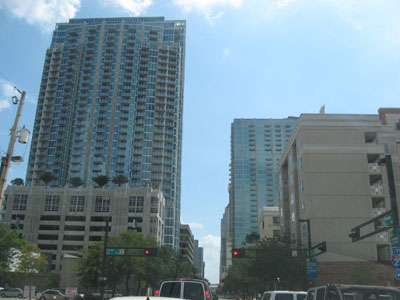
    Photo: Downtown Tampa (by the author)

  • The Hudson Tunnel: Issues for New Jersey

    New Jersey Governor Chris Christie sent shockwaves through the transportation industry on last Thursday when he cancelled the under-construction ARC (Access to the Regional Core) rail tunnel under the Hudson River from New Jersey to New York (Manhattan).

    The Governor accepted the Access the Regional Core (ARC) Executive Committee’s recommendation to “pull the plug” on the expensive project because of cost overruns. The project was to have cost $8.7 billion, but could escalate up to $14 billion according to the Governor’s office. All of any such cost overrun would have to be absorbed by the state of New Jersey, which like many other states is in dire financial straits.

    Christie said:

    “I have made a pledge to the people of New Jersey that on my watch I will not allow taxpayers to fund projects that run over budget with no clear way of how these costs will be paid for. Considering the unprecedented fiscal and economic climate our State is facing, it is completely unthinkable to borrow more money and leave taxpayers responsible for billions in cost overruns. The ARC project costs far more than New Jersey taxpayers can afford and the only prudent move is to end this project.”

    Governor Christie indicated that the project could become New Jersey’s “Big Dig,” referring to the Boston highway project that he said escalated in cost by 10 times (that is not a typo).
    Yet supporters of the tunnel were unanimous in their condemnation of Christie’s move, from Paul Krugman of The New York Times to the Regional Plan Association.

    New Jersey Senator Frank Lautenberg announced that Christie had backed down, noting his “reversal of yesterday’s decision to kill” the tunnel project. Referring to a meeting between US Secretary of Transportation Ray LaHood and Governor Christie, Lautenberg said “The Secretary was clear with Governor Christie: if this tunnel doesn’t get built, the three billion dollars will go to other states. We can’t allow that to happen.” Lautenberg listed a litany of benefits such as a reduction of greenhouse gas emissions by 70,000 tons annually. He also noted that New Jersey would have to reimburse the federal government the $300 million it had received for the tunnel. Senator Robert Menendez added that “New Jersey taxpayers don’t want to own a $600 million hole to nowhere.”

    However, under examination, it is unclear whether Christie had “reversed” his position. Christie agreed to consider “options to potentially salvage” a tunnel project based upon options (not made public) offered by LaHood. New Jersey and Federal officials will be meeting on the matter over the next two weeks. Christie, however, reaffirmed his concern about project finances, stating that” the ARC project is not financially viable “ and its expectation “to dramatically exceed its current budget remains unchanged. ” The Newark Star-Ledger cited state officials as saying that the decision does not represent a reversal of Christie’s original decision.

    Thus, everything may be up in the air. Given that, here are a few issues the state of New Jersey may like to consider as it finalizes its decision:

    1. Exaggerating the Need for the Project The new rail tunnel is to serve a purported increase in commuter rail ridership to Manhattan jobs in the future. The project’s Final Environmental Impact Statement says that Midtown Manhattan’s employment will grow from its present 2.6 million by another 500,000 by 2030. This is unlikely. Manhattan’s entire employment (not just Midtown) peaked at 2.4 million in 2008. One might expect the planners could have gotten something so simple correct. Manhattan employment remains below 2001 levels and never rose more than 35,000 even at the peak of the last boom (annual figure, from 2001). The consultants also are projecting a 1.6 million population increase west of the Hudson River (New Jersey suburbs along with the New York counties of Rockland and Orange) by 2030. However, the New Jersey and New York metropolitan counties to the west of the Hudson are more likely to grow only 1.1 million, based upon official state projections (Note). The questionable population and employment projections reveal that the “need” for the new tunnel may have been grossly overstated.

    2. Exporting New Jersey Jobs to New York Why should New Jersey pay to build more capacity so that its people can work across the state line? Why should they not work in New Jersey? New Jersey is often thought of an economic afterthought in Manhattan centric media and business interests (such as by The New York Times). In fact only a small share of New Jersey commuters travel to Manhattan for work. Even in the New Jersey counties that border New York, only 12% of commuters work in Manhattan. In the other New York metropolitan area counties in the metropolitan area, the figure drops to 5%.

    The trends here are also important. Since 1956, every new job in the New York metropolitan area has been created outside Manhattan (Manhattan’s employment is 400,000 lower now than back then). New Jersey depends on New Jersey far more than it does New York. New Jersey has developed successful new office complexes in Jersey City, New Brunswick, along the I-287 Belt Route and elsewhere. Perhaps New Jersey should seek to minimize work trip lengths and encourage the next 500,000 jobs to be created in the state rather than in New York. Downtown Newark, for example, has excellent transit access and could use substantial new employment investment. This might prove more beneficial for New Jersey and its taxpayers.

    3. Costs Could Rise Even Higher The tunnel could easily climb in cost beyond the now feared $14 billion. Big Dig cost escalation continued almost to the project’s opening. There is no reason to expect it will be different with the Hudson tunnel. It has been reported that one of LaHood’s options is simply to lower cost projections. New Jersey should buy that option only if the federal government underwrites all of the cost overruns. However, such a deviation from federal policy would bring stiff opposition from other parts of the country.

    4. The Cost of Reducing Greenhouse Gas Emissions Like so many transit projects, the reduction of greenhouse gas (GHG) emissions is raised as a benefit of the tunnel. But at what cost? Each of the 70,000 annual tons of greenhouse gas emissions removed would require a capital expenditure of $16,000. The present market price for greenhouse gases is $20 per ton. New Jersey could accomplish the same objective for just $1.4 million annually.

    The Decision Much rides on Governor Christie’s decision. It may be better for the state to have a $600 million tunnel to nowhere than a $14, $20 or $25 billion tunnel that may not really be needed. Moreover, frustration is building with Washington’s “plunder” philosophy that encourages wasting money at home, so that another state doesn’t get the chance. Digging the nation out of its present (and future) malaise seems likely to require fresher thinking than this.

    If Governor Christie musters the courage to stop this project now, it could be a shot across the bow of an international vendor and consulting engineering community that has routinely low-balled costs only to later jack them up, confident that no project would be canceled once started.

    ——–

    Note: This figure is derived using New York 2030 projections and New Jersey 2025 projections, increased by the 2020-2025 growth rate to project 2030 population.

    Wendell Cox is a Visiting Professor, Conservatoire National des Arts et Metiers, Paris and the author of “War on the Dream: How Anti-Sprawl Policy Threatens the Quality of Life

    Photo: Hudson River looking south between Lower Manhattan and Jersey City (photo by author)

  • Vancouver Olympic Villiage Development Becoming a Burden to Taxpayers

    The former Olympic athlete’s village in Vancouver is in the news again, but this time no one is celebrating. The billion dollar plus development, originally built to house athletes then converted to a residential housing development, was primarily financed by a loan from the city of Vancouver. Millennium Development Corp., developer of the project, currently owes the city $731 million. Millennium was scheduled to pay back the first $200 million by August 31st, but came up $8 million short. They managed to find another $5 million by September 20th, but they are still $3 million short. On top of this, they have another $75 million due in January. The city is considering legal action against the developer.

    This isn’t the first we’ve heard about financial troubles with the project. The city actually took over the loan from Millennium’s initial lender due to cost overruns. The repayment schedule was considered feasible, given the strength of the Vancouver real estate market. Unfortunately for them, sales have been slow. While 223 units sold during the presale, only 36 units have moved since. This leaves more than half of the units. 454, lingering on the market. The city has actually been forced to take over the 252 units of social housing that were required to be built due to the city’s inclusionary zoning laws.

    Amidst this turmoil, the city is doing everything it can to ensure that the remaining units are neither sold off cheaply nor rented out, since this would reduce the long run selling price. Their solution is to wait for the market to rebound. Councilor Raymond Louie stated that “the benefit of being the city is that we are lasting and we can stay forever…it’s a paper loss for now, but we can wait for the market to recover.” Of course, if this were a wise decision, why are private brokers and developers not doing the same? The answer is simple: the assets are depreciating anyways, so they may as well cut their losses. The problem here seems to be that the sitting government is afraid that it will look bad for them if the sale of the units doesn’t cover the full loan amount. By telling the developer to sit on the assets, they can claim that the debt will be repaid when the market recovers (and they are happily retired from council).

    The British Columbia government reported that the cost of the Olympics to BC taxpayers was $925 million. The original estimate was $600 million. On top of this, the federal government kicked in $1 billion for security costs. That also doesn’t count the $700 million they spent on highway upgrades, $2 billion for a light rail extension, or $885 million for a convention center. Millennium’s financial troubles threaten to add to the losses incurred by taxpayers. Reports claim that the development is worth between $150-200 million less than what they owe the city. On top of that, at least 15 of the pre-sale buyers are trying to back out of their purchases. The bad news for taxpayers just keeps coming.

    While the city was forced to back the loan in order to live up to its Olympic commitments, there is a clear lesson here: cities should not be in the housing business. Even though they’ve managed to keep housing prices artificially high, they can’t break even on a housing development that was advertised to the whole world. Either the housing market will overheat again, and the project will become solvent, or the taxpayers will lose a couple hundred million dollars. Potential home owners in Vancouver can’t seem to win. The best thing the city can do at this point is admit failure, and allow Millennium to have a fire sale. It won’t do much about the cost of living in the city, but at least a few people will pick up bargains. Of course, politicians aren’t likely to cut their losses. Better to pass the buck to the next council.

  • The Great Deconstruction: Competing Visions of the Future

    During the Great Recession, America’s wealth has diminished while indebtedness has increased. This is simply a matter of fact. How the United States will marshal its resources and deploy its wealth in the future is a matter of great public debate. Previous installments of the Great Deconstruction series have explored the debate over the growing size of government and the impact the Tea Party movement may have on a possible smaller role for future government.

    The current administration has its own vision of how to address the coming period of deconstruction. John P. Holdren, Director of the White House Office of Science and Technology, shied away from using the term “de-development” that he endorsed in past writing. When asked by CNSNews how he would “de-develop” the United States, Holdren said he would use the “free market economy” to implement “stopping the kinds of activities that are destroying the environment and replacing them with activities that would produce both prosperity and environmental equality”.

    But this stated new appreciation for market forces likely does not mean he has shifted from his belief that resources “must be diverted” from advanced countries to the underdeveloped countries. An example of how Holdren’s vision of the future may be implemented as policy in the United States can be found in this administration’s actions towards energy and in particular, oil drilling. The BP oil well, Deep Horizon, has been officially capped yet the federal ban on all drilling in the Gulf remains in place. The administration estimates the ban cost just 8,000 – 12,000 jobs but Baton Rouge-based Louisiana Mid-Continent Oil and Gas Association believes that the moratorium may put as many as 46,000 rig workers out of work. If all workers on deep water rigs were laid off during the suspension, the moratorium would lead to the loss of 23,247 jobs.

    In contrast, the same Administration approved $2 billion in loan guarantees from the US Import Export Bank to Brazil’s state owned oil giant, Petrobas, to open the giant Tupi oilfields in the Santos Basin fields near Rio de Janeiro. The oil recovered from the Tupi fields will not go to the US and US taxpayers, but it will make Brazil richer and energy independent

    Critically much of what the Administration has proposed follows the contours of “de-development”. This can be seen in a host of initiatives that would hit Americans economically from the “cap and trade” scheme, support for solar and wind energy, as well the attempt to regulate greenhouse emissions through the EPA.

    Oddly the Administration has not put much priority on nuclear power, which is arguably the most effective way to reduce greenhouse gases. Despite announcing an $8 billion loan program for nuclear power plant construction, there is only one nuclear power plant under construction in the US, compared to 50 worldwide. Jeff Immelt, CEO of General Electric, joked that the nuclear industry’s most important output these days is press releases. Nuclear power remains banned in many states. Just 6 states are able to generate more than 40% of their electricity from nuclear power.

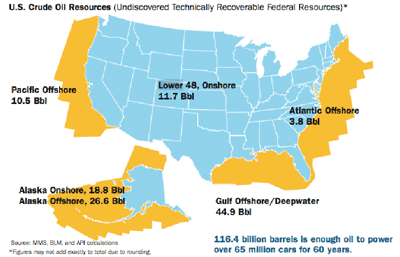
    The drive to de-develop America begins with control of energy. This includes actions to restrict access to our natural resources. The United States has 31 billion barrels of oil reserves on-shore in the lower 48 and Alaska. Off-shore oil reserves include 60 billion barrels along the coastal US and 26 billion barrels in off shore Alaska. Yet almost all of these reserves remain untouchable. Drilling in ANWAR is still banned and due to the BP oil leak in the Gulf, a drilling ban remains in place on the only coastal resource previously open for drilling.

    The US oil reserves are a pittance compared to our reserves of oil shale deposits. Estimates put oil shale reserves at 1.5 – 2.0 trillion barrels or five times that of Saudi Arabia. “The technical groundwork may be in place for a fundamental shift in oil shale economics,” the Rand Corporation recently declared. “Advances in thermally conductive in-situ conversion may enable shale-derived oil to be competitive with crude oil at prices below $40 per barrel. If this becomes the case, oil shale development may soon occupy a very prominent position in the national energy agenda.” Shell utilized a process called “in situ” mining, which heats the shale while it’s still in the ground, to the point where the oil leaches from the rock. The process eliminates the need to mine the shale to get to the oil. The Administration has shown little sign of encouraging the development of these resources, particularly in the areas controlled by the federal government.

    US policy towards the coal industry is no more favorable. U.S. coal production decreased in 2009, dropping by 8.5 percent to a level of 1,072.8 million short tons. The decline in coal production in 2009 was the largest percent decline since 1958 and the largest tonnage decline since 1949.

    In sharp contrast, the administration openly promotes green technologies like wind and solar. Unfortunately, these sources provide just 1% of our energy requirements.

    De-development, the Obama Administration’s version of deconstruction, is very different from a growing political movement aimed at reducing the nation’s debt and current spending. The Great Deconstruction will not come from a government policy of reducing energy consumption to bring America into a more correct distribution and use of the world’s resources. Rather, it will come from the people demanding a smaller bureaucracy, more efficient government and government employees actually willing to do the job they are paid to do.

    The election in November offers the most profound choice for the future of America that we have seen in decades. One choice espouses government control of our natural resources, motivated by the strategy of “de-development” and expensive, rationed energy. The other choice seeks deconstruction of unsustainable and dysfunctional bureaucracies and intends to choke off the money supply from Congress and defund these programs.

    **************************

    Robert J Cristiano PhD is the Real Estate Professional in Residence at Chapman University in Orange, CA and Head of Real Estate for the international investment firm, L88 Investments LLC. He has been a successful real estate developer in Newport Beach California for twenty-nine years.

    Other works in The Great Deconstruction series for New Geography
    Deconstruction: The Fate of America? – March 2010
    The Great Deconstruction – First in a New Series – April 11, 2010
    An Awakening: The Beginning of the Great Deconstruction – June 12, 2010
    The Great Deconstruction :An American History Post 2010 – June 1, 2010
    A Tsunami Approaches – Beginning of the Great Deconstruction – August 2010
    The Tea Party and the Great Deconstruction – September 2010