Category: Politics

  • Environmentalism as Religion

    Traditional religion is having a tough time in parts of the world. Majorities in most European countries have told Gallup pollsters in the last few years that religion does not “occupy an important place” in their lives. Across Europe, Judeo-Christian church attendance is down, as is adherence to religious prohibitions such as those against out-of-wedlock births. And while Americans remain, on average, much more devout than Europeans, there are demographic and regional pockets in this country that resemble Europe in their religious beliefs and practices.

    The rejection of traditional religion in these quarters has created a vacuum unlikely to go unfilled; human nature seems to demand a search for order and meaning, and nowadays there is no shortage of options on the menu of belief. Some searchers syncretize Judeo-Christian theology with Eastern or New Age spiritualism. Others seek through science the ultimate answers of our origins, or dream of high-tech transcendence by merging with machines — either approach depending not on rationalism alone but on a faith in the goodness of what rationalism can offer.

    For some individuals and societies, the role of religion seems increasingly to be filled by environmentalism. It has become “the religion of choice for urban atheists,” according to Michael Crichton, the late science fiction writer (and climate change skeptic). In a widely quoted 2003 speech, Crichton outlined the ways that environmentalism “remaps” Judeo-Christian beliefs:

    There’s an initial Eden, a paradise, a state of grace and unity with nature, there’s a fall from grace into a state of pollution as a result of eating from the tree of knowledge, and as a result of our actions there is a judgment day coming for us all. We are all energy sinners, doomed to die, unless we seek salvation, which is now called sustainability. Sustainability is salvation in the church of the environment. Just as organic food is its communion, that pesticide-free wafer that the right people with the right beliefs, imbibe.

    In parts of northern Europe, this new faith is now the mainstream. “Denmark and Sweden float along like small, content, durable dinghies of secular life, where most people are nonreligious and don’t worship Jesus or Vishnu, don’t revere sacred texts, don’t pray, and don’t give much credence to the essential dogmas of the world’s great faiths,” observes Phil Zuckerman in his 2008 book Society without God. Instead, he writes, these places have become “clean and green.” This new faith has very concrete policy implications; the countries where it has the most purchase tend also to have instituted policies that climate activists endorse. To better understand the future of climate policy, we must understand where “ecotheology” has come from and where it is likely to lead.

    From Theology to Ecotheology

    The German zoologist Ernst Haeckel coined the word “ecology” in the nineteenth century to describe the study of “all those complex mutual relationships” in nature that “Darwin has shown are the conditions of the struggle for existence.” Of course, mankind has been closely studying nature since the dawn of time. Stone Age religion aided mankind’s first ecological investigation of natural reality, serving as an essential guide for understanding and ordering the environment; it was through story and myth that prehistoric man interpreted the natural world and made sense of it. Survival required knowing how to relate to food species like bison and fish, dangerous predators like bears, and powerful geological forces like volcanoes — and the rise of agriculture required expertise in the seasonal cycles upon which the sustenance of civilization depends.

    Our uniquely Western approach to the natural world was shaped fundamentally by Athens and Jerusalem. The ancient Greeks began a systematic philosophical observation of flora and fauna; from their work grew the long study of natural history. Meanwhile, the Judeo-Christian teachings about the natural world begin with the beginning: there is but one God, which means that there is a knowable order to nature; He created man in His image, which gives man an elevated place in that order; and He gave man mastery over the natural world:

    And God blessed them, and God said unto them, Be fruitful, and multiply, and replenish the earth, and subdue it: and have dominion over the fish of the sea, and over the fowl of the air, and over every living thing that moveth upon the earth. And God said, Behold, I have given you every herb bearing seed, which is upon the face of all the earth, and every tree, in the which is the fruit of a tree yielding seed; to you it shall be for meat. [Genesis 1:28-29]

    In his seminal essay “The Historical Roots of Our Ecologic Crisis,” published in Science magazine in 1967, historian Lynn Townsend White, Jr. argues that those Biblical precepts made Christianity, “especially in its Western form,” the “most anthropocentric religion the world has seen.” In stark contrast to pagan animism, Christianity posited “a dualism of man and nature” and “insisted that it is God’s will that man exploit nature for his proper ends.” Whereas older pagan creeds gave a cyclical account of time, Christianity presumed a teleological direction to history, and with it the possibility of progress. This belief in progress was inherent in modern science, which, wedded to technology, made possible the Industrial Revolution. Thus was the power to control nature achieved by a civilization that had inherited the license to exploit it.

    To White, this was not a positive historical development. Writing just a few years after the publication of Rachel Carson’s eco-blockbuster Silent Spring, White shared in the concern over techno-industrial culture’s destruction of nature. Whatever benefit scientific and technological innovation had brought mankind was eclipsed by the “out of control” extraction and processing powers of industrial life and the mechanical degradation of the earth. Christianity, writes White, “bears a huge burden of guilt” for the destruction of the environment.

    White believed that science and technology could not solve the ecological problems they had created; our anthropocentric Christian heritage is too deeply ingrained. “Despite Copernicus, all the cosmos rotates around our little globe. Despite Darwin, we are not, in our hearts, part of the natural process. We are superior to nature, contemptuous of it, willing to use it for our slightest whim.” But White was not entirely without hope. Even though “no new set of basic values” will “displace those of Christianity,” perhaps Christianity itself can be reconceived. “Since the roots of our trouble are so largely religious, the remedy must also be essentially religious.” And so White suggests as a model Saint Francis, “the greatest spiritual revolutionary in Western history.” Francis should have been burned as a heretic, White writes, for trying “to substitute the idea of the equality of all creatures, including man, for the idea of man’s limitless rule of creation.” Even though Francis failed to turn Christianity toward his vision of radical humility, White argued that something similar to that vision is necessary to save the world in our time.

    White’s essay caused a splash, to say the least, becoming the basis for countless conferences, symposia, and debates. One of the most serious critiques of White’s thesis appears in theologian Richard John Neuhaus’s 1971 book In Defense of People, a broad indictment of the rise of the mellifluous “theology of ecology.” Neuhaus argues that our framework of human rights is built upon the Christian understanding of man’s relationship to nature. Overturning the latter, as White hoped would happen, will bring the former crashing down. And Neuhaus makes the case that White misunderstands his own nominee for an ecological patron saint:

    What is underemphasized by White and others, and what was so impressive in Francis, is the unremitting focus on the glory of the Creator. Francis’ line of accountability drove straight to the Father and not to Mother Nature. Francis was accountable for nature but to God. Francis is almost everyone’s favorite saint and the gentle compassion of his encompassing vision is, viewed selectively, susceptible to almost any argument or mood…. It was not the claims of creation but the claims of the Creator that seized Francis.

    Other Christian writers joined Neuhaus in condemning the eco-movement’s attempt to subvert or supplant their religion. “We too want to clean up pollution in nature,” Christianity Today demurred, “but not by polluting men’s souls with a revived paganism.” The Jesuit magazine America called environmentalism “an American heresy.” The theologian Thomas Sieger Derr lamented “an expressed preference for the preservation of nonhuman nature against human needs wherever it is necessary to choose.” (Stephen R. Fox recounts these responses in his 1981 book John Muir and His Legacy: The American Conservation Movement.)

    The Greening of Christianity

    From today’s vantage, it seems that White’s counsel has been heeded far and wide. Ecotheologies loosely based on concepts lifted from Hinduism or Buddhism have become popular in some Baby Boomer circles. Neo-pagans cheerfully accept the “tree-hugger” designation and say they were born “green.” And, most strikingly, Christianity has begun to accept environmentalism. Theologians now speak routinely of “stewardship” — a doctrine of human responsibility for the natural world that unites interpretations of Biblical passages with contemporary teachings about social justice.

    In November 1979, a dozen years after White’s essay, Pope John Paul II formally designated Francis of Assisi the patron saint of ecologists. Over the following two decades, John Paul repeatedly addressed in passionate terms the moral obligation “to care for all of Creation” and argued that “respect for life and for the dignity of the human person extends also to the rest of Creation, which is called to join man in praising God.” His successor, Benedict XVI, has also spoken about the environment, albeit less stirringly. “That very ordinariness,” argues a correspondent for the National Catholic Reporter, “seems remarkable. Benedict simply took for granted that his audience would recognize the environment as an object of legitimate Christian interest. What the matter-of-fact tone reveals, in other words, is the extent to which Catholicism has ‛gone green.’”

    American Protestantism, too, has gone green. Numerous congregations are constructing “green churches” — choosing to glorify God not by erecting soaring sanctuaries but by building more energy-efficient houses of worship. In some denominations, programs for recycling or carpooling seem as common as food drives. Church-sponsored Earth Day celebrations are widespread.

    Even some evangelicals are turning toward environmentalism. Luis E. Lugo, the director of the Pew Forum on Religion and Public Life, speaks of their “broader environmental sensitivity”:

    Once it’s translated into Biblical terms, [evangelicals] pick up the environmental banner using phrases that resonate with the ­community — “Creation care.” That immediately puts it in an evangelical context rather than the empirical arguments about the environment. “This is the world God created. God gave you a mandate to care for this world.” It’s a very direct religious appeal.

    That said, the widely reported “greening of evangelicals” shouldn’t be exaggerated. Conservative evangelical leaders remain wary of environmentalism’s agenda and of any attacks on industrial prowess that could be seen as undermining American national greatness. Many evangelicals are rankled by environmentalists’ critique of the Genesis depiction of man’s place in the natural order. And evangelicals are alert to any hint of pagan worship. Moreover, the available poll data — admittedly rather sparse — paints a mixed picture. In a 2008 survey conducted by the Barna Group, a California-based public opinion firm that concentrates on church issues, 90 percent of the evangelical respondents said they “would like Christians to take a more active role in caring for creation” (with two thirds saying they strongly agreed with that sentiment). But the term “Creation care” had not sunk in (89 percent of the respondents who ­identified ­themselves as Christian said they had never heard of it). And both the Barna survey and another 2008 survey conducted by Pew found that evangelicals tend to be much more skeptical about the reality of ­global warming than other American Christians or the population at large.

    To the extent that evangelicals and environmentalists are in fact reaching out to one another, there can be benefits for each side. For churches with aging congregations, green issues reportedly help attract new, younger members to the pews. And what do environmental activists hope to gain by recruiting churches to their cause? “Foot soldiers, is the short answer,” says Lugo.

    Carbon Calvinism

    Beyond influencing — one might even say colonizing — Christianity, the ecological movement can increasingly be seen as something of a religion in and of itself. It is “quasi-religious in character,” says Lugo. “It generates its own set of moral values.”

    Freeman Dyson, the brilliant and contrarian octogenarian physicist, agrees. In a 2008 essay in the New York Review of Books, he described environmentalism as “a worldwide secular religion” that has “replaced socialism as the leading secular religion.” This religion holds “that we are stewards of the earth, that despoiling the planet with waste products of our luxurious living is a sin, and that the path of righteousness is to live as frugally as possible.” The ethics of this new religion, he continued,

    are being taught to children in kindergartens, schools, and colleges all over the world…. And the ethics of environmentalism are fundamentally sound. Scientists and economists can agree with Buddhist monks and Christian activists that ruthless destruction of natural habitats is evil and careful preservation of birds and butterflies is good. The worldwide community of environmentalists — most of whom are not scientists — holds the moral high ground, and is guiding human societies toward a hopeful future. Environmentalism, as a religion of hope and respect for nature, is here to stay. This is a religion that we can all share, whether or not we believe that global warming is harmful.

    Describing environmentalism as a religion is not equivalent to saying that global warming is not real. Indeed, the evidence for it is overwhelming, and there are powerful reasons to believe that humans are causing it. But no matter its empirical basis, environmentalism is progressively taking the social form of a religion and fulfilling some of the individual needs associated with religion, with major political and policy implications.

    William James, the pioneering psychologist and philosopher, defined religion as a belief that the world has an unseen order, coupled with the desire to live in harmony with that order. In his 1902 book The Varieties of Religious Experience, James pointed to the value of a community of shared beliefs and practices. He also appreciated the individual quest for spirituality — a search for meaning through encounters with the world. More recently, the late analytic philosopher William P. Alston outlined in The Encyclopedia of Philosophy what he considered the essential characteristics of religions. They include a distinction between sacred and profane objects; ritual acts focused upon sacred objects; a moral code; feelings of awe, mystery, and guilt; adoration in the presence of sacred objects and during rituals; a worldview that includes a notion of where the individual fits; and a cohesive social group of the likeminded.

    Environmentalism lines up pretty readily with both of those accounts of religion. As climate change literally transforms the heavens above us, faith-based environmentalism increasingly sports saints, sins, prophets, predictions, heretics, demons, sacraments, and rituals. Chief among its holy men is Al Gore — who, according to his supporters, was crucified in the 2000 election, then rose from the political dead and ascended to heaven twice — not only as a Nobel deity, but an Academy Awards angel. He speaks of “Creation care” and cites the Bible in hopes of appealing to evangelicals.

    Selling indulgences is out of fashion these days. But you can now assuage your guilt by buying carbon offsets. Fire and brimstone, too, are much in vogue — accompanied by an unmistakable whiff of authoritarianism: “A professor writing in the Medical Journal of Australia calls on the Australian government to impose a carbon charge of $5,000 on every birth, annual carbon fees of $800 per child and provide a carbon credit for sterilization,” writes Braden R. Allenby, an Arizona State University professor of environmental engineering, ethics, and law. An “article in the New Scientist suggests that the problem with obesity is the additional carbon load it imposes on the environment; others that a major social cost of divorce is the additional carbon burden resulting from splitting up families.” Allenby, writing in a 2008 article on GreenBiz.com, continues:

    A recent study from the Swedish Ministry of Sustainable Development argues that males have a disproportionately larger impact on global warming (“women cause considerably fewer carbon dioxide emissions than men and thus considerably less climate change”). The chairman of the Intergovernmental Panel on Climate Change states that those who suggest that climate change is not a catastrophic challenge are no different than Hitler…. E.O. Wilson calls such people parasites. Boston Globe columnist Ellen Goodman writes that “global warming deniers are now on a par with Holocaust deniers.”

    The sheer volume of vicious language employed to recast social and cultural trends in terms of their carbon footprint suggests the rise of what Allenby calls a dangerous new “carbon fundamentalism.”

    Some observers detect parallels between the ecological movement and the medieval Church. “One could see Greenpeacers as crusaders, with the industrialist cast as the infidel,” writes Richard North in New Scientist. That may be a stretch, but it does seem that this new religion has its share of excommunicated heretics. For example, since daring to challenge environmentalist orthodoxy, Freeman Dyson has discovered himself variously described as “a pompous twit,” “a blowhard,” “a cesspool of misinformation,” and “an old coot riding into the sunset.” For his part, Dyson remains cheerily unrepentant. “We are lucky that we can be heretics today without any danger of being burned at the stake,” he has said. “But unfortunately I am an old heretic…. What the world needs is young heretics.”

    Many of those making the case that environmentalism has become a religion throw around the word “religion” as a pejorative. This disdain is rooted in an uncontroversial proposition: You cannot reason your way to faith. That’s the idea behind the “leap of faith” — or the leap to faith, in Kierkegaard’s original formulation: the act of believing in something without, or in spite of, empirical evidence. Kierkegaard argued that if we choose faith, we must suspend our reason in order to believe in something higher than reason.

    So those on the right side of the political spectrum who portray environmentalism as a religion do so because, if faith is inherently not ­achievable through rationality, and if environmentalism is a religion, then environmentalism is utterly irrational and must be discredited and ignored. That is the essence of Michael Crichton’s 2003 speech. “Increasingly,” he said, “it seems facts aren’t necessary, because the tenets of environmentalism are all about belief.” Environmentalism, he argued, has become totally divorced from science. “It’s about whether you are going to be a sinner, or saved. Whether you are going to be one of the people on the side of salvation, or on the side of doom. Whether you are going to be one of us, or one of them.”

    A similar attack from the right comes from Ray Evans, an Australian businessman, politician, and global-warming skeptic:

    Almost all of the attacks on the mining industry being generated by the environmentalist movement [in the 1990s] were coming out of Northern Europe and Scandinavia, and it didn’t take me long to work out that we were dealing with religious belief, that the elites of Northern Europe and Scandinavia — the political elites, the intellectual elites, even the business elites — were, in fact, believers in one brand of environmentalism or another and regardless of the facts. Some of the most bizarre policies were coming out of these countries with respect to metals. I found myself having to find out — “Why is this so?” — ­because on the face of it they were insane, but they were very strongly held and you’d have to say that when people hold onto beliefs regarding the natural world, and hold onto them regardless of any evidence to the contrary, then you’re dealing with religion, you’re not dealing with science….

    Secondly, it fulfills a religious need. They need to believe in sin, so that means sin is equal to pollution. They need to believe in salvation. Well, sustainable development is salvation. They need to believe in a mankind that needs redemption, so you get redemption by stopping using carbon fuels like coal and oil and so on. So, it fulfills a religious need and a political need, which is why they hold onto it so tenaciously, despite all the evidence that the whole thing is nonsense.

    Leftists also sometimes disparage environmentalism as religion. In their case, the main objection is usually pragmatic: rationalism effects change and religion doesn’t. So, for instance, the Sixties radical Murray Bookchin saw the way environmentalism was hooking up with New Age spirituality as pathetic. “The real cancer that afflicts the planet is capitalism and hierarchy,” he wrote. “I don’t think we can count on prayers, rituals, and good vibes to remove this cancer. I think we have to fight it actively and with all the power we have.” Bookchin, a self-described revolutionary, dismissed green spirituality as “flaky.” He said that his own brand of “social ecology,” by contrast, “does not fall back on incantations, sutras, flow diagrams, or spiritual vagaries. It is avowedly rational. It does not try to regale metaphorical forms of spiritual mechanism and crude biologisms with Taoist, Buddhist, Christian, or shamanistic ‛Eco-la-la.’”

    The Prophet and the Heretic

    In the 1960s, a British chemist working with the American space program had a flash of insight. Planet Earth, James Lovelock realized, behaves like one complex, living system of which we humans are, in effect, some of its parts. The physical components of the earth, from its atmosphere to its oceans, closely integrate with all of its living organisms to maintain climatic chemistry in a self-regulating balance ideal for the maintenance and propagation of life.

    His idea turned out to have scientific value. However, Lovelock would probably just be a footnote in scientific history instead of the much-decorated intellectual celebrity he is, except for one thing: He named this vast planetary organism after the Greek goddess who personified the earth — Gaia — and described “Her” as “alive.”

    Not only was his Gaia Hypothesis predictably controversial in the world of science — as befits a radical rethinking of earth’s complex biosphere — but it was both revered and reviled by those who saw it as fitting in perfectly with tie-dyed New Age spirituality. This was true even though he describes his time at the Jet Propulsion Laboratory in Pasadena as one in which “not all of us were hippies with our rock chicks.” For both good and ill, Lovelock not only gave the planet a persona, he created one for himself, becoming “the closest thing we have to an Old Testament prophet, though his deity is not Jehovah but Gaia,” as the Sunday Times recently noted.

    Even though Lovelock continues to go to great lengths to be an empiricist, his 2009 book The Vanishing Face of Gaia: A Final Warning — published in the year he celebrated his ninetieth birthday — has been reviewed as a prophet’s wrathful jeremiad of planetary doom, studded with parables of possible salvation for the few.

    Being embraced by the spiritual left has brought Lovelock fame and attention. Yet it’s a marvel the challenges Lovelock has created for himself in changing the minds of zealots. In Vanishing Face, for example, Lovelock, ever the scientist, open-mindedly considers the possibilities for last-ditch humans fighting global warming by intentionally reengineering the planet. One idea he discusses is retrofitting every commercial airliner on earth to allow them, as they fly, each to spray a ton or two of sulfuric acid into the stratosphere every day for the foreseeable future. The notion is that this will create molecules that will cause solar energy to be reflected back into space, replacing the reflectivity of the melting polar ice caps.

    So, you say to Lovelock: You’ve succeeded in getting out this idea that the planet is a living organism. An awful lot of people are totally convinced by your hypothesis, and even view you as a prophet. How would you begin to sell this idea of injecting sulfuric acid into a living being that some view in religious terms?

    “Yes, especially when you think about the role of the element sulfur in old theology,” Lovelock replies. “The devil — the scent of sulfur reveals his presence. I hear what you’re saying very clearly. I’ve never had to sell it to religious greens so far. I don’t look forward to the job.”

    Of environmentalism increasingly being faith-based, Lovelock says, “I would agree with you wholeheartedly. I look at humans as probably having an evolutionary desire to have ideology, to justify their actions. Green thinking is like Christian or Muslim religions — it’s another ideology.”

    In terms of saving Gaia, do you view carbon Calvinism as a net plus or a net minus?

    “A net minus. You often hear environmentalists saying that one should do this or the other thing — like not fly — because not doing it can save the planet. It’s sheer hubris to imagine we can save Gaia. It’s quite beyond our capacity. What we have to do is save ourselves. That’s really important. Gaia would like it.”

    Gaia would like it?

    “Yes. I’ve got to be very careful here, because I get misinterpreted badly. I’m not making out Gaia to be a sentient entity and that sort of thing. It’s really metaphoric. So having said that — ”

    Gaia would think it important for us to save ourselves?

    “Exactly. Our evolution of intelligence is something of immense value to the planet. It could make, eventually, part of it, an intelligent planet. More able to deal with problems like incoming asteroids, volcanic outbursts and so on. So I look on us as highly beneficial and therefore ­certainly worth saving.”

    The good news about religious greens, Lovelock says, is that they can be led. Saints like him can change minds. “I have a personal experience here. Something like five years ago in Britain they did a big poll. There was hardly anybody” in favor of nuclear power. Now — thanks in no small part to Lovelock’s lobbying, at least in his own account — the great majority of Britons favor nuclear energy.

    Lovelock’s faith in democracy is shared by Bjørn Lomborg. He believes that people want to do good, and if you approach them on that basis, you can get them to listen to reason. Lomborg is the Danish author of The Skeptical Environmentalist (published in English in 2001), and the director of the Copenhagen Consensus Center. He has been pilloried for opposing the Kyoto Protocol and other measures to cut carbon emissions in the short term because of the evidence he sees that they don’t achieve their goals. Instead, he argues that we should adapt to inevitable short-term temperature rises and spend money on research and development for longer-term environmental solutions, as well as other pressing world crises such as malaria, AIDS, and hunger. He argues, for example, that ­getting Vitamin A and zinc to 80 percent of the 140 million children in the developing world who lack them is a higher priority than cutting carbon emissions. The cost, he argues, would be $60 million per year, yielding health and cognitive development benefits of over $1 billion.

    Despite his heresy, Lomborg thinks empiricism can prevail over faith. He believes that, in a democracy, if you keep calmly and rationally and sympathetically making your case, the great majority can come to think you are making more sense than the true believers. “My sense is that most people do want to do good,” he says.

    They don’t just want to pay homage to whatever god or whatever religion is the flavor of the year. They actually want to see concrete results that will leave this planet a better place for the future. So I try to engage them in a rational manner rather than in the religious manner. Of course, if people’s minds are entirely made up there is nothing you can do to change it. But my sense is that most people are not in that direction. My sense is that in virtually any area, you have probably 10 percent true believers that you just cannot reach. And probably also 10 percent who just disparage it and don’t give a hoot about it. But the 80 percent are people who are busy living their lives, loving their kids, and making other plans. And I think those are the 80 percent you want to reach.

    So why do so many people want to burn you at the stake?

    Oh sure. Certainly a lot of the high priests have been after me. But I take that as a compliment. It simply means that my argument is a lot more dangerous. If I was just a crazy guy ranting outside the religious gathering, then it might not matter. But I’m the guy who says, maybe you could do smarter. Maybe you could be more rational. Maybe you could spend your money in a better way.

    A lot of people have been after me with totally disproportionate behavior if this were really a discussion on facts. But I continuously try to make this an argument about rationality. Because when you do that, and your opponents perhaps exaggerate, and go beyond the rational argument, it shows up in the conversation. Most people would start saying, “Wow, that’s weird, that they’d go this far.”

    This is not to deny that global warming is also a serious problem. But then again I ask: why is it that we tackle it only in the way that current dogma talks about — cut carbon emissions right now and feel good about yourself? Instead of focusing on making new innovations that would [allow everyone] to cut carbon emissions in the long run much cheaper, more effectively, and with much greater chance of success.

    When you make those double arguments, I think the 80 percent we’ve talked about start saying, “That guy makes a lot of sense. Why are the other people continuously almost frothing around the mouth?” And always saying, “No, no, no, it has to be cut carbon emissions and that has to be the biggest problem in the world.”

    I think that’s the way to counter much of this discussion. It’s not about getting your foot into the religious camp as well. It’s simply to stand firmly on the rational side and keep saying, “but I know you want to do good in the world.”

    Lovelock and Lomberg, prophet and heretic, honored and reviled, one hoping for action today and the other expecting solutions tomorrow — yet each professes confidence in an eventual democratic endorsement of his plan. Talk about a leap of faith.

    The New Religion and Policy

    The two faces of religious environmentalism — the greening of mainstream religion and the rise of carbon Calvinism — may each transform the political and policy debate over climate change. In the former case, the growing Christian interest in stewardship could destabilize the political divide that has long characterized the culture wars. Although the pull of social issues has made the right seem like a natural home for evangelicals, a commitment to environmentalism might lead them to align themselves more with the left. Even if no major realignment takes place, the bond between evangelicals and the right might be loosened somewhat. (And beyond politics, other longstanding positions may be shaken up. Activists and scientists who long pooh-poohed evangelicals because of their views on evolution or the life questions will have to get accustomed to working with the new environmental “foot soldiers,” and vice versa.)

    A deeper concern is the expansion of irrationalism in the making of public policy. Of course, no policy debate can ever be reduced to matters of pure reason; there will always be fundamentally clashing values and visions that cannot be settled by rationality alone. But the rhetoric of many environmentalists is more than just a working out of those fundamental differences. The language of the carbon fundamentalists “indicates a shift from [seeking to help] the public and policymakers understand a complex issue, to demonizing disagreement,” as Braden Allenby has written. “The data-driven and exploratory processes of science are choked off by inculcation of belief systems that rely on archetypal and emotive strength…. The authority of science is relied on not for factual ­enlightenment but as ideological foundation for authoritarian policy.”

    There is nothing unusual about human beings taking more than one path in their search for truth — science at the same time as religion, for example. Nor is there anything unusual about making public policy without sufficient data. We do it all the time; the world sometimes demands it.

    The good news about making public policy in alliance with faith is that it can provoke a certain beneficial zeal. People tend to be more deeply moved by faith than by reason alone, and so faith can be very effective in bringing about necessary change — as evidenced by the civil rights movement, among others.

    The bad news is that the empirical approach arose in no small part to mitigate the dangers of zeal — to keep blood from flowing in the streets. A strict focus on fact and reason whenever possible can avert error and excess in policy. But can someone who has made a faith of ­environmentalism — whose worldview and lifestyle have been utterly shaped by it — adapt to changing facts? For the one fact we reliably know about the future of the planet’s climate is that the facts will change. It is simply too complex to be comprehensively and accurately modeled. As climatologist Gavin Schmidt jokes, there is a simple way to produce a perfect model of our climate that will predict the weather with 100 percent accuracy: first, start with a universe that is exactly like ours; then wait 14 billion years.

    So what happens if, say, we discover that it is not possible to return the environment to the conditions we desire, as James Lovelock expects? What happens if evidence accumulates that we should address climate change with methods that the carbon Calvinists don’t approve of? To what extent, if any, would devotees of the ­“natural” accept reengineering the planet? How long will it take, if ever, for nuclear power to be accepted as green?

    In the years ahead, we will see whether the supposedly scientific debates over the environment can really be conducted by fact and reason alone, or whether necessary change, whatever that may turn out be, will require some new Reformation. For if environmental matters really have become matters of faith — if environmentalism has become a new front in the longstanding culture wars — then what place is left for the crucial function of pragmatic, democratic decision-making?


    This article first appeared in The New Atlantis.

    Joel Garreau is the author of Radical Evolution: The Promise and Peril of Enhancing Our Minds, Our Bodies — and What it Means to be Human (Doubleday, 2005); the Lincoln Professor of Law, Culture, and Values at Arizona State University; and a Senior Future Tense Fellow at the New America Foundation. This article was developed during a Templeton-Cambridge Journalism Fellowship in Science and Religion at the University of Cambridge.

    © 2010 by Joel Garreau

    Photo by Andy Revkin.

  • California’s Failed Statesmen

    The good news? Like most rock or movie stars, there’s nothing fundamentally wrong with California. It’s still talented, and retains great physical gifts. Our climate, fertility and location remain without parallel. The state remains pre-eminent in a host of critical fields from agriculture to technology, entertainment to Pacific Rim trade.

    California can come back only if it takes a 12-step program to jettison its delusions. This requires, perhaps more than anything, a return to adult supervision. Most legislators, in both parties, appear to be hacks, ideologues and time-servers. This time, when the danger is even greater, we see no such sense of urgency. Instead we have a government that reminds one more of the brutally childish anarchy of William Golding’s 1954 novel “Lord of the Flies.”

    Arnold Schwarzenegger has not turned out to be that supervision. Rather than the “post-partisan” leader hailed by the East Coast press, he has proven to be the political equivalent of the multi-personality Sybil. One day he’s a tough pro-business fiscal conservative; next he’s the Jolly Green Giant who seems determined to push the green agenda to a point of making California ever more uncompetitive.

    Contrast this pathetic performance with what happened after our last giant recession in the early 1990s. At that time, a bipartisan coalition of leaders – Speaker Willie Brown, State Senator John Vasconcellos and Governor Pete Wilson – worked together to address what was perceived as a deep economic crisis. They addressed some key problems and brought the state back from the brink. California recovered smartly between the mid-90s and the new millennium.

    Overall though, things are worse now. California has been flirting for the past year with its highest unemployment rate since the Great Depression. The last time we could blame the end of the Cold War for much of our economic distress; now the problem is a more broadly based, largely self-inflicted secular decline.

    A bloated government is part of the problem: Between 2003 and 2007, California state and local government spending grew 31 percent, even as the state’s population grew just 5 percent. The overall tax burden as a percentage of state income, once middling among the 50 states, has risen to the sixth-highest in the nation, says the Tax Foundation. Even worse, the state is getting ever less benefit from these revenues; since the Pat Brown era the percentage of budget spent on basic infrastructure has dropped from 20 to barely 5 percent.

    Although these taxes are often portrayed as “progressive,” California has continued to become more socially bifurcated. Our ranks of middle-wage earners are dropping faster than the national average even as the numbers of the affluent and poor swell. Overall California’s per capita income, roughly 20 percent above the national average in 1980, now barely stays with the national average. When housing and other costs are factored in, Los Angeles, San Francisco and Fresno rank among the top five major urban areas in America in terms of percentage of people in poverty, according researcher Deborah Reed of the Public Policy Institute of California. Only New York and Washington, D.C. do worse.

    At the root of these problems is an increasing lack of economic competitiveness. An analysis of the economy made for the Manhattan Institute shows California losing its edge in everything from migration, income, jobs and in entertainment industry employment. Tech companies may cluster in Silicon Valley but many are sending their new jobs abroad or to other sites. Recently, several leading Bay Area firms – Twitter, Adobe, eBay, Oracle and Adobe – have established major new operations in the Salt Lake area alone.

    So how do we turn it around? First, let’s find some adults, like former Speaker Robert Hertzberg or GOP financer Gerald Parsky, who know what it is to run a business and comprehend that the economy actually matters, and get them to head up a commission on the economy. Second, our leaders and policy elites must engage the emerging new business leadership of the state, which is increasingly immigrant, Asian and Latino.

    Right now neither party seems focused on the state’s future besides enriching their core constituencies. Lower taxes – the favored strategy of the right – on the already wealthy reflects an understandable desire to preserve one’s asset but is insufficient as a strategy.

    Democrats meanwhile seem determined to defend public sector pensions, Draconian labor, the high-speed rail boondoggle and environmental regulations, no matter what the cost to the economy.

    However contradictory their sound bites, the established parties are each following a script that would assure the next generation of Californians – largely Latino – remain an underclass that will have to move elsewhere to reach their aspirations. The left would do it by killing jobs in such fields as agriculture, manufacturing, construction and warehousing. As Robert Eyler, chairman of the economics department Sonoma State puts it, “the progressives have become the regressives.”

    For their part the GOP would kill the new California by starving it. They have no plan to bolster the basic services – like community colleges, roads, water and power systems – that will allow future working-class Californians to thrive.

    Their interests ignored by the parties, the immigrants and their offspring still represent the very key source of demographic energy and entrepreneurship that can revitalize the state. If you still want to see hopeful stirrings in California, go to places like Plaza Mexico in Lynwood or the new Irvine center recently built by the Diamond Development Group. Appealing to young families and distinct tastes, these retail facilities have thrived as the rest of the state’s overall retail economy has declined.

    More important still are the companies started by immigrant entrepreneurs like John Tu, CEO of Kingston Technology or scores of smaller Asian-owned firms in places like the San Gabriel Valley. Since the 1990s, newcomers have launched roughly one in four Silicon Valley startups.

    Add to this the muscle of the emerging Latino economy, led by food processing companies like the Cardenas Brothers, who now provide Costco with its frozen Mexican food.

    Due to their strong family and cultural ties in California, such ethnic firms appear less likely to move than more Anglo-dominated companies. But if the state keeps eroding public services and adding new regulations, these firms – like their counterparts in Silicon Valley and elsewhere – will place most of their new jobs as well in Utah, Texas or overseas.

    What we have here, in the end, is a massive disconnect between economics and politics. Does anyone in Sacramento talk to or even know about the largely Middle Eastern-led L.A. fashion industry? Is anyone talking to the hip sportswear mavens of Orange County’s own “Velcro valley”? Or what about agriculture, our traditional ace in the hole, which is largely disdained by the state’s intellectual and media class who see in large farms the work of the corporate devil?

    Somehow these productive voices – essential to our comeback – must be placed at the center of the debate. Sacramento’s leaders need to talk not just to lobbyists but to the key job-creators.

    These are the people who, even in hard times, are showing how we can grow an economy based on our natural advantages of climate, ethnic diversity, entrepreneurship and location.

    Ultimately we must make the creation of new jobs a priority that goes beyond formulaic mantras about lower taxes or illusory, state-supported “green jobs.” With a return to growth, California can still address its basic problems and challenges. But first we must corral the ideological hobbyhorses now running wild through Sacramento and make the needs of job-creators the central issue for our policy-makers.

    This article originally appeared in the Orange County Register.

    Joel Kotkin is executive editor of NewGeography.com and is a distinguished presidential fellow in urban futures at Chapman University. He is author of The City: A Global History. His newest book is The Next Hundred Million: America in 2050, released in February, 2010.

    Photo by Nate Mandos

  • Latino Dems Should Rethink Loyalty

    Given the awful state of the economy, it’s no surprise that Democrats are losing some support among Latinos. But they can still consider the ethnic group to be in their pocket. Though Latinos have not displayed the lock-step party loyalty of African-Americans, they still favor President Barack Obama by 57 percent, according to one Gallup Poll — down just 10 percentage points from his high number early in the administration.

    This support is particularly unusual, given that probably no large ethnic group in America has suffered more than Latinos from the Great Recession. This is true, in large part, because Latino employment is heavily concentrated in manufacturing, and even more so in construction.

    A half-million Latino workers in the construction sector — in which their share of the work force is double what it is in the broader economy — have lost their jobs since the start of the recession.

    Unfortunately, the Obama stimulus plan was light on physical infrastructure. It favored Wall Street, public-sector unions and large research universities. Big winners included education and health services — in which Latinos are under-represented.

    Not surprisingly, Latino communities across the country are in trouble. Today, of the 10 most economically “stressed” counties, seven are majority or heavily Latino, according to The Associated Press.

    Theoretically, Republicans should be able to take advantage of this situation. But not with the party’s increasing embrace of its noisy nativist right — evident not only in support of the controversial Arizona immigration law but also in the strong move against “birthright citizenship.” This makes the prospect of earning back President George W. Bush’s 40-plus-percentage-point support difficult at best.

    Thus, Latinos remain allied with Democrats whose policies inhibit the growth of construction and manufacturing jobs. This dichotomy puzzles many in the business community.

    “You have all these job losses in Latino districts represented by Latino legislators who don’t realize what they are doing to their own people,” said Larry Kosmont, a California business consultant. “They have forgotten there’s an economy to think about.”

    Despite that economic logic, Latino Democrats mindlessly follow liberal Democrats such as House Speaker Nancy Pelosi and Rep. Henry Waxman of California and Sen. John Kerry of Massachusetts, who represent largely white, affluent white-collar constituencies on issues such as cap and trade and federal regulation of greenhouse gases. Whatever the intent, these policies are likely to further decimate blue-collar employment in Latino districts.

    If they had independent thoughts, Latino Democratic politicians would be advocating positions that create new opportunities for their districts — particularly among young people. They could push, for example, a Works Progress Administration-like public works program that could provide new opportunities and skills training.

    One possible reason for not doing so is the opposition of public employee unions, which dominate Democratic politics, particularly in urban districts, and would see such a program as competing against their special interests.

    In contrast, Obama administration policies favor Ivy League schools, high-speed rail and light-rail service — issues with predominantly well-to-do, Anglo constituencies.

    This disjunction between interests and politics is particularly evident in California, the state with the largest Latino population. Latino Democrats have generally embraced the state’s draconian environmental and planning policies.

    The state’s fertile Central Valley offers one example. A green-inspired diversion of water from farms to save an obscure species of fish has forced more than 450,000 acres to lie fallow. Thousands of agricultural jobs — held mostly by Latinos — have been lost, perhaps permanently. Unemployment, which stands at 17 percent across the valley, reaches upward of 40 percent in towns like Mendota.

    These policy positions speak to the limits of the current Latino leadership. Latino political power has waxed in Sacramento since 1999 — the state Assembly has had three Latino speakers. But on the ground, things have waned for the state’s Latino working class. During the past decade, according to research from California Lutheran University, the state has experienced one of the nation’s most dramatic drops in household earnings — between $35,000 and $75,000 in lost income.

    The pain at the bottom of the economic ladder is even greater. Indeed, according to Deborah Reed of the left-leaning Public Policy Institute of California, when housing and other costs are factored in, three heavily Latino counties — Los Angeles, Fresno and Monterey — rank among the 10 poorest metropolitan areas in the United States. Increasing numbers of working- and middle-class Latinos have been migrating to more job-friendly areas such as Texas and the Plains states.

    Latino Democratic politics are equally dysfunctional at the local level. In the largely Hispanic industrial belt south of downtown Los Angeles, for example, a sprawling Latino machine, marked by near Chicago-scale corruption, now controls most elective posts. Many of its leaders — most outrageously in the city of Bell — have proved far more adept at feathering their own nests than at reviving local economies.

    A similar disconnect can be seen in the City of Los Angeles, where corruption and inefficiency have led some local entrepreneurs to invest in other regions. “It’s extremely difficult to do business in Los Angeles,” said retail developer Jose de Jesus Legaspi. “The regulations are difficult to manage. … Everyone has to kiss the rings of the [City Hall politicians].”

    L.A. Mayor Antonio Villaraigosa epitomizes this self-defeating ethnic politics. Last year, for example, Cecilia Estolano, executive director of the Los Angeles Community Redevelopment Agency, supported shifting resources from building high-end housing and amenities downtown to rejuvenating the large industrial district, a major employer of blue-collar Latinos.

    Her efforts quickly ran afoul of Villaraigosa, whose staff favors pouring more money into downtown amenities — even if doing so drives out industrial jobs. Estolano, who now works for a local nonprofit, says the lack of interest in manufacturing and the blue-collar economy is easy to explain: campaign contributions.

    “The problem is manufacturers in L.A. are mostly small and don’t contribute to campaigns,” Estolano said. “L.A.’s politics are controlled by real estate interests, their lawyers and consultants.”

    As Latinos become a critical part of our emerging economy, they need to develop a policy agenda that focuses less on old-style, machine ethnic politics and more on the critical issue of upward mobility.

    Latino voters might also consider avoiding the African-American one-party model by embracing both growth-oriented Democrats and enlightened Republicans. This is most likely to increase their political leverage, while creating a politics that supports their most fundamental interests.

    This article originally appeared at Politico.

    Joel Kotkin is executive editor of NewGeography.com and is a distinguished presidential fellow in urban futures at Chapman University. He is author of The City: A Global History. His newest book is The Next Hundred Million: America in 2050, released in February, 2010.

    Photo by chadlewis76

  • The Tea Party and The Great Deconstruction

    Some say a Second American Revolution has begun. In the first American Revolution, American militiamen at the Old North Bridge in Concord, Massachusetts, fired the Shot Heard Round the World at British Redcoats on April 19, 1775.

    The Shot Heard Round the World in the Second American Revolution was the surprise election of Scott Brown, again in Massachusetts, on January 19, 2010. The bullets fired were ballots as a Tea Party-backed candidate captured the “Kennedy seat” in the US Senate. The militiamen of 2010, riding pickup trucks rather than horses, call themselves the Tea Party, named after an act of insurrection against the out of touch establishment of King George.

    Since January of 2010 the Tea Party has swept Republican establishment politicians from office in Massachusetts, New Jersey, Pennsylvania, Alaska, Delaware, Utah and Florida. Like King George, the establishment does not plan to go quietly. Governor Crist continues to run as an independent in Florida. Senator Murkowski announced she would run as a write-in candidate in Alaska.

    Americans who joined the Tea Party movement believe our government has grown too big. In this they have broad support that extends beyond the 50% coalition that elected George Bush. Part of the key to their successes to date has been steering clear of divisive social issues and concentrating on fiscal ones.

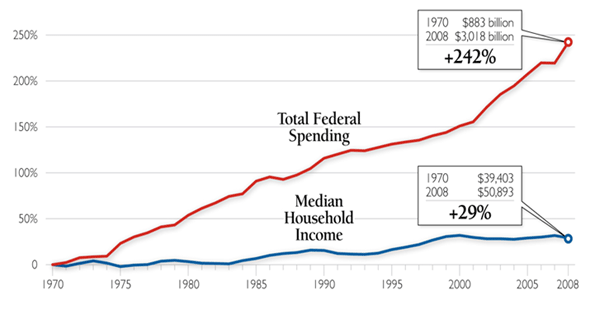
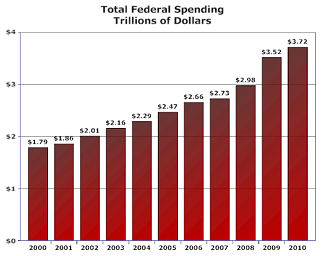
    Like a majority of Americans, Tea Parties are alarmed that government spends too much (Chart from Heritage Foundation) and does so with borrowed money. They understand that our children and grandchildren will be forced to pay for today’s reckless spending. As a result they have gone to the polls in record numbers to make their voice heard. They want the spending to stop and if the politicians do not listen, they will throw them out as their forefathers displaced King George. It does not appear that the politicians are listening. Despite the boisterous town hall meetings of 2009 and a string of primary upsets in 2010, politicians discount the public sentiment. Democratic Congressman Tom Perriello of Virginia recently said, “If you don’t tie our hands, we’ll keep stealing.”


    Source: Heritage Foundation

    What kind of America does the Tea Party want?

    The Tea Partiers have watched the federal budget double under Bush and Obama at a time hen they have had to cut back on their own family expenditures. (Chart from the Cato Institute) They want a smaller, less intrusive government and most importantly, a government that lives within its means. The Tea Party wants an end to trillion dollar deficits. Where the two political parties accept trillion dollar deficits, The Tea Party demands draconian change in our system of governance. They recognize the need for the coming Great Deconstruction.

    The Cato Institute has offered a website dedicated to downsizing the federal government. Cato outlines clear and concise methods to reduce spending and deconstruct the various departments of government as the Tea Party is demanding. Cato’s author, Chris Edwards, envisions the elimination of entire branches of the federal government by “devolving” various programs to the states.

    The annual savings proposed by the Cato Institute study total more than $400 billion per year. Some call the recommendations draconian and outrageous. Yet the savings represent just 11% of current spending – a critical way to adjust to the new realities of the deconstruction.

    The Second American Revolution may have begun. If it is so, and America earns its independence from trillion dollar budget deficits and professional politicians, the future of America may look very much like Cato study has proposed. No matter what the outcome of the elections in November of 2010, the future will look very different than today as the Great Deconstruction comes to pass.

    ***************************

    Robert J Cristiano PhD is the Real Estate Professional in Residence at Chapman University in Orange, CA and Head of Real Estate for the international investment firm, L88 Investments LLC. He has been a successful real estate developer in Newport Beach California for twenty-nine years.

    Other works in The Great Deconstruction series for New Geography

    Other works in The Great Deconstruction series for New Geography
    Deconstruction: The Fate of America? – March 2010
    The Great Deconstruction – First in a New Series – April 11, 2010
    An Awakening: The Beginning of the Great Deconstruction – June 12, 2010
    The Great Deconstruction :An American History Post 2010 – June 1, 2010
    A Tsunami Approaches – Beginning of the Great Deconstruction – August 2010

  • Political Decisions Matter in State Economic Performance

    California has pending legislation, AB 2529, to require an economic impact analysis of proposed new regulation. Its opponents correctly point out that AB 2529 will delay and increase the cost of new regulation. There will be lawsuits and arguments over the proper methodology and over assumptions. It is not easy to complete a thorough and unbiased economic impact analysis.

    Should California incur the costs and delays of economic impact studies?

    California should, because political decisions matter and too many California politicians don’t believe it. I’ve had a State Legislator, sitting in her office in the Capital, tell me in essence that decisions made in this building won’t impact California’s economy.

    She’s not alone. It is common to hear politicians or their advisors claim that “California will come back” or something similar. They believe that California’s climate and abundant amenities are enough to guarantee prosperity. They are wrong.

    Consider North Dakota, and its booming economy. As of July 2010, North Dakota’s unemployment rate was 3.6 percent, and in 2008, the most recent year for which we have data, its economy grew at a 7.3 percent rate. California’s unemployment rate was 12.3 percent in July 2010, and its 2008 economic growth rate was an anemic 0.4 percent.

    That’s a very big difference. If California had North Dakota’s unemployment rate, it would have over 1.3 million jobs than it has today. That is almost the entire population of Sacramento County and 30 percent more than the entire population of Northern California’s Contra Costa County.

    Why the big difference? Why is North Dakota booming, as the United States suffers its most devastating economic decline in over 70 years? Why is California’s economy, with almost 30 percent higher unemployment than the United States, performing so poorly?

    Does North Dakota have some naturally endowed advantage over California? If so, nobody has noticed it before. It is not climate. California has a friendly Mediterranean climate, while North Dakota has a Northern Continental climate. North Dakota’s mean minimum temperature is below freezing six months of the year, and it gets as low as -60F! Many Californians, living on the coast, can go decades without witnessing a freezing temperature. I remember when we had a multi-day freeze in my hometown of Ventura, sometime in the 1980s. I was freezing; a North Dakotan would be walking around in a t-shirt.

    California has oil and gas. North Dakota has oil and gas. California has over 2,000 miles of beaches. North Dakota doesn’t have beaches. California has magnificent mountains. North Dakota doesn’t have any mountains and only a few hilly areas. Over 20 species of trees reach their largest size in California. Most of North Dakota doesn’t naturally grow many trees.

    Let’s face it. Most Californian’s consider North Dakota to be a cold, windy, God-forsaken piece of dirt best left to the bison. North Dakota’s natural endowment doesn’t explain why it has been growing with vigor while California has been stagnating.

    Maybe North Dakota has been lucky while California has been unlucky? Luck can play a part in economic performance, and North Dakota has almost surely been luckier than California over the past few years, but that can’t be the only explanation.

    It’s hard to point to a single source of North Dakota’s prosperity. Its taxes aren’t particularly low. It has a reasonable safety net for the unfortunate. It does have a booming oil and gas business. Its agriculture sector is doing well. It has a small, but dynamic, tech sector. Its universities remain well funded since the state is actually running surpluses. It has a hardworking, well educated, Midwestern population. Governments and politicians in both parties tend to be business friendly, willing to support business and enter into occasional partnerships. North Dakotans have done lots of things right, and they’ve probably also been a bit lucky.

    It’s just as hard to point to a single source of California’s dismal performance. California hasn’t maximized the economic potential of its oil and gas resources, but its economy is large, and oil and gas alone can’t explain the differences between California and North Dakota. California hasn’t updated its ports to accommodate the most recent and planned ships, but those ports see lots of activity. Many California communities are not business friendly, but some are, particularly some smaller ones inland. California has lost some military bases, but many remain. California is a relatively expensive place to do business, because of taxes and regulation, but California’s workers are more productive, even after adjustment for industrial composition and capital, and California’s consumers still constitute a huge market.

    California’s economy is dying the death of a thousand cuts: a tax here, a regulation there, an unfriendly city council in Coastal California, a lack of infrastructure investment everywhere. These things add up to a significant net negative for California, its businesses, and its workers.

    Californians have done lots of things wrong, and they’ve been a bit unlucky.

    That’s why AB 2529 is a good idea for California, why it’s worth the costs and delays. The analysis will require regulators to consider the economic costs of regulation, something many green activists and Sacramento politicians simply ignore. Perhaps if this regulation had been in place over the past few years, some of California’s 2.2 million unemployed workers would have jobs and once Golden State would not be on the verge of becoming, as historian Kevin Starr has noted, “a failed state”.

    Bill Watkins is a professor at California Lutheran University and runs the Center for Economic Research and Forecasting, which can be found at clucerf.org.

    Photo by Willem van Bergen

  • Why Housing Will Come Back

    Few icons of the American way of life have suffered more in recent years than  homeownership. Since the bursting of the housing bubble, there has been a steady drumbeat from the factories of futurist punditry that the notion of owning a home will, and, more importantly, should become out of reach for most Americans.

    Before jumping on this bandwagon, perhaps we would do well to understand the role that homeownership and the diffusion of property plays in a democracy. From Madison and Jefferson through Lincoln’s Homestead Act, the most enduring and radical notion of American political economy has been the diffusion of property.

    Like small farmers in the 19th century, homeowners–and equally important, aspiring homeowners–now represent the core of our economy without which a strong recovery is likely impossible.  Houses remain as a financial bulwark for a large percentage of families, the anchor of communities, and, increasingly, home-based businesses.

    The reasons given for abandoning the homeownership ideal are diverse.  Conservatives rightfully look to diminish the outsized role of government in promoting homeownership.  Some suggest  that Americans would be better off  putting their money into things like the stock market or boosting consumer purchases.

    New-urbanist intellectuals like the University of Utah’s  Chris Nelson predict  aging demographics will lead masses to abandon their homes for retiree communities and nursing homes.   The respected futurist Paul Saffo predicts that as skilled laborers move from Singapore to San Francisco to New York and London, there is little need to “own” a permanent place. In the brave new future, he suggests, we will prefer time-sharing residences  as we flit from job to job across the global economy.

    Some of the greatest hostility towards homeownership increasingly comes from the progressive left, some of whom are calling for the total elimination of the homeowner mortgage interest deduction.  “The Case Against Homeownership,” recently published in Time,  encapsulates the current establishment’s  conventional wisdom: that homeownership is by nature exclusionist, “sprawl” promoting and responsible for “America’s overuse of energy and oil.”

    Yet for all the problems facing the housing market, homeownership–not exclusively single-family houses–is not likely to fade dramatically for the foreseeable future. The most compelling reason has to do with continued public preference for single-family homes, suburbs and the notion of owning a “piece” of the American dream.   This is why that four out of every five homes built in America over the past few decades, notes urban historian Witold Rybczynski, have less to do with government policy than “with buyers’ preferences, that is, What People Want.”

    What we are going through now is not a sea change but a correction from insane government and business practices.   The rise in homeownership from 44% in 1944 to nearly 70% at the height of the bubble reflected a great social democratic achievement. But by the mid-2000s government attempts to expand ownership–eagerly embraced by Wall Street speculators–brought in buyers who would have historically been disqualified.

    In some markets, prices exploded as people moved up too quickly into ever more expensive housing. Housing inflation was further exacerbated by “smart growth” policies, which limited new home construction in suburban areas and instead promoted dense, “transit oriented” housing with limited market appeal and economic logic.

    Rather than artificially constraining supply and protecting irresponsible borrowers,   we should let nature take its course. Home values need to readjust historic balance between incomes and prices. Over the past 60 years, notes demographer Wendell Cox, it took two to three years or less of median household income to purchase a median-priced home. At the peak of the boom, that ratio had ballooned to 4.6.

    The disequilibrium was the worst in regions like Los Angeles, Las Vegas, San Bernardino-Riverside and Miami. At the peak of the bubble, between 2006 and 2008, according to the National Homebuilders Association- Wells Fargo “Housing Opportunity Index,” barely 2% of families with a median income households in Los Angeles could afford to buy a median priced home; even in the traditionally affordable Riverside area, the number was roughly 7%. In Miami, barely 10% could afford such a purchase; in Las Vegas, often seen as one of the cheaper markets, only 15%.

    What a difference a market correction makes. The affordability number for Los Angeles is now 34%, 17 times better than two years ago, while Riverside is now near 70%. Miami’s affordability picture has improved to over 60% while in Las Vegas, it’s back over 80%.

    These lower prices–not Wall Street or federal gimmickry–will lure new buyers to the places that some new urbanists   have predicted will be “the next slums.” Already there’s evidence in places like Miami of a renewed interest in now-affordable suburban single-family homes while condos stay empty  or become rentals.

    Of course without a return to robust job growth, particularly in the private sector, the home market– and pretty much all mainstream consumer purchases–will remain weak. No matter how low prices get, people worried about losing employment do not constitute a promising new market for homes.

    But over the longer run most Americans will seek to purchase homes –whatever the geography. Increasingly this will be less a casino gamble, and more  a long-term lifestyle choice.  As America adds upwards of 100 million more Americans by 2050, the demand will stare us in the face.

    As boomers age, the two big groups that will drive housing will be the young Millenial generation born after 1983 as well as immigrants and their offspring. Sixty million strong, the millenials are just now entering their late 20s. They are just beginning to start hunting for houses and places to establish roots. Generational chroniclers  Morley Winograd and Mike Hais, describe millenials in their surveys as family-oriented young people who value homeownership even more than their boomer parents. They also are somewhat more likely to choose suburbia as their “ideal place to live” than the previous generation.

    These tendencies are even more marked among immigrants and their children. Already a majority of immigrants live in suburbia, up from 40% in the 1970s. They are attracted in many cases by both jobs and the opportunity to buy a single-family home. For an immigrant from Mumbai, Hong Kong or Mexico City, the “American dream” is rarely living in high density surrounded by concrete; if they wanted that, they could have stayed home.

    Over coming generations, changes in family and work life will make single-family homes, townhouses and other moderate-to-low density housing more attractive.  Contrary to the anonymity predicted by most futurists, your chosen place is becoming more important, as evidenced by numerous suburban and small town downtown revivals as well as growing local volunteerism.

    Equally important, multi-generational households are on the rise back to 1950s levels–in part due to immigrant lifestyle preferences. People are staying put; even before the bubble burst, mobility had dropped to the lowest level in over a half century. With the rise of new technologies allowing for dispersed work, the single family home increasingly houses not only residents, but part and full-time offices.

    Barring a long-term permanent recession or a national planning regime aimed at curbing single-family home construction, these factors should lead to a new surge in home buying starting later this decade. It may be too late to save many who overextended themselves in the bubble, but this resurgence could do much to propel our anemic economy, restoring the home to its rightful place one of the cornerstone not only of the American dream, but of our democracy.

    This article originally appeared at Forbes.com.

    Joel Kotkin is executive editor of NewGeography.com and is a distinguished presidential fellow in urban futures at Chapman University. He is author of The City: A Global History. His newest book is The Next Hundred Million: America in 2050, released in February, 2010.

    Photo by Wootang01

  • Unmanageable Jakarta Soon To Lose National Capital?

    Jakarta is the world’s third largest urban area with 22 million people (Note 1) and the second largest metropolitan area with 26.6 million people (Note 2). Jakarta is the capital of the world’s fourth most populous country, the Republic of Indonesia, which has 240 million people (following China, India and the United States). Jakarta is located on the island of Java, which covers slightly more land area than the state of New York and has 8 times the people (135 million). There is probably no smaller piece of real estate in the world that houses so many people.

    A Unique Metropolitan Name: Jakarta is the only megacity (urban area with more than 10 million people) in the world that has adopted a new name for its urban and metropolitan area: Jabotabek, which combines the beginning letters of Jakarta and the suburban jurisdictions of Bogor, Tangerang and Bekasi.

    Jabotabek is also one of the world’s fastest growing urban areas and the prospects are for even stronger growth. The United Nations expects Indonesia to add 90 million people to its urban areas over the next 40 years. If Jabotabek gets its present share of Indonesian urbanization, its population would double.

    Jabotabek’s Unmanageable Problems: For already crowded Jabotabek and its even more crowded core of Jakarta, this is bad news. Jabotabek covers nearly the same land area as Paris (more than 1,000 square miles), but has more than twice the population. And unlike Paris, with its well-planned streets and multi-story buildings, much of Jabotek is made up of low-slung, terribly crowded makeshift slums.

    Jabotabek may have the most intense traffic congestion in the world. One report says road speeds average little more than 5 miles per hour. The government has plans to expand the freeway system, which is already extensive for a developing world megacity. But, Jabotabek’s density is already far above the critical mass of dispersion required for automobiles to serve efficiently, especially in the longer run. Automobile ownership is reportedly rising as much as 15% annually.

    Of course, every public official’s answer seems to be transit. Sadly, Jabotabek has anything but a transit friendly urban form, despite its high population density. Jabotabek may be the ultimate, dispersed Asian urban area, with little of a commercial core (though larger Delhi has even less) and even that is spread out. There’s no concentration of buildings, for example, as dense as downtown San Diego. Thus, building the kind of hub and spoke transit system that could effectively serve a dense commercial core makes no sense since economic activity is already so dispersed.

    Exclusive busways have been built. But the construction of two monorails has been suspended and there are plans to build a metro (subway). Given Jabotabek’s commercial dispersion, nothing short of an 800 meter rapid transit grid could possibly make a difference. This would bring everyone within the international transit standard of 400 meters, which given Jakarta’s dispersion is the only way a rapid transit system would work.

    That would cost far more than all of the personal income in the area each year in capital and operating expense. Jabotabek falls short of the critical mass needed in a commercial or even a residential core to make transit a viable solution.

    Thus, Jabotabek sits in the broad no-man’s land ill suited for transit and too dense for cars. However, in Jabotabek, as in Mumbai and Bangkok, having the choice between a transit system that cannot get you where you need to go and being stuck in traffic, people opt for the traffic as soon as they can afford it.

    There are other massive problems. Jakarta city is on a lowland on the Java Sea and has severe drainage and flooding problems. Rising sea levels could make things even worse. Urban planner Yayat Supriyatna says that the present core of Jakarta should halve its present population of over 9 million.

    Move the Capital? The nation’s leaders think they have an answer: move the capital. President Susilo Bambang Yudhoyono has called upon the government to prepare a study of the options. The entire national government could be moved completely out of Jakarta, or most of the government functions could be moved to another part of Jabotabek. Traffic is high on the list of ills that the President justifiably cites.

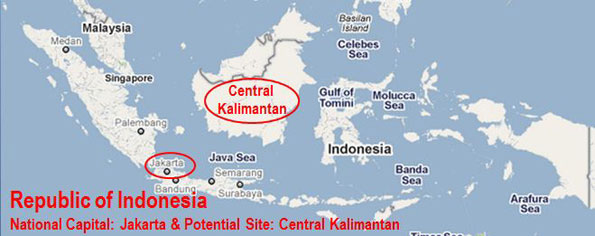
    Others, such as Siti Zuhro of the Indonesian Institute of Sciences are concerned that the capital needs to be moved away from Jabotabek altogether, to escape its problems. Speaker of the House of Representatives Marzuki Alie has suggested moving the capital to Central Kalimantan province, on the island of Borneo (Figure 1). This location has the advantage of being centrally located geographically to the nation. It is also conveniently accessible to komodo dragons, but far away from the population center of Java. A 1.5 hour flight would be required, or a far longer ferry ride. Neither travel option seems likely to facilitate the effective operation of democratic institutions in a low income nation.

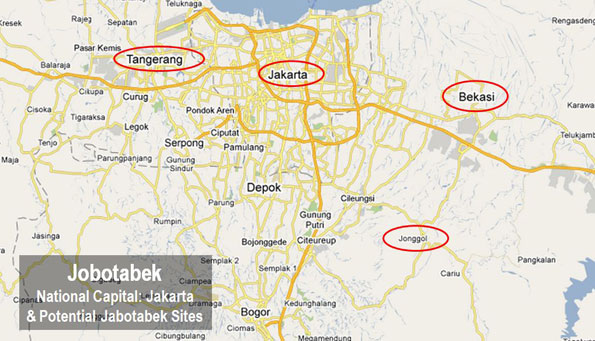
    The president has expressed doubts about moving the capital to Borneo. He has suggested locations within Jabotabek, such as to Jonggol, which is 30 miles southeast of Jakarta city in Bogor regency. Indeed, fifteen years ago, planning was well along for moving the capital to Jonggol, That move was cancelled because of the east Asian financial crisis in the late 1990s. Others have mentioned moving the capital the adjacent suburbs of Bekasi or Tangerang (Figure 2), the latter of which has the advantage proximity to Sukarno-Hatta International Airport (one of the most modern in the world).

    Learning From Others? There are no easy answers, and the record of national capital relocations provides little guidance.

    Brazil moved its capital to Brasilia in 1960 to honor a 70 year old provision for internal development in its constitution. Since that time, former capital Rio de Janeiro has nearly tripled in population and spread to occupy the flats beyond the mountains that used to constrain it. Pakistan’s relocated capital at Islamabad has considerable advantages over former capital and megacity Karachi. Yet, Karachi has added more than 10 million people since the government moved. National capitals can be moved from megacities, but that may not slow down megacity growth. Moreover, given Jabotabek’s dominance (6 times as large as second ranked Bandung), it seems inconceivable that the commercial heart of the nation would move or that rural migrants would stream into smaller urban areas, where incomes seem likely to remain lower.

    Some have suggested copying the Malaysian model of government offices to the suburbs (like Jabotabek’s Jonggol). However, Putrajaya was quickly engulfed by the urbanization of Kuala Lumpur. Strategies that might work on the urban fringe of a much smaller, slower growing, more affluent and more manageable urban area of 6 million people (Kuala Lumpur) may not be appropriate for an urban area adding the equivalent of a Kuala Lumpur every decade. Given Jabotabek’s explosive growth, any new government center would be quickly surrounded and many of Jakarta city’s problems would be replicated.

    Jabotabek: The Dimensions of Expansion: Jabotabek continues to grow and is on course to become the world’s largest urban area and metropolitan area by 2030.

    Meanwhile, Jabotabek is not only expanding its population and land area, it’s adding to its name. Many now refer to it as Jabodetabek, adding extra letters for the suburb of Depok. Recently, a new city was carved out of Tangerang regency, South Tangerang. Jabotabek’s continuous urbanization has now stretched eastward into Karawang regency.

    Jabotabek the unmanageable could become Jabodetasokabek the unpronounceable.

    —–

    Note 1: The most recent edition (July 2010) of Demographia World Urban Areas and Population Projections lists Jakarta as the second largest urban area in the world (July 2010). New United Nations data now shows Delhi to have risen above Jakarta, with a population of more than 22,100,000. The Jabotabek urban area (like the Manila urban area) is routinely shown by international sources to have a far smaller population, however such estimates exclude huge populations in continuous urbanization in suburban jurisdictions.

    Note 2: While there are no international metropolitan area standards, it is generally agreed that the Jabotabek metropolitan area is second in size only to the Tokyo metropolitan area. If Karawang Regency is included (into which Jabotabek’s continuous urbanization stretches), Jabotabek’s metropolitan population in 2010 rises to 28.7 million, approximately 50% more than that of New York. Metropolitan areas and urban areas are often confused. Unlike urban areas, metropolitan areas include rural areas from which people commute into the urban area for employment, while urban areas are limited to the continuous urbanization (development) within metropolitan areas. See Urban Terms Defined.

    —–

    Wendell Cox is a Visiting Professor, Conservatoire National des Arts et Metiers, Paris and the author of “War on the Dream: How Anti-Sprawl Policy Threatens the Quality of Life

    Photograph: Jakarta (photograph by author)

  • Urban Plight: Vanishing Upward Mobility

    Since the beginnings of civilization, cities have been crucibles of progress both for societies and individuals. A great city, wrote Rene Descartes in the seventeenth century, represented “an inventory of the possible,” a place where people could create their own futures and lift up their families.

    What characterized great cities such as Amsterdam—and, later, places such as London, New York , Chicago, and Tokyo—was the size of their property-owning middle class. This was a class whose roots, for the most part, lay in the peasantry or artisan class, and later among industrial workers. Their ascension into the ranks of the bourgeoisie, petit or haute, epitomized the opportunities for social advancement created uniquely by cities.

    In the twenty-first century—the first in which the majority of people will live in cities—this unique link between urbanism and upward mobility is under threat. Urban boosters still maintain that big cities remain unique centers for social uplift, but evidence suggests this is increasingly no longer the case.

    This process reflects a shift in economic and social realities over the past few decades. For example, according to a recent Brookings Institution study, New York and Los Angeles have, among all U.S. cities, the smallest share of middle-income neighborhoods. In 1980, Manhattan ranked 17th among the nation’s counties for social inequality; by 2007 it ranked first, with the top fifth earning 52 times that of the lowest fifth, a disparity roughly comparable to that of Namibia.

    President Obama’s hometown of Chicago shows much the same pattern, according to a recent survey by Crain’s Chicago Business. Conditions have improved for a relative handful of neighborhoods close to the highly globalized central businesses. But for many neighborhoods things have not improved, and in some cases have deteriorated. Even before the recession there were fewer jobs than in 1989 and fewer opportunities for the middle class, many of whom—including more than 100,000 African-Americans—have left the city over the past decade.

    This pattern does not reflect perverse conditions unique to the United States, as many academics and progressive pundits often suggest. Between 1970 and 2001, the percentage of middle-income neighborhoods in Toronto dropped from two-thirds to one-third, while poor districts had more than doubled to 41 percent. According to the University of Toronto, by 2020, middle-class neighborhoods could account for barely less than 10 percent of the population, with the balance made up of both affluent and poor residents.

    Similarly, Tokyo, once widely seen as an exemplar of egalitarianism, is transforming. The city’s post–World War II boom yielded a thriving middle class and remarkable social mobility. That is now giving way to a society where wealth is increasingly concentrated. The poverty rate, including some 15,000 homeless people, has risen steadily to the highest level in decades.

    Much the same process can be seen in great social democratic havens of Europe. In Berlin, Germany’s largest city, unemployment has remained far higher than the national average, with rates at around 15 percent. Some 36 percent of children are poor; many of them are from other countries. The city, notes one left-wing activist, has emerged as “the capital of poverty and the working poor in Germany.”

    To a large extent, urban poverty in Berlin and other European megacities is concentrated among Muslim immigrants. Muslims constitute at least 25 percent of the population of Marseilles and Rotterdam, 20 percent of Malmo, 15 percent of Birmingham, and 10 percent or more of London, Paris, and Copenhagen. Over the next few decades, according to a recent Pew Research Center study, Muslims will constitute a majority of the population in several of these European cities.

    The Case of London

    Perhaps nowhere is the growing class divide more evident than in London, perhaps the world’s most important megacity. Despite a massive expansion of Britain’s huge welfare state, the ladder for upward mobility seems broken, especially in London. This represents a dramatic shift from the period after World War II. In the ensuing decades, incomes for most Londoners grew, access to education expanded, and the sharply drawn and notorious class lines began to blur.

    But contemporary London’s emergence as the headquarters of globalization has had widely differentiated impacts on class. On the one hand, it has paced the emergence of the West End. Many once hardscrabble neighborhoods—including Shoreditch, Islington, and Putney—have gentrified. Yet walk a bare half mile or less from the Thames River, particularly to the south, and you encounter many marginal, and often dismal, districts. These areas have not much benefited from the global economy and are inhabited largely by those who survive at the expanding bottom of the wage profile.

    Equally troubling, globalization’s benefits have disproportionately accrued to those already possessing considerable means; the ranks of top professionals, according to a 2009 report by the British government’s social mobility task force, have been increasingly dominated by the children of the wealthiest families.

    Even less noted has been London’s deepening concentration of poverty. Today more than one-third of the children in inner London are living in poverty, as are one in five in the outer ring communities. London has the highest incidence of child poverty in Great Britain, even more than the beleaguered Northeast.

    Poverty also affects 30 percent of working-age adults, more than one-third of pensioners in inner London, and roughly one in five in outer London. The inner London rates are the worst in Britain. More than 1 million Londoners were on public support in 2002. These figures are certain to become worse as a result of the recession that began in 2008.

    The conditions are certainly not as extreme as those recorded in Friedrich Engels’s searing 1844 tome, The Condition of the Working Class in England, but there remains a macabre relationship between mortality and geography. Steve Norris, a former Conservative Party chairman and onetime head of London Transport, notes that public health data published by the King’s Fund demonstrates that life expectancy in the poorer parts of east London is 4.5 years lower than in West London. That’s six months for every station east of Waterloo on the Jubilee Line. This poverty, Norris adds, extends to many white Londoners. They often live cheek to jowl with immigrants, and feel themselves competing for housing, jobs, and government services. The rich, Norris adds, “Buy their way out of poor quality education and healthcare” while the working and middle classes “queue for public housing for themselves and their children.”

    Of note is the rise of the phenomena among the white working class described as “yobbism.” Large parts of Britain—including less fashionable corners of London—suffer among the highest rates of alcohol consumption in the advanced industrial world. London School of Economics scholar Dick Hobbs, who grew up in a hardscrabble section of east London, traces this largely to the decline of the blue-collar economy in London. Over the past decade, job gains in Britain, like those in the United States, have been concentrated at the top and bottom of the wage profile. The growth in real earnings for blue-collar professions—in industry, warehousing, and construction—generally has lagged those of white-collar workers.

    One other thing is clear: the welfare state has not reversed the growing class divide. Despite its proletarian roots, New Labour, as London Mayor Boris Johnson acidly notes, has presided over what has become the most socially immobile society in Europe.

    The Role of Housing and ‘the Green Factor’

    Housing costs have exacerbated these conditions. Due largely to restrictions on new housing on the periphery, London now ranks, next to Vancouver, as the most expensive city to buy a house in the English-speaking world. Estimates by the Centre for Social Justice finds that unaffordability for first-time buyers doubled between 1997 and 2007. This has led to a surge in waiting lists for government-funded “social housing”; by mid-2008, some 2 million households (5 million people) were on the waiting list for such housing. In London, this number reached one in ten in 2008.

    Broad-based economic growth might seem the most logical solution to this dilemma. In the past, socialists, liberals, and conservatives might vigorously have debated various approaches, but generally agreed about the desired end result: shrinking slums and expanding opportunity for the middle or working class. Today, however, many urban “progressives” do not trouble themselves overmuch about the hoi polloi. Instead, they are more likely to devise policies to lure the much-ballyhooed “creative class” of well-educated, often childless, high-end workers to their cities. This goes along as well with an increased focus on aesthetic and “green” issues.

    In many ways, these approaches actually work at cross-purposes with upward mobility. Green-oriented policies are often hostile to “carbon intensive” industries such as manufacturing, warehousing, or construction that employ middle-income workers. Green policies implicitly tilt towards industries such as media, entertainment, and finance that employ the best-situated social classes.

    Indeed, some climate change enthusiasts, such as The Guardian’s George Monbiot, see their cause in quasi-religious terms. In Monbiot’s words, he is waging “a battle to redefine humanity.” In his view, we must terminate the economic “age of heroism,” supplanting the “expanders” with anti-growth “restrainers.”

    This is not just the latest edition of British “loony Left” thinking. President Obama’s own science advisor, John Holdren, long has embraced the notion of what he calls “de-development” of Western economies to a lower level of affluence. Such approaches impose enormous costs on both the middle and working classes in European and North American cities, particularly given the unlikelihood of similar restrictions on competitors in China, India, Russia, and other countries. A huge shift to renewable fuels, for example, could quadruple the cost of energy in Britain, forcing a large percentage of the population into “fuel poverty.”

    Key Focus: Economic Growth

    The emerging class conflict in the great global cities ultimately could have many ill effects. Persistently high unemployment and underemployment in British metropolitan areas, for example, has spurred nativist sentiment and intolerance towards immigrants. This is true in America today as well. But views towards immigrants generally soften as an economy improves. Broad-based prosperity is a good antidote for intolerance.

    Attacking the class gap requires a redefinition of current views about the overused term “sustainability.” This concept needs to be expanded beyond its conventional environmental definition to reflect broader social and economic values as well. It is one thing to consider how, in an era dominated by dispersed work, core cities might still attract those elite workers needing direct “face-to-face contact.” It is quite another to develop strategies so that the vast majority will be able to find work doing anything other than servicing the needs of the upper echelons.

    In turning away from the fundamental issues of economic growth and upward mobility, these cities are in danger of permanently undermining the very thing that has made great cities so attractive over the centuries. The ultimate worth of urbanity lies in its ability to deliver a better life, not only to the established affluent and the most skilled, but to that broader population who, like others over the millennia, come to a big city to create a better life.

    This article originally appeared at The American.

    Joel Kotkin is executive editor of NewGeography.com and is a distinguished presidential fellow in urban futures at Chapman University. He is author of The City: A Global History. His newest book is The Next Hundred Million: America in 2050, released in February, 2010.

    Photo by ecstaticist

  • Fortress Australia: Groundhog Day

    A decade ago, politics in Australia lurched to embrace all things rural, happily demonizing urban interests. This happened in response to a renegade Politician – Pauline Hanson – who for a time captured public sympathy with populist anti-immigration sentiments, threatening to unseat entire governments in the process.

    Now the result of the recent National Election in Australia has seen not only the return of anti immigration sentiments, but the ascendency of anti-growth statements in mainstream politics. For a large country with only 24 million people, it’s a dangerous development.

    Two things are shaping in the aftermath of the 2010 Federal Election as portents of things to come for our economic future. One is the rise of an increasingly orthodox view that Australia at 24 million people is reaching its maximum sustainable population. The second is toward appeasing the agrarian socialism and social conservatism of rural politics. Together, this could mean we are about to usher in an era of low growth, high protection policies. Fortress Australia could easily become a reality no matter which side ultimately claims the keys to the Government benches.

    Prior to the recent Federal Election (August 2010) both major political parties have become shy of the country’s long term population growth patterns. In September 2009, Federal Treasurer Wayne Swan released some early findings of the Intergenerational Report, which predicted Australia could reach 35 million by 2050. Although this rate of growth was pretty much the same as the preceding 40 years, the figure was greeted with alarm by media, the community, and much of the political herd. ‘Australia Explodes’ went the headlines and the lemmings followed over an ideological cliff. (See this blog post from a year ago).

    A month later, then Prime Minister Kevin Rudd was proclaiming that he believed in ‘a big Australia’ but by mid 2010 his later nemesis Deputy Prime Minister Julia Gillard was proclaiming she ‘did not believe in a big Australia.’ Gillard replaced Rudd in a Labor Party coup, and then as Prime Minister declared we shouldn’t ‘hurtle’ toward 36 million but instead plan for a ‘sustainable’ population, renaming the recently created portfolio of ‘Population Minister’ the ‘Sustainable Population Minister’ in the process. The word ‘sustainable’ in this context stands for ‘slow down or stop.’

    Then came the election campaign with Opposition Leader Tony Abbot promising to ‘slash’ the ‘unsustainable’ immigration numbers (that his mentor John Howard had been responsible for as conservative Prime Minister for over a decade) and to ‘turn back the boats’ of illegal immigrants and asylum seekers, mainly from south east Asia or Afghanistan. Population growth was to be cut to 1.4% (a long term trend anyway) and migrants potentially forced to settle in rural areas (some dodgy form of zipcode migration policy).

    The message from both political leaders was clear: support for a ‘big Australia’ (35 million population by 2050 or the same rate of growth we’d seen in the last 40 years) was gone.

    Add to that the quixotic Australian entrepreneur Dick Smith and his population TV documentary ‘The Population Puzzle’ where he alleged Australia was at risk of running out of food, out of space and out of control, comparing us (oddly) with places like tiny Bangladesh (population 160 million). Smith might be mad but you can’t discount the impact he has on Australian popular opinion. People believe him, politicians included.

    Could it get any worse for the prospects of maintaining even modest levels of population growth in Australia? The last election outcome means the answer is yes. The balance of power in the Senate of the Australian Parliament will now be controlled by ‘The Greens’ (a left wing environmental party). The Greens’ view on population growth is clear: they don’t support it (unless oddly if you’ve arrived illegally, by boat). “This population boom is not economic wisdom, it is a recipe for planetary exhaustion and great human tragedy” said Greens leader Bob Brown when the Intergenerational Report was released last year.

    In the House of Representatives, the balance of power is now held by a handful of independents, representing rural seats. Socially conservative but economically protectionist, the independents’ views on population suggest they would lean toward the Abbot view: turn back the boats, and slow the overall rate of growth. They are quite likely to also push for a redistribution of economic riches to a range of projects for rural and regional areas. The irony that the election result hinged on big swings in urban seats but that a handful of rural independents are now trying to call the shots shouldn’t be lost on anyone.

    Joining the growing chorus of slow or no growth chants is municipal government. The Local Government Association of Queensland’s annual conference this year talked of limits on population growth unless bountiful riches are showered on local governments to cope with ‘unsustainable’ rates of growth. Association President Paul Bell says “councils cannot let population growth exceed infrastructure needs.”

    “Where we find water supplies no longer match the size of the community, where we find roads are congested, where we’re seeing other infrastructure whether it be health or education are falling behind,” he said, population growth was by implication to blame.

    The bottom line? Population growth is now a dirty word in politics and for any business which relies on growth for its prosperity, this is not good news. Everything from airports to property to construction to farming to retailers, manufacturers and tourism will be affected by slowing growth.

    Even social services could suffer if growth is deliberately slowed. Why? Because in 50 years time, without migration or natural growth, the ageing bubble of post-war baby boomers may mean there are two working adults for every five retired. You wouldn’t want to be one of those two and paying their tax bill in 50 years’ time or dependent on the kindness of those workers.

    How has this come about? The answer is simple: growth itself has never been the problem. Instead, it’s been a notoriously inefficient planning approach which has misdirected precious infrastructure spending, pushed up housing prices through artificial restraint on supply combined with usurious upfront levies, which now average $50,000 per dwelling in Queensland (often more) and considerably more in NSW.

    In the last decade, can anyone honestly claim that our planning schemes are now more efficient and quicker, or more easily understood, or better targeted, than a decade ago? I doubt it.

    Would it be too much to ask for a sensible, evidence-based approach that ties population growth to urban and regional strategies, which emphasises economic progress while maintaining lifestyle and environmental standards? How about some decent plans to link regional urban centres to major cities, based not on pork barrels to influential independents but based only on the business case and community mutual benefit? Or how about putting the ‘growth’ back into smart growth, with policies that allow our urban areas to expand in line with demand matched to infrastructure spending, rather than policy dogma?

    Those same questions were being asked a decade ago. Welcome to ground hog day.

    For those interested, here’s a couple of yarns from 10 years ago:
    Slicker Cities for City Slickers. October 1999.
    Nation Building and a National Urban Strategy. May 2001.

    Ross Elliott has more than 20 years experience in property and public policy. His past roles have included stints in urban economics, national and state roles with the Property Council, and in destination marketing. He has written extensively on a range of public policy issues centering around urban issues, and continues to maintain his recreational interest in public policy through ongoing contributions such as this or via his monthly blog The Pulse.

    Photo by Linh_rOm

  • Mayor Daley Calls it Quits

    Chicago’s Mayor Daley has decided to end his political career. Chicago’s Mayor since 1989, in December he will break his father’s record as Chicago’s longest serving Chief Executive. No one knows the real reason Daley chose to hang it up, whether it’s his wife’s health or his low polling numbers. Long time Chicago Sun-Times reporter Fran Spielman summarizes Daley’s current troubles:

    Chicago’s stunning first-round knock-out in the Olympic sweepstakes, political fall-out from his nephew’s pension fund deals and a budget crisis that forced him to deplete the city’s long-term reserves and demand furlough days and other cost-cutting concessions from city employees.

    Chicago is facing more of the same — and another painful round of service cuts — to erase a record $654.7 million shortfall in 2010.

    The city’s bond rating was dropped. Its homicide rate is on the rise, including the murder of three Chicago Police officers in recent months.

    More voters were increasingly viewing Chicago as a city that doesn’t work. Being known as a “union” town isn’t an asset in a competitive, global economy. Who will confront Chicago’s problems as the next Mayor?

    Several people are interested in being Chicago’s next Mayor. The most noteworthy is Obama’s Chief of Staff Rahm Emanuel. Whether Emanuel will leave the White House before the November election to start a campaign for February is anyone’s guess. Would President Obama get involved in local Chicago politics to endorse Emanuel?

    Emanuel will face scrutiny over his tenure as a board member of the failed GSE Freddie Mac. What exactly did Rahm Emanuel know about corrupt accounting there? But, Emanuel has other problems. Whether Emanuel can overcome hostility from the African-American and Hispanic community over comments made about issuing drivers licenses to high school dropouts is another issue. Both communities will look to run a candidate in February’s election.

    Then there’s the problem Chicago may be reluctant to elect a Jewish Mayor. As Alderman Burke told Professor Milton Rakove’s in an interview:

    “There is a latent anti-Semitism in Chicago and a large population that will never vote for a Jew. They would vote for anybody before a Jew.”

    Whoever decides to run for Mayor will have to have the backing of powerful Alderman Ed Burke, who is Chairman of the Finance Committee. With $6 million in his campaign fund, Alderman Burke will be the kingmaker behind the scenes. After all, the business community “feels” it is good business to be on the good side of Alderman Burke. Chicago Sun-Times reporter Fran Spielman asked Alderman Burke if he would run:

    “Stay tuned,’’ he said, laughing. “It would be one of the farthest things from my mind. [But] in Chicago politics, people never close the door.”

    It’s not likely Alderman Burke is going to give up his lucrative legal business to take a pay cut as Chicago’s Mayor. Alderman Burke was handing out the money before Mayor Daley was elected and he will continue in that role no matter who is Chicago’s next Mayor.

    The “Chicago Way” is likely to continue whoever is the next Mayor.