Category: Politics

  • L.A.’s Economy Is Not Dead Yet

    “This is the city,” ran the famous introduction to the popular crime drama Dragnet. “Los Angeles, Calif. I work here.” Of course, unlike Det. Sgt. Joe Friday, who spoke those words every episode, I am not a cop, but Los Angeles has been my home for over 35 years.

    To Sgt. Friday, L.A. was a place full of opportunities to solve crimes, but for me Los Angeles has been an ideal barometer for the city of the future. For the better part of the last century, Los Angeles has been, as one architect once put it, “the original in the Xerox machine.” It largely invented the blueprint of the modern American city: the car-oriented suburban way of life, the multi-polar metropolis around a largely unremarkable downtown, the sprawling jumble of ethnic and cultural enclaves of a Latin- and Asian-flavored mestizo society.

    Yet right now even the most passionate Angeleno struggles to feel optimistic. A once powerful business culture is sputtering. The recent announcement of Northrop Corp.’s departure to suburban Washington was just the latest blow to the region’s aerospace industry, long our technological crown jewel. The area now has one-fourth as many Fortune 500 companies as Houston, and fewer than much-smaller Minneapolis or Charlotte, N.C.

    Other traditional linchpins are unraveling. The once thriving garment industry continues to shift jobs overseas and has lost much of its downtown base to real estate speculators. The port, perhaps the region’s largest economic engine, has been mismanaged and now faces severe threats from competitors from the Pacific Northwest, Baja, Calif., and Houston. Although television and advertising shoots remain strong, the core motion picture shooting has been declining for years, with production being dispersed to such locations as Toronto, Louisiana, New Mexico, Michigan, New York and various locales overseas.

    Once a reliable generator of new employment, over the past decade L.A. has fared worse than any of the major Sun Belt metros–including hard-hit Phoenix–losing over 167,000 jobs between 2000 and 2009. Historic rival New York notched modest gains, while the rising big metro competitors, Dallas and Houston, enjoyed strong and steady growth. L.A. may not be Detroit, and probably never will be, but its once proud and highly diversified industrial base is eroding rapidly, losing one-fifth of all its employment since 2004. In contrast to the rest of the country, unemployment still continues to rise.

    To give you an idea how much L.A. has sunk, look to this year’s Forbes best city rankings, which measures both short- and mid-term job growth. Once perched in the upper tier of major cities, Los Angeles now ranks a pathetic 59th out of 66 large metro areas, far below not only third-place Houston and fourth-place Dallas but also New York and even similar job-losing giants like San Francisco and Philadelphia.

    It takes a kind of talent to sink this low given L.A.’s vast advantages: the best weather of any major global city, the largest port on this side of the Pacific, not to mention the glamour of Hollywood, the Lakers and one of the world’s largest and most diverse populations of creative, entrepreneurial people.

    Jose de Jesus Legaspi, a prominent local developer, pins much of the blame for this on what he describes as “a parochial political kingdom”–with Antonio Villaraigosa, mayor since 2005, wearing the tinsel crown. A sometimes charming pol utterly bereft of economic acumen, Villaraigosa is a poor manager who is also highly skilled at self-promotion. His idea of building an economy revolves around subsidizing downtown developers and pouring ever more funds into the pockets of public sector workers. No surprise then that L.A. suffers just about the highest unemployment rate of any of the nation’s 10 largest cities outside Detroit. One in five county residents receive some form of public aid.

    But the real power in L.A. today is not so much Villaraigosa but what the Los Angeles Weekly describes as a “labor-Latino political machine,” whose influence extends all the way to Sacramento. These politicians represent, to a large extent, virtual extensions of the unions, particularly the public employees.

    The rise of the Latino-labor coalition does stir some pride among Hispanics, but it has proved an economic disaster for almost everyone who doesn’t collect a government paycheck–L.A.’s city council is the nation’s highest paid–or subsidy. Although perhaps not as outrageously corrupt as the Chicago machine, it is also not as effective. L.A.’s version manages to be both thuggish and incompetent.

    According to an analysis by former Mayor Richard Riordan, the city’s soaring pension liabilities will grow by an additional $2.5 billion by 2014, by which date the city will probably be forced to declare bankruptcy.

    So is the city of the future doomed for the long term? Not necessarily. Although Latino politicians and “progressive” allies strive to derail entrepreneurialism, our grassroots remains stubbornly entrepreneurial. This is particularly true of Latino and other immigrant businesspeople in Los Angeles. In 2006, for example, roughly 10% of the foreign born population was self-employed, almost twice the percentage of the native born.

    To be sure, much of this activity takes place in smaller area municipalities–Burbank, Glendale, Lynwood, Monterey Park–that are mercifully outside the reach of the City of Los Angeles, which accounts for somewhat less than half of L.A. County’s 10 million people. But as Legaspi, who came to L.A. from Zacatecas, Mexico, in 1965, points out, ethnic enterprises–Armenian, Iranian, Israeli, Korean, Chinese as well as Mexican and Salvadoran–continue to thrive even within the city limits. You rarely find in L.A. the kind of desolation found in dying cities like Detroit or Cleveland or even large swaths of New York or Chicago.

    All this suggests there’s still hope for Los Angeles to blossom further as a hub for international trade, global culture and fashion. But to achieve that goal the city needs a government that will nurture its grassroots rather than stomp or extort them. “Los Angeles is a potential great world city, but it needs to be ruled like a world city,” Legaspi points out. Until that happens, our putative city of the future will exist more as dreamscape than reality.

    This article originally appeared in Forbes.com.

    Joel Kotkin is executive editor of NewGeography.com and is a distinguished presidential fellow in urban futures at Chapman University. He is author of The City: A Global History. His newest book is The Next Hundred Million: America in 2050, released in Febuary, 2010.

    Photo by k.landerholm

  • The Politics of Risk

    Barack Obama has reached for the mantle of a transformative presidency, aspiring to recast our national social contract in the interest of greater equality and fairness. In cooperation with a Democratic-controlled Congress, he has pursued this goal by expanding Federal authority in response to economic crises and supporting interventions into finance and banking, automobile manufacturing, health care, and environmental policy. This strategy adopts the “statist” philosophy of economic risk management by centralizing governmental authority and control over private markets.

    Ironically, this Europeanization of US public policy is occurring exactly when sovereign debt crises and taxpayer bailouts are casting an ominous cloud over the European model. It seems public sector risk may turn out to be more dangerous than private sector risk. But if we can connect recurring financial crises to the long-term erosion in the economic health of states, we should seriously question whether statism offers the best array of policies to manage the uncertainties of the modern world.

    A surplus of world savings drove people in the developed world to over-borrow, and concentrate debt and risk in overpriced housing assets. Banks then distilled these risky assets into securitized debt obligations and sold them to investors worldwide. What ensued was risk mismanagement on a colossal scale, as the concentration of leveraged debt made the crash far worse than dot-com or tulip bulb mania. This shell game violated all we know about prudent risk management and sucked in politicians, central bankers, financiers, the housing industry, and citizens alike.

    The response has been to substitute massive public credit for shrinking private credit, while seeking new means to regulate financial risk and reward. This sounds a bit too much like the dog that bit us. In terms of public policy it means more centralized political control over central banks and the financial sector, with unpredictable market distortions yielding more liabilities and burdens for taxpayers. The net result will be an increase in systemic risk exposure.

    The modern social welfare state would more accurately be labeled the social insurance state, as its spending priorities are dominated by programs related to old age pensions, health care, and the risks of unemployment and poverty. Social insurance has been the developed world’s primary political response to systemic risk. Regrettably, it may impose the least efficient means to manage risk, with the most costly consequences.

    Financial risk is managed by saving, pooling, hedging and, most important, asset diversification. The key concepts are savings and diversification, as these underpin the logic of insurance pooling. A financially sound insurance pool must align contribution and benefit ratios according to known actuarial data and demographic trends. The inconvenient truth is that our social insurance programs, like Social Security and Medicare, are not really insurance pools, but pay-as-you-go transfer schemes. We tax younger workers to immediately pay out benefits to older, retired citizens. This design inflicts a host of problems and costs.

    Pay-as-you-go means our Social Security and Medicare taxes have not been saved in a “trust” fund, rather they are doled out in benefit promises and used to fund other political priorities through general revenues. This is the problem of political and bureaucratic “agents” following their own short-term incentives. This is also how we get “too big to fail” and runaway budgets.

    Because taxes to fund entitlement transfers crowd out private savings and lead us to believe the government is saving for us, private savings decrease. This means we cannot adequately fund the economic growth necessary to fund future social insurance liabilities. The alternative has been to borrow from abroad, mostly from the Chinese. As birth rates decline and longevity increases, the “trust” funds will run out or overburden younger workers as baby boomers age.

    We can readily measure the consequences of our policy failures in societal risk management. Household savings rates in the U.S. have dropped from an average of 10% in the 1970s to less than 1% just before the financial crisis in 2008. In the immediate response to the crisis the rate jumped to 6%, but this was offset by roughly a trillion dollars in new public debt. (Estimates for China’s household savings rate range from 25-50%)

    US public debt as a percentage of GDP now fluctuates around 80%. This compares to Japan at 192%, Italy at 115%, Greece at 108%, France at 80%, and Germany at 77%. Chile, which privatized its social insurance three decades ago, services a public debt at 9% of GDP.

    Our current account deficit, which measures how much more we import than export, persists at 3% of GDP while China runs a 6% surplus. In simplest terms, the Chinese are lending us money to buy their goods.
    A recent survey by the Peter G. Peterson Foundation of US political leaders from both parties found unanimous agreement that US structural deficits due to entitlement programs would cause a financial collapse of US public finances within ten years unless the programs were reformed.

    A true national insurance program cannot be a shell game that transfers resources from one group to another. The nation must accumulate real savings to be invested to fund future needs. The danger of our current treatment of risk management through entitlements is that we are not really insuring against our risks, but merely passing them on to others. This is neither moral, nor economically viable.

    Our only chance of solving these problems must focus on managing economic risk by boosting savings and promoting the widespread diversification of assets. The increased concentration of political, economic, and financial power currently dominating the developed world is antithetical to such solutions and financial reform should not risk reinforcing a Wall Street-Washington oligarchy.

    The unfocused blame put on markets for our financial crises is disingenuous. The heavy reliance on credit and debt, the opacity of financial technology, the capture of regulatory agencies by the industries they regulate, and the volatility of asset markets are all symptoms of misguided policies. History and theory have both shown how functioning private markets are most efficient in allocating and managing diversified risk. The best financial regulation, then, is not another politicized agency, but the continued promotion of open, competitive, and transparent financial markets. The caveat for financiers is that failure and bankruptcy are essential features of free markets.

    A world defined by risk and uncertainty is like a sea full of hidden icebergs. Politicians like to reinforce social solidarity and national cohesion by claiming we are all in the same boat and must pull together. Mr. Obama seems to favor this metaphor, but, in terms of systemic risk, it also fits the Titanic analogy. A more useful metaphor is that we are all in different boats on the same sea. This can apply to countries, states, cities, markets, workplaces, and families. The multiplicity and diversity of institutional structures is a lesson conveyed by nature through biodiversity. All we need do is apply the lesson. As one Greek citizen was quoted saying about his country’s latest crisis: “It could be a chance to overhaul the whole rancid system and create a state that actually works.”

    Flickr photo: “Loaded” by Niffty

    Michael Harrington is a policy analyst who has taught political science at UCLA and conducted economic research for The Reason Foundation, The Milken Institute and the US Chamber of Commerce. His work has appeared in the Wall Street Journal, Barron’s, Business Week, the Economist, the Christian Science Monitor, the Los Angeles Times, and other publications.

  • An Awakening: The Beginning of the Great Deconstruction

    The federal debt climbed above $13 trillion this month. An easier way to define the national debt is to comprehend that we each owe more than $39,000 to the Chinese, Japanese, and Arabs of the Persian Gulf. The budget deficit will exceed $1.5 trillion this year and forty-seven states are running deficits. California has a $19 billion deficit and its legislature’s landmark response was to pass a law banning plastic bags. Our cities are in worse shape. The former mayor of Los Angeles, Richard Riordan, says that a bankruptcy by that city is inevitable. At the same time, the United States’ Congress voted themselves a 5.8% pay increase. It is no wonder why Americans are nervous.

    Americans are stressed out because of debt, according to an Associated Press-GfK poll. They are trimming their debt at the fastest rate in more than six decades, according to the Federal Reserve. The average amount owed on credit cards is $3,900, the poll said. That’s down from $5,600 last fall and $4,900 last spring. Household debt fell 1.7 percent last year to $13.5 trillion, according to the Fed. It was the first annual drop, based on records going back to 1945. As Americans get their own house in order, the approval rating for Congress has fallen to an all time low. The public will likely make them pay for their angst in November.

    The American people are about a year ahead of the politicians. The spending by Washington, Sacramento, Los Angeles, and by politicians in general, is unsustainable. The people understand that it must be changed. As Senator Tom Coburn (OK) told me last week, either we change our ways or they will be changed for us. Leaders like Senator Coburn will begin The Great Deconstruction. The nation can no longer afford the government it has created.

    The Department of Energy was created by President Carter in 1977 after an OPEC embargo caused gas lines and rationing. In 1977, America imported 33% of its oil. The DoE’s goal was to eliminate our dependence on imported oil. The DoE budget for 2010 was $26.4 billion. It employs 116,000 workers. We now import 66% of our oil. America can no longer afford such an inefficient bureaucracy. Bureaucracies like the DoE that have lost sight of their purpose must be deconstructed.

    Senator Coburn is preparing legislation to rescind $120 billion in 2010 spending by rescinding 2010 budget increases, consolidating 640 duplicative governmental agencies, returning unspent appropriations and cutting wasteful spending. A few examples:

    • Congress has a discretionary budget of $4.7 billion per year. They voted themselves a 6% increase in 2010. Coburn wants this increase rescinded for a saving of $250 million.
    • The Department of Education spends $64.2 billion per year. They spend $1 billion each year administering 207 separate programs at 13 different federal agencies to “encourage” students to take math and science.
    • The Department of Agriculture owns 57,523 buildings. More than 4,700, valued at $900 million, are vacant. Despite this vacant space they spend $193 million per year renting an additional 11 million square feet.

Our politicians have perfected the art of spending money, or as we now know, wasting money. Last year, they loaded spending bills with $11 billion of earmarks – after spending $860 billion on a Stimulus Bill. A new breed of politician, like Senator Coburn, will begin the long process of deconstruction.

There is precedent for deconstruction. In 1945, federal spending ballooned to $106 billion, $93 billion of which was for defense. The deficit jumped from $40 billion in 1938 to $253 billion in 1945. A Democrat President and a Republican Congress established the Commission on Organization of the Executive Branch of the Government in 1947. President Truman put a former Republican President, Herbert Hoover, in charge. It became known as the Hoover Commission. It created the structure of government that exists today and generated savings of $7 billion at the time. A total of 273 recommendations were presented to Congress in a series of nineteen separate reports. A 1955 study concluded that 116 of the 273 recommendations were fully implemented and that another 80 were mostly or partly implemented. By 1949, the federal budget had fallen to $40 billion.

It will come to be known as The Great Deconstruction because it must occur at every level of government. Federal spending is unsustainable. Moody’s is already speculating that we may lose our AAA rating. The states are in crisis with 46 in deficit. The press is referring the California as a “failed state” and “our Greece”. The $860 billion Stimulus Bill sent approximately 30% to the states to support their public employees. But it was a one-year fix. This year, the states are burning through their reserves and next year, they will be forced to cut services, raise taxes, or both. Connecticut, the wealthiest state on a per capita basis with personal income of $54,397 in 2009 (Department of Commerce) saw its Fitch rating lowered from AA+ to AA. Connecticut needs to borrow $956 million to close a budget gap this fiscal year and it borrowed $947.6 millionto cover last year’s deficit.

The cities are no better off with many states raiding their reserves. Many cities are exploring municipal bankruptcy, Chapter 9, as a way out of unsustainable contracts. The Great Deconstruction will take a decade or more. Like the Hoover Commission before it, this process will transform the role of government, and the image of government as it transforms the cost of the people’s business.

***************************************************

The Great Deconstruction is a series written exclusively for New Geography. Future articles will address the impact of The Great Deconstruction at the national, state, county and local levels.

Robert J. Cristiano PhD is the Real Estate Professional in Residence at Chapman University in Orange County, CA and Director of Special Projects at the Hoag Center for Real Estate & Finance. He has been a successful real estate developer in Newport Beach California for twenty-nine years.


Other works in The Great Deconstruction series for New Geography

The Great Deconstruction :An American History Post 2010 – June 1, 2010
The Great Deconstruction – First in a New Series – April 11, 2010
Deconstruction: The Fate of America? – March 2010

  • The Vote: Democracy or Disease?

    When the California polls closed on Tuesday, the most costly primary race in the state’s history—thus far—came to an end. Like many high profile races for Senator and Governor nationwide, the spending attracted national attention.

    Of course, this isn’t the first time that California politics and political trends have captured the national imagination and spread like a virus. Given the particularly brutal economic meltdown in California, one would not expect the state’s notoriously dysfunctional governance system to be a role model for others to follow. Alas, it unfortunately seems that it is. Three examples below from the Midwest show that California-style governance definitely has its fans. Indeed, the rise of using constitutional amendments to make policy, and of big money/ special interest- backed referendum petitions shows that the California governance disease is starting to metastasize, even in the Heartland.

    The first example is Missouri, where billionaire Rex Sinquefield launched launched a successful drive to get an initiative on the ballot to eliminate the city earnings tax in Kansas City and St. Louis. Sinquefield is a self-made man who became rich after, among other things, creating the first S&P 500 index fund. Known for his ardent support of free market views, Sinquefield has followed in the footsteps of George Soros and other wealthy financiers in pushing his ideas politically, albeit in a smaller arena. Like Soros, Sinquefield channels plenty of money to candidates, and even has his own think tank, the free market Show Me Institute.

    Sinquefield’s latest crusade is to change state law to prohibit new cities from having local earnings taxes, and to require those cities where they are already in place to put them to a vote every five years and phase them out if ever voted down, with no mechanism for ever reinstating such a tax, even if the city’s voters approve it. While this is a state law change, it targets two specific cities, Kansas City and St. Louis; the latter gets a third of its revenue from the earnings tax. Sinquefield says he wants to replace the earnings tax with a land value tax – an excellent idea – though his actual initiative text doesn’t replace it with anything.

    Whatever one thinks of the actual policy, the idea of billionaire-backed petition drives is right out of the California special interest playbook. Also, while Sinquefield might reasonably want to eliminate the earnings tax in St. Louis, where he lives and pays taxes, it isn’t clear what skin he has in Kansas City’s tax. In effect, Kansas City residents are will have their city’s fiscal future determined by voters who largely live outside the city limits, in a campaign financed by an out-of-town billionaire who lives 250 miles away on the far side of the state.

    And there will be more than 20 other referendum votes on the Missouri ballot this fall. In this governance environment, it shouldn’t be surprising that a significant number of Kansas City businesses are migrating across the state line to Overland Park and other Kansas suburbs where they don’t have to deal with this type of politically induced uncertainty. The political risk in Missouri is commercially toxic.

    The second example is Indiana. Prodded by court rulings, Indiana switched from a property assessment system that undervalued older buildings to one more reflective of market values. This, in combination with the elimination of an inventory tax, led to a spike in property taxes across the state. The spike, along with an income tax increase, led to the mayor of Indianapolis losing his reelection bid to a total political neophyte without any significant financial or establishment backing.

    This stunning upset jolted the legislature into action. Indiana sales taxes were raised by one percentage point, the state took over several key municipal expenses, including educational operations costs and juvenile justice, and it bailed out underfunded local pensions. In return, property taxes were capped to prevent a repeat of the tax crisis.

    So far, so good. By most accounts the financial restructuring and the tax caps are working reasonably well. But state politicians aren’t satisfied. They are in the process of amending the state constitution to write the tax caps into law.

    This is a mistake on two levels. First, it assumes a constitutional tax cap is a substitute for political will on fiscal policy. The notion that if property taxes are limited, then legislative spending won’t increase has been disproven; the example of Prop 13 in California immediately comes to mind. In fact, writing the tax caps into the constitution might actually cause future legislatures to breathe easy and take their eye off the fiscal ball.

    The second is that constitutions should deal with the structure and general powers of government, not with setting tax rates. Writing specified property tax rates into the constitution is simply an attempt by the current legislature to take advantage of high current popularity for a particular policy, and to prevent future legislatures from changing that policy, even if conditions or public opinion change. As a general rule, one legislature or governor should not be able to bind the terms of policy of their successors. If that is established as a valid exercise of legislative power, it seems likely to be used again and again in the future, perhaps for more dubious policies.

    The last and most incredible example is Ohio, where a group of developers wanted to open casinos. Led by Rock Ventures, the investment vehicle of Quicken Loans owner Dan Gilbert of Detroit, the group spent $47 million to draft, put on the ballot, and pass a constitutional amendment permitting casino gambling in Ohio. But this initiative did much, much more than that. It only permitted casinos on four specific properties — properties controlled by the referendum backers — and thus granted them exclusive rights to open casinos. It exempted their casinos from zoning or most other types of local control, authorized them to operate 24 hours a day, and specified a very low license fee of only $50 million per casino to the state. It also permitted them not only to run any game currently allowed by any surrounding state, but also any game those states might approve in the future. It’s undoubtedly one of the most incredible constitutional amendments in the history of the United States.

    Casino companies are far from the only special interest groups to use Ohio’s liberal initiative process to their own ends. Other users include the conservative Cincinnati anti-tax group COAST – Citizens Opposed to Additional Spending and Taxes. COAST does endorse candidates, but in general has a poor track record of getting politicians elected. It has, however, used initiatives to defeat or delay a slew of projects locally. On another front, animal rights advocates at the Humane Society are trying to amend the Ohio constitution to implement their preferred standards for treatment of animals in agriculture.

    The takeaway on Ohio referendums for any special interest group is very clear: “Why not us, too?”

    The legislature is starting to get fed up. Rep. John Domenick wants to amend the constitution to require future changes to obtain a two-thirds supermajority vote, not just a simple majority. He cites the growing ability of deep pocketed, out-of-state interest groups like the Michigan-based casino developers to effectively take over policy making from elected officials.

    Domenick is on the right track. Direct democracy can play an important role in many cases. For example, there’s nothing wrong with requiring voter approval for large tax increases or bond issues for major civic programs after they are approved by elected officials. This gives the matters in question extra legitimacy. But referendum petitions that are too easy to submit and approve only lead to political gridlock and a special interest takeover of the levers of power. The lessons of California suggest that going too far down the road of reliance on constitutional restrictions can become a substitute for political will.

    Flckr photo by SanFranAnnie

    Aaron M. Renn is an independent writer on urban affairs based in the Midwest. His writings appear at The Urbanophile.

  • Toronto’s G-20 Conference: Financial Boon or Boondoggle?

    Ever since the ill fated 1999 WTO meeting in Seattle, there has been some debate over the merits of hosting meetings of international organizations in major cities. Some argue that there are economic spin offs from the tourism generated by these conferences, but others argue that the security costs far outweigh the benefits. In the lead up to the G-20 meeting in Toronto, scheduled for June 26-27, there has been a flurry of controversy over the price tag for conference security. The combined security tab for the G-8 and G-20 could end up as high as $900 million dollars (Canadian). The tourism industry does have the potential to reap some gains from the G20.

    The best case scenario for the industry would see 50,000 rooms booked for the conference. Unsurprisingly, Greater Toronto Hotel Association’s Terry Mundell is excited. “It’s a good news story for us,” he claims. If we assume (optimistically) that each room goes for $300/night, the hotel industry could make $30 million out of the deal. On top of this, people will obviously be spending money while they’re in town. Let’s assume that these 50 thousand people consume 4 meals/day at $100/person. This would be a cool $40 million for the restaurant industry. Maybe these folks will have a few drinks. Let’s budget in $100/night. After all, these are affluent folks. That’s $10 million for the bars. Maybe a few souvenirs to bring back for the kids? Let’s say another $10 million. And what if they need some Tylenol? Toothbrushes? Toss in another $10 million. We’re up to about $100 million in direct economic benefits. But wait, people need to get to Toronto, and to get around the city. We’ll be generous and throw in $100 million for airfare, though the benefits of this are not entirely injected into the Canadian economy. Add to that $100/day in cabs, and we have another $10 million. This brings the grand total to $210 million. Far from negligible. Unfortunately, that’s about double the official estimate of $100 million. Like I said, this is a best case scenario.

    On the cost side of the ledger, it is important to note that the costs will be divided between the G-20 Conference in Toronto, and the G-8 conference in Huntsville, 2 ½ hours north of the city. Let’s be extremely generous and assume it is an even split. Of the $833 million already announced, we’ll say $400 million is going to the Toronto conference. This still leaves us with a shortfall of $190 million, even under an extremely optimistic scenario.

    Here’s the bad news: even under the optimistic scenario, we still haven’t factored in opportunity costs. So far it has been confirmed that three Blue Jays games will be moved to Philadelphia, and the University of Toronto will shut down during the conference. In anticipation of former Jays star pitcher Roy Halliday’s first return to Toronto, the team had budgeted for 90,000 fans to attend. At an average revenue of $39/fan, that’s a loss of $3.5 million dollars. It’s hard to say how many fans would have come into the city from out of town, but it wouldn’t be at all unrealistic to say that the city is going to lose at very least another $3.5 million in spin offs.

    Even without any similar cancellations, Seattle business managed to lose at least $10 million in revenue as a result of the WTO meeting in 1999 (not to mention the $2 million in property damage). Furthermore, if the G-20 wasn’t going to be in Toronto, we don’t know how many hotel rooms would have been rented out for other events, or whether the conference goers will crowd out other patrons from restaurants. This is the difficulty with these types of estimates. They take into account the benefits that we see, but not the unseen opportunity costs. It’s hard to count a family that decided not to to Toronto for recreation or a cultural event because they want to avioid crowds or inflated room rates.

    One might argue that the short term costs will be mitigated by long term benefits. After all, some people might like the city so much that they’ll want to visit again. Perhaps some number of people will even want to move to the city. I had a similar experience during the G-20 in Pittsburgh last year (though haven’t followed through). If we look at it this way, any shortfall could be seen as a tourism advertising expense. Will this pay off in the long run? Unfortunately it is impossible to tell.

    So let’s assume that the shortfall for the conference is $200 million dollars. That seems pretty reasonable at this point. Let’s further assume that there will be a non-trivial long term tourism benefit to the city. In fact, let’s assume they make it all back. I still don’t buy into the idea of holding major international political conferences in major cities.

    Here’s why. There is an enormous inconvenience to city residents, which will likely include many people being caught up in violent protests and police retaliation. No one should have to get tear gassed in the name of boosting tourism. I was in Pittsburgh during the last G-20 meeting when stores were being smashed in, and the police were gassing protesters. Given that I was wise enough to stay away from the protests, I didn’t personally witness the chaos. Having said that, there is plenty of footage showing the violent clashes between protesters and police. After Seattle, London, Pittsburgh, and many other cities have endured chaos during these conferences, politicians should have learned their lesson. Forget tourism dollars. These conferences are about solving major economic problems. The G-8 meeting is being held in tiny Huntsville, where the G-20 originally was supposed to be held. That’s how it should be.

    It’s easier to import police to a small town than evacuate the downtown of a major city. Unfortunately, governments have not learned from history They seem determined to let their citizens pay the price for their cherished few days in the sun.

    Steve Lafleur is a public policy analyst and political consultant based out of Calgary, Alberta.

    Photo by Sweet One

  • The Future Of America’s Working Class

    Watford, England, sits at the end of a spur on the London tube’s Metropolitan line, a somewhat dreary city of some 80,000 rising amid the pleasant green Hertfordshire countryside. Although not utterly destitute like parts of south or east London, its shabby High Street reflects a now-diminished British dream of class mobility. It also stands as a potential warning to the U.S., where working-class, blue-collar white Americans have been among the biggest losers in the country’s deep, persistent recession.

    As you walk through Watford, midday drinkers linger outside the One Bell pub near the center of town. Many of these might be considered “yobs,” a term applied to youthful, largely white, working-class youths, many of whom work only occasionally or not at all. In the British press yobs are frequently linked to petty crime and violent behavior–including a recent stabbing outside another Watford pub, and soccer-related hooliganism.

    In Britain alcoholism among the disaffected youth has reached epidemic proportions. Britain now suffers among the highest rates of alcohol consumption in the advanced industrial world, and unlike in most countries, boozing is on the upswing.

    Some in the media, particularly on the left, decry unflattering descriptions of Britain’s young white working class as “demonizing a whole generation.” But many others see yobism as the natural product of decades of neglect from the country’s three main political parties.

    In Britain today white, working-class children now seem to do worse in school than immigrants. A 2003 Home Office study found white men more likely to admit breaking the law than racial minorities; they are also more likely to take dangerous drugs. London School of Economics scholar Dick Hobbs, who grew in a hardscabble section of east London, traces yobism in large part to the decline of blue-collar opportunities throughout Britain. “The social capital that was there went [away],” he suggests. “And so did the power of the labor force. People lost their confidence and never got it back.”

    Over the past decade, job gains in Britain, like those in the United States, have been concentrated at the top and bottom of the wage profile. The growth in real earnings for blue-collar professions–industry, warehousing and construction–have generally lagged those of white-collar workers.

    Tony Blair’s “cool Britannia,”epitomized by hedge fund managers, Russian oligarchs and media stars, offered little to the working and middle classes. Despite its proletarian roots, New Labour, as London Mayor Boris Johnson acidly notes, has presided over that which has become the most socially immobile society in Europe.

    This occurred despite a huge expansion of Britain’s welfare state, which now accounts for nearly one-third of government spending. For one thing the expansion of the welfare state apparatus may have done more for high-skilled professionals, who ended up nearly twice as likely to benefit from public employment than the average worker. Nearly one-fifth of young people ages 16 to 24 were out of education, work or training in 1997; after a decade of economic growth that proportion remained the same.

    Some people, such as The Times’ Camilla Cavendish, even blame the expanding welfare state for helping to create an overlooked generation of “useless, jobless men–the social blight of our age.” These males generally do not include immigrants, who by some estimates took more than 70% of the jobs created between 1997 and 2007 in the U.K.

    Immigrants, notes Steve Norris, a former member of Parliament from northeastern London and onetime chairman of the Conservative Party, tend to be more economically active than working-class white Britons, who often fear employment might cut into their benefits. “It is mainly U.K. citizens who sit at home watching daytime television complaining about immigrants doing their jobs,” asserts Norris, a native of Liverpool.

    The results can be seen in places like Watford and throughout large, unfashionable swaths of Essex, south and east London, as well as in perpetually depressed Scotland, the Midlands and north country. Rising housing prices, driven in part by “green” restrictions on new suburban developments, have further depressed the prospects for upward mobility. The gap between the average London house and the ability of a Londoner to afford it now stands among the highest in the advanced world.

    Indeed, according to the most recent survey by demographia.com, it takes nearly 7.1 years at the median income to afford a median family home in greater London. Prices in the inner-ring communities often are even higher. According to estimates by the Centre for Social Justice, unaffordability for first-time London home buyers doubled between 1997 and 2007. This has led to a surge in waiting lists for “social housing”; soon there are expected by to be some 2 million households–5 million people–on the waiting list for such housing.

    With better-paid jobs disappearing and the prospects for home ownership diminished, the traditional culture of hard work has been replaced increasingly by what Dick Hobbs describes as the “violent potential and instrumental physicality.” Urban progress, he notes, has been confused with the apparent vitality of a rollicking night scene: “There are parts of London where the pubs are the only economy.”

    London, notes the LSE’s Tony Travers, is becoming “a First World core surrounded by what seems to be going from a second to a Third World population.” This bifurcation appears to be a reversion back to the class conflicts that initially drove so many to traditionally more mobile societies, such as the U.S., Australia and Canada.

    Over the past decade, according to a survey by IPSOS Mori, the percentage of people who identify with a particular class has grown from 31% to 38%. Looking into the future, IPSOS Mori concludes, “social class may become more rather than less salient to people’s future.”

    Britain’s present situation should represent a warning about America’s future as well. Of course there have always been pockets of white poverty in the U.S., particularly in places like Appalachia, but generally the country has been shaped by a belief in class mobility.

    But the current recession, and the lack of effective political response addressing the working class’ needs, threatens to reverse this trend.

    More recently middle- and working-class family incomes, stagnant since the 1970s, have been further depressed by a downturn that has been particularly brutal to the warehousing, construction and manufacturing economies. White unemployment has now edged to 9%, higher among those with less than a college education. And poverty is actually rising among whites more rapidly than among blacks, according to the left-leaning Economic Policy Institute.

    You can see the repeat here of some of the factors paralleling the development of British yobism: longer-term unemployment; the growing threat of meth labs in hard-hit cities and small towns; and, most particularly, a 20% unemployment rate for workers under age 25. Amazingly barely one in three white teenagers, according to a recent Hamilton College poll, thinks his standard of living will be better than his parents’.

    It’s no surprise then that Democrats are losing support among working-class whites, much like the now-destitute British Labour Party. But the potential yobization of the American working class represents far more than a political issue. It threatens the very essence of what has made the U.S. unique and different from its mother country.

    This article originally appeared in Forbes.com.

    Joel Kotkin is executive editor of NewGeography.com and is a distinguished presidential fellow in urban futures at Chapman University. He is author of The City: A Global History. His newest book is The Next Hundred Million: America in 2050, released in Febuary, 2010.

    Photo by MonkeyBoy69

  • An American History Post 2010: The Great Deconstruction

    There is a great battle brewing – the proverbial paradox of the immovable object versus an irresistible force. The battle lines are drawn. On one side is the Greatest Generation, Americans over 60, middle class and mostly white. Mainstream media calls them The Tea Party and worse.

    On the other side is President Barack Obama and a younger generation of progressive Democrats who see the need for an ever more expansive government. The battlefield is spending and debt. The Greatest Generation, following World War II, bought homes with a 30-year mortgage and 20% down, and paid off those mortgages accumulating trillions in equity along the way. The Credit Card Generation – epitomized by both George W. Bush and his Democratic successor – nurtured the zero down, no doc, adjustable rate mortgage that allowed millions of homebuyers, who could not afford to purchase a home, to buy one. The bursting of the housing bubble cost trillions in lost equity and resulted in 2.8 million foreclosures in 2009.The figures tell the story.

    Spending

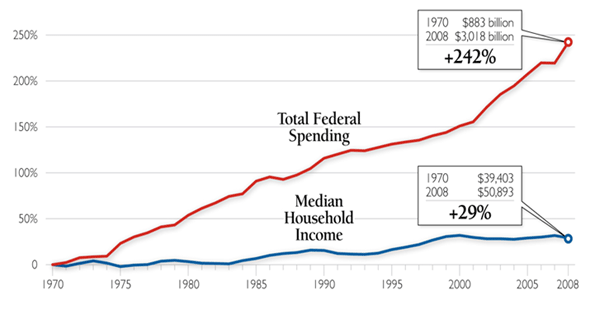
    According to the Office of Management & Budget (OMB), Federal spending has grown more than eight times faster than Household Median Income. Since 1970, middle-income Americans’ earnings have risen 29 percent, but federal spending has increased 242 percent (Percentage Change of Inflation-Adjusted Dollars, 2009). The Greatest Generation believes that spending by Washington politicians has grown out of control. They understand it is not a Republican or Democrat issue. They opposed the $800 billion TARP Bailout under Bush as much as Obama’s $800 Stimulus Bill. They opposed the trillion dollar Healthcare Bill recently enacted into law despite a clear majority opposed to its passage. They recognize that Social Security and Healthcare comprise huge unfunded obligations that will be passed on to their grandchildren.


    Source: Heritage Foundation

    Debt

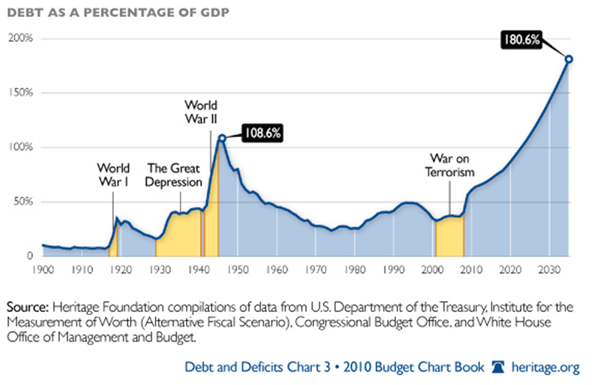
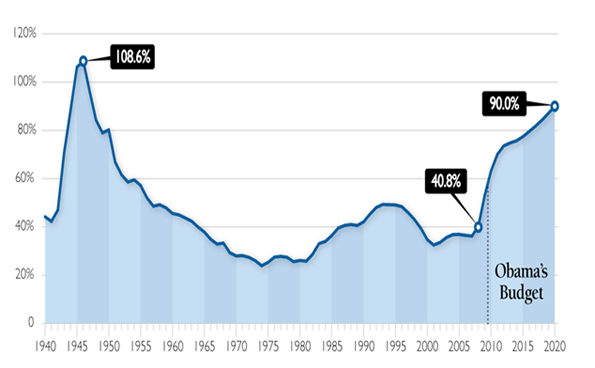
    Since World War II, publicly held debt as a percentage of the economy (GDP) has remained below 50%. In 2008 when President Obama took office, it was 40.8 percent, nearly five points below the post-war average. According to the OMB, Obama’s budget would more than double this figure to 90 percent of Gross Domestic Product by 2020, levels not seen since World War II. (Greece’s debt level of 150% precipitated their meltdown). By 2020, Americans will spend more on interest payments on the Federal debt than on military spending. The Greatest Generation believes these debt levels to be unsustainable.


    Source: Heritage Foundation

    An Unsustainable Path

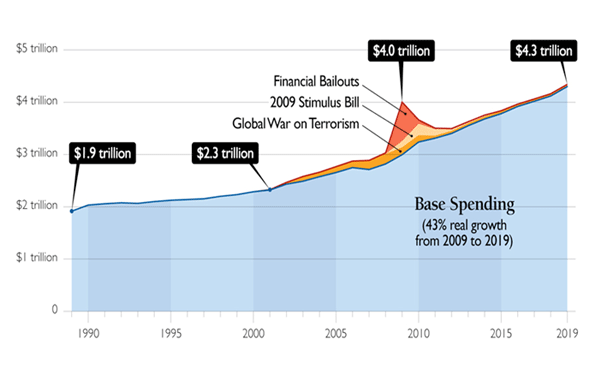
    In 1990, the federal budget was less than $2 trillion. Ten years later the federal budget was just $2.3 trillion. By 2010 the budget exploded to $4 trillion. The Obama budget projects a 43% growth to $4.3 trillion by 2019 according to the OMB. This massive increase over the $2.9 trillion budget Obama inherited in 2008 is not due to emergency spending alone but an intentional structural growth in government. Federal revenues have not kept pace with spending. The U.S. government was forced to borrow $1.5 trillion to pay its bills last year. The national debt is projected to increase from $13 trillion to $20 trillion by 2020 (Inflation-Adjusted Dollars, 2009). The path is unsustainable.


    Source: Heritage Foundation

    While the classic paradox of the immoveable object versus the irresistible force can never be solved, this battle will be settled at the ballot box in 2010 and 2012 when Americans determine the path their country will follow in the 21st Century. If the Greatest Generation prevails, many incumbent politicians will find themselves out of a job as collateral damage. A new wave of politicians will begin The Great Deconstruction.

    New Jersey Governor Chris Christie may be the prototype of this new generation of politicians. He was elected to deconstruct the dysfunctional government of New Jersey, an economy that resembles Greece. Christie inherited the nation’s worst state deficit — $10.7 billion out of a $29.3 billion budget. Christie is doing something unusual, honoring his campaign promises and acting like his last election is behind him. Christie epitomizes the politician the Greatest Generation craves, one willing to lose his job.

    Christie has already declared a state of emergency, signed an executive order freezing spending, and cut $13 billion in spending – in just two months. His first budget included 1,300 layoffs, cut spending by 9%, and privatized government services. The deconstruction of New Jersey has begun. New Jersey may be an unlikely place for The Great Deconstruction to begin, but it is a harbinger of things to come.

    The Great Deconstruction is a series written exclusively for New Geography. Future articles will address the impact of The Great Deconstruction at the national, state, county and local levels.

    Robert J. Cristiano PhD is the Real Estate Professional in Residence at Chapman University in Orange County, CA and Director of Special Projects at the Hoag Center for Real Estate & Finance. He has been a successful real estate developer in Newport Beach California for twenty-nine years.

    Other works in The Great Deconstruction series for New Geography
    The Great Deconstruction – First in a New Series – April 11, 2010
    Deconstruction: The Fate of America? – March 2010

  • The Hong Kong Model for National Identity Cards

    “May I see some identification, please?” asked a retail clerk in my home town Seattle taking my check. I said certainly and handed the sales woman my Hong Kong identity card. She looked at it blankly for a moment then said, “Can I see some other kind of identification?”

    Sometimes when I’m feeling cranky or mischievous, I hand over my Hong Kong ID card when I need to produce some kind of identification. Why not? It is a perfectly valid document. It has my photograph on it. I know of no law that specifies that my state driver’s license has become a national ID card. At least not yet.

    The United States is groping towards a national ID card system, compelled both by worries about security in an age of terrorism and the need to control immigration. In doing so it could learn some lessons from Hong Kong.

    In the U. S. the driver’s license, issued by individual states, has become a de facto identity card. It is used more for cashing checks and opening bank accounts to getting on aircraft even for domestic flights.

    Call me too literal-minded, but a driver’s license is for driving. Identity verification is something else. Why should citizenship be confused with a demonstrated ability navigate through heavy traffic without causing an accident?

    I was reminded of the need for such a card by the controversy over Arizona’s new anti-immigrant law. That state has, if nothing else, put the cart before the horse. Before the police can check on somebody’s “papers” one needs to settle on what “papers” a person should be required to carry.

    The U.S. clearly has a need for some kind of identification card to cash checks, to board airplanes, even to enter a federal building to pick up tax forms. But Americans instinctively balk at the idea of having to carry around a national identity card. Since strictly speaking nobody actually has to have a driver’s license, we kid ourselves into thinking it is still voluntary.

    Before returning to the U.S., I lived for sixteen years in Hong Kong, where everybody over a certain age must obtain an ID card and carry it with him or her at all times. I never considered this a serious infringement on my freedom, although there certainly was a hassle having to obtain one (and to replace one when lost.)

    The Hong Kong police can and do stop people at random and ask them to produce their ID cards. It is not uncommon on the streets to see a couple policemen huddled around a young Chinese man inspecting his ID. That this involves profiling is undeniable. In my sixteen years there, I never once was asked by a policeman to produce my card. It was assumed that being a Westerner I had entered on a valid work permit.

    Of course, I had to produce my ID, or at least provide the number on it, numerous times during the ordinary course of living, from opening a bank account to applying for a job to voting.

    It would be far better to follow Hong Kong’s example and create a national card, probably issued through the Department of Homeland Security. It would lift a burden from state motor vehicle authorities that they were never intended or are equipped to shoulder.

    The advantage that the ID card has over a driver’s license, social security card or any of the other make-shift sources of identification now in use is that they can be coded to show at a glance a person’s status: citizen, permanent resident, foreign student, guest worker.

    In Hong Kong, ID cards are issued to everyone, whether or not they are born there, have become permanent residents or are on short-term work contracts such as the tens of thousands of domestic helpers from Indonesia and the Philippines. In the same way, a national identity card is also a requisite if America is to have any kind of orderly guest-worker program.

    A standardized, secure national ID card issued by the federal government is essential for controlling immigration into the U.S. In short: it’s the way it’s done. Anybody who thinks a national ID card is un-American might have a valid point. But then he should stop complaining about “securing our borders.”

    Todd Crowell worked as a Senior Writer for Asiaweek in Hong Kong before returning to the U.S.

  • Rail Transit Expansion Reconsidered

    More than two years ago we suggested in these pages that the era of multi-billion dollar system-building investments in urban rail transit is coming to an end. We wrote: “The 30-year effort to retrofit American cities with rail infrastructure, begun back in the Nixon Administration, appears to be just about over. The New Starts program is running out of cities that can afford or justify cost-effective rail transit investment. To be sure, federal capital assistance to transit will continue, but its function will shift to incrementally expanding existing rail networks and commuter rail services rather than embarking on construction of brand new rail systems.” (“Urban Rail Transit and Freight Railroads: A Study in Contrast,” February 18 2008).

    Now comes a startling new revelation from a senior U.S. DOT official that even rail extensions may be at risk. Speaking at a National Summit on the Future of Transit before an audience of leading transit General Managers on May 18, Federal Transit Administrator Peter Rogoff questioned the wisdom of expanding rail networks when money is badly needed to maintain and modernize existing facilities:

    “At times like these, it’s more important than ever to have the courage to ask a hard question: if you can’t afford to operate the system you have, why does it make sense for us to partner in your expansion? If you can’t afford your current footprint, does expanding that underfunded footprint really advance the President’s goal for cutting oil use and greenhouse gases… Or are we at risk of just helping communities dig a deeper hole for our children and our grandchildren?”

    In Rogoff’s judgment, the first priority for the transit industry is to follow the precept “fix it first.” “Put down the glossy brochures, roll up our sleeves, and target our resources on repairing the system we have,” he told the assembled transit officials. Transit systems that don’t maintain their assets in a state of good repair risk losing riders, he warned. The Administrator cited the preliminary results of an FTA study of the financial needs of 690 public transit systems across America that show a $78 billion backlog of deferred maintenance. Fully 29 percent of all transit assets are “in poor or marginal condition.” The challenge facing transit managers is to resist the siren call of new construction and devote money to the “unglamorous but absolutely vital work of repairing and improving our current systems.”

    At first blush Rogoff’s position would appear to go counter to the Administration’s announced policy of favoring public transit. Hasn’t Transportation Secretary Ray LaHood repeatedly championed public transit as an alternative to highway expansion? Hasn’t the Administration’s proposed Fiscal Year 2011 budget include major commitments to funding new rail lines in Denver, Honolulu, Minneapolis and San Francisco? Hasn’t the Federal Transit Administration dropped the former emphasis on cost-effectiveness as an evaluation factor in rail project selection in favor of a broader range of factors? All true.

    But fiscal realities can do wonders to bring federal officials down to earth. The Transit Account of the Highway Trust Fund is barely solvent. The U.S. DOT budget will grow by only one percent in 2011. With commendable consistency and fairness, the Administration seems to have decided to apply the same investment standard to transit as it has preached and laid down for highways: Forget about massive capacity expansion; focus on getting the most out of the assets already in place by maintaining them in a state of good repair. To critics of the DOT’s new posture – and there will be some – a good answer could be: It’s just a different way of looking at what it means to be pro-transit.

  • It’s the Jobs, Stupid: Infrastructure Matters

    It may surprise you to know that some policy makers and academics believe that “nothing matters” when it comes to infrastructure — the physical structures that make water, energy, broadband and transportation work — and economic prosperity. The thrust of the idea that infrastructure doesn’t matter may have started with Larry Summers, appointed by President Obama as Director of the National Economic Council in 2009. The New York Times says he is “the only top economic adviser with a West Wing office” – meaning he is very powerful in Washington terms.

    His most vocal critic in the matter of infrastructure is Representative Peter DeFazio (D-Oregon). DeFazio appeared on MSNBC’s Rachel Maddow, criticizing Summers, saying that Obama is “ill-advised by Larry Summers” in regards to using stimulus money to cut taxes for businesses. “Larry Summers hates infrastructure,” says DeFazio, who argues that more of the stimulus should have gone to infrastructure. Summers backed away from any earlier comments when he told the Financial Times last June that there may also be “a case for carefully designed support for infrastructure investment.”

    The question seems obvious. What good is it to stimulate business if they don’t have the tools they need to work with?

    Summers’s attitude could make it difficult to generate major new investments in things like roads, bridges, and the broadband communication access that businesses – small and large – need to get the job done. Companies choose to locate where infrastructure is better. Businesses will leave areas where infrastructure is missing or deteriorated – taking jobs with them.

    Certainly U.S. firms look for good infrastructure when they consider placing offices overseas, and foreign firms must do the same when they consider locating here. The idea that good infrastructure would enable economic specialization and lower costs – making U.S. businesses more efficient, more competitive, and therefore able to create more U.S. jobs – is clearly reflected in the way that businesses behave. Emerging market countries remain economically competitive, and are constantly building and rebuilding their infrastructure as their economies develop. Can the U.S. remain competitive if our infrastructure doesn’t keep up with them? It is becoming increasingly clear that deteriorating infrastructure in the United States may actually be contributing to increased costs (and decreased efficiency) of American businesses.

    Recently, the U. S. Chamber of Commerce initiated a project under the Let’s Rebuild America initiative to find a way to measure the performance of infrastructure and the role it plays in economic prosperity. Over the next year, a team of experts (of which I am a member) led by Michael Gallis & Associates will create an Infrastructure Index that can be used to explore the contribution infrastructure makes in keeping American businesses competitive in an increasingly global economy.

    What is innovative about the project team’s approach is that it measures the performance of infrastructure, and not just the size. Thirty years ago researchers on this subject limited their measurement of “infrastructure” to “government spending on public projects” to analyze the impact on economic growth and productivity. This approach is flawed for several reasons.

    First, not all money designated for infrastructure is spent the same way. Government inefficiencies and political corruption plus purchasing power in local economies contribute to inconsistency in quantity and quality of infrastructure based on money spent. Measuring infrastructure in terms of spending alone doesn’t cover the impact of growth on infrastructure. In other words, that a growing economy can afford more infrastructure is just as likely a cause of positive statistical results as the possibility that more infrastructure helps the economy grow. Further, where spending is used to measure infrastructure, the studies usually consider only public spending, ignoring the contribution of investments from private companies (e.g., the contribution of private satellites to communications infrastructure).

    Less than half of the statistical studies using expenditure-based infrastructure measures find that developing or maintaining infrastructure has significant positive effects on the economy. In contrast, over three-fourths of the studies using physical indicators – the number of phone lines, the miles of high-quality road — find a significant positive contribution from infrastructure to the economy.

    There is no dispute that economic growth is necessary as long as there is an increasing population, which will be the case over the next four decades in America as well as Canada and Australia. We need to address the question: is it possible for the economy to “hit a wall” because it runs out of usable infrastructure? In other words, the question is not if infrastructure helps the economy but rather can a lack of infrastructure impede the economy? Can the economy outgrow its infrastructure?

    As the economy changes, so will the demands for infrastructure. The four components of infrastructure – transportation, energy, water and broadband – need to be made relevant across decades, even as the role of one industry may change within the economy. For example, while it is obvious that information-workers, such as computer programmers and software developers who increasingly work from remote locations, require access to broadband infrastructure, they also alter the way that transportation infrastructure is used. Some knowledge-based activities relying on spatial agglomeration place greater importance on rail/subway and less importance on roads. Yet, that does not mean that a knowledge-based economy will need fewer roads – someone has to service those computers and that technician will likely travel to its customers on roads.

    We need to move away from the “one-size-fits-all” approach to infrastructure development toward better integration with the economic activity that uses it. Each region needs to assess its own needs and base their investment decisions on conditions that exist within their region.

    Susanne Trimbath, Ph.D. is CEO and Chief Economist of STP Advisory Services. She will be participating in an Infrastructure Index Project Workshop Series throughout 2010. Her training in finance and economics began with editing briefing documents for the Economic Research Department of the Federal Reserve Bank of San Francisco. She worked in operations at depository trust and clearing corporations in San Francisco and New York, including Depository Trust Company, a subsidiary of DTCC; formerly, she was a Senior Research Economist studying capital markets at the Milken Institute. Her PhD in economics is from New York University. In addition to teaching economics and finance at New York University and University of Southern California (Marshall School of Business), Trimbath is co-author of Beyond Junk Bonds: Expanding High Yield Markets.