Category: Politics

  • Can David Cameron Close the Deal?

    With the Labour Government exhausted and its supporters dismayed, why isn’t the Conservative Party leader David Cameron sailing home to victory?

    Under the leadership of Prime Minister Gordon Brown, all the weaknesses of the Labour Party have been painfully exposed. British Prime Ministers are elected by the House of Commons, and the Members of that Parliament by the people; so when Brown’s predecessor Tony Blair resigned, his replacement as Labour Party leader became Prime Minister without a general election. In the country, Brown had been a popular figure – if only because he seemed to be the more trustworthy next to the mercurial Blair. But once he took office, Brown’s weaknesses were on view.

    Just as much as Blair, Brown was the architect of the ‘New Labour’ project that shed the party’s welfare state socialist image for a ‘Third Way’. Modelled on Bill Clinton’s revamp of the Democratic Party, the programme demanded that Labour stop using government to provide for its urban poor and trade union constituencies – supporters who would frighten away more aspiring middle class voters.

    But clearing the old-school socialists out of Labour’s policy-making bodies left an ideological vacuum that was filled by environmentalists, the culturati and NGO-enthusiasts for action over the third world. New Labour had freed itself of its traditional socialism only to become beholden to the enthusiasms of the educated political classes. Attention-grabbing ‘humanitarian interventions’ into third world countries were avowedly not in Britain’s national interests, but in pursuit of an ethical foreign policy. Money was directed into subsidising arts centres and other cultural projects.

    Government took on policies that protected the environment, but damaged industry: ‘traffic-calming’ measures – bus and cycle lanes, speed restrictions, congestion charge zones – were put in place with the express purpose of dissuading people from using the roads. Meanwhile road building was put on hold; licenses for new power stations were withheld, so that the country is facing blackouts in six years’ time; bans were put in place on use of GM crops.

    Labour did listen to the City of London’s financial lobby – Goldman Sachs’ Gavyn Davies was a close advisor, as was ‘Shrieky’ Shriti Vadera of UBS Warburg. Labour kept the Conservatives’ banking deregulation but retained Britain’s extraordinary legal controls on land development, so that credit to buy homes was readily available, but very few were built. Anyone sentient could have predicted the result: prices went sky-high putting home ownership beyond the reach of working class people.

    Given his subservience to the City, it was not surprising that when British banks over-extended position led to collapse in late 2008, Brown bailed them pushing public debt into the trillions. Labour’s traditional working class supporters were asking why their party was subsidising million pound bailouts to banks, while their own jobs were disappearing. Most Britons are proud of their armed services, but they had to ask why they were losing their lives in Afghanistan and Iraq. And they wondered how it was that the income gap between rich and poor was getting so much worse under Labour.

    Public disaffection with the political class reached fever pitch when newspapers published details of the Members of Parliament’s own expense claims. MPs were seen to have lied about their addresses to get the taxpayer to pay the mortgage, just as they put their relatives down as researchers and assistants.

    David Cameron ought to have been in the best possible place to take advantage of the government’s difficulties. But Cameron has proven for too much in the same mould as Gordon Brown, and Tony Blair.

    Cameron got to be Tory Party leader after three successive general election defeats. The lesson that the party drew from its experiences in 1997, 2001 and 2005 was that it was the Tory Party’s core brand that was at fault. Cameron was chosen largely by saying that the party should imitate Blair’s ideology-lite, environmentally-conscious, caring, dash for the ‘middle ground’. The Conservatives had to get over their ‘nasty party’ image.

    Cameron dropped a lot of the party’s traditional MPs, and invited people who were not mainstream Tories on board. Cameron’s remodelling of the Conservative Party followed the Brown-Blair model of pushing the core constituency aside to let in new faces. But the new faces that rushed in had the same gentry-liberal preoccupations as those that had taken over the Labour Party in 1997.

    Here’s an example of the new Conservative. As well as running an organic hobby farm, Zac Goldsmith is Cameron’s dashing prospective Tory Party candidate for Richmond Upon Thames. For the last ten years he has been proprietor and editor of The Ecologist magazine, Britain’s foremost green media voice. Zac inherited £300 million from his father, asset-stripping financier Sir James Goldsmith, using the proceeds to finance his pet causes through his own grant-making bodies, the JMG Foundation and the Isvara Foundation. He gives money to his own small-farmers groups FARM, which is committed to stopping private housing developments, has underwritten the Ecologist’s debts of £864,675. He has financed his own web-site SpinWatch to ‘expose’ corporate lobbying – though as Private Eye pointed out, its attack on the nuclear industry was curiously selective, mentioning no Tories, only Labour-backing investors (26 May 2006).

    Well-heeled voters in Richmond might not be too bothered that Zac has written a book The Constant Economy saying we need an end to growth, because they are already enjoying theirs.

    Another key Cameron supporter is advisor Philip Blond whose manifesto Red Tory bemoans the loss of England’s traditional charm under the twin evils of state socialism and the free market ideologies he blames upon the (conveniently foreign-sounding) Milton Friedman. Blond’s traditionalist fantasy of Merrie England is drawn from the backward-looking dreams of G.K. Chesterton and Hilaire Belloc, who railed against modernity back in the early twentieth century.

    Blond’s call for people to rely less on the state is well-made, but his anti-capitalism must have alarmed the party’s core supporters: ‘economic liberalism has often been a cover for monopoly capitalism and is therefore just as socially damaging as left-wing statism.’ Blond’s solution, though, is some state-enforced localism, with legal controls to redirect investment into municipal authorities – what he calls a ‘distributist state’. If this is David Cameron’s big idea, redistributing wealth through local government, it is not surprising that he has not made a great deal of headway in the polls given that everyone understands the real issue is the penurious state of the country’s finances.

    Throughout the election, Cameron has led in the opinion polls, but not by enough to guarantee a majority in parliament. When the country held its first ever televised leaders debate, something that the Tory leader had demanded, he was up-staged by Nick Clegg, leader of Britain’s third party, the Liberal Democrats. In truth Clegg’s appeal is not programmatic – he is pretty much more of the same as the other two. But what he did very effectively was to position himself as the outsider, not a part of the old two party system, a kind of younger, more attractive Ross Perot.

    Clegg’s appeal to the politically disaffected ought to have worked for David Cameron. But Cameron’s failing lies in the fact that he simply has replicated the New Labour project, just as the public were falling out of love with it. Environmentalism, stopping urban sprawl, and ‘restoring communities’ are the preoccupations of a narrow strand of British society: the kind of people who occupy the lower rungs of government service. It is not that most Britons want to trash the environment, or concrete over the countryide, nor indeed support community breakdown. It is just that they do not understand why their own self-betterment always has to give way to those concerns.

    Tragically, the only party that has made an issue of Britain’s chronic housing shortage is the far-right British National Party. Neither the Tories, nor Labour, less still the Liberal Democrats, have the courage to face down the NIMBY opponents of new building. The Tories’ own supporters (like the Lib Dems) have made it to the suburbs and do not want to share or expand them. Labour cannot give up its grip on government planning laws. With no-one willing to free up land for development, the BNP’s call to drive immigrants out is the loathsome conclusion of anti-growth sentiment.

    When they look at the Eton-educated front bench team that Cameron is putting up, voters see the kind of people who have made (or inherited) their stash, and now are pulling up a drawbridge behind them. All of the pious talk about looking after the poor sounds like parish charity, not giving people a chance to help themselves.

    David Cameron’s Conservatives are still the favourite to win the General Election, the only puzzle is why are they finding it so hard to close the deal – a puzzle until you look at their policies, that is.

    James Heartfield works for the Audacity.org think tank, and most recently wrote Green Capitalism: Manufacturing Scarcity in an Age of Abundance (Mute, 2009). His website is at www.heartfield.org

    Photo by: conservativeparty

  • Finding the Good in This Bad Time

    This year’s best places rankings held few great surprises. In a nation that shed nearly 6.7 million jobs since 2007, the winners were places that maintained or had limited employment declines. These places typically had high levels of government spending (including major military installation or large blocs of federal jobs) or major educational institutions. Nor was the continued importance of the energy economy surprising in a nation where a gallon of gas is still about $3 a gallon.

    Even including part of 2010, only 13 cities (out of 397) showed growth, reflecting the breadth and depth of the downturn. In an economy where the most promising statistic is a “limited” decline in the number of new job losses from month to month, where is the proverbial silver lining?

    It is found in two places: (1) areas that show some resilience in this dour economy; and (2) a newly retooled American economy positioned to compete more strongly in the future.

    Regions of Current Hope
    With disaster as a backdrop, the early signs of buoyancy in the economies of the Intermountain West, the Great Plains, and even parts of the Midwest are quite impressive. Many predicted these areas would mirror the collapse of their larger, high-growth counterparts in California, Florida, Arizona and Nevada. To the contrary, these relatively rural locations are emerging as beacons of hope.

    In the big cities, there have been across-the-board declines in most sectors led by the collapse of construction and financial services. Thousands of small businesses have disappeared in addition to huge layoffs by large employers. You see many “For lease” signs now at what were once your favorite shops and watering holes.

    In a business climate like this, a lot can be said for slow and steady. Comparatively, slower-growing cities across the middle parts of the country are recovering more easily and more quickly.

    Perhaps the most important lesson is that the economies of the future are not all about the “knowledge class” and that “too-good-to-be-true” high wage jobs may be just that. As seen in the dot-com bubble and in this real estate bubble, those fancy, high-wage finance and tech jobs are highly vulnerable to swings in the economy and high-paying construction jobs are only as good as the housing market.

    This is simply because markets eventually adjust. In the case of overheated stock and real estate markets, the losses are felt by the knowledge class, financiers and construction workers. In the case of manufacturing, as the price is bid up through labor costs, other places become more competitive.

    During volatile times, places with the broad-based growth strategies — like Texas and Utah — do best. Cities that are heavily dependent on a narrow set of industries leave themselves vulnerable, paying back the gains of good years in poor years.

    Part of the success of Texas is not just energy (as the modest performance of Midland and Odessa shows), but rather to the state’s adjustments to a past crisis, the savings and loan crisis of the 1980s. The state instituted new laws that imposed a range of disciplines on financial markets — such as limiting home equity lines — thereby minimizing the damage to the state’s economy as those markets went topsy-turvy.

    Regions of Future Hope
    There remains hope for the future in the story of this recession. One of the defining aspects of this recession was not just that certain sectors were hit hard, but that it was also broadly distributed across the economy. This pervasiveness extended deeply enough to cause every enterprise in America to seriously reconsider their business model and re-engineer how they served their customers.

    Consequently, the American economy is leaner and cleaner than it was three years ago. Businesses are more in touch with what makes them successful. While growth will be slower, it will be focused on areas that will bring about quick increases in productivity across the economy and bring new, real wealth to the local economies.

    Where will this happen most quickly? In those places where businesses survived best. Expect the Intermountain West and smaller manufacturing hubs across the United States to lead the charge (because of their lower costs), but large metros like Los Angeles, Chicago, Houston, Minneapolis, and Dallas, with their deep inventories of manufacturers and large labor pools, should see these returns before too long.

    Similar stories can be told for nearly every sector although the beneficiaries will be different. Much of the growth in information sector, for example, will continue to take place outside Silicon Valley. Business services will grow most rapidly where there is growth in business overall, initially outside the core hubs. Midsized and small communities will lead this recovery, and the big cities will eventually follow.

    Economies open to a wide array of occupations will do better than those that are less diversified. Places like Portland and Atlanta, so deeply focused on attracting high-wage, knowledge-based jobs are likely to miss out on the “basic” job growth that will fuel the first stage of the American recovery. Venture capital is still tight across the nation and capital markets are uncertain, especially with new government regulations up in the air. Consequently, high-end, white collar, and high tech jobs, with their insatiable need for investment capital, will develop more slowly. Even among the high-tech superstars, high profits will not lead to huge surges in hiring.

    Why Government Holds the Key
    Government’s actions over the next six to 12 months will define potential and the pace of this recovery. With an election looming, all sides will be jockeying for electoral advantages in November. They will cater legislation to many competing constituencies, fostering tremendous uncertainty in the private sector.

    One thing is certain, however. The current pace of government spending is unsustainable. Not even the US economy can support ongoing deficits in excess of $1.5 trillion per year. Either government spending must slow or someone must pay a lot more. The only alternative — high inflation — will have its own negative effect. One way or another some combination of the three MUST happen.

    Additionally, current regulatory initiatives will change the dynamics and employment patterns within some important sectors. Whether it is the complete restructuring of the health care industry (part of one of the only bright spots in the current economy), or the prospective new regulation in the financial services sector, potentially destabilizing change is coming.

    And the feds are not the only destabilizing government actors. California’s aggressive climate legislation, for example, and the mixed signals it is sending businesses across the state’s 28 MSAs will certainly shape their near and midterm economic futures.

    So what should the federal and state governments be doing at this time? Most importantly, they need to ensure stability: stable capital and lending markets, a consistent and stable tax code, focusing interventions on broad-based, low-shock actions, and developing a plan for moderating and containing the national deficits and mounting national debt. The key to continued prosperity in these times is a growing private job base, not a growing government sector.

    Moreover, government needs to learn the lessons of the private sector. Even as private firms retrench, governments at all levels need to reduce their cost structures. This is happening in many localities, at least on a temporary basis, as even unionized local employees are accepting wage and benefit reductions to retain jobs. Localities and states must recognize the true cost of the services they provide. They must either find consistent ways of providing funding for them, or eliminate them to preserve more critical services.

    Finally, public and private sectors alike must learn that this has been a transformational recession. Unlike downturns in the past, business and government cannot expect things will return to the way they were. Markets and banks will not be printing imaginary value increases in real property for consumers to spend any time soon and capital markets are cautious about financial good news,,preferring the old tried and true winners to novelties.

    Government and government employees are behind the curve understanding this transformation. Wage and benefit concessions given up during this recession are not likely to reappear. The concepts of furlough and unpaid time off are here to stay. Even as the private sector has been forced to reconsider its baseline practices, so, too, the political pressure now will be on government to retain savings obtained during the recession.

    Michael Shires, Ph.D. is a professor at Pepperdine University School of Public Policy.

  • Guns, Guts, And Geithner

    Calls for more bank regulators remind me of a regulatory go-round with an erratic European bank chairman to whom I once reported. Almost eighty years old, with a failing memory and a fondness for mid-day Martinis, he once interrupted a luncheon to call his wife and ask that she send his revolver over to the bank.

    At one time in his life he might have had a license to carry a firearm, but the permit had long expired. He wanted the great equalizer on this particular afternoon because the television was full of possible terror threats against financial interests, and he figured, after his second highball, that outside agitators might rush the corporate dining room.

    The meal continued, and in due course his chauffeur arrived carrying a white plastic bag, which looked like it was packing lunch more than heat. The chairman removed the pistol, checked it for ammunition, and tucked it into the waistband of his Savile Row suit, as if he had made a loan against a Maltese Falcon.

    News of the lock-and-load chairman circulated around the bank, and eventually reached the ears of the board of directors and the regulators, who, as part of their mandate, had to insure the fitness of the chairman to serve in his capacity. I was present when the regulators were informed that the bank had a chairman who was eighty years old, had no memory, and was loaded not just with booze but for bear.

    Regulators are being celebrated everywhere today as the champions of free markets and fair competition. You might think that they had earned a track record in this regard and — for example, in this instance — would have questioned the chairman’s ability to remain in office.

    Instead, even after they heard about his piece and judged his inability to understand the business of the bank, the regulators did nothing to change the composition of the board. They took the position that there was nothing that they could do, and left him on the job for another few years, during which time the gun would come and go in his briefcase, and occasionally fall on to the conference room table when he was searching for a document. It brought new meaning to the corporate phrase, “Let’s stick to our guns.”

    Does my experience necessarily mean that all banking regulators, notably those charged with implementing financial reform, will be slow on the draw when it comes to cleaning up Dodge City’s balance sheets?

    In general, regulators tend to be recent college graduates who are padding their resumes until going to business or law school, or they are career bureaucrats, immersed in one or two minor regulatory issues. Most miss the big picture, as nearly every regulator did in reviewing the balance sheets of A.I.G., Merrill Lynch, or Washington Mutual. For better or for worse, financial profits — to regulators challenged to understand the strike prices of futures contracts — look like magic.

    The problem with entrusting them with the health of the financial system is that few, at least in my experience, understand anything about how banks, brokerage businesses, and hedge funds operate or how they make money.

    As the ideal regulator, look no further than Treasury Secretary Timothy Geithner, who now is pushing financial reform as hard as he once peddled deregulation and “market solutions” for most banking problems.

    Geithner owes his financial expertise to political expedience, first to that of Henry Kissinger and his associates, and later to presidents Clinton and Obama, all of whom take the view — to use the phrase of historian Richard Hofstadter — that they came to office to defend property as opposed to democracy.

    Had Geithner been a claims adjuster in the arson division of Geico, he might have been less inclined to believe that Wall Street was doing “God’s work.”

    Think, too, of the iconography of Goldman Sachs, which within the last three years has gone from the “culture of success” to America’s most wanted. In between, depending on the country’s mood, it was either the stock pond for Treasury secretaries or in need of a bailout. All the while, the regulators no more understood Goldman’s businesses than did their counter-parties, who were loading up on subprime while the partners went short.

    Despite the high moral tone of Senator Dodd’s proposals to fit bankers with bespoke hair shirts, the challenge of the proposed new financial regulations is how Congress can dress up yet more loopholes and shop them as reforms.

    What Congress will pass is lofty legislation that promises to unleash “consumer watchdogs,” with Volker Rules against proprietary trading and denunciations of derivatives, and it will extend the amount of time that homeowners can live in a house on which the mortgage is in default. Even better, members of Congress will finally have a good safe menace, Wall Street greed and ruin, to run against in November 2010.

    In exchange for the effigy, many of the proposals could have been written by bank lawyers, as these “reforms” subsidize, rather than challenge, bank earnings. Banks love nothing more than a guarantor of bad loans. My feeling is that, whatever the particulars of the federal financial reform package, it will use government dollars to bailout underwater consumers and feed banking bottom lines, much the way health care reform could well have been called the Insurance Industry Full Employment Act of 2010.

    Rather than buy into the prowess of regulators, time and effort should be spent in setting guidelines that will allow the market to ensure the health of good financial institutions or the failure of bad ones. The effect of most regulations, however, is to prop up speculation, if not bad banks, in the interest of preserving “the system” (which sounds a lot like Michael Corleone’s “family”).

    For example, if the financial reform bill did nothing more than require that all banks and bank-like companies maintain 20 percent of their risk assets in capital that is liquid and available within seventy-two hours, it might constrain economic growth. But few banks would fail. Nor would be they be in a position to pay out fat bonuses, as most would have returns on equity like those of hardware stores.

    What wiped out many banks in the recent financial crisis was inadequate capital and mismatched balance sheets. At its risk peak, Lehman had assets thirty-one times its capital, so even a small down move in markets made it insolvent. Even now, Goldman’s balance sheet is more that of a pyramid scheme than a bank.

    A second proposal might mandate the close matching of all financial assets and liabilities, so that future Lehmans could not fund mortgage-backed securities (with the tenors of underlying loans extending to thirty years) using ninety-day commercial paper. Mortgages are fine if they have a cushion of capital and are match funded.

    To protect credit card consumers, cap the interest charged on credit cards to five percent more than three-month interbank borrowing rates, and require that once every two years consumers “clean up” their outstanding balances. The mall will be less crowded, but the banks will not swell with bloated profits.

    The limits of bank regulators could be seen even in fifteenth century Florence, where a financial reformer asked Cosimo the Elder to help stop gambling in the clergy. In response, the head of the Medici clan said: “Maybe first we should stop them from using loaded dice.”

    Matthew Stevenson is the author of Remembering the Twentieth Century Limited, and editor of Rules of the Game: The Best Sports Writing from Harper’s Magazine.

  • Contemporary China’s Mirror Image: Imperial Germany

    China has emerged as the bad boy on the global scene, pushing around executives at Rio Tinto, attacking Google, and humiliating Barack Obama at the Copenhagen Climate Talks. Speculation is growing about China’s rising power and the country’s leaders are displaying a discouraging sense of hubris. There is growing fear that the autocratic Middle Kingdom will soon dominate the world.

    These fears have parallels with another rising power of a century ago: Imperial Germany. Both emerged quickly on the global scene and did so with an enormous chip on their shoulders. Like China today, Germany was a little late coming to the industrial revolution, though its cultural contribution to European civilization and in turn to American civilization was enormous (Ralph Waldo Emerson was passionate student of Goethe). Only after its final unification and triumph over the French in the Franco-Prussian War of 1871 could Otto von Bismarck, the great 19th century pragmatist, force Germany’s sundry states into union.

    Again like China, once united and in control of its own destiny, Germany grew quickly, harboring ever more delusions about its place in the sun. In the years leading to the First World War Wilhelm I, the competent Bismarck confidant, died of cancer. This allowed vainglorious Wilhelm II to assume the mantle of the state in 1888. Prussian militarism by then was backed by a massive industrial machine operating in complete fealty to the state. Germany’s new Emperor and his clique felt that it had something to prove.

    China, once the most advanced nation on earth, similarly has a passel of historical resentments ranging from the Opium War to the complete denigration of its standing in the world. Like Germany, China has viewed itself as an advanced culture whose time had now arrived. Like Germany in the late 19th Century, it has incorporated technologies from others about as fast as it could get its hands on them.

    When Deng Zhao Ping awoke China from its Maoist/Stalinist nightmare that ripped through the country under the guise of the Cultural Revolution, they were confronted with the disintegration of communist governments around the world. Chinese leaders knew that the only way to for them to hold power was to have their economy grow. This approach parallels the economic pragmatism in late Imperial Germany under Bismarck and the Hohenzollerns, who pushed economic growth as a means of promoting social welfare while simultaneously doing all they can to consolidate power in their hands. Bismarck created the first social security system not out of a deep seated concern for the proletariat but to emasculate the socialist party.

    China by the same token has not adopted capitalism because they want to move the country towards rule of law and greater democracy but as a means of justifying their continued presence at the country’s helm. China, much like Imperial Germany, has witnessed unbelievable growth because of these centralized policies.

    On the eve of WWI, Germany was the second largest economy in the world after shooting ahead of Britain and trailing America. China just accomplished a similar feat in an even shorter time frame. China passed contemporary Germany a couple of years ago and is poised to do so with Japan in the coming year. China is cultivating a modern-style imperial prescence in Iran, Africa and Latin America in an effort to secure the natural resources that the country lacks much like Germany did. Ironically, China is doing more to raise living standards in Africa than any western aid program has been able to do.

    German industrial bosses were elites, most bore the titles of nobility. China’s bosses have been compared to the Emperor’s corrupt courtesans. The vast wealth of the Thyssen and Krupp steel dynasties can still be seen today in the massive industrial museums lining the Ruhr Valley. As in Imperial Germany, the military dominates large swaths of the economy. Germany in the late 19th and early twentieth century used its coal and iron resources to build the munitions factories that lined the despoiled Ruhr and Rhine. Holding even tighter on the reigns, China has developed an a strong state-dominated economy, forcing, for example, foreign firms to enter a joint venture with a state-owned corporation, which will quickly steal what it can of the western company’s intellectual property.

    The two governments bear disturbing similarities. Germany also had a vast bureaucracy attempting to tamp down any sedition amongst its masses. China is doing much the same. The most interesting parallel however is the rampant nationalism propagated in both Imperial Germany then and contemporary China.

    Of course, there are also some significant differences. China, for example, is much larger than Germany ever was. China is also not necessarily as instinctively expansionist . But it is extremely sensitive when it comes to Taiwan. The kerfuffle over arms sales to Taiwan last month provides more than enough evidence of this. Germany also had territories that it got very sensitive about as well. China’s attitude towards Taiwan and Tibet echoes the Kaiser’s sentiment towards occupying Strasbourg along the French border.

    Is China going to attack its neighbors and plunge the Pacific Rim into World War Three? It seems highly unlikely. China still has a lot of growing left to do. Large swaths of the peasantry are still stumbling along at poverty levels. China is also well aware of the US military’s ability to project force should it try to attack Taiwan.

    China may want to occupty Taiwan and there is none of the rhetoric among the leadership cadre about the need for Lebensraum that dominated conversations in German salons before the Great War. China’s leadership also appears far more competent than that of late Imperial Germany. But this may have to do with dumb luck. The Hohenzollerns up until Wilhelm II were all competent leaders. Could China be so unlucky as well? Could one idiot weasel his way up through the CP ranks? Who knows?

    China has serious problems with restive minorities and a growingly arrogant and repressive regime. It has industrial might, a massive resentment of western powers and a desire to get its own place in the sun. It does not have the same geographical pressures that Germany had and it is still not in any position to take on the US in the military theater and its rulers realize that. Though its economy is inflating, much of the population living below the poverty line.

    So far the technocrats over the last thirty years have been freakishly capable and have generally done a good job. The real trial of China’s claim to its place in the sun will be when a blustering fool like Kaiser Wilhelm weasels his way into the party chairmanship. Just as Germany was powerless to dispose of its ill-suited leader, China may very well be as well. If that happens, God help us all.

    Kirk Rogers resides in Bubenreuth on the outer edges of Nuremberg and teaches languages and Amercan culture at the University of Erlangen-Nuremberg’s Institut für Fremdsprachen und Auslandskunde. He has been living in Germany for about ten years now due to an inexplicable fascination with German culture.

    Photo by Artshooter

  • We Need a New Ross Perot

    Is it time to bring back Ross Perot? Not the big-eared, chart-crazed egomaniac and his Texas cigar boat, but a nascent movement like his among independents that can transform today’s stale and essentially self-destructive debate between two equally bankrupt parties.

    Independent politics outside the established main parties has been on the upswing around the world, from Europe to the Tea Parties here at home. Perhaps the most stunning case has occurred in the United Kingdom, where Nick Clegg, leader of the perennial also-rans, the Liberal Democrats, was widely judged as the winner of the second in three debates with Prime Minister Gordon Brown and Conservative challenger David Cameron.

    Helped by good looks and an affable manner, Clegg is emerging as a real threat to the long-established Labour and Conservative parties. He has risen in the polls since early April from below 20 percent to above 30 percent. As my London-based colleague at the Legatum Institute, Ryan Streeter, observes, Clegg may himself be an Establishment figure—educated at elite schools and married to a Spanish lawyer—but his rise is based largely on “anti-government, anti-political sentiment.” His appeal is particularly strong among 18- to 34-year-old voters.

    This revolt of the independent middle is not unique to the U.K. Last year Japanese voters threw out the long-dominant Liberal Democratic Party for a newly cobbled together Democratic Party. French voters this year also bolted away from established parties to support independent, smaller groupings on both left and right.

    Independents matter even if they fail to take power. Clegg may not make it all the way to 10 Downing Street, but his stronger showing could transform British politics, forcing both Tories and Labourites to find ways to counter his appeal.

    This occurred here with the Perot movement in the early 1990s. Looking back, one can almost say it was Perot who ultimately shaped the times. Challenging both Bill Clinton and George the First, Perot gave voice to a deep-seated national concern—particularly among the older adult middle class—about out-of-control spending, a rising deficit, and declining national competitiveness. By focusing on these issues, he made George Bush and his cynical deal with the religious right seem both diversionary and divisive.

    The Perotista base, not wildly dissimilar from today’s Tea Parties, helped drive the first Bush from the White House by splitting the center-right vote. Two years later, upset with perceived Clintonian overreaching, particularly on health care, these same middle-class independents handed the Congress to the Republicans. In the end, we got the best of both worlds: a fiscally responsible government without the moralistic clatter and reflexive militarism of the GOP right.

    Over the next few years, we could use a Perot-like person who would challenge both the slavishly pro-greed Republicans and the crony capitalism of our Chicago machine government. The time seems right: Both Democrats and Republicans are losing support and, more important, respect from an increasingly alienated mainstream middle.

    The rise of new political forms across both Europe and America reflects some of the new realities of contemporary media. With the rise of the Internet, the ability of large parties to use the press as their obedient propaganda corps has been greatly diminished. Similarly, establishment consensus on issues—for example, on climate change—is no longer easy to enforce. The Internet is too protean and easy to penetrate to be corralled by either the power of money or lobbyist influence-peddling.

    The current political unrest also reflects a growing sense among the middle class in advanced countries, particularly those employed in the private sector, that the dominant parties are simply not interested in their fate. In the U.S., this view has been reinforced around the two biggest issues facing Congress this year, health-care and financial reform.

    On health care, the Republicans, ever subservient to their corporate donors, refused to address the fundamental issues—such as eliminating exclusions for pre-existing conditions, portability of coverage, or provisions allowing small businesses and sole proprietors to buy reasonably priced coverage—that matter to middle-class voters. Their inability to do something significant when in control of Congress and the White House opened the door to Obamacare.

    That said, the Democratic alternative, as Rodney Dangerfield would put it, proved no bargain either. Their plan ended up suiting insurance companies, Big Pharma, and those, mostly union members, holding “Cadillac” health plans. The losers were, as usual, members of the entrepreneurial middle classes who will now be subject to ever higher taxes in exchange for what could prove even worse coverage.

    The bankruptcy of the existing parties is, if anything, even more evident in the financial-reform debate. Desperate to win back their wayward constituency on Wall Street, most Republicans oppose regulation of even the dodgiest practices. At the same time, they are correct to call out the Democrats’ embrace of “too big to fail” institutions, which in essence would allow big banks to operate with the patina of guaranteed federal support.

    So in the end, we have something akin to a shouting match in a whorehouse over who gets to cavort with the best-endowed john. The Democrats may play a populist tune, but they take in far more money from the likes of Goldman Sachs—the firm was the largest corporate donor to the 2008 Obama campaign—than the more obviously craven GOP. A former Obama White House counsel, Gregory Craig, even serves on the pirate firm’s legal defense team.

    All this suggests the Democrats stand largely for the expansion of crony capitalism, the melding of corporate power and state. The Dodd bill, as Representative Brad Sherman, an independently minded California Democrat, has suggested, will give the kind of “unlimited executive bailout authority” that the Wall Street interests “desperately want but doesn’t dare ask for.”

    The Republicans, for their part, talk of adherence to conservative principles but, with a sly wink, are engaged in a giant “come-on” to the financial elite. Instead of too big to fail, they embrace the unfettered right to cheat and dissemble. In the end, the losers are the smaller banks and the middle class, who are forced to choose between corporate vultures and an ever more arrogant, clubby government-business alliance.

    Ultimately, the only way to rein in these awful people is to develop new independent political movements outside the Beltway. This category can include the Tea Partiers but also can extend to budget-conscious, grassroots Democrats like Montana Governor Brian Schweitzer. Although we could conceivably see the emergence of a new Perot-like figure, the independents may flex their muscle this time in a more grassroots, multifaceted manner.

    Something certainly needs to arise to force the parties to abandon policies that will lead to the destruction of the middle class—one party by unbridled corporations, the other by over-expansive government. In this respect, for all his goofiness, Ross Perot and his movement are looking better all the time.

    This article originally appeared at The Daily Beast.

    Joel Kotkin is executive editor of NewGeography.com and is a distinguished presidential fellow in urban futures at Chapman University. He is author of The City: A Global History. His newest book is The Next Hundred Million: America in 2050, released in Febuary, 2010.

    Photo: Leia

  • A Spotlight on Chicago Machine Boss Alderman Burke

    With President Obama’s approval ratings headed downward, there’s a growing interest in the powerful Cook County politicians that pushed Obama. James Peterson has written a three part series on Chicago Machine boss, Alderman Ed Burke. The series was written for Andrew Breitbart’s Big Government website.

    The first installment of the series deals with Alderman Burke’s association with the Chicago Mob. Burke’s unapologetic relationship with Alderman Fred Roti, who was described by the FBI (in 1999) as one of only 47 made members of the Chicago Mob. Peterson quotes this resolution Burke entered into Chicago’s City Council glorifying Roti:

    Fred B. Roti, a committed public servant, a cherished friend of many and good neighbor to all, will be greatly missed and fondly remembered by his many family members, friends and associates.

    Peterson’s second article deals with top FBI informer Robert Cooley’s accusation that Alderman Burke attempted to fix a murder trial for the Chicago Mob. Even though Cooley repeated this accusation, Burke failed to sue him or the publisher of the book. Peterson also deals with the sensitive subject of Alderman Burke’s relationship with Chicago’s media. Peterson quotes a 2003 Chicago Sun-Times story:

    The curious public feud between City Council’s most powerful alderman and one of Chicago’s highest profile television reporters was turned up a notch Wednesday. Unable to persuade WLS-TV Channel 7 to pull reporter Andy Shaw off the City Hall beat because of the bed and breakfast Shaw and his wife run out of their Lincoln Park home, Finance Committee Chairman, Edward M. Burke (14th) did what he considers to be the next best thing. He introduced a legislative “order” directing six city departments—Fire, Revenue, Buildings, Streets and Sanitation, Zoning and Public Health—to enforce “any and all provisions” of the municipal code at only one address:607 West Deming. That happens to be the address of the Windy City Urban Inn, where the Shaws have continued to rent seven rooms at their three-story mansion…

    Part three deals with Alderman Burke and the legitimate world. Peterson delves into the relationship Burke has had with the law firm Jenner and Block. Peterson quotes an a 1997 Chicago Sun-Times story:

    Ald. Edward M. Burke (14th), whose decisions on hiring lawyers in the City Council ward remap case have funneled $7.5 million in city fees to the prominent Jenner and Block law firm, holds co-counsel status with that firm in two recent lawsuits, court records show. Burke’s links with the firm do not appear to violate any laws or regulations…

    Managing partner Jerold Solovy – who is the lead attorney in the remap case – was treasurer of the unopposed 1996 campaign for Illinois Appellate Court justice of Anne Burke, the alderman’s wife. And prominent [Jenner and Block] partner John Simon served as her campaign chairman. The firm provided $14,414.15 in services and money to the campaign.

    The firm hired Burke’s daughter Jennifer A. Burke in June, 1995, shortly after she graduated 173rd in a class of 385 from Chicago Kent College of Law. In making new hires, the firm usually draws top students from the nation’s leading law schools. Two weeks ago, Burke, whose name has been linked to the federal investigation of ghost payrolling at City Hall, hired Jenner and Block partner and former U.S. Attorney Anton Valukas to represent him in that inquiry.

    Anyone interested in the place President Obama came from should read all three articles in detail. Alderman Burke is one key people who fast tracked Obama’s career. You’ll also want to read about the Chicago Democrats and the Chicago Mob. When Rod Blagojevich’s trial starts on June 3, the names of Tony Rezko, Jesse Jackson Jr., Valerie Jarret, Rahm Emanuel, and David Axelrod, and Barack Obama are guaranteed to be mentioned. They are part of the Chicago Democratic Machine, a Machine with Alderman Burke at the top.

  • Leading a Los Angeles Renaissance

    Surprisingly, despite the real challenges Los Angeles faces today, the city is out in front of many of its urban competitors in transforming its capacity to provide a safe place to raise and properly educate children, exactly the criteria Millennials use in deciding where to settle down and start a family. It is the kind of challenge that cities around the country must meet if they wish to thrive in the coming decade.

    LA’s biggest win in this respect derives from the political courage of former Mayor James Hahn. It was Hahn who appointed Bill Bratton as police chief, who then deployed his COMPSTAT process for continuously reducing crime. During his tenure as the city’s Police Commissioner under both Mayor Hahn and his successor, Antonio Villaraigosa, Bratton achieved the same improvement in LA as he did previously in New York,– in a city with many of the same societal problems but about one-fourth the police resources and a much larger area to patrol. Even as unemployment soared in 2009 during the Great Recession to 12.3 percent in Los Angeles County, the city saw a 17 percent drop in homicides, an 8 percent reduction in property crime and a 10 percent drop in violent crime. This is a first great step in restoring Los Angeles, once the destination for families, back to its historic promise. Today, Angelinos feel safer than they have in decades.

    COMPSTAT is above all a vehicle for changing bureaucratic cultures. In his initial dialogue with the brass of the New York Police Department (NYPD) Bratton told his management team that he planned on holding them accountable for the crime reductions he had promised Mayor Rudy Giuliani.

    Citing the FBI’s national crime reports, they responded by telling Bratton that since crime “is largely a societal problem which is beyond the control of the police,” it was completely unfair to hold them accountable for reducing it. Since the police department was not responsible for the city’s economic vitality, its housing stock, its school system, and certainly not its racial and ethnic tensions, all of which were the root causes of crime, the managers felt it was unreasonable to expect them to actually reduce crime.

    When Bratton asked them what they could be held accountable for, the leadership replied that they were prepared to accept responsibility for the “perception of crime in New York City” and that their existing tactics of high profile drug busts, neighborhood sweeps, and the like were effective ways to manage that perception. Bratton adamantly refused to accept this definition of accountability from his team and went about creating a system that placed accountability for crime reduction on the NYPD’s leadership, something that also worked its way down through the ranks of every precinct in the city and into the fabric of the department’s culture.

    This fully captures the type of cultural change that every part of any city’s bureaucracy must undergo to become a Millennial city.

    During Mayor Hahn’s tenure in Los Angeles, for example, he expanded the COMPSTAT process to all departments in order to hold General Managers accountable for their performance under a program called “CITISTATS.” Some departments, such as Street Services, Sanitation, and Street Lighting, are still using the lessons learned in that experience to continuously improve the cost and quality of their services.

    But Los Angeles’s recovery has often been blocked by the City Council which has proven reluctant to cede its traditional right to intervene in department operations and to direct resources to specific projects or programs in their Councilmanic districts regardless of the overall city’s needs. When Villaraigosa ascended to the Mayor’s office he removed the potential irritant to his relationship with the Council by disbanding CITISTATS. That decision has deprived Los Angeles of key insights that could have been used to help deal with its current budget challenges.

    It also removed one of the more promising vehicles for Neighborhood Councils to hold city bureaucrats accountable for the services they deliver. The Councils, although far from perfect, remain one of the city’s best hopes for fulfilling Millennials’ desire for direct, locally-oriented involvement.

    In contrast, Mayor Villaraigosa’s determination to hold the Los Angeles Unified School District (LAUSD) accountable for the performance of its students has begun to pay dividends. Recently the board voted 6-1 to adopt a policy mandating competitive bids eventually be issued for the management of all 250 “demonstrably failing schools” as defined by federal education law. The parent revolution that spurred this new approach would not have been successful without the support of LAUSD board members that the Mayor had helped to elect.

    Including parents armed with new information on student performance in the process of reforming LAUSD’s schools promises to produce schools that deliver superior results at lower costs and to create a new, decentralized, parent-controlled, educational decision-making system that will be especially attractive to Millennials and their parents.

    Now that the Great Recession has brought single family housing back to affordable levels in many parts of Los Angeles, the building blocks of safer streets and better schools give the metropolitan area an opportunity to establish an environment that can attract large numbers of Millennials just as they enter young adulthood. To take advantage of this opportunity, however, all members of the city’s leadership will need to learn one more Millennial lesson.

    Unlike the Baby Boomers running the Los Angeles City Hall today, Millennials aren’t interested in confrontation and debilitating debates focused on making sure one side wins and the other loses. They want what business people term “win-win” solutions that take into account everyone’s needs and produce outcomes that benefit the group or community as a whole. Los Angeles, a city built on the expectations of the last civic GI Generation that came to LA in the 1940s, must realign itself to the tastes of the emerging next civic generation, the Millennials.

    Finding such solutions, given the many challenges LA faces, will not be easy. LA continues to be run by Boomer politicians, like those in Congress, who know how to play up divisive issues, but haven’t demonstrated an ability to get results.

    But if today’s leaders in cities like Los Angeles aren’t up to the task, it won’t be long before a new generation of leaders who have grown up believing in such an approach will emerge to take their place. As Ryan Munoz, a politically active high school senior put it, “With all the technology at our disposal, our approach is different. We can be less partisan, less confrontational and work better together.”

    Rachel Lester, who at 15 years old just won election as the youngest member of any Los Angeles Neighborhood Council by campaigning with her Facebook friends, captured the potential power of the generation. “When a few teenagers do something, a lot of teenagers do something.” When cities develop leaders as great as America’s newest civic generation, the Millennials, those cities will once again take their rightful place in the pantheon of America’s most desired places to live. Los Angeles would be an ideal place to start that movement.

    Morley Winograd and Michael D. Hais are fellows of the New Democrat Network and the New Policy Institute and co-authors of Millennial Makeover: MySpace, YouTube, and the Future of American Politics (Rutgers University Press: 2008), named one of the 10 favorite books by the New York Times in 2008. Morley Winograd served as a consultant to Mayor Hahn on the implementation of the CITISTAT process.

    Photo by Lucas Janin

  • The Great Deconstruction – First in a New Series

    History imparts labels on moments of great significance; The Civil War, The Great Depression, World War II. We are entering such an epoch. The coming transformation of America and the world may be known as The Great Deconstruction. Credit restrictions will force spending cuts and a re-prioritization of interests. Our world will be dramatically changed. There will be winners and losers. This series will explore the winners and losers of The Great Deconstruction.

    ***

    The phrase, The Great Depression, was coined by British economist Lionel Robbins in a 1934 book of the same name. Its unexpected onset followed years of speculative growth during which economist Irving Fisher famously proclaimed, “Stock prices have reached what looks like a permanently high plateau.” The depression can be traced to the stock market crash of Black Tuesday, October 29, 1929, when stocks lost $14 billion in a single day. During the Great Depression that, followed, unemployment soared to 25%, a drought turned the farm belt into a dust bowl and international trade plummeted by two-thirds. The worldwide slump did not end until the advent of World War II.

    A similar, albeit less catastrophic, stock market collapse occurred in 2008. Following the speculative rise of a housing bubble, trillions of dollars in home equity and stock value were wiped out and 15 million Americans were left looking for work. Paul Krugman, columnist for the New York Times, labeled the worst downturn in nearly a century, The Great Recession. The Dow fell from a peak of 14,093 in October of 2007 to 6,626 in March of 2009. While Wall Street recovered half of its losses thanks to TARP, an $800 billion financial rescue package for the banks, Main Street has lagged behind. Home equity fell by $5.9 trillion. Housing starts plummeted from 2,075,000 in 2005 to 306,000 in 2009 decimating the construction industry. Foreclosure notices went out to 2.8 million homeowners in 2009 and 4,000,000 are projected for 2010. Eight million jobs have been lost and despite an $800 billion stimulus package, unemployment remains at 9.7%. Under-employment, the real jobless number, has reached 17%. Diversion of agricultural water to protect an endangered species in California and a severe drought has brought bread lines to the famously fertile Imperial Valley.

    Like the Great Depression before it, this recession will leave permanent scars on the people. The depression experience made our parents forever frugal. The Greatest Generation became savers, amassing trillions in home equity, stocks and savings accounts. In contrast, their spoiled and coddled children, the Baby Boomers, became the generation of instant gratification. Easy credit and home equity credit lines meant flat screen TVs, vacations, jewelry and jet-skis could be acquired instantly and paid for later. The Baby Boomers entered Congress, the state house and local government with the same attitude: buy now and pay later. Their largesse was fueled by a bubble mentality. Even though the Dot-Com Bubble burst in the late 90s, it was followed by the Housing Bubble of the 00s and a seemingly endless stream of revenue. A spending frenzy ensued with equity rich homeowners offered home equity lines of credit and credit cards with $100,000 limits.

    It wasn’t just consumers who went wild. In many states, such as California, so did the Legislature. In 1999, California rewarded its public employees with generous pensions (SB 400) that allowed retirement at age 50 with 90% of salary – for life. The California Legislative Analyst’s Office estimated the cost of SB 400 at $400 million per year. In 2009, the actual cost was $3 billion. The pension drain contributed to the $20 billion state deficit that California now faces. A Stanford Institute for Economic Policy Research report estimates California’s unfunded pension obligation at $500 billion.

    Cities in California matched SB 400, as did counties and municipal agencies, and it led to similar economic results. On April 6th, the City of Los Angeles announced furloughs for public employees, a 40% pay cut, effective immediately to help plug a $500 million deficit. Vallejo, a small city of 120,000 that generously paid its City Manager $600,000 per year and its firemen, $175,000, was forced to file for Chapter 9 Municipal Bankruptcy once the Great Recession dried up their honey pot.

    The problem has consumed municipal government across the nation. The Center on Budget and Policy Priorities recently estimated budget deficits for cities and counties would reach $200 billion this year. Detroit, with a $300 million deficit, has proposed leveling and returning huge sections of the decaying city to farmland.

    At the Federal level, the Obama Administration projects deficits of $1 trillion per year as far as the eye can see. The unfunded obligations for Social Security and Medicare are a staggering $107 trillion. Congressional Budget Office Director Douglas Elmendorf said, “U.S. fiscal policy is unsustainable, and unsustainable to an extent that it can’t be solved through minor changes. It’s a matter of arithmetic.”

    Elmendorf said fixing the problem will require fundamental changes and government would need to make changes in the large programs, Medicare, Medicaid and Social Security and the tax code, to get the deficit under control.

    When the Credit Card is Denied …

    Such deficits simply cannot be ignored. There will be an intervention. It may come from outside if China, Japan and the Saudis stop buying our debt. It could come from our children who may object to being forced to repay debt they did not spend. It will more likely come from our parents, The Greatest Generation, in the form of a credit intervention. Our parents may intervene, like they did back in the 60s when the Boomers experimented with sex, drugs and rock n roll. When some of us lost control, it was our parents who intervened and straightened us out. They may be forced to intervene once again. this time at the ballot box in November 2010. The Greatest Generation may send the politicians packing, impose order where chaos has reigned, and cut up the credit cards used by their spoiled and coddled Baby Boomer children. Have you noticed who attends the Tea Party rallies? They are retired, educated, tax paying middle class Americans – they look a lot like our parents.

    Deconstruction will take many forms and will encompass all that we know. Private industry has already shed 8 million jobs. The firing of private employees was low hanging fruit. Once untouchable social programs will be forced to disappear. Sacred cows will be slaughtered. Pet programs will be defunded. Even the military may have to learn to live with less. Further changes imposed will cut deep, reaching the union protected public employees and their constitutionally protected pensions. Just as General Motors was forced to abandon its venerable Pontiac brand along with Saturn, Saab and Hummer, unions will lose many of the benefits they obtained the last ten years. There will have to be changes to Medicare, Medicaid and even Social Security.

    We learned something from the health care fiasco. If we treat seniors, our parents, fairly and honestly, they will make the sacrifice. They were upset with the unfairness of the Cornhusker Kickback and the Louisiana Purchase. They became furious when Cadillac health care plans of union members received different treatment than theirs. Treated fairly, our parents will be part of the solution.

    Fifteen million Americans are looking for work. The jobs will not return soon. Thirty-three states have deficits that must be resolved by law. It will not happen without major sacrifice and draconian job lay-offs of public employees at the national, state, and local levels. The furloughs in Los Angeles only portend things to come. The Great Deconstruction has already begun.

    ***************************************

    The Great Deconstruction is a series written exclusively for New Geography. Future articles will address the impact of The Great Deconstruction at the national, state, county and local levels.

    Robert J Cristiano PhD is the Real Estate Professional in Residence at Chapman University and Director of Special Projects at the Hoag Center for Real Estate & Finance. He has been a successful real estate developer in Newport Beach California for twenty-nine years.

  • Power in Los Angeles: The High Price of Going Green

    Greece and Los Angeles are up against a financial wall. Los Angeles had its bond rating cut on April 7. Greece managed to hold out until April 9. Greece has endured public employee strikes as it has attempted to reign in bloated public payrolls. Los Angeles Mayor Antonio Villaraigosa drew the ire of the city’s unions and city council opposition in proposing two-day a week furloughs for city employees.

    A Bankrupt Los Angeles?

    Most recently, the context of discussions has been an expected $73 million payment to the city from the Los Angeles Department of Water and Power (DWP). Mayor Villaraigosa raised the possibility of a city bankruptcy if the payment was not received.

    The Mayor attempted to encourage the city council to approve an electricity rate increase, which was sought by DWP. In support of the rate increase, Villaraigosa submitted a report to the city council saying that “Council rejection of the DWP board’s action [to increase rates] would be the most immediate and direct route to bankruptcy the city could pursue.”

    DWP Interim General Manager S. David Freeman added such action would lead the “utility would think twice about sending” the money o to the city. Despite these warning, the city council then rejected the proposed rate increase.

    The Price of Renewable Energy

    For its part, DWP says that that the rate increase is necessary to cover the costs of investing in renewable energy sources, as required by state and federal regulations. They cited a Mayoral directive to increase generation from renewable sources (solar and wind). Right now the bulk of Los Angeles’ power comes from fossil fuels, much of it from coal-fired plants outside the state.

    Switching from this relatively inexpensive energy is proving very expensive. Indeed, the rejected rate increase is just the first of four planned hikes. The result, if all four increases are ultimately granted by the city council, would be to increase residential electricity bills up to 28% and commercial electricity bills up to 22%.

    How Much Will the People Pay?

    There is a much larger story here than the immediate financial difficulties faced by the city of Los Angeles. It is clear that council members are concerned about the impact of rate increases on their constituents. It is a particularly challenging for consumers in the city of Los Angeles. Unemployment is high, with Los Angeles County consistently above the national average The city, with its higher concentration of poverty, is likely to be somewhat higher. Many households are having difficulty paying their inflated mortgages and hardly in the position less more for electricity. The city has more than its share of poverty. And, finally, the city’s lack of business competitiveness is so legendary that it repeatedly ranks near or in the Kosmont “cost of doing business” surveys.

    This larger story is likely to be played out in communities around the nation, as politicians, such as the President, who expect and perhaps even would favor that electricity bills “skyrocket.” One would think rising expenses in any critical sector are a “non-starter” in the presently hobbled economy. It will be interesting to see what eventually gives in Los Angeles those who advocate for consumers (including some on the city council) , or those, including the DWP and its unions, who wish to add additional costs to the budgets of those already in distress. In the longer run, this will not be sustainable, in Los Angeles or anywhere else, because the public appetite for higher prices is not unlimited.

    But the behavior of DWP is a matter of curiosity, regardless of how or why the city of Los Angeles reached its present financial embarrassment.

    What if it Were Southern California Edison?

    As is indicated from its name, DWP is a publicly owned utility, owned by the city of Los Angeles. Its rate increases are subject to approval by the city council. DWP appears intent on withholding payment from the city because its proposed rate increase have not been approved. Imagine, if instead, the city of Los Angeles were served by a private but publicly regulated electricity utility, such as Southern California Edison (SCE). Imagine further that the California Public Utilities Commission denied a rate increase and that, in response, SCE announced that it “would think twice” about sending some or all of its taxes to the state in response. When DWP officials undertake such a strategy, there is apparently no legal sanction. The legal sanctions against SCE would be manifold. It is a paradox that a publicly owned utility can be less subject to restraint than one that is, in essence, owned by the taxpayers.

    Who is in Charge?

    But there is an even more curious situation. The Los Angeles Department of Water and Power is, in fact, an agency completely under the control of the city of Los Angeles. The Mayor and the city council represent the sum total of the policy authority over the city of Los Angeles and all of its commissions, departments and other instrumentalities. The DWP board of directors is appointed by the Mayor and must be confirmed by the city council.

    Regardless of the Mayor’s authority to remove DWP board members, he has considerable persuasive political power, which could be used to encourage a more cooperative attitude on the part of the DWP. This was proven in 1984, when predecessor Mayor Tom Bradley asked for (Note 1), and received, the resignations of all 150 city commissioners, as well as his two appointees to the Southern California Rapid Transit District.

    Mayor Bradley then announced a practice that required new appointees to submit an undated letter of resignation upon appointment, to ease removal should it be necessary. This became a bi-partisan practice, also followed by Bradley’s successor, Mayor Richard Riordan (Note 2).

    The Crisis Passes

    Within the last couple of days, the immediate crisis appears to have passed, but the fundamental problems wil continue to fester. The city has found $30 million, the result of higher property tax collections. The Mayor is now asking DWP to pay $20 million, instead of $73 million. However, as Mayor Bradley showed, the Mayor can do much more than “ask.”

    The Mayor’s two-day furlough plan for city workers now has been shelved. Ray Ciranna, the city’s Acting Administrative Officer told the Los Angeles Times that: “We are still in a budget crisis, but we will end the year paying all of our bills.” Things, however, may not be so rosy for residents facing stiff electricity rate hikes tied to the inordinate costs of renewable energy. Many of them already face financial distress every bit as serious as the city’s was just a few days ago. This is one Hollywood movie that, sad to say, we may see repeated in other locations around the country as cities, localities and citizens try to cope with the high costs of draconian “green” energy policies.


    Note 1: The author was, at the time, a Tom Bradley appointee to the Los Angeles County Transportation Commission. He was not included in the Mayor’s call for resignations.

    Note 2: While elective offices in the city of Los Angeles are non-partisan, Bradley was a Democrat and Riordan was a Republican.

    Photo: John Ferraro Department of Water & Power Building (City Council President Ferraro was the first chairman of the Los Angeles County Transportation Commission, whose meetings were normally held in the DWP board room).

    Wendell Cox is a Visiting Professor, Conservatoire National des Arts et Metiers, Paris. He was born in Los Angeles and was appointed to three terms on the Los Angeles County Transportation Commission by Mayor Tom Bradley. He is the author of “War on the Dream: How Anti-Sprawl Policy Threatens the Quality of Life.

  • Transit in Los Angeles

    Los Angeles officials hope to convince Congress take the unprecedented step of having the US Treasury to front money for building the area’s planned 30 year transit expansions in 10 years instead. The money would be paid back from a one-half cent sales tax (Measure R), passed by the voters in 2008. That referendum required 35% of the new tax money to be spent on building 12 rail and exclusive busway transit lines.

    Measure R was not the first instance of Los Angeles officials committing to spend 35% of a new one-half cent sales tax on new transit lines.

    Proposition a: the Start of it All

    In 1980, County Supervisor and Los Angeles County Transportation Commission (LACTC) chairman Kenneth Hahn, whose district included low-income south Los Angeles, made a last-minute proposal (Note 1) to place a half-cent sales tax on the ballot to lower bus fares to $0.50. No funding would have been provided for rail.

    Chairman Hahn’s proposal was amended twice and adopted by LACTC (Note 2). The first amendment provided funding to municipalities to start or expand their own transit services. The second amendment (which I spontaneously introduced), dedicated 35% of the money to building a rail system (My seconder, Supervisor Baxter Ward, required excluding busways). A 10 corridor map was drawn during the meeting (see Rail Rapid Transit System above). LACTC (Note 2) approved the program, which was adopted by the voters as Proposition A in November of 1980.

    Results: The Proposition A programs met with varying levels of success (and failure):

    Bus Fare Reduction: The bus fare was reduced for three years. As a result, transit ridership at the Southern California Rapid Transit District (SCRTD), the principal bus operator, rose 40%, to its modern peak, in perhaps the largest major system ridership increase in modern history. The program was also cost effective, with a cost per new passenger of $0.56 (2008$), a small fraction of virtually any new rail system built in the United States in recent decades. Fares were raised in 1985 and one-third of the bus ridership disappeared.

    Municipal Transit Services: The more efficient municipal bus operators (such as Santa Monica, Long Beach, Gardena, Montebello and others) used the new money to expand their services and ridership. Other jurisdictions established new local services, usually provided more cost-effectively by private operators under competitive contracts (costs average 40% less per hour).

    Rail Program: As it turned out, LACTC grossly over-promised on the its rail system. By 1990, only four lines were either completed or under construction but there was no money for the rest. Another half cent tax was approved by the voters to finish the job. By 2008, six lines were completed or under construction, still short of the 1980 promise. During the interim, two new exclusive busways had also been added to the system. The 2008 referendum, Measure R, would finish the job, and more, by building 12 new rail or exclusive bus lines.

    Nonetheless, approximately 300,000 people ride the metro and light rail trains of the Los Angeles County Metropolitan Transit Authority (formerly the Southern California Rapid Transit District) every day. Some MTA officials have even suggested that this decade’s modest growth in Los Angeles traffic congestion has resulted from people giving up their cars to ride the rail lines.

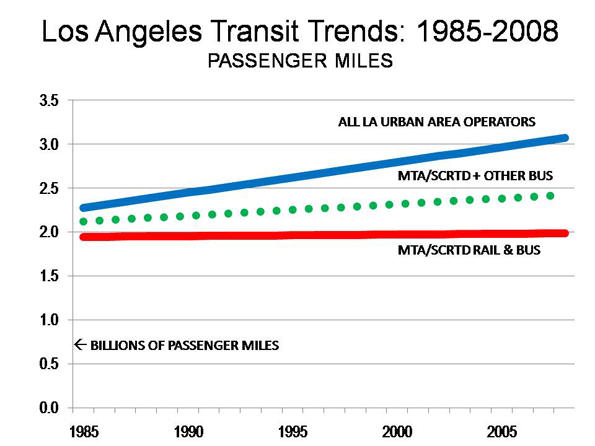
    The Results: The reality is quite different. Even when gasoline prices peaked at nearly $5.00 per gallon in 2008, total MTA bus and rail ridership was 5% below 1985 levels, indicating that for each new rail rider; at least one former bus rider had abandoned transit. Daily bus ridership dropped more than 300,000 (Table 1).

    Moreover, traffic congestion growth slowed during this decade Los Angeles not due to a shift to transit (there wasn’t one), but because of its anemic population growth, with Los Angeles County adding only one-quarter the number of new residents during the 2000s as had been forecast. The Los Angeles metropolitan area (including Orange County) also had the highest rate of domestic outmigration in the nation from 2000 to 2009, losing at a rate one-third greater than Detroit. Employment in Los Angeles County was at the same level in 2008 as in 2000.

    Table 1
    MTA/SCRTD Ridership, Costs and Fare Recovery: 1985-2008
      1985 2008 Change
    Unlinked Trips (Millions)             497          474 -5%
    Passenger Miles (Millions)          1,947      1,989 2%
    Operating & Annualized Capital Costs (Millions)  $      1,077  $  1,775 65%
    Cost per Passenger Mile  $        0.55  $    0.89 61%
       Bus: Cost per Passenger Mile  $        0.55  $    0.77 38%
       Light Rail: Cost per Passenger Mile  $    0.85
       Metro: Cost per Passenger Mile  $    1.81
    Fare Ratio 23% 19% -19%
       Bus: Fare Ratio 23% 25% 5%
       Light Rail: Fare Ratio 11%
       Metro: Fare Ratio 8%
    Bus capital costs estimated using national ratio from APTA Transit Fact Book
    Rail capital costs estimated from mid-year of project construction (discounted at 7% over 30 years)

    The Costs: Rail systems are often promoted for their “cost-effectiveness.” However, these claims always exclude the cost of capital (building the system and buying the vehicles). Capital costs are far higher for rail systems than for buses. Los Angeles is no exception. It is estimated that SCRTD/MTA annual capital and operating costs rose 65% from 1985 to 2008, adjusted for inflation, in large measure due to the rail services. Bus riders pay double or triple the fares in relation to costs as rail riders (Table 1).

    With Other Bus Operators: Ridership Up, Market Share Down:

    Los Angeles is somewhat unique as a metropolitan area in having a large number of transit operators. So, even as the MTA/SCRTD system grew, the other bus systems expanded more rapidly. This was made possible by their more cost-effective operation and, especially among the newer systems, the use of competitive contracting (contracts with private operators) to reduce costs even more. In 2008, for example, more than 35% of the county’s bus service was provided by operators other than MTA. Approximately 85% of the added transit usage (passenger miles) from 1985 to 2008 was from the bus services of these other operators.

    Overall transit ridership increased in the Los Angeles urban area, with the new five-county Metrolink commuter rail system contributing substantially to the increase as well. The neighboring Orange County Bus system doubled its ridership, while rejecting rail (Figure). Even so, transit’s market share in the Los Angeles urban area declined nearly 10% from 1985 to 2008 (Table 2).

    Table 2
    LOS ANGELES URBAN AREA ROADWAY & TRANSIT DATA
      1985 2008 Change
    Annual Roadway Passenger Miles    114,590   168,219 47%
    Annual Transit Passenger Miles         2,279       3,071 35%
    Roadway & Transt Passenger Miles    116,869   171,290 47%
    Transit Market Share 2.0% 1.8% -8%
     
    Freeway Lane Miles         5,310       6,992 32%
    Vehicle Miles per Freeway Lane Mile       13,487     15,037 11%
    Average Congestion Delay (Peak Period) 27% 49% 81%
    Los Angeles urban area includes Mission Viejo urban area.
    Metrolink commuter rail system: 75% of passenger miles estimated in Los Angeles urban area.
    Annual passenger miles in millions

    Prospects: The Next 30 Years

    Los Angeles has again committed to a major expansion of transit service, despite the fact that the Metro and light rail lines have done little more than siphon ridership from buses. There is little to suggest that the future will be any more successful than the past.

    • MTA, like LACTC before it appears to have over-promised on transit expansion. 35% of a half-cent sales tax is no more likely to finance a 12 line expansion today than a 35% share could fund an 11 line expansion in the 1980s and 1990s.
    • Nonetheless, new transit lines will be built. These Measure R expansions are likely, however, to be no more successful in reducing traffic congestion than the earlier rail expansions.

    Further, funding the Measure R rail system is likely to be more challenging. The original Proposition A was followed by decades of growth, which generated rising tax revenues. Now, however, both LA’s population and employment growth have ground to a standstill. The rosy revenue forecasts are not likely to be achieved, which should be a matter for concern among not only local officials, but to the federal taxpayers being asked for a hefty advance.


    Notes

    1. LACTC had held hearings on a proposed ballot initiative, but a consensus had developed that no referendum would be placed on the ballot in 1980. Chairman Hahn surprisingly called a special meeting of LACTC just before the deadline for submitting a measure to the ballot.

    2. LACTC was the principal transportation (transit and highways) policy body in Los Angeles County from 1977 to 1993. By state law, the commission included the mayor of Los Angeles, the five county supervisors (county commissioners), the major of Long Beach, two elected officials from smaller cities, and two additional appointments by the mayor of Los Angeles. Mayor Tom Bradley routinely appointed a city council member to LACTC and a private citizen (three times the author of this article). In 1992, LACTC and SCRTD merged into the Los Angeles County Metropolitan Transportation Authority (MTA), which has a similarly composed board of directors.

    Illustration: 1980 Proposition A Rail Map (Los Angeles County Transportation Commission)

    Wendell Cox is a Visiting Professor, Conservatoire National des Arts et Metiers, Paris. He was born in Los Angeles and was appointed to three terms on the Los Angeles County Transportation Commission by Mayor Tom Bradley. He is the author of “War on the Dream: How Anti-Sprawl Policy Threatens the Quality of Life.