Category: Politics

  • Trump Country: Where the Immigrants Aren’t

    Trump did best in the states with the lowest percentages of foreign-born residents.

    “I love the poorly-educated”, gushed Donald Trump after winning the Nevada primary in February. But in the end, what happened in the primary, stayed in the primary. Come November, Trump lost the state to Hillary Clinton, a turn that is explained by the fact that there is a higher percentage of foreign-born residents in Nevada than in any state won by Trump, save Florida.

    In fact, Trump won the general election because he carried almost all of the states where there are few foreign-born residents. His anti-immigration message resonated most in the parts of the country that have the fewest immigrants. Of course, he also won immigrant-heavy Arizona, Florida and Texas, but mainly by prevailing in rural counties. He lost in the counties that include the major urban centers of Miami, Orlando, Tampa, Dallas, Houston, Austin and San Antonio. He did win in Maricopa county where Phoenix is located but perhaps not in Phoenix itself. (Maricopa county encompasses a lot more than Phoenix as it is larger by itself than the entire state of New Jersey, and larger than Connecticut and Delaware put together.)

    If the size of the Trump vote can be used as a proxy for a state’s sentiment towards immigration and concern about terrorism, and it probably can, then it seems that the people who are most worried about immigration and terrorism are those who are the least exposed to it and the least at risk from it. This is counter-intuitive from the point of view of probability: why worry about a low probability event? But it could make sense from the point of view of fear: many people can be prone to fear and to misunderstand what they do not know well. Their opinions of others are formed mainly by what they see or read in the media, rather than by their own first-hand experiences.

    Where Trump Won

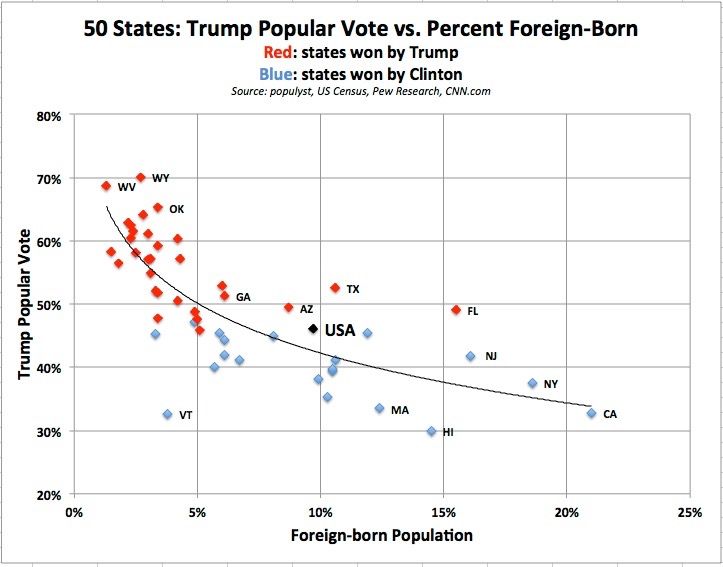
    In the United States overall, there were in 2015 as many as 42 million people who were born in another country, or 13.2% of the US population. But as shown in the chart, every state won by Trump last November, except for Arizona, Texas and Florida, has a smaller percentage of foreign-born than the national average. In fact, the lower the percentage of foreign-born in a given state, the better Trump has done in that state.

    In Wyoming and West Virginia (3.6% and 1.5% foreign-born), he carried approximately 70% of the popular vote. But in Georgia (9.8% foreign-born), he carried about 50%. This difference in the vote cannot be totally attributed to the fact that a majority of the foreign-born probably went for Clinton, given that the difference between 70% and 50% is far higher than the difference between 9.8% and 3.6% and that the latter variable includes non-voters such as children and undocumented immigrants.

    Meanwhile California, New York, New Jersey, Nevada, Hawaii and Massachusetts all have a higher percentage of foreign-born than the national average and they all voted for Hillary Clinton by wide margins. With Illinois, the District of Columbia, Washington state and a few others, these are the states with the big urban centers that saw the largest protests against the recent executive order banning entry from seven Muslim countries.

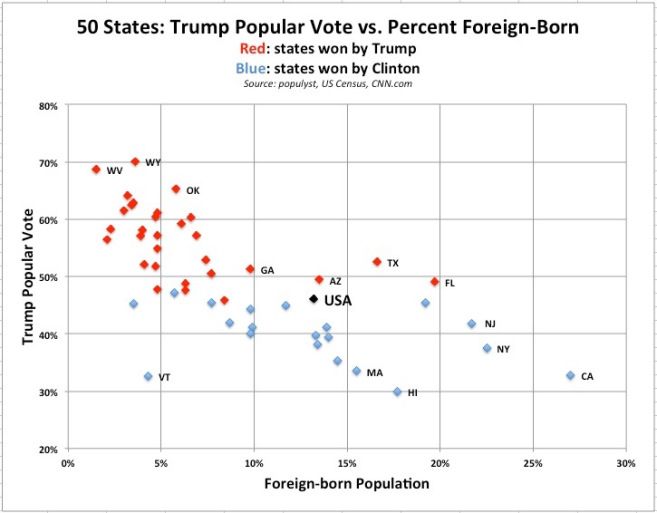
    In the above chart, the percent of foreign-born (provided by the US Census) includes unauthorized migrants. Pew Hispanic Research estimated their numbers in every state as of 2014. If we strip the unauthorized figure from the foreign-born figure, we end up with an even better correlation. The resulting chart below reinforces the notion that Trump did well in inverse proportion to the foreign-born presence in any state.

    Texas and Florida are moderate outliers in the sense that Trump did better than one would have expected from the regression. But conversely, he did far worse in the New England states, in particular Vermont, New Hampshire and Maine all of which have fewer than 5% foreign-born in their populations. Vermont is a big outlier, ostensibly because of the number of former New Yorkers living in the state, or the Bernie Sanders factor. Its total population is also very small at around 630,000.

    (click and zoom in to enlarge the table)

    screen-shot-2017-02-03-at-10-37-43-am-2

    With his current policies, the President is not courting any immigrant-heavy states and his solid base elsewhere allows him to ignore the protests. People who live in the rural South or Midwest may feel just as strongly in favor of the visa ban or of other Trump initiatives but their low-density living makes it harder for them to make their numbers visible through outdoor protests. The same is true of the lower density regions of Arizona, Florida and Texas where support for Trump was rock solid.

    Terror Calculus

    It is also worth noting that the Trump states (red in the chart) have not been the targets of terrorist activities or threats to the same extent as New York or Washington DC. So here again, the people more often targeted by terrorism seem less worried about newcomers and Muslims than people who live in a small town or rural setting where the odds of terror attacks are close to nil. Terrorists want to inflict as much damage and as many casualties as possible, a more attainable goal in dense urban centers. Even if they targeted smaller localities, the odds that it would be one’s own small town out of thousands of others are probably no greater than the odds of a mass shooting by a citizen born and raised in the United States.

    Meanwhile, there is only one New York City and only a few cities of the size of Chicago or Washington DC. Even in these cities, the odds of being a victim of terrorism are very small. An attack may well occur but the likelihood that it will be at the exact time T and place P where a resident R may find himself, out of hundreds of millions of other possible daily T-P-R combinations, is indeed minimal. Of course, a scenario involving a WMD attack throws off this tragic and otherwise reassuring calculus. But then this speaks more to the need for detection and prevention of WMDs, rather than to the extreme vetting of individuals originating from certain countries.

    So to sum up, people who have few if any foreign neighbors appear to be more worried about foreigners and terrorism than people who have many foreign neighbors. And from their sparsely populated townships, they could now effect restrictive policies not only for their own localities, but even for the large cities that they rarely visit. This is not so unusual. Historically, decisions made at the center have not always complied with local preferences. However, it should be added that historically, it was more often the preferences of the big cities that were imposed on the great plains.

    President Trump says he loves the poorly-educated but he also relies on the support of voters who are less exposed to immigrants. Which then begs the following question: how deep is these voters’ sentiment towards the foreign-born in places where they are scarce, and for how long can the President tap it to maintain his popularity? A lot hinges on the answer.

    Sami Karam is the founder and editor of populyst.net and the creator of the populyst index™. populyst is about innovation, demography and society. Before populyst, he was the founder and manager of the Seven Global funds and a fund manager at leading asset managers in Boston and New York. In addition to a finance MBA from the Wharton School, he holds a Master’s in Civil Engineering from Cornell and a Bachelor of Architecture from UT Austin.

    Photo: Gage Skidmore, CC License

  • How Richard Longworth Predicted 20 Years Ago That Globalization Would Cause a Social Crisis

    Global Squeeze: The Coming Crisis for First-World Nations
    Richard C. Longworth
    McGraw-Hill 1998

    Whenever we see the reality of momentous shifts in society, it’s always good to go back and take a look at the people who saw it coming far away. Generally speaking, there were usually people who understood what was happening in advance. For example, Daniel Bell wrote his book The Coming of Post-Industrial Society in 1976. There were probably even other earlier books touting the same theme.

    One person who clearly saw the challenges that globalization would bring to the developed countries was Richard C. Longworth. Longworth was a reporter for most of his career, and a long time foreign correspondent at the Chicago Tribune. Most readers here probably know him from his 2008 book Caught in the Middle: America’s Heartland in the Age of Globalism.

    But arguably more important was his 1998 book Global Squeeze: The Coming Crisis for First-World Nations, a book in which Longworth predicted most of the dynamics that would play out in the next two decades, culminating (so far) with Trump’s election. He predicted massive job displacement from China’s entry into the global trading system, describes how developing world countries would move up the value chain, predicts the erosion of middle-class standards of living, the rise of the gig economy, and the deterioration in race relations. He puts his finger on the nationalism vs. globalism debate and anticipated populist revolt. He didn’t predict everything, but he nailed an awful lot of it.

    I don’t know how this book performed in the market, but its timing was certainly inauspicious. It came out right as the dot com boom was going nova. Just as one contemporaneous event, on March 30 of that year James Glassman and Kevin Hassett wrote an op-ed in the Wall Street Journal (which no longer appears to be online) that became the basis of their now infamous 1999 book Dow 36,000.

    I was then in my late 20s and about to leave Andersen Consulting (now known as Accenture) for a telecom startup. I had no inking of how the future would ultimately play out, but I was incredibly, and naively, optimistic. Since coming out of school at the end of the early 90s recession, the tech industry had been booming beyond belief.  The post-mainframe tech transitions of the 90s, plus the nationalization (and early stage globalization of business) drove fantastic demand for consultants and while collar workers. It was truly the golden age for young people with college degrees. Unlike today’s Millennials, who are experiencing downward economic mobility, our salaries were soaring.

    Having a great employer and living in a nascently gentrifying Chicago, I was living in a bubble. I certainly did not see trouble ahead in these boom times. I was aware that manufacturing was in structural decline, but my assumption was that this was transitional and generational. Future generations would enter the exploding white collar workforce as I had and industrial displacement would be as forgotten as agricultural displacement had been.

    I didn’t see it coming. But Longworth did, even in those boom times.

    A Critique of Free Trade

    It’s interesting to see how Longworth, someone you’d certainly place today as in the mainstream of center-left thinking, was at that time sharply critical of what is now considered conventional wisdom by both parties, such as free trade dogmatism. For example, he criticizes the doctrine of comparative advantage:

    World trade is based on the idea that each nation should make what it makes best and most cheaply, and then trade those wares to another nation for what that nation makes best and most cheaply. In the process, both nations will prosper and will have access to better goods than if they tried to do it all themselves. This is the principle of ‘comparative advantage.’ It also has very little to do with trade in the real world of the global economy….Trade as it exists today bears little resemblance to the textbook images dear to the heart of free traders, for several reasons. One reason deals with the ability of giant firms to create comparative advantage and move it around the globe. If world trade used to take place between companies in different countries, it goes on as often now between branches of the same company operating in many different countries…These are not cases of countries taking advantage of their natural competitive advantages to make goods and services that can be sold freely to less-favored countries. They are cases of companies using technology to build enclosed and controlled trading systems.

    This is part of his general disdain for the economics profession:

    [Robert Z.] Lawrence and most of his mainstream colleagues are devoted free traders, literally trained from their undergraduate days to reject the thought that trade can cause more harm than good. Lawrence has even warned against letting such ideas get around, saying, ‘The very perception that a link exists [between trade and labor problems] could put the continuing evolution of trade and investment flows at risk.’ No one actually accuses these economists of faking their evidence to protect the sanctity of free trade. But it’s clear that many economists have carefully limited their research to product the results they wanted. The growing evidence that free trade can indeed cause severe damage, and that this damage may even outweigh the gains is producing nothing less than a religious crisis among the true believers in the economics departments of American universities.

    They may possibly have had a momentary crisis of faith in the 1990s, but if so, they quickly repented of their heresy. If anything, the economics profession today is more militant and more hysterical about any impingement on global trade than they used to be, even as they finally start to admit, belatedly, that just maybe trade with China has had some negative effects on American workers.

    I’ve been wanting to dig more deeply into trade economics because like Longworth I’m not convinced that the studies that are touted regarding trade’s effect on employment tell us what they are marketed as doing. For example, we frequently hear that research shows that relative few jobs were off shored, and that most job losses have been due to automation and other onshore productivity improvements.

    Yet I then read articles saying that just one company, Apple, and its subcontractors employ 700,000 people in China.  And I wonder: were these 700,000 jobs a) lost to trade/off shoring b) lost to automation or c) counted in some third bucket we’re not being told about? If they aren’t in large part doing jobs that would otherwise be done somewhere else, what the heck are all these untold tens of millions of workers in China manufacturing products for export actually doing?

    Longworth points out the hypocrisy inherent in some free trade arguments by pointing to China’s extremely state managed economy and highly protectionist legal system. By the standard arguments, this should have torpedoed them. Yet China has had a three decade run of fabulous growth so far. Even if they crash tomorrow, that’s remarkable. Far from chasing away businesses, even companies they’ve banned like Facebook continue to prostrate themselves before Emperor Xi hoping to get back in, all while delivering sanctimonious lectures to governments back home. And speaking of the tech industry, Longworth saw that China was using its trade discrimination rules to move up the value chain too:

    [China] has every intention of upgrading its exports from clothing and toys to high-end, high-tech, high-profit goods such as cars, electronics, and pharmaceuticals….and it is using its trade and investment policies to force Western companies to help it achieve this mastery, which it clearly intends to employ to compete with these countries in the future. Western and Japanese companies that want to invest in China are forced to bring in modern technology and teach the Chinese how to use it.

    The Primacy of the Nation and Its Social Integrity

    In contrast to the pre-Trumpian mainstream thinking of the Clinton-Bush-Obama years, Longworth argued that even if it’s economically inefficient, some type of protectionism was necessary in order for developed country societies to survive China’s entrance into the global trade system intact:

    If Japan was a problem, China will be a catastrophe. It seems impossible that the world trade system, with all its benefits, can withstand an assault of this sort….The major nations must now begin planning new rules to limit aggressive exports of this sort and to demand strict reciprocity – equal access to the markets of China…This is of course, both protectionism and managed trade, and will be attacked as such by purists who consider anything less than free trade a sin. But trade is an economic issue, not a theological one. The First World nations have civilizations worth protecting. If the price of that protection is some protectionism aimed at global predators, it seems folly not to pay it.

    This was of course rejected, and these civilizations are in fact badly damaged. And the global trade system is in serious jeopardy as a result, as Longworth predicted.

    This passage also gets at the core debate at the heart of contemporary politics: nationalism vs. globalism. Longworth tables this as they key issue in the opening passage of the book: “What is the purpose of an economy? If it is not solely for the well-being of the people who live within it, what is an economy for?”

    Longworth at this point in time clearly sided with the nationalist perspective, though as we’ll see in part two this review, his personal and political background created cognitive dissonance on this point that caused him to ultimately side with the very people he raked over the coals in this book.

    He saw that on the path the country was on, the prognosis for the middle class was grim and threatened our very understanding of a fair society.  Sadly, he was accurate here too:

    This is the proletarianization of the middle class, which once considered itself set for life in cushioned cubicle of big corporations but now finds itself pitched onto the pavement, a loser in the global competition for jobs. If there is a focal point of the growing debate on the global economy, it is here, where people work….The global emphasis on profits, the unrelenting pressure of the capital markets, and the search for best practice preclude comforting answers. The truth is that no one at this stage can give answers with assurance. The logic of global markets leads to more pressure on workers, not less. Millions of new workers appear on the world market every year, all hungry and ready to compete. The power of computer-driven automation makes it at least possible that, for the first time, new technology will be a job destroyer, not a job creator….This is the “race to the bottom,” a process that drives incomes ever lower. It is also straightforward supply-and-demand economics at work…This is the dehumanization of labor. No other major country treats its workers as commodities in this way, as raw materials or components that can be bargained to the lowest price.

    He also correctly foresaw that race relations would degrade with economic stresses. Not only did this cause the white working class to prioritize its own self-interest (the same as every other group), but if the white working class sneezes, the black working class gets a serious case of Spanish flu. As Longworth says:

    Racial progress, if not racial harmony, is real. The past three decades in particular have seen once-closed doors open for the vast majority of blacks. Anyone who can recall the legal segregation of the immediate postwar years must marvel at the changes. But economic problems threaten much of this progress.

    The retrogression of the racial fabric that we’ve seen is part of that social unraveling that he saw unfettered globalization imposing on America.

    And there’s much more he got right, including seeing the rise of the “gig economy” in a section called “A World of Temps.”

    The Moral Bankruptcy of the American Elite

    One of the major themes woven throughout the book is the moral bankruptcy of America’s elite and more broadly those who, like me at that time, were living large and loving life thanks to this new economy.

    He adopts Robert Reich’s “secession of the successful” thesis:

    The upper 20% retreats to its gated communities in the suburbs, withdrawing not only physically but psychologically and socially from the country around it. They are not only the wealthy, the executives and traders, but also the economists, journalists, and others who tout the global economy largely because they are best equipped to cope with it and most insulated from its effects. These fortunate few go by different names. Rohatyn calls them the “technological aristocracy.” Robert Reich, the former secretary of labor, calls them “symbolic analysts”….I prefer to think of them as global citizens, having more in common with the elites of Tokyo and Frankfurt than with the other Americans who live beyond the gates, in the shantytowns on the outskirts of the global village. Any country needs its elites. It needs their money, and more important, it needs their leadership. Now the United States is losing its elites.

    He talks about the dismal ethics and reckless behavior of much of the financial class:

    American traders usually have more formal schooling than their British counterparts, but they have no less ambition and no more real knowledge of the world. Most know the difference between normal risk and betting the bank. But some don’t. Most are honest. But some aren’t. Barely prepared and innocent of ethics, these traders are pitched into stupendous sums of money.

    He describes how major Western corporations came to think of themselves as post-national, and repudiated the social contract:

    Once the social contract expressed a deal between the wealthy and the poor, between businesses and their employees. Economic change has always brought both gain and pain. But in the short run, the wealthy were more likely to get the gain, and the poor more likely to feel the pain. The great stabilizer of postwar industrial society was the recognition by government and business that, if change creates both winners and losers, then the winners have an obligation to help and compensate the losers. This was more than simple fairness. It was good politics. It was the price that the winners paid to pacify the losers, who had the vote. If the pain became too great, the losers would stop supporting the system that caused the pain. So the Western nations created the safety net, a social balm that soothed the pain and kept the losers non-mutinous.

    This social contract has been broken. Footloose global corporations have stopped paying the taxes that financed it. The slack has been taken up, at least partly, by higher taxes on workers. In other words, workers are financing their own social contract. It’s robbing Peter to pay Peter. The losers are comforting the losers, while the winners pay minimal taxes in Indonesia or buy bonds in cyberspace.

    Or set up shell companies in Ireland or Luxembourg. The merits of corporate taxation are debatable. But we’ve all read the stories of how these Silicon Valley firms have racked up gigantic profits while using complex strategies to pay little if any tax.  It’s indisputable these companies have little concept of the social contract as previous generations understood it.

    These global companies have even seceded from national legal systems in favor of private justice.

    Even the functions that the governments used to do are being taken over by the global market. With no global laws or regulations to discipline these global markets, a sort of privatized form of justice has arisen. Around the globe, private arbitrators and arbitration centers are producing a “transnational legal profession and indeed a transnational private judiciary. These arbitrators, being private, compete for business and so depend on the goodwill of the corporations they judge. These corporations, in turn, use this private judicial system largely to escape the jurisdiction of national courts.

    These private courts can even force nominally sovereign nations to submit to them. That’s because these trade treaties set up international arbitration courts that empower businesses to sue countries outside of those countries’ home court systems. This is nothing less than a destruction of sovereignty, and one of the biggest complaints critics have about these “trade” treaties. There’s a reason it takes 5500 pages to print a so-called “free trade pact” – and it’s not free trade.

    As you can see, there’s a ton that Longworth got right 20 years ago – and he put his finger on issues that are if anything more relevant to public debates now than they were then. In fact, a few anachronisms aside, Global Squeeze holds up very well and is still eminently worth reading today. If nothing else, doing so will make clear that anyone who claims “we didn’t see it coming” isn’t telling the truth. Some people did see it coming. But they were ignored.

    That’s not to say Longworth predicted or got everything right. In the second part of this series I’ll highlight the areas he missed, and also how cognitive dissonance on his part and that of others like him who were sharply critical of globalization back then fatally undermined their efforts at reform and led them to ultimately be perceived as champions of globalization.

    Aaron M. Renn is a senior fellow at the Manhattan Institute, a contributing editor of City Journal, and an economic development columnist for Governing magazine. He focuses on ways to help America’s cities thrive in an ever more complex, competitive, globalized, and diverse twenty-first century. During Renn’s 15-year career in management and technology consulting, he was a partner at Accenture and held several technology strategy roles and directed multimillion-dollar global technology implementations. He has contributed to The Guardian, Forbes.com, and numerous other publications. Renn holds a B.S. from Indiana University, where he coauthored an early social-networking platform in 1991.
  • Decentralize Government to Resolve Country’s Divisions

    America is increasingly a nation haunted by fears of looming dictatorship. Whether under President Barack Obama’s “pen and phone” rule by decree, or its counterpoint, the madcap Twitter rule of our current chief executive, one part of the country, and society, always feels mortally threatened by whoever occupies the Oval Office.

    Given this worsening divide, perhaps the only reasonable solution is to move away from elected kings and toward early concepts of the republic, granting far more leeway to states, local areas and families to rule themselves. Democrats, as liberal thinker Ross Baker suggests, may “own” the D.C. “swamp,” but they are beginning to change their tune in the age of Trump. Even dutiful cheerleaders for Barack Obama’s imperial presidency, such as the New Yorker, are now embracing states’ rights.

    The founders’ solution

    When the founders crafted the Constitution, they confronted a country with deep divisions — rural and urban, slave and free, immigrant and nativist, manufacturing and commodity producing. The solution they came up with had its shortcomings, notably the tolerance of the truly deplorable institution of slavery, but without these built-in restraints the republic likely would not have survived its first decades.

    Even after the Civil War settled control of the central government, the country largely followed the founders’ vision of separating and restraining power. Education, zoning, laws and the governing of morality were handled largely at the local level. The federal government focused on things that were its natural purview — interstate transportation, immigration, foreign and defense policy.

    Federal intervention remained necessary at times, for example, to assure voting rights. But, overall, maintaining power at the local level has remained broadly popular, with the support of over 70 percent of the adult population. Even in one-party California, most would prefer to see local officials, not those at the national or state level, in control.

    Division and the road to alternating dictatorships

    As in the antebellum period, American politics sadly reflects two increasingly antagonistic nations. One can be described as a primarily urban, elite-driven, ethnically diverse country that embraces a sense of inevitable triumphalism. The other America, rooted more in the past, thrives in the smaller towns and cities, as well as large swaths of suburbia. Sometimes whiter, the suburbs are both more egalitarian and less reflexively socially liberal.

    This division worsened in the Obama era, whose city-centric approach all but ignored the interests of the resource-producing regions of the country, as well as the South. In contrast, under Presidents Bill Clinton and Jimmy Carter, Democrats were joyously competitive in these areas, assuring that the party was truly diverse, rather than simply the lap dog of the littoral constituencies.

    With the GOP now in control of Washington, the coastal areas are becoming, to paraphrase President Obama, the new clingers, whether on the environment, racial redress or gender-related issues. Now they fear, with good reason, that the very administrative state they so eagerly embraced could come back to undermine their agenda even at the local level.

    Republicans, for their part, are stoking these fears by using statehouse control to slap down efforts by communities in the states they control to embrace progressive policies on minimum wages, transgender bathrooms and fracking bans. By doing this, the GOP could be accused of engaging in its own form of payback, which simply assures that when the Democrats get back in power, they will do the same to them.

    Read the entire piece at The Orange County Register.

    Joel Kotkin is executive editor of NewGeography.com. He is the Roger Hobbs Distinguished Fellow in Urban Studies at Chapman University and executive director of the Houston-based Center for Opportunity Urbanism. His newest book The Human City: Urbanism for the rest of us, was published in April by Agate. He is also author of The New Class ConflictThe City: A Global History, and The Next Hundred Million: America in 2050. He lives in Orange County, CA.

    Photo: Matt H. Wade, [CC BY-SA 3.0], via Wikimedia Commons

  • How the Visa Ban Will Hurt US Innovation

    A key reason for the prosperity found in the United States is the ability of universities and companies to attract the best and brightest people from abroad. Shutting out skilled individuals from entire countries could have grave consequences for America’s intellectual institutions as well as knowledge-intensive businesses. The obstacles put in place following the 2001 terrorist attack did reduce the position of the US in the global competition for talent, yet the regulations were about increasing security and allowed those that had been screened to enter. The new visa ban sends a message to talent from majority-Muslim countries: you are not wanted here, even individuals posing no threat. It is hard to imagine that this will not hurt America’s goodwill significantly, particularly in the European tech-sector where people from countries such as Iran play an important role.

    To illustrate the importance of talent attraction one only needs to look at Silicon Valley, the world’s greatest hub for new technologies and entrepreneurship. It is no coincidence that Silicon Valley has grown in close connection to Stanford University, one of the leading global institutions for learning and research in engineering and sciences. Without the brains attracted to Stanford and other similar universities, innovative American businesses such as Cisco, eBay and Netflix would not be able to dominate the global marketplace. Top entrepreneurs in Silicon Valley and other tech-hubs are understandably concerned about the visa ban. Facebook CEO Mark Zuckerberg was among the first to address the ban publicly, writing on Facebook: “We need to keep this country safe, but we should do that by focusing on people who actually pose a threat”. Since then numerous other CEOs spanning from the Automotive sector to the Pharma industry have made their voices heard against the travel ban.

    Much of the talent that fuels America’s universities and tech hubs comes from abroad. Between 1990 and 2014 for example, the college-educated immigrant population increased 339 per cent from 3.1 to 10.5 million. A group of particular importance is graduate students in fields such as science, engineering and health. It is these individuals whose knowledge and innovative ideas fuel the technologically advanced businesses on which US exports rely. Among the graduate students in these fields, one third are not US citizens or permanent residents, but rather foreign visitors. In some fields, international students make up the majority. An analysis of the latest data shows that 61 per cent of full-time graduate students in computer science are international. In the field of Electrical Engineering the share is even higher, 72 per cent.

    Where do these students come from? China and Korea are countries often associated with global talent influx into the US. But, we should not forget that several Muslim-majority countries, such as Pakistan and Iran, are also of importance, along with Muslim groups from India and Bangladesh. An illustrative example is Maryam Mirzakhani, born in Iran in 1977. Showing an early gift for mathematics, she received a degree from Sharif University of Technology in Tehran. After moving to the US, Maryam earned her PhD from Harvard before becoming a young professor at Stanford. In 2014 she was awarded the International Medal for Outstanding Discoveries in Mathematics. Maryam was the first women to win the medal, unofficially referred to as the “Nobel Prize of mathematics”. Since it was established in 1936, all previous winners have been male.

    Her story is not unique. In 2003, administrators at Stanford University’s Electrical Engineering Department were reportedly startled when the notoriously difficult entrance exam for PhD studies had been aced by a group of foreign students. The majority originated from one place – the same Sharif University where Maryam had studied. Stanford is not an isolated example. Iranian top students are doing well in the International Science Olympiads and flourishing in foreign universities.

    The Trump administration’s visa ban is affecting graduate students from Stanford. The Stanford Daily reported that Mostafa Afkhamizadeh, a Stanford PhD student born in Iran, was visiting his family when the presidential order was unexpectedly announced. The prospects for the fifth-year PhD student remain unclear. Will he be able to travel back to the US to finish his research studies in management science and engineering? Another example is that of Nisrin Omer, a Sudanese Harvard University graduate who is a graduate student in anthropology at Stanford. Although Omer is a legal U.S. resident and has lived in the country since 1993, she was briefly handcuffed and detained at JFK airport. There are more examples to be found amongst Stanford PhD students alone, such as Khashayar Khosravi and his fiancée whose wedding plans have been disrupted by the visa ban simply since they both happened to be born in Iran. We should keep in mind that the next wave of graduate students seeking to apply to foreign universities are taking note of the new risks associated with applying to the US. It helps putting oneself in someone else’s shoes: if you were a talented young Pakistani student, would you apply to a university in the US next year?

    Not long ago, the US was the unchallenged destination of choice for global talents. Following the 2001 terrorist attacks, the Bush administration introduced background checks that made it time consuming for international students from certain countries to enter the US. Some of the brightest international students could not gain entry into Stanford and other top US institutions, which led them to universities in Canada, the UK, and Germany. Suddenly, academic institutions outside the US realized that they could better compete. Universities which have attracted some international talent are more likely to attract additional international talent – since top students from abroad follow in the footsteps of previous top students, and because universities that have learned to attract some talents will have an easier time attracting others.

    The position of the US as the unchallenged destination of global talent has shifted since the policies of the Bush administration. Today, the best American universities are often but not always the top choice. While the US takes the influx of international brains as a given, governments in other countries are keenly aware that we live in a world where competitiveness is increasingly about knowledge. A study presented for Global Affairs Canada last year estimates that after accounting for Canadian scholarships and bursaries, the total annual expenditure of international students, their families, and friends contributed $9.3 billion in GDP to the Canadian economy. The long-term benefit of attracting this human capital from abroad will likely be many times higher. The Canadian government is actively signaling to global talent: we embrace you. This is, to say the least, not quite the positive message sent out by the US.

    The visa ban’s repercussions matter for international exchange between technology firms. Talent from majority-Muslim countries plays a key role in the technology sector not only in the US, but also in a range of other countries. For example, a study found Stockholm, the capital city of Sweden, “is the second most prolific tech hub globally, with 6.3 billion-dollar companies per million people (compared to [Silicon] Valley with 6.9)”. The innovative companies in Stockholm grow in close connection with those in the US, not least in Silicon Valley. In the Stockholm tech sector, people born in Iran and other parts of the Middle East make up a significant share of the engineers, researchers and entrepreneurs. Creating barriers for these individuals to travel to the US – as the visa requirement introduced last year by congressional Republicans did and the Trump ban reinforced – makes it difficult for Silicon Valley to grow along with tech hubs worldwide. The unicorn factory of Stockholm is a single example, many more can be found across Europe. Highly educated people from countries such as Pakistan and Iran play an important role in the European tech sector. They, and their colleagues, are anything but happy with the visa ban.

    While the direct effect of the visa ban is bad news for the US in an increasingly talent driven environment, the message it sends to the world is even worse: the Trump administration is willing to shut people out simply due to their place of birth. A comparison to the tighter rules introduced after the terrorist attack in 2001 is useful to illustrate this point. While certainly causing problems for many individuals, those affected then could sympathize with the effort to increase US security. The policy was about increasing security, not excluding those born in the “wrong countries”. The ban says to educated people from majority-Muslim countries, you are not wanted in the US. In a global knowledge economy, where the obstacle for growth is increasingly a lack of talent rather than a lack of financial capital, this form of policy is not wise. It will certainly hurt the promise of the Trump administration to boost US competitiveness. Republicans in favor of sound economic policies should advocate that the ban be replaced with more nuanced measures focused on security, not exclusion based on nationality.

    Atta Tarki is the CEO of Ex-Consultants Agency, an executive search firm helping Fortune 500 companies solve their most pressing talent needs across the world.

    Dr. Nima Sanandaji is the president of the European Centre for Policy Reform and Entrepreneurship. A number of his books, such as “Debunking Utopia”, “The Nordic Gender Equality Paradox”, “Renaissance for Reforms” and “SuperEntrepreneurs” have gained widespread international attention.

    Photo: Fibonacci Blue from Minnesota, USA (Protest against Donald Trump’s Muslim ban) [CC BY 2.0], via Wikimedia Commons

  • Trump and the End of the World Order

    In comparison with Barack Obama, who was well regarded in the foreign media, Donald Trump does not come off as a good guy. He is also clearly redefining the country’s identity and global focus. The first American president since the 1920s to walk away from a role as global pooh-bah, Trump instead defines his job as helping the people who elected him.

    Trump’s new nationalism, spelled out in his inauguration speech, effectively rejects both the progressive globalism of the Obama years and the conservative idealism associated with George W. Bush. In the process, Trump has managed to outrage virtually the entire foreign policy establishment, including the CIA “deep state,” and more than a few foreigners as well. Everywhere in the mainstream media, here and around the world, Trump is portrayed as a destroyer of ideals, institutions and alliances bringing, in the words of the Atlantic, “the end of the American century.”

    Failure of the globalists

    Yet, as Larry Summers has pointed out, there’s a reason for the rise of “populist authoritarianism.” What he calls “global elites” have been more focused on working with their foreign counterparts than helping their own middle- and working-class populations.

    The old order is not working out all that well. The foreign policy establishments of both parties have ended up producing an America that is perhaps the weakest it has been since the end of the Vietnam debacle. George W. Bush launched a disastrous war in Iraq, which drained the country’s riches, bled its military and, in the end, left Iraq as a de facto Iranian vassal. For good measure, he pushed the expansion of trade in ways that accelerated the decline of many American industries, particularly in the Midwest, while helping boost China as our most formidable rival since the fall of the Soviet Union.

    If, as Council on Foreign Relations President Richard N. Haass has suggested, Bush did too much, Obama’s response was to do too little. By his prevarications and refusal to acknowledge the world as it is, Obama has left behind a disastrous reality. Despite engaging in several armed conflicts and increasingly lethal drone attacks, U.S. influence in the Middle East has weakened while that of Iran and Russia has soared. To be in second place to Russia — with an economy about the size of that great economic superpower, Italy — in the Middle East owed little to hacking, but much to greater skill at outmaneuvering the Obama administration’s diplomacy.

    The real challenge: China

    Despite the progressive hyperventilation about Russia, the real policy challenge lies with China, the only country that presents a serious economic and, ultimately, military threat. Despite Obama’s “pivot to Asia,” the U.S. position has demonstrably weakened there as well. China has shifted the rules of trade in its favor, built islands to gain control of the South China Sea, upgraded its military and won over old allies such as the Philippines. It is making huge inroads in Africa, and even in Latin America.

    Now Trump’s often unfocused belligerence opens the door for Chinese President Xi Jinping to posture himself as the new enlightened global hegemon. Here’s the man who heads up the world’s biggest emitter of greenhouse gases — a country committed to building more coal plants and not halting emissions growth before 2030 — preening as the enlightened son of science. A dictator who increasingly adopts an authoritarian Maoist ideology while bolstering a crony capitalist empire, Xi has convinced some progressives that he is a great advocate of free trade, something he and his country have not embraced in the real world.

    Read the entire piece at The Orange County Register.

    Joel Kotkin is executive editor of NewGeography.com. He is the Roger Hobbs Distinguished Fellow in Urban Studies at Chapman University and executive director of the Houston-based Center for Opportunity Urbanism. His newest book The Human City: Urbanism for the rest of us, was published in April by Agate. He is also author of The New Class ConflictThe City: A Global History, and The Next Hundred Million: America in 2050. He lives in Orange County, CA.

    Photo: Matt A.J., Creative Commons

  • What the U.S. Thinks About Immigration – and Why it Should Matter When We Attempt Reform

    Americans agree that the country’s policies on handling immigration have long needed reform. However, what kinds of reform and the impact immigration itself has on the United States are matters of great controversy. For both former Presidents Barack Obama and George W. Bush, promising efforts at comprehensive immigration reform were blocked by the unrelenting opposition.

    As Obama’s second term began it seemed that the time for successful comprehensive immigration reform had arrived, especially when the Senate passed its major reform bill in June 2013. However, with the Republican-controlled House refusing to give it consideration, the bill died when the congressional session ended the next year. With both chambers in Republican hands after the November 2014 elections, any executive reforms needing congressional approval were doomed.

    Consequently, President Obama acted unilaterally on immigration, contending that he had the requisite authority to do so. He announced a new policy, the Deferred Action of for Parents of Americans, which deferred deportation of individuals who met the new guidelines. Although this executive action was very popular with Democrats and Hispanics, it was opposed by a slight national majority in the first surveys after its announcement.

    When asked the question of whether they approve or disapprove of the way Obama is handling immigration, 51% of the total population and 85% of Republicans disapproved. The question was asked at more than three dozen points between April 2015 and October 2016.

    More so than any of the other Republican candidates, Donald Trump seized on the issue of immigration with his strong, restrictionist positions which resonated with primary voters. For example, in the crucial South Carolina primary, the Trump vote was 14 percent higher among those who agreed that all illegal immigrants should be deported than his overall vote in the state (which was 33 percent). For the 27 states with exit polls (and a few entrance polls for caucus states), Trump’s advantage among voters agreeing with the deportation of illegal immigrants was 13 percent; for a ban on all Muslim immigration it was 9 percent. By comparison, on his best performing economic question his advantage was only 4 percent.

    One of President Trump’s most defining issues has been his promise to build a wall across the entire U.S. Mexican border. This position proved very popular with his supporters, 87 percent of those who voted for him in the Republican primaries were in agreement. This was 31% higher than the average for Republicans supporting other candidates.

    However, when we turn to the overall population, support for Trump’s position drops substantially. Looking at numerous surveys going back to September 2015, general popular support for the wall has been consistently below 50%, often substantially so, and with that support falling as the country moved into the general election period.

    Until recently, the two major political parties have been evenly matched when it comes to which is more trusted to handle the immigration issue. However, last year, a small advantage opened for the Democrats. When asked on seven different occasions between March and September 2016 which candidate they most trusted to handle immigration issues, Hillary Clinton was preferred over Donald Trump each time by a median margin of 8%. In 2012, in contrast, Mitt Romney had a slim median advantage of 1% over Barack Obama.

    Nonetheless, since Republicans retained control of Congress in the 2016 elections, President Trump should find a strong base of legislative support for his immigration initiatives. This should be especially true in the House of Representatives for restrictionist sentiment prevails in the states with the largest Republican delegations.

    However, when we move from Republicans to the overall population a different story emerges which may complicate action in the Senate where the filibuster gives Democrats important leverage. For some years, the public has been moving toward the expansionist position on immigration-related issues (although notably still preferring a decrease in overall immigration levels). Support for a path to citizenship for illegal immigrants already in the country has been growing and for the past four years it has commanded a slight majority. Despite his best efforts, President Trump has failed in moving the majority of Americans towards his position on this issue.

    President Trump should be able to redirect national immigration policy where he can take unilateral executive action, but not without substantial opposition. The executive order he issued at the end of his first week, banning travel from seven Muslim-majority countries, has sparked protests around the country, raised many legal questions, and prompted international outcry. Trump could very well be stymied, just as his successors were, when it comes to major changes requiring congressional approval.

    Personally, I favor a comprehensive package of reforms that lean in the permissive direction. However, I have some sympathy for those who favor greater immigration restrictions. In my years of studying immigration policy I have taken notice of the gap between what the public says it wants concerning immigration and what it has received instead from public policy. This has been especially true on questions related to illegal immigration, which there has been long-standing, deep, and wide opposition.

    This is not healthy in a democracy. Immigration expansionists have failed to meaningfully address the concerns of pluralities and even majorities of citizens consistently registered in surveys of public opinion. When there is an unwillingness to listen, a restrictionist grassroots backlash should not be a surprise.

    Regardless of one’s preferences on this issue, I believe that we all need to do a better job of paying attention to what the American public says and wants. Until we do, it is likely we will continue to be frustrated by policy stalemate.

    Charles D. Brockett has a PhD in political science and several decades’ experience teaching about immigration in courses both on U.S. and Latin American politics. A professor emeritus at Sewanee: The University of the South, he has written What the U.S. Public Thinks about Immigration—and Why It Should Matter When We Attempt Reform: The Trump Years (Kindle edition) as well as two well-received books on Central America and is the co-editor of two collections concerning immigration and citizenship in the United States—Complex Allegiances: Constellations of Immigration, Citizenship & Belonging and Shifting Balance Sheets: Women’s Stories of Naturalized Citizenship & Cultural Attachment, both published by Wising Up Press.

    Photo: lcars via Flickr Creative Commons

  • All Houston Does (Economically) is Win

    Like most big cities that get the nod, Houston has spruced itself up for the Super Bowl, planting flowers and concentrating in particular on the rough stretches between Hobby Airport and NRG Stadium. Yet it’s unlikely the city’s reputation will be much enhanced by the traveling media circus that accompanies these games.

    The last time the city hosted the Super Bowl, in 2004, the Washington Post called it “super ugly.” The website Thrillist recently named Houston “the worst designed city” in America, with the usual kind comments about porn shops near offices, lack of walking districts, fat people and awful traffic. For good measure, 24/7 Wall Street named it among the 25 worst cities in America.

    Casting shade on Houston is nothing new. In his best-selling 1946 travelogue Inside U.S.A., the journalist John Gunther described Houston as having “a residential section mostly ugly and barren, without a single good restaurant and hotels with cockroaches.” The only reasons to live in Houston, he claimed, were economic ones; it was a city “where few people think about anything but money.”

    Gunther clearly did not see a great future for the place, predicting that it would have only a million people by now. In fact, the Houston metropolitan area’s population now stands at 6.6 million with the city itself a shade under 2.3 million. At its current rate of growth, Houston could replace Chicago as the nation’s third-largest city by 2030.

    Why would anyone move to Houston? Start with the economic record.

    Since 2000, no major metro region in America except for archrival Dallas-Fort Worth has created more jobs and attracted more people. Houston’s job base has expanded 36.5%; in comparison, New York employment is up 16.6%, the Bay Area 11.8%, and Chicago a measly 5.1%. Since 2010 alone, a half million jobs have been added.

    Some like Paul Krugman have dismissed Texas’ economic expansion, much of it concentrated in its largest cities, as primarily involving low-wage jobs, but employment in the Houston area’s professional and service sector, the largest source of high-wage jobs, has grown 48% since 2000, a rate almost twice that of the San Francisco region, two and half times that of New York or Chicago, and more than four times Los Angeles. In terms of STEM jobs the Bay Area has done slightly better, but Houston, with 22% job growth in STEM fields since 2001, has easily surpassed New York (2%), Los Angeles (flat) and Chicago (-3%).

    More important still, Houston, like other Texas cities, has done well in creating middle-class jobs, those paying between 80% and 200% of the median wage. Since 2001 Houston has boosted its middle-class employment by 26% compared to a 6% expansion nationally, according to the forecasting firm EMSI. This easily surpasses the record for all the cities preferred by our media and financial hegemons, including Washington (11%) and San Francisco (6%), and it’s far ahead of Los Angeles (4%), New York (3%) and Chicago, which lost 3% of its middle-class employment.

    Voting With Their Feet

    Urbanistas may revile Houston but the metro area’s population has grown more than any other U.S. metropolis in the new millennium, up by 1.2 million between 2000 and 2010. The most recent figures show Houston’s population expanded 159,000 between 2014 and 2015, the most of any U.S. metro area.

    Much of this is a result of people moving from elsewhere, roughly 500,000 net since 2000. In comparison, New York, Los Angeles, Chicago and even the Bay Area have suffered considerable migration losses.

    It may be popular to suppose the new Texans are just a bunch of losers looking for cheap rent and low taxes. But the recent rate of increase in the population of educated 25- to 34-year-old educated people in Houston tops that of the San Jose area, and easily exceeds that of competitors like New York, Los Angeles and Boston. Houston has been getting not only bigger but also smarter.

    Like domestic migrants, foreigners like the idea of jobs, particularly decent paying ones. Since 2000 Houston’s foreign-born population has grown 60%, roughly three times the expansion in New York, San Jose and San Francisco, and more than five times that of Los Angeles or Chicago. In the last decennial Census, Houston ranked second, just behind New York, in total numbers of new foreign-born residents.

    So, what’s the appeal? Even the most civically minded Houstonians will admit it’s not the weather — particularly the humid, brutal summers — or the topography, which makes a plate seem mountainous. More critical is housing prices. Per demographer Wendell Cox, housing prices in Houston, adjusted for income, are roughly one-third those of coastal California and half those in places like metropolitan New York, Boston and Seattle.

    Houston simply offers a more congenial setting for upward mobility than its more celebrated rivals. The National Association of Home Builders/Wells Fargo Bank Housing Affordability Index finds more than 60% of homes in the Houston metro area are affordable for median-income families, compared with only 15% in Los Angeles, once ground zero for the dream of aspirational homeownership. Overall, when incomes and costs are weighed, Houston ranks at or near the top of places where paychecks stretch the farthest.

    Life After Oil

    Some have predicted that with the fall in oil prices, Houston would experience a sharp decline, repeating the disastrous experience of the early 1980s. The energy sector has lost some 67,000 jobs but the economy has not collapsed. Patrick Jankowski, chief economist for the Greater Houston Partnership, notes that, unlike the early 1980s, overall employment has not declined. To be sure last year’s gains — some 15,000 net jobs — are meager compared to the remarkable 120,000 increase experienced in 2014. This year Jankowski predicts better, but hardly robust growth of nearly 30,000 jobs.

    Though some sectors of the real estate market are clearly overbuilt, notably luxury housing and high end office space, construction remains buoyant, particularly in the lower end of the single family market. David Wolff, one of the area’s largest land developers and former head of the transit agency, Metro, lived through the 1980s crash and frankly expected a harder landing this time. “It’s like being in the middle of a gun battle, and picking yourself up from the floor and being amazed you don’t have a bullet hole,” Wolff says.

    The change in administrations has also boosted confidence. “It is nice to have a president who doesn’t hate your major industry, “Wolff quips. He and others also point to the port, which is booming, the massive and expanding Texas Medical Center and anti-business practices in blue states, such as New York and California, as contributing to the region’s increasing economic diversity.

    Andrew Segal, head of Boxer Properties, one of the city’s leading owners of Class B real estate, sees little decline in either rents or demand for his buildings. Energy may never regain the prominence it once had, he argues, but other sectors have emerged, and the city itself has greatly enhanced its urban amenities, parks, and educational offerings. “It’s getting more diversified like Dallas and cooler like Austin. The ’80s simply did not come back.”

    The Secret Sauce

    My Center for Opportunity Urbanism colleague Anne Snyder suggests Houston’s resiliency stems largely from its culture of openness. One of the most diverse metro areas in the country, Houston long has been accessible for newcomers of all kinds. In contrast to more hierarchical, the planning-oriented regimes elsewhere, she writes, “ creative friction – unchaperoned and prescribed – is Houston’s secret sauce.”

    Low prices and vast landscapes, she notes, allow space for minorities to set up businesses, buy houses, open a dizzying array of shops and restaurants. Houston’s much-maligned strip malls, notes architect Tim Cisneros, are the “immigrant’s friend,” allowing for small businesses to start with lower rents and easy parking.
    Not all Houstonians like the way the place works. Local intellectuals and some in the media have been pushing for the Bayou City to renounce its no-zoning policies and embrace the top-down “smart growth” approach that dominate places like California, Oregon and many areas of the Northeast.

    And to be certain, there are trade-offs. Although there are some promising walkable districts — both in the city and in some of the planned developments on the periphery — most Houstonians rely on their cars to get around, shop and eat at strip malls. And to be sure, entrenched poverty, inequality and inadequate schools remain all too common, but minorities, at least, are far more likely to own a house there than in more regulated places like New York, Los Angeles or Boston.

    Houstonians also show their optimism by making the ultimate bet on the future: children. Per the American Community Survey’s Houston ranks in the top five cities for elementary-age school children per family among the 53 major metropolitan areas, well ahead of places like Chicago, Los Angeles, New York, and San Francisco, which placed 45th.

    Jobs, housing, diversity, and the movement of families have driven Houston’s success. An upbeat attitude, and openness to outsiders, has made Houston a super city, Super Bowl or not.

    Joel Kotkin is executive editor of NewGeography.com. He is the Roger Hobbs Distinguished Fellow in Urban Studies at Chapman University and executive director of the Houston-based Center for Opportunity Urbanism. His newest book, The Human City: Urbanism for the rest of us, was published in April by Agate. He is also author of The New Class ConflictThe City: A Global History, and The Next Hundred Million: America in 2050. He lives in Orange County, CA.

    Photo: Hequals2henry [CC BY-SA 3.0], via Wikimedia Commons

  • The Immigration Dilemma

    In often needlessly harsh ways, President Donald Trump is forcing Americans to face issues that have been festering for decades, but effectively swept under the rug by the ruling party duopoly. Nowhere is this more evident than with immigration, an issue that helped to spark Trump’s quixotic, but ultimately successful, campaign.

    Many Americans are clearly upset about an estimated 11 million undocumented immigrants, and many also fear the arrival of more refugees from Islamic countries. Perhaps no issue identified by Trump has been more divisive.

    Not surprisingly, Trump’s rhetoric has stirred bitter anger among the country’s polite establishment, right and left, as well as the progressive grievance industry. His call for a massive border wall has not only offended our neighbor, Mexico, but also created legitimate concern in Latino communities of massive raids. According to a 2012 study for the National Institutes for Health, the undocumented account for roughly one in five Mexicans and up to half of those from Central American countries.

    The weakness of the open borders position

    Anti-immigrant sentiment has a long, if somewhat nasty, history in America. It usually follows periods of great immigration, and ethnic change, as occurred in the mid-19th century and early 20th century, when immigration policies were dramatically tightened.

    Today, economics dictates some change of direction. In a country where wages for the poorest have been dropping for decades, the notion of allowing large numbers of similarly situated people into the country seems to be more a burden than a balm. In California, among noncitizens, three in five are barely able to make ends meet, according to a recent United Way study.

    In California, Gov. Jerry Brown has famously laid out a “Welcome” sign to both Mexican illegal and legal immigrants coming to the state. Many progressives consider concerns with nationality and cultural integration as vile attempts to have them “Anglo-Saxonized.” The open borders ideology has reached its apotheosis in “sanctuary” cities which extend legal protection from deportation even to criminal aliens who have committed felonies.

    Trump’s over-the-top response

    Politically, the open borders rhetoric helps Trump. Even in California, three-quarters of the population, according to a recent UC Berkeley survey, oppose sanctuary cities. Overall, more Americans favor less immigration than more. Most, according to a recent Pew Research Center study, also want tougher border controls and increased deportations. They also want newcomers to come legally and adopt the prevailing cultural norms, including English.

    But in his rants on immigration, Trump may be going too far. Only a minority favor Trump’s famous wall, and the vast majority, including Republicans, oppose massive deportations of undocumented individuals with no criminal record. Limiting Muslim immigration does better, but appeals to only roughly half of Americans.

    Trump’s restrictionist choice for attorney general, Sen. Jeff Sessions, is also on record opposing more legal immigration. This could prove ruinous to the country’s long-term future. Like most high-income countries, the United States’ fertility rate is below that needed to replace the current generation. If the U.S. cuts off its flow of immigrants too dramatically, we will soon face the labor shortages, collapse of consumer demand and drops in innovation already seen in the European Union and much of East Asia.

    An overly broad cutback in immigration would also deprive the country of the labor of millions of hard-working people, many of whom do difficult jobs few native-born Americans would do. The foreign-born, notes the Kaufmann Foundation, are also twice as likely to start a business as the native-born.

    Read the entire piece at The Orange County Register.

    Joel Kotkin is executive editor of NewGeography.com. He is the Roger Hobbs Distinguished Fellow in Urban Studies at Chapman University and executive director of the Houston-based Center for Opportunity Urbanism. His newest book, The Human City: Urbanism for the rest of us, was published in April by Agate. He is also author of The New Class ConflictThe City: A Global History, and The Next Hundred Million: America in 2050. He lives in Orange County, CA.

    Photo: JamesReyes [Public domain], via Wikimedia Commons

  • Nixon’s Revolutionary Vision for American Governance

    President Nixon, though possessing the instincts and speaking the increasingly conservative language of the mainstream Republican Party all his life (his writings on domestic policy attest to this,) governed within the boundaries set by the New Deal. Where other conservatives like Barry Goldwater had no interest in “streamlining government,” “making it more efficient,” and “promoting welfare,” Nixon sought to do exactly these things. He might be considered a “good-government conservative,” seeking, as did his mentor Eisenhower, to make the institutions of the New Deal state work more effectively and efficiently for the American people. At the time, liberal Democrats had no interest in reforming governance in this way, while more conservative Republicans offered no solutions but “starve-the-beast.” Nixon was pioneering a pragmatic middle ground.

    If there was a single animating principle behind Nixon’s good-government reform efforts, it was this: lessen the power of the federal bureaucracy. There were various ways Nixon went about this, but this article will examine three. Nixon would empower the poor and those dependent on federal aid by replacing strings-attached welfare and social programs with no-strings-attached payments, believing poor people would be better at deciding how to spend their money than bureaucrats. Nixon would empower officials (and bureaucrats) at the state, city, and county levels by passing revenue sharing aid along to them. Finally, Nixon would oversee the smoother management of the federal government, by reorganizing the federal departments into departments based on broad purpose and function rather than on sector or constituency.

    These initiatives-the Family Assistance Plan, General Revenue Sharing, and Executive Reorganization- made up a significant chunk of Nixon’s domestic policy, also known as the “New Federalism.” There were other aspects, including Keynesian full-employment spending, creation of new federal regulatory departments, and a push for universal healthcare. But the Family Assistance Plan, Revenue Sharing, and Executive Reorganization were the boldest in terms of reforming the New Deal and Great Society institutions for a new era, and incidentally, they all failed to gather sufficient popular support to be institutionalized in the long term. The Reagan Administration ended most Revenue Sharing plans in 1986, while the Family Assistance Plan and Executive Reorganization never passed in Congress (in the latter case, largely due to the distracting factor of Watergate.)

    But these bold good-government reforms are worth revisiting today, if only to gain insight into the unique governing philosophy of President Nixon.

    The Family Assistance Plan

    Daniel Patrick Moynihan, head of Nixon’s Urban Affairs Council, strongly advocated for what he called the “income strategy-“ a resolution to fight poverty by boosting incomes and putting money in poor people’s pockets, rather than providing social services staffed by career bureaucrats. After much internal jockeying over such issues as the enforcement of work requirements and rates of support payments, the “Family Assistance Plan” became the administration’s keystone domestic policy initiative, the vital core of its New Federalism.

    The Family Assistance Plan (FAP) was designed to largely replace the Aid to Families with Dependent Children (AFDC) put in place by the New Deal and expanded under the Great Society. FAP’s logic was simple: poor families would have a better knowledge and understanding of how to help themselves if given welfare payments than would the social workers and bureaucrats whose programs those dollars might otherwise fund. There was also a strong work requirement and work incentive, distinguishing the plan from previous versions of welfare programs. As President Nixon said in his August 8, 1969 Address to the Nation on Domestic Programs,

    … I, therefore, propose that we will abolish the present welfare system and that we adopt in its place a new family assistance system. Initially, this new system will cost more than welfare. But, unlike welfare, it is designed to correct the condition it deals with and, thus, to lessen the long-range burden and cost.…The new family assistance system I propose in its place rests essentially on these three principles: equality of treatment across the Nation, a work requirement, and a work incentive.

    The FAP would have been the most significant reform in American social welfare policy since the 1930s and one of the most transformative domestic policies of the latter half of the 20th Century. It would have served the administration’s goal of weakening the bureaucracy by reducing the responsibilities of federal service agencies, opting instead for a cash handouts approach that incentivized job attainment.

    Ultimately, due to lengthy conflicts over the substance of welfare reform between the Moynihan and Burns camps, the administration never put forth a bulletproof proposal to Congress, and Congressional conservatives and liberals united to defeat what they respectively regarded as too generous and too stingy a proposal.

    Revenue Sharing

    If the purpose of the Family Assistance Plan was to remove the bureaucratic middleman from welfare policy, then the point of Revenue Sharing was to remove the bureaucratic middleman from many other aspects of federal policy, particularly social services. Revenue Sharing in its various forms- General Revenue Sharing, which did not have any strings attached, and Special Revenue Sharing, which was directed at specific sectors but still had few strings attached- was conceived in the spirit of decentralizing policymaking power to states, counties, and municipalities. As President Nixon said in his February 4, 1971 Special Message to Congress proposing General Revenue Sharing,

    There is too much to be done in America today for the Federal Government to try to do it all. When we divide up decision-making, then each decision can be made at the place where it has the best chance of being decided in the best way. When we give more people the power to decide, then each decision will receive greater time and attention. This also means that Federal officials will have a greater opportunity to focus on those matters which ought to be handled at the Federal level.

    Strengthening the States and localities will make our system more diversified and more flexible. Once again these units will be able to serve–as they so often did in the 19th century and during the Progressive Era–as laboratories for modern government. Here ideas can be tested more easily than they can on a national scale. Here the results can be assessed, the failures repaired, the successes proven and publicized. Revitalized State and local governments will be able to tap a variety of energies and express a variety of values. Learning from one another and even competing with one another, they will help us develop better ways of governing.

    The ability of every individual to feel a sense of participation in government will also increase as State and local power increases. As more decisions are made at the scene of the action, more of our citizens can have a piece of the action. As we multiply the centers of effective power in this country, we will also multiply the opportunity for every individual to make his own mark on the events of his time.

    Finally, let us remember this central point: the purpose of revenue sharing is not to prevent action but rather to promote action. It is not a means of fighting power but a means of focusing power. Our ultimate goal must always be to locate power at that place–public or private-Federal or local–where it can be used most responsibly and most responsively, with the greatest efficiency and with the greatest effectiveness.

    Integral to the Revenue Sharing programs, and indeed to the New Federalism as a whole, was the urge to, as Richard P. Nathan put it, “sort out and rearrange responsibilities among the various types and levels of government in American federalism.” With the complex ecosystem of American federalism approaching incomprehensibility, Nixon’s administration sought to rationalize it somewhat by decentralizing some functions and centralizing others. Nathan argues that inherently trans-regional issues, such as air and water quality or basic minimum welfare standards, were best managed at the federal level, as were basic income transfer payments. Meanwhile, more complex and regionally variant issues, such as social services and healthcare and education, might be better dealt with locally.

    Many of the functions of powerful federal departments would thereby increasingly be taken up by states and cities, which would now have the federal funding to manage things they once could not. In this way, Nixon weakened the federal bureaucracy by empowering political entities far away from the national bureaucracy’s central core in Washington.

    Revenue Sharing of all sorts was broadly popular across party lines, but was terminated by the middle of the Reagan Administration.

    Executive Reorganization

    The third significant aspect of President Nixon’s domestic agenda was the wholesale reorganization of the Executive Branch’s departments. The twelve departments existing at the time of Nixon’s presidency had all been born out of necessity over the first two centuries of American history, and typically corresponded to particular economic or infrastructural sectors (for example, the Department of Agriculture.) New agencies proliferated within the departments, and often times different departments would pass conflicting regulations on the same subjects, making a tangled environment for citizens navigating through the mess.

    The solution developed by the President’s Advisory Council on Executive Organization (PACEO) was to completely reorganize the Executive Branch based on function rather than constituency. The Departments of Defense, State, Treasury, and Justice would remain largely as they were; the remaining departments would be reorganized into a Department of Human Resources, a Department of Natural Resources, a Department of Community Development, and a Department of Economic Development. As President Nixon said in his March 21, 1971 Special Message to Congress on Executive Reorganization,

    We must rebuild the executive branch according to a new understanding of how government can best be organized to perform effectively.

    The key to that new understanding is the concept that the executive branch of the government should be organized around basic goals. Instead of grouping activities by narrow subjects or by limited constituencies, we should organize them around the great purposes of government in modern society. For only when a department is set up to achieve a given set of purposes, can we effectively hold that department accountable for achieving them. Only when the responsibility for realizing basic objectives is clearly focused in a specific governmental unit, can we reasonably hope that those objectives will be realized.

    When government is organized by goals, then we can fairly expect that it will pay more attention to results and less attention to procedures. Then the success of government will at last be clearly linked to the things that happen in society rather than the things that happen in government.

    Rather than being a conscious component of the New Federalism, the Executive Reorganization is more rightly thought of as a part of what Richard P. Nathan calls the “Administrative Presidency-“ Nixon’s attempts after 1972 to bring the federal bureaucracy much more directly under his personal control, through reorganizing the Executive Branch and through appointing personal loyalists to Cabinet positions and other spots. This, of course, would have lessened the influence of career bureaucrats and directly increased the President’s power over policy implementation.

    The Executive Reorganization failed largely due to the Watergate scandal.

    Conclusion

    It’s very likely that much of Nixon’s plan to weaken the federal bureaucracy and fundamentally reform the federal government was driven by his own distrust of the “Establishment.” That does not, however, detract from the very real fact that the U.S. federal government of 1968, after almost three-and-a-half decades of near-continuous expansion, was cumbersome, overbearing, and inefficient at fulfilling the tasks assigned it by the American people. Much of this dysfunction, it could be argued, lay in the fact that the federal bureaucracy was becoming an interest group committed to its own perpetuation and loathe to undergo reforms imposed from the outside.

    Nixon’s plans to lessen the federal bureaucracy’s authority, responsibility, and power, whatever their fundamental motive, bore much potential to transform the federal government from a hulking behemoth into a sleeker, more responsive, and fundamentally more effective machine attuned to the needs of the last few decades of the 20th Century. Had the Family Assistance Plan, Revenue Sharing and policy decentralization, and the Executive Reorganization passed, the apparatus of the federal government might well look different today. Agencies and departments would be more goal-oriented than constituency-oriented; many federal services would be outsourced to newly-vibrant state and local governing entities; the welfare system would be entirely transformed into a payments system rather than a services system.

    President Nixon’s legacy as a good-government reformer ought to be examined more closely, both for its own sake, and for the sake of better informing government reform efforts in the 21st Century. There is potentially much we could learn from many of Nixon’s initiatives.

    Luke Phillips is a political activist and writer in California state politics. His work has been published in a variety of publications, including Fox&Hounds, NewGeography, and The American Interest. He is a Research Assistant to Joel Kotkin at the Center for Opportunity Urbanism.

    Photo: Oliver F. Atkins [Public domain], via Wikimedia Commons

    Sources

    “The Plot That Failed: Nixon and the Administrative Presidency,” Richard P. Nathan, 1975

    “Richard M. Nixon: Politician, President, Administrator,” Leon Friedman and William F. Levantrosser, 1991

    “Address to the Nation on Domestic Programs,” Richard Nixon, August 8th 1969

    “Special Message to Congress Proposing General Revenue Sharing,” Richard Nixon, February 4th 1971

    “Special Message to Congress on Executive Reorganization,” Richard Nixon, March 21st, 1971

  • Loyal Opposition Versus Resistance to Trump

    Perhaps nothing has made modern progressivism look sillier than the often hysterical reaction to the election of Donald Trump. This has spanned everything from street protests, claims of Russian electoral manipulation and even reports of sudden weight gain and loss of sexual interest. Rather than become more introspective in the face of defeat, the bulk of left-leaning media and their intellectual allies have embraced the notion — even before the new president proposes anything — of following what UC Berkeley public policy professor and former U.S. labor secretary Robert Reich calls “the resistance agenda.”

    The notion of modern progressives donning berets and fighting the modern-day version of Nazis is absurd. Donald Trump may be wrongheaded, and personally venal, but he is not Adolph Hitler, or even Benito Mussolini. Critically, he is not particularly popular, as were those demagogues. Trump’s election certainly was not a mandate, as many liberals correctly point out.

    The election showed a still deeply divided nation. Hillary Clinton won the popular vote, but the GOP triumphed everywhere else, notably at the congressional level, where they won by 3.5 million votes, and it did even better at the state and local levels. Certainly, the progressives can get back into the game, but first they need to toss out the berets, stop talking civil disobedience and instead embrace the role of loyal opposition, using counter-arguments rather than histrionics.

    Progressives still have wind at their backs

    Democrats, time is still largely on your side. All the constituencies that backed Hillary Clinton — minorities, millennials, college-educated professionals — are demographically ascendant. Those that backed Trump, such as boomers, seniors and members of the white working class, are destined to fade.

    To return to power in the short run, however, the Democrats need to appeal to parts of the largely white, older Trump base, many of them former Democrats. The meme, as seen in Slate’s assertion that the election proved “how racist, sexist and unjust America is,” does not seem the best way to win over these wavering voters. There are opportunities galore to do this.

    Read the entire piece at The Orange County Register.

    Joel Kotkin is executive editor of NewGeography.com. He is the Roger Hobbs Distinguished Fellow in Urban Studies at Chapman University and executive director of the Houston-based Center for Opportunity Urbanism. His newest book, The Human City: Urbanism for the rest of us, was published in April by Agate. He is also author of The New Class ConflictThe City: A Global History, and The Next Hundred Million: America in 2050. He lives in Orange County, CA.

    Trump protest photo by i threw a guitar at him. (https://www.flickr.com/photos/becc/26879649373/) [CC BY 2.0], via Wikimedia Commons