Category: Politics

  • Young People Living Off the System in Sweden

    There are those who believe that Sweden has a low level of unemployment. This is far from the truth. The combination of high taxes, generous government benefits and a regulated labor market has led to many Swedes to rely on handouts rather than work. The system does succeed in one thing: hiding the true unemployment.

    A few years ago, the Swedish economist Jan Edling noted that the number of people on sick leave and early retirement tended to correlate strongly with unemployment figures. The reason, Edling explained, was that many of the unemployed were hidden from the statistics through these measures.

    Far from being a right-leaning economist, Edling at the time worked for LO – an influential labor union with strong official and unofficial ties to the then-ruling Social Democratic party. The claim that the Swedish welfare state hid actual unemployment through various measures was unpopular among Swedish socialists. So unpopular in fact that Edlings report was not published, causing him to resign after 18 years faithful service.

    Four years ago a center right government was elected with the promise to reduce visible and hidden unemployment. The government has had some success in this, at last before the financial crisis hit and again raised unemployment. Tax cuts and reduced generosity of government benefits have promoted work over dependence. However, among one group reliance on government has not decreased: young people who are relying on early retirement for their living.

    The concept of relying on early retirement among the relatively youthful might sound a bit strange. Swedish politicians have even changed the term “early retirement” into “activity and sickness compensation” to make it sound more acceptable. And it has oddly enough become more or less an accepted fact that many young Swedes who cannot find a job instead rely on early retirement – often on a permanent basis.

    Since 2004 close to 70,000 Swedes in the ages 20-39 have been supported by early retirement. This represents close to three percent of the total population among this age group living in the country. In the Stockholm region, where the labor market is strong, two percent of the young population is living on early retirement. In regions where jobs are scarcer, the figure is four percent. Even among the youngest group – those between 20-24 years – more than two percent of Sweden’s population is being supported by early retirement.

    One reason for the popularity of early retirement is because of the increasing troubles for young Swedes to find employment. According to Statistics Sweden, the unemployment amongst those between 15-24 years was fully 24 percent in the beginning of 2009. Although Sweden does not have minimum wages set by the government, the vast majority of the employers have to follow labor union contracts and the contracts in turn include very high effective minimum wages.

    Not only is the price of youth labor set too high for demand to meet supply, but employers find it too risky to hire inexperienced youth since rigid labor market regulation make it difficult to fire those who do not perform well on their job.

    The high unemployment amongst youth is not only an economical, but also a social issue. Many young people feel depressed since they cannot find a meaningful purpose and cannot contribute to society. This feeling, strong among the youth who are not even officially employed, but rather hidden from the statistics through early retirement, sick leave or other systems.

    The OECD measures the percentage of those who are officially declared to be outside of the workforce but view themselves as being unemployed. This group is referred to as “discouraged workers”. In countries such as Denmark, Germany and the United Kingdom only 0.1 percent of the labor force of 15-24 year olds is composed of discouraged workers. In Sweden, the figure is almost a hundred times higher.

    The Swedish welfare system is seen as many as a role model. When it comes to creating opportunities for the youth however, Sweden could learn much from free-market systems. Or for that matter it could learn from neighboring welfare state Denmark, which has combined welfare mechanisms with a dynamic labor market. The combination, coined by previous Social Democratic Prime Minister Poul Nyrup Rasmusson as “flexicurity”, is far superior to the system of high effective minimum wages and rigid labor regulations introduced by the Social Democrats and their labor union allies in Sweden.

    Nima Sanandaji is the CEO of Swedish think tank Captus, and author of a report on early retirement among the youth for the think tank Timbro.

    Photo: by Claudio.Ar

  • Obama’s Middle-Class Meltdown

    The rapid decline in public support for Democrats and President Obama represents one of the most breathtaking political collapses in modern times. Little over a year from a huge electoral triumph, President Obama’s level of support has dropped from around 65% to under 50%. The Democrats in Congress, who held as much as a 10% edge over the Republicans last spring, are actually losing a “generic” vote.

    Many Republicans and conservatives may think this represents a confirmation of their values. Yet in reality, the Democratic meltdown has less to do with belated admiration for the GOP—their support as a party remains at historically low levels—than a question of a massive disconnect between the people in power and the large, middle-class majority.

    The Great Disconnect reflects a growing chasm between the normative “wisdom” within political parties and their aligned media, academic and policy cadres. The Disconnect in part derives from the tendency of politicos and their associates to converse mostly with each other—and not develop much of a direct feel for that vast, and increasingly complex, country beyond the Beltway.

    As President, Barack Obama’s Great Disconnect seems most obvious. Although he occasionally uses populist middle-class rhetoric, both Obama’s priorities and body language suggest his inspiration comes largely from the rarified world of the universities and Democratic Party contributors.

    Not surprising then that he started with a stimulus package that, although one was needed, offered little to private sector Main Street businesses. Instead, the primary beneficiaries turned out to be Wall Street grandees, whose high salaries he variously denounces and excuses, and public employee unions.

    Obama’s move was encouraged by the aging leadership of the Democratic Party, shaped by places like Nancy Pelosi’s San Francisco and Henry Waxman’s lushly affluent Beverly Hills. It has little to do with the views of the middle class who reside generally in smaller towns and less-than-tony suburbs—but some of the wealthiest, and most privileged, populations on earth.

    President Obama’s other key constituency lies in the public sector unions, whose power in his home state of Illinois now rivals and perhaps surpasses that of the Daley machine. Even as middle-class voters see their pensions dwindle along with their housing prices and jobs, the public sector has waxed into something resembling the Blue Meanie in Yellow Submarine who consumes everything in sight, and ultimately itself.

    Perhaps nothing so illustrates the Great Disconnect than the president and the congressional lions’ embrace of the radical green climate change agenda. Still popular in upper-class urban areas and university towns, this agenda is notably less well-supported in middle and working class communities, particularly in the middle of the country.

    Even before the Climategate revelations—which led to one top warmist figure admitting to the BBC that there had been in fact “no statistically significant” warming over the past fifteen years—the agenda was losing support, ranking it dead last among 20 priorities in a Pew survey last year. Now the public is becoming openly skeptical, with support for the notion of primarily human-caused warming falling since April from 47 to 35%.

    President Obama must realize that prioritization of the climate agenda, along with other coastal liberal priorities, undermines Democratic support in the Great Plains and the Great Lakes, where the party recently has been making some significant gains. The recent withdrawals of Senators Byron Dorgan and Evan Bayh reflect the Democrats’ growing vulnerability in these regions. Recent polls in Iowa, where Obama won his signature primary victory in 2008, show the president’s popularity at less than 50 percent, in large part due to losses among independent voters.

    Yet if Americans have been departing the Democrats, does it follow that they will shift en masse to the GOP? There is reason for skepticism here as well. After all, this is the same party that, along with the Democrats, supported massive spending under George Bush and actively promoted the disastrous de-regulation of the financial markets. The prescience of the likes of former Majority Leader Dick Armey—a co-conspirator in the Bush era’s profligacy—at the forefront of the Tea Parties should worry even the most credulous small-government activist.

    The Republican claim to the populist mantle is even more suspect. Republicans like House Minority Leader John Boehner have cozied up to Wall Street, hoping to take advantage of rising “buyer’s remorse” among the grandees. Suggesting Republicans could shield the financial sector from even modest Democrat efforts to make them face consequences for their loathsome and disastrous folly, they unintentionally show that their critique of the president’s “crony capitalism” largely involves shifting the identity of the cronies.

    The Republicans also have a bit of a demographic problem. Their Neanderthal stance on social issues varies radically from the rising millennial generation, and threatens to alienate them permanently. And perhaps even more seriously, the strong nativist wing of the party, epitomized by Tea Party keynoter former Representative Tom Tancredo, represent a threat to the other large emerging voting block, immigrants and their offspring.

    If you want to see an illustration of what this means, just examine the plummeting GOP registration levels in increasingly multi-racial California. For the first time in modern history, according to veteran political observer Allan Hoffenblum, there is not a single congressional, state Senate or Assembly district in the state with a majority Republican registration.

    Although the Republicans are riding high now, do not overestimate their ability to seize the field now so ineptly being vacated by the Democrats. It may well turn out that President Obama still may overcome the Great Disconnect before the GOP does. Obama’s ability to change direction already can be seen in such things as his new-found enthusiasm for nuclear power and more drilling on public lands. His most recent jobs bill also has more of a focus on promoting private employment growth than past efforts.

    Ultimately, the party that wins in 2010 and beyond will be the one that addresses the real issues of this age—the battle for private sector jobs and upward mobility—that matter to the vast majority of Americans. It is on those issues, not global warming, ethnic purity or gay marriage that the political future will now turn.

    This article originally appeared at The Daily Beast.

    Joel Kotkin is executive editor of NewGeography.com and is a distinguished presidential fellow in urban futures at Chapman University. He is author of The City: A Global History. His newest book is The Next Hundred Million: America in 2050, released in Febuary, 2010.

    Photo: Official White House Photo by Pete Souza

  • Recessions Destroy Lives

    Thursday a man flew an airplane into the Austin, Texas, IRS Building. The Left claimed he was a “Tea bagger,” their vulgar term for Tea Partiers, apparently because he was anti-government. The Right claimed he was a whacky leftist, apparently because he was critical of Bush. A Muslim group claimed he was a terrorist, apparently because he wasn’t a Muslim.

    They all miss the point, and quite frankly, the attempt to make political points out of personal tragedy is pretty disgusting.

    Today, there is a report of a Moscow, Ohio, man who bulldozed his home before it was foreclosed. No doubt someone somewhere will try to make political hay out of this man’s misfortune. That will be as misguided as the response to the Texas man’s misfortune.

    What these events really do is highlight the human costs of recessions, costs that increase in recession severity and duration. These are the more extreme examples, but the fact is, people’s lives are ruined in recessions. Some working families will suffer a permanent decrease in income. Some of our young people will never recover from a bad start to their working lives. Some families will be destroyed because of financial stress. Some individuals will commit suicide. A few will do things like bulldoze their home or fly into a building.

    To ask how big a problem we have is to ask how many are unemployed and how long have they been unemployed. Here are the numbers as of January 2010:

    • 14.8 million Americans were out of work and looking for a job.
    • 6.3 million Americans had been out of work over six months.
    • 9.3 million Americans were underemployed
    • Over half of unemployed Americans had been out of work for over 19 weeks.
    • The unemployed American’s average unemployment duration was 30 weeks.
    • 4.5 million Americans had left the labor force.

    All of these people deserve our sympathy. They also deserve more from our society and our leaders. Most of them are in their current circumstances through no fault of their own. Even worse, our political class appears to be far more interested in election, reelection, rewarding supporters, partisanship, and political purity than they are in providing the environment for job creation. They have also failed to provide a humane safety net, one that provides at least a minimum standard of living, maintains dignity, and provides appropriate incentives.

  • America’s European Dream

    The evolving Greek fiscal tragedy represents more than an isolated case of a particularly poorly run government. It reflects a deeper and potentially irreversible malaise that threatens the entire European continent.

    The issues at the heart of the Greek crisis – huge public debt, slow population growth, expansive welfare system and weakening economic fundamentals – extend to a wider range of European countries, most notably in weaker fringe nations like Portugal, Italy, Ireland, Greece and Spain (the so-called PIIGS). These problems also pervade many E.U. countries still outside the Eurozone in both the Baltic and the Balkans.

    But things are also dicey in some of the core European powers, notably Great Britain, which has soaring debt, high unemployment and very slow growth. Even solvent economies like France, the Netherlands and the continental superpower, Germany, have fallen short of expectations and are expected to experience meager growth for the rest of the year.

    Europe’s poor performance undermines the widespread view held by left-leaning American pundits, policy wonks and academics about Europe’s supposedly superior model. This Euro-philia has a long history, going back at least to the Tories during the Revolution. In better times America usually moves beyond European norms instead of retreating to its cultural mother.

    When the U.S. hits a rough spot, however, there’s a ready chorus urging us to emulate the old continent. During the psychological meltdown that accompanied the Vietnam War, some pundits looked longingly at the relatively peaceful and increasingly affluent Europe as a role model. “There is much to be said for being a Denmark or Sweden, even a Great Britain, France or Italy,” Andrew Hacker said in 1971.

    In the 1980s, as the country struggled to recover its historic competitiveness, numerous pundits suggested adopting European models, notably French and German, to restore our economic standing – a notion widely echoed by Euro-nationalists such as former French President Francois Mitterand’s eminence grise, Jacques Attali.

    Two decades later, with the U.S. reeling from the Great Recession, there’s been a rebirth of euro-mania. Author Parag Khanna, for his part, envisions a “shrunken” America that is lucky to eke out a meager existence between a “triumphant China” and a “retooled Europe.” And Jeremy Rifkin, in his The European Dream, promotes the continent as a morally preferable model – more egalitarian, open and environmentally sensitive – a sentiment recently echoed in my old New America colleague Steven Hill’s Europe’s Promise: Why the European Way Is the Best Hope in an Insecure Age.

    Yet over the past four decades Europe’s core economies – the E.U. 15 – have lagged behind the U.S. in terms of both gross domestic product and job growth. Overall, the E.U. 15’s share of the global GDP has declined to 26% from 35% while the U.S. has held on to its share, now roughly equal to that of its European counterparts. The big winners, of course, have been in East and South Asia.

    Some of this has to do with the difficulties of maintaining an elaborate welfare state. In a productive, efficient and still largely homogeneous country such as the Netherlands or Sweden, an expansive system of social insurance and a vast public sector remains an affordable luxury.

    In contrast, countries like Portugal, Greece and to some extent Spain have tried to create a Scandinavian-style welfare state based on Banana Republic economies. In addition, over-reliance on tourism and real estate speculation has proved no more viable there than in places like Las Vegas or Phoenix.

    Europe’s problems may prove even more profound in the long term. For example, Europe has some of the lowest birthrates in the world. Among 228 countries ranked in terms of birthrate, Europe accounts for 20 of the bottom 28. These include relatively prosperous Germany (No. 226) and Sweden as well as a range of the shaky fringe including Greece, Bosnia, Hungary, Latvia, Italy, Portugal and Spain.

    The shrinking population problem is complicated by the fact that the one growing source of new Europeans consists of Muslim immigrants who generally have not integrated well into continental society. Many European countries – Denmark, the Netherlands and Switzerland, for example – are taking steps to shut their doors, something that may promote harmony and security but could exacerbate the long-term demographic decline.

    With their state-driven economies pledged largely to support a growing population of aging boomers, it’s hard to see what new sources of growth will propel the continent in the coming decades. Overall, according to the European Central Bank, the Eurozone’s growth potential is now roughly half that of the United States.

    Meager economic growth may also be affecting one of Europe’s greatest achievements: its relative egalitarianism. The trend toward greater inequality, earlier evident in the U.S., has now spread to Europe, including such famously “egalitarian” countries as Finland, Norway and Germany, which was the only E.U. country to see wages fall between 2000 and 2008.

    In Berlin, Germany’s largest city, unemployment has remained far higher than the national average, with rates at around 15%. One quarter of the workforce earns less than 900 euros a month. In Berlin, 36% of children are poor, many of them the children of immigrants. “Red Berlin,” with its egalitarian ethos, notes one left-wing activist, has emerged as “the capital of poverty and the working poor in Germany.” [i]

    As in the U.S., the burden of recession has fallen most heavily on younger people. An OECD analysis found that older European workers enjoyed the best gains during the past 30 years, while children and young people fared worse. For E.U. workers under 25 the unemployment rate is well over 20%, slightly higher than that of the U.S. but a remarkable statistic given the far less rapid expansion of the European workforce.

    The situation is particularly dire in Europe’s exposed southern tier. Young people who rioted in Athens in 2008 suffer unemployment rates in excess of 25%. By the end of 2009 unemployment for those under 25 stood at 44% in Spain and 31% in Ireland. Even in Sweden the youth unemployment rate has reached 27%.

    If the pattern of the last decade holds, many of Europe’s most talented young people will end up in the U.S., particularly once the recession comes to an end. By 2004 some 400,000 European Union science and technology graduates were residing in the U.S. Barely one in seven, according to a recent European Commission poll, intends to return. “The U.S. is a sponge that’s happy to soak up talent from across the globe,” observes one Irish scientist.

    Of course, there is still much we can learn from Europe. Besides a sometimes enviable lifestyle, Europeans offer some intriguing health care models and have led the way in efficient fuel economy standards. But overall, profound differences in demographics and cultural traditions suggest that America cannot easily follow a European approach to social organization and planning.

    Indeed as the U.S. and Europe confront the challenge of the rising Asian powers, their approaches likely will have to diverge. To maintain its economy and pay its debts, America will have to focus on creating jobs and opportunities for a growing population. Europeans will struggle with declining workforces, radically skewed demographics and an increasingly burdensome welfare state.

    In the 21st century we will witness not so much a clash of civilizations, but a more subtle parting of the ways. Americans need to choose a path that makes sense for us, not one drawn from an aging society whose future seems unlikely to match its past achievements.


    [i] “Income inequality and poverty rising in most OECD countries,” OECD, Oct. 21, 2008; Nicholas Kulish, “In German Hearts, a Pirate Spreads the Plunger Again,” New York Times, Nov. 6, 2008; Sally McGrane, “Berlin’s Poverty Protect It From Downturn,” Spiegel on line, March 4, 2009; Emma Bode, “Unemployment and poverty on the rise in Berlin,” World Socialist Web Site, Aug. 30, 2008

    This article originally appeared at Forbes.com.

    Joel Kotkin is executive editor of NewGeography.com and is a distinguished presidential fellow in urban futures at Chapman University. He is author of The City: A Global History. His newest book is The Next Hundred Million: America in 2050, released in Febuary, 2010.

    Photo: leucippus @Flickr

  • The Transportation Community Braces for Continued Uncertainty

    Recent game changing events — notably, the Massachusetts election depriving the Senate Democrats of a filibuster-proof 60-vote majority, and the projected record breaking $1.6 trillion deficit in the FY 2011 budget proposal — have introduced serious uncertainties into the President’s domestic agenda. The federal surface transportation program is no exception.
    Even though this program traditionally has enjoyed bipartisan support it, too, is being buffeted by the shifting political winds. What follows is an assessment of the status and prospects of four legislative initiatives that bear directly on the future of the federal transportation program.

    The National Infrastructure Bank
    The National Infrastructure Bank (NIB) has been receiving a lot of attention lately. It was the subject of a January 20 press conference sponsored by the Building America’s Future coalition. It was endorsed in a Wall Street Journal op-ed by three members of the president’s Economic Recovery Advisory Board. And it was discussed by a panel of experts at a January 25 seminar on “Financing Public Works in Turbulent Times” sponsored by New York University. Responding to the multiple pleas, the White House included a modest $4 billion for the bank in its FY2011 budget request.

    The press conference featured a group of prominent long-time NIB advocates — Pennsylvania Gov. Ed Rendell, Senator Chris Dodd (D-CT), Rep. Rosa DeLauro (D-CT), former House Majority Leader Dick Gephardt and Ambassador Felix Rohatyn. Representatives of some 20 interest groups and trade associations provided a supporting cast. The speakers spoke eloquently about the need for greater infrastructure investment in America and how the National Infrastructure Bank could effectively serve that purpose. The Bank, they said, would fulfill three policy objectives: finance projects of regional and national importance, and create jobs and long-term economic growth. It also would serve as a vehicle for making better resource allocation decisions — based on merit rather than on pork barrel politics.

    The press conference failed to do, however, was to clarify some of the questions posed by critics of the NIB concept. Reason’s Robert has noted that if the NIB were set up “as a genuine bank, operated on commercial principles“, it would not able to fund a broad range of public infrastructure projects, some of which, such as schools, public housing and mass transit facilities which do not generate a revenue stream that could be used to repay the bank loans. Hence, the NIB would require periodic federal appropriations to cover grants for non-revenue producing projects. In that sense, it might turn out to be more like a foundation than a bank.

    There is little likelihood that Congress would be willing to turn the power of decision over large-scale capital projects to a new bureaucratic organization lodged in the Executive Branch. Many lawmakers, including the powerful chairman of the Senate Finance Committee, Sen. Max Baucus (D-MT), believe that Congress must not abdicate its authority over the spending of public capital. As one Senate aide remarked, one cannot “depoliticize” the project selection process, as NIB advocates would urge, because major public infrastructure investment decisions are inherently and fundamentally political in nature.

    The High Speed Rail Program
    The White House decision (announced on January 28) allocates the $8 billion in high-speed rail grants authorized in the Recovery Act to a total of 30 separate projects in 13 different rail corridors. Principal beneficiaries are the California High-Speed Rail Authority ($2.25 billion), the Florida Rail Enterprise and its 84-mile Tampa-Orlando high-speed line ($1.25 billion) and the Chicago-St. Louis rail corridor ($1.10 billion). The remainder of the money is spread around in amounts ranging from half a billion to as little as a few million dollars among 26 rail improvement projects in 31 states.

    Generally, high-speed rail advocates have been disappointed by the Administration’s selections because few of the projects offer the promise of true high-speed service — even the Florida project is not expected to attain European-like average high speeds. In contrast, the Administration’s decision to fund upgrades of rail infrastructure in as many as 13 different rail corridors makes good sense both in terms of politics and cost-effectiveness.

    True “high speed” service (as that term is used in Europe and the Far East, i.e. top speeds of 150 mph and higher) would require separating freight and passenger traffic. It would require building entirely new rail infrastructure in dedicated rights-of-way — something that is clearly not within the scope of a $8 billion program. The final price tag for California’s complete high-speed rail system could reach $60 to $80 billion and a recent Government Accountability Office report cites a range of construction costs for high-speed rail between $22 million/mile to $132 million/mile. From that perspective, the $8 billion looks like a drop in the bucket.

    In the meantime, with railroads expected to assume an ever growing share of intercity freight transport, upgrading infrastructure in existing rail corridors has become an urgent necessity. Since nearly all of Amtrak’s passenger trains run on rail lines owned by freight railroads, such improvements will also benefit passenger traffic. In most corridors, track and signaling upgrades on existing shared passenger/freight lines would permit raising speeds from today’s 60-80 mph to (0-100 mph, according to railroad experts.

    To be sure, a strong case can be made that true high-speed rail service will eventually be necessary between major city-pairs separated by less than 300 miles to relieve unacceptable levels of highway and air traffic congestion. But building a national network of dedicated high-speed rail lines from scratch will require decades of a sustained national commitment, spanning many administrations. There is no assurance that future presidents and future Congresses will share President Obama’s and Transportation Secretary LaHood’s enthusiasm for high-speed rail.

    Climate change legislation
    Chances of enacting tough greenhouse gas (GHG) emission reductions during this session of congress are remote. Senator Byron L. Dorgan (D-ND), Chairman of the Senate Energy Appropriations Subcommittee, has made it clear that a cap-and-trade bill, such as the giant House-passed Waxman-Markey bill, is “probably dead on arrival.” The prospects for a Senate compromise bill authored by Sens. John Kerry (D-MA), Joseph Lieberman (I-CT) and Lindsey Graham (R-SC) are also dubious at best.

    There are many factors that have contributed to the fading prospects for climate change legislation including disappointment over the inability of the Copenhagen Summit to reach a binding agreement to reduce carbon emissions. The revelations of ClimateGate, casting doubts on the integrity of some climate scientists’ objectivity as well as more recent disclosures about false claims of melting Himalayan glaciers have undermined the credibility of the UN Intergovernmental Panel on Climate Change (IPCC). Add to this the opposition of 14 Senate Democrats from coal-dependent states who fear that a cap on GHG emissions would raise energy costs and utility rates and growing public skepticism about the “consensus” over global warming and the future for any strong legislation seems murky. Indeed when the President in his the State of the Union address mentioned “the overwhelming scientific evidence” about global warming, it provoked muffled but clearly audible laughter among the assembled lawmakers.

    With the hopes of enacting a comprehensive cap-and-trade bill fading, attention is turning to energy initiatives that could launch the nation on the road to energy self-sufficiency and greener energy sources. Those prospects have brightened considerably since President Obama spoke of “building a new generation of safe, clean nuclear power plants” and “opening new offshore areas for oil and gas development” during his State of the Union address. However, the prospects for a more sweeping energy bill during this session of Congress remain in doubt.

    The Surface Transportation Reauthorization
    Finally, what of the oft-delayed multi-year surface transportation authorization? The responsibility for enacting this measure will very likely fall upon the shoulders of the next Congress. In the meantime, during the remainder of this year, the U.S. Department of Transportation may be expected to continue its series of “listening sessions” on how to reform the program and develop a vision that would merit broad stakeholder and congressional support. The Senate, for its part, is expected to launch its own process of legislative development. Sen. Barbara Boxer, Chairman of the Environment and Public Works Committee, has announced that her committee will begin drafting a multi-year authorization bill in March and will hold hearings later this year.

    Finding the revenue to support an ambitious multi-year bill will remain the overarching challenge facing reauthorization drafters in 2011. That new Congress may well be more tax-averse; the state of the economy and the price of oil will determine whether a hefty increase in the price of gas will be feasible. Until the question of funding is resolved, the transportation community will continue to live in a state of uncertainty, improvisation and a limited ability to plan ahead.

    Ken Orski has worked professionally in the field of transportation for over 30 years and is publisher of Innovation Briefs

    Photo: Center for Neighborhood Technology

  • Atlanta: Ground Zero for the American Dream

    The Atlanta area has much to be proud of, though it might not be obvious from the attitudes exhibited by many of its most prominent citizens. For years, local planners and business leaders have regularly trekked to planning’s Holy City (Portland) in hopes of replicating its principles in Atlanta. They would be better saving their air fares.

    Money Better Spent by Government than People? Most recently, Jay Bookman of the Atlanta Journal Constitution wonders whether taxes are high enough in Georgia and seems envious of the fact that Oregon’s voters approved tax increases in a recession, despite months of having one of the highest unemployment rates in the nation. Perhaps they were naïve enough to believe that the higher taxes would not stand in the way of attracting new business to the state. Or, perhaps the voters believed that, as a neighbor to basket case California, Golden State businesses might still flee to Oregon as an expensive but less congested environment (Note 1).

    Portland Transit: Nothing to Emulate: Bookman is also envious of Portland’s transit system with its light rail and commuter rail. Perhaps he is unaware of the “pecking order” of transit. Atlanta’s MARTA is superior to Portland’s MAX light rail in virtually every respect. MARTA a world class Metro. It is fully grade separated and averages about 70% faster than MAX, which is a revival of abandoned streetcar technology. It is thus not surprising that MARTA carries three times as much passenger demand as MAX, despite a total route length approximately the same as in Portland. Despite MARTA’s superiority to MAX, both the Atlanta and Portland transit systems share the transit curse of excessive costs. Atlantans are paying far less to subsidize their transit system than if they had unwisely, like Portland, extended it and taxed residents throughout the suburbs.

    Portland’s Embarrassing Commuter Rail Line: And, commuter rail does not appear to be a matter of pride in Portland at this point. Portland’s one commuter rail line celebrated its first year anniversary recently. Before the line opened, Tri-Met transit officials estimated that the line would “have 2,400 riders a day as soon as service begins.” The Wilsonville to Beaverton WES commuter rail line, however, never came close to that number. Daily ridership has been under 1,200. But the relative paucity of riders did not interfere with the transit agency’s spin and the media’s general sheepish agreement. At the one year anniversary a Tri-Met spokeswoman commented that “When you think about having 55,000 jobs lost in the region, that translates into fewer transit riders throughout the system and particularly during rush hour.” However, nowhere near the half of riders that failed to show for WES cannot be blamed on Portland’s high unemployment rate. If Portland were to return to unemployment levels of a year ago, WES would likely add no more than 50 daily riders.

    So, recession-ravaged Portland has built a commuter rail line that carries, at best, 0.5% of the capacity of adjacent freeways when it operates. Moreover, it has been costly. The line costs about $60 per passenger, only $2.50 of which is collected in fares. This means that the annual subsidy per passenger is nearly $15,000, almost enough to pay the annual mortgage cost on two median priced Atlanta homes.

    Portland Traffic Congestion Worse than Atlanta: Atlanta is renowned for its traffic congestion, which is a direct result of its failure to invest in the type of arterial grid that could provide substantial relief for its less than robust freeway system. Yet, based upon the latest Inrix National Traffic Scorecard, (GPS collected data for 2009), there is less peak period travel delay (as measured by the Travel Time Index) in Atlanta than in Portland, which is a reversal from data earlier in the decade (see note).

    Atlanta: Adding a New Zealand: Atlanta has no reason to look to Portland as a model, or anywhere else, for that matter. Coming out of World War II, the Portland metropolitan area was larger than the Atlanta metropolitan area (1950). Since that time, Portland has grown strongly, adding 1.5 million people. Atlanta has added more than three times as many people. The result is an economy that produces at least $150 billion more in wealth every year than Portland. Thus, the difference between Atlanta and Portland is more than the gross domestic product of New Zealand. For at least the last two decades, Atlanta has been the fastest growing large metropolitan area in the high-income world.

    Atlanta: Land of Opportunity: But perhaps the biggest draw about Portland for Atlanta leaders is its “growth management” (so-called “smart growth”) land use policies. Portland has drawn an urban growth boundary around its urbanization. Its land regulators commission “sun rises in the West” studies to deny the fact that this rationing of land increases house prices. There is, however, no question of the impact of more restrictive land use policies, from the World Bank to members of central bank boards to decorated economists such as Kat Barker of the Bank of England and Donald Brash, former governor of the Reserve Bank of New Zealand.

    The result is superior housing affordability. Late in the year, the median house price in Atlanta was 2.1 times median household incomes (the Median Multiple). By comparison, the Median Multiple in Portland was 4.2, indicating that house prices are twice as high relatively speaking in Portland. In 1990, before Portland implemented its more stringent smart growth policies, housing affordability in Portland was about equal to Atlanta.

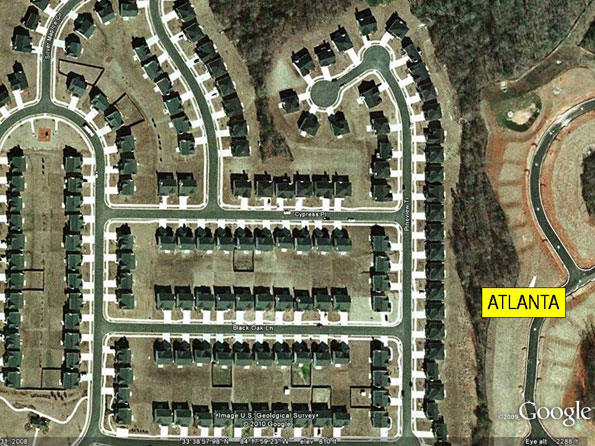
    But there is more to the story. Portland’s heavy handed planning policies are distorting product offerings so much that only the richest can afford more than a miniature back yard. This is illustrated by the images of new housing developments below in the suburbs of Portland and Atlanta (below). Both pictures are taken from approximately 1,500 feet above the ground.

    In the Portland example, virtually on the fringe of the urban area (the next urbanization is at least 10 miles away); houses are stacked in at more than 15 to the acre, with just a few feet between the roof-lines – vaguely reminiscent of third world shantytowns (Note 2). The more traditional suburban development that characterizes most of Portland is also shown on three sides of the overly dense new development.

    In the Atlanta example, houses have been recently built at about 4 to the acre, which has been the American suburban norm (except where land use regulations have required larger lots). The emerging sameness of Portland’s housing gives new meaning to the “ticky tack” criticism of suburbanization.

    Our 6th Annual Demographia International Housing Affordability Survey found Atlanta to be the second most affordable metropolitan area with more than 1,000,000 residents and the 17th most affordable metropolitan area out of 272 markets in six nations. Portland ranked 180th. Atlanta is truly a land of opportunity for young households and lower middle income households that can never hope of owning their own home in Portland’s pricey, growth management driven market.

    Rather than being a shameful example of metropolitan disaster, Atlanta remains one of the diminishing number of American urban areas where the American Dream can still be offered at a price that middle income households can afford. Atlanta has also emerged as one of the world’s best examples of ethnic diversity, not only in the core but also in the suburbs. More than half of the new residents in the suburbs have been non-Anglo since 1990 in Atlanta, about which it can proud. Atlanta is inferior only in the quality of is public relations and self-understanding. It should be a required stop for planners from Portland and beyond, for remedial education on injecting humanity and aspiration back into urbanization.


    Note 1: Bookman also notes in his column that Portland’s traffic congestion has not worsened at the rate I predicted in a 1999 Atlanta Constitution oped. I had not anticipated the huge gasoline price increases, which have materially reduced the rate of traffic growth virtually everywhere and made previous congestion increase rates unreliable as predictors of future growth.

    Note 2: For example, see the similar rooflines in a Dhaka shantytown near Gulshan at 23:47 North and 90:24 East in Google Earth. The principal difference in roof lines is the Dhaka slum’s lack of streets and cars, both of which seem consistent with the anti-mobility stance of “smart growth” planning.

    Wendell Cox is a Visiting Professor, Conservatoire National des Arts et Metiers, Paris. He was born in Los Angeles and was appointed to three terms on the Los Angeles County Transportation Commission by Mayor Tom Bradley. He is the author of “War on the Dream: How Anti-Sprawl Policy Threatens the Quality of Life.

    Photo: hyku

  • Ryan Streeter Making Poverty History: A Short History

    Former chief economist of the Organization for Economic Cooperation and Development David Henderson coined the appellation, “Global Salvationism,” to describe the kind of behavior one witnesses at gatherings such as this past week’s World Economic Forum (WEF) in Davos, Switzerland. WEF was created in 1971 so that elites from around the world could gather to “map out solutions to global challenges,” according to WEF’s website. This year’s forum is entitled, “Improve the State of the World: Rethink, Redesign, Rebuild.” WEF’s program summary explains the urgency of the task facing those gathered in beautiful eastern Switzerland this way: “Improving the state of the world requires catalyzing global cooperation to address pressing challenges and future risks.” In an effort to compound jargon with alliteration, WEF uses “rethinking” in the titles of 29 conference sessions, “redesign” 16 times, and “rebuild” 9 times, for a total of nearly one-quarter of all the sessions. With all the turmoil created by the global recession and other “pressing challenges” in 2009, the world’s elites came together this week ready to re-do about everything.

    Central to WEF’s annual objectives is what to do about life’s inequities and imbalances. Hardly anything warrants “catalyzing global cooperation” more than the ongoing effort to make poverty history, reduce inequality, and correct global imbalances. WEF has announced that global development is taking center stage on the third day of the event.

    How ironic, then, that just prior to their gathering, Maxim Pinkovskiy and Xavier Sala-i-Martin updated findings from their 2009 National Bureau of Economic Research paper, “Parametric Estimations of the World Distribution of Income,” on the economics website VOX. Their findings show precipitous drops in global poverty since 1970—just about the same time WEF began meeting in Davos (Mark Perry wrote about the original paper here).

    Between 1970 and 2006, the global poverty rate fell nearly 75 percent. During this period, the percentage of the world’s population living on less than a dollar a day fell from 26.8 to 5.4 percent. The world’s population grew 80 percent during the same period, which makes the poverty reduction all the more astounding. The global Gini coefficient, a standard measure of inequality, fell from 67.6 to 61.2 percent, indicating a drop in inequality as well as poverty. The same trend is found in other measures of inequality besides Gini.

    And when one computes a measure of global “welfare” understood in the old-fashioned sense of well-being, we find that life has gotten better faster for a larger share of the world’s population than perhaps any time in history. By deriving a calculation of well-being from GDP and inequality measures, the authors show that between 1970 and 2006, global welfare more than doubled, growing faster than GDP.

    The authors also consider the World Bank’s new purchasing power parity (PPP)–adjusted measures of GDP and find that while global poverty increases overall, the rate of poverty actually drops faster since 1970 than it does under more conventional GDP measures. In other words, under the PPP model, the world looks a lot poorer in 1970 than it does using more traditional measures of poverty, but today, the poverty rate is nearly the same regardless of whether one uses the PPP or more traditional measures (see the graph below). Using the World Bank’s adjustment actually has the effect of making it look like we have been doing a better job of reducing poverty over the past three decades, despite how the world looks poorer in any given year.

    graph
    (Chart available at http://www.voxeu.org/index.php?q=node/4508.)

    Now, just days before Pinkovskiy and Sala-i-Martin published their VOX article, Princeton’s Angus Deaton shot to pieces the idea that one can accurately measure global poverty and inequality across countries in his presidential address to the American Economic Association. Deaton’s argument is persuasive and serves as a good reminder that economic measures across different societies are nearly impossible to establish with perfection and complete accuracy. That said, it is interesting that Pinkovskiy and Sala-i-Martin find the same drops in poverty across the various methodologies they test. Something is going on here.

    One might draw the conclusion that the precipitous drop in poverty corresponds with the beginning of the WEF meetings in 1971. Maybe the elite gathering has worked! Or, one might conclude liberalization of states and economies is working. During roughly the same period covered by the authors, the percentage of free countries in the world increased from 29 to 46 percent, according to Freedom House’s annual ratings. Liberalization and economic growth go together. One might also conclude that China’s explosive growth, which has carried Asia as a whole from 19 percent to 28 percent of the global economy during this period, has had a significant impact on poverty reduction, not to mention India’s rapid rise in its share of global GDP.

    Instead of rethinking, redesigning, and rebuilding the world, WEF’s best minds might consider devoting a full day to understanding what worked the past forty years and figuring out how to “repeat” it.

    This post originally appeared at The Enterprise Blog at The American.

    Ryan Streeter is a senior fellow at the London-based Legatum Institute and can be followed on Twitter here.

  • Reforming Anti-Urban Bias in Transportation Spending

    State governments have to stop treating transportation like yet another welfare program.

    Among urban and rural areas, who subsidizes whom?

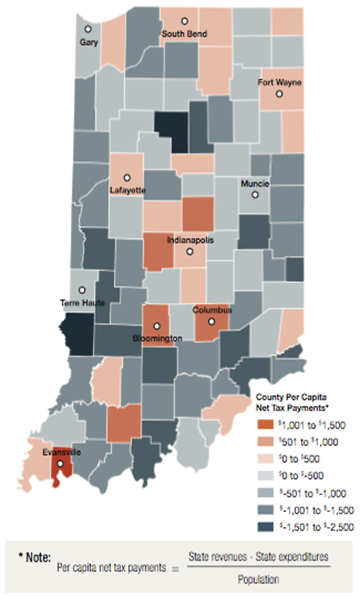
    It’s methodologically difficult to measure net taxation, but the studies that have been done suggest that, contrary to the belief of some, urban areas are big time net tax donors. For example, a recent Indiana Fiscal Policy Institute study found that Indiana’s urban and suburban counties generally subsidize rural ones.

    Just the consolidated city-county of Indianapolis-Marion County sends $420 million more to the state annually than it receives every year. That’s equal to the entire public safety budget of the city. The rest of the metro area sends another $340 million to the state annually.

    Similarly, a 2009 Georgia State University study found that the Atlanta metro area accounted for 61% of state tax collections but only but only 47% of expenditures. A 2004 University of Louisville study found that the state’s three major urban regions – Louisville, Lexington, and Northern Kentucky (south suburban Cincinnati) – generate over half the state’s tax revenues but only receive back about one third in state expenditures, an annual net outflow of $1.4 billion per year.

    The Atlanta and Indianapolis examples are particularly instructive, since both are the capital and by far the largest city of their state. They are sometimes presumed to benefit from disproportionate state spending as a result, but the reality is quite different.

    That’s not to say that this is necessarily bad. The fundamental basis of any government is a commonwealth, a body of citizens who see themselves as fellows, who believe each other’s fates are linked. Thus, generally spreading the burdens on some type of a progressive basis is broadly considered equitable, and assistance to the less fortunate constitutes a core function of government. To the extent that cities generate the most wealth in today’s economy, and have the highest incomes, it is no surprise they pay more in taxes. This doesn’t per se mean there’s an anti-urban bias in policy.

    Indeed, income redistribution is one of the key functions of state government. Actual welfare and safety net programs, including things like health care for the poor, are a major budget item in every state. But it goes beyond that. K-12 education could be treated as a purely local service, but every state spends large amounts on it. One could argue this is strictly to ensure a minimum level of funding equity between rich and poor districts. That is, it’s purely redistributive. Indeed, states sadly spend more time fiddling with funding formulas than in actual education reform and improvement. Even corrections disproportionately and unfortunately affects the poor. We are, in effect, a collection of 50 welfare states.

    The fact that so many of the functions of state government have taken on a redistributive cast also comes with downsides. Most importantly, even functions that should have little to do with welfare or equity have come to be seen through that lens.

    Exhibit A is transportation. Two-thirds of Americans live in large metro areas, yet less than half the federal transportation stimulus funds are going to the top 100 metro areas. Missouri is spending half its stimulus money on 89 small counties that account for only a quarter of the state’s population. In Ohio, the state cancelled plans to spend $100 million in stimulus funds on the crumbling Cleveland Inner Belt bridge in order to divert them to paying for a $150 million bypass around Nelsonville – a town of only 5,000 people. This is part of a plan to construct a four lane divided highway into sparsely populated southeast Ohio as part of a “build it and they will come” economic development plan. Mecklenburg County, NC, the state’s largest and home to Charlotte, received only $7.8 million out of the first $423 million in projects in that state. The Atlantic Monthly described this as a contest between a “mayor’s stimulus” and a “governor’s stimulus” – and the governor won.

    State after state has rural “roads to nowhere.” Without any legitimate economic development strategy on offer for depressed rural areas and small industrial cities, salvation is said to lie in access to four lane highways. The logic is that until every county in America is crisscrossed with these things, somehow residents are deprived of their due. This plays well to rural resentment, allowing people who are by nature proud believers in self-reliance and dismissive of welfare to claim instead that they’ve been cheated out of their “fair share” of transportation money. One suspects at least some deep inside understand the fiscal reality, which accounts for the self-righteous rhetoric designed as much perhaps to convince themselves as others.

    Regardless, a lack of transportation investment is crippling our cities, many of which have congested, crumbling roads and shaky bridges. Earmark reform would help at the federal level. Earmarked projects and “high priority corridors” are too often, as with “strategic” corporate programs, projects for which no traditional justification can be found.

    But beyond this, governance reform at the state level is critical to bring transportation funding allocations in line with real population and economic development measures. That’s not to say that rural areas should get no funding. There are many areas where legitimate state funding is warranted, such as replacing substandard bridges or correcting roads with dangerous geometry. But that doesn’t mean states should spend huge amounts of money on large rural expansion projects of dubious value that rob urban areas of the funds needed for projects with genuine transportation merit and real economic development potential.

    If states won’t act to reform this, then, despite legitimate governance concerns in our system of federalism, the federal government may need to step in to take a more direct role in funding formulas to ensure that a proper share of the money gets sub-allocated to metro areas. The federal government simply can’t allow states to continue diverting critical and limited transport money to boondoggles.

    With metro areas as the economic locus of the 21st century, failing to take action to make sure our cities get the transportation investment they need puts both the state treasury and national economic competitiveness at risk. Cities can only continue to play their role as wealth generators and sources of transfer funds for their states if they themselves are economically healthy, which requires infrastructure investment. As the Indiana, Georgia, and Kentucky examples show, state treasuries and rural funding are dependent on urban economic health. You can’t redistribute money from urban to rural areas if there’s nothing to distribute.

    Aaron M. Renn is an independent writer on urban affairs based in the Midwest. His writings appear at The Urbanophile.

    Photo: Pete Zarria

  • Blame Their Parents, Not Us

    We appreciate Pete Peterson’s attention to our work, but in responding to his complaint that we are denigrating Generation X and underrating its civic participation, we should begin at the beginning, define our terms, and give credit where credit is due. In writing our book, Millennial Makeover: MySpace, YouTube, and the Future of American Politics, we borrowed heavily from the thinking of and acknowledged our intellectual debt to Neil Howe and the late William Strauss, the founders of generational theory. In their seminal books, Generations (1992) and The Fourth Turning (1997), Strauss and Howe described the four generational archetypes – Idealist, Reactive, Civic, and Adaptive – that have cycled throughout Anglo-American history. Stemming from the way each generation was reared by its parents, each generational type develops a characteristic set of attitudes and behaviors that is broadly similar regardless of where in American history it appears.

    It is the attitudes and behaviors of these archetypes, not our biases or disdain for Generation X, that underpin our comments. Those same archetypical attitudes and behaviors also shape the statistics that Peterson cites both selectively and somewhat out of context in his New Geography posting.

    One of Peterson’s contentions is that members of Generation X currently participate in voluntary or non-profit activities to at least the same extent as Millennials do. He cites a survey conducted by the National Conference on Citizenship (NCOC) to prove his point. It is clear, however, that the NCOC itself places great hope in the Millennial Generation, entitling a section in its reports, “The Emerging Generation: Opportunities with the Millennials” and stating that “In the 2009 Civic Health Index, Millennials emerge as the ‘top’ group for volunteers.”

    While the NCOC statistics do indicate that Millennials lead the way in civic engagement, to be fair the overall differences between the X and Millennial Generations are not large. What most distinguishes Millennials from other generations is the type of community activities in which they are involved. Not surprisingly, given the lower incomes normally associated with entry level jobs and the fact that the Great Recession has hit them to a far greater extent than other generations, Millennials are more likely than older generations to volunteer rather than make financial donations. While a plurality of those in all generations say they both volunteer and donate financially, Millennials are substantially more likely to engage solely as volunteers. Among those who only volunteer, Millennials do so at 3.25 times the rate of Baby Boomers, 2.6 times that of seniors, and 1.3 times more than members of Generation X. In effect, at least in the current economy, Millennials have more time than money.

    As Peterson points out, when respondents were asked whether they had increased their civic participation in the past year, Gen-Xers led the way with 39% answering “yes” surpassing Millennials (29%), Boomers (26%), and seniors (25%). He dismisses the possibility that this might reflect improvements in previously low engagement levels among Gen-Xers, but actually it does. According to the U.S. Department of Education in 1984, when all of them were Gen-Xers, only a quarter (27%) of high school students participated in community service. Twenty years later, when all high school students were Millennials about three times as many (80%) did so. It could be argued that this increase occurred simply because by 2004 students were required to be active in their communities while they weren’t previously. But, for whatever reason, Millennials better seemed to internalize the lessons about community service to which they were exposed in high school. In 1989, 13% of those participating in the National Service organizations like the Peace Corps and Teachers Corps were from Generation X, about the percentage contribution of the generation to the U.S. population at that time. In 2006, 26% of National Service participants were Millennials, twice their percentage in the population.

    Peterson also maintains the voting turnout of Generation X equals that of Millennials when the two generations were of similar age. To demonstrate this he compares youth turnout in the 1992 and 2008 presidential elections. According to CIRCLE, a non-partisan organization that studies and attempts to increase the political participation of young people, 18-29 years did indeed vote at similar rates in 1992 when those of that age were Gen-Xers (50%) and in 2008 when that age group consisted primarily of Millennials (52% overall and 59% in the competitive battleground states in which the Obama and McCain campaigns concentrated their efforts).

    What Peterson did not do is to report on what occurred in all of the elections between 1992 and 2008. This provides more nuanced data that is generally more favorable to Millennials. For example, in 1996, when again all young voters were members of Generation X, youth electoral participation fell to 37%, the lowest of any year for which CIRCLE reports data. Youth voting began to steadily increase starting in 2000 as the first Millennials attained voting age until, in 2008, it reached the highest level since 1972.

    But, Peterson’s biggest unhappiness with those of us who “gush” about the Millennials really seems to be his belief that we extol them for partisan reasons. It is true that Millennials lean heavily to the Democratic Party. They supported Barack Obama against John McCain by a greater than 2:1 margin (66% vs. 32%) and, according to Pew, last October identified as Democrats over Republicans by 52% vs. 34%. They are also the first generation in at least four to contain more self-perceived liberals than conservatives.

    We certainly don’t hide the fact that we are life-long Democrats, something we clearly pointed out in the introduction to our book even as we made every effort to be evenhanded in our examination of American politics. That evenhanded examination suggests that as a civic generation, at this point in American history, it is hard to imagine most Millennials being anything other than Democrats. Civic generations, like the Millennials, favor societal and governmental solutions to the problems facing America. At least since the New Deal, the Democratic Party has had more affinity for such approaches than the GOP. It is for this reason that the GI Generation (Tom Brokaw’s Greatest Generation) became lifelong Democrats in the 1930s and why we believe most Millennials now see themselves as Democrats and vote that way. For Peterson to wish that were different won’t make it so.

    But, in the end, all generational archetypes play key roles in the mosaic of American life. In truth, no generation is somehow “better” or “worse” than another. When the civic GI Generation served America so nobly and effectively in World War II, members of the idealist Missionary Generation like Franklin D. Roosevelt inspired it and it was commanded in battle by great generals from the reactive Lost Generation such as Dwight Eisenhower and George Patton. America now faces a new set of grave issues. It will take the concerted efforts of all generations to confront and resolve them.

    Morley Winograd and Michael D. Hais are fellows of the New Democrat Network and the New Policy Institute and co-authors of Millennial Makeover: MySpace, YouTube, and the Future of American Politics (Rutgers University Press: 2008), named one of the 10 favorite books by the New York Times in 2008.

  • A Race Of Races

    When Americans think of our nation’s power (or our imminent lack of it) we tend to point to the national debts, GDP or military prowess. Few have focused on what may well be the country’s most historically significant and powerful weapon: its emergence as the modern world’s first multiracial superpower.

    This evolution, after centuries of racial wrangling and struggle, will prove particularly critical in a world in which the power of the “white” race will likely diminish as power shifts to China, India and other developing countries. By 2039, due largely to immigrants and their offspring, non-Europeans will constitute the majority of working-age Americans, and by around 2050 non-Hispanic whites could well be in the minority.

    But this should not be seen so much as a matter of ethnic succession as multiracial amalgamation. The group likely to grow fastest, for example, will be made up of people, like President Obama himself, who are of mixed race. There is no more demonstrable evidence of the changing racial attitudes of Americans. As recently as 1987 slightly less than half of Americans approved of interracial couples. By 2007, according to the Pew Center, 83% supported them. Among the millennial generation, who will make up the majority of adults in 2050, 94% approve of such matches.

    Today roughly 20% of Americans, according to Pew Research Center, say they have a relative married to someone of another race. Mixed-race couples tend to be younger; over two-fifths of mixed-race Americans are under 18 years of age. In the coming decades this group will play an ever greater role in society. According to sociologists at UC, Irvine, by 2050 mixed-race people could account for one in five Americans.

    The result will be a U.S. best described in Walt Whitman’s prophetic phrase as “the race of races.” No other advanced, populous country will enjoy such ethnic diversity.

    The U.S. will likely remain militarily and even economically preeminent, but much of its power will stem from its status as the world’s only multiracial superpower. America’s global reach will extend well beyond Coca-Cola, Boeing and the Seventh Fleet and express itself in the most intimate cultural and familial ties.

    Our continuing relative success with immigration is key to this process. In the next decades the fate of Western countries may well depend on their ability to make social and economic room for people whose origins lay outside Europe. No Western-derived country produces enough children of European descent to prevent them from becoming granny nation-states by 2050.

    In other words, countries and societies need to become more racially diverse in order to succeed. Yet over the past few decades many countries, from Iran to the nations of the former Soviet bloc, have narrowed their definition of national identity. Even the province of Quebec, bordering the U.S., has imposed preferential policies devised to blunt successful minorities. Because of these restrictive policies, which in some places are accompanied by lethal threats, Jews, Armenians, Coptic Christians and diaspora Chinese have often been forced to find homes in more-welcoming places.

    In recent decades Europe has received as many immigrants as the U.S., but it has proven far less able to absorb them. The roughly 20 million Muslims who live in Europe have tended to remain segregated from the rest of society and economically marginalized. In Europe, notably in France, unemployment among immigrants – particularly those from Muslim countries – is often at least twice that of the native born; in Britain, as well, Muslims are far more likely to be out of the workforce than either Christians or Hindus. British Muslims, according to Britain National Equity Panel, possess household wealth one-fifth that of the predominant nominally Christian population.

    This is also a famously alienated and socially isolated population. For example, in Britain in 2001 up to 40% of the Islamic population believed that terrorist attacks on both Americans and their fellow Britons were justified. They are not mixing much; 95% of white Britons say they have exclusively white friends. In comparison, only 25% of American whites in 29 selected metropolitan areas reported having no interracial friendships at all.

    Despite scattered cases of terrorists in our midst, the contrast between U.S. Muslims and their counterparts overseas is particularly telling. In the U.S. most Muslims are comfortably middle class, with income and education levels above the national average. They are more likely to be satisfied with the state of the country, their own community and their prospects for success than are other Americans – even in the face of the reaction to 9-ll.

    More important, more than half of Muslims – many of them immigrants – identify themselves as Americans first, a far higher percentage than in the various countries of Western Europe. This alienation may be a legacy of the European colonial experience, but it can also be seen in Denmark and Sweden, which had little earlier contact with the Muslim world. In contrast, in the U.S. more than four in five are registered to vote, a sure sign of civic involvement. “You can keep the flavor of your ethnicity,” remarked one University of Chicago Pakistani doctorate student in Islamic studies, “but you are expected to become an American.”

    But the general success of American immigration extends beyond Muslims. Even the largely working-class immigrants from Mexico generally have had lower unemployment than white and other workers, at least until 2007; then with the housing-led recession their unemployment rate began to rise, since so many were involved in construction and manufacturing. Once the economy recovers the historical pattern should reassert itself. Other large groups, including Asians, Cubans, Africans and a still considerable number of Europeans, have performed even better.

    Immigrants by their very nature, of course, are a work in progress, reflecting the essential protean nature of this civilization. Yet they are clearly becoming Americans and transforming who we are as a people. Ideologues on the left and right often don’t understand what is going on in America. The left, locked on the racial past, looks for new grievances to stoke among newcomers. They envision the rise of a fractured country – precisely the same thing many conservatives fear.

    Yet Hispanics, and particularly their children, are not becoming serape-wrapped Spanish speakers. Among Hispanics in California, 90% of children of first-generation immigrants speak fluent English; in the second generation half no longer speak Spanish. Only 7% of the children of immigrants speak Spanish as a primary language.

    Over the next few decades this pattern of ethnic and racial integration will separate America from its key competitors. In 2005 the U.S. swore in more new citizens than the next nine immigrant-receiving countries put together. These newcomers will reshape the very identity of the country and allow the U.S. to continue growing its labor force.

    Our prime competitors of the future – India and China – are unlikely to evolve in this direction. India is a highly heterogeneous country itself and remains driven by ethnic and religious conflicts. China, like Japan and Korea, remains a profoundly homogeneous country with little appetite or capacity to accept newcomers.

    America’s relative openness is particularly critical in the worldwide struggle for skilled labor. Right now more than half of all skilled immigrants in the world come to the U.S., though Australia and Canada, which have much smaller populations, have higher percentages of them. Despite repeated press reports about return migration to home countries, understandable given our sometimes bizarre immigration policy and the deep economic downturn, the vast majority of skilled immigrants – at least 60% – from around the world are staying.

    America’s successful evolution to a post-ethnic society will prove particularly critical in U.S. relations with developing nations, our largest source of immigrants. Even those immigrants who return home to Europe, China, India, Africa or Latin America often retain strong familial and business ties to the U.S. They can testify that America maintains a special ability to integrate all varieties of people into its society.

    As we negotiate the next few decades, America’s growing diversity allows it to stand alone, a multiracial colossus unmatched by any in the evolving global economy. In the current world being a “race of races” represents not a dissolution of power but a new means for expressing it.

    This article originally appeared at Forbes.com.

    Joel Kotkin is executive editor of NewGeography.com and is a distinguished presidential fellow in urban futures at Chapman University. He is author of The City: A Global History. His newest book is The Next Hundred Million: America in 2050, released in Febuary, 2010.