Category: Politics

  • The Fate of Detroit – Revisited Green Shoots? The Changing Landscape of America

    During the first ten days of October 2008, the Dow Jones dropped 2,399.47 points, losing 22.11% of its value and trillions of investor equity. The Federal Government pushed a $700 billion bail-out through Congress to rescue the beleaguered financial institutions. The collapse of the financial system in the fall of 2008 was likened to an earthquake. In reality, what happened was more like a shift of tectonic plates.

    *******************************************************

    By May of last year, when the first of this series appeared, it was clear that the American auto industry was about to fundamentally change. It has been just eight months and the changes have already been monumental. In 2009, China overtook America as the largest market for automobiles in the world. Sadly, America will never see that title again.

    Industry CEOs flew into Washington, DC on their private jets asking for billions in federal hand-outs. They were chastised and embarrassed for their greed and insensitivity by politicians who have mastered that fine art of public outrage. GM’s CEO Rick Wagoner was publicly fired. The next day, GM put all eleven corporate jets on the market causing the resale market for G-5s to collapse overnight.

    Since then, GM has entered and exited bankruptcy and senior debt holders were wiped out so the government could give ownership of GM to the UAW, in contravention of all existing bankruptcy laws. A thousand dealers were summarily terminated without compensation, or a hearing. The Saturn brand was snuffed out and the Saab brand will follow unless a miracle occurs – an unlikely prospect. Pontiac and Hummer have already been terminated.

    Chysler is now owned by Fiat, the government and the UAW. It too wiped out 1,000 loyal dealers without compensation, or a hearing. Chrysler sales, down 36%, were the worst since 1962. The company is on life support. The Italians will attempt to resuscitate the ailing brand with a fuel efficient Fiat 500 and curvaceous Alfa-Romero. Chrylser called on Lee Iacocca to help them recover in the 1980s. This time, they may need Sophia Loren to coax buyers back into the showroom.

    Ford did not take TARP bail out money and the public responded by buying Ford products. While their sales were down 15%, they gained market share because GM and Chrysler sales were down 30% and 36% respectively. Sales in December were actually up 33% from a year ago. Ford dumped loser Volvo to the Chinese automaker, Geely, who coveted the domestic dealer network. Expect to see Chinese cars in an auto mall near you sooner rather than later.

    Clunkers
    Government showed its ignorance of the automible industry by sponsoring a Cash for Clunkers program. They will claim it was a great success, selling 677,842 new cars, but critics will remind that it cost $3 billion dollars. Edmunds.com reports that all but 125,000 sales would have taken place anyway. So taxpayers forked over about $24,000 per car for 125,000 sales. The National Highway Transportation Board reported that 20,000,000 barrels of oil will be saved over 20 years but critics will remind that we import that much in just two days. In addition, the cost to administer a program that lasted just six months was $100,000,000. The government was loathe to mention the top two brands purchased in the Cash for Clunkers progran were Honda and Toyota, not American brands.

    Electrics
    As promised, the government supported the move to electric vehicles. The U.S Department of Energy gave Tesla Motors a loan of $465 million to build the $87,900 electric Karma in California. Tesla claims it has sold 1,000 cars. That means Tesla sales represent a little over one hundredth of one percent of the domestic car business. The financial wisdom of such a loan would be questionable if it were not for the equally stunning announcement that Fisker would receive $529 million from the DOE to build its $100,000 electric car – in Finland. Al Gore is a shareholder of Fisker. Honda, which sells the $20,000 Insight hybrid vehicle and achieved just 25% of forecasted sales. If Honda has trouble selling a $20,000 electric hybrid, one wonders how many $100,000 electrics Fisker and Tesla models must be sold to repay our billion dollar loan.

    Winners
    The surprise winner of the last year was Korean car manufacturer, Hyundai. With a potent combo of great styling, affordable pricing on its Kia brand and new upscale products, Hyundai sales increased a surprising 10%. They project a 17% increase in 2010. Hyundai is doing so well it may spin off its own luxury brand, Genesis, as Toyota did so successfully with Lexus. The new Equus luxury sedan is about the same size as a large Mercedes, BMW or Lexus but $25,000 less. This basic formula worked to establish the Lexus and Infiniti brands in 1989. Expect it to be repeated by Hyundai in the near future.

    Green shoots
    Even though it has relinquished its title as top dog to the Chinese, there are signs of life in the American automobile industry. Buick is the top brand in China and is resurgent in our domestic market. The new Buick Lacrosse and Regal are superb automobiles. Chevy rests its hopes on a trio of new attractive products like an all electric Volt, a retro-styled Camaro and the 40 MPG Cruze. Cadillac released a new fleet of gorgeous CTS and SRX models and announced a new full-size XTS is on the way. Cadillac will get its own stunning version of the Volt called the Converj. And Government Motors (GM) announced it will invest a billion dollars to create the fuel efficient trucks of the future in time for the economic recovery.

    At Ford, they hope the 2011 Ford Focus will be a huge success. This small car is a move upscale for Ford. It has great styling and amenities, a higher price tag and therefore higher profits. Will Ford be able to sell an expensive small car to replace the profitable SUVs like the Explorer and Expedition?

    Chrysler’s future is much murkier. A mini Fiat 500 is coming but the Alfa-Romeros have been delayed. The new Jeep Grand Cherokee and the Chrysler 300 are attractive, but the Chysler Lancia is simply weird. Chrysler revealed a new 200C EV, a surprise all electric concept. Will these models be enough to save Chrysler? We will see.

    The car business is changing. Green Shoots, as our president likes to muse. We hope he is correct.

    ***********************************

    This is the seventh in a series on the Changing Landscape of America.

    Robert J. Cristiano PhD is a successful real estate developer and the Real Estate Professional in Residence at Chapman University in Orange, CA.

    PART ONE – THE AUTOMOBILE INDUSTRY (May 2009)
    PART TWO – THE HOME BUILDING INDUSTRY (June 2009)
    PART THREE – THE ENERGY INDUSTRY (July 2009)
    PART FOUR – THE ROLLER COASTER RECESSION (September 2009)
    PART FIVE – THE STATE OF COMMERCIAL REAL ESTATE (October 2009)
    PART SIX – WHEN GRANNY COMES MARCHING HOME – MULTI-GENERATIONAL HOUSING (November 2009)

  • Connecting Facts to Forecast 2010

    Anyone can figure out the State of the Union by taking a good look around. I mean, I was born in the afternoon – but not yesterday afternoon – I don’t need four days of press coverage and a long speech by the President to tell me that Americans are suffering.

    This time of year, though, everyone is looking for some hint of what is to come. Even the most rational among us are tempted to seek out some prediction of the future. Economists often rate high on the list of seers sought out by most Americans – right up there with stock brokers, Dionne Warwick’s Psychic Friends Network, and Joan Quigley (White House astrologer to the Reagans).

    In this article, I’ll give you a few of my own predictions and then invite you to tell me the subject areas you want predicted. When pressed for my vision of the future, I like to add up what I already know to arrive at what I think will happen. Here’s an example:

    1. Consumer debt is about $2.5 trillion + The Federal Government Bailout commitment topped out at $12.8 trillion = American consumers, no matter how voracious their appetite for debt and foreign goods, are not the problem and cannot be the solution.

    See how it works? I confess I learned to do this while working with Mike Milken on the Global Conferences at his Milken Institute in Santa Monica, California. He called it taking the “view from 35,000 feet.” It entails taking two or more pieces of information that most people don’t hold in their heads at one time and trying to see how the ideas are connected. Here’s another one:

    2. The eight largest bank holding companies decreased lending year-over-year in the first and second quarters of 2009 + Domestic deposits are growing at double digit rates = Too Big to Fail has created monster institutions that do not have to respond to market forces or consumer demands.

    The largest bank holding companies in order of commercial banking assets are JPMorgan Chase, Bank of America, Citigroup, Wells Fargo, PNC Financial Services Group, US Bancorp, Bank of New York Mellon, and Suntrust. That you may not have a “Suntrust” branch on the corner in your town tells you something about how big the first seven are. These banks are so big that they aren’t even using the excess reserves that the Federal Reserve Bank is making available to them – they just let it sit in the Federal Reserve accounts earning zero interest. They are no longer simply U.S. banks, subject to controls by the Fed’s monetary policy actions. They can reach out for funding across the world – including funding from sovereign wealth funds controlled by governments from China to Kuwait.

    Here’s one more, just to get the ball rolling. Then, I’ll turn to your questions and see if we can manage a few more predictions for 2010 and beyond, just using the facts as we know them today.

    3. The Federal Reserve System more than doubled the money in the banking system virtually overnight (from $984 billion on September 17, 2008) and kept it at that level ever since ($2,249 billion as of last week) + the third quarter 2009 increase in economic activity (output or gross domestic product) only got us back to where we were at the same period in 2007 = There’s enough money building up in the banking system to meet the definition of “inflation”: too much money chasing too few goods.

    The rise in GDP, while it may signal the technical end of the recession, does not put an end to the financial stress we are suffering. In the seven years before the technical beginning of the recession, the U.S. economy was growing at more than five percent each year. Basically, that means the recent recession put us about $1 trillion in the hole to economic prosperity. The much-touted improvement in the economy in the third quarter of 2009 was about $90 billion. At this rate, it will take 11 quarters (nearly 3 years) to catch up. That’s why so many economists are more pessimistic than many politicians.

    For the rest of 2010, I invite you to submit comments below or drop me an email with two or three facts that you would like to see connected. I’ll take on the challenge of finding the connections, the relationships and interpreting the signals for what those facts might mean for you and the economy in the coming months.

    Susanne Trimbath, Ph.D. is CEO and Chief Economist of STP Advisory Services. Her training in finance and economics began with editing briefing documents for the Economic Research Department of the Federal Reserve Bank of San Francisco. She worked in operations at depository trust and clearing corporations in San Francisco and New York, including Depository Trust Company, a subsidiary of DTCC; formerly, she was a Senior Research Economist studying capital markets at the Milken Institute. Her PhD in economics is from New York University. In addition to teaching economics and finance at New York University and University of Southern California (Marshall School of Business), Trimbath is co-author of Beyond Junk Bonds: Expanding High Yield Markets.

    Photo: Vermin Inc

  • The Fed: Reappoint Captain Smith?

    The debate surrounding the re-appointment of Ben Bernanke as Chairman of the Board of Governors of the Federal Reserve (the Fed) is not without historical parallel.

    Just recall the RMS Titanic: It was April 14, 1912, when White Star’s “unsinkable” RMS Titanic, the largest and newest passenger liner in the world, was steaming from Southampton and Ireland to New York. The ship was traveling through a part of the North Atlantic where icebergs had been reported. The highly decorated Captain Edward J. Smith had rerouted the Titanic a bit to the south, but was aware that there were icebergs in the area. Urgent reports were radioed to the Titanic from other ships in the vicinity. These reports were not delivered to Captain Smith.

    Nonetheless, Captain Smith was confident enough that he ordered the ship to continue at its normal speed and apparently saw no reason to be on the bridge through the evening. The story is familiar to everyone. Just before midnight, lookouts spotted an iceberg dead ahead. The ship could not be steered away in time to avoid a collision that fatally wounded the Titanic.

    Unsinkable Economy: In the middle of the decade, the American economy, too, was steaming into dangerous waters. Yet the Fed, the nation’s financial watchdog, missed it big and makes one wonder if its website’s claim that it provides the nation with a safe, flexible and stable monetary and financial system is a line they borrowed from Conan O’Brien.

    The country thrust at near full speed into an abyss of phony mortgage debt in late 2008, which plunged the nation and the world into the worst economic downturn since the Great Depression.

    Ben Bernanke had taken over as Chairman of the Board of Governors of the Federal Reserve Bank in early 2006, but his late arrival does not excuse his role, or that of the Fed. Bernanke had long been involved in leading economic roles, immediately before as Chairman of President Bush’s Council of Economic Advisors and before that as a member of the Board of Governors of the Federal Reserve (from 2002 to 2005). There is no indication that Bernanke did anything to sound a serious alarm while in these positions.

    Signs of Trouble: Yet the signs were clear. How could it be that the urgent radio reports were not forwarded to Captain Smith? It might have been expected that he or a deputy might be checking frequently with the radio operators. Perhaps the failure resulted from the belief that the Titanic was unsinkable.

    Similarly, the warnings of the housing bubble were clear, if only someone had been looking. There is no indication that Ben Bernanke, in any of his capacities, understood the extreme threat that the housing bubble had to the economy or its perverse nature. Many of the nation’s leading economists, Bernanke included, continued to look only at national averages, completely missing the point that a dangerous concentration of far greater intensity plagued many specific markets. These far more severe bubbles represented a far greater threat to financial stability than would have been the case if the national averages had been representative.

    Captain Smith was well aware of the dangers of icebergs and knew that they were in the area. Presumably, Ben Bernanke knew – or should have known – of the dangers of an unprecedented housing bubble and of the dangers it could create for the economy. Perhaps he thought the US economy was unsinkable.

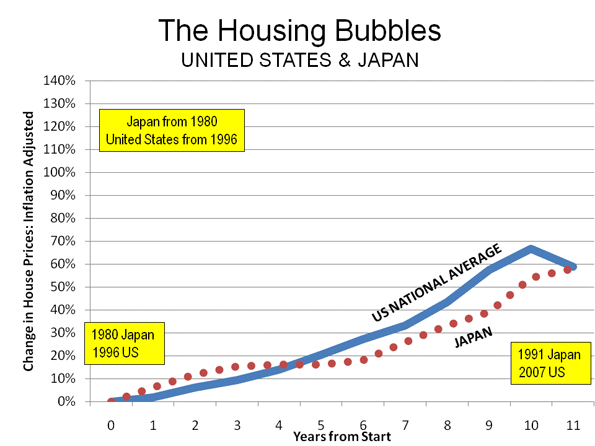
    How Bad It Was: It’s not like this was a bubble without precedent. Bernanke and the Fed should have been alarmed that the American housing bubble was equal in its overvaluation to the fabled housing bubble in Japan that hobbled that economy for many years (Figure 1).

    But the problem was even bigger. During the housing bubble, the economic community, Bernanke and the Fed were afflicted with a myopia that prevented looking beyond national average house prices. But those few willing to “dirty their hands” and look further found even more troubling developments.

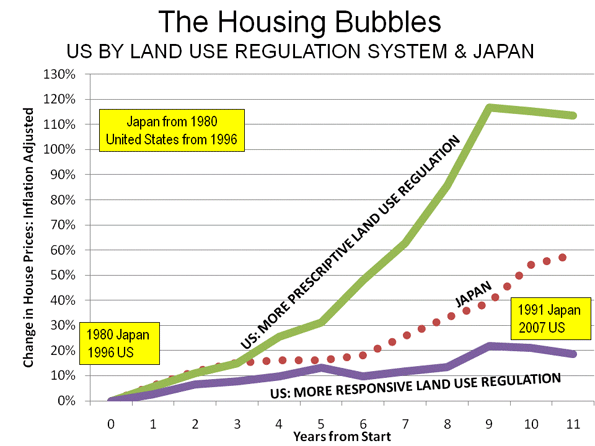
    In 2005, eventual Nobel Prize winner Paul Krugman pointed out that the housing bubble was limited to only part of the market; what he called the “zoned zone.” The “zoned zone” refers to what I have been calling the areas with “more prescriptive” land use regulation (also called “growth management” or “smart growth”). These are the types of intensive interventions that reduce the supply of land for development, raise its costs and provide an open invitation to speculators seeking short term, but occasionally enormous profits. It is important to note that not all land regulation produces such results, but that the regulation typical of the bubble markets did exactly that.

    This was missed by Bernanke and the Fed. In the more prescriptively regulated markets house prices had risen at double the national rate and double the Japanese bubble rate. In other areas (what Krugman called “flatland” and I call “more responsively regulated” markets), house prices rose at one-third the average rate (Figure 2).

    This concentration meant that the bubble in the more prescriptive markets was far more unstable and threatening. In the end, at least 85% of the gross value increase occurred in the more prescriptive markets, with particular concentrations in California, Florida, Phoenix and Las Vegas. When the bubbles in these markets burst, it ravaged the national mortgage finance industry even in the face of far more reasonable prices elsewhere in the country.

    Wandering in the Wilderness: That Chairman Bernanke still does not understand this dynamic was amply illustrated by his recent Atlanta speech to the American Economic Association, in which he claimed that the easy money policies of the Fed had little to do with the Great Recession. Instead he blamed lax regulation that permitted “exotic mortgages.” Moreover, it is clear that neither he nor the Fed have managed to scratch below the surface of the bubble in specific markets and its ability to create enormous havoc on the national and world economy.

    A Bully Pulpit: What could Bernanke and the Fed have done? First of all, they could have sounded the alarm about the profligate lending that has reduced this nation’s “soundness of banks” rating to 108th out of 133, just behind Tanzania, and seven places behind Bangladesh and 21 behind Nigeria. Second, Bernanke and the Fed could have bothered to suggest corrective actions to prevent development of the unsustainable values in the “zoned-zone.” At a minimum, Bernanke and the Fed could have used their bully pulpit in hopes of sparing the nation and the world an unnecessary financial catastrophe.

    The Rescuer: Of course, Chairman Bernanke has earned high marks for his work to avoid a depression. If Captain Smith had somehow survived the ordeal caused by his misjudgments, however, White Star probably would not have awarded him another command.

    Wendell Cox is a Visiting Professor, Conservatoire National des Arts et Metiers, Paris. He was born in Los Angeles and was appointed to three terms on the Los Angeles County Transportation Commission by Mayor Tom Bradley. He is the author of “War on the Dream: How Anti-Sprawl Policy Threatens the Quality of Life.

  • The Death Of Gentry Liberalism

    Gentry liberalism, so hot just a year ago, is now in full retreat, a victim of its hypocrisy and fundamental contradictions. Its collapse threatens the coherence of President Barack Obama’s message as he prepares for his State of the Union speech on Wednesday.

    Gentry liberalism combines four basic elements: faith in postindustrial “creative” financial capitalism, cultural liberalism, Gore-ite environmentalism and the backing of the nation’s arguably best-organized political force, public employee unions. Obama rose to power on the back of all these forces and, until now, has governed as their tribune.

    Obama’s problems stem primarily from gentry liberalism’s class contradictions. Focused on ultra-affluent greens, the media, Wall Street and the public sector, gentry liberalism generally gives short shrift to upward mobility, the basic aspiration of the middle class.

    Scott Brown’s shocking victory in Massachusetts–like earlier GOP triumphs in Virginia and New Jersey–can be explained best by class. Analysis by demographer Wendell Cox, among others, shows that Brown won his margin in largely middle- and working-class suburbs, where many backed Obama in 2008. He lost by almost 2-to-1 among poor voters and also among those earning over $85,000 a year. He also won a slight margin among union members–remarkable given the lockstep support of their organizations for Brown’s Democratic opponent, Martha Coakley.

    Geography played a role, of course, but class proved the divider. Coakley did well in the wealthiest suburbs largely north and northwest of Boston. But Brown’s edge in the more middle- and working-class suburbs proved insurmountable.

    Obama, a genius at handling race, has always had problems with class. His early primary victories in 2008 resulted not only from superior organization but the preponderance of students and upper-income professionals in early primary states. Once Hillary Clinton morphed, just a bit late, into Harry Truman in a pants suit, she proved unstoppable, rolling over Obama in critical states like Pennsylvania, Texas, California, Florida, Michigan and throughout Appalachia.

    In the general election Obama succeeded in winning over a significant portion of these voters. Long-simmering disgust with the Bush administration and the Republican Congress, combined with a catastrophic economic collapse, undermined the GOP’s hold on middle-class suburbanites.

    Now that the ball is in his court, the president and his party must abandon their gentry-liberal game plan. The emphasis on bailing out Wall Street and public employees, supporting social welfare and manufacturing “green” jobs appealed to the core gentry coalition but left many voters, including lifelong Democrats, wondering what was in it for them and their families.

    In the next few elections there’s an even greater threat of alienation among millennial voters, who in 2008 accounted for much of the president’s margin of victory. Generational researchers Morley Winograd and Mike Hais note that millennials are starting to enter the workforce in big numbers. Right now their prospects are not pretty. The unemployment rate for those under 25 stands at 19%. Even for college graduates, wages are declining even as opportunities dry up.

    The greatest political danger is not so much a millennial switch to the GOP but a loss of enthusiasm that will diminish the youth vote. Winograd and Hais estimate only about one-third of those who voted in 2008 in Massachusetts voted in this last special Senate election. “Republicans will keep on celebrating victories until Democrats turn their attention to young voters and get them as excited as Obama did in 2008,” Winograd warns.

    Ever deepening disillusionment–not only among millennials–is inevitable unless Obama changes course and starts building a broad-based recovery. The president’s economic team is as pro-big-bank as any conjured up by the most rock-ribbed Republican. Its motto could be a reworking of that old notion by onetime GM CEO and Eisenhower Defense Secretary Charles Wilson: “What’s good for General Motors is good for the USA”–just substitute Wall Street for GM.

    But where GM brought jobs and prosperity to millions, the current Wall Street focus has forged a recovery that works for the gentry but fails to promote upward mobility. Bailed out from their disastrous risky bets and then provided with easy access to cheap credit, the financiers have had themselves a fine party while the rest of the private sector economy suffered. The partygoers have become so rarified that they are unable to lift even the New York City economy, whose unemployment rate now surpasses the national average.

    This spectacle has forced Obama to try locating his hidden populist, but dangers lurk in this shift. If he attacks Wall Street with any real ferocity, the only linchpin of the current weak recovery could crumple. An administration that has focused on finance as the essence of the economy may prove poorly suited to skewer its primary object of affection.

    Yet it may not be too late for the president to recover some of his economic mojo. Although his financial tax plan represents little more than petty cash at today’s absurd Wall Street rates, Obama’s endorsement of Paul Volcker’s more muscular reform agenda could rally Democrats while forcing Republicans into a doctrinal crisis. Some, like Sen. John McCain, may favor a policy to downsize the megabanks and limit their activities. But many others who hold up the holy grail of free markets über alles will expose themselves again as mindless corporate lackeys.

    But badmouthing the financial aristocracy is not enough. Obama also must jettison some of the lamer parts of the gentry agenda. Cap and trade, a gentry favorite that satisfies both green piety and Wall Street’s greedy desire for yet another speculative market, needs to be scrapped as a potential job-killer for many industries. Similarly, the administration needs to delay measures to impose draconian limits of greenhouse gas emissions through the Environmental Protection Agency, which could devastate large sectors of the economy, including manufacturing, agriculture and construction.

    Obama, particularly after the Copenhagen fiasco, needs to shift to more practical, job-creating conservation measures like tree-planting and reducing traffic congestion–notably by promoting telecommuting–while continuing research and development of all kinds of cleaner fuels. Measures that make America more energy-efficient and self-sufficient–without ruining the economy with ruinously high prices–would be far more saleable to the public than the current quasi-religious obsession with wind and solar.

    Obama also needs to stop his naive promotion of the chimera of “green jobs” as his signature answer to the country’s mounting employment woes. There is no way a few thousand, mostly heavily subsidized, jobs creating ever more expensive energy can turn around any economy. Just look at the economic carnage in Spain–where youth unemployment has now reached a remarkable 44%–which has bet much of its resources targeting “green” energy.

    More than anything the president needs to make the case that government can help the productive economy. This requires a scaling down of regulatory measures that are now scaring off entrepreneurs–including some aspects of health care reform–and beginning to demonstrate a direct concern for basic industries like manufacturing, agriculture and trade.

    Pivoting away from gentry liberalism will no doubt offend some of the president’s core constituencies. But if he does not do this soon, and decisively, he will find that the middle-class anger seen in Massachusetts will spread throughout the country. As a result Barack Obama, a man who would be Franklin Roosevelt and could settle on being the next Bill Clinton, will end up looking more like that sad sack of Democratic presidents, James Earl Carter.

    This article originally appeared at Forbes.com.

    Joel Kotkin is executive editor of NewGeography.com and is a distinguished presidential fellow in urban futures at Chapman University. He is author of The City: A Global History. His next book, The Next Hundred Million: America in 2050, will be published by Penguin Press February 4th, 2010.
  • The Kids Will Be Alright

    America’s population growth makes it a notable outlier among the advanced industrialized countries. The country boasts a fertility rate 50% higher than that of Russia, Germany or Japan and well above that of China, Italy, Singapore, North Korea and virtually all of eastern Europe. Add to that the even greater impact of continued large-scale immigration to America from around the world. By the year 2050, the U.S. population will swell by roughly 100 million, and the country’s demographic vitality will drive its economic resilience in the coming decades.

    This places the U.S. in a radically different position from that of its historic competitors, particularly Europe and Japan, whose populations are stagnant. The contrast between the U.S. and Russia, America’s onetime primary rival for world power, is particularly dramatic. Some 30 years ago, Russia constituted the core of a vast Soviet empire that was considerably more populous than the U.S. Today, even with its energy riches, Russia’s low birth and high mortality rates suggest that its population will drop to less than one-third that of the U.S. by 2050. Russian Prime Minister Vladimir Putin has spoken of “the serious threat of turning into a decaying nation.”

    An equally dramatic and perhaps more critical demographic shift is taking place in East Asia. Over the past few decades a rapid expansion of their work force fueled the rise of the “East Asian tigers,” the great economic success stories of the late-20th and early-21st centuries. Yet that epoch is coming to an end, not only in Japan and Korea but also in China, where the one-child policy has set the stage for a rapidly aging population by mid-century.

    Within the next four decades, most of the developed countries in both Europe and East Asia will become veritable old-age homes: A third or more of their populations will be over 65, compared with only a fifth in America. Like the rest of the developed world, the U.S. will certainly have to cope with an aging population and lower population growth, but in relative terms the county will boast a youthful, dynamic demographic.

    As many other advanced countries become dominated by the elderly, the U.S. will have the benefit of a millennial baby boom as the “echo boomers” start having offspring in large numbers later in this decade. This next surge in growth may be delayed if tough economic times continue, but over time the rise in births will add to the work force, boost consumer spending and allow for new creative inputs.

    The differing demographic trajectories create a diverse set of issues for 21st-century America than those facing its rivals. The key challenges the European Union, Japan and Korea will contend with in the coming decades involve coping with a rapidly aging population, filling labor shortages and finding ways to invest in growing economies. In contrast, the U.S.’s greatest priority will be to create opportunities for its ever-expanding population. The New America Foundation estimates the country needs to add more than 125,000 jobs a month simply to keep pace with population growth in 2010. What the U.S. does with its “demographic dividend”—that is, its relatively young working-age population—will largely depend on whether the private sector can generate the incomes among the young to meet the needs of a larger aging population.

    Entrepreneurialism and America’s flexible business culture—including the harnessing of entrepreneurial skills of aging boomers—will prove critical to meeting this challenge. Many of the individuals starting new firms will be those who have recently left or been laid off by bigger companies, particularly during a severe economic downturn. Whether they form a new bank, energy company or design firm, they will do it more efficiently—with less overhead, more efficient use of the Internet and less emphasis on pretentious office settings.

    “People are watching their companies go under. Therefore you get three vice presidents who get laid off but know their business,” says Texas entrepreneur Charlie Wilson. “They start a new company somewhere cheap that is more efficient and streamlined. These are the new companies that will survive and grow the next economy.”

    It is here—at the grassroots level—that you can best glimpse the essential sources of American resiliency. American society draws most of its adaptive power not from its elite precincts but through the efforts of communities, churches, entrepreneurs and families.

    You can see this in the resurgence of once-declining Great Plains cities like Fargo, N.D., where high-tech now joins agriculture and manufacturing to form one of the country’s strongest local economies. Or you can visit the emerging immigrant hotbeds, such as the San Gabriel Valley east of Los Angeles or the Sugarland area, just west of Houston, with their plethora of new churches, temples, companies and ethnic shopping malls.

    Immigrants represent a critical component of our next wave of new dynamism. Between 1990 and 2005, immigrants started one quarter of all venture-backed public companies. Large American firms are also increasingly led by people with roots in foreign countries, including 14 of the CEOs of the 2007 Fortune 100.

    But much of the energy will come from more obscure enterprises. Recent newcomers have already distinguished themselves as entrepreneurs, forming businesses from street-level bodegas to the most sophisticated technology start-ups.

    What drives immigrants is their optimism in America’s future. California developer Dr. Alethea Hsu, in explaining why she opened a new Asian-oriented shopping center in Orange County, cited the entrepreneurial energy of both affluent and working class immigrants which, she said, will allow them to thrive through the recession and beyond. “We are leased up, and we think the supply of shopping still is not enough,” Ms. Hsu said in early 2009. “We feel great trust in the future.”

    This entrepreneurial urge also extends beyond the immigrant community. In 2008, 28% of Americans said they had considered starting a business, more than twice the rate for French or Germans. Self-employment, particularly among younger workers, has been growing at twice the rate as in the mid-1990s. In the most recent Legatum Prosperity Index, the U.S. ranked at the top among all countries in terms of entrepreneurship and innovation.

    Most important of all will likely be the rise of the millennial generation—a group of Americans who will start reaching their prime earning years late in the next decade. Surveys identify them as strongly family- and community-oriented. The millennials will be America’s new entrepreneurs, workers and consumers in the coming decades. They will provide the kind of resource our major competitors are destined to run short on.

    The millennials also will help shape an increasingly culturally diverse America which by 2050 will be roughly half made up of ethnic minorities. This emerging post-ethnic future contrasts dramatically with the ethnic politics common among the nation’s chief global rivals. Even famously politically correct nations as Sweden, Denmark and the Netherlands have turned against immigration. Switzerland just banned the construction of minarets, while France is considering banning some forms of Islamic garb.

    Our prime Asian rivals—China, Japan, and Korea—remain even more culturally resistant to diversity. Chinese xenophobia, in particular, is deeply entrenched, notes Martin Jacques, author of “When China Rules the World.” A Chinese world superpower would be both racially homogenous and far from tolerant of newcomers. Recently the appearance of a mixed-race Shanghai girl on a national talent show sparked a surge of racist invective.

    The very diversity of the emerging America makes many wonder what will hold the country together. Ultimately, this unique society will find its binding principle in the notions that have long differentiated it from the rest of world: a common belief system, a sense of a shared destiny and an aspirational culture.

    As the British writer G. K. Chesterton once put it, the U.S. is “the only nation…that is founded on a creed.” This faith is not, and was not initially meant to be, explicitly religious; rather, it is a fundamentally spiritual idea of a national raison d’être.

    Of course, this optimistic scenario depends on intelligent and energetic actions by central and local governments, as well as community organizations. But the road to the American future will be primarily laid not by the central state but by families, individuals and communities. During the industrial age Ralph Waldo Emerson once observed, “The age has an engine, but no engineer.” Much the same may be said in the coming decades.

    This article first appeared at The Wall Street Journal.

    Joel Kotkin is executive editor of NewGeography.com and is a distinguished presidential fellow in urban futures at Chapman University. He is author of The City: A Global History. His next book, The Next Hundred Million: America in 2050, will be published by Penguin Press February 4th.

    Photo: jcolman

  • Florida: From Hard Times in the Sunnier Climes

    By Richard Reep

    Florida’s era of hard times continues. Last week we held a “Jobs Summit ” here in Orlando but heard little but self-congratulation by politicians like Governor Charlie Crist. He praised the Legislature’s budget cuts but had little to claim when it came to reviving the economy.

    The basic reality is this: Florida is not only troubled, but in danger of falling further behind. For example, Suntech China, a solar cell manufacturer, recently worked with the State of Florida to build a solar cell manufacturing plant – in Arizona. Thanks to Florida’s unconvincing efforts, this employer decided to call Arizona its new home.

    The television and movie industry is rapidly expanding out of California into states like New York, Louisiana and New Mexico, thanks to incentives by these states to attract film and TV producers. Florida, with MGM, Universal Studios, Full Sail, and other venues, remains stagnant in this industry.

    While Central Florida is one of the country’s top ten “super regions” of population clusters, it consistently fails to get on the national stage regarding transportation, employment, and return on its federal tax money. For every dollar of income tax sent by Central Florida citizens each year, far less than a dollar comes back in terms of federal spending. Other states, like New Mexico and Alaska, receive our portion of that dollar.

    Publicly funded capital improvement projects, such as Nemours Hospital, continue to be awarded to out-of-state companies, leaving companies here in Florida, already reeling from the collapse of the real estate bubble, in even worse shape.

    Florida, which has little onshore energy resources such as oil or gas, has offshore energy resources that could pump billions of dollars into its coffers. Instead the riches of the Gulf are being exploited by Texas, Louisana, and Alabama.

    Florida, the “Sunshine State,” with vast solar and agricultural potential, has no renewable energy policy. Instead, biofuel and solar research leadership seems headed to Michigan, California and other states.

    Florida has yet to create a policy of sustainability at a statewide level. Instead, the state relies on growth, tourism, and agriculture for employment, hardly a sustainable policy given the catastrophe of 2009.

    While statewide unemployment is over 11%, labeled “Great Recession” by the press, those in the design and construction industry face unemployment estimates between 25% and 33%, levels matching that of the Great Depression.

    Nor are politics in our favor, even though Florida, reversing its generally conservative past, cast its lot with Obama in 2008. But now the promises of Transportation Secretary Ray LaHood in return for the State’s funding of commuter rail seem to be largely forsaken. During the Jobs summit, Obama’s railroad czar Joseph Szabo assured Florida that its priority would be yielded to Illinois. High-speed rail in Florida is unlikely in our lifetime. Chicago is simply more important than Orlando in today’s politics.

    Clearly Florida is not yet a basket case. With the right help from Tallahassee, Florida can reinvent itself and take advantage of the following natural assets:

    Sunshine still can bring talent and jobs. Sure, we are behind right now, but sunshine brought jobs before WW2 when Florida was ahead in aviation training. The mild climate is far more forgiving on student pilots than places where harsh winters ground light aircraft.

    Suntech should serve as Florida’s Pearl Harbor. Sure, we lost one solar cell manufacturer, but that technology is barely efficient enough to be viable. Florida could take advantage of this failure to revamp its poor growth management process, which was the reason for the failure to begin with, and actively seek out the best candidate for research and development of photovoltaic technology that would compete with Suntech and win.

    Deregulate Power Generation: The Sunshine State should be a net energy producer, not consumer. We could build a conduit to supply energy, through solar fields, up into the Southeast, as well as down into the Caribbean. There is a rather large island in need of vast amounts of clean power 90 miles away that will need this someday soon.

    Agricultural jobs: The statewide emergency declared as a result of the freeze should be a wake-up call to assist agriculture with some new ideas. Rather than sell dead orange groves out to developers, Florida should assist farmers to convert a portion of cropland to power generation, using solar collectors, photovoltaics, and biofuel crops.

    Media: This is a no-brainer for jobs. The movie industry grew in California because of the climate but is unionized and regulated to death. It’s time for Florida to compete. The next wave of entertainment culture is interactive virtual reality anyway, and the center of this activity has yet to be established, although there is an emerging concentration of firms like Raytheon doing research here. Florida could become a virtual reality technopole if it attracts the right players and provides the right resources.

    Transportation and the National Stage: For too long, Florida’s congressional delegation seems to have labored in the background, and Florida sends too few effective people to Washington. As a state made up of people escaping hard reality up north, we seem to have taken our “live and let live” beach culture too far and it has cost us credibility, capital, and clout. It’s time to reverse this trend and get passionate about our worth as a state and our contribution to America in items that matter. As a destination, Florida must rank much higher than Illinois for travel, and high speed rail should be awarded based on need rather than political favoritism.

    Meanwhile, growth and tourism will come back. They always do. And Florida, instead of losing designers to its competition, could find ways to retain them for the next generation of entertainment and leisure destinations. Housing, presently overbuilt, shouldn’t be ignored, but Florida has much to fix in terms of the quality of housing. Public/private partnerships to increase quality of life over quantity are necessary to make housing attractive and affordable and create quality, desirable communities for the 21st century.

    Florida is truly at a crossroads. For the last hundred and sixty-five years it relied on agriculture, growth, and tourism, but these narrow economic bands perpetuate cyclical booms and busts. Fundamental change can occur if the state’s leadership declares war on business as usual. The state needs to get nimbler to stay competitive when the economy does return. For those who want to stick it out and see Florida through this economic transition, it is imperative that the leadership respond now not just with words, but with actions that effect true, deep, and meaningful change.

    Richard Reep is an Architect and artist living in Winter Park, Florida. His practice has centered around hospitality-driven mixed use, and has contributed in various capacities to urban mixed-use projects, both nationally and internationally, for the last 25 years.

  • America’s Agricultural Angst

    In this high-tech information age few look to the most basic industries as sources of national economic power. Yet no sector in America is better positioned for the future than agriculture–if we allow it to reach its potential.

    Like manufacturers and homebuilders before them, farmers have found themselves in the crosshairs of urban aesthetes and green activists who hope to impose their own Utopian vision of agriculture. This vision includes shutting down large-scale scientifically run farms and replacing them with small organic homesteads and urban gardens.

    Troublingly, the assault on mainstream farmers is moving into the policy arena. It extends to cut-offs on water, stricter rules on the use of pesticides, prohibitions on the caging of chickens and a growing movement to ban the use of genetic engineering in crops. And it could undermine a sector that has performed well over the past decade and has excellent long-term prospects.

    Over the next 40 years the world will be adding some 3 billion people. These people will not only want to eat, they will want to improve their intake of proteins, grains, fresh vegetables and fruits. The U.S., with the most arable land and developed agricultural production, stands to gain from these growing markets. Last year the U.S.’ export surplus in agriculture grew to nearly $35 billion, compared with roughly $5 billion in 2005.

    The overall impact of agriculture on the economy is much greater than generally assumed, notes my colleague Delore Zimmerman, of Praxis Strategy Group. Roughly 4.1 million people are directly employed in production agriculture as farmers, ranchers and laborers, but the industry directly or indirectly employs approximately one out of six American workers, including those working in food processing, marketing, shipping and supermarkets.

    Yet none of this seems to be slowing the mounting criticisms of “corporate agriculture.” A typical article in Time, called “Getting Real About the High Price of Cheap Food,” assailed the “U.S. agricultural industry” for precipitating an ecological disaster. “With the exhaustion of the soil, the impact of global warming and the inevitably rising price of oil–which will affect everything from fertilizer to supermarket electricity bills–our industrial style of food production,” the article predicts, “will end sooner or later.”

    The romantic model being promoted by Time and agri-intellectuals like Michael Pollan hearkens back to European and Tolstoyan notions of small family farms run by generations of happy peasants. But this really has little to do with the essential ethos of American agriculture.

    Back in the early 19th century Alexis de Tocqueville noted that American farmers viewed their holdings more like capitalists than peasants. They would sell their farms and move on to other businesses or other lands–a practice unheard of in Europe. “Almost all the farmers of the United States,” he wrote, “combine some trade with agriculture; most of them make agriculture itself a trade.”

    Despite the perceptions of a corporatized farm sector, this entrepreneurial spirit remains. Families own almost 96% of the nation’s 2.2 million farms, including the vast majority of the largest spreads. And small-scale agriculture, after decreasing for years, is on the upswing; between 2002 and 2009 the number of farms increased by 4%.

    This trend toward smaller-scale specialized production represents a positive trend, but large-scale, scientifically advanced farming still produces the majority of the average family’s foodstuffs, as well as the bulk of our exports. Overall, organic foods and beverages account for less than 3% of all food sales in the U.S.–hardly enough to feed a nation, much less a growing, hungry planet.

    Then there’s the even more fanciful notion–promoted by Columbia University’s Dickson D. Despommier–of moving food production into massive urban hothouses. In a recent op-ed in the New York Times he argues we are running out of land and need to take agriculture off the farm. According to Despommier, “The traditional soil-based farming model developed over the last 12,000 years will no longer be a sustainable option.”

    Yet Praxis Strategy’s Matthew Lephion, who grew up on a family farm, points out that such projects hardly represent a credible alternative in terms of food production. Urban land is far more expensive–often at least 10 times as much as rural. Energy and other costs of maintaining farms in big cities also are likely to be higher.

    Furthermore the notion that America is running out of land–one justification for subsidizing urban farming–seems fanciful at best. The past 30 years have seen some loss of farmland, but the amount of land that actually grows harvested crops has remained stable. Though some prime farmland close to metropolitan centers should be protected, agriculture has over the past decades returned to nature–forests, wetlands, prairie–millions of acres, far more than the land that has been devoted to housing and other urban needs.

    However ludicrous the arguments, the Obama administration remains influenced by green groups and is the cultural prisoner of the lifestyle left, with its powerful organic foodie contingent. That leaves farmers and the small towns dependent on them with little voice.

    The ability of greens and others to wreak havoc on agriculture can be seen in the disaster now unfolding in California’s fertile Central Valley. Large swaths of this area are being de-developed back to desert–due less to a mild drought than to regulations designed to save obscure fish species in the state’s delta. Over 450,000 acres have already been allowed to go fallow. Nearly 30,000 agriculture jobs–held mostly by Latinos–have been lost, and many farm towns suffer conditions that recall The Grapes of Wrath.

    Not satisfied with these results, the green lobby has prompted the National Marine Fisheries Service to further cut water supplies, in part to improve the conditions for whales and other species out in the ocean. Given these attitudes, farmers, including those I have worked with in Salinas, are fretting about what steps federal and state regulators may take next.

    One particular concern revolves around the movement against genetically modified food. Already there are calls for banning GMOs in Monterey County. Local officials worry this would cripple the area’s nascent agricultural biotech industry as well as the long-term ability of existing farmers to compete with less regulated competitors elsewhere. The fact that a less advanced form of genetic engineering also sparked the “green revolution” that greatly reduced world hunger after 1965 seems, to them at least, irrelevant.

    When viewed globally, the anti-big farm movement seems even more misguided. As Chapman University’s professor of food science Anuradha Prakash observes, India’s own organic farms serve a small portion of the market and cannot possibly meet the nutritional needs of the country’s expanding population. “You just don’t get the yields you need for Africa and Asia from organic methods,” she explains.

    A formula that works for high-end foodies of the Bay Area or Manhattan can’t produce enough affordable food to feed the masses–whether in Minnesota or Mumbai. The emerging war on agriculture threatens not only the livelihoods of millions of American workers; it could undermine our ability to help feed the world.

    This article originally appeared at Forbes.com.

    Joel Kotkin is executive editor of NewGeography.com and is a distinguished presidential fellow in urban futures at Chapman University. He is author of The City: A Global History. His next book, The Next Hundred Million: America in 2050, will be published by Penguin Press February 4th, 2010.

    Photo:

  • If I Were Sheikh Mohammed

    On January 15th, Dubai’s ruler, Sheikh Mohammed bin-Rashid bin-Maktoum responded to an article written by the author and Joel Kotkin suggesting the United Nations should move its headquarters from New York to Dubai. Dubai issued a formal statement, “The emirate would welcome talks with officials at the organisation to inform them of the facilities and advantages that Dubai can offer.”

    If I were Sheikh Mohammed, I would follow this bold gesture with another and offer to lead a modern Marshall Plan for reconstruction of Haiti, fueled by the crude oil fortune pumped from the Persian Gulf. What better way to demonstrate the deservedness of Dubai and the Gulf region as the site of the new United Nations Headquarters than to demonstrate the ability to lead the world in a time of crisis.

    The Marshall Plan was announced by Secretary of State George C. Marshall during a speech at Harvard University on June 5, 1947. Marshall said,

    “The truth of the matter is that Europe’s requirements for the next three or four years of foreign food and other essential products – principally from America – are so much greater than her present ability to pay that she must have substantial additional help or face economic, social, and political deterioration of a very grave character”.

    The European Recovery Program, or Marshall Plan as it was known, reconstructed the war ravaged economies of Western Europe between 1948 and 1952. By 1952, these economies were 35% higher than in 1938. The recovery led to unprecedented growth for twenty years and stability on the continent.

    Change “Europe” to “Haiti” and the words ring as true in 2010 as they did in 1947. The United States has pledged $100 million. Britain has pledged $10 million. The UAE, to date, has offered just “shelter materials” according to the UN Office for the Coordination of Humanitarian Affairs (WSJ 1/16/10). Dubai must do more to take its place as a leader on the world stage.

    Haiti is a tiny island nation of 9,000,000. Between two and three million souls were clustered in ramshackle housing around the city of Port au Prince when a 7.2 earthquake hit. More than 100,000 perished although the true count may never be known. Haiti is one of the poorest places on earth with a per capita income of just $1,317 (2008).

    The Persian Gulf, half a world away, pumps 20,000,000 barrels of crude per day at a cost of approximately $4 per barrel. At current world prices of $80 per barrel, the gulf nations have free cash flow approximating $1.5 billion per day. The developed nations of the West pump more than half a trillion dollars per year into the coffers of the Persian Gulf nations and these nations are struggling with the worst financial crisis in a century. To the contrary, the sovereign wealth funds of Abu Dhabi, Saudi Arabia and other oil rich GCC nations contain $3 trillion dollars.

    Presidents Bill Clinton and George W. Bush have agreed to lead an international effort to raise emergency funds to aid in the immediate rescue of the Haitian people. They will raise enough to bring in badly needed rescue personnel, water, food and tents for 2,000,000 people living in hellish conditions. But their efforts do not touch Haiti’s long term needs.

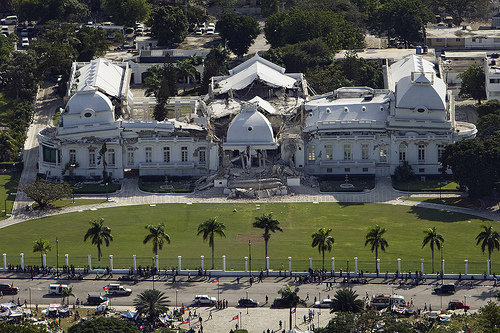
    Haiti has been mostly destroyed. It is estimated that 75% of its buildings have been damaged or destroyed. Its Presidential Palace collapsed as did its main Cathedral and the island’s UN Headquarters. Its infrastructure is in ruins, its water system destroyed. It looks reminiscent of Dresden, Germany during the carpet bombing of World War II. Dead bodies lie everywhere amidst the smoking ruins of a destroyed city.

    The city of Port au Prince needs to be razed to the ground. 2,000,000 people need to be dispersed around the Caribbean as the residents of New Orleans were after Hurricane Katrina. And then a massive reconstruction project, similar to the Marshall Plan after WWII, must be undertaken to rebuild everything from roads and ports to homes, hospitals and schools. Who will lead that effort? The nations of Latin America do not have the expertise or capital. The United States is financially exhausted, drained from two wars half a world away, 10% unemployment and a financial collapse as severe as the Great Depression.

    There is one man who is no stranger to multi-billion dollar projects and the transformation of a nation, Dubai’s ruler, Sheikh Mohammed bin-Rashid bin-Maktoum. Why would Sheikh Mohammed intervene and lead an effort to rebuild Haiti that will cost several billion dollars? Haiti is half a world away from the Persian Gulf. One reason is his proven ability to create and build a radical new urban vision. Sheikh Mohammed built the tallest structure on the planet, huge residential islands in the Gulf, and the world’s largest airport – simultaneously.

    The Gulf Cooperation Council, (GCC) consists of the UAE, Kuwait, Bahrain, Saudi Arabia, Oman and Qatar. To say these nations are rich is an understatement. Their oil reserves total somewhere around 500 billion barrels. Dedicating $10 billion to rebuild Haiti would require allocating a week’s revenue from crude oil production. That much money will not be needed tomorrow. A pledge of $3 billion per year for three years would suffice and not even dent the balance sheets of the Gulf nations.

    Sheikh Mohammed needs to take the lead if he wants the balance of power, respect and authority to move the UN from New York City to the Middle East. For too long, the Middle East has exported oil, its wars, the Israeli/Palestinian conflict and terrorists to the world. To many, the face of Islam has been the face of a terrorist, committing heinous acts on innocent people. Dubai, despite its majesty, has not yet become a true global destination, particularly in the wake of the world economic crisis. What better way to raise the image of Islam and the Middle East than to lead a 21st Century Marshall Plan to rebuild Haiti? The reward might just be a Nobel Peace Prize as George C. Marshall was awarded in 1953.

    Sheik Mohammed should make this announcement at the foot of the tallest structure ever created by man to show, while reaching for the sky, the ruler of Dubai can reach down to the poorest, most ravaged people on the earth and lift them up as well. He could take the center stage of the world, once again, and do what has made him arguably the most visionary developer since the Pharaohs of ancient Egypt.

    Robert J. Cristiano PhD is a successful real estate developer and the Real Estate Professional in Residence at Chapman University in Orange, CA.

    Photos:

  • Oregon Tries to Catch California – On the way down!

    Oregon’s voters will soon give their judgment on Measures 66 and 67, measures that will raise income and corporate taxes in the recession-ravaged state – with unemployment at 11.1 percent, the eighth highest in the nation. Besides leaving the state with the highest marginal rate in the country, tied with Hawaii, more insidiously measure 67 will impose a minimum tax based on sales, not profits, implying an infinite marginal tax rate for low-profit companies.

    This is not good news for businesses and citizens of Oregon. In a report titled Tax Policy and the Oregon Economy: The Effects of Measures 66 and 67, Two Cascade Policy Institute economists, Eric Fruits and Randall Pozdena, thoroughly review the literature on the impacts of tax increases on jobs and domestic migration, and they rigorously analyze the measures’ impact on Oregon jobs and migration.

    They estimate the new measures through 2018, will cost Oregon employment losses of “approximately 47,000.”

    Finally, Fruits and Pozdena examine the impacts of measures 66 and 67 on migration. They find that adoption of measures 66 and 67 will result in the loss of approximately 80,000 Oregon tax filers with a loss of $5.6 billion in adjusted gross income.

    These results have to be taken as the minimum impacts. Fruits and Pozdena are careful researchers. They do nothing that is not completely defensible. Consequently, because of statistical issues, some of the potential impacts, particularly those of measure 67’s minimum tax based on sales are almost surely under measured.

    Clearly Oregon , where many residents look down on the increasingly bedraggled Golden State seems anxious to follow California’s decline trajectory. We all know how that story ends: high unemployment, domestic out-migration, declining jobs, declining opportunity, and a vanishing middleclass.

    I am not alone in seeing the warning signs.

    The PEW Center on the States issued a report in November 2009 titled Beyond California: States in Fiscal Peril. PEW created an index using foreclosure rates, job losses, state revenues, budget gaps supermajority requirements, and money-management practices. The index resulted in values ranging from 6, Wyoming, to 30 California. Higher values are bad here, and the closer to California’s 30, the more a state is at risk of California-style fiscal problems. Oregon, with a value of 26 is listed as one of nine states that the PEW researchers consider at high risk.

    Then there’s Small Business & Entrepreneurship Council’s recently released Small Business Survival Index. They use a much larger set of variables to create their index of public policy climates for entrepreneurship, a total of 39 indicators covering tax policy, regulation, crime rates, costs, and more. This index results in values ranging from 25.7 for South Dakota to 84 for the District of Columbia. As with the previous index, high numbers are bad. California, with a score of 77.7 is the second worst state, behind only New Jersey. Oregon’s score is 65.2, the 38th among states, and dangerously close to California’s score.

  • Denmark, and the US, in 2010

    Denmark is a good microcosm. It holds lessons for us here in the States, good and bad. I felt that way when I first lived there in 1971, when I researched my doctoral dissertation there in 1977, and I feel that way now.

    Denmark is a mixed-economy (free market competition with a large public sector), social welfare, multi-party democratic country that, because of its small size and international exposure, is affected more quickly and deeply by social, economic and political forces at work in the Western (and wider) world. It was a founding NATO member (1949) and the first Nordic member of the European Union (which it joined, simultaneously with Britain and Ireland, on New Year’s Day 1973). For such a small, homogenous country, it has amazing social, economic and political diversity (for example, over the past 36 years some 15 different political parties have at one time or another garnered representation in Folketinget, the Danish Parliament).

    Denmark has had, and continues to have, an outsized global influence relative to its size, whether in diplomacy, design, architecture, or quality manufacturing. Denmark gets a lot of things right. The standard of living is high, and so is the quality of life. As for the Danes themselves, both the famous and anonymous, they display an unmistakable national character combined with healthy individualism. (The unwritten law of Danish culture commands that one is not to draw attention to oneself, but it’s liberally violated!)

    The US is also a mixed-economy, social welfare, multi-party, democratic, diverse nation. There is an undeniable leftist political orientation among elites, media, academia, government and public policy professionals in both countries. What lessons can we learn from recent developments in Denmark? Like the US, Denmark has gone through, and is going through, economic, financial, real estate, employment, debt and deficit problems of unanticipated severity. And like the US, responsible parties have taken their eye off the ball.

    My colleague and partner Jorn Thulstrup, owner, CEO and publisher of News ex-press, a daily compilation of Danish news media presented in English for the diplomatic community in Copenhagen (among other clients), recently wrote a sharply critical report on the hangover left in Denmark by the Climate Conference. He states:

    The COP15 Climate Conference held in Copenhagen in December, fuelled by political and economic special interests and enthusiastically embraced by naive Danish journalists, preoccupied people in this country far more than the rest of the world. For a lengthy period of time, leading Danish politicians and commentators seemed to be suffering from the illusion that, in terms of climate and energy, Denmark could rule the world. A widespread perception flourished that Denmark, as host of COP15, could create some kind of platform to market Danish technology, especially wind energy and enzymes used in the production of bio-ethanol.

    But eventually, as expected, the concluding “Copenhagen Accord” failed to live up to the exaggerated expectations and only confirmed that the skeptics were right at least about the politics: the climate conference was a ritual event without meaning or influence.

    Preoccupation with meaningless things is not costless. Hosting the Climate Conference cost Denmark billions of kroner, but the indirect costs were even more serious: it tied up official government business, cabinet ministers and security forces for such a long time, and to such an extent, that many serious political and economic issues – like how to get the economy growing again – were neglected.

    Denmark deservedly prides itself on its quality of life, which includes a low crime rate. But while Copenhagen was free of the widespread destruction and vandalism that many had feared during the climate conference, the devotion of overwhelming police resources to COP15 over the past two years has actually been accompanied by an increased crime rate generally.

    The failure of COP15 is disappointing, if not unexpected. But the global economic crisis has left its mark throughout this country too. Years of budget surpluses have been transformed into deficits, in the necessary effort to prevent a collapse of the financial sector and limit growing unemployment. The government is now focused on the domestic agenda, with the top priority to restore economic growth, aiming to secure a political platform that will lead to victory at the next general election. Sound familiar?

    Small country, big ideas
    Another more serious problem is Denmark’s inability to compete, writes Thulstrup. Major wage hikes at home and devaluations abroad have made Danish goods and services too expensive. Unfortunately, Danish workers haven’t been able to compensate with increased productivity – in fact, quite the opposite. Possibly, as a society, the crisis was not taken seriously enough. Things went well for years and it appeared, after years of balance of payments and budget surpluses, that the country was capable of managing any setback. Also sound familiar?

    Every year or so some international poll shows that Danes are the “world’s happiest people.” (It would be more accurate to say “most contented,” or, if I’m feeling mischievous, “resigned to their situation”!) But the problem, writes Thulstrup, is that they are no longer very industrious. Studies, reports and commissions have been warning for years of the lack of qualified manpower.

    Denmark has a high workforce participation rate, due to the share of women that work outside the home, but is a laggard in actual hours worked. It’s a case of short working days, long holidays, and a high amount of sick leave. Students take too long to become qualified and too many people retire early – at the state’s expense. More and more fail to contribute anything to production and are being supported by fewer and fewer. A third of working-age adults – the potential labor force – is out of work, compared to just one in four eight years ago. And it’s going to get worse in the coming years. Thulstrup expects very little change in Denmark in 2010, in terms of economic growth. .

    That also sounds depressingly familiar.

    What about “flexicurity,” the Danish labor market scheme that seeks to combine employer flexibility (the ability to hire and fire easily) with employee security (publicly-funded job retraining)? Robert Kuttner praises flexicurity in Foreign Affairs (March/April 2008), while conceding that Danish conditions are unique and not applicable elsewhere. Thulstrup says flexicurity keeps the official Danish unemployment rate artificially low by forcing into job training, and then counting as employed, many people whose employment prospects are meager. In this way and others, he says, the system is susceptible to waste, fraud and abuse. Additionally, its costs are exorbitant: an “astonishing” 4.5% of GDP (as per Kuttner).

    Big country, perverse ideas
    We have taken our eye off the ball here in the States too. Over the past year our liberal elites have been consumed with climate control, health-care reform and public-sector pump-priming, when they should have been focusing on creating the conditions for private sector economic growth. We are now faced with the specter of laws, regulations and taxes that are unwanted and harmful, more expensive energy, and slower economic growth than would otherwise occur. That’s a shame, because economic growth is an all-purpose salve that cures a multitude of ills, and an all-purpose social lubricant that hides a multitude of sins.

    The essence of all of this is the matter of incentives.

    The lesson we should be learning from Denmark is that preoccupation with ritual, meaningless and nonsensical things is not costless. The cost of not working is greater than imagined over time. Misallocation of resources is not just wasteful and expensive, it does violence to the general welfare, not to mention common sense.

    Dr. Roger Selbert is a trend analyst, researcher, writer and speaker. Growth Strategies is his newsletter on economic, social and demographic trends. Roger is economic analyst, North American representative and Principal for the US Consumer Demand Index, a monthly survey of American households’ buying intentions.

    Photo: