Category: Politics

  • Copenhagen: the Fall of Green Statism

    Now we have the Copenhagen deniers. These are people who won’t accept that the UN’s climate change process has been derailed. The highest emitting nations refuse to be bound by an enforceable treaty. Instead of bedding down a replacement for the near-defunct Kyoto Protocol, they asked for a rain check.

    If the grandly named Copenhagen Accord is “a first step”, as President Obama put it, what were Rio (1992), Geneva (1996), Kyoto (1997), Buenos Aires (1998), Lyon (2000), The Hague (2000), Marrakech (2001), New Delhi (2002), Milan (2003), Buenos Aires (2004), Montreal (2005), Nairobi (2006), Vienna (2007), Bali (2007), Bangkok (2008), Ghana (2008), Poznan (2008), Bangkok (2009) and Barcelona (2009)?

    Apparently these earlier meetings of the UN Framework Convention on Climate Change were just for cocktails. And the list doesn’t include the eleven or so gatherings since 1998 of the Convention’s “subsidiary bodies”, all held in Bonn.

    Copenhagen wasn’t meant to be just another UNFCCC meeting. It was the Conference of Participants (the Convention’s supreme body) where member nations were to sign off on a successor to Kyoto, which only covers the period to 2012. Their failure to do so means the process is in disarray. Consisting of twelve short clauses, the Accord is little more than a face-saving device full of vague and unenforceable aspirations. The final clause calls “for an assessment of the implementation of this Accord to be completed by 2015”, so the world won’t have a binding operational treaty for some time, if ever.

    Copenhagen wasn’t a first step; it was the last step. It marked the end point in a long cycle of top-down, bureaucratic, multilateralism launched at the 1992 Rio Earth Summit. This all came unstuck in the very different world of 2009.

    The geo-political rifts on display at Copenhagen can’t be papered over with the diplomatic equivalent of a Hallmark greeting card. Essentially, the UN process is hostage to a standoff between the two largest emitters and their respective camps. On the one hand there’s China (for which read the Communist Party, whose grip on power depends on high rates of carbon-spewing growth) and so-called rapidly industrialising countries like India, Brazil, South Africa and Indonesia. On the other there’s the United States (for which read representatives of energy-producing regions in Congress, which must ratify any treaty negotiated by the President) and most of the developed world.

    Negotiations are rarely successful when both parties can only lose. Climate talks are about the apportionment of pain and blame, with benefits flowing to a third category of poorer countries, so the prospect of a workable compromise between the major camps is remote. Expect emissions to go on rising.

    Australia counts for little in all of this and was rebuffed at Copenhagen. Our 1.4 per cent contribution to global emissions has zero impact on the climate.

    Despite all the guff about Copenhagen being “a first step” or “a good beginning”, the collapse of the UNFCCC process changes everything. Absent a binding multilateral instrument, or the realistic prospect of such an instrument, the rationale for government-level, legislative and tax-funded initiatives disappears. The contention that we must enact a framework complementing the Kyoto Protocol and succeeding protocols, and demonstrate a credible intention to achieve prescribed emission targets, has been swept away.

    Bizarrely, our government persists with the argument that early action is essential to avoid the higher costs of delay. This claim rests on the assumption that acting now will prevent adverse climate effects. But that assumption was demolished at Copenhagen. Assuming the IPCC is right, only action by the major emitters, not Australia, can avoid such effects and they aren’t playing ball.

    If this is really about climate change, the government should call a moratorium on climate-related legislation and spending until the international position is clearer.

    Of course, individuals, firms and organizations in the private sector are always entitled to act on their own initiative, should they feel strongly about the issue. There just isn’t a rationale, or moral justification, for coercive state action.

    As John Humphreys of the Centre for Independent Studies points out, “it is an indication of the sorry state of community groups that when faced with a problem, they spend millions of dollars whingeing and asking other people to do something“. He proposes that “instead of whinging and waiting for politicians to become benevolent, people who are worried about anthropogenic global warming can take immediate action”. Climate activists and concerned citizens should put their money where their mouths are.

    On a practical level, Humphreys estimates that if activists were to organise a system of voluntary “workplace giving”, whereby people could opt to allow 0.5 per cent (or more) of their income to go directly into a “climate fighting fund“, more that $1 billion would be raised if only one third of Australians participated. These funds could be used to buy low-emission energy from alternative energy producers for sale to into the power grid at the going market price. For one thing, this would spur investment in alternative energy technologies without inefficient meddling from government.

    This is one of many courses open to those who profess to be alarmed about the coming cataclysm. We’re often told they’re in the majority. Since the future of the planet is at stake, why should higher contributions matter?

    If green activists and entrepreneurs can generate demand for expensive but clean energy sources, the government should facilitate this market by removing barriers to entry, not by mandating or subsidising particular energy options. If property developers can generate demand for high-density “green” housing, planning officials shouldn’t regulate against this, just as they shouldn’t regulate against low-density housing. The same applies to transport and cars. Let consumers choose. This is the real “market solution” to climate change (assuming a solution is needed), not the fake market represented by a cap-and-trade ETS.

    Surveys and electoral returns show that the affluent tend to be more concerned about green issues, so this approach has an added advantage. It relieves wealthy greens of the moral hypocrisy inherent in demanding state interventions which produce glittering opportunities for them, while shifting the pain disproportionately to the most vulnerable in the community.

    This article first apeared at The New City Journal

    Photo:

  • Stop Coddling Wall Street!

    By all historical logic and tradition, Wall Street’s outrageous bonuses—almost $20 billion to Goldman Sachs alone—should be setting a populist wildfire across the precincts of the Democratic Party. Yet right now, the Democrats in both the White House and Congress seem content to confront such outrageous fortune with little more than hearings and mild legislative remedies—like a proposed new bank tax, which, over the next decade, seeks to collect $90 to $100 billion. This amounts, on an annual basis, to about half of this year’s bonus for Goldman’s gold diggers alone. It’s speaking loudly and carrying a stick made of paper mache.

    But this should come as no surprise, really. Postmodern Democrats are generally more concerned about the fate of the polar bears than real people on Main Street.

    One reason may be that Democrats increasingly collect the bulk of contributions from the very financial sector that they have bailed out and coddled since taking office. However, more substantially, the Democrats—including many “progressives”—seem more comfortable with big business and high finance than their erstwhile working- and middle-class constituencies. For this, we need the Democratic Party?

    Somewhere outside Nashville, the shade of Andrew Jackson, the founder of the modern Democratic Party, is stirring uncomfortably. So, too, are the remains of Harry Truman and Franklin Roosevelt, Jackson’s heirs to the leadership of the Party of the People.

    Faced with highway robbers like those at Goldman Sachs, Jackson would have threatened to seize their assets and, if they protested, hang them from the highest tree. Franklin Roosevelt would have made political mince meat out of these outrageous “economic royalists.” Harry Truman would have uttered an earthy expletive and sought to cut them down to size. Truman hated phonies and elitists; today’s Democrats Party is lousy with them.

    Now we see the very abandonment of the idea of the Democratic Party opposing concentrations of power. Historically, Democrats took on the largest and most powerful institutions of society. Jackson made his critical battle against the government-run Bank of the United States, which he considered a means “ to grant titles, gratuities, and exclusive privileges, to make the rich richer and the potent more powerful.”

    In his time, Franklin Roosevelt battled big business, which largely hated him, by seeking to create a more equal distribution of wealth. He tried to save homeowners and farmers from the banks; speculators wiped out in 1929 did not enjoy banner years for a long time to come. Truman fought not for big banks and major companies, but for programs that spread capital to the middle class, whether for college loans or mortgages.

    Now we have the postmodern Democratic Party of Barack Obama. The new party has little use for populism of any kind—it prefers to legislate from on high, whether on financial reform, climate change or land-use policy, from what it considers its superior knowledge. If your factory or business is shut down as a result, it’s you who better learn to evolve.

    We will see this same mind-set in action with the administration’s proposal for a cap-and-trade program. It may end up doing little for the environment, but a lot of traders, well-connected corporate CEOs, and academic consultants will be made even richer. Draconian “green” policies that boost subsidies and energy prices may not be what Americans want—climate change ranks near the bottom of popular concerns—but such an approach fits neatly the agendas of Harvard faculty, Wall Street, and the mainstream media. That is, those who matter.

    The rotten economy remains detestable but the stimulus program is working fine for their key constituencies. Stocks are up, many hedge funds are doing well, university research coffers are bulging. Meanwhile, taxpayers are employing ever-more unionized public employees, whose often-insane pensions are consuming many local government budgets.

    Many Americans who work for themselves are enraged, but they lack a credible channel for expressing it. The Republicans are largely discredited by their disgraceful performance over the last decade, up to and including the initial Bush-Paulson bailout. The Republicans presided as easily as the Democrats over the disastrous financialization of the economy; by the mid-2000s, finance accounted for some 41 percent of all American profits—three times the percentage in the 1970s.

    But for now, populists are in retreat in Washington. Last week, Byron Dorgan of North Dakota announced his retirement from the Senate. Dorgan, friends tell me, was disgusted with Obama’s focus on health care and climate change at a time when the economy was unraveling and Americans were losing their jobs. He also knew that the president’s mounting unpopularity in Middle America posed a profound threat to his own reelection prospects.

    Dorgan will be missed. His voice would have been set against the coddling of Wall Street. He supported reinstating the 1933 Glass-Steagall Act, which put a barrier between banks and investment houses. He also opposed “too big to fail” policies and was ready to attack the administration’s “cap-and-trade” scheme, which he considered a large giveaway to Wall Street traders.

    Dorgan’s departure leaves only a handful of genuine populists in Congress, including Jon Tester from Montana, James Webb of Virginia, as well as our resident socialist, Vermont’s Bernie Sanders. They may well be at last willing to take on the battles that Jackson, Roosevelt, and Truman would have fought against “interests.”

    Right now for every populist, there are several gentry Democrats—epitomized by the likes of New York Senator Charles Schumer and his sidekick, Kirsten Gillibrand—who will do Wall Street’s bidding on the Hill. Erstwhile populists may find some allies among independent-minded Republicans but, for the most part, the GOP is too blinded by ideology or too well bought to curb the big investment houses.

    So in the end, another crop of 35-year-old Wharton and Harvard MBAs gets to spend their multimillion-dollar windfalls. Maybe if you live in New York, perhaps a few shekels might fall your way. After all, these people have kids to nanny, dogs to walk, apartments to decorate, and toenails to be painted.

    These bonuses simply remind us of our outrage. Jackson, Roosevelt, and Truman would have understood the opportunity for the Democratic Party presented by this egregious, undeserved windfall. Truman in particular would have detested the academically oriented “progressives” who explain away excess and look for new ways to harry independent smaller businesses. As he once quipped, “There should be a real liberal party in this country, and I don’t mean a crackpot professional one.”

    Yet that’s exactly the kind of Democratic Party we have now: one that shames the legacy of Truman, Roosevelt, and Jackson and looks the other way while the Treasury is raided and the economy works mainly for the benefit of the least deserving.

    This article first appeared at TheDailyBeast.com

    Joel Kotkin is executive editor of NewGeography.com and is a distinguished presidential fellow in urban futures at Chapman University. He is author of The City: A Global History. His next book, The Next Hundred Million: America in 2050, will be published by Penguin Press February 4th.
  • Move the United Nations to Dubai

    The opening last week of the world’s tallest building, the half-mile-high Burj Dubai, has largely been greeted with guffaws and groans. The Daily Telegraph labeled it “the new pinnacle of vanity”–“a purposeless monument to the subprime era.” The Wall Street Journal compared it to the Tower of Babel. (When the Empire State Building was completed in 1931, in the throes of the greatest financial crisis of the 20th century, it was met with similar jeers. The then-tallest building in the world was called the Empty State Building, and it remained vacant for several years.)

    Yet the Burj’s completion–indeed the whole wild enterprise known as Dubai–could signal a potential opportunity to the global community: turning the place into the headquarters for that other misguided ship, the United Nations.

    Let’s spell out the logic. The United Nations is a pain in the butt. It pays no taxes and annoys hard-working New Yorkers with its sloth, pretensions and cavalier disregard for traffic laws. The place is a sinkhole dominated by anti-American, anti-Semitic and authoritarian fantasies. It is far from the elegant crown jewel that celebrated the U.S.’s global ascendancy after the Second World War.

    Today the U.N. building is a mostly empty shell–water dripping through its roof, asbestos lining its ceiling and an erratic heating and cooling system have forced most UN workers to new facilities. The building is in the midst of a $1.87 billion overhaul–of which the U.S., which could use the cash for myriad other things, would be on the hook for $437 million.

    And the U.N. may be leaving anyway. A relocation committee has recommended that the organization move temporarily to Singapore by 2015. It will be hard to vacate Asia again for New York, which is far away from the bulk of the world’s largest population centers.

    Singapore might make a fine world capital, since it does work like a fine watch. But it’s already crowded, expensive and highly regulated. You have to wonder if hard-working, rational Singaporeans would want to drive up costs and lose their ability to run things as they see fit to accommodate the U.N. bureaucracy.

    In contrast, the al-Maktoum family has transformed a once vast, empty landscape into a Star Wars-like capital city of the future. There is no skyline more arresting than the one built over the past 15 years by Sheikh Mohammed bin Rashid Al Maktoum, the Absolute Ruler of the tiny Emirate. In just 500 square miles, about half the size of Orange County, Calif., the sheikh has created a monument to modern architectural engineering.

    Sheikh Mohammed could offer to build a United Nations City to house the U.N. in any number of vacant office towers. Business Bay has 65 million square feet of office space under construction in more than 200 high-rises. Dubai already has thousands of newly constructed apartments that await the international delegates. More than 2 billion people in Africa, Europe and Asia are within a six-hour flight from Dubai. Travel connections through the world’s largest airport would be a breeze. Dubai has 55 five-star hotels to accommodate every regal and royal delegation, as well as the Harvard Medical School Dubai Center, a $1,400,000,000 facility branded with the Harvard crest, just in case one of the U.N.’s elite workers breaks a gasket.

    Questions of taste and timing aside, you have to admire the sheikh’s chutzpah. The al-Maktoums, descendants of the Bani Yas clan, have ruled Dubai since 1833, first under the protection of the British. The United Arab Emirates was founded in 1971 with big brother Abu Dhabi, the emirate with 96% of the confederation’s oil reserves.

    Like New York, Dubai aimed first to be a capital of capital. Recognizing that oil revenues at $70 a barrel brought immense cash flow to the Persian Gulf, Sheikh Mohammed set out to create a setting where Arab pride and excess oil revenues could be comfortably parked. His boldness caught the attention of the world financial community and soon the tiny emirate employed more construction cranes than any site on Earth.

    For now flying so close to the sun has resulted in a painful and somewhat humiliating fall. With the financial market collapse of 2008 to 2009 international buyers disappeared and property values plummeted. Half of the $300 billion in construction projects screeched to a halt. The Dubai government, with $80 billion to $100 billion of debt, was in trouble, and Dubai World, its investment arm, announced suspension of interest payments on its loans. Enter Abu Dhabi. The neighboring emirate wrote kid brother Dubai a check for $25 billion. What does $25 billion get you in 2010? On Jan. 4, at the grand opening of the Burj Dubai, Sheikh Mohammed announced that the tower would forever be known as Burj Khalifa, named after the Emir of Abu Dhabi.

    Let’s look a bit longer term. Right now there’s 33.6 million square feet of mostly state-of-the-art office space in Dubai. More than 8 million square feet is vacant with millions more in the pipeline. There’s a great airport–as opposed to that aerial dumpster, JFK–that is hours closer to the emerging economic powers of the new century, notably the oil states, India and China. The workforce is skilled and open to foreigners, since the vast majority are foreigners. In Dubai 83% of the 2.2 million residents are from somewhere else. Talk about cosmopolitan.

    But how about New York? “Moving the U.N. to Dubai would be a boon for New Yorkers who have to put up with traffic jams created by the likes of Colonel Qaddafi, scofflaws protected by diplomatic immunity and the loss of real estate revenue they would gain if the U.N. building were turned into something far more useful–condos with a view,” suggests urban historian Fred Siegel, a visiting professor at Saint Francis College in Brooklyn and a fellow at New York’s Manhattan Institute.

    Liberating New York from the United Nations, in fact, would open up some of the best situated real estate in the world. A treasure trove of great apartments and offices right along the East River would suddenly become available, bringing a potential revenue windfall to New York City, which could use it. None of this would threaten the city’s—or the country’s–economic and political status. That grows out of economic and military power, which the U.N. does little or nothing to augment.

    What would Dubai get? It’s an ideal opportunity to refurbish its tarnished image on the world stage in a way that plays to its infrastructural and geographical advantages. The Arabian Sea and the Indian Ocean are increasingly the focal point of the world economic and political systems. Some of the biggest challenges facing the U.N. are concentrated in the south in Somalia and Yemen, to the west in Israel and Palestine, and to nearby Iran and Pakistan. Dubai would have to reconcile itself to a permanent Israeli presence, but that may not be as difficult as many think. Jews, and even Israelis, do business today in Dubai with perhaps less worry about running into manifestations of anti-Semitism than in London or Paris.

    Bringing the United Nations to Dubai makes sense. New York gets rid of one of its worst welfare cheats, and Dubai finds new tenants to fill its vacant towers. Dubai has already built something that looks the part of a 21st-century world capital. Let it get a cast appropriate for its glittering set.

    This article originally appeared at Forbes.com.

    Joel Kotkin is executive editor of NewGeography.com and is a distinguished presidential fellow in urban futures at Chapman University. He is author of The City: A Global History. His next book, The Next Hundred Million: America in 2050, will be published by Penguin Press February 4th, 2010. Coauthor Robert J. Cristiano Ph.D. is a successful real estate developer and the Real Estate Professional in Residence at Chapman University in Orange, Calif.

    Photo:

  • Will Anyone Stand Up for American Industry?

    “Esau for one morsel of meat sold his birthright. For ye know how that afterward, when he would have inherited the blessing, he was rejected: for he found no place of repentance, though he sought it carefully with tears.” – Hebrews 12:16-17

    Built from 1933-1936, the Bay Bridge linking San Francisco to Oakland was an engineering marvel of its day. A complex series of multiple spans, when it opened – six months ahead of the more famous Golden Gate Bridge – it was both the longest suspended bridge deck in the world and the longest cantilever bridge in the world. The western suspension bridge section, technically two bridges in one, had to settle for being only the second and third longest suspension bridges in the world.

    The 1989 Loma Prieta earthquake badly damaged the Bay Bridge. The iconic western suspension span was seismically reinforced, but the eastern steel truss section required replacement. San Francisco wanted another iconic span, not just a functional one. A striking self-anchored suspension structure was selected and is under construction.

    The dubious part of this new span isn’t the usual matter of being way late and massively over budget – though it is – but where it’s being made. The steel for the bridge is not being built in America but in China.

    Why is this bridge being fabricated in China? The troubling answer, according to a lengthy article in the SF Public Press, is that no American company can do the job. America, a country that once pulled off the most audacious of engineering projects with panache, one that put a man on the moon in the 1960s, now can’t even build a bridge to replace one it constructed with ease in the 1930s.

    What’s more disturbing, is that China can’t really build it either – but we are teaching them, and paying for them to learn how.

    When you drive across that new Bay Bridge, your tolls will literally be helping to finance the advancement of China’s industrial base and the evisceration of America’s.

    I believe in free trade, strongly. I believe America can compete in a free market. But the United States is a country curiously uncommitted to industry. Other countries build, promote and protect industrial champions. They blockade their markets against American competitors. India freely sells us software and BPO, but passes laws to hamper Wal-Mart and other American firms. China demands many foreign companies do business there only through joint ventures, and transfer technology to local partners. It also intervenes to keep its currency artificially low. Many countries outright ban foreign involvement in many sectors such as energy. They view even their privately owned firms, many of which have close and corrupt ties to the state, as instruments of national and foreign policy.

    These places see Japan as a model to follow, a country that used its closed market to build industrial champions, even in high technology markets. Perhaps in time the same problems that hobbled Japan – asset bubbles, debt, demographic collapse, or an inflexible economy – will similarly afflict these emerging markets. But by that time it might be too late for American industry. And those problems are just as likely to affect us as them.

    This raises difficult questions about the future of America. Can we thrive as a purely post-industrial economy? Can we have a long term prosperous society built on little more than selling each other ever more exotic pieces of financial paper, creative consultancies, typing away at computers, serving up caffe lattes, and the like? Can we have a just social order as a two-tier society of only highly-paid elite knowledge workers and a low end service class, but not the robust middle class a manufacturing economy – along with agriculture and energy – supported?

    Can America even retain its military industrial strength under such conditions? In the past, military technologies launched spin-offs to the commercial world. Today, the reverse is as likely to happen. Already the only major ship builders left in America are captive suppliers to the US Navy. Only the anomalous Jones Act has kept a tradition of small and medium sized commercial shipbuilding alive.

    There’s a positive reinforcement cycle at work. The less we manufacture, the less we can manufacture. We slowly lose the skills, the facilities, the institutions, and the culture that enable a robust manufacturing economy to thrive. Eventually, we won’t be able to recover.

    Maybe we won’t even want to. The less we make, the less we want to make. As we become unmoored from our agro-industrial roots, we fail to see them as central to our national identity and frequently treat them with hostility. As Douglas and Wildavsky put it in Risk and Culture (1982):

    A larger proportion of the population of working age was disengaged from the production process than had been before. The economic boom and educational boom together produced a cohort of articulate, critical people with no commitment to commerce and industry.

    Increasingly, Americans have no personal experience with industry, and even no family experience with it. What was once common is just another niche, much like military service has become. This means most people have little familiarity or affection for industry, agriculture, or energy production. Many, especially urban dwellers, view most productive industry as a negative, as a source of blight where once others saw jobs and a strong tax base.

    Portland provides the perfect example. It views its waterfront as prime territory for residences and recreation, but not for industry. As the Oregonian reports:

    The question makes Jay Zidell uncomfortable. When will he stop building barges on the waterfront and start building high-rises? The room goes silent….Oregon power brokers have nudged the Zidell family for decades to do more with their prime Portland real estate…In the 1970s, Gov. Tom McCall called Jay Zidell’s late father, Emery, to suggest he stop adding industrial buildings. As Jay Zidell has told the story, McCall said: “We have big plans for the waterfront.”

    Those big plans don’t include manufacturing. Portland is the perfect example of where America is heading. It’s a place where thousands of highly educated but often underemployed young people sip lattes by the light rail while on the waiting list for a job at Starbucks. Meanwhile people in third world countries, hungry for more, hustle to build an ambitious future for themselves and their nation. Americans increasingly view manufacturing as an undesirable activity, particularly in an urban context, when in fact we should be looking to build new industrial cities – updated, re-imagined, and re-designed for a 21st century economy.

    Also, too often industry is viewed only as a source of pollution. Many industrial expansions are opposed on environmental grounds. But from a global, not local perspective, an ever stricter regime of regulation is sending firms offshore where pollution standards are usually far laxer. Corporations put a green gloss on their branding campaigns while building their products in China, where they get electricity from one of the new coal fired power plants that open at a rate of more than one per week. They also escape independent unions, anything like the Environment Impact Statement process in the US, and operate in a regime of weak property rights, questionable worker health and safety conditions, and a limited ability for the public to dissent. It’s not just cheap labor, it’s regulatory arbitrage. It’s like inverse colonialism, only this time the joke’s on the West. And the end result is a global environment that ends up worse, not better.

    To really protect the environment, we should be doing more manufacturing at home, where we can keep an eye on it and prevent the worst abuses. It’s like the Steak ‘n Shake boast about their open kitchens: “In sight, it must be right”.

    The sometimes exception to this negative take on manufacturing is, of course, “green” industry, notwithstanding that the concept does not exist except as a transitory state. In a decade there will just be “manufacturing”, and virtually all will adhere to green standards. But if America can’t succeed at traditional manufacturing, why would anyone think it will be different with green manufacturing? Even if so, by then there might not be many major American producers left to succeed.

    American firms and labor have made many mistakes over the years, but more often today they are adopting the new approaches needed to compete in tomorrow’s world. American labor can compete, even against cheap foreign workers, since it is the best and most productive workforce in the world. But not when public policy implicitly favors shipping manufacturing overseas.

    The answer is not protectionism, it’s freeing American labor to compete and developing policies designed to advance American manufacturing interests. Alexis de Tocqueville talked about Americans knowing the difference between raw, naked self interest, and “self-interest well-understood”. Likewise, we need to find a new approach to create “free trade, well understood”, a modern day trade equivalent of speaking softly, but carrying a big stick. Billions for American infrastructure, but not one $4 Bay Bridge toll to finance China’s technology ambitions.

    Alas, this seems unlikely. American industry is trapped between a political right that can’t see beyond instinctive anti-federalism and an overly ideological vision of free trade, and a political left that, while paying lip service to labor interests, no longer embraces industry. Almost alone among nations, America today lacks political champions for its industry. That, more than anything, is why it is being left to wither. Will anyone stand up and be counted before it’s too late?

    Aaron M. Renn is an independent writer on urban affairs based in the Midwest. His writings appear at The Urbanophile.

  • The Limits Of Politics

    Reversing the general course of history, economics or demography is never easy, despite even the most dogged efforts of the best-connected political operatives working today.

    Since the 2006 elections – and even more so after 2008 – blue-state politicians have enjoyed a monopoly of power unprecedented in recent history. Hardcore blue staters control virtually every major Congressional committee, as well as the House Speakership and the White House. Yet they still have proved incapable of reversing the demographic and economic decline in the nation’s most “progressive” cities and states.

    Obama and his congressional allies have worked overtime in favor of urban blue-state constituencies in everything from transportation funding and energy policies to the Wall Street bailouts and massive transfers of private wealth to powerful public-employee unions. Yet these areas continue suffering from net outmigration and stubbornly high job losses – as well as from some of the most severe fiscal imbalances in the nation.

    Nowhere is this more evident than in the president’s hometown of Chicago. The Windy City has suffered a very bad recession and may have fallen to its worst relative position since the Daley reconquista in 1989. As Chicago blogger Steve Bartin points out, even the presence of a Daley operative in the White House has failed to prevent the city from falling “in a funk.” He writes that even a reliable booster, columnist Mary Schmich of the Chicago Tribune, has lately described the city “as edgy, a little sullen and scared, verging on depressed.”

    There’s plenty reason for feeling low, well beyond the humiliating loss of the Obama-backed Olympics bid last year. For example, Oprah Winfrey, the city’s one bona fide A-list celebrity, is retiring her talk show in 2011. She is also reportedly shifting much of her media empire to Southern California, which, for all its admitted problems, has gads of celebrities and much better weather.

    Chicago’s most serious concern, however, revolves around the economy. In June, its unemployment rate peaked at 11.3%, far outpacing the national unemployment rate of 10%. Since 2007, the region has lost more jobs than Detroit, and more than twice as many as New York. Chicago’s total loss over the entire decade is greater than any region outside Detroit: about 250,000 positions, which is about the amount its emerging mid-American rival Houston has gained. In hard times businesses tend to look for places with a friendly environment for their enterprise. They avoid high taxes, political payoffs and inflated public employee salaries – all well-known Chicago specialties. These costs are undermining the city’s competitive position in, for example, the convention business, among others.

    Other key sectors are also flailing. Political influence in Washington will not stem the flow of high-wage trading jobs away from the Mercantile Exchange to decentralized electronic exchanges. Nor can it reverse the deteriorating state fiscal crisis caused by weak economies and exacerbated by insanely high pensions and out of control spending policies. Late last month Moody’s and S&P downgraded the debt ranking for the State of Illinois. Of course, such fiscal malaise is not limited to Chicago or Illinois. True blue California has an even worse debt rating. New York, another blue bastion, is also just about out of cash.

    To be sure, the recession has not hurt New York as much as Chicago, but the Big Apple has lost heavily , including 50,000 financial sector jobs since 2007. The outrageous bonuses to a few well-placed financial types will cushion but not deflect the influence of declining high-wage jobs. This can be seen in the striking weakness in the once seemingly unstoppable high-end condominium market. Particularly hard hit have been recent gentrified neighborhoods like Williamsburg in Brooklyn, N.Y., much like the hard-hit, newly developed areas along the Chicago lakefront.

    Other blue bastions have been shedding jobs as well, both during the recession and over the whole decade. Beyond Chicago and Detroit, the biggest losses among the mega-regions have taken place in the San Francisco Bay Area, Los Angeles-Long Beach and Boston. Big money can still be made in Silicon Valley, Hollywood or around the academic economy of Boston, but in terms of overall jobs, the past decade has been dismal for these regions. Meanwhile, the consistent big gainers have been – besides Houston – Dallas and Washington, D.C., the one place money really does seem to grow on trees. Even Miami, Phoenix and San Bernardino-Riverside, in California, boast more jobs today than in 2000, despite significant setbacks in the recent recession.

    These trends coincide with continuing shifts in demographics. The recession may have slowed the pace of net migration, but the essential pattern has remained in place. People continue to leave places like New York, Chicago, San Francisco and Los Angeles for more affordable, economically viable regions like Houston, Dallas, Austin and San Antonio. Overall, the big winners in net migration have been predominately conservative states like Texas – with over 800,000 net new migrants – notes demographer Wendell Cox. In what Cox calls “the decade of the South,” 90% of all net migration went to southern states.

    Utah, Colorado and the Pacific Northwest have also experienced positive flows – but perhaps most striking have been the migration gains, albeit modest, in Great Plains states such as Oklahoma and South Dakota as well as Appalachian Kentucky and West Virginia. Historically these places shipped many of their people to cities of the industrial Midwest, the eastern seaboard and California; that is no longer the case.

    Ultimately these shifts could undermine the true blue political strategy, perhaps as early as the 2010 congressional and state elections, and certainly after reapportionment. By 2012, the census will likely take seats from New York, Michigan, Pennsylvania and Ohio, handing them over to Texas, North Carolina, Georgia and Utah. Perhaps nothing will epitomize the new reality more than the fact that California, now among the most extreme blue states in terms of governance, will not gain a Congressional seat for the first time since the 1860s.

    These trends suggest that the current administration and the majority party in Congress must adjust their strategy. Further attempts to push a radical “progressive” agenda – expansive public employee bailouts, higher taxes and radical measures to combat “climate change” and suburban development – might please their current core constituencies, but they have the perverse effect of driving even more people and jobs out of these regions.

    All these underlying trends appear a boon to Republicans. But Democrats could counter the emerging GOP edge by appealing to the needs of these ascendant regions. By their very nature, growth states have the most urgent need for government investments in basic infrastructure, something traditional Democrats long have espoused. Moreover, such areas tend to become more tolerant as they welcome outsiders, and could be turned off to excessive Republican social conservatism.

    For any of this to work, however, Democrats must first abandon their current narrow, urban-centric blue-state strategy. They must learn to adjust their appeal to regions on the upswing, or things could turn out very badly for them very soon.

    This article originally appeared at Forbes.com.

    Joel Kotkin is executive editor of NewGeography.com and is a distinguished presidential fellow in urban futures at Chapman University. He is author of The City: A Global History. His next book, The Next Hundred Million: America in 2050, will be published by Penguin Press early next year.

  • Urbanity Drives Gay Rights Victory in Washington

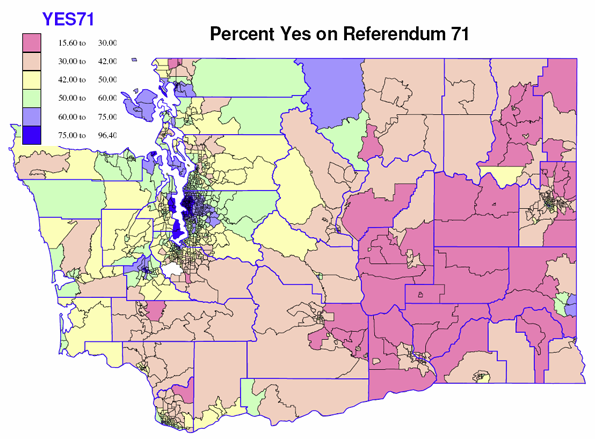
    If anyone were to doubt that there really are two Washingtons, that the Seattle metropolitan core (and its playgrounds) are another world from most rural to small city Washington (especially east of the Cascade crest), a look at the maps for the vote on Referendum 71 last November should be persuasive. These are not subtle, marginal differences, but indisputable polarization in what political and cultural researchers may call the modernist-traditional divide.

    Referendum 71 passed by a 53 to 47 percent vote, and revealing the power of the King County electorate, which alone provided a margin of 204,000, compared to a statewide margin of 113,000! To overcome the problem of variable size of precincts, and the need to suppress too small numbers, I aggregated precincts to census tracts, which have the added advantage of permitting comparison of electoral results with social and economic data from the census.

    Looking at the statewide map, about 85 percent of the territory of the state (95 % in Eastern WA, 70 % in western WA) voted NO. But the strong no vote came from overwhelmingly rural areas and small towns. The only core metropolitan census tracts that voted a majority no were in Richland-Kennewick area, Yakima and Longview. The heart of traditionalist, and arguably, of anti-gay sentiment lies in the farm country of eastern Washington, especially wheat and ranching areas in Adams, Douglas, Garfield, Lincoln, Walla Walla and Whitman counties, but extending also to the rich irrigated farmlands of Grant, Franklin, Benton and Yakima counties. The highest no votes in western Washington were far rural stretches, and most interesting, Lynden, home to many Dutch descendants, members of the conservative Christian Reformed Church. Not surprisingly the census tracts in eastern Washington which supported Referendum 71 were the tracts dominated by Washington State University in Pullman, around Central Washington university in Ellensburg, the mountain resorts tracts in western Okanogan (Mazama, Twisp), and a few tracts in the core of the city of Spokane.

    Across western Washington majorities against Ref 71 prevailed over a sizeable contiguous southeastern area, from northern Clark and Skamania through urban as well as rural Lewis county (reinforcing the county’s reputation of being the anti-Seattle!) into much of southeastern Pierce county. A lesser vote against 71 occurred in the rest of rural small town western Washington, including most of rural Snohomish county.

    The zone of strong support, voting over 60 percent in favor, flowed largely from Seattle and its inner commuting zone, its spillover playgrounds and retirement areas of Port Townsend and the San Juans, and college and university dominated tracts around Western Washington in Bellingham, the Evergreen State College, Olympia, plus the downtown cores of Vancouver, Tacoma and Everett. Weaker but still supportive were rural spillover, retirement and resort tracts, often in coastal or mountain areas of Pacific, Grays Harbor, Jefferson, Clallam, Skagit and Whatcom counties.

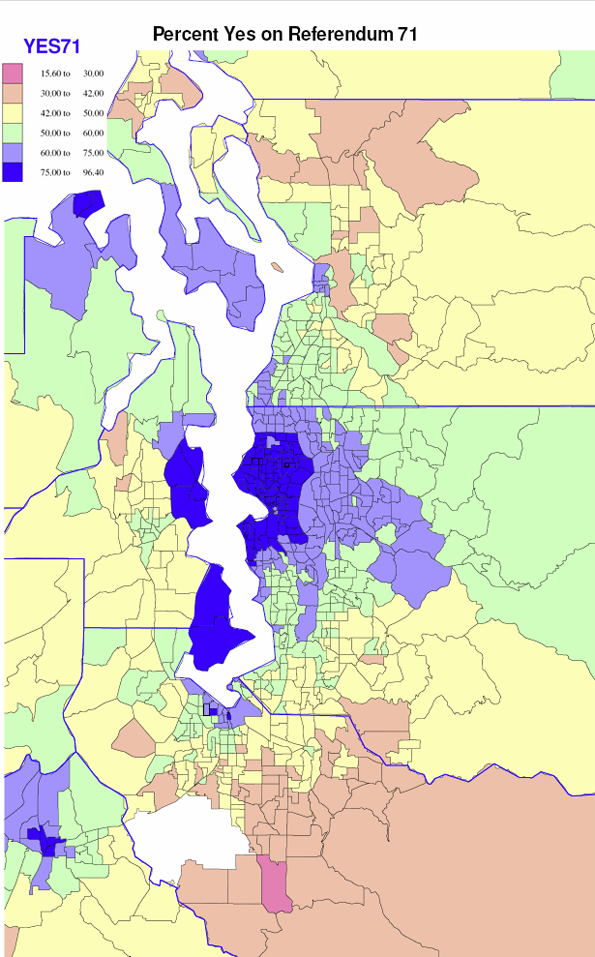
    Looking at the detailed map of central Puget Sound, we can see revealing contrasts between the two camps. Support levels of over 75 percent almost coincides with the city of Seattle boundaries (not quite so high in the far south end), and its professional commuting outliers of Bainbridge and Vashon, plus the downtown government core of Olympia and tracts around the University of Puget Sound and the UW Tacoma.

    Moderately high support (60 to 75 percent) surrounds the core area of highest support, most dominantly in the more affluent and professional areas north of Seattle through Edmonds and east to Redmond, Issaquah and Sammamish (Microsoft land). Weak but still positive votes occurred in the next tier of tracts, around Olympia, north and west of inner Tacoma, most of urban southwest Snohomish county and much of exurban and rural King county (quite unlike most rural areas). But on the contrary, the shift to opposition is remarkably quick and strong in southeastern King and especially in Pierce county, in northern and eastern Snohomish county, and, not surprisingly, in military dominated parts of Kitsap county (e.g., Bangor) and Pierce (Fort Lewis).

    The temptation to compare the voting levels of census tracts with social and economic conditions of those tracts is too great to resist. Here are the strongest correlations (statewide).

    Washington State Correlations with voting in favor of Ref 71
    % Use transit 0.75 %  Drive SOV -0.54
    % Non-family HH 0.65 % HW families -0.45
    % Single 0.48 Average HH size -0.53
    % Same sex HH 0.57
    % aged 20—39 0.43 %  under 20 -0.55
    % foreign born 0.28 % Born in Wash. -0.4
    % College grad 0.65 % HS only -0.62
    % Black 0.27 % white -0.13
    % Asian 0.42 % Hispanic -0.22
    Manager-Profess 0.53 % Craft occup -0.46
    % in FIRE 0.34 % laboring occup -0.47

    These statistics reflect the profound Red-Blue division of the American electorate, in both the geographic differences (large metropolitan versus rural and small town), as well as the modern versus traditional dimension (socially liberal or conservative). The strongest single variable is not behavioral, but transit use is a surrogate for the metropolitan/non-metropolitan split. The critical social characteristic lies in the nature of households: the traditional family versus non-families (partners, roommates, singles). This is a powerful tendency, and useful to describe differences in areas, but of course many in families – often more educated and professional – support Ref 71, and many singles – often elderly, or opposite sex partners – opposed it, especially in more conservative parts of the state.

    The next strongest set of variables, clearly visual from the maps, lay in the strong split of the electorate according to the predominant educational level of the tracts. The tendency of the more educated to support 71 represents the key statistic of the “modern” vs “Traditional” dimension, and is closely related to the differences by occupation and industry. Managers and professionals, and those working in finance, and information sectors tended to be supportive of 71, while those in laboring and craft occupations, and in manufacturing, transport and utilities, tended to oppose. (South King county and much of Pierce county have high shares of blue collar jobs).

    Finally differences by race exist, but are not so strong as, say, in the presidential election in 2008 (although the correlation of the percent for Ref 71 and for Obama was .90).

    Yes, greater Seattle is indeed very different than the rest of Washington and much of America as well.

    Richard Morrill is Professor Emeritus of Geography and Environmental Studies, University of Washington. His research interests include: political geography (voting behavior, redistricting, local governance), population/demography/settlement/migration, urban geography and planning, urban transportation (i.e., old fashioned generalist).

  • Why New York City Needs a New Economic Strategy

    When Michael Bloomberg stood on the steps of City Hall last week to be sworn in for a third term as New York City’s mayor, he spoke in upbeat terms about the challenges ahead. The situation, however, is far more difficult than he portrays it. American financial power has shifted from New York to Washington, while global clout moves toward Singapore, Hong Kong, and Shanghai. Even if the local economy rebounds, the traditional media industries that employ many of Bloomberg’s influential constituents likely will continue to decline. New Yorkers have long had an outsize view of their city; historically, its mayors have touted mottos that encouraged that view, from Rudy Giuliani’s “capital of the world” to Mike Bloomberg’s “luxury city.” But as Bloomberg begins his new term, New York needs to reexamine its core economic strategy.

    A good first step would be to recognize that the world owes New York nothing. The city cannot simply rely on inertia and the disbursements of Wall Street megabonuses to save its economy. Instead, it needs to rebuild its middle-class neighborhoods and diversify toward a wide range of industries that can capitalize on the city’s unique advantages—including its appeal to immigrants; the port; and its leadership in design, culture, and high-end professional services.

    It’s also time to get rid of the Sex and the City image and start making New York a city where people can have both sex and children. This will become more important as the millennial generation enters its late 20s and early 30s later this decade. This is when many young migrants to the city, including upwardly mobile immigrants, typically become ex–New Yorkers.

    Despite all the “back to the city” hype, New York over the past decade suffered one of the highest rates of out-migration of any region in the country. Young singles may come to New York, but many leave as they get older and have families. An analysis by the city controller’s office in 2005 found that people leaving the city were three times more likely to have children than those arriving.

    If New York is to thrive, it will need to keep more of these largely middle-class families. To do that, it needs to diversify its economy beyond Wall Street, which in 2007 provided roughly 35 percent of all income earned in the city. Since the recession, the city has lost 40,000 financial-service jobs, but the industry has been quietly downsizing for years: over the past two decades, more than 100,000 financial-services jobs have disappeared from New York. In good years, financial services provided an enormous cash engine, but it can no longer provide enough jobs. According to an analysis by the Praxis Strategy Group, finance now accounts for barely one in eight jobs in New York City. Most job growth has come instead in lower-paying professions like health care and tourism.

    To become economically sustainable, New York needs to create policies that help encourage development in areas where its less wealthy citizens live. Most outsiders identify New York almost exclusively with Manhattan, yet roughly three out of four New Yorkers actually live in the outer boroughs: Queens, Brooklyn, Staten Island, and the Bronx. Neighborhoods like Bay Ridge, Whitestone, Flatbush, Howard Beach, and Middle Village are really New York’s middle-class bastions.

    Over the past decade, these communities have provided a critical middle ground between the bifurcated Bloombergian “luxury city” with its high-end enclaves and the many distressed neighborhoods throughout the city. Although the mayor, some urbanists, and many developers would like to make these middle-class enclaves ever denser, their very appeal often lies in their moderate scale, proximity to work areas, decent schools, and parks. Those attributes hold sway, even in a recession. “Brand- new and expensive places have not held up as well as the established family neighborhoods,” says Jonathan Bowles, director of the New York–based Center for an Urban Future.

    Nurturing these neighborhoods will require a distinct shift in public policy. During the Bloomberg years the big subsidies have gone to luxury condo megadevelopments, sports stadiums, or huge office complexes. Consider the 22-acre Atlantic Yards project in downtown Brooklyn, which will include luxury housing and a new arena for the NBA’s Nets; one recent report by the city’s Independent Budget Office put the total subsidies provided by the city, New York state, and the transit authority at $726 million and estimated the project will hurt, not help, the city’s economy over time.

    More than anything, the plain-vanilla neighborhoods that represent New York’s real future will require policies that create a broad array of economic opportunities. Right now New York is so overregulated and highly taxed that only the most high-end business, such as big media and financial firms, can possibly thrive. The city has neglected its smaller firms, typically engaged in such activities as food processing, furniture making, and garment production. Traditionally these industries were run by Russian, German, Polish, and Italian immigrants; West Indians, Latinos, Koreans, Chinese, and South Asians do much of this work today. Over the past decade, the number of self-employed immigrants in New York has grown even as the number of self-employed among the native-born has dropped.

    Earlier generations of urban residents as well as many immigrants today stay in the city to be close to their communities and industries dominated by them. These days many others stay in the city largely because of its cultural attributes and quality of life. This doesn’t mean these workers remain unreconstructed bohemians forever. Their priorities often change as they age, start businesses, and raise families. Different, more mundane issues—stable employment, taxes, safety, schools, and housing affordability—often determine whether they stay in the city. “It’s easy to name the things that attracted us—the neighbors, the moderate density,” says Nelson Ryland, a film editor with two children who works in his sprawling home in Brooklyn’s Flatbush neighborhood. “More than anything it’s the sense of the community. That’s the great thing that keeps people like us here.”

    Technology will boost this sense of community. Online groups like the Flatbush Family Network can facilitate contact in different parts of a city among artists, families, and neighborhood groups, supplementing the traditional community adhesives of schools, churches, synagogues, and clubs. These new online institutions can perform some of the functions that urbanist Jane Jacobs’s “eyes on the street” did in the old, cohesive city neighborhood. Information about the arrival of a promising new store or restaurant, or the unwelcome appearance of a possible child molester, travels through these community networks much as it did when mothers spoke over the washing, men went to the pool hall, or kids hung out at the candy store.

    Bloomberg has built on many of the achievements of his predecessor during his eight years in City Hall. This, combined with huge campaign spending from his personal fortune, is why voters sent him back for a third term. To position the city for prosperity in an economy that’s no longer overly dominated by Wall Street, he’d be wise to spend his final term focused on making new opportunities for people who live far from his own Upper East Side neighborhood—the people who represent the real future of New York.

    This article originally appeared at Newsweek.

    Joel Kotkin is executive editor of NewGeography.com and is a distinguished presidential fellow in urban futures at Chapman University. He is author of The City: A Global History. His next book, The Next Hundred Million: America in 2050, will be published by Penguin Press early next year.

  • Obama’s Elite Power Base

    Looking back at President Obama’s first year in office, this much is clear: Obama first enraged the right wing by seeming to veer far left, then turned off the left by seeming to abandon them. Even as Fox News fundamentalists rail against “socialism,” self-styled progressives like Naomi Klein scream about a “blown” opportunity to lead the nation from the swamp of darkest capitalism.

    Both right- and left-wing critics fail to consider the fundamental nature of the Obama regime. This presidency represents not a traditional ideology but a new politics that mirrors the rise of a new, and potentially hegemonic class, one for which Obama is a near-perfect representative.

    Every president and political movement, of course, brings to power an often-hoary group of grasping interest groups. Under the conservatives and George W. Bush, the favored classes included standbys like the fossil-fuel energy companies, Big Agriculture, suburban homebuilders, and the defense industry.

    Rather than the “good old boys,” Obama’s core group hails from what may be best described as the “creative class” – the cognitive elite, or, to borrow from Daniel Bell’s The Coming of Postindustrial Society, the “hierophants of the new society.” They come not from traditional productive industry, but the self-conscious “knowledge” sectors – such as financial services, the software industry, and academia.

    From early on, Barack Obama attracted big-money people like George Soros, Warren Buffett, and JP Morgan’s Jamie Dimon far more effectively than his opponents in either party. As The New York Times’ Andrew Sorkin put it back in April, “Mr. Obama might be struggling with the blue-collar vote in Pennsylvania, but he has nailed the hedge-fund vote.”

    Other bastions of support could be found in Silicon Valley, where Google Chairman Eric Schmidt and venture capitalist John Doerr were all early backers. Obama, the former law school professor, also did exceedingly well with academics, and many of his pivotal wins in the Midwest rested heavily on both votes and volunteers from college constituencies.

    Finally Obama gained the early support of public-sector unions, now arguably the dominant power within the Democratic Party. Together, these groups now enjoy the lion’s share of influence inside the administration.

    In contrast, the representatives of traditional Democratic sectors such as industrial labor unions, Latinos, or even many African Americans were slow to join the Obama bandwagon. Even after they joined his electoral coalition, they have received little in the way of succor from the president and the administration.

    Indeed, for most of these voters, the past year has been an awful one. Unemployment for Latinos, blacks, and blue-collar workers has skyrocketed, particularly among males. For them, Obama’s economic plan has done very little – unsurprising given its primary focus on sustaining public-sector employment and large financial institutions.

    In contrast, the core Obama constituencies appear to have ridden out the recession in fine shape. Mega-patron George Soros, for example, has boasted openly about how he was having “a very good crisis.” Much the same can be said of the largely pro-Obama hedge funds and investment bankers, for whom Paulson to Bernanke to Geithner has provided a double-play combination for the ages.

    Academia has also emerged as a big winner. This administration is crammed with professors from Science Adviser John Holdren and Energy Secretary Steven Chu to former Harvard President Larry Summers, the director of the National Economic Council. More broadly, academics have reaped massive windfalls from the stimulus, both in terms of direct support for universities and funding for research projects.

    One place where the priorities and class interests of the cognitive elite coalesce most has been on “climate change.” In contrast to manufacturers, farmers, or fossil-fuel firms, investment bankers, software companies, and university professors have little to fear from the rash of “green” policy initiatives.

    In fact, for these groups, “climate change” often means a once-in-a-lifetime bonanza. Wall Street sees the administration’s “cap and trade” proposals as opening a whole new frontier to enjoy yet more profit. University researchers – particularly those with the right spin on the climate issue – have been big winners in the tens of billions of dollars being handed out by the Chu-led Energy Department and other federal agencies.

    Overall, subsidized “alternative energy” – largely excluding both nuclear power and natural gas – also provides Silicon Valley with federal backing for ventures in everything from luxury electric cars and dodgy geothermal developments to “smart” energy grids. And, of course, all this increased federal spending also plays into the public-sector unions, for whom an ever-expanding government represents the ultimate growth industry.

    In the short term, Obama’s loyalties have gained him political credit even in hard times. Support from Wall Street and Silicon Valley assures access to big-money sources and influences the upper echelons of the establishment press, particularly in New York. Meanwhile, the academy and the public bureaucracy provide a cadre of political shock troops who may be needed to rouse an increasingly disaffected Democratic base in the 2010 elections.

    But Obama’s class strategy also poses considerable longer-term risks. The cognitive elites – clustered in places like Washington, New York, Boston, or Silicon Valley – tend to only talk to and listen to each other. This often makes them slow to recognize shifts in grassroots opinion on such issues as the health plan or global warming.

    That risks continued erosion of support from many hard-pressed middle-class voters around the country more concerned with economic growth and holding onto their home than saving the planet. These are precisely the voters, not the tea party activists or their leftist analogues, who likely will determine the political winners in 2010 and beyond.

    Official White House Photo by Pete Souza.

    This article originally appeared at The Daily Beast.

    Joel Kotkin is executive editor of NewGeography.com and is a distinguished presidential fellow in urban futures at Chapman University. He is author of The City: A Global History. His next book, The Next Hundred Million: America in 2050, will be published by Penguin Press early next year.

  • New Geography Top Stories of 2009

    As we bring to a close our first full calendar year at NewGeography.com, we thought readers may be interested in which articles out of more than 350 published enjoyed the widest readership. It’s been a solid year of growth for the site; visits to the site over the past six months have more than tripled over last year and subscribers have increased by a factor of six. The list of popular articles is based both on.readership online and via RSS.

    15. Joel Kotkin’s piece, Numbers Don’t Support Migration Exodus to “Cool Cities”, makes the case that places considered “cool” by many in media and economic development circles are actually losing net migrants to other U.S. regions. In almost every case, he argues, your local resources are better spent focused on skills upgrades for your local residents or hard and soft infrastructure upgrades for industries already successful in your region. This article originally appeared on Forbes.com

    14. The British Labour Party is no example for American Progressives. Legatum Institute Senior Fellow Ryan Streeter’s piece just in time for the 4th of July, View from the UK: The Progressive’s Dilemma, dissects Britain’s high social spending, increasing debt load. Streeter contends that the UK is danger of mortgaging its future.

    13. Breaking down Obama’s first year and looking forward. In two equally popular pieces from this fall, Joel Kotkin outlines a five point plan to improve Obama’s presidency (Obama Still Can Save His Presidency which originally appeared in Forbes.com. In the second piece he takes encouragement from signs that the President may be retuning his policy back towards America – “a big, amazingly diverse country with an expanding population” – and away from the “Scandinavian Consensus” model (Is Obama Separating from His Scandinavian Muse?) . This article originally appeared on Politico.com.

    12. State of the economy June 2009. Susanne Trimbath says it may be a while before the average citizen will actually see tangible improvements in the economy. As is often the case, Susanne’s predictions have turned out so far to be all too accurate.

    11. Questioning the stimulus plan. In February’sStimulus Plan Caters to the Privileged Public Sector, Joel Kotkin calls the stimulus plan “a massive bailout and expansion of the public-sector workforce as well as quasi-government workers in fields like health and education” yet “as little as 5% of the money is going toward making the country more productive in the longer run – toward such things as new roads, bridges, improved rail and significant new electrical generation.” This article originally appeared in Forbes.com

    10. Is California’s economic malaise leaking into Oregon? After years of strong migration flows of former Californians heading to Oregon, Joel Kotkin and California Lutheran University economist Bill Watkins point out that the state’s oppressive tax policies and red tape may be leaking into Oregon as well in California Disease: Oregon at Risk of Economic Malady. The article originally appeared in The Portland Oregonian.

    9. Tracking housing decline. Wendell Cox broke down the comparative national housing market in two widely read pieces. In the first he points out that the downturn can be broken into two phases, one mirroring the explosive growth in many overvalued markets, and another second phase were markets are declining across the board: Housing Downturn Moves Into Phase II. In the second, Wendell uses his median multiple calculation for the 49 largest metropolitan regions to show that prices in many place still have much farther to fall to reach historic norms: Housing Downturn Update: We May Have Reached Bottom, But Not Everywhere.

    8. Public debt is looming. Susanne Trimbath lists public debt levels of the most highly leveraged sovereign nations and explains why this debt and the credit default swaps purchased against it could create a looming public catastrophe: The Next Global Financial Crisis: Public Debt.

    7. Washington, DC is flourishing in the recession. NYU Professor and urban commentator Mitchell Moss explains how Washington is the one city benefiting from the government stimulus. He argues this is stimulating the DC economy, from increased lobbyist activity to web designers benefiting from the government’s new interest in digital communications: Washington, DC: The Real Winner in this Recession.

    6. Californa’s Decline. Three equally widely read pieces track the drastic shift in California from economic vibrancy to stagnancy: Kotkin’s “Death of the California Dream which ran first in Newsweek and The Decline of Los Angeles from February on Forbes.com. The third piece by economist Bill Watkins examines California’s domestic migration net losses using an old coal mining metaphor: In California, the Canary is Dead.

    5. Housing Affordability Rankings. The most read housing piece this year was Wendell Cox’s release of his annual housing affordability rankings based on median multiple calculations (ratio of median housing price to median household income in a given market). “Housing Prices Will Continue to Fall, Especially in California” lists median multiple calculations for each metropolitan region in the U.S. of more than 1,000,000 population.

    4. Detroit as a model for urban renewal. In a widely linked piece across the blogosphere, Aaron Renn points out that the decline in Detroit could be a platform for residents to get creative with urban re-development. This piece is full of stunning imagery of formerly dense neighborhoods now full of greenspace that sent me on a two hour Google Earth binge exploring the area. Detroit: Urban Laboratory and the New American Frontier.

    3. ”Alternative” Geography. New Geography publisher Delore Zimmerman’s run down of odd and quirky maps that redefine borders of the U.S. proved very popular on social bookmarking sites. “Borderline Reality”: “Sometimes maps can inspire and motivate us by helping to more fully understand the geography of our economic and demographic challenges and opportunities. Perhaps most importantly thematic maps tell a story about places.”

    2. Portland isn’t a model for every community. Easily our most widely discussed, shared, and linked piece this year was Aaron Renn’s “The White City.” The piece sparked a fair amount of criticism with some looking to poke holes in the racial breakdowns and others taking the piece as an affront to liberal politics instead of an examination of urban planning policy. Many of the most vehement critics failed to address the central point of the piece: Portland is a unique place with a unique disposition and composition, yet it is held up by many community leaders in other regions as the ultimate in public policy. Instead of holding up Portland as a model, cities and regions need to do a better job of looking at themselves and defining policy based upon local community identity. Be who you are.

    1. Best Cities Rankings. Overall, our most read content at New Geography this year was the Best Cities Rankings, released in April with Forbes. Our rankings are purposefully focused just on a combination of measures of one metric, employment change. We leave out all of the more qualitative measures thinking that all contribute to the output of a shifting employment landscape.

    Where are the Best Cities for Job Growth? (Summary Piece)
    2009 How We Pick the Best Cities for Job Growth
    All Cities Rankings – 2009 New Geography Best Cities for Job Growth

    It’s been a good year at New Geography, one of steady growth and, we believe, increased influence. We welcome your comments, participation, and submissions. Thanks for reading.

  • How California Went From Top of the Class to the Bottom

    California was once the world’s leading economy. People came here even during the depression and in the recession after World War II. In bad times, California’s economy provided a safe haven, hope, more opportunity than anywhere else. In good times, California was spectacular. Its economy was vibrant and growing. Opportunity was abundant. Housing was affordable. The state’s schools, K through Ph.D., were the envy of the world. A family could thrive for generations.

    Californians did big things back then. The Golden State built the world’s most productive agricultural sector. It built unprecedented highway systems. It built universities that nurtured technologies that have changed the way people interact and created entire new industries. It built a water system on a scale never before attempted. It built magnificent cities. California had the audacity to build a subway under San Francisco Bay, one of the world’s most active earthquake zones. The Golden State was a fount of opportunities.

    Things are different today.

    Today, California’s economy is not vibrant and growing. Housing is not affordable. There is little opportunity. Inequality is increasing. The state’s schools, including the once-mighty University of California, are declining. The agricultural sector is threatened by water shortages and regulation. Its aging, cracking, highways are unable to handle today’s demands. California’s power system is archaic and expensive. The entire state infrastructure is out of date, in decline, and unable to meet the demands of a 21st century economy.

    Indications of California’s decline are everywhere. California’s share of United States jobs peaked at 11.4 percent in 1990. Today, it is down to 10.9 percent. In this recession, California has been losing jobs at a faster pace than most of the United States. Domestic migration has been negative in 10 of the past 15 years. People are leaving California for places like Texas, places with opportunity and affordable family housing.

    California’s economy is declining. Those of us who live here can all see it. Yet, Californians don’t have the will to make the necessary changes. Like a punch-drunk fighter, sitting helpless in the corner, California is unable to answer the bell for a new round.

    Pat Brown’s California – between 1958 and 1966 – crafted the Master Plan for Higher Education, guaranteeing every Californian the right to a college education, a plan that has served the state very well. That system is threatened by today’s budget crisis and may be on the verge of a long-term secular decline. California was a state where people said yes, a state where businesses could be created, grow, and prosper. Some of these businesses were run by Democrats, others Republicans but all celebrated a culture of growth and achievement.

    Today’s California is a state where building a home requires charrettes with the neighbors, years in the planning department, architects, engineers, and environmental impact studies – we built the transcontinental railroad in three years, faster than a builder can get a building permit in many California communities. People here dream of a green future but plan and build nothing. There’s big talk about the future, but California now turns more and more of our children away from college, and too many of our least advantaged children don’t even make it through high school.

    Once, California was a political model of enlightened government. Now it’s a chaotic place where everyone has a veto on everything; a state where people say no; a state where business is wrapped up in bureaucracy and red tape; a state our children leave, searching for opportunity; a state with more of a past than a future.

    Some things have not changed. California’s physical endowment is still wonderful. The state is blessed with broad oak-studded valleys, incredible deserts, magnificent mountains, hundreds of miles of seashore, and an optimal climate. California’s location on the Pacific Rim situates the state to profit from growing international trade with the dynamic Asian economies. California didn’t change, Californians changed. Californians have forgotten basics that Pat Brown knew instinctively.

    How did California get to this point? How did it move from Pat Brown’s aspirational California to today’s sad-sack version? What did Pat Brown know in 1960 that Californians now forget?

    First thing: Pat Brown knew that quality of life begins with a job, opportunity, and an affordable home. Other Californians in Pat Brown’s time knew that too. His achievements weren’t his alone. They were California’s achievements.

    It seems that California has forgotten the fundamentals of quality of life. Instead, the state has embraced a cynical philosophy of consumption and denial. The state’s affluent citizens celebrate their enjoyment of California’s pleasures while denying access to those less fortunate, denying not only the ticket, but the opportunity to earn the ticket. At best California offers elaborate social services in place of opportunity.

    Today, too many Californians don’t rely on the local economy for their income. For them, quality of life has nothing to do with jobs, opportunity, or affordable homes. Many see the creation of new jobs as bad, something to be avoided. They see no virtue in opportunity. They have theirs, after all. It is their attitude that if someone else needs a job, let them go to Texas; if people are leaving California, so much the better.

    They see someone else’s opportunity as a threat to them. Perhaps the upstarts will want a house, which might obstruct their view. They see economic growth as a zero sum game. Someone wins. Someone loses.

    This type of thinking is unsustainable. Opportunity is not a zero sum game. It may be a cliché, but it is true, that if something is not growing it is dying. Many of the things that make California the place it is are not part of our natural endowment. The Yosemite Valley is part of the state’s natural endowment, but the Ahwahnee Hotel is not. Monterey, Santa Barbara, San Francisco, the wine countries, and California’s many other destinations were made possible and built because of economic growth. Will California add to this impressive list in the 21st century?

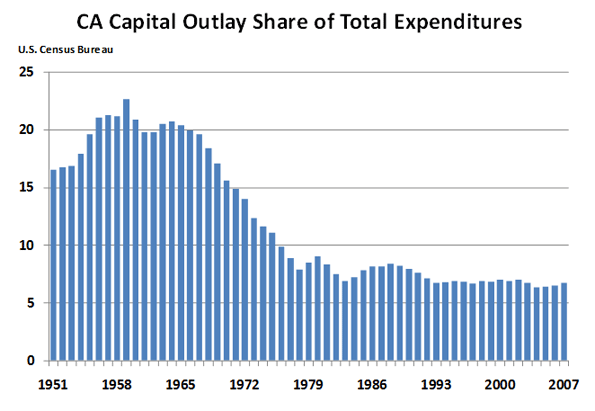
    Not likely. Today, we are not even maintaining our infrastructure. Infrastructure investment’s share of California’s budget has declined for decades. In Pat Brown’s day California often spent over 20 percent of its budget on capital items. Today, that number is less than seven percent. It shows.

    Pat Brown also knew that with California’s natural endowment, all he had to do was build the public infrastructure and welcome business, business will come. Too many today act as if they believe that business will come, even without the infrastructure or a welcoming business climate. Indeed, many Californians – particularly in the leadership in Sacramento – seem to think that business will come no matter how difficult or expensive the state makes doing business in California. This is just not true.

    California needs to embrace opportunity and economic growth. It is necessary if California is to achieve its potential. It is necessary if California is to avoid a stagnant future characterized by a bi-modal population of consuming haves and an underclass with little hope or opportunity and few choices, except to leave.

    Bill Watkins is a professor at California Lutheran University and runs the Center for Economic Research and Forecasting, which can be found at clucerf.org.