Category: Politics

  • There is no “Free Market” Housing Solution

    The common line used by advocates of housing affordability has been that the solution lies in “free markets”. Yet this “free market” solution does not address the fundamental problem which is really a political one.

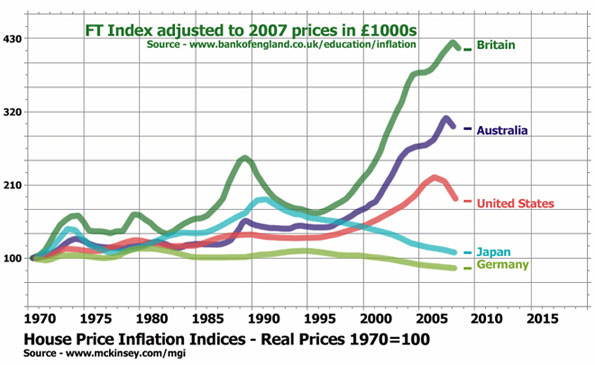
    This true fundamental problem is particularly evident here in Britain, the leader in house price inflation and housing financial bubbles since the 1970s. In their recent report Global capital markets, the McKinsey Global Institute has confirmed what has been shown in recent Demographia surveys.

    The root of this problem lies with an elite agenda that is highly ideological. The ideology at work is environmentalism, making a moral virtue of the retreat of political and commercial elites from the industrial production of housing.
    The preference is for interest payments on a fund of mortgage debt rather than the effort of turning a profit from development, let alone construction. Professionals like estate agents, planners, architects, and bankers are certainly in collusion with that elite ideology.

    That is not to say there is a conspiracy to plan a housing bubble. That is too crude. There is clearly regulation and legislation. On 24 November 2009 the Housing Minister John Healey confirmed that Britain will be the first country in the world to require zero carbon homes as a matter of law from 2016. Britain is the world leader in green ideology.

    John Healey
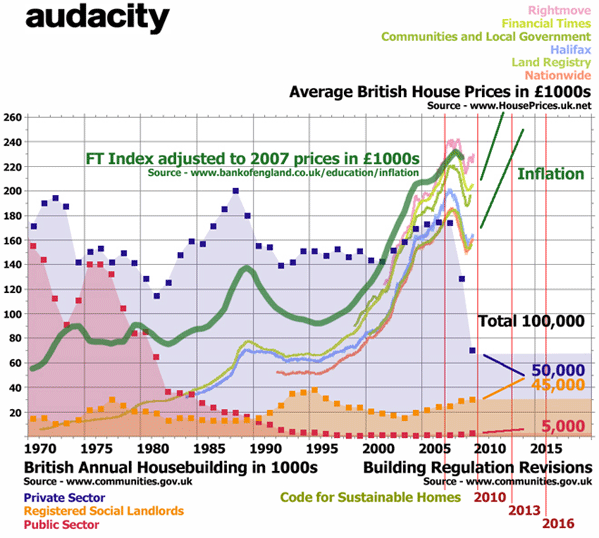
    All of the newly built British housing will have much better insulated walls, windows, roofs and floors. The clear aim of the government is to keep reducing the energy consumption of all new homes to be measured in kilowatt-hours per square metre of floor area per year. New Labour hope to make it law that total energy consumption is no more than 46 kWh/m2/year for semi-detached and detached homes, and then no more than 39 kWh/m2/year for all other homes. The energy efficiency standards will be applied from 2016, subject to yet another consultation on the Code for Sustainable Homes, announced at the end of 2006, and technically published for use on a voluntary basis in 2007. The building regulations get revised in 2010, 2013, and 2016 leading to this legal requirement for maximum energy consumption in all new homes.
    Healey says that “zero carbon” is a concept that will apply to a new home at the “point of build”. ‘We are not going to regulate through this policy how occupants live in them,’ he says. However the Code for Sustainable Homes assumes patterns of behaviour. Environmentalists within and without government will argue that behaviour needs to change. They will be suggesting all sorts of intrusions into daily life.

    British environmentalism couldn’t be more ideological, and more of a barrier to the production of affordable housing. The planning system has been “greened”. The mood is against development, and planning approvals for new land for new housing are hard to obtain. The zero carbon requirement will only apply to around the 100,000 new homes that will be built annually, while the existing stock is around 26 million homes. Healey is also going to regulate existing housing, and is not just looking at the residential sector.

    I am sure politicians like Healey don’t want their pursuit of “zero carbon” buildings to mean that fewer buildings are built. I am sure there are some environmentalists who will be pleased that building activity is in decline. The logic of green thinking entails that the most energy efficient thing to do is not to build more buildings at all.

    It is green not to build new homes to meet demographic demand. Let people modify their behaviour, say the environmentalists, and live together in as much of the existing stock as can be refurbished. It also happens that the existing stock is highly mortgaged, and the vast majority doesn’t want their homes to fall in value. An indefinite policy of green refurbishment of the homes that already exist and a future of house price inflation are highly compatible. That suits the mortgage lenders and the government. The commitment to “zero carbon” allows government to appear virtuous in its legislation for the new build sector.

    This suits the financial markets as well, since it guarantees house price inflation by making it difficult to meet the demographic demand for homes. Environmentalism offers more and more reasons not to build. Green thinking ensures that house price inflation can be sustained through a bubble, and projected beyond the bursting of that period of financialisation into the next.

    As capitalism ”greens” itself, capitalists continue to profit, while not meeting the fundamental demands of the people for housing. But simply restoring “the free market” will not solve the problem. In an old industrial country like Britain, there are ever more people who don’t earn enough to buy a home even at the “affordable” price of two and a half times their gross annual household income, which is the Demographia measure of affordability.

    This reality has a great appeal to what Robert Bruegmann refers to as “the incumbents club” – established homeowners, increasingly older, and those with inherited money. That majority want homes to be an appreciating asset, not a depreciating utility, like a pair of trousers, or a car. They want their home to appreciate in value, and they want to be green. Most people want to be greener and better off.

    Being anti-development for green reasons allows the incumbents to preserve their wealth, while making mundane opposition to new house building, or the attempt to constrain “sprawl”, seem virtuous. People don’t wake up thinking that they will inflate the value of their home by resisting sprawl in principle. Instead they oppose new development in the mistaken belief that Climate Change is caused by sprawling development. It is common for people to think that sprawl is bad for the planet, even while living, mostly with a mistaken sense of guilt, in the sprawl.

    By hoping for a “free market” solution to the problem of unaffordability, Hugh Pavletich of Demographia assumes that it is politicians, businessmen, and professionals who have distorted the market for reasons of narrow and immediate self-interest. Yet that is not how people think: they believe their environmentalism is morally above self-interest. They are saving the planet in their minds by blocking new building, and by their opposition to sprawl. The incumbents’ club members can feel virtuous at little cost to themselves and don’t worry too much about house price inflation. Of course there is no actual Club. There is no conspiracy. Homeowners simply share a self-interest in raising the value of their home, and tend to also want to show how selflessly green they are.

    This all has had the effect of making the lending of mortgages on inflated land values a much larger business than the construction of homes. No-one planned to cause a sequence of bubbles, but Britain’s desperate social dependence on sustained house price inflation can’t be brought to an end easily.

    The only way to stop national or regional housing bubbles recurring is the establishment of the freedom for everyone to build a home on cheap agricultural land without any government or professional hindrance except in matters of technical building regulations. Fire should not spread, and buildings should not fall down. But even building regulations can become ideological rather than technical. The British building regulations, as Healey has made clear, will also push energy efficiency standards to illogical extremes of peak performance in an attempt to address Climate Change. Even while the supply of new homes reduces

    The political freedom to build wouldn’t be a “free market” because not everyone is able to raise the finance to buy cheap land and pay for construction. The idea of a “free market” is a long running ideological myth. But the universal freedom to build would mean people are free to attempt to raise the finance to buy land and build.

    More importantly, the freedom to build would undermine the financialisation of the housing market. If everyone was free to build on cheap land the incumbents’ club would have to compare the value of their existing home to the cost of building a new one. Mortgage lenders would not be able to lend over the cost of construction unless they felt secure in doing so. The security of the 1947 Town and Country Planning Act would be removed for financiers. Government, the finance system, planners, or the incumbents’ club will be ideologically opposed to that for a host of environmental reasons. Britains mostly want to be greener but with renewed house price inflation, while no-one wants to make an argument explicitly for un-affordability. This may be confused and deluded, but it is an ideology promoted by the British government.

    However, ideas can be challenged and changed. One step is to understand that there is no “free market” housing solution. Getting rid of the 1947 denial of the freedom to build doesn’t mean an end to planning. Homes will still need to be planned, just as they were before 1947. But planners will not have the power to stop people from building. There is a need to politically end the environmentalist denial of the freedom to build in an industrial democracy. With a population free to build the finance system would be more interested in cheapening new construction on lower cost land, and not preoccupied with securing the financialisation of periodic but persistent house price inflation. A freedom to build is very much not a right to a home. It is a freedom from the obstructions of planners, with the weight of government legislation behind them. A freedom that is denied to protect the environment, a denial that sustains house price inflation.

    The market is not capable of being a “free market”. Capitalism is a system of control by political and commercial elites, and their professional employees. British capitalists tend to be less interested in industry, which is held to have caused Climate Change, and more interested in finance these days. What is precisely missing in the face of the morally selfless capitalist ideology of environmentalism is an ideology in favour of raising the productive capacity of the construction industry based on a universal sense of immediate and material self-interest. Getting rid of the 1947 planning legislation is a limited attempt to reconnect house building with the cost of construction and household incomes by removing the means by which house price inflation is sustained. Homes would be more of a utility than an investment in Britain, and we would cease to be world leaders in housing based financial bubbles.

    To do that requires us to oppose those who would be world leaders in the environmental ideology that industrial production is a problem for the planet. In Britain we need to set people free to build housing to the best of their abilities within a capitalist planning system stripped of the legal powers it gained in 1947. Innovative in their day, British planning now only sustains housing bubbles and restricts people’s opportunity for decent housing.

    Ian Abley, Project Manager for audacity, an experienced site Architect, and a Research Engineer at the Centre for Innovative and Collaborative Engineering, Loughborough University. He is co-author of Why is construction so backward? (2004) and co-editor of Manmade Modular Megastructures. (2006) He is planning 250 new British towns.

  • Is Obama Separating from His Scandinavian Muse?

    Barack Obama may be our first African-American president, but he’s first got to stop finding his muse in Scandinavia. With his speech for the Nobel, perhaps he’s showing some sign of losing his northern obsession.

    On the campaign trail, Obama showed a poet’s sensitivity about both America’s exceptionalism and our desire to improve our country. His mantra about having “a father from Kenya and a mother from Kansas” resonated deeply with tens of millions of Americans.

    Obama’s more recent recasting as a politically correct Nordic seemed out of sync. His speech in Oslo – a surprising defense of American values and role in the world – must have shocked an audience that all but the most passionate courtiers suspect he does not deserve.

    But the bigger challenge will come when he rushes off to Copenhagen to push for his politically dubious climate change agenda. This will take a more serious break from his unfortunate tendency to identify first with the global cognitive elite.

    This is a particularly European, and particularly Scandinavian, affliction. In these countries professors, high-level bureaucrats, and corporate chieftains usually dominate the media, policy making and public perceptions. This constitutes an essential part of what is often called the “Scandinavian consensus” model.

    It works pretty well there. Historically homogeneous, affluent and well-educated Scandinavians generally accept working hard and giving up much for people for the poorer members of societies. These admirable attitudes reflect noble Nordic virtues of thrift, study and social trust.

    These values also work reasonably well in Nordic parts of America, such as in North Dakota. When a local economist told Milton Friedman “In Scandinavia we have no poverty”, he replied: “That’s interesting because in America among Scandinavians, we have no poverty, either.”

    As Obama may finally be learning, America is not Scandinavia, outside a handful of places. It is a big, amazingly diverse country with an expanding population. In a country made up of so many crunched together cultures an expansive welfare state faces many problems. (This is one reason northern Europe is having such a difficult time with its immigrants.)

    In a diverse society, you cannot assume that everyone will play by the rules. Coexisting with very different kinds of people, Americans tend to be less than enthusiastic about paying high taxes to support them.

    Demographics are also a major factor. Our relatively youthful and socially diverse population includes a large component of people, particularly males, with limited skills and education. Yet, at least until they were blindsided by falling poll numbers and stubbornly high unemployment, Obama’s administration treated the recession as if it could be cured Euro-style by simply adding more employment in government, education and medical care.

    Similarly the president’s to date dogmatic embrace of an extreme climate change agenda seems one more saleable to Danes or Swedes than people in the Dakotas or South Carolina. After all, they are well-positioned to absorb the costs. Norway and Sweden enjoy huge reserves of hydropower, the largest sources of renewable fuels. Norway also has lots of oil to boot and fellow traveler Netherlands still boasts strong reserves of natural gas.

    The dense land use policies associated with the climate change agenda fit better into small compact cities like Amsterdam, Copenhagen, Stockholm and Oslo than their sprawling American counterparts. In America, the vast majority lives in sprawling suburbs and small towns. With the exception of the Northwest few parts of the U.S. rely on hydropower, with most of the country reliant on coal, oil and natural gas.

    Then there are political risks to Obama’s dogged embrace of the alarmist “climate change” agenda. Recent Gallup, Pew, and Rasmussen surveys show weakening interest in global warming and increasing levels of skepticism. Today we even have considerable disputes over whether the temperature is even warming. Certainly a series of cold winters and mild summers might make some casual citizens a bit skeptical.

    Even one of the scientists whose email was hacked recently at the UK’s University of East Anglia Climate Research Unit wondered, “Where the heck is global warming?” The revelations, now widely known as Climategate, make clear that some of the science – and the scientists – behind the most apocalyptic predictions are suspect, a view now held by a majority of Americans, according to a recent Rasmussen survey.

    Yet so far, Obama appears blissfully unaffected by the swirling controversy. But the man has a full capacity to surprise. Perhaps he will understand that just because the media and his climate advisors have circled the wagons, this may be a case where the “crowds” may be onto something that the self-proclaimed experts would rather ignore.

    Perhaps if President Obama had studied history, rather than law, he might realize that “smart” (i.e. highly credentialed) types often get things terribly wrong. After all, a century ago eugenics – that some races were intrinsically superior to others – stood as the reigning ideology of the scientific community. Back in the 1970s, the scientific consensus embraced by his science advisor, John Holdren, predicted imminent mass starvation, a catastrophic decline in resource availability, and a bleak future for all developing countries, including China and India. This assessment proved widely off the mark.

    Of course, having committed himself to today’s climate orthodoxy, Obama may find it difficult to reverse course. Not only does he seem ill-disposed to challenging the cognitive elites but he also gains support from the well-funded warming lobby – rent-seeking utilities, “green” venture capitalists, investment bankers and urban land speculators – who hope to wrest huge fortunes from a strict carbon regime.

    If he wants to regain his effectiveness, however, the president needs to realize that these groups and the science establishment are just a small fraction of the country that elected him. His speech in Oslo may be the first sign he may be waking up from his Scandinavian slumber to become the assertive, independent American leader that we need.

    Joel Kotkin is executive editor of NewGeography.com and is a distinguished presidential fellow in urban futures at Chapman University. He is author of The City: A Global History. His next book, The Next Hundred Million: America in 2050, will be published by Penguin Press early next year.

  • Capping Emissions, Trading On The Future

    Whatever the results of the Copenhagen conference on climate change, one thing is for sure: Draconian reductions on carbon emissions will be tacitly accepted by the most developed economies and sloughed off by many developing ones. In essence, emerging economies get to cut their “carbon” intensity–a natural product of their economic evolution–while we get to cut our throats.

    The logic behind this prediction goes something like this. Since the West created the industrial revolution and the greenhouse gases that supposedly caused this “crisis,” it’s our obligation to take much of the burden for cleaning them up.

    Plagued by self-doubt and even self-loathing, many in the West will no doubt consider this an appropriate mea culpa. Our leaders will dutifully accept cuts in our carbon emissions–up to 80% by 2050–while developing countries increase theirs, albeit at a lower rate. Oh, we also pledge to send billions in aid to help them achieve this goal.

    The media shills, scientists, bureaucrats and corporate rent-seekers gathered at Copenhagen won’t give much thought to what this means to the industrialized world’s middle and working class. For many of them the new carbon regime means a gradual decline in living standards. Huge increases in energy costs, taxes and a spate of regulatory mandates will restrict their access to everything from single-family housing and personal mobility to employment in carbon-intensive industries like construction, manufacturing, warehousing and agriculture.

    You can get a glimpse of this future in high-unemployment California. Here a burgeoning regulatory regime tied to global warming threatens to turn the state into a total “no go” economic development zone. Not only do companies have to deal with high taxes, cascading energy prices and regulations, they now face audits of their impact on global warming. Far easier to move your project to Texas–or if necessary, China.

    The notion that the hoi polloi must be sacrificed to save the earth is not a new one. Paul Ehrlich, who was the mentor of President Obama’s science advisor, John Holdren, laid out the defining logic in his 1968 best-seller, The Population Bomb. In this influential work, Ehrlich predicted mass starvation by the 1970s and “an age of scarcity” in key metals by the mid-1980s. Similar views were echoed by a 1972 “Limits to Growth” report issued by the Club of Rome, a global confab that enjoyed a cache similar to that of the United Nations’ Intergovernmental Panel on Climate Change.

    To deal with this looming crisis, Holdren in the 1977 book Ecoscience (co-authored with Anne and Paul Ehrlich) developed the notion of “de-development.” According to Holdren, poorer countries like India and China could not be expected to work their way out of poverty since they were “foredoomed by enormous if not insurmountable economic and environmental obstacles.” The only way to close “the prosperity gap” was to lower the living standards of what he labeled “over-developed” nations.

    These predictions were less than accurate. World-wide systemic mass starvation did not take place as population escalated. Rather those many millions wallowing in poverty in the developing world, particularly in Asia, lifted themselves into the global middle class. Far more efficient ways to use energy have been developed, and unexpected caches of new resources continue to be discovered all over the planet.

    Yet however wrong-headed, Holdren’s world view now has jumped from the dustbin of history into the craniums of presidents and prime ministers. President Obama’s pledge to “restore science to its rightful place” has morphed into state-sponsored scientific ideology.

    The blind acceptance of this agenda threatens the credibility of Obama and other Western leaders. For one, if the crisis is by its nature global why should we allow massive increases in carbon emissions in developing countries–China will soon surpass us in greenhouse gas emissions, if it hasn’t already–while we draconically cut ours? Does the planet really care if it’s turned to toast by American- vs. Chinese-made gas?

    Then there’s the specious historical narrative that insists we pay for creating the industrial revolution since it brought on global warming. Should the West pay for the sins of the British who brought electricity and railroads to India? Does America owe carbon penance for making the technology transfers critical to East Asia’s remarkable rise? Maybe we should start by making Wal-Mart cancel its China orders. That might help de-carbonize the planet a bit.

    There’s also growing skepticism about the whole warmist narrative. Climate change now ranks last among 20 top issues in a recent Pew report. There’s been a similar rise in skepticism in the U.K., once a hot bed of warmist sentiment.

    The reasons for the shift may vary. First, there’s a controversy over the temperatures of the past decade, with even some concerned about climate change admitting that there has not been the expected warming. Or perhaps a deep recession has made many “rich” countries feel a trifle less “overdeveloped.”

    And now we have Climate-gate–where leading warmist pedagogues are trying to suppress unsuitably conformist scientists and perhaps even cook the numbers a bit. Although you won’t see too much tough coverage in the mainstream press, the tawdry details have poured out over the Internet and diminished the aura of scientific objectivity of some leading global warming researchers. One recent poll shows that a large majority of Americans believe scientists may have indeed falsified their research data. By well over 4 to 1, they also believe stimulating the economy is a bigger priority than stopping global warming.

    Clearly the political risks of giving first priority to the carbon agenda are on the rise. Australia’s Senate just voted down that country’s proposed cap and trade scheme. The Western center-right, once intimidated by the well-financed greens and their media claque, has become bolder in challenging climate change alarmism.

    There’s also something of a rebellion brewing, at least toward emissions trading schemes, among some liberals from the South and Midwest, notably Wisconsin’s Russ Feingold and North Dakota’s Byron Dorgan. As analyst Aaron Renn has pointed out, these areas are most likely to be negatively affected by the current climate change legislation. Feingold recently stated that he was “not signing onto any bill that rips off Wisconsin.”

    So why do leaders like Barack Obama and British Prime Minister Gordon Brown continue identifying themselves with the climate change agenda and policies like cap and trade? Perhaps it’s best to see this as a clash of classes. Today’s environmental movement reflects the values of a large portion of the post-industrial upper class. The big money behind the warming industry includes many powerful corporate interests that would benefit from a super-regulated environment that would all but eliminate potential upstarts.

    These people generally also do not fear the loss of millions of factory, truck, construction and agriculture-related jobs slated to be “de-developed.” These tasks can shift to China, India or Vietnam–where the net emissions would no doubt be higher–at little immediate cost to tenured professors, nonprofit executives or investment bankers. The endowments and the investment funds can just as happily mint their profits in Chongqing as in Chicago.

    Global warming-driven land-use legislation possesses a similarly pro-gentry slant. Suburban single family homes need to be sacrificed in the name of climate change, but this will not threaten the large Park Avenue apartments and private retreats of media superstars, financial tycoons and the scions of former carbon-spewing fortunes. After all, you can always pay for your pleasure with “carbon offsets.”

    So who benefits from this collective ritual seppuku? Hegemony-seeking communist capitalists in China might fancy seeing America and the West decline to the point that they can no longer compete or fund their militaries. A weakened European Union or U.S. also won’t be able provide a model of a more democratic version of capitalism to counter China’s ultra-authoritarian version.

    The Chinese may win a victory in Copenhagen greater than anything accomplished so far in the marketplace–and our leaders will likely thank them for it. Forget bowing to the emperor in Tokyo; like vassal states at the height of the old Middle Kingdom, the new requisite diplomatic skill for Westerners will be kow-towing to Beijing.

    Yet most people in the developing world will not benefit from the suicide of the West. The warmists’ vision is not one of growing prosperity, but of capping wealth at a comparatively low level. De-industrialization means the West falls back while emerging economies grow a bit. The “prosperity gap” may close, but ultimately everyone is left with less prosperity.

    In the long run developing countries gain less from harvesting guilt than enjoying a bounty of customers, capital and expertise. The West’s experience and technology can assist developing nations in improving their far more greatly threatened environment. Turning the West into a spent force will leave the world poorer, dirtier and ultimately less hopeful.

    This article originally appeared at Forbes.com.

    Joel Kotkin is executive editor of NewGeography.com and is a distinguished presidential fellow in urban futures at Chapman University. He is author of The City: A Global History. His next book, The Next Hundred Million: America in 2050, will be published by Penguin Press early next year.

  • The European Model Gets A Makeover

    Does the United States finally have its first European President in Barack Obama? Does he truly want to Europeanise the American health system and impose European-style socialism on the US? RealClearPolitics.com assures us that ‘his policies on government spending, taxation, health care and carbon emissions would all tend to bring America in line with European norms.’

    It is a powerful message – or it would be were the US not already in line with European norms in nearly every way that matters. In terms of social welfare expenditure, working hours, socialized health and even military spending, the US slips snugly in place among its European counterparts.

    So why the constant comparisons between the US and Europe? It’s all rather simple: people who refer to ‘Europe’ as an alternative to the United States rarely specify which European countries they mean. Europe is a continent consisting of around 50 countries (its borders are debatable) of which only 27 are in the EU and 26 in NATO. These countries run from Liechtenstein, with the highest GDP per capita in the world, to Kosovo, which is poorer than Nigeria. The idea that one common European policy or culture could exist in such a diverse environment is absurd.

    Europe, as a single economic system with a single culture simply doesn’t exist. It is a myth, pushed by some on the left as an egalitarian liberal alternative to the US, and by some on the right as an example of a socialist failure – neither side ever defining what Europe actually is.

    Perhaps this is all a little pedantic. After all, we know that when people talk about European socialism they mean France, Germany and Sweden, not the irrelevant, piddling little states like Ireland, Latvia and, eh, Russia. By far Europe’s largest and most populous country, with more than three quarters of its population living on the European side of the Urals, Russia is rarely counted as European at all. Commentators often ponder ‘Europe’s response to Russia,’ a nonsensical statement unless ‘Europe’ is clearly defined as the EU, or the European NATO members, or whoever.

    When Europe is left undefined in this way, it becomes a convenient catch-all tag to mislead, reinforce prejudices and polarise debates. Look no further than the present debate about health care in the US, where Obama has been criticized for wanting to Europeanise American health care, the implication being that there is a single European socialist alternative to the US. Glenn Beck pounced on this idea last July:

    America’s health care is much better than Europe’s…. Americans have a better survival rate for 13 of the 16 most common cancers than Europe. Take prostate cancer: 91.9 percent of men live through it, versus 73.7 percent in France and just 51.1 percent in Britain.

    These are shocking statistics, but puzzling. France and Britain are just two of Europe’s 50 countries, so why are they picked to represent the rest? In fact there is massive variation in cancer survival rates across Europe. Poland managed to save only 37.1% of prostate cancer victims. But Austria, with its heavily socialized health system, had a survival rate of 86.1%.

    Just days ago a study by the Israeli Health Ministry showed that the US has a total female survival rate of all cancers of 66%, with Finland managing 67%. Glenn Beck could avoid the fact that Finland’s socialized health care is a bit better at saving women from cancer than the American system, because he simply generalized about the entire European continent and cherry-picked two convenient statistics from it.

    This October, former Italian prime minister Romano Prodi told an audience at Brown University that the US should follow Europe’s lead in recognizing health care as a right. As a left-wing Italian, it’s understandable why Prodi would say this: in 2006, government expenditure on health made up 77.2% of total health spending in Italy, compared with only 45.8% in the US. The European region as a whole averaged at 75.6%, much higher than the US.

    Yet government health expenditure in Italy’s neighbour Albania made up only 37.3% of the total health spending. Cyprus was 44.8%. Switzerland 59.1%. Moldova 46.9%. Georgia was only 21.5%. Prodi seems to have ignored these countries because they were inconvenient for his generalization, yet they are crucial to the debate. If Obama is trying to ‘Europeanise’ the American health system, does it mean he wants to cut government expenditure to Albanian levels or increase it to Iceland’s?

    As it happens, the US government under Bush spent more on health as a percentage of GDP than most European countries: 7% in 2005 compared with only 4.3% in Poland, 5.3% in Slovakia and 5.8% in ‘socialist’ Norway.

    Nobody would judge American policies – for example, its social protection or welfare programs — by averaging out policies in Cuba, Costa Rica, Canada, Nicaragua and any other countries that happen to share the continent with it, but this happens with Europe all the time. Donald Rumsfeld seemed to realize it was silly when, in 2003, he dismissed Germany and France as ‘old Europe’, pointing to NATO’s centre of gravity shift into eastern Europe. Rumsfeld had a point: many of the former Communist countries have distinctly different economic situations to some of those in ‘old Europe’.

    In 2005 the EU countries with the highest expenditure on social protection as a percentage of GDP were Sweden (32%), France (31.5%), Denmark (30.1%), Belgium (29.7%) and Germany (29.4%), all ‘old Europe’ nations. OECD statistics for 2005 show the US has a much lower expenditure on social protection, only 15.9%.

    How about new Europe? Latvia spent only 12.4% of its GDP on social protection in 2005. Estonia spent 12.5%, Ireland spent 18.2% and Romania spent 14.2%.

    Perhaps the strangest reference to Europe in recent times came after Obama won the Nobel Peace Prize. The Wall Street Journal had this to say:

    George W. Bush may have retired from American public life, but the Europeans want the Yanks to know they never want to see his likes again…. On one level, all of this represents the parochial European foreign policy agenda…. The Europeans are applauding that at long last there is an American President willing to let himself and his country mingle as equals with this amorphous global “majority.”

    The Nobel Peace Prize Laureate is chosen by five Norwegian committee members, who are, in turn, elected by the 169 members of the Norwegian parliament. Norway is not a member of the European Union.

    Yet somehow the Wall Street Journal managed to convince itself that five Scandinavians in a small non-EU country represent well over 700 million people and all fifty European countries’ foreign policies. This makes as much sense as phoning up Fidel Castro, Hugo Chavez and Evo Morales and dubbing their opinions as representative of ‘American foreign policy’.

    Let’s be clear. It’s not that there aren’t trends among European countries, especially among the ‘old’, wealthy, West European countries. But in terms of most socio-political indicators, the US sits quite comfortably inside the European group, rather than standing apart as a radical alternative to it. The US isn’t even the highest in military spending as a percentage of GDP: Turkey, Bosnia and Herzegovina and Greece all spend more.

    It would take little effort for journalists to point out what exactly they mean by Europe: EU members, NATO members, Western Europeans, etc. So let’s not talk about this non-existent Europe anymore. At best it is lazy and inaccurate; at worst it is misleading and divisive.

    Shane Leavy is a freelance journalist for hire. Born and raised in Ireland, he has lived on three continents and been published on four, made an award-winning radio documentary on the banned Chinese religious movement Falun Gong, and written about science, religion, travel, culture, politics, environment and business.

  • For Millennials, It’s the Economy Stupid

    This month’s off year elections sent one message to Washington that has been heard loud and clear. Voters expect Congress to focus on the economy, especially employment, and take decisive and affirmative steps to deal with both the causes and ravages of the greatest economic downturn in the U.S. since the Great Depression. As the Obama administration considers a variety of new proposals to help bring down the unemployment rate, one key constituency is raising its voice and asking for a return on the investment it made in his presidency.

    Members of the Millennial generation, born between 1982-2003, who were eligible to vote in 2008 went for Barack Obama over John McCain by a 2:1 margin and made up over 80% of the President’s winning margin. They continue to support his presidency and identify as Democrats by similar margins. A late October Pew survey indicates that Millennials identify as Democrats over Republicans by almost 20 percentage points (52% vs. 34%), well above the 8-point Democratic advantage among older generations. In the latest Research 2000 weekly tracking survey conducted for Daily Kos, 80% of Millennials had a favorable opinion of the president; only 14% of everyone in this generation viewed him unfavorably. This compares with a 55% vs. 39% favorable/unfavorable ratio among the entire electorate in both the Research 2000 survey and in a series of November surveys conducted by organizations ranging from ABC News and the Washington Post to Fox, although some other polls put the President’s job performance ratings closer to 50%.

    But despite the clearly stronger support the President has among their generation, Millennials are increasingly restive about the lack of action in Congress to address the economic problems they face – both now and in the future.

    Recent Pew research studies underline the major impact that the recession has had on individual Americans and their families. Thirteen percent of parents with grown children told Pew researchers that one of their adult sons or daughters had moved back home in the past year. Pew found that of all grown children living with their parents, 2 in 10 were full-time students, one-quarter were unemployed and about one-third had lived on their own before returning home. According to the census, 56 percent of men 18 to 24 years old and 48 percent of women were either still under the same roof as their parents or had moved back home.

    The lack of jobs was particularly acute among adult members of the Millennial Generation (18-27 year olds), 61% of whom said that they or someone close to them was jobless recently. A clear plurality (46%) says that the “job situation” rather than rising prices (27%), problems in the financial markets (14%) and declining real estate values (7%) is their major economic worry.

    As a result, the number one concern among Millennials is the state of the economy and the need for jobs, but they have a unique perspective on how to deal with this issue.

    Millennials believe there is a clear link between education and employment and are increasingly concerned that the pathway through the educational system into the world of work is becoming increasingly more difficult and expensive to navigate. Last week, about one hundred of the nation’s top private sector and government leaders gathered for the Wall Street Journal’s CEO Council also identified education as the nation’s top economic priority.

    For Millennials, the problem is personal. A smaller share of 16-to-24-year-olds – 46 percent – is currently employed than at any time since the government began collecting that data in 1948. A job market with Depression-level youth unemployment (18.5%) and a wrenching transformation in the types of jobs America needs and produces makes the implicit bargain of education in return for future economic success harder for Millennials to believe in every day.

    Recently Matt Segal, Executive Director of the Student Association for Voter Empowerment (SAVE) and Founder and National Co-Chair of the “80 Million Strong for Young Americans Job Coalition” presented some ideas to the House Education and Labor Committee on what Congress could do to address this challenge. He advocated increased entrepreneurial resources be made available to youth; more access to public service careers through internships and loan forgiveness programs; and the creation of “mission critical” jobs in such fields as health care, cyber-security and the environment that would tap the unique talents of this generation. Since two-thirds of Millennials who graduate from a four-year college do so with over $20,000 in debt, debt, his testimony also urged immediate Senate approval of the student debt reform bill recently passed by the House.

    There is more that can be done beyond these excellent recommendations. This summer, the President’s Council of Economic Advisors released a report outlining the importance of community colleges in making America’s workforce more competitive in the global economy. “We believe it’s time to reform our community colleges so that they provide Americans of all ages a chance to learn the skills and knowledge necessary to compete for the jobs of the future.” The report urged Congress to pass House Democratic Caucus Chairman John Larsen’s bill, The Community College Technology Access Act of 2009, in order to help meet President Obama’s goal of graduating five million more Americans from community colleges by 2020.

    Millennials, like their GI Generation great grandparents in the 1930s, are facing economic challenges that caught them by surprise and for which no one prepared them. But Millennials aren’t looking for a handout or sympathy. Instead, in the “can do” spirit of their generation, they are organizing to overcome the challenges created for them by their elders. It’s time for the Democrats who control Congress to recognize these concerns and to act decisively on their behalf.

    Morley Winograd and Michael D. Hais are fellows of the New Democrat Network and the New Policy Institute and co-authors of Millennial Makeover: MySpace, YouTube, and the Future of American Politics (Rutgers University Press: 2008), named one of the 10 favorite books by the New York Times in 2008.

  • Obama in China: Walking the Great Mall

    Ever since Richard Nixon visited China in winter 1972—an event timed to play into that year’s presidential elections—American presidents have made the pilgrimage to the modern version of the Forbidden City.

    Landing in Shanghai on Sunday evening, President Obama has two days of meetings with the Chinese leadership, not to mention a town hall event with Chinese students (as if they were eligible to vote in a New Hampshire primary).

    As a stage-set for photo opportunities, China is hard to beat. American presidents can walk the Great Wall, toast a nation in the Great Hall of the People, tower over diminutive Chinese leaders dressed in gray Mao suits, and make sweeping statements about new world orders.

    For their part, the Chinese leadership loves nothing more than the chance to block traffic around Tiananmen Square, call out the drill corps, shoot off some fireworks, and release photographs of summit meetings, which then become the fodder of endless Sinologist conferences to try to figure out who has power in China and who is in line for a little “self-criticism.”

    When President Nixon went to China, his only political goal—other than to show up—was to reach agreement on a joint communiqué that was drafted to avoid all the contentious issues of U.S.-Chinese relations, such as the war in Vietnam or U.S. support for Taiwan.

    While aides haggled over the text of the equivocatory statement, Nixon and his National Security Advisor, Henry Kissinger, met with Mao, whose health was failing and who had to be propped up in a chair, as if part of a Disney World – Epcot diorama on the Long March.

    For reasons of domestic political consumption, Nixon and Kissinger needed Mao as much as he needed them to help fend off Russian threats along the Amur River and to nudge China into a broader world.

    They left the meeting and China gushing about how Mao had political magnetism, a great sense of humor, and the vision of a wise emperor, although he probably said little more than one of his gift pandas.

    That Mao’s Cultural Revolution had killed millions mattered little more than the American wars in Korea and Vietnam or that Nixon himself had devoted his political career to China’s political isolation.

    All that mattered was that the world would get the impression of Sino-American harmony—whatever the underlying reality—and that tea-like ceremony is how every subsequent summit meeting has been choreographed.

    For a while, after the Nixon visit, American presidents thought it was good politics to preface a China visit with strong words of U.S. support for Taiwan, which has always played well as a plucky anti-communist billboard.

    Even as the presidential administrations of Ford, Carter, Reagan, Bush, Clinton, and Bush II were turning toward the economic riches of the East, and Taiwan was relegated to a diplomatic sideshow, the warm-up footage to any Chinese summit had to include a few profiles of Chiang Kai-shek or Free Tibet as popular icons of freedom.

    After the 1989 massacres at Tiananmen Square, no American president could get close to Chinese airspace without finger waggling China for its abysmal record on human rights.

    So as not to be seen kissing the rings of communist autocrats, the American president would “bring up” the name of an imprisoned dissident, just so that it was clear that the United States did not place Wal-Mart’s inventory ahead of personal freedoms. Only later in the trips did anyone take out an order form.

    The problem for President Obama on this trip to China is that he arrives with the aura of someone late on his VISA card payments but still talking up his next trillion-dollar vacation.

    In this analogy, China’s leadership is best understood as a bunch of repo men nervous about the penalty interest, although, to be fair, in the last ten years, the economic miracles of both the United States and China have been founded on illusions.

    China accumulated its huge foreign trade surpluses based on an artificially low currency and the sweatshop wages paid to its workers. By contrast, the United States has thrived on debt funded from its reserve currency, and the cheap goods its can buy from overseas.

    In the middle of both pyramid schemes is the U.S. financial services industry that rolls over America’s $12 trillion debt, a large chunk of which is due to the Chinese and other Asian depositors.

    On most geopolitical issues, the United States and China have little in common. China props up the Stalinist regime of North Korea, abuses the human rights of its citizens, fires up a coal plant every month, buys spheres of influence in all sorts of rogue states like Iran and the D.R. Congo, and refuses to co-operate in international currency reforms.

    In turn, China has little time for American running-dog policies in Afghanistan and India, feels Taiwan is an internal matter, remains terrified of a re-armed Japan, and is fearful that its U.S. dollar-denominated financial assets are wasting away in Margaritaville.

    These differences of opinion ought to necessitate substantive diplomatic exchanges. In a positive sense, American consumers have fueled much of China’s economic growth and political confidence, and Chinese production can be an engine of increasing affluence in the developing world, interests that both countries should share.

    Instead, empty symbolism will likely reign for the remainder of President Obama’s package tour. Like President Nixon, he’ll leave behind an optimistic-sounding protocol (on global warming, nuclear disarmament, and the wealth of nations) and come home with swell pictures of the Great Wall.

    Someday the lack of a serious dialogue between the United States and China might be the subject of a show trial (in either country). After all, the question of “Who lost China?” has been a specter of American foreign policy since 1949. And even in the booming free-market China that Obama will no doubt admire, no one wants to be known as a “capitalist-roader.”

    Matthew Stevenson was born in New York, but has lived in Switzerland since 1991. He is the author of, among other books, Letters of Transit: Essays on Travel, History, Politics, and Family Life Abroad. His most recent book is An April Across America. In addition to their availability on Amazon, they can be ordered at Odysseus Books, or located toll-free at 1-800-345-6665. He may be contacted at matthewstevenson@sunrise.ch.

  • Hyper-Partisans on the Green Politics Battlefield

    America is more polarized today than at any time since Reconstruction. A major quantitative analysis by social scientists Nolan McCarty, Keith Poole and Howard Rosenthal found today to be the most polarized period in 130 years.

    If you want to understand how it is that the debate over — for example — global warming policies became so shrill, consider the recent pattern of behavior by the country’s second-most read climate blogger, Joe Romm. We will argue – against those who pooh-pooh his influence – that Joe Romm is, in fact, far more influential today than Joe McCarthy was in the 1950s, a fact that, unfortunately, has proven poisonous to creating the consensus needed for serious action on climate.

    Today’s fractured and polarized media environment has allowed Joe Romm to become the most influential liberal climate activist in the country, largely because he has convinced liberals and Democrats that he is an energy and climate science expert. This explains why Nobel Prize Winner and New York Times columnist Paul Krugman says “I trust Joe Romm,” Thomas Friedman calls ClimateProgress.org “the indispensable blog,” Al Gore relies on him for technical analysis, and the Center for American Progress makes him the organization’s chief spokesperson on climate and energy issues.

    Partisan Identity as a Mental Short-Cut
    It’s no coincidence that America’s Climate McCarthyite-in-chief is a blogger at the largest liberal think tank and not a U.S. Senator. Busy fundraising and campaigning, members of Congress have largely outsourced the deliberative process of legislating to partisan interest groups and think tanks.

    Much has been written about the ideological echo chamber conservatives like Sen. James Inhofe, Rush Limbaugh, and Glen Beck have created to enforce anti-environmental orthodoxy on the Right. Less remarked upon has been the creation of its analog on the Left – an accomplishment in which Romm has taken a leading role. Romm has mastered the echo chamber in its liberal expression and creates a reassuring green womb for his growing cadre of loyal readers.

    Most importantly Romm functions to inform his readers of the partisan identity of any given thing, whether it be a new technology, policy, or analysis. Thus, when it came time for Romm to criticize a rather technical piece on the rising carbon intensity of the global economy that appeared in the journal Nature he attacked it not as inaccurate or incorrect, but rather as Republican:

    It will be no surprise to learn the central point of their essay, ironically titled “Dangerous Assumptions” is “Enormous advances in energy technology will be needed to stabilize atmospheric carbon dioxide concentrations at acceptable levels,” which is otherwise known as the technology trap or the standard “Technology, technology, blah, blah, blah” delayer message developed by Frank Luntz and perfected by Bush/Lomborg/Gingrich.

    In other words, the Nature article was not what it claimed to be. It wasn’t an analysis suggesting that the United Nations Intergovernmental Panel on Climate Change should revisit its assumptions about decarbonization. It wasn’t an argument for stronger technology policies. No, it was a devious Republican message – one designed by Republican pollster Frank Luntz during the Bush years – to delay action.

    How then did Romm become convinced that, rather than being genuine, the “Dangerous Assumptions” analysis was, in fact, Republican propaganda? Because Romm’s Climate McCarthyism is, in large measure, the product of his Hyper-Partisan mind, one which sees everything through the gaze of Republican or Democratic, “climate denier” or “climate science advocate,” and “climate destroyer” or climate savior.

    Elsewhere Romm attacked Robert Mendelsohn, another leading environmental economist:

    When the global warming deniers and delayers at right wing think tanks like the Hoover Institute agree with your analysis, you should start to ask yourself whether you really know what you’re talking about.

    Get it? The economists in question should rethink their work not because their assumptions are wrong, or their findings invalid, but rather because a conservative think tank agrees with them.

    If You Do Not Agree Then You Must Be A Republican
    Romm does not simply enforce the existing Democratic discourse, he also seeks to narrow it, effectively reducing its appeal by making it more hysterical, shrill, and apocalyptic. Little surprise, then, that Romm felt the need to attack the views of environment writer Gregg Easterbrook for writing a critical review of Friedman’s book, which relied heavily on Romm’s apocalyptic interpretation of the climate science.

    Here’s Easterbrook:

    Why does the cocktail-party circuit embrace claims about a pending climate doomsday? Partly owing to our nation’s shaky grasp of science–many Americans lack basic understanding of chemicals, biology, and natural systems. Another reason is the belief that only exaggerated cries of crisis engage the public’s attention; but this makes greenhouse concern seem like just another wolf cry.

    Romm responded by calling Easterbrook – wait for it – Republican:

    Thanks to the Gregg Easterbrooks of the country — otherwise known as Reagan, Gingrich, Bush and McCain – the United States became only a bit player in a global industry it helped create and once dominated, a bit player in what will certainly be one of the largest job-creating industries in the world.

    Reading Romm, one would be hard pressed to conclude that Easterbrook was anything other than an opponent of action to reduce carbon emissions. In fact, Easterbrook is an advocate of the dominant Democratic and environmental approach to climate change, cap and trade. “Government should regulate greenhouse emissions,” he wrote in his review, “then let the free market sort out the details, including by funding the research.”

    Easterbrook’s policy agenda turns out to be closer to most national environmental groups than to Bush’s, Gingrich’s, or Luntz’s. If Easterbrook is recycling partisan talking points, they are mostly Democratic, not Republican ones, save for his view that global warming’s threat is real but not apocalyptic.

    McCarthyism in a Hyperpartisan Era
    Some readers have complained to us that Joe Romm is no Joe McCarthy. They are right. Joe Romm is far more influential. Others wonder why we criticize Romm, who believes passionately that global warming is occurring and that we must take action to address it, rather than Limbaugh or Inhofe, who reject climate science and oppose action.

    And yes, to be fair, McCarthy had the ability to get people fired and put on blacklists. In this way he was more powerful. But Romm shapes how a whole generation of Democratic leaders, liberals, and greens think about the most serious environmental problem in the world, climate change, and about the master resource, energy, in the most powerful economy humankind has ever created. In this way Romm is more influential. Those who wave away Romm’s influence are disconnected from our new hyper-partisan and fractured media reality.

    “The nation grows more politically segregated,” Nicholas Kristof quoted Bill Bishop, the author of the Big Sort, saying, “and the benefit that ought to come with having a variety of opinions is lost to the righteousness that is the special entitlement of homogeneous groups.”

    Joe Romm has the trust of liberals and Democrats, but not on the force of his arguments, the weight of his evidence, or the success of his agenda, for all are spectacular failures. As terrible as it may turn out to be, global warming is not “apocalypse now.” No, Joe Romm has won the trust of partisans because he tells them the story they want to hear better than anyone else. Unfortunately, hyper-partisans like Joe Romm are part of the problem, not the solution. Effective solutions to global warming cannot be enacted in our extremely divided political environment.

    Democratic partisans, liberals and greens have spent much of the last eight years tearing out our hair about all the ways the hyper-partisan it’s-all-a-hoax! Republicans have blocked action on climate. These complaints may have been cathartic, but they have not been productive. We have not had and cannot have any impact on Republicans, and our partisan apocalypse talk and our sacrifice-now agenda are obviously alienating the vast, moderate middle.

    The work of holding Republican obstructionists, anti-government extremists, and right-wing conspiracy mongers to task is work for principled conservatives, not liberals. The work of greens and liberals is to challenge the Democratic demagogues, the left-wing bullies, and the Climate McCarthyites who narrow and polarize the debate in ways that make effective policy action all but impossible. If we can hold our own hyper-partisans to account then fair-minded conservatives might do the same. For until the establishment and the grassroots on both left and right learn to say no to Joe Romm and to Glenn Beck, hyper-partisanship is here to stay.

    An earlier version of this article appeared at The Breakthrough Institute blog.

    Michael Shellenberger and Ted Nordhaus are co-founders of the Breakthrough Institute and authors of the seminal essay The Death of Environmentalism in 2004 and the controversial and critically acclaimed Break Through: Why We Can’t Leave Saving the Planet to Environmentalists in 2007. They are widely recognized experts on climate and energy policy and their work has deeply influenced a new generation of clean energy advocates.

  • Honest Services From Bankers? Increasingly Not Likely

    Once you understand what financial services are, you’ll quickly come to realize that American consumers are not getting the honest services that they have come to expect from banks. A bank is a business. They offer financial services for profit. Their primary function is to keep money for individual people or companies and to make loans. Banks – and all the Wall Street firms are banks now – play an important role in the virtuous circle of savings and investment. When households have excess earnings – more money than they need for their expenses – they can make savings deposits at banks. Banks channel savings from households to entrepreneurs and businesses in the form of loans. Entrepreneurs can use the loans to create new businesses which will employee more labor, thus increasing the earnings that households have available to more savings deposits – which brings the process fully around the virtuous circle.

    As U.S. households deal with unemployment above 10% as a direct result of the financial crises caused by excessive risk-taking at banks, one bank, Goldman Sachs, posted the biggest profit in its 140-year history. According to Nobel laureate economist Joseph Stiglitz at Columbia University, Goldman’s 65% increase in profits is like gambling – the largest growth came from its own investments and not from providing financial services to households and businesses.

    Under fraud statutes created in 1988, Congress criminalized actions that deprive us of the right to “honest services.” The law has been used generally to prosecute fraudsters and potential fraudsters – from Jack Abramoff to Rod Blagojevich – whenever the public does not get the honest, faithful service we have a right to expect.

    The theory of “honest services” was used in one of the best known U.S. cases of financial misbehavior – Jeff Skilling of Enron – who has been granted a hearing early next year with the U.S. Supreme Court on the subject. Prosecutors won the original 2006 conviction on the strategy “that Skilling robbed Enron of his ‘honest services’ by setting corporate goals that were met by fraudulent means amid a widespread conspiracy to lie to investors about the company’s financial health.” The U.S. Attorney argued that CEO Skilling set the agenda at Enron. In this case, the fraud and conspiracy were means by which corporate ends were met.

    Skilling’s defense attorney admitted in his appeal before the 5th Circuit in April that his client “might have only bent the rules for the company’s benefit.” The appeal was not granted – a move by the court that is viewed as an overwhelming success for the prosecution. The application of the theory of “honest services” to the Skilling case – targeting corporate CEOs instead of elected officials – has been the subject of debate which may explain why the Supreme Court agreed to hear the arguments.

    Regardless of the outcome of that or other cases on the subject, the fact remains that bankers are doing better for themselves than they are for American households. This is the number one complaint we have about banks today. If I had to summarize the rest of what bothers us about banks, I would start with the fact that they are secretive. They take advantage of a very common fear of finance to convince consumers that they know what’s good for you better then you do.

    Next in line is the fact that they have purchased Congress. Banks have access to the halls of power that – despite 234 years of egalitarian rhetoric – ordinary voters can never achieve. Finally, we resent banks because we are required to use their services, like a utility, to gain access to the American Dream.

    Financial services contribute about 6 percent to the U.S. economy. Manufacturing and information industries use financial services, but the industry increasingly depends on itself: recall the portion of Goldman’s earnings growth coming from using its own investment services. According to the latest data from the Bureau of Economic Analysis, the financial services industry requires $1.27 of its own output to deliver a dollar of its final product to users. Despite the fact that our economic reliance on financial services has been creeping up steadily since 2001, they remain one of the least required inputs for U.S. economic output – only wholesale and retail trade have less input to the output of other industries.

    So, why did Congress vote them nearly a trillion dollars worth of life-support bailout money at the expense of taxpayers? Why did Wall Street get swine flu vaccine ahead of rural hospitals and health care workers? Why did they get the bailout without accountability? By making banks account for what they did with the money, congress could have 1) prohibited spending on bonuses and lavish retreats; 2) ensured improved access to credit for small and medium enterprises; and 3) provided transparency to taxpayers on who got how much and what they did with it. Need more reasons to demand honest services from a banker? Try this list:

    1. Congress raised the FDIC insurance to $200,000 to make depositors comfortable leaving money in banks; then the banks passed the insurance premium on to customers – including those that never had $200,000 cash in the bank in their lives and probably never will. Seriously, how much money do you have to have before it makes sense to have $200,000 in cash in a savings account earning 0.25%?
    2. Banks can borrow at 0% from the Fed yet they raise the interest rates they charge even their best customers. The bank I use for my company willingly lent me $10,000 last year to open a new office and approved a $7,000 credit card limit. Last month they sent me a letter saying they are raising the interest rate by +1.9 percentage point – though I have never missed a payment deadline.
    3. The banks can use our deposits to purchase securities issued by the Federal government, which are yielding better than 3 percent. They pay us about 0.25 percent yet still find it necessary to tack on a multitude of fees – which amount to 53 percent of banks’ income today, up from 35 percent in 1995.

    For now, Brother Banker skips along as lively as a cricket in the embers. But remember this: Marie Antoinette didn’t know anything about the French revolution until they cut off her head. Matt Taibbi, in a recent Rolling Stone article called Goldman Sachs a “great vampire squid wrapped around the face of humanity, relentlessly jamming its blood funnel into anything that smells like money.” We are at risk for leaving the virtuous circle behind and entering a vicious circle of spiraling inflation. A massive increase in government debt is being paid down by printing more money. Between July 2008 and November 2008, the Federal Reserve more than doubled its balance sheet from $0.9 trillion to $2.5 trillion. A year later, there is no evidence that they are trying to rein it in. As Brother Banker fails to provide honest services, a briar patch of a different kind may be waiting around the corner.

    Susanne Trimbath, Ph.D. is CEO and Chief Economist of STP Advisory Services. Her training in finance and economics began with editing briefing documents for the Economic Research Department of the Federal Reserve Bank of San Francisco. She worked in operations at depository trust and clearing corporations in San Francisco and New York, including Depository Trust Company, a subsidiary of DTCC; formerly, she was a Senior Research Economist studying capital markets at the Milken Institute. Her PhD in economics is from New York University. In addition to teaching economics and finance at New York University and University of Southern California (Marshall School of Business), Trimbath is co-author of Beyond Junk Bonds: Expanding High Yield Markets.

  • Reducing Carbon Should Not Distort Regional Economies

    A pending bill in Congress to reduce carbon emissions via a “cap and trade” regime would have significant distorting effects on America’s regional economies. This is because the cost of compliance varies widely from region to region and metro to metro. This is all the more important since such legislation may do very little to reduce overall carbon emission according to two of the EPA’s own San Francisco lawyers.

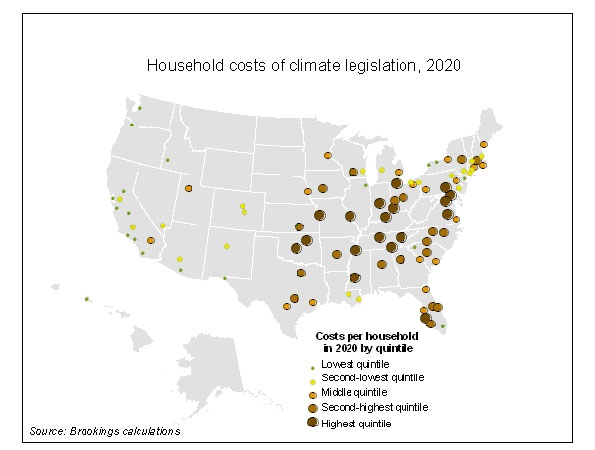
    The Brookings Institution recently calculated the projected cost of compliance under the cap and trade plan on a metro by metro basis and produced the map below for The New Republic:

    The costs of compliance are highest in the lower Midwest through to the Mid-Atlantic and in the South. New England, the Upper Midwest, and the West are the winners from a cost standpoint.

    The actual costs vary from a high of $277 per household per year in 2020 in Lexington, KY to a low of $96 in Los Angeles among the 100 largest metros. Other hard hit metros include Washington, DC ($250), Indianapolis ($246) and Kansas City ($228). Among the winners are Portland ($107), San Francisco-Oakland-Fremont ($119) and Chicago ($135).

    In aggregate, this adds up to a significant amount of money. The Cincinnati metro had 815,000 households in 2008. Brookings did not include their household estimates for 2020, but even with no population growth at all, at $244 per household that still adds up to about $200 million per year in compliance costs. To put that in perspective, Cincinnati is proposing to construct a new downtown streetcar system for that same amount of money. It could conceivably build a new streetcar line every single year in perpetuity for the cost of compliance. Portland has 835,000 households, for an annual compliance cost of $90 million. Though they are about the same size regions, Cincinnati will be paying over $100 million more per year compliance costs. This creates a $100 million disincentive to live or locate a business in Cincinnati vs. Portland.

    In short, cap and trade creates disparities between metros. As the New Republic put it, “place matters” on cap and trade. And because the effects are geographically clustered, these disparities aren’t just local, they are regional. This is enough to immediately prompt the question as to whether or not this was an implicit design goal of the system.

    Among the biggest beneficiaries of cap and trade is California. Its large metros are clustered together at the bottom of the list. I noted previously how California is placing a huge bet on the green economy as its engine of economy renewal. In fact, beyond legacy industries such as high tech, agriculture, and entertainment, California’s political leaders are betting their entire future on green. With so much on the line for California, it should come as no surprise that the state would seek to federalize its policies and institutionalize the advantages it has in this arena through its state level climate regulations. One might even better name this bill “The California Economic Recovery and Competitor Hobbling Act of 2009”.

    This reality isn’t lost on Indiana Governor Mitch Daniels. With Indianapolis the fifth hardest hit metro in the country, it is no surprise he denounced the plan in a Wall Street Journal editorial, saying, “Quite simply, it looks like imperialism. This bill would impose enormous taxes and restrictions on free commerce by wealthy but faltering powers – California, Massachusetts and New York – seeking to exploit politically weaker colonies in order to prop up their own decaying economies.”

    It is clear that getting a bill out of Washington is not just a matter of cost, but of states and regions jockeying for position. The significant regional disparities in impact grind the legislative gears and might ultimately imperil getting legislation passed. Reducing regional disparities could help improve the chances of action on carbon.

    But shouldn’t places that implemented what is considered good policy be rewarded? To some extent, yes. Many places actually voted to cause economic pain for themselves for the sake of a better environment. Other places have fought environmental regulation every step of the way. Clearly, we do want to provide incentives for good behavior, and certainly not reward bad.

    On the other hand, not all the differences in current carbon emissions or abilities to reduce them are the result of good policy. Quite a bit of them are the result of simple good luck. Some places have climates that reduce the need for heating and air conditioning. Other places face more extreme weather.

    Plentiful clean energy sources are unequally spread throughout the country. Not every place has access to large amounts of solar, wind, or hydro power sources. Much of the Midwest and South built coal fired power plants due to plentiful coal supplies in the region. Technology and transportation costs made other sources cost prohibitive. Carbon emissions were not on anyone’s radar then. Some places like Chicago were fortunate to build nuclear plants, which were bitterly opposed by environmentalists at the time, but now are praised by some as a source of low carbon power.

    In short, much of the inequality in carbon emissions results from accidents of geography or history, not deliberate bad choices. People shouldn’t be punished for practices that were rational at the times. As Saul Alinksy put it, “Judgment must be made in the context of the times in which the action occurred and not from any other chronological vantage point.” And while one could say perhaps regions whose climates require excessive heating and cooling shouldn’t be favored places to live, one could say the same about much of the West, including California, whose existence depends on a vast edifice of what many consider environmentally destructive water works.

    To actually get action on carbon – the true imperative – we should adopt the following policy guiding principles:

    1. The goal is carbon reduction, full stop. Encumbering it with additional regional economic gamesmanship, or becoming overly enamored with particular means to that end should be avoided.
    2. Reducing carbon emissions will come with an economic cost. It isn’t realistic to expect that we will get away with pain free reductions. Obviously we should seek to get the best blend of costs and benefits, but let’s not pretend we can have our cake and eat it too, holding carbon action hostage to a standard that can never be met.
    3. The carbon reduction regime should not create significant regional cost disparities. As a purely practical matter, this helps ease passage and should be embraced. Complete equality is never realistic, but when some regions will pay twice as much as others, that by itself creates oppositional voting blocs. If a cap and trade scheme is the preferred approach, then perhaps assistance to high compliance cost areas should partially fund the transition away from coal and towards less polluting sources.
    4. The carbon reduction regime should not encourage business to migrate offshore. We should also not take action that reduces the attractiveness of America as a place to do business and especially to manufacture. Regulatory arbitrage already provides an incentive to move to China, where you can largely escape environmental rules, health and safety regulations, and avoid the presence of independent, vigorous unions. An ill chosen carbon regime could simply enhance China’s allure as a “carbon haven”. Again, this skews manufacturing regions and labor interests against action on carbon, while shifting production to areas with only minimal regulatory restraints.

    In short, action on carbon reduction may well be a good policy goal. But we shouldn’t embrace any means to that end uncritically if it creates huge distortions in regional economic advantage or further damages America’s industrial competitiveness.

    Aaron M. Renn is an independent writer on urban affairs based in the Midwest. His writings appear at The Urbanophile.

  • High Speed Rail: Not One Big Happy Family

    California High Speed Rail Commission member Rod Diridon is chafing at all of the competition that has been created by the billions committed by the federal government to high speed rail. According to a New York Times report, he called many of the proposed systems around the country “vultures” and told an American Public Transportation Association meeting “If I can borrow a term from our good friends in labor, they are a ‘Do not patronize… And I cannot say it any stronger”. Consistent with that view, Diridon urged that the federal government be asked to commit all of its current $8 billion in funds to the California project.

    There may be even more disturbing news for Diridon: new competition has appeared on the horizon. A report (page 23) by the David Suzuki Foundation and the Pembina Institute (both of Canada) suggests that:

    “Using the Edmonton – Calgary example as a template, judgmentally adjusted for distance, geography and relative land values, we estimate that a full high-speed link would cost about $4 billion. If the cost were shared equally between Canada and the United States, the Canadian total would be about $2 billion.”

    Why stop at that? How about getting a quarter each from Zimbabwe and the Honduras? It would certainly make it less expensive for Canadian taxpayers. Perhaps our friends to the North simply made a typographical error, but perhaps not. Stranger things have been proposed.