Category: Politics

  • Central Banking: Feds Rule The Game

    In mid-September President Barack Obama mounted Theodore Roosevelt’s bully pulpit and railed against market greed to an audience of corporate tycoons. The objects of his derision included, and were limited to, bankers, financiers, and speculators in the ‘private’ financial community. Notably absent from the enemy bankers list were quasi-government banking corporations and America’s central bankers.

    Needless to say, the Wall Streeters convened in New York’s Federal Hall sat on their hands, perhaps wondering what had happened to the options that they underwrote for the Obama presidency when they passed around his campaign contribution hat to chip in $700 million.

    To hear President Obama’s version of recent financial history — echoed both by demonstrators and summiteers at Pittsburgh’s G20 jamboree — rapacious speculators and freebooters hijacked otherwise innocent American investors, stuffed their portfolios with inflated or worthless mortgage-backed securities, paid themselves huge bonuses for the effort, and then left the mess to be cleaned up, to use a George Bushism, by “the good folks in Washington.”

    The September New York meeting should have made for a compelling prime-time encounter session: Progressive president takes on the robber barons. After all, voters are leery of health care reform partly because they feel that, despite good intentions, their government has already bet the ranch by bailing out the banks.

    Such are the mixed metaphors of the Obama presidency that there is a constituency that cannot tell if he is a creeping socialist (too many public options) or a Wall Street front man (making the world safe for Goldman Sachs). Nor is there much consensus around the proposals to cap the bonuses of corporate hierarchs, even those who bled their companies dry.

    Certainly it seems odd that, after a global collapse of so many markets, President Obama cannot ignite a bonfire of the vanities at the head of Wall Street. After the recent speech, the corporate Medicis dismissed the need for comprehensive financial regulations and justified their bonuses much the way Babe Ruth once explained why he was paid more than the President (“Well, I had a better year”).

    The reason the U.S. administration does not get more traction with the panegyric of financial outrage is that many Americans now see little difference between the speculators on Wall Street and those running the government in Washington.

    After all, the biggest bets on sub-prime were made at two quasi-government corporations, Fannie Mae and Freddie Mac, and many of the bailed-out corporations earn their daily bread floating and trading U.S. government securities. In that sense, Wall Street treats President Obama as a cranky client, someone who often complains about the fees and commissions, but who has few alternatives to discount his paper.

    Teddy Roosevelt was able to take on corporate interests because, during the early 20th century, the U.S. government wasn’t in the banking businesses. President Andrew Jackson had driven a stake through the heart of the Second Bank of the United States, and throughout the 19th century the economy was in private, non-governmental hands.

    That private oligopoly was broken with the Federal Reserve Act of 1913, which put the U.S. government in the money game of issuing and regulating the currency.

    After 1913, it wasn’t just railroad speculators like Daniel Drew who could water the stock. The regional branches of the Federal Reserve System were also in the business of manipulating prices and values in the American economy. But that does not mean that the regulators always got it right.

    One way to read the history of the Great Depression is as a cautionary tale on the fallibility of central banking and the risks of government intervention in a market economy.

    That is a thesis of Liaquat Ahamed’s Lords of Finance, an account of the European and American central banks that “regulated” their economies into the failures of the 1930s. He makes the compelling case that the central bankers of Britain, France, Germany, and the United States fiddled with exchange rates, gold parity, currency issuance, and interest rates until the market crash of 1929-30 became the Great Depression of the 1930s.

    Central banks are, he asserts, above all political and not economic machines, and that for much of the early twentieth century, the government bankers never had “much of a year.”

    Leading up to the Great Depression, Britain pegged its currency to gold at too high an exchange rate, which led to collapse as traders relentlessly exchanged weakening pounds for Bank of England gold. France (like China today) played the game of low exchange rates, and subsidized its exporters with a cheap French franc, which undercut the European competition and hampered Germany’s re-integration into Europe.

    For its part, the United States insisted that France and England repay its war loans, which, indirectly, kept the economic pressure on Germany, which owed billions in reparations to the former Allies. And the German central bank, at various moments, chose to lessen its debt load with runaway inflation, which wiped out not just interest payments, but savings accounts and democratic government.

    In many ways, in steering the U.S. economy away from Great Depression, Part II, the Obama administration is facing the same dilemmas that confronted the Bank of England, if not the German government, after the 1929 Crash. Although the U.S. dollar is not pegged to gold, it is fixed to an artificially high standard of American living, which is supported with massive debt at all government and household levels.

    To pay off these obligations, the government can let the dollar sink, which will subsidize exporters, but infuriate foreign creditors, such as China. This route would also prime the pump of inflation, which is a tax on savings and a gift to debtors, such as the indebted U.S. government.

    Or Washington can push a strong dollar policy, which our allies and creditors would prefer. But that will make the United States a poorer nation, as national wealth and assets will need to be transferred to pay off the borrowing binge.

    Little did President Obama acknowledge, when he stood at Federal Hall in the shadow of George Washington’s first inaugural, that the speculator he should have been denouncing was none other than the government that he heads. This does not excuse the self-congratulatory bonuses of Wall Street punters or the failures that they engineered, and which President Obama papered over with bailout money and stimulus packages. But it does suggest why few in the crowd, or the electorate at large, cried “bully” when he was finished. They are in the same game.

    Matthew Stevenson was born in New York, but has lived in Switzerland since 1991. He is the author of, among other books, Letters of Transit: Essays on Travel, History, Politics, and Family Life Abroad. His most recent book is An April Across America. In addition to their availability on Amazon, they can be ordered at Odysseus Books, or located toll-free at 1-800-345-6665. He may be contacted at matthewstevenson@sunrise.ch.

  • Bifurcated American Politics

    Bifurcated means to split or divide something into two parts. It is a term often used to describe trees, but today it can also be applied to our politics in America. It seems that right and left, liberal and conservative, Republican and Democratic have never been more at odds than in our recent history.

    Politics has always been blood sport. A quote often attributed to President Harry Truman is, “If you want a friend in Washington, get a dog.” This may have been true about our politics, but our legislative process was much more collegial. Elected leaders worked together, shared power, listened to the other point of view, and knew how and when to compromise. Today, lines in the sand have become chasms, and compromise is viewed as retreat. What happened? .

    Robert Bork, by any objective criteria, would be judged to be highly qualified to become Justice of the Supreme Court. He was a renowned legal scholar who had the misfortune of also being a strict constructionist of the constitution. In 1987, he was nominated by then-President Ronald Reagan to fill a vacancy on the court. Within an hour of his nomination, Senator Edward Kennedy stated, “Robert Bork’s America is a land in which women would be forced into back-alley abortions, blacks would sit at segregated lunch counters, rogue police could break down citizens’ doors in midnight raids, schoolchildren could not be taught about evolution, writers and artists could be censored at the whim of the Government…” At that point civility ended. Bork’s nomination was withdrawn and the process has not been the same since. Ted Kennedy defined the fears America harbored about conservatives, and a new word was added to the American lexicon – “borked” – which is defined of a savaging of a candidate because of what they believe.

    In 1988, Rush Limbaugh syndicated his talk radio program nationally. He was unabashedly conservative and a ratings sensation. His three hour show usually does not include any guests. To his audience, he is a “lovable little fuzz ball,” but to his enemies he is the personification of mean-spirited Republicanism that is anti-Black, anti-woman, and anti-environment. Limbaugh set the stage for conservatives like Sean Hannity, Glenn Beck and Laura Ingraham to follow and achieve talk radio dominance for the conservative point of view. Limbaugh provides daily talking points to his listeners in the form of arguments against what he deems liberal policies. His “dittoheads” now form a network of followers throughout America who can be quickly mobilized into opposition.

    Liberals tried and failed to match Limbaugh by launching “Air America” and other programming, but their programs have all been ratings failures, leaving the right firmly in command of talk radio content. Talk radio has divided America not so much along party lines as along ideological propensity, liberal and conservative.

    Trust in our elected leaders has been greatly diminished over the past few decades. Republican trust was shattered when George H.W. Bush broke his “read my lips” promise not to raise taxes. The wound deepened when Newt Gingrich “flamed out” in 1998. Democrats circled the wagons around Bill Clinton during his impeachment. His impeachment was viewed as criminal by Republicans, while his actions were considered minor, personal issues by Democrats. George W. Bush was elected in a disputed ballot election. From that point forward, to Democrats he was “selected not elected.” Our trust in our elected leaders is at an all time low as evidenced at recent town hall meetings on health care and polling data that puts Congressional approval below 30 percent.

    The powerful nightly news programs and newspapers at one time were the primary shapers of opinion in America. No longer. New internet based media and content providers simply beat them to the punch on a daily basis. This has caused a divide in how we get news. Fox News is soaring in the ratings with its “fair and balanced” tagline. In response, other mainstream media has moved left. What is troubling is that stories that are broken by Fox, using good journalism, are not even carried in the mainstream media. Two recent examples are reporting on Obama appointee Van Jones, and Fox’s explosive reporting on ACORN. The New York Times missed the Jones story. When he resigned they explained their lack of coverage, writing, “Our Washington bureau was somewhat short-staffed during the height of the pre-Labor Day vacation.” Charles Gibson, anchor at ABC, when asked about the ACORN scandal laughingly stated, “It’s a mystery to me.”

    The way our “two media” view tea parties, town hall protesters and the September 12th March on Washington goes far beyond a mere gap in perception or difference of opinion on what constitutes news. It defines the camps in a divided America

  • Mexico’s Real War: It’s Not Drugs

    Balding, affable and passionate, Uranio Adolfo Arrendondo may not be a general or political leader, but he stands on the front lines of a critical battle facing Mexico in the coming decade. This struggle is not primarily about the drug wars, which dominate the media coverage–and thus our perceptions–of our southern neighbor. It concerns the economic and political forces stunting the aspirations of its people.

    For the past 36 years, Arrendondo’s small family-owned school, Liceo Reforma Educativa, where he is principal, has served as an incubator for Mexico City’s aspiring middle class. Modest and reasonably priced, the school has offered small-business owners, professionals and mid-level managers a way to propel their children up the economic ladder.

    Yet today Arrendondo finds many parents lacking the resources for even a modest alternative to Mexico’s troubled state-run schools. “The middle class in Mexico is going down,” Arendondo told me in his office by the courtyard of the brightly painted school in the largely lower-middle-class Iztacalco, one of Mexico City’s 16 diverse delegaciones, or boroughs. “The middle class is predated by both the super-rich and the criminal poor. We are squeezed in the middle of the sandwich.”

    This predicament is not unique to Liceo Reforma, which has some 245 students. Data from the Asociacion Nacional de Escuelas Particulares estimate that as many as 400,000 people have pulled their children out of small private schools over the last few years, placing them instead in the generally much inferior public ones.

    This is just one sign of a worrisome trend toward downward mobility, greatly exacerbated by the economic crisis. And it is all the more painful, as it represents a reversal of progress toward an expanding middle class in the 1970s and 1980s. In those decades, Mexico–spurred by its energy wealth and an expanding industrial base–was finally beginning to break away from its age-old pattern of being a society dominated by a few rich and many very poor.

    To be sure, Mexico City’s sprawling expanse still exhibits this legacy of upward mobility. A good number of the capital’s 20 million people can be seen crowding elegant shopping centers, driving late model cars and eating in crowded restaurants. With the elegant Polanco, not far from the central district, lovely Lomas de Chapultepec, or sprawling, ultra-modern Santa Fe, Mexico City can seem very much a first-world city.

    At the same time, however, much of it–including lower-middle class Iztacalco–needs considerable repair. The root of the problem lies in demographics. Although Mexico’s population growth has slowed, labor-force growth still outpaces economic fecundity. Victor Manuel, director general of a leading high-tech institute in Mexico City, estimates the country’s gross domestic product needs to grow at 7% annually to produce the 2 million new jobs needed each year to keep up with labor-force growth. Over the past decade, that growth has been roughly 3%, and last year declined by as much as 7%.

    In the immediate future, many economists expect Mexico’s recovery to lag that of both the U.S. and its Latin neighbors, particularly Brazil and Peru. The most recent survey of expectations among industrialists conducted by Canacintra, a leading national business chamber of manufacturers, found more than half expected conditions to get worse, 10 times as many who expressed optimism.

    The sluggish economy has had its most dramatic impact on the poor, who constitute upward of 25% to 30% of the population. In contrast to earlier decades, their ranks may now be growing, suggests Alfonso Celestino, a social scientist who works for the government of the sprawling Districto Federal, which includes Mexico City. “Mexico is a first-world city, but large parts are like third-world African cities,” he asserts

    Particularly notable has been the growth of the so called “misery suburbs” or pueblos nuevos, sprouting in the outer periphery of the city. In these areas, as well as poor inner city neighborhoods, unemployed young people are being “absorbed,” as Celestino puts it, into the illicit economy. This burgeoning criminal infrastructure preys directly on the super-rich through kidnappings and their bloody feuds that discourage both investors and tourists.

    Yet it is perhaps more dangerous, as violence has grown and poverty increased, that the middle class has begun to recede. Unlike the very poor and the elderly, such families receive little public assistance and often make do by working in the massive “informal economy” that, by some estimates, constitutes as much as 40% of the entire country’s gross product.

    Even before the economic crash in 2007, large percentages of educated Mexican workers were finding it difficult to get placed in high-skilled jobs. Miguel Angel Juarez Noguez, a junior-high math instructor, graduated with a degree in computer science in 2006, but says few of his friends have found employment inside the information sector.

    He believes his parents, both mathematics instructors, enjoyed far better prospects than he and his family–including two children–now face due to a weak job market and rising cost of living. “Today” he suggests, “you need more education to get less.”

    These problems have been exacerbated by the deep recession in the U.S., whose market created many relatively high-paying industrial and technical jobs. Meanwhile, workers remittances from Mexicans in the U.S., the second-largest source of income for the country after oil, have begun to dry up.

    Many discouraged Mexican immigrants have returned home, notes Celestino, but they find few employment opportunities. And Mexico’s border boomtowns, which once offered considerable opportunity, are now suffering not only from the American recession but from the shift of production to China. Coastal communities have been decimated by a decline in tourism, a result not only of the recession but also of concerns over violence and swine flu epidemic.

    Ultimately, many concede that the basic problem lies not in the outside world but in Mexico itself. Although much can be said for greater transparency and economic liberalism under the current PAN government, most believe the entrenched system of crony capitalism has been barely affected by the political change.

    This system–where bribery is commonplace and connections are necessary to build even a small business–stymies growth by undermining innovation, notes technology entrepreneur Victor Manuel. “People come back from schools, or from the United States, with all sorts of skills and money,” he notes, “but there’s no system here to create an economy they can contribute to.”

    Such frustrations are heightened by a sense that other countries–notably the BRIC nations of Brazil, Russia, India and China–are rushing ahead while the once-promising Mexico falls behind. These countries appear to be tapping their human and material resources more efficiently and strategically than Mexico. “There is no vision from the state,” Manuel says, echoing a common refrain.

    Edgar Moreno, a 37-year-old M.B.A. who currently works for Hewlett-Packard at the ultra-modern Santa Fe district southeast of the city, agrees that political dysfunction is the main impediment to progress. Corruption and inefficiency hamper the development of the nation’s potentially huge energy resource, and that’s one reason why Mexico lacks the capital to develop new enterprises. Real interest rates for entrepreneurial ventures start at 12%.

    Moreno’s own ambition, to develop renewable fuels based on sugar, corn and other crops, is also held back by bureaucratic obstacles that discourage such ventures. “It’s not the location of the country that keeps us from developing the way we should,” he points out. “It’s the laws, the framework, how the government does things. Mexicans have lots of ideas and a lot of interests, but the system is stacked against us.”

    The surge in drug violence–over 7,000 died just last year–adds to the perception that Mexico may be on the verge of becoming a “failed state.” Mexican author Enrique Krauze believes the crime wave constitutes Mexico’s “most serious crisis” since the bloody 1910 Revolution, an upheaval that cost more than 2 million deaths.

    Yet, however terrible the violence, Arrendondo believes the decline of the middle class and upward mobility presents Mexico with a more lethal, long-term threat. The parents of the Liceo’s students, he argues, may not “take up a pistol” like their forebears a century ago but might embrace a return to the anti-American authoritarianism and protectionism of the past.

    This would not be good news for America. Mexico stands as our second export market, well ahead of China. Mexicans are also our closest cousins in terms of blood–four in 10 claim to have relatives in the U.S.–and our tastes in food, music and culture increasingly converge.

    This suggests that what happens to the kids and their parents at Liceo Reforma Educativa matters to us as well. A thriving Mexico would need to send us less of their poor and could buy more of what we produce. Mexico’s fate has at least as much relevance to our future as developments in Iraq, Afghanistan, Europe or even China, where our media and politics focus most of their attention.

    “These kids’ parents are struggling with opportunities lost and destroyed,” Arrendondo told me. “We have to change that. Mexico has to become a place where opportunities are created for kids like these. That’s the most important thing to determine the future.”

    This article originally appeared at Forbes.com.

    Joel Kotkin is executive editor of NewGeography.com and is a distinguished presidential fellow in urban futures at Chapman University. He is author of The City: A Global History. His next book, The Next Hundred Million: America in 2050, will be published by Penguin Press early next year.
  • Germany’s Role in the Green Energy Economy

    Germany likes to brag about its green credentials. It is a source of pride and it is justified to a certain extent. The country, which is located on the same latitude as Canada, had the largest number of installed solar panels as of 2007.

    The key to growth clearly has not been abundant sunshine, but massive subsidies. Germany sponsors its solar industry with generous tax credits that take the form of feed-in tariffs, i.e. payment above the going market rate for energy from renewable sources like solar panels, it can run anywhere from twice to three times the market rate for a conventionally produced kilowatt. These tariffs can run high. They are being lowered slowly but perhaps a bit too slowly. As we have recently seen with the disasters impacting Spain’s renewable energy industry, dependence on subsidies can create a potential catastrophic downturn once the spigot is turned off.

    Would a similar model be appropriate for sponsoring renewable energy in the US? Probably not, in large part the technology is already developed. The Germans and now the Chinese have already subsidized their industries. The legwork has been done and anti-greenhouse legislation will sustain the market without massive subsidization.

    The first factor is that most of the investment in research and development has created the pre-conditions for grid parity within the next few years for southern countries. Even Germany will achieve it by 2012 according to the German business newspaper Handelsblatt. The economies of scale are sinking unit costs dramatically and production technologies like thin film are allowing solar cell manufacturers to produce ever more efficient panels with less and less silicon. Several silicon production plants are set to come on line in China soon.

    The US, whose fiscal situation is parlous compared to China and even Germany, wants to waste years developing already available technologies from scratch. It could try the European approach but would probably be much better off to follow the same path that it followed with the automobile or the motion picture: allow other countries to get the basic technology in place and concentrate its exceptional energy on marketing and scaling up the technologies from abroad.

    China’s entry into the market seems destined to create a dramatic collapse in the price of what was until a few years ago essentially a cost plus industry. China has low labor costs and inflation busting economies of scale. China’s entry into the silicon wafer market already has depressed prices for the once dear raw material. They are also working on a massive power plant with First Solar of the United States.

    Some are predicting that China’s entry into the renewable energy market will have the same effect as its entry into the consumer electronics market, i.e. it will make the expensive affordable and then cheap. German solar cell production companies have suffered much like its chip producers but to the general benefit of the economy. China will drive production costs further down. Germany is still coming to terms with this.

    A recent article in Die Zeit illustrates the growing discrepancy between renewable energy policy and the market potential. The feed-in tariffs have the perverse effect of making solar energy far more expensive than it actually needs to be. The government subsidies are essentially shielding domestic producers from China making the consumers pay the higher rates. Germany needs to focus on its traditional strengths in producing industrial machinery and carve a niche for itself. The US would be better off to maintain trade relations with China and let Adam Smith’s invisible hand work its magic. It would be far cheaper than trying to use protectionist measures to protect domestic manufacturers.

    All this is predicated on the assumption that the price of oil will only increase in price in the coming decades as China and India motorize their masses. This in turn will drive up conventional power costs. Even at its current price of around $70 a barrel, oil is still 7 times more expensive than it was just a decade ago. Some are predicting that that last year’s prices of almost a $150 a barrel represent a taste of what will confront the world when the economy begins to grow again

    This, however, will be a gradual process, based on undulating prices. The hysterical claims of Peak Oil have been delayed again and again by technological improvements. The latest finds off of Brazil and the Gulf of Mexico represent dramatic examples. Massive new gas reserves in North America represent another countervailing force. In the end, fossil fuels will be more expensive, but they will make renewable energy more competitive only at reasonable price points.

    Politics will also play a role. Climate change and the perceived need to combat it has gained enormous currency among world leaders including German Chancellor Angela Merkel. Regardless of what one thinks of the arguments calling for action, we will probably see some sort of carbon tax in the future, whether it be cap and trade or some other means of increasing the costs of carbon emissions. Conventional fuels like coal, oil, and natural gas are only going to get more expensive for political if not economic reasons. The growing consensus, regardless of its veracity, is set to create huge costs for non-renewable sources of energy.

    Over time, this will make renewable energy more attractive and unit costs will shrink as economies of scale start to kick in. The European cheerleaders of climate legislation are not doing it out of the goodness of their heart. They want to see a return on the billions spent on developing renewable technology. The US would be ill-advised to simply try to create technologies that are already up and running. Take the technology, commercialize it and thank the Europeans for footing the bill.

    The US would be well advised to keep their renewable energy markets open. The Europeans will come and are coming. The solar energy trade fairs in Germany focus on the immense potential available in the US market. Several large German producers are expanding aggressively on the American market bringing with them the technologies that they have created. China will also start to flood the market with cheap silicon wafers and further reduce solar panel costs. The US does not need to subsidize this technology lavishly. It simply needs to allow the companies that have it to sell it on their market. The initial support provided by countries like Germany was more than enough to get the technology to the point where it is ready to survive on the free market.

    Kirk Rogers resides in Bubenreuth on the outer edges of Nuremberg and teaches languages and Amercan culture at the University of Erlangen-Nuremberg’s Institut für Fremdsprachen und Auslandskunde. He has been living in Germany for about ten years now due to an inexplicable fascination with German culture.

  • Purple Politics: Is California Moving to the Center?

    You don’t have to be a genius, or a conservative, to recognize that California’s experiment with ultra-progressive politics has gone terribly wrong. Although much of the country has suffered during the recession, California’s decline has been particularly precipitous–and may have important political consequences.

    Outside Michigan, California now suffers the highest rate of unemployment of all the major states, with a post-World War II record of 12.2%. This statistic does not really touch the depth of the pain being felt, particularly among the middle and working classes, many of whom have become discouraged and are no longer counted in the job market.

    Even worse, there seems little prospect of an immediate recovery. The most recent projections by California Lutheran University suggest that next year the state’s economy will lag well behind the nation’s. Unemployment may peak at close to 14% by late 2010. Retail sales, housing and commercial building permits are not expected to rise until the following year.

    This decline seems likely to slow–or even reverse–the state’s decade-long leftward lurch. Let’s be clear: This is not a red resurgence, just a shift toward a more purplish stance, a hue that is all the more appropriate given the economy’s profound lack of oxygen.

    There is growing disenchantment with the status quo. The percentage of Californians who consider the state “one of the best places” to live, according to a recent Field poll, has plummeted to 40%, from 76% two decades ago. Pessimism about the state’s economy has risen to the highest levels since Field started polling back in 1961.

    Inevitably, this angst has affected political attitudes. Though still lionized by the national media, Gov. Schwarzenegger’s approval ratings have fallen from the mid-50s two years ago into the low 30s. The 12% approval rate for the state legislature, according to a Public Policy Institute of California survey in May, stands at half the pathetic levels recorded by Congress.

    Moreover, voters now favor lower taxes and fewer services by a 49-to-42 margin–as opposed to higher taxes and more services. Support for ultra-green policies aimed to combat global warming has also begun to ebb. For the first time in years, a majority of Californians favors drilling off the coast. Californians might largely support aggressive environmental protections, but not to the extreme of losing their jobs in the process.

    Remarkably, state government seems largely oblivious to these growing grassroots concerns. The legislature continues to pile on ever more intrusive regulations and higher taxes on a beleaguered business sector. Agriculture, industry and small business–the traditional linchpins of the economy–continue to be hammered from Sacramento.

    Agriculture now suffers from massive cutbacks in water supplies, brought about in part by drought, but seriously worsened by the yammerings of powerful environmental interests. Large swaths of the fertile central valley are turning into a set for a 21st-century version of Steinbeck’s Grapes of Wrath.

    At the same time, the state’s industrial base is rapidly losing its foundation. Toyota recently announced it was closing its joint venture plant in Fremont, the last auto assembly operation in the state, shifting production to Canada and Texas. Even the film business has been experiencing a secular decline; feature film production days have fallen by half over the decade, as movie-making exits for other states and Canada.

    Most important, California may be undermining its greatest asset: its diverse, highly creative and adaptive small-business sector. A recent survey by the Small Business and Entrepreneurship Council ranked California’s small-business climate 49th in the nation, behind even New York. Only New Jersey performed worse.

    Regulation plays a critical role in discouraging small-business expansion, a new report from the Governor’s Office of Small Business Advocate suggests. Prepared by researchers from California State University at Sacramento, the report estimates that regulations may be costing the state upward of 3.8 million jobs. California currently has about 14 million jobs, down 1 million since July 2007.

    Ironically, the regulatory noose is now slated to tighten even further as a result of radical measures–from energy to land use–tied to reducing greenhouse gases. Another study, authored by California State University researchers, estimates these new laws could cost an additional million jobs.

    Many in the state’s top policy circles, as well as academics and much of the media, dismiss the notion that regulations could be deepening the recessionary pain. Some of this stems from the delusion–always an important factor in this amazing state–that ultra-green policies will actually solidify California’s 21st-century leadership. Few seem to realize that other states, witnessing the Golden State’s economic meltdown, might not rush to emulate California’s policy agenda.

    Internally, discontent with the current agenda seems particularly strong in the blue-collar, interior regions of the state. Brookings demographer Bill Frey and I have described this area as the “Third California.” In the first part of the decade, this region expanded roughly three times as rapidly as Southern California, while the Bay Area’s population remained stagnant.

    Today the Third California represents roughly 30% of the state’s population, compared with barely 18% for the ultra-blue Bay Area. The most conservative part of the state has skewed somewhat more Democratic in recent elections, largely due to migration from coastal California and an expanding Latino population.

    But the intense economic distress now afflicting the interior counties–where unemployment rates are approaching 20%–may now reverse this process. The ultra-green politics embraced by the Democrats’ two prospective gubernatorial nominees-Attorney General Jerry Brown and San Francisco Mayor Gavin Newsom–may not appeal much to a workforce heavily dependent on greenhouse-gas-emitting industries like farming, manufacturing and construction.

    Eventually, the Democrats may rue their failure to run a pro-business, pro-growth candidate, particularly one with roots in the interior region. This oversight could cost them votes among, say, Latinos, who have been far harder hit by the recession than the more affluent (and overwhelmingly white) coastal progressives epitomized by Brown and Newsom. Along with independents, roughly one-fifth of the electorate, Latinos could prove the critical element in the state’s purplization.

    This, of course, depends on the Republicans developing an attractive pro-growth alternative. In recent years, the party’s emphasis on conservative cultural issues and xenophobic anti-immigrant agitation has hurt the GOP in the increasingly socially liberal and ethnically diverse California.

    Although he has proved a poor chief executive, Gov. Schwarzenegger did at least show such a political approach could work. The recent emergence of three attractive Silicon Valley-based candidates, including former eBay CEO Meg Whitman and State Insurance Commissioner Steve Poizner, as well as the likable libertarian-leaning former congressman Tom Campbell, could score well at the polls.

    This political course-correction should be welcomed not only by Republicans but by California’s moderate Democrats and Independents. However blessed by nature and its entrepreneurial legacy, California needs to move back to the pro-growth center if it hopes to revive both its economy and the aspirations of its people.

    This article originally appeared at Forbes.

    Joel Kotkin is executive editor of NewGeography.com and is a distinguished presidential fellow in urban futures at Chapman University. He is author of The City: A Global History. His next book, The Next Hundred Million: America in 2050, will be published by Penguin Press early next year.

  • Pittsburgh Didn’t Volunteer for G20

    As host of the G-20 summit, Pittsburgh briefly will sit in the global spotlight. With this article by longtime Pittsburgh resident and columnist Bill Steigerwald, New Geography opens a three part series looking at this intriguing metropolis from the point of view of planning, demography and economic performance.

    Pittsburgh didn’t volunteer to host the G-20 Summit that is coming here next week to inflict so much civic pain and disruption.

    It was entirely President Obama’s call. He apparently thought it would be a good idea to have the finance ministers and central bankers of the world’s top 20 economies hold one of their city-disrupting conferences in downtown Pittsburgh on Sept. 24-25.

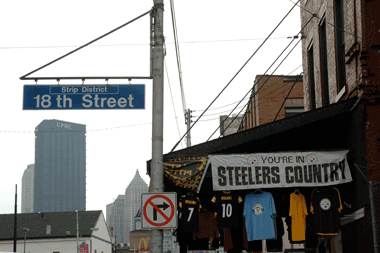
    Perhaps Mr. Obama, who will chair the G-20, thought he was doing the financially strapped city of Pittsburgh a favor by sending 4,000 foreign bureaucrats and media folk here to spend their Euros and Yen on Steelers T-shirts and game jerseys.

    Maybe he thought placing the G-20 meeting in Western Pennsylvania – a disproportionately Caucasian and socially conservative corner of America where his 2008 vote totals were disappointing – would pay him political dividends in the 2012 election.

    In either case, the president was sadly mistaken.

    Except for the local booster & tourism sector – who’d welcome a Category 8 hurricane to Pittsburgh as long as the international media covered it and said nice things about their no-longer smoky city – it’s safe to say everyone in this town who doesn’t work in the homeland security industry wishes they had never heard of the G-20.

    As months of local media stories have made plain, the conference is not only going to be a huge public annoyance, it’s going to be a lose-lose situation for everyone – especially the city government.

    Any economic benefits to the local GDP from the arrival of 4,000 visitors with fat expense accounts will be outweighed by the cost of protecting property from the tens of thousands of leftist protestors, angry anarchists and professional window-breakers who stalk G-20 meetings around the world.

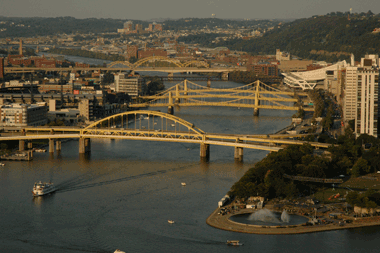
    To maximize security and minimize destruction, the Secret Service and local authorities will fortify most of the Golden Triangle, the photogenic downtown business district squeezed between the Allegheny and Monongahela rivers as they meet to create the Ohio River.

    Barricades will be erected. Cars and mass transit will be diverted. Several major construction sites will be sealed off to deny protestors dangerous things to throw. Most downtown businesses probably will close. City schools and colleges will shut down.

    The predicted cost to local public coffers for hiring, feeding and equipping additional police and paying overtime will be at least $20 million, most of which will be reimbursed by the federal government.

    Whatever the final bill is, hosting the G-20 is an “honor” the city of Pittsburgh and its taxpayers didn’t need and can’t afford. The city is already bankrupt and in state receivership because of the generous pension deals it’s promised but won’t be able to pay for.

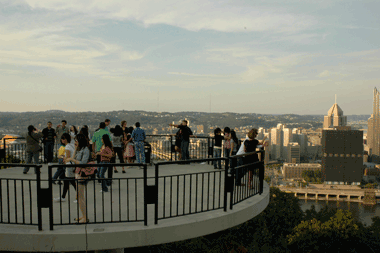
    The city of Pittsburgh looks fabulous and robust when its skyline and riverbanks are shown on TV during Steelers home games. But it’s really the capital city of an economically stagnant, over-taxed, over-regulated, steadily depopulating metropolitan region that has been horribly governed for 60 years.

    The private-public power-brokers who’ve run the city have wasted billions on a never-ending series of destructive urban renewal projects, redevelopment boondoggles and wasteful mass-transit projects.

    Almost nothing has been built in downtown Pittsburgh or on its riverbanks in the last 20 years without being handed millions in public subsidies – whether it was PNC Financial Service’s almost completed downtown skyscraper, a gorgeous Lazarus department store that went bust in the ‘90s or the shiny new homes for the Pirates, Steelers and (soon) the Penguins.

    If curious G-20 attendees have time to stroll around the city’s abandoned downtown streets on Thursday and Friday, they will have no trouble finding evidence of City Hall’s current crop of fiascoes-in-the making.

    Right in front of fancy Fifth Avenue Place, for example, is a deep trench where busy Stanwix Street should be.

    It’s not where a Scud missile hit during the first Gulf war. It’s the construction zone of one end of the local mass transit system’s infamous “Tunnel to Nowhere.”

    The 1.2-mile light-rail extension goes from Gateway Center downtown under the Allegheny River to the North Shore, where its other end has been tearing asunder the wasteland of former parking lots between the subsidized new homes of the Steelers and Pirates for several years.

    The twin light-rail tunnel – cleverly built under a river in the “City of Bridges” so as to maximize the cost and provide unions and construction companies with six or seven years of high-paid make-work – will allegedly carry 4.2 million riders a year in the distant transit future.

    That impressive but fraudulent projection comes out to about 11,000 “riders” a day – which actually represents only 5,500 human commuters making a (two-ride) round trip commute. A large proportion of those annual riders, by the way, will be baseball or football fans.

    All that socially correct “mass transit” will end up costing at least $650 million, with federal and state taxpayers picking up about 97 percent of the tab. Except for yours truly and the conservatives on the Pittsburgh Tribune-Review’s editorial page, virtually no one in local politics or the media questioned or challenged the lunacy of building the transit tunnel.

    Another wasteland in the middle of downtown that G-20-goers might visit is the flattened construction site that used to be Market Square.

    Once upon a time, before City Hall planners began demolishing and rebuilding huge chunks of downtown in the 1950s; it was what urbanists are supposed to encourage: an actual square with markets.

    Then, in the 1960s, the city took it over and transformed it into a poorly designed, commerce-free urban park with trees, grass and heavy city bus traffic. The public space delighted crowds of lunching office workers at midday but the rest of the time it was a lawless playpen for about 100 homeless people, drunks and drug pushers.

    Today the area around Market Square, last refurbished in the 1990s, hardly has a live store or restaurant left standing. It is waiting to be turned into its next reincarnation – a $5 million European-style piazza with no vehicles piercing its heart and no low walls and green spaces for social misfits to reside.

    On one edge of battered Market Square is Fifth Avenue, which has been tortured constantly by City Hall for about 25 years.

    In the early 1980s, its street surface was torn up for several years so the city’s rinky-dink light-rail subway could be built beneath it. Not long after that, Fifth Avenue was rendered virtually impassable to shoppers for a couple years while the city slowly redid its sidewalks and curbs.

    Then, in the late 1990s, Fifth was targeted by City Hall for a preposterously stupid and destructive redevelopment scheme.

    The crude 1960s-style renewal project would have misused eminent domain power to clear-cut Fifth Avenue and Forbes Avenue, wipe out nearly 100 businesses and build what amounted to an outdoor suburban mall anchored by a Nordstrom store.

    Fortunately, that plan was miraculously stopped by an alliance of preservationists and property rights defenders. But is it any wonder that after a quarter century of torture by city planners Fifth Avenue became “dilapidated” and in need of serious redevelopment?

    As G-20 attendees will learn if they bother to walk a few moments from their hotels, the nightmare on Fifth Avenue continues. Its northern end is currently being torn down, fixed up, blocked to pedestrians or under construction.

    PNC Financial is putting the final touches on its new 23-story, $178 million headquarters – which received $48 million in state and local subsidies and wiped out half a block of retail storefronts. Meanwhile, up the street, the lovely stone tomb the city erected in the late 1990s for Lazarus has been all but given away to a local developer who’s converted it into a pricy condo and office space that still has 32 of its 65 units to sell.

    Whenever the national media rediscover the glories of Pittsburgh’s clear skies and affordable livability, which they seem to do every four years, they never stick around long enough to note the failings of its governments and politicians.

    Taxes on property and people and businesses are too high. The city schools are absurdly expensive and ineffective. The roads and 1950s parkways are old, narrow and crumbling. Public services are often poor or costly. Unions and Democrats wield the sort of uncontested political power that’s never good for a municipality.

    Yes, it is still true, as the national media and local booster sector never tire of repeating, that the “City of Champions” and its suburbs are a great place in which to live, raise a family, grow old and die peacefully.

    With its famous three rivers and hills and bridges and skyscrapers and hillside homes and urban neighborhoods and spectacular views and historic downtown buildings, Pittsburgh is rich in natural and man-made charm.

    Toss in a cost of living 17 percent below the national average and low crime rates, lots of good affordable housing, major-league super-teams like the Steelers and Penguins, great museums like the Carnegie and top universities like Carnegie Mellon and Pitt – Pittsburgh does deserve to be ranked highly on those meaningless most-livable city lists.

    It’s also true – as some in the national media latched on to earlier this year – that compared with many other parts of the country, Pittsburgh has not suffered greatly in the current recession.

    Pittsburgh has an unemployment figure lower than the national average, a very low home-foreclosure rate and stable-to-slightly-rising housing prices.

    But Pittsburgh’s good fortune was not, as out-of-town media claimed, because its wise leaders had figured out how to dodge a severe economic downturn. Or because – as President Obama has been led to believe – the region’s post-industrial “eds and meds” service economy is particularly healthy or even resilient.

    Pittsburgh’s relatively impressive economic statistics are pretty much the 30-year norm for Pittsburgh – in times of national booms or busts. They probably won’t change for the better unless the spectacularly rich Marcellus shale natural gas deposits lying underneath western Pennsylvania are exploited, which may not happen for decades or ever happen at all.

    There’s one thing about Pittsburgh’s future that is a near certainty: It’s going to have fewer residents next year than it has today.

    Since the mid-1990s, Pittsburgh has had more deaths than births each year. Between 2000 and 2006, in fact, it had 21,045 more deaths than births, earning it the distinction of being the largest metropolitan area where deaths outnumber births.

    That negative ratio wouldn’t be so bad if immigrants from anywhere else were flocking to Pittsburgh. But they aren’t. Metro Pittsburgh has the lowest percentage of foreign-born residents of any major city – 3 percent – compared to 12.5 percent nationally.

    Pittsburgh has only about 7,000 immigrants from Latin America – second to the 7,800 who hail from India. Only 16,000 international immigrants arrived in metro Pittsburgh between 2000 and 2006, dead last among the 25 largest cities.

    Post-industrial decline, out-migration, too many older people, more deaths than births, too few immigrants from Mexico and Georgia – they’ve all contributed to Pittsburgh’s incredible six-decade population decline.

    In 1950, Pittsburgh was the country’s 12th biggest city. It had 676,806 citizens in a metropolitan area of about 2.5 million.

    Today the metro population, ranked 22nd, is down to 2.35 million and Pittsburgh’s surviving population of 310,000 live in the country’s 59th biggest city – right behind Aurora, Colo., a growing municipality that will never have to worry about getting stuck with hosting a G-20 summit.

    Photos by Bill Steigerwald.

    Bill Steigerwald, a free-lance libertarian writer who recently retired from daily newspaper journalism, loves his native Pittsburgh but hates the political and corporate power brokers who’ve been damaging the city for 60 years. His columns are archived at the Pittsburgh Tribune-Review and his 2000 article for Reason magazine on the city’s abuse of eminent domain powers is here.

  • Play It Cool at the G-20, Mr. President

    Barack Obama goes to this week’s Pittsburgh G-20 with what seems the weakest hand of any American president since Gerald Ford. In reality, he has a far stronger set of cards to play — he just needs to recognize it.

    Our adversaries may like our new president, but they don’t fear him. And, on the surface, why should they? The national debt is rising faster than the vig for a compulsive, debt-ridden gambler. And our primary rivals, the Chinese, continue to put the squeeze on American producers by devaluing their currency, subsidizing exports and penalizing imports.

    When the Chinese threaten to call in their debts, they can count on Timmy Geithner to kowtow like an obedient vassal. Some of Obama’s most important supporters — like Warren Buffett and The New York Times‘ Thomas Friedman — have discovered what Friedman calls “the great advantages” of autocracy over our cockamamie, boisterous democracy.

    From Virgil, Maecenas and the court of August to Hitler-admirers Henry Ford and George Bernard Shaw, as well as Stalin-fan Max Eastman, imperial scribes and money lenders have long demonstrated a weakness for even the worst autocrats. But our bedraggled democracy may have a lot more aces to play than many recognize.

    Just look at the other players around the table. French President Nicolas Sarkozy, when not worrying about his (lack of) height, tells his countrymen to stop worrying about gross domestic product. Productivity, one presumes, doesn’t mean as much as a good baguette, long vacation or wet kiss from a former model.

    Across the channel, Prime Minister Gordon Brown seems determined to take the Good Ship Brittania further underwater. According to Tony Travers of the London School of Economics, Britain, with the exception of London, is already well on its way to becoming “a second- or third-tier country.” And as my colleague Ryan Streeter points out, New Labour’s response to the economic crisis — basically raising taxes and doubling down on regulation — doesn’t seem a formula for a vibrant economy.

    Germany, Italy, Spain and the rest of E.U. face equally daunting problems. These “progressive” role models suffer from unsustainably low birthrates, and many face a future more Islamic than European. Their “green” rhetoric may thrill some fans in the U.S., but these economies still run largely on oil and natural gas, which makes them ever more dependent on the autocrat of all — Russia.

    And Japan, once considered the mega-tiger of the future by American policy wonks, is transforming itself into something of a post-modern pussycat. It won’t take immigrants even as its population begins to shrink. Largely dependent on exports, its new government does not like globalization and wants to expand its welfare state. Moreover, Japan seems to be wobbling toward a future as a quiescent vassal for the Greater Chinese East Asian sphere.

    So how does America compare? Let’s start with the basics. The U.S. is the only major advanced country that enjoys a steady population increase. Yes, immigrants are driving much of that growth, but our newcomers are generally very different from the largely alienated and isolated Muslim communities now nesting in Europe. America’s Mexicans, Chinese, Indians, Armenians, Caribbeans and Africans — and more pointedly Arabs and Iranians — do not constitute a hostile “them.” Instead they are the ones redefining us by adding new dimensions to what Nathan Glazer once described as “a permanently unfinished country.”

    Of course, it helps to be the only serious global military presence in the world. A strong military represents an invaluable asset in a world dominated by autocrats and lunatics. That doesn’t mean Obama should swagger like a Viagra-enhanced neo-con. He just needs to follow Teddy Roosevelt’s dictum: Speak softly, but keep a hold on that big stick.

    A powerful military and better demographics represent just part of America’s strong hand. Compared with the E.U., Japan, China or even India, the U.S. remains phenomenally rich in resources.

    Take our most basic need: food. The U.S. has the most arable land in the world and is its largest food exporter. Our $1.4 trillion food sector accounts for 12% of our economy, and prospects for expansion are enormous. By 2050, the population of the planet will be around 9 billion people — up from 6 billion today. More than 85% of the world’s population will reside in developing countries, most in cities, and they will constitute a gigantic future market.

    Equally important, the U.S. is sitting on huge energy resources. Of course, renewable fuels should become a major, even dominant, factor, but in the short- and maybe mid-term, oil, gas and even coal will continue driving the economy. The Great Plains and even the Northeast, particularly Pennsylvania, have enough natural gas to become a junior Abu Dhabi.

    Furthermore, despite its many weak links, our industrial base remains the most advanced in the world. If mindless “green” policies don’t force us to dismantle it, we could produce, through the use of new technology and a better-trained workforce, virtually everything we buy from the Chinese and the Europeans.

    This is not to argue for strict protectionism. But right now we buy almost $4.50 from the China for every $1 we sell there. China’s trade with us is worth 13 times to its economy what our trade with them is worth to us.

    Fundamentally, this means that the Chinese are more exposed to a potential trade war than we are. Without rising exports to the U.S., China’s leaders could face massive unemployment and internal unrest. For us, reducing Chinese imports means somewhat higher prices at Wal-Mart — and perhaps more vigorous business with better partners such as Mexico, whose future prosperity is directly tied to ours.

    All this suggests that Obama has more leverage to demand better trade terms than some might think. There’s nothing in the Constitution that mandates that Americans be the world’s trade chumps. So you want trade war, President Hu? Give him a little Clint Eastwood. Make. My. Day. Then give them a wink or a chance to think about it.

    How about the $1.5 trillion that the Chinese are holding? Well, they could call in their $1.5 trillion for yen or euros, ruining those economies by inflating their currencies. Polish zlotys? Iranian rials?

    Of course, losing Chinese investors and cheap products would hurt in the short term, but it could prove beneficial in the long run. After all, during World War II, we learned to thrive without German machinery or Southeast Asian rubber. Best of all, a Chinese withdrawal could force Washington to live on a budget, just like the rest of us.

    None of this suggests that Obama should discard his charm and morph into a svelte Dick Cheney. America’s preeminence rests on far more than missiles, resources, land or machines. The U.S. is more than a geographic place, or the home of a race, but, as Lincoln noted, the great human experiment about self-government and individual aspirations.

    Whatever his faults — and there are plenty — Obama epitomizes this ideal with his very being. When he arrives in Pittsburgh, our president should play the American hand like the guy who knows he holds aces in the hole.

    This article originally appeared at Forbes.

    Joel Kotkin is executive editor of NewGeography.com and is a distinguished presidential fellow in urban futures at Chapman University. He is author of The City: A Global History. His next book, The Next Hundred Million: America in 2050, will be published by Penguin Press early next year.
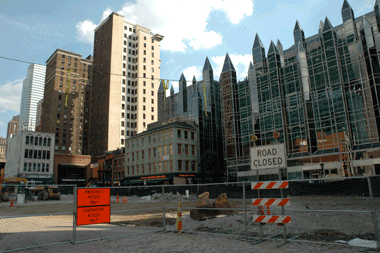
    Photo: White House Photo/Pete Souza

  • High Speed Rail in Springfield: “The Whole City Would Look Like Crap”

    Not every local official is smitten with the romance of high-speed rail. Graphic evidence of this was provided by Springfield, Illinois mayor Tim Davlin, who expressed his concern that the proposed rail overpasses would slice the city in half. Davlin told the State Journal Register that the “Whole city would look like crap.” This is a problem faced not only by historic Springfield, the state’s capital and location of many Abraham Lincoln sites. Citizens and cities on the San Francisco peninsula are concerned that a proposed “Berlin Wall” will divide their communities if construction of an elevated high speed rail wall proceeds through their communities.

  • Losing Touch With the Changing Definition of “Community”

    Mathew Taunton opens his review of “The Future of Community – Reports of a Death Greatly Exaggerated” (Note 1) with the observation that:

    “Community is one of the most powerful words in the language, and perhaps because of this it is frequently misused. A profoundly emotive word, it is also a coercive one, and a key political buzzword in modern times. That community is being eroded in modern Britain is a matter of cross-party consensus, and it is also widely agreed that one of the state’s roles is to devise means of counteracting the decline of communities.”

    It is refreshing to see a writer prepared to use ‘community’ and ‘coercive’ in the same sentence. Taunton reminds us that practically all urban architecture now attempts to force social solidarity into existence, and, by definition, condemns those who do not conform for daring to exercise their choice.

    Unfortunately many of these attempts to coerce community into existence tend to repress or subvert the informal processes through which people interact of their own free will.

    So why do so many influential people in the UK, the United States, and other countries of the New World, hold this ‘consensus’ that communities, like morality, are in decline, requiring government interventions to restore them to good health, within some reborn urban village?

    In the past, communities were primarily place-based, if only because people could not travel very far or communicate over any great distance. But as civilizations have developed, this interaction between transport and communication has reshaped the prevailing structure and meaning of communities, as each reacts with each other. The printing presses of Renaissance Europe enabled the development of scientific and religious communities, as well as a host of “communities of ideas” both conservative and revolutionary.

    Last century the establishment of national broadcast networks and television helped constitute national communities of listeners or viewers, which in turn reinforced the communities of “us” and “them” through the great global conflicts of that century.

    The Internet has now created a whole new class of virtual communities or tribes. Many wage their tribal wars with considerable venom.

    However, these internet tribes, too, simply build on the superior transportation technologies that have enabled us to physically flee to find more friendly groupings of associates, or to avoid the ‘neighbours from hell’. Of course, place remains important to communities based on activity – people continue to visit their golf course, football field, church, beach, or shopping mall. Modern transport has gifted us with ready access to them all.

    Similarly, communications technology plays an important role in communities of shared interests or ideas – the blog site, the book club, talk-back radio, and the specialist channels on cable TV or YouTube.

    However, rigidly place-based communities can also be coercive traps.

    In the late sixties I wrote a paper at U.C Berkeley drawing on surveys that showed that “neighboring” was more intensive in mobile-home parks than in most suburbs or inner city areas, precisely because the residents felt that if they fell out with their neighbors they could always move on. Neighboring is not without risk.

    Similarly, people in camping grounds felt free to share coffee, drinks and dinners around the barbecue, precisely because they know they need not meet again.

    Many retirees have discovered the pleasures of the summer nomadic lifestyle spent driving from location to location in a well-appointed motor-home.

    One retired couple (my American god-parents) were keen “rock-hounds” during the seventies and spent their summers driving their motor-home from one rock-rich territory to another, attending gatherings of rock-hounds along the way. They combined technological mobility, with place-based communities, and communities of common interests within the one retirement experience.

    However, these contemporary communities, no matter how plentiful and rewarding, fail to meet the expectations of urban planners trapped within their general theory of architectural or spatial determinism. They remain convinced that urban form and places determine our behaviour. Yet in reality, our behaviour and preferences actually determine how and where we chose to live, work and play.

    They may also be responding, in their reflexive way, to a genuine loss of sense of political community, a loss that may be more deeply felt that we think.

    For the last forty or fifty years, through most of the New World jurisdictions, ‘reform’ of Local Government has meant ‘amalgamation’ on the presumption that ‘bigger is better’, probably because this coincided with the management theories of the sixties, which presumed conglomerates were the way of the future, and that all corporate mergers would benefit the shareholders and customers alike.

    The track record of such local government ‘reform’ has given scant support to the theory. Forced amalgamations in particular have proved to be disastrous. And many of the voluntary ones – i.e. those driven from the bottom up – have fared little better.

    These reform programs have generally been prepared to dilute or even ignore the traditional emphasis on ‘community of interest’ in favor of ‘economies of scale’ or the benefits of ‘regional integrated planning.’ In the end citizens have generally, and genuinely, lost contact with their Mayors and Councilors. They used to meet the Mayor in the street and have a chat about their concerns. Now they have to phone, leave voice messages and wait for the return call that never comes.

    Political authority, now often housed in some distant place, is more remote than ever. You can’t meet it, let alone beat it.

    Citizens may know their ward councilor but their ward councilors explain they are always outvoted by a majority who has no interest in any ward but their own. This is why large councils are actually less effective at delivering satisfaction than small ones. A small council is likely to be serving a single community of interest. But if one neighborhood wants to build a municipal swimming pool, all those who live more than an hour’s drive away understandably wonder why they should pay for a pool they will never use.

    This bias towards larger and larger local bodies – enhanced by the rapid population growth in many peripheral areas and regional towns – has been given a massive boost in recent times by ‘Smart Growth’ planning theory. This approach necessitates large areas of regional governance so that people cannot escape from the planned densification that most independent areas would likely reject.

    The Metro planners also often seek to extend their boundaries into the rural areas so as to prevent people and businesses locating where they prefer. Instead it is all determined by where the planners say people and business should go – for their own good, of course.

    It may well be that when the central planners try to create “place-based communities” they are responding to a genuine problem, but have chosen the wrong tool-box to fix it. Community can not be imposed from above and large government is clearly the wrong way to nurture it.

    A better approach may be to create a new system of local governance controlled by smaller, truly local councils, based on identifiable communities of interest, which are able to freely associate with other organizations if they believe it will provide services and infrastructure beyond their financial means.

    We should learn to define the services we need, and then match them to the appropriate organization, rather than trying to find the one or two magic sizes that can cope with all our needs.

    We no longer need to accept being re-organized from above; the internet allows even smaller units access to sophisticated information. We have a wonderful opportunity to take control of our destiny through a new world of local government in which the people themselves decide on their common communities of interest and set up novel and innovative joint-management entities where economic efficiency and common sense demand such arrangements.


    Note 1: The Times Literary Supplement, July 31, Mathew Taunton’s review of a collection of essays “The Future of Community – Reports of a Death Greatly Exaggerated”, by Clements, Donald, Earnshaw and Williams, Editors.


    Owen McShane is Director of the Centre for Resource Management Studies, New Zealand.

  • California Golden Dreams

    California may yet be a civilization that is too young to have produced its Thucydides or Edward Gibbon, but if it has, the leading candidate would be Kevin Starr. His eight-part “Dream” series on the evolution of the Golden State stands alone as the basic comprehensive work on California. Nothing else comes remotely close.

    His most recent volume, “Golden Dreams: California in an Age of Abundance, 1950-1963,” covers what might be seen as the state’s true Golden Age. To be sure, there is some intriguing history before—the evolution of Hollywood in the 1920s, the reaction to the Depression and the fevered buildup during the Second World War—but this was California’s great moment, its Periclean peak or Augustan age.

    “It was a time of growth and abundance,” Starr writes in his preface, and provides the numbers to prove it. In 1950, California was home to 10.7 million, making it a large state to be sure, but hardly a dominant one. By the early 1960s, the population passed 16 million, slipping by New York state in population.

    Yet it was not a mere matter of numbers that made California so appealing or important. It was the idea of California as not only a part of America, but also something more. To millions in America and around the world, California grew to mean opportunity, sunshine and innovation.

    The state’s business elite, for example, did not identify with the button-down hierarchy that sat atop teeming New York, and its second-tier competitors like Chicago. The leaders of Los Angeles would never consider it a second city, but simply a different, and generally, better one. There was no need for the excessive Manhattan penis envy that led Chicago to keep trying to build higher buildings than Gotham.

    In a different way, San Francisco’s top executives also did not crave that their city be New York—it was always more beautiful, nuttier, freer and more creative than Gotham. What they shared with their downstate rivals was a sense of superiority over the old part of the country. If anything, they felt a mixture of contempt—particularly the conservatives—and condescension about an older, decaying society that fixated on tradition, order and breeding.

    “California,” Cyril Magnin, scion of one of San Francisco’s great families, told me back in the late 1970s, “has recaptured what America once had—the spirit of pioneering. People in business out here are creative; they’re willing to take risks.”

    Geography also plays a role here. Leaders in California, starting at least by the turn of the last century, looked out across the Pacific and saw themselves as part of an emerging shift from Europe to Asia, a process that continues and will dominate the rest of this century. This connection, suggested Pete Hannaford, a public relations executive and partner of Ronald Reagan’s Svengali, Michael Deaver, took on an almost Spenglerian inevitability. “Out here there’s a sense of being where the action is,” Hannaford believed, “with Japan and the Pacific.”

    Starr captures these attitudes, which already had become deeply entrenched by the late 1950s and early 1960s. There was, as he writes, “a conviction that California was the best place to seek and attain a better American life.” However, it was more than money or power. It was about the quality of life. Success in California was not a matter of living by the rules, sheltered in a dark Manhattan apartment, but about the seduction of the physical world. In California, Starr writes, “Eros vanquished Thanatos.”

    Yet Starr’s book is not merely about the rich, the powerful, and even the culturally influential. He finds his primary muse not in the Bohemian realms of San Francisco or the mansions of Beverly Hills, but in that most democratic of everyman’s places, the San Fernando Valley, the place author Kevin Roderick aptly dubbed “America’s Suburb.”

    To see long excerpts from “Golden Dreams,” click here.

    “The Valley” lies over the Santa Monica Mountains from the Los Angeles Basin. As late as the 1930s, it was largely an arid district of ranches, citrus orchards and chicken farms. The area’s postwar expansion was rapid, even by California standards. Between 1945 and 1950 alone, the Valley’s population more than doubled to nearly 500,000. By 1960, it had doubled again.

    This growth was far more than the mindless bedroom sprawl often depicted by aesthetes and urban intellectuals. People in the Valley did not depend largely on the old part of Los Angeles the way, for example, Long Island lived off Manhattan. Most of the Valley’s growth was homegrown—driven by local industry such as aerospace, entertainment, electronics and until the 1960s automobiles.

    Even today, the Valley has very much its own economy and sense of separation from Los Angeles. However, more important, the Valley was, first, a middle-class phenomenon. A cosmopolitan of the first order, Starr manages to chronicle California’s artistic and literary elites, but does not see in them the essence of the state’s appeal. Instead, he explores the everyday wonders of the Valley’s families, single-family homes and swimming pools—6,000 permitted in one year, between 1959 and 1960!

    As a Valley resident myself, I can still see the basic imprint of that culture, what Starr calls its “way of life.” Compared to the tony Westside and hardscrabble east and southside of Los Angeles, the Valley has remained a relatively safe “child-oriented” society, with a big emphasis on restaurants, malls, ball fields, churches and synagogues.

    The single-family tracts, of course, have changed hands, and the majority of the owners have changed. The primarily WASP and second-generation Eastern European Jews are still there, but they have steadily been augmented, and sometimes outnumbered, by others—Armenians, Orthodox Jews, Israelis, Persians, Thais, Chinese, Mexicans, Salvadorans, African-Americans and at least 10 groups I somehow will neglect and no doubt offend.

    Yet the essential way of life forged in the 1950s and 1960s has remained a constant, and that remains the source of California’s attraction. Of course, it is no longer just a “Valley” phenomenon. As California has grown, there are many such places, outside San Diego, in Orange County, the Inland Empire, outside Sacramento, Fresno and scores of other towns. Almost all have the same imprint—an auto-dominated culture, dispersed workplaces, pools and a culture of aspiration.

    In the ensuing decades, perhaps to be covered in Starr’s next book, this archetype evolved mightily. The San Gabriel Valley, once a plain vanilla suburban appendage, has morphed into the country’s largest Asian suburbia, complete with a shopping center jokingly referred to as “the Great Mall of China.” The often-monotonous housing tracts between San Jose and Palo Alto, on the San Francisco Peninsula, also attracted hundreds of thousands of Asians but also produced something equally astounding—the Silicon Valley, the world’s leading center for technology.

    These suburban developments long ago surpassed in importance the urban roots of California metropolises. A serious corporate center during the time covered by Starr’s volume, San Francisco has devolved in a ultra-politically correct, hip and cool urban Disneyland for Silicon Valley, providing good restaurants and housing for those still too young to crave a house on the Peninsula. The San Gabriel Chinatown long ago replaced the older one in downtown Los Angeles as the center of Asian culture and cuisine.

    These places grew before the current malaise infected the state. As Starr points out, California based its ascendancy on two seemingly contradictory principles: entrepreneurship and activist government. Under Gov. Earl Warren, but also Goodwin Knight and finally Pat Brown, the state made a commitment both to basic infrastructure—energy, water, roads, schools, parks—and expanding its economy.

    By the early 1960s, this system was hitting on all cylinders. New roads, power plants and water systems opened lands for development for farms, subdivisions, factories. Ever expanding and improving schools produced a work force capable of performing higher-end tasks, and capable of earning higher wages. New parks preserved at least some of the landscape, and gave families a place to recreate.

    For Pat Brown, arguably the greatest governor in American history, this was all part of California’s “destiny.” Starr describes Brown’s California as “a modernist commonwealth, a triumph of engineering, a megastate committed to growth as its first premise.” Yet within this great modernist project was also stirring opposition, on both left and right, that would soon place this Golden Age at its end.

    Many of the objections were legitimate. The Sierra Club and its many spinoffs rightfully saw the Brown development machine as threatening California’s landscape, wildlife and, in important ways, the appeal of its way of life. More careful controls on growth clearly were needed. The battle over the nature of those controls continues to this day.

    Some more angry voices, then as now, targeted the very existence of suburbia, the dominant form of the state’s growth, and eventually sought its eradication. This struggle goes on to this day with a religious fervor, led, ironically, by the former and perhaps future governor, Jerry Brown, currently attorney general and leading Torquemada of the greens.

    Minorities also began to stir amid the celebrations of the 1950s and early 1960s. Woefully underrepresented in the halls of power and the corridors of business, Asians and Latinos remained largely passive politically. However, by the early 1960s acceptance of exclusion was giving way to more assertive attitudes. Ultimately the massive immigration that swelled both their numbers in the 1970s and beyond would ensure these groups far more influence both on the politics and in the economy of the state.

    Yet it was the African-American who would really upset the balance of the golden era. Never discriminated against as in the South, black Californians felt the lash of a thousand, often-informal exclusions. As the civil rights movement grew, with it less deferential attitudes, particularly toward the police, a powder keg was building. In 1964, the first year after the era chronicled in “Golden Dreams,” Watts blew up, shattering the comfortable assumptions of a progressive, post-racial state.

    Finally, as Starr reports, there was mounting thunder on the right. The business elite and the middle class were financing the ever-expanding California state. They saw their money go to the poor, to minorities and state employees. Particularly annoying were the university students, many of whom were in open revolt against the state, in the mind of much of the public that had nurtured them.

    By the early 1960s many of these latter Californians also were angry, but their rage would express itself not in riots, but at the ballot box, ushering in the age of Ronald Reagan. The period that follows “Golden Dreams” emerges as one of conflicting visions, between greens, students and minorities, on the one hand, and largely suburban middle-class workers and business owners on the other.

    These two groups would battle over the next generation, with the advantage oscillating over time. Today the heirs of the protesters—greens, minority activists and former ’60s radicals—hold the political advantage, although the state they dominate has fallen on parlous times.

    In retrospect, the golden era before these conflicts does indeed seem like a high point. The question now is whether California, down on its luck, will find a way to rebound, much as imperial Rome did after the demise of the Julian dynasty, or fall, like Athens, into ever more squalid decline. Does the state have a bright “destiny” ahead or only more ruin?

    This, of course, will be the basis for another historical epoch. Let us hope Kevin Starr be around to chronicle it for the rest of us.

    This piece originally appeared at Truthdig.com

    Golden Dreams: California in an Age of Abundance, 1950-1963 at Amazon.com.

    Joel Kotkin is executive editor of NewGeography.com and is a distinguished presidential fellow in urban futures at Chapman University. He is author of The City: A Global History. His next book, The Next Hundred Million: America in 2050, will be published by Penguin Press early next year.