Category: Politics

  • Confronting Street Art

    By Richard Reep

    Street art has been around since ancient times, with the triple theme of craft, sabotage, and branding. Paris’ “Blec le rat” and New York’s Taki 183 were early pioneers in street art. Today, street art has spread into nearly every city with artists, media, and collectors. Skateboards, tattoos, stickers, and spray paint are but a few examples of the craft of the street. The adrenalin rush an artist feels in executing his work is augmented by the urban thrill of working at night, rushing to leave behind a signature before the police come. The chief aim of most street art is branding, as the artist’s main form of expression is to create a recognizable personal logotype.

    On the street, the city’s public space in general has slowly been eviscerated by our culture of consumption, for it provides an antiquated, nearly obsolete physical format for civic discourse. Long ago proclaimed dead by noted architect Daniel Liebeskind, physical public space has precipitously declined in value to most of the citizens of the city. In its place has risen virtual public space – first television, which was a one-way path, and then the internet, which provides a two-way path.

    Yet physical public space continues to serve as medium of the new Street Art form. Stickers, tags, skateboards, and tattoos are all viewed on the street, offering a means to carry this new art form into the next century. The so-called “cutting edge” artists have retreated into their private studios to conceive their next moves in video or computers, but the street artists have taken over the city.

    The elite artists may inhabit the galleries but street artists proclaim their brand of art as supreme. Globalism is achieved by hard work: Artists like Barry McGee or Banksy are no longer confined to one city; Space Invader, having successfully placed his own particular brand across the face of Paris, now has spread to London and New York, making his own global art tour as a form of civic art.

    Viewing a piece of graffiti at once causes a reaction of fear and a perception of danger. Can anyone claim the same immediate, visceral reaction to anything seen in a gallery or museum? This art form reaches people at such a gut level that it trumps most of the work of other artists being exhibited and discussed in the art world. Street artists use this to their own advantage, and their craft reinforces what McLuhan described so well in his epigram “the medium is the message.” The content of the piece is almost irrelevant; the viewer’s reaction is the same regardless of the tag’s content or author.

    Street art is tied into a larger urban culture, and expresses the visual aspect of this larger milieu. As Western mainstream culture retreats from the street into the air-conditioned, connected bubbles of the suburbs, street art and its culture expands to fill the empty space. The zone emptied by the suburbanites does indeed reek of death, more so today, as public investment in the city dwindles or becomes remarkably predictable or prosaic. Budget cuts in schools, government facilities, and even basic street maintenance presage an ever higher level of decay and disrepair, of neglect and abandonment of our shared space, and those who inhabit this space are simply documenting what they see and returning it back to us. We cannot escape the messages of street art, for they are everywhere, embedded into the context. Some are more overt, and some are covert – only noticed, for example, when waiting for a red light – but they are there, reminding us that there is life amidst the emptiness.

    Graffiti’s barrage of skulls, vacant-eyed cartoon children, and other signs of death and destruction are easy to ignore, but they are telling us something important about the urban environment. The sooner we stop and examine this evidence, the sooner we can begin a process to find common ground, and to seek out a shared vision that does not divide the urban world into an us-and-them mentality. Street art simply puts visual form to the voices we have so long shut out of the urban conversation.

    In Orlando, the trend of giving street artists “permission walls,” or walls where they have permission to paint their work, has tamed and channeled some of the sabotage. By allowing graffiti artists to work with permission, they are free to develop their craft without fear of getting caught before completion, and the artwork becomes a colorful, mural-sized effort to which the artists can point with pride. These permission walls encourage friendly competition between teams, or crews, and there is a sense of pride among them for having created something with great exposure.

    Two permission walls exist to the east of downtown Orlando, but it is the cluster of warehouses at 630 E. Central that showcase graffiti artwork at its best. Artist Robin Van Arsdol owns part of this cluster and has been sponsoring an international graffiti conference for several years, bringing in artists from Europe, the Caribbean, and North America for a weekend of painting at his studios. Driving by his property offers a study in converting urban form into art, and perhaps suggests the visual future of more than one city.

    The graffiti artists have offered a philosophical change-up that should not be overlooked. The conversation about postmodern art seemed to have reached a dead end some time ago; artists
    first threw out figure, then form, then color, then the frame, and then wandered into their process itself as an art form. Graffiti artists begin with the end: their signature, or tag, becomes the art,
    and by using this as the starting point, and the city as their canvas, they unconsciously offer a new beginning to think about the relationship between art and the city.

    We must accept the challenge that graffiti artists offer us. We need to confront this takeover of the physical urban form and push back. Street art constitutes a fresh, interesting language. It is the language of a city that is weak and divided. We must hear what graffiti says to us as a society, and retake our physical urban character as a common, broad place that offers secure, sacred, and special places for all citizens. By ignoring graffiti art, we postpone our treatment of the urban malaise. By confronting it and bringing it into the mainstream, we can better treat our urban condition and improve the city as a dwelling place for the benefit of all.

    Richard Reep is an Architect and artist living in Winter Park, Florida. His practice has centered around hospitality-driven mixed use, and has contributed in various capacities to urban mixed-use projects, both nationally and internationally, for the last 25 years.
  • Reducing Vehicle Miles Traveled Produces Meager Greenhouse Gas Emission Reduction Returns

    Senators Jay Rockefeller (D-West Virginia) and Frank Lautenberg (D-New Jersey) have introduced legislation that would require annual per capita reductions in driving each year. Another bill, the National Transportation Objectives Act, introduced by Representative Rush Holt (D-Indiana), Representative Russ Carnahan (D-Missouri) and Representative Jay Inslee (D-Washington.) would require a 16 percent reduction in driving in 20 years.

    Last week, a highly publicized report by the Urban Land Institute (Moving Cooler) also called for policies that would reduce the vehicle miles traveled (VMT) by people in their cars. This report was analyzed here by Alan Pisarski). The reductions in driving would be achieved by highly intrusive land use policies that would make it impossible for most Americans to live where they want, allow for only minor expansion of roadway capacity and force almost all new development to be within existing urban footprints. It would employ such radical strategies as forcing people to pay $400 per year to park their cars in front of their own homes.

    The assumption behind these initiatives is that reducing driving will produce substantial reductions in greenhouse gas emissions. It sounds like a simple enough proposition, since cars emit greenhouse gases in direct proportion to the gasoline they consume. It would seem logical that reducing their use would lower their emissions by a similar percentage. Moving Cooler assumes that for every 10 percent reduction in driving miles, there will be a 9 percent reduction in greenhouse gas emissions.

    Meager GHG Emission Reductions from Reducing Driving: But things are not nearly so simple. It appears that reducing vehicle miles would not produce a similar reduction in greenhouse gases from cars.

    It is well known that at the slower speeds of vehicle operation in cities, fuel economy tends to decline with speed. Further, as congestion increases, so does fuel consumption, due to longer idling periods (such as at signals or in stopped traffic), more acceleration and more deceleration. Thus, not only does fuel economy drop when average speeds drop, but it drops even further when traffic congestion intensifies. The extent to which any reduction in urban driving would reduce greenhouse gas emissions is not at all well known, simply because there has been insufficient research on the subject.

    Perhaps the best indication is a comparison of Environmental Protection Agency (EPA) “driving cycles,” which are tests used to estimate some emissions (although not greenhouse gases) and fuel economy. There is considerable data for the normal urban cycle, which replicates driving conditions in most of the nation’s urban areas. There is much less information available for the “New York City Cycle,” which replicates the congested traffic conditions in New York City, which is far more congested than any of the nation’s urban areas (Note).

    Under the New York City Cycle average speeds are two-thirds less than under the average urban cycle. This reduction in speed and increase in congestion results in a 50 percent loss in fuel economy, according to an Argonne National Laboratory Study. Thus, between New York City and the average urban area, fuel efficiency drops at a rate 80 percent of the lower driving rate in New York City.

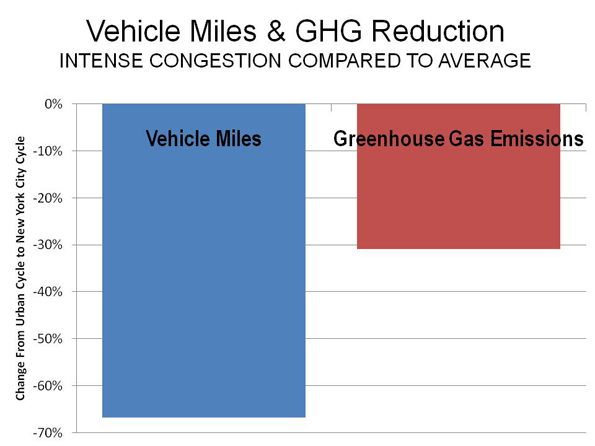
    On average, vehicle travel in New York City is approximately 8 miles per capita daily. In the average large urban area outside New York City (such as the Phoenix urban area, or for that matter the suburbs of New York City), vehicle travel is approximately 24 miles per day per capita. Thus, per capita driving in New York City is 67 percent less than in Phoenix. However, because of the loss in fuel consumption, the greenhouse gas emissions from cars per capita is only 31 percent less (Figure 1). Thus, the limited data indicates that nearly one-half of the greenhouse gas emissions difference between New York City driving rates and Phoenix driving rates are cancelled out by the impacts of slower speeds and increased congestion.

    Shortcomings of Policies to Reduce Driving: UCLA’s Lewis Center for Regional Policy Studies Program on Local Government Climate Action Policies raised concerns about relying on VMT reduction policies in a submittal to the California Air Resources Board:

    Especially in congested areas of California, VMT is an inadequate proxy for vehicle greenhouse gas emissions.

    Yet it is precisely more intense traffic congestion that we can expect if federal laws and policies should force most development into present urban footprints. Between 2010 and 2030, nearly 70,000,000 residents will be added to US urban areas, an increase of more than 25 percent. This increase would mean that the legislation introduced by Congressmen Hold, Carnahan and Inslee would require a one-third reduction in per capita driving to achieve its overall 16 percent reduction. Per capita driving declines such as those envisioned by the Congressmen or Moving Cooler have never occurred before in any American (or international) urban area. By comparison, charging people $400 to park their cars in front of their houses seems utterly reasonable.

    Further, higher population densities are associated with more intense traffic, both at the national and international level. Policies such as recommended by Moving Cooler would produce little additional highway capacity to handle the far higher levels of driving produced by a larger population. We could expect traffic congestion to increase markedly. It would take longer to get to work and local air pollution would be more intense (a health impact largely ignored by proponents of higher densities).

    The Economic Cost: A serious economic toll would be produced by more grid-locked urban areas, because of the positive relationship between personal mobility and economic performance. Remy Prud’homme and Chang-Woon Lee of the University of Paris have shown that greater economic mobility is associated with greater economic growth. Greater personal mobility also alleviates poverty, according to a Progressive Policy Institute study):

    In most cases, the shortest distance between a poor person and a job is along a line driven in a car. Prosperity in America has always been strongly related to mobility and poor people work hard for access to opportunities. For both the rural and inner-city poor, access means being able to reach the prosperous suburbs of our booming metropolitan economies, and mobility means having the private automobile necessary for the trip. The most important response to the policy challenge of job access for those leaving welfare is the continued and expanded use of cars by low-income workers.

    The UCLA submission further notes that policies aimed at reducing driving could damage the economy:

    … policies which seek to reduce VMT may hinder economic growth without reducing emissions.

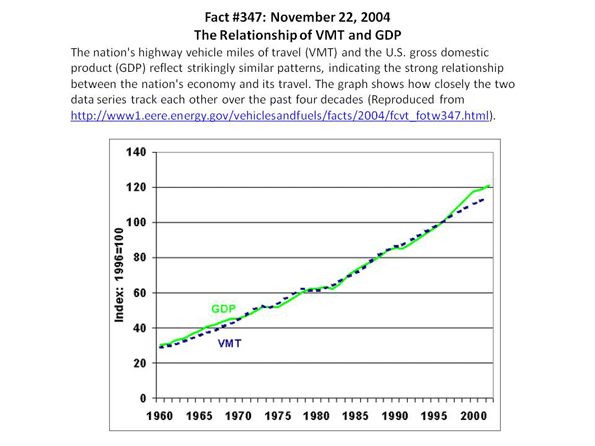
    The relationship between greater mobility and economic prosperity is also demonstrated at the national level. This is vividly illustrated in the chart from the United States Department of Energy (Figure 2).

    The significant improvements in fuel economy from higher mileage cars and less carbon intensive fuels will do far more to reduce greenhouse gas emissions from cars than the meager results that can be achieved by heavy handed policies to “coerce” people out of their cars (as Secretary of Transportation Ray LaHood put it). And, critically, it would do so with far less impact on both economic and physical mobility.

    Both the Economy and Greenhouse Gas Emissions at Stake: With the economic challenges facing the nation, policy makers need to steer clear of strategies that hobble the economy, like forcing people to drive less (or pay $400 to park in front of their houses) and make only minor improvements in reducing emissions. Indeed, a society with less money will have less to spend on reducing emissions through the adoption of new technologies that offer greater hope for creating a more prosperous as well as more environmentally sustainable society.


    Note: The New York City refers to the City of New York, not the metropolitan area or the urban area.


    Wendell Cox is a Visiting Professor, Conservatoire National des Arts et Metiers, Paris. He was born in Los Angeles and was appointed to three terms on the Los Angeles County Transportation Commission by Mayor Tom Bradley. He is the author of “War on the Dream: How Anti-Sprawl Policy Threatens the Quality of Life.

  • Green Jobs Can’t Save The Economy

    Nothing is perhaps more pathetic than the exertions of economic developers and politicians grasping at straws, particularly during hard times. Over the past decade, we have turned from one panacea to another, from the onset of the information age to the creative class to the boom in biotech, nanotech and now the “green economy.”

    This latest economic fad is supported by an enormous industry comprising nonprofits, investment banks, venture capitalists and their cheerleaders in the media. Their song: that “green” jobs will rescue our still weak economy while saving the planet. Ironically, what they all fail to recognize is that the thing that would spur green jobs most is economic growth.

    All told, green jobs constitute barely 700,000 positions across the country – less than 0.5% of total employment. That’s about how many jobs the economy lost in January this year. Indeed a recent study by Sam Sherraden at the center-left New America Foundation finds that, for the most part, green jobs constitute a negligible factor in employment – and will continue to do so for the foreseeable future. Policymakers, he warns, should avoid “overpromising about the jobs and investment we can expect from government spending to support the green economy.”

    This is true even in California, where green-job hype has become something of a fetish among self-styled “progressives.” One recent study found that the state was creating some 10,000 green jobs annually before recession. To put this into context, the total state economy has lost over 700,000 jobs over the past year (more than 200,000 in Los Angeles County alone). Any net growth in green jobs has barely made a dent in any economic category; only education and health services have shown job gains over this period.

    More worrisome, in terms of national competitiveness, the green sector seems to be going in the wrong direction. The U.S.’s overall “green” trade balance has moved from a $14.4 billion surplus in 1997 to a nearly $9 billion deficit last year. As the country has pushed green energy, ostensibly to free itself from foreign energy, it has become ever more dependent on countries such as China, Japan and Germany for critical technology. Some of this is directly attributable to the often massive subsidies these countries offer to green-tech companies. But as New America’s Sherraden puts it, this “does not augur well for the future of the green trade balance.”

    Nor are we making it any easier for American workers to gain from green-related manufacturing. Some of America’s “greenest” regions are inhospitable for placing environmentally oriented manufacturing facilities. For example, high taxes and regulatory climate have succeeded in intimidating solar cell makers from coming to green-friendly California; a manufacturer from China told the Milken Institute’s Ross DeVol that the state’s “green” laws precluded making green products there.

    Attempts to put windmills in Nantucket, Mass., the Catskills and Jones Beach in New York and other scenic areas have also been blocked by environmentalist groups. Transmission lines, necessary to take “renewable” energy from distant locales to energy-hungry cities, often face similar hurdles. Solar farms in the Mojave desert might help meet renewable energy quotas but, as wildlife groups have noted, may not be so good for local fauna.

    And then there is the impact of green policies on the overall economy. Green power is expensive and depends on massive subsidization, with government support levels at roughly 20 times or more per megawatt hour than relatively clean and abundant natural gas. Lavishing breaks for Wall Street investors and favored green companies also may be harmful to the rest of the economy. A recent study on renewable energy subsidies on the Spanish economy found that for every “green” job created more than two were lost in the non-subsidized economy.

    So how do we build a green economy that is sustainable without massive subsidies? First, governments need to learn how to say no to some environmentalists. Green jobs and renewable energy can not be fully developed without affecting somebody’s backyard. Windmills will have to be built in some scenic places; transmission lines may mar somebody’s “view-shed.”

    Arguably, the thing that would spur green jobs and domestic industries most would be economic growth. Environmentalists long have been cool to growth, since they link it to carbon production and other noxious human infestations. As an official at the Natural Resources Defense Council put it, the recession has “a moment of breathing room.” Disaster may be still looming, but bad times add a few more moments to our carbon clock.

    Long term, though, I would argue hard times may prove harmful for the environmental cause. Even with subsidies, many renewable energy projects are now on hold or being canceled across the country. Slackening energy demand, brought on by a weak economy, has undermined the case for new sources of energy generation; what looked attractive with oil prices at $140 a barrel and headed higher looks at $70 less so.

    Similarly, hard-pressed homeowners and businesses don’t constitute the best market for new, often expensive “green” products. A growing economy, which would drive up energy prices, could spur a more sustainable interest in alternative energy from firms that now only do so for public relations concerns. At the same time, cash-rich consumers could more afford to install energy-saving home insulation or rooftop solar panels. A strong economy would also spur sales of new energy-efficient appliances and cars.

    This process would go more quickly if government relied less on mandates, which tend to scare serious investors, and turned toward incentives. With the right tax advantages, energy efficiency could become a positive imperative for companies.

    There’s also an unappreciated political calculus at work. A persistently weak economy undermines support for the green agenda. For the first time in 25 years, according to a Gallup poll, more people place higher priority on economic growth than on the environment.

    Furthermore, more people now feel claims about global warming are “exaggerated.” Early this year, Pew reported that global warming ranked last among the top 20 priorities of Americans.

    Ultimately, environmentalists need to realize that the road to a green economy does not lie in promoting hysteria, guilt and self-abnegation while ignoring prohibitive costs and grim economic realities. Green enthusiasts should focus on promoting a growing economy capable of generating both the demand and the ability to pay for more planet-friendly products. After all, the economy needs green jobs less than green jobs need a thriving economy.

    This article originally appeared at Forbes.

    Joel Kotkin is executive editor of NewGeography.com and is a presidential fellow in urban futures at Chapman University. He is author of The City: A Global History. His next book, The Next Hundred Million: America in 2050, will be published by Penguin early next year.

  • “Cash For Clunkers” Doesn’t Utilize Junkyard Efficiency

    My father owned and operated a junkyard in Tucson for a number of years, and I learned a lot about the auto recycling industry helping around the office and as a delivery driver. So as a junkyard enthusiast, the “Cash For Clunkers” program naturally caught my interest lately. Though it looks to be the product of good intentions, I don’t think the legislation understands that junkyards already comprise an efficient, well developed recycling system for salvaging vehicles, with a beneficial result for the environment overall. I’m skeptical that quickly scrapping so many government-defined “clunkers” and replacing them with new, fuel-efficient models will have a substantial environmental benefit, because the plan has the potential to waste many useful materials in these cars.

    A junkyard may appear to be little more than a landfill for old cars if you’re just driving by, but in fact, to succeed, it must function as a highly efficient recycling operation. Junkyards sell parts to other junkyards, mechanics, and directly to consumers, and attempt to make as much of a profit as possible from each part on every car in their inventories.

    There is also a network of scavengers who travel around to junkyards gathering large core items, like alternators and starters, and a number of precious metals in small amounts that most don’t even recognize as in our cars. (Catalytic converters, for example, contain platinum and palladium, which are quite valuable when salvaged.) But a car needs to sit on the lot for a considerable period of time for this recycling process to work itself through. Parts from a car are usually sold one at a time over a period of months or even years; scavengers work on their own schedules. A scavenger may only come by a junkyard a few times a year to core out a particular metal or gather the useful components. Meanwhile, the junkyard needs to be selling parts off the car for it to be financially worth keeping in the inventory. A car is only sent off to be crushed for scrap metal when it no longer retains enough value to justify filling the space on the lot.

    If the Cash For Clunkers program is successful, it has the potential to throw a wrench into the system. The program’s rules require that the engine of a trade-in car be destroyed with an injection of sodium silicate so that the car won’t be resold and put back on the road. The rules seem to encourage the immediate crushing and shredding of the trade-in cars, but should they remain on junkyard lots, their inventory value would take an immediate hit with a non-functioning engine (the most valuable part of the car). To what degree the value decreases depends on the extent of the engine damage, the demand for the particular engine, and the age of the engine.

    A genuine old clunker would be likely to have a well used, and therefore less valuable engine, but then, the “clunker” program nickname (its official title is the “Car Allowance Rebate System”) is something of a misnomer. To be eligible for the program, cars must fall into certain categories of fuel inefficiency, be less than 25 years old, and worth less than $4500. This includes a number of models from the nineties. A working engine in many of the models targeted for the program is likely to have fewer miles on it, and therefore a higher inventory value, than a more traditionally defined clunker.

    But engine issues aside, if the program succeeds in taking a large number of particular models off the road, it could have an even more drastic effect on the junkyard value of those models, simply by lowering the demand for their parts. If there are only a few of a given model on the road, few consumers will buy parts for them from junkyards. Many junkyards are picky about which models they purchase for inventory, and won’t even bother with a model if there is little or no demand for its parts. So if Cash For Clunkers leaves some car models without junkyard value, those models would start going directly to the crusher, taking many of their valuable components with them. The scrap metal from crushed cars is used to make things like rebar and fence posts, so it isn’t as though the scrap winds up in the landfill. But it’s still a waste for precious metals and other valuable components to be crushed down with the low-end materials for low-end product.

    And even beyond the metals, something mundane like a plastic glove box has its own environmental impact. The overall junkyard process, where cars without “street” value become parts donors for cars still in use, prevents a great deal of after-market manufacturing of glove boxes and all the other parts that wear out or get damaged in cars on the road. If entire models are abruptly taken off the road, devalued at the junkyard, and crushed, it means that many new glove boxes must be manufactured – both for the new cars replacing the model, and for any other models and even makes still on the road for which that model of glove box, or stereo, or steering column fits (and many parts are surprisingly versatile this way). That could mean a boost in manufacturing, sure – but it also means an environmental impact that offsets some of the gains from the new fuel-efficient car that replaces the clunker.

    Cash For Clunkers is scheduled to end November 1, so it’s unlikely to have a long-term effect on the auto recycling industry beyond burdening it with a glut of devalued inventory. But so far the program is popular, and may be expanded or set a precedent for future programs. If this happens it could take a toll on the junkyards and their ability to recycle effectively. If there are suddenly millions of brand new car models on the road, there would be a period of hardship for the auto recycling industry, as the new cars would be running well, with any repairs done mostly under warranty at the dealerships with new parts. This whole scenario could also, by extension, tax the junkyard consumer base of low income, self-sufficient individuals whose cars are older, skillfully maintained, and perhaps most importantly, paid off.

    It’s beyond my pay rate to comprehensively evaluate the net difference in environmental impact between manufacturing and selling new, fuel-efficient cars for these quick “clunker” trade-ins and letting the older models stay on the road. But a legitimate evaluation would clearly involve more complex factors than a simple comparison of fuel efficiencies. Yet it’s clear that the program doesn’t appear to insert any innovative solutions into an already dynamic and effective recycling system. Even if it has some positive outcomes, it doesn’t look like Cash For Clunkers will utilize the industry’s full potential for environmental benefit.

    Perhaps its primary motive lies elsewhere, in its attempt to jump-start the auto industry with a “green” marketing gimmick. But in the process we may have reaped some unintended damage on a sometimes unsightly but remarkably environmentally resourceful industry.

    Andrea Gregovich lives in Anchorage, Alaska. She has written a novel about a junkyard called Martyred Cars and is looking for a publisher.

  • Koyaanisqatsi Redux

    I went to Hollywood one night last week to watch my favorite film of all time, Koyaanisqatsi (released in 1983). It was being shown on a big screen at the Hollywood Bowl, accompanied by orchestra playing the original score, conducted by its composer, Philip Glass. Oh, I didn’t go to the Bowl; I watched it at my daughter’s apartment about half a mile away (hi def DVD and digital sound system turned way up, thank you). It was much more enjoyable than going to the Bowl; after all, I didn’t want to share the experience with an audience that undoubtedly would have, shall we say, a different appreciation of the art.

    You see, the message and meaning most of the Hollywood crowd take from Koyannisqatsi (Hopi Indian for “life out of balance” or “crazy life”) is that man has despoiled and separated himself from his natural environment. Frankly, it has always had the exact opposite effect on me. Even after what must be 100 viewings, I am continually overwhelmed, impressed and delighted by the images of what man has been able to create, invent and build to control his environment, increase his wealth, provide him his food and energy, raise his standard of living, and transport him around the planet (or across the city).

    I am sure most of the Hollywood Bowl crowd has a different response, and finds the images disturbing and disgusting. This is the reactionary impulse, born of an anti-industrial, anti-development mindset. I would wager the majority of that audience has bought completely into the scaremongering of catastrophic man-made global warming, which to the properly skeptical and scientifically literate remains unproven (oh hell, it’s ludicrous on its face). This is deliciously ironic, as many sequences in Koyaanisqatsi were filmed in the 1970s, when most of the same crowd were hectoring us about global cooling (doubly ironic, as a cooling may now actually be upon us).

    My first review of the film, published some 25 years ago, needs only minor updating.

    This truly remarkable film by Godrey Reggio has no plot, no characters, no dialogue. The images of the film are awe-inspiring: first, huge expanses of pristine nature: deserts, rivers, mountains, mesas, lakes, waterfalls, clouds. Then grand-scale technology: huge earth-moving machines, power plants (nuclear and otherwise), oil refineries, food-processing plants, space shuttles, rockets, jets, freeways, subways, skyscrapers, shopping malls, train stations (and of course the obligatory atomic bomb explosions and mushroom clouds) – all shot in fascinating slow-motion and/or time-lapse format by cinematographer Ron Fricke. The accompanying music by Philip Glass is eerie, haunting and perfect.

    The film is a visual, aural and emotional feast. If it bores you, you don’t understand you are looking at, in juxtaposition, the majestic indifference of nature; the supreme accomplishments of physical engineering; and some of the most awful consequences of attempts at social engineering. Some of the images that make indelible impressions, all set to a majestic, driving score:

    • desert rock formations unchanged through thousands, if not millions of years
    • huge power transmission lines stretching forever across barren desolation
    • the implausible flying behemoth that is a 747
    • the flow of vehicles on a freeway, at night, from 50 stories up, that in time-lapse photography really does look just like the flow of blood through vessels, arteries and capillaries as seen through a microscope
    • row upon row of huge, empty, abandoned south Bronx tenements
    • the razing of the Pruitt-Igoe housing project in St. Louis (the most graphic depiction of public policy failure ever committed to film, I should think)
    • the rush of commuters who in time-lapse photography look like ants swarming an anthill
    • various mass production activities: mail-sorting machines, industrial assembly lines, escalators, elevators, revolving doors, conveyor belts, money counting machines, huge bowling alleys, movie theaters
    • finally, the high resolution satellite photograph of a massive city grid (Los Angeles, of course) overlaid, first, on a printed circuit microchip board, and secondly, on an intricate Hopi Indian woven blanket. The matches are nearly perfect.

    A very noticeable detail of the ’70s-era footage from Los Angeles is the blanket of smog that covers the city; I can tell you, having lived here all of these years, that the situation is dramatically improved. (I now see far-off mountain ranges daily; in the ’70s that was rare.) Environmental quality has been improving over the decades (read The Skeptical Environmentalist by Bjorn Lomborg for the statistical evidence). The solutions to the problems that technology causes often end up being more technology, sensibly and carefully applied.

    The single greatest contributor to the amelioration of LA smog, for example, is the catalytic converter. Instigated and required by government, you say? Developed and produced by industry in response to marketplace demand, says I.

    I find the movie very relevant today. It seems some of our new political overlords seem to think they can have a productive economy without production, without what the film depicts: heavy industry; mass processing of food, clothes, consumer and industrial goods; massive residential and commercial development; huge efforts devoted to energy extraction, production and transmission; untrammeled mobility for goods, people and vehicles. Now I’m a “new economy” guy myself, but I realize that our wealth, standard of living and quality of life – the current and future prospects for hundreds of millions of us – are dependent upon these activities, and that the health of the industries that make them possible are far more important than any particular small sub-species of bird, fish, ant or rat (the threats to which are always exaggerated anyway).

    We are really talking about the role of government here, not only in protecting nature. What the film shows me is that it is in fact government’s job to protect the “other” environment: the environment that encourages, promotes and allows incentives for production. Part of this environment is the need for massive infrastructure: energy systems, water systems, waste systems, transport systems, roads, dams, etc., etc., in adequate capacity and in good repair. Mass production and economies of scale bring good quality cheap to millions, and provide opportunities to generate incomes, grow wealth and lead productive, modern lives. More efficiency can also create more nature; for example, the millions of acres of non-redundant farmland turned into forest or open space.

    We used to know and understand this as a society. Our political elites were devoted to it. Now, not so much. We need to relearn the basic lessons and regain that consensus again.

    Dr. Roger Selbert is a trend analyst, researcher, writer and speaker. Growth Strategies is his newsletter on economic, social and demographic trends; IntegratedRetailing.com is his web site on retail trends. Roger is US economic analyst for the Institute for Business Cycle Analysis and its US Consumer Demand Index, a monthly survey of American households’ buying intentions.

  • Forget Second Stimulus; We Need Economic Vision

    As the American economy slowly heals, the Obama administration will no doubt claim some credit for its $787 billion stimulus — and perhaps even suggest doubling down for a second stage. Republicans, for their part, will place their emphasis on the “slow” part of the equation and persistent high unemployment, blaming the very same stimulus program.

    Whatever the politics, no new stimulus should be considered unless it deals with the fundamental illness undermining the country’s long-term economic prospects. Such a stimulus would address the country’s essential problem: persistent overconsumption amid underproduction.

    Neither party wants to address this issue because neither chooses to understand it. From the very beginning, the Obama administration has viewed the stimulus as a political issue, not an economic one. This became clear to me even before the election when I asked Obama’s campaign economic adviser, Austan Goolsbee, about “the goal” of the president-to-be’s program.

    All I got for my trouble was vague political rhetoric about improving the economy. Though some parts of the stimulus, such as extending health and unemployment benefits, were clearly justified, the whole program never sought to address the roughly $800 billion annual imbalance between American consumption and production.

    Instead, we have witnessed a grab bag of political handouts — Chicago machine politics on a grand scale — designed to placate key Democratic constituencies. Most have gone to what my old teacher Michael Harrington described as “the social-industrial complex” consisting of the education industry, social service providers and the various government bureaucracies.

    As a recent New America Foundation report makes clear, precious little has gone to the productive side of the economy that determines the country’s competitiveness and creates many high-paying blue-collar jobs. Infrastructure, a critical component of any productivity-enhancing strategy, has accounted for barely 10 percent of the package.

    The results have not been pretty for the productive sectors of the economy. Construction workers now have higher than 19 percent unemployment; jobs in this sector have fallen during the past year in 333 out of 352 metropolitan areas, with more than 200 plunging by double digits. Meanwhile, the hard-pressed manufacturing sector suffers more than 12 percent unemployment.

    Why this disinclination to fund the tangible parts of the economy? One reason may be that those working in construction and manufacturing — both blue-collar workers and white-collar professionals — do not wield the same influence in this law review administration as college professors, Service Employees International Union-organized workers or unionized teachers.

    One also senses that some militant environmentalists in the administration may be less than enthusiastic about anything associated with the entire carbon-creating part of the economy. Certainly, new factories, natural gas facilities, roads, ports and waterways don’t fit the professed passion of the president’s own science adviser, John Holdren, for the gradual “de-development” of the U.S. and other advanced economies.

    Even prospects for the auto industry — the one manufacturing sector that the administration has effectively annexed — are threatened by plans to enact policies that will “coerce” Americans out of their cars. This amounts to trying to “save” an industry by destroying it.

    For sectors not under government control — warehousing, fossil fuel energy, home construction and agriculture — the administration’s “green” regulatory regime could boost costs at the worst possible time. As a result, the coming recovery once again may be consumption-led and fail to improve our overall competitiveness. The biggest beneficiaries will most likely be Chinese manufacturers, German and Japanese automakers and, because of a lack of sufficient domestic alternatives, energy producers from Venezuela and the Middle East to Russia.

    If they had a collective IQ over 50, the still largely discredited Republicans could run strongly against this economic scenario. Yet, for the most part, they seem incapable of putting the national interest ahead of Wall Street’s profits and corporate excess.

    So no matter how much the conservatives complain, Obamanomics most likely will end up with results remarkably like those of Bushonomics: more consumption, less production, expanding public debt, asset inflation on Wall Street and a slowly declining middle-class standard of living. The only real difference will lie in who gets to rob the public — instead of pharmaceutical and oil companies, we get Gorite “renewable” energy traders and well-connected “green” venture capitalists.

    Americans need to place a pox on both these flawed models. We need a totally new approach that focuses on key productivity-enhancing investments such as improved transportation infrastructure — new roads, bridges, ports and waterways to meet the demands of an expanded economy for a growing population. We should be looking at modern equivalents of the New Deal electrification program, the GI Bill, the Eisenhower highway and the space program.

    Clearly, an infrastructure that is inadequate today will be utterly useless in 2050, when there are projected to be at least 100 million more Americans. Already, our energy-generating capacity in some parts sputters like that of a Third World country. Commodity exports, such as grains, unable to reach foreign markets because of a lack of rail cars and adequate waterways, are left to rot and feed rats.

    This is not the way to prepare ourselves for ever greater competition from countries such as China, India and Brazil. Americans must demand a program that, while perhaps financially painful now, will make it possible for our progeny to enjoy a prosperous future rather than a declining one.

    This article first appeared at Politico.

    Joel Kotkin is executive editor of NewGeography.com and is a presidential fellow in urban futures at Chapman University. He is author of The City: A Global History. His next book, The Next Hundred Million: America in 2050, will be published by Penguin early next year.

  • Millennials Think Globally, Act Locally

    The phrase, “Think Globally, Act Locally” has often been used by environmentalists to sum up a strategy devoted to conserving the earth’s scarce natural resources at the local level. More recently, business executives borrowed the idea to emphasize the need for building capabilities at the country or regional level even as they pursue global growth. But now the Millennial Generation, Americans born between 1982 and 2003, are giving the phrase an entirely new meaning as they pursue their efforts to change the world – one local community at a time.

    In contrast to the generational stereotypes many people hold of them, Millennials are very much concerned about and connected to the world around them – more so, in fact, than many older Americans. Responding to questions on foreign policy in a recent Pew Research Center survey, only 9% of Millennials were unable to express an opinion on how President Obama is doing in working with our allies, while almost a quarter of senior citizens had no opinion on the same subject. On the knotty question of Israeli/Palestinian relations, all but 7% of Millennials could tell survey researchers what they thought of American foreign policy in this area. On the other hand, 26% of senior citizens could not (see table below).

    In addition to its high level of concern with international matters, the Millennial Generation’s ability to make virtual friends instantaneously on Facebook or Twitter with Iranian protesters provides a unique perspective on how to deal with America’s foreign policy challenges.

    Perhaps most notable is how the Millennial Generation deals with the concept of “threats”. A majority of Millennials do see Al Qaeda, and the nuclear programs of North Korea and Iran as “major threats” to the United States, but by rates 15 to 20 points less than other generations. Other more intractable but less direct security concerns, such as the drug trade in Mexico, China’s emergence as a world power, or conflicts in the Mideast ranging from Pakistan to Palestine, are not considered a major threat among a majority of Millennials. To be sure, some of these attitudes may reflect the inevitable naiveté of young people, but we believe the underlying beliefs of Millennials suggest an alternative explanation.

    Millennials have been taught since at least high school that the best way to solve a societal problem is act upon it locally and directly. Tired of exalted rhetoric from Boomer leaders that rarely produced results and frustrated by their older Gen-X siblings lack of interest in pursuing any collective action to address broad social problems, Millennials have embraced individual initiative linked to community action. Eighty-five percent of college age Millennials consider voluntary community service an effective way to solve the nation’s problems. Virtually everyone in the generation (94%) believes it’s an effective way to deal with challenges in their local community. No wonder one of Barack Obama’s first legislative initiatives, the Kennedy National Service Act, was in response to the desire to serve of his most loyal constituency, the Millennial Generation.

    And when it comes to public service, Millennials are putting their money where their mouth is, although lack of opportunity in the private sector also could be accelerating this public service trend. Teach for America, which places new graduates in low-income schools, saw a 42% increase in applications over 2008. Around 35,000 students are now competing for about 4,000 slots. U.S. undergraduates ranked Teach for America and the Peace Corps among their top 10 “ideal employers,” ahead of the likes of Nike or General Electric.

    Scotty Fay, a recent University of Massachusetts graduate, typifies the continuing belief of her generation in the importance of collective action to cope with a challenging world. “If we excel and we’re able to keep ourselves working, we’ll be OK, we hope, because we haven’t experienced anything different than that,” says Fay, who worked two jobs on top of her full-time course load, and is now getting ready for her Peace Corps assignment in Guinea.

    First Lady Michelle Obama, in kicking off the administration’s “summer of service” initiative, made it clear that the administration sees this belief as key to America’s future. “This new Administration doesn’t view service as separate from our national priorities, or in addition to our national priorities – we see it as the key to achieving our national priorities.” Given the likelihood of continuing employment challenges for America’s newest workers, more and more Millennials are likely to gain their first work experiences performing some type of voluntary service.

    This penchant for public service shapes the beliefs of Millennials on how the United States should deal with the problems it faces around the world. In last year’s contest for the Democratic presidential nomination, Millennials believed Barack Obama was right and Hillary Clinton was wrong over whether to conduct direct talks with our enemies. And they thought Sarah Palin was completely off base when she declared in her acceptance speech at the convention that “the world is not a community and it doesn’t need an organizer.” In fact, Millennials believe that what the world needs most is thousands of community organizers, working on the ground to solve their own country’s problems, linked electronically, of course, to friends around the world.

    This is a trend that, appropriately, resonates outside our borders as well. Grassroots activism, led largely by young Iranians, produced protests that may yet topple one of the most autocratic regimes in the world. Activism of this type across the Mideast could result in regime changes of far greater consequence than the military conquest strategy the United States employed in Iraq. Given the distinctions Millennials make between the seriousness of direct military threats, such as terrorism and nuclear proliferation, as opposed to squabbles over power or territory, America’s foreign policy is likely to shift towards a more multi-lateral, institution-building focus as this generation assumes our country’s leadership. This will occur even as Millennials continue to express support for our military by word and deed – when that becomes the only available option.

    It may take a decade or two before we know how the Millennial Generation’s belief in the need to “think globally, act locally” will impact our overall foreign policy. But in the interim, the United States will surely benefit from the generation’s focus on rebuilding our country, as well as the world, one community at a time.

    Total Millennials Gen-X Boomers Silent & Older
    Obama favors… (6/09)          
    Israel too much 6% 5% 9% 6% 4%
    Palestinians too much 17% 9% 16% 20% 23%
    Right balance 62% 79% 62% 63% 47%
    DK 14% 7% 13% 11% 26%
    Compared with Bush Administration has Obama Administration made US (6/09)          
    Safer from terrorism 28% 40% 23% 29% 23%
    Less safe from terrorism 21% 16% 20% 23% 24%
    No difference 44% 38% 48% 43% 44%
    DK 7% 6% 9% 5% 9%
     Is each of following a "major threat" to well-being of US (6/09)          
    Islamic extremist groups like Al Qaeda 78% 59% 77% 86% 85%
    North Korea’s nuclear program 72% 51% 74% 75% 81%
    Iran’s nuclear program 69% 55% 67% 75% 76%
    Drug-related violence in Mexico 59% 42% 55% 61% 77%
    China’s emergence as world power 52% 31% 51% 59% 61%
    Political instability in Pakistan 50% 30% 45% 59% 63%
    Israel/Palestine conflict 49% 39% 45% 53% 58%
    In dealing with our allies does Obama…(6/09)          
    Push America’s interests too hard 8% 3% 10% 6% 11%
    Take account of allies’ interests too much 20% 13% 18% 25% 22%
    Strikes right balance 57% 76% 53% 59% 46%
    DK 15% 9% 18% 10% 22%
    Approve how Obama is handling foreign policy (6/09) 57% 59% 61% 52% 55%
    Is Obama’s approach to national security…(6/09)          
    Too tough 2% 1% 2% 5% 2%
    Not tough enough 38% 30% 37% 42% 41%
    About right 51% 64% 53% 46% 48%
    DK 8% 6% 8% 7% 10%
    Approve/Disapprove how Obama is handling North Korea (6/09)          
    Approve 51% 61% 50% 55% 38%
    Disapprove 23% 15% 26% 22% 25%
    DK 26% 24% 24% 23% 36%


    Morley Winograd and Michael D. Hais are fellows of the New Democrat Network and the New Policy Institute and co-authors of Millennial Makeover: MySpace, YouTube, and the Future of American Politics (Rutgers University Press: 2008), named one of the 10 favorite books by the New York Times in 2008.

  • Salinas Dispatch: A Silver Lining in the Golden State

    From a distance, a crisis often takes on ideological colorings. This is true in California, where the ongoing fiscal meltdown has devolved into a struggle between anti-tax conservatives and free-spending green leftist liberals.

    Yet more nuances surface when you approach a crisis from the context of a specific place. Over the past two years my North Dakota-based consulting partner, Delore Zimmerman, and I have been working in Salinas, a farm community of 150,000, 10 miles inland from the Monterey coast and an hour’s drive south of San Jose. Our work has been funded by a variety of sources, including the city, local business interests and the Chamber of Commerce.

    Our goal has been to find ways to promote upward mobility in the town, which is almost two-thirds Hispanic. Poverty is widespread, and gang problems rank among the worst in California. Unemployment, devastated by the recent recession, hangs at around 15%.

    These conditions are not at all unusual for inland California, and they are particularly prevalent in farm regions. In the Central Valley, over the next range of mountains, conditions are far worse, with some communities losing thousands of acres in production and unemployment rushing upward of 40%.

    One liberal journalist, Rick Wartzman, recently described the vast agricultural region around Fresno as “California’s Detroit.” As environmentalists push to cut back on water supplies and protect fish populations in the San Francisco Bay Delta, Wartzman notes, its local workers and businesspeople “are fast becoming a more endangered species than Chinook salmon or delta smelt.”

    In Salinas, where water comes from local aquifers, wells and the Salinas River, death seems less imminent, but there is a profound sense that things may be deteriorating. Local growers worry about regulatory constraints that will drive up costs to meet new state greenhouse gas standards. They also fear a possible county initiative, promoted by the well-funded local greens, to ban the growing of genetically modified foods.

    The growers’ response to the pressure – as with other businesses in California – is not to quit but to scale down operations. Some are cutting back thousands of acres of lettuce and other green crops that have been the prime business for the area for nearly a century.

    Yet we also see many reasons for hope. Salinas remains a unique place with an amazing richness in what the French call terroir, a combination of climate and soil. The city’s most famous son, John Steinbeck, wrote of the Valley’s unique topography:

    “The high gray-flannel fog of winter closed off the Salinas Valley from the sky and the rest of the world. On every side it sat like a lid on the mountains and made of the great valley a closed pot.”

    Growing conditions in Salinas cannot be easily duplicated elsewhere. Its richness has created a cornucopia responsible for the predominant part of the area’s private-sector employment.

    But it’s not just physical factors that make Salinas – and California – so productive. People matter too. The area is populated by scores of hard-driving agricultural families, people whose forebears transformed the place into the “salad bowl” of a nation. By 1952, when Steinbeck published East of Eden, Salinas produced 70% of the nation’s lettuce and much of its fresh vegetables.

    Salinas’ growers are not hereditary gentry; talk to local farmers and you find people whose roots lay in Italy, Portugal, Ireland, Japan and, increasingly, Mexico. “People, if given opportunity, can accomplish anything,” notes Lorri Kester, CEO of Mann Packing, a leading broccoli producer. “Many of the firms that lead us now were started by ‘Okies’ who worked the land. Now we see the same things with Latinos who started out as hands and now are foremen or managers.”

    What the Salinas growers do best – like their high-tech counterparts up in the Santa Clara Valley – is innovate. Working with the USDA and University of California-Davis scientists, they have led the way in creating new strains of vegetables and new ways of marketing, including the notion of “salad in a bag.”

    But not all the knowledge that makes Salinas such an economic powerhouse comes from entrepreneurs or PhDs. Like many agricultural communities, Salinas has had a sometime brutal labor history, particularly in the 1930s. The worst of this is now thankfully over, but farm labor remains a tough and often unrewarding profession.

    Yet even the hardest-edged growers acknowledge the importance of their labor force. Although education levels remain relatively low, our research revealed an extraordinarily high concentration of people with practical skills that can be applied to growing the agricultural economy. Future mechanization may reduce the overall employee counts but will make growers even more dependent on skilled workers in the fields.

    This proficiency, acquired in the fields and the processing sheds, has helped create another product for the Valley: expertise. Salinas growers, foreman, irrigation workers and marketers now sell their knowledge in other parts of California, as well as to Arizona, Mexico and, increasingly, East Asia. “I am seeing a lot of product and technical products from Salinas go to China and elsewhere,” notes Frank Pierce, a local agricultural consultant.

    Salinas also teaches you to avoid the great distinction made by many pundits between the “knowledge” industry and the productive type that focuses on tangible goods. A successful economy draws on information but also creates real products. There is a relationship between the two that is dynamic and has long been a critical component of California’s economic vitality.

    This is not just true of Salinas. I learned long ago from the founding fathers of Silicon Valley – people like Intel founder Bob Noyce and venture capitalist Don Valentine – that the practical knowledge from making circuits and chips helped create the Valley’s unique engineering terroir. Similarly, the “magic” of Hollywood does not emerge full-blown from the brain storms of stars and moguls. The entertainment complex’s unique abilities grow from the interplay of practical knowledge of less glamorous camera people, grips, editors, caterers and prop-managers servicing what Angelenos invariably refer to as “the industry.”

    Sadly, this insight largely has been lost on California’s political and business leadership. Among the so-called “progressive” community, production of any kind, outside of small artisanal farms or funky software shops, is disdained.

    This anti-development ethos has gained extra traction by claims that large farms and factories might add to the “carbon footprint” of a given place. Among well-funded foundations and some corporate leaders there remains an implicit sense that California can still mine enough riches in cyberspace to support the vast hoi polloi.

    Yet in reality, Californians need hard jobs, even mundane ones. The farm, sound stage or electronics factory provide the employment essential to broad-based prosperity. And when those jobs leave California they usually migrate to a place – whether over the border or abroad – where wages are lower and environmental controls are far weaker.

    This is not to argue that California’s right has the answers either. Lower taxes are generally preferable to higher ones. But in Salinas – and California – sometimes higher taxes might be preferable to cutting services, like the critical training offered by community colleges, which make the economy work and offer hope to the younger generation.

    In Salinas, Mayor Dennis Donahue, a Democrat of the Pat Brown variety, has embraced a call to raise the sales tax in order to maintain basic services. It’s not an ideal solution, but in the real world of running a city, particularly one with a big gang problem, you don’t want to cut back on police and libraries or add to already surging unemployment.

    What California needs most now is what it’s most missing: common sense and a sense of balance. This is what we learned in Salinas. California cannot be saved by ideologies – it needs to be saved from them.

    To be sure, preserving the land and air quality should remain a priority; it is the basis of California’s riches and unique appeal. But sustainability – the great buzzword of our time – needs to apply not only to the environment but also the economy and society. The right-wing solution of lower taxes even at the price of eviscerating the public sector and letting the infrastructure deteriorate does not constitute a program for long-term prosperity.

    We prefer an approach that focuses on practical steps for private and public sectors to collaborate on restoring economic growth. In Salinas, this means establishing – through cooperation with Hartnell, the local community college – a center for the development of agricultural technology. Salinas could use its combination of intellectual and grassroots knowledge to become the Silicon Valley of the “fresh” economy. It would also serve as a center of practical research on E. coli and other diseases that threaten the entire agricultural industry.

    Another step would be to expand the area’s thriving wine corridor to promote the region’s vintages. And there needs to be a plan to restore the historic central core into a bustling business district and to attract the predominately Latino shoppers, now lured to malls and outlet centers outside the city, back into town.

    These steps will take effort and money, but neither free market ideology nor green zealotry alone will get it done. California’s greatness was created not just by entrepreneurs or through its public sector, but in a clever, pragmatic melding of the two. Blessed with resources of topography, climate and human skill, our state should not allow dueling extremes to turn a global paragon into a planetary laughingstock.

    This article originally appeared at Forbes.

    Joel Kotkin is executive editor of NewGeography.com and is a presidential fellow in urban futures at Chapman University. He is author of The City: A Global History. His next book, The Next Hundred Million: America in 2050, will be published by Penguin early next year.

  • Britain, the Big Blue State

    This week in the UK saw the publication of a much-awaited report on social mobility. Member of Parliament Alan Milburn chaired the “Panel on Fair Access to the Professions,” which studied which segments of the British population are advancing upward into the professional class. The report has generated coverage and discussion in nearly every media outlet. So what did the report conclude? Essentially, it found that, in increasing measure, the more affluent a child’s family, the more likely he or she will get a professional job such as a lawyer, doctor, or teacher, while children in poorer families will not. It further concludes that the UK’s track record on social mobility is not good and, since professional jobs require higher educational attainment, education reform must be a top priority in the next British government.

    In some ways, these conclusions were anti-climactic, because they repeated what observers of intergenerational mobility have already seen, namely that the UK has had flatter social mobility compared to other European countries (consider this Sutton Trust report). And it’s hardly news that the present economy places a premium on services and knowledge-based industries, which in turn makes education all the more important. The report, as a product of a Labour government, should be applauded for going so far as to recommend school vouchers as a way to improve educational attainment.

    But the report’s logic regarding the “professions”—those valuable occupations that hold the key to upward mobility—has gone untested in the media’s coverage of the findings. The report claims that there are currently 11 million jobs in Britain that qualify as “professional” occupations. The largest single group within this elite cohort is listed as “local government,” which accounts for 2.25 million jobs. The next largest is NHS, the UK’s national health program, at 1.4 million. The third largest is teaching at 700,000, the majority of which are presumably government-funded salaries. Together, these three groups account for 40 percent of the total.

    Are the other 60 percent of professional jobs supposed to generate the tax revenue that will pay for the other 40 percent? Probably not. Financial sector jobs, which create a sizable portion of British GDP, are not included in the list of “professions.” Therefore it seems that an unstated aspect of the report’s logic is that the UK needs to ensure that financial services continue to generate enough income that can be taxed at high rates to pay for “ the professions.” Or, perhaps to be fairer, new types of professional jobs (the report cites a rapid growth in “creative industries” such as music, fashion, and TV) will be created to pay the bill.

    Either way, it is odd that a government report puts forward a strategy for increasing upward mobility that relies so heavily on government-funded jobs—especially considering that the government plans to tax top earners at 50 percent next year, a rate that would presumably affect a fair number of professional people. And all of this is on top of a general agreement that government spending needs to be reduced somehow in order for the UK’s economy to recover.

    Does this problem sound familiar? Regular readers will surely have noted Joel Kotkin’s important July 22 article on the meltdown in blue states, a key ingredient of which is bloated public sector employment. These are the same states that have relied upon the self-defeating strategy of raising taxes to pay for it all. And these are the same states that have a disproportionate effect on the logic that Obama and Congress use to make economic decisions. Britain is, in some way, a big blue state. The U.S. is not yet a blue country. How and whether it increases the rolls of government-funded jobs as an overall percentage of the workforce will be a key indicator of how blue it becomes. This is clearly a live issue Obama’s healthcare, energy, and stimulus spending priorities.

    Ryan Streeter is a senior fellow at the Legatum Institute.

    This blog entry originally appeared at The American.

  • Globalization Leads to Civic Leadership Culture Dominated by Real Estate Interests

    Cleveland’s leadership has no apparent theory of change. Overwhelmingly, the strategy is now driven by individual projects. These projects, pushed by the real estate interests that dominate the board of the Greater Cleveland Partnership, confuse real estate development with economic development. This leads to the ‘Big Thing Theory’ of economic development: Prosperity results from building one more big thing.

    Ed Morrison wrote the above about Cleveland, but he could have been describing any number of other cities. Why is it that so many cities have turned to large real estate projects to attempt to restart growth, turning away from strategies that previously made them successful?

    The answer possibly lies in structural economic changes resulting from the nationalization and globalization of industry. Up until the 1990s, many businesses – including retail, utilities, some manufacturing, and especially banking – operated on a regional or local basis. This meant that the civic leadership of a community was heavily dominated by businessmen, again, especially bankers, whose success was dependent on the overall macroeconomic health of the particular city or region they were located in.

    But with banking deregulation, we saw large numbers of hometown banks merged out of existence. Industry after industry was subjected to national or international level roll-ups as changes in the economy and regulatory environment gave increasing returns to scale.

    Why is it that “real estate interests” dominate in a local economy like Cleveland? Because, to a great extent, they are among the only ones left. Consider the local industries that were not as subject to roll-ups. Principal among these are real estate development, construction, and law. This means the local leadership of a community is now made up of executives in those industries, and they bring a very different world view versus the previous generation.

    Consider the difference between a banker and a lawyer. Banks make money on the spread between what they pay for deposits or wholesale funding, and what they charge for loans. This means the CEO of a bank is making money while he plays golf at 3. He’s got a cash register back at the office that never stops ringing.

    By contrast, lawyers get paid by the hour for work on specific matters and transactions. The law partner is only making money on the golf course if he is closing a deal. It’s similar between many other “operational” businesses that were previously prominent in communities, and the “transactional” businesses that are now often dominant.

    Additionally, even where the hometown bank or company did not get bought out, it likely escaped that fate by getting big itself and making large numbers of acquisitions or otherwise expanding. This means those institutions are less dependent on the health of the particular local market they happen to be headquartered in than they are overall macroeconomic conditions. While no doubt they want the headquarters town to be successful, not least of which so they can effectively recruit talent, they can afford to take a portfolio view of local markets.

    Not only has the drying up of local and regional operating businesses led to a business leadership community unbalanced in favor of transactionally oriented firms, the loss of those local and regional operating businesses robbed many of the transactional companies such as law and architecture firms of their principal local client base. Large national businesses employ national firms for advertising, law, architecture, etc. If they use local firms, it is in a subsidiary role. (Or, if a smaller firm is fortunate enough to land a contract, it is servicing a client on a national, not local basis).

    Richard Florida described this in his Atlantic Monthly article on the financial crash. “As the manufacturing industry has shrunk, the local high-end services—finance, law, consulting—that it once supported have diminished as well, absorbed by bigger regional hubs and globally connected cities. In Chicago, for instance, the country’s 50 biggest law firms grew by 2,130 lawyers from 1984 to 2006, according to William Henderson and Arthur Alderson of Indiana University. Throughout the rest of the Midwest, these firms added a total of just 169 attorneys. Jones Day, founded in 1893 and today one of the country’s largest law firms, no longer considers its Cleveland office ‘headquarters’—that’s in Washington, D.C.—but rather its ‘founding office.’”

    Where then is the source of transactions these firms can turn to in order to sustain their business? The public sector, of course.

    I would hypothesize that many local transactionally oriented services companies have seen the public sector take on a greater share of billings than in the past. With the old school bankers and industrialists mostly out of the picture, the leadership in our communities consists increasingly of the political class and a business community dominated by transactional interests.

    When you look at the composition of this group, it should come as no surprise that the publicly subsidized real estate development is the preferred civic strategy. Politicians get to cut ribbons. Cranes always look good on the skyline. Local architects, engineers, developers, and construction companies love it. And there is plenty of legal work to go around.

    This is not to say these people are acting nefariously. And nor were old school bankers and industrialists always acting purely altruistically. Rather, the difference comes from the world view and “theory of change” that people steeped in transactionally oriented businesses bring with them.

    With the current financial crisis, bigness, as a strategy, is out of favor for the moment. Also, the gimmicky financial transactions that underlie much of the crisis are calling the entire transactional model into question. There’s an increasing alarm at the precipitous decline of manufacturing, particularly the auto sector. And people are questioning whether we as a country can survive simply through services, or whether we need to revitalize the concept of the operational business and actually making things. Plus, real estate deals are tougher to get done because of tight credit, and it seems unlikely that the go-go days of recent years are coming back soon.

    We’ll see where this leads. But if we see more local and regional scale operating businesses start to emerge again, then perhaps the urban development pendulum will start swinging the other direction again. In the meantime, large scale real estate development will likely continue to be preferred.

    Aaron M. Renn is an independent writer on urban affairs based in the Midwest. His writings appear at The Urbanophile.