Category: Politics

  • Follow the Money: Special Inspector General for the Bailout

    The House Committee on Oversight and Government Reform held a critically important hearing on July 21 titled “Following the Money: Report of the Special Inspector General for the Troubled Asset Relief Program (SIGTARP).” Sadly the mainstream media under reported the meeting. They focused on Federal Reserve Chairman Ben Bernanke telling the House Financial Services Committee “don’t worry,” but missed Special Inspector General (SIG) Neil Barofsky telling the Oversight Committee all the really sexy stuff: Conflicts of Interest, Collusion, and Money Laundering.

    Bernanke likes to tell us his Federal Reserve could take on a Super-Cop role, but the truth is quite the opposite. Reviewing the SIG report, Oversight Committee Chairman Edolphus Towns (D-NY) described it as “a wake-up call to the Treasury and the Fed that our financial system cannot be run behind closed doors.”

    Back in October 2008, Congress passed a bill to relieve the suffering caused by the Subprime Crisis. The Troubled Asset Relief Program (TARP) gave Treasury the authority to “purchase, manage and sale $700 billion of toxic assets, primarily troubled mortgages and mortgage-backed securities.” Within days, then Treasury Secretary (and former head of Goldman Sachs (NYSE: GS)) Hank Paulson unilaterally decided to take the money but to do something completely different with it – that is bail out his good-old friends on Wall Street.

    Representative John J. Duncan, Jr. (R-TN) noted that the banks that got TARP bailout money didn’t use it to help homeowners but to buy other banks, increase investments in China, improve their balance sheets and, now, report huge profits. This is not merely something that bothers grousing Republicans. Representative Dennis J. Kucinich (D-OH), one of the house’s most radical left members, called the TARP bailout program “one bait-and-switch after another…This is an ongoing fraud and deception on the American people.”

    We are committed to neither political party but agree that TARP has done precious little to help homeowners or the Main Street economy while performing wonders for Wall Street. There should be no surprise now that only 325,000 homeowners have been helped instead of the 4,000,000 we were promised.

    Since the October 2008 switcheroo, our elected officials in Congress have not been trying to stop Treasury or even rein the TARP beneficiaries. Real-Life Super Cop SIG Barofsky told the House Oversight Committee, “Treasury takes the position that it will not even ask TARP recipients what they are doing with the taxpayers’ money.” In some bizarre logic that only a Washington-insider could understand, they seem to think that if they don’t ask, they don’t have to tell.

    Not surprisingly Treasury is left trying to discredit SIG Barofsky’s report. According to Chairman Towns, the Rogue Treasury has “requested legal opinion from the Department of Justice challenging the Special Inspector General’s independence.” Representative Jason Chaffetz (R-UT) discretely pointed out that there is a distinct danger that the Secretary of the Treasury will try to stop Barofsky’s request for additional allocations to keep SIGTARP operations running past mid-2010. Representative Dan Burton (R-IN) called Treasury’s actions “blatant attempts to intimidate Barofsky to keep this information from the public.”

    Early news reports focused on just one number from the report: the potential for the government to spend $23 trillion to fix the financial system. Sadly the media ignored the most sinister – and more obvious to anyone who read even the summary of the report or merely watched SIG Barofsky’s testimony – issues raised in the report. Here are the ones that give me indigestion:

    • Treasury refuses to follow recommendations requiring fund managers to gather the information necessary to screen their investors for organized crime syndicates or terrorists. (page 183). In my 20+ years in financial services, one rule sticks in my mind: “Know Your Customer.” It means that you never do business with anyone you can’t vouch for, because financial intermediaries, like banks and brokers, must stand behind every transaction they put in the system – even if their customer defaults. So why is it that we are now funneling trillions of dollars through financial intermediaries who are not required to gather enough information from their investors so we can be sure we aren’t funding terrorism?
    • SIG Barofsky said that “Blackrock (NYSE: BLK) may have incredible profits under contracts with both Federal Reserve and Treasury.” Representative Marcy Kaptur (D-OH) suggested that SIG Barofsky “look at the people involved, not just companies like Blackrock” because the same people who created the subprime crisis are now working for the Federal Reserve on the bailout. They have the same staff investing government programs and private money without any “separating wall” to prevent conflicts of interest.
    • It appears that Treasury, the New York Federal Reserve and even Presidential Economic Advisor Larry Summers may be passing information to their friends that can be used for financial gain, giving positions in bailout programs to business associates, and engaging in “too cordial relationships” with bailout recipients, according to Representative Darrell Issa (R-CA), Ranking Minority Member of the Oversight Committee.
    • Treasury is “picking winners and losers” in the public/private partnership programs in a completely opaque process. SIG Barofsky calls this potentially “devastating to the public’s view of government.” People are hungry for information, too: The SIG’s website has received 12 million hits by people interested in getting copies of testimony and reports.
    • TARP is no longer a $700 billion bailout. “Treasury has created 12 separate programs involving Government and private funds of up to almost $3 trillion…a program of unprecedented scope, scale, and complexity” according to SIGTARP’s quarterly report to Congress.
    • Treasury and the Federal Reserve have ignored recommendations to stop relying on rating agency determinations. (page 184) They continue to rely on rating agencies – the same ones who made tragic misjudgments over the past two years – in making determinations about the prices we will pay for the purchase of “troubled assets” or “legacy assets” or whatever name they decide to apply to the junk bonds in the hands of private banks. By relying on the rating agencies (who played a role in the crisis by rating junk bonds as triple-A credits), the bailout programs run the risk of being “unduly influenced by improper incentives to overrate.”
    • Representative Dan Burton (R-IN) suggested that Treasury Secretary Geithner is deliberately attempting to keep information from the public. SIG Barofsky has been unable to get more than one meeting with Treasury Secretary Geithner since January 2009 – and then only for a few minutes. This arrogance is not new to the current Administration’s Treasury. Representative Issa says the Oversight Committee was twice promised data on the value of TARP assets from former Treasury employee (and former Goldman Sachs (NYSE: GS) employee) Neel Kashkari. That data was “never forthcoming.”
    • Treasury has “repeatedly failed to adopt recommendations essential to providing basic transparency and accountability.”

    Representative Issa concluded that SIG Barofsky has given us the facts; now it’s up to Congress to take action. In closing Chairman Towns said that if Treasury doesn’t turn over information voluntarily, Secretary Geithner will be brought before the Committee to answer. “I can now understand why the Treasury Department would like to rein in the SIGTARP. But we are not going to let that happen.”

    I can think of 23 trillion reasons why the Treasury Department will fight him all the way. And just as many why we taxpayers should not like Tim Geithner and the rest of the insider crowd getting away with the murder of the American economy.

    Susanne Trimbath, Ph.D. is CEO and Chief Economist of STP Advisory Services. Her training in finance and economics began with editing briefing documents for the Economic Research Department of the Federal Reserve Bank of San Francisco. She worked in operations at depository trust and clearing corporations in San Francisco and New York, including Depository Trust Company, a subsidiary of DTCC; formerly, she was a Senior Research Economist studying capital markets at the Milken Institute. Her PhD in economics is from New York University. In addition to teaching economics and finance at New York University and University of Southern California (Marshall School of Business), Trimbath is co-author of Beyond Junk Bonds: Expanding High Yield Markets.

  • Rural-Urban Rift on Healthcare Reform

    While much of the media coverage on the ongoing healthcare reform debate has focused on partisan division, a less mentioned point of conflict exists between rural and urban healthcare interests.

    Rural healthcare providers have long received lower Medicare reimbursement rates than their urban counterparts. Such geographic disparities are set by complex formulas that take into account (among other things) prevailing wage rates and assume higher costs of care provision in urban areas. Rural providers have argued that while wage rates may be lower in their communities, they face challenges in providing care not seen in urban environments, and are less able to take advantage of economies of scale potentially available in higher volume urban settings.

    Rural concern over reimbursement rates has now become a point of contention in the heated healhcare reform debate. At issue is a proposal to have the so-called ‘public option’ “pay health care providers at reimbursement rates used by Medicare”. Rep. Earl Pomeroy (D-North Dakota), a member of the House Ways and Means Committee, voted against what he stated was “a very urban bill.” Another Democrat, Ron Kind of Wisconsin’s 3rd District, also voted against the reform bill in committee, arguing that the proposed reimbursement rates were unfair, and that he didn’t “want to lock our providers into a system where they continue to be penalized”.

    Perhaps sensing a growing threat to their healthcare agenda, the Obama administration appears to be making conciliatory moves to placate rural Democrats. On Tuesday, House “Blue Dog” Democrats, representing the more conservative wing of the Democratic Caucus, met with President Obama to discuss their concerns. On the table were proposed changes to the legislation focused on “protecting rural areas and small businesses.”

    Upon leaving the White House, Rep. Mike Ross (D-Arkansas) expressed hope that the meeting had yielded progress towards creation of an “independent Medicare advisory council”. Such a council would, reports the Wall Street Journal, be empowered to “to make binding recommendations on how Medicare pays doctors and hospitals.” This would appear to be a concrete step towards addressing rural concerns over potential geographic disparities under the public option. However, it remains to be seen if the proposed changes will be acceptable with representatives from more urban districts.

  • The Blue-State Meltdown and the Collapse of the Chicago Model

    On the surface this should be the moment the Blue Man basks in glory. The most urbane president since John Kennedy sits in the White House. A San Francisco liberal runs the House of Representatives while the key committees are controlled by representatives of Boston, Manhattan, Beverly Hills, and the Bay Area—bastions of the gentry.

    Despite his famous no-blue-states-no-red-states-just-the-United-States statement, more than 90 percent of the top 300 administration officials come from states carried last year by President Obama. The inner cabinet—the key officials—hail almost entirely from a handful of cities, starting with Chicago but also including New York, Los Angeles, and the San Francisco area.

    This administration shares all the basic prejudices of the Blue Man including his instinctive distaste for “sprawl,” cars, and factories. In contrast, policy is tilting to favor all the basic blue-state economic food groups—public employees, university researchers, Silicon Valley, Hollywood, Wall Street, and the major urban land interests.  

    Yet despite all this, the blue states appear to be continuing their decades-long meltdown. “Hope” may still sell among media pundits and café society, but the bad economy, increasingly now Obama’s, is causing serious pain to millions of ordinary people who happen to live in the left-leaning part of America.

    For example, while state and local budget crises have extended to some red states, the most severe fiscal and economic basket cases largely are concentrated in places such as New York, New Jersey, Illinois, Pennsylvania, Michigan, Oregon, and, perhaps most vividly of all, California. The last three have among the highest unemployment rates in the country; all the aforementioned are deeply in debt and have been forced to impose employee cutbacks and higher taxes almost certain to blunt a strong recovery.

    The East Coastdominated media, of course, wants to claim that we have reached “the twilight” of Sunbelt growth. This observation seems a bit premature. Instead, traditional red-state strongholds such as the Dakotas, Idaho, Texas, Utah, and North Carolina, dominated the list of fastest-growing regions recently compiled for Forbes by my colleagues at www.newgeography.com.

    When the recovery comes, job growth also is most likely to resurge first in the red states, while the blue states continue to lag behind. For reasons as diverse as regulatory policy, aging infrastructure, and high levels of taxation, blue states continue to be more susceptible to recessions than their red counterparts.

    This assumption is borne out by an analysis of economic cycles by the website JobBait.com, which has found that since 1990 the states most vulnerable to economic downturns include the Great Lakes states of Michigan, Illinois, Ohio, and New York as well as Connecticut and California. Those most resistant have been generally red bastions such as the Dakotas, Nebraska, and Texas, and resource-rich states such as Alaska, Montana, New Mexico, and Wyoming.

    This suggests that even the hardest-hit red states, notably Florida and Arizona, are likely better positioned in the long term for a recovery. A generation of out-migration may be slowing down temporarily due to the recession, but many people moved to places such as Arizona, Florida, Texas, and Georgia over the first seven years of the decade; in contrast, the high-tax blue states, including New York, New Jersey, and California, lost 1,100 people every day between 1998 and 2007. Most of them headed to the red states.

    “When the economy comes back,” notes veteran California-based economist and forecaster Bill Watkins, “there will be a pent-up demand. People will compare and move to the places that are affordable and don’t have the fundamental tough tax and regulatory structures.”

    Devolution in Blue

    These demographic and economic trends will have a long-term political impact. The net in-migration states—almost all of them red—will gain new representatives in Congress after the next census while New York, Pennsylvania, Michigan, and perhaps even California could see their delegations shrink.

    In fact, amidst the Blue Man’s current political ascendency, the devolutionary process is likely to continue. Its roots are very deep, and will prove more difficult to reverse than media and policy claques suggest. In historic terms, blue states’ relative decline represents one of the greatest shifts of political and economic power since the Civil War.

    In the modern period that starts with the end of the Second World War, the states that are now blue were also, to a large extent, the best. They included the undisputed centers of finance, industry, culture, and education. Blue-state politicians also dominated both parties, either directly or behind the scenes.

    In contrast, the Red Man was disdained. As late as the 1940s, Los Angeles—still then very much in its red period—as well as Houston, Dallas, Charlotte, and Phoenix, were all not listed on the Social Register, the ultimate list of the socialite elite. You might visit Texas or invest in its oil, buy Los Angeles real estate, or winter in Scottsdale, but these were not places of consequence. These cities were not for civilized, serious people.

    Yet demographic forces changed this balance of power forever. In sharp contrast to Europe, often the preferred model for the Blue Man, the United States’ population exploded in the postwar era. This expansion could not be comfortably accommodated in the old cities.

    New demographics and timing shaped America’s urban patterns in largely unforeseen ways. Urban theorist Ali Modarres notes that America’s population over the second half of the 20th century grew by 130 million, essentially doubling, while the populations of France, Germany, and Britain together increased by 40 million, or 25 percent.

    In Europe slower population growth meant that planners could accommodate expansion through gradual expansion of existing cities. In contrast, America’s huge growth could only be accommodated by creating new places and vastly expanding others. This led to the growth of suburbs everywhere, but the bulk of expansion took place in vast emerging metropolitan areas such as Los Angeles, and later Phoenix, Dallas, Houston, Atlanta, Miami, and Las Vegas.

    This trend held up through much of the past decade. Nevada’s s population grew at four times the national increase of 8 percent while Arizona expanded three times as much and Florida twice the average. In contrast, growth in the blue states of the Northeast and Midwest generally stood well behind the national average.

    More important still, the new regions experienced a broad entrepreneurial explosion that reshaped the whole economy. In many cases, this growth came directly at the expense of the blue states. When major companies relocated they tended to leave places like New York, Pittsburgh, Cleveland, and Chicago for the burgeoning red cities.

    In 1950 Atlanta did not rank among America’s most important economic centers; 50 years later it stood among the most popular cities for large corporations and their subsidiaries. The same could be said for places like Houston, Dallas, and Charlotte. It was the quintessential American story, evidence, as Marxist scholar William Domhoff observed, that America’s “open class system is almost the opposite of a caste system.”

    Blue Man Economics

    Today two principles now drive the political economy of the blue states—and so shape the Obama administration today. The first one is the relentless expansion of public sector employment and political power. Although traditional progressives such as Franklin D. Roosevelt, Harry Truman, Fiorello La Guardia, and Pat Brown built up government employment, they never contemplated the growth of public employee unions that have emerged so powerfully since the 1960s.

    Public sector employees initially played a positive role, assuring that the basic infrastructure—schools, roads, subways, sewers, water, and other basic sinews of society and the economy—functioned properly. But as much of the private economy moved out of places such as New York, Illinois, and, more recently, California, public sector employment began to grow as an end to itself.

    Some blue-state theorists, columnist Harold Meyerson among them, have identified this new, highly unionized public sector workforce not so much an adjunct to the middle class but its essence. This has become very much the reality in many core blue regions—particularly big cities like New York, Chicago, and Detroit—as the private-sector middle class has drifted to the suburbs or out to the red states.

    Even before the recession these public-sector unions and their lavish benefits had become a major burden for blue states and cities. In California alone state pensions are now $200 billion underfunded. San Francisco has more than 700 retirees or their survivors earning pensions in excess of $100,000 per year. In New York, despite Mayor Michael Bloomberg’s occasional utterances about the city’s expanding pension system being “out of control,” city contributions to the pension system have grown fivefold under his watch. They now consume roughly one in ten dollars in the city budget.

    The only way to pay for these expenditures rests on the second key blue economic principle—the notion of an ever expanding high-end “creative economy.” This conceit is based on the notion that tangible things matter little and that, as former Wired magazine editor Kevin Kelly put it, “communication is the economy.”

    New York pioneered the idea that the economy could depend totally on the efforts of the talented few, mostly those on Wall Street but also those in the media and other “creative” industries. This formula has been widely accepted since New York Mayors John Lindsay and Ed Koch allowed New York City’s public sector to expand, often with borrowed money.

    Sadly this focus has tended to leave little room for a diverse economy that might employ an expanding, upwardly mobile middle class. Instead, companies and employees in these high-value industries tend to dominate almost all the attention of blue-state policy makers.

    Since this class had less need than traditional industries for basic infrastructure, a confluence of interest has emerged between the post-industrial elites and the public employees. Money raised from the monied post-industrial elite would essentially buy social peace by funneling largesse not into improving the roads, subways, or ports but into the pockets of the public employees.

    The Great Delusion and Its Blue-State Victims

    This elite strategy has served to bifurcate most blue states into an affluent core and a rapidly declining periphery. For example, California, a state whose shift from red to blue has given some heft to “progressives” everywhere, has experienced an increasing gap between a small sliver of wealthy metropolitan residents along the coast and an increasingly marginalized interior populated largely by middle- and working-class Hispanics.

    And then there is the imposition of increasingly stringent environmental regulation. This has hit hardest the essential sectors of the non-“creative class” economy such as manufacturing, warehousing, and agriculture. Basic industries depend more than finance or “creative” ones on reasonably priced energy and land, access to raw materials, and a sane regulatory regime. “In California,” notes economist Watkins, “everything has priority over the economy.”

    You can see the effects clearly in California. Climate change regulations work to constrain new construction of homes, particularly suburban single-family homes. Manufacturing industries, even relatively “clean” ones, make easy targets for carbon-hunting regulators. A recent Milken Institute report found that between 2000 and 2007 California lost nearly 400,000 manufacturing jobs, all this while industrial employment was growing in major competitive rivals such as Texas and Arizona.

    Trucking firms, saddled with harsh new deadlines to shift to cleaner vehicles, also are going out of business. Like manufacturers, many of these have historically been sources of upward mobility for largely Latino entrepreneurs and workers.

    Perhaps the most searing disaster is unfolding in the rich Central Valley. Large areas are about to be returned to desert—due less to a mild drought than to regulations designed to save obscure fish species in the state’s delta. Over 450,000 acres have been allowed to go fallow. Nearly 30,000 agriculture jobs—mostly held by Latinos—were lost just in May. Unemployment, 17 percent across the Central Valley, reaches to more than 40 percent in some towns such as Mendota.

    “We are getting the sense some people want us to die,” notes native son Tim Stearns, a professor of entrepreneurship at California State University at Fresno. “It’s kind of like they like the status quo and what happens in the Central Valley doesn’t matter. These are just a bunch of crummy towns to them.”

    A similar process of secular decline can also be seen in the peripheries of other blue states such as upstate New York, which has ranked near the bottom of job growth nationwide over the past 40 years. But nowhere has this occurred more completely than in Michigan.

    Under the leadership of Governor Jennifer Granholm, Michigan has sought to reinvent itself from an industrial powerhouse to a center of the “creative economy.” For much of her first term, Granholm focused on such inanities as promoting a “cool cities” program, following the notion that creating places for the terminally hip would help turn around her state’s economy.

    Yet in the end, Michigan stands at the worst end of almost every calculator, with the highest unemployment and rates of out-migration, and the worst cities for business. Its per capita income, which was 16th in the nation shortly before Granholm ascended as governor, has now dropped to 33rd, the lowest since the federal government has been keeping records.

    Detroit now suffers a 22 percent unemployment rate, the highest of any major city. Nearly one in three residents is on food stamps. But the pain goes well beyond Motor City. Altogether Michigan communities account for a remarkable six of the nation’s ten worst job markets, according to the most recent ForbesNew Geography survey.

    Waiting for Obama

    Many in the true blue states greeted Barack Obama’s election like the coming of a Messiah who would redress these serious problems. After all, it is widely believed in blue states that the red-state barbarians had looted the Treasury for their clients in the energy, industrial, home-building, pharmaceutical, and defense industries. Now the blue states, and their industries, would get payback. A vast expansion of public infrastructure, more emphasis on basic industry, and incentives for new entrepreneurial ventures could now help rapidly declining areas in the blue states.

    Yet hopes that Obama would emphasize such basic infrastructure now have been dashed. Instead, the stimulus has been largely steered to social service providers, “green” industries, and academic research. One reason, as we now know, is that feminists saw such an approach as too favorable to “burly men” who might not have been among the president’s core fan base.

    Sadly, many of those “burly men,” particularly the unemployed, still reside in the blue states. They might not be in the places inhabited by the post-industrial elites but they do live in the hardscrabble neighborhoods, industrial suburbs, and small towns from Michigan and upstate New York to California’s vast interior.

    Another group that may be unexpectedly hurt by the Obama policies will be the middle and upper middle classes in blue states. Already burdened by high rates of taxation locally and higher costs for everything from housing to education, these hardy souls—making more than $125,000 to $250,000 a year—now are about to find themselves heaped in with the “rich.” Higher federal tax rates, as proposed by the administration, could prove disastrous for many blue-state middle-income families.

    The Chicago Model: Obama’s ‘Closed Circle’

    This skewed allocation of resources reflects the administration’s roots in contemporary Chicago. It derives from a pattern of rewarding core constituencies as opposed to lifting up the whole economy.

    The financial bailout reflects one part of this. Money lavished on bankers and lawyers, most of them in New York and Chicago, represents relief to what is now a core Obama constituency. Indeed the whole Troubled Asset Relief Program mechanism is being run by what Simon Johnson, a former chief economist at the International Monetary Fund, has described as a “wonderfully closed circle.”

    This approach, notes University of Illinois political scientist Dick Simpson, comes naturally for an administration dominated by veterans of the Chicago machine. Politicians in the Windy City do not worry much about opposition—49 out of 50 aldermen are Democrats—and follow policies adopted by the small central cadre.

    Once the message is set upon, notes Simpson, Chicago Mayor Richard M. Daley operatives such as David Axelrod set about spinning things. This system is ideal for cultivating both media skill and political discipline during election season—something so evident in Obama’s brilliant campaigns against first Hillary Clinton and then John McCain, Simpson observes.

    But machine politics do not necessarily work out so well for the rest of the population. “The principle problem is that the machine is not subject to democracy,” notes Simpson, who remains hopeful for the Obama presidency. “There’s massive patronage, a high level of corruption . . . There’s a significant downside to authoritarian rule. The city could do much better.”

    To be sure, there has been considerable gentrification in Chicago, as in many cities. Chicago’s “revival” also has been a classic case of blue-state economics, driven largely by a now fading real estate boom, the financial industry, a growing college and university population, and tourism. But overall, from the point of view of most middle and working class residents, Chicago’s political system has proved inefficient and costly. This can be seen in demographic trends that show Chicago as the only one of few large U.S. cities to lose population. At the same time, the middle class, particularly those with children, continue to flee to the suburbs. Roughly half of all white families (as of 2005) leave when their children reach school age.

    Is There Hope for Blue America?

    Ultimately, waiting for Obama will not revive the blue states. Instead the best prospect lies in blue states healing themselves. Fortunately, there are some tentative signs of unrest. The same regime failure that stuck to Republicans in the wake of the Bush presidency soon may be felt by Democrats burdened with the failed legacy of Illinois Governor Rod Blagojevich, New Jersey Governor Jon Corzine, or New York Governor David Paterson. Even Illinois, the president’s home state, could go Republican, suggests political scientist Simpson, if the Republicans put up a viable, middle-of-the-road candidate.

    Powerful signs of mounting resistance have emerged in the most important state of all, California. The massive rejection of the budget agreement last spring was a blow to not only its architects, Governor Arnold Schwarzenegger and the Democrats in the legislature, but the general conventional wisdom that holds increased taxes as the key to addressing the state’s budget problem.

    Even in deep blue Los Angeles, the public sector machine built around onetime union organizer and current Mayor Antonio Villaraigosa has lost some recent battles, including an attempt to create a public sector union monopoly over the city’s solar industry. There is now greater appreciation of soaring public sector pension obligations as groups like the California Foundation for Fiscal Responsibility expose lists of public employees enjoying mega-pensions.

    Similar efforts have started in other states, and with private-sector pensions being cut around the country, anger over the emerging privileged class of public workers may well gain traction. Ultimately, more people in blue states will begin to realize that their states need to learn again how to compete against both their red counterparts and the rest of the world.

    There is no intrinsic reason blue states should continue to decline. They have created much of the industrial enterprise, technological innovation, and cultural vitality that made the United States the world’s preeminent country. The prospects for these places can certainly be brighter than they are today.

    This article originally appeared at the American.

    Joel Kotkin is executive editor of NewGeography.com and is a presidential fellow in urban futures at Chapman University. He is author of The City: A Global History. His next book, The Next Hundred Million: America in 2050, will be published by Penguin early next year.

    *State map courtesy of Mark Newman: http://www-personal.umich.edu/~mejn/election/2008/

  • The Next Culture War

    The culture war over religion and values that dominated much of the last quarter of the 20th century has ended, mostly in a rout of the right-wing zealots who waged it.

    Yet even as this old conflict has receded , a new culture war may be beginning. This one is being launched largely by the religious right’s long-time secularist enemies who are now enjoying unprecedented influence over our national politics.

    For all the manifest differences between these two groups, these culture warriors have much in common. Each represents an effort by a highly motivated minority to impose a particular vision of life on a population that does not share either their level of conviction or specific policy preferences.

    The Christian right saw its mission as using government policy to restore family and faith to a country they saw losing adherence to both. Not content with hometown pieties, they wanted to use government power to regulate areas ranging from abortion and gay marriage to stem cell research, in ways reflecting their values and agenda.

    For a while, their agenda also appealed to white ethnics in urban areas, largely Catholics, who recoiled against the crime and disorder in city streets. When they moved en masse to the suburbs, the religious right’s social base narrowed further.

    One critical weakness of the movement stemmed from the fact that many prominent figures like Pat Robertson, Jerry Falwell and Jesse Helms rose from the segregationist South. This limited their appeal outside the white Confederate ethnic enclaves in small towns and some Southern suburbs. They were notably less successful in the fastest-growing, more ethnically and socially diverse communities, where the future of evangelical Christianity now is being shaped.

    Many of the goals espoused by Christian political activists are clearly commendable – promoting charity and respect for human life. In some areas, such as abortion, they have made real inroads on influencing broader society’s attitudes. But overall, their political attempts to impose a narrow religious agenda has fallen into disrepute even among Republicans.

    Today, the locus of the culture war has shifted to the secularist left, whose primary geographic base lies in our densest, most elite cities. This group has evolved into its own version of what the Calvinists would call “the elect” – those chosen to thrive amid a sinful nation. They might also be called “the cognitive elite,” since their self-image comes not from religious worship but from a sense of higher intelligence, greater rationality and even superior healthfulness.

    Perhaps the most honest description of this largely urban grouping was made in the Seattle alternative paper The Stranger shortly after George Bush’s 2004 re-election. Shocked by John Kerry’s defeat, The Stranger defined their preferred constituency as “islands of sanity, liberalism and compassion.” The red regions, they concluded, were the abode of “people [who] are fatter and slower and dumber.”

    At the time, The Stranger’s solution was to secede in spirit from the red states and build a new America hewing to what they considered humane and scientific values. Yet four years later, the self-proclaimed “islands of sanity” now dominate the government in a manner unprecedented in recent American history.

    The rapid ascendancy of the new culture warriors has everything to do with class and caste. The religious right’s base lay predominately in the small towns and lower middle class. They may have had more votes than the sophisticated city-dwellers, but in the end they had little influence among Bush-era policy-makers, whose greater allegiance was to Wall Street, energy and other corporate interests.

    In sharp contrast, the cognitive elites rise straight from the critical bastions of Obama-era power. They draw strength from the mainstream media, the vast “progressive” non-profit community, the universities, and the professional policy elites. University and think-tank denizens, according to a recent National Journal survey, constitute 37 percent of the top 366 appointees by the Obama administration, far more than under the Bush regime.

    One group, not surprisingly far less well-represented, are white Christians, whose number, according to the National Journal, has dropped from 71 percent under Bush to 46 percent. It’s not that the Obamites lack faith, just that they lean less to conservative Christianity and more toward the gospel according to Al Gore.

    Like their Christian right counterparts, the cognitive elite’s agenda does address some important issues. You do not have to embrace the theology of global warming (aka climate change) to favor incentives for reducing energy use and cleaning up pollution. Advocating healthier outcomes through more walking, bike riding and better school lunches also make sense as public goals. And a planning approach that allows for more housing options in suburbs and better access to transit also could be useful.

    The problem here, as with the Christian right, lies with overzealousness and intolerance. Whether environmentalism qualifies as a religion or ideology for legal purposes, it is clearly being embraced in a quasi-theological way. As Bjorn Lomborg and others have pointed out, any objection to the Gorite carbon emissions agenda invites scorn and denunciation for, as Paul Krugman recently suggested, “treason against the planet.” Even mild skeptics can expect to be treated like a strident atheist at a mega-church – although probably with likely far less compassion or politeness.

    Critically, the climate-change zealots likely will be in our faces and wallets far more than the religious fulminators. Although the public is widely skeptical of the whole climate change agenda, they will have to confront a huge new bureaucratic apparatus that could impact millions of businesses and local planning decisions down to the household level.

    This desire to micromanage in the public interest also extends well beyond climate change. There is clear desire now to influence everything from how we live to what we eat. You can see the beginnings in everything from ever-higher cigarette taxes to bans on trans-fats at your local hot dog stand.

    San Francisco, always ground zero for such intrusive lunacy, now has determined to find ways to shove healthy foods on the plates of city residents, preferably from urban gardens. The city is even taking steps to prevent city workers from ordering donuts for meetings. Now bureaucrats must follow guidelines from the Health Department.

    City workers even have to cut bagels into quarters or halves, presumably so that workers may all look as svelte as Mayor Gavin Newsom. “We have an eating and drinking problem in America,” declared Newsom, a candidate for governor with an admitted former alcohol problem of his own.

    But perhaps the most intrusive changes may come in terms of planning and development. The Obama administration has already declared its desire to “coerce” people out of their cars and discourage sprawl in order to promote its health and carbon-cutting agendas.

    This could evolve into a concerted attempt to force more Americans into the high-density housing as opposed to the single family suburban homes they prefer for reasons ranging from cost to privacy and safety. It may be questionable how much these steps will improve health or the environment, but this may not matter much given the current theological consensus.

    What we now see is policy enacted in the name of scientific dogma, even though science’s essence lies in open inquiry and debate. In the process, agendas are often conflated; reports even mildly contrary to the received wisdom of climate change are ridiculed or ignored. For some urbanists, climate change also provides a convenient excuse to reverse the dispersion to suburbs that they have railed against for decades.

    What we need now is not self-interested dogma, but open, wide-ranging debate designed to find the most effective ways to achieve energy efficiency in both cities and suburbs. Amid the worst economic downturn in a half-century, we also might want to weigh the impact of some “green” policies on the employment, income and wealth prospects for middle- and working-class Americans.

    The anointed secular clerisy seems destined to become very unpopular. Americans do not like to be preached to by their political leaders about how to manage the details of their lives, particularly when the preachers often fail to follow their own precepts; this was a core problem with those who aligned with the religious right. Environmental and health activists would do better to focus more on suasion as opposed to coercion and to offer incentives rather than dictates to achieve their goals.

    They should also learn that problems are addressed most effectively at the local, community and familial levels. The wide access to information through the Internet undermines the very logic for relentlessly centralized solutions; the best “green” policies may be those that evolve organically and fit specific local conditions.

    Basically, cultural warfare makes for stupid politics, as the Republicans should have – but likely have not – learned by now. The new culture war now developing could pose similar dangers for the Democrats, if they are not careful.

    This article originally appeared at Forbes.

    Joel Kotkin is executive editor of NewGeography.com and is a presidential fellow in urban futures at Chapman University. He is author of The City: A Global History. His next book, The Next Hundred Million: America in 2050, will be published by Penguin early next year.

  • Fears of Stimulus Favoratism to Pro-Obama Counties is Overblown

    A recent USA Today analysis of government disclosure and accounting records has revealed that counties that supported Obama last year have reaped more of the benefits of the stimulus package than those counties that supported Senator John McCain.

    That federal aid, which amounts to around $17 billion, has been the first piece of the Obama administration’s stimulus package that can be tracked locally. The USA Today findings showed that Obama-counties received an average of $69 per person while McCain-counties received around $34.

    While the disparity between the two looks bad on paper, it is not all that uncommon. As USA Today writes, “much of [the aid] has followed a well-worn path to places that regularly collect a bigger share of federal grants and contracts, guided by formulas that…leave little room for manipulation.”

    The aid has gone to repairs for military bases, improvements in public housing and helping students to pay for college – all areas that eclipse political party lines. Additionally, about a third of the $17 billion allocated towards projects such as runway repaving and nuclear waste clean up has gone to counties that supported McCain.

    It is far too soon to be drawing conclusions about a stimulus effort that favors Obama’s constituents. While we can keep an eye out for “political favoritism,” ensuring that the stimulus aid lands where it’s most needed (regardless of county) should be our first priority.

  • Bailout Success!!

    “I guess the bailouts are working…for Goldman Sachs!” The Daily Show With Jon Stewart

    Goldman Sachs reported $3.4 billion second quarter earnings. Mises Economics Blogger Peter Klein says these earnings are the result of political capitalism – earned in the “nebulous world of public-private interactions.” Klein points to an interesting perspective offered by The Streetwise Professor (Craig Pirrong at University of Houston): Moral Hazard. Goldman Sachs’ status as “too big to fail,” conferred on them by the United States Government, has allowed them to increase the money they put at risk of loss in one day’s trading by 33 percent since last May. Goldman received $10 billion in the TARP bailout on October 28, 2008; they returned the money on June 9, 2009. By April 2009, they had paid about $149 million in dividends on the Treasury’s investment – a negligible return. Goldman Sachs also will be receiving transaction fees for managing Treasury programs under contracts awarded to them during the Bailout and beyond. When Goldman Sachs changed its status to “bank” last year they also gained access to the FDIC safety net, which perversely provides incentives for banks to take risks by absorbing the consequences of losses.

    To underscore the importance of cronies in capitalism, Goldman Sachs is on track to dole out bonuses equal to about $700,000 per employee – a 17 percent increase over 2006, when bonuses were sufficient to “immunize 40,000 impoverished children for a year … throw a birthday party for your daughter and one million of her closest friends … and still have enough left over to buy a different color Rolls Royce for each day of the week.”

    Since employees of Goldman Sachs will one day be in charge of the U.S. Treasury, it only makes sense that the company has to keep them happy now – how else can they be assured of future access to capital? The House Oversight and Government Reform Committee seems to think that former Treasury Secretary Hank Paulson – himself a former Goldman Sachs bonus recipient – gave bailout money to his cronies after telling Congress the money was for Main Street homeowners.

    If it isn’t clear by now that the United States Government is picking the winners and losers in this economy, the experience of CIT Group Inc. – a lender to small businesses that is being allowed to fail – should remove any doubts you may have had until now.

    The United States Government passed an additional $12.1 billion to Goldman Sachs through the AIG bailout – money that won’t be returned unless AIG succeeds. To assure their success, AIG is preparing to pay millions of dollars more in bonuses to their executives this year under the premise that a contract is a contract and must be honored (unless it’s a UAW contract, of course.) JP Morgan Chase reported better than expected earnings; even Bank of America, still reeling from the Merrill Lynch merger and extensive mortgage losses in California, earned $3.2 billion in the second quarter of 2009. Citigroup reported $4.28 billion profit in the second quarter.

    With government money and government protection coming at them from all sides, it’s a wonder all the big banks and big bank employees aren’t rolling in dollar bills by now.

  • Forcing Density in Australia’s Suburbs

    Australia is a continent sized country with total urbanized area of only 0.3%.  As is the case with the USA, the population is increasing as a result of natural growth and immigration. The country is blessed with a sunny climate and enough space to enable its inhabitants to enjoy a relaxed, free lifestyle.

    Given this, one would expect there would be little support for the higher density housing ideology of the Smart Growth advocates. Yet since the early 1990s the Australian Federal Department of Housing has been pushing exactly this approach.

    Sydney, located in the state of New South Wales, has been the forefront for this densification policy. Sydney (population 4.34 million) is subdivided into local municipalities, each run by a popularly elected council. Traditionally these councils have had the responsibility of planning their own areas. Over the years council zoning plans have complied with the expressed preference of over 80% of Australians to live in free-standing homes. In an effort to alter this long-standing pattern the New South Wales Government has resorted to the use of authoritarian processes to force densification, whether areas like it or not.

    High-density regulations from the Planning Minister come about by ministerial fiat without discussion in the State Parliament. These regulations require municipal councils to submit planning strategies to the Planning Minister that increase density, to his/her satisfaction, under threat of removal of a council’s planning powers. In a blatant conflict of interest, half of the members of the minister’s assessment panel are developers who stand to gain from the implementation strategies being assessed and the other half are bureaucrats. There is no community representation.

    Most councils have meekly complied with the coercive demand to submit high-density planning strategies.  As a result previously attractive suburbs with their flowers and foliage are being overcome by the relentless march of grey concrete and bitumen. Bewildered long-time residents find themselves isolated amongst the drab shadows of upward-rising, smothering unit blocks.

    One leafy, mainly single-residential council area in the northern part of Sydney (Ku-ring-gai) insisted that the submission of their residential strategy be delayed until studies could be conducted of the effects of the resulting higher density on infrastructure, traffic, the environment and heritage. This cheekiness was dealt with savagely. Its traditional planning powers have been taken away and given to a planning panel appointed by the Planning Minister.

    This planning panel organised a plan that will increase the population density of the municipality by some 50%. The plan proposes that the traditional village centres and numerous surrounding homes in the area be replaced by massive high-rise tower developments, many spreading deep into surrounding residential streets.

    In a token show of democracy the panel arranged for a public consultation meeting on the draft plan. During the meeting, resident after resident excoriated the high-density plan as grossly excessive, defiant of independent studies and contemptuous of environmental and heritage constraints. Speaker after speaker denounced the panel’s processes – as “failures of transparency and due process”, “patronising and condescending of community concerns”, “pandering to developer interests”, being “part of a process to impose a policy that was not in the greater public interest” and a “sham”. The panel ended the meeting when only half of those who registered to speak had done so. Despite tumultuous scenes of uproar, the planning panel resolved to adopt the high-density plan.

    One would think that such dictatorial impositions on a community could be warranted only by indisputably being in the wider public interest. The Planning Department has attempted to justify its stance by alleging benefits for the greater public good. Chief among these are claims that high density is better for the environment and that the policy saves on infrastructure cost.

    In Australia the evidence points to the contrary. On the question of greenhouse gas emissions, a recent study which allocates greenhouse gas emissions to final consumption at the household level1 shows that on average per person emissions in the high-density inner city areas are nearly twice that in the outer low density areas. Another study shows that there are more greenhouse emissions from domestic energy use in high-density living (5.4t/person/year) than in detached dwellings (2.9t/peson/year)2. This results from lifts, clothes dryers, air-conditioners and common lighted areas such as parking garages and foyers. What is more, the energy required to construct high-rise is nearly five times the energy needed to build single-residential, per resident. 

    In Australia high density hardly reduces travel intensity at all. Research on Melbourne areas shows that the people squeezed into newly converted dense areas did not use public transport to any greater extent than before and there was little or no change in their percentage of car use3.

    There is not nearly enough difference in the greenhouse gas emissions of public versus private transport to counter the increased emissions of high-density dwelling. Greenhouse gas emission per passenger km on the Sydney rail network is 105 gm. The figure for the average car is 155 gm – but for  modern fuel efficient vehicles is as low as 70 gm.

    Adding more people to existing infrastructure results in overload. After 15 years of high-density policies, the quality of Sydney suburban roads, rail service, water supply and electricity has noticeably deteriorated. High-density retrofit is hugely more expensive than laying out new infrastructure on greenfield sites. Infrastructure costs quoted by the authorities almost always omit the cost of restoring the standard of infrastructure back to the level of service people enjoyed before high-density was imposed. One example of these “forgotten” costs – the augmentation of electricity supplies in downtown Sydney, necessitated by 4900 additional apartments, will eventually cost $A429 million ($US340 million) – or $A80,000 per new apartment.4

    The effect of high density policies on the cost of housing has been devastating to the younger generation. In attempting to force people into higher density on existing land, the authorities have drastically cut down the supply of new land for housing. This has resulted in the cost of land now comprising 70% of the cost of a place to stay, instead of the traditional 30%. A new dwelling on Sydney’s outskirts should cost about $A210,000 ($U168,000) but is actually more than $A500,000.

    The cost of commercial land in Sydney has also rocketed out of control. Employers take their business elsewhere. Back in 2000, the New South Wales proportion of the national economy was 35%. This has now plunged to barely 30%.5  The proportion of bankruptcies has increased from 25% to 38%.6

    Besides ostensible “green” ideology, perhaps the powerful driver for high-density policies lies with the resulting opportunities for infill developers to make huge profits. Over the last five years, the ruling New South Wales Labor Party received donations from the development industry of $A9 million while the opposition party netted $A5 million. These donations exceeded the total contributions for all political parties over the same period from the gambling, tobacco, alcohol, hotel, pharmaceutical and armaments industries combined7.

    The political donations gain donors favoured access to government.  This inevitably results in policies sympathetic to them, which in turn result in more profits and more donations.  

    Other Australian states also have implemented high-density policies but not to the degree of New South Wales. Recently in Victoria8 and in Western Australia9 carefully couched announcements have revealed that policies are moving away from excessive high-density.

    Mistaken ideology and financial rewards to a minority have made high-density an enduring feature of New South Wales planning policy. The results are not pretty: more greenhouse gases, high traffic densities, worse health outcomes, a creaking and overloaded infrastructure, a whole generation locked out of owning their own home and business fleeing the state for the greener, less congested pastures elsewhere.

    (Dr) Tony Recsei has a background in chemistry and is an environmental consultant. Since retiring he has taken an interest in community affairs and is president of the Save Our Suburbs community group which opposes over-development forced onto communities by the New South Wales State Government.


    1 Australian Conservation Foundation Consumption Atlas, ,http://www.online.org.au/consumptionatlas/

    2 Myors, P. O’Leary, R. and Helstroom, R.,2005, Multi-Unit Residential Building Energy and Peak Demand Study, Sydney, New South Wales Department of Infrastructure, Planning and Natural Resources

    3 Christopher Hodgetts, 2008,Thesis: Urban Consolidation And Transport, University of Melbourne

    4 EnergyAustralia website accessed October 2008

    5 Sydney Morning Herald 15 November 2008

    6 Sydney Morning Herald 29 March 2009

    7 Sylvia Hale, Member of NSW Legislative Council, 29 April 2009, Speech to the National Trust Breakfast

    8 http://www.theage.com.au/opinion/opposition-to-a-bigger-melbourne-smacks-of-cultural-snobbery-20090624-cwpv.html?page=-1

  • Subsidies, Starbucks and Highways: A Primer

    At a recent Senate Banking Committee hearing, Senator Robert Menendez of New Jersey, responding to comments about large transit subsidies, remarked that the last federal highway bill included $200 billion in subsidies for highways.

    The Senator should know better. The federal highway bill builds highways with fees paid by highway users, not by subsidies. Perhaps the Senator was frustrated at having just heard an effective fact-based dismantling of transit lore in testimony by the Cato Institute’s Randal O’Toole and felt it necessary to strike out at the mode by which nearly all travel occurs in the United States.

    In fact, virtually all of Senator Menendez’s $200 billion for federal highway spending come from user fees, which are paid by people and companies that use the highways, not subsidies. The Menendez comment might simply result from ignorance. But often the error appears to be the purposeful muddying of an issue that has become so common in public affairs.

    The “subsidy” litany is accepted by many in the public, who have better things to do than to check the veracity of statements by public “servants”. As a result, we offer this primer on the subject, not only for casual observers of public policy, but also for any members of Congress who might have an interest in veracity.

    What is A Subsidy?

    A government subsidy occurs when taxpayers are forced to pay for a government service, whether or not they use it. Subsidies are legitimate. Subsidies are needed to fund government services demanded by the electorate, such as welfare services and education. On the other hand, payments made by users of a government service (or private goods and services) in proportion to their use are not subsidies. They are user fees, including taxes on the use of gasoline and other fuels.

    This point can be illustrated by looking at the electricity industry. No one would suggest that Potomac Power, Pacific Gas and Electric or other privately owned utilities that are supported by payments from consumers are subsidized. Similarly, government owned utilities like the Los Angeles Department of Water and Power, Austin Energy and the Tennessee Valley Authority are not subsidized, since they receive their funds from users. It would have been no more absurd to characterize user payments to electricity companies as subsidies than to characterize the federal highway program as subsidized (Note 1).

    There is a simple way to tell the difference between subsidies and user payments. With subsidies you pay whether or not you use the service. In contrast, with user fees, you don’t pay if you don’t use. People who don’t use electricity from the Los Angeles Department of Water and Power don’t pay and people who don’t use the highways don’t pay either.

    Transit Subsidies

    Everyone agrees that transit is subsidized. Approximately one-quarter of transit’s operating and capital funding comes from passenger fares. Nearly all of the rest is subsidies. Moreover, an “open and shut” case can be made for subsidies to transit as a welfare service in core cities where it provides the only mobility for some lower-income residents who do not have access to cars. The case is, however, less than “open and shut” with respect to the substantial subsidies for upper-middle income commuters such as those from Connecticut, the Hudson Valley and New Jersey to Manhattan, or from tony East Bay suburbs to San Francisco, or for well-paid Maryland and Virginia commuters into the District of Columbia.

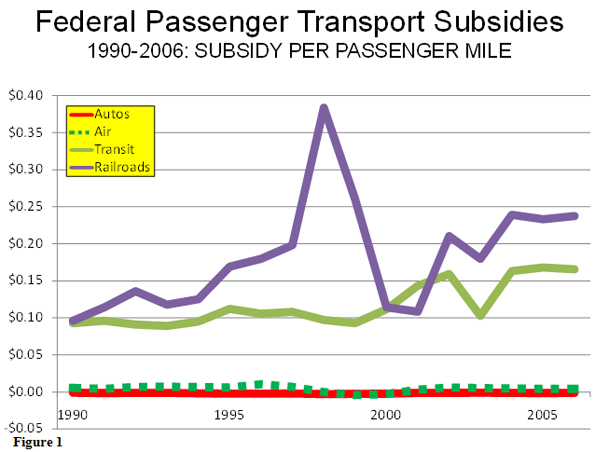
    A 2004 United States Department of Transportation (USDOT) report indicated that federal subsidies to transit amounted to $0.16 per passenger mile in 2002. Our update of this report estimated that the federal subsidy had risen to $0.17 per passenger mile by 2006. Overall, federal subsidies to transit were $7.7 billion in 2002, which increased to $8.6 billion in 2006 (Figure 1).

    Subsidies to Highways

    Virtually all federal highway spending was financed by fees paid by users in proportion to their use of the highways. There was no taxpayer subsidy.

    Indeed, the USDOT report indicates that in 2002, the federal government made a profit on automobile use of highways of $0.001 and had made a profit in every year since 1990, the first year reported upon. Overall, automobile use of the highways earned the federal government a profit of $4.5 billion in 2002 and $5.5 billion in 2006 (Figure 1).

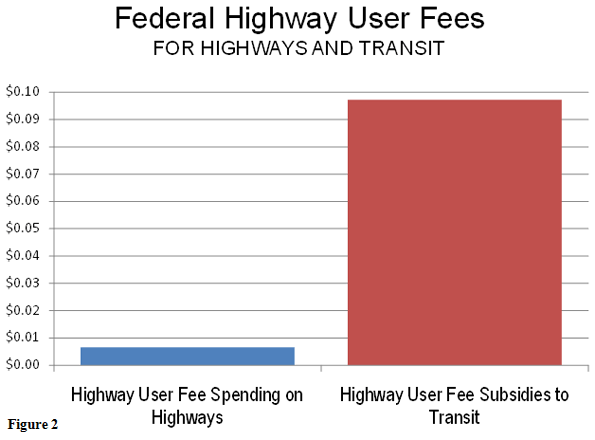
    The profits made by the federal government on highways indicate that highways are, in fact, subsidizing other government services. Senator Menendez neglected to mention, of course, that last highway bill (called “SAFETEA-LU,” its predecessor was called “ISTEA,” pronounced by insiders as “ice tea”) included $34 billion in subsidies by highway users for transit. For more than 25 years, federal law has required an add-on to highway user fees to support transit. Today nearly 15 percent of highway user fees are used to subsidize transit. In fact, road users pay 15 times as much in gas taxes per passenger mile on transit as they paid for highway expenditures (Figure 2).

    The profits do not stop at the federal level. Federal Highway Administration data indicates that user fees exceed the federal and state share of money spent on state highways, these being intercity highways, urban freeways and some other urban roadways. Only at the local government level are expenditures more than highway user fees, indicating subsidy.

    A real world parallel: Most of us have had Starbucks coffee. Our Starbucks coffee is not subsidized; rather we pay for it, 100% of it (Note 2). We can call this a price or we can use the public policy synonym, a user fee. As in the case of highways, those who do not drink Starbucks coffee do not pay for it. However, if Starbucks were financed like the federal highway program, 15 percent of the price of the coffee would be taken to subsidize tea drinkers (the authorizing legislation might be called ICECAFE).

    Airports

    While Senator Menendez did not refer to airports, those afflicted with a love affair with trains frequently claim that airports are subsidized in order to argue for massive expenditures on high speed rail, intercity rail and Amtrak. They are nearly as wrong as Senator Menendez. The air transportation system is overwhelmingly paid for by users, through taxes on tickets and airport fees. As in the case of highways, only those who use airports and the commercial air system pay for them.

    There are relatively small subsidies to commercial air transportation. The USDOT report found subsidies per passenger mile of approximately one-half penny.

    By comparison, the nation’s intercity passenger rail system (Amtrak) was subsidized to the extent of $0.21 per passenger mile in 2002, according to the USDOT report. Our report found that the figure had edged up to $0.24 in 2006, more than 50 times the subsidy to the commercial air system (Figure 1).

    These commercial air subsidies, however small, should be eliminated. Failing that, train proponents have grounds to ask for up to a half-penny per passenger mile of subsidy for high speed rail and intercity rail. Beyond that, equity requires that high speed rail and intercity rail be financed the same way as the commercial air system: with passenger fares, taxes on rail tickets and fees for the use of railroad stations.

    The Bottom Line

    The bottom line is that you pay for your coffee from Starbucks, you pay for your electricity from the Los Angeles Department of Water and Power and you pay for your federal highways with your own money, not with subsidies by people who do not use them.


    Note 1: Of course, if general taxpayer funding is provided to electric utilities, such payments would be subsidies, whether the utility is privately owned or owned by government.

    Note 2: All of this assumes that the local Starbucks is not the recipient of special tax incentives or abatements that might have been used by local government as enticement to locate in the community.

    Wendell Cox is a Visiting Professor, Conservatoire National des Arts et Metiers, Paris. He was born in Los Angeles and was appointed to three terms on the Los Angeles County Transportation Commission by Mayor Tom Bradley. He is the author of “War on the Dream: How Anti-Sprawl Policy Threatens the Quality of Life.

  • Washington, DC: The Real Winner in this Recession

    No matter how far the economy falters, there is always a winner. And no city does better when the nation is at the brink of disaster than Washington, DC. Since December 2007, when the current recession formally began, the nation has lost approximately 6 million jobs. Only two states, Alaska and North Dakota, have lost a smaller percentage of jobs than Washington, DC, which has seen a job loss of 0.6%, or 4,400. Simply put, Washington has done better in this recession than 48 of the fifty states when it comes to job performance.

    This is not the first time that Washington flourished while the rest of the nation suffered. For the first few, largely prosperous decades of the 19th Century, the district was a backwater, growing more slowly than the national average. It was widely reviled as fetid, swampy place with little in the way of commerce, industry or culture. Even its great buildings were compared to “the ruins of Roman grandeur.”

    It was only during arguably our greatest national tragedy – the Civil War – that the District of Columbia grew into an urban center, more than doubling in population from 1860 to 1870. Soldiers from the northern states flocked to the District of Columbia before going to battle, a new military force was established to guard against a Confederate attack, and the management of the war itself became a major federal enterprise. Slavery was abolished in Washington prior to emancipation, and freed slaves added to the District’s growing population.

    During the 1930s, FDR created an entirely new set of federal agencies designed to create jobs by financing projects across the country. At the same time, to prevent abuses on Wall Street, Congress created new regulatory agencies, such as the Securities and Exchange Commission, which hired droves of young accountants and lawyers unable to find work in other cities across the country.

    The Second World War and the Cold War also played to Washington’s advantage, as a vast military-industrial complex rose to the fore. So it’s not surprising that now, with the nation in the midst of its worst downturn since the Great Depression, that Washington appears about to indulge in yet another orgy of growth.

    Washington has always been a one industry town: that’s why it has an intrinsically self-absorbed monotonic culture. Everyone there depends on government for their livelihood. It is fundamentally not a city of competitive industries, but a giant taxpayer-funded office park, surrounded by museums and memorials. The great presidents: Washington, Lincoln, and Jefferson, have their own monuments, while more recent leaders have concert halls and office buildings named after them.

    Today Washington, DC appears much as the twenty-first century version of a gold mining town, even if the gold, so to speak, is coming from taxpayers as well as foreign buyers of our increasingly debased US currency. The Bush Administration kicked off this boom when it created the third largest cabinet department, the Department of Homeland Security, (by consolidating unrelated federal agencies into one super-sized department) and made it the employer of airport baggage and security inspectors across the nation. A new federal agency deserves a new headquarters, of course. DHS is now rising on the site of St. Elizabeth’s Hospital in southeast Washington DC, a pre-stimulus stimulus for the District of Columbia.

    The passage of the American Recovery and Reinvestment Act may be only slowly stimulating the nation’s economy but it is already working wonders in DC. Everyone wants a piece of the action. There is a surge in the lobbying industry, with every school board, regional transit agency and county government hiring a lobbyist to guide them through the new federal grant programs.

    Tourism may be temporarily down in DC, but the hotels are filled with local law enforcement officials, university bureaucrats, and housing advocates all trying to create jobs with federal dollars. The National Telecommunications and Information Administration and the US Department of Agriculture have just nineteen months to spend $4.7 billion on broadband communications.

    To evaluate the thousands of proposals for federal funding, expert panels will convene in Washington, DC. Where else? Communities across the country may receive grants, but the hotel and restaurant industry in the nation’s capital will also prosper from this new federal program.

    The same process will follow other Obama initiatives. Health care and climate change legislation will produce the same rounds of hearings, a growing cadre of regulators and the corps of tassel-shoed lobbyists who will try to influence them.

    The heightened emphasis on transparency in government has compelled every federal department to build sophisticated websites to engage the public, to distribute information, and to conduct the entire process of awarding grants and contracts. The demand for website designers and managers has grown so quickly that a Los Angeles-based interactive advertising agency, “Sensis,” a minority owned and operated corporation, recently opened an office in the District of Columbia just to “capitalize on the federal government’s new interest in digital communications.”

    There is one unambiguous measure that signals the growth of business activity within a city. Until recently, taxi fares in the nation’s capital were based on zones. These made it very inexpensive for members of Congress to go to and from the Capital. Today, every DC taxi has a meter and the old-fashioned zone-based system has been abolished. Both the municipal government and taxi drivers understand that there are more dollars to be made from those seeking to influence government than those who actually make the laws.

    Ben Smith of Politico.com has recently pointed out that five new Washington-based reality television shows are in the planning stages, with Bravo ready to launch “The Real Housewives of Washington, DC.” It is no accident that the entertainment industry has discovered the District of Columbia. A city that thrives in a recession may become the Fantasyland of our generation.

    Mitchell L. Moss is Henry Hart Rice Professor of Urban Policy and Planning at NYU Wagner School of Public Service.

  • Prince Charles is Britain’s Master-eco-fraudster

    Thomas Paine was born in Thetford, Norfolk, in 1737. He understood that history is made. Aged 39, writing his Common Sense, he noted that Britain is constituted of ‘…the base remains of two ancient tyrannies, compounded with some new republican materials.’ These were:

    ‘First. – The remains of monarchical tyranny in the person of the king

    Secondly. – The remains of aristocratical tyranny in the persons of the peers.

    Thirdly. – The new republican materials, in the persons of the commons, on whose virtue depends the freedom of England.’ (1)

    Since Britain’s reformist politicians in the House of Commons have shown no republican virtue, in 2009 we now also suffer the “aristocratical tyranny” of the House of Lords being augmented with life peers. These political appointees must give their allegiance to the monarchy, even if they imagine they serve the majority. In contrast to reformists today, the revolutionary republican Paine had the “common sense” to ask:

    ‘How came the king by a power which the people are afraid to trust, and always obliged to check? Such a power could not be a gift of a wise people, neither can any power, which needs checking, be from God.’ (2)

    The king in waiting, Prince Charles, certainly believes in God, and entertains the myths of many Gods, but his claim to the throne in 2009 is that he understands and represents “the natural order”. He has been arguing like this for 30 years. He reiterated his claim in the 2009 Richard Dimbleby Lecture. His is the 33rd lecture held in honour of the veteran broadcaster who died in 1965. Charles had warned in March 2009 that there were only 100 months in which to avoid disaster. (3) He reminded the BBC audience on 8 July that there were 96 months left. The imagined catastrophe he hopes to avoid is otherwise due in July 2017. (4)

    The full lecture is available to see on BBC iPlayer.

    It does not matter if Charles Windsor is “well meaning”. As Paine understood in the Rights of Man, ‘…a casual discontinuance of the practice of despotism, is not a discontinuance of its principles; the former depends on the virtue of the individual who is immediate possession of the power; the latter, on the virtue and fortitude of the nation.’ (5) Prince Charles conveniently imagines himself to be the “steward” of “natural capital”. He has an urgent “duty” in his mind to use his monarchical authority to sustain not only Britain, but the entire planet, in some undefined “natural balance and harmony”. This is his eco-myth, and no matter how benign, how little he uses his power, along with the military command that entails, he cannot be tolerated by a self-interested people.

    We are weak if we allow his eco-mysticism to go unchecked, and to reinvigorate the monarchy in Britain. Those promoting Charles as the spokesman for “natural capitalism” are worse than weak.

    Charles talks of not taking too much “income” from the Earth, which makes him sound modest in his monarchy. He does not seem like a feudal monarch. Yet Paine could see through this in 1792:

    ‘As time obliterated the history of their beginning, their successors assumed new appearances, to cut off the entail of their disgrace, but the principles and objects remained the same. What at first was plunder, assumed the softer name of revenue; the power originally usurped they affected to inherit.’ (6)

    The Windsors have been adept at assuming new appearances since the Second World War. Where his grandmother walked through Blitzed streets, and his mother managed to appear “ordinary”, the now 60 year old Charles makes an effort to appear “green”. He is an environmentalist promoting the stasis of sustainability, and the political deception works to the point where in drawing his revenue from “natural capital” he seems to be doing not only the British people but the whole of humanity a favour. ‘If we fail the Earth, we fail humanity,’ he says. (7)

    Even if he lived as a monarch as poorly as the majority of the world does, he would still be a focus for every anti-democratic interest in twenty-first century capitalism. Of course, even before he inherits the British throne from his aging mother, he does not live poorly.

    With a Parliament of worse than weak representatives checked by a house of new gentry and old aristocrats, all in deference to a feudal monarchy in charge of an interventionist military, Britain is a mostly low paid industrial democracy of debt-laden professional and amateur residential property speculators using a planning system that makes a political and economic nonsense of freehold land ownership. We must find a way to break free of this social containment, (8) focused in Britain on the impending coronation of a “green” king.

    ‘Hereditary succession is a burlesque upon monarchy. It puts it in the most ridiculous light, by presenting it as an office which any child or idiot may fill. It requires some talents to be a common mechanic; but, to be a king, requires only the animal figure of man – a sort of breathing automation. This sort of superstition may last a few years more, but it cannot long resist the awakened reason and interest of man.’ (9)

    In the second part of Rights of Man, Paine was over-optimistic. He thought that kings would make themselves sufficiently ridiculous. While Charles is worthy of ridicule on many occasions, he still commands loyalty from “greens”, even when they are embarrassed by his fantasy of the Earth as “Gaia”, as a conscious entity.

    It is not enough to point out his self-deceptive eco-hypocrisy, or its popularity. The pervasive idea that capitalism is in any way “natural” must be broken. That requires the promotion of industrial production based on an appreciation of the social division of labour. It is necessary to see that in moaning about the effect of “mechanisation” on the environment, for which the contemporary capitalist will even accept moral and legal responsibility, they will abandon industry and make a virtue out of a life of laborious effort, sustained as a “duty”.

    In 2009, 200 years after Thomas Paine died, ‘…environmentalism is the ideology of capitalism in retreat from production.’ (10) That is what we understand at audacity. What people lack is social control of the vast industrial surplus that is produced by all of us. At present the aggregated value of our social production is taken as privately owned capital, partially taxed and redistributed through government, while mystified and made acceptable by the likes of the Prince of Wales as “natural capital”.

    Charles says:

    ‘It seems to me a self-evident truth that we cannot have any form of capitalism without capital. But we must remember that the ultimate source of all economic capital is Nature’s capital.’ (4)

    Wrong. Nature just exists. Only human labour turns nature into product, using machines to enable less labour to produce more. Capitalism has succeeded so far in developing industry so that sufficient surplus is produced beyond the needs of subsistence. That has allowed employers to live off their employees. Paine did not understand the parasitical relationship of the employer on employees. The workforce is paid less than the value it produces. However Paine could see institutionalised fraud that we tend to ignore:

    ‘Monarchy would not have continued so many ages in the world, had it not been for the abuses it protects. It is the master-fraud, which shelters all others. By admitting a participation of the spoil, it makes itself friends.’ (11)

    Democratic society depends on raising the productivity of labour. He may fool himself, and some of his fellow “greens”, but we must not let Charles fool us. He and his backward, stasis-loving supporters must be denied the appearance of being “natural” leaders, as they attempt to promote an anti-machine age of capitalist “sustainable development”:

    ‘Our current model of progress was not designed, of course, to create all this destruction. It made good sense to the politicians and economists who set it in train because the whole point was to improve the well-being of as many people as possible. However, given the overwhelming evidence from so many quarters, we have to ask ourselves if it any longer makes sense – or whether it is actually fit for purpose under the circumstances in which we now find ourselves?’ (4)

    What “model of progress” and what “destruction” is he talking about? In his pre-recorded Richard Dimbleby Lecture, broadcast on BBC One on 8 July 2009, Charles insisted that Facing The Future meant a new system that is more ‘…balanced and integrated with nature’s complexity.’ (7)

    This is complete nonsense, but popular “sustainababble”. The majority needs complete control of industrial advance. That requires a plan to rescue society from “greens”. Prince Charles knows much “…depends on how you define both ‘growth’ and ‘prosperity’.” (4) Much certainly depends on whether most people accept his redefinitions, anticipating his imagined “catastrophe”, or whether we are no longer willing to be subject to his retreat from industrial production. We don’t need to accept his prediction for 2017. We need not be his duped “commoners”.

    “As to the word ‘Commons,’ applied as it is in England, it is a term of degradation and reproach, and ought to be abolished. It is a term unknown in free countries.” (12)

    There is much to abolish in Britain, fraudulent monarchy included, and much to build with “republican materials” in pursuit of democracy.

    Ian Abley, Project Manager for audacity, an experienced site Architect, and a Research Engineer at the Centre for Innovative and Collaborative Engineering, Loughborough University. He is co-author of Why is construction so backward? (2004) and co-editor of Manmade Modular Megastructures. (2006) He is planning 250 new British towns.

    References:

    1. Thomas Paine, Common Sense: Addressed to the Inhabitants of America, 14 February 1776, Philadelphia, reprinted in Mark Philp, editor, Thomas Paine: Rights of Man, Common Sense, and Other Political Writings, Oxford, Oxford University Press, 1998, p 8

    2. Ibid, p 9

    3. ‘Prince Charles: ‘We have less than 100 months to stop climate change disaster” ‘, 8 March 2009, posted on www.dailymail.co.uk

    4. Prince Charles, ‘Facing the Future’, The Richard Dimbleby Lecture as delivered by HRH The Prince of Wales, St James’s Palace State Apartments, London, 8 July 2009. For transcript see here as directed on the Press Release, ‘Richard Dimbleby Lecture 2009: The Prince of Wales’, 9 July 2009, BBC, posted on www.bbc.co.uk

    5. Thomas Paine, Rights of Man: Being an Answer to Mr Burke’s Attack on the French Revolution, to George Washington, President of the United States of America, 1791, reprinted in Mark Philp, editor, Thomas Paine: Rights of Man, Common Sense, and Other Political Writings, Oxford, Oxford University Press, 1998, p 98

    6. Thomas Paine, Rights of Man: Part the Second, Combining Principle and Practice, 9 February 1792, London, reprinted in Mark Philp, editor, Thomas Paine: Rights of Man, Common Sense, and Other Political Writings, Oxford, Oxford University Press, 1998, p 221

    7. ‘Prince fears Earth “catastrophe” ‘, 8 July 2009, posted on http://news.bbc.co.uk

    8. Ian Abley, We are witnessing a British built “housing crisis” that Government is powerless to resolve, 23 July 2008, posted on this website here

    9. Ibid, p 226

    10. James Heartfield, Green Capitalism – Manufacturing scarcity in an age of abundance, www.heartfield.org, 2008, p 91, with details of how to buy posted here

    11. Ibid, p 257

    12. Ibid, p 351