Category: Politics

  • Enviro-wimps: L.A.’s Big Green Groups Get Comfy, Leaving the Street Fighting to the Little Guys

    So far, 2009 has not been a banner year for greens in Los Angeles. As the area’s mainstream enviros buddy up with self-described green politicians and deep-pocketed land speculators and unions who have seemingly joined the “sustainability” cause, an odd thing is happening: Environmentalists are turning into servants for more powerful, politically-connected masters.

    On March 3, voters shot down Measure B, a controversial solar energy initiative pushed by Mayor Antonio Villaraigosa and endorsed heartily by many prominent environmentalists. The stunning defeat in this liberal city came after critics accused the mayor and his friends of secret deals that rushed the measure onto the ballot as a favor to a city union whose workers be guaranteed almost all of the resulting solar jobs.

    Then, on April 29, U.S. District Judge Christina Snyder placed a temporary injunction on part of the “clean trucks” program at the Port of Los Angeles, whose air pollution is so foul that the EPA warns its emissions cause cancer in suburbs like Cerritos, miles upwind of the port. Judge Snyder rejected efforts by Villaraigosa and the Teamsters to force port truckers to give up their independence and work for companies – spun as a green rule, but ridiculed as a move to pressure the truckers to become Teamsters.

    Today, labor unions, big businesses, and politicians are embracing a green economy to solve their own political and financial woes. And the green agenda – repairing a damaged planet and protecting the local environment in which we live – is at risk of ending up an after-thought.

    “I don’t think the traditional environmental organizations are up to speed,” says Miguel Luna of Urban Semillas, a grassroots environmental group. Alberto B. Mendoza, president of the Coalition for Clean Air, concurs: “If we don’t become more modern in our approach, we’ll become obsolete.”

    In Los Angeles, developers now market, or “green wash,” big new buildings as “sustainable” – meaning healthy for the planet over the long term. The city of Los Angeles requires large buildings to follow “LEED” rules – low flush toilets, on-site renewable energy and the like. But do these projects cause more congested streets filled with idling cars, for example, than the energy they claim to save? In truth, nobody knows. “If you have a project that would normally be four stories high and now it has 20 stories,” says Hollywood activist Bob Blue, there’s a “net increase in power, water, sewer, traffic, pollution – and impact.”

    Yet among many greens, LEED is a closed debate – and represents a profound shift. In the 1990s, greens like Marcia Hanscom, Rex Frankel, Bruce Robertson, Cathy Knight, Sabrina Venskus, and Patricia McPherson took on Los Angeles City Hall, preventing it from wiping out the Ballona Wetlands to erect a vast housing development, Playa Vista. Those greens publicly trounced the pols and their speculator friends over absurd “sustainability” claims — including an effort to count the grassy median strips as “open space.”

    Nowadays, though, Los Angeles enviros are sliding toward the argument that big development is good for the air, land and water – and small bits of green are enough. Environmentalists rarely engage in the city’s intense development hearings. “Maybe one time an environmentalist showed up,” Blue says, “but it was on the behalf of the developer.”

    Within the green movement, Andy Lipkis, the founder of Tree People, and Mark Gold, executive director of Heal the Bay, have reputations as heavyweights with access to Villaraigosa and other politicians. Neither of them, though, wants to jump into rough-and-tumble politics. Lipkis, a likeable and dedicated activist, proudly says he is politically “naive.” Gold, a smart and equally dedicated environmentalist, says he is not “even a little” worried that politicians, labor unions or speculators are hijacking the greens’ issues.

    But today, developers regularly peddle their proposed apartments near L.A. freeways as “sustainable” – claiming they bring workers closer to jobs. The developments are backed by Villaraigosa and the L.A. City Council – to the horror of health experts. Researchers now know, for certain, that children living in these projects are burdened with often lifelong lung disease. “They are putting individuals at risk,” says USC professor Jim Gauderman, whose 2007 study confirmed it.

    Heavily focused on lowering emissions region-wide to fight global warming, greens now praise freeway-adjacent housing projects, utterly forgetting about the young humans involved. Incredibly, city Planning Commissioner Michael Woo, a Villaraigosa-appointee, hasn’t heard a word of opposition from them. Two years after USC’s study, he says, “I’m not sure there’s a political will to stop housing projects at these locations.”

    Grassroots activist Marcia Hanscom, who has never gotten anything by staying quiet, worked for years with other environmentalists to save the Ballona Wetlands. In 2003, that relentless effort paid off – the state bought more than 600 acres to protect and restore. But now, she says, the environmental movement in L.A. has lost its way. It’s time to talk openly about a “mid-course correction.”

    L.A. politicians “sometimes call me as if I’m one of their staff members,” she notes, “and I’m supposed to do what they say. They have their roles mixed up. I’m here to advocate for the environment, not to advocate for them.”

    Pro-green politicians control the office of mayor, almost every Los Angeles City Council seat, every Los Angeles Unified School Board seat, and, for years, have controlled the legislature. Yet the greens seem oddly incapable of asserting power. Mark Gold of Heal the Bay, for example, went out of his way to endorse solar power Measure B, even though Villaraigosa clearly dissed him by dreaming it up utterly without Gold’s input. What L.A. union boss would stand for that?

    Stefanie Taylor, interim managing director interim of the Green L.A. Coalition, a group of over 100 organizations, says, “We have to make sure we’re at the table when these decisions are made about the new green economy.” But right now, says enviro-lobbyist John White, environmentalists are “more like the menu.”

    The stark difference between the daily work of Hanscom, the grassroots environmentalist, and Jonathan Parfrey, the political insider and mainstream environmentalist, is instructive. When the Weekly talked with Hanscom, she was in the middle of an almost surreal battle to keep glaring, Vegas-style digital billboards, made up of 480,000 piercingly bright LED light bulbs, from being allowed adjacent to the blue herons and wildflowers of the Ballona Wetlands.

    Says Hanscom, “The city has the Ballona Wetlands as a part of a billboard ‘sign district?’ It’s outrageous! I even had [developer] lobbyists and lawyers ask me what they were thinking.”

    As Hanscom aimed her firepower at City Hall, environmentalist Parfrey, one of Antonio Villaraigosa’s newest political appointees, was getting ready to visit a Department of Water and Power wind farm way out of town, with the idea of creating “educational tours” for environmentalists. Nothing wrong with that, but it sounded like a public relations campaign for the big utility.

    It’s hard to escape the fact that Los Angeles power brokers regard the environmental movement not as a passionate force they can tap to improve the quality of life and to clean the air, water, and open spaces, but, increasingly, as just another jobs program. And some of the greenest greens have begun to wonder if their own leaders are taking part in the movement’s demise.

    Patrick Range McDonald is a staff writer at L.A. Weekly, and this piece appears in full at www.laweekly.com. Contact Patrick Range McDonald at pmcdonald@laweekly.com.

  • Who Killed California’s Economy?

    Right now California’s economy is moribund, and the prospects for a quick turnaround are not good. Unable to pay its bills, the state is issuing IOUs; its once strong credit rating has collapsed. The state that once boasted the seventh-largest gross domestic product in the world is looking less like a celebrated global innovator and more like a fiscal basket case along the lines of Argentina or Latvia.

    It took some amazing incompetence to toss this best-endowed of places down into the dustbin of history. Yet conventional wisdom views the crisis largely as a legacy of Proposition 13, which in effect capped only taxes.

    This lets too many malefactors off the hook. I covered the Proposition 13 campaign for the Washington Post and examined its aftermath up close. It passed because California was running huge surpluses at the time, even as soaring property taxes were driving people from their homes.

    Admittedly it was a crude instrument, but by limiting those property taxes Proposition 13 managed to save people’s houses. To the surprise of many prognosticators, the state government did not go out of business. It has continued to expand faster than either its income or population. Between 2003 and 2007, spending grew 31%, compared with a 5% population increase. Today the overall tax burden as percent of state income, according to the Tax Foundation, has risen to the sixth-highest in the nation.

    The media and political pundits refuse to see this gap between the state’s budget and its ability to pay as an essential issue. It is. (This is not to say structural reform is not needed. I would support, for example, reforming some of the unintended ill-effects of Proposition 13 that weakened local government and left control of the budget to Sacramento.)

    But the fundamental problem remains. California’s economy–once wondrously diverse with aerospace, high-tech, agriculture and international trade–has run aground. Burdened by taxes and ever-growing regulation, the state is routinely rated by executives as having among the worst business climates in the nation. No surprise, then, that California’s jobs engine has sputtered, and it may be heading toward 15% unemployment.

    So if we are to assign blame, let’s not start with the poor, old anti-tax activist Howard Jarvis (who helped pass Proposition 13 and passed away over 20 years ago), but with the bigger culprits behind California’s fall. Here are five contenders:

    1. Arnold Schwarzenegger

    The Terminator came to power with the support of much of the middle class and business community. But since taking office, he’s resembled not the single-minded character for which he’s famous but rather someone with multiple personalities.

    First, he played the governator, a tough guy ready to blow up the dysfunctional structure of government. He picked a street fight against all the powerful liberal interest groups. But the meathead lacked his hero Ronald Reagan’s communication skills and political focus. Defeated in a series of initiative battles, he was left bleeding the streets by those who he had once labeled “girlie men.”

    Next Arnold quickly discovered his feminine side, becoming a kinder, ultra-green terminator. He waxed poetic about California’s special mission as the earth’s guardian. While the housing bubble was filling the state coffers, he believed the delusions of his chief financial adviser, San Francisco investment banker David Crane, that California represented “ground zero for creative destruction.”

    Yet over the past few years there’s been more destruction than creation. Employment in high-tech fields has stagnated (See related story, “Best Cities For Technology Jobs“) while there have been huge setbacks in the construction, manufacturing, warehousing and agricultural sectors.

    Driven away by strict regulations, businesses take their jobs outside California even in relatively good times. Indeed, according to a recent Milken Institute report, between 2000 and 2007 California lost nearly 400,000 manufacturing jobs. All that time, industrial employment was growing in major competitive rivals like Texas and Arizona.

    With the state reeling, Arnold has decided, once again, to try out a new part. Now he’s posturing as the strong man who stands up to dominant liberal interests. But few on the left, few on the right or few in the middle take him seriously anymore. He may still earn acclaim from Manhattan media offices or Barack Obama’s EPA, but in his home state he looks more an over-sized lame duck, quacking meaninglessly for the cameras.

    2. The Public Sector

    Who needs an economy when you have fat pensions and almost unlimited political power? That’s the mentality of California’s 356,000 workers and their unions, who make up the best-organized, best-funded and most powerful interest group in the state.

    State government continued to expand in size even when anyone with a room-temperature IQ knew California was headed for a massive financial meltdown. Scattered layoffs and the short-term salary givebacks now being considered won’t cure the core problem: an overgenerous retirement system. The unfunded liabilities for these employees’ generous pensions are now estimated at over $200 billion.

    The people who preside over these pensions represent the apex of this labor aristocracy. This year two of the biggest public pension funds, CalPERS and CalSTERS, handed out six-figure bonuses to its top executives even though they had lost workers billions of dollars.

    Almost no one dares suggest trimming the pension funds, particularly Democrats who are often pawns of the public unions. Some reforms on the table, like gutting the two-thirds majority required to pass the budget, would effectively hand these unions keys to the treasury.

    3. The Environment

    Obama holds up California’s environmental policy as a model for the nation. May God protect the rest of the country. California’s environmental activists once did an enviable job protecting our coasts and mountains, expanding public lands and working to improve water and air resources. But now, like sailors who have taken possession of a distillery, they have gotten drunk on power and now rampage through every part of the economy.

    In California today, everyone who makes a buck in the private sector–from developers and manufacturers to energy producers and farmers–cringes in fear of draconian regulations in the name of protecting the environment. The activists don’t much care, since they get their money from trust-funders and their nonprofits. The losers are California’s middle and working classes, the people who drive trucks, who work in factories and warehouses or who have white-collar jobs tied to these industries.

    Historically, many of these environmentally unfriendly jobs have been sources of upward mobility for Latino immigrants. Latinos also make up the vast majority of workers in the rich Central Valley. Large swaths of this area are being de-developed back to desert–due less to a mild drought than to regulations designed to save obscure fish species in the state’s delta. Over 450,000 acres have already been allowed to go fallow. Nearly 30,000 agriculture jobs–held mostly by Latinos–were lost in the month of May alone. Unemployment, which is at a 17% rate across the Valley, reaches upward of 40% in some towns such as Mendota.

    4. The Business Community

    This insanity has been enabled by a lack of strong opposition to it. One potential source–California’s business leadership–has become progressively more feeble over the past generation. Some members of the business elite, like those who work in Hollywood and Silicon Valley, tend to be too self-referential and complacent to care about the bigger issues. Others have either given up or are afraid to oppose the dominant forces of the environmental activists and the public sector.

    Theoretically, according to business consultant Larry Kosmont, business should be able to make a strong case, particularly with the growing Latino caucus in the legislature. “You have all these job losses in Latino districts represented by Latino legislators who don’t realize what they are doing to their own people,” he says. “They have forgotten there’s an economy to think about.”

    But so far California’s business executives have failed to adopt a strategy to make this case to the public. Nor can they count on the largely clueless Republicans for support, since GOP members are often too narrowly identified as anti-tax and anti-immigration zealots to make much of a case with the mainstream voter. “The business community is so afraid they are keeping their heads down,” observes Ross DeVol, director of regional economics at the Milken Institute. “I feel they if they keep this up much longer, they won’t have heads.”

    5. Californians

    At some point Californians–the ones paying the bills and getting little in return–need to rouse themselves. The problem could be demographic. Over the past few years much of our middle class has fled the state, including a growing number to “dust bowl” states like Oklahoma, Texas and Arkansas from which so many Californians trace their roots.

    The last hope lies with those of us still enamored with California. We have allowed ourselves to be ruled by a motley alliance of self-righteous zealots, fools and cowards; now we must do something. Some think the solution is reining in citizens’ power by using the jury pool to staff a state convention, as proposed by the Bay Area Council, or finding ways to undermine the initiative system, which would remove critical checks on legislative power.

    We should, however, be very cautious about handing more power to the state’s leaders. With our acquiescence, they have led this most blessed state toward utter ruin. Structural reforms alone, however necessary, won’t turn around the economy’s fundamental problems and help California reclaim its role as a productive driver of the American dream.

    This article originally appeared at Forbes.

    Joel Kotkin is executive editor of NewGeography.com and is a presidential fellow in urban futures at Chapman University. He is author of The City: A Global History. His next book, The Next Hundred Million: America in 2050, will be published by Penguin early next year.
  • View from the UK: The Progressive’s Dilemma

    American progressives long have looked upon Britain’s Labour Party as an exemplar of how to prioritize social welfare without entirely alienating business. Unlike their European counterparts, whose overly suspicious view of wealth and overly generous view of social welfare spending make poor role models for America, the British Labour Party has brokered a “partnership” between wealth and welfare over the years more suitable to the American psyche.

    Yet today that partnership is nearing collapse. For over a decade Britain’s supercharged financial sector fuelled the growth of an expansive state. But as the financial sector has cooled, Britain’s Labour party is now faced with the stark reality of burgeoning social welfare commitments, unprecedented public debt, and dubious upward mobility prospects for the ordinary citizen. The government has seemed more competent at creating upward mobility for civil servants who service the growing social welfare state than doing the same for the larger population who have to pay for it.

    Now the question for Labour – and the UK – is how to maintain an expansive social insurance program by somehow creating the kind of growth needed to pay for it. Once its “wealth creation strategy” of relying on a fecund banking sector fell apart, its project of providing income security rather than fostering income growth for ordinary people appears to be on the verge of failure.

    In order to maintain social welfare goals amidst a floundering economy, the UK has financed its shortfall through massive debt – something the average British household knows something about. Between 1997 and 2007 average household debt grew from 105 to 177 percent of disposable income. The US, of course, also experienced an explosion of household debt during the same period but not nearly to the same extent. At the end of 2007 America’s average household debt reached 106 percent of disposable income – essentially where the UK started 10 years earlier.

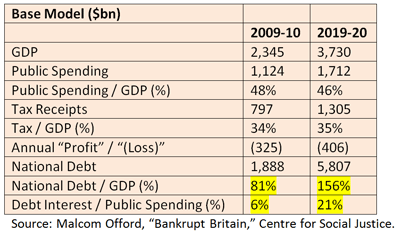
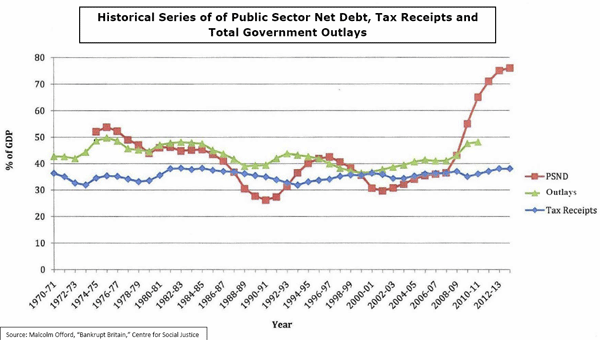
    The UK’s comfort with personal debt has now extended to the public realm. Even before the recession, Britain had $1.2 trillion of public debt, and by next year it will rise to $1.8 trillion, or 81 percent of GDP. If debt payment were a government agency, it would be the fourth largest in Britain. According to the London-based think tank the Centre for Social Justice, 21 percent of total public spending will be devoted to debt service in 2020, compared to 6 percent today. Public debt in the US, by comparison, will reach 60 percent of GDP by next year, and interest on the debt will rise from 4.6 percent to nearly 14 percent ten years from now. Labour’s legacy will be the Mount Everest of indebtedness it has left the current and subsequent generation.

    To put this in perspective, we need look no further than historic trends over the past 30 years. Public debt has tracked fairly proportionately with public spending in the UK during this period. During the economic stagnation of the late 1970s, public debt rose to nearly 50 percent of GDP. It hit its nadir at around 25 percent in 1990 after the Thatcher era, and then rose to around 35 percent, where it has remained ever since – until last year. Suddenly, debt has skyrocketed to more than 75 percent of GDP in the past year – an unprecedented level – and will rise to 100 percent by 2012 before swelling to 150 percent by 2020. In order to reduce debt to its 45 percent level of just a few years ago, public spending would need to be cut by a third. Given that one-fifth of all public spending will go to debt service in 10 years, cutting spending will prove politically impossible for a government – and perhaps an entire nation – that identifies ever expanding government-funded services as essential.

    Even more disquieting, tax receipts have mainly hovered around 35 percent of GDP regardless of the tax rate during the past 30 years. This means that raising tax rates – such as Labour’s proposal to lift the top tax bracket to 50 percent– have little effect as high earners move away or find other ways to protect their assets. Logically, if it hopes to cope with its debt obligations, Britain should therefore keep taxes as low as possible and cut public spending. But instead the UK drives full-speed ahead into the fog of debt without having any notion of how to service its future obligations.

    The UK is therefore faced with a thorny dilemma: on the one hand, it has spent decades creating a social welfare system that reduces risk and promises citizens protection from life’s vagaries, and on the other, it needs people to take risks in order to revitalize the economy. Government spending fostered risk avoidance precisely when Britain most needs an entrepreneurial class that can help diversify the economy away from finance and, to a lesser extent, tourism.

    The people most hurt by social welfare are young working class people – the very group Labour purports to represent. In the UK there’s much talk about the NEETs – young people in their late teens who are Not in Employment, Education, or Training. In 2000 there were 630,000 young people between the ages of 16 and 19 in this group. Today, that number totals 860,000, a 36 percent increase in less than a decade. This would be the equivalent of 4.5 million young people in the United States. If NEETs were a city, they would be the third largest metropolitan area in the UK.

    Increasing numbers of able-bodied young people dropping out of society altogether reflects a growing sense of hopelessness. According to the Gallup World Poll, only 20 percent of 25-34 year olds, and 25 percent of 35-49 year olds, thought the economic conditions in the UK were good before the current economic crisis. The UK’s NEET problem and economic pessimism were rampant when the going was good – something that can only be worse now.

    This is not merely the result of a profligate welfare state. The NEET problem has its origins in complex cultural phenomena. However, it is difficult to argue with the conclusion that an increasing economic resignation among Britain’s younger population is ill-timed for a government betting on future workers to pay the public mortgage.

    The US has a more diversified economy than the UK and likely suffers from less economic resignation, but it is beset with a similar dilemma. Despite historically unprecedented levels of public debt, albeit less extreme than Britain’s, the Obama administration appears to be pursuing an economic program that bears similarities to the Labour preoccupation with creating prophylactics against risk and hardship. In a matter of months, the US deficit has risen from 3.2 to 13.1 percent of GDP, according to the Congressional Budget Office.

    Even with President Obama’s widely doubted promises to cut the deficit in half, the CBO estimates a yearly shortfall of more than $1 trillion ten years from now. Even worse, there is precious little in the administration’s plans – including its grandiose claims about “green jobs” – that will create the growth necessary to carry such debt in the future. In fact many of the administration’s proposals – from its healthcare program to its auto company ownership and a more heavily regulated financial sector – could serve more to curb growth than encourage it. In addition, increased taxes on “the rich” will hit small businesses most grievously, the most plausible engine for growth.

    It appears the administration seems intent on following Labour’s folly of mortgaging the future. Without addressing the issue of how to unleash the entrepreneurial energies of the young generation, it’s hard to see how America will avoid falling into the morass in which its British cousins are now so perilously trapped.

    Ryan Streeter is Senior Fellow at the London-based Legatum Institute.

  • Lessons from the Left: When Radicals Rule – For Thirty Years

    Contrary to popular notions held even here in southern California, Santa Monica was never really a beach town or bedroom community. It was a blue-collar industrial town, home to the famed Douglas Aircraft from before World War II until the 1970s.

    When I first lived there in the early ’70s, the city was pretty dilapidated, decaying and declining (except for the attractive neighborhoods of large expensive homes in the city’s northern sections). I remember a lot of retirees, students, and like me and my wife, renters of small apartments in old buildings. The tiredness of the place was incongruous with its great location and weather. But then the first of several spectacular rises in real estate values took off. Rents started rising precipitously as well, and in a city where 80% of residents were renters, a political earthquake shook the establishment: in 1979 voters passed rent control and soon after that elected a slate of politicians backed by the SMRR – Santa Monicans for Renter Rights – to a majority on the city council. It has now been 30 years that the city of Santa Monica has been dominated by the politics and politicians of SMRR. What have they wrought?

    There have been some momentous battles. Property owners, denied the full use and fair value of their property, came to calling the place “the People’s Republic of Santa Monica.” As economists would predict, rent control resulted in the loss of rental units (and therefore the number of renters), slowed construction of new units, led to the deterioration of existing units as landlords deferred maintenance, decreased the city’s diversity, and increased its exclusivity. These were all opposite effects the original intentions of the new radical rulers.

    But rent control was not the only “social justice” concern on the SMRR agenda; “homeless friendly” policies led to an explosion of homeless people in the city, which comedian Harry Shearer reminds the nation every week on his NPR radio show is “The Home of the Homeless.”

    Other battles fought over the years have involved traffic issues, a living wage ordinance, preferential parking zones, McMansions, development and redevelopment, planning, zoning, schools, affordable housing requirements, and the height of fences and hedges – a thousand things big and small one would expect in a city of 85,000 residents and an annual budget of over $500 million. At some point in the 1980s, the SMRR-dominated City Council, once anti-development, realized that development could generate millions of dollars for city government necessary for funding its political agenda. Massive rezoning and redevelopment were approved.

    One might think that inconsistent policies often causing opposite effect of their intentions would have weakened the left. But two large factors have come into play over time. First, SMRR does not rule without consent and consensus – many, perhaps more than half, of home owners have supported the progressive politics and policies of the SMRR-controlled city council. Secondly, despite the concerns of some property owners and economists, Santa Monica has prospered. Despite powerful regulation, hotels, arts, jobs, and restaurants continue to flow into the city. Opponents on both sides concede most of the population is content and satisfied with the status quo.

    This has been accomplished with pragmatism and a willingness to change policies that were not working. The worst effects of rent control are in the past due to a state law that allowed vacancy decontrol. Same with homelessness: residents wanted to be “progressive” but realized that being kind to the homeless only increased their numbers. The city still overdoes it on permits, regulations, etc., but homeowners and business want to be “progressive,” so they go along with it (and they like regulation when it benefits their interests).

    The city decided to make itself a tourist destination, and it is, but when it looked like nothing but hotels would be built, voters passed a proposition to halt hotel development. On the other hand, last November voters defeated Prop T, which would have limited most commercial development in the city to 75,000 square feet a year for the next 15 years.

    Santa Monica Place, a huge indoor shopping mall, outlived its usefulness, so now it’s being rebuilt as an outdoor mixed-use development. A living wage law was passed by the City Council, and then repealed by voters.

    SMRR is a political machine that has dominated the city for 30 years, using money, favors, jobs for the connected (and bupkis for those not) to build voting blocs for power and control. It inserts its people onto all the boards and commissions with input into policymaking. Their power ultimately comes from persuading renters, who are still a big majority of the city’s inhabitants, that they need SMRR for protection from “greedy landlords.”

    So SMRR dominates political life in the city of Santa Monica, but it does so with the consent of many homeowners, property and business owners, as well as renters. Santa Monica is green, PC, insufferably “tolerant,” self-satisfied, etc., but still doing well for itself. Taxes, rules, regulations and restrictions are onerous, but people and businesses still want to be there.

    I have lived through and observed the political battles of the last 30 years as a renter, homeowner and briefly as a landlord (never again, thanks). The transformation of Santa Monica reflects an interesting story: left-leaning activists who realize they can bend the establishment by controlling it from the inside. They then become the new establishment, but like in today’s left-leaning academia, work to make sure they themselves are never similarly deposed. And yes, I wonder if it holds lessons for the nation, with President Obama and the Democrats now in control and looking to implement a left-leaning agenda.

    What might those lessons be? One, particularly difficult for conservatives to accept, is that the time-tested machinations of leftist political machines sometimes work. They work for the powerful and the connected (who get to have their cake and eat it too: financial reward with a patina of progressivism), and they are perceived to work for the powerless and unconnected (however deleterious in reality). And that the left can come to power and rule with the consent of the governed, if it doesn’t “push the envelope” beyond a certain point, changes course when warranted, rewards cronies and allies, co-opts opponents where possible (and freezes them out where not). It worked for Tammany Hall, it has worked for Mayor Daley, and it seems to be working for Obama. Saul Alinsky would be proud of his protégé.

    Perhaps at the heart of its success is that like all successful political machines, SMRR “fixes potholes.” Frank Gruber, who writes a weekly column about life and politics in Santa Monica for The Lookout News, calls this “squeaky wheel government.” SMRR council members try to turn every complaining resident – and there are many – into happy SMRR voters. Whatever the aims of SMRR, they have created a popular government.

    Gruber, who considers himself an “old leftie” of the “jobs, housing, education, environment” school, takes SMRR to task for putting the needs of comfortable voters (traffic, for instance) ahead of the needs of the larger community (such as jobs for minority youth). (A collection of Gruber’s columns has recently been published in a book called, fittingly, Urban Worrier: Making Politics Personal.)

    In the 2008 elections, in which Santa Monicans voted overwhelmingly for Barack Obama, all four incumbents of the City Council won easily. SMRR seems as entrenched as always. In at least this paradisiacal portion of Southern California, left-wing government appears to be working – even if sometimes at odds with its own old radical objectives.

    Dr. Roger Selbert is a trend analyst, researcher, writer and speaker. Growth Strategies is his newsletter on economic, social and demographic trends; IntegratedRetailing.com is his web site on retail trends. Roger is US economic analyst for the Institute for Business Cycle Analysis and its US Consumer Demand Index, a monthly survey of American households’ buying intentions.

  • Amid Obama’s Change is More of the Same

    The Obama administration has been, so far, hierarchical and even conservative in its thinking. Following and even surpassing the Bush administration’s reliance on an M.B.A.-trained elite, which drove the country nearly to ruin, the Obama approach seems to boil down to finding the smartest guy in the room, rather than utilizing people with hands-on experience or acquired wisdom.

    This fixation on hierarchy has been unexpected for an administration whose stock sold on the notion of being something other than the same old, same old. Yet as it turns out, the Obamanians seem to be as narrow, if not narrower, than their much-disdained predecessors.

    Early on, President Barack Obama’s magical mystery tour gained power in places you would not expect it to — winning critical victories in overwhelmingly white, socially conservative Great Plains and Midwestern states. Yet today, he has built one of the narrowest administrations, both ideologically and regionally, in recent memory.

    This trend became apparent in a new National Journal study of the administration’s top 366 officials. To be sure, the Obama team has more Hispanics, African-Americans and women than its predecessors. But beyond gender and color, the Journal reports, this is an administration of remarkable sameness.

    For one thing, people with practical business experience — outside of finance — have little role in formulating economic policy. This differs from the Bush administration’s tilt toward traditional autocracies; this is more rule by the cognitive elites. A history of real problem solving seems to matter less than the quality of university pedigrees; the Obama team appears to be a bit like a giant law review, drawing on only the best and brightest from places such as the University of Chicago, Oxford, Harvard and Stanford, as well as some elite think-tank denizens.

    This narrow gauge is even clearer geographically. There are few people around the president who come directly from exurbs or small towns; virtually all the inner circle hail from a handful of locales — Washington, Chicago, New York, Boston and the Bay Area. Remarkably, according to the National Journal, only 7 percent worked last year in a state carried by John McCain. Red appears to be one color that does not pass diversity muster for this administration.

    The danger here is not so much inexperience but a vision clouded by similar experiences and prejudices from the liberal wing of the baby boomer generation. The president remains broadly popular with the young, yet his administration is actually older than that of President George W. Bush. Obama may be a millennial matinee idol, but his administration appears boomer-dominated in its point of view.

    This may explain why Obama has focused so much on the old obsessions of left-leaning boomer elites — health care, civil rights, pacifistic foreign policy — and less on the issues, notably job and wealth creation, that matter most to those younger than 50. Even on the environment, an issue with great appeal to millennial Americans, his approach has been less community-based and consensual and more dogmatically and centrally directed than might appeal to a generation shaped by social networking and the Internet.

    Of course, Obama still could change course and evolve into the bold, innovative leader needed for these fast-changing times. However, to get there, he must be more than merely articulate. This president needs a surer and more current approach to dealing with epochal challenges whether on the public squares of Tehran or on this country’s Main Streets.

    This article first appeared at Politico.

    Joel Kotkin is executive editor of NewGeography.com and is a presidential fellow in urban futures at Chapman University. He is author of The City: A Global History. His next book, The Next Hundred Million: America in 2050, will be published by Penguin early next year.

  • America’s Energy Future: The Changing Landscape of America

    During the first ten days of October 2008, the Dow Jones dropped 2,399.47 points, losing 22.11% of its value and trillions of investor equity. The Federal Government pushed a $700 billion bail-out through Congress to rescue the beleaguered financial institutions. The collapse of the financial system in the fall of 2008 was likened to an earthquake. In reality, what happened was more like a shift of tectonic plates.

    History will record that the tectonic plates of our financial world began to drift apart in the fall of 2008. The scale of this change may be most visible in who controls the energy that powers our world.
    ***********************************

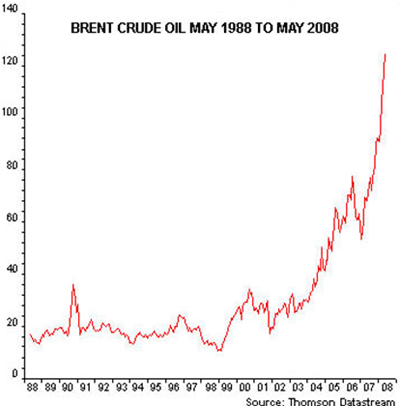
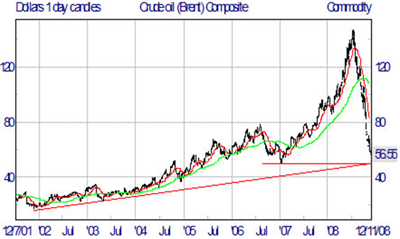
    May 2008 brought with it the highest price on record for Brent Crude Oil – $148 per barrel. At the pump that translated into prices in excess of $4.00 per gallon. A sixteen gallon fill-up of a Toyota Prius in Los Angeles cost its owner $72.00 and a fill-up of a twenty-five gallon Cadillac Escalade set its owner back more than $100.00. The largest transfer of wealth in the history of mankind was underway and consumers were feeling the pinch.

    The countries that border the Persian Gulf produce and export 20,000,000 barrels of oil per day. At its peak in May of 2008, the Persian Gulf producers (Saudi Arabia, Iran, Iraq, Kuwait, Qatar and the U.A.E) were receiving $3 billion per day, $90 billion per month and $1 trillion per year in revenues from the industrialized nations of the world, including the EU, North America and, most importantly, the rising powers of India and China.

    These Persian Gulf nations are mostly monarchies controlled by individuals, royal families or at best a few power brokers. American consumers abandoned their love affair with the SUV and Detroit’s assembly lines began to grind to a halt. New car sales which peaked at 17 million units in 2007 plummeted to a rate of 9.2 million within six months. The inventory of unsold vehicles built up and led inexorably to the bankruptcies of Chrysler and General Motors.

    At the same time, the airlines began charging for checked bags and discontinued the ubiquitous bag of peanuts as they reeled under the cost of jet fuel. Bellicose despots in oil rich lands outside the Middle East used their new found wealth to rattle their sabers. Russia, the world’s second largest oil producer after Saudi Arabia, began flying their venerable Backfire bombers to the American coast. Hugo Chavez of Venezuela, the world’s ninth largest oil producer, used his oil wealth to turn himself into an icon of the anti-gringo sentiment always beneath the surface throughout Latin America.

    Politicians, who placed America’s coastline off limits for drilling, were forced to recant their precious moratorium under the growing chorus of “Drill here and drill now”. Environmentalists, who destroyed the nuclear power industry with fearmongering over its safety, were increasingly on the defensive. T. Boone Pickens invested millions of his own money to promote wind farms – and more importantly natural gas – across America’s heartland. Sales of little known Jatropha seeds, a plant indigenous to India that produces an oil clean enough to run a diesel engine, skyrocketed. By the fall of 2008, the financial markets were buckling under the strain.

    As the economies of the world contracted, demand for oil plummeted and the price of crude collapsed. Terrified by the apparent mismanagement of the economy by the Republicans, Americans elected an untested junior Senator to the most powerful position in the world. Predictably, plans for alternative energy withered as prices plummeted and gas dropped to $1.50 per gallon. Russia, whose cost to develop crude is $50 per barrel, lost its swagger as its currency and stock market collapsed with the price of crude. The collapse of oil to $35 per barrel even silenced Hugo Chavez, at least for a moment.

    Sadly, the America public lost interest in energy as they were distracted by a 40% loss in their 401ks, corporate bankruptcies and the growing numbers of lay-offs. Politicians quickly shifted their focus from drilling, nuclear energy and independence from imported oil and began espousing the Obama administration mantra of “green energy” and “green collar jobs”. Unfortunately, these words are just a chimera since they are likely, even with massive subsidy, to produce only a small fraction of the nation’s energy for at least decade or two.

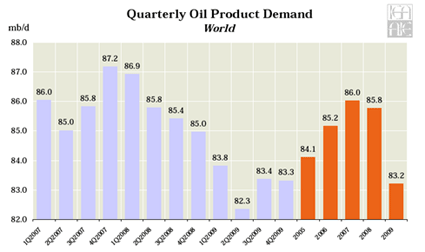
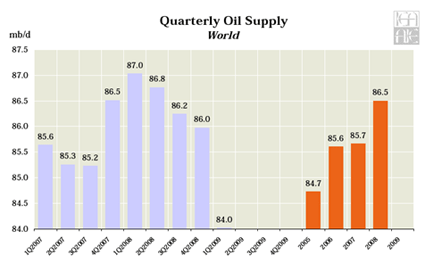
    These ephemeral goals only mask the real problem: America’s dependence on imported oil. The world demand for oil averages 85 mbd (million barrels per day). In the darkest days of the global financial crisis during the spring, when we stood at the abyss of The Great Depression, demand dropped to just 82.3 mbd. Conversely, world oil supply peaked at 87 mbd in 2007. This relative parity between supply and demand eliminates the elasticity that puts some control on prices. With literally no elasticity, speculators know that buyers will purchase every barrel of oil and prices rise. The proof of this market force is visible at the pump where gasoline has crested $3.00 per gallon in California and more than $2.66 per gallon nationwide. The United States consumes 20,000,000 barrels of oil per day or 24% of the world’s supply. In previous decades this was not a problem because the United States was a major producer of oil. But our peak production was reached in the 1970s when the US imported just 35% of its oil. Today we import more than 66% and no longer can influence the price of black gold. That price is now determined by despots in the Persian Gulf, Russia and Venezuela.

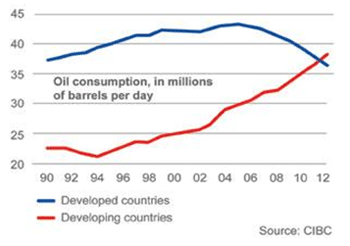
    This problem is not going away soon. According to the Energy Information Agency of the U.S. Government, the world demand for oil will require an additional 44 million barrels of oil every day to meet projected demand. The increase of demand is not going to come from the American or European markets. The developed nations through conservation, fuel standards, a reinvigorated nuclear power industry and, over time, the push for alternative fuels will actually reduce their consumption over the next twenty years. The push will come from India, Russia, Brazil, and of course China.

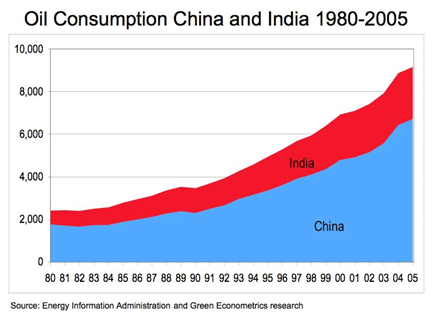
    India, with a population over one billion, has announced its version of the Interstate Highway System that opened America to its great Middle Class. After the acquisition of Jaguar and Land Rover, Tata Industries has begun production of the Nano, a car that sells for $2,000 in India. The demand for oil to power the cars for an educated and increasingly affluent Indian society will keep pressure on oil prices for years to come. India uses just 2.7 mbd today but expects that demand to grow to 4.5 mbd by 2030.

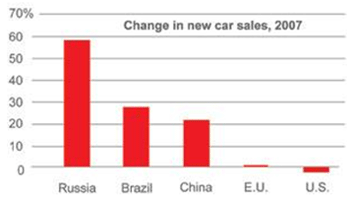
    There are now more than a billion Chinese. China consumed just 2 mbd of oil in 1990. Oil consumption jumped to 7.6 mbd in 2007 and is projected to grow to 15 mbd in 2030. The Chinese automobile industry grew at 21% last year while the US auto industry contracted by 40%. China displaced Germany as the third largest auto producer and will soon eclipse the damaged US auto industry which is contracting to a mere shadow of its former self. Chinese brands such as Chery and Geely, unknown to American consumers, may soon become as well known in America as Nissan or Hyundai.

    Demand will push oil over $100 barrels again. Vast capital will pour into the Persian Gulf, Russia and Venezuela once again. Into this tempest comes America with a thirst for 20,000,000 barrels each day. The major oil producers in the Middle East, Russia and Venezuela are not America’s friends. Russia will use its oil wealth to thwart the US and veto in the United Nations any effort to subdue the North Koreas and Irans of the world. China, with its surplus of US dollars, will continue to harvest natural resources around the world, and forge strategic alliances with the likes of Iran as it secures the flow of oil and natural resources to its industries for years to come.

    Meanwhile our politicians ignore our growing dependence on unfriendly nations and our weakening credit rating in the world to chase the chimera of green collar jobs and a green economy. Wind and solar will never power more than a minuscule fraction of America’s engines. America needs the equivalent of the Apollo moon project, a national challenge to move America off its dependence on foreign oil. We need simultaneous development of domestic oil and natural gas drilling, nuclear power, development of hydrogen fuel cells and clean coal technologies along with wind and solar power plants.

    A year from now the landscape of America will be forever changed. Five years from now, will American find the fortitude to grasp its energy independence? Or will our weak politicians in both parties keep their heads buried in the sand until China and India emerge to deny us what we are no longer in a financial position to demand?

    ***********************************

    This is the third in a series on The Changing Landscape of America. Future articles will discuss real estate, politics, healthcare and other aspects of our economy and our society. Robert J. Cristiano PhD is a successful real estate developer and the Real Estate Professional in Residence at Chapman University in Orange, CA.

    PART ONE – THE AUTOMOBILE INDUSTRY (May 2009)

    PART TWO – THE HOMEBUILDING INDUSTRY (June 2009)

  • Why Attitude Matters: How Nebraska is Reaping the Stimulus

    In what are tough times for most states, conditions for business remain surprisingly good in Nebraska. Like other states in the “zone of sanity” Nebraska is especially supportive of small businesses.

    Nebraska is one of a series out of mid-American outliers. In 2008 – a year of a severe national contraction – the state experienced a 3.6 percent growth in gross domestic product. Its current unemployment rate of just 4.4 percent stands at less than half the U.S. rate of 9.4 percent (latest available from Bureau of Labor Statistics).

    The state itself is in good financial shape, with a cash reserve over $500 million (including a $20 million to $30 million operating surplus every year since 2001). I believe there are two important factors fundamental to Nebraska’s health. The first lies in cooperation across levels and borders – which was described in my piece on regional cooperation in the Omaha World-Herald. This positive attitude toward growth and economic development in Nebraska extends through every level – you find it at the state, regional, county and city level. A supportive attitude toward development plays an important role in making things work.

    The second and perhaps more important factor critical to fostering an environment supportive of growth and prosperity lies with a broad acceptance of the benefits of on-going economic development as a source of continued quality of life. This attitude can be described – as opposed to the traditional NIMBYism seen so often in more crowded, coastal states – as “Yes, In My BackYard” or YIMBYism. Nebraska has pockets of pro-development populations, like Sarpy County, on the southern border of the city of Omaha.

    Before moving to Omaha, my business was based in Santa Monica, California. With a population of about 89,000, Santa Monica is a beautiful city consisting of smart people who often make foolish choices. Many residents in Santa Monica, like those in Portland and other NIMBY-areas of the country, oppose development in their neighborhoods.

    Many who live in million-dollar single-family homes in Santa Monica were opposed to building new middle-class jobs and homes in their neighborhood, although they often favor building homes for the poor, albeit somewhere not in their bailiwick. This promotes a “haves versus have-nots” social order, and also doesn’t make sense from a personal point of view. Whenever the growth debate was on the table (which it often is in Santa Monica), I would tell people, “Wouldn’t you like to build jobs and housing so your children can work and live in Santa Monica, too? Do you want your grandchildren to move to Texas? Because I assure you they are building middle-class jobs and housing in Texas.”

    In contrast I’ve found some pro-growth Nebraskans who relentlessly seek making development happen. For the mayors of the United Cities of Sarpy County, the emphasis is on cooperation as a path to success. Recent developments around my adopted hometown of Bellevue, Nebraska – home to Offutt Air Force Base and U.S. Strategic Command – provide a simple, straight-forward example of how YIMBYism works in practice.

    About seven years ago, the City of Bellevue, along with the Bellevue Chamber of Commerce, funded an economic development plan that could be used to set a community agenda for growth. The resulting plan highlighted several locations where development was feasible, desirable and likely to lead to greater growth. One of the initial designated areas is a 6.5 mile corridor along Fort Crook Road. “Fort Crook Road,” says Megan Lucas, President of the Bellevue Chamber of Commerce, “is the spine of Bellevue. Other nodes of economic development will fill-in around Fort Crook when it is ready to move forward.”

    The City and the Chamber then devised a development plan specific for the Fort Crook Road Corridor. The Fort Crook Road Plan was approved as part of a new comprehensive plan for City development – with zoning updated to accommodate retail development along the entire length. The long-range plan is to shift the road west, closer to an existing active railroad line, and to create a linear park along the median strip to connect two existing trail systems – the Lewis & Clark in the north and the Bellevue Loop of the Keystone Trail on south end.

    Two points make this specific example interesting. The foresight in developing the comprehensive plans for the area positioned it perfectly for the current environment. A good chunk of the Fort Crook Road Corridor is currently occupied by an abandoned concrete production facility. These blighted structures need to be demolished to get the property ready for development. But since the City already owns the property and a comprehensive development plan is in place, the project is “shovel ready” – those magic words that qualify any development project for federal stimulus funding under the American Recovery and Reinvestment Act of 2009.

    In contrast, there are hundreds of worthy projects in every state that will not qualify for Stimulus money because they fail to meet the “shovel ready” requirement. Part of the Fort Crook Road Plan made it through the initial review stages for stimulus funding in Nebraska. The project ranked in the top three in the state for eligibility and suitability. According to Mayor Ed Babbitt, some stimulus funding has been allocated to revise traffic signals in the corridor; funding to remove blighted structures will likely come later this year from an environmental clean-up fund.

    The second point that makes the Fort Crook Road Corridor an interesting example is that one of its biggest proponents – Megan Lucas – lives in the Corridor. The development and expansion of Fort Crook Road is in her backyard. She and many other residents in Bellevue are saying, “Yes, In My Backyard.” Even more recently, three cities in Sarpy County vied to be the location of a Triple-A ballpark to be built in cooperation with the Omaha Royals of the Pacific Coast League. YIMBY-ite residents far out-numbered the NIMBY-ites at every public forum on the choice of location. A positive attitude toward economic development has emerged as a major factor in getting ready for the stimulus – something many in the Obama bastions in the blue states might want to consider.

    Susanne Trimbath, Ph.D. is CEO and Chief Economist of STP Advisory Services. Her training in finance and economics began with editing briefing documents for the Economic Research Department of the Federal Reserve Bank of San Francisco. She worked in operations at depository trust and clearing corporations in San Francisco and New York, including Depository Trust Company, a subsidiary of DTCC; formerly, she was a Senior Research Economist studying capital markets at the Milken Institute. Her PhD in economics is from New York University. In addition to teaching economics and finance at New York University and University of Southern California (Marshall School of Business), Trimbath is co-author of Beyond Junk Bonds: Expanding High Yield Markets.

  • Why The Left Is Questioning Its Hero

    Much has been made by the national media and the markets about the emergence from our desiccated economic soil of what President Obama has called “green shoots.” But although the economy may already be slowly regenerating (largely due to its natural resiliency), we need to question whether these fledglings will grow into healthy plants or a crop of crabgrass.

    The political right has made many negative assessments of the president’s approach, decrying the administration’s huge jump in deficit spending and penchant for ever more expansive regulatory control of the economy. Polling data by both The New York Times and the Wall Street Journal shows some growing unease about both the expanding federal role in the economy and the growing mountain of debt.

    But this conservative critique, which includes sometimes shrill accusations of nascent “socialism,” isn’t the most important counter to Obamanomics. Perhaps more on point – and politically risky for the administration – are criticisms coming from his supposed bedfellows further to the left.

    One recent example comes from a new report issued by my old colleagues at the liberal-leaning New America Foundation called “Not Out of the Woods: A Report on the Jobless Recovery Underway.” It amounts to a blistering, if largely unintentional, critique of the administration’s policies, providing a sobering antidote to manufactured euphoria peddled by both presidential spin-meisters and some Wall Streeters.

    The report baldly asserts that the president’s programs are simply not sufficient to make up for a “huge job creation deficit” that is getting worse by the day. It estimates the country needs to generate 125,000 or more new jobs a month just to keep pace with population growth – something few see happening for at least several years.

    Even with little immediate hope for such employment gains, the report does cite government and private-sector projections of upward of 10% unemployment well into next year. More worrisome still, the authors assert that the administration’s current program is unlikely to create a return to a “normal” level of joblessness – to between 4% and 5% – until after the president’s first term.

    The New America report then goes on to make some even scarier observations. It claims unemployment rates are far higher in reality than official statistics reveal, citing calculations by Chairman of New America’s Economic Growth Program Leo Hindery of what they call “effective unemployment.” This also includes the millions now working part-time but seeking “full-time and productive work.”

    Hindery is no conservative. He was an adviser to John Edwards and, more recently, to the president himself. Yet his prognosis is grimmer than the ones offered by most right-wingers. He calculates that the real unemployment rate in the country last month was not 9.3%, which is the figure that was reported, but rather closer to an alarming 16.8%. By that measure, more than 30 million people are effectively out of work. That’s nearly one-fifth of the labor force.

    Given current economic policies, the report suggests, we can expect “a six-year recovery for what has been to date only a year-and-a-half recession.” Hiring by government and green industries are clearly not going to make up for the massive losses in productive sectors like manufacturing, business services, energy and agriculture.

    Against this grim background, the president’s program seems inadequate and even chimerical. To be sure, the massive bailout of institutions such as the big banks – as well as Chrysler and General Motors – has provided some reassurance to Wall Street that paper assets may continue their recent upward climb.

    Yet that will do precious little to make a dent in unemployment elsewhere in the economy. Treasury Secretary Timothy Geithner, chief economic guru Larry Summers and others might see “green shoots” for investors, but those could turn out to be more like crabgrass for the rest of us.

    In fact, finance is surviving the recession remarkably unscathed. Just compare the numbers. Since 2007, manufacturing (and other blue-collar-dominated sectors) lost 13% of its employment, while construction payrolls have plunged over 16%. Meanwhile, finance, the industry arguably most responsible for the economic meltdown, has dropped a mere 5% of its jobs. Today unemployment in the financial sector stands at less than 5%, compared with nearly 20% in construction and over 12% for manufacturing.

    So as hundreds of thousands of construction and factory workers are being sacrificed, many grandees of finance – like top executives of Bank of America and Citigroup – remain in their plush perches. Even proven financial demolition experts like Mark Walsh, who led Lehman Brothers’ disastrous march into toxic properties, are now being paid to clean up the mess they so brilliantly created.

    No wonder some factions of the left are becoming uneasy with their hero. Some privately admit that the administration – despite its pro-middle class rhetoric – has adopted an economic program that makes Ronald Reagan seem like the vox populi. One wonders how they will react later this year, when continued high unemployment meets massive, perhaps even record, Wall Street bonuses.

    This state of affairs, as the New America report correctly suggests, does not lead us down a path toward “a strong and sustained recovery.” Clearly, we need something more. For one thing, the country needs to reassert its ability to produce more of what it consumes. (See Joel Kotkin’s earlier column, “We Must Remember Manufacturing.”)

    Others on the left are also making this point, perhaps none more effectively than an article in the Nation called “The Case for Kenosha.” The piece, in short, skewers the Obama administration’s manhandling the auto industry and manufacturing sectors. It accuses Obama of taking the old industrial belt on a “wild ride” that will lead to more plant shutdowns and increased outsourcing to foreign factories. “With ‘fixes’ like these,” the article states, “it’s hard to imagine how Obama plans to fulfill his campaign promise to ‘revive and strengthen all of American manufacturing.’”

    This is not to say that the entire left side of the political spectrum opposes the administration’s economic policy. There is now more than one left in this country, and the gaps between these lefts are every bit as wide as those between, say, small-government libertarians, social conservatives and messianic global interventionists.

    To date, the administration has listed toward the agenda of what may be best described as the left’s gentry wing. These include activists at universities, urban planners and liberal nonprofits, many of whom see in Obama’s pro-green policies and multicultural agenda the fulfillment of their long-time fantasies.

    This, at times, puts them at odds with large parts of the middle- and working-class base of the Democratic Party. The administration’s plans to”coerce” people out of their cars for the alleged good of the environment probably does not offer much “hope” for those working at auto plants. Highly dependent as they are on stocks and asset inflation for their income, the gentry are not likely to object to the administration’s coddling of large financial institutions.

    Then there is the party’s populist contingent, whose inspiration comes more from FDR and Harry Truman than from the likes of Barney Frank and Nancy Pelosi. They are less likely to see much of a difference between a Timothy Geithner or a Hank Paulson. To them, the two Treasury secretaries have both been useful servants for the nation’s “economic royalists.”

    Of course, most conservatives might despair over the populists’ tendency to embrace statist solutions to our economic problems. But would-be inheritors of the Reaganite mantle should at least sympathize with their goal to restore broad-based upward mobility and close-to-full employment. Indeed, if the Republican Party figures out how to take command of the issues like job creation and social mobility, they could even become relevant once again.

    Right now, though, critiques from the left may be more effective than yammering from the still-clueless right. The president knows that talk of green shoots makes people and markets feel better. But unless those shoots show some staying power, the long-term economic consequences – and ultimately political ones, too, for the president and his party – could prove unwelcome indeed.

    This article originally appeared at Forbes.

    Joel Kotkin is executive editor of NewGeography.com and is a presidential fellow in urban futures at Chapman University. He is author of The City: A Global History. His next book, The Next Hundred Million: America in 2050, will be published by Penguin early next year.

  • Smart Growth Bill Vetoed

    Texas Governor Rick Perry has vetoed a bill that would have created a state level “smart growth” program. The veto message is below.

    June 19, 2009

    Pursuant to Article IV, Section 14, of the Texas Constitution, I, Rick Perry, Governor of Texas, do hereby disapprove of and veto Senate Bill No. 2169 of the 81st Texas Legislature, Regular Session, due to the following objections:

    Senate Bill No. 2169 would create a new governmental body that would centralize the decision-making process in Austin for the planning of communities through an interagency work group on “smart growth” policy. Decisions about the growth of communities should be made by local governments closest to the people living and working in these areas. Local governments can already adopt “smart growth” policies based on the desires of the community without a state-led effort that endorses such planning. This legislation would promote a one-size-fits-all approach to land use and planning that would not work across a state as large and diverse as Texas.

    IN TESTIMONY WHEREOF, I have signed my name officially and caused the Seal of the State to be affixed hereto at Austin, this the 19th day of June, 2009.

    RICK PERRY
    Governor of Texas

    Reference: http://governor.state.tx.us/news/veto/12632/

  • On Our Knees: Prince Charles vs. Lord Rogers

    It is no wonder that architect Richard Rogers is feeling a bit peeved at Prince Charles. This month, the heir to the British throne scuppered plans for a £1 billion development putting 552 apartments on the 12.8-acre site of the old Chelsea Barracks. Rogers was most offended that the Prince used his Royalty to by-pass the usual planning law consultation, by speaking direct to the Qatari royalty who owned the site.

    This is not the first time the heir to the throne has acted as Lord High Planner. Twenty five years ago, he threw a hissy fit about a modernist, hi-tech tower development planned on the national gallery. It was created by the firm Ahrends, Burton and Koralek – but inspired by a Rogers’ design. His sub-majesty called it a ‘monstrous carbuncle’ on the face of a much loved and elegant friend (his ancestor predecessor William IV had a lower opinion of William Wilkins late classical design – ‘a nasty pokey little hole’). He got his way, then, and a pseudo-classical outgrowth was manufactured by Robert Venturi.

    Just a month ago, Charles was asked back to the Royal Institute of British Architects, where he first made the ‘carbuncle’ attack, and even apologised, half-jokingly, promising not to set off another debate about modernist versus traditional architecture. But word had already got out that he was going to sabotage the Chelsea Barracks development.

    Charles’ has been dogged, or perhaps the word is better dogmatic, in his interest in architecture and planning. Out in Dorchester, on land owned by the Duchy of Lancaster (that’s Prince Charles, to you and me) he constructed a weird dreamscape of a village called Poundbury, wholly built according to the Prince’s own ideals, of tradition, community and high density dwellings, designed by the new urbanist Leon Krier. It is full of desperately traditional motifs, like a film set, and it is supposed to be built to dissuade car use (though according to a recent survey, resident are above average car users).

    Richard Rogers has dared break ranks with the Prince publicly over his busy bodying. Rogers makes some excellent points. The Prince is but a man, amongst many: why should he have more say so than anyone else? The Prince will not debate his views, so why should he be allowed this influence on political choices? Even moderate constitutionalists agree that the Royalty enjoys its formal position as head of state (which Charles will become, if his mother Queen Elizabeth dies) on the condition that they keep out of day-to-day politics.

    One person who put some real flesh on the bones of Rogers’ complaints has been Vicky Richardson, the editor of the architecture magazine Blueprint. When Charles stood to address the Royal Institute of British Architects, she shouted out ‘abolish the monarchy’, a cry that was perhaps a bit too plebeian for Richard Rogers.

    Rogers is the last person to be telling us that we should not fawn to established authority. Let me spell it out for you. This is no plebe; it’s Sir Richard Rogers, Baron Rogers of Riverside, a peer of the realm. In 1991, Rogers, in an act of fealty, bent down on one knee before the Queen, to be made a knight. In 1996, he was made a Baron, and sits in the unelected House of Lords (on the Labour benches). Quite why Rogers thinks he is free of the oaths he made to protect the Queen – and consequently her progeny – is not clear.

    Richard Rogers’ leaning on the Royal brand when it suits him is not the end of his fixation with authority over the common people. Though he pressed a few demotic buttons when he turned on Prince Charles, there was a weird undercurrent of superiority in his complaints. Prince Charles is not an expert he was keen to say. Charles has no expertise in architecture … unlike Richard Rogers. It was quite a snooty put down to place on a soon-to-be King.

    Rogers went further, asking whether things ought to be changed, so that the unspoken rule that the monarchy stay out of everyday politics might be shored up. Indeed, Richard Rogers called for a panel of constitutional experts to re-examine the Prince’s powers. ‘A panel of constitutional experts’? Who are these ‘experts’ that know better than the rest of us how the United Kingdom ought to be run? A committee of the House of Lords, perhaps?

    At the heart of Richard Rogers case against the monarchy is not an argument for the people against entrenched authority. Rather, it is an argument for a new elite to take over – ‘experts’ (so-called), technocrats, people like Rogers himself, who know better than the rest of us how we should live.

    In real fact, Rogers may be even more a throwback to medievalism than the Prince. Rogers’s Chelsea Barracks development has been attacked for being too ‘modern’. But the row is cast in terms of traditional versus modern, because in many ways, Rogers plans are more backward looking that Charles’s.

    One feature that lies behind the many complaints that preceded Charles’ intervention is the density of the development. Originally planned for 638 flats, the developers were persuaded to reduce the number and increase the open space from two to 6.2 acres.

    Local people resent more bodies being crammed into an already overcrowded, teeming and increasingly dehumanized London. In this process, Rogers is far more a villain than the unlikable Prince. In 1998 his government appointed Urban Task Force saddled planning authorities with the principle that most new development would take place on ‘brownfield’, that is previously built-upon land, not newer greenfield sites out in the country.

    This is almost something out of apartheid or the 19th Century enclosure acts. The policy is to keep Londoners kettled up behind the Green Belt, telling local authorities to keep filling in every patch of land that becomes available with extra housing, densifying the city. Ironically, the Prince entirely agrees with Rogers on the need for densification – but at least he prefers something more humane, like a nice cottagey feel, and some old stonework.

    The ‘urban nimbys’ who objected to the Chelsea barrack development are a new thing. In north London, residents protested against an apartment block squeezed into a space that used to be garages at Pilgrims Way. Under the regional plan, drawn up on rules laid out by Baron Rogers, local objections have no purchase, because the overriding goal is cramming: forcing ever more people in a fixed amount of space. That is why Rogers is so angry with the Prince. Rogers has the planning approval all sewn up. Because his development offers the highest density, it ticks all the right boxes as far as the planners are concerned. But for residents, looking at results of cramming on their already limited space, 500 new flats squeezed in does not look so good. They have a right to object, but the plan – blessed by the experts, knighted and not – trumps their objections.

    Rogers objects that the Prince is using his hereditary power. But what makes Rogers so cross is that he is accustomed to exercising unchecked and undemocratic power to get his own way. He cannot quite believe that there might be a greater unelected power in the land than his own.

    The fact is the so-called great are only great because we are on our knees, said the Irish rebel James Connolly. It is time the British stood up and kicked both of these unelected overlords out, whether to the manor born or entitled by their “expertise”.

    James Heartfield is author of Let’s Build! Why we need five million homes in the next ten years, and a director of www.Audacity.org.

    Image courtesy of Henry Bloomfield