Category: Politics

  • Project Development: Regulation and Roulette

    The site plan logically should be the key to approval of a development project. Yet in reality, the plan is secondary to the presentation. My conclusions are based upon experience with well over a thousand developments over four decades, most in the mainland USA. And what I’ve observed is that the best site plan is only as good as the presentation that will convince the council or planning commission to vote “Yes” on it. No “yes” vote, no deal, no development.

    Each presenter deals with the dog-and-pony show in his own way. There’s an endless variety of styles (or lack of styles). All of these public meetings have one thing in common: The neighbors (if there are any) will be there to oppose the new development.

    Not Too Long Ago…
    In the old days there were three factions: The developer presenting the plan, the neighbors opposing the plan, and the council listening to both sides. If the development was high profile, someone from the local press might also show up. The planning commission and council are fully aware that all plans will be met with neighborhood opposition, and they will have to listen to lengthy complaints along the route to approving (possibly) the plan.

    In the past, the citizens sitting on these boards would most likely dismiss Elwood and Betsy Smith’s complaint about how a development in their back yard would invade their privacy, and would vote in favor of the new master planned community instead.

    How It’s Different Today
    Today there is often an additional audience. Televised meetings provide an entire region of neighbors. The on-screen council listens to the neighbor’s objections, no matter how absurd they may be, then answers directly to the camera, showing the general community watching at home that they really care about every citizen’s opinion. The council member must never appear too much in favor of the developer, as that could be misconstrued as not caring about the citizens he or she represents. A televised Council member hears the Smith’s complaint with a very concerned on-camera look, explains how maybe we have too many new homes in this town, and proceeds to tell viewers that the developer might want to consider a buffer and a drop in density. Concerns have changed from developing economically sensible neighborhoods to “please elect me Mayor when I’m on the ballot”.

    Planning Outside The USA
    Our first large site plan done outside the States was in Freeport, Bahamas. In 2000, when we were first contacted to design Heritage Village, we asked about doing presentations to the city council and planning commission to help move the approval process along. We were told that the development company and the regulating entity were the same, and if they liked the plan it would be built! That is exactly what had happened.

    Our next attempt outside the USA was not so easy. In Mexico City when we asked to sit down with government officials to change policy to create better neighborhoods, the developer said… No. At the time, we did not understand why it was so critical that we were not to suggest changes.

    We Discover A Superior Foreign System
    We wrongly assumed that all planning outside the USA could have similar problems, with restrictions that were absurdly prohibitive for designing great neighborhoods. It was only when we worked in Bogota, Columbia last year that we had the opportunity to work within a system that may not be so backwards after all. Our request to meet with the authorities to show them new ways to design neighborhoods was met, as it had been in Mexico City, with an absolute… No.

    We then asked for an opportunity to present the plan, and were told that was not necessary. Being that it was Columbia you can imagine our first thoughts. Cartels? Maybe corruption? The reality was much simpler. Since our plans met the minimums (they actually exceeded them), they were automatically considered approved. Imagine that – no neighbors to complain! If everything conforms, it should be approved … right? Just plain common sense.

    Zoning-Compliant Projects Should Be Exempt From Public Meetings
    When you think about it, why wouldn’t this work in the USA? if the development plan being submitted meets or exceeds the zoning and the subdivision regulation minimums, why does it need to go through any public approvals at all? The American developer often faces months or years of delays, enormous interest payments, and tens or perhaps hundreds of thousands of dollars spent on consultants and legal help to re-create plans that conform. Those massive sums could go towards making better neighborhoods, better architecture, better landscaping, less environmental impacts, and more affordable housing.

    We’d Still Need Public Meetings
    The public would still have plenty of input on regulation and zoning exemptions, where public citizen input is valuable. If a developer is proposing something that goes below minimums or does not conform to zoning regulations, then it is reasonable to go through the more time consuming process that we currently have. This brings up the question of how the developer would introduce something different to the written law. This could be a problem under typical PUD (Planned Unit Development) regulations, which typically allow blanket changes to the minimums when alternative designs are not covered by typical zoning.

    This PUD Pandora’s box, once opened, can have devastating results if the regulators and the neighbors both agree that the plan is simply not good enough. The developer thinks the plan is just dandy as is, but in reality most PUD proposals are simply too vague to be functional. A battle of wills that can last years often ensues.
    In the end , these expensive delays increase lot costs, and the home buyer ultimately pays. If a special ordinance such as PUD, Cluster Conservation, or Coving was specifically spelled out in a rewards-based — instead of a minimums-based — system, developers could get benefits for great plans complete with open space and connectivity, typically density and setback relaxations.

    While writing Prefurbia, we began to ask ourselves, how did we take something so simple and let it get so out of control? The third world countries are progressive enough to actually allow developers who comply with the rules to quickly build their neighborhood. Maybe they are not so far behind us after all.

    Perhaps our regulations and planning approach is intended to keep the system “busy” with billable hours. Imagine if we could get a conforming plan stamped, and the next day construction could begin. How many billable hours would be eliminated, how much construction cost and land holding interest saved? That would be very hard to calculate, but it’s likely significant.

    “It is difficult to get a man to understand something when his salary depends upon his not understanding it…” Al Gore, An Inconvenient Truth

    The inconvenient truth won’t win us many friends in the consulting industry whose incomes depend upon generating billing time in meetings. But can we afford to continue down the path we are presently on? We need to take a hard look at the regulations. Are they written solely to provide the highest living standards? Or do they generate the highest billable hours for the consultants who propose them?

    Rick Harrison is President of Rick Harrison Site Design Studio and author of Prefurbia: Reinventing The Suburbs From Disdainable To Sustainable. His websites are rhsdplanning and prefurbia.com.

  • The Changing Landscape of America: The Fate of Detroit

    INTRODUCTION

    During the first ten days of October 2008, the Dow Jones dropped 2399.47 points, losing 22.11% of its value and trillions of investor equity. The Federal Government pushed a $700 billion bail-out through Congress to rescue the beleaguered financial institutions. The collapse of the financial system in the fall of 2008 was likened to an earthquake. In reality, what happened was more like a shift of tectonic plates.

    In 1912 a German scientist, Alfred Wegener, proposed that the continents were once joined together as one giant land mass called Pangea.

    About 200 million years ago the continents began to drift apart as the globe separated into eight distinct tectonic plates. History will record that the financial tectonic plates of our world began to drift apart in the fall of 2008. They have not stopped moving and the outcome of where they will end up remains uncertain.
    PART ONE – THE AUTOMOBILE INDUSTRY

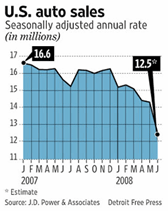
    Edsel, Packer, Studebaker, Hudson, Nash, AMC – the demise of these brands may have seemed tragic at the time, but were actually a sign of industrial health. In contrast, for the last fifty years the American automobile industry has been static. Despite the proliferation of Japanese, Korean and German imports, General Motors, Ford and Chrysler managed to hold on to a majority of the domestic market, with a dizzying stable of makes and models that grew to near 17 million new car sales in 2007. That epoch is now over. The tectonic plates have shifted under the automotive business and a year from now, the industry will bear little resemblance to the static structure of the last fifty years.

    Fifty years ago General Motors owned more than 50% of the American market and automobile jobs made up one seventh of the US workforce. It was said that when GM sneezed the US economy caught a cold. GM shares now sell for less than a cup of coffee at Starbucks. Now GM is about to enter bankruptcy.

    The brands are dissolving, Oldsmobile was the first casualty. Pontiac and Hummer have been discontinued. When they reorganize, eleven hundred dealers will be terminated. General Motors will close all its plants for three months this summer. Many will never reopen. The New GM, to be known as Government Motors, will be owned by the UAW (20%) and the Federal Government (70%). Twenty billion of tax-payer loans will be converted to ownership to make the UAW pensions liquid. The debt holders will see their senior $27 billion investment converted into just 10% of stock. The shareholders will be wiped out.

    The New GM will become the platform for small fuel efficient cars, hybrids, electric vehicles and experimental technologies mandated by an ever demanding government. Its shareholders vanquished, The New GM will bear no resemblance to the car company that we have known for the last 50 years. Can the Chevy Volt rescue GM? The answer is no.

    GM will continue to shrink as their SAAB and Saturn franchises are sold off to the Chinese. China’s automobile sales are up 10% this year versus declines of 23% in the US and 15% in Europe. Chinese automobile manufacturers are grabbing market share, 30% this year versus 26% in 2008, while their competitors are distracted. Chinese companies unknown to Americans like Geely Motors, Chery Automobiles or BYD Co. will buy SAAB or Saturn for their dealer network. Warren Buffett invested $230 million into BYD, a firm that has been manufacturing cars for just six years. They already provide batteries to Ford and GM and soon will be building the world’s least expensive mass produced hybrid and electric vehicles. Geely plans to triple its domestic sales to 700,000 by 2015 and Chery plans to introduce 36 new models over the next two years.

    Chrysler is in far worse shape and will likely never recover. The Federal Government already forced it into bankruptcy. Seven hundred and eighty nine dealers have been told that their franchises are terminated. Its shotgun marriage to Fiat will look more like a surgical amputation of unnecessary body parts than a marriage. If Fiat remains in the game, they will do so for the Jeep brand and a portion of the dealer network. Like Oldsmobile and Pontiac, Plymouth and Dodge brands are doomed as well as most of the Chrysler line. No one will mourn the demise of the Crossfire, Pacifica, Sebring, or the PT Cruiser. Fiat should keep the new Chrysler 300, a beautiful design that deserves to be built. Chrysler has not produced many stars in the last few decades. The trail blazing design of the 300 brought the full size sedan back from the dead.

    Chrysler will jettison the weakest of its dealers in bankruptcy. Fiat will retain the big dealers in the network. They will bring the stunning and iconic Fiat 500 to America, a fuel efficient small car that will enjoy the same success as Volkswagen’s retro Beetle. Fiat will also use the dealer network to bring the Alfa-Romeo back to America. The Fiat-Jeep-Alfa dealer of the future will bear no resemblance to the staid Chrysler-Dodge-Plymouth dealer of today.

    The surprising winner among the American troika of manufacturers is the Ford Motor Company. Ford and Lincoln will survive because they took no government bail-out money. Mercury may not survive but Ford and Lincoln should make it through the transition. The new Ford-Lincoln will be the refuge for auto enthusiasts who want attractive fast and powerful cars. Ford will become the Apple of the auto business, doing its own thing and flaunting political correctness and conventional wisdom. Ford’s namesake CEO has been an environmentalist for many years so Ford was well into fuel economy and hybrids before the tectonic plates began to move last fall. At just $5.00 per share, Ford is a tantalizing buy for the long term.

    One can no longer call Mercedes, BMW, Toyota and Honda imports as many of their cars are made entirely in the U.S. The Japanese system is different than the American counterpart although we are drifting toward their model. The Japanese government plays a heavy hand in their industry, subsidizing the encroachment into new markets until the brands have stabilized market share. But they are not immune. Toyota lost $7.7 billion in the last quarter – even more than GM.

    True imports like Volkswagen will weather the storm because they were well positioned with small fuel efficient cars long before the tectonic plates began to shift. VW is making a huge bet that oil will top $100/barrel again soon and their fuel efficient and clean diesels will be accepted by American drivers.

    The biggest winner is obviously the UAW and their pensions which have been bailed out with tax payer money by an administration beholden to its labor supporters. Who will be the biggest loser? Clearly, it will be America’s small towns. Our small towns will lose their local dealer and their choice in automobiles. They will be forced to buy the brand that remains in town or drive scores of miles to the next closest dealer for service. Most small town auto dealers were also the most generous members of the community. Charitable giving and support will wither as will local sales tax revenues when the big ticket automobile sales tax revenues disappear. Ironically, as the plates continue to shift, America’s small towns could be decimated by the changes in the automobile industry as they were one hundred years ago when the automobile shifted millions from rural communities to the cities.

    A year from now the landscape of America will be forever changed but the plates will continue to shift. Five years from now, will American ingenuity bring about a renaissance of the American automobile industry? Or, will what is left of this industry be gobbled up by the Chinese and the Korean manufacturers as the Japanese did in the 70s and 80s? The key issue may be what role the government will play. Will Americans buy cars designed by government bureaucrats and built by the unions that own the factories? Will an administration devoted to “coercing” Americans out of their cars be able to simultaneously save the auto industry?

    ***********************************

    This is the first in a series on the Changing Landscape of America. Future articles will discuss real estate, politics, healthcare and other aspects of our economy and our society. Robert J. Cristiano PhD is a successful real estate developer and the Real Estate Professional in Residence at Chapman University in Orange, CA.

  • Can California Make A Comeback?

    These are times that thrill some easterners’ souls. However bad things might be on Wall Street or Beacon Hill, there’s nothing more pleasing to Atlantic America than the whiff of devastation on the other coast.

    And to be sure, you can make a strong case that the California dream is all but dead. The state is effectively bankrupt, its political leadership discredited and the economy, with some exceptions, doing considerably worse than most anyplace outside Michigan. By next year, suggests forecaster Bill Watkins, unemployment could nudge up towards an almost Depression-like 15%.

    Despite all this, I am not ready to write off the Golden State. For one thing, I’ve seen this movie before. The first time was in the mid 1970s. The end of the Vietnam War devastated the state’s then powerful defense industry, leaving large swaths of unemployment and generating the first talk about the state’s long-term decline.

    An even scarier remake came out in the 1990s. Everything was going wrong, from the collapse of the Soviet Union and the unexpected deflating of Japan to a nearly Pharaonic set of plagues, ranging from earthquakes and fires to the awful Los Angeles riots of 1992.

    Yet each time California came roaring back, having reformed itself and discovered new ways to create wealth. In the wake of the early ’70s decline came the first full flowering of Silicon Valley as well as other tech regions, from the west San Fernando Valley to Orange and San Diego counties. Much of the spark for this explosion of growth came from those formerly employed in the defense and space sectors.

    The ’90s recovery was even more remarkable. Amazingly, the politicians actually were part of the solution. Aware the state’s economy was crashing, the state’s top pols–Assembly Speaker Willie Brown, Sen. John Vasconcellos, Gov. Pete Wilson–made a concerted effort to reform the state’s regulatory regime and otherwise welcomed businesses.

    The private sector responded. High-tech, Hollywood, international trade, fashion, agriculture and a growing immigrant entrepreneurial culture all generated jobs and restored the state’s faded luster.

    These sectors still exist and still excel even under difficult conditions. The problem this time is that the political class seems clueless how to meet the challenge.

    Politics have not always been a curse to California. In the 1950s and 1960s, the Golden State’s growth stemmed in large part from what historian Kevin Starr describes as “a sense of mission” on the part of leaders in both parties. Starr chronicles this period in his forthcoming book, Golden Dreams: California in an Age of Abundance, 1950-1963.

    Under figures like Earl Warren, Goodwin Knight and Pat Brown, Starr notes, California “assembled the infrastructure for a great commonwealth.” Their legacy–the great University system, the California Water Project, the freeways and state park system–still undergirds what’s left of the state economy.

    Perhaps the best thing about these investments was that they helped the middle class. Sure, nasty growers, missile makers and rapacious developers all made out like bandits–which is why many of them also backed Pat Brown. But the ’50s and ’60s also ushered in a remarkable period of widespread prosperity.

    Millions of working- and middle-class people gained good-paying jobs, and could send their children to what was widely seen as the world’s best public university system. People who grew up in New York tenements or dusty Midwest farm towns now could enjoy a suburban lifestyle complete with single-family homes, cars, swimming pools and drive-through hamburger stands.

    “This was an epic success story for the middle class,” historian Starr notes. It’s one reason why, when people ask me about my politics, I proudly identify myself as a Pat Brown Democrat.

    That’s why California’s current decline is so bothersome. A state that once was home to a huge aspirational middle class has become increasingly bifurcated between a sizable overclass, clustered largely near the coast, and a growing poverty population.

    Over the past 40 years California’s official poverty rate grew from 9% to nearly 13% in 2007, before the recession. Three of its counties–Monterey, San Francisco and Los Angeles–boast large populations of the über rich but, adjusted for cost of living, also suffer some of the highest percentages of impoverished households in the nation.

    Most worrisome has been the decline of the middle–the increasingly diverse ranks of homeowners, small business people and professionals. The middle has been heading out of state for much of the past decade. Politically, they have proven no match for the power of the wealthy trustfunders of the left, the powerful public employee union as well as a small, but determined right wing.

    The good news is that the middle class shows signs of stirring. The nearly two-to-one rejection of the governor’s budget compromise reflected a groundswell of anger toward both the Terminator and his allies in the legislature.

    Simply put, California voters sense we need something more than an artful quick fix built to please the various Sacramento interest groups. Required now is a more sweeping revolutionary change that takes power away from the state’s most powerful lobby, the public employees, whose one desired reform would be ending the two-thirds rule for approval of new taxes and budgets.

    Middle-class Californians are asking, with justification, why we should be increasing taxes–we’re ranked sixth-highest in the nationto pay for gold-plated state employee pensions as well as an ever-expanding social welfare program. Although state spending has grown at an adjusted 26% per capita over the past 10 years, it is hard to discern any improvement in roads, schools or much of anything else.

    As an opening gambit, the right’s solution–strict limits on state spending–makes perfect sense. However, long-lasting reform needs to be about more than preserving property and low taxes. To appeal to the state’s increasingly minority population, as well as the younger generation, a reform movement also has to be about economic growth and jobs.

    Not surprisingly, local leaders of the “tea party” movement gained some profile from last week’s vote. Yet the right, which has exhibited strong nativist tendencies, is not likely to win over an increasingly diverse state.

    In my mind, California’s revival depends on three key things. First, the lobbyist-dominated Sacramento cabal needs to be shattered, perhaps turning the legislature into a part-time body, as proposed by one group. Perhaps the cleverest plan has come from Robert Hertzberg, a former Speaker of the Assembly who heads up the reformist California Forward group.

    Hertzberg proposes a radical decentralization of power to the state’s various regions, as well as cities and even boroughs in urban areas like Los Angeles. This would break the power of the Sacramento system by devolving tax and spending authority to local governments.

    Secondly, California needs to develop a long-term economic growth strategy. Over the past decade, California’s growth has become ever more bubblicious, dependent first on the dot-com bubble and then one in housing. The basic economy–manufacturing, business services, agriculture, energy–has been either ignored or overly regulated. Not surprisingly, we could see 20% unemployment, or worse, in places like Salinas and Fresno by next year.

    Third, both political reform and an economic strategy aimed at restoring upward mobility depends on a revival of middle-class politics in this state. It would include building an alliance between the more reasoned tea partiers and saner elements of the progressive community.

    The new alliance would not be red or blue, liberal or conservative, but would represent what historian Starr calls “the party of California.” At last there could be a political home for Californians who are angry as hell but still not yet ready to give up on the most intriguing, attractive and potentially productive of all the states.

    This article originally appeared at Forbes.

    Joel Kotkin is executive editor of NewGeography.com and is a presidential fellow in urban futures at Chapman University. He is author of The City: A Global History and is finishing a book on the American future.

  • California Meltdown: When in doubt, Blame the Voters!

    By rejecting the complex Sacramento budget settlement, Californians have brought about an earthquake of national significance as has not been seen since the passage of Proposition 13 over thirty years ago. Once again, California voters handed politicians something they fear more than anything else, constraints on the ability to raise taxes and raid revenues for their pet interests.

    Some, like long time Los Angeles Times statehouse reporter George Skelton thinks it’s the voters’ fault, as he suggested in his recent op-ed. The problem, we are told, lies with voters. The state’s massive fiscal crisis, which I and others warned was coming, was apparently unforecastable to California politicians and their enablers, like Skelton.

    Blame the voters will become a large part of the national and local media spin. It is not the first time. Consider Proposition 13. The problems that led up to Prop 13 were years in the making, and they were well understood. Inflation and rising home prices were increasing taxes beyond what citizens were prepared to pay. Sacramento tried several times to address the problem, but then as now, politicians couldn’t make hard decisions. The entrenched interests, notably the public employee unions, would not hear of anything that might shrink state revenues.

    Contrary to some versions of history, Proposition 13 was not backed by oil companies, land developers and other business interests. In fact, most opposed it.

    Proposition 13 backers were outmanned, outspent and certainly without much media support. The measure was passed because after years of incompetence in Sacramento, California voters, like Medieval peasants, grabbed their pitchforks and torches and stormed the castle. They passed Prop 13.

    Some interpret this story as showing voter ignorance and fickleness. I interpret it as showing that California voters are patient, but only to a point. Once they have reached a certain point, California voters take matters into their own hands. The results are invariably far more onerous for the state than if the political class had effectively faced the issue. Part of the reason for this is because the voters have fewer tools available to them. Legislatures and governors may have scalpels, voters have only axes.

    Gray Davis was the victim of a similar uprising. He took the fall for a government that had failed. Arnold was going to be different. He would be the Governator. He won election promising mortal combat with special interests. In 2005, he tried to change things but was outmaneuvered by his union-backed opponents. After losing round one, he became Gray Davis but without his predecessor’s grasp of the essentials of government. As the Sacramento Bee’s Dan Walters has pointed out, hubris and ignorance make a deadly combination.

    Now, we have a budget crisis, and California voters are unwilling to give Sacramento a pass. Why?

    Maybe they don’t think they are getting value for their increased investment in government. California spent about $2,173 per resident (2000 dollars) in the 1997-1988 budget. The 2007-2008 budget spends about $2,738 (2000 dollars) per resident. That represents a 26 percent increase in real (inflation adjusted) per-capita spending in ten years.

    What have California voters purchased with their 26 percent increase in government spending? Are the roads 26 percent better? Are schools 26 percent better? What is 26 percent better?

    That is Sacramento’s problem. It is very hard to identify what good that this increase in spending has purchased. If it has been a good investment, why haven’t California’s leaders convinced the voters?

    Maybe you can make a case that we are 26 percent better off; maybe not. I don’t know, but then I haven’t seen a strong effort to make the case. Instead, we get predictions of doom. We’ll cut back on teachers. We’ll let prisoners out of jail. Skelton says “And, oh yes, the elderly poor, blind and disabled – welfare moms and children’s healthcare? They’ll take the biggest hits, as usual.”

    The problem with predictions of doom is that they don’t ring true, or they sound as if the political leaders will punish voters for forcing the leaders to face a budget constraint. Voters can remember 1997-1998. California had teachers. Prisoners were in jail. Healthcare was provided for those with the least resources. If California had these essential services then, and the State is spending 26 percent more now, why cut those essential services now?

    That is the question the California’s leaders have to answer soon. Today Sacramento faces a crisis. The governor and the legislature will have to deal with a real binding budget constraint, and how they choose to deal with that constraint will make a huge difference. They could show leadership. They could make difficult choices. They could stand up to the special interests that will spare no effort to punish them.

    They may not. They may try to punish voters by cutting essential services. They may try even more Enron-style accounting tricks. They may sell assets or use federal money to push the problem to future legislators and governors. They may make poor choices. They may avoid cutting entitlements and public employee pensions, the real source of the state’s fiscal distress.

    We are heading towards a convulsion, not only here in California but in a host of high-tax, high-regulation states now controlled by their own employees. This includes New York, Illinois, and New Jersey for starters. In the age of Obama, with its celebration of bigger government, this suggests perhaps a whiff of a counter-revolution.

    Bill Watkins, Ph.D. is the Executive Director of the Economic Forecast Project at the University of California, Santa Barbara. He is also a former economist at the Board of Governors of the Federal Reserve System in Washington D.C. in the Monetary Affairs Division.

  • The Twilight of Special Interest Politics

    Special interest groups are the scourge of the common interest, are they not? The Founding Fathers, in The Federalist Papers, recognized the danger posed by “factions,” but assumed that competing groups would keep the balance. They could not have foreseen our current Special Interest State, wherein tens of thousands of special interest groups exert such profound influence on politics, policies and life in the United States.

    Nowhere is this more evident than in California, my adopted home state. In California, as in much of the country, government is forever and hopelessly trapped in interest group politics and therefore, forever large and growing. Interest groups are intractable, in this view, because they are always able to devote more resources to their specific causes and concerns than are any conceivable guardians of the common interest.

    California’s predicament is a perfect illustration of public choice theory, which shows that government will always act in its own interest, interest group politics seem to be the logical and inevitable end-point of democracy. Multiply this process by the tens of thousands of special interests that lobby, petition and influence politicians and the public sector and it becomes clear why government will tend only to grow, never to shrink, crowding out the private sector. Over the decades the number of special interests has expanded exponentially, whether Democrats or Republicans control Sacramento or Washington.

    But eventually this system must overwhelm carrying capacity. Maybe in California we are approaching that limit even faster than the rest of the country.

    Debts, deficits, waste, inefficiency and voter/taxpayer fatigue must at some point render the special interest state untenable. Readers of this web site are familiar with the dire situation in California: a budget deficit of gargantuan proportions, driven by increases in public sector spending that have outpaced population growth plus inflation, now combined with a drastic drop in state revenues. Attempting to deal with the situation, the Governor and legislators have placed six measures on the May 19th special statewide election ballot. Proponents claim the measures will stabilize the budget process, save billions, modernize the lottery, preserve needed services, and cap elected officials’ salaries. Opponents claim the measures will raise taxes, not put a meaningful cap on spending, and not solve the state’s basic problems.

    A new poll by the Public Policy Institute of California asks voters, “Would you say the state government is pretty much run by a few big interests looking out for themselves, or is it run for the benefit of all the people?” Among likely voters, 76% say special interests dominate the state government which, only a few decades ago, was once touted as having one of the best, most forward-thinking governments on the planet!

    According to Shane Goldmacher, writing in the Sacramento Bee, they’re right. The six ballot propositions, agreed upon in February’s budget deal between Governor Schwarzenegger and the Legislature, are designed to please or neutralize the state’s most powerful political players: labor unions, public service workers, the teachers union, casino-operating Indian tribes, the liquor, beer and wine industry, and the oil industry, to name a few.

    Some of these very interest groups protected in the budget deal are bankrolling the campaign to ratify it. But, writes Goldmacher, the influence of such groups is, more often than not, simply unspoken.

    According to Jerry Roberts and Phil Trounstine (www.calbuzz.com) voters hate the propositions for the following reasons:

    • They were carefully crafted to avoid causing any pain or requiring any sacrifice by Sacramento’s heavyweight special interests.
    • They were written with stultifying complexity, the better to sell them to voters with simple-minded sound bites.
    • Their political perspective has far more to do with inside-Sacramento tactics and strategy than with the real lives of real people.

    The Third American Republic
    Clearly, in California and on the federal level, the special interest state is untenable in the long run, and what cannot continue will stop. How and when it will stop, and what will replace it, is the subject of an essay in The American by James DeLong, “The Coming of the Fourth American Republic.”

    The special interest state is the third iteration of American politics and policy, in DeLong’s analysis. The first was the Civil War and its aftermath, which established that sovereignty belongs to the nation first and the states second. The second great institutional upheaval was the New Deal, which radically revised the role of government to include responsibility for the functioning of the economy.

    As governmental power expanded, it needed to delegate management and implementation of tasks to those with administrative abilities or specific expertise. This stimulated the rise of agencies, legislative committees and subcommittees, and yes, interest groups. Eventually, perhaps inevitably, power came to rest with those with the greatest interest or the most money at stake. Thus was the Special Interest State created, with various interest groups seizing control over particular power centers of government and using them for their own ends.

    This Special Interest State must expand, explains DeLong: the larger and more complex the government becomes, the higher the costs of monitoring it. No one without a strong interest in a particular area can be expected to possess the time and energy to keep track. As a result policy turf is left to the beneficiaries of government action.

    Special interests wield their power through laws, regulations and the tax code. Voters may object, and politicians may pronounce and promise, but nothing ever gets done to diminish special interest power. In fact, special interests have become their own special interest: the millions of lobbyists, governmental officials and compliance officers that make a living from the system and resist all reform.

    But the special interest Third American Republic, writes DeLong, is falling of its own weight. American progress cannot proceed without reforming it.

    The End of the Third Republic
    This Third Republic has had a good run, and could continue, writes the author, but it is more likely that the Special Interest State has reached a limit. This may seem a dubious statement, at a time when the ideology of total government is at an acme, but DeLong offers a catalogue of the current regime’s insoluble problems:

    Sheer size. Government in the US consumes about 36% of GNP (federal and state combined). This does not reflect the impact of tax provisions, regulations, or laws, however, so an accurate estimate of how much of the national economy is actually disposed of by the government is impossible. Whatever it is, it is growing apace, and the current administration is determined to increase it considerably.
    Responsibility. As the government has grown in size and reach, it has justified its claims to power by accepting ever more responsibility for the economy and society. Failure will result in rapid loss of legitimacy and great anger.
    Lack of any limiting principles. There is no limit on the areas in which special interests will now press for action, nothing that is regarded as beyond the scope of governmental responsibility and power. Furthermore, special interests try to convert themselves into moral entitlements to convince others to agree to their claims. Compromise is regarded as immoral.
    Conflicts. The combination of moral entitlement, multiplication of claimants, and lack of limits on each and every claim throws them into conflict, and rendering unsustainable the ethic of the logrolling alliances that control it.
    U.S. politicians do not grasp the situation. None of the leaders of any branch are demonstrating an appreciation of the problems and limits of the Special Interest State.
    Past Governors and Presidents have understood the importance of keeping special interests at some distance. They may have given up the agencies, but most ensured at some level, the executive, at very least, acted in the overall public interest. This is no longer the case.

    Over the past few years, political winners have become increasingly aggressive. Losers have become increasingly restive, ready to attack the legitimacy of the winners’ victory. This was true for George Bush and now Barack Obama. Politics has become more like a contest between equally fierce warring gangs than a civilized contest for ideas. Each party is regarded by the other as a principle-free alliance of special interests, eager to loot the government.

    What Comes Next?
    Given these trajectories and the lack of any mechanisms for altering them, writes the author, it is hard to see how the polity of the Third Republic can continue. Nor is there any easy self-correcting mechanisms in the Special Interest State. Quite the reverse; the incentives all seem to be pushing the accelerator rather than the brake.

    Thus the need for a new break: what DeLong calls the Fourth American Republic.

    What will this look like, and how will it come about? Two possibilities for change seem most promising, he believes. The first is a third political party that explicitly repudiates the present course and requires that its members reject the legitimacy of the Special Interest State. This would require a certain almost religious fervor, but the great tides of history and politics are always religious in nature, so that is no bar. In California at least this comes up often in meetings between interested, but frustrated, citizens.

    This second would be more bottom-up. In California, there is a growing movement to change the Constitution. This could also occur on the national level as well. There could also be a groundswell to force responsible change within the current constitutional framework.

    This may seem a bit pie in the sky but, as the California crisis worsens, that of the country may not be far behind. Something, quite clearly, needs to change.

    Dr. Roger Selbert is a trend analyst, researcher, writer and speaker. Growth Strategies is his newsletter on economic, social and demographic trends; IntegratedRetailing.com is his web site on retail trends. Roger is US economic analyst for the Institute for Business Cycle Analysis in Copenhagen, and North American agent for its US Consumer Demand Index, a monthly survey of American households’ buying intentions.

  • Obama’s Energy Triangulation

    With the possible exception of health care reform, no major issue presents more political opportunities and potential pitfalls for President Barack Obama than energy. A misstep over energy policy could cause serious economic, social and political consequences that could continue over the next decade.

    To succeed in revising American energy policy, the president will need to try to triangulate three different priorities: energy security, environmental protection and the need for economic growth. Right now, the administration would like to think it could have all three, but these concerns often collide more than they align.

    A president should have no higher priority than to ensure that America becomes more independent from foreign producers, particularly those outside North America. This represents a great opportunity to diverge from the failure of the Bush administration to reduce this dependence and encourage conservation.

    Instead, the best course could be called an “all of the above” strategy. This would embrace not only conservation and investment in renewable fuels but also aggressive expansion of the electric grid, the domestic fossil fuel industry and nuclear power. In particular, the country should focus on exploiting our vast reserves of relatively clean natural gas and drive technologies that could also clean up emission from coal, our other large resource.

    Instead of promoting fossil fuel development, environmental lobbyists — and Obama — like to talk about “green jobs.” Although green elements need to be integrated into all walks of economic life, the notion that green jobs can provide economic salvation seems more like a marketing strategy than one based on reality.

    Given current energy prices, large-scale numbers of green jobs can be created only through huge subsidization, the costs of which would, of course, be born by other parts of the economy. At the same time, jobs lost in fossil fuel production and manufacturing because of the high costs associated with renewables would most likely far outweigh any imaginable surge of green jobs.

    A recent study conducted in Spain, another country with a history of strong subsidies for renewable fuels, found that the money invested in green jobs actually cost so much that the overall employment effects were negative. Increasingly, the “green jobs” mantra seems like a story we tell our children to get them to sleep.

    The mantra also obscures the critical fact that the true goal of the environmental lobby is, above all, to shrink the much detested “carbon footprint” of people and communities. People like Obama’s science adviser, John Holdren, do not place much priority on maintaining much of the present American way of life. An acolyte of the many-times-wrong neo-Malthusian Paul Ehrlich, Holdren has promoted the “de-development” of Western societies as a way to lower carbon emissions and redistribute the world’s wealth.

    Such an approach might be popular at academic soirees or even among some investment bankers who see their future in Shanghai as opposed to Saginaw or Sacramento. It may prove a bit less popular among those, particularly in the middle and working class, who might not welcome seeing their families and communities de-developed.

    This should be obvious to the president and the clever political tacticians around him. Recent polls reveal that voters now rate global warming among their 20 least-critical concerns. Not surprisingly, the economy and jobs ranked as the top two.

    There are also serious regional issues to consider. Areas with economies tied to fossil fuels — mainly in Texas, the Great Plains, the Southeast and Appalachia — view the issue differently than do places like Manhattan, San Francisco or Chicago’s Gold Coast, whose residents can afford much higher energy prices and have few ties to traditional productive industries.

    As leader of both the country and his party, the president will have to consider these regional and class divides. The Republicans may be irrelevant, but the swelling ranks of more-pragmatic Democrats from Western, Southern and exurban districts cannot be so easily dismissed.

    In this sense, the possibility of the election next year of Houston Mayor Bill White, a Democrat, to the Senate represents more of a threat to the green lobby than a Republican victory does. White, like many Texas Democrats, has close ties to the energy industry and has already expressed grave misgivings about the administration’s renewables-obsessed carbon emissions policies.

    Given growing opposition in Congress, green groups and their allies in legal circles now argue that the administration can transcend the messy political process by imposing a strict anti-greenhouse-gas policy through the Environmental Protection Agency apparat. This has the virtue of allowing the president to avoid direct confrontation with many congressional Democrats but leaves power firmly in the hands of zealots for whom both energy independence and economic growth are less-than-compelling priorities.

    Ultimately, energy policy is too important to the economy and security to be left in the hands of bureaucratic zealots and their allies. It is up to the president to forge an energy program that, while looking toward renewables in the long run, does not sacrifice the livelihoods of millions of American workers today or leave our country ever more susceptible to the machinations of hostile foreign powers.

    This article originally appeared at Politico.

    Joel Kotkin is executive editor of NewGeography.com and is a presidential fellow in urban futures at Chapman University. He is author of The City: A Global History and is finishing a book on the American future.

  • Cap and Trade: Who Wins, Who Loses

    President Obama recently announced his plan for environmental protection and Congress took up the debate. Called “Cap and Trade” Obama explained it simply in several public appearances. The government puts a limit on the total amount of carbon emissions that are acceptable in the United States. Carbon emissions come, basically, from burning carbon-based fuels – natural gas, petroleum and coal – in the production and use of energy. Users and producers of energy emit carbon dioxide (and other pollutants) into the atmosphere.

    As Richard Ebeling writes at the Mises Institute, under cap and trade “the government will formally nationalize the atmosphere above the United States.” The program bypasses fundamental questions like what is pollution, how much does it take to cause harm, who is harmed by it and linking the causation between pollution and harm. Fear of lawsuits, torts and injunctions (which could provide the answers) keeps the Administration from addressing these questions head-on. Reliance on the same, tired old source for solutions – Wall Street – ensures that those being harmed aren’t necessarily the ones who will benefit.

    Under Cap and Trade, each carbon-emitting entity – cars, power plants, factories, etc. – is allotted some share of that total limit, or Cap, permitted for carbon spewed into the air in the United States. For example, a power plant producing electricity for 50,000 homes and businesses might be allowed to emit 2 tons of carbon per year. That’s their “cap,” the maximum amount of carbon they are allowed to put in the air.

    Now for the “trade”: if that plant finds a cleaner way to produce the electricity needed for 50,000 homes and businesses, say only 1 tons of carbon per year, they can sell the right to emit 1 ton of carbon to a power plant that puts 3 tons of carbon into the air while generating electricity for 50,000 homes and businesses. The plant that buys the right to emit an extra 1 ton of carbon per year is not required to limit their emissions to 2 tons – they bought the right for the extra ton.

    It all sounds very lovely as long as the caps will control the total amount of carbon added to the air from the United States. The money gained by selling the rights for “unused” emissions will provide financial incentives to the makers and users of cars, power plants and factories to pay for the technology to be cleaner. Since the money spent to pay for the more efficient technology can be recovered in the Cap and Trade marketplace, the cost of the cleaner energy shouldn’t require higher costs to consumers of the now cleaner air.

    This is great if you live near a power plant that manages to reduce the carbon emissions into the air you breathe below the maximum cap level. Here’s the problem: what if you live next to the power plant that paid for the right to put an extra ton of carbon into the air? Two things happen. First, you will be paying for the extra carbon because the power company will have to charge more to pay the cleaner power company for the right to produce the extra ton of carbon. That leads to the second problem: the extra ton of carbon is being emitted into the air around your home. That means that you could end up paying more for your electricity, while also breathing more polluted air.

    Cap and Trade is not a solution, it is another money-making scheme cooked up by the “dangerous dreamers” of Wall Street. In the EU they at least have the good grace to call it a “Trading Scheme.” A global carbon trading market already exists. “Pollution rights” have been traded since the 1990s when the Environmental Protection Agency held the first auction of air emission allowances, or pollution rights, at the Chicago Board of Trade. Starting with sulfur dioxide allowances, other pollutants were added in the next ten years to eventually create a complete trading market on the Chicago Climate Exchange. “The right to use water or air is more valuable than food, and we can use the price system to allocate that right,” said Richard Sandor at the 2005 Milken Institute Global Conference (yes, that Milken). The Chicago Mercantile Exchange and the New York Stock Exchange are now prepared to expand the environmental markets for industrial pollution, also known as the carbon markets, into “futures and options on more than 40 U.S. and international indexes [for pollution rights].”

    But, really, do we want the same bunch of guys that gave us junk bonds, mortgage-backed securities and credit default swaps allocating air and water? Globally? Into the future?

    Like sending subprime mortgages throughout the global economy, this scheme will allow pollution rights to be bought and sold by anyone. So, it isn’t just the factory next door to the power generator in Detroit that will be emitting the extra tons of carbon – factories in other countries will be able to sell their carbon emitting rights to power companies in Detroit. It’s a great money-making scheme for a solar powered producer in Costa Rica – but a very bad deal for those breathing the air and paying for power in Detroit.

    The Cap and Trade scheme is being supported by President Obama’s main economic advisor, Larry Summers – who once said we should export pollution to Africa because their per capita figures are too low. “I think the economic logic behind dumping a load of toxic waste in the lowest wage country is impeccable and we should face up to that.”

    Cap and Trade gets the polluters mixed up with the victims of pollution. Shouldn’t the money generated from the sale of pollution rights accumulate to the persons harmed by the pollution? The idea that you can structure economic incentives to produce socially beneficial results really ends up being about creating paper profits for the money-traders at the expense of the people living with the pollution. This does not seem like a fair trade to me.

    Susanne Trimbath, Ph.D. is CEO and Chief Economist of STP Advisory Services. Her training in finance and economics began with editing briefing documents for the Economic Research Department of the Federal Reserve Bank of San Francisco. She worked in operations at depository trust and clearing corporations in San Francisco and New York, including Depository Trust Company, a subsidiary of DTCC; formerly, she was a Senior Research Economist studying capital markets at the Milken Institute. Her PhD in economics is from New York University. In addition to teaching economics and finance at New York University and University of Southern California (Marshall School of Business), Trimbath is co-author of Beyond Junk Bonds: Expanding High Yield Markets.

  • Unsustainable Transit: New York City

    When it comes to transit, as like many things in the United States, there is no place like New York City. The subways and buses of the New York City Transit Authority (NYCTA) carry more than 40 percent of the nation’s transit rides (unlinked trips). To account for 40 percent of the nation’s ridership is quite an accomplishment inasmuch as the city represents less than 3 percent of the nation’s population.

    Of course, New York City’s ridership domination stems from the evolution of an ideal environment for transit. Most of the ridership comes from the heavily urban boroughs of Manhattan, Brooklyn, Queens and the Bronx, with a much smaller ridership in Staten Island, most of which looks like the second ring adjacent New Jersey suburbs. The four highly urban boroughs have exceedingly high population densities, averaging above 30,000 per square mile. The city of San Francisco, with its reputation for density, is little more than one-half as dense. The four boroughs are nearly as dense as city (23 ku area) of Tokyo, denser than most European core cities and nearly three times as crowded as Amsterdam.

    The most important factor, however, is the concentration of destinations in the central business district, south of 59th Street in Manhattan. This is the world’s second largest central business district and the home of approximately 2,000,000 jobs. Only the geographically larger business district inside Tokyo’s Yamanote Loop has more jobs. The Manhattan business district (really two, Uptown and Lower Manhattan and the area between) has at least four times as many jobs as Chicago’s Loop, the second largest central business district in the nation.

    The share of people commuting to work by transit is far higher than anywhere else in the nation. Approximately 75 percent of the people commuting to jobs in Manhattan get there by transit. Approximately 55 percent of the city’s working population commutes by transit, double the percentage of automobiles. By comparison, other highly urbanized central cities have far smaller transit work trip market shares, with Boston at 34 percent, San Francisco at 33 percent and Chicago at 26 percent. In each of these cities, considerably more people commute by car than by transit.

    Suffice it to say that New York is the penultimate transit city. If transit is the answer anywhere, it is the answer in New York.

    Yet the history of New York City Transit Authority has been one of financial crisis. From the NYCTA’s founding in 1953, transit riders of New York City have been faced by recurring threats of service reductions and fare increases. Over the years, transit fares have risen sharply despite increased subsidies. The financial downturn has generated yet another financial crisis at NYCTA, as well as at many other transit agencies around the country. There may be a financial bail-out from Albany, or there could be significant fare increases or service reductions. But the present financial crisis is by no means the first and it is unlikely to be the last. The problem is that transit is characterized by perverse incentives that keep if from focusing on its principal mission.

    Transit’s mission, as my late Los Angeles County Transportation Commission colleague (and Santa Monica city councilwoman) Christine Reed so eloquently put it, is to serve both riders and taxpayers. Regrettably, however, the riders and taxpayers routinely take a back seat to other more concentrated and powerful groups with a strong interest in getting themselves more money and scant interest in cost efficiency.

    As a result, the story is always the same in New York and elsewhere. Financial crises are characterized as funding crises and the answer to every question is more money. Little or no serious attention is paid to the cost side of the equation. In the present environment, the riders and the taxpayers are unlikely to ever be able to provide enough money to make transit financially sustainable.

    Both labor and management operate in an environment of perverse incentives. Labor unions understandably seek to improve the wages and working conditions of their members. In a competitive environment, there are some limits. But transit remains immune to competitive pressures; it is rather a political environment. Transit board members are appointed by elected officials, many of whom rely heavily on political contributions from labor unions and their often sophisticated get out the vote operations.

    Transit managers must live with this reality and any who become too courageous in their dealings with transit labor can expect to be shown the door. At the same time, transit labor negotiations are often not really conducted between parties across the table from one-another. Indeed, often the table is shoved up against the wall, since the gains that are won by the labor unions are largely duplicated in the pay and benefits packages of transit managers. Thus, costs are higher in transit – whether at NYCTA or at other agencies – than they would be for similar work in the private sector.

    One might expect transit to face frequent crises in Eugene, Madison or even Los Angeles or Seattle. But New York City? Perverse incentives are the problem, but other cities have managed to have successful transit systems without such incentives. In some of the world’s largest cores, such as Tokyo and Hong Kong, transit obtains virtually all of its funds from commercial revenues, principally fares. Without access to the deep pockets of taxpayers, transit is required to live within their means. Serious attention is paid both to funding and costs. It may be too much to ask for transit in New York City to be converted from its heavy subsidies to a profitable operation. But improvements can be made.

    In transit operations, one answer is competitive contracting (competitive tendering), whereby the transit agency seeks competitive bids on bus and rail routes for private operation. The competitive market reduces costs, while the transit agency specifies all aspects of the service. The best example of competitive contracting in the world is the London Transport bus system, which is the largest city bus system in the developed world. Buses are operated by multiple private contractors, under the control of Transport for London, which determines fare levels, routes, schedules and transfer arrangements. To the public, London Transport’s buses look and act like a single system. There is, however, a big difference. Competitive contracting has reduced costs per mile by nearly 40 percent after adjustment for inflation over the past 25 years. The savings have been plowed back into substantial service increases, which have led to strong ridership increases. Subway operating costs have also been reduced through competitive contracting, such as in Stockholm.

    But so long as the focus is on revenues and costs are largely ignored, the only thing sustainable about transit in New York City will be its fiscal crises. Even if there is an eventual financial bailout of NYCTA this time, expect the clock to start ticking towards the next inevitable crisis.

    Wendell Cox is a Visiting Professor, Conservatoire National des Arts et Metiers, Paris. He was born in Los Angeles and was appointed to three terms on the Los Angeles County Transportation Commission by Mayor Tom Bradley. He is the author of “War on the Dream: How Anti-Sprawl Policy Threatens the Quality of Life.

  • Lessons from Chrysler and the Nationalized Economy

    Economists and accountants could very likely have told us six months ago that Chrysler was doomed as a business and that the likely best course of action would be Chapter 11 bankruptcy and restructuring. Doing this in a timely manner would have saved the taxpayers billions of dollars.

    But the politics were not right to permit this to happen at that time. So instead we invested billions of tax dollars to save it, only to find ourselves right back were we started. Except now the clock is striking twelve and it is the right time to reorganize the automaker – politically speaking.

    The politics has worked to “force” Daimler, Cerberus, Banks, UAW and the U.S. taxpayer to forgive nearly $17 billion in debt, and to transfer ownership to a consortium that includes Fiat, U.A.W., and the U.S. and Canadian governments. The same fate may soon await General Motors given the current political atmosphere.

    Government action is not driven so much by economics or accounting as it is by shifts and changes in public opinion and the political winds on Capitol Hill. Regardless of the problem and the consequences of delay, no issue will be dealt with until opinion has been properly shaped around it. This is inefficient by its nature, but government is not a business and cannot fail, so the consequences are never felt by government.

    This means government will often invest in what’s next and ignore what is needed in the present. Why? Because the public likes the new and the novel and grows weary of the old and tried and true. Transportation infrastructure is a great example. It is an accepted fact that our road and bridge infrastructure is failing and will require billions of additional dollars to rebuild and reform into a 21st century, integrated mobility network. Yet there is no political will to address an issue which could seriously undermine our economic competitiveness costing us countless jobs and businesses.

    Politicians know that a solution will require new revenues and very likely a new user fee to augment the current gas tax. Raising taxes is not good for the long term political health of our elected “leaders” because the public does not want to pay for things. So rather than solve a pressing need, government proposes borrowing $8 billion to spend on high speed rail projects like the one to connect Disneyland and Las Vegas. This project works politically because it is filled with perceived benefits and no one really has to pay for them – we can pass it all on to the next generation.

    As we move toward increasing the politicization of our economy where politicians replace CEOs, government becomes a major shareholder in corporations, and the metrics of elections replace standard accounting practices, we should remember the inherent and unintended consequences.

    Businesses succeed or fail based on markets. The government’s attempt to create a false housing market with its affordable housing initiative is arguably one of the major contributing factors to our current recession. They will likely assert their new power in the automobile industry to create “green” cars that may or may not sell. What if consumers choose to buy Japanese, Korean or German label cars made in Mississippi or Alabama, instead of UAW-built cars from Michigan?

    Markets work, and yet they are being ignored. The second most profound economic event of the past year (the collapse of the financial markets being the first) was when the price of gasoline moved above $4.00 a gallon in April of 2008. People drove less. Demand for SUVs plummeted. Ridership of public transportation increased dramatically. Many valued components of American way of life changed almost overnight.

    What is often missed is the fact that government was powerless to do anything about gas prices. Elected leaders looked for scapegoats in speculators and commanded the heads of the Big Oil companies pay homage at their feet. They attacked profits, demanded more drilling, put their environmental agenda on the back burner. The crisis showed them to be feckless on the horns of a dilemma. When prices retreated swiftly in August 2008 and public opinion cooled on the issue, drilling for new energy disappeared from the radar and everything was “green” again. The problem has not disappeared of course, but only public support for a solution. Is this any way to run an economy?

    Businesses concentrate on profit. Elected leaders focus on votes. Bad business decisions are unsustainable in a free market which metes out consequences with failure. Bad political decisions make an elected official unelectable, so it is always better to avoid conflict by putting off the really tough decisions for another day. This is not the way most Americans run their households, but it’s how politicians would run our economy – responding to opinion, not market conditions.

    There are some very difficult decisions as we move through this economic downturn. Do we want more and more of the political processes to be incorporated into our economy on a permanent basis? Banks and financial institutions have already seen first hand the consequences of getting into bed with government. Our automobile industry is next in line. Let’s hope it is the end of the line, but it probably won’t be.

    Dennis M. Powell is president and CEO of Massey Powell an issues management consulting company located in Plymouth Meeting, PA.

  • America’s (Sub)Urban Future

    Cities today have more political clout than at any time in a half century. Not only does an urbanite blessed by the Chicago machine sit in the White House, but Congress is now dominated by Democratic politicians hailing from either cities or inner-ring suburbs.

    Perhaps because of this representation, some are calling for the administration and Congress to “bail out” urban America. Yet there’s grave danger in heeding this call. Hope that “the urban president” will solve inner-city problems could end up diverting cities from the kind of radical reforms necessary to thrive in the coming decades.

    Demographics and economics make self-help a necessity. Despite the wishful thinking of urbanophile pundits and policymakers, central cities have little realistic chance to reclaim their pre-1950 role as the dominant arbiters of American life.

    Short of a catastrophic change, the country will remain predominately made up of suburban, exurban and small town residents. Since 2000, more than four-fifths of metropolitan growth has taken place in suburbs and exurbs. Economically, we see a similar pattern. According to a recent Brookings Institution study of 98 large metropolitan areas, only 21% of employees work within three miles of downtown. The report found that only three regions avoided the decentralizing trend.

    The Brookings report and many others decry all these trends as promoting “sprawl,” but name-calling will not assure that urban areas can impose their political hegemony over the long run. The Obama administration may try to boost cities by imposing barriers to suburban growth, but these seem doomed to failure given both the preference of most Americans for lower-density lifestyles and the president’s demonstrated ability to count votes.

    Rather than waiting for Barack, urban boosters should instead take up the New Testament injunction to “heal thyself.” Cities should have a chance to grow based on the roughly 10% to 20% of Americans who tell researchers they would like to live in a dense urban environment. With an extra 100 million Americans coming on line by 2050, cities could look forward to accommodating upwards of 20 million more people in the next few decades. As my grandmother would say, that’s not exactly chopped liver.

    Yet in order to enjoy this repast, cities will need to address three fundamental and inextricably related issues: public safety, business climate and political reform. Of these, public safety is the most critical. From the earliest times, security has represented a critical pre-condition for urban success. The huge surge in urban crime during the 1960s, for example, played an enormous role in the precipitous decline of cities in the ensuing decades.

    Conversely, improvements in public safety after 1990–notably in New York and Los Angeles but also in other large cities–helped slow the out-migration from urban cores and attract new residents, mostly young educated professionals and immigrants. Now urban crime may be on the rise, and could again threaten new growth.

    This is worrying because urban crime rates, notes demographer Wendell Cox, remain still three times higher than those of surrounding suburbs. Almost all the highest crime areas in America can be found in urban settings, while the safest places tend to be in suburban towns.

    Even the president’s much-celebrated hometown of Chicago suffered roughly a murder a day last year. On the city’s MTA trains, robbery soared 77% between 2006 and 2008. Now there’s also more than a stickup a day.

    Hard economic times may exacerbate these problems, with an estimated 250,000 more Chicagoans predicted to fall into poverty by the end of the year. More widely, unemployment among core urban populations–young people, minorities and immigrants–is on the rise, even more than in the general population. Indeed, for the first time since the mid-1990s, the foreign born now suffer a higher rate of joblessness than the native born.

    Yet even in the face of a tough economy, few cities seem to focus on long-term middle-class job creation. Most seem to prefer to indulge in marginally useful taxpayer-subsidized prestige projects like convention centers, arts complexes, ball parks and arenas. Meanwhile, the core issues stifling growth–high taxes, stiff regulatory burdens and sometimes corrupt governments–remain largely ignored.

    Recently while researching the middle class in New York, I met many otherwise committed urbanites considering leaving to less costly, lower-tax and more business-friendly locales. Up until recently, this problem was somewhat obscured by spectacular earnings on Wall Street, which engendered the growth of an extensive “luxury economy” largely insulated from high costs. But even Timothy Geithner won’t be able to bail out this favored segment of the economy ad infinitum.

    Instead cities, including New York, will have to diversify to less gilded industries. Increasingly cities will need to rely on small companies, micro-enterprises and self-employed high-tech artisans to drive their economies. To keep them there, they will need to attend to basic services–education, police and transportation–while managing to curb taxes and regulations.

    This will necessitate confronting the largest source of high city costs: public employee salaries and pensions. This problem is not unique to core cities, but tends to be more severe in urban areas where public employee unions often dominate local politics.

    Finally, cities need to address their educational systems. Despite all the talk of urban educational reform, the urban dropout rate, according to a recent study of the nation’s largest cities by America’s Promise Alliance remains around 50%, roughly 20 points higher than the rate for suburbs. Poor-quality urban schools drive out both the middle class and the most upwardly mobile segment of the working class.

    Even more money from Washington won’t solve this problem. Cleveland, with a 38% graduation rate, spent far more on students per capita than Ohio’s statewide averages. In contrast, the surrounding suburbs enjoyed an 80% graduation rate.

    Are cities capable of changing their governance for the better? In the 1990s, the emergence of tough, reform-minded mayors like New York’s Rudy Giuliani, Indianapolis’ innovative Steven Goldsmith, Richard Riordan in Los Angeles and Houston’s hard-driving Bob Lanier all sparked urban revivals in their cities.

    Today, however, there are few such personages; Houston’s Bill White is one glaring exception. Yet without an infusion of bold new leadership, the future of American cities, although not universally bleak, will not be nearly as bright as it should be. Rather than a constellation of strong, reviving cities, we can envision the emergence of a less promising set of scenarios.

    One archetype will be the Bloombergian “luxury city,” a very expensive urban area dominated by the wealthy and their servants, students and nomadic young workers as well as the poor. The affluent will drive this growth, but only in a relatively few neighborhoods in attractive places like New York, Chicago, Boston, Los Angeles, Seattle, Portland, Denver and Minneapolis.

    San Francisco may presage this urban form. Already middle-class families are becoming scarce in the city by the bay. The place seems increasingly something of a Disneyland for privileged adults, exempting of course the large homeless population. “A cross between Carmel and Calcutta,” jokes California historian and San Francisco native Kevin Starr.

    At the opposite end of the spectrum lie those cities consistently at the bottom of our Worst Cities For Jobs ranking. Despite some zones of gentrification, such once-great cities as Detroit, Cleveland, Memphis, Baltimore and Philadelphia could continue to suffer persistently high rates of poverty, diminished populations and high crime rates.

    Not that this has to be. These areas could stage a real resurgence if their governments determine to throttle criminals, improve basic services and nurture small businesses. Low housing prices, cheap land and, in some cases, strategic locations could attract businesses as well as some of the millions who will be seeking out an urban lifestyle in the coming decades.

    Currently the brightest hopes for America’s urban future lie with newer, “aspirational,” middle-class-oriented cities such as Houston, Dallas, Austin, Phoenix, Raleigh-Durham, Charlotte and Orlando. Although some are now suffering from the recession, these places will benefit from both lower costs and more business-friendly regimes. Primarily suburban in nature, many of these cities have worked to develop attractive dense urban districts, which could expand much further over the next few decades.

    There remains nothing pre-determined about the urban future. Some cities may surprise us by reviving strongly while others may continue to disappoint. Success will depend not on Washington, but on how each city addresses the basics of safety, economics and governance. Grasping this fundamental truth constitutes the first step towards creating a sustainable long-term urban resurgence.

    This article originally appeared at Forbes.

    Joel Kotkin is executive editor of NewGeography.com and is a presidential fellow in urban futures at Chapman University. He is author of The City: A Global History and is finishing a book on the American future.