Category: Politics

  • Beyond the Stimulus: Time to Get Real

    In remarks on Friday following a meeting with Fed Chairman Ben Bernanke and Sheila Bair, Chair of the Federal Deposit Insurance Corporation, President Obama pointed to some “glimmers of hope” in the economy, and indeed a few green shoots – rising mortgage refinancings and a slight uptick in durable goods orders – have appeared in recent weeks.

    But the economy is still in trouble. Don’t bet what remains of your 401K on the White House’s optimistic growth forecasts of the economy rebounding to 3.2 percent to 2010 and then improving to more than 4 percent on average for the next three years. Given the damage the housing and credit bubbles have done to the economy and the inadequacies of the administration’s economic recovery program, these growth assumptions are unrealistic. If anything, we will eventually need another better directed stimulus package before we see the kind of sustained economic growth the White House is predicting for the years beyond 2010.

    With its growth forecasts, the President’s economic team is betting on a sustainable V-shaped recovery typical of a normal business-cycle downturn. But as his team knows, this was not a normal business-cycle recession. For one thing, consumer spending is unlikely to return to its bubble-year levels given high household debt levels, slumping home prices, and constraints on credit expansion. In addition, unemployment is not expected to peak well in double digits until later in 2010, and thus it will put downward pressure on wages and incomes for some time to come. There are also serious impediments to increased business investment, not least of which is the fact that businesses have little incentive to invest given weak demand and excess capacity in many sectors.

    To be sure, Obama’s economic recovery program will help soften the economy’s fall as households and the financial system deleverage and rebuild their balance sheets. But it fails tragically to put the economy on a new more sustainable growth path. First, the $787 economic recovery program passed by Congress in February is too unfocused, too scattered over many areas, and too concerned with social spending to create a big new source of economic growth given likely lower levels of consumption in the future.
    The administration’s much-hyped green investment agenda comes to about $17 billion a year, far short of what is needed to create a new driver of investment and job creation.

    Indeed, on balance, the White House’s green energy agenda could actually become a drag on any economic recovery. The administration’s proposals for doubling the contribution of renewable energy by 2012 will make at best a modest contribution to energy supply. (Together, wind and solar sources produce only 1.1 percent of America’s electricity consumption and a far smaller percentage of all energy use.)

    Meanwhile, the cut-back in the domestic exploration of oil and gas, caused by falling prices and by Obama’s withdrawal of incentives for exploration, seems likely to reduce the domestic supply of energy by as much or even more. This a prescription for a new spike in energy prices that could snuff out any recovery just as it gets going. In the short term the administration’s green investment agenda may actually cost the economy jobs in the energy sector and lead to higher imports of foreign oil.

    Second, the economic recovery program is too concerned with short-term consumption as opposed to long-term investments in our public infrastructure that can create jobs and improve U.S. productivity. The White House estimates that the economic recovery program will create or save at most 3.5 million jobs over two years. Private forecasters are less optimistic and put the number at less than three million. But given the scale of job losses (now running at more than 600,000 per month) created by this recession, the economy will need to create 9 million more jobs to return the economy to something approaching full employment. Wages therefore are not likely to show any significant improvement any time soon, thereby eliminating the possibility of wage and income-led growth in the short-term. At the same time, weak private and public investment will undercut future gains in productivity, eroding the foundation for long-term income gains.

    Third, a sustainable economic recovery depends upon a strengthened tradable goods sector and a sustainable improvement in our trade balance. In order to work our way out of the debt accumulated during this crisis and, at the same time, improve American living standards, we will need to export more and import less. But the Obama economic recovery program will at best provide only a modest boost to America’s manufacturing sector. The most important help will come from the increased infrastructure spending included in the economic recovery program and the 2010 budget. Good basic infrastructure is critical to the success of American-based manufacturing companies, and the program will create some improvements in this area and relieve some bottlenecks that are now preventing increased investment.

    There are, however, other aspects of the Obama program that are much less favorable to the strengthening of manufacturing. As suggested earlier, the Obama green energy strategy will raise the cost of energy to American producers, and thus create new disincentives to business investment. In recent days, the White House has backed away from the president’s ambitious proposals for cap-and-trade, but some Congressional members of the President’s party are determined to push forward with this misguided policy.

    An improved trade balance also depends upon stronger global demand, critical if the exports are to increase in the months ahead. The president understands the importance of rebalancing the global economy with the large current account surplus economies consuming more and saving less. But even though the president received high marks for his recent European trip, he gave up more than he received in this area. Large current-account economies like China and Germany need to increase their fiscal stimulus to encourage more consumption. But in face of resistance from Germany and France, the administration quietly dropped its call for G-20 countries to commit to a modest 2 percent of GDP target for fiscal expansion. At the same time, the administration pledged to resist Buy America provisions and other measures that would ensure that the US stimulus does not leak out of the economy and help economies free-riding off world demand. As a result, once again the U.S. economy will bear a disproportionate burden in pulling the world economy out of a deep recession.

    The basic point here: The administration’s program is not properly structured to create a bridge to a new healthy pattern of economic growth. It is too reliant on the Federal Reserve and its program of quantative easing. At best, this will create a pale version of the debt-financed consumption-led economic growth that we experienced over the last five years – with a new bubble forming in commodities and energy that will act as a drag on a sustained economic recovery. The economy may experience a short recovery that will peter out into a prolonged slow-growth recession with high unemployment as stimulus dries up and energy prices begin to rise

    So how do we avoid this prospect? We need a second economic recovery program, one that focuses on the economic basics of encouraging real investment and demand creation. This economic recovery program would be more strategically focused on creating jobs with more emphasis on investment in America’s tradable goods sector. It would include the following features:

    • A temporary payroll tax cut to help restore the purchasing power of working families and to reduce the cost to employers of retaining or hiring new workers.
    • A greatly expanded long-term public infrastructure investment program that would commit the country to spend 1 percent of GDP beyond current spending to build the infrastructure needed for the 21st century
    • A crash oil and gas exploration energy program, combined with a program to convert part of our transportation fleet to natural gas by 2012, to complement Obama’s renewable energy initiative.
    • A cut in the corporate income tax to draw capital back to the United States and help spur onshoring of investment and jobs.
    • A jobs training program that would provide paid apprenticeships in fields and industries reporting shortages before the economic recession.

    This economic recovery plan should be accompanied by a new global diplomatic initiative that would push for new rules of trade and investment that would force chronic current account surplus economies to expand domestic demand and increase support for international development. If successful, such a global rebalancing plan would increase demand for U.S. good and services. This together with the domestic measures above would enable us to reduce America’s trade deficit and to stimulate private investment and job creation in our tradable goods sector.

    This program would represent a real sustainable economic stimulus for the country because it would create a new pattern of economic growth – one that no longer relies on debt-financed consumption but focuses instead on raising real wages and incomes through investment and job creation in America’s productive economy.

    Sherle Schwenninger directs the New America Foundation’s Economic Growth Program and the Global Middle Class Initiative. He is also the former director of the Bernard L. Schwartz Fellows Program.

  • Is the Census Now a Target for a GOP War On Science?

    The 2010 Census makes a convenient political target since its findings define so much of where federal aid – now the country’s one true growth industry – is apportioned as well as legislative seats in states and nationally. Yet after an abortive attempt to hijack the Census by narrowly focused Democratic groups, cooler heads have now prevailed in the White House.

    President Obama has nominated Dr. Robert M. Groves – who currently leads one of the most prestigious social science research centers in the country, the University of Michigan’s Survey Research Center, Institute for Social Research – to be Director of the U.S. Census Bureau. Dr. Groves epitomizes the values of non-partisan science and was previously appointed by and served under President George H.W. Bush as an Associate Director at the Census Bureau from 1990–1992. President Obama also has made it clear that Dr. Groves will report to the Secretary of Commerce, Gary Locke, as he should, and not to the overtly partisan White House chief of Staff, Rahm Emanuel.

    Now the danger to the integrity of the Census is coming from the other direction: the right-wing of the Republican Party. Rep. John Boehner, the House Republican Leader, expressed “concern” about the selection of Dr. Groves. Boehner said the nominee “reportedly advocated a scheme to use computer analysis to manipulate Census data, rather than simply conducting an accurate count of the American people.” Boehner was referring to Dr. Groves’ membership on an eleven-member expert panel of senior Census Bureau staff that reviewed the results of a post-census survey, the Post Enumeration Survey (PES), which measured the accuracy of the 1990 census at the request of President Bush’s Census Director, Barbara Bryant. All but two of the panel’s members recommended that the PES results be used to adjust (not replace) the initial census count. Based on the panel’s suggestion, in mid-1991 Dr. Bryant recommended a statistical adjustment of the census to Republican Secretary of Commerce Robert Mosbacher, who promptly rejected the recommendation.

    Other Republicans go much further than Boehner in their criticism of the selection of Dr. Groves. They want to prevent the use of scientifically proven statistical sampling techniques that will insure a complete tabulation of those who are hardest to count, primarily minority populations and immigrants. Rep. Patrick McHenry (R-NC), the Ranking Member on the subcommittee with jurisdiction over the census, said Dr. Groves’ nomination signaled that President Obama “intends to employ the political manipulation of census data for partisan gain. Mr. Groves is a leading advocate for partisan data manipulation.”

    In truth, the party seeking most to gain partisan advantage in the 2010 census count is now Rep. McHenry’s GOP. Secretary Locke has already testified during his Senate confirmation hearing that the 2010 census plan did not include consideration of statistical adjustment for purposes of apportioning each state’s seats in Congress. This conforms to the Supreme Court’s 1999 ruling, but leaves open the possibility of using such techniques to gain valuable insights into the demographic details of America’s population.

    In contrast, leading Democratic interest groups that originally intended to take a partisan stance on the census, have largely acquiesced to the President’s decision. At the same time non-partisan research groups, ranging from the Council of Professional Associations on Federal Statistics to the American Association for Public Opinion Research, have endorsed Dr. Groves’ nomination. These groups, whose professional needs require an accurate census, said Dr. Groves “has demonstrated the scientific capacity and leadership to run the 2010 Census and other programs at the Census Bureau.”

    In this age of technology, it is perhaps not surprising that the methodologies by which we conduct the Census have become something of a political football. But politicians in both parties need to understand that it’s in everyone’s interest to make sure that every person is present and accounted for in America’s decennial civic endeavor, the 2010 census.

    Morley Winograd and Michael D. Hais are fellows of the New Democrat Network and the New Policy Institute and co-authors of Millennial Makeover: MySpace, YouTube, and the Future of American Politics (Rutgers University Press: 2008), named one of the 10 favorite books by the New York Times in 2008.
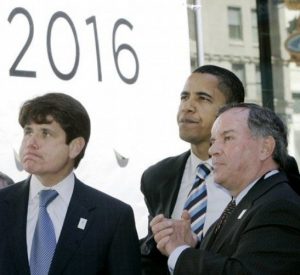
  • Mayor Daley Offers Tips on Fighting Corruption

    Is this a story from the Onion? No. Too Implausible. The Chicago Tribune reports:

    Coming from as far away as Azerbaijan, dozens of corporate executives and government bureaucrats gathered at a downtown hotel Wednesday to hear Mayor Richard Daley share his tips for preventing corruption.

    Absent from his speech at the international event was any talk of city hiring fraud, the Hired Truck program or the myriad other scandals that put Daley aides in federal prison or left them free pending appeals of official misconduct convictions.

    In 2005, The Chicago Sun-Times explained “From an exhaustive Hired Truck investigation to a probe into patronage hiring at City Hall, there’s so much corruption to investigate in the Chicago area, the FBI is adding manpower.” Chicago got a third public corruption squad while New York and L.A. only had two. The Hired Truck scandal was one of the biggest in recent history, where private trucking companies were paid to do nothing. Mayor Daley has yet to explain why a Chicago Mob bookmaker was running the program.

    But, it’s not only Hired Truck. Mayor Daley’s Water Department was described by the Justice Department as a racketeering enterprise for at least 10 years. Just a week ago,the Chicago Democratic Machine’s own Rod Blagojevich was indicted for running a racketeering scheme even before he took office as Governor.

    Blagojevich earned the early endorsement of the Machine in 2001. The Daily Herald reported powerful Alderman Burke’s glowing endorsement, “I am with Rod 100% because he has what it takes to win – money, message and an army of supporters.”

    Mayor Daley’s son and nephew have just hired a prominent criminal lawyer for their questionable business dealings with the city of Chicago.

    Mayor Daley isn’t the only Chicago Democrat lecturing audiences about ethics. Recently, Illinois Supreme Court Justice Anne Burke(wife of Alderman Ed Burke) lectured Illinois state workers on “Ethics in the Workplace” at University of Illinois-Chicago.Anne Burke has been accused by a top FBI informant of corruption.

    Since 1971, 31 Chicago Aldermen have been convicted of felonies. Sometimes you just have to laugh. Or cry.

  • The Rogue Treasury

    The U.S. Treasury took enormous powers for itself last fall by telling Congress they would use it to “ensure the economic well-being of Americans.” Six months after passage of the Emergency Economic Stabilization Act of 2008 Americans are worse off. Since it was signed into law on October 3, 2008, here are the changes in a few measures of our economic well-being:


    Before TARP

    So Far

    National Unemployment

    7%

    8%

        Lowest state unemployment

    3.3% (WY)

    3.9% (WY)

        Highest state unemployment

    9.3% (MI)

    12% (MI)

    National Foreclosure rate (per 5,000 homes)

    11

    11

        Lowest state foreclosure rate

    < 1 in 7 states

    < 1 in 6 states

        Highest state foreclosure rate        

    68 (NV)

    71 (NV)

    Dow Jones Industrial Average

    10,325

    7,762

    “Before TARP” figures are as close to October 3, 2008 as possible; “So Far” figures are most recent available, which varies by category from February through April. Unemployment and foreclosure rates by state are available at Stateline.org

    The Troubled Asset Relief Program (TARP) was sold to Congress and the American public as an absolute necessity to save the American Dream of homeownership. Once the legislation was passed and the funds were released, however, Treasury decided to give the money to banks with no restrictions on its use – no monitoring, no reporting requirements, no nothing. We are worse off today than we were when the legislation was signed – and are likely to remain so when TARP has its first year birthday later this year.

    Yet, the U.S. government has already paid out $2.9 trillion, with further commitments to raise the total to over $7 trillion – a number that Senator Max Baucus (D-MT) said “is mind-boggling, indeed it is surreal. It’s like having a second government.” The money Treasury is passing out is more than all government spending in 2008. The Senate Finance Committee, of which Baucus is chair, held a hearing on March 31 (TARP Oversight: A Six Month Update). The three parties established as monitors in the 2008 legislation were there to testify. Without exception they “are deeply troubled by the direction in which Treasury has gone.”

    Senator Chuck Grassley (R-IA) suggested [referring to former-Secretary Paulson] that Congress “was awed by a person who comes off of Wall Street, making tens of millions of dollars. … You think he knows all the answers and when it’s all said and done you realize he didn’t know anything more about it than you did.”

    As soon as Treasury got the money they decided to bailout big banks instead of helping homeowners with mortgages bigger than the market value of their homes. Since then, Paulson, Geithner, and Bernanke have refused to comply with demands to produce documents about the TARP recipients’ use of funds.

    Neil Barofsky, Special Inspector General and the one monitor with authority to pursue criminal investigations, directly solicited information from the recipients of TARP funds – all over Treasury’s objections that it couldn’t be done. Barofsky received responses from all 532 recipients. He will be summarizing the findings, but so far knows that some banks used TARP funds to pay off their own debt (including at least one bank that used TARP funds to pay off a loan to another bank that also received TARP funds); some banks made loans they couldn’t otherwise have done. Some banks monitored the funds separately from their other assets; some co-mingled the money with no effort to separate, monitor or control what they did with the TARP bailout money.

    Elizabeth Warren, Chair of the Congressional Oversight Panel, brought up the central issue: once Treasury decided not to bailout homeowners, what was the plan? “What is the strategy that Treasury is pursuing?” she asked. “We have asked this question over and over, with the notion that without a clearly articulated plan and methods to measure progress to goals, we cannot have good oversight.” Warren is still waiting for an answer. She also added that there is no bank in this country that would lend with a policy of “take the money and do what you want with it” – which is exactly what Treasury has done.

    Senator Debbie Stabenow (D-MI) put it bluntly: auto manufacturers get reorganization (through bankruptcy) while banks get subsidization. One side is being held accountable for their past bad decisions and the other side has a total lack of accountability. Her bottom line: “If we don’t make things in this country, we won’t have an economy.”

    Warren laid some of the blame with Congress, who “gave treasury significant discretion” but is unable to get real-time explanations for what is being done with the bailout money. There is no transparency when it comes to Treasury. “Without it, I’m afraid …. Congress and the American people have been cut out of the conversation”, she says. One group in Michigan is being asked to bear enormous pain and another group in New York is not – that’s the way Stabenow sees it and Warren agreed. The alternative offered by Warren is that either Congress manages to “get Treasury to get some religion and put standards in place” or Congress has to step in with new legislation.

    Susanne Trimbath, Ph.D. is CEO and Chief Economist of STP Advisory Services. Her training in finance and economics began with editing briefing documents for the Economic Research Department of the Federal Reserve Bank of San Francisco. She worked in operations at depository trust and clearing corporations in San Francisco and New York, including Depository Trust Company, a subsidiary of DTCC; formerly, she was a Senior Research Economist studying capital markets at the Milken Institute. Her PhD in economics is from New York University. In addition to teaching economics and finance at New York University and University of Southern California (Marshall School of Business), Trimbath is co-author of Beyond Junk Bonds: Expanding High Yield Markets.

  • Baby Boomers: The Generation That Lost America

    Tom Brokaw named our parents The Greatest Generation. They came of age during The Great Depression and defeated Fascism, Nazism and Communism. They built the Interstate Highway System and landed a man on the moon. They built the great American middle class with safe communities and public schools that were the envy of the world. They deserve the title of The Greatest Generation. One of their few criticisms is that they spoiled us boomers, adhering to the teaching of Dr. Benjamin Spock.

    I am 59 years old and a child of perhaps the most indulged and impatient generation in history. I fear we may also become known as the generation that lost the American Dream. The Baby Boomers have rejected personal responsibility and exhibited a lack of mental discipline that could have enormous implications for the future.

    The United States House of Representatives, now overwhelmingly controlled by the Boomers, signed a $787 billion legislative “stimulus” package comprised of 1,071 pages and a hefty 8 pounds. Not one legislator read the bill before signing it. Months later, the same House members publicly screamed at the corrupt executives of AIG who received bonuses in 2008 – bonuses specifically allowed in the very legislation they passed without reading.

    This abandonment of personal responsibilities by the Lost Generation took on historic significance on January 20, 1993. That’s when the first President Bush, a member of the Greatest Generation, was replaced with President William Jefferson Clinton, the first Baby-Boomer to reach the Presidency. The Clinton presidency was notorious for its personal indulgence – and not just by introducing oral sex to the Oval Office. During Clinton’s watch, 100,000 Islamic terrorists were trained in camps in Afghanistan while terrorist strikes against American interests went unanswered. Clinton failed to respond to the attack on the USS Cole that killed 17 servicemen. Our enemies grew emboldened believing that America did not take their deadly threats seriously. On September 11th 2,996 American civilians died in part because the government did not see its first priority to be protecting them.

    Also under President Clinton, the Federal Government in 1999 relaxed Fannie Mae and Freddie Mac’s requirements of home mortgages. The decades old formula of 20% down and a 30 year fixed mortgage that allowed the Greatest Generation to lift home ownership to more than 60% was replaced with an array of instruments including sub-prime loans, “no-doc” applications where income was not verified, and teaser rates of 1%. Such tinkering led to unqualified purchasers with 100% financing pushing home values up at 20% per year. The bubble burst in 2007 with disastrous consequences. The heads of Fannie Mae and Freddie Mac made tens of millions in annual salary. Despite the calamitous consequences of their stewardship, no one was fired.

    Another Boomer, George W. Bush followed Clinton and continued the Lost Generation’s abdication of personal responsibility. He also failed to comprehend the extremist Islamic threat. Again, no one was fired. On December 12, 2002, George Tenet, fellow Baby-Boomer and Director of the CIA assured President Bush the case that Saddam Hussein had weapons of mass destruction was a “slam dunk”. President Bush authorized the invasion of a sovereign nation based on that intelligence. No weapons of mass destruction were found. America’s soldiers inherited a broken country and hundreds of billions of responsibilities. No one, including George Tenet, lost their job. In fact, on December 14, 2004, President Bush awarded Tenet the Presidential Medal of Freedom.

    On August 29, 2005, Hurricane Katrina slammed into Louisiana and Mississippi as a Category 3 hurricane. The result was catastrophic. The levees were breached and 1,836 Americans lost their lives. Americans watched in horror as police abandoned their positions, and the National Guard struggled to protect the trapped citizens who could not evacuate. Dead bodies lay uncollected in the streets. No one will forget the scene of 60,000 American refugees at the Louisiana Superdome without food, water or medical care for days. On national television, President Bush proclaimed, “Brownie, you’re doing a heck of a job.” Although three days later, FEMA Director, Michael D. Brown was forced to resign, no one else at FEMA was fired.

    In July 2008, gasoline prices hit a national average of more than $4.00 per gallon as demand outstripped supply pushing oil to $147 barrel. The Lost Generation howled in protest at the oil companies who were profiting from the pain of American citizens. This came as no surprise. The environmental movement had stopped production on both nuclear power plants and gasoline refineries. Congress banned oil exploration off America’s coastline. Congress decided that ANWAR, a barren strip of coastal Alaska the size of Logan Airport in Boston, was off-limits to oil exploration. At $147 barrel, the Western economies were shipping more than $1 trillion dollars per year to the Persian Gulf to nations whose interests were simply not aligned with ours. Once again, our elected officials, dominated by boomers, abdicated their responsibility to keep America safe. Their inaction allowed our nation to become even more vulnerable to the oil weapon.

    In 1973, under President Carter, when the OPEC nations first used oil as a political weapon, America imported 30% of its daily oil quota. Yet not a word is mentioned by the Lost Generation expanding American production of oil to reduce this dependency. Yes, they talk of wind and solar energy – which collectively generate less than one percent of our energy – but no one has yet figured out how to power a car with wind or solar energy. After falling to $30 a barrel, oil has slowly crept back up over $50 a barrel – in a deep recession. When the recovery arrives, does anyone believe oil will not return to $100 barrel? Yet the Lost Generation sleeps with no energy policy in place and once again abdicates its responsibilities to a future generation.

    The same is true of Social Security. The Baby-Boomers are retiring now. The system is broken and there are not enough workers to make the transfers to the retirees. Do you hear anyone in Washington raising the red flag of warning? Once again, the Lost Generation has abdicated its responsibilities and kicked the can down the road.

    In the waning months of the Bush Administration, Treasury Secretary Paulson informed Congress that a $700 billion bail-out of the financial sector was needed to avoid a melt-down of our banking system. TARP, the Troubled Asset Relief Program was passed by the Congress in a matter of days. Only $350 billion was committed, banks were forced to accept TARP funds, and little of those funds made their way to acquire troubled assets. GM and Chrysler received $17 billion even though they had no “troubled assets.” Another $8 billion went to Sheik Mohammed in Dubai. He had no troubled assets either, and $1.6 billion was paid out in bank bonuses. AIG received $165 billion of TARP money and paid out $286 million in bonuses. No one in Congress anticipated the AIG bonuses when they signed the legislation that specifically allowed the payments. It does not end there.

    Franklin Raines, chief executive of Fannie Mae received $91.1 million in compensation from 1998 to 2004. In 1998, Fannie Mae stock was $75 per share. Today, Fannie Mae shares are worth 67 cents. Mr. Raines was not fired – he was simply hired as an economic advisor to President Elect Obama. Raines recently settled a civil lawsuit alleging fraud and stock manipulation for $31.4 million.

    Postmaster General John Potter received compensation of $800,000 in 2008 while the United States Post Office lost $2.8 billion. It is possible his $135,000 bonus was based on future performance. The USPS is projected to loss $6 billion in 2009. Postmaster Potter did not lose his job either.

    Our congressional representatives earn $174,000 per year for this fiscal oversight. Their congressional staff earns another $1.3 million per year plus too many perks to mention like free cars, airfare, and postage stamps.

    The very things that we took for granted as children of the Greatest Generation are now challenged. Home values have fallen dramatically. Our retirement accounts have been decimated. Our public schools are not working. Traditional allies no longer stand with America. Not surprisingly, most Americans fear their children will not be better off. The approval numbers for Congress are at an all-time low. Despite the vast number of problems facing our country in 2009, when Congress passed a Continuing Resolution in March 2009, it contained 8,500 earmarks of pork barrel spending confirming that this Congress is going to maintain business as usual.

    Dr. Spock wrote that our parents should not spank us and they should always bolster our self-esteem. That misguided advice led to the today’s climate of political correctness where the ideal of self-esteem outweighs the importance of performance, success or accomplishment.

    Consequently, the Lost Generation measures itself by its good intentions rather than by its accomplishments. Its good intentions led to policies that prohibited oil exploration off the coastlines. The result was $4.00 gasoline. Its good intentions of teaching all children in their native tongue was a good idea but the cost to do so weakened the overall education system in America. Its good intentions of helping poor families buy homes led to the sub-prime mess that has cost American families trillions in lost equity. In the last twelve months, under the dominant control of the Baby-Boom generation, America has witnessed $11 trillion of home and stock equities disappear.

    The Baby-Boomer’s move into retirement comes none too soon. Let the boomers in Congress retire at 65. We’ll even let them retire on the fat retirement plans they voted for themselves. But let’s get rid of them. The next generation can’t do much worse.

    Robert J. Cristiano Ph.D. has more than 25 years experience in real estate development in Southern California. He is a resident of Newport Beach, CA.

  • From Bush’s Cowboy to Obama’s Collusive Capitalism

    Race may be the thing that most obviously distinguishes President Barack Obama from his predecessors, but his biggest impact may be in transforming the nature of class relations — and economic life — in the United States.

    In basic terms, the president is overseeing a profound shift from cowboy to what may be best described as collusive capitalism. This form of capitalism rejects the essential free-market theology embraced by the cowboys, supplanting it with a more managed, highly centralized form of cohabitation between the government apparat and the economic elite.

    Never as pure as its promoters suggested, cowboy capitalism always depended on subsidies to businesses such as corporate farming, suburban development, pharmaceuticals, energy and aerospace. George W. Bush and the Republican majorities of the early 2000s simply drove this essential hypocrisy to a disastrous extreme by increasing deficits and allowing deregulated financial markets to run wild. In the process, they helped drive the world economy off the cliff.

    Not surprisingly, Obama and his backers see their mission to reverse the course. However, the path they are taking may prove no friendlier — and perhaps less so — to the interests of American democracy and the middle class than those of the now-deposed cowboy posse.

    The Obama policy of collusive capitalism is most evident in the financial bailout. He has placed his economic program in the hands of a man — Treasury Secretary Timothy Geithner — who can best be called, as analyst Susanne Trimbath puts it, a “lap dog of Wall Street.” A protégé of former Treasury Secretary and Citicorp board member Robert Rubin, Geithner played a pivotal role in the original Bush bailout of the Wall Street elite.

    Most recently, he proposed selling toxic assets to hedge funds and other financiers, a plan widely denounced by a host of liberal commentators, notably Paul Krugman and Joseph Stiglitz. The Geithner plan, Stiglitz noted this week in a New York Times op-ed, represents “the kind of Rube Goldberg device that Wall Street loves: clever, complex and nontransparent, allowing huge transfers of wealth to the financial markets.”

    The winners in the plan are the top guns of the financial industry, who would welcome further government-sponsored financial consolidation. For them, this would be vastly preferable to the more democratic alternative of selling the remaining assets of the failed large firms to dispersed, healthy, usually smaller, regional institutions.

    Largely missing from even these critiques is precisely why Obama has adopted this collusive approach while mostly avoiding anything smacking of populist anger. Perhaps one has to start with the very obvious fact that the president — despite occasional attacks on the greed of Wall Street — did not run against the financial markets but, rather, with their strong support. As early as the 2008 Democratic primaries, noted New York Times Wall Street maven Andrew Ross Sorkin, Obama had “nailed [down] the hedge fund vote.”

    This group includes the notorious currency speculator George Soros, a major backer of liberal groups in Washington who recently admitted to London’s Daily Mail that he was having “a nice crisis.” Whatever Geithner is doing seems to be working well for Soros and his ilk, although not so beneficently for the people who are losing their jobs and homes.

    I do not mean to suggest the shift to collusive capitalism represents a conspiracy; it simply reflects a changing of the guard among the American elite. The new hegemons include not only financial barons but also powerful interests such as the burgeoning green industry, the high-tech/venture capital complex, urban landowners and, at least in the category of useful idiots, Hollywood and much of the media.

    The new collusive capitalist class differs from the cowboys in its view of government. The collusive capitalists — notably, powerful IT companies and venture capitalists — now look to spur “green” technologies, which are seen as their next meal ticket.

    Others standing to benefit from the rise of collusive capitalism include the university and nonprofit research establishment. Universities have become critical linchpins for the new Democratic Party — providing student shock troops and professorial financial contributions as well as the basic ideological underpinnings and much of the key personnel.

    Are there any dangers for the administration from this approach? In the short run, they certainly have little to fear from the Republicans, whose strident claims about a lurch toward socialism have about as much credibility as their supposed born-again faith in fiscal conservatism.

    A potentially more dangerous threat lies from those parts of the non-gentry left, who fear that collusive capitalism will promote a dangerous further concentration of wealth and power. More immediately, it may also suffer from the limitations of a top-down, green-obsessed strategy that is unlikely to generate enough private-sector jobs, particularly for blue-collar workers.

    This large job creation deficit may take years to become evident but could have a long-term impact on middle-class voters and, perhaps most important, the generally pro-Obama millennial generation workers who are among the prime victims of the current economic malaise. Hopefully, before then, the president will recognize the limitations of collusive capitalism and set out on a broader, more democratic wealth-creating agenda.

    This article originally appeared at Politico.

    Joel Kotkin is executive editor of NewGeography.com and is a presidential fellow in urban futures at Chapman University. He is author of The City: A Global History and is finishing a book on the American future.

  • Geithner’s Reforms: More Power to the Center May Appeal to Europeans, But Won’t Work for U.S.

    There will be much talk in London about global financial regulation, particularly from the Europeans. But don’t count on it ever coming into existence.

    At a House Financial Services Committee on March 26 Treasury Secretary Geithner testified that this particular subject “will be at the center of the agenda at the upcoming Leaders’ Summit of the G-20 in London on April 2.”

    Secretary Geithner presented a 61 page proposal dealing with financial companies that pose systemic risk. Let me paraphrase the main points:

    1. Create a Uni-regulator – This idea has been around a while; it won’t hurt. We tried to do this in the U.S. during the last round of sweeping financial reforms but couldn’t make it happen, primarily due to protectionist politics among the existing regulators (SEC, FRB, Treasury, FDIC, etc.). The UK and others have done it. It didn’t prevent the financial crisis from reaching them. Still, it wouldn’t hurt to have at least one adult in charge of the financial markets when things get messy.
    2. Make companies hold more cash to back up their riskier investments – The banks already have strict national and international capital requirements. It didn’t prevent them from needing a bailout, but the big banks are still standing while the rest of the financial companies are gone. This is probably a good idea.
    3. Set size limits on unregistered fund managers – I don’t think there should be any size limits: if you provide financial services you should register. Don’t plumbers have to be licensed? Why not bankers?
    4. Figure out how to regulate derivatives – We’ve known for a long time that this was a problem. If they haven’t figured it out by now, it’s unlikely they’ll get it right; the proposal is short on details. Geithner’s plan is to bring derivatives into the same centralized system now used for stocks and bonds – consolidating the risk rather than dispersing it – definitely a bad idea. The existing U.S. centralized system has, as of December 31, 2007, only $4.9 billion to back up $5.8 billion in off-balance-sheet obligations.
    5. Have the SEC set requirements for money market fund risk management – I’m not sure why on earth anyone would want the SEC to assume this responsibility. The SEC has failed miserably at protecting investors from basic short selling schemes and even more blatant schemes like Madoff’s Ponzi. Risk management at financial institutions should be the job of the central bank – that means the Federal Reserve, not the SEC.
    6. Let the government nationalize “too big to fail” companies – They just did this with AIG. In essence, the proposed legislation would codify and make permanent authority for the government to lather, rinse and repeat. Government ownership of financial institutions inevitably leads to inefficiency and worse.

    We’ve tried creating “revolutionary” financial laws before: the Depository Institutions Deregulation and Monetary Control Act of 1980 set the stage for the Savings and Loan Crisis; the Financial Services Modernization Act of 1999 helped get us where we are now. Better laws come about in “evolutionary” ways. It starts with a generally accepted good business practice, which all market participants follow. Eventually, one or more participants find a way to advance their position by cheating, by not following that good practice. When they get caught, new laws are created to codify the original “good business practice” and some punishment is put in place for those who don’t. What was once considered just a good way to conduct business now becomes a legal business requirement.

    Geithner’s proposed legislation is law by revolution – an attempt to toss aside all previous practices. The legislation was drafted at Davis, Polk & Wardwell, the New York lawyers for the Federal Reserve Bank and advisors to Fed and Treasury on AIG, not the kind of experience I’d want on my resume this year. There is an embedded comment on page four in the pdf-document: “Can Congress write a federal statute trumping a State Constitution?” I’m not sure what frightens me more: that they want to take power away from the states or that they don’t know if they can get away with it! Now is the time to give more authority to the states, not less. By their own admission, federal authorities have proven themselves incapable of protecting investors: Treasury Secretary Geithner told the House, “our system failed in basic fundamental ways.”

    Worse yet is the idea of proposing a global financial regulator, which will be high on the agenda at the G-20 Leaders’ Summit. Designing one regulatory framework for financial services to serve the capital markets in every country is akin to looking for people in every country to “cheat” the same way. Capital markets can work anywhere in the world, but the social and cultural foundations of the system that supports these markets may be quite different. The laws and regulations will need to be quite different, too. When it comes to developing the financial institutions that provide the infrastructure for robust capital markets, there is no “one size fits all”.

    “Stable financial markets through reform” has been the theme of innumerable conferences, conventions and meetings of the leaders and finance ministers of country groups from G8 to the United Nations. Two decades of experience with the “Washington Consensus” tells us that global regulation will not work any better than concentrating all power in Washington.

    Here’s the primary problem with trying to design one set of financial reforms that will serve many nations: Financial services are global not multi-national. Most other products and services sold around the world are multinational, but not global. For example, salt is a multinational product. The salt sold in Cairo is basically the same product as salt sold in Paris or London. Perhaps the label contains the word “salt” in a different language; maybe the Danes use more salt than the Swedes and the Japanese combine it with sugar. But a package of salt contains the same product and is used for the same purpose – one product, used the same way in many nations.

    Financial services are different. A share of stock in Paris has different rights, a different meaning, than a share of stock issued in Buenos Aries. Bondholders play a prominent role in restructuring companies in bankruptcy in the US; in France, debtors are protected from bondholders completely. Yet anyone anywhere can buy a share of a French company or the bond of a US company – many products, used for different investments in one world. For reasons like this, there is no one solution for regulating the banks, brokers and stock exchanges in every country.

    Economists have known for a long time that global financial regulation – or even ”sweeping” national changes – won’t work. Perhaps the lesson from the current financial crisis will be that national regulation must be supplemented with more oversight in the States. Given Geithner’s plan and his penchant for ever more consolidation of authority over financial services, it’s unlikely we’ll get the chance to find out.

    Susanne Trimbath, Ph.D. is CEO and Chief Economist of STP Advisory Services. Her training in finance and economics began with editing briefing documents for the Economic Research Department of the Federal Reserve Bank of San Francisco. She worked in operations at depository trust and clearing corporations in San Francisco and New York, including Depository Trust Company, a subsidiary of DTCC; formerly, she was a Senior Research Economist studying capital markets at the Milken Institute. Her PhD in economics is from New York University. In addition to teaching economics and finance at New York University and University of Southern California (Marshall School of Business), Trimbath is co-author of Beyond Junk Bonds: Expanding High Yield Markets.

  • Whatever Happened to “The Vision Thing?”

    When I was in elementary school, I remember reading about the remarkable transformations that the future would bring: Flying cars, manned colonies on the moon, humanoid robotic servants. Almost half a century later, none of these promises of the future – and many, many more – have come to pass. Yet, in many respects, these visions from the future served their purpose in allowing us to imagine a world far more wondrous than the one we were in at the time, to aspire to something greater.

    I am reminded of these early childhood memories not because I lament the loss of my flying car (although it would come in handy every now-and-again in fighting the Washington, D.C. rush hour gridlock) but because, with all of the rhetoric about change and hope, the Obama Administration has failed to articulate a strong, singular vision for what the future of America and the world can and should be. While some would argue that now is not the time for grand visions for the future but, rather, for hunkering down and muddling through these desperate economic travails, the fact of the matter is that at least part of the cause of continuing economic decline in this country, and in many other developed nations as well, is a lack of confidence in the future.

    I was somewhat hopeful during his address to the joint session of Congress in early February – shortly after the passage of the economic stimulus bill – that President Obama was indeed starting down the path of articulating a new vision for America. He recalled in that speech great innovations that had been spurred by prior economic and other exigencies. In that speech he stated:

    “The weight of this crisis will not determine the destiny of this nation. The answers to our problems don’t lie beyond our reach. They exist in our laboratories and universities; in our fields and our factories; in the imaginations of our entrepreneurs and the pride of the hardest-working people on Earth. Those qualities that have made America the greatest force of progress and prosperity in human history we still possess in ample measure. What is required now is for this country to pull together, confront boldly the challenges we face, and take responsibility for our future once more.”

    And again, later in his address:

    “History reminds us that at every moment of economic upheaval and transformation, this nation has responded with bold action and big ideas. In the midst of civil war, we laid railroad tracks from one coast to another that spurred commerce and industry. From the turmoil of the Industrial Revolution came a system of public high schools that prepared our citizens for a new age. In the wake of war and depression, the GI Bill sent a generation to college and created the largest middle-class in history. And a twilight struggle for freedom led to a nation of highways, an American on the moon, and an explosion of technology that still shapes our world.”

    Bold action and big ideas: Yet the focus of all of the Administration’s efforts have been on specific “solutions” to the problem set with which our economy is now faced. Some are well-intentioned but arguably poorly executed by Congress while are others rolled out for public consumption with less than full baking time—without any suggestion about what our “brighter future” might look like and how these various solutions might be woven together to help realize a brighter and different future.

    We may indeed be on the cusp of something big: It may be tragic or triumphant depending upon how and how quickly we find our way out of the country’s current predicament.

    After Hurricane Katrina ravaged New Orleans and the Gulf Coast, some urban planners, architects, emergency management experts, and others were bold enough to suggest that maybe the Ninth Ward shouldn’t be rebuilt; perhaps nature never intended us to put so many homes and so many people below sea level, in harm’s way. Regrettably, that conversation was preempted as soon as it was started by the hundreds of displaced residents who, having been treated with what appeared to be utter disregard by their local, state, and federal government in the face of that tragedy as it unfolded, insisted that at least they deserved to be returned to their homes. Politics and pragmatics trumped bold and broad thinking that could have conjured a different outcome.

    There is so is so little new and dynamic mainstream discourse about where and how we live as individuals and in communities. There is no modern proxy for flying cars and colonies on the moon. And funding billions of dollars in support of “shovel-ready projects” will certainly do nothing to advance the cause of innovative thought about how we would like to see our current communities – urban, suburban, and exurban, and rural – evolve over the next twenty-five or fifty years. What could life be like in America in 2034 or 2059? We should not have to rely upon science fiction writers, futurists, and block-buster sci-fi movie producers to craft all of our visions of the future.

    So here’s an idea for our new President. Now that everyone is relatively comfortable with the notion of spending billions (and even trillions) of dollars, let’s spend a very small portion of that on our future, rather than focusing exclusively on our near-term economic salvation. Make $10 billion available to fund five pilot projects with $2 billion each. Think of is as the “X Prize” for Innovations in Livability. Invite communities throughout the country, without restriction as to size or location, without constraints on the marketplace of ideas, to bring together their best and brightest to craft implementable proposals for how they plan to evolve their community into an exemplar for the future: Then fund the five best proposals. Take the funding decisions out of the hands of elected officials and policy makers, and place it unfettered in the hands of a blue-ribbon panel of experts from a broad range of disciplines.

    Let all Americans and the world marvel at what will replace the flying cars of the 60s.

    Peter Smirniotopoulos, Vice President – Development of UniDev, LLC, is based in the company’s headquarters in Bethesda, Maryland, and works throughout the U.S. He is on the faculty of the Masters in Science in Real Estate program at Johns Hopkins University. The views expressed herein are solely his own.

  • Guessing Which Congressional Seats Change Hands at Census Time

    The next official Census isn’t till 2010, but Election Data Services is already predicting considerable impacts on Congressional representation.

    Things will be getting bigger in Texas, with four added seats, as well as Arizona, with two. Six states—Florida, Georgia, Nevada, Oregon, South Carolina, and Utah—will increase their federal delegations by one district each.

    On the opposite end, Illinois, Iowa, Louisiana, Massachusetts, Michigan, Minnesota, Missouri, New Jersey, New York, and Pennsylvania will all relinquish one seat, with Ohio appearing to lose two.

    While the redistricting process is in the distant future, it should prove interesting to see how the 2010 Census will change the seating arrangement in Washington.

  • Why We Need A New Works Progress Administration

    As the financial bailout fiasco worsens, President Obama may want to consider a do-over of his whole approach towards economic stimulus. Instead of lurching haphazardly in search of a “new” New Deal symphony, perhaps he should adapt parts of the original score.

    Nothing makes more sense, for example, than reviving programs like the Works Progress Administration (WPA), started in the 1935, as well as the Civilian Conservation Corps (CCC), begun in 1933. These programs, focused on employing young people whose families were on relief, completed many important projects – many still in use today – while providing practical training to and instilling discipline in an entire generation.

    Unemployment today may not be as extreme as in the 1930s, but for whole segments of the population – notably young workers under 25 – it is on the rise. Already young workers with college educations suffer a 7.7% jobless rate, while employment is nearly twice that among young workers overall. Hardest hit, in fact, are young people without college educations, whose real earnings already have dropped by almost 30% over the past 30 years, according to one study.

    Tapping the energies of this new “millennial” generation – those now entering their teens and early 20s – would make enormous sense both for economic and social reasons.

    Not only do they need work, but also, as their chroniclers, authors Morley Winograd and Mike Hais have demonstrated, many share an interest in community-building in ways reminiscent of the last “civic generation” in the 1930s.

    In contrast, the current stimulus, rather than inspiring a new generation, has focused on bailing out failed corporations, few of which will generate much employment. Many of the “new” jobs will be going to the already entitled: highly paid, big-pension-collecting, unionized government workers and well-educated people working in federal and university laboratories.

    Also getting short shrift has been the kind of construction projects that drive fundamental economic growth and competitive advantage. These include roads, freight rail, electrical transmission lines and water services that boost productivity in agriculture, manufacturing, high-end business services and technology. The Chinese are currently targeting their spending on precisely the steps that would aid these sectors.

    This is where a New Deal revival would help. The WPA and the CCC were all about building useful, tangible things that made the country stronger and more competitive. Overall, these and other New Deal programs amassed an amazing record – finishing over 22,000 roads, 7,488 educational buildings and over 7,000 sewer, water and other projects.

    These efforts put to work over 3 million workers. (Compare that to the mere 250,000 slated to work in the expanded AmeriCorps program.) Their earnings helped support 10 million dependents. The WPA also employed 125,000 engineers, social workers, accountants, superintendents, supervisors and timekeepers scattered in every state and community. Ultimately, notes political economy professor Jason Scott Smith, the New Deal intimately touched the lives of more than 50 million people – out of a total U.S. population, in 1933, of 125 million. Now that’s stimulus!

    Critically, the WPA and CCC also left behind useful things for the next generation. As historian Gary Breichin has pointed out, we unknowingly walk, drive and ride through many structures built by these agencies.

    These projects did not act as “lures” for the elites, cognitive and otherwise – as so many of our current efforts do – but rather served a broader purpose for the public. The University of Washington’s Richard Morrill notes that the WPA bequeathed “an enduring legacy” around Seattle: bridges and retaining walls and drainage systems, parks and playgrounds, roads and trails, sewers, recreational facilities, airports, streetcars, low-income housing, as well as programs for musicians, artists and writers.

    The WPA and CCC left a similar mark even on the most remote parts of rural “red” America. In places such as Wishek, N.D., notes native Delore Zimmerman, few people recognize that it was the New Deal-sponsored WPA that built the still-used local pool and the community center. Nor do farmers, many of them rock-ribbed Republicans, readily acknowledge that the windbreaks and other conservation projects started by the CCC helped preserve the land from devastating erosion.

    A public works agenda today, of course, would include different things, like expansion of broadband Internet access and a greater emphasis on private financing and skills training. Yet a neo-WPA would still focus on upgrading and expanding our basic infrastructure, which, by all estimates, is generally in sad shape.

    If this is such a good idea, why is no one else promoting it? Among Republicans and conservatives, of course, nothing done by Franklin Roosevelt – except, perhaps, winning the Second World War – could ever hold much merit. They certainly can argue, with some justification, that it was the war, and not the New Deal, that finally got us out of the Great Depression.

    But this is narrow thinking. America’s post-war boom owed much to the work of WPA, CCC and other New Deal programs. Our late 20th-century expansion required travel along their roads and bridges; their energy plants and transmission lines powered our industrial growth, extending it to formerly poor regions like the South. Water and conservation projects undertaken in the agricultural heartland precipitated a revolution in productivity that has fed much of the world.

    More troubling may be why Democrats – often professed admirers of FDR and his work – have not been eager to revive these programs. One factor may be the enormous power of unions representing public employees. The power of organized public-sector workers, notes historian Fred Siegel, was a non-issue in the 1930s and 1940s.

    Today, though, these groups are powerful enough to boost the cost of any government initiative – because often they require high salaries, costly work rules and, most important, pension benefits. The last thing these unions would sanction would be the mass employment of young workers on a temporary basis at living, but not union-scale, wages and benefits.

    Secondly, there are political obstacles. This administration often appears, as one Democratic mayor from central California put it, like “moveon.org run by the Chicago machine.” Its first priority seems to be to reward allies in organizations – whether in “grassroots” groups like ACORN or in the academy – who also share their political agenda.

    Take, for example, the federal government’s proposed expenditure of $500 million to $600 million for “climate change research.” These funds are almost certain to end up in the pockets of high-end government workers and university-based zealots; as a scientific enterprise, it is likely to be as valid as asking the College of Cardinals in Rome to determine the existence of God. The ultimate result will be to provide new grist for Al Gore’s – and the administration’s – friends in the “green” investment banking world and Silicon Valley.

    This green agenda itself may also constitute a third cause itself for WPA avoidance. Much of the environmental movement – committed largely to reducing the carbon footprint of 300 million Americans – doesn’t want new bridges, roads, ports or much of anything that uses greenhouse gas-spewing concrete. They’d prefer to scale back agriculture and grow just enough organic produce to keep Alice Waters clucking happily in her kitchen.

    A similar disconnect can be seen in energy policy. A new WPA could help build transmission lines to connect the energy-rich parts of the country to the major metropolitan areas. This would spur both industrial development in places like the Great Plains – rich in everything from fossil fuels to wind power – while keeping energy prices down for U.S. consumers and firms.

    Yet so far, the energy program seems focused almost exclusively on providing rich contracts to Silicon Valley firms that are close to the administration. So don’t expect a massive expansion of new transmission lines or any expansion of new, “clean” hydropower. The administration’s green agenda seems to revolve not predominately around better or even cleaner energy, but less.

    And, sadly, conservation is one place a new WPA would be most effective. One possible function for a modern WPA would be to go to neighborhoods – particularly poor and working class ones – and insulate houses. This would certainly save money over having government workers or contractors do the same work.

    All this suggests a profound disconnect between the new administration and the real world.

    The post-industrial educated class that now dominates Washington appears, if not scornful, profoundly detached from the problems facing productive industry. These officials also seem blissfully unaware that the public – as opposed to the academy and the elite media – cares more about jobs than about being green; by nearly three to one, according to the most recent Pew poll, they are more worried about the economy than climate change.

    In many ways, this disconnect is inevitable. Products of the “information age,” Obama’s academically oriented backers seem to have trouble distinguishing between words and actual things. Virtually no one in the upper reaches of this administration has been tested by running a private company, manufacturing a product or bringing in a crop. This administration of “experts” from academia and government service appears to possess little tactile knowledge of the real world.

    In this way, Obama’s great strengths – he is a brilliant communicator and image-builder – are also proving to be a source of profound weakness. Right now, he is selling a post-racial kumbaya and a vague confection of ‘hope.” Financing for these good intentions is likely to ebb, however, as a result of a stunning redistribution of wealth from taxpayers to an expanded class of tax-takers.

    Indeed, for all his communication skills, the president has failed to create an attainable vision of a stronger, wealthier America with better jobs, more wealth and improved infrastructure. Roosevelt and even Truman provided inspiration, too, but they backed it up with practical changes that promised improvements in the day-to-day lives of most Americans.

    These hard times require tangible solutions to basic economic problems. Rather than worry about the generally clueless Republicans, the administration should focus on building a legacy as real and long-lasting as the one left behind by the WPA and CCC.

    More than a mere matter of building roads and bridges and increasing access to cheap energy, the WPA was about restoring a collective spirit, a shared stake, in constructing the sinews of a more competitive, prosperous country. Unfortunately, amidst the confused priorities of this administration, such bold initiatives remain but distant possibilities.

    This article originally appeared at Forbes.

    Joel Kotkin is executive editor of NewGeography.com and is a presidential fellow in urban futures at Chapman University. He is author of The City: A Global History and is finishing a book on the American future.