Category: Small Cities

  • Still Moving to the Suburbs and Exurbs: The 2011 Census Estimates

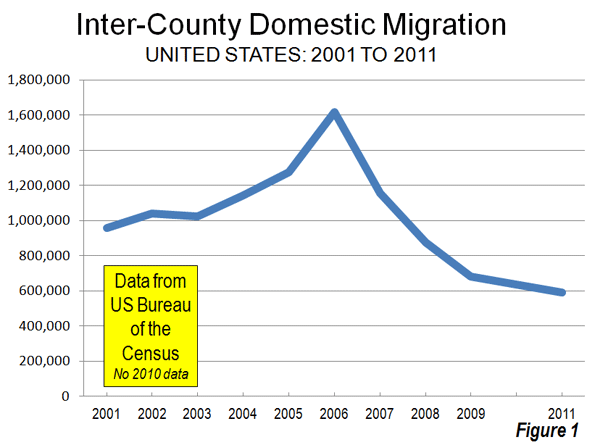
    The new 2011 Census Bureau county and metropolitan area population estimates indicate that Americans are staying put. Over the past year, 590,000 people moved between the nation’s counties. This domestic migration (people moving within the nation) compares to an annual rate of 1,080,000 between the 2000 and 2009. Inter-county domestic migration peaked in 2006 at nearly 1,620,000 and has been falling since that time (Figure 1). The continuing low rate of domestic migration has been reinforced by the economic malaise that has kept job and income growth well below levels that would be expected in a more genuine recovery.
    Yet the nation has continued to grow. With less domestic migration, natural growth (births minus deaths) and considerable, but slower international migration, growth over the past year has been more in proportion to total population. The movement between counties within major metropolitan areas has become less of a factor. Predictably, there the usual doom and gloom reports  about suburbs and exurbs and how poorly they are doing compared to before, and how people are returning to the cities (Note 1). As usual, the data shows no such thing, as people continue to move from core counties in greater numbers than others move in (See Note 2 on county classifications).

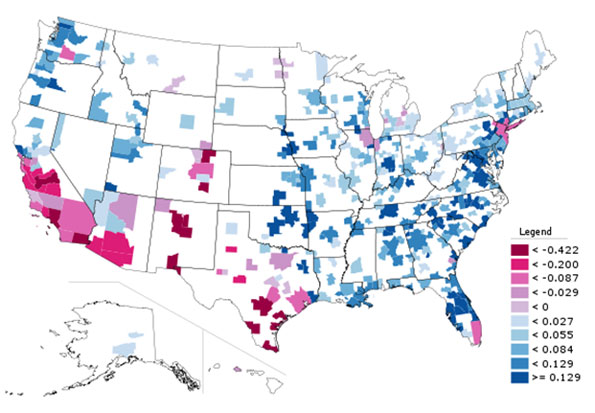
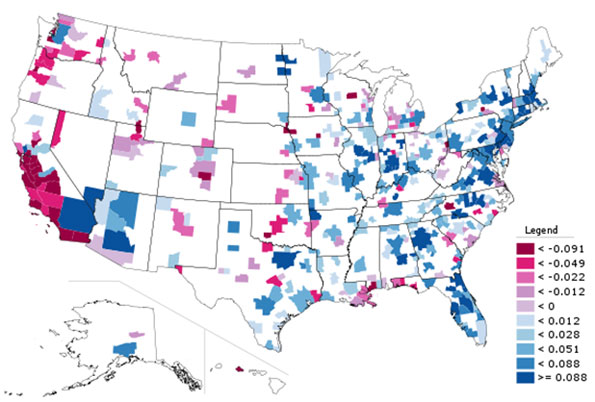
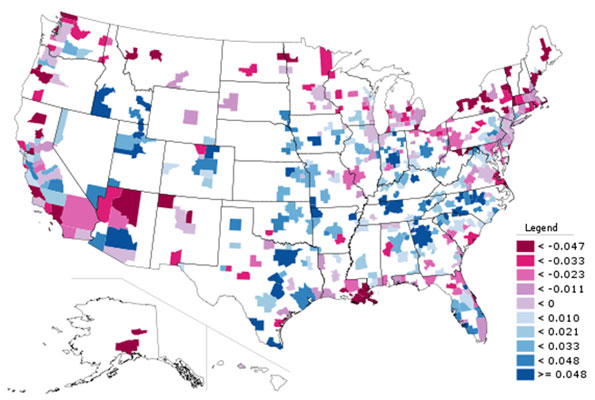
    Domestic Migration: Despite the higher gasoline prices and the illusions of a press that is often anti-suburban, both the suburbs and the exurbs continued to attract people from elsewhere in the nation. The core counties, which contain the core cities, continued to lose domestic migrants to other parts of the country, principally to the suburbs and the exurbs of the large metropolitan areas.

    Over the past year, the core counties of major metropolitan areas lost 67,000 domestic migrants (people move between a metropolitan area and somewhere else in the nation). Suburban counties gained approximately 72,000 domestic migrants, while exurban counties gained 49,000 domestic migrants (Figure 2). Because of their lower population base, exurban counties had the highest relative rate of net domestic migration, at 0.34% of their 2010 population. This is more than three times the rate of the suburban counties (0.11%) and far higher than the minus 0.09% of the core counties (Figure 3). Thus, the overall slower rate of growth among exurban counties was due to a lower natural growth rate and less international migration, not the result of any losses to the core. The same is true, to a lesser extent, of the suburban counties.
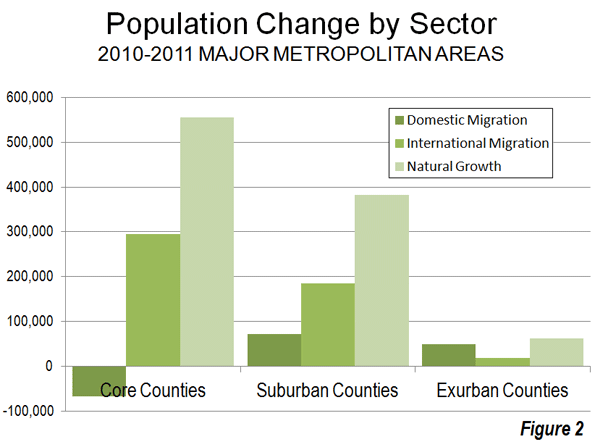
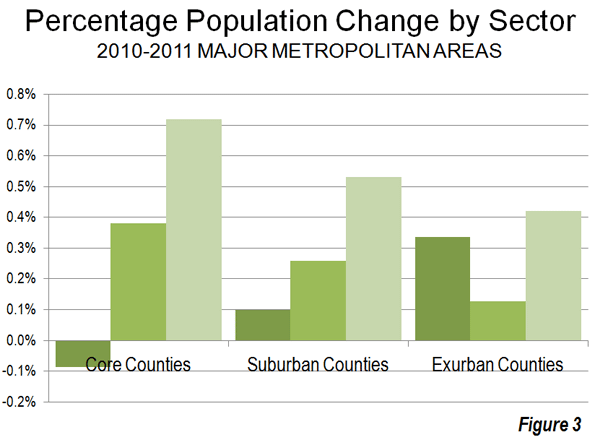
    Overall, the major metropolitan areas gained 48,500 domestic migrants between 2010 and 2011. By contrast, between 2000 and 2009, the major metropolitan areas lost, on average, nearly 200,000 domestic migrants to the rest of the nation each year. The huge domestic out migration in the last decade has been associated with the housing bubble. Less affordable housing markets lost 3.2 million domestic migrants between 2000 and 2009. More affordable markets gained 1.7 million domestic migrants. This was not enough to negate the losses in the higher cost markets, and major metropolitan markets lost 1.5 million domestic migrants overall.

    Natural Growth: As the grim economic times induced people to stay put, core counties grew marginally faster than suburban and exurban counties principally because of higher natural growth rates, which is the net of births minus deaths. More than 70% of the higher population in core counties was from natural growth. Natural growth was less of a factor in the suburban counties, at 60%. In the exurban counties, natural growth accounted for only 47% of the population growth (Table 1). The higher core county natural growth rates are especially evident where there are large foreign born populations, due to their generally higher birth rates (such as Los Angeles, Dallas-Fort Worth, Houston, Austin and Riverside-San Bernardino, as well as Raleigh and Salt Lake City).

    International Migration: The other component of growth was international migration, which contributed 38% of the growth in core counties and 29% of the growth in suburban counties. International migration was much less important in the exurban counties, contributing only 15% of the growth (Table 1)

    Table 1
    Major Metropolitan Areas
    Components of Population Change: 2010-2011: Summary by Sector
     Net Domestic Migration   Net International Migration   Natural Increase (Births Minus Deaths) 
    Core Counties -8.5% 37.6% 70.8%
    Suburban Counties 11.2% 29.0% 59.8%
    Exurban Counties 37.9% 14.5% 47.4%
    Multi-County Major Metropolitan Areas 3.5% 32.1% 64.3%
    Single County Major Metropolitan Areas -10.9% 34.5% 76.7%
    Major Metropolitan Areas with More Than 1 County 3.0% 32.2% 64.7%
    Single County Major Metropolitan Areas: San Diego and Las Vegas


    The Gainers: The fastest growing major metropolitan areas were dominated by the four largest Texas metropolitan areas. Austin (3.2%), Dallas-Fort Worth (2.0%), Houston (1.9%) and San Antonio (1.9%) were all among the five fastest growing. Raleigh placed second, with a one-year growth rate of 2.3%. The top five numeric gainers in domestic migration were in all in Texas or Florida — Dallas-Fort Worth (39,000), Miami (36,000), Austin (31,000), Tampa-St. Petersburg (27,000) and Houston (21,000). The much improved housing affordability in Florida seems likely to be a factor in the recovery of Miami and Tampa-St. Petersburg. Further, Houston became the second Texas metropolitan area to exceed Philadelphia in population, following Dallas-Fort Worth in the last decade. Texas thus becomes the first state to place two metropolitan areas in the five largest in the nation (Table 2).

    Table 2
    Major Metropolitan Areas: Population
    Population: 2010-2011
    Metropolitan Area 2010 2011 Change % Change
    New York, NY-NJ-PA        18,919,649        19,015,900                  96,251 0.51%
    Los Angeles, CA        12,844,371        12,944,801                100,430 0.78%
    Chicago, IL-IN-WI          9,472,584          9,504,753                  32,169 0.34%
    Dallas-Fort Worth, TX          6,400,511          6,526,548                126,037 1.97%
    Houston. TX          5,976,470          6,086,538                110,068 1.84%
    Philadelphia, PA-NJ-DE-MD          5,971,589          5,992,414                  20,825 0.35%
    Washington, DC-VA-MD-WV          5,609,150          5,703,948                  94,798 1.69%
    Miami, FL          5,578,080          5,670,125                  92,045 1.65%
    Atlanta, GA          5,286,296          5,359,205                  72,909 1.38%
    Boston, MA-NH          4,559,372          4,591,112                  31,740 0.70%
    San Francisco-Oakland, CA          4,343,381          4,391,037                  47,656 1.10%
    Riverside-San Bernardino, CA          4,245,005          4,304,997                  59,992 1.41%
    Detroit. MI          4,290,722          4,285,832                   (4,890) -0.11%
    Phoenix, AZ          4,209,070          4,263,236                  54,166 1.29%
    Seattle, WA          3,447,886          3,500,026                  52,140 1.51%
    Minneapolis-St. Paul, MN-WI          3,285,913          3,318,486                  32,573 0.99%
    San Diego, CA          3,105,115          3,140,069                  34,954 1.13%
    Tampa-St. Petersburg, FL          2,788,151          2,824,724                  36,573 1.31%
    St. Louis, MO-IL          2,814,722          2,817,355                     2,633 0.09%
    Baltimore, MD          2,714,546          2,729,110                  14,564 0.54%
    Denver, CO          2,554,569          2,599,504                  44,935 1.76%
    Pittsburgh, PA          2,357,951          2,359,746                     1,795 0.08%
    Portland, OR-WA          2,232,896          2,262,605                  29,709 1.33%
    San Antonio, TX          2,153,891          2,194,927                  41,036 1.91%
    Sacramento, CA          2,154,583          2,176,235                  21,652 1.00%
    Orlando, FL          2,139,615          2,171,360                  31,745 1.48%
    Cincinnati, OH-KY-IN          2,132,415          2,138,038                     5,623 0.26%
    Cleveland, OH          2,075,540          2,068,283                   (7,257) -0.35%
    Kansas City,  MO-KS          2,039,766          2,052,676                  12,910 0.63%
    Las Vegas, NV          1,953,927          1,969,975                  16,048 0.82%
    San Jose, CA          1,841,787          1,865,450                  23,663 1.28%
    Columbus, OH          1,840,584          1,858,464                  17,880 0.97%
    Charlotte, NC-SC          1,763,969          1,795,472                  31,503 1.79%
    Austin, TX          1,728,247          1,783,519                  55,272 3.20%
    Indianapolis, IN          1,760,826          1,778,568                  17,742 1.01%
    Virginia Beach (Norfolk), VA-NC          1,674,502          1,679,894                     5,392 0.32%
    Nashville, TN          1,594,885          1,617,142                  22,257 1.40%
    Providence, RI-MA          1,601,065          1,600,224                      (841) -0.05%
    Milwaukee, WI          1,556,953          1,562,216                     5,263 0.34%
    Jacksonville, FL          1,348,702          1,360,251                  11,549 0.86%
    Memphis, TN-MS-AR          1,318,089          1,325,605                     7,516 0.57%
    Louisville, KY-IN          1,285,891          1,294,849                     8,958 0.70%
    Oklahoma City, OK          1,258,111          1,278,053                  19,942 1.59%
    Richmond, VA          1,260,396          1,269,380                     8,984 0.71%
    Hartford, CT          1,212,491          1,213,255                        764 0.06%
    New Orleans, LA          1,173,572          1,191,089                  17,517 1.49%
    Raleigh, NC          1,137,297          1,163,515                  26,218 2.31%
    Salt Lake City, UT          1,128,269          1,145,905                  17,636 1.56%
    Buffalo, NY          1,135,293          1,134,039                   (1,254) -0.11%
    Birmingham, AL          1,129,068          1,132,264                     3,196 0.28%
    Rochester, NY          1,054,723          1,055,278                        555 0.05%
    Total      167,462,456      169,067,997             1,605,541 0.96%
    Data derived from US Bureau of the Census
    Major Metropolitan Areas: Over 1,000,000 Population


    The Losers: Four metropolitan areas, Detroit, Cleveland, Providence and Buffalo suffered small population losses. Pittsburgh had a small gain, but was alone in having an excess of deaths over births. New York again led the nation in its net domestic migration loss, at 99,000. Chicago lost 54,000 and Los Angeles lost 51,000 residents to other areas of the country between 2010 and 2011, while Detroit lost 24,000. Domestic migration data is available for New York City because it is composed of five counties. New York City lost 57,000 domestic migrants (Table 3).

    Table 3
    Major Metropolitan Areas
    Components of Population Change: 2010-2011
     Net Domestic Migration   Net International Migration   Natural Increase (Births Minus Deaths)  Total Components of Change (Note)
    New York, NY-NJ-PA              (98,975)                83,322                112,336               96,683
    Los Angeles, CA              (50,549)                54,725                  96,150             100,326
    Chicago, IL-IN-WI              (53,908)                24,422                  61,483               31,997
    Dallas-Fort Worth, TX                39,021                23,291                  63,504             125,816
    Houston. TX                21,580                24,105                  64,363             110,048
    Philadelphia, PA-NJ-DE-MD              (13,133)                11,413                  22,769               21,049
    Washington, DC-VA-MD-WV                21,517                24,872                  48,235               94,624
    Miami, FL                36,191                35,215                  20,440               91,846
    Atlanta, GA                12,419                17,370                  42,908               72,697
    Boston, MA-NH                 (1,627)                15,494                  18,143               32,010
    San Francisco-Oakland, CA                  5,880                17,996                  23,939               47,815
    Riverside-San Bernardino, CA                15,131                  9,065                  35,826               60,022
    Detroit. MI              (24,170)                  7,468                  11,734                (4,968)
    Phoenix, AZ                  5,585                15,866                  32,847               54,298
    Seattle, WA                17,598                12,228                  22,280               52,106
    Minneapolis-St. Paul, MN-WI                      536                  7,832                  24,296               32,664
    San Diego, CA                      816                  9,591                  24,703               35,110
    Tampa-St. Petersburg, FL                27,157                  6,857                     2,318               36,332
    St. Louis, MO-IL              (10,260)                  2,671                  10,256                 2,667
    Baltimore, MD                 (1,341)                  5,004                  10,941               14,604
    Denver, CO                19,565                  5,204                  19,997               44,766
    Pittsburgh, PA                  3,740                  1,426                   (3,260)                 1,906
    Portland, OR-WA                11,388                  4,806                  13,511               29,705
    San Antonio, TX                19,515                  3,841                  17,486               40,842
    Sacramento, CA                  2,856                  6,173                  12,659               21,688
    Orlando, FL                10,394                  9,767                  11,557               31,718
    Cincinnati, OH-KY-IN                 (7,149)                  2,152                  10,624                 5,627
    Cleveland, OH              (12,521)                  1,896                     3,344                (7,281)
    Kansas City,  MO-KS                 (2,820)                  3,009                  12,705               12,894
    Las Vegas, NV                 (6,353)                  8,007                  14,395               16,049
    San Jose, CA                 (2,704)                11,072                  15,376               23,744
    Columbus, OH                  2,219                  3,329                  12,390               17,938
    Charlotte, NC-SC                13,778                  4,581                  13,038               31,397
    Austin, TX                30,669                  6,134                  18,085               54,888
    Indianapolis, IN                  1,940                  2,953                  12,827               17,720
    Virginia Beach (Norfolk), VA-NC                 (7,086)                  2,382                  10,044                 5,340
    Nashville, TN                  9,323                  3,015                     9,867               22,205
    Providence, RI-MA                 (6,254)                  2,487                     2,940                   (827)
    Milwaukee, WI                 (4,862)                  1,796                     8,384                 5,318
    Jacksonville, FL                  2,911                  1,935                     6,691               11,537
    Memphis, TN-MS-AR                 (2,933)                  1,841                     8,615                 7,523
    Louisville, KY-IN                  1,886                  1,711                     5,400                 8,997
    Oklahoma City, OK                  8,746                  2,228                     8,904               19,878
    Richmond, VA                  1,546                  1,965                     5,519                 9,030
    Hartford, CT                 (4,749)                  3,066                     2,493                     810
    New Orleans, LA                10,153                  1,563                     5,630               17,346
    Raleigh, NC                13,262                  3,228                     9,608               26,098
    Salt Lake City, UT                      915                  3,090                  13,674               17,679
    Buffalo, NY                 (2,558)                  1,185                        176                (1,197)
    Birmingham, AL                 (2,452)                  1,245                     4,421                 3,214
    Rochester, NY                 (3,320)                  1,235                     2,650                     565
    Total                48,513              517,129             1,039,221         1,604,863
    3.0% 32.2% 64.8% 100.0%
    Data derived from US Bureau of the Census
    Major Metropolitan Areas: Over 1,000,000 Population
    Excludes San Diego and Las Vegas, which have only a single county


    Captive v. Discretionary Markets? One year’s data does not make a trend, especially in unusual times. Until the nation returns to normal economic growth, many young who would otherwise move are staying put, as well as young families that would be looking for larger houses. The driving factor in the more modest domestic migration trends observed today could well be necessity rather than desire.

    Wendell Cox is a Visiting Professor, Conservatoire National des Arts et Metiers, Paris and the author of “War on the Dream: How Anti-Sprawl Policy Threatens the Quality of Life

    —-

    Note 1: It is a misconception that suburbs and exurbs have grown principally because people have moved from cities. In fact, most suburban and exurban growth has been from smaller towns and rural areas. See Cities and Suburbs: The Unexpected Truth. Components of change data (domestic migration, international migration and natural growth) is available only at the county level. Thus, city or municipality data is only available where a municipality and a county are combined.

    Note 2: The core county contains all or most of the largest historical core municipality (see Suburbanized Core Cities) in the metropolitan area, except in New York, where all five counties that comprise the city of New York are classified as core counties. The suburban counties are those designated by the Bureau of the Census as central counties, but exclude the core counties. The exurban counties are as classified by the Bureau of the Census.

    Note 3: The largest historical core municipalities comprise slightly more than 55 percent of the core county population (both figures combined).

    Photo: Chicago (West Wacker Drive) By Author
  • Smart Growth: The Maryland Example

    This is Part Two of a two-part series.

    Evidence that people just don’t like Smart Growth is revealed in findings from organizations set up to promote Smart Growth. In 2009, the Washington Post reported, “Scholars at the National Center for Smart Growth Research and Education found that over a decade, smart growth has not made a dent in Maryland’s war on sprawl.”

    Citing the “most comprehensive review to date” from the same Center, the Baltimore Sun in 2011 argued that Maryland had made “little progress with Smart Growth” despite adopting laws and policies hailed across the country as models for growth management.

    One of the innovative policies was the establishment of Priority Funding Areas (PFAs) where development was to be directed and incentivized with money for cash-strapped jurisdictions. Yet the representative bodies closest to the people continued to permit development outside the PFAs.

    Assessing the failure of incentives to concentrate development, the Center concluded: “As the Maryland experience suggests, without statutory requirements, tools that matter to the state are not always those that matter to local governments.”

    The anti-democratic outlook among Smart Growthers was evident in a comment by Gerrit Knapp, the director of the National Center for Smart Growth Research and Education, who said, “What makes incentives so politically attractive is that governments and individuals can choose to ignore them if they wish. Unfortunately, in Maryland over the last decade, that’s exactly what many have been doing.”

    This “unfortunate” behavior by free people is consistent with the conclusion of Robert Bruegmann, author of Sprawl: A Compact History, who found that low density development was “the preferred settlement pattern everywhere in the world where there is a certain measure of affluence and where citizens have some choice in how they live.”

    Deconstructing Density

    Under the new PlanMaryland, Priority Funding Areas essentially become urban growth boundaries. People still can choose to live outside PFAs, but new housing can be built at no greater than one unit per 20 acres, making such dwellings unaffordable to all but the extremely rich. Ninety percent of new development must be inside the PFAs at a minimum density of 3.5 units per acre.

    The impact of increased densities is hard to gauge when presented in this manner, but 3.5 units per acre converts to 2,240 units per square mile. Maryland averages 2.62 people per dwelling unit, so the minimum population density for almost all new development will be on a scale of 5,846 people per square mile, a density higher than Portland or San Francisco, and just shy of Copenhagen, Denmark.

    Furthermore, reviewing previous drafts of PlanMaryland leads one to believe that this minimum density will be the exception to the rule of even higher densities. The earliest draft available for public comment, April 2011, was unapologetic about the need for significantly higher densities, saying this “threshold for new development – a relatively low density of 3.5 units per acre – is not accommodating growth in PFAs as needed to minimize continued impacts on our rural and resource lands and industries.”

    A later draft, September 2011, established ranges for “medium density” (3.5 to 10 units per acre) and “high density” (10+ units per acre) and repeatedly showed a preference for the high density classification, which converts to a scale of at least 16,704 people per square mile.

    For example, on page 18 is the complaint that incentive-based planning “hindered high-density urban development,” and page 35 says there would be dramatic per capita savings “if 25 percent of the low-density development projected to be built from 2000 to 2025 was shifted to high-density development.”

    But a strange thing happened on the road to the final draft: high density was euphemized. The sixteen-page Executive Summary does not once mention density. “Low density” makes numerous appearances in the final draft in the context of wasteful land use patterns, and “high density” appears just once.

    Instead, PlanMaryland relies on the phrase “compact development”. A comparison table, laughably labeled “Low Density versus Compact Development,” steers clear of medium or high density labels even though, when converted to population per square mile, the “compact” living arrangement would be more than seven times Maryland’s current density.

    To discern the density thresholds that Maryland planners have in mind, consider, PlanMaryland claims that “Compact development leads people to drive 20 to 40 percent less, at minimal or reduced cost, while reaping fiscal and health benefits.”

    This appears to be lifted from the influential 2007 Growing Cooler report, sponsored by the National Center for Smart Growth Research and Education, Smart Growth America, and other advocacy organizations. The authors call on “all housing growth” to be built at an average density of 13 units per acre (21,798 people per square mile), in order to increase the overall metropolitan density to 9 units per acre (15,091 people per square mile) by the year 2025. There’s not a lot of room for detached single family homes in this scenario.

    PlanMaryland’s Best Practices section highlights White Flint in North Bethesda for redeveloping “an auto-dominated suburban strip into an environment where people walk to work, shops and transit.” This project puts 1,400 apartments on 32 acres, for a density of 44 units per acre.

    Hyattsville’s Arts District is recognized because “this mixed-use community features row homes, condominiums, live-work units, shops and a new community center,” but there is no room for detached, single family homes among the 500 dwellings crowded onto 25 acres, or 20 units per acre. Also featured is Carroll Creek Park that has 300 residential units, all multi-family, mixed among commercial and office space along a linear 1.3-mile strip.

    As a “Traditional Neighborhood Development,” Kentlands is closer to the norm, and features some single family housing among its mix of shops, apartments, and condos, but the 1,655 residential units on 352 acres is still 35 percent higher than the “minimum” densities mentioned in PlanMaryland, and thirteen times the state’s current density level.

    These places are architecturally striking and aesthetically attractive, but they are unaffordable to most of the state’s population. Furthermore, the dearth of detached single family housing, the predominance of multi-family dwellings mixed with (not nearby) other uses, and dramatically higher densities are not at all what an overwhelming majority of people want in Maryland or anywhere else.

    The emergence of Smart Growth in Maryland is indicative of the movement in general: For successful implementation, it would be necessary to replace incentives with mandates, and continue to rely on euphemistic language to avoid a candid discussion of density.

    In October, I spoke — along with Wendell Cox and a few others — at a technical forum on PlanMaryland, addressing many areas of concern including density. Signed into law by Governor Martin O’Malley in December 2011, PlanMaryland weakens the authority of local governments, eviscerates property rights, and expresses hope for declining interest in the single family home.

    Defenders will argue that most people support Smart Growth; after all, O’Malley and others like him were popularly elected. Yet these politicians never campaign on the specifics of Smart Growth, such as how many people per square mile they believe is necessary, or what kinds of restrictions they will impose on single family housing in the suburbs, or the impacts on affordability.

    The September draft of PlanMaryland said, “PlanMaryland, we believe, is what the public says it wants and deserves in government.” Tellingly, this statement is missing from the final report. That’s because what planners want and what people prefer are starkly different.

    Photo: New residential smart growth, from the state of Maryland’s, “Smart, Green, and Growing” site.

    Ed Braddy is the executive director of the American Dream Coalition, a non-profit organization promoting freedom, mobility and affordable homeownership. Mr. Braddy often speaks on growth management related issues and their impact on local communities or at ed@americandreamcoalition.org

  • Don’t Bet Against The (Single-Family) House

    Nothing more characterizes the current conventional wisdom than the demise of the single-family house. From pundits like Richard Florida to Wall Street investors, the thinking is that the future of America will be characterized increasingly by renters huddling together in small apartments, living the lifestyle of the hip and cool — just like they do in New York, San Francisco and other enlightened places.

    Many advising the housing industry now envisage a “radically different and high-rise” future, even though the volume of new multi-unit construction permits remains less than half the level of 2006. Yet with new permits at historically low levels as well for single-family houses, real estate investors, like the lemmings they so often resemble, are traipsing into the multi-family market with sometimes reckless abandon.

    Today the argument about the future of housing reminds me of the immortal line from Groucho Marx:Who are you going to believe, me or your lyin’ eyes? Start with the strong preference of the vast majority of Americans to live in detached houses rather than crowd into apartments. “Many things — government policies, tax structures, financing methods, home-ownership patterns, and availability of land — account for how people choose to live, but the most important factor is culture,” notes urban historian Witold Rybczynski.

    Homeownership and the single-family house, Rybczynski notes, rests on many fairly mundane things — desire for privacy, need to accommodate children and increasingly the needs of aging parents and underemployed adult children. Such considerations rarely enter the consciousness of urban planning professors, “smart growth” advocates and architectural aesthetes swooning over a high-density rental future.

    Just look at the numbers. Over the last decade— even as urban density has been embraced breathlessly by a largely uncritical media — close to 80% of all new households, according to the American Community Survey, chose to settle in single-family houses.

    Now, of course, we are told, it’s different. Yet over the past decade, vacancy rates rose the most in multi-unit housing, with an increase of 61%, rising from 10.7% in 2000 to 17.1% in 2010. The vacancy rate in detached housing also rose but at a slower rate, from 7.3% in 2000 to 10.7% in 2010, an increase of 48%. Attached housing  – such as townhouses –  posted the slightest increase in vacancies, from 8.4% in 2000 to 11.0% in 2010, an increase of 32%.

    The attractiveness of rental apartments may soon be peaking just in time for late investors to take a nice haircut. Rising rents, a byproduct of speculative buying of apartments, already are making mortgage payments a more affordable option in such key markets as Atlanta, Chicago, Miami, Phoenix and Las Vegas.

    Urbanist pundits often insist the rush to rental apartments will be sustained by demographic trends. One tired cliché suggest that empty nesters are chafing to leave their suburban homes to move into urban apartments. Yet, notes longtime senior housing consultant Joe Verdoon, both market analysis and the Census tells us the opposite: most older folks are either staying put, or, if they relocate, are moving further out from the urban core.

    The two other major drivers of demographic change — the millennial generation and immigrants — also seem to prefer suburban, single-family houses. Immigrants have been heading to the suburbs for a generation, so much so that the most diverse neighborhoods in the country now tend to be not in the urban core but the periphery. This is particularly true in Sunbelt cities, where immigrant enclaves tend to be in suburban areas away from the core.

    Millennials, the generation born between 1983 and 2003, are often described by urban boosters as unwilling to live in their parent’s suburban “McMansions.” Yet according to a survey by Frank Magid and Associates, a large plurality define their “ideal place to live” when they get older to be in the suburbs, even more than their boomer parents.

    Ninety-five million millennials will be entering the housing market in the next decade, and they will do much to shape the contours of the future housing market. Right now many millennials lack the wherewithal to either buy a house or pay the rent. But that doesn’t mean they will be anxious to stay tenants in small places as they gain some income, marry, start a family and simply begin to yearn for a somewhat more private, less harried life.

    In the meantime, many across the demographic spectrum are moving not away from but back to the house. One driver here is the shifting nature of households, which, for the first time in a century are actually getting larger. This is reflected in part by the growth of multi-generational households.

    This is widely believed to be a temporary blip caused by the recession, which clearly is contributing to the trend. But the move toward multigenerational housing has been going on for almost three decades. After having fallen from 24 percent in 1940 to barely 12 percent in 1980, the percentage topped over 16 percent before the 2008 recession took hold. In 2009, according to Pew Research Center, a record 51.4 million Americans live in this kind of household.

    Instead of fading into irrelevance, the single-family house seems to be accommodating more people than before. It is becoming, if you will, the modern equivalent of the farm homestead for the extended family, particularly in expensive markets such as California. This may be one of the reasons why suburbs — where more than half of owner-occupied homes are locatedactually increased their share of growth in almost all American metropolitan areas through the last decade.

    Some companies, such as Pulte Homes and Lennar, are betting that the multi-generational home — not the rental apartment — may well be the next big thing in housing. These firms report that demand for this kind of product is particularly strong among immigrants and their children.

    Lennar  has already developed models — complete with separate entrances and kitchens for kids or grandparents — in Phoenix, Bakersfield, the Inland Empire area east of Los Angeles and San Diego, and is planning to extend the concept to other markets. “This kind of housing solves a lot of problems,” suggests Jeff Roos, Lennar’s regional president for the western U.S. “People are looking at ways to pool their resources, provide independent living for seniors and keeping the family together.”

    But much of the growth for multigenerational homes will come from an already aging base of over 130 million existing homes. An increasing number of these appear to being expanded to accommodate additional family members as well as home offices. Home improvement companies like Lowe’s and Home Depot already report a surge of sales servicing this market.

    A top Home Depot manager in California traced the rising sales in part to the decision of people to invest their money in an asset that at least they and their family members can live in. “We are having a great year ,” said the executive, who didn’t have permission to speak for attribution. “ I think people have decided that they cannot move so let’s fix up what we have.”

    These trends suggest that the widely predicted demise of the American single family home may be widely overstated. Instead, particularly as the economy improves, we may be witnessing its resurgence, albeit in a somewhat different form. Rather than listen to the pundits, perhaps it would be better to follow what’s before your eyes. Don’t give up the house.

    This piece originally appeared in Forbes.com.

    Joel Kotkin is executive editor of NewGeography.com and is a distinguished presidential fellow in urban futures at Chapman University, and contributing editor to the City Journal in New York. He is author of The City: A Global History. His newest book is The Next Hundred Million: America in 2050, released in February, 2010.

    Photo by Bigstockphoto.com.

  • Unintended Consequences of the Neo-Traditional City Planning Model

    Since the early 20th century, the almost universal adoption of the automobile by US residents has had a profound impact on how we plan and design communities. The widespread use of the auto not only spurred development outside of traditional urban centers, it minimized the need to blend multiple land uses into compact areas.

    In contrast, traditional neighborhood design, especially in the northern Midwest and Northeast, accommodated a microcosm of commerce including grocery, butcher, hardware, tavern, cafe and dining establishments to serve relatively small markets living and working within walking distance of the neighborhood.

    The advent of the automotive age has spurred the development of suburbs outside the urban core that are characterized by carefully separated land uses, especially between residential and non-residential uses. Most cities developed zoning ordinances which created barriers to ‘protect’ residential sanctity. In contrast to this style of development, a new school of thought began to evolve in the early 90s, which followed the principles used to guide urban development prior to the dominance of the automobile.

    Neo-traditional is the favored label for this new school of planning thought; however, the terms Transit Oriented Design (TOD), New Urbanism, Walkable Communities, Smart Growth and Sustainable Communities are also used to identify subcomponents of this form of urban growth. The basic principles behind the neo-traditional movement include:

    • enhanced walkability
    • mixed land uses
    • ease of access to public transit
    • sustainability
    • high density residential
    • defined town/commerce center
    • mixture of housing types

    Each of these principles has merit and plays a valid role in the development decision making process. However, in the dash to adopt the neo-traditional model for suburban development, planners have attempted to create a formula of inflexible planning techniques that establishes a one-size-fits-all model with the goal of curing all of the ills attributed to suburban growth.

    This tactical criteria of the Neo-traditional model, however, can create unintended negative consequences. The criteria to which I refer includes:

    • grid street patterns
    • connectivity to adjacent neighborhoods
    • mixed, non-residential land uses
    • alley access/rear loaded house

    The inflexible application of these tactical criteria enhances opportunities for criminal activities to occur.

    Predictable Criminal Behavior
    To understand how a space can facilitate criminal activity, it is important to understand the relative opportunities and risks perceived in the criminal mind. 

    There are many factors which contribute to criminal activity; however there are four factors a “thinking” criminal evaluates prior to engaging in crimes against property, especially home burglary. The first factor is anonymity; more specifically the ability to engage in a criminal act without being easily identified by potential witnesses. The second factor is the ability to study and evaluate a potential target prior to initiating the specific act. By integrating themselves and their vehicles into a neighborhood’s daily routine, criminals can identify potential targets by determining the occupancy of residences or operating patterns of commercial establishments. The third factor is the ability for a quick, inconspicuous departure which is enhanced by the ability to easily flee the scene via multiple exit routes. The fourth factor is accessibility by car. Certainly some crimes are committed on foot, however a vehicle is predominately used to facilitate a hasty retreat and remove stolen goods from a burglary site.

    Grid Street Patterns
    As early as the 12th century urban design was used to discourage patterns of criminal activity in London. In the 1970s, studies began to document criminal activities and how they were facilitated by the design decisions that shape our everyday environment. The practice of utilizing design decisions to minimize criminal activity became known as “Crime Prevention through Environmental Design” (CPTED).  The CPTED Guidelines were developed through extensive study of criminal activities. I want to stress that environmental design decisions do not cause the criminal activity, but they can facilitate a more accommodating environment for it to occur. Oscar Newman explains in Design Guidelines for Creating Defensible Space how thoughtful design of the places in which we live, work, play and learn as well as the routes which connects them can significantly reduce the occurrence of crime against property. Google lists over 13 million sites on the topic “street design and crime”. Simply stated, communities with greater street complexity (fewer exit routes) and fewer common destinations (land uses which attract non-residents) have lower rates of crime as noted in a study by Daniel Beaverton for the School of Criminology at Simon Fraser University. The grid street pattern combined with high level of connection to adjacent neighborhoods provides maximum opportunities for non-residents to enter and leave a neighborhood with minimal notice.

    Advocates for highly connected neighborhoods contend that dispersing driving patterns over a greater number of neighborhood streets minimizes traffic congestion. However, it also creates a means for non-residents to traverse neighborhoods without undue notice. These dispersed travel patterns also allow potential criminals easy access and familiarization with neighborhoods in which they have little first hand knowledge.

    In Newman’s study for the U.S. Department of Housing and Urban Development, Defensible Space – Crime Prevention Through Urban Design, he notes that criminals seldom conduct their activity in areas not familiar to them.  Newman’s theory concurs with the study prepared by C. Bevis and J. B. Nutter, Changing Street Layouts to Reduce Residential Burglary that burglars tend to victimize areas with which they are familiar.

    Simply put, increased criminal activity is enhanced in communities where transient traffic is encouraged and increased street connectivity allows for ease of access, observation and escape. The practice of merging homes and businesses into a single community to reduce the reliance on the automobile has validity.  However, it also provides anonymity for criminals as they become cloaked within the community. The neo-traditional design relies on straight streets, rectangular blocks and interlinking grids to connect adjacent neighborhoods and provide numerous access and departure points for residents and non-residents. The grid system also provides criminals a means to anonymously cruise their target without detection.

    The consequences of the neo-traditional community design are underscored by the National Crime Prevention Council’s research that shows a correlation between the increase in accessibility for any street segment and the increase in the crime rate. 

    To better illustrate the point, the Los Angeles Metropolitan Area is generally designed on the grid system. The network of streets allows traffic to leave congested roadways and traverse neighborhoods as an alternate route of movement. In 1996, the Los Angeles Police Department studied the effects of roadways on criminal activity, establishing barricades to stop thru traffic in high crime areas. The study concluded “closing thru streets makes offenders escape more problematic”. For the two years after the barriers were put in place drug activity, residential break-ins, drive-by shootings and homicides were reduced by 65%. Many other inner cities’ designs are based on grid patterns, New York City, Denver, Phoenix, Chicago, et al. This design increases the susceptibility to criminal activities in areas where poor maintenance, vacant buildings and low street traffic compound the pattern of crime.

    Common Destinations Attracting Non-Residents
    The principle of multi-use communities may provide a reduction of vehicular traffic, however multi-family and commercial uses draw non-residents into the neighborhood. Convenience stores, clubs and taverns operating well into the night provide a convenient venue for potential criminals to congregate and hang out.

    Land uses which attract individuals from outside the community provide a neutral location to observe the adjacent neighborhoods as well as a cloak of activity for criminals to remain unnoticed.

    Alley Access
    Many neo-traditional communities require alley access behind all single-family dwellings. Although this creates a more aesthetically pleasing streetscape and enhances walkability, it also increases the street permeability and opportunity to observe all sides of the house as a potential target for burglary. Alleys also provide an additional means of escape as well as a venue for criminal activity as its utilitarian design discourages social interaction providing a welcome area to foster and avoid detection for criminal enterprise.

    The current status of neo-traditional community planning is entering a crucial stage. The imposition of planning techniques to shape our future communities is forcing suburban growth into a dictated one-size-fits-all planning model endorsed and promoted at the federal level and enthusiastically supported by many states, local governments and most of academia. Without the flexibility to incorporate factors such as local values, market preferences and geographic character; future communities may result in higher housing costs, limit the selection of housing types while simultaneously enhancing the opportunity for criminal activity.

    Obviously, the negative consequences identified can be mitigated.  However, the key here lies in planning flexibility. Many communities enamored with neo-traditional concepts seek to impose absolute formulaic solutions which offer little flexibility in compliance with the technical standards rather than focusing on achieving the guiding principles which form the basis of the neo-traditional movement.

    Joe Verdoorn, a Principal at SEC Planning, LLC, has over 40 years land planning and development experience working with clients such as Pulte/Del Webb, Motorola, Apple and Hunt Investments.  He is a pioneer in the field of active adult community design who continues to research the retiree market to understand their evolving wants and needs. 

    Photo courtesy of BigStockPhoto.com.

  • Local Chambers of Commerce: Not Born for Ourselves Alone

    Most people are more interested in organized crime than in organized business. Chambers of commerce do not often attract headlines except for the occasional, inevitable dustup with a public authority.  For that reason, this April’s 100 year anniversary of the founding of the U.S. Chamber of Commerce may pass without much public attention.  This would be a shame, as groups of companies have left their fingerprints all over the American civic landscape, and were busy even at the birth of Tom Donohue’s organization in 1912.

    President William Howard Taft, who called the U.S. Chamber into existence, was a frequent visitor to local chambers of commerce.  He once joked that even towns without any commerce had a chamber or a board of trade.  Indeed, during the Progressive Era these groups were proliferating wildly, and filled with excitement .

    Behind much of the excitement stood a man named Ryerson Ritchie.  Starting in 1893, he turned the Cleveland Chamber of Commerce into the most dynamic civic organization in the country.  One of its hundreds of activities was to vet the charities that approached its members, a policy that eventually led to its introduction of federated giving in 1913, which in turn led to Community Chests and the United Way.

    Ritchie, whose personality was as difficult as his ideas were brilliant, moved rapidly from chamber to chamber, becoming something of a Johnny Appleseed of the chamber movement.  Soon dozens of business organizations were proclaiming, Ritchie-like, that they weren’t old-fashioned boosters and “factory grabbers” any more.  Instead they were civic transformers, improving education, city government, city planning, you name it.  The Boston Chamber of Commerce even had a committee seeking a cure for the common cold.

    Chambers seized the innovations of commission government (initiated in Galveston in 1901 after the disastrous hurricane) and city manager administration (first set up in Staunton, Va. in 1908), spreading them into dozens, then hundreds, of communities.  These were seen as businesslike ways to improve the efficiency of local government .

    City planning was the rage, too.  The Washington Board of Trade was a prime mover in setting up a commission that, among other things, got the ugly railroad tracks removed from the Mall and helped set up the capital’s park system.  The Cleveland Chamber enlisted the eminent planner Daniel Burnham to help create the city’s Public Square.  And in Chicago, the Commercial Club and the Merchants Association united to fund and publish Burnham’s magnificent Plan of Chicago in 1909, considered by many to be the greatest achievement in this field for that era.

    Business organizations in this period were remarkably optimistic about their communities and their abilities.  The president of the San Francisco Chamber wrote after the earthquake and fire of 1906, “it could have been worse.”  In nearby Santa Rosa, a group of merchants formed a chamber after the quake and used the opportunity to widen streets for the new-fangled horseless carriages.  (The same chamber, including its founder, Frank Doyle Jr., would lead the push for the Golden Gate Bridge in the 1920s.)

    In the capital of commerce, the New York Merchants’ Association sprang up like a weed after Manhattan, Brooklyn, and nearby areas became an expanded New York City in 1898. The NYMA, which soon would have thousands of members, fought against everything from West Side “rowdies” to the common house fly.  It asked its members in bold print, “Are you doing your share?”   

    In 1906, a much older chamber, the New York Chamber of Commerce, explored fundamental changes to the nation’s financial system.  But because a New York-led banking reform movement would be a political nonstarter, the Chicago Association of Commerce (an aggressive new chamber, founded in 1904) was asked to set up the key lobbying organization.  The effort was then folded into the new U.S. Chamber of Commerce in 1912, and led to success:  the following year, President Woodrow Wilson signed into law the Federal Reserve Act.

    Small cities were active and innovative, too.  The chamber in Binghamton, N.Y., created a new bureau in 1911 to coordinate business, academic, and federal assistance for farmers.  Its “farm bureau” concept spread to the chambers in Watertown, Cortland, and elsewhere.  This movement soon became independent, although still calling itself the Farm Bureau, and by the 1920s involved more farmers than  did any other organization in the nation.

    Other chambers did much to change their communities.  With Galveston devastated by the 1900 hurricane, the Houston Chamber of Commerce redoubled its ancient efforts to beat a better path to the sea.  In order to get the needed money for its Houston Ship Channel, the chamber led one of the first major efforts to raise local matching funds to go with federal appropriations.  Meanwhile, one state away, the Oklahoma City Chamber of Commerce engineered a coup of its own:  getting the state to move the capital from Guthrie to Oklahoma City in 1910.

    Chambers were prime movers behind the “good roads” movement of this period.  Indeed, a U.S. Chamber expert, G. Grosvenor Dawe, noted in 1912 that an explosion in the number of chambers over the past 15 years had coincided with the growth of the good roads movement.  Why?  It was simple, he reported.  Towns had to have access to the nation’s road network or they would be bypassed by the new automobiles.  Business people were among the first to see the need for connection, and they organized into chambers so as to push, sometimes desperately, for the asphalt.

    Even in the do-gooder Progressive Era, the old chamber urge to promote and market the community never completely disappeared.  No one could top the Los Angeles Chamber’s Frank Wiggins, who would later be called by Life magazine “the greatest city booster who ever lived.”  It was his chamber that sent out the brochure – bragging about the community’s 350 days of sunshine per year – that caught the attention of Colonel William Selig in Chicago.  Selig in 1907 dispatched a team to Wiggins’s city that would bring a new industry to California: motion pictures.  Three years later, the Los Angeles Chamber grabbed another sun-loving field of enterprise, putting on the first major air show in the United States and thereby “virtually hijacked the newly developing aviation industry in its entirety to Southern California,” according to historian Kevin Starr.

    Wiggins was a genius, but the Honolulu Chamber of Commerce knew something about promotion, too.  For example, it seized on Mark Twain’s description of the territory as “the loveliest fleet of islands anchored in any ocean.”  Moreover, it set up a display on Atlantic City’s teeming boardwalk and showed off a drink that Chamber Trustee James Dole had just figured out how to bottle:  pineapple juice.  The drink was an instant sensation.  Dole produced 2,000 test bottles in 1909 and 2 million the following year, creating an effective liquid advertisement for Twain’s paradise.

    In this time of optimism, new horizons, and big dreams, one thing went terribly wrong.  On its maiden voyage, the New York-bound passenger ship Titanic struck an iceberg on April 14, 1912, sinking the next day.  One of those on the ship was Isidor Straus, a Macy’s executive and a member and former vice president of the New York Chamber.  Although offered a spot on a lifeboat, he decided to stay aboard the ship and let younger men or others live.  His wife Ida refused to leave him, and they went down together.

    The Straus’s deaths were perfectly in line with the motto of the New York Chamber:  “Not born for ourselves alone.”  Hundreds of poems were written about them (and indeed the couple was depicted in James Cameron’s movie, The Titanic).  Three other members of the chamber also died in the North Atlantic, including an Astor and a Guggenheim.

    One week after the Titanic sank, on April 22, 1912, 700 business people, led by Chicago banker Harry Wheeler, formed the Chamber of Commerce of the United States.  All of a sudden, the New York Chamber became the second most important business organization in the land.  It would still have great moments, such as in helping create the Port Authority of New York and New Jersey, but most of its greatest deeds were behind it.  It would no longer be the place where, as admirer President Theodore Roosevelt had written in 1902, “no [other] body of men can render a greater service.”

    Other local chambers, too, were giving something up. But unlike the separate states that came together to make up the United States, the local chambers did not lose any freedom of action. They did relinquish a bit of their call on the attention of the nation. From now on, for many Americans, “the chamber” meant the U.S. Chamber of Commerce. 

    For most chambers, this was a small price to pay for having an organization with the muscle to stand up to organized labor and even, occasionally, to Uncle Sam.  And over the succeeding century, the local business groups would cooperate frequently with their national organization. The project didn’t work out too badly:  the coming 100 years would bring American industry and commerce to unprecedented, almost undreamed-of levels of wealth and power.

    And what of all that ambitious, local civic spirit that animated so many people and groups and chambers of commerce in 1912?  Has it disappeared in pervasive national or international organizations and institutions and corporations?  Have we given up so much money and responsibility to governments that we are incapable of doing really ambitious things together, on a voluntary basis?

    Perhaps, for the next century, the big questions will not be about institutions, but about us.  The New York Chamber first confronted such issues at its founding in 1768.  Are we, indeed, not born for ourselves alone?  And if so, what will we do for the places where we live?

    –   –   –   –

    Chris Mead is senior vice president of the American Chamber of Commerce Executives (Alexandria, Va.), an association of 1,150 chambers of commerce.  He is working on a history of chambers, The Magicians of Main Street.

    Photo of the Albany, GA Chamber of Commerce building by Flickr user The Suss-man (Mike).

  • New Urbanism vs. Dispersionism

    The Florida real estate developer, unburdened of state regulatory agencies, may now focus his efforts on pleasing the investment community and the local market.  I recently played the role of real estate developer interviewing two consultant teams vying to help me create a new fictional community.  Fortified with readings in both the New Urbanist camp and the Dispersionist camp, each team of students pitched their method of community building to me. 

    The actual debate was very lively, with many rebuttals and some serious emotional engagement.  The premise:  I have a multi-acre greenfield property.   I have shortlisted my planning candidates down to two:  a New Urbanist team, and a Dispersionist team.  Each team must pitch their philosophy, and I will select one team to design it.

    Question 1:  Since I am only able to afford Phase 1, future phases will be left to future developers.  In your approach, can future generations be trusted to keep focus on high-quality development?  How would you guarantee that the property rises in value?  I asked the New Urbanists to go first.

    The New Urbanist team was ready:  As Master Planners, they will create the entire form-based vision for the property and design it around a smart code so that the future developers will obey a plan to keep property values rising.  No future developer will get to ‘cheap out’.  For this team, the Master Plan will guarantee a quality of life for all residents.

    The Dispersionists will plan Phase 1, not as a rigid image of a town, but rather as a response to the natural landscape.  This team said the community would grow organically, from its functional needs, guaranteeing  the freedom of future generations to plan their own destiny. They  scoffed at a Master Plan that determined the urban form.  What good is a guarantee of a quality of life, they asked, if future generations want something different than the Master Planner intended?

    This round, in my mind, went to the Dispersionists.  Their argument that future generations should have the freedom to plan based on their functional needs outweighed the seductive beauty of a Master Plan.  Too many Master Plans are implemented poorly, or abandoned due to their disutility based on changing needs and markets.

    Question 2:  How does your viewpoint deal with the car?  How will residents and visitors get around your community?  I asked the Dispersionists to go first this time.

    “Well,” replied the Dispersionists, “Americans love their cars, and we love the car too.  We’ll plan for sidewalks and bikes, but we know that the car is a necessity.  We know that a 5-minute walk isn’t so realistic in Florida’s hot, humid climate.”  The Dispersionists have a hearty regard for cars, and they spoke of long, sweeping curves and scenic drives.  They pointed out that most residents will need to drive to other parts of the city as well.

    The New Urbanists shuddered.  “We will plan for car-free living,” they stated.  With very clever planning, they intended to keep driving to a minimum, and will design walking trails.  One New Urbanist ventured 4-story parking garages, crowing that their proposal would not be littered with gas stations.  The New Urbanists pointed out the ugly commercial strips dominating our current city, and how little they want that to intrude into the new development.

    I liked this, and challenged the Dispersionists.  Isn’t it better health, and less use of oil, to reduce vehicle dependency?  The Dispersionists asked me why, in this ten-acre community, I thought I could attract residents with 4-story parking garages?  Good point, I thought.

    Both sides had good answers, and the question did not fully go to one side or the other.  Cars do tend to  generate a lot of aesthetic horror.  On the other hand, they are not going away anytime soon, so learning how to deal with them seems like an important task for a developer looking to the future.

    Question 3:  How would you distribute density in your development?  One center, multiple centers, and centered around what?  This time the New Urbanists went first.

    The core, they stated, will be in the center of town, and could go to 8-10 stories, leaving the perimeter a green zone.  In the center will be the government and institutional buildings, carefully matched with proper style.  The point, they said, is predictability. They pledged to learn from the failures of the past, and their Master Plan will account for the full scope of development.

    The Dispersionists suggested multiple centers.  “Phase 1 will be our first density cluster,” they said, “and we’ll see how it goes.”  Unlike the New Urbanists, they didn’t want to introduce all their product at once, in case the market changes.  “We believe in New England-style green space,” they said, and wanted to evolve the community around these.  They saw the vitality of the community coming from diversity.

    I asked the New Urbanists what they would do if the market changes .  When pressed, they insisted their Master Plan had plenty of contingency plans in case the original plan wasn’t workable, but it sounded like they were winging it.

    This is what  the Dispersionists saw as their own strong suit.  “We don’t have all the answers,” they said.  Their first phase would gently nudge the community in a certain direction, but it would leave future developers the choice whether to reinforce the first phase, or strike out and build another phase better suited to a unique need.

    I felt that this round went to the Dispersionists. 

    Question 4:  Do you think your development scheme can promote or discourage social values?  Why or why not?  This time the Dispersionists went first.

    The Dispersionists believed that one cannot engineer social values through urban design.  However, they can be influenced.  Conservation, for example, is a value that they would promote in their plan to conserve open space and not overtake the land with development.  A sense of community, they said, was another, giving people a loyalty to their community out of good design.  These, they felt, led to a sustainable plan.

    The New Urbanists guaranteed that conservation land would always be there, and pointed out the Dispersionists’ flexibility as a negative . The New Urbanists insisted that their sense of place would be stronger, because it would be designed.  People want predictability.  New Urbanists would engage people by walking and having front porches.

    The Dispersionists speculated that neighbors will get to know one another in a cul-de-sac just as well as they would if they all had front porches.  They also felt that the shared experiences of a community would transcend the particular style or form that community took.

    Although I gave this one to the New Urbanists, I was skeptical about  the New Urbanists’ implication that well-behaved buildings produce well-behaved people.  The Dispersionists’ view that a cul-de-sac breeds any neighborly closeness also seemed a bit disingenuous.  It was near the end of class.

    Question 5:  Give me your arguments why your strategy is sustainable.  I let the New Urbanists go first.

    For one thing, they said, they will have more efficient transportation. Vertical buildings save land, they argued, and people who choose this community will value open space more highly and be willing to live densely.  They believed that they will have less gridlock by de-emphasizing the car and will be more stable and socially cohesive.  All this will come from a well-designed Master Plan.

    The Dispersionists said  their community would start small and then grow.  Failures won’t cause dead zones, they claimed, because they are not sentimental about form and want a community that works.  So if a building in their development begets a failed business, the building will need to be reinvented to make it successful.

    “Yes, but,” countered the New Urbanists, “for every successful community like yours, there are 10 that have failed and ultimately decline in value.  What guarantee do you give that you will be the one out of ten?”  They went on to cite their successes – Seaside, Celebration, and so on.

    The Dispersionists noted that Seaside was a resort town and Celebration was heavily subsidized by a local employer, so those weren’t exactly good models.  In any case, they said, their community will appeal to a much broader segment of the population than the New Urbanists, and therefore more likely to sustain growth in the future.

    With that, the debate was concluded.  What lingers, however, are some truths that show both sides need to do some more work.

    The New Urbanists, fresh on the scene, seem overly evangelical in their approach, and demand a great deal of faith in the Master (Planner).  The slow, organically grown towns of which they are so fond were largely planned before the car.  While many of these towns, like Charleston, South Carolina, are sentimental favorites, their practical replication in today’s transportation-intensive, constantly changing real estate market is questionable.

    The Dispersionists, on the other hand, have been around for quite a long time, and are the modus operandi for much of the earth’s population.  They seem uninvolved in the aesthetics of the built environment, preferring to leave this up to individual taste, and the result is a rather shabby, cluttered contemporary American scene.  Some cleaning up is certainly in order.

    While the New Urbanists have a hopeful approach in this regard, they are overreacting to the vast consumer-oriented real estate development world that operated up until 2007, and are missing the fundamentals of how a real community works.  None are built around employers or economic producers in any significant way. None admit the lowest socioeconomic groups.  Content, perhaps, to dabble with shopping districts and farmer’s markets, New Urbanists have yet to offer what contemporary employers need – space, flexibility, and room to grow.  They therefore seem doomed to create peripheral urban designs rather than communities integrated with 21st century employers.

    Dispersionists would do well to pay a bit more attention to the natural environment, for the general public is quite aware of the toll that this strategy has taken.  Developers, having overbuilt in so many markets recently, will face tough opposition to bulldozing another woodland, given the empty real estate that exists in our cities today.

    It seems inevitable that dispersionist strategies will continue; they largely dominate our real estate development world and will continue to do so.  They make the most economic sense, they leave the future choices to the future generations, and they respond to people’s natural density tendencies.  One hopes that the New Urbanists will nudge the market a bit more towards aesthetic continuity and environmental stewardship as the next wave of growth inevitably begins again, and that the debate remains healthy, productive, and positive as citizens get re-engaged about the future of their cities.

    Richard Reep is an Architect and artist living in Winter Park, Florida. His practice has centered around hospitality-driven mixed use, and has contributed in various capacities to urban mixed-use projects, both nationally and internationally, for the last 25 years.

    Photo courtesy of BigStockPhoto.com.

  • How Libraries and Bookstores Became the New Community Centers

    Bookstores and libraries have long played a central role in fostering a deeper appreciation of knowledge, and in lifelong learning. Increasingly, these places are also filling another critical need in our communities, by providing a haven for those seeking a communal connection in an ever-more isolated world.

    Ray Oldenburg, author of The Great Good Place, coined the term “third place” to describe any environment outside of the home and the workplace (first and second places, respectively) where people gather for deeper interpersonal connection. Third places include, for example, places of worship, community centers, and even diners or pubs frequented by the “locals.”

    Third places, according to Oldenburg, are vitally important to the social fabric of communities because they facilitate the healthy exchange of ideas and provide a public venue for civil debate and community engagement.

    Libraries and bookstores clearly are long-time ‘third places’ That shouldn’t be a surprise, given that books serve as the lingua franca of new ideas. Notice, though, that these establishments frequently provide coffee bars, meeting rooms, Wi-Fi access, public computer terminals, and other amenities. They serve as accessible retreats for community groups and clubs, offices for transitioning job-seekers or home-based business owners, logical meeting places for children’s literacy organizations, havens for latchkey kids, and bases of operation for homeless men and women as they try to reintegrate into the community. These are the features, probably more so than the rows of books and racks of periodicals, which grant libraries and bookstores their ‘third places’ status.

    Libraries have been hit hard by the proliferation of home-based Internet access and digitized material. The impact is exacerbated by state and local budget cuts that place some libraries in a vicious downward spiral — reduced foot traffic from those with other options often is held out as “evidence” of library irrelevance, leading to more budget and staff cuts and further reduced access for those who need it.

    Large libraries in major urban centers are particularly vulnerable, with their cavernous buildings and row upon row of books that are rarely touched. If libraries are to survive, city leaders and library boards must continue to explore creative solutions for the changing needs of their patrons. As economists would put it, they must “drive demand” for expanded library services.

    A great example of success with this approach is the Martin Luther King, Jr. Library (www.sjlibrary.org) in San Jose, California. It purports to be the only institution of its kind: It serves as the primary library for both a major university and a major city. This joint partnership between the city of San Jose and San Jose State University was announced in 1997, and the primary building opened in 2003. It boasts over 7 floors and 1.6 million books. There are also dedicated rooms for quiet study sessions, teen activities and multimedia access. In effect, SJSU students have access to all the popular features of a typical public library, while the public has access to all the academic resources of a university library. The entire community is well served by this far-sighted collaboration.

    It represents the convergence that is taking place between the traditional role that libraries have long played and the virtual world. According to a study funded by the American Library Association in conjunction with the Bill and Melinda Gates Foundation, the number of U.S. libraries nationwide offering public Internet access has ballooned from under 13% in 1994 to nearly 100% today. What this suggests is that the role of libraries as technology hubs is increasingly supplanting their function as simply a repository of books.

    The use of community space in libraries to access technology is particularly vital for low-income residents and for individuals in small towns where the library may be the only connection point for free Wi-Fi access.

    Bookstores are confronting the dual challenge of staying both vital and profitable. The most successful brick and mortar bookstores have evolved into third places. Once just exclusively retail outlets, they now are quasi-library/community gathering spots with onsite coffee shops and free Wi-Fi access. While bookstores have always attracted those who wish to browse and kill time, they now also draw others, laden with backpacks, to research, write, and study. Bookstore-based reading groups abound.

    But even when a bookstore embraces its role as a third place institution, its viability is not guaranteed. The bankruptcy and closure of more than 600 outlets of Borders Books nationwide is evidence of a shakeout in the retail book industry, amid the proliferation of electronic book portals such as Amazon, Apple and Google. Independent bookstores especially have struggled to maintain their niche in the marketplace (although they may have more flexibility to quickly embrace third place-related amenities).

    The lesson in this case is that capitalism can be harsh. For example, Amazon’s controversial price comparison tool allows shoppers to scan bar codes to check prices at rival brick and mortar and online stores. But capitalism also encourages differentiation. As every good business owner knows, becoming a commodity dealer and competing only on price usually is a recipe for failure.

    Rather, libraries should be more like bookstores, creating an inviting, leisurely environment. Bookstores should be more like libraries, providing community rooms and programs.

    Both should think creatively about how to provide the things that online sellers cannot. That includes, of course, the pleasures of shelf browsing as opposed to web-based browsing. But beyond that, the most successful libraries and bookstores will embrace the opportunities for relevance that their special third place status enables.


    Michael Scott is a speaker and co-host of the Internet radio show Bookmark Radio. He can be reached at michael@bookmarkradio.com. Photo by the author of the Tattered Cover bookstore in Denver, Colorado.

  • Urban Development: Playing Twister With The California Environmental Quality Act

    When it comes to environmental issues, emotions often trump reasoned argument or sensible reform, especially in California. In Sacramento at our state capitol, real world impacts are abstracted into barbed soundbites. It’s the dialogue of the deaf as environmental advocates rally around our landmark California Environmental Quality Act (CEQA) — and economic interests decry it as “a job killer.” Perhaps the polarization can be put aside to ask about a specific example in the real world. Why does an old K-Mart sit vacant on Ventura’s busiest boulevard despite initial City approval for a Walmart store? All the thunder and lightning surrounding whether a Walmart belongs in Ventura is behind us. A vigorous and contentious debate (and a failed citizen initiative) have rendered the verdict that filling an empty discount retail space with a different discount retailer is a function of the market, not government regulation.

    Nor can we directly blame the stalemate directly on the California Environmental Quality Act (CEQA). What keeps the store empty is not the controversial law itself, but the way it has been twisted like a pretzel into a tool to stop urban developments opposed by well-funded interests. Recently, the Los Angeles Times exposed the ironic way it has even been adapted by developers and big corporations to fend off their competition.

    The California Environmental Quality Act is the toughest state environmental protection statute in the nation. Passed more than 40 years ago in the wake of the first Earth Day (and signed by Governor Ronald Reagan), CEQA has spawned an industry of specialist consultants, attorneys and planners. Its original laudable goals for managing natural resources have been obscured by the hard ball tactics of litigators in our state.

    The vast majority of Californians support sensible environmental protections and are suspicious when business interests lobby to weaken them. They remember oil spills and toxic dumps and slash and burn hillside developments. Yet the case law that has grown up around CEQA is so burdensome that virtually any public or private project can be slowed or killed on bogus grounds that really have nothing whatever to do with protecting our natural environment.

    Yes, the law has protected stands of redwood trees from clear-cutting and sensitive habitat from suburban sprawl. And there are David and Goliath stories: a little band of neighbors stop a mega-developer from flooding their neighborhood with traffic (although this is a long stretch from protecting “natural resources”.) But it is now routine for special interests to hire high-powered law firms to exploit the law for their own economic interests.

    Here in Ventura, lawyers for construction unions combed over the Environmental Impact Report done for the new Community Memorial Hospital project with the goal of seizing on any technical errors or ambiguities. They fired off a thirty page “comment letter” which lays the groundwork for a lawsuit. The goal was certainly not “protecting the environment” — it was to pressure the hospital to use union labor for the construction. They were successful.

    The proposed Walmart at the old K-Mart site is stalled after initial city approval because the company knows that even something as simple as changing the facade on the building could trigger a lawsuit alleging inadequate “environmental review.” So the project sits in limbo while Walmart analyzes its legal options. What Walmart fears is exactly what happened to WinnCo grocery, which did see its proposed new signage and facade challenged by a CEQA lawsuit.

    There are lots of things not to like about development in a city. But that’s why we have planning commissions, public hearings and appeals to elected City Councils, along with detailed rules that must meet stringent legal guidelines for adoption and enforcement. But why have an elaborate land use entitlement and permit review process if it can be superseded by anyone with the resources to file a CEQA lawsuit? Democratic due process goes out the window, replaced by months or years of costly legal maneuvering.

    No sensible person advocates repealing CEQA. But after forty years, it is past time to return to its original, laudable purpose and intent: to protect our natural environment and sustainably manage our natural resources.

    Understandably, environmental advocates are skittish about tinkering with the law. There is precedent, however, for consensus reform. When the League of Conservation Voters pushed a bill to curb greenhouse gas emissions and promote sustainable regional planning, they won the support of both the League of California Cities and the Building Industry Association by incorporating a modest relaxation of onerous CEQA burdens on “infill development.” There’s lots more room for common sense consensus to separate environmental protection from a racket for special interest litigation.

    One of the worst ways to proceed is to pick out individual projects for favorable CEQA treatment. That’s what’s happened on a couple of controversial stadium projects that won legislative relief from the typical CEQA procedural hurdles. Having to lobby Sacramento to pass a special law is a brutally stark example of special interest litigation. Football stadiums are not the only or even the most important projects held hostage by CEQA abuse. Comprehensive reform is long overdue.

    In these economic times, the jobs lost to CEQA abuse aren’t offset by the ones created for CEQA experts and CEQA attorneys. California led the nation in protecting our state’s environment. If we can look past the symbolism that CEQA has assumed to both advocates and detractors, we’ll see that it’s urgent to restore the law’s original purpose and keep it from being hijacked for other agendas. That may be unlikely in today’s polarized political climate. That’s why it is crucial to bypass the soundbites and the symbolic posturing, and remember the real world fallout of failing to reform the way CEQA is administered in the Golden State.

    Rick Cole is city manager of Ventura, California, and recipient of the Municipal Management Association of Southern California’s Excellence in Government Award. He can be reached at RCole@ci.ventura.ca.us

    Photo: The vacant K-Mart in Ventura, California

  • California’s Deficit: The Jerry Brown and ‘Think Long’ Debate

    California has three major problems: persistent high unemployment, persistent deficits, and persistently volatile state revenues. Unfortunately, the only one of these that gets any attention is the persistent deficit. It is even more unfortunate that many of the proposals to reduce the deficits are likely to make all three of the problems worse over the long run.

    Two major proposals to deal with the deficit will shape the coming debate. One is from the newly formed Think Long for California Committee; the other from the governor.

    Governor Jerry Brown’s plan would increase sales taxes, and would increase the tax rate on the portion of anyone’s income that is over $250,000 (the marginal rate). It is a general rule of tax analysis that if you want there to be less of something, tax it. Indeed, this proposal would result in some wealthier people leaving California, and it would accelerate the trend of substituting internet retail purchases for local retail purchases.

    It would also increase California’s tax receipt volatility. California’s tax base is dependent on the income of a relatively small group of wealthy people. It turns out that this income is more volatile than the economy. Increasing top marginal tax rates would only increase the volatility of the state’s revenue.

    So, why would the governor make such a silly proposal? I’ve heard a few reasons.

    • The government is starving and it needs the income now.

    This is nonsense. Combined national, state, and local government spending is now over 35 percent of gross product. This is highest it has ever been, including the peak spending years of World War II.

    We can disagree on the optimal size of government, but to argue that this is a time of scarce government spending is absurd.

    • The wealthy have too much money. We must increase the progressivity of California’s tax code.

    The governor’s proposal will do that. If implemented, the plan will give California the highest marginal tax rates in the United States. The problem is that people with high incomes often have more choices than most of us. They can move. They can reallocate earnings to other states or into less-taxed activities. They can just forego earnings if the return is too low.

    Most analysts agree that California’s tax structure should be broader based. The only way to do that is to make the system less progressive, not more progressive. Increasing taxes on the wealthy may feel good when the law is implemented, but it will eventually lead to lower tax revenues, increased revenue volatility, and slower economic growth.

    • There is nothing else we can do. The political situation does not allow a better fix.

    It never will be easy to implement comprehensive tax reform in California. There are too many groups with too much at stake. However, it is senseless to argue that we should therefore increase the distortions in an already distorted tax code. California has been doing this for years, and it just keeps making things worse. California’s governance is a mess precisely because it is the result of hundreds of ad-hoc decisions.

    California desperately needs comprehensive tax reform, “if not now, when?”

    Which brings us to the proposal by the Think Long for California Committee . The Think Long committee is a subset of California’s political elite. You will recognize many of the names; for a start: Nicolas Berggruen, Eli Broad, Willie Brown, Gray Davis, Condoleeza Rice, Bob Hertzberg, Eric Schmidt, Terry Semel, Laura Tyson, and George Schultz. The proposal has three components:

    Empowering Local Governments and Regions: Here’s what it says about decentralizing decision-making: “While the committee embraces the principles of de-centralization, devolution and realignment of revenues and responsibilities, we have not endeavored to propose precisely how that should be accomplished.”

    That’s a bit like endorsing Mom and apple pie, isn’t it? The committee has not earned itself any honor or credibility by failing to have a proposal for one of the three major components of its plan, the first that it enunciates.

    Improving Accountability: “The Citizens Council For Government Accountability – an independent, impartial and non-partisan body – would be established to develop a vision encompassing long-term goals for California’s future.”

    Only, it is not a citizens group at all. It would be funded by the state, and it would have access to state agencies for support. Nine of the committee’s thirteen members would be appointed by the governor, two of whom could not be registered in either party. The Senate Rules Committee and the Speaker of the Assembly would each appoint two members, one from each major party. The committee would have four non-voting ex-officio members: the director of finance, the state treasurer, the state controller, and the attorney general.

    That sounds to me a lot like just another government agency. Not exactly; this would be a super-committee with broad powers. It would soon be involved in almost every aspect of California’s government. The committee would have subpoena power, and the ability to publish on the election ballot its comments and positions on proposed ballot initiatives and referendums, as well as to place initiatives directly on the ballot.

    Giving the committee the ability to place initiatives directly on the ballot is a nice touch in a document that elsewhere tries to make it more difficult for others to place initiatives on the ballot.

    Restructuring the Tax Code: California’s tax code needs restructuring, no doubt about that. This proposal doesn’t get us to where we need to be, though. It reduces sales tax rates, top marginal income and business tax rates, and deductions from personal income taxes, except for education and health care, and for taxing services.

    In general, these are steps in the right direction. However, exempting education and healthcare is a serious, perhaps fatal, flaw. It amounts to a huge subsidy for those industries, and places an extraordinary burden on the remaining service providers. The exempted industries are big, and exempting them means higher taxes on other service providers.

    Who would actually bear the tax burden? That depends on the elasticities of supply and demand. In general, when demand is less elastic than supply (when the consumer is relatively indifferent to price changes), the consumer bears the tax burden, which is what is desired. However, for many services, it would appear that demand is not that inelastic.

    Consumers can easily reduce the frequency of services such as haircuts, lawn maintenance, and the like. This would shift the burden of the tax from the consumer to the provider, that is, the hairdresser or landscape worker. In many cases, these are very low-income workers, making the tax extraordinarily regressive. California’s tax code needs to be less progressive, but this could be a huge regressive swing, one that would create extreme hardships for some of our least advantaged citizens.

    Economic theory is clear that there are fewer distortions in consumption taxes than in income and capital taxes. However, these models assume that the tax burden is squarely placed on the consumer. It appears that for many services this may be impossible. Perhaps that is why we don’t observe many service taxes.

    It is also the case that, in many services, taxes are avoided by the use of cash transactions. Estimates of the size of the “underground economy” vary, but most economists believe it is significant. A tax on services would likely increase its size dramatically.

    The Think Long proposal is not the solution to California’s challenges. It does, however, represent far more thought than went into the governor’s proposal. It provides a service, in that it provides a starting point for a conversation that California desperately needs.

    Photo by Randy Bayne; California Governor Jerry Brown

    Bill Watkins is a professor at California Lutheran University and runs the Center for Economic Research and Forecasting, which can be found at clucerf.org

  • The Shifting Landscape of Diversity in Metro America

    Census 2010 gave the detail behind what we’ve known for some time: America is becoming an increasingly diverse place.  Not only has the number of minorities simply grown nationally, but the distribution of them among America’s cities has changed. Not all of the growth was evenly spread or did it occur only in traditional ethnic hubs or large, historically diverse cities.

    To illustrate this, I created maps of U.S. metro areas showing their change in location quotient. Location quotient (LQ) measures the concentration of something in a local area relative to its concentration nationally. This is commonly used for identifying economic clusters, such as by comparing the percentage of employment in a particular industry locally vs. its overall national percentage. In a location quotient, a value of 1.0 indicates a concentration exactly equal to the US average, a value greater than 1.0 indicates a concentration greater than the US average, and a value less than 1.0 indicates a concentration less than the US average.

    While commonly used for economic analysis, the math works for many other things. It can be useful to measure how the concentration of particular values changes over time relative to the national average.  In this case, we will examine the change in LQ for various ethnic groups between the 2000 and 2010 censuses for metro areas. Those metro areas with a positive change in LQ grew more concentrated in that ethnic group compared to the US average over the last decade. Those with a negative change in LQ grew less concentrated compared to the nation as a whole, even if they grew total population in that ethnic group.

    To increase concentration level requires growing at a faster percentage than the US as a whole. This is obviously easier for places that start from a low base than those with a high base. In this light, places that have traditionally been ethnic hubs – such as west coast metros for Asians – can grow less concentrated relative to the nation as a whole even if they continue to add a particular ethnic group. Asian population, for example, can grow strongly in California, but at a slower rate than the rest of the country. This is indeed the case as groups like Hispanics and Asians have been de-concentrating from the west coast, and now are showing up in material numbers even in the Heartland.

    Black Population


    Black Only Population, Change in Location Quotient 2000-2010

    The change in Black concentration is particularly revealing. Much has been written about the so-called reversing of the Great Migration. But contrary to media reports, there is no clear monolithic move from North to South. Instead, we see that the outflow has been disproportionately from America’s large tier one metros like New York, Chicago, and Los Angeles. In contrast, Northern cities like Indianapolis, Columbus, and even Minneapolis-St. Paul (home to a large African immigrant community) grew Black population strongly, and actually increased their Black concentrations. Similarly, there were clearly preferred metro destinations in South for Blacks, like Atlanta and Charlotte. Many other Southern metros , particularly those along the Atlantic coast of Georgia and the Carolinas continued to lose their appeal to Blacks, relatively speaking.

    Hispanic Population


    Hispanic Population (of any race), Change in Location Quotient 2000-2010

    Here we see de-concentration clearly in action. The Mexican border regions retained high Hispanic population counts, but they are no longer as dominant as in the past. Places like Nashville, Oklahoma City, and Charlotte particularly stand out for increasing Hispanic population percentage. Again, large traditionally diverse tier one cities like New York and Chicago show declines on this measure as smaller cities are now more in on the diversity game.

    Asian Population


    Asian Only Population, Change in Location Quotient 2000-2010

    Again, we see here that America’s Asian population spread well beyond traditional west coast bastions. There were big increases in Asian population counts, with resulting LQ changes, in places like Atlanta, Indianapolis, Philadelphia, and Boston. Even New York (which now has over one million Asian residents within the city limits alone) and Chicago showed gains among Asians.

    Children (Population Under Age 18)

    As a bonus, here is a look at LQ change for metro areas for people under the age of 18.


    Children (Population Under Age 18), Change in Location Quotient 2000-2010

    Here we see that metros along America’s northern tier now have relatively fewer children than a decade ago, while metros like Denver, Dallas, and Nashville had more. Clearly, some places are increasingly seen as better – and perhaps also more affordable – locations for child rearing than others.  Perhaps unsurprisingly many of the out of favor locales are either expensive, have poor economic prospects, and/or are excessively cold. Not surprisingly, for example, Atlanta, Houston and Florida’s west coast have gained in this demographic while much of the Northeast, particularly upstate New York, have lost out.

    The overall key is while there are certain broad themes that emerge from the recent Census, such as America’s increasing diversity or signs of a reversing of the Great Migration, we need to take a more fine grained view to see which places are in fact benefitting and being hurt by these trends.  What we see here is that traditional large urban bastions of black population and ethnic diversity are no longer the only game in town. Smaller places in the interior and the South are now emerging as diversity magnets in their own right, as well as magnets for families with children. This is the collection of places to watch to look for the next set of great American cities to emerge.

    Aaron M. Renn is an independent writer on urban affairs based in the Midwest. His writings appear at The Urbanophile. Telestrian was used to analyze data and to create maps for this piece.

    Note: The original version of this piece included incorrect charts for the Asian, Hispanic, and child measures.