Category: Small Cities

  • The Dispersionist Manifesto

    We live in an era of the heady drumbeat of urban triumphalism. In a world that is now, by some measures, predominately urban, observers like historian Peter Hall envision a “coming golden age” of great cities. It is time to look at such claims more closely, replacing celebratory urban legends with careful analysis. Although the percentage of people living in cities is certain to grow, much of this growth will be in smaller cities, suburbs and towns. And it is unclear whether extreme centralization and densification are either inevitable or desirable, for as cities get larger—both in the developed and developing world—they display a tendency to become increasingly congested, bifurcated by class and economically inflexible.

    It may be time to propose a less gargantuan vision that is more humane for the vast majority of people. This alternative view embraces not cramming and concentration— the favored strategies of most planners, pundits, architectural stars and their urban land-owner enablers—but the protean development of more dispersed and less concentrated cities and suburbs. This is what is happening in most cities in the world today, and has been the pattern of urban areas throughout history.

    There are numerous signs that this reality is taking root, both in the developing world and in high-income countries. Shlomo Angel, a lecturer at the Woodrow Wilson School at Princeton, has shown that as the world’s urban population has grown, the percentage living in the 100 largest cities has declined. Between 1960 and 2000, the share of the largest cities declined from nearly 30 percent to closer to 25 percent. Since the nineteenth century, notes Angel, urban population densities have declined, as people have sought out less dense, more appealing, and usually less costly locations on the periphery. This is true, he points out, in London and even to some extent Mumbai, as well as in the United States. As the World Bank has noted: “Cities became more packed and more sprawling at the same time.”

    What may be best is to forge not an agenda for centralization, but policies that promote both smaller cities and villages. This, notes Ashok R. Datar, chairman of the Mumbai Environmental Social Network and a long-time advisor to the Ambani corporate group, may represent the most practicable strategy for relieving the unbearable congestion that threatens so many mega-city environments.

    Down from the Commanding Heights

    The dispersionist viewpoint challenges the assumption that the bigger, more densely packed a city is, the better. This approach appeals to prominent urbanists, such as the University of Chicago’s Saskia Sassen, who see such places as the inevitable occupiers of the (Leninist) “commanding heights” of the global economy. To spread out economic growth, a World Bank report asserts, is to discourage it.

    The dispersionist view begs to differ. In many important ways, the largest urban agglomerations can also be seen as gradually losing their edge to more smaller cities. One of the ironies of this Age of Cities lies in the fact that relative size is no longer the overwhelming critical advantage as was the case in the less urbanized past. Before the late twentieth century, big cities were efficient and economically viable. The greatest urban centers of history—Babylon, Rome, Constantinople, Paris, London, Kaifeng, Baghdad, New York, Tokyo—grew in part because concentration provided the best, and sometimes only, way to support the basic infrastructure for commerce, cultural development, state religion or the exercise of power. But increasingly size not only matters less, but actually can be seen as a detriment to efficient, sustainable urbanism. This is particularly evident in the developing world where urbanization is spreading most rapidly. With the exception of Tokyo, the world’s most populous urban agglomerations—Delhi, Mumbai, São Paulo, Mexico City—have evolved into almost unspeakably congested leviathans, plagued by both deepening class divides and environmental problems.

    By 2025, cities in developing countries are projected to account for eight of the ten world’s largest cities. Four will be located in the Indian subcontinent alone, and each will accommodate twenty million or more residents. They may be seen as “colorful” by what one writer calls “slumdog tourists,” and “exciting” for those working within the confines of their “glamour zones,” but for most of their citizens life will be very difficult, and better only compared to what are even more dismal conditions in the countryside.

    Over the past forty years, the percentage of Mumbai’s population living in slums has grown from one in six to a majority. One indicator of the conditions there: the average Mumbaiker’s lifespan is now seven years less than the national average. This is all the more remarkable since most Indians still live in villages with very limited sanitation and even less access to quality health care. Concentrating more people in Mumbai or other developing mega-cities represents a form of lunacy. Much the same can be said for Kolkata, Manila, Cairo, Mexico City, and Lagos.

    On the other hand, the dispersionist notion emphasizes second and third tier city development. Already many Indian businesses and skilled workers are moving to smaller, less congested, often better-run cities such as Bangalore, whose density is roughly one-fourth of Mumbai’s, or Ahmadabad in the state of Gujarat. Much of this new growth takes place in campuslike settings on the edge of the city that take advantage of newer infrastructure and offer workers a less harried way of life. Many of India’s key industries—auto manufacturing, software and entertainment— are establishing themselves in such smaller cities, which are far less dense and less populated than Mumbai or Kolkata.

    In a more planned fashion, China is embracing decentralization, encouraging growth in smaller interior cities such as Chengdu, Wuhan and Xi’an. Such cities, notes Chengdu-based architect Adam Mayer, offer a healthy alternative to the coastal megacities of Shanghai, Hong Kong, Shenzhen, and Guangzhou. China’s bold urban diversification strategy hinges both on forging new transportation links and on nurturing businesses in these interior cities.

    Such commitment, and the resources to fund it, are lacking in much of the developing world. Africa, for example, now boasts many huge, and rapidly growing, cities, but it is hard to describe Lagos in Nigeria, Luanda in Angola, and Kinshasa in the Democratic Republic of the Congo as places with particularly bright prospects. One exception may be Capetown, the beautiful South African coastal city that shone so well during the recent World Cup. Latin America, too, has a plethora of huge and growing cities, but it is hard to imagine Mexico City and São Paulo as likely hot-spots for future economic growth. Instead the best prospects lie in smaller cities like Santiago, the capital of resource-rich Chile, or Campinas, a growing smaller Brazilian city with three million residents that lies outside the congested São Paolo region.

    This shift to smaller cities, as Michigan State’s Zachary Neal points out, has been conditioned by rapid improvements in telecommunications and transportation infrastructure. But perhaps the most conclusive evidence that smaller can be better and more efficient can be found in other parts of the developing world. Cairo, Baghdad, and Tehran are the biggest cities in the Middle East, but they are hardly economic successes. In contrast, Tel Aviv, whose total metropolitan population is only three million, has emerged as a major center for technology as well as one of the world’s premier diamond centers. The other leading candidates in the region hail from the United Arab Emirates, notably oil-rich Abu Dhabi and perhaps also its now financially weakened neighbor, Dubai.

    No place illustrates the principle that smaller can be better as well as Singapore. With roughly four million residents, Singapore ranks only sixtieth in terms of population among the world’s cities. But its economy clocks in at twenty-seventh, ahead of much larger Mumbai. In per capita terms, by purchasing power parity, it boasts an income of $62,200, one of the highest in the world, and behind only Liechtenstein, Luxembourg, Bermuda, and Qatar (and roughly the same as the United States). This is a remarkable achievement for a city-state whose per capita income at the time of its independence in 1965 was equal to those of other developing countries. Today Singapore boasts one of the world’s largest ports, a highly efficient subway system, and among the world’s most impressive skylines. It is easily the cleanest, most efficient big city in all of Asia. It is noteworthy that Singapore has employed its collective intelligence to develop a socially, economically and increasingly environmentally viable city in a space of only 268 square miles.

    The High-Income World

    The dispersionist reality is also evident in the high-income world. Even though some city cores have improved markedly, the largest and densest urban regions have performed somewhat worse than newer, smaller and often less compact urban areas. This decentralizing trend can also be seen in the western United States. In 1965, New York presided over the American economy like a colossus, accounting for more than 150 of the nation’s 500 largest companies; today that number is fewer than fifty. Not far behind New York are Los Angeles and Chicago, which also claim the coveted status of “world city.” In the meantime, a host of smaller and far more dispersed Texas cities have come to the fore. Houston, Dallas, San Antonio, and Austin enjoy the most rapid job and population growth of the nation’s largest metropolitan regions. Houston, which replaced New York as the center of the global energy industry, now has more Fortune 500 companies than Chicago. Together, the four Texas cities boast more large company headquarters than greater New York.

    But this movement from large dense cities to less dense ones represents only part of the dispersionist trend. A more critical one involves the movement from larger cities to smaller ones. In fact, between 2000 and 2008, notes demographer Wendell Cox, regions of more than ten million suffered a 10 percent rate of net outmigration. The big gainers were cities between 100,000 and 2.5 million residents. The winners included not only cities in Texas, but also southern urban regions such as Raleigh-Durham, now the fastest growing metro area over one million in the nation, and Nashville, and rising Heartland cities such as Columbus, Indianapolis, Des Moines, Omaha, Sioux Falls, and Fargo. Among urban areas of over one million, Columbus, Raleigh, Indianapolis, Denver and Kansas City all rank considerably ahead (in terms of growth of educated migrants between 2007 and 2009) of megacities such as New York, Los Angeles and San Francisco, according to the most recent American Community survey. One key advantage for these smaller cities is the price of housing. Even after the real estate bust, according to the National Association of Home Builders, barely one in three Los Angeles median-income households can afford a median-priced house; in New York, that ratio falls to one in four. In contrast, in regions such as Raleigh, Austin, San Antonio and Indianapolis, between two in three or four in five can afford the American dream. Advocates of dense cities mega-regions often point out that many poorer places, including old Rustbelt cities, enjoy high levels of affordability while regions such as New York do not. But that does not mean that affordability itself is a problem; areas with the lowest affordability, including New York, also have suffered among the high rates of domestic outmigration. The formula for a dynamic region mixes affordability with a growing economy.

    The smaller cities also are often easier for workers and entrepreneurs in which to do business. Despite the presence of the nation’s best developed mass transit system, the New York area has the longest commuting travel times; the worst are in Queens and Staten Island. As a general rule, average commuting time also tends to be longest in some of the biggest denser cities, notably New York, Chicago, and Washington, D.C. In contrast, the average commutes in places like Salt Lake City and Kansas City are slightly above twenty minutes. Over a year, moving to these smaller cities can save roughly 70 hours a week in commuting time.

    Finally there is the critical social issue. The largest cities such as New York and Los Angeles also tend to suffer the most extreme polarization of incomes. New York, for example, now has a distribution of wealth roughly twice as concentrated at the top than the national average. In 1980 Manhattan ranked seventeenth among the nation’s counties for social inequality; by 2007 it ranked first, with the top fifth of wage earners earning fifty-two times that of the lowest fifth, a disparity roughly comparable to that of Namibia. This is not only an American phenomenon. A study of the core city of Toronto, for example, found that between 1970 and 2001 the portion of middle-income neighborhoods in the city had dropped from two thirds to one third, while poor districts had more than doubled to 40 percent. By 2020, according to the University of Toronto researchers, middle-class neighborhoods could fall to barely less than 10 percent, with the balance made up of affluent and poor residents.

    Increasingly, one sees income gaps in high-income country megacities that one normally associates with developing countries. This is particularly true in expensive megacities whose finance-driven economies create high costs but lesser opportunities for middle and working class families. Once cost of living is factored in, more than half the children in inner London live in poverty, the highest level in Great Britain. More than one million Londoners were on public support in 2002.

    The Triumph of Suburbia

    We can see the impact of dispersion not only in the movement between cities but also in population shifts within them. Even the great metropolitan areas are, for the most part, de-concentrating. They increasingly boast not one center but a series of smaller ones, some far from the urban core. This can also be seen in both developing and high-income cities. The new business center of Mexico City, for example, is located in suburban Santa Fe and not the historic core. Much of the Mumbai entertainment complex known as Bollywood long ago migrated to the northern suburbs, with their malls and less dense neighborhoods.

    This pattern can be seen even more in the high-income countries. In virtually every major city in Europe, the urban core now represents a smaller percentage of the metropolitan population than two decades ago. Cities such as London, Paris, Frankfurt and Madrid, despite the presence of excellent mass transit, are far more suburbanized and decentralized than they were two decades ago. Since 1965, virtually all European major metropolitan area growth has been in the suburbs. Indeed, the share of the metropolitan area population gains in the suburbs has been greater in Western Europe than in the United States. As in the United States, this reflects in part the shift of technology industries into suburban areas. The reasons for this may have much to do with the family-oriented nature of many engineers and scientists, and their preference for campus-like settings. This is true both in the Grande Couronne around Paris, where many French tech firms cluster, and in Great Britain. The dynamic growth in fields such as technology and high-value-added and design-led manufacturing are concentrated not in the core, or even the surrounding suburbs, but in the outer reaches of the Thames Valley and around Cambridge. New home-work opportunities and attractive housing concentrates workers in such places, as well as in cities such as Bath and Taunton. “Cities,” concluded one recent report by the British Urban Regeneration Association, “are no longer the main source of new enterprises.”

    This statement will be familiar to people who study North America. For all the talk about new media and other tech related fields clustering in “hip and cool” urban cores, the greatest concentrations of technology industries are in predominately suburban areas, such as those on the periphery of Ottawa, Montreal, and Toronto, or Route 128 around Boston, Orange County, California and the hill country around Austin, Texas. One reason is that the brain power is there. According to the United States Census, eighteen of the nation’s twenty counties with the highest percentage of college-educated people over twenty-five are in either suburban or small cities.

    Silicon Valley, the world’s predominant high-tech concentration, remains to a large extent a vast suburb. The headquarters of such firms such as Intel, Apple, and Google are not in urbanized, transit-oriented San Francisco, but in sprawling, car-dominated places like Santa Clara, Cupertino and Mountain View. Although there are some pockets of density, the Valley essentially functions along suburban lines with no significant real urban core. Transit ridership in the Valley now stands at 3 percent, closer to a Phoenix or Houston than a New York or San Francisco.

    These economic trends are also reflected in demographics. Nationwide, over the past decade, suburbs have accounted for 85 percent of all metropolitan growth. Over the past decade, out of the forty-eight metropolitan areas, suburban counties gained more migrants than core counties in forty two cases; virtually all the fastest-growing communities in the country over the past decade have been located on the suburban fringe. Another indicator: Despite all the talk of people moving “back to the city” to experience the joys of density, between 2000 and 2008, the share of households living in detached housing rose from 61.4 percent to 63.5 percent.

    The Urban Future

    Whether in the high income or developing world, the evidence suggests our urban future will be more diverse—and dispersed—than commonly assumed. Like the housing around some suburban areas, there has also been a crash in many inner city markets.

    As a result of overestimating the demand for high density, there are sad stretches of abandoned or drastically devalued highrise and mixed-use areas in Miami, Kansas City, Chicago, Los Angeles and even the core of Portland, where condo prices have tumbled by at least 30 percent since 2007.

    Rather than force a density agenda on a largely unwilling population, it is better to consider how to make the more dispersed urban future more workable and sustainable. In the developing world, this might include the development of regional employment centers to reduce the often unbearable congestion of the urban core. At the same time, more thought should be given to allowing for houses on small lots, which could serve as gardens or placing for small household industry. In the high-income countries, there will be new opportunities in what may have once been considered second-tier markets to develop new urban amenities. There will be similar openings in the suburbs and even exurbs. Although these areas will not become densely packed, they will become more urban in many ways.

    Much also can be done to make our dispersing geography more environmentally friendly. Recent studies by environmental scientists in Australia suggest that the carbon footprint of high-rise urban residents, contrary to the conventional wisdom, is higher than that of medium and low-density suburban homes, due to the cost of heating common areas such as parking garages, and the highly consumptive lifestyles of more affluent urbanites, a considerable number of whom own second residences in the countryside. Even if these claims are exaggerated, there is no question suburbs and lower-density cities can be made more environmentally sustainable by such relative low-cost, relatively unobtrusive steps, these including insulation and tree-planting as well as the adoption of more fuel-efficient automobiles and a greater embrace of telecommuting, which is by far the fastest form of commute to work.

    Instead of clinging to the idea that density and concentration are best, planners, architects and developers would do better to focus what appeals to the vast majority of the population, particularly the middle and working classes. Nurturing smaller, more efficient cities, as well as expansive suburbs and revived small towns, may prove far more practical and beneficial to society than imposing the manic agenda among planners, pundits and urban land speculators for relentless centralization.

    This piece originally appeared in Wharton Real Estate Review.

    Joel Kotkin is executive editor of NewGeography.com and is a distinguished presidential fellow in urban futures at Chapman University, and an adjunct fellow of the Legatum Institute in London. He is author of The City: A Global History. His newest book is The Next Hundred Million: America in 2050, released in February, 2010.

    Photo by Paul Sapiano

  • Washington State’s Evolving Demography

    Population change in the state of Washington has relevance to the nation and to other states because it tells us something about market preferences of households versus the orientation of planners (e.g., “smart growth”). It tells us much about gentrification and America’s changing racial and ethnic diversity.

    The summary will be in two parts. This piece will look at population growth and redistribution. A second article will review the growth of the minority population and its (surprising to some) redistribution and its relation to the gentrification of the city of Seattle, plus a look at the implications of ethnic change to Washington’s new 10th congressional district.

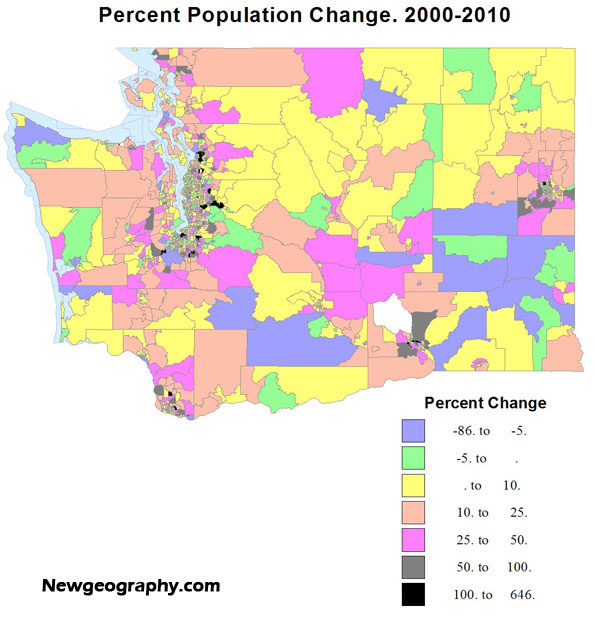
    Washington state and the greater Seattle region grew fairly vigorously 14% (838,000 new residents) in the decade, as they have most decades for over a century. This growth is unusually high for a “non Sunbelt” state. This growth is due not just the engine of Seattle, as eastern and western Washington also experienced substantial growth.

    Most smaller metropolitan areas across the state grew faster than the Seattle metropolitan core. Fast-growing counties are found in the east (Franklin 50%, the easy winner, Benton 23; Kittitas, 22; and Grant 20); all associated with Latino in-migration, as well as in the west (Clark, 23 %; suburban Portland, Mason, 23 percent; suburban Olympia, Thurston (Olympia) 22; Whatcom (Bellingham), 20; and Snohomish, finally, suburban Seattle, 18.

    There are two Washingtons: greater Seattle and the rest of the state, marked by a love and hate relationship. But the balance of power – and demography – is clearly changing in both. There were a few areas of slow growth or decline, as in the heart of the wheat country, but significant growth took place in other metropolitan areas, most notably the Tri-Cities, Vancouver (suburban Portland), Bellingham, Olympia (the state capitol) as well as Spokane, Yakima, and Wenatchee.

    There has been considerable population growth associated with the Columbia Basin project, fueled by heavy Latino in-migration and high birth rates. At the same time there has been population expansion in selected environmental amenity areas – often with retiree in-migration – in many counties across the state. Amenity fueled growth was dramatic in all directions beyond the metropolitan central Puget Sound core, but was also impressive in several areas in eastern Washington, as in Okanogan, Pend Oreille, and Stevens, the far north and northeast, and in Kittitas. Some of this growth comes from migration east from Seattle. Fourth, despite a growth management plan, metropolitan exurbs continue to expand, especially around Vancouver, Spokane, Bellingham and the Tri-Cities (black on the map, over 100% growth).

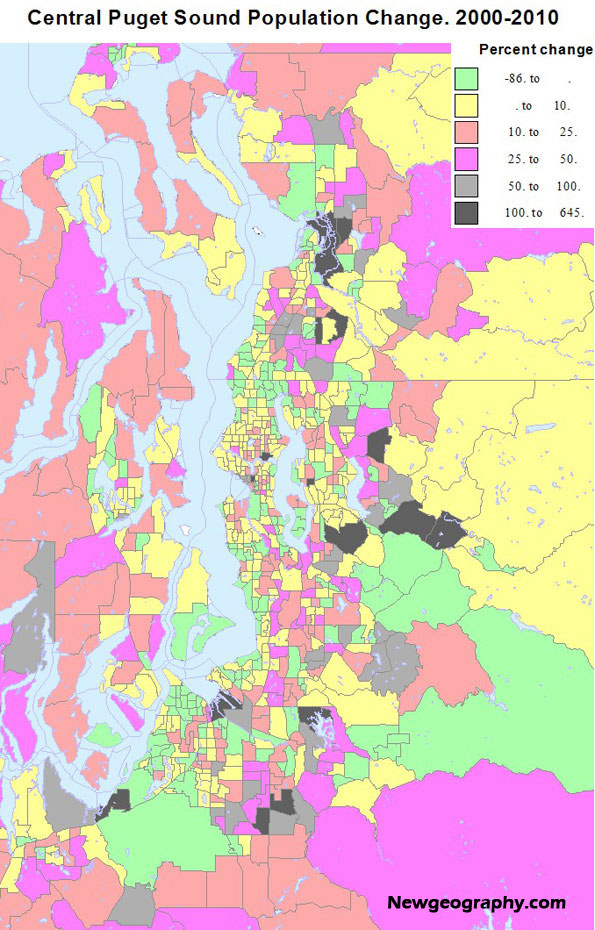
    Turning to central Puget Sound, the most dramatic growth (often over 100 percent), occurred at the far edge of the urban growth areas, and just beyond as exurban growth. This is true in absolute numbers as well as rates. Growth management and upzoning have been unable to stem this tide, for two main reasons rarely acknowledged by planners: the preference of families with children for single family houses and greater housing affordability, at least in some areas (for example, King county south and east of Seattle, and south into Pierce county). Growth was also impressive in most rural and exurban areas, especially in Pierce, Snohomish and Kitsap counties, but far less in King county, which has by far the strictest growth controls

    At the same time, there was concentrated growth in already urban areas, city and suburban, as higher density apartment sprang up across much of Seattle, Tacoma, south King county, in some Eastside cities, and in the SR 99 corridor of Snohomish county north from Seattle.

    In Pierce, Snohomish and south King, some single family and small apartment growth occurred in less affluent areas, attracting many people, including young families who cannot afford to live closer to Seattle. Areas of slower growth tended to be military areas, some urban non-residential tracts, and some more affluent, older settled single family home areas, with an aging population. Growth in downtown Seattle and Bellevue, even Tacoma, was substantial, if not quite as great as planners envisioned. The current shift from home ownership to renting is leading some to project a projected apartment boom in or near downtown Seattle.

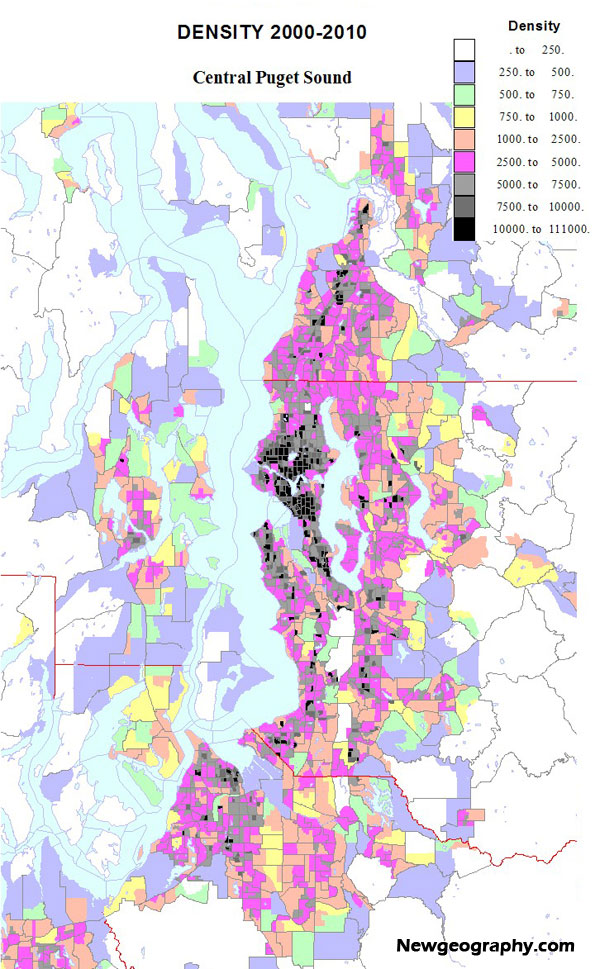
    It’s also interesting to look at density as a measure of “urban-ness”. The third map for density is at a finer block group level. Moderate urban densities from 1000 to 5000 per square mile are dominated by single family homes, areas between 5000 and 7000, by a mix of single family homes and apartments, and over 7000 by apartments, essentially the density goal of urbanist smart growth planning. Seattle really has achieved a substantial degree of such urbanness, dominating central Seattle, but spreading to all corners of the city. Other areas of higher density include the SR99 corridor in Snohomish county, especially south Everett, high tech suburbs to the east, and in south King county the SR 99 corridor again, in some less affluent suburbs, and in Pierce county, downtown Tacoma, and some of South Tacoma toward Ft. Lewis.

    But still more than half the urban footprint resists the officially preferred urban densities. Even with densification, redevelopment and the opening of the first light rail line, these higher density areas housed only 34 percent of the population of King county (up from 32 % in 2000), and only 10 % of the population of the people of the three suburban counties. The city of Seattle is exceptional, containing 52 percent of the high density tracts on the metropolitan area, although it has only one-sixth of the population.

    As the late great UW economist Charlie Tiebout told a seminar 50 years ago, “People vote with their feet” This is certainly true about residential choices. While perhaps twenty percent at most of Americans may prefer higher density living, for reasons of age, family status or ideology, the large majority does not and likely will not.

    To a leftist like me, the tragedy is how smart growth transfers wealth and the vaunted “quality of life” to the rich and the professionals, at the expense of the poor and of minorities. Sadly the Democratic party seems totally blind to the fact that the fixation on new urbanism contributes to the rightward backlash. Folks do not want to be told how to live, especially, dare I assert, when those hectoring them have already cornered the nicest parts of the region for themselves. Middle and working class families are not likely to embrace policies – beloved by affluent professionals – that would deny them a chance to own their preferred kind of residence at a reasonable price.

    Richard Morrill is Professor Emeritus of Geography and Environmental Studies, University of Washington. His research interests include: political geography (voting behavior, redistricting, local governance), population/demography/settlement/migration, urban geography and planning, urban transportation (i.e., old fashioned generalist).

  • Pickles Plans a Pogrom

    Pogróm is a word with Yiddish origin, and is a Russian word meaning “to wreak havoc, to demolish violently, to destroy, or to devastate a town."

    Eric Pickles, British Secretary of State for Communities and Local Government, is planning to demolish, destroy, and devastate half of Dale Farm, on Oak Lane, Crays Hill, near Billericay. Situated to the North of the now established "plotlands" around the post-war New Town of Basildon in Essex, Dale Farm is home to around 1000 people. It is not a farm. It is a 5 hectare former scrapyard off the A127, outside the M25, owned by the Gypsies and Travellers themselves. They have built their own chalet homes in around 100 plots, large enough to include caravan pitches for their families and friends. The problem they have is that the Local Authority has changed it’s attitude to letting Gypsies and Travellers stay to make something of this redundant Brownfield site. Today the Local Authority is mostly against the residents of Dale Farm. But it was not always so in this part of Essex with a long history of "plotlands".

    In the 1960s there were fewer than 10 plots on Oak Lane. Over time the Local Authority, Basildon Council, granted planning permission for around 40 additional plots. Then attitudes hardened in 2000. The Local Authority decided that the Dale Farm plots could not be added to, and that having allowed earlier building on the scrapyard was a mistake. Residents faced opposition to new building on their own land, and the 50 or so homes that were built in the twenty-first century were never going to be granted planning permission by the Local Authority that now wished none of them were there. Half the homes are legal. The other half have had to be built on land the residents legally own, but which the Local Authority now sees as "Green Belt". The Gypsies and Travellers face a Local Authority that, despite Basildon’s history of "plotlands", has nastily turned against them.

    For more information see http://dalefarm.wordpress.com

    Plotlands as a measure of affordability 75 years on 05.04.2009

    Googling plotlands at 10 to 30 homes a hectare 22.04.2009

    On Google Earth look for the rectangle of family housing built in poor quality Green Belt land at Dale Farm, Oak Lane, Crays Hill, Billericay, Essex, CM11 2YJ. The Dale Farm Gypsies and Travellers have shown how people can meet their own housing needs, if only the Local Authority will give them planning permission. Now Basildon Council is planning to spend £8.0 million in demolishing their homes, plus the cost of policing the action. The Daily Mail claimed that Essex Police has asked the Home Office for £10.0 million to cover that policing cost. (1) What kind of crazy planning tyranny is it when people – just like you and I – are prevented from planning and building a field of family houses for themselves?

    Faced with a challenge to 1947 legislation the planning system is acting desperately in forcing the demolition of the Dale Farm homes. The Coalition government has pledged up to £1.2 million to help Basildon Council clear the Gypsies and Travellers away. (2) Basildon Council had asked the department for Communities and Local Government for £3.0 million to help fund an eviction. (3) It’s not the money, but the bigger principle that bothers Eric Pickles, who is now going further. He promises that the CLG will be consulting on new planning guidelines intended to strengthen the hand of Local Authorities in dealing with "unauthorised developments". Dale Farm may be unauthorised, but it is the Local Authority, the CLG, and ultimately Eric Pickles as Secretary of State, who refuse to grant planning approval. If planning approval was likely this conflict would not exist, and 1000 people would be left in peace.

    Pickles is determined to clear the Gypsies and Travellers away. He told the Evening Standard that ‘… we are giving councils the power and discretion to protect the environment and help rebuild community relations’. (2) What he means, of course, is that he sees no place in the local community for Gypsies and Travellers. He is blaming them for any strained local relationships when all they want is to be left alone. He appeals to green ideologues, when the Green Belt that engulfs Dale Farm is waste land. James Heartfield made that point on Spiked! in 2009, when the Dale Farm residents were, once again, unable to overcome the planning legal system. The Dale Farm residents face eco-elitism:

    ‘The law that the Basildon Council is upholding is the law that protects the so-called "Green Belt", which is supposed to stop our towns and cities from sprawling over the unspoilt countryside. Sheridan and his fellow travellers have not taken anyone else’s land; they have built their own homes on their own land. But they are being punished because they have sinned against the sacred cow that is the English Countryside.’ (4)

    Even Pickles will probably admit that vast swathes of the Green Belt, and particularly in Essex, is poor quality, but like New Labour before him, he will not let it be used to live in, and particularly not by working people. He sees an opportunity to get the "law abiding" working people of Basildon to turn on the hard working and independent Gypsies and Travellers for breaking the stupid planning law, and challenging the very idea of an ecology in need of his protection. So Pickles is now going deeper into the green prejudice that people are sprawling over the countryside, and need to be contained. At Dale Farm he is tapping into the prejudice amongst environmentalists that large families are a problem. Many Gypsies and Travellers like to have large families, and look after each other, but their sociable culture is evidently at odds with the anti-human idea amongst greens that population growth is threatening the planet.

    The anti-human prejudice is common to environmentalists, but is being directed by Pickles as he pushes the planning system towards a legal presumption in favour of "sustainable development". Pickles is saying that Gypsies and Travellers building homes represents the unsustainable development his National Planning Policy Framework aims to stop.

    Large families flouting the planning law, and building on the Green Belt in ways that government defines as unsustainable are unacceptable to Pickles. He encourages the local community to organise to move them on, and to use the police to forcibly clear their homes from their own land. Pickles plans a pogrom against Gypsies and Travellers in 2011. As even The Guardian recognised, anticipating "The Battle of Basildon", Pickles ‘… is fast turning his personal track record of vehement opposition to unauthorised Traveller sites into government policy’. (5)

    Pogróm originally meant attacks on Jews in the Russian Empire. The first was anti-Jewish rioting in Odessa in 1821. The term "pogrom" gained common use with anti-Jewish riots across the Ukraine and southern Russia between 1881 and 1884, after Narodnaya Volya terrorists assassinated Tsar Alexander II in St. Petersburg. The "People’s Will" anarchists were responsible, but the reaction to the assassination took the form of anti-semitic attacks, lootings, evictions, and expulsions. The perpetrators were organized locally, often with government and police encouragement. Between 1903 and 1906 there were further pogroms, while the 1917 Bolshevik Revolution was widely denounced as a Jewish conspiracy. The British "Khaki" General Election after the First World War returned David Lloyd George as Prime Minister in December 1918, and Winston Churchill became War Minister and Air Secretary. No strangers to anti-semitism, and fearing a spread of mutinous internationalism throughout Europe, they sent the British Expeditionary Forces to help the Tsarist "White" Russians attack the Bolsheviks in the Soviet Union.

    Nationalists and the Tsarist Army, backed by Expeditionary Forces from Britain, France, and the United States of America, engaged in pogroms in Ukraine, Poland, Belarus, Romania, and Western Russia, killing tens of thousands of Jews between 1918 and 1920. Pogroms continued in Romania to 1921. Anti-semitism went systematically with racism against Gypsies across Europe between the wars, and did not end with the massacre of the Gypsy Camp at Auschwitz-Birkenau on 2 August 1944.

    Eric PicklesEric Pickles is a socially divisive nationalist, but he is no fascist, and would probably hate to be thought of as racist. He believes he is working to protect the planet, while talking about a "Big Society" to businessmen, (6) but he really wants a sustainable Little Britain that makes a virtue out of parochial intolerance. Pickles is adept at exploiting political division. This is of course not a new dispute, nor one limited in consequence to Dale Farm. Much depends on the outcome. The residents were ordered to leave in February 2007 when Ruth Kelly was running the CLG, but they appealed against the decision. (7) The Dale Farm case has gone on since 2001. The leader of Basildon Council Tony Ball insists that ‘… wrong is wrong and there can’t be one rule for one group, and one for another. The law of the land must be upheld’. (8) He knows that the planning law stops everyone from building on their own land unless the Local Authority accepts their design. Ball knows that if the Dale Farm Gypsies and Travellers are not made an example of, then there are plenty of other people around Basildon, Essex, and Britain who would like to build on their own land. Councillors like him would no longer have the power of refusal and demolition that Eric Pickles expects to be exercised on behalf of national government. Ball can’t imagine a planning system based on pursuasion rather than a universal denial of development rights:

    ‘Look at the alternatives. If a council turns a blind eye to law-breaking what moral right do we have to enforce against anybody else who breaches planning laws? Green belt is there for a reason. It is to stop urban sprawl’. (9)

    If the Dale Farm residents win, the denial of the Right to Build can be challenged by many more people around Britain than there are Gypsies and Travellers. Planners would need to win support for something positive to be built by freeholders, having lost the power to say "No".

    Basildon Council Leader Tony Ball defended the eviction plan on 15 March 2011 in a television interview, posted on www.bbc.co.uk.

    Tony BallBall no doubt wants the Dale Farm residents to move on. He seems willing to allow at least a limited window of opportunity for residents to find alternative locations. (10) Yet Ball also appears utterly insensitive to the fact that the Dale Farm residents want the freedom of choice to stay on their own land, at Oak Lane, Crays Hill. Until Secretary of State Pickles intervened it seemed that the 28-day notice of eviction might not be delivered to residents quickly. However Pickles is publicly recommending that all Local Authorities watch for movements of Gypsies and Travellers over the Spring holiday. Rosa Prince, writing for The Telegraph, was not slow to repeat the pre-holiday alarm from Pickles, when she screamed:

    ‘Travellers have been known in the past to take advantage of bank holidays to launch “land grabs,” setting up home on land which they do not have authorisation to camp on, and applying for retrospective planning permission once the council offices reopen… Councils are also being allowed to resist retrospective planning applications submitted by gipsies and other home builders, and give more rights to enforce removal notice against those who act illegally’. (11)

    This eco-anxiety is getting to the truth of the matter. Pickles is blaming Gypsies and Travellers for their independence, but is really worried about "other home builders" who might break the planning law on their own land. ‘It’s time for fair play in the planning system’, he said, ‘… standing up for those who play by the rules and tougher action for those who abuse and play the system’. (12) Gypsies and Travellers know the planning system is not fair. It is stacked against them, and if they try to do anything to solve their own housing predicament the planning system will be used by "the wider community" to demolish, destroy, and devastate their homes. Locals who are not Gypsies and Travellers are asking "Why don’t we all start building extra houses, if they can get away with it?" As James Heartfield has observed, ‘… people usually mean it rhetorically. But actually, it is the right question, just put the wrong way around’. (4) If many more people broke the planning law, and argued to be free to build on their own land as a point of principle, Britain would not have a housing shortage. If Pickles persisted with evictions he would be exposed for his intolerance of Gypsies and Travellers, which in this impending pogrom is hard not to see as an expression of racism.

    It seems clear that eco-elitism can very easily slip into racism, and the ambition of "Localism" seems reduced to mobilising parochial hatreds.

    Talking up "Localism", Pickles told the Conservative Home blog readers that ‘… it’s up to you. Be as ambitious as you can. Be as radical as you like. Be as bold as you want. I’m not going to stand in anyone’s way’. (13) Pickles doesn’t mean Gypsies and Travellers. He will do more than stand in their way, and is whipping up racism against Gypsies and Travellers. Not everyone in Basildon will support what he is doing, but the problem is that locally, and nationally, the disparate working people who support the Gypsies and Travellers are not yet sufficiently organised to effectively stop Pickles. That need not remain a political weakness.

    Pickles will obstruct everyone challenging the 1947 planning law, but he will be viscious against Gypsies and Travellers. He wants "the wider community" to be involved in discussions in determining the number of traveller sites to be provided. (11) Gypsies and Travellers should be free to live on their own land without this sort of government backed locally perpetrated "community" discipline. Don’t be fooled by all the talk from this Coalition about "Big Society" or ending the "dependency culture".

    Britain can’t so easily stop the Dependency Culture 31.10.2010

    The Dale Farm Gypsies and Travellers are clearly being singled out for having the strength to demonstrate their desire for independence. In fact it is Pickles and his burdensome planning law that wants to keep them in a state of dependency. As James Heartfield argued in 2008, we should all applaud and follow the example of Britain’s Gypsies and Travellers:

    Forget Eco-towns – Let’s follow the example of Britain’s Gypsies 15.04.2008

    More urgently, the Dale Farm Gypsies and Travellers need to be defended against the destructive and socially divisive pogrom that Eric Pickles is planning. These family chalet homes should not be demolished. ‘We’re not wanted anywhere. We’re not wanted in the countryside. We’re not wanted in the town’, Candy Sheridan told The Guardian. An Irish Traveller, and Vice Chair of the Gypsy Council 2010, founded in 1966, she is busy trying to help others through the planning system. ‘Councillors don’t want to see us’, but ‘… we are part of the countryside and we have been for 600 years. We have more right to be there than they do’. (14) There is plenty of space for everyone in the 90 per cent of Britain that is not built on.

    Dale Farm Residents - courtesy of Mary Turner

    Britain should be pushing for a universal freedom to build, not forced demolitions, targeted against the few. Don’t be fooled by the awesome mendacity of Eric Pickles. He’s got it in for Gypsies and Travellers, and they threaten his planning system. For Pickles this is a long run battle.

    The awesome mendacity of Eric Pickles 31.03.2011

    Every planning initiative from this government and from the last one is in tatters. Pickles has no plan to build housing, only punish Gypsies and Travellers who refuse to wait around for the planning system to allow house building. They won’t go easily, and they should be supported. (15)

    The CLG looks to be about to demolish more homes built by Gypsies and Travellers than they have managed to deliver through the entire failed Eco-Towns programme. The CLG should be ashamed of their record, and of what Pickles is doing in the name of the planning system.

    Zero Eco-Towns 28.03.2011

    Grattan Puxon representing the Dale Farm Residents Association wrote an open letter to Pickles on the http://lolodiklo.blogspot.com, an organization dedicated to raising awareness about the history, culture and true lives of Romani people. Puxon told Pickles that ‘… forced eviction is always an ugly action but when it’s being taken against ninety families of one community and those families belong to a ethnic minority, then there must be cause for concern, alarm and shame’. (16) But Pickles is shameless. He says he is acting for the environment and the community of Basildon. In reality he is acting on his own prejudices from within a Coalition government sustained in power by Liberal Democrats.

    It is time to stand in the way of Eric Pickles as he plans a pogrom in 2011

    Ian Abley, Project Manager for audacity, an experienced site Architect, and a Research Engineer at the Centre for Innovative and Collaborative Engineering, Loughborough University. He is co-author of Why is construction so backward? (2004) and co-editor of Manmade Modular Megastructures. (2006) He is planning 250 new British towns.
    Notes:

    1. ‘Essex travellers facing eviction threaten Big Fat Gypsy War on the authorities’, 13 March 2011, Daily Mail, posted on www.dailymail.co.uk

    2. ‘Travellers face bank holiday crackdown’, 13 April 2011, Evening Standard

    3. ‘Not evicting gypsies will set "very bad precedent" ‘, 10 March 2011, This is Total Essex, Essex Chronicle

    4. James Heartfield, ‘Dale Farm rebellion against eco-elitism’, 26 January 2009, Spiked Online, posted here

    5. Patrick Barkham, ‘Dale Farm Travellers eviction: the battle of Basildon’, 25 March 2011, The Guardian

    6. Eric Pickles, speech to the ‘Home Builders Federation "One Year On" Conference’, London, 31 March 2011

    7. Andrew Levy, ‘Travellers build a £12,000 hall at illegal camp – with taxpayers’ cash, and without planning permission’, 1 May 2008, Daily Mail

    8. Joshua Farrington, ‘Basildon: Council votes for eviction despite travellers’ protests’, 16 March 2011, This is Total Essex, Essex Chronicle

    9. Tony Ball, quoted by Patrick Barkham, ‘Dale Farm Travellers eviction: the battle of Basildon’, 25 March 2011, The Guardian

    10. ‘Basildon Council votes to evict Dale Farm’, 16 March 2011, Travellers’ Times

    11. Rosa Prince, ‘Eric Pickles: gipsies could take advantage of Royal Wedding bank holiday to set up illegal camps’, 13 April 2011, The Telegraph

    12. Eric Pickles, quoted by Rosa Prince, ‘Eric Pickles: gipsies could take advantage of Royal Wedding bank holiday to set up illegal camps’, 13 April 2011, The Telegraph

    13. Eric Pickles, ‘It’s the local economy, stupid’, 30 July 2010, Conservative Home Blog

    14. Candy Sheridan, quoted by Patrick Barkham, ‘Dale Farm Travellers eviction: the battle of Basildon’, 25 March 2011, The Guardian

    15. Rachel Stevenson, ‘Dale Farm Travellers: ‘We won’t just get up and leave’, 27 July 2010, The Guardian

    16. Grattan Puxon, open letter to Eric Pickles, Secretary of State for Communities and Local Government, ‘UN calls for halt to UK Gypsy Evictions’, 22 July 2010, Lolo Diklo

  • Census 2010 Offers Portrait of America in Transition

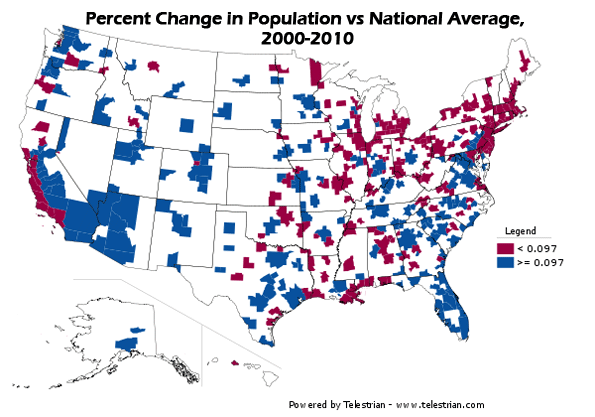
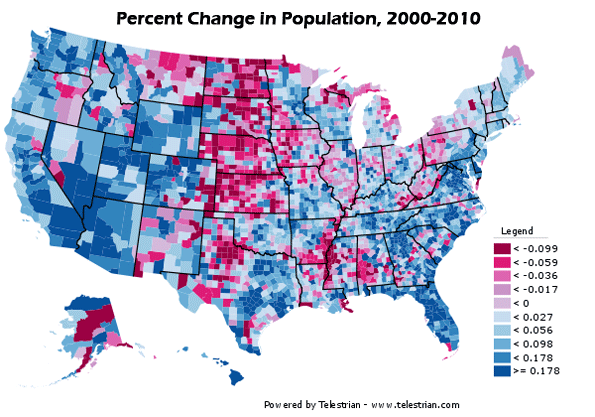
    The Census Bureau just finished releasing all of the state redistricting file information from the 2010 Census, giving us a now complete portrait of population change for the entire country.  Population growth continued to be heavily concentrated in suburban metropolitan counties while many rural areas, particularly in the Great Plains, continue to shrink.


    Percentage change in population, 2000-2010. Counties that grew in population in blue, decliners in red. Note: Legend values not multiplied by 100.

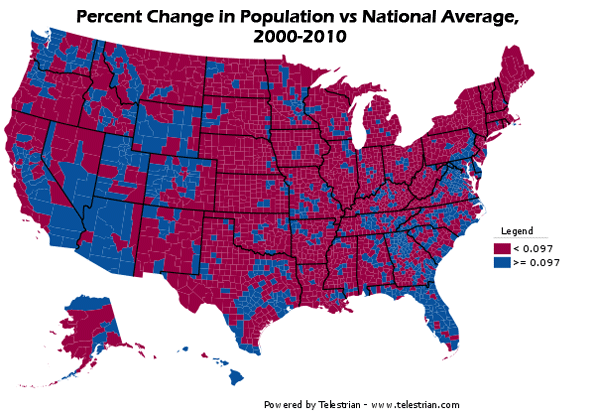
    Dividing counties by those growing faster or slower than the US average paints the picture even more starkly:


    Percentage change in population, 2000-2010.  Counties growing faster than the US average in blue, slower than the US average in red.  Note: Legend values not multiplied by 100.

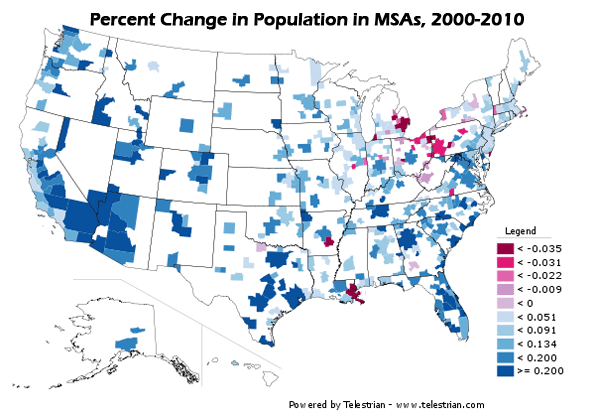
    The release of all county data means it is also possible to take an unofficial, preliminary look at metropolitan area growth.  The biggest gainers were Sunbelt cities in the South, Texas, and the Midwest, while the Midwest and Northeast continued to lag, particularly the old heavy manufacturing axis stretching from Detroit to Pittsburgh. But this picture was not monolithic. Many Southern cities with Rust Belt profiles like Birmingham failed to grow much compared to neighbors, nor did coastal California with its development restrictions.


    Percentage change in population, 2000-2010. MSAs that grew in population in blue, decliners in red. Note: Legend values not multiplied by 100.


    Percentage change in population, 2000-2010.  Counties growing faster than the US average in blue, slower than the US average in red.  Note: Legend values not multiplied by 100.

    A full table of population change for large metro areas (greater than one million people) is available at the bottom of this post.

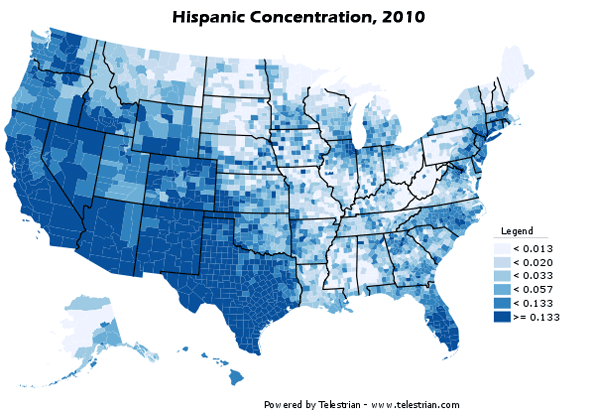
    Basic race information is also available in this data release, since it is used to ensure redistricting complies with the requirements of the Voting Rights Act.  Here’s a map showing the concentration of Hispanic population the US:


    Population of Hispanic Origin, as a percentage of total population. Note: Legend values not multipled by 100.

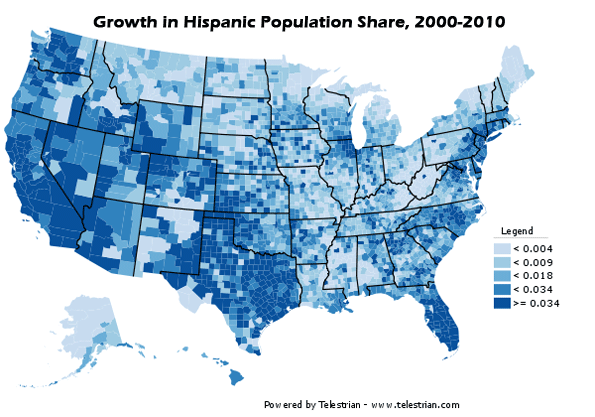
    Hispanic population remains heavily concentrated in the Southwest, but the interior, and especially parts of the South one would not expect, such as Alabama, posted significant gains in Hispanic population share.


    Hispanic population as change in percentage of total population, 2000-2010.  Note: Legend values not multiplied by 100.

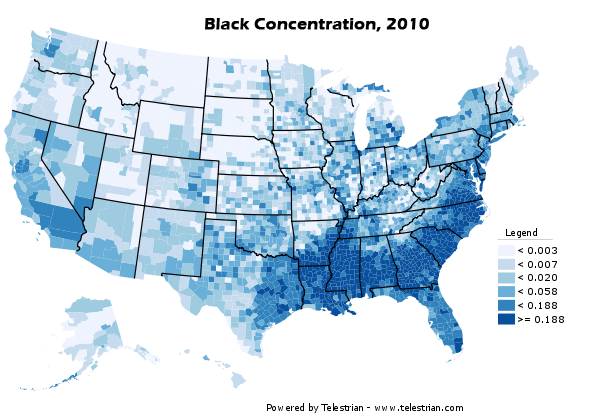
    As the highest concentrations of Hispanics remain in the Southwest, similarly the Black population is at its heaviest concentrations in the South:

    Black Alone population as a percentage of total population, 2010.  Note: Legend percentages not multiplied by 100.

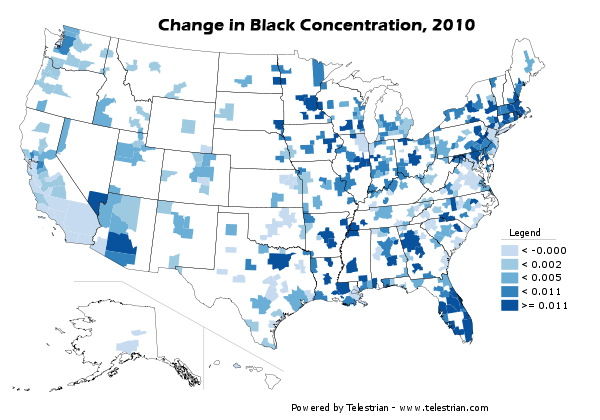
    A lot has been written about the so-called reverse Great Migration of blacks from the North to the South.  These results show something of that effect, but less of a general than a specific migration. Some cities both North and South are becoming magnets for Blacks, while other traditional Black hubs like Chicago are no longer favored. Note that some northern cities that showed a larger increase in concentration started off on a low base, like Minneapolis-St. Paul:


    Black Alone population as change in percentage of total population, 2000-2010.  Note: Legend values not multiplied by 100.

    As noted above, here are all US metro areas with a population greater than one million people in 2010, ranked by percentage change in population:

    2000-2010 Population Growth, MSAs of 1 Million or More
    Rank Metropolitan Area 2000 2010 Total Change Pct Change
    1 Las Vegas-Paradise, NV 1,375,765 1,951,269 575,504 41.8%
    2 Raleigh-Cary, NC 797,071 1,130,490 333,419 41.8%
    3 Austin-Round Rock-San Marcos, TX 1,249,763 1,716,289 466,526 37.3%
    4 Charlotte-Gastonia-Rock Hill, NC-SC 1,330,448 1,758,038 427,590 32.1%
    5 Riverside-San Bernardino-Ontario, CA 3,254,821 4,224,851 970,030 29.8%
    6 Orlando-Kissimmee-Sanford, FL 1,644,561 2,134,411 489,850 29.8%
    7 Phoenix-Mesa-Glendale, AZ 3,251,876 4,192,887 941,011 28.9%
    8 Houston-Sugar Land-Baytown, TX 4,715,407 5,946,800 1,231,393 26.1%
    9 San Antonio-New Braunfels, TX 1,711,703 2,142,508 430,805 25.2%
    10 Atlanta-Sandy Springs-Marietta, GA 4,247,981 5,268,860 1,020,879 24.0%
    11 Dallas-Fort Worth-Arlington, TX 5,161,544 6,371,773 1,210,229 23.4%
    12 Nashville-Davidson–Murfreesboro–Franklin, TN 1,311,789 1,589,934 278,145 21.2%
    13 Jacksonville, FL 1,122,750 1,345,596 222,846 19.8%
    14 Sacramento–Arden-Arcade–Roseville, CA 1,796,857 2,149,127 352,270 19.6%
    15 Denver-Aurora-Broomfield, CO 2,179,240 2,543,482 364,242 16.7%
    16 Washington-Arlington-Alexandria, DC-VA-MD-WV 4,796,183 5,582,170 785,987 16.4%
    17 Tampa-St. Petersburg-Clearwater, FL 2,395,997 2,783,243 387,246 16.2%
    18 Salt Lake City, UT 968,858 1,124,197 155,339 16.0%
    19 Portland-Vancouver-Hillsboro, OR-WA 1,927,881 2,226,009 298,128 15.5%
    20 Indianapolis-Carmel, IN 1,525,104 1,756,241 231,137 15.2%
    21 Richmond, VA 1,096,957 1,258,251 161,294 14.7%
    22 Oklahoma City, OK 1,095,421 1,252,987 157,566 14.4%
    23 Columbus, OH 1,612,694 1,836,536 223,842 13.9%
    24 Seattle-Tacoma-Bellevue, WA 3,043,878 3,439,809 395,931 13.0%
    25 Miami-Fort Lauderdale-Pompano Beach, FL 5,007,564 5,564,635 557,071 11.1%
    26 Kansas City, MO-KS 1,836,038 2,035,334 199,296 10.9%
    27 Minneapolis-St. Paul-Bloomington, MN-WI 2,968,806 3,279,833 311,027 10.5%
    28 Louisville/Jefferson County, KY-IN 1,161,975 1,283,566 121,591 10.5%
    29 San Diego-Carlsbad-San Marcos, CA 2,813,833 3,095,313 281,480 10.0%
    30 Memphis, TN-MS-AR 1,205,204 1,316,100 110,896 9.2%
    31 Birmingham-Hoover, AL 1,052,238 1,128,047 75,809 7.2%
    32 Baltimore-Towson, MD 2,552,994 2,710,489 157,495 6.2%
    33 Virginia Beach-Norfolk-Newport News, VA-NC 1,576,370 1,671,683 95,313 6.0%
    34 Cincinnati-Middletown, OH-KY-IN 2,009,632 2,130,151 120,519 6.0%
    35 San Jose-Sunnyvale-Santa Clara, CA 1,735,819 1,836,911 101,092 5.8%
    36 Hartford-West Hartford-East Hartford, CT 1,148,618 1,212,381 63,763 5.6%
    37 San Francisco-Oakland-Fremont, CA 4,123,740 4,335,391 211,651 5.1%
    38 Philadelphia-Camden-Wilmington, PA-NJ-DE-MD 5,687,147 5,965,343 278,196 4.9%
    39 St. Louis, MO-IL 2,698,687 2,812,896 114,209 4.2%
    40 Chicago-Joliet-Naperville, IL-IN-WI 9,098,316 9,461,105 362,789 4.0%
    41 Los Angeles-Long Beach-Santa Ana, CA 12,365,627 12,828,837 463,210 3.7%
    42 Milwaukee-Waukesha-West Allis, WI 1,500,741 1,555,908 55,167 3.7%
    43 Boston-Cambridge-Quincy, MA-NH 4,391,344 4,552,402 161,058 3.7%
    44 New York-Northern New Jersey-Long Island, NY-NJ-PA 18,323,002 18,897,109 574,107 3.1%
    45 Rochester, NY 1,037,831 1,054,323 16,492 1.6%
    46 Providence-New Bedford-Fall River, RI-MA 1,582,997 1,600,852 17,855 1.1%
    47 Buffalo-Niagara Falls, NY 1,170,111 1,135,509 -34,602 -3.0%
    48 Pittsburgh, PA 2,431,087 2,356,285 -74,802 -3.1%
    49 Cleveland-Elyria-Mentor, OH 2,148,143 2,077,240 -70,903 -3.3%
    50 Detroit-Warren-Livonia, MI 4,452,557 4,296,250 -156,307 -3.5%
    51 New Orleans-Metairie-Kenner, LA 1,316,510 1,167,764 -148,746 -11.3%

    Aaron M. Renn is an independent writer on urban affairs based in the Midwest. His writings appear at The Urbanophile. Maps and analysis done using Telestrian.

  • Why North Dakota Is Booming

    Living on the harsh, wind-swept northern Great Plains, North Dakotans lean towards the practical in economic development. Finding themselves sitting on prodigious pools of oil—estimated by the state’s Department of Mineral Resources at least 4.3 billion barrels—they are out drilling like mad. And the state is booming.

    Unemployment is 3.8%, and according to a Gallup survey last month, North Dakota has the best job market in the country. Its economy “sticks out like a diamond in a bowl of cherry pits,” says Ron Wirtz, editor of the Minneapolis Fed’s newspaper, fedgazette. The state’s population, slightly more than 672,000, is up nearly 5% since 2000.

    The biggest impetus for the good times lies with energy development. Around 650 wells were drilled last year in North Dakota, and the state Department of Mineral Resources envisions another 5,500 new wells over the next two decades. Between 2005 and 2009, oil industry revenues have tripled to $12.7 billion from $4.2 billion, creating more than 13,000 jobs.

    Already fourth in oil production behind Texas, Alaska and California, the state is positioned to advance on its competitors. Drilling in both Alaska and the Gulf, for example, is currently being restrained by Washington-imposed regulations. And progressives in California—which sits on its own prodigious oil supplies—abhor drilling, promising green jobs while suffering double-digit unemployment, higher utility rates and the prospect of mind-numbing new regulations that are designed to combat global warming and are all but certain to depress future growth. In North Dakota, by contrast, even the state’s Democrats—such as Sen. Kent Conrad and former Sen. Byron Dorgan—tend to be pro-oil. The industry services the old-fashioned liberal goal of making middle-class constituents wealthier.

    Oil also is the principal reason North Dakota enjoys arguably the best fiscal situation in all the states. With a severance tax on locally produced oil, there’s a growing state surplus. Recent estimates put an extra $1 billion in the state’s coffers this year, and that’s based on a now-low price of $70 a barrel.

    North Dakota, however, is no one-note Prairie sheikdom. The state enjoys prodigious coal supplies and has—yes—even moved heavily into wind-generated electricity, now ranking ninth in the country. Thanks to global demand, North Dakota’s crop sales are strong, but they are no longer the dominant economic driver—agriculture employs only 7.2% of the state’s work force.

    Perhaps more surprising, North Dakota is also attracting high-tech. For years many of the state’s talented graduates left home, but that brain drain is beginning to reverse. This has been critical to the success of many companies, such as Great Plains Software, which was founded in the 1980s and sold to Microsoft in 2001 for $1.1 billion. The firm has well over 1,000 employees.

    The corridor between Grand Forks and Fargo along the Red River (the border between North Dakota and Minnesota) has grown rapidly in the past decade. It now boasts the headquarters of Microsoft Business Systems and firms such as PacketDigital, which makes microelectronics for portable electronic devices and systems. There are also biotech firms such as Aldevron, which manufactures proteins for biomedical research. Between 2002 and 2009, state employment in science, technology, engineering and math-related professions grew over 30%, according to EMSI, an economic modeling firm. This is five times the national average.

    While the overall numbers are still small compared to those of bigger states, North Dakota now outperforms the nation in everything from the percentage of college graduates under the age of 45 to per-capita numbers of engineering and science graduates. Median household income in 2009 was $49,450, up from $42,235 in 2000. That 17% increase over the last decade was three times the rate of Massachussetts and more than 10 times that of California.

    Some cities, notably Fargo (population 95,000), have emerged as magnets. “Our parking lot has 20 license plates in it,” notes Niles Hushka, co-founder of Kadrmas, Lee and Jackson, an engineering firm active in Great Plains energy development. Broadway Drive in Fargo’s downtown boasts art galleries, good restaurants and young urban professionals hanging out in an array of bars. This urban revival is a source of great pride in Fargo.

    What accounts for the state’s success? Dakotans didn’t bet the farm, so to speak, on solar cells, high-density housing or high-speed rail. Taxes are moderate—the state ranks near the middle in terms of tax per capita, according to the Tax Foundation—and North Dakota is a right-to-work state, which makes it attractive to new employers, especially in manufacturing. But the state’s real key to success is doing the first things first—such as producing energy, food and specialized manufactured goods for which there is a growing, world-wide market. This is what creates the employment and wealth that can support environmental protection and higher education.

    Thankfully, this kind of sensible thinking is making a comeback in some other states, such as Ohio and Pennsylvania. These hard-pressed states realize that attending to basic needs—in their case, shale natural gas—could be just the elixir to resuscitate their economies.

    This piece originally appeared in the Wall Street Journal.

    Joel Kotkin is executive editor of NewGeography.com and is a distinguished presidential fellow in urban futures at Chapman University, and an adjunct fellow of the Legatum Institute in London. He is author of The City: A Global History. His newest book is The Next Hundred Million: America in 2050, released in February, 2010.

    Photo by SnoShuu

  • Telecommuting and Satellite Cities

    Smaller satellite cities throughout the Midwest may have an advantage that they have yet to realize: strong bases for telecommuters. Cities such as Iowa City, IA; Albert Lea, MN; and Hastings, NE have this advantage, where over four percent of the city’s population works from home according to American Community Survey’s information from 2009. The average rates for larger metros tended to be in the mid 3% range. Here are a few Midwestern cities that were of note:


    % Population working from home

    Albert Lea, MN

    5.7

    Athens, OH

    5.0

    Brainerd, MN

    6.4

    Dubuque, IA

    4.1

    Freeport, IL

    4.8

    Hastings, NE

    5.7

    Iowa City, IA

    4.7

    La Crosse, WI

    4.7

    Source:  U.S. Census American Community Survey, 2009

    These cities have similar attributes: relatively small populations, mostly remote locations, and within 200 miles of a large metro. These characteristics may be a foundation for increased telecommunication in these cities. Could these cities one day become far-flung constituents of a larger conurbation?

    For example, of the eight cities cited above, three of them could call Chicago their focal city. Other cities that act as cardinal municipalities in this list are Madison, Minneapolis, and Omaha. While millions from the labor force pile into large, over-populated metros throughout the Midwest for work, others may be able to find integral employment in these smaller regions, while still in close enough proximity to benefit from the larger markets.

    Telecommuting may also have a positive affect on the quality of life of the individuals who take advantage of the opportunity. A smaller city often makes for lower costs, cheaper housing, less time driving from place to place, and more access to the community. On top of this, rising oil prices have less affect on the telecommuter. Furthermore, some of the cities listed are in an optimal location for natural amenities of the region to be factored in. For instance, Brainerd’s prime location amidst a plethora of lakes and forestry helps to add to the city’s natural lure, while remaining twice daily flight or a 130 mile drive to downtown Minneapolis. 

    If these satellite cities can adapt to be friendly to telecommuters, they may be able to help strengthen the regional economies with a more specialized, more productive workforce. Businesses in the area must be inclined to initiate telecommuting as a part of their workforce and have trust in their workers. A smaller community may make this an opportune place for this, as it forms a more cohesive social unity amongst citizens.

    If these smaller places can maintain reasonable air and telecommunications access, affordable housing, high-end schools and child care, and perhaps flexible small office space or business assistance for lone eagle entrepreneurs, these places could become hubs for this growing segment of workers.  However, the big incentive for those desiring and learning about telecommuting work may simply be the opportunity to do important work in their pajamas.

  • Regional Efficiency: The Swiss Model?

    Given that no one likes Switzerland’s banks, coo-coo clocks, high prices, smugness, dull cities, cheesy foods, or yodeling, I realize that it is too early to speak politically about “the Swiss Model.” But it needs to be pointed out that while the European Union evaporates and Homeland America goes for broke, the world’s second oldest democracy (1291) has trade and budget surpluses, a multi-lingual population, a green network of trains and buses to every village, excellent public schools, and a federal-style government that is closer to Thomas Jefferson’s America than the bureaucratic monarchy that gives the king’s speeches in Washington.

    Yes, the Swiss recently voted against the construction of minarets (NIMCP or “not in my cow pasture”) and for the eviction of immigrants convicted of serious crimes. (Would you vote “for” protecting the immigration rights of the rapist next door?) But a quarter of the students in Geneva’s public schools are foreign, and—in the age of focus groups and slick pollsters—the democracy remains in the hands of its citizenry, for better or for worse, which every two months votes on the referendums of the critical issues. On this month’s ballot is gun control.

    A mythical Swiss story involves a man on a morning bus, chatting with someone standing near him, exchanging pleasantries about work and the weather, and discovering that his commuting friend is also the president of the Swiss confederation.

    I had a similar experience. I had arrived at the Geneva Press Club on my bike, and discovered that the woman sitting near me was also the president, Micheline Calmy-Rey. To be clear, she was at the front of the room, and I was in the audience. But her unassuming manner was that of a bus commuter, and had she walked into the room unescorted, I would not have marked her as the leader of the country.

    In a way, she is not. To be president of Switzerland is to be the head of a seven person federal council, whose members are apportioned according to the political parties in the parliament. Real power in the country remains vested in the villages and in the twenty-six cantons. Think of the Swiss president as the unlucky committee person who has to keep the minutes.

    After the European revolutions of 1848, Switzerland adopted a federal constitution, in part modeled on the American system, although instead of the imperial presidency (which Jefferson called “a bad edition” of the Polish king), the Swiss went for an executive council. Benjamin Franklin had the same idea earlier for the U.S., but lost out to the more presidential Adams and Madison.

    Each year, the members of Switzerland’s federal council draw straws for the presidency and the other executive offices, such as the portfolios for justice, sport, and economics. Technically, the chief executive is composed of the entire collective.

    Recent presidents include Hans-Rudolph Merz and Doris Leuthard (often the Swiss president is a woman). The Merz administration, however, proved the limits of a referendum democracy in the fast-paced, somewhat dictatorial age of globalization.

    From the German-speaking part of the country, and regarded by his critics as a small town politician, Merz had the misfortune to horse trade with Libya’s Muammar el-Qaddafi. The diplomatic row began when Hannibal, the son of the Libyan president, was arrested in a Geneva hotel for having mistreated his servants.

    No one in Geneva doubts that Hannibal Qaddafi’s servants were treated little better than Arab slaves. The staff at the posh hotel reluctantly called the police to intervene. Warming to the Ali Baba-like themes of the crime, the local press published Hannibal’s mug shot, and the crisis was off to the camel races.

    After picking up two Swiss businessmen in Tripoli with expired visas, Father Muammar — Qaddafi, that is — threw them into solitary confinement and vowed to release them only if the Swiss punished the Geneva police, apologized to Hannibal, and groveled inside the colonel’s tent.

    Agreeing to Qaddafi’s terms, because the great Swiss trait is accommodation, Merz flew to Tripoli, thinking he had a Clintonian deal to return triumphantly to Bern with the Swiss hostages.

    Instead, the colonel-for-life lectured Merz on the finer points of visa legislation, and the Swiss president flew back to Bern with only the hostages’ luggage, which had been loaded onto the presidential executive jet. The hostages had to serve humiliating prison terms, and a grateful nation watched Merz retire at the end of 2009. A government of “sapeur pompiers” (volunteer firemen) is not without its comic charms.

    As she was then minister of foreign affairs, Calmy-Rey was not blameless in what the press calls the “Affaire Qaddafi,” but that didn’t prevent her from becoming president this year, her second time in the position.

    At a press conference, she admitted, in so many words, that a rotating federal council perhaps wasn’t the best way to deal with erratic strongmen. Her actual words were much more diplomatic; she suggested that the council had lacked the “resources” to manage the crisis.

    In person, I liked Calmy-Rey much more than I expected. Her image in the press is as a glad-hander, someone unwilling to tell Swiss detractors to stick it. She wore a head scarf to meet Iranian president Mahmoud Ahmadinejad.

    In person she’s thoughtful, well spoken, conversationally direct, up on the details of government, ever-so-slightly humorous, and modest, as if she were mayor of a small commune, which is another way to understand Switzerland.

    I have been in Washington press conferences, and they are like a Versailles levée compared with a Swiss question-and-answer session. Calmy-Rey shared the modest dais with two officials and the head of the press club, as if they were panelists at a Rotary meeting.

    Her formal remarks were confined to a budgetary review of the pluses and minuses of supporting “international Geneva,” the sprawling network of UN-related organizations that have come to roost in the city. At the cost of billions, laid on in office infrastructure and tram lines, the hope is that peace becomes part of the Swiss brand.

    Everyone in the room who wanted to ask a question did, and Calmy-Rey stayed as long as it took to recite the liturgy on Brazilian floods, Middle East protest riots, banking secrecy, bilateral relations with the European Union, Kosovo’s future, nuclear Iran, building plans at the United Nations, Armenia and Turkey, the surplus of the federal budget, and more, until the room felt like a class eager for the break.

    The conference hardly made the daily papers. The only sound bite was her answer to a question about whether the Swiss were prepared to give asylum to the WikiLeaks founder and publisher, Julian Assange. Calmy-Rey gave a broad, politically evasive smile, and said, in somewhat fractured English, “We cannot give what we have not been asked to give.”

    Meaning: Neither Assange personally, nor any government, had approached the Swiss to grant him asylum. If I had to guess, I would say the Swiss would pass on granting asylum to Assange, just to avoid more aggravation with the Americans, who routinely use the Swiss as punching bags on banking secrecy and their nonaligned status in world affairs. In another context Calmy-Rey said, “We know we’re alone,” and that was a weakness in dealing with Qaddafi.

    I found Calmy-Rey realistic and self-effacing on Switzerland’s diplomatic nether world. The country has to straddle “international Geneva” and its many world agencies with another Swiss impulse, which, in the words of George Washington, is to avoid “foreign entanglements.”

    Switzerland has come through the recent economic horrors with its budget in surplus ($3 billion), and without any of the Euro debts that followed the long weekends in Ireland and Greece. Power remains in the cantons and the communes, which decide what to teach in the schools, how much tax to collect, and who lives in the villages.

    Refreshing, as well, is that the Swiss president can travel in a motorcade of one (I noticed that her driver is a woman), if not on the bus. When Calmy-Rey was in her first term as president, my daughter Laura was in high school. One night at dinner she described shopping after school in a discount department store. In the checkout line she stood next to Calmy-Rey, who, by herself, was buying a blouse.

    Photo by Juerg Vollmer; Micheline Calmy-Rey, Zuerich, 2009

    Matthew Stevenson is the author of Remembering the Twentieth Century Limited, a collection of historical essays. He is also editor of Rules of the Game: The Best Sports Writing from Harper’s Magazine. He lives in Switzerland.

  • The Midwest: Coming Back?

    Oh my name it is nothing
    My age it is less
    The country I come from
    Is called the Midwest

    –Bob Dylan, “With God on Our Side,” 1964

    For nearly a half century since the Minnesota-raised Robert Zimmerman wrote those lines, the American Midwest has widely been seen as a “loser” region–a place from which talented people have fled for better opportunities. Those Midwesterners seeking greater, glitzier futures historically have headed to the great coastal cities of Miami, New York, San Diego or Seattle, leaving behind the flat expanses of the nation’s mid-section for the slower-witted, or at least less imaginative.

    Today that reality may be shifting. While some parts of the heartland, particularly around Detroit, remain deeply troubled, the Midwest boasts some of the lowest unemployment rates in the country, luring back its native sons and daughters while attracting new residents from all over the country.

    For example, Des Moines, Omaha, Kansas City, Columbus, Minneapolis, Milwaukee and Madison have all kept their unemployment rates lower than the national average, according to a recent Brookings survey. They are also among the regions that have been able to cut their jobless rates the most over the past three years.

    This contrasts sharply with the travails of the metropolitan economies of the Southeast, Nevada, Arizona and California. Of course, other regions are doing better than the Sun Belt sad sacks. The stimulus and TARP benefited some parts of the Northeast, but even those areas haven’t performed as well as the nation’s mid-section. The only other arc of prosperity has grown around the Washington leviathan, largely a product of an expanded government paid for by the rest of the country.

    In contrast, the relative prosperity in parts of the Midwest largely stems from the private sector. Take the rise in the price for agricultural commodities, global energy demand, greater home affordability and a  slow but perceptible pickup in domestic manufacturing. According to University of Iowa researcher Jacob Langenfeld, these factors suggest that it’s time to stop seeing the Heartland as a perennial loser and to start seeing it as a “[model] for effective economic development.”

    The new reality is reflected in several ways.  In terms of personal-income growth last decade, several Midwest regions ranked  among the top ten in the U.S., including Milwaukee, Cleveland, Kansas City and Cincinnati.

    These cities all performed better than Seattle, Denver or Portland. San Jose and San Francisco, those perennial darlings of the information age,  sat around the bottom of the list. The mid-section also boasts many of the nation’s healthiest real estate markets, according to Realtor.com. Three of the top five markets–Kansas City, Kansas, Omaha and Fargo–are located in the region

    An analysis of shifting migration patterns provides even more intriguing evidence. Over the past century the Midwest’s share of the nation’s population fell from nearly 35% of the total to barely 21%. Only the Northeast, now less than a fifth of the population, has experienced a similar decline, while the West and South have registered impressive gains.

    Now some of the very regions that experienced losses over the past few decades, such as St. Louis, suffer much lower rates of out-migration than a similarly sized area like San Diego. Others, such as Indianapolis, Columbus, Madison and Kansas City, have enjoyed strong rates of domestic migration. In sharp contrast, coastal giants like metropolitan Los Angeles or New York have worse domestic out-migration rates than Detroit.

    The outcome of the recent midterm elections means that political changes may further propel the Midwest express. The new Congress is largely dominated by representatives of the heartland such as Speaker John Boehner of Ohio and Budget Committee Chairman Paul Ryan of Wisconsin. This marks a powerful shift from the previous Congress, controlled by iron-fisted coastal Democrats like former Speaker Nancy Pelosi of San Francisco.

    We can expect the new Congress to adhere more closely to Midwestern interests on a host of issues. Energy legislation will now reflect the interests of Midwestern states, which depend heavily on coal, rather than the renewable dreams of the coastal big cities. In transportation we may see a shift in priorities from high-speed rail to such mundane things as roads and bridges.

    More important still may be changes at the local level. For decades Midwestern governors and mayors tried to emulate the Northeast and West Coast. Historian John Teaford observed that the struggling Midwestern cities in the 1960s and 1970 employed “cookie cutter” redevelopment in a vain effort to replicate the great coastal cities. Ultimately the building of “international style” towers, sports stadia and cultural palaces did little to restore places whose economies had become increasingly uncompetitive.

    In recent years, the most risible example of coastal aping could be found in Michigan, the nation’s most economically ravaged state. Under Gov. Jennifer Granholm Michigan focused on a strategy of promoting “cool cities” to lure the young entrepreneurial hipsters away from the coasts. Like California, Michigan placed huge bets on renewable fuels and other green industries.

    By the end of Granholm’s term this winter the state suffered one the country’s highest unemployment rates, a falling population and epic out-migration. She has been replaced by a pragmatic pro-business conservative, Rick Snyder, who is focused on a practical economic-development agenda. Similar shifts have taken place in Ohio and Wisconsin.

    The new brand of Midwestern realism has been embraced for years by some regions. For example, non-partisan business and civic leaders in Kalamazoo, Mich., have pushed both educational reform and economic diversification. The region, though hardly booming, has done better than the state overall and is experiencing an entrepreneurial and community renaissance.

    Kalamazoo entrepreneurs tend to understand that the key to Midwestern renewal lies with the region’s core competencies and attractions. David Zimmermann, founder of Kalexsyn, a flourishing biotech company, identifies these assets:  Michigan’s resident pool of skilled labor, a low cost of living and a generally community-oriented, family-friendly atmosphere.

    Zimmermann says his company, which now employs 30 workers and has revenues of $5.4 million, has surprisingly little trouble attracting younger skilled workers. The median age at the company, he notes, is only 36, and many have come to Kalamazoo from traditional coastal biotech hot spots. This includes several researchers some who originally left the Midwest in their teens and twenties.

    “People are looking at the Midwest and crunching the numbers,” Zimmermann says. “Maybe you take a 20% pay cut from San Francisco but you buy a nice house for $200,000. You come out way ahead. We think this a very strong advantage.”

    Such a newfound appreciation for the Midwest represents a critical element in expanding the region’s turnaround. With enhanced power in Washington and more common sense government at home, the Midwest could be poised to regain a competitive advantage that has been missing for several generations.

    This piece originally appeared in Forbes.

    Joel Kotkin is executive editor of NewGeography.com and is a distinguished presidential fellow in urban futures at Chapman University, and an adjunct fellow of the Legatum Institute in London. He is author of The City: A Global History. His newest book is The Next Hundred Million: America in 2050, released in February, 2010.

    Photo by Paladin27

  • Agglomeration Vs. Isolation for Science Based Economic Development

    Earlier this month President Obama signed the reauthorization of the COMPETES Act, which provides federal funding for science initiatives aimed at enhancing economic competitiveness. In addition to shoring up agencies like the National Science Foundation, the bill called on the Department of Commerce to create a new program charged with supporting the development of research parks and regional innovation clusters. Unheard of before World War II, these entities today represent the cutting edge in what insiders call TBED: technology-based economic development. By leveraging existing strengths and promoting cooperation between universities and private industry, TBED-minded regions seek to attract outside investment and carve out a niche in the global economy.

    Research parks and innovation clusters both draw on the logic of agglomeration: when smart people (or up-and-coming firms) gather in a concentrated area, the story goes, they bounce ideas off each other and push each other to innovate and eventually outperform other people or firms who are more widely dispersed. This is the logic at the heart of Geoffrey West’s grand unified theory of urbanism featured in the New York Times back in December. It’s the logic of Silicon Valley. But is agglomeration always good for science? What assumptions do clusters and science parks make about how research gets carried out? That is, does science cluster of its own accord? Or can the political and economic arguments for clustering come into conflict with strains of science that are best kept at arm’s length?

    An instructive case to consider is that of the National Bio- and Agro-Defense Facility (NBAF), an animal disease research facility set to be built in Manhattan, Kansas. After the anthrax attacks of 2001, bioterrorism experts convinced the Bush administration that biological agents and, specifically, diseases affecting American livestock could constitute a threat to the nation’s security. American agriculture was, in the words of one presidential directive, “an extensive, open, interconnected, diverse and complex structure providing potential targets for terrorist attacks.” So the Department of Homeland Security (DHS) dreamed up a new, state-of-the-art laboratory for animal disease research, and after a long, involved site selection process, Kansas was selected to host the new lab in December 2008. As the Daily Yonder recently reported, concerns persist about whether it’s a good idea to conduct research on deadly livestock diseases smack in the middle of cattle country.

    Then what brought NBAF to Kansas, if DHS acknowledged that a mainland location was riskier than a lab located offshore? The answer, as far as I can tell, is agglomeration. NBAF’s predecessor, the Plum Island Animal Disease Center, was located in the middle of Long Island Sound to minimize the risk of an accidental pathogen release. Scientists took a ferryboat to work in the morning, and in the early years nothing could leave the island, not even library books. NBAF, on the other hand, was always envisioned as part of a constantly circulating network. DHS’s request for proposals explicitly mentioned “proximity to other related scientific programs and research infrastructure” as one of the selection criteria. Others included proximity to vaccine manufacturers and access to an international airport. If the geographical logic of animal disease research after World War II was one of isolation, then the new logic of post-9/11 science was one of hyperconnection.

    The sites that were well connected—literally—were the ones that moved forward in the NBAF site selection process. Georgia and North Carolina offered access to nearby veterinary schools, while Mississippi vowed to work with contract research giant Battelle to drum up the necessary workforce. Backers in San Antonio proposed locating the lab in, you guessed it, the Texas Research Park. But it was the Kansas bid that best exemplified the new logic of agglomeration, by envisioning NBAF as the anchor for an emerging Kansas City Animal Health Corridor. Kansas State University, where the lab would be located, offered DHS “surge capacity” in its new Biosecurity Research Institute if a crisis were to ensue. And as for the half-million cattle in nearby counties? Those, too, became part of the cluster, with the Kansas Livestock Association issuing a letter of support arguing that “having this facility in close proximity to the nation’s geographic concentration of meat production is extremely logical.” The proximity that a previous generation of researchers understood as a vector of contagion was now being repackaged as a source of reassurance and a boon to scientific discovery.

    You can’t fault Kansas, of course, for wanting to secure its slice of the knowledge economy. In a report for the Chicago Council on Global Affairs, Mark Drabenstott argues that Midwestern states need to be looking beyond silos and smokestacks, and the Kansas Bioscience Authority estimates that NBAF will have a positive economic impact of $3.5 billion over the next two decades. That’s pretty good. Except, according to a 2009 report from the Government Accountability Office, the cost of a large-scale outbreak of foot-and-mouth disease would be even greater. There are no easy answers here. The point is that science-driven development carries risks, and concentrating brainpower in one place can also mean concentrating the harmful substances that those knowledge workers handle each day. Without being hobbled by irresponsible fearmongering, states and regions pursuing an innovation agenda need to be honest about the associated risks—and to ensure that the people who bear those risks also stand to reap the rewards.

    After all, confining science to uninhabited islands means asking scientists to live like monastics, and risks isolating them in an echo chamber of their own assumptions. That’s neither desirable nor practical. So, if the science cluster is here to stay, then the question becomes how to build a research infrastructure that maximizes the benefits of clustering and minimizes the drawbacks.
    Brazil’s Ministry of Science and Technology just put forward a promising template, which calls for decentralizing scientific research from the southern cities of São Paulo and Rio de Janeiro to other parts of the country. Too much concentration in the south, the ministry concluded, could actually quash innovation and exacerbate existing inequalities. But a growing research economy in the north could ease the strain on the region’s natural resources and help incoming president Dilma Rousseff to make good on her pledge to combat poverty in the South American nation.

    Let’s be clear: there’s no neatly replicable way of manufacturing scientific breakthroughs, and people around the world will continue to have good ideas without ever setting foot in an innovation cluster. Still, modern science thrives on linkages, and managing those linkages has become an increasingly central part of modern statecraft. As policymakers use the new tools at their disposal to promote cooperation between universities, companies, and local economies, they would do well to think of agglomeration, not as an inherent good, but as a means of securing real, sustainable prosperity.

    Marcel LaFlamme is a graduate student in the Department of Anthropology at Rice University. His research focuses on science-driven development on the American Great Plains.

    Photo: NBAF draft rendering, K-State.edu

  • GIS and Online Mapping: Stretching the Truth Scale

    When I began my land planning career in 1968, one of the first things I learned about was the use of the Rubber Scale. What is it? Rubber Scale was a term used by civil engineers and land surveyors to describe an inaccurate plan that ignored the physical limitations of the existing terrain. To say that the planner or architect had used a Rubber Scale to create a beautifully rendered plan with pastel colors and soft shadows cast from tree stamps was a negative comment, since these plans were pretty much worthless to the engineer and surveyor that had to make the plans conform to regulations. Because the lines were hand drawn back then (and in many cases still are today), accuracy was, and remains, an issue.

    I was guilty of “stretching the scale” to maximize density, thus the term. The rubber scale was beloved by designers who wanted to look good to their developer clients. The developer expected a plan that maximized yield, and a plan that was of a higher density than they expected would surely be pleasing. Of course, these plans had no basis in reality. Ultimately, the land surveyors and civil engineers would lose the units we falsely claimed, and they would also get blamed for the density loss!

    Fast forward two decades to 1988, when GIS (Geographic Information Systems) began gaining market share. Government agencies (typically cities and counties) embarked on spending sprees with the promise of a new era in planning technology brought on by the advent and proliferation of the GIS technology, which blended graphic mapping information with a data base. You wanted to know property information, demographics, soil types? Just query the map. The sales teams of GIS mapping systems convinced those in charge of purchasing that “parcels” shown on the map could be traced quickly from a variety of sources, then later “rubber sheeted” into accurate surveyed section corners. As if by magic, inaccurate parcels would be made precise.

    So— early, existing hand drawn maps were traced into a computer, and the imprecise data was made even more imprecise. Even when the data came from aerial maps, created by flights several thousand feet above the surface, the accuracy was at best within three to five feet of actual location. What happens to curved boundary lines if the map is stretched to meet tens of thousands (or more) of lot corners, with all four section corners set accurately? The answer is, of course, a map that would be impractical to correct at a later date. Very few GIS maps exist today that were done using accurate land survey from the beginning.

    Fast forward another two decades and more to today, when Google Earth and its rivals, MapQuest and BingMaps, have unfortunately become the basis for site information. Call the data of these suppliers “on-line graphics”. There are a variety of software systems that boast that site layout can easily be done using on-line-graphics, or simply using the available on-line GIS mapping data.

    Here lies today’s problem: None of this information is likely to be accurate enough to be useful to an engineer or surveyor who ultimately must put their license on the drawing, guaranteeing its accuracy.

    GIS salesman make their sales commissions by convincing the world’s governments that data can be “adjusted” later to a more accurate data structure. This is true, but not economically feasible or practical. Since curved property lines are represented in a GIS system by a series of miniscule lines, it could be possible for the data to be corrected. This is like saying that it could be possible to temporarily build an approximate building and later on move walls to the locations shown on the plan. It would be possible, yes, but hardy cost (and time) effective.

    A lack of correct information is a huge problem when using GIS or on-line-graphics information. For example, it’s not possible to see contour lines that are accurate enough to determine flood plain, wetlands, or other information critical to the initial site design. Even when this information is shown on the city or county on-line map, what is the source of that data? Most of these maps are sourced to the lowest bidder. Was that wetland shown on the site just something that looked wet on an aerial map traced by a low-bidding draftsman, or was the wetland defined by an environmental expert who accurately surveyed it and somehow placed it precisely on the GIS map? This is the modern day version of using a rubber scale to measure the very data used to make decisions. Entire cities are stretched beyond practical use by surveyors and engineers.

    Many think that the on-line-graphics are taken from a satellite in space with some military camera that spy agencies use. Wrong! The images are derived from aerial mapping firms. These photographs might be several years old, which is why you might look at a newly developed suburban area, while the map still shows a farm field. You could be looking at a site to build residential units, not realizing a sewage treatment plant was recently built next door.

    Building Information Modeling (BIM) is a way for architects, engineers, contractors and owners to communicate and collaborate while designing a structure they are all involved in creating. The various parties can be instantly communicating worldwide on a single project located anywhere. Recently, I was participating in an on-line conference from one of the suppliers of BIM technology, who wanted to sell me on the idea of using BIM as an additional tool to use with our precision site design software. I require a developer to furnish us with an accurately surveyed boundary, topography, and any wetlands delineated precisely on the site before I begin my work. The BIM supplier took an office building from Florida (created accurately), and placed it on a site in South Dakota shown by Google Maps as if somehow that’s all there is to planning. Nowhere in the conversation did the salesman mention local regulations, site restrictions, where any easements might be (most often easements are not easily seen in photographs), etc. As soon as I was shown how a building from Florida could be placed on a site in a northern state using an on-line-graphics data base as the planning solution, the demonstration was over. Could BIM be used for site design? Absolutely, but only by using precision data from qualified engineers and surveyors, not on-line-graphics.

    The tax payers have financed billions of dollars worth of GIS systems with map data of questionable accuracy, with the understanding that the rough mapping data could be rectified accurately later. While true, the cost of converting existing maps would be prohibitive. The general public might think that these public data structures replace the need for land surveys and accurate civil engineering. But these vague images actually make it even more important to consult with a licensed professional to provide precision data before any design or development decisions are made.

    Over four decades ago I was guilty of using the rubber scale. New technology has promoted us into a new problem, and moved us from a rubber scale to a rubber sheeted world.

    Photo by edibleoffice: GIS of Hayes Valley, San Francisco.

    Rick Harrison is President of Rick Harrison Site Design Studio and Neighborhood Innovations, LLC. He is author of Prefurbia: Reinventing The Suburbs From Disdainable To Sustainable and creator of Performance Planning System. His websites are rhsdplanning.com and performanceplanningsystem.com.