Category: Small Cities

  • The Dispersing of Urbanism

    For more than a century, people have been moving by the millions to larger urban areas from smaller urban areas and rural areas. Within the last five years, the share of the world population living in rural areas has dropped below one-half for the first time. The migration to the larger urban areas has spread to lower income nations as the countryside seemingly empties into places like Chongqing, Jakarta and Delhi. In the United States, the rural population has declined from slightly more than 60% in 1900 to approximately 18% in 2010. In Australia, the rural population is expected to decline to below 10% later in this decade.

    Of course, the driving factor in this urban migration is the quest for opportunity. People have flocked to urban areas because opportunities are greater.

    Yet if the opportunities are in metropolitan areas, indications are that this is taking place over a wider area than in the past. A review of income growth between 2001 and 2006 in four nations shows that incomes rose more in some surrounding regions than within the metropolitan areas, at least during the first half of the decade. It will be interesting to see if these patterns have changed in the second half of the decade, something we will be able to discern once the 2010/2011 round of census data is available.

    Australia

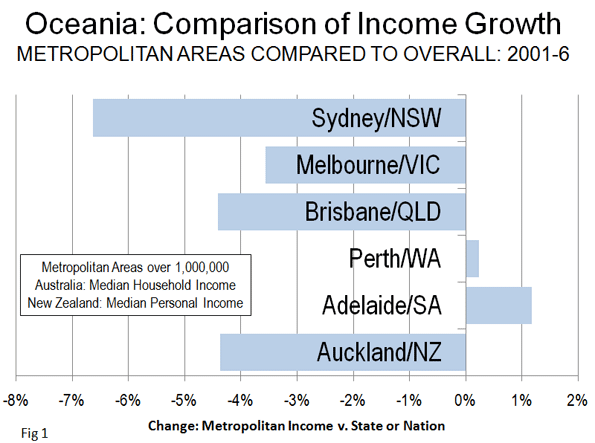
    This dispersion of opportunity is particularly evident in Australia, where data from the last two national censuses indicates that incomes overall have risen more quickly outside some major metropolitan areas. In three of five cases (the three largest) incomes rose higher outside rather than inside the major metropolitan areas (Figure 1).

    • In Sydney, the largest metropolitan area in Australia, median household incomes declined 6.6% relative to those of the state of New South Wales.
    • Melbourne median household incomes declined 3.5% relative to those of the state of Victoria.
    • Brisbane median household incomes declined 4.4% relative to those of the state of Queensland.
    • Median household incomes in Perth rose marginally more than those in the state of Western Australia (0.2%), while Adelaide incomes rose the strongest against state (South Australia) incomes at 4.4%.
    New Zealand

    Mimicking the largest metropolitan areas in Australia, Auckland, New Zealand’s largest metropolitan area, experienced a median personal income loss of 4.4% relative to that of the nation between 2001 and 2006 (Figure 1).

    Canada

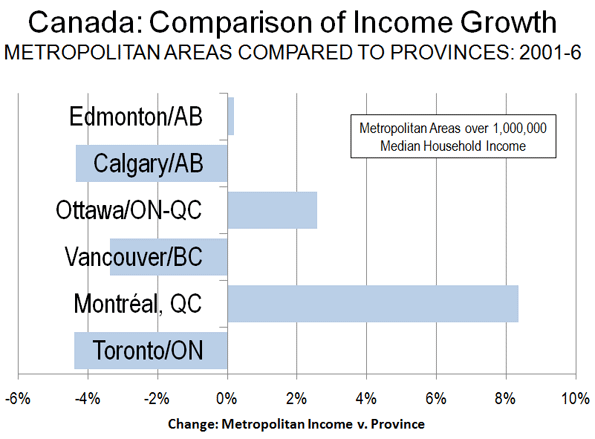
    A similar story has unfolded in Canada. Major metropolitan area median household incomes declined relative to provincial incomes in one half of the cases (Figure 2). The largest relative losses occurred in arguably two most dynamic metropolitan areas :

    • Toronto, which accounts for nearly one fifth of Canada’s population experienced a median household income decrease of 4.4% relative to that of the province of Ontario. Steve LeFluer’s recent article shows that within the Greater Toronto area, the core city, with its amalgamated inner suburbs, has the lowest median household income.
    • Calgary, Canada’s energy capital, also experienced a median household income decrease of 4.4% relative to its province, Alberta.

    Vancouver’s median household income also fell, 3.3% relative to that of British Columbia’s.
    Three metropolitan areas experienced faster economic growth:

    • By far the strongest growth income growth occurred in Montréal, where median household incomes increased 8.4% relative to incomes in Québec.
    • The nation’s capital, Ottawa (a metropolitan area that straddles the borders of Ontario and Québec) experienced a median household income increase of 2.6% relative to the weighted median of the two provinces.
    • Edmonton, Alberta’s capital, experienced income growth marginally above that of the province (0.2%).

    United States

    A review of data in the United States indicates similar results. The same time span (2001 to 2006) was analyzed for the 34 metropolitan areas with more than 1 million population that are in a single state. State personal incomes per capita rose at a greater rate than the metropolitan area rates in 18 of the 34 cases (Figure 3).
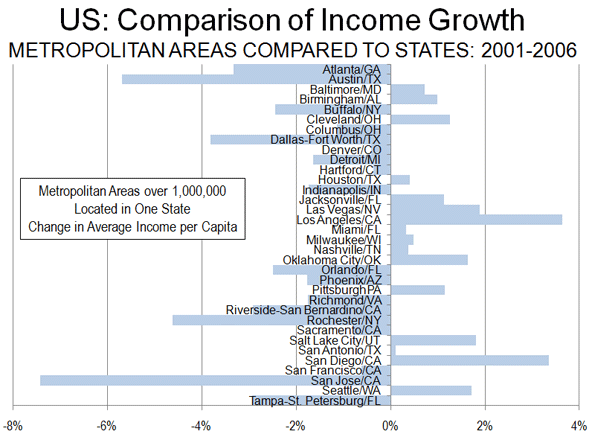
    Two California metropolitan areas performed the best. In Los Angeles personal income per capita rose 3.6% relative to that of California in San Diego, per capita income rose at 6% relative to that of the state.

    Other metropolitan areas, including Las Vegas, Salt Lake City, Seattle, Oklahoma City, Cleveland, Pittsburgh and Jacksonville experienced income per capita increases of between 1% and 2% relative to those of their respective states.

    The largest loss occurred in information technology intensive San Jose, where incomes dropped 7.4% relative to those of California. Austin, capital of the nation’s second-largest state, experienced the second largest drop at 5.7% relative to incomes in the state of Texas, which as one of the leading information technology centers in the nation, generally mirrors the San Jose performance.

    Other losses between 2% and 5% relative to their states occurred in Rochester, Dallas-Fort Worth, Atlanta, Tampa-St. Petersburg, Riverside-San Bernardino, Orlando and Buffalo.

    Among the 15 multi-state metropolitan areas, eight experienced income increases relative to the states in the largest share of the population lives (this state with the historical core municipality) and seven declined. Perhaps the most surprising finding is that two metropolitan areas (New York and Washington), which have been among the most consistent in providing economic opportunities experienced only modestly greater income growth than their states.

    • New York, one of the two or three principal financial centers of the world, experienced income growth only 0.6% relative the weighted average of the states of New York and New Jersey, where nearly all of the area is located (Pike County, Pennsylvania is also in the metropolitan area).
    • Washington, where federal government and related in one can be counted upon to produce income growth, experienced only a modest rise of 0.3% relative to the weighted average of the two states (Virginia and Maryland) that comprise nearly all of the metropolitan area (Jefferson County, West Virginia is also in the metropolitan area).

    Metropolitanizing the World?

    These trends suggest a shift in metropolitan fortunes, at least in advanced countries. Historically incomes have grown much more strongly in metropolitan areas than in other areas. Now incomes are rising more quickly or at least nearly as quickly outside some major metropolitan areas as they are inside. It can no longer be blithely assumed that large metropolitan areas experience greater economic growth than their less urban hinterlands. The differences may be fading away, shaped not so much by proximity to the core but by other regional factors.

    We currently can only speculate as to the reasons for this development. The expansion of personal mobility and the ability of people to commute from outside major metropolitan areas may be one reason. Perhaps the most important factor is the rise of the information economy, which has freed some people from more intense urban living by permitting working at home part or all of the time. The proliferation of shopping opportunities, through franchised chains, the outward movement of immigrants, and online ordering may have made formerly remote areas more able to fulfill the needs and desires of people who previously would have inclined to live in more urban surroundings.

    These developments are consistent with the net migration of more than 2 million people away from metropolitan areas of more than 1 million population between 2000 and 2009 in the United States. Further, the phenomenon may be spreading beyond the high income world. As recently noted, in China, economic opportunities may be expanding in rural areas.

    ——

    Note

    This analysis compares metropolitan incomes to incomes in larger political jurisdictions (such as the metropolitan area of San Diego and California). An analysis that compared the area within the larger jurisdiction, but outside the metropolitan area, would yield a somewhat a difference (whether higher or lower), because the larger jurisdiction data available includes the metropolitan areas.

    Photo: “Outback” New South Wales: Faster Income Growth than Sydney (by author)

    Wendell Cox is a Visiting Professor, Conservatoire National des Arts et Metiers, Paris and the author of “War on the Dream: How Anti-Sprawl Policy Threatens the Quality of Life

  • Education Wars: The New Battle For Brains

    The end of stimulus — as well as the power shift in Congress — will have a profound effect on which regions and states can position themselves for the longer-term recovery. Nowhere will this be more critical than in the battle for brains.

    In the past, and the present, places have competed for smart, high-skilled newcomers by building impressive physical infrastructure and offering incentives and inducements for companies or individuals. But the battle for the brains — and for long-term growth — is increasingly tied to whether a state can maintain or expand its state-supported higher education. This is particularly critical given the growing student debt crisis, which may make public institutions even more attractive to top students.

    The great role model for higher-education-driven growth has been California. The Golden State’s master plan for education — developed under Pat Brown in 1960 — created an elaborate multi-tiered public system that offered students a low-cost and generally high-quality alternative education. Over the next half century, California became, in historian Kevin Starr’s phrase, a “utopia for higher education,” as well as a model for other states and much of the world.

    Today many of the states that copied California’s model — notably North Carolina, Texas and Virginia- — threaten to upend the Golden State’s dominance of public higher education. These states now all spend far more than traditional leader California when you look at percentage of state expenditures; Virginia, for example, spends twice as much of its state budget on higher ed than California does. New York and Illinois spend an even a smaller percentage.

    The combination of fiscal woes and misplaced priorities has engendered spending cuts in California. Tuitions for higher public education have soared: In 2009 they were raised 30%, and they have been raised over 100% over the past decade.

    To be sure, the University of California (disclaimer: I attended the Berkeley campus) retains a huge reservoir of talent, with courses taught by 111 Nobel Laureates. It still dominates lists of top public universities;  six of the top 14 schools in the US News and World Report 2010 rankings are UC schools.  But the signs of relative decline are clear. In 2004, for example, the London-based Times Higher Education ranked UC Berkeley the second leading research university in the world, just behind Harvard; in 2009, that ranking, due largely to an expanding student-to-faculty ratio, had tumbled to 39th place.

    Other states are now looking to knock California further off its perch. In 2009 alone the University of Texas lured three senior faculty members from UC. As departments shrink at places like Berkeley, those in schools such as the University of Texas at Austin, Texas A&M and Texas Tech have expanded rapidly, adding students and buildings.

    Of course, these schools also have budget problems, and they have increased tuition too–albeit at a significantly lower rate. But for the most part, these up-and-coming state systems are more focused on expansion than on retrenching and survival. While some in California question the viability of some of the newer UC campuses, Texas is busily expanding its roster of tier-one, public research universities, seeking to add the University of Houston as well as UT campuses in north Texas, Arlington, Dallas, El Paso and San Antonio to the ranks of UT Austin, Texas A&M and Rice, a private school in Houston.

    Texas Tech,  best known for its engineering and agriculture-oriented programs, for example, is thriving. Located on the windy Great Plains on the western side of the state, it is far from the state’s major metropolitan areas, and its home town of Lubbock (population: 225,000) is likely not high on anyone’s list of hip and cool college towns. Yet the school, which enjoys strong alumni and business support, is in the midst of a major building boom and a $1 billion capital campaign. When I visited there earlier this month, the campus was full of construction crews; Texas Tech has added over 3000 students in the past two years and now has over 31,000 students.

    Other unlikely upstarts include the University of North Dakota, which has boosted spending by 18.5% in 2009, a luxury afforded by the state’s booming energy, agriculture and increasingly high-tech economy. North Dakota, which historically has suffered significant loss of young talent, has set a goal to rank No. 1 in the average education of its population. Today it already ranks No. 3 in terms of college-educated residents between the ages of 25 and 34.

    These shifts could presage — and to some degree enhance — what is already a powerful trend toward states that, in the past, have been educational also-rans. Although Texas also faces budgetary constraints, its annualized $9 billion deficit is dwarfed by those of California, Illinois and New York. And those bluish states already have much higher tax rates, which leave less room for revenue increases. Texas also has the luxury of an $8.2 billion “rainy day” fund, as well as a more vibrant economy.

    More important still, states like North Carolina, Virginia and Texas continue to grow more rapidly than the older brain-center states. This is particularly true in terms of the high-tech jobs many graduates would likely seek.  Indeed since 2002 these states have all enjoyed far greater growth rates in high-tech employment than California, Illinois, Michigan or New York. They also have added more new tech jobs in actual numbers than California–despite their significantly smaller size.

    Migration patterns are also changing among college-educated workers. Between 2005 and 2007, Texas, Virginia and North Carolina already enjoy higher rates per capita of net migration of educated workers between the ages of 22 and 39 than California, New York or Massachusetts.

    This advantage could expand as the upcoming states increase their educational offerings along with employment opportunities. Students may end up tempted to attend schools closer to where there is job growth. Unlike Austin and Raleigh-Durham, which have rapidly expanded tech employment, Silicon Valley has produced virtually no new net tech jobs for the past decade.

    The second impact may  be more subtle, as declining revenues from businesses and individuals reduces the opportunity to boost education spending. As the country stumbles into this recovery, the greatest advantage will fall not only to states with the most natural resources, but those with the best-educated human resources. For a half century this is a game that states like California have played to perfection, but it is one in which other places are likely to catch up, and perhaps even pass. The long-term implications for the nation’s economic geography could prove profound.

    Joel Kotkin is executive editor of NewGeography.com and is a distinguished presidential fellow in urban futures at Chapman University. He is author of The City: A Global History. His newest book is The Next Hundred Million: America in 2050, released in February, 2010.

    Photo by Luca Zappa

  • The Rise of the Efficient City

    Smaller, more nimble urban regions promise a better life than the congested megalopolis.

    Most of the world’s population now lives in cities. To many academics, planners and developers, that means that the future will be dominated by what urban theorist Saskia Sassen calls “new geographies of centrality.” According to this view, dense, urban centers with populations in excess of 20 million—such as metropolitan Tokyo, New Delhi, Sao Paolo and New York—are best suited to control the commanding heights of global economics and culture in the coming epoch.

    In fact, the era of bigger-is-better is passing as smaller, more nimble urban regions are emerging. These efficient cities, as I call them, provide the amenities of megacities—airports, mass communication, reservoirs of talent—without their grinding congestion, severe social conflicts and other diseconomies of scale.

    Megacities such as New Delhi, Mumbai, Sao Paolo and Mexico City have become almost unspeakably congested leviathans. They may be seen as “colorful” by those engaging what writer Kennedy Odede calls “Slumdog tourism.” They may also be exciting for those working within the confines of “glamour zones” with high-rise office towers, elegant malls, art galleries and fancy restaurants. But most denizens eke out a meager existence, attractive only compared to even more dismal prospects in the countryside.

    Consider Mumbai, with a population just under 20 million. Over the past 40 years, the proportion of its citizens living in slums has grown from one in six to more than half. Mumbai’s brutal traffic stems from a population density of more than 64,000 per square mile, fourth-highest of any city in the world, according to the website Demographia.

    Many businesses and skilled workers already are moving to smaller, less congested, often better run cities such as Bangalore, where density is less than half that of Mumbai. Much of this new growth takes place in campus-like settings on the edge of town that take advantage of newer roads, better sanitation systems and sometimes easier access to airports. Companies like Alcatel-Lucent and Infosys offer their employees facilities more similar to those of Silicon Valley or suburban Austin than to Mumbai or Kolkata (formerly Calcutta).

    Consider also Singapore and Tel Aviv, which are among the best models for the efficient cities of the future. At its founding in 1965 after independence from Malaysia, Singapore’s per capita GDP was about that of Guatemala and well below that of Venezuela and Iraq. Today it equals, on a purchasing power basis, that of most Western cities including London, Sydney and Miami.

    The city-state bears no resemblance to the typical unsanitary and disorderly tropical metropolis. Singapore’s roughly five million citizens live under efficient (if heavy handed) government. With its modern port, airport and excellent transport network, Singapore consistently ranks as the No. 1 locale for ease of doing business by the World Bank. Over 6,000 multinational corporations including Seagate, IBM and Microsoft have a large presence in Singapore.

    Tel Aviv represents a decidedly different approach to building the efficient city. With roughly two million people in its metropolitan area, this little dynamo produces the vast majority of Israel’s soaring high-tech exports, is home to a preponderance of the country’s financial institutions and has established itself as the global center of the diamond industry. Incomes in the region are as much as 50% above Israel’s national average.

    Tel Aviv’s pleasure-loving denizens may differ markedly from more controlled Singaporeans—or the usually more religious citizens of Jerusalem—but they employ many of the key efficient city advantages: a sharp focus on business, a well-developed sense of place and a first-class communications infrastructure. The city’s tech industry includes firms such as Microsoft, Cisco, Google and IBM. It is home to Israel’s only stock exchange and most of the country’s resident billionaires.

    The U.S. is also embracing the efficient city. Between 2000 and 2008, notes demographer Wendell Cox, metropolitan areas of more than 10 million suffered a 10% rate of net outmigration. The big gainers were generally cities with 100,000 to 2.5 million residents. The winners included business-friendly Texas cities and other Southern locales like Raleigh-Durham, now the nation’s fastest-growing metro area with over one million people. You can add rising heartland cities like Columbus, Indianapolis, Des Moines, Omaha, Sioux Falls, Oklahoma City and Fargo.

    Some of these—such as Austin, Columbus, Raleigh-Durham and Fargo—thrive in part by being college towns. Others like Houston, Charlotte and Dallas have evolved into major corporate centers with burgeoning immigrant populations. But they thrive because they are better places for most to live and do business.

    Take the critical issue of getting to work. According to the American Community Survey, the average New Yorker’s daily trip to work takes 35 minutes; the average resident of the Kansas City or Indianapolis region gets to the office in less than 13 minutes. That adds up in time and energy saved, and frustration avoided.

    The largest American cities—notably New York, Los Angeles and Chicago—also show the most rapid decline in middle-class jobs and neighborhoods, with a growing bifurcation between the affluent and poor. In these megacities, high property prices tend to drive out employers and middle-income residents. By contrast, efficient cities are where most middle- and working-class Americans, and their counterparts around the world, will find the best places to achieve their aspirations.

    This article originally appeared at the Wall Street Journal.

    Joel Kotkin is executive editor of NewGeography.com and is a distinguished presidential fellow in urban futures at Chapman University. He is author of The City: A Global History. His newest book is The Next Hundred Million: America in 2050, released in February, 2010.

    Photo by wili_hybrid

  • Amtrak Fails To Weather The Storms

    Why do I persist in riding Amtrak, the short name for the National Railroad Passenger Corporation, a company originally owned by the freight railways, but now subsidized by Congress and run like a Russian bureaucracy, complete with late trains, sullen employees, myriad petty regulations, budget deficits, cold coffee, feather bedding, broken seats, clogged toilets, rail cars that feel like buses, and a schedule that serves the interests of congressmen, lobbyists, unions, budget stimulators, and small-town mayors, but rarely passengers?

    Isn’t it time to let Amtrak go the way of such failed railroads as the Nickel Plate, Erie Lackawanna, Chicago & Alton, Rock Island, Maine Central, Wabash, Missouri Pacific, or the New York Central, lines that outlived their corporate incarnations and were either wound up or merged into larger entities?

    Amtrak was set up in 1971 to replace the passenger rail network that was killed off by government regulations, the Interstate Commerce Commission, subsidized air and road travel, and urban blight. The new entity went to work hauling passengers on a route system better adapted to 1921 than 1971. The earlier trains were faster.

    It’s hard to imagine Leland Stanford or E.H. Harriman buying into the Amtrak business model. Forty years after Amtrak’s creation, little of its plan has changed. It offers corridor services on the East and West coasts and, in between, a meandering schedule of trains that account for less than one percent of all intercity travel.

    Buyers could easily be found for the Northeast Corridor service between Boston and Washington. Better yet, allow competition on the line, and auction off the franchise rights, using the proceeds to pay down national debt.

    England had the dreadful network that operated as BritRail. After it was privatized, Britain’s rail service became competitive, passenger friendly, faster, and more comfortable.

    Compare the new British private train system with the Amtrak experience (“Enjoy the journey”). Think about New York’s Pennsylvania Station, a subterranean strip mall with dank corners, uncomfortable chairs in cheerless waiting rooms, confusing destination boards and dreary platforms that have seen few improvements since I first used them in the early 1960s.

    Passengers buying Amtrak tickets in Penn Station stand in a line that feels like Ceauşescu’s Romania. Only one or two agents are on duty, the tickets are expensive, you need you an identity card to buy one, and getting on the train has the feel of descending into a Chilean mine.

    At the cost of billions, there’s a plan for a new “Moynihan Station” across the street, although much of what’s wrong with Penn Station could be fixed if Amtrak outsourced the operation to Hyatt.

    Its shoddy service explains the rise of discount bus lines that are now digging into core Amtrak passenger revenue between Boston, New York, and Washington. Companies such as Bolt Bus charge $15 or $20 to get from New York to Boston, while Amtrak costs $67 to $95, depending on the day and time.

    Bolt leaves from West 34th Street, and departures are punctually on the hour. The seats are cramped, but the buses are clean and have Wi-Fi. The trip takes less time than many trains, when you add in inevitable Amtrak delays. Nor is there a surly Amtrak conductor reading the riot act at each station.

    To get a flavor of Amtrak’s attitude toward its passengers, read the cheerful words of its CEO in the on-board magazine: “Our identification policy, random screenings in stations, random on-board ticket verification process and more interactive police efforts—including our K-9 teams—are some of the visible activities we have been working on.” Trains used to advertise comfortable berths with sleeping kittens.

    Killing off Amtrak would mean the end of long-haul passenger service, the sleepers that are the heirs to trains like the Twentieth Century Limited. I would deeply regret the absence of long-distance train travel in the United States. But, were Amtrak spun off, its overpriced and indifferent service might be replaced by a network of private operators that would compete to take Americans around a glorious country that longs to be seen by rail.

    Even today, Amtrak trains run near full capacity, and the potential to tap into a travel-happy country of 300 million ought to interest a few hedge funds and stock jobbers, not to mention flourishing overseas rail companies.

    Already there are nascent private companies and sleeping car owners that offer rail trips to national parks, art museums, jazz festivals, baseball games, and the homes of famous writers. Deregulate the passenger industry, and companies like these will flourish. Railroads are in America’s entrepreneurial DNA.

    Recently, for $325, less than the cost of a cramped night in an Amtrak “Slumberette” (emphasis on the “ette”), I rode round-trip in a private rail car, New York Central 3, owned by Lovett Smith III, from New York to Pittsburgh.

    Along the way, I sat on the open, rear platform from which presidential candidates whistle-stopped across America, and took in the sweep of the Philadelphia skyline, the majesty of Amish country (I loved the teams of horses pulling plows), the arched bridge across the Susquehanna, the engineering marvel that is the Horseshoe Curve, the path of the Johnstown Flood, and the remnants of the steel industry around Greensburg. Inside the car, I chatted with my fellow passengers, ate elegant meals, and sampled Italian wines (a group on board had organized a tasting). Were Amtrak a service company, not a protection racket set up to bleed government money into padded contracts, it would have the imagination to operate similar excursions.

    Instead, Amtrak wants to position itself as the paymaster for a national rail plan. The Department of Transportation recently issued a strategic plan called Moving Forward: A Progress Report. (If Amtrak were to issue a report to its passengers, it could be entitled, “Sorry for the Inconvenience: Due to a Track Incident, We’re Being Held in Baltimore.”)

    Amtrak imagines itself as the federal agency that should be hired to spend $117 billion, over thirty years, to build a segregated high-speed rail system between Boston and Washington, and for additional billions, to operate Core Express Corridors between cities less than 500 miles apart.

    Such visions of grandeur come from a company that needs nine hours and fifteen minutes to run a train the 444 miles from New York to Pittsburgh; that’s an average speed of 48 m.p.h.

    To be fair, not all of Amtrak’s failings are its fault. Most of the tracks on which it operates are owned by freight companies that find passengers a nuisance, and think nothing of shunting aside “the varnish” to send through more coal and containers.

    Amtrak, however, is responsible for a corporate culture that makes a mockery of “customer service.” In many ways, it is the perfect metaphor for everything that is wrong with letting Washington have a heavy hand in the economy, or for imagining that an economic revival can be built around companies with federal guarantees.

    Amtrak lacks direction, lives off subsidies and stimulating money, and now wants $117 billion to operate high-speed rail that, for the cost differential, would be only marginally better than the private bus companies now competing up and down the East Coast, with fares of one third or less than what Amtrak charges.

    Americans would happily pay for low-speed rail, if the food was good, the seats spacious, the broadband fast, and if, on the rails, they could surf, shop, eat tacos, and watch movies.

    At the moment, I am riding an Amtrak train that is four hours behind schedule on its way into North Carolina. So far, to use a phrase from railroading legend, the services have not been worth a “plated nickel.”

    Photo By Kyle Gradinger, Amtrak Keystone Snowstorm I. Amtrak AEM-7 locomotive 904 leads a Keystone Corridor train through the snow in Rebel Hill, King of Prussia, PA.

    Matthew Stevenson is the author of Remembering the Twentieth Century Limited, winner of Foreword’s bronze award for best travel essays at this year’s BEA. Growing up, he was a “Central” man, but loved the majesty of the old Pennsylvania Station. Together with his father, now 91, he recently has waded through a 1969 edition of the ‘Official Guide to the Railways’. He lives in Switzerland.

  • The Other Chambers of Commerce

    The recent political conflict between the Obama Administration and the U.S. Chamber of Commerce has thrown a new spotlight on an old communication problem. Local chambers of commerce, although they predate the U.S. Chamber by nearly a century and a half, often are assumed to be part of the U.S. Chamber, or otherwise under its direction. They aren’t. They are independent.

    During the pre-election controversy this year, it was clear that many people, including many chamber members, did not know this fact. They believe that U.S. Chamber President Tom Donohue and his colleagues on H Street directly or indirectly control all that local chambers do. But Donohue and his staff don’t exercise such control, nor do they want to.

    Few people think about what chambers do locally. For example, who knows that Elliot Tiber, president of the Bethel, N.Y., Chamber of Commerce, secured the permit for Woodstock?

    It was also a local chamber – the Business Men’s League of Atlantic City – that came up in 1920 with the idea of a festival to keep tourists in town after Labor Day. Pretty women in beachwear would turn out to be the centerpiece of the annual event. We have that business group (now called the Greater Atlantic City Chamber) to thank for the Miss America Contest.

    Was Charles Lindbergh’s plane called The Spirit of Enterprise (the U.S. Chamber’s tag line)? No, the flying bucket of bolts was, of course, The Spirit of St. Louis. The president of the St. Louis Chamber came up with the name in order to promote the great river city. And why should Lindbergh object? The chamber president also raised most of the money for the aircraft.

    And who sent out the promotional brochure that enticed the first movie producer to southern California in 1907? It was the Los Angeles Chamber of Commerce. In nearby Hollywood a chamber was later active as well, helping re-fashion the famous Hollywood sign out of a decaying advertisement for a real estate development called “Hollywoodland.”

    Moreover, there’s a guy in a suit present next to the glamorous celebrities who get their photos taken when their stars are set in the Hollywood sidewalk. Who is that business man? It’s Leron Gubler, president of the Hollywood Chamber of Commerce, which invented and maintains the Walk of Fame.

    Most of the thousands of things that local chambers have done and do are far removed from the big national issues that embroil the U.S. Chamber. Sure, most of the chambers in the country agree with and support the lion’s share of the U.S. Chamber’s positions. Although the goals are often the same, the priorities, issues, methods, leadership and, importantly, ownership are not.

    Local chambers have shown themselves perfectly able to get into fights of their own, without orders from a non-existent chamber of commerce command center.

    Was it the national chamber’s president who financed the Florida and Alabama, the ships that terrorized Union merchants during the Civil War? No, it was George Trenholm, one of the most active members of the Charleston (SC) Chamber of Commerce. As president of the chamber, Trenholm had asked for a thorough federal charting of the waterways around the Charleston harbor. The survey provided valuable navigation information that became critical when Trenholm emerged a decade later not only as privateer king of the Confederacy but also as chief sponsor of blockade runners. (Some believe he was a model for Rhett Butler in Gone with the Wind.)

    But it wasn’t as if all chambers were Confederates. It was the New York Chamber of Commerce that furnished a cash reward of $25,000 to the captain and crew of the Kearsarge, which finally sank the Alabama.

    There have been other times when local chambers have performed roles worthy of national headlines. During Prohibition, a liquor wholesaler named Al Capone was seen as bad for business by the president of the Chicago Association of Commerce, Colonel Robert Isham Randolph. In an act of some courage, Randolph personally warned Capone and created a chamber subcommittee, popularly called the “Secret Six,” that engineered Capone’s downfall. The Six hired a consultant named Alexander Jamie to gather information, especially financial information, on Capone. Jamie brought in his brother-in-law, Eliot Ness, to help. Capone later credited the Secret Six with taking him down.

    Of course the local chambers have made their share of mistakes over the years. The St. Louis Chamber of Commerce once tried to stop the first railroad bridge across the Mississippi, but was stymied in court by the common sense and careful research of a folksy lawyer named Abraham Lincoln. And the New Orleans Chamber of Commerce successfully pushed for easing the quarantine regulations on ships in its harbor, after which a yellow fever-laden ship travelled up the Mississippi and nearly wiped out Memphis in 1878.

    But if you take some water and add a chamber, the result can be a megalopolis. Starting in 1840, the Houston Chamber with single-minded determination pushed for the removal of snags and mud from the Buffalo Bayou, which trickled on a circuitous 50-mile path to the sea. In the late 1800s, rain melted the salt on a barge on the bayou, and the Galveston News cackled that Houston finally had a salt-water port. But the laughing stopped on September 8, 1900, when a hurricane flattened Galveston.

    Houston overnight became a critical port for Texas, just in time for the Spindletop oil bonanza of January 10, 1901. The chamber would continue to push for improvements on what became the Houston Ship Channel, guaranteeing decades of future growth. Today, the chamber, now called the Greater Houston Partnership, is anticipating the shipping/economic impact of the opening of the second Panama Canal.

    Some national change in the country’s economic model has sprung directly from the actions of chambers. The Chicago Board of Trade, a chamber founded in 1848, revolutionized how its members bought and sold farm commodities, becoming so successful that by 1859 it essentially left the traditional chamber business. Instead, the Board of Trade continued to plow the virgin soil of this new financial field, inventing futures contracts and modern commodities trading.

    And so it goes. The Birmingham (AL) Chamber of Commerce belatedly, but successfully, broke the power of segregationist Bull Connor and promoted integration of the downtown, while the Atlanta Chamber of Commerce president negotiated the accord that, in a celebrated speech, Martin Luther King defended by saying, “If anyone breaks this contract, let it be the white man.” Segregation, especially racial conflict and the resulting negative publicity, was bad for business, and chambers took the side of peaceful integration in many (although not all) cities throughout the South.

    So much of what we think of as America was facilitated or aided by those often forgotten, always resourceful groups known as local chambers of commerce. Whether it’s the Golden Gate Bridge, Great Smoky Mountains National Park, the statue of Vulcan over Birmingham, commission and city manager forms of government, United Way-style giving, Baltimore’s Inner Harbor, and so much more – it was local chambers that led the way. The U.S. Chamber was fighting for business and free enterprise principles in Washington, but it was local chambers working “on the ground” that helped plant so many of these seeds across the nation.

    Each of the local chambers is vastly smaller than the U.S. Chamber, but collectively they have had a large impact. As in so many things, it has been the local organizations, not merely the national ones, that have shaped this country’s enterprise culture.

    Chris Mead is senior vice president of the American Chamber of Commerce Executives. He is working on a history of local chambers of commerce in the United States.

    Photo by Rob Shenk

  • Car Wars: Should Autos Rule The Road? Part II

    We have a severe drug problem, we’ve been told, that mostly affects suburbanites. The dangerous drug is not taken by mouth, nor by injection, yet it is used daily by every family member and must be stopped before we, as a nation, are utterly destroyed. According to many experts, our “dependence” on cars must stop.

    Internet rumors abound that we are about to be legislated out of our stupor, and be taxed into high density, inner core cities. Should this rumor become fact, let’s look at what effect it will have on our economy, and, quite frankly, on the American Dream of home ownership.

    Today, the housing market is still dealing with the disaster of plummeted prices. Since 80% of the new home market this past decade has been suburban, it would be safe to say that 80% of Americans that bought in this century are the hardest hit, because these new homes have dropped to pre-boom pricing. It has been young families, generally, that have driven out to the suburbs to find new homes, the promise of lower density, and newer safe schools. In addition, many (most) of these families believed that their homes were a source of income; after all, values were increasing 10% or more annually, and that equity could be tapped in loans, (both suburban and urban).

    While many think of the suburbs as pure white, that is no longer true. The suburbs today, in general, are intermixed with all races. But the new race being ridiculed by many is the “suburbanite”. The suburbanite yearning for his or her daily fix of the car, consuming our fuel, and spewing carbon into our atmosphere must be eradicated at all costs.

    So how do we eradicate this vermin? There are rumors of a carbon tax that will place a financial burden on those vehicular junkies. Who cares that this major portion of America’s population is under the most financial pressure since the depression. If we tax these infidels, that will surely bring them to their senses , and we can cure their dependence on Chevys, Fords, and Mini-vans. Let’s break their backs once and for all, so that these families will abandon what is left of the suburbs and be forced back to the inner core. If reason does not work, we can just legislate it.

    Let’s imagine this new future filled with promise of a new America. In this fantasy, we visit the Smith family, who moved from their 10,000 foot suburban lot into the urban core. Adam Smith, the father, now must take the bus to the train station for the new light rail line that goes to Edenville, his job out in the suburb as a plant manager (it seems that his place of employment did not make the move). With connections, he can make it to work within an hour, whereas his 10 mile commute from suburb to suburb took 20 minutes.

    Lilly Smith (his new wife, as the old one refused to move into a 20 story inner city high-rise) works at Bester Buy on the edge of the city. She needs two bus connections to get there Having a car is not an option, since parking costs are prohibitive in the city. Luckily, the kids are old enough to be left alone; Josh is 8 years old, Jane is 12, and Joey, who is 15, watches over the siblings. Today is a holiday and they are home from school, but the cold rainy day keeps them inside, along with hundreds of other kids who play in the vast corridors.

    Lilly arrives at work, only to remember that Jane had a dentist appointment which she forgot about. She shivers, thinking about the old days, and the warm comfort of the Mini-van she once relied on to take her kids to appointments. She breaks out into a sweat and falls into a stupor. Her fellow workers recognize the symptoms, as they too have been weaned of their dependence upon personal vehicles. Her manager, Ralph, lets her take a week of sick leave to get help.

    Ralph is lucky. He lives in a single family neighborhood on the edge of the city. He has his own large lot, a spacious 35 feet wide and 90 feet long. He and his wife each posses a car. His luxury two story home, setback five feet from the sidewalk, is 25 feet wide and 50 feet deep; the house itself is a massive 2,500 square feet, over twice as large as the Smiths inner city apartment. He also has three children who enjoy the privacy of their back yard. The garage adjacent to the 12 foot wide alley consumes 440 square feet of their remaining 1,200 square foot rear yard. Still, with 760 square feet of green space, the kids are lucky.

    Ralph and his wife, Mary, both drive electric cars. Mary has the larger vehicle, with a 50 mile range per charge on a warm day. Their daughter wants to play with a cousin who still lives in the suburbs, 20 miles away. This is a cold day, which reduces the range of the vehicle to 35 miles, and their cousins do not have a charging station, so their 11 years old daughter is driven to the Light Rail station, a mile away.

    A week later, back at the Smith apartment, an argument starts between Adam and Lilly about her desire to get out of the city. Even if they did move out to near Adam’s plant, they would need Lilly’s paycheck to make ends meet, so she would need the light rail and two bus connections to get to work. Lilly begins to sweat and shake again… When Josh asks what is wrong with Mommy, Adam explains about the days when Americans were drugged out on their cars, the days when people were free to go when and where they wanted. As he describes those terrible times, he too yearns for those days. Adam and Lilly dream of moving out to a place with space, if only the carbon tax on moving out of the city could allow it, but alas, it’s only a dream that only the wealthy can now afford.

    A fantasy? Here is what I’m experiencing as a planner. When I met with a city official a few weeks ago I was admonished for a proposal that included attached garages. I explained that attaching the garage reduces 40 feet of exterior wall to be built, and here in Minnesota, an attached garage means you do not have to shovel snow between the home and the garage, nor slip on the ice. Why would I detach a garage, I asked? The city official explained that according to his planning staff, the space between the garage and the home is a social gathering spot where neighbors can stop and talk about their day. I had thought that’s what that large front porch we are proposing on the homes was for.

    There is a movement to prevent the toxic drug — the car — from infecting our lives. For me, no way you are taking me off my ERPT — Extremely Rapid Personal Transport — dependence.

    This is the second of a two-part series in which different authors examined the centrality of the autombile in urban and suburban life.

    Photo by Rick Harrison of the author’s ERPT — his Porsche.

    Rick Harrison is President of Rick Harrison Site Design Studio and Neighborhood Innovations, LLC. He is author of Prefurbia: Reinventing The Suburbs From Disdainable To Sustainable and creator of Performance Planning System. His websites are rhsdplanning.com and performanceplanningsystem.com.

  • Car Wars: Should Autos Rule The Road? Part I

    We’ve decided to become a one car family. Denver has proven to be the ideal locale for this experiment, of sorts. The “Mile High City,” and particularly our new neighborhood, provide a range of mobility options beyond the four-wheel variety for trekking from place to place.

    The metropolitan area is naturally blessed with a mobility-favorable landscape. It is approximately 10 miles by 10 miles. More importantly, our neighborhood possesses what I affectionately refer to as “accessible proximity” to local amenities such as grocery stores, coffee houses, parks, and specialty shopping centers. The immediate area is not only safe, it’s engaging in its physical and social makeup, with stately homes and troves of dog-walkers along suburban style streets.

    Recently, our daughter, who is eight, remarked “Ya know, at our old home it seemed like we always needed a car to go places, while here in Denver, we can actually walk places and enjoy the clean air.”

    The website Walkscore, an online index, which ranks communities nationwide based on access by foot to restaurants, coffee houses, schools, businesses and other frequent destinations. Denver’s score provides tangible evidence of my daughter’s contention: According to the site’s analytics, our Denver address registers a whopping 88 out of 100, defined as ‘very walkable,’ meaning that “one is able to accomplish most errands by foot. Our residence in Folsom, California — from which we recently relocated — stumbled in at a paltry 48 out of 100, defined by Walkscore as ‘car dependent’.

    Why is this such a big deal to us, as well as to growing numbers of Americans? I would contend that it is affordability. As Americans continue to struggle financially amid the worst economic times since the great depression, the argument could be made that location efficient neighborhoods offer a cost effective alternative to those that are exclusively auto-centric. In an era where expenses associated with automobile ownership, maintenance and fuel represent a significant slice of our household budgets, policy makers would be wise to expand options that encourage alternative forms of mobility.

    Automobiles are still the transportation mode of choice for most working commuters, and for good reason, as most Americans still live a reasonable distance from where they work. But alternative forms of transportation are gaining momentum, as many struggle with insurance and other automotive related expenses.

    According to the U.S. Census Bureau’s recently released American Community Survey (ACS), bicycling is becoming a viable option for Americans willing to pump the pedal on their way to work. Portland leads the U.S. in terms of the most bike commuters, with almost six percent of its residents using a bicycle as their primary mode of transportation to work in 2009. Minneapolis (3.86%), Seattle (2.99%), San Francisco (2.98%), and Oakland (2.53%) round out the top five.

    Denver is one of a handful of cities that is actively promoting the use of bicycles as a viable short-run commute option. This year, the city introduced the first large-scale bike-sharing program in the U.S. A partnership between Humana, Trek Bicycle and the advertising agency Crispin Porter + Bogusky, this initiative flows from the shared belief that bicycles should serve as vehicles for positive health and environmental change, as well as important parts of a community’s transportation ecosystem. It’s this latter point that has gained the attention of Denver hotels and the convention center, which are seeking to provide visitors with mobility tools that compliment the downtown’s free bus system and walkable grid.

    The dilemma continues to be how to efficiently travel short distances that are too far to walk. Like Pavlovian dogs, many of us are conditioned to reach for the car keys, even for the shortest of trips. This behavior is deeply embedded in our consciousness;, an auto-centric mindset that has been nurtured in us for years.

    Chris Wiggins of the Folsom, California based Glide Electric Cruiser believes that a huge demand exists for short-range transportation options. His invention is ideal for short commutes and has virtually no impact on the environment. What is it? A series of motorized electric scooters with top speeds of up to 38 miles per hour. Currently in a first production run stage, these “cruisers” have attracted a wide swath of interest, from law enforcement agencies to senior groups. “I personally believe they have the potential to revolutionize short-range commuting in the U.S. and beyond,” says Wiggins. “My greatest hope in developing them is that they will have a meaningful impact on the quality of life, as well as improve the environment.”

    Recognizing that car-based travel will continue to be a reality for most Americans, innovative companies like Zip Car and Car2Go have adroitly positioned themselves for where I believe the auto market is headed: Short-term, just-in-time rentals that eliminate the expense of owning a car. And since my family has only one car, I personally am exploring these and other options to assist with those commutes beyond my immediate, local area.

    There are many factors affect the viability of a mobility option. Density currently receives the greatest amount of air-time. I’m often reminded of a business trip several years ago to the wonderful island community of Bermuda. I was intrigued to discover that because of its dense configuration and its size, cars weren’t allowed on the island until 1946. Today, only residents are permitted to drive cars on the island, and only one car is allowed per household. As Bermuda is a heavily trafficked tourist destination, I wondered what forms of transportation were available. An amused hotel bellman directed me to a lot full of mopeds and scooters.I discovered that these low-power transporters were the predominant form of transportation for residents as well as visitors to the island.

    While it could be argued that population density is the raison d’etre for alternative mobility options, there are other factors that should be taken into consideration. Much talk of late has centered around a concept called “intersection density,” which refers to the number of intersections in an area. The greater the intersection density, the shorter the blocks, and it is these short blocks that are the main contributing factor to neighborhood walkability. In Travel and the Built Environment: A Meta Analysis, which appeared in the summer 2010 issue of the Journal of the American Planning Association, Reid Ewing and Robert Cervero, urban planning academics at University of Utah and U.C. Berkeley respectively, found that of all the built environment measurements, intersection density has the largest effect on walking — more than population density, or distance to a store or to a transit stop, or jobs within one mile. According to the authors, it’s this ease of accessibility that spurs walkable foot-traffic to high destination nodes such as shopping and recreation.

    Density, unfortunately, is often associated exclusively with large urban environments that possess tightly packed, downtown center-cities. This undermines the enormous advantages of many suburban style cities such as Naperville, Illinois; Traverse City, Michigan; and Glenwood Springs, Colorado, all of which offer a plethora of local amenities within walking distance of their adjacent neighborhoods.

    Our deeply ingrained auto-centric habit makes it hard to say if any of these lessons in metropolitan mobility will gain traction, and if so, where they are likely to lead us. But one thing is for certain: A new narrative for how to approach short-distance trips is fostering a debate that is, at the very least, a carbon footprint in the right direction.

    This is the first of a two-part series in which different writers examine the centrality of the automobile in urban and suburban life. Tomorrow, read a very different viewpoint in Part Two.

    Photo by Michael Scott of the author’s Denver neighborhood.

    Michael P. Scott is an associate with Centro, Inc, a Denver-based consulting firm focused on the future of our city centers. He can be reached at michael@becentro.com

  • Greetings From Recoveryland: Ten Places to Watch Coming Out of the Recession

    Like a massive tornado, the Great Recession up-ended the topography of America. But even as vast parts of the country were laid low, some cities withstood the storm and could emerge even stronger and shinier than before. So, where exactly are these Oz-like destinations along the road to recovery? If you said Kansas, you’re not far off. Try Oklahoma. Or Texas. Or Iowa. Not only did the economic twister of the last two years largely spare Tornado Alley, it actually may have helped improve the landscape.

    We have compiled a list of the 10 American cities best situated for the recovery. These are places where the jobs are plentiful, and the pay, given the lower cost of living, buys more than in bigger cities. In other words, places unlike much of the rest of the country. The cities, most of which lie in the red-state territory of America’s heartland, fall into three basic groups. There’s the Texaplex—Austin, Dallas, San Antonio, and Houston—which has become the No. 1 destination for job-seeking Americans, thanks to a hearty energy sector and a strong spirit of entrepreneurism. There are the New Silicon Valleys—Raleigh-Durham, N.C.; Salt Lake City; and urban northern Virginia—which offer high-paying high-tech jobs and housing prices well below those in coastal California. And then there are the Heartland Honeys—Oklahoma City, Indianapolis, and Des Moines, Iowa—which are enjoying a revival thanks to rising agricultural prices and a shift toward high-end industrial jobs.

    Unlike the Sun Belt states and cities along the East and West coasts, these locales not only grew during the boom of the mid-2000s, they suffered least in the Great Recession. The fact that they are mostly in red states should give the newly ascendant GOP comfort as it tries to deliver on its election-year promise to right the economy. That isn’t to say all the blue states will remain weather-beaten. Wall Street, heady with cheap money, has sparked a return to opulence. And the strong demand for high-tech products and services will likely keep places like Boston, San Francisco, and San Diego from devolving into fancy versions of Detroit. Yet given the results of last week’s election and the increasing odds against another bailout of state governments, the near-broke and highly regulated blue states will be hard-pressed to generate much new employment.

    Of course, not everyone living in our Top 10 cities has avoided the heartache. And the continued slow pace of the economic recovery could hamper expansion even in the most-favored cities. If energy tanks as a result of a renewed global slowdown, it could hurt Texas and Oklahoma; dropping agricultural prices would hit some of the Heartland Honeys hard. But relatively—and that is the operative word in this tough economy—our 10 cities should fare better than most anywhere in America. And they could offer us a road map for what the nation’s economy will look like once the dust settles.

    THE TEXAPLEX

    For sheer economic promise, no place beats Texas. Though the Lone Star State’s growth slowed during the recession, it didn’t suffer nearly as dramatically as the rest of the country. Businesses have been flocking to Texas for a generation, and that trend is unlikely to slow soon. Texas now has more Fortune 500 companies—58—than any other state, including longtime corporate powerhouse New York.

    Austin boasted the strongest job growth in our Top 10, both last year and over the decade. Home to the state capital and the ever-expanding University of Texas, the city is arguably the best-positioned of the nation’s emerging tech centers. It enjoys good private-sector growth, both from an expanding roster of homegrown firms and outside companies, including an increasing array of multinationals such as Samsung, Nokia, Siemens, and Fujitsu.

    Yet Austin’s newfound prosperity isn’t simply a product of its university culture or its synergetic collection of technology firms. Its success owes a great deal to simply being in Texas—a state itching to eclipse its historic archrival, the increasingly troubled California. Indeed, Texas is becoming to the Golden State what Arizona, Nevada, and Oregon were in the last decade: a refuge for workers and companies fed up with California’s high unemployment, cost of living, and dysfunctional state government.

    The Texas economy has benefited from widening diversification. Houston has a robust energy business and medical-services industry, and thriving international trade—all long-term growth areas. Dallas enjoys an expanding tech sector and well-developed business-service industries tied to a powerful corporate base. San Antonio has a strong military connection and an expanding manufacturing capacity, and it is a key locale for the growing Latino marketplace. What’s more, Texas offers pro-business policies and relatively low taxes, and the physical infrastructure in the cities is generally as good or better than in many East and West coast metropolitan areas.

    People are voting with their feet. All four Texas cities are enjoying strong immigration from the rest of the country and abroad. Houston and Dallas have higher rates of immigration than Chicago, and if the job picture stays the same, those cities could someday rival New York and Los Angeles in terms of ethnic diversity.

    THE NEW SILICON VALLEYS

    Although Massachusetts and California are lauded as the places “where the brains are,” neither ranked high in the growth of tech jobs over the past decade. More important is where the brains are headed.

    A lot of them are going to North Carolina, Virginia, and Utah. The population of Raleigh-Durham grew faster than any major U.S. metropolitan area during the recession, and the city ranked third on our list in terms of job growth over the last decade. To the north, in Virginia, lies another Silicon Valley wannabe, stretching across Alexandria, Arlington, and Fairfax counties. And then there’s Salt Lake City and its environs, buoyed by the arrival of such big names as Adobe, Twitter, and Electronic Arts. The Greater Salt Lake region, which follows the Wasatch Mountains from Provo to Ogden, has much to attract tech companies: short commutes, decent public schools, spectacular nearby recreation, and, perhaps most important, affordable housing. Roughly 75 percent of households in Salt Lake can afford a median-priced house, as compared with 45 percent in Silicon Valley and roughly half that in New York City and San Francisco. The cost advantages of cities like Salt Lake and the other high-tech hubs are expected to prove especially attractive to millennials—the generation born after 1982—as they begin forming families and buying homes en masse.

    None of these Silicon Valleys may ever reach the critical mass of the real thing in California, but they will become increasingly more effective competitors and take an expanding market share of the nation’s technology business.

    THE HEARTLAND HONEYS

    The oft-ignored center of the country boasts a thriving economy that seems poised for further expansion. The region is well positioned to take advantage of growing markets for agricultural commodities and farm machinery in fast-growing countries such as India and China. The Great Plains and parts of the southern Midwest have also attracted new investments in manufacturing, both from domestic and foreign firms.

    Having largely missed out on the housing bubble, the region also avoided the hangover. As a result, after watching generation after generation move away, several heartland cities are enjoying a noticeable uptick in domestic migration as well as immigration. During the Great Depression, it was Oklahomans who moved to California to escape the Dust Bowl. Now there are considerably more people moving from California to Oklahoma than the other way around.

    Indianapolis, once written off as “Indiana no-place,” is one emerging hotspot. The area’s housing affordability now stands at a remarkable 90-plus percent. Although the recession has hit some of Indiana’s manufacturing-oriented northwest corner, over the past decade Indianapolis’s population grew at a rate 50 percent greater than the national average, notes urban analyst Aaron Renn. Much of this success is due to an aggressively pro-business attitude that promotes growing clusters such as life sciences, motor sports, and Internet marketing.

    Oklahoma City and Des Moines have also enjoyed steady growth in both jobs and net migrants over the past decade. Des Moines was recently rated the No. 1 spot in the country for business and careers by Forbes magazine, thanks to a surging agricultural sector and strength in the business-services segment. And Oklahoma City—which enjoys low unemployment as a result of its steadily growing energy and aerospace sectors—has been ranked among the best job markets for young people, ahead of Dallas, Seattle, and even New York (having Kevin Durant lead the NBA’s Oklahoma City Thunder for the foreseeable future can only improve the buzz).

    Of course, none of the cities in our list competes right now with New York, Chicago, or L.A. in terms of art, culture, and urban amenities, which tend to get noticed by journalists and casual travelers. But once upon a time, all those great cities were also seen as cultural backwaters. And in the coming decades, as more people move in and open restaurants, museums, and sports arenas, who’s to say Oklahoma City can’t be Oz?

    Job Growth
    Net Domestic Migration
    Total 2010
    2009
     
    10yr
    7yr
    2yr
    1yr
    9yr
    6yr
    2yr
    1yr
    Emplymt
    Population
    Northern Virginia 13.8% 11.5% -1.0% 1.2% 12.3 3.2 10.1 8.3 1,309,675 2,558,256
    Raleigh 13.5% 13.7% -4.9% -0.4% 236.7 186.6 47.2 18.4 496,900 1,125,827
    Salt Lake City, Ogden, Provo 7.7% 8.5% -6.7% -1.4% 9.2 15.9 7.4 2.4 961,900 2,227,413
    Austin 14.1% 17.8% -0.9% 1.7% 177.2 136.5 37.3 15.5 768,500 1,705,075
    Dallas-Fort Worth 3.7% 8.1% -3.6% 0.8% 59.3 44.8 14.3 7.2 2,876,925 6,447,615
    Houston 11.7% 10.9% -3.6% -0.5% 51.2 42.9 15.5 8.7 2,518,675 5,867,489
    San Antonio 11.4% 10.8% -2.7% -0.2% 102.1 86.4 21.3 9.3 833,325 2,072,128
    Oklahoma City 4.9% 6.7% -2.2% 1.0% 37.8 32.7 11.6 7.3 561,125 1,227,278
    Des Moines 7.8% 7.4% -3.5% -0.9% 63.6 56.2 14.0 6.1 316,975 562,906
    Indianapolis 1.6% 0.3% -5.5% -0.3% 45.9 34.6 8.0 4.1 870,850 1,743,658
    New York -1.5% 0.3% -4.1% -0.5% -104.7 -82.6 -13.8 -5.8 8,288,300 19,069,796
    Los Angeles -6.2% -5.2% -8.0% -1.0% -107.9 -89.0 -15.7 -6.3 5,118,950 12,874,797
    San Francisco -13.1% -6.0% -8.9% -2.6% -83.1 -57.6 3.4 1.9 1,853,350 4,317,853
    Chicago -8.0% -4.8% -7.4% -1.7% -60.0 -45.8 -8.8 -4.2 4,235,175 9,580,567
    Nation -1.2% 0.4% -4.9% -0.1%   130,690,750  
    Areas are Metroplitan Statistical Areas
    Northern Virginia, Va. includes Arlington, Clarke, Fairfax, Fauquier, Loudoun, Prince William, Spotsylvania, Stafford, and Warren Counties and Alexandria, Fairfax, Falls Church, Fredericksburg, Manassas, and Manassas Park Cities in Virginia.
    Salt Lake City region includes Ogden and Provo Metroplitan Statistical Areas
    Job growth uses May-August average for each year.
    Job data:  U.S. Bureau of Labor Statistics, Current Employment Survey
    Migration data:  U.S. Census Population Estimates.  Migration is cumulative over 10, 7, 2, or 1 yr period.  Number is rate per 1,000 residents in base year.

    —————-

    This article originally appeared in Newsweek.

    Praxis Strategy Group and Zina Klapper provided research for this article.

    Joel Kotkin is executive editor of NewGeography.com and is a distinguished presidential fellow in urban futures at Chapman University and an adjunct fellow with the Legatum Institute in London. He is author of The City: A Global History. His newest book is The Next Hundred Million: America in 2050, released in February, 2010.

    Photo: Jeanette Runyon

  • Religious Freedom or A Tax-Free Ride?

    The furor over a mosque in Manhattan has swirled around issues of personal freedom and collective tolerance. But very little of the discussion has focused on the pros and cons of construction of places of worship in our cities and suburbs, or on their tax status. In a country that displays high rates of worship and has a growing population, it’s to be expected that religious spaces would be on the increase. Yet, like all things that are added to the built environment, churches, synagogues, temples and even meeting halls can have a negative impact on those who live in the area. Economists term this a ‘negative externality’.

    Parks are a simple analogy, in that it is nice to have somewhere to walk your dog if you live nearby, but it is not so pleasant if dogs are shipped in by their owners from other neighborhoods to use the space, especially if they have little incentive to clean up after themselves [that would be the owners, not the pets]. Places of worship are the same, insofar as it might be convenient to have a temple next door, but only if it is for a compatible religion. If not, it is just another source of traffic and noise for the neighborhood, and if it is a religion that is presently controversial, then there is even more likelihood of unhappiness.

    One of the reasons that so many congregations can afford to build new spaces for themselves is that religious enterprises are not taxed. A glance at the chat rooms across the Internet suggests that this is a warm-button topic — not of major importance, but ready to become so at a moment’s notice. Those who patrol these issues have developed a rather neat logic for this tax exemption, namely, that payment of income or property taxes by religious institutions would violate the separation of church and state. Indeed, the Supreme Court seems to have fostered this logic, arguing in 1970 in Walz vs. Tax Commission of the City of New York, that a tax exemption for churches “restricts the fiscal relationship between church and state, and tends to complement and reinforce the desired separation insulating each from the other”.

    Logically then, payment of taxes by religious groups should indeed be considered unconstitutional. But what if we were to separate the payment of taxes on income from the payment of property taxes? It’s reasonable enough to argue that the former should be exempt, especially if you are comfortable with the reality that plenty of corporations and many affluent individuals pay little or nothing in income tax.

    However, the non-payment of property taxes is quite different, as it has a large impact on the way in which cities operate. Religious enterprises can afford to outbid their competitors when purchasing land as they buy at a discount, namely, the dollars saved on non-payment of property taxes. Put another way, they can afford to purchase marginally larger properties, as they are able to fold the putative taxes into their bids for land.

    Congregations can often afford to buy prime locations at urban intersections; in the suburbs, they can afford to buy larger lots and build mega-churches with vast parking lots. The scale of these developments can be remarkable. A new LDS temple that is planned for Gilbert, Arizona will cater to tens of thousands of worshipers on a 21 acre site.

    Now, I would rather that the urban fabric be maintained than be left idle, especially at present, while the construction industry is in poor shape. It makes little sense, though, to encourage market distortions. Churches can break up the land-use in a city, inserting a structure that is used intermittently among, say, office spaces for which there can be high demand. Building any kind of religious structure in Manhattan, where land can fetch $100 million per acre, serves to drive up the costs of real estate yet further. In the suburbs and exurbs, where land is of course infinitely cheaper, the distortion is less, but the impacts are potentially higher. Vast mega-churches have all the impact of a Wal-Mart but none of the tax benefits, and of course none of the jobs.

    How much are we talking here in hard cash? My simplistic calculations and equally non-rigorous research suggest that there are approximately 350,000 religious spaces in the US. If we assume that each occupies 10,000 square feet [and many are five to ten times larger], then that would be approximately 80,000 acres of land on which taxes are not being paid. Clearly, few of those acres are as expensive as those in Manhattan, but even in suburban Phoenix, raw land reached $300,000 per acre before the 2008 correction. My arithmetic suggests that $20 billion of land is being used without tax payment, which would amount to tens of millions annually.

    Places of worship are in general highly inefficient uses of space if you simply take into account the number of hours per week they are used. This notwithstanding, they place a burden on the public purse in terms of water and sewerage links, road maintenance, and fire and police protection—the fact that they are unoccupied may actually increase the cost of surveillance. These services, plus the opportunity costs of lost taxes, come at a moment when nearly all municipalities and most States are looking for ways to replace contracting revenues. Law professor Evelyn Brody has done a fabulous job in documenting the ways in which non-payment is hurting the public sector, and the innovative ways in which some jurisdictions are using PILOTS (payments in lieu of taxes) to make up the losses.

    As we know, religion is a touchy subject. Asking congregations to pay their property taxes will be taken by many as an assault on religious freedom. But if we also look at the larger class of charitable and non-profit organizations, we find many small charities that could not and thus should not pay property taxes. Small churches, mosques and temples would be in this category. But there are also non-profit organizations that are wealthy; Harvard University should pay millions of dollars on its holdings in Boston, and the same is true of large, wealthy religious organizations with land holdings throughout the country’s urban areas.

    Why single out what many regard as ‘the good guys’? The answer is that welfare subsidies distort the market, wherever and whenever they occur. That’s true of mega-churches, and it’s equally true of new shopping malls that receive tax incentives to locate in one jurisdiction rather than another. Taxes are of course anathema to many in our society, but then so is welfare. So let’s be consistent and get rid of property tax subsidies for developers and large charities, regardless. If that includes large churches, then so be it. The new revenues will be a boon for municipalities, so that they can provide services for those who need them most. Some organizations will claim they cannot pay, but even there the news is not bad: There is evidence that when land-uses change, redevelopment can have a multiplier effect. This was true of plenty of military sites, and it has been documented for churches being re-purposed in inner city redevelopment areas.

    In its 1970 decision, the Supreme Court observed that “the power to tax involves the power to destroy.” Yet it is also the case that the power to provide exemptions is a powerful distortion of the ways that cities organize themselves as efficient providers of goods and services. To the extent that we can have a sensible discussion of religion or taxation, let’s explore just which interests are served by subsiding worship.

    Photo by rauchdickson of Solid Rock megachurch, Monroe, Ohio

    Andrew Kirby is an urbanist based in Phoenix. For several years he lived next door to the 12th century church in Cholsey in the UK, where Agatha Christie is buried.
    .

  • Political Decisions Matter in State Economic Performance

    California has pending legislation, AB 2529, to require an economic impact analysis of proposed new regulation. Its opponents correctly point out that AB 2529 will delay and increase the cost of new regulation. There will be lawsuits and arguments over the proper methodology and over assumptions. It is not easy to complete a thorough and unbiased economic impact analysis.

    Should California incur the costs and delays of economic impact studies?

    California should, because political decisions matter and too many California politicians don’t believe it. I’ve had a State Legislator, sitting in her office in the Capital, tell me in essence that decisions made in this building won’t impact California’s economy.

    She’s not alone. It is common to hear politicians or their advisors claim that “California will come back” or something similar. They believe that California’s climate and abundant amenities are enough to guarantee prosperity. They are wrong.

    Consider North Dakota, and its booming economy. As of July 2010, North Dakota’s unemployment rate was 3.6 percent, and in 2008, the most recent year for which we have data, its economy grew at a 7.3 percent rate. California’s unemployment rate was 12.3 percent in July 2010, and its 2008 economic growth rate was an anemic 0.4 percent.

    That’s a very big difference. If California had North Dakota’s unemployment rate, it would have over 1.3 million jobs than it has today. That is almost the entire population of Sacramento County and 30 percent more than the entire population of Northern California’s Contra Costa County.

    Why the big difference? Why is North Dakota booming, as the United States suffers its most devastating economic decline in over 70 years? Why is California’s economy, with almost 30 percent higher unemployment than the United States, performing so poorly?

    Does North Dakota have some naturally endowed advantage over California? If so, nobody has noticed it before. It is not climate. California has a friendly Mediterranean climate, while North Dakota has a Northern Continental climate. North Dakota’s mean minimum temperature is below freezing six months of the year, and it gets as low as -60F! Many Californians, living on the coast, can go decades without witnessing a freezing temperature. I remember when we had a multi-day freeze in my hometown of Ventura, sometime in the 1980s. I was freezing; a North Dakotan would be walking around in a t-shirt.

    California has oil and gas. North Dakota has oil and gas. California has over 2,000 miles of beaches. North Dakota doesn’t have beaches. California has magnificent mountains. North Dakota doesn’t have any mountains and only a few hilly areas. Over 20 species of trees reach their largest size in California. Most of North Dakota doesn’t naturally grow many trees.

    Let’s face it. Most Californian’s consider North Dakota to be a cold, windy, God-forsaken piece of dirt best left to the bison. North Dakota’s natural endowment doesn’t explain why it has been growing with vigor while California has been stagnating.

    Maybe North Dakota has been lucky while California has been unlucky? Luck can play a part in economic performance, and North Dakota has almost surely been luckier than California over the past few years, but that can’t be the only explanation.

    It’s hard to point to a single source of North Dakota’s prosperity. Its taxes aren’t particularly low. It has a reasonable safety net for the unfortunate. It does have a booming oil and gas business. Its agriculture sector is doing well. It has a small, but dynamic, tech sector. Its universities remain well funded since the state is actually running surpluses. It has a hardworking, well educated, Midwestern population. Governments and politicians in both parties tend to be business friendly, willing to support business and enter into occasional partnerships. North Dakotans have done lots of things right, and they’ve probably also been a bit lucky.

    It’s just as hard to point to a single source of California’s dismal performance. California hasn’t maximized the economic potential of its oil and gas resources, but its economy is large, and oil and gas alone can’t explain the differences between California and North Dakota. California hasn’t updated its ports to accommodate the most recent and planned ships, but those ports see lots of activity. Many California communities are not business friendly, but some are, particularly some smaller ones inland. California has lost some military bases, but many remain. California is a relatively expensive place to do business, because of taxes and regulation, but California’s workers are more productive, even after adjustment for industrial composition and capital, and California’s consumers still constitute a huge market.

    California’s economy is dying the death of a thousand cuts: a tax here, a regulation there, an unfriendly city council in Coastal California, a lack of infrastructure investment everywhere. These things add up to a significant net negative for California, its businesses, and its workers.

    Californians have done lots of things wrong, and they’ve been a bit unlucky.

    That’s why AB 2529 is a good idea for California, why it’s worth the costs and delays. The analysis will require regulators to consider the economic costs of regulation, something many green activists and Sacramento politicians simply ignore. Perhaps if this regulation had been in place over the past few years, some of California’s 2.2 million unemployed workers would have jobs and once Golden State would not be on the verge of becoming, as historian Kevin Starr has noted, “a failed state”.

    Bill Watkins is a professor at California Lutheran University and runs the Center for Economic Research and Forecasting, which can be found at clucerf.org.

    Photo by Willem van Bergen