Category: Small Cities

  • Iowa’s Agro-Metro Future

    When Brent Richardson, a field rep for Cadillac, was told he’d been transferred to Des Moines, he assumed he’d be spending the next year in a small town environment. Des Moines turned out to have much more bustle than he expected. The city had a robust insurance sector among its diverse industries. And the lifestyle was very similar to what he was able to live in big city suburbs like Naperville, Illinois or Bellingham, Massachusetts. Steeped in a decade of Farm Aid concerts, he also expected the surrounding rural areas to be populated with hardscrabble homesteaders struggling to hang on. Instead, he discovered that farming was big business – and, these days in particular, reasonably profitable. And some of those Iowa farmers turned out to be Cadillac buyers.

    Richardson’s outsider view of Iowa is typical. Few people give it much thought, and those who do conjure up visions of cornfields and American Gothic. There’s some truth to that, but the real Iowa today is much more than that. A resurgent but industrialized agriculture sector and thriving cities give the state a 1-2 “agro-metro” punch, although large areas of the state still struggle.

    Straddling the Midwest and the Great Plains, Iowa is in a region known for trouble. But the state has managed to pile up impressive statistics. Iowa lost fewer jobs than the nation in the last decade, and has consistently maintained a lower unemployment rate. In 2009, Iowa’s unemployment was only 6.0% compared to a national average of 9.3%, a huge differential. Its agricultural sector is booming. So far this year US farm cash incomes were up 23%. That’s increasingly driven by large farm operations, as 75% of farm output comes from just 12% of farms. Iowa is right in the middle of this.

    But if the state as a whole looks reasonably healthy, this obscures its unevenness. Des Moines and big farms are doing well, but many rural and manufacturing communities are not. This is best illustrated by a map of domestic migration over the last decade.

    Net Domestic Migration, 2000-2009, in-migration in gray, out-migration in red. Darker shading denotes intensity.

    This shows net in-migration in grays and net-outmigration in pinks. The darker gray areas are clustered in metro Iowa, which is showing incredible growth, particularly around Des Moines. Des Moines population is actually up 16.5% in the last decade, about double the national average growth rate. In a decade where the US as a whole didn’t add any jobs, Des Moines powered ahead on employment by 9.3%. It’s GDP per capita is actually 12% higher than Chicago’s.

    Many other Iowa metros are likewise doing well. Dubuque recently landed a 1,000 job operation from IBM and grew its employment by over 3% last decade. Dubuque, along with other Iowa metros like Ames and Sioux Falls, grew economic output per capita faster than the average for the rest of America’s cities.

    But for non-metro Iowa, it can be a different story. Some big farmers are doing well, but many places are living up to their Great Plains reputation; they are simply drying up and emptying out. They are too remote, too sparsely populated, too lacking in talent concentrations, and ill prepared for the demands of the global economy.

    As farming transforms, cities thrive, and other areas shrivel, Iowa in changing, splitting into two states as its regions diverge, and becoming increasingly metropolitan in character.

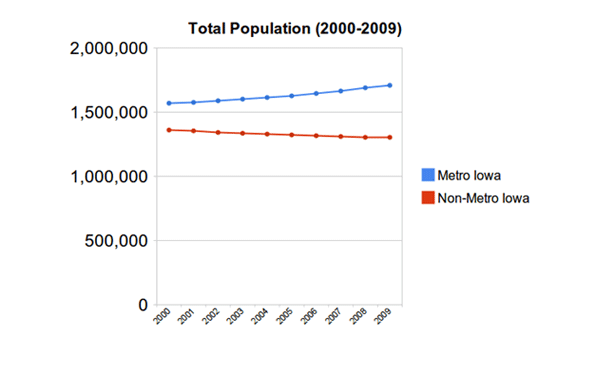
    This divergence is most easily illustrated by a chart of population:

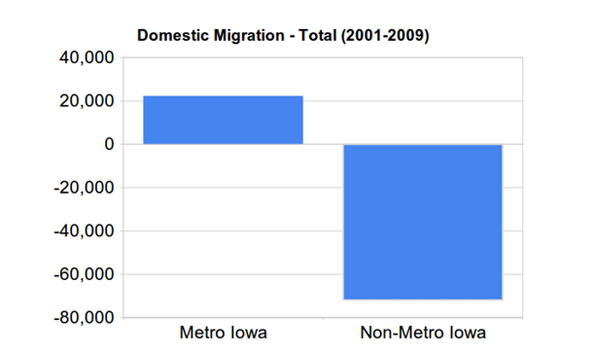
    There are already more people living in metro areas than non-metro areas in Iowa, and the gap is only getting wider. Non-metro Iowa is actually shrinking as people leave and the population re-orders itself in the state:

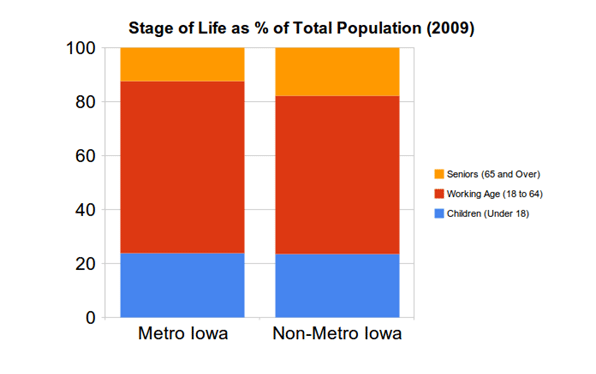
    Non-metro Iowa also has a larger senior population and lower population of working age. Generational turnover will drive even further population declines over time:

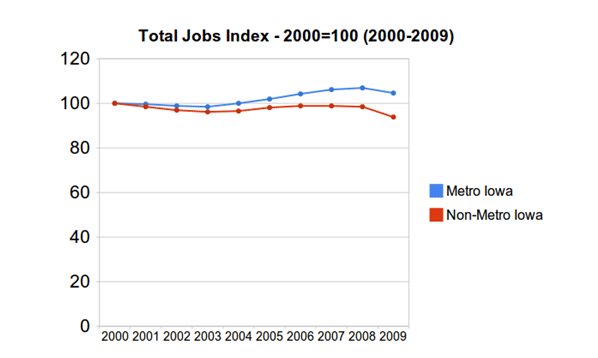
    And of course, these demographic trends are reflected in employment numbers as well, with metro Iowa adding jobs even in the last decade while non-metro Iowa is losing them.

    People’s opinions of Iowa are largely shaped by which of these two states they are looking at. More people tend to think about the struggling parts because that fits the traditional coastal media narrative and those places look big on a map. Iowa’s thriving metro regions are often overlooked because they are smaller and don’t fit the mold espoused by big city urbanists. Des Moines might not look like a Boston or Chicago, but that doesn’t mean it isn’t prosperous – and growing at almost Sunbelt rates.

    Like all of America, Iowa is a state in transition. And while it faces challenges to be sure, it’s managing that change better than most. Iowa’s future is likely to be very different from its small town past. It will be a more urban state, with several thriving metro regions. Farming will remain important, but will increasingly as a big business operation. Iowa’s future will be neither small town nor “hip cool” big city; it will represent the kind of agro-metro future that is emerging across wide swaths of America’s heartland.

    Aaron M. Renn is an independent writer on urban affairs based in the Midwest. His writings appear at The Urbanophile.

    Photo by Pete Zarria

  • Why Housing Will Come Back

    Few icons of the American way of life have suffered more in recent years than  homeownership. Since the bursting of the housing bubble, there has been a steady drumbeat from the factories of futurist punditry that the notion of owning a home will, and, more importantly, should become out of reach for most Americans.

    Before jumping on this bandwagon, perhaps we would do well to understand the role that homeownership and the diffusion of property plays in a democracy. From Madison and Jefferson through Lincoln’s Homestead Act, the most enduring and radical notion of American political economy has been the diffusion of property.

    Like small farmers in the 19th century, homeowners–and equally important, aspiring homeowners–now represent the core of our economy without which a strong recovery is likely impossible.  Houses remain as a financial bulwark for a large percentage of families, the anchor of communities, and, increasingly, home-based businesses.

    The reasons given for abandoning the homeownership ideal are diverse.  Conservatives rightfully look to diminish the outsized role of government in promoting homeownership.  Some suggest  that Americans would be better off  putting their money into things like the stock market or boosting consumer purchases.

    New-urbanist intellectuals like the University of Utah’s  Chris Nelson predict  aging demographics will lead masses to abandon their homes for retiree communities and nursing homes.   The respected futurist Paul Saffo predicts that as skilled laborers move from Singapore to San Francisco to New York and London, there is little need to “own” a permanent place. In the brave new future, he suggests, we will prefer time-sharing residences  as we flit from job to job across the global economy.

    Some of the greatest hostility towards homeownership increasingly comes from the progressive left, some of whom are calling for the total elimination of the homeowner mortgage interest deduction.  “The Case Against Homeownership,” recently published in Time,  encapsulates the current establishment’s  conventional wisdom: that homeownership is by nature exclusionist, “sprawl” promoting and responsible for “America’s overuse of energy and oil.”

    Yet for all the problems facing the housing market, homeownership–not exclusively single-family houses–is not likely to fade dramatically for the foreseeable future. The most compelling reason has to do with continued public preference for single-family homes, suburbs and the notion of owning a “piece” of the American dream.   This is why that four out of every five homes built in America over the past few decades, notes urban historian Witold Rybczynski, have less to do with government policy than “with buyers’ preferences, that is, What People Want.”

    What we are going through now is not a sea change but a correction from insane government and business practices.   The rise in homeownership from 44% in 1944 to nearly 70% at the height of the bubble reflected a great social democratic achievement. But by the mid-2000s government attempts to expand ownership–eagerly embraced by Wall Street speculators–brought in buyers who would have historically been disqualified.

    In some markets, prices exploded as people moved up too quickly into ever more expensive housing. Housing inflation was further exacerbated by “smart growth” policies, which limited new home construction in suburban areas and instead promoted dense, “transit oriented” housing with limited market appeal and economic logic.

    Rather than artificially constraining supply and protecting irresponsible borrowers,   we should let nature take its course. Home values need to readjust historic balance between incomes and prices. Over the past 60 years, notes demographer Wendell Cox, it took two to three years or less of median household income to purchase a median-priced home. At the peak of the boom, that ratio had ballooned to 4.6.

    The disequilibrium was the worst in regions like Los Angeles, Las Vegas, San Bernardino-Riverside and Miami. At the peak of the bubble, between 2006 and 2008, according to the National Homebuilders Association- Wells Fargo “Housing Opportunity Index,” barely 2% of families with a median income households in Los Angeles could afford to buy a median priced home; even in the traditionally affordable Riverside area, the number was roughly 7%. In Miami, barely 10% could afford such a purchase; in Las Vegas, often seen as one of the cheaper markets, only 15%.

    What a difference a market correction makes. The affordability number for Los Angeles is now 34%, 17 times better than two years ago, while Riverside is now near 70%. Miami’s affordability picture has improved to over 60% while in Las Vegas, it’s back over 80%.

    These lower prices–not Wall Street or federal gimmickry–will lure new buyers to the places that some new urbanists   have predicted will be “the next slums.” Already there’s evidence in places like Miami of a renewed interest in now-affordable suburban single-family homes while condos stay empty  or become rentals.

    Of course without a return to robust job growth, particularly in the private sector, the home market– and pretty much all mainstream consumer purchases–will remain weak. No matter how low prices get, people worried about losing employment do not constitute a promising new market for homes.

    But over the longer run most Americans will seek to purchase homes –whatever the geography. Increasingly this will be less a casino gamble, and more  a long-term lifestyle choice.  As America adds upwards of 100 million more Americans by 2050, the demand will stare us in the face.

    As boomers age, the two big groups that will drive housing will be the young Millenial generation born after 1983 as well as immigrants and their offspring. Sixty million strong, the millenials are just now entering their late 20s. They are just beginning to start hunting for houses and places to establish roots. Generational chroniclers  Morley Winograd and Mike Hais, describe millenials in their surveys as family-oriented young people who value homeownership even more than their boomer parents. They also are somewhat more likely to choose suburbia as their “ideal place to live” than the previous generation.

    These tendencies are even more marked among immigrants and their children. Already a majority of immigrants live in suburbia, up from 40% in the 1970s. They are attracted in many cases by both jobs and the opportunity to buy a single-family home. For an immigrant from Mumbai, Hong Kong or Mexico City, the “American dream” is rarely living in high density surrounded by concrete; if they wanted that, they could have stayed home.

    Over coming generations, changes in family and work life will make single-family homes, townhouses and other moderate-to-low density housing more attractive.  Contrary to the anonymity predicted by most futurists, your chosen place is becoming more important, as evidenced by numerous suburban and small town downtown revivals as well as growing local volunteerism.

    Equally important, multi-generational households are on the rise back to 1950s levels–in part due to immigrant lifestyle preferences. People are staying put; even before the bubble burst, mobility had dropped to the lowest level in over a half century. With the rise of new technologies allowing for dispersed work, the single family home increasingly houses not only residents, but part and full-time offices.

    Barring a long-term permanent recession or a national planning regime aimed at curbing single-family home construction, these factors should lead to a new surge in home buying starting later this decade. It may be too late to save many who overextended themselves in the bubble, but this resurgence could do much to propel our anemic economy, restoring the home to its rightful place one of the cornerstone not only of the American dream, but of our democracy.

    This article originally appeared at Forbes.com.

    Joel Kotkin is executive editor of NewGeography.com and is a distinguished presidential fellow in urban futures at Chapman University. He is author of The City: A Global History. His newest book is The Next Hundred Million: America in 2050, released in February, 2010.

    Photo by Wootang01

  • Cities: Size Does Not Matter Much Anymore

    The heart and brain are certainly not the largest organs in the human body, but they are arguably the most important. Why? The heart, through a miles-long network of capillaries, keeps every part of the body supplied with nutrients, and the brain, through an equally extensive network of nerves, provides instructions to every part of the body about what to do with those nutrients. They are important not because they are big, but because they are connected to everything else.

    It seems that cities work in much the same way. Some cities are much larger than others, but these size differences play virtually no role in their economic development today. Instead, urban economies depend primarily on cities’ connections to one another through networks of transportation, communication, business transactions, and cultural exchanges. Well-connected cities, regardless of their size, are more likely to develop robust regional economies.

    This is hardly a recent phenomenon. The ancient network of trade routes known as the Silk Road played a major role in the development of cities as commercial centers throughout Asia, and Rome’s imperial power was built upon and maintained by the fact that, proverbially, all roads led there. But, the importance of networks has become more critical recently for cities in the United States.

    In the past, dominated largely by agriculture and mass commodity production, bigger was better. America’s largest cities served as what Walter Christaller dubbed ‘central places.’ These central places served people living in the surrounding territory, as a place to purchase goods and services, and to sell crops and livestock. Bigger cities drew people in from further away, fueling their economic growth. However, as technological developments allowed people and goods to be transported more quickly and cheaply, people were no longer as shackled to the closest big city. Well connected cities, tied to other places by rail lines and highways, and more recently by airline routes and the internet, could benefit from consumers’ demand and workers’ labor in other places.

    Driven by such technological advances, the economic prosperity of American cities has become more tied to their connectedness than their sheer size. But, exactly what kind of connectedness is important can vary from place to place. Cities like New York or Chicago, which drew strength from their size in the past, today thrive largely by being well connected to other cities globally by multiple types of networks, serving simultaneously as transportation hubs, stock exchanges, and cultural centers.

    But the biggest change has been the rise of selected smaller cities. Some, not long ago relatively inconsequential, are now major players due to their linkages in more specialized networks. For example, much of Miami’s remarkable economic and demographic growth, and its status as a global city, is the result of its role as the primary economic and cultural bridge between North America and Central/South America. The Research Triangle in North Carolina and Silicon Valley in California have benefitted from intellectual linkages among universities and the world wide tech industry that join independent towns like Raleigh and Durham into cohesive urban regions. Even very small towns like Bentonville, Arkansas (2007 estimated population: 33,744) can be influential in the world arena with the help of vast supply-chain networks orchestrated by a major corporation (Wal-Mart) and large inflows of people made possible by a major airport (Northwest Arkansas Regional, nearly 1.2 million passengers in 2006).

    What does this change mean for American cities? Perhaps it’s more helpful to consider what it doesn’t mean. The heightened role networks and connectivity for cities likely does not herald the much-hyped death of distance, where internet technologies like high-resolution teleconferencing allow businesses to successfully operate anywhere. Certainly these technologies may simplify routine transactions like training employees at satellite offices, while email and social networking sites may help maintain existing relationships and collaborations over long distances. However, chance encounters that are almost impossible online but common in hallways or on sidewalks are frequently where new relationships are built and new ideas emerge. Even if technology did eliminate the need for proximity, real physical locations would still be significant. Not all cities are well connected, and this type of inequality serves to channel innovation and wealth toward some places and away from others. Although transportation and communication networks could disperse people and resources evenly across the landscape, more often they concentrate people and resources at key bottlenecks and ‘basing points’ in the networks.

    The triumph of networks over size also does not mean the triumph of all small towns over big cities. Size is not bad but simply increasingly irrelevant. Although large cities may encounter inefficiencies due to their size, strategically designed networks can offset many of them. For instance, congestion can be relieved by public transit worth using, or inadequate public services could be bolstered by improving inter-metropolitan coordination. Still, entrepreneurs increasingly seek to locate outside the city’s central core, in smaller suburbs or edge cities. This is a notable development in economic geography, and seems likely to continue. However, the success of these exurbs comes not from their independence from large cities, but instead from their interdependence upon them. Cheap land or favorable tax codes won’t likely transform an isolated small town into an economic powerhouse, while congestion and pollution won’t likely hinder the continued development of a well-connected port city.

    Ultimately, we need to change how we think about cities and their economic growth. Contrary to strategies that seek to ‘grow’ cities by building (or rebuilding) their tax bases, cities do not necessarily need more people or even more companies. Instead, city leaders need to concentrate on growth in terms of cities’ connectivity. Each new capillary or nerve takes a small amount of energy for the body to build, yet they are precisely what make the heart and brain such efficient and important engines of life. Similarly, forging new relationships between cities often does not deplete scarce resources, and cities that are linked to one another can exploit economies of scale by pooling their strengths, making them sleeker and more efficient. A city that stands on its own, no matter how large or small, is likely to burn out in the long run. But, a city that can draw on the resources of the whole world through extensive network connections to other cities, whether it is a metropolis or a hamlet, is likely to thrive.

    Zachary Neal, PhD, is assistant professor of sociology and global urban studies at Michigan State University. This essay draws on his recent study, “From Central Places to Network Bases,” that will appear in the research journal City and Community, and is available here.

    Photo by wzefri

  • Where’s Next: November May Determine Regional Winners

    As the recovery begins, albeit fitfully, where can we expect growth in jobs, incomes and, most importantly, middle class opportunities? In the US there are two emerging “new” economies, one largely promoted by the Administration and the other more grounded in longer-term market and demographic forces.

    The November election and its subsequent massive expansion of federal power may have determined which regions win the post-bust economy, but the stakes in November are particularly acute for some prime beneficiaries of what could be called the Obama economy: the education lobby, Silicon Valley venture firms, Wall Street, urban land interests and the public sector. All backers of his 2008 campaign, these groups have either reaped significant benefits from the stimulus or have used it to bolster themselves from the worst impact of the recession.

    In a sense the Obama policies are designed to overturn the pattern of economic dispersion –towards the exurbs, the south, the intermountain West, and more recently the Plains – that has defined the last half century. The biggest winner, in regional terms, is the Washington area. Even as local governments cut back, the federal establishment continues to swell. Federal employment, excluding the postal service, remains roughly 200,000 larger than in 2008.

    It is not surprising then that the capital district enjoys the highest job growth since December 2009 of any region. Indeed, the Great Recession barely even hit the imperial center. Given its current trajectory, it’s likely to remain the primary boom town along the east coast.

    There are other less obvious regional winners from Obamanomics. Wall Street, despite its recent wailing, has fattened itself on the Fed’s cheap money. It may benefit further from highly complex new financial regulations that will drive smaller, regional competitors either out of business or into mergers with the megabanks.

    Manhattan – a liberal bastion dependent on arguably the greediest, most venal purveyors of capitalism – enjoyed a revived high end consumer economy of high fashion, fancy restaurants and art galleries. Silicon Valley’s financial community also is seeing a surfeit of grants and subsidies for the latest venture schemes, keeping Palo Alto and its environs relatively prosperous. Perhaps this is the positive “change” that Time recently credited in its paen to the stimulus.

    Other regional winners from the Obama economy generally can be found in state capitals and University towns, particularly those with the Ivy or elite college pedigrees that resonate with this most academic Administration. One illustration can be seen in the relatively strong recovery of Massachusetts – home to many prestigious Universities and hospitals – which has seen jobs grow by 2.2 percent since the Obama ascension.

    Similar, albeit less dramatic recoveries can be found in Columbus, Madison and Minneapolis-St.Paul, with their large university communities and regional federal employment centers. Yet the political benefits of this growth may be limited. Many other parts of these same states, including the outer boroughs of New York are not doing well; aside from Columbus, Ohio has continued to skid as its industrial and corporate base dwindles, often moving to more business friendly states.

    At the same time, the strongest growth clusters in those regions that stick to the basics: relatively low taxes, pro-business regulations and continued infrastructure investment. Some regions – particularly in Texas, Alaska, Wyoming and the Great Plains – also have benefited from the growth in such basic industries as agriculture, oil and mining.

    Like resource-producing Canada and Australia, which barely felt the great recession, these economies have been boosted by continued growth in demand from countries like India and China. The current rise in food commodity prices, in part due to poor conditions in Russia and other former Soviet Republics, may further intensify this trend. Beyond the current food crisis, changing consumer tastes in boom markets like China seem certain to boost demand for such products as corn, used to help meet that country’s soaring demand for pork and other meat products.

    But perhaps even more important, once the economy recovers these areas – with their business friendly regimes and lower costs – may continue to siphon much of the next wave of industrial and even tech growth from the more expensive, largely Obama-friendly regions. Caterpillar, for example, one of the likely beneficiaries of expanded exports, recently announced plans to open a new assembly plant not in its Midwestern base but in Victoria, outside Houston.

    This trend has been building for at least a generation and seems likely to intensify under today’s highly competitive global business environment. If we start seeing a recovery in such things as auto sales, one can expect much of the new demand to be meant in efficient, largely foreign owned factories that have been gearing up across the Southeast. Unless powerful federal intervention forces Americans to buy General Motors products like the Volt, consumer preference is likely to be strongest for smart, fuel efficient brands built largely in towns from southern Ohio down to Texas.

    Perhaps even more significantly, these areas are also challenging the Obama regions in such fields as high-technology. Tech hiring has picked up in places like Silicon Valley, New York and DC, but consistently the fastest growth in science, engineering and technical jobs has been in low-cost states such as North Dakota, Virginia, New Mexico, Utah and Texas. Just recently, several major Silicon Valley powerhouses – Adobe, Twitter, Electronic Arts and eBay – announced major new expansions in Utah, a state that is among a brood seeking to move prized businesses, including even entertainment, from the Golden State.

    To a distressingly large extent, the fate of these two distinct economies may hinge on the outcome in November. If the Republicans gain an effective blocking majority – perhaps with a handful of centrist Democrats from growth-oriented states – many favored programs of the Obama economy may be cut or eliminated entirely. These include high-speed rail, increased subsidies for new light rail lines, massive investments in University research and investment breaks for renewable fuels.

    On the other hand, if the Democratic majority persists the tilt towards the Obama economy may even become stronger, as the Democrats will be the ones primarily losing their seats in many growth states. Many policies inimical to the growth states – support for government satrapies like General Motors, tougher restrictions on domestic fossil fuel development and policies designed to curb suburban single family housing – might even intensify.

    In this sense, we need to see November as much as a conflict between growth economies as an ideological contest. The results could determine what regions are next to boom, and whose economy will slow or even decline. What might be best – a compromise recognizing the need to boost growth in all regions – may be a too far a stretch of logic in this political climate.

    This article originally appeared at Forbes.com.

    Joel Kotkin is executive editor of NewGeography.com and is a distinguished presidential fellow in urban futures at Chapman University. He is author of The City: A Global History. His newest book is The Next Hundred Million: America in 2050, released in February, 2010.

    Photo by bcbeatty

  • A Mass Transit New England Ramble

    To escape the summer crowds in the Hamptons, I rode the S92 bus (fare $1.50) for almost three hours, as it cruised the south and north forks of Long Island, before leaving me at the ferry that connects Orient Point to New London, Connecticut.

    I might end up late to some meetings, but this way I could monitor the progress of the American Recovery and Reinvestment Act of 2009, at least as it pertains to the more than $8 billion earmarked for high-speed trains, if not buses and ferries.

    Not many Hampton People leave on a local bus, which in this case was filled with Latino day laborers, giving it the air of a John Steinbeck novel. I was headed to New England, and I wanted to see if I could make a circuit to Providence, Boston, Amherst, and Keene entirely on public transportation.

    Conclusion: Mass transit works better as a White House sound bite than as a way to get around New England.

    The S92 rolled through the Hamptons to Riverhead, the county seat, where the Latinos got off, leaving me with the driver (from Masuria in Poland) to pass by the North Fork vineyards, which are vast and sophisticated. When I was young, only winos drank Long Island vintages; now it can cost $40 a bottle.

    The ferry to New London made the crossing in local fog banks, which obscured Plum Gut, but parted for the run into New London, the American Gibraltar. I saw a surfacing submarine and, at the ferry terminal, a sculpture of the playwright Eugene O’Neill, shown as a boy gazing out to sea (even though he spent most of his adult life looking at bad marriages rather than the waves).

    The train to Providence ran along the snug harbors around Mystic and Stonington, although inexplicably it arrived forty-five minutes late. Brown University and some local technology companies are the reason that the Rhode Island capital does not feel like a failed mill town. My friend on the local newspaper whispered that the well reputed university is long on celebrity children, and short on academic excellence.

    I switched to the Massachusetts Bay Transportation Authority (MBTA) for the hour run into Boston’s Back Bay Station. It ran with the air conditioning on full blast, as if it were a rolling meat locker. The rail car had wifi, a commuter train novelty for me, and much appreciated.

    The $15 billion Big Dig, to bury the city’s interstates, not to mention the U.S. Treasury, is largely completed. Even so, much of downtown feels like an exit ramp, usually named after one of the Kennedys. Boston is not one of the cities where I am at home, but I appreciate the glimpses of the Freedom Trail and thinking I might have to make way for ducklings.

    After my Boston meetings, I headed for Amherst in central Massachusetts. Traveling by bus would have meant changing in Springfield, as would have Amtrak (estimated travel time, about four hours). Instead, I took a MBTA commuter train to North Leominster, a gritty mill town now given over to Jiffy Lube and donuts.

    The Amherst area has thousand of students from eastern Massachusetts, but few plans to improve its bus or train connections. Nor is it possible to take public transportation from Amherst one hour north to Keene, New Hampshire. Had I wanted to do so, I would have had to first go south to Springfield, then back up to Bellows Falls, Vermont, spend the night, and connect the following morning to Keene on Greyhound (“safe, reliable, courteous, and slow”).

    I surrendered and rented a car.

    Before leaving Amherst, I visited the Emily Dickinson House, where I had the good luck to join Ms. Casey Clark’s tour. She made the reclusive Emily come to life: by quoting from her work (“Forever is composed of nows”), and pointing to the solitary window table where Dickinson wrote many of her 1,800 poems, the passionate Tweets of the nineteenth century.

    I had not been to Amherst College since October 1963, when as a nine-year old boy I was taken to see President John F. Kennedy dedicate the new Robert Frost Library.

    On this visit, I recalled seeing JFK’s helicopter land on the football field, and his motorcade along the main street. His bright red hair and toothy smile are etched in memory. He sat on the back of an open car; the President as prom queen. Even to a rapturous boy, he looked vulnerable. Less than a month later, he died in the same convertible.

    For the benefit of my university-bound children, I joined a campus tour. After exhaustive inspections of laundry rooms, showers, dorms, lounges, and food courts — why are colleges marketed as subdivisions? — I gave up and drove to Brattleboro, Vermont, another mill town that is trying make a go of spinning cappuccino.

    My New England ramble ended on Amtrak’s Vermonter, a train that goes from northern Vermont to Washington, probably in about the same amount of time that the Indians took to make the journey in canoes. The train poked across Massachusetts, idled in Springfield, and then picked up speed south of Hartford, where we crossed the Connecticut River.

    The biggest problem with American public transportation is that it lacks a critical mass. The infrequent service is more of a problem than the slow speeds, which could be padded over with comfortable seats, wifi, and better coffee. Amtrak has only one train a day north of Springfield, which in turn has one train to Boston and spotty bus service. Little wonder everyone drives.

    Why throw money at high-speed rail when Amtrak runs on such dilatory schedules? Spend the money, instead, on more traditional rail cars and engines, which are in short supply, or hire some Swiss conductors and engineers to keep to the schedules.

    Amherst to Princeton, New Jersey, where I was headed, is a five–hour car ride. I made the trip by train in a leisurely eight hours, with the proximity of an AmCafé and a power outlet for my computer, to write this article.

    I appreciated not having to drive on the interstate or sit on a cramped bus, although the station waits were maddening. The train crew changes were frequent, suggesting a company hostage to union rules and feather bedding. To my knowledge, Emily Dickinson never wrote a poem about Amtrak. If she had, it might read:

    I cast my Fate upon the Rails –
    As if a spirit on Indian trails –
    We stopped, and shuddered, and watched our steps –
    And sweated during A/C fails

    Leaving out the $80 cost of the rental car, my travels cost less than $125. And although I loved being on trains and ferries, there is something shabby about public transportation, as though it’s headed for obscurity, rather than for the President’s brave, new high-speed world.

    Back home, the question on my mind was: If you had $8 billion, would you let Amtrak manage it?

    Matthew Stevenson is the author of Remembering the Twentieth Century Limited, winner of Foreword’s bronze award for best travel essays at this year’s BEA. He is also editor of Rules of the Game: The Best Sports Writing from Harper’s Magazine. He lives in Switzerland.

    Photo: Black-backed gull and Sea Jet high-speed ferry, New London, Ct.
    By L’eau Bleue

  • Urban Legends: Why Suburbs, Not Dense Cities, are the Future

    The human world is fast becoming an urban world — and according to many, the faster that happens and the bigger the cities get, the better off we all will be. The old suburban model, with families enjoying their own space in detached houses, is increasingly behind us; we’re heading toward heavier reliance on public transit, greater density, and far less personal space. Global cities, even colossal ones like Mumbai and Mexico City, represent our cosmopolitan future, we’re now told; they will be nerve centers of international commerce and technological innovation just like the great metropolises of the past — only with the Internet and smart phones.

    According to Columbia University’s Saskia Sassen, megacities will inevitably occupy what Vladimir Lenin called the “commanding heights” of the global economy, though instead of making things they’ll apparently be specializing in high-end “producer services” — advertising, law, accounting, and so forth — for worldwide clients. Other scholars, such as Harvard University’s Edward Glaeser, envision universities helping to power the new “skilled city,” where high wages and social amenities attract enough talent to enable even higher-cost urban meccas to compete.

    The theory goes beyond established Western cities. A recent World Bank report on global megacities insists that when it comes to spurring economic growth, denser is better: “To try to spread out economic activity,” the report argues, is to snuff it. Historian Peter Hall seems to be speaking for a whole generation of urbanists when he argues that we are on the cusp of a “coming golden age” of great cities.

    The only problem is, these predictions may not be accurate. Yes, the percentage of people living in cities is clearly growing. In 1975, Tokyo was the largest city in the world, with over 26 million residents, and there were only two other cities worldwide with more than 10 million residents. By 2025, the U.N. projects that there may be 27 cities of that size. The proportion of the world’s population living in cities, which has already shot up from 14 percent in 1900 to about 50 percent in 2008, could be 70 percent by 2050. But here’s what the boosters don’t tell you: It’s far less clear whether the extreme centralization and concentration advocated by these new urban utopians is inevitable — and it’s not at all clear that it’s desirable.

    Not all Global Cities are created equal. We can hope the developing-world metropolises of the future will look a lot like the developed-world cities of today, just much, much larger — but that’s not likely to be the case. Today’s Third World megacities face basic challenges in feeding their people, getting them to and from work, and maintaining a minimum level of health. In some, like Mumbai, life expectancy is now at least seven years less than the country as a whole. And many of the world’s largest advanced cities are nestled in relatively declining economies — London, Los Angeles, New York, Tokyo. All suffer growing income inequality and outward migration of middle-class families. Even in the best of circumstances, the new age of the megacity might well be an era of unparalleled human congestion and gross inequality.

    Perhaps we need to consider another approach. As unfashionable as it might sound, what if we thought less about the benefits of urban density and more about the many possibilities for proliferating more human-scaled urban centers; what if healthy growth turns out to be best achieved through dispersion, not concentration? Instead of overcrowded cities rimmed by hellish new slums, imagine a world filled with vibrant smaller cities, suburbs, and towns: Which do you think is likelier to produce a higher quality of life, a cleaner environment, and a lifestyle conducive to creative thinking?

    So how do we get there? First, we need to dismantle some common urban legends.

    Perhaps the most damaging misconception of all is the idea that concentration by its very nature creates wealth. Many writers, led by popular theorist Richard Florida, argue that centralized urban areas provide broader cultural opportunities and better access to technology, attracting more innovative, plugged-in people (Florida’s “creative class“) who will in the long term produce greater economic vibrancy. The hipper the city, the mantra goes, the richer and more successful it will be — and a number of declining American industrial hubs have tried to rebrand themselves as “creative class” hot spots accordingly.

    But this argument, or at least many applications of it, gets things backward. Arts and culture generally do not fuel economic growth by themselves; rather, economic growth tends to create the preconditions for their development. Ancient Athens and Rome didn’t start out as undiscovered artist neighborhoods. They were metropolises built on imperial wealth — largely collected by force from their colonies — that funded a new class of patrons and consumers of the arts. Renaissance Florence and Amsterdam established themselves as trade centers first and only then began to nurture great artists from their own middle classes and the surrounding regions.

    Even modern Los Angeles owes its initial ascendancy as much to agriculture and oil as to Hollywood. Today, its port and related industries employ far more people than the entertainment business does. (In any case, the men who built Hollywood were hardly cultured aesthetes by middle-class American standards; they were furriers, butchers, and petty traders, mostly from hardscrabble backgrounds in the czarist shtetls and back streets of America’s tough ethnic ghettos.) New York, now arguably the world’s cultural capital, was once dismissed as a boorish, money-obsessed town, much like the contemporary urban critique of Dallas, Houston, or Phoenix.

    Sadly, cities desperate to reverse their slides have been quick to buy into the simplistic idea that by merely branding themselves “creative” they can renew their dying economies; think of Cleveland’s Rock and Roll Hall of Fame, Michigan’s bid to market Detroit as a “cool city,” and similar efforts in the washed-up industrial towns of the British north. Being told you live in a “European Capital of Culture,” as Liverpool was in 2008, means little when your city has no jobs and people are leaving by the busload.

    Even legitimate cultural meccas aren’t insulated from economic turmoil. Berlin — beloved by writers, artists, tourists, and romantic expatriates — has cultural institutions that would put any wannabe European Capital of Culture to shame, as well as a thriving underground art and music scene. Yet for all its bohemian spirit, Berlin is also deeply in debt and suffers from unemployment far higher than Germany’s national average, with rates reaching 14 percent. A full quarter of its workers, many of them living in wretched immigrant ghettos, earn less than 900 euros a month; compare that with Frankfurt, a smaller city more known for its skyscrapers and airport terminals than for any major cultural output, but which boasts one of Germany’s lowest unemployment rates and by some estimates the highest per capita income of any European city. No wonder Berlin Mayor Klaus Wowereit once described his city as “poor but sexy.”

    Culture, media, and other “creative” industries, important as they are for a city’s continued prosperity, simply do not spark an economy on their own. It turns out to be the comparatively boring, old-fashioned industries, such as trade in goods, manufacturing, energy, and agriculture, that drive the world’s fastest-rising cities. In the 1960s and 1970s, the industrial capitals of Seoul and Tokyo developed their economies far faster than Cairo and Jakarta, which never created advanced industrial bases. China’s great coastal urban centers, notably Guangzhou, Shanghai, and Shenzhen, are replicating this pattern with big business in steel, textiles, garments, and electronics, and the country’s vast interior is now poised to repeat it once again. Fossil fuels — not art galleries — have powered the growth of several of the world’s fastest-rising urban areas, including Abu Dhabi, Houston, Moscow, and Perth.

    It’s only after urban centers achieve economic success that they tend to look toward the higher-end amenities the creative-classers love. When Abu Dhabi decided to import its fancy Guggenheim and Louvre satellite museums, it was already, according to Fortune magazine, the world’s richest city. Beijing, Houston, Shanghai, and Singapore are opening or expanding schools for the arts, museums, and gallery districts. But they paid for them the old-fashioned way.

    Nor is the much-vaunted “urban core” the only game in town. Innovators of all kinds seek to avoid the high property prices, overcrowding, and often harsh anti-business climates of the city center. Britain’s recent strides in technology and design-led manufacturing have been concentrated not in London, but along the outer reaches of the Thames Valley and the areas around Cambridge. It’s the same story in continental Europe, from the exurban Grand-Couronne outside of Paris to the “edge cities” that have sprung up around Amsterdam and Rotterdam. In India, the bulk of new tech companies cluster in campus-like developments around — but not necessarily in — Bangalore, Hyderabad, and New Delhi. And let’s not forget that Silicon Valley, the granddaddy of global tech centers and still home to the world’s largest concentration of high-tech workers, remains essentially a vast suburb. Apple, Google, and Intel don’t seem to mind. Those relative few who choose to live in San Francisco can always take the company-provided bus.

    In fact, the suburbs are not as terrible as urban boosters frequently insist.

    Consider the environment. We tend to associate suburbia with carbon dioxide-producing sprawl and urban areas with sustainability and green living. But though it’s true that urban residents use less gas to get to work than their suburban or rural counterparts, when it comes to overall energy use the picture gets more complicated. Studies in Australia and Spain have found that when you factor in apartment common areas, second residences, consumption, and air travel, urban residents can easily use more energy than their less densely packed neighbors. Moreover, studies around the world — from Beijing and Rome to London and Vancouver — have found that packed concentrations of concrete, asphalt, steel, and glass produce what are known as “heat islands,” generating 6 to 10 degrees Celsius more heat than surrounding areas and extending as far as twice a city’s political boundaries.

    When it comes to inequality, cities might even be the problem. In the West, the largest cities today also tend to suffer the most extreme polarization of incomes. In 1980, Manhattan ranked 17th among U.S. counties for income disparity; by 2007 it was first, with the top fifth of wage earners earning 52 times what the bottom fifth earned. In Toronto between 1970 and 2001, according to one recent study, middle-income neighborhoods shrank by half, dropping from two-thirds of the city to one-third, while poor districts more than doubled to 40 percent. By 2020, middle-class neighborhoods could fall to about 10 percent.

    Cities often offer a raw deal for the working class, which ends up squeezed by a lethal combination of chronically high housing costs and chronically low opportunity in economies dominated by finance and other elite industries. Once the cost of living is factored in, more than half the children in inner London live in poverty, the highest level in Britain, according to a Greater London Authority study. More than 1 million Londoners were on public support in 2002, in a city of roughly 8 million.

    The disparities are even starker in Asia. Shenzhen and Hong Kong, for instance, have among the most skewed income distributions in the region. A relatively small number of skilled professionals and investors are doing very well, yet millions are migrating to urban slums in places like Mumbai not because they’ve all suddenly become “knowledge workers,” but because of the changing economics of farming. And by the way, Mumbai’s slums are still expanding as a proportion of the city’s overall population — even as India’s nationwide poverty rate has fallen from one in three Indians to one in five over the last two decades. Forty years ago, slum dwellers accounted for one in six Mumbaikars. Now they are a majority.

    To their credit, talented new urbanists have had moderate success in turning smaller cities like Chattanooga and Hamburg into marginally more pleasant places to live. But grandiose theorists, with their focus on footloose elites and telecommuting technogeniuses, have no practical answers for the real problems that plague places like Mumbai, let alone Cairo, Jakarta, Manila, Nairobi, or any other 21st-century megacity: rampant crime, crushing poverty, choking pollution. It’s time for a completely different approach, one that abandons the long-held assumption that scale and growth go hand in hand.

    Throughout the long history of urban development, the size of a city roughly correlated with its wealth, standard of living, and political strength. The greatest and most powerful cities were almost always the largest in population: Babylon, Rome, Alexandria, Baghdad, Delhi, London, or New York.

    But bigger might no longer mean better. The most advantaged city of the future could well turn out to be a much smaller one. Cities today are expanding at an unparalleled rate when it comes to size, but wealth, power, and general well-being lag behind. With the exception of Los Angeles, New York, and Tokyo, most cities of 10 million or more are relatively poor, with a low standard of living and little strategic influence. The cities that do have influence, modern infrastructure, and relatively high per capita income, by contrast, are often wealthy small cities like Abu Dhabi or hard-charging up-and-comers such as Singapore. Their efficient, agile economies can outpace lumbering megacities financially, while also maintaining a high quality of life. With almost 5 million residents, for example, Singapore isn’t at the top of the list in terms of population. But its GDP is much higher than that of larger cities like Cairo, Lagos, and Manila. Singapore boasts a per capita income of almost $50,000, one of the highest in the world, roughly the same as America’s or Norway’s. With one of the world’s three largest ports, a zippy and safe subway system, and an impressive skyline, Singapore is easily the cleanest, most efficient big city in all of Asia. Other smaller-scaled cities like Austin, Monterrey, and Tel Aviv have enjoyed similar success.

    It turns out that the rise of the megacity is by no means inevitable — and it might not even be happening. Shlomo Angel, an adjunct professor at New York University’s Wagner School, has demonstrated that as the world’s urban population exploded from 1960 to 2000, the percentage living in the 100 largest megacities actually declined from nearly 30 percent to closer to 25 percent. Even the widely cited 2009 World Bank report on megacities, a staunchly pro-urban document, acknowledges that as societies become wealthier, they inevitably begin to deconcentrate, with the middle classes moving to the periphery. Urban population densities have been on the decline since the 19th century, Angel notes, as people have sought out cheaper and more appealing homes beyond city limits. In fact, despite all the “back to the city” hype of the past decade, more than 80 percent of new metropolitan growth in the United States since 2000 has been in suburbs.

    And that’s not such a bad thing. Ultimately, dispersion — both city to suburb and megacity to small city — holds out some intriguing solutions to current urban problems. The idea took hold during the initial golden age of industrial growth — the English 19th century — when suburban “garden cities” were established around London’s borders. The great early 20th-century visionary Ebenezer Howard saw this as a means to create a “new civilization” superior to the crowded, dirty, and congested cities of his day. It was an ideal that attracted a wide range of thinkers, including Friedrich Engels and H.G. Wells.

    More recently, a network of smaller cities in the Netherlands has helped create a smartly distributed national economy. Amsterdam, for example, has low-density areas between its core and its corporate centers. It has kept the great Dutch city both livable and competitive. American urbanists are trying to bring the same thinking to the United States. Delore Zimmerman, of the North Dakota-based Praxis Strategy Group, has helped foster high-tech-oriented development in small towns and cities from the Red River Valley in North Dakota and Minnesota to the Wenatchee region in Washington State. The outcome has been promising: Both areas are reviving from periods of economic and demographic decline.

    But the dispersion model holds out even more hope for the developing world, where an alternative to megacities is an even more urgent necessity. Ashok R. Datar, chairman of the Mumbai Environmental Social Network and a longtime advisor to the Ambani corporate group, suggests that slowing migration to urban slums represents the most practical strategy for relieving Mumbai’s relentless poverty. His plan is similar to Zimmerman’s: By bolstering local industries, you can stanch the flow of job seekers to major city centers, maintaining a greater balance between rural areas and cities and avoiding the severe overcrowding that plagues Mumbai right now.

    Between the 19th century, when Charles Dickens described London as a “sooty spectre” that haunted and deformed its inhabitants, and the present, something has been lost from our discussion of cities: the human element. The goal of urban planners should not be to fulfill their own grandiose visions of megacities on a hill, but to meet the needs of the people living in them, particularly those people suffering from overcrowding, environmental misery, and social inequality. When it comes to exporting our notions to the rest of the globe, we must be aware of our own susceptibility to fashionable theories in urban design — because while the West may be able to live with its mistakes, the developing world doesn’t enjoy that luxury.

    This article originally appeared at Foreign Policy

    Joel Kotkin is executive editor of NewGeography.com and is a distinguished presidential fellow in urban futures at Chapman University. He is author of The City: A Global History. His newest book is The Next Hundred Million: America in 2050, released in February, 2010.

    Photo: Mugley

  • A Localist Solution

    By Richard Reep

    “There is a great deal of historical evidence to suggest that a society which loses its identity with posterity and which loses its positive image of the future loses also its capacity to deal with present problems, and soon falls apart.”
    –Kenneth Boulding, economist and philosopher (1966)

    Written in the depths of the Cold War, when nuclear annihilation appeared imminent, if not inevitable to some, Boulding’s words remain applicable to today’s popular culture. Increasingly unable to imagine a positive future since the 1990s, we have largely replaced the end of the nuclear threat with the beginning of global warming, among other environmental threats. Others have raised the spectre of Chinese global domination or a prolonged and destructive jihad from the Islamic world.

    Fatigued by perpetual threat, our society appears today to have largely lost its capacity to deal with present problems. Government, media and academia all have largely adopted, and even sought to expand their own power, by exacerbating this sense of omnipresent threat. Pick your thesis and line up your dialectical arguments, and you can almost hear the politicians and business leaders talking past each other already. And so goes our contemporary cultural conversation.

    In this circumstance, the task of rebuilding a sense of optimism and resilience has fallen on a number of local community groups seeking to find an alternative pathway out of the current zeitgeist. As the politicians turn up the volume, individuals are simply turning them off, and inventing solutions that address tomorrow’s needs. From these efforts come the most significant optimism for the future.

    Nondialectical change seems to be the only hope in a society where progress, particularly for the hard-pressed middle class, seems increasingly dubious. Small, isolated, cumulative efforts that begin on the grassroots level – localism – are our best, most positive pathway out of the seemingly intractable argument engaging western scientific society.

    Based in communities, families and churches, these groups are very different from those – on both sides of the political aisle, in the corporate world, the media, the scientific and academic communities – who hope to benefit from a climate of gloom and hopelessness. These are people who are thinking not how to gain more power or influence, but to make lives better for themselves, their neighbors and their children.

    Intentional communities. People creating a community around the intention of responsible environmental stewardship began this movement in Vermont in the 1990s. They represent a vehicle for a community to take responsibility for its environmental impact, wherein homeowners’ dues go towards an engineer’s time to monitor the community’s own wastewater treatment system, electrical power generation, and other needs defined by the community. It has parted company with conventional towns and cities, and today this movement represents any groupings of like-minded individuals around ecological concerns, religious affiliations, and other niche interests as a way of dropping out of the mainstream. Coping with stress by removing oneself from the city helps the individual, but leaves the city behind.

    The transition movement, begun in the United Kingdom, may be another pathway, based on the notion of peak oil. Encouraging bicycle riding, walking, and preparation for a low-hydrocarbon future, transition at least increases everyone’s exercise level. It is spreading quickly across America with local organizers creating visioning meetings and action plans, hoping that community strength will be a force multiplier. These movements are building in cities, where the hard work needs to be done. In Central Florida, Transition Orlando leader Jim Belcher facilitates community workshops focused on creating a shared vision for the future of this region. By July, its third gathering attracted over 60 people coming to realize that the future starts here, not in Washington or New York.

    The Living Building Challenge, begun in the Pacific Northwest, is yet another pathway, based on the notion that buildings can actually produce energy and clean water while cleaning pollution. Turning the conventional model on its head, building owners engaging in this process have already produced a few examples that appear to meet their self-imposed requirements to be restorative in character. This initiative takes the existing real estate development industry, sorely in need of reform, down a new road as well. With over 70 buildings being analyzed for compliance with this very new standard, four are close to meeting this challenge: a residence in Victoria, British Columbia; the Tyson Living Learning Center in Eureka, Missouri; the Omega Center for Sustainable Living in Rhinebeck, New York; the Hawaii Preparatory Academy Energy Laboratory in Waimea, Hawaii and the EcoCenter at Heron’s Head Park in San Francisco, California. More projects like these will have an impact on how people think about the role of buildings in society.

    In all these movements, the emphasis is on the process rather than the product. No leadership claims to have all the answers. The importance of this cannot be overstated. With a sense of desperation, communities seem too quick to turn solutions – often concocted from the outside by groups with distinct national or global agendas – that closes off all future dialogue and process, as if the future cannot be trusted to meet its own needs. These approaches may appear to address this generation’s anxiety over the future, but zips the lips of the future generation. A more open, indeterminate vision allows inconsistencies and conflicts to be solved as they arise. Teleological fantasies can only go so far.

    Due to their small size these micro-movements and others mean little if considered individually, and they are easy to dismiss as experiments. They are also reactions to the dialectic, whether peak oil or global warming. The important thing about them is not which side they react to, but rather what they are doing about it, and the gradual, step-by-step basis through which individuals and communities can act.

    These developments should be watched carefully if a positive image of the future is yet to be regained. Enough destruction has occurred, and rather than bemoan the loss of our past lifestyles and bemoan a future of scarcity, the middle class might look at it rather as a freedom to change and grow stronger, more resilient, and less dependent upon the oligarchy of organized interest groups, academic influence, media money and power.

    Richard Reep is an Architect and artist living in Winter Park, Florida. His practice has centered around hospitality-driven mixed use, and has contributed in various capacities to urban mixed-use projects, both nationally and internationally, for the last 25 years.

    Photo by photobunny

  • Guys Gone Wild: Sturgis Motorcycle Rally Begins

    Yesterday marked the opening of the outrageous phenomenon known as the Sturgis Motorcycle Rally, a week-long, $987 million party for about 500,000 people. Every year in early August my sleepy hometown, Sturgis, population 6,500, hosts a half million biking enthusiasts who swarm here for a combination carnival, racing event, party, music festival, and shopping mall.

    Tucked into the scenic Black Hills of western South Dakota, for one memorable week each year Sturgis becomes the epicenter of the oldest, biggest, loudest, most authentic and out-of-control motorcycle rally in the world. We become the largest city in the state by a factor of three. That equates to each household in town hosting 183 “guests.” Nearly 500 festival-goers will land in jail; hundreds will be issued tickets for violations such as indecent exposure, open container, or driving on the sidewalk; 350 or so will require hospital emergency room visits; two or three will die of heart attacks; and a half-dozen or more will be killed in traffic accidents. Keeping its guests safe costs the city of Sturgis over $1 million in insurance, increased law enforcement, attorney costs, fire and ambulance services, and the like.

    Our temporary denizens are clad in skull caps, sunglasses, boots, sleeveless shirts, and black leather. Tattoos are required; piercings are optional. Body paint, thongs, and pasties will do for women. For men, cleanliness is not a virtue; grimy grubbiness is fine and chest hair encouraged. Don’t come to Sturgis looking for metrosexuals—you won’t find any.

    The streets are teeming with beautiful, scantily dressed women, but the real beauties are the motorcycles, their chrome sparkling in the sun as though they had just left the showroom floor. Few things you will ever see are as impressive as thousands of custom-painted Harley Davidsons parked four rows deep and lined up for blocks, many of them true works of art. Few things you will encounter can compare to the noise made by an undulating river of 700-pound motorcycles. Hunter S. Thompson described it as “a burst of dirty thunder.”

    The Sturgis Rally is an economic engine that drives state tourism and represents capitalism at its finest. According to a survey funded by the Sturgis Motorcycle Rally itself, $987 million comes into South Dakota annually from the event. Rally-goers will need to pay an inflated $5.50 for a beer at the world’s largest biker bar, but Mt. Rushmore, Custer State Park, and some of the most scenic drives in the country are complimentary. A free pancake breakfast is provided daily by the Son of Light Ministry whose sign proclaims, “Flapjacks along with the word of God. And the best part—they’re both free!” In the same vein, the Christian Motorcycle Association will bless your bike while offering you a free bike wash, coffee and pancakes.

    Tens of thousands of people will be “inked” at the rally. “A decision that will last a lifetime,” warns the tattoo artist doing business out of a small concrete building that just last week was my beauty parlor. Many local businesses have been “repurposed,” in other words, closed down and rented out to vendors for handsome sums. Grocery stores, gas stations, and the local department store remain open for business; items in high demand include sunscreen, pillows, and energy drinks. The city-owned liquor store, creatively named Sturgis Liquor, is the only liquor store in town, a pretty smart move on the part of our founding fathers, given that rally goers drink an estimated three million gallons of beer. On average, visitors stay 5.5 days and spend $180 per day. Says one local, “It’s like a really loud relative comes to your house, stuffs your pockets full of money, and leaves a week later.”

    Demand exceeds the supply of hotel rooms, camping spots, and bathrooms. Hotel rates double and triple, climbing as high as $300 a night for a room and are sold out for a 50-mile radius. It seems as though every square foot in town is rented to someone: Locals rent out their homes for $3,000 to $10,000 a week and rent their yards to campers who pitch tents or park bikes. City law limits homeowners to 19 renters per property.

    Consider this for comparison: New York City: 26,402 persons per square mile. South Dakota: 9.9 persons per square mile. Sturgis, South Dakota (August 9-16, 2010, projected) : 160,427 persons per square mile.

    There are three types of people who come to the Sturgis Rally. First, the casual observers who may ride occasionally, but more than likely not at all. They’re easy to spot — they point a lot and look like kindergarteners on the first day of school. They carry shopping bags filled with t-shirts as proof to the folks back home that they were here to experience the mayhem and rub shoulders with the real thing.

    Next are the recreational riders. Mostly in their late 40s and 50s, they own bikes but don’t belong to biker clubs. They ride their Harleys only on sunny and mild weekends. They trailered their $35,000 bikes to the rally behind 2010 Ford F-series pickups with heated leather captain’s seats. This group offers the best opportunity for venders. They look like walking billboards for the Harley-Davidson brand, and buying the fantasy of the biker subculture does not come cheap.

    Finally, there are the bikers whose leather jackets have a cracked “been there, done that” patina that matches their sunburned faces. (You don’t get to look like that by hauling your bike on a trailer or riding only on weekends.) Their bikes have never seen a trailer, they do their own tune-ups, they sport socially offensive tattoos, and they don’t own rain gear.

    Although it’s impossible to determine the exact number of people at the rally, there are several metrics used by the city to estimate annual attendance, including traffic counts and taxable receipts. Over 700 temporary vendors set up shop in the city, hawking everything from $2 rubber bracelets to $125,000 custom-made motorcycles. A more ingenious method of estimating crowd size is by examining the quantity of artifacts left behind. Six hundred tons of “rally garbage” was hauled away in 2009, and we don’t expect this year’s guests to leave any less.

    The rally has been held every year in Sturgis since 1938 with the exception of two years during WWII when gas rationing rules prevented recreational travel. Nine racers participated in the first rally, competing for $750 in prize money in front of a small crowd of racing enthusiasts who had paid 50 cents each for the experience. By 1960 attendance was 800, by 1970 that number had grown to 2,000, and in 2010, for the rally’s 70th anniversary, projections are for over 600,000 attendees.

    Campgrounds which are empty fields during the rest of the year pound with rock bands from high noon until early the next morning. The largest campground, the 600 acre Buffalo Chip, has been estimated to host 25,000 rowdy revelers, transforming it overnight into the third largest city in the state. Like several local campgrounds it is also a concert venue. This year’s lineup includes Kid Rock, Bob Dylan, ZZ Top, Ozzie Osbourne, and . . . wait for it . . . Pee-wee Herman. The Buffalo Chip also offers “less conventional” entertainment, such as topless beauty contests, redneck games, and a shooting arcade for grownups billed as the ultimate Second Amendment experience. Participants can choose from WWI, WWII, Korean, and Vietnam War era weapons and receive the training required for a 35-state concealed carry permit.

    Events like the Sturgis Motorcycle Rally hearken back to the Roman Empire. The Romans celebrated what anthropologists call rituals of reversal, times in the yearly calendar that allowed patricians, plebeians, and slaves to abandon the constraints of an ordered society. The society enjoyed a “time out” during these festivals. when people could break the rules without fear of recrimination. Reversal rituals included a strong sexual focus, anonymity, costumes, feasting to excess, and some form of intoxicant that reduces inhibitions.

    I asked my friend Tony Bender, an avid biker and former news director and publisher of Sturgis’s local newspaper, what the Sturgis Motorcycle Rally really means. “I think it is one of the great expressions of American freedom,” he told me. “The open road, the sense of rebellion, the pulse of the V-twin motors… and yet, a real sense of brotherhood. Modern day cowboys… Americans being utterly American.”

    Unleash your id. Come to Sturgis for an experience you’ll never forget. My 6,500 neighbors and I are happy to see you come, but to be honest, we’re looking forward to seeing our little town return to normal. Go home, shower and shave, put on your khaki dockers and your loafers, and squeeze back into your cubicle. In other words, get back to work — you are going need to pay off your August credit card bill.

    Photo: The author in Sturgis

    Debora Dragseth, Ph.D. is an associate professor of business at Dickinson State University who lives in Sturgis, South Dakota.

  • Resort Towns Becoming Neo-Company Towns

    Over the past few years resort communities – communities ideal for a ski vacation, a beach week, a hiking excursion or the like – have been hard hit by the downturn in real estate.

    The key question is how these communities can be revived. If the issues involved are successfully addressed head-on, these small towns are able to provide significant amounts of affordable housing, viable and productive public transportation networks, and public functions such as parks, schools, police, and fire, despite limited financial and physical resources.

    Resort towns face growth-related issues not usually associated with such perceived idyllic settings. Many of these involve concerns over sprawl, workforce housing and lack of basic infrastructure. In the wake of the financial fallout that has affected both primary and second homes, there is an opportunity to address a quiver of such issues. Resort communities are still hard pressed to provide adequate housing stock for their workers, despite vacancies and stalled projects throughout their respective regions.

    Most stalled or dead projects were geared to higher-end buyers searching for second, or third or fourth, homes. As the lenders and creditors seize these assets and write down their values after taking heavy losses, perhaps there is an opportunity to reposition them and solve both worker housing demand and over supply of second homes.

    Indeed, post-write down, these places can become profitable through the conversion of costly amenities, like golf courses, in to less capital and maintenance intensive community amenities, such as walking trails or greenbelts. Note, however, that many of these communities can be relatively remote, so assessing transportation systems for workers will be necessary. This, too, can become an opportunity, as concentrated and growing communities provide growth centers for transportation systems.

    There is an added bonus to such an approach, often overlooked by competing sides of the battle over “sustainability” that weighs ever more heavily in regions whose economy is built primarily on the natural environment. The environmental lobby, which likely opposed such communities from the onset, may be too hostile to embrace the conversion to workforce housing. But, whatever their wishes, these communities are not going away; few will become 21st Century ghost towns. They are already built, with their infrastructure laid in. The question will be how to promote “creative destruction” without destroying the physical environment.

    Populating such areas with local workers also addresses the oft-ignored social, political and economic end of the sustainability equation. There is an opportunity to promote the evolution of true communities, with neighbors and stakeholders likely to take up the cause, among other things, of protecting the natural environment in their community and promoting transportation alternatives. Indeed, the “green” movement gains by putting existing buildings to better use than simply being second homes for the affluent. And, in the amenity region, they could grow their constituency. This should be a win-win for environmentalists, families, new purchasers and indeed everyone, except perhaps the original developer.

    Such resort communities may have started as a ski or golf resort, but they can certainly be transformed into something far less ephemeral. These places would remain amenity-based, but not in the same sense that a golf community uses the golf course as a sales and marketing pawn. Instead, they could evolve much like the company towns of the industrial era, with the difference being that a single, centralized corporation is not the hub of the wheel.

    A series of public and private institutions, unique to that particular place and not replicable, will become the anchors. These intstitutions would provide the central “amenities” that provide for the needs of the expanding number of home-based or spin-off businesses and the services they require. In this sense, a new hub of economic development can emerge. The remaining tourists at the resorts, as well as groups such as students and visiting faculty at universities, could bring some dynamism to both local residents and businesses.

    So, what exactly is the market for real estate sales in these communities? College towns and resort towns have inherent advantages. One key consideration will be physical access to larger communities, airports and other key transport facilities. Another will be to make sure that high levels of communications technology – internet, cell phones, laptops, etc. – are installed. Although there is still no substitute for face-to-face contact, technology can enable markets to attract the quality-of-life-seekers who nonetheless want to and need to feel as if they can get where they need to go.

    Thus, these “neo-company” towns need airport access and the ability to easily and quickly connect to large international airports. For example, the mountain communities of the west need air connections to Salt Lake City or Denver. The physical connectedness complements the technological connectedness to overcome the isolation that has made the countryside so difficult for business activities. Those seeking lifestyle-driven locales are the same demographic groups, marketers, merchandisers and trendwatchers often considered major trendsetters, along with Generation Y, or the millennials, and the Baby Boomers. The millennials are getting in to their 30s and many want a better environment than the suburbs for themselves and their kids, but they still want the quality schools and range of housing types often unavailable or unaffordable in major core urban areas such as Washington, New York or Los Angeles. On the other end of the age spectrum are the Baby Boomers, a huge cohort that has been re-writing demographic trends as they age. The Baby Boomers are working in large numbers beyond the traditional retirement age. They are, however, slowing down and cutting back on work hours, focusing increasingly on their own lifestyle. Educated, motivated, active and relatively worldly, a large portion of Baby Boomers should be attracted to the amenities and activities in resort communities for their primary residences.

    Lastly, combining both the millennials and the Baby Boomers allows for greater proximity within family units. Both the millennials and boomers make location choices based not only on lifestyle, but family consideration, as well. As aging parents make lifestyle choices and decide to relocate, their children are increasingly following, concerned about their care and also taking advantage of grandparents able to provide daycare. This is particularly critical for dual income households.

    These locational decisions by two enormous demographic cohorts have the potential to profoundly shape the built environment. The reconfigured resort communities could create new communities, new economic vitality and a powerful constituency to preserve local character and environment. Rather than a legacy of abandoned, foreclosed, slow-selling or otherwise underutilized developments, we can create a harvest of new, sustainable communities for a broad spectrum of generations and incomes.

    Howard Kozloff is Manager of Development Strategies and Director of Operations at Hart Howerton, an international strategy, planning and design firm based in New York, San Francisco and London.

    Photo by caribb

  • Chickens from Wal-Mart?

    As I arrived for a visit, my 90 year old father was perusing ads from his favorite big box store for chicken parts. Seizing the moment that all children savor, I sought to impress him with my declaration: “I buy my chicken parts – albeit at higher prices – at the natural foods store; you know daddy, where the chickens ate naturally off the barn yard floor like they did when you were a boy”? Not missing a beat and dashing my hope for an “at a boy,” he retorted: “I saw what those chickens ate off the barnyard floor and I’ll buy my chickens at Walmart(s)!”

    And so, in his own way, my father just about sums it up – and puts me in my place. For one, he certainly doesn’t long for the good old days that were anything but. He was raised poor in Appalachia Kentucky and likely had to work for his supper, wringing the neck of a chicken that ate whatever it could scrape from the dirt. He prefers the modern conveniences like the big box stores so hated by the urbane crowd. And, so we see the clash of the old versus the new; of culture that is good and culture that is changing to fit the times in which we live.

    How does that translate into the lives we lead and where we are going? Note that the “Walmart chicken man” is the same father who observed that computers were evil because they had put blue collar line workers like him on the street. So, in this the age of “technology as savior” and as the end all be all, we are alas seeing a revival of interest in local culture. We are seeing the dawn of small versions of big box stores and the “re-sizing” of American lifestyles. As The Economist (May 15, 2010) has noted, some really smart people may simply wish to live next door to cows and chickens even if my father does not. There’s a notion that small may appeal to people living in an outrageously outsized world. This can be seen in a renewed interest in coming home or staying home in the smaller towns of America.

    But, that return toward local culture goes only so far. The palpable interest in lifestyles that eschew the “cold flickering computer screen in the middle of the night” in favor of warmer and more nurturing places does not mean we can return to the past. Frankly, as my father reminds me, we might not want to. The new small town lifestyle is anything but complacent and “old fashioned.”

    There are stories abounding of telecommuters working for big east/west coast companies inventing software programs – inspired by the springtime hills alive with rosebud trees. There is even the former advertising executive, who commented upon hearing of friend’s involvement in a controversy: “There is always extraordinary life (in the countryside) beyond controversy … I am farming these days and stifling my leadership urges except for cows, goats and Border Collies.”

    As much as we might like to think that youthful retirees and young millennials will relocate to the mythic “Mayberry,” with its homespun values and slow deliberate quality of life, the successful Mayberry has to offer more than nostalgia. The pleasing camaraderie of neighbors is not enough. You also need educational opportunities, good health care and transportation. People may be seeking warmth and nurturance and bucolic scenes but we are demanding lot, fed by the 21st century to hold such contradictory views as shopping at Starbucks or Wal-mart while marching in the street for more locally-owned shops.

    So in the face of all this, how do we build a rural America that can sustain our small towns and offer an alternative lifestyle of Americans who yearn for one? We are accustomed to turning our “lonely eyes” to technology for all the answers and indeed it is critically important. But, the answer for small town rural America lies in merging the blessings of technology with the culture that makes the small town lifestyle so special.

    To put it bluntly: culture eats technology on any day of the week. Examples range from Afghanistan’s impenetrable and powerful ground level tribal network that thwarts the strongest armies – from the British to the Soviets to the US – to the puzzling rejection of educational attainment in Appalachia due to the reality of fear that “getting smart” will only encourage children to leave home. In the rougher part of the world, “staying close to home” is deeply rooted in ancient cultural ties to land and place.

    So, how do we combine the technology that will lift up economic prosperity and build wealth and while understanding better the role of local culture in creating the resilient rural communities of the future? I call it the ultimate “mash-up”. It will require the combination of the five Ps: PERSPECTIVE and hard-nosed research to know where you stand: who is coming to or staying in your community or region; investment in PEOPLE and their education and health and other documented needs; recognition and promotion of PLACE, PRESERVATION of what is dear in our culture; and finally putting all that together with technology that can bring economic PROSPERITY not only in dollars but in quality of life.

    We certainly need to take what technology offers, with its gift of allowing us to live and work anywhere. But this is a hollow benefit unless we imbue it with the culture that makes our lives special. It won’t be computers that will make our rural places unique. It will be the native music, crafts and stories and how we preserve and adapt them to modern times.

    Sylvia Lovely is an author, commentator and speaker on issues relating to communities and how we must adapt to the new landscape that is the 21st century.

    Photo by pfly.