Category: Small Cities

  • There is no “Free Market” Housing Solution

    The common line used by advocates of housing affordability has been that the solution lies in “free markets”. Yet this “free market” solution does not address the fundamental problem which is really a political one.

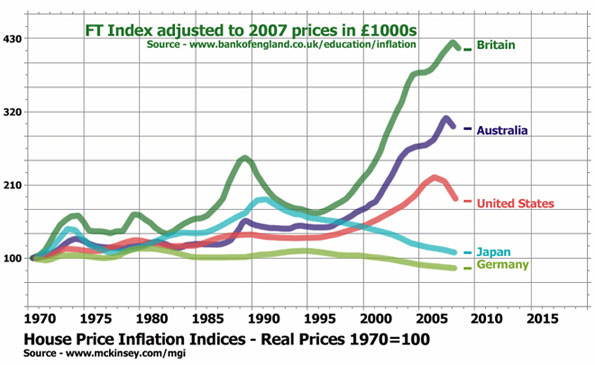
    This true fundamental problem is particularly evident here in Britain, the leader in house price inflation and housing financial bubbles since the 1970s. In their recent report Global capital markets, the McKinsey Global Institute has confirmed what has been shown in recent Demographia surveys.

    The root of this problem lies with an elite agenda that is highly ideological. The ideology at work is environmentalism, making a moral virtue of the retreat of political and commercial elites from the industrial production of housing.
    The preference is for interest payments on a fund of mortgage debt rather than the effort of turning a profit from development, let alone construction. Professionals like estate agents, planners, architects, and bankers are certainly in collusion with that elite ideology.

    That is not to say there is a conspiracy to plan a housing bubble. That is too crude. There is clearly regulation and legislation. On 24 November 2009 the Housing Minister John Healey confirmed that Britain will be the first country in the world to require zero carbon homes as a matter of law from 2016. Britain is the world leader in green ideology.

    John Healey
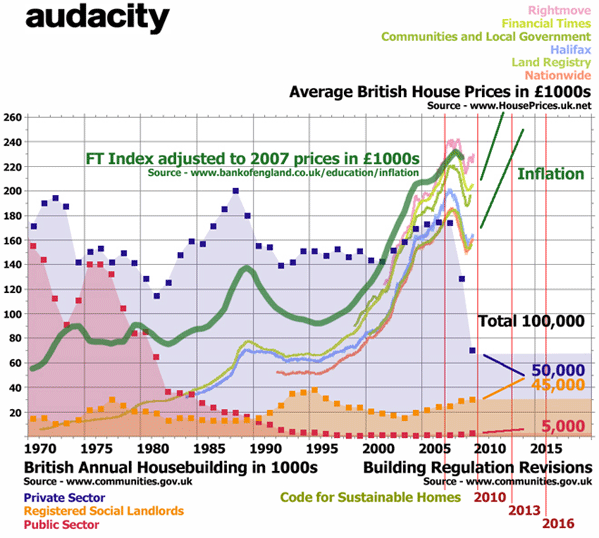
    All of the newly built British housing will have much better insulated walls, windows, roofs and floors. The clear aim of the government is to keep reducing the energy consumption of all new homes to be measured in kilowatt-hours per square metre of floor area per year. New Labour hope to make it law that total energy consumption is no more than 46 kWh/m2/year for semi-detached and detached homes, and then no more than 39 kWh/m2/year for all other homes. The energy efficiency standards will be applied from 2016, subject to yet another consultation on the Code for Sustainable Homes, announced at the end of 2006, and technically published for use on a voluntary basis in 2007. The building regulations get revised in 2010, 2013, and 2016 leading to this legal requirement for maximum energy consumption in all new homes.
    Healey says that “zero carbon” is a concept that will apply to a new home at the “point of build”. ‘We are not going to regulate through this policy how occupants live in them,’ he says. However the Code for Sustainable Homes assumes patterns of behaviour. Environmentalists within and without government will argue that behaviour needs to change. They will be suggesting all sorts of intrusions into daily life.

    British environmentalism couldn’t be more ideological, and more of a barrier to the production of affordable housing. The planning system has been “greened”. The mood is against development, and planning approvals for new land for new housing are hard to obtain. The zero carbon requirement will only apply to around the 100,000 new homes that will be built annually, while the existing stock is around 26 million homes. Healey is also going to regulate existing housing, and is not just looking at the residential sector.

    I am sure politicians like Healey don’t want their pursuit of “zero carbon” buildings to mean that fewer buildings are built. I am sure there are some environmentalists who will be pleased that building activity is in decline. The logic of green thinking entails that the most energy efficient thing to do is not to build more buildings at all.

    It is green not to build new homes to meet demographic demand. Let people modify their behaviour, say the environmentalists, and live together in as much of the existing stock as can be refurbished. It also happens that the existing stock is highly mortgaged, and the vast majority doesn’t want their homes to fall in value. An indefinite policy of green refurbishment of the homes that already exist and a future of house price inflation are highly compatible. That suits the mortgage lenders and the government. The commitment to “zero carbon” allows government to appear virtuous in its legislation for the new build sector.

    This suits the financial markets as well, since it guarantees house price inflation by making it difficult to meet the demographic demand for homes. Environmentalism offers more and more reasons not to build. Green thinking ensures that house price inflation can be sustained through a bubble, and projected beyond the bursting of that period of financialisation into the next.

    As capitalism ”greens” itself, capitalists continue to profit, while not meeting the fundamental demands of the people for housing. But simply restoring “the free market” will not solve the problem. In an old industrial country like Britain, there are ever more people who don’t earn enough to buy a home even at the “affordable” price of two and a half times their gross annual household income, which is the Demographia measure of affordability.

    This reality has a great appeal to what Robert Bruegmann refers to as “the incumbents club” – established homeowners, increasingly older, and those with inherited money. That majority want homes to be an appreciating asset, not a depreciating utility, like a pair of trousers, or a car. They want their home to appreciate in value, and they want to be green. Most people want to be greener and better off.

    Being anti-development for green reasons allows the incumbents to preserve their wealth, while making mundane opposition to new house building, or the attempt to constrain “sprawl”, seem virtuous. People don’t wake up thinking that they will inflate the value of their home by resisting sprawl in principle. Instead they oppose new development in the mistaken belief that Climate Change is caused by sprawling development. It is common for people to think that sprawl is bad for the planet, even while living, mostly with a mistaken sense of guilt, in the sprawl.

    By hoping for a “free market” solution to the problem of unaffordability, Hugh Pavletich of Demographia assumes that it is politicians, businessmen, and professionals who have distorted the market for reasons of narrow and immediate self-interest. Yet that is not how people think: they believe their environmentalism is morally above self-interest. They are saving the planet in their minds by blocking new building, and by their opposition to sprawl. The incumbents’ club members can feel virtuous at little cost to themselves and don’t worry too much about house price inflation. Of course there is no actual Club. There is no conspiracy. Homeowners simply share a self-interest in raising the value of their home, and tend to also want to show how selflessly green they are.

    This all has had the effect of making the lending of mortgages on inflated land values a much larger business than the construction of homes. No-one planned to cause a sequence of bubbles, but Britain’s desperate social dependence on sustained house price inflation can’t be brought to an end easily.

    The only way to stop national or regional housing bubbles recurring is the establishment of the freedom for everyone to build a home on cheap agricultural land without any government or professional hindrance except in matters of technical building regulations. Fire should not spread, and buildings should not fall down. But even building regulations can become ideological rather than technical. The British building regulations, as Healey has made clear, will also push energy efficiency standards to illogical extremes of peak performance in an attempt to address Climate Change. Even while the supply of new homes reduces

    The political freedom to build wouldn’t be a “free market” because not everyone is able to raise the finance to buy cheap land and pay for construction. The idea of a “free market” is a long running ideological myth. But the universal freedom to build would mean people are free to attempt to raise the finance to buy land and build.

    More importantly, the freedom to build would undermine the financialisation of the housing market. If everyone was free to build on cheap land the incumbents’ club would have to compare the value of their existing home to the cost of building a new one. Mortgage lenders would not be able to lend over the cost of construction unless they felt secure in doing so. The security of the 1947 Town and Country Planning Act would be removed for financiers. Government, the finance system, planners, or the incumbents’ club will be ideologically opposed to that for a host of environmental reasons. Britains mostly want to be greener but with renewed house price inflation, while no-one wants to make an argument explicitly for un-affordability. This may be confused and deluded, but it is an ideology promoted by the British government.

    However, ideas can be challenged and changed. One step is to understand that there is no “free market” housing solution. Getting rid of the 1947 denial of the freedom to build doesn’t mean an end to planning. Homes will still need to be planned, just as they were before 1947. But planners will not have the power to stop people from building. There is a need to politically end the environmentalist denial of the freedom to build in an industrial democracy. With a population free to build the finance system would be more interested in cheapening new construction on lower cost land, and not preoccupied with securing the financialisation of periodic but persistent house price inflation. A freedom to build is very much not a right to a home. It is a freedom from the obstructions of planners, with the weight of government legislation behind them. A freedom that is denied to protect the environment, a denial that sustains house price inflation.

    The market is not capable of being a “free market”. Capitalism is a system of control by political and commercial elites, and their professional employees. British capitalists tend to be less interested in industry, which is held to have caused Climate Change, and more interested in finance these days. What is precisely missing in the face of the morally selfless capitalist ideology of environmentalism is an ideology in favour of raising the productive capacity of the construction industry based on a universal sense of immediate and material self-interest. Getting rid of the 1947 planning legislation is a limited attempt to reconnect house building with the cost of construction and household incomes by removing the means by which house price inflation is sustained. Homes would be more of a utility than an investment in Britain, and we would cease to be world leaders in housing based financial bubbles.

    To do that requires us to oppose those who would be world leaders in the environmental ideology that industrial production is a problem for the planet. In Britain we need to set people free to build housing to the best of their abilities within a capitalist planning system stripped of the legal powers it gained in 1947. Innovative in their day, British planning now only sustains housing bubbles and restricts people’s opportunity for decent housing.

    Ian Abley, Project Manager for audacity, an experienced site Architect, and a Research Engineer at the Centre for Innovative and Collaborative Engineering, Loughborough University. He is co-author of Why is construction so backward? (2004) and co-editor of Manmade Modular Megastructures. (2006) He is planning 250 new British towns.

  • Fighting Spirit Lives On In Northern Montana

    On a hot July day in 1923 northern Montana served as the unlikely backdrop for a boxing extravaganza on the international stage. There on the plains right outside the City of Shelby, Jack Dempsey defended his World Heavyweight Boxing Championship against the hard-hitting Tommy Gibbons – the only world championship fight that Jack Dempsey ever fought that went the full fifteen rounds.

    The fight began as a real-estate stunt and a chance to get the recently oil-rich town’s name into the national media. As recounted in a 2004 Chicago Tribune story “The prestige and attention brought by a world-class sporting event could bring more money — perhaps even new residents and investment — into the community, or so thought town leaders at the time. Boomtown mentality had taken over.”

    Local boosters lauded the bustling town near the Canadian border as the Tulsa of the West and built a 40,208-seat stadium to host the match – the biggest outdoor arena in America at the time.

    But there on Champions Field the “gladiatorial battle” between Dempsey and Gibbons was fought amidst ticketing problems reminiscent of the modern day Woodstock Festival.

    Reports throughout the last days leading up to the fight cast doubt on the event. And even though Jack Dempsey stepped in to assure organizers that a bout would take place, the damage had been done. Rail services had been cancelled for special trains, advance reservations cancelled and fight fans stayed home. In the end, only 7,702 paying fans showed up. An estimated 13,000 people got to see the fight free.

    Today a local group of dedicated citizens are working hard to build a park on the original fight sight with a full size ring holding life size bronzes of Jack Dempsey, Tommy Gibbons and the referee. Kiosks throughout the park will depict pictures and audio highlights recounting fight events as well as feature the history of northern Montana homesteading, the oil and gas industry and the railroad.

    The fighting spirit lives on in other ways in Northern Montana as four-term Mayor Larry Bonderud (Shelby, Montana) and other civic leaders step into the ring of economic development on a daily basis.

    Shelby, the County seat of Toole County, is a small community that thinks and acts big. Led by Mayor Bonderud and supported by a strong cast of local and regional civic and business leaders, the city has set in play a diverse, aggressive and successful approach to economic development focusing on attracting young families by bringing new businesses, industries and family wage jobs to the community. This approach is paying off, with the city realizing a 6.31 percent population increase since 2000.

    Capitalizing on long-term vision and an entrepreneurial approach to economic development, Shelby has been successful in attracting and growing business and employment opportunities within the city and county. Going back ten years, in an effort to grow job opportunities in the region, the city worked to attract a private adult correctional center near the city. Fast forward to today, the Crossroads Correctional Facility is the top private employer within the county with over 150 employees.

    Always the promoter, Bonderud suggests that “We’re one of the safest counties anywhere,” noting some 230 correction officers, Border Patrol agents, local police and regional FBI and Montana Highway Patrol officers who work in the county with 5,100 residents.

    The community continues to work on growing its industrial base by expanding its industrial park, capitalizing on its growing wind energy developments and a concerted development effort to put together an innovative 25 million dollar intermodal facility and energy park that capitalizes on existing rail capacity, access to energy and a location adjacent to the Canadian border. The city, county and regional port authority are working and investing together to make this opportunity a reality.

    Working together seems to come naturally in these parts. Shelby and Toole County are part of the 5-county Sweetgrass Development region (Cascade, Glacier, Pondera, Teton and Toole counties) that is working collaboratively to diversify and grow the regional economy and capitalize on its competitive advantages. Nestled together adjacent to the I-15 corridor and along the Rocky Mountain front, the five county region is well positioned to meet growing needs for domestic energy consumption in the western United States. The region’s renewable energy sources including wind and hydro-electric based power, and its significant agricultural capacity (the backbone of the regional economy) have served as a buffer in the recent economic downturn.

    The Sweetgrass Development organization is spearheaded by Cascade County Commissioner Joe Briggs, an affable and effective leader who along with regional partners Corlene Martin, Cynthia Johnson, Cheryl Currie, Bill McCauley, Brett Doney and Mayor Bonderud are working to set aside parochial power plays and find economic development solutions that work for the region. A common refrain is “what is good for one is good for all”. This team spirit is exemplified by regional efforts to retain and expand value-added agriculture opportunities including milling operations and packing plants and assistance in growing the regional capacity for wind energy development and transmission.

    The region is not driven by wind and wheat alone. The area’s numerous high-tech, knowledge-based industries such as D.A. Davidson (financial consultants), Centene (healthcare services), AvMax (aviation support and management services), Intercontinental Truck Body (truck body manufacturing) exemplify the knowledge base and work ethic inherent in the region and speak of the natural appeal of the Sweetgrass region as one component in the race to attract and retain a quality work force.

    A combination of “can do” spirit and strategic investments to support growing local companies and new infrastructure to feed new industries fitting with the region’s strengths place the Shelby, MT region in a strong position to beat the recession.

    Doug McDonald is a Senior Associate with , a development firm specializing in economic development strategies and initiatives for small to medium-sized metropolitan areas and urbanizing rural regions. Delore Zimmerman is president and CEO of Praxis Strategy Group and publisher of Newgeography.com

    Photo by jimmywayne

  • Growing Today’s Green Jobs Requires Solid Economic Development Policy

    I was hired for my first Green Job, thirty-four years ago, shoveling horse stalls for a barn full of Tennessee Walking Horses. The droppings and bedding that was removed from the stables was then composted and applied to my employer’s crops in lieu of chemical fertilizers. You don’t get much greener than that!

    Now don’t get me wrong, I am not bragging about holding such a lucrative job because the 75 cents an hour they paid me made this Ozark, Missouri boy feel rich. Actually, I am bragging that I learned the value of environmental stewardship and the interdependence of our economy at an early age. For our community, no horses meant no corn.

    My employer, a local auto dealer who owned the farm, created these value-added “green jobs” without any subsidy from the government or without a governmental policy forcing his customers to pay him a subsidy. But I guess that is the good old days. So much for market forces and producing a product that customers will pay for.

    I have spent more than 25 years in the profession of economic development serving at the community and state levels. I have worked with hundreds of companies to create tens of thousands of jobs. In that time, I have seen more “silver bullets” than the Lone Ranger ever gave away. These have included the following “you must have” edicts: four lanes/interstate highway; a new airport terminal; micro chips; nanotechnology; aqua culture; speculative buildings; a Super Bowl; a bohemian bastion; or a biotech cluster. Now, it’s environmentally friendly “green” businesses like wind farms and solar fields that are calling for precious public resources.

    Yet in reality, these silver bullets usually work only for a few places and certainly do not constitute a national strategy for job creation. Some places may benefit from the rush to wind and solar energy, although the benefits may well diminish if the panels or turbines are made elsewhere. There are not too many industries that have such a large profit margin that they can afford to pay double or triple their existing electric rates.

    In fact, the answer to job creation is definitely not financially supported and government-mandated green energy policy that focuses its efforts on wind and sun. The reasons why that policy won’t work include:

    1. A quick review of a recent issue of a national economic development trade publication featured ads by 32 states that claim to be the next green energy place, although they only focus on wind and solar. Maybe it is because the public is being coerced into subsidizing these industries. But at the end of the day there will NOT be 32 places nationwide that are green energy centers of excellence, but more likely a dozen or so globally.
    2. Most of these green initiatives rely on nature. Nature is not constant – that is what makes it “natural.” Wind may be a suitable form of power off the ocean on Monday, Tuesday and Wednesday evenings but what happens when it quits blowing? Not only are the resources stranded and not providing a return on investment but no power is being generated.
      Now don’t get me wrong, wind power has worked for years. Farmers have been using it to fill up water tanks for their animals for hundreds of years. But as all farmers know, if the wind quits for long enough, the animals die. Are we to bet our economies and our lives on the hope that maybe someone can develop a storage tank for electricity generated by the wind even if it quits?

    3. Solar power is great. But let’s be realistic. How are we ever going to get solar panels on the roof of every home – at a cost of $60,000 or more – in America when some people don’t even have cable television or broadband access yet? And what about the heat radiated from the panels themselves? And, solar power still has the same storage and reliability issues that come with wind power.

    Let’s be clear that here are two very clear outcomes we, as a nation, must strive to achieve: low cost, environmentally sensitive energy independence and job creation. These are not mutually exclusive goals.

    Energy independence will never come from wind and solar power; neither is dependable or manageable enough to meet our needs. Compound this with artificially mandated requirements and the hidden taxes that go with them and we are facing higher energy prices which will cripple the economy.

    When it comes to jobs, we must embrace the age-old adage: Be yourself but be great. We call this model Community Capitalism. In short, Community Capitalism is focused and organized philanthropy and business investment occurring simultaneously in five strategic areas based upon historical and geographical advantages in order to create jobs and wealth.

    I am blessed to live in a place, Kalamazoo, Michigan, that has embraced the fundamentals of Community Capitalism for more than 100 years. Kalamazoo is the place where the friable pill, a pill easily dissolved when ingested, was invented; where Dr. Homer Stryker invented the oscillating device that cuts casts off; where the yellow-checkered cab was invented; where most of the nation’s corsets and paper were once produced, and home of the Kalamazoo sled, the direct-to-you-from Kalamazoo Stove, Shakespeare Rod & Reel and Gibson Guitars.

    So what are we great at? We are one of only a few places globally where a drug can move from concept through trials to market. We are centrally located, a short drive to the logistical hub of Chicago. We can staff a call center or customer care center with the speed of light. We will leave the micro chips to Boise, the film industry to Hollywood, the Country music business to Nashville, the financial district to Manhattan; and telecommunications to Dallas. Not to say we won’t welcome a few of their companies. But they are great at those things; we will be good at best.

    So how do we create jobs using the five precepts of Community Capitalism: place, capital, infrastructure, talent and education? The same way communities have grown for hundreds of years.

    First is the concept of place. Great economic regions know who they are and that sense of identity ensures people are not only comfortable within the environment but can nurture their personal and professional growth. Think about places that do this really well and where place has become their brand – like Boise, Idaho; Austin, Texas; Melbourne, Australia and Gorongosa in Africa.

    Capital is critical to spur innovation and entrepreneurship. In the case of Kalamazoo, we established in 2005 a limited partnership venture fund to invest in early-stage life science companies. The $100 million Southwest Michigan First Life Science Fund is believed to be the largest sum of community-based private capital ever to be raised and managed by an economic development organization. Other communities have focused on angel networks, revolving loan funds or even micro lending. But whatever the source, we know that companies cannot grow without the capital to grow a business.

    Great communities understand that great minds need the right place to make things happen and are committed to providing the necessary infrastructure. For example, when we saw the need to create a place for local talent to incubate biotech concepts, we created a 69,000-square-foot accelerator to do just that. This same catalyst served the Palm Beach, Florida region’s desire to grow life science research when Scripps Research Institute decided to locate there and mix its DNA with the local biotech economy. It also worked for Corpus Christi, Texas when the Harte Research Institute was built to chart the future of the Gulf of Mexico.

    Communities cannot be great if they lack a long-term, funded commitment to education and academic excellence. Our legacy in life science and manufacturing prominence has resulted in an indigenous cluster of highly educated people. And we realize that educated people seek out strong education for their families which in turn produces a high-performance workforce.

    We are home to the world-renowned Kalamazoo Promise college scholarship program which provides free scholarships to every child that graduates from the Kalamazoo Public school system. In fact, Southwest Michigan’s diversified workforce is highly educated and boasts one of the nation’s highest concentrations of Ph.D.’s (1.84%), more than two times the national average per capita (0.81 %).

    Other economic regions have used “education” to make a difference. For example, the African Children’s Choir uses its funds to build schools, provide medical care and fund community development projects in the villages from which its young members come from. Oprah Winfrey’s Leadership Academy for Girls in South Africa looks to instill change for young girls in a place where almost a third of all pregnant women are afflicted with HIV.

    Finally, we recognize that a community needs to embrace talent. Kalamazoo is home to the Stryker Corporation, which is the only publicly traded company to achieve double-digit growth every year over a twenty-year period due to its commitment to putting the right people in the right place at the right time.

    I understand that none of these five things is as easy as the Lone Ranger’s silver bullet. It is much harder to raise capital to grow companies than it is to get your congressman to earmark dollars for highways or build a speculative building in a corn field. But if we are to truly build a sustainable economy that grows jobs and wealth, we must invest in Community Capitalism while limiting artificial governmental manipulations of the economy.

    Ron Kitchens serves as the Chief Executive Officer of Southwest Michigan First, as well as the General Partner of the Southwest Michigan First Life Science Fund. Ron has worked with more than 200 Fortune 500 corporations as a Certified Economic Developer in addition to starting multiple privately held companies and serving as a city administrator, elected official and staff member to United States Senator John Danforth.

  • When Granny Comes Marching Home Again… Multi-Generational Housing

    During the first ten days of October 2008, the Dow Jones dropped 2,399.47 points, losing 22.11% of its value and trillions of investor equity. The Federal Government pushed a $700 billion bail-out through Congress to rescue the beleaguered financial institutions. The collapse of the financial system in the fall of 2008 was likened to an earthquake. In reality, what happened was more like a shift of tectonic plates.

    *******************************************

    The driveway tells the story. The traditional two-story 2,200 square foot suburban home has a two-car attached garage. Today’s multi-generational families fill the garage, the driveway and often also occupy the curb in front of the home. The economic crisis that is transforming America is also changing the way we live. The outcome will change the way America views its housing needs for the balance of the 21st Century.

    As is often the case, we can more clearly see the future by looking into our past. That is because time and time again America has reverted to its roots when confronted with a challenge. The root of the American family is the home. A century ago, America was an agrarian nation. Most Americans grew up on the farm or in a small town often tied to agriculture. A century ago, our census was 92,000,000, less than one-third of today’s population. Los Angeles was a city of 319,000. Cleveland was the fifth largest city with 560,000. The tenth largest city in 1910 was Buffalo NY with 423,000 souls.

    A century ago, parents, children, grown children, and grandparents lived together in America’s homes. In 1910, the vast majority of kids did not go off to college. They stayed home and worked the farm. Mom certainly did not drive and usually she did not work outside the home. Grandma – who then as now usually outlived grandpa – did not go off to an active senior housing project or nursing home at age 55. With the average life expectancy at just 49 years, there was little market for such facilities. A young Grandma lived in the family home and helped with the cooking, the sewing and the child rearing.

    Along the way, we fought in two world wars, America industrialized and the great Middle Class exploded. Our children went off to college and did not return. Our cities exploded. By the end of the century, Los Angeles grew to 3,700,000. The tenth largest city was Detroit with 1,000,000. Children were expected to leave the home shortly after high school and never come back, except to visit.

    Big changes occurred on the other end of the demographic curve. As life expectancy grew to 75. Grandma had her choice of active senior living, congregate care or a skilled nursing facility when she hit 70 and slowed down.

    The expectations of greater family dispersion – with young people leaving home early and grandparents on their own – drove much of real estate thinking at the end of the 20th Century. With empty-nesters and young people both heading back to the city, urban planners were focusing on high-rise apartments and condominiums in dense urban areas. Many eagerly anticipated the death of the suburbs since the number of young families declined. Across the country, and even in suburban areas like the City of Irvine, CA brilliant urban planners began rezoning industrial land into high density housing. The face of America was thought to be changing in predictable ways.

    Then, along came 2008 and the economic crisis. The plates under our feet began to shift. The mass migration to dense urban living evaporated as people stayed put and speculating in condos lost all economic logic. The shiny new urban corridor in Irvine now lined with high rise housing sits empty, with many units vacant and foreclosed. In nearby Santa Ana, twin 25-story residential towers sit eerily vacant with not a single unit sold or occupied. Central Park, a giant new urban project in Irvine that boasted dense high-rise, townhouse and mid-rise units, sits vacant behind green security fences.

    Where did the buyers go? Many young people moved back home with their parents when their high paying jobs in real estate or mortgage brokerage disappeared. With their jobs and income gone, they sought refuge in the safety of their childhood homes. Their parents ended any speculation of selling and down-sizing when their children returned. With job creation non-existent, they do not plan on leaving anytime soon. In one recent Pew study, 13 percent of parents with grown children reported one of their adult offspring had moved back home in the past year. Roughly half of the population 18 to 24 still lives with their parents.

    This stay-at-home trend predates even the recession. According to the U.S. Census Bureau, the national relocation rate in 2008 was the lowest since the agency started tracking the data in 1948. The rate was 11.9 percent in 2008, a decline from 13.2 percent in 2007. The 2008 figure represents 35.2 million people, which is the smallest number of residents to move since 1962. The number was 38.7 million in 2007.

    What about Grandma and, increasingly, even Grandpa? Our parents, thanks to the miracle of modern medicine, are living longer than ever. If she has reached age 65, she can expect to live another 20 years. Unfortunately, her retirement account and savings plan may not. Many Americans are living well into their 90s and we will see the first wave of centurions in our lifetime. No one expected this to happen and we are unprepared for it. Grandma will not be able to afford the $3,000 to $4,000 a month expense of a quality retirement facility – for 20 years.

    This changing dynamic will alter movement of Americans, which has now been slowing down for a generation. In 1970, nearly 20 percent of Americans changed their place of residence every year. But by 2004, that figure had dropped to 14 percent, the lowest level since 1950. The tough economy and aging demographics will slow migration down even more. Mom and Dad will not find it easy to take that new position in another city with the kids at home and now Grandma, and even Grandpa, too.

    This will have profound impact on the kind of housing Americans will want. Homebuilders may find lower demand for single family houses as America doubles up but it will be the much ballyhooed drive to urbanize America with dense high-rise units that is most in danger.

    Extended families will want larger – not smaller – houses. They may not be able to afford McMansions, but conventional suburban houses will be changed to meet the demands of extended families. Granny flats, consisting of self contained ground floor units, will be in demand as the baby boomer generation moves into retirement. Smaller single floor homes called Casitas will need to be mixed into planned developments so that the Grandparents can live closer to the children.

    City staff and urban planners, already grappling with a mandate to accommodate global warming and carbon footprints, will have to rethink existing zoning rules which have not yet responded to the new reality. This reality will be driven by aging demographics, diminished capital and the shifting plates of our economy. The baby boomer “bubble” that is now beginning to retire is a well established fact. Lesser known is the impact of the financial crisis on young workers who simply have been priced out of the housing market. Along the pricier coasts and Northeastern cities, they will need the down payment from their parents – who in exchange will live with their kids – to purchase their own home.

    The kids have already come home. Like the financial downturn, they will not be leaving anytime soon. Grandma is next in line. When she comes home, the circle will be complete, with consequences few in the real estate industry have yet to contemplate seriously.

    **********************************
    This is the sixth in a series on The Changing Landscape of America. Future articles will discuss real estate, politics, and other aspects of our economy and our society.

    Robert J. Cristiano PhD is a successful real estate developer and the Real Estate Professional in Residence at Chapman University in Orange, CA.

    PART ONE – THE AUTOMOBILE INDUSTRY (May 2009)
    PART TWO – THE HOME BUILDING INDUSTRY (June 2009)
    PART THREE – THE ENERGY INDUSTRY (July 2009)
    PART FOUR – THE ROLLER COASTER RECESSION (September 2009)
    PART FIVE – THE STATE OF COMMERCIAL REAL ESTATE (October 2009)

  • So Much for Evidence-Based Planning

    Has evidence-based planning fallen from grace in favour of catchy slogans and untested assumptions? In the case of urban planning, arguably that is just what’s happened. The evidence, in Australia at least, is worrying.

    “We must get people out of cars and onto public transport.” “We must stop urban sprawl and the consumption of valuable land.” “We must build higher density communities to achieve sustainable environmental outcomes.” Phrases like this are now de rigueur across many discussions about urban planning in the media, in politics and in regulatory circles in Australia. They are rarely challenged on the basis of what the actual social, economic or scientific evidence is really saying. It’s produced an Animal Farm like dogma: ‘Four legs good, two legs bad.’ Or ‘Napoleon is always right.’ Denial, followed by ‘pass the buck’ and ultimately ‘shoot the messenger’ are responses to legitimate questions.

    But given the far reaching social and economic changes which will invariably flow from some of the regulatory planning schemes now being legislated, we should at least ask whether the various policies will actually achieve their stated goals. After all, these regulatory planning schemes are intended to govern our urban growth over the next 20 years. It would be a shame to get it badly wrong, simply because assumptions weren’t tested.

    The rise of the big plan

    Since the late 1990s, there has been a raft of Australian regional planning schemes dealing with urban growth in our major centres. The common theme has been the creation of urban growth boundaries and increased density in established urban areas, with an emphasis on public transport as opposed to the private vehicle.

    Typical of these schemes is the recently released ‘South East Queensland Regional Plan 2009-2031’ (SEQRP) which aims to ‘manage growth and protect the region’s lifestyle and environment.’ The plan, like others of its type, is influenced by a desire to contain urban growth and implicitly assumes that we are at risk of reckless growth if we don’t. But Australia’s total population is currently around 24 million people, in a land mass roughly the size of continental USA. This puts us below Nepal and Uzbekistan but ahead of Madagascar in population rankings. Reports that Australia’s population may reach 35 million in another 40 years (the current population of Canada) have raised domestic fears that we might become over populated. (See my blog post ‘Australia Explodes’ for more on this).

    The State of Queensland is the second largest state by area, but contains only 4.4 million people in total. Its population growth rates have in the past been amongst the highest of any region in Australia, growing at up to 1500 people per week (close to 80,000 per annum). Much of this growth has occurred in the south east corner of the state, surrounding the capital city – Brisbane. While modest by global standards, this rate of growth has thrown governments and some sections of the community into apoplexy. How will we ever cope? The region of southeast Queensland (population 3 million) has even been compared to California (population 38 million) in terms of its growth rates and population pressures.

    Against this context, the SEQRP identifies the need to provide a further 750,000 dwellings in the period to 2031, with roughly 50% to be developed in established urban areas via infill, and the balance through new detached housing development on land within an urban growth boundary. The challenge for infill is greater in Brisbane, where 138,000 new dwellings are expected to be developed in established urban areas, especially around transit centres (typically rail).

    One of the many assumptions that underpin the core strategy of the SEQRP have to do with
    the risk of sprawl. This suggests that modest and manageable growth rates of 1500 people per week are somehow tipping the big end of the global scale. The region’s current population of 3 million shows obvious signs of urban expansion as a result of growth to date, yet, with some notable exceptions in recent years, infrastructure has generally kept pace with the growth. Even at the urban fringe, new housing development has been at higher rates of dwelling density than in years past (lot sizes are shrinking).

    There is also an assumption that we are running out of land. But South east Queensland has vast tracts of land suitable for urban expansion and has several established regional centres readily capable of servicing new expansion with infrastructure and town centres already in place and capable of upscaling. The urban growth boundary imposed by the SEQRP is approximately 300 kilometres in length as it curtains the urban area. An expansion of this boundary by as little as a kilometer (under a mile) would create a notional land supply suitable for an additional 500,000 detached homes at 15 to the hectare (or six to the acre).

    Behind the plan lies an accepted wisdom that demand for ‘the quarter acre block’ is driving excessive expansion. The evidence, however, suggests this is now ancient history: lot sizes have not been anywhere near a quarter acre since the 1960s. The typical lot size now is 400 square metres, or around one tenth of an acre, hardly an irresponsible over-consumption of land for housing.

    It is also assumed that all this growth imperils quality farm land. This assumption can only come from those with a vague understanding of farming practices. In the south east corner of Queensland, typically two types of land have been conserved for this reason. The first is land devoted to growing sugar cane which is no longer economically efficient. This agriculture produces a biodiversity desert and is far better suited to the more tropical north.

    The second type of land conserved under this rationale is land historically devoted to cattle grazing. This was always marginal grazing land in the main – dry, shallow soils that struggle to hold moisture or grow pasture. As technology improved and transport economics developed, more efficient grazing country has been opened up further from city markets. But as farmers are prevented from selling their land for housing, despite its logical location for that purpose, herds of bony cattle continue to roam the urban fringes of the metropolis.

    This assumption also seems to hold dear the notion that, for sustainability reasons, regions should source their food needs from within a nearby catchment, minimizing transport costs. Were this true, Queenslanders would not enjoy apples (grown in southern temperate zones) and neither would Tasmanians (our cool climate southern state residents) ever enjoy bananas (two thirds of Australia’s crop of which are grown in Queensland). It would also mean our agricultural industries, which rely heavily on export, would fail.

    The cost of infrastructure provision is a subject that preoccupies governments in growth regions. Perhaps for this reason, the suggestion that infrastructure is more economically deployed in established urban areas, as opposed to newly provided in outer growth areas, found much support in treasury corridors. However, the evidence suggests otherwise: established urban areas‘ essential services (electricity, water, sewerage, stormwater) are ageing and incapable of serving significantly higher demand loads. The replacement and upgrade cost of retrofitting these services is demonstrably higher than the cost of installing new services in new growth areas.

    It is also assumed outer suburban growth will mean worsening urban congestion. Yet relatively few residents of new outer suburban growth areas are employed in inner city areas: according to the Census and other official government data, most jobs are in suburban locations – 90% of all jobs in fact. The CBD (our downtown) is a high density focus area for many headquarter operations, but at 2 million square metres of office space, it cannot by any stretch of the imagination provide sufficient space for the majority of the region’s workers.

    There is the assumption that infill and higher density will get more people using public transport. Current public transport usage represents under 15% of all trips. With higher density housing in established areas, especially in and around transit nodes (TODs), that figure could theoretically increase. But even the most heroic of assumptions would put the future rate at little more than 30%. Meaning 70% of new residents will still be auto dependent. There is also an unanswered question on the capacity of existing rail and bus services to cope with additional demand (frequent reports mention chronic overcrowding) combined with the high level of public transit subsidies per passenger, which will somehow have to be funded.

    Finally, it’s assumed that high density housing is more ‘sustainable.’ But according to several Australian University studies, unit and townhouse dwellings actually consume more energy than equivalent detached dwellings. Common area lighting, lifts, clothes driers and airconditioning are all more commonplace in high density dwellings than detached (where natural light, cross flow ventilation and solar power for drying clothes are the norm). Factor in the higher number of persons per dwelling in detached housing, and the per person energy consumption of inner city, high density housing looks ordinary. No less an authority than the Australian Conservation Foundation actually proved this in their Consumption Atlas which revealed that inner city high density residents had much larger carbon footprints than their suburban cousins.

    On balance, many of the assumptions that underpin the central strategic intent of regulatory planning schemes such as The South East Queensland Regional Plan, just don’t stand the test of evidence. Indeed in many cases, the evidence suggests the opposite of what is assumed. But evidence, it seems, is out of favour and slogans are in.

    Four legs good, two legs bad. Napoleon is always right. Why consult the facts when the mantra will do?

    About the author: Ross Elliott has 20 years experience in the property and development field, including stints in research, advocacy and urban economics. He writes an occasional blog, which you can find here and works as a consultant in marketing, strategy and business development, specializing in the property sector.

  • Bangor or Bust: Navigating To Thanksgiving At Grandma’s

    Everything that is the matter with America’s transportation and energy policies can be understood by attempting to travel with a family from New York City to Bangor, Maine.

    I use Bangor for my example — although places like Louisville, Columbus, Lynchburg, and Wheeling would work just as well because — for better and for worse — I, (a New Yorker) married into a Maine family in the early 1980s. For the last twenty-five years I have devoted countless waking hours to plotting connections to family reunions, as I have once again done for this Thanksgiving.

    For a brief period in the 1980s, People Express flew from Newark to Portland, and for less than $50 my wife and I could fly there in an hour, and then cajole a relative to drive us the rest of the way. You paid for the ticket on board by handing the stewardess a wad of small bills.

    Since that happy interlude, Bangor has remained as inaccessible as parts of Albania, a place of stark beauty, served only by the automobile, a few buses, and expensive planes. From New York, the journey involves a nine-hour drive (without stops), a bus odyssey, or a bank-busting flight. With children in tow (and we have four), Bangor is best understood as a luxury destination, at least as far as the cost of admission is concerned.

    Herewith are the unhappy options to take a family of six from New York City to Bangor for five days during the Thanksgiving holiday:

    It’s Better On The Train (sort of): Not since Amtrak was conjured from bankrupt railways in 1971 has there been direct rail service from New York to Maine, a popular tourist destination. (It still has that super-sized statue of Paul Bunyon holding a huge axe, even though Bunyon was from Bear Lake, Michigan. I guess he couldn’t get home.)

    For most of Amtrak’s history, there were no trains at all in Maine. In 2001, thanks to state subsidies in Massachusetts and Maine, service was started between Boston’s North Station and what is called the Portland Transportation Center (read: “huge parking lot that is a long way from downtown”).

    To get from New York to Portland, however, means first a train to South Station in Boston, and then a cross-town taxi to North Station for the connection to Portland, which is, alas, 166 miles from Bangor. The one-way fare on the Wednesday before Thanksgiving, for a family of six, is $775. The trip starts at 8:30 AM and ends in Portland at 4:10 PM.

    The fare is the same for the return journey on the Sunday after Thanksgiving, and then the cost of renting a car, for five days in Maine, is about $80 a day. But here’s another catch: There are no car rental companies that I can find that have locations at the Transportation Center. So throw in a cab ride to Portland’s Jetport, add about an hour to the trip, and figure you will get to Bangor at 7:30 PM in time to miss dinner (which in Maine is earlier than in New York City).

    Total cost of the journey, without the tolls: $1,940. One reason Amtrak’s fares are so high is that the company fears being swamped with travelers if it encourages rail travel with family-friendly pricing. Its expensive fares are actually calculated to discourage travelers, as many routes lack sufficient rolling stock for more passengers.

    Go Greyhound, Or At Least Try To Take A Bus: For reasons my father attributes to the failure of Trailways some years ago and monopolistic bus practices (at 90 he worries about these things), there is no direct bus service between New York City and the state of Maine. All the bus trips involve a change at South Station in Boston.

    To get to Maine for Thanksgiving, it would be possible to load the family onto a Bolt Bus, the new low-cost carrier (owned by Greyhound) that connects West 34th Street in New York with Boston. The one-way fare is $22 per person or $132 for all, and Bolt has wifi. It’s a real bus and not the spiritual heir of the Gray Rabbit.

    From Boston, we would switch to Concord Coach Lines (one-way fare for six, $246) and take a 2:15 PM bus that gets to Bangor at 6:30 PM. Total bus fare for the round-trip adventure is $756, and each trip (safe, dependable, reliable, and very cramped) can be done in about ten hours.

    I am not even sure Clark Griswald would take his family to Maine on the bus, although I have done it many times, at least from Boston. Advantages? Concord has movies. Disadvantages? Most star Adam Sandler.

    Fly Me (remember the ad campaign of the racy Braniff Airlines?): There is direct air service from New York City to Bangor on U.S. Airways (well, okay, a turboprop operated by Piedmont Airlines), and it lumbers up the coast in two hours. But for a family of six, the roundtrip airfare is $1,998, although I am sure with advance booking, and changes in Cincinnati, that amount could be shaved to $1,700. Jet Blue ($1,488) does go to Portland, but then you need a $500 car. In winter months, if changing planes in Boston (to save money), expect delays and cancellations, and think about traveling with a sleeping bag.

    Try Less Hard And Rent A Car: Here we get to the essence of America’s mass transportation failures. By far the cheapest way to take a family from New York to Maine is to rent a car. Listings at Enterprise and Budget start around $270 a week for a full-size car. To be sure, there is insurance, those hidden travel taxes, tolls, and gas, so figure the cost of driving to Maine at about $500. Mapquest estimates the journey at 7 hours 33 minutes, as it never gets stuck on Interstate 495 going around Boston or stops at Denny’s.

    So the car is faster, door-to-door, than the train, the bus, and probably a plane (when airport strip searches are factored into the pleasures of traveling). But not calculated into the drive is the odd war in the Middle East, melting ice caps, road accidents, and the effects of listening to AM radio. And who wants to spend two Thanksgiving days “merging left” to “avoid congestion ahead?”

    How Do I Want To Get To Maine? In my mind, the journey should take place on a State of Maine Express (fine, call it the Paul Bunyon), which would miss Boston and track northeast through Hartford, Worcester, Portland, Brunswick, and get to Bangor in about six hours. (Average speed of 72 m.p.h.)

    For the trip, I would reserve, at a reasonable price, places in the restaurant observation car, and we would read and drink good coffee before sitting down for lunch. We would also talk, look out the window, play cards, and dally on our computers.

    Ideally the train would leave Grand Central at 9:40 AM, serve lunch after Worcester (where the fresh fish would be taken on board), and arrive in Bangor at 3:40 PM. Alternatively, we would watch a Broadway show, and then board a sleeper train that would leave Penn Station at 11:30 PM and arrive after the crew had served waffles, eggs, bacon, and coffee for breakfast.

    A Romantic Daydream? Perhaps, at least given America’s atrocious record with mass transportation in the last fifty years. It has killed off most passenger trains, subsidized air travel and then made it miserable, forced travelers into cars for all sorts of journeys, strip-mauled the suburbs, destroyed city neighborhoods with interstate highways, and even eviscerated bus service to many smaller towns. Other than that, it’s the greatest system in the world.

    But here is a list of countries where the journey that I am proposing — to a smaller regional city in an elegant dining car — would not be more complicated than buying tickets down at the station: England, France, Switzerland, Romania, Spain, China, Russia, Germany, Czech Republic, Italy, Hungary, Scotland, and Malaysia. Is not the United States at least as enlightened or wealthy as some of these nations? I know about these possibilities because in recent years I have taken excellent trains — and have eaten well en route — in each and every one of these countries.

    This does not mean that I only agree with Paul Theroux, author of The Great Railway Bazaar, who wrote that “it is better to go first class than to arrive.” But why have a public transportation system that costs a fortune…and goes nowhere?

    Matthew Stevenson was born in New York, but has lived in Switzerland since 1991. He is the author of, among other books, Letters of Transit: Essays on Travel, History, Politics, and Family Life Abroad. His most recent book is An April Across America. In addition to their availability on Amazon, they can be ordered at Odysseus Books, or located toll-free at 1-800-345-6665. He may be contacted at matthewstevenson@sunrise.ch

  • Obama Still Can Save His Presidency

    A good friend of mine, a Democratic mayor here in California, describes the Obama administration as “Moveon.org run by the Chicago machine.” This combination may have been good enough to beat John McCain in 2008, but it is proving a damned poor way to run a country or build a strong, effective political majority. And while the president’s charismatic talent – and the lack of such among his opposition – may keep him in office, it will be largely as a kind of permanent lame duck unable to make any of the transformative changes he promised as a candidate.

    If Obama wants to succeed as president he must grow into something more than movement icon, become more of a national leader. In effect, he needs to hit the reset button. Here are five key changes that Obama can implement to re-energize and save his presidency.

    1. Forget the “Chicago way.” The Windy City is a one-party town with a shrinking middle class and a fully co-opted business elite. The focused democratic centralism of the machine – as the University of Illinois’ Richard Simpson has noted – worked brilliantly in the primaries and even the general election campaign. But it is hardly suited to running a nation that is more culturally and politically diverse.

    The key rule of Chicago politics is delivering the spoils to supporters, and Obama’s stimulus program essentially fills this prescription. The stimulus’s biggest winners are such core backers as public employees, universities and rent-seeking businesses who leverage their access to government largesse, mostly by investing in nominally “green” industries. Roughly half the jobs saved form the ranks of teachers, a highly organized core constituency for the president and a mainstay of the political machine that supports the Democratic Party.

    The other winners: big investment banks and private investment funds. People forget that Obama, even running against a sitting New York senator, emerged as an early favorite among the hedge fund grandees. As The New York Times’ Andrew Sorkin put it back in April, “Mr. Obama might be struggling with the blue-collar vote in Pennsylvania, but he has nailed the hedge fund vote.”

    At best, the president’s policy seems like Karl Rove in reverse, essentially smooching the core and ignoring the rest. This is a formula for more divisiveness, not the advertised “hope” Americans expected last November.

    2. Focus on Real Jobs, Not Favored Constituencies . The Chicago approach works better in a closed political system controlled by a few powerbrokers than in a massive continental economy like the U.S. Health care and education, which depend on government largesse, are surviving. But the critical production side of the economy that generates good blue-collar jobs – like agriculture, manufacturing and construction – is getting the least from the stimulus.

    These industries need more large-scale infrastructure spending, as well as more focused skills training and initiatives to free capital for politically unconnected entrepreneurial businesses. Instead, productive industries face the prospect of more regulation while capital for small businesses continues to dry up.

    Those in post-industrial bastions tied to speculative capital – think Manhattan and the Hamptons – are the ones most benefiting from Obamanomics. College towns like Cambridge, Mass., Madison, Wis., Berkeley, Calif., and Palo Alto, Calif., will also prosper, becoming even richer and more self-important. It seems, then, that Obama has done best for elite graduates of Harvard and Stanford and other members of the “creative class.”

    The rest of America, however, is still waiting for a real sustained recovery. Industrial and office properties remain widely abandoned not only in Detroit but Silicon Valley. The future sustainability of our economy depends mostly on what happens to those who previously staffed these facilities – those who produced actual goods and services – not just on a relative handful of people working at Google or the national laboratories. In other words, we need jobs for machinists, welders and marketers as well as scientists with Ph.D’s.

    3. Step on the Gas. Providence has handed America – and Obama – an enormous gift in the now recoverable deposits of natural gas found across the continent. Proven levels have been soaring and now amount to 90 years’ supply at current demand. More will be found, and across a wide section of the country.

    Natural gas may be a fossil fuel, but it is relatively clean and thus the perfect intermediate solution to our energy problems. The problem: The president’s green advisers will seek to prevent developing these resources.

    Although Obama should support strong environmental controls on gas extraction, the greens should not be allowed to block this unique and historic opportunity to shift economic power back to North America. Along with modest increases in domestic and Canadian oil, natural gas could end our dependence on fossil fuels from outside North America. This would relieve our military from the onerous task of defending other people’s oil supplies. But most important, the new energy sources could expand our industrial and agricultural economies so they can capitalize on the huge potential growth from markets at home and in the developing world.

    The natural gas era could then finance continued research and deployment of renewable fuels. Let’s give it the 10 or 20 years that great transformations require. Quick fixes will lead us to subsidize the purchase of rapidly dated technology from China or Europe; we should aim at the energy equivalent of the moon shot, helping forge a huge technological advantage.

    4. Rediscover America. As a candidate, Obama spoke movingly about his Kansas roots, but lately he seems to have become all big city all the time. This administration offers very little to people who live in places like Kansas, as many of my heartland Democrat friends complain.

    Urbanites often forget that this is an enormous country. Crowded into dense cities themselves, they fail to look down from the window when crossing the country by plane. The vast majority of America is, well, vast – sparsely settled, if settled at all.

    Moreover, Obama’s people need to understand that 80% of America live in suburbs or small towns. They do not want to live in dense cities or realize a move there would mean living in less than idyllic conditions. If Obama wants to shape a green America, he must find ways that work with the majority’s preferences.

    But so far the president’s housing, transport and planning advisers seem to be pushing the death of suburbia and promoting ever more densification. It’s hardly surprising, then, that suburbs and small towns feel left out. After finally starting to inch toward the Democrats, they are now turning again to the right. If Democrats want to retain their majority, they need the strong support of these constituencies – without it the Congressional majority will be gone by the end of the second term, if not the first.

    5. Chuck the Nobel; Embrace Exceptionalism. Many progressives love Obama because they see him as one of them in the struggle with what the immortal Bill Maher calls “a stupid country.” But the president should remind himself that the country may not be quite as dumb as it sometimes looks from Oslo – or from Dupont Circle, Cambridge or Soho.

    Being smart was part of the reason the Republicans lost the majority. The voters understood the country was wasting resources – and young people – on internecine conflicts for energy that we could produce at home. The Bush years also undermined any GOP claim to fiscal responsibility.

    Initially Obama allowed us to redefine American exceptionalism as something more than monomaniacal use of force and overconsumption. He spoke to our traditions of inclusiveness, adaptability and idealism. He offered the perfect vehicle because he and his story are so exceptional. Yet Obama sometimes seems more interested in serving as the apologizer rather than as commander in chief. His vision appears less American than pseudo-European.

    This is not the path to success for American presidents. Whether Ronald Reagan or Franklin Roosevelt, Harry Truman or even Bill Clinton, a president has to be a spokesman for his country. Right now, on the world stage, Obama is looking more and more like Jimmy Carter.

    I suggest these things because, for all his missteps over the past year, Barack Obama is my president and I want him to succeed. But to do so, first he needs to hit his own reset button – and the sooner the better. Unlike some, I do not believe the Obama presidency is already doomed. Presidents often grow in office: Despite his exceptionalism in other areas, let’s hope that Obama proves the norm here.

    This article originally appeared at Forbes.com.

    Joel Kotkin is executive editor of NewGeography.com and is a distinguished presidential fellow in urban futures at Chapman University. He is author of The City: A Global History. His next book, The Next Hundred Million: America in 2050, will be published by Penguin Press early next year.

    Official White House Photo by Pete Souza

  • Congress and the Administration Take Aim at Local Democracy

    Local democracy has been a mainstay of the US political system. This is evident from the town hall governments in New England to the small towns that the majority of Americans choose to live in today.

    In most states and metropolitan areas, substantial policy issues – such as zoning and land use decisions – are largely under the control of those who have a principal interest: local voters who actually live in the nation’s cities, towns, villages, townships and unincorporated county areas. This may be about to change. Two congressional initiatives – the Boxer-Kerry Cap and Trade Bill and the Oberstar Transportation Reauthorization Bill – and the Administration’s “Livability Partnership” take direct aim at local democracy as we know it.

    The Boxer-Kerry Bill: The first threat is the proposed Senate version of the “cap and trade” bill authored by Senator Barbara Boxer-Kerry (D-California) and Senator John Kerry (D-Massachusetts). This bill, the Clean Energy Jobs and American Power Act (S. 1733), would require metropolitan planning organizations (MPOs) to develop greenhouse gas emission reduction plans. In these plans, the legislation would require consideration of issues such as increasing transit service, improvements to intercity rail service and “implementation of zoning and other land use regulations and plans to support infill, transit-oriented development or mixed use development.” This represents a significant step toward federal adoption of much of the “smart growth” or “compact development” agenda.

    At first glance, it may seem that merely requiring MPOs to consider such zoning and land use regulations seems innocent enough. However, the incentives that are created by this language could well spell the end of local control over zoning and land use decisions in the local area.

    True enough, the bill includes language to indicate that the bill does not intend to infringe “on the existing authority of local governments to plan or control land use.” Experience suggests, however, that this would provide precious little comfort in the behind-the-scenes negotiations that occur when a metropolitan area runs afoul of Washington bureaucrats.

    The federal housing, transportation and environmental bureaucracies have also been supportive of compact development policies. As these agencies develop regulations to implement the legislation, they could well be emboldened to make it far more difficult for local voters to retain control over land use decisions. There could be multiple repeats of the heavy-handedness exercised by the EPA when it singled out Atlanta for punishment over air quality issues. In response, the Georgia legislature was, in effect, coerced into enacting planning and oversight legislation more consistent with the planning theology endorsed by EPA’s bureaucrats. No federal legislation granted EPA the authority to seek such legislative changes, yet they were sought and obtained.

    There is also considerable support for the compact development agenda at the metropolitan area level. The proclivity of metropolitan and urban planners toward compact development is so strong as to require no encouragement by federal law. The emerging clear intent of federal policy to move land use development to the regional level and to densify existing communities could encourage MPOs to propose plans that pressure local governments to conform their zoning to central plans (or overarching “visions”) developed at the regional level. Along the way, smaller local jurisdictions could well be influenced, if not coerced into actions by over-zealous MPO staff claiming that federal law and regulation require more than the reality. It would not be the first time. Further, MPOs and organizations with similar views can be expected to lobby state legislatures to impose compact development policies that strip effective control of zoning and land use decisions from local governments.

    Surface Transportation Reauthorization: The second threat is the Surface Transportation Authorization Act (STAA or reauthorization) draft that has been released by Chairman James Oberstar (D-Minnesota) of the House Transportation and Infrastructure Committee. This bill is riddled with requirements regarding consideration of land use restrictions by MPOs and states. Unlike the Boxer-Kerry bill, the proposed STAA includes no language denying any intention to interfere with local land use regulation authority.

    Like the Boxer-Kerry Bill, the Oberstar bill significantly empowers the Department of Transportation and the Environmental Protection Agency and poses similar longer term risks.

    The Administration’s “Livability Agenda:” These legislative initiatives are reinforced by the Administration’s “Livability Agenda,” which is a partnership between the EPA, the Department of Housing and Urban Development and the Department of Transportation. Among other things, this program is principally composed of compact development strategies, including directing development to certain areas, which would materially reduce the choices available to local government. Elements such as these could be included in an eventual STAA bill by the Obama Administration.

    The Livability Agenda: Regrettably, the Boxer-Kerry bill, the Oberstar bill and the “Livability Agenda” will make virtually nothing more livable. If they are successful in materially densifying the nation’s urban areas, communities will be faced with greater traffic congestion, higher congestion costs and greater air pollution. Despite the ideology to the contrary, higher densities increase traffic volumes within areas and produce more health hazards through more intense local air pollution. As federal data indicates, slower, more congested traffic congestion produces more pollution than more freely flowing traffic, and the resulting higher traffic volumes make this intensification even greater.

    There are also devastating impacts on housing affordability that occur when “development is directed.” This tends to increase land prices, which makes houses more expensive. This hurts all future home buyers and renters, particularly low income and minority households, since rent increases tend to follow housing prices. It is particularly injurious to low income households, which are disproportionately minority. The large gap between majority and minority home ownership rates likely widen further. So much for the American Dream for many who have not attained it already.

    The Marginal Returns of Compact Development Policies: These compact development initiatives continue to be pursued even in the face of research requested by the Congress indicating that such policies have precious little potential. The congressionally mandated Driving and the Built Environment report indicates that driving and greenhouse gas emissions could be higher in 2050 than in 2000 even under the maximum deployment of compact development strategies.

    Local Governments at the Table? The nation’s local governments should “weigh in” on these issues now, while the legislation is being developed. If they wait, they could find bullied by EPA and MPOs to follow not what the local voters want, but what the planners prefer. Local democracy will be largely dead, a product of a system that concentrates authority – and perceived wisdom – in the hands of the central governments, at the regional and national level.

    Even more, local citizens and voters need to be aware of the risk. It will be too late when MPOs or other organizations, whether at their own behest or that of a federal agency, force the character of neighborhoods to be radically changed, as Tony Recsei pointed out is
    already occurring in Australia.

    Wendell Cox is a Visiting Professor, Conservatoire National des Arts et Metiers, Paris. He was born in Los Angeles and was appointed to three terms on the Los Angeles County Transportation Commission by Mayor Tom Bradley. He is the author of “War on the Dream: How Anti-Sprawl Policy Threatens the Quality of Life.

  • Getting Real About “Green” Jobs

    Over the past year, Economic Modeling Specialists, Inc. (EMSI) has been fielding questions from local planners (workforce boards, community colleges, and economic developers) on how to look at green jobs, particularly at the regional level. Perhaps nothing has been more hyped, or misunderstood, than the potential impact of this sector on local economies.

    In order to wade through the rhetoric and often overblown expectations, we’ve been doing our best to link labor market data to potential green sectors so people can gain an understanding of trends, earnings, education levels, and skills associated with “green occupation clusters”. So far, we have made three general observations:

    1. Many of these jobs are going to fall within the construction and manufacturing sectors (e.g., welders, roofers, HVAC installers, etc.),
    2. Based on a lack of understanding, concrete information, and large scale demand, green jobs pose a very difficult development mission for local planners, and
    3. It is vital to speak “from the data” as much as possible.

    Such realism is necessary. Given the recession, job loss, and our nation’s otherwise dismal financial condition, many are now questioning the continued emphasis on green jobs, climate change, and cap-and-trade legislation. In recent months we have seen a sizable pushback against some of this policy from groups ranging from the American Farm bureau and even the educational community. Recently, for example, Inside Higher Ed wrote about how “some leaders in workforce development are concerned that more traditional skill trades within the manufacturing and construction fields are being deemphasized by community colleges looking for federal dollars to support newfangled programs.”

    The public is also getting skeptical. A Gallup poll indicated that the recession has dried up some of the support for increased environmental regulation. Similar surveys by Rasmussen and Pew suggest a similar trend in popular opinion.

    None of this suggests that most Americans, or most business, oppose environmental protection. It’s just that that economic growth and environmental protection should not be mutually exclusive.

    Increasingly we find ourselves at a crossroads between two competing points of view – one that thinks that we need to restore economic stability before we deal with environmental issues, and one that believes that if we fail to address environmental concerns aggressively right now, we are forfeiting our future.

    Chasing Trends vs. Being Demand Driven

    The promise of “green jobs” has the allure to square this circle, and reconcile the needs of the economy and the environment. This causes a kind of thinking reminiscent of that associated with the ‘90s dot-com boom. In that era, software and information was the next big thing. Many regional developers tried to get into the game, and some failed miserably. When the bubble burst, many were left empty-handed and embarrassed that they had essentially just wasted a lot of the public’s time, energy, and money on something that they frankly didn’t understand or have any real reason (in a regional context) to be pursuing.

    Given this experience, it’s not surprising that green is being met with skepticism by some local planners, who can and should be rigorously dedicated to spending their dollars wisely and only on things that will advance their region’s businesses and people. This seems to come from an understandable concern that economic development should essentially be “demand-driven” and in touch with needs of the local community.

    At the same time, regional development can be traced back to the needs of local industry. The activities, interests, and employment of local industries directly and indirectly drive much of the employment and earnings in an area (the concept of an economic base). This leads some loath to invest resources into an emerging sector or a new policy, such as green, where there is little demand, enough jobs, or the background to justify the efforts.

    “Policy” vs. “Environment”

    Right now, the primary struggles with green development come from: (1) actually understanding what “green” is and (2) knowing which industries people need to be prepared/trained for. Some of the problem stems from the fact that green is happening according to a top-down, policy driven approach rather than an industry driven one.

    In the U.S. we often see industry development happening from the ground up (e.g., from the local level and up to the national level). Industries develop hubs of production (e.g., Silicon Valley, the Research Triangle, and Hollywood). Regions benefit from this and become specialized and competitive at producing and exporting something that is demanded by the larger economy. This gives rise to specific skill and knowledge sets which further enhance the development of a region. Green jobs don’t really work this way. The “greening” of our economy has sprouted from a particular ideological point of view (global warming, overpopulation, etc.), that drive the initiatives, many of them associated with the stimulus.

    As is often the case, it is not particularly easy to translate the broad rhetoric, concepts, and policy (things like “clean tech”) into local industries, impacts, skills, training programs, and demand. At the local level, it is also incredibly difficult to project future trends of what jobs and industries will begin to thrive or fail. Those who try to use only national predictions to implement new regional training programs or to develop local policies could find their new programs may not result in tangible benefits to the region. In a recession folks need and want jobs (in some cases, any job will do), and discussions about how something like clean tech is going to be the next big thing can be really frustrating (think “dot-com” bubble).

    Finally, a big part of the frustration around green jobs actually comes down to semantics. Politicians and news anchors often refer to green jobs as some sort of new “industry.” Yet in reality green is much less about “what” is being produced than “how” things are produced.

    In this sense, in order to have “green” industry, you first need to have an industry that can be, if you will, “greened”. Here is an illustration that points out the nuance: let’s imagine you have two tire manufacturers. One produces tires using traditional “non-green” methods and the other uses recycled materials and can be classified as “green.” At the end of the day are they both manufacturing tires? Well, yes of course. Are they part of different industries? No. Both companies also likely employ the same sort of people, use the same sort of equipment, and have similar sales and supply chains. Also, from a training/workforce development perspective these industries are going to look pretty identical – with maybe a few minor skills differences.

    Seen from this angle, green is not actually about creating a new industry sector in either a general or specific sense. Rather, it’s more about changing and retooling all existing industry sectors to make them operate differently.

    It Needs to Be Data-Driven

    In the United States, we have a huge amount of data at our disposal for development decisions. Our nation has over 1,800 (and counting) well-established industry codes (NAICS codes) that are standardized for the entire country. The 20 big industry sectors that compose our economy exist because of broad, long-lasting, nationwide demand. But right now, local developers cannot take such a well-researched, data-driven approach to green. There are a lot of people who are highly in favor of green, but in many ways, they don’t bring the sort of objectivity needed to hash things out for the sake of the local workforce. What if green actually isn’t a good idea for a specific community? Something like Biotech is great if you can have it, but if it’s not the right fit for the community, forcing it can be a bad thing.

    Final Remark

    For green to work at the local level, it needs to be demand-driven. It needs to be harmonized with local development efforts, and it must complement and not fight against regional economies. This means helping and not hurting local industries with too much regulation, and allowing regional developers to stay focused on longer-term efforts as opposed to short-term trends.

    Do we want green to succeed? Well, sure. However, as the polls show, we will not have these things at the expense of economic growth. All this is to say that people are going to be more supportive of the green movement if it embraces another aspect of sustainability – economic sustainability. The green movement and economic considerations are not mutually exclusive. If the economy continues to suffer, the green movement will suffer as there will be no money or opportunities to invest in green technologies. Only a broad based economic recovery – based in the revival of productive industry – can make green industry not only desirable, but practicable.

    Rob Sentz is the marketing director at EMSI, an Idaho-based economics firm that provides data and analysis to workforce boards, economic development agencies, higher education institutions and the private sector. He is the author of a series of green jobs white papers.

    Illustration by Mark Beauchamp

  • Stimulate Yourself!

    Beltway politicians and economists can argue themselves silly about the impact of the Obama administration’s stimulus program, but outside the beltway the discussion is largely over. On the local level–particularly outside the heavily politicized big cities–the consensus seems to be that the stimulus has changed little–if anything.

    Recently, I met with a couple of dozen mayors and city officials in Kentucky to discuss economic growth. The mayors spoke of their initiatives and ideas, yet hardly anyone mentioned the stimulus.

    “We didn’t see much of anything,” noted Elaine Walker, mayor of Bowling Green, a relatively prosperous town of 55,000 in the western part of the state. “The money went to the state and was siphoned off by them. We got about zero from it.”

    Ironically, Walker does not seem overly upset about the lack of federal assistance for Bowling Green. Instead, Walker–a self-described supporter of the president in a part of the country largely resistant to Obamamania–seems more disposed to taking matters into her own hands. Rather than waiting for Obama, Bowling Green is looking to stimulate itself–and other communities would do well to emulate this grassroots approach

    Bowling Green’s “self-stimulation” is part of a concentrated effort at diversification for the city, which has long depended on its General Motors plant, which produces the Corvette. Other single-industry-dominated regions, notably Detroit, have made much noise about moving into other fields, but their emphasis has frequently revolved around high-profile, highly subsidized projects such as “green” industries, entertainment or tourism.

    Instead, says Walker, the first step in diversification lies with boosting small local businesses.

    A primary vehicle for this has been the successful Small Business Accelerator located at an abandoned mall. Buddy Steen, who runs the program in conjunction with Western Kentucky University, claims it has fostered some 38 companies and created over 700 jobs. Blu Pharmaceuticals, developed by Small Business Accelerator, for example, currently employs five but expects to add another 40 workers at its new plant in nearby Franklin. The program’s other firms specialize in everything from electronic warfare to robotics.

    Kentucky may seem an unlikely spot for such ventures, admits local entrepreneur Ed Mills, but things are changing in the Bluegrass State. Mills, a former General Motors executive, and his twin sons, Clint and Chris, founded a Web-based software firm, HitCents, in 1995 when the boys were still in high school.

    Today the company, which develops software for retail and other applications, has over 50 employees and customers from across the country, including GM, as well as a host of local companies, unions and public agencies. “We hope to build a $100 million company, and we think we can do it.” Mills says. “You don’t have to be in California. People think you can’t do this in Kentucky but plainly you can.”

    With its strategic location on Interstate 65 connecting the old industrial heartland to the emerging one along the Gulf, Bowling Green enjoys many advantages. It’s slightly over an hour to Nashville and two hours to Louisville, the area’s two major consumer and cultural marketplaces.

    Other small communities in the state have also realized that any green shoots would have to come from local grassroots. Russellville, a rural community of some 7,200 in the southwest part of the state, is looking at a “back to basics” economic development plan that stresses the export of local food products and crafts.

    “You can ride down the highways and smell the hams smoking,” notes one local economic developer. “We are looking on how to export those hams to the rest of country.”

    Mayor Gary Williamson of Mt. Sterling, a town of 6,000 located in Montgomery County, in the generally more impoverished east, has been pushing a different strategy. His region is dotted with industrial plants of varying sizes. The city is also 45 minutes from Georgetown, site of a large Toyota factory.

    These employers require a steady stream of skilled industrial workers, particularly in such fields as machine maintenance. Williamson and other officials in the area see training such workers–starting at the high school level–as a way to not only keep people employed but to attract other firms to the area. “We want to keep people here, and they will do so if they have jobs after school,” he explains.

    It’s significant that such grassroots-based development–geared to unique local conditions–is taking place in Kentucky. For generations, the state and the rest of the surrounding Appalachian region has been the brunt of both jokes and patronizing attention from the nation’s academes, policy circles and media.

    Most Americans, observed Newsweek in 2008, “see Appalachia through the twin stereotypes of tragedy (miners buried alive) and farce (Jed Clampett).” One prime reflection of that approach can be seen in a CNN report last year that painted a decidedly dismal portrait of the region.

    For generations, Appalachia’s seeming backwardness has led to the creation of numerous federal programs aimed at lifting it into the national economic and cultural mainstream, notes University of Kentucky historian Ronald Eller. In his excellent Uneven Ground: Appalachia Since 1945, Eller describes how these efforts reflected the region’s “struggle with modernity.” Progress has been often associated with efforts to undermine what the late Michael Harrington described as a “separate culture, another nation with its own way of life.”

    Yet, this unique culture also could provide some of the basis for a regional recovery. There’s a growing sense, notes longtime Kentucky League of Cities President Sylvia Lovely, that the region’s fundamental assets–its natural beauty, resources and traditions of craftsmanship–could constitute a distinct advantage in the coming decades.

    More important still could be less tangible values, Lovely notes. “Modernity” in its current unadulterated form–with a lack of community, homogeneity and disconnect from the natural world–could be losing its allure for millions of Americans. In terms of what matters, she suggests, Appalachian towns may possess “if not more information, perhaps more wisdom than those who hold themselves out as experts. “

    Looking at the statistics, the news is not all grim. Despite its still glaring problems, particularly in its rural hinterland, Appalachia has been gaining steadily compared to the rest of the country. In 1960 one-third of Appalachia residents lived in poverty, compared with 1 in 5 nationally; by 2000 the poverty rates had fallen to 13.6%, just a tick higher than the national 12.3%. The region’s continued struggle with the gap between rich and poor, Eller notes, now more reflects broader national trends as opposed to something unique to the region.

    Perhaps the most dramatic changes are illustrated by migration patterns. By the end of the 1960s one out of every three industrial workers in Ohio came from Appalachia. Young people studied, notes Eller, “reading, writing and Route 23,” referring to the main highway to the industrial north.

    Since 2000 Kentucky, as well as Tennessee and West Virginia, have enjoyed positive rates of net migration. Although some parts of the region continue to suffer horrendous poverty and continued out-migration, many other communities–such as Bowling Green, Lexington and Louisville, as well some more rural areas–have attracted more newcomers than they have lost. Overall Appalachian states’ migration statistics look a lot healthier than Ohio and Illinois, not to mention New York or California.

    Walker–who moved to Kentucky from Los Angeles shortly after the 1992 race riots–sees this new migration as part of what will sustain a recovery in the region. Like many newcomers, Walker came to Kentucky not for bright lights but for a good place to raise her children. “Everyone still waves and says hi,” she observes. “That makes a lot more difference to people than many think. In the end, people come here because it’s a better place to live and also to raise your kids. It’s all about families.”

    Ultimately, a combination of folksiness and access to the world brought by technology could spark a continued renaissance not only in Bowling Green but across the region. The fact that the resurgence seems to be the product of largely local efforts not only makes it all the sweeter, but could inspire similar approaches among those communities still waiting for Washington to rescue them.

    This article originally appeared at Forbes.com.

    Joel Kotkin is executive editor of NewGeography.com and is a distinguished presidential fellow in urban futures at Chapman University. He is author of The City: A Global History. His next book, The Next Hundred Million: America in 2050, will be published by Penguin Press early next year.

    Downtown Bowling Green photo courtesy of OPMaster