Category: Small Cities

  • Wikigovernment: Crowd Sourcing Comes To City Hall

    Understanding the potential role of social media such as blogs, twitter, Facebook, You Tube, and all the rest in local government begins with better understanding the democratic source of our mission of community service. The council-manager form of local government arose a century ago in response to the “shame of the cities” — the crisis of local government corruption and gross inefficiency.

    Understanding what business we are in today is vital. It drives the choices we make and the tools we use. Railroads squandered their dominance in transportation because they defined their business as railroading. They shunned expansion into trucking, airlines, and airfreight. While they were loyal to one mode of transportation, their customers were not. Similarly, newspapers are in crisis because they defined their trade as the newspaper industry. Today’s readers don’t wait for timely news to arrive in their driveways. They have digital access on their computers and hand-held phones. Guess where advertisers are going?

    Most local governments suffer similar myopia. Many managers define our core mission as delivering services. But that overlooks the history of why local governments deliver those services. We deliver police services in the way that we do because Sir Robert Peel invented that model in response to the public safety challenges of industrializing London.

    We deliver library services because Ben Franklin invented that model in response to the need for working people in Philadelphia to pursue education and self-improvement. Governments didn’t arise to provide services; services arose from “government of the people, by the people, and for the people.”

    Our core mission is not to provide traditional services, but to meet today’s community needs. To do this, we can learn more from the entrepreneurial risk-taking of Peel and Franklin than from public management textbooks.

    We face these new dangers and opportunities:
    • Transitioning from unsustainable consumption to living in sustainable balance with planetary resources.
    • Overcoming an economic crisis that is slashing our capacity to maintain traditional services and meet growing community needs.
    • Embracing growing diversity while dealing with increasing fragmentation marked by divergent expectations about the role of local government.

    During a similar period of historic upheaval, the young Karl Marx wrote that “all that is solid melts into air.”

    Of course, it’s possible to underestimate the emerging crisis from the perspective of local government in many American towns and suburbs. The local voting population seems stable, though declining in numbers. The “usual suspects” still populate the sparse audiences at council and commission meetings. The budget is horrendous, but we’ve seen these cycles before.

    In reality, this overhang is typical of the lag between action and reaction, the inertia Thomas Jefferson identified when he wrote, “Mankind are more inclined to suffer, while evils are sufferable, than to right themselves by abolishing the forms to which they are accustomed.”

    In California, we’re confounded by the seemingly endless crisis in political leadership that is squandering our state’s credit rating and capacity to deliver vital services. Members of our political class resemble cartoon characters who dash off a cliff, then momentarily hang in the air before abruptly plunging. As the economist Herb Stein wryly observed, “If something cannot go on forever, it will stop.”

    Global Communication Tools
    In the current tough times, we all pay lip service to civic engagement and we all pursue it, with varying degrees of enthusiasm and success. But if we want to avoid plunging into the vortex like the state of California (and Vallejo, California, its bankrupt local counterpart), we will need to reassert and reinvent government of the people, by the people, and for the people in our communities.

    The textbook model puts the elected governing board squarely between us and the public. Elected officials interpret the will of the people. They’re accountable to the public. We report to those who have been elected. But in the modern world, professional staff cannot hide behind that insulation. We cling to the old paradigm because we lack a better one.

    That’s where the real significance of social media comes into focus. These aren’t just toys, gizmos, or youthful fads. Social media are powerful global communication tools we can deploy to help rejuvenate civic engagement.

    The Obama presidential campaign lifted the curtain on this potential. “Nothing can stand in the way of millions of people calling for change,” he asserted at a time when conventional political wisdom doubted his path to the White House. MyBarackObama.com wasn’t his only advantage, but he deployed it with stunning effectiveness to raise colossal sums from small donors, pinpoint volunteer efforts in 50 states to the exact places of maximum leverage, and carry his campaign through storms that would have capsized a conventional campaign.

    It remains to be seen how this translates into governance at the federal level. But it has direct application to local democracy. Crowd sourcing is a new buzzword spawned by social media. It recognizes that useful ideas aren’t confined to positional leaders or experts. Wikipedia is a powerful success story, showing how millions of contributors can build a world-class institution, crushing every hierarchical rival. “Wikigovernment” is not going to suddenly usher in rankless democratic nirvana, but it’s closer to the ideal of government of the people, by the people, and for the people than a typical local government organization chart.

    “To govern is to choose,” John Kennedy famously said. Choices must be made, and citizens will increasingly insist on participating in those decisions. As citizens everywhere balk at the cost of government, we can’t hunker down and wait for a recovery to rescue us. Like carmakers suddenly confronted by acres of unsold cars, we are arriving at the limits of the “we design ‘em, you buy ‘em” mentality.

    A crowd-sourcing approach to local government resembles a barn raising more than a vending machine as a model for serving the community. Instead of elected leaders exclusively deciding the services to be offered and setting the (tax) price of the government vending machine, a barn raising tackles shared challenges through what former Indianapolis mayor Stephen Goldsmith calls “government by network.”

    Citizen groups, individual volunteers, activists, nonprofits, other public agencies, businesses, and ad hoc coalitions contribute to the designing, delivering, and funding of public services. The media compatible with this model are not the newspapers such as — for example — the local newspaper that reports yesterday’s council meeting. The new media are the instant Facebook postings, tweets, and YouTube clips that keep our shifting body politic in touch.

    The Dark Side
    It’s not hard to conjure up the dark side of all this. Web presence is often cloaked in anonymity. This isn’t new in political discourse; the Founders engaged in anonymous pamphleteering. But the Web can harbor vitriol that wasn’t tolerated in the traditional press (at least until recently).

    The Web also tends to segregate people. One study concluded that 96 percent of cyber readers follow only the blogs they agree with. This self-selection of information bypasses editors trained in assessing the credibility of information. Opinion is routinely passed off as fact.

    But it isn’t surprising that the cutting edge of digital communication is full of both danger and promise, nor should it keep us from using these new media in our 2,500-year quest for self-government. The atomization generated by a zillion websites also breeds a hunger for the community of shared experience. Both the election of Barack Obama and the death of Michael Jackson tapped into that yearning.

    We can foster that yearning by deploying these exciting new tools in the service of building community. Yes, it’s risky to be a pioneer, but in a rapidly changing world, it’s even riskier to be left behind.

    This is part two of a two-part series. A slightly different version of this article appeared in Public Management, the magazine of the International City/County Management Association; icma.org/pm.

    Rick Cole is city manager of Ventura, California, and this year’s recipient of the Municipal Management Association of Southern California’s Excellence in Government Award. He can be reached at RCole@ci.ventura.ca.us

  • E-Government: City Management Faces Facebook

    Does a City Manager belong on Facebook?

    Erasmus, the Dutch theologian and scholar, in 1500 wrote, “In the country of the blind the one-eyed man is king.” I feel this way in the land of social media — at least among city and county managers. Inspired by the first city manager blog in the nation, started by Wally Bobkiewicz in Santa Paula, California, I began posting back in 2006. Although most bloggers strive for frequent, short blurbs, I’ve employed blogging to provide a place to get beyond the sound bites (and out of context quotes) in the local press. I seek to provide background, explanation, and context for the stories in the news, along with the trends that don’t make the news.

    I tried MySpace and Facebook initially out of curiosity. For my first six months, I had only six friends on Facebook. Now I have more than 400, and few days go by when I don’t review requests for more. I post at least once a day, usually links to intriguing articles on public policy and photos of my three kids.

    While I was finding my way as a boomer in cyberspace, I resisted Twitter…until an invitation arrived from a friend 30 years older than I. If someone in his 80s was interested in tweets from me, I figured the time had come to join the crowd. And although I’ve never made a YouTube video, several videos of me are floating in cyberspace.

    For local managers, all of these social media offer new tools to work on one of democracy’s oldest challenges: promoting the common good. What local governments can’t do is fall hopelessly behind. The fate of railroads, automakers, and newspapers shows what happens to the complacent. It’s time to get online — and reach far beyond the initial step of a city website with links — to lead the effort to build stronger communities and a healthier democracy for the 21st century.

    Civic Engagement and Social Media: The Ventura Case Study

    Ventura has a civic engagement manager position, but civic engagement is considered a citywide core competency, like tech savvy and customer service. It’s not something we do periodically; it’s how we strive to do everything.

    One of our key citywide performance measures is the level of volunteerism in the community. We look not just at the 40,000 volunteer hours logged by city government last year, but at the percentage of the population that volunteer for any cause or organization: 50 percent versus 26 percent nationally. We strive to raise awareness, commitment, and participation by citizens in local government and their community.

    Reports by Council staff not only list fiscal impacts and alternatives, but document citizen outreach and involvement in each recommendation. There are obviously different levels; they recently ranged from a stakeholder committee that held four facilitated sessions to produce rules governing vacation rentals, to a citywide economic summit cosponsored with the chamber of commerce that drew 300 businesspeople and residents to develop 54 action steps unanimously endorsed by the city council at the conclusion.

    Effective engagement requires aggressive, fine-tuned, and immediate communication. We address traditional media with a weekly interdepartmental round table that reviews what stories are likely to surface and identifies other stories we’d like to see covered. We encourage city staff to quickly post comments to online newspaper postings to set the record straight, respond to legitimate queries, and direct citizens to additional information on our website.

    We have two public access channels — one for government, one for the community — and actively provide both with programming. Our most direct access comes from a biweekly e-newsletter that goes out to 5,000 addresses, linking directly to website resources, including the city manager’s latest blog post.

    Slow at first to embrace Facebook, Twitter, and YouTube, we’re closing the gap. One councilmember is a prolific blogger, and another uses Facebook for interactive community dialogue. We make judicious use of reverse 911 to get public safety information out quickly to residents. We’ve also pioneered “My Ventura Access”, a one-stop portal for all citizen questions, complaints, compliments, and opinions, whether they come by phone, Internet, mail, or in person.

    Not Your Grandfather’s Democracy

    Twitter, which allows just 140 characters – including spaces and punctuation – per “tweet”, gets a disproportionate share of the social media chatter. After a Republican member of Congress was ridiculed for tweeting during the State of the Union address this past February, Twitter usage exploded 3,700 percent in less than a year. By the time you read this, U.S. Twitter users will outnumber the population of Texas, or possibly California. In just five years, techcrunch.com reports, Facebook users have zoomed past 250 million. A Nielsen study estimates that usage has increased by seven times in the past year alone.

    Yet as blogs, tweets, Facebook, YouTube, and text blasts reshape how America communicates, few local governments — and even fewer city and county managers — are keeping pace. E-government remains largely focused on websites and online services. This communication gap leaves local government vulnerable in a changing world. “Business as usual” is not a comforting crutch; it’s foolish complacency. Just look at the sudden implosion of General Motors, the Boston Globe, and the state of California.

    It would be equally shortsighted to thoughtlessly embrace these new communication media as virtual substitutes for thoroughgoing civic engagement. We’re part of a 2,500-year-old experiment in local democracy, launched in Athens long before Twitter and YouTube. Local democracy operated long before the newspapers, broadcast media, public hearings, and community workshops familiar to today’s local government managers.

    We may live in a hi-tech world, but the basis of what we do remains “high touch,” involving what some of the most thoughtful International City/County Management practitioners call “building community.” Social media offer new tools to build community, although they aren’t a magic shortcut.

    This is part one of a two-part series. A slightly different version of this article appeared in Public Management, the magazine of the International City/County Management Association; icma.org/pm.

    Rick Cole is city manager of Ventura, California, and this year’s recipient of the Municipal Management Association of Southern California’s Excellence in Government Award. He can be reached at RCole@ci.ventura.ca.us

  • There’s No Place Like Home, Americans are Returning to Localism

    On almost any night of the week, Churchill’s Restaurant is hopping. The 10-year-old hot spot in Rockville Centre, Long Island, is packed with locals drinking beer and eating burgers, with some customers spilling over onto the street. “We have lots of regulars—people who are recognized when they come in,” says co-owner Kevin Culhane. In fact, regulars make up more than 80 percent of the restaurant’s customers. “People feel comfortable and safe here,” Culhane says. “This is their place.”

    Thriving neighborhood restaurants are one small data point in a larger trend I call the new localism. The basic premise: the longer people stay in their homes and communities, the more they identify with those places, and the greater their commitment to helping local businesses and institutions thrive, even in a downturn. Several factors are driving this process, including an aging population, suburbanization, the Internet, and an increased focus on family life. And even as the recession has begun to yield to recovery, our commitment to our local roots is only going to grow more profound. Evident before the recession, the new localism will shape how we live and work in the coming decades, and may even influence the course of our future politics.

    Perhaps nothing will be as surprising about 21st-century America as its settledness. For more than a generation Americans have believed that “spatial mobility” would increase, and, as it did, feed an inexorable trend toward rootlessness and anomie. This vision of social disintegration was perhaps best epitomized in Vance Packard’s 1972 bestseller A Nation of Strangers, with its vision of America becoming “a society coming apart at the seams.” In 2000, Harvard’s Robert Putnam made a similar point, albeit less hyperbolically, in Bowling Alone, in which he wrote about the “civic malaise” he saw gripping the country. In Putnam’s view, society was being undermined, largely due to suburbanization and what he called “the growth of mobility.”

    Yet in reality Americans actually are becoming less nomadic. As recently as the 1970s as many as one in five people moved annually; by 2006, long before the current recession took hold, that number was 14 percent, the lowest rate since the census starting following movement in 1940. Since then tougher times have accelerated these trends, in large part because opportunities to sell houses and find new employment have dried up. In 2008, the total number of people changing residences was less than those who did so in 1962, when the country had 120 million fewer people. The stay-at-home trend appears particularly strong among aging boomers, who are largely eschewing Sunbelt retirement condos to stay tethered to their suburban homes—close to family, friends, clubs, churches, and familiar surroundings.

    The trend will not bring back the corner grocery stores and the declining organizations—bowling leagues, Boy Scouts, and such—cited by Putnam and others as the traditional glue of American communities. Nor will our car-oriented suburbs replicate the close neighborhood feel so celebrated by romantic urbanists like the late Jane Jacobs. Instead, we’re evolving in ways congruent with a postindustrial society. It will not spell the demise of Wal-Mart or Costco, but will express itself in scores of alternative institutions, such as thriving local weekly newspapers, a niche that has withstood the shift to the Internet far better than big-city dailies.

    Our less mobile nature is already reshaping the corporate world. The kind of corporate nomadism described in Peter Kilborn’s recent book, Next Stop, Reloville: Life Inside America’s Rootless Professional Class, in which families relocate every couple of years so the breadwinner can reach the next rung on the managerial ladder, will become less common in years ahead. A smaller cadre of corporate executives may still move from place to place, but surveys reveal many executives are now unwilling to move even for a good promotion. Why? Family and technology are two key factors working against nomadism, in the workplace and elsewhere.

    Family, as one Pew researcher notes, “trumps money when people make decisions about where to live.” Interdependence is replacing independence. More parents are helping their children financially well into their 30s and 40s; the numbers of “boomerang kids” moving back home with their parents, has also been growing as job options and the ability to buy houses has decreased for the young. Recent surveys of the emerging millennial generation suggest this family-centric focus will last well into the coming decades.

    Nothing allows for geographic choice more than the ability to work at home. By 2015, suggests demographer Wendell Cox, there will be more people working electronically at home full time than taking mass transit, making it the largest potential source of energy savings on transportation. In the San Francisco Bay Area and Los Angeles, almost one in 10 workers is a part-time telecommuter. Some studies indicate that more than one quarter of the U.S. workforce could eventually participate in this new work pattern. Even IBM, whose initials were once jokingly said to stand for “I’ve Been Moved,” has changed its approach. Roughly 40 percent of the company’s workers now labor at home or remotely from a client’s location.

    These home-based workers become critical to the localist economy. They will eat in local restaurants, attend fairs and festivals, take their kids to soccer practices, ballet lessons, or religious youth-group meetings. This is not merely a suburban phenomenon; localism also means a stronger sense of identity for urban neighborhoods as well as smaller towns.

    Could the new localism also affect our future politics? Ever greater concentration of power in Washington may now be all the rage as the federal government intervenes, albeit often ineffectively, to revive the economy. But throughout our history, we have always preferred our politics more on the home-cooked side. On his visit to America in the early 1830s, Alexis de Tocqueville was struck by the de-centralized nature of the country. “The intelligence and the power are dispersed abroad,” he wrote, “and instead of radiating from a point, they cross each other in every direction.”

    This is much the same today. The majority of Americans still live in a patchwork of smaller towns and cities, including many suburban towns within large metropolitan regions. There are well over 65,000 general-purpose governments, and with so many “small towns,” the average local jurisdiction population in the United States is 6,200, small enough to allow nonprofessional politicians to have a serious impact.

    After decades of frantic mobility and homogenization, we are seeing a return to placeness, along with more choices for individuals, families, and communities. For entrepreneurs like Kevin Culhane and his workers at Churchill’s, it’s a phenomenon that may also offer a lease on years of new profits. “We’re holding our own in these times because we appeal to the people around here,” Culhane says. And as places like Long Island become less bedroom community and more round-the-clock locale for work and play, he’s likely to have plenty of hungry customers.

    This article originally appeared in Newsweek.

    Joel Kotkin is executive editor of NewGeography.com and is a distinguished presidential fellow in urban futures at Chapman University. He is author of The City: A Global History. His next book, The Next Hundred Million: America in 2050, will be published by Penguin Press early next year.

  • Losing Touch With the Changing Definition of “Community”

    Mathew Taunton opens his review of “The Future of Community – Reports of a Death Greatly Exaggerated” (Note 1) with the observation that:

    “Community is one of the most powerful words in the language, and perhaps because of this it is frequently misused. A profoundly emotive word, it is also a coercive one, and a key political buzzword in modern times. That community is being eroded in modern Britain is a matter of cross-party consensus, and it is also widely agreed that one of the state’s roles is to devise means of counteracting the decline of communities.”

    It is refreshing to see a writer prepared to use ‘community’ and ‘coercive’ in the same sentence. Taunton reminds us that practically all urban architecture now attempts to force social solidarity into existence, and, by definition, condemns those who do not conform for daring to exercise their choice.

    Unfortunately many of these attempts to coerce community into existence tend to repress or subvert the informal processes through which people interact of their own free will.

    So why do so many influential people in the UK, the United States, and other countries of the New World, hold this ‘consensus’ that communities, like morality, are in decline, requiring government interventions to restore them to good health, within some reborn urban village?

    In the past, communities were primarily place-based, if only because people could not travel very far or communicate over any great distance. But as civilizations have developed, this interaction between transport and communication has reshaped the prevailing structure and meaning of communities, as each reacts with each other. The printing presses of Renaissance Europe enabled the development of scientific and religious communities, as well as a host of “communities of ideas” both conservative and revolutionary.

    Last century the establishment of national broadcast networks and television helped constitute national communities of listeners or viewers, which in turn reinforced the communities of “us” and “them” through the great global conflicts of that century.

    The Internet has now created a whole new class of virtual communities or tribes. Many wage their tribal wars with considerable venom.

    However, these internet tribes, too, simply build on the superior transportation technologies that have enabled us to physically flee to find more friendly groupings of associates, or to avoid the ‘neighbours from hell’. Of course, place remains important to communities based on activity – people continue to visit their golf course, football field, church, beach, or shopping mall. Modern transport has gifted us with ready access to them all.

    Similarly, communications technology plays an important role in communities of shared interests or ideas – the blog site, the book club, talk-back radio, and the specialist channels on cable TV or YouTube.

    However, rigidly place-based communities can also be coercive traps.

    In the late sixties I wrote a paper at U.C Berkeley drawing on surveys that showed that “neighboring” was more intensive in mobile-home parks than in most suburbs or inner city areas, precisely because the residents felt that if they fell out with their neighbors they could always move on. Neighboring is not without risk.

    Similarly, people in camping grounds felt free to share coffee, drinks and dinners around the barbecue, precisely because they know they need not meet again.

    Many retirees have discovered the pleasures of the summer nomadic lifestyle spent driving from location to location in a well-appointed motor-home.

    One retired couple (my American god-parents) were keen “rock-hounds” during the seventies and spent their summers driving their motor-home from one rock-rich territory to another, attending gatherings of rock-hounds along the way. They combined technological mobility, with place-based communities, and communities of common interests within the one retirement experience.

    However, these contemporary communities, no matter how plentiful and rewarding, fail to meet the expectations of urban planners trapped within their general theory of architectural or spatial determinism. They remain convinced that urban form and places determine our behaviour. Yet in reality, our behaviour and preferences actually determine how and where we chose to live, work and play.

    They may also be responding, in their reflexive way, to a genuine loss of sense of political community, a loss that may be more deeply felt that we think.

    For the last forty or fifty years, through most of the New World jurisdictions, ‘reform’ of Local Government has meant ‘amalgamation’ on the presumption that ‘bigger is better’, probably because this coincided with the management theories of the sixties, which presumed conglomerates were the way of the future, and that all corporate mergers would benefit the shareholders and customers alike.

    The track record of such local government ‘reform’ has given scant support to the theory. Forced amalgamations in particular have proved to be disastrous. And many of the voluntary ones – i.e. those driven from the bottom up – have fared little better.

    These reform programs have generally been prepared to dilute or even ignore the traditional emphasis on ‘community of interest’ in favor of ‘economies of scale’ or the benefits of ‘regional integrated planning.’ In the end citizens have generally, and genuinely, lost contact with their Mayors and Councilors. They used to meet the Mayor in the street and have a chat about their concerns. Now they have to phone, leave voice messages and wait for the return call that never comes.

    Political authority, now often housed in some distant place, is more remote than ever. You can’t meet it, let alone beat it.

    Citizens may know their ward councilor but their ward councilors explain they are always outvoted by a majority who has no interest in any ward but their own. This is why large councils are actually less effective at delivering satisfaction than small ones. A small council is likely to be serving a single community of interest. But if one neighborhood wants to build a municipal swimming pool, all those who live more than an hour’s drive away understandably wonder why they should pay for a pool they will never use.

    This bias towards larger and larger local bodies – enhanced by the rapid population growth in many peripheral areas and regional towns – has been given a massive boost in recent times by ‘Smart Growth’ planning theory. This approach necessitates large areas of regional governance so that people cannot escape from the planned densification that most independent areas would likely reject.

    The Metro planners also often seek to extend their boundaries into the rural areas so as to prevent people and businesses locating where they prefer. Instead it is all determined by where the planners say people and business should go – for their own good, of course.

    It may well be that when the central planners try to create “place-based communities” they are responding to a genuine problem, but have chosen the wrong tool-box to fix it. Community can not be imposed from above and large government is clearly the wrong way to nurture it.

    A better approach may be to create a new system of local governance controlled by smaller, truly local councils, based on identifiable communities of interest, which are able to freely associate with other organizations if they believe it will provide services and infrastructure beyond their financial means.

    We should learn to define the services we need, and then match them to the appropriate organization, rather than trying to find the one or two magic sizes that can cope with all our needs.

    We no longer need to accept being re-organized from above; the internet allows even smaller units access to sophisticated information. We have a wonderful opportunity to take control of our destiny through a new world of local government in which the people themselves decide on their common communities of interest and set up novel and innovative joint-management entities where economic efficiency and common sense demand such arrangements.


    Note 1: The Times Literary Supplement, July 31, Mathew Taunton’s review of a collection of essays “The Future of Community – Reports of a Death Greatly Exaggerated”, by Clements, Donald, Earnshaw and Williams, Editors.


    Owen McShane is Director of the Centre for Resource Management Studies, New Zealand.

  • Vertical Urban Farming? Pull Your Head from the Clouds

    Dickson D. Desposmmier, in a recent op-ed in the New York Times, argues that the world, faced with increasing billions of mouths to feed, will soon run out of land. According to Mr. Despommier, “the traditional soil-based farming model developed over the last 12,000 years will no longer be a sustainable option.”

    Despommier’s answer to this ‘problem’: “move most farming into cities, and grow crops in tall, specially constructed buildings.” Such vertical farms, argues Despommier, would “revolutionize and improve urban life,” while also addressing issues such as agricultural runoff, air pollution, and carbon emissions.

    To sophisticated urbanites with little or no exposure to agriculture, vertical farming may seem to present a sort of utopian panacea. But first one must look at the underlying problem Mr. Despommier claims to address: land shortages.

    In this case, Despommier fails to show that land shortages will be a debilitating issue, rather than a manageable challenge. Desposmmier presents figures from the UN showing that the amount of arable land per person has dropped from one acre per person in 1970 to about half an acre in 2000, and may drop toward a third of an acre per person by 2050. This simply means that future generations will have less land available per person. But, does this necessarily translate into impending, persistent, worldwide food shortages?

    Even prior to the time of Thomas Malthus, there have been voices warning of disaster lying just around the bend with regards to food production and consumption. Yet, over the past two centuries, those tilling the soil (full disclosure: the author comes from a long line of family farmers, and has, from time to time, taken part in some ‘soil tilling’ of his own) have continued to keep pace with ever-increasing demands for food. True, the equitable distribution of this increased productivity sometimes leaves something to be desired (often for reasons of politics, not of production), but one cannot dispute the fact that farmers worldwide have made massive leaps and bounds in productivity.

    In the face of less acreage per human, the UN’s Food and Agriculture Organization continues to track increasing output per capita, and projections for the future show production levels able to meet increasing demand. One notable Dutch study showed the world’s farmers, using existing land resources, capable of feeding up to 10 billion people at least a “moderate diet,” if not an affluent one. Such projections have been supported by a “sizable literature,” some of which argues that future production of food will not be an overwhelming challenge, even at populations up to 12 billion. Between 1960 and 2000, the world’s farmers were able to increase food produced per capita, while the world’s population nearly doubled. We have now reached a point where Americans throw away around 14% of the food they buy.
    Making better use of the food we already produce, including gleaning of wasted food, and shifting land away from production of non-food crops, would be common-sense steps towards combating current and future food insecurity. Making better, more efficient use of our existing arable land makes more sense, both now, and in the future.

    High-rise urban farming, however, is not the solution. Even if we assume that the world will, as Despommier fears, face potential shortages of arable land in the future, the solution he proposes is far from the most feasible initial solution. In his piece, Mr. Despommier states that a prototype farm, covering one eighth of a city block and consisting of 5 stories, would cost around 20 to 30 million dollars to construct. A vertical farm of such size might mean around five acres of indoor production space (city blocks vary in size from place to place). Despommier states that one indoor acre might be able to replace 20 acres of outdoor farmland. So, giving the benefit of the doubt on cost to Despommier, for 20 million dollars his vertical farm might be able to match 100 acres of outdoor production: a cost per acre of around 200,000 dollars.

    For that same 20 million dollars, Despommier could purchase nearly 7,500 acres of productive, existing farmland in a state such as Minnesota or North Dakota, (the national average cost for an acre of farmland is about $2,600) and farm it with the latest in sustainable, organic, and/or low or no-till methods, already being implemented by many American farmers. Such practices can minimize or eliminate chemical use, reduce fossil fuel use, and help prevent erosion of valuable soil. In order to match his indoor production, financed at massive cost, Despommier would only need to find a way to increase the outdoor output by very small percentages, using land that is far less costly and readily available. As an added benefit, he’d have the opportunity to protect and preserve the very land he sees as under threat.

    Potentially more valuable still would be aiding farmers worldwide in the use of the most modern, sustainable, and environmentally-friendly practices in areas facing severe underutilization and degradation of valuable arable land resources. Since 1961 farmers in Asia have been able to increase their output by nearly threefold, while yields per acre in Africa have remained stagnant. Investing more resources in agricultural extension services to educate and empower local farmers in soil conservation, land stewardship and sustainable production techniques would be a common sense step towards addressing such challenges that would not require the construction of expensive towers, and would allow farmers to protect and preserve the world’s existing arable land while battling local food insecurity. In fact, according to one prominent soil scientist, protecting and restoring soil, the “most basic of resources,” offers “the chance not only to fight hunger but also to attack problems like water scarcity and even global warming.”

    Unfortunately, investing resources in such plans, using existing, tenable resources, might preclude Mr. Despommier from building a shiny new building in New York City, where “everyone” could see it. The more cynical observer might also point out that it could cut off a potential revenue stream for his new vertical farm business, which he envisions being financed by “venture-capital funds.”

    While vertical farms might be an interesting topic for light-hearted discussion, there is a reason we don’t farm intensively in urban areas: the land is too expensive, with costs that rise even higher building towering structures. That said, encouraging use of local agricultural products, even adjacent to or within urban areas, is a laudable goal. This supports the sort of family farmers that serve as good stewards of the land Despommier sees as under threat. Mr. Despommier need look no farther than his employer’s own Columbia University Greenmarket to find a farmer’s market supplying the very sort of agricultural product he extols and desires. Encouraging urban gardening is also a great idea, allowing people to take an active role in providing some of their own food, while making use of potentially underutilized spaces, at much less cost than “building up.”

    There are, to be sure, challenges to be faced moving forward: recent commodity price spikes (which have since abated) inflicted increased food insecurity on the world’s poor. However, such populations are the least likely to be able to afford the gleaming towers of Despommier’s dreams. Despommier and those interested in sustainable agriculture, including many farmers, will be better off trying to protect our existing farmland from urban sprawl, and supporting the use of the latest in sustainable agricultural practices worldwide, to better use and protect the farmland we already possess.

    On the other hand, promoting wildly expensive, Buckminster Fulleresque “leaps of faith”, while neglecting existing resources, is not the path towards long-term agricultural sustainability. Instead of pouring limited financial resources into building fields in the sky to serve as playthings for the urban elite and venture capitalists, farmers, governments and investors worldwide would be better served by plowing resources into making better, more sustainable use of the land that already exists, for the benefit of all.

    Matthew is a Research and Development Analyst for Praxis Strategy Group, and a native of Crary, ND.

  • New Feudalism: Does Home Ownership Have a Future?

    In mid August, as we were beginning to feel a pulse in the nation’s housing market, an academician and housing expert from the University of Pennsylvania named Thomas J. Sugrue wrote an article in the Wall Street Journal proposing that, for many people, the new American Dream should be renting.

    Sugrue is writing a book on the history of real estate in America, a tome I cannot wait to read because it will apparently illustrate how epic events in our nation’s history have shaped and molded our real estate market, hence our lives. He quotes builder William Levitt, considered the father of affordable suburban mass housing, saying “no man who owns his own house and lot can be a Communist.”

    That was said during the Cold War and McCarthy era: Levitt was marketing his wares, playing off the public’s fears like any good salesman. And for many politicians – from Herbert Hoover to Bill Clinton and George W. Bush – expanding ownership of homes remained critical to the nation’s identity.
    But is all this changing? The Obama Administration seems at best ambivalent about homeownership. It seems determined to put more resources into rental housing while promulgating policies that may coerce Americans out of the suburban single family homes and back into dense, multifamily urban housing.

    This would mark a major change in what we usually consider the American dream. Enabling home ownership is like crack cocaine for politicians: the impetus for the Great Recession of 2008 may well have been formed on the day President Bill Clinton launched National Homeownership Day in 1995. And I remember sitting terrified in front of the television post 9/11 when President George W. Bush reassured us that America was strong and would recover. Our housing market is strong, he said, a theme that would echo throughout his presidency. Seeing two by fours go up and mortar flying gave Americans a sense of calm, of rebuilding.

    The attacks of 9/11 almost brought down our economy. The housing market helped prop it up.

    Most of us still love our homes. Sugrue quotes a Pew survey that faintly echoes the national health care debate: nine out of ten homeowners view their homes as a comfort in their lives. He seems to argue we should change everything for ten percent. To be sure, as he suggests, for some home ownership has become a source of panic and despair: 53,000 people packing a Save the Dream fair at Atlanta’s World Congress Center. Georgia’s housing market has been hit hard – 338,411 homes went into foreclosure in May and June, 2009.

    But it’s not just Georgia. Since the second quarter of 2006, housing values across the nation have plummeted to values roughly equivalent to post 9/11. We are not immune even here in Texas, with one of the nation’s strongest large state economies: our prices are soft, down anywhere from five to 20%, and buyers want deals. Go north to Little Elm; you might think you are in Atlanta. Homes may not be selling for thirty cents on the dollar as they are in Phoenix, but a house in the trophy community of University Park listed for $999,000 recently, sold in the mid $800s. The owner of a Preston Hollow mansion not too far from George W. Bush turned down a $38 million dollar offer two years ago, insulted. He recently sold his nine-plus acre property for $28 million.

    And just one week ago I spoke with an Allen, Texas home builder who told me that current tough love lending standards were keeping a lot of people out of the jumbo market – that is, halting them from buying million dollar homes. When you have to put down 30%, he said, that’s $300,000 on a million dollar home. If homes are not appreciating, he said, smart people say, why do we want to tie up that much money in our homestead?

    Yet we have been here before. Half of all U.S. mortgages were in default during The Great Depression, although it’s true far fewer people owned homes. This is when Herbert Hoover and Franklin Roosevelt created government programs to help save homeowners from foreclosure. I remember my grandmother telling me how Mr. Roosevelt saved her home in 1932 – she voted Democratic in every election because of it until the day she died in 1966. In 1938, Fannie Mae was created to buy mortgages on the secondary market, an effort to stimulate credit.

    After World War II, when the government made home loans accessible for thousands of GIs returning from the wars, home ownership rates climbed like the staircases in a suburban colonial. Now more than two-thirds of Americans own their homes.

    The government’s role in shaping this industry has been pretty explicit. Government programs gave us those first FHA loans that got many of us on the housing track, out to the suburbs, allowing people to leave more congested, and often dangerous, inner cities. Government is the hand that keeps the mortgage industry in motion, like a giant conveyor belt of money. But the hand might be pushing us where we shouldn’t go.

    This is certainly true for many in the communities traditionally underserved in the housing market. The government tried to fix this through creation of the Department of Housing and Urban Development, and by pushing Fannie Mae to underwrite loans to “riskier” buyers. The result: in 2006, Sugrue writes, almost 53% of blacks and more than 47% of Hispanics got sub-prime mortgages.

    Those were the loans that were packaged to spread the risk, and sold off as securities. Very lucrative for banks, who always make out like bandits either way, our federal government stood in the background as a silent backer. An appraiser I interviewed recently told me that Fannie Mae will now be ordering appraisals on loans before they buy them.

    You mean, I said, they weren’t doing this before?

    Then there’s the former sub-prime mortgage lender, now turned real estate agent. You, I scolded, how could you approve a school teacher for a loan on a $400,000 house? Shame on you. Well, he told me, if I would have denied her the loan, she could have come back at me for discrimination, or she would have just gone to someone else. So I made the loan and took my commission.

    Yet for all this, I am bullish on home ownership. I think it gives homeowners a sense of security, a blanket of protection that may or may not be a mirage. Economists, who see the world in a “cash nexus”, do not understand this; planners, believing they know a better way, don’t realize that a rental apartment in a dense development does not usually provide our peaceful havens from the cruel world like a single family home or a townhouse that we have a stake in.

    Homeownership may be precarious, but it does provide a greater sense of permanency for families and communities. Home ownership also stimulates the economy. Consumers never buy as much as they do the first few days in a new home – countless trips to Lowes, Home Depot, Bed, Bath & Beyond, the Container Store. A tenant or landlord may buy for their place, but perhaps never with the care and fervor that comes with homeownership. Apartments are built with, at the most, 30 year life spans. I’ve seen enough Section 8 housing to tell you – you don’t want to live in them at the end of their life-cycle. Apartments are considered temporary, places for people who are in transition or not really sure they are going to stay, one reason why they drive higher crime rates.

    Homes are more permanent. Children thrive with structure and feel more secure coming home to a familiar place day after day. Children who live in homes score higher on standardized tests. They may eventually move from one home to another, but will always come back to it and show a friend – that is the house where I grew up.

    Home ownership also forges financial security. Mortgages are like forced savings accounts. Pay your mortgage and in 30 years you’ll have an asset that could cushion your retirement. Either you will own your home outright, or you will have equity to supplement your income when you sell and downsize. The problems came when we started using our homes as slot machines or banks. Home equity lines of credit were illegal in Texas until 1997 as a consumer protection, and the banking industry led the charge to loosen that law with a constitutional amendment. In Texas, the total of all mortgage debt on your home (including HELOCs) is limited to 80% of the home’s fair market value, among other stipulations.

    What we need now is not to move against homeownership but return to more basic fundamentals that seemed to work just fine for 50-plus years. The cost of a house should reflect more of people’s ability to pay. But do we want to be a nation of renters? My bet is no.

    Candace Evans is the Editor of DallasDirt, a Dallas-based real estate blog for D Magazine Media Partners.

  • College Towns: High Marks For Lifestyle

    At a time when many cities are struggling to spur civic vitality, places that are home to major colleges or universities are percolating along robustly, often with healthy job growth, low costs of living and rising property values. Fueling this rise is the massive influence academic institutions have on their regions in terms of economic impact, civic connections, and innovative mindsets. Diverse spots — Columbia, Missouri; College Park, Pennsylvania; Raleigh-Durham, North Carolina and Chico, California, just to name a few — attract families, retirees, and the academically-minded. The migrants are drawn to the intellectual stimulation and community vibe.

    Universities have long served as incubators for fresh thinking and new research. They also provide a solid economic base for area residents, allowing college towns to hold the distinction as areas of low unemployment. The economic activity trickles down into the host city, influencing the ethos of its civic life, from outdoor leisure pursuits to the performing arts.

    For evidence, look at Columbus, Ohio’s capital city. In “Buckeye Nation,” the words ‘The Ohio State University’ mean one thing: football. Saturday afternoon crowds at Ohio Stadium are often in excess of 100,000; a major phenomenon. The steady fan base yields benefits for Columbus, the university’s home, in economic and cultural diversity: OSU has students from all 50 states and over 100 foreign countries, making it the largest student population of any single campus in the nation.

    The two-mile stretch of High Street in the university district presents an energetic cross-section of students, college professors, local residents and visitors, all drawn to the energy for which collegiate communities are known. Areas like the university district in Columbus are also robust real estate markets, as they attract steady streams of academics and students who seek housing.

    Even as the state of Ohio has been ravaged economically, Columbus recorded an unemployment rate of 8.9%, according to second quarter stats released by the Columbus Chamber of Commerce. That’s nothing to brag about, but certainly below the 11.2% and 9.4% rates, respectively, for the state and nation.

    This fact is consistent with recent studies which suggest that cities with a university presence have lower unemployment rates than in other locales. According to June 2009 U.S. Census bureau figures, Manhattan, Kansas, home of Kansas State University, came in at an unemployment rate of 4.6%, the second lowest small city rate in the nation. Iowa City, Iowa, where the University of Iowa is located, recorded a respectable 6.2%.

    University cities often experience strong job growth from start-up companies seeking to capitalize on readily available talent. The Research Triangle in North Carolina — Raleigh, Durham, and Chapel Hill – is perhaps the most striking example of a region benefiting economically from the presence of three major universities: North Carolina State University, the University of North Carolina, and Duke University. These three institutions are adjacent to regional research and technology firms that are on the cutting edge of important innovations. Emerging start-up companies in particular serve in essence as potential feeder systems for new graduates.

    Toward Virginia’s eastern border lies Charlottesville, an eclectic city of 40,000 and of the University of Virginia. It has a deep historical legacy as the home of three U.S. presidents (Jefferson, Madison, and Monroe) and is the locality of Monticello, Jefferson’s residence and a heavily visited tourist attraction. The university’s influence on Charlottesville is most notable in the faculty and student presence in the downtown district, which features a walkable mall as well as trendy restaurants. There’s also a bustling local arts movement.

    Charlottesville is also one of eighty-plus cities nationally that features college linked retirement communities: senior enclaves affiliated with education institutions that allow residents to audit classes and participate in other local learning opportunities. Students over sixty who have lived in-state for at least a year can also audit courses at the University of Virginia for free.

    According to Tom Wetzel, founder and president of the Retirement Living Information Center in Redding, Connecticut, the development of retirement communities near colleges and universities is a trend that is gaining momentum nationally. “Our information suggests that learning opportunities, as well as cultural, entertainment and sporting events, are attracting growing numbers of seniors’ to university cities,” says Wetzel. “These seniors tend to be intellectually curious.”

    Blacksburg, Virginia, is a another example of a city whose university serves as a catalyst for community vitality and economic growth. Home of Virginia Polytechnic and State University, Blacksburg offers the quintessential small-town collegiate environment. Nestled in a picturesque pleat between the Blue Ridge and Allegheny mountains, it boasts a moderate climate, reasonable cost of living and abundant leisure activities, many derived from its natural surroundings. Outdoor enthusiasts are drawn by the easily-accessible Appalachian Trail and Washington-Jefferson National Forest. Downtown Blacksburg features brick streetscapes, and unpretentious restaurants, coffeehouses, and watering holes, all within walking distance of the college. With its unique mix of local and regional amenities, Blacksburg is often among the top-rated cities for livability and outdoor activities.

    Davis, California is a college town that has formed a niche identity around its university. Known for its forward-thinking, ecologically based emphasis, the University of California Davis attracts a range of global scholar-practitioners who are committed to sustainable living practices. Recognized as one of the most educated cities in the nation (based on its percentage of residents with a graduate degree), Davis has evolved into a close-knit community of intellectuals, researchers and environmental advocates — some with official University affiliation; some not — pursuing advancements in such areas as hydrogen fuel cell technology, green building practices, and viticulture.

    Davis has also played a pioneering role as a bicycling community, featuring extensive bike lanes, paths and crossings, that create the backbone of the city’s social fabric. Thousands of residents, as well as students and professors, use this alternate form of transportation, creating massive daily seas of cyclists who navigate around campus and through the city’s downtown corridor.

    University cities represent a key engine for our nation’s economic emergence. But perhaps more importantly, they serve as vibrant centers of livability, built upon partnerships between higher education institutes and civic institutions; between academic researchers and businesses, and between students and the community.

    Michael P. Scott is a Northern California urban journalist, demographic researcher and technical writer. He can be reached at michaels@vdowntownamerica.com.

  • Online Neighborhood: The Front Porch Forum

    Last summer, Sharon Owens had a problem. The Burlington, VT mother of three was trying to satisfy the wishes of her soon-to-be 14-year old daughter who wanted to celebrate her birthday with a canoe outing with friends. The problem was that renting the necessary canoes would have cost hundreds of dollars. Interestingly, it seemed that nearly ever other house in Sharon’s neighborhood had a canoe in the backyard, or parked under a tarp next to a garage. But Sharon, like many of us, did not know her neighbors, and felt uncomfortable asking them.

    The solution to this dilemma came in the form of a website called Front Porch Forum (FPF), a micro-community site geographically focused on a neighborhood within Burlington encompassing a couple hundred households. Within days of posting her situation to the site there were over a half-dozen canoes on her front yard. Problem solved. But more than that, a community built. As Sharon says, “not only did my daughter have a great birthday and I saved a couple hundred dollars, but now I have a genuine connection to a half-dozen neighbors. Why didn’t I know these good people years ago?”

    Front Porch Forum is the brainchild of Michael Wood-Lewis and his wife Valerie who faced a similar challenge back in 2000. Newly moved in to the Five Sisters Neighborhood in Burlington, they too had trouble connecting. When they missed word of the annual block party, a neighbor later told them: “Oh, well, I guess you gotta live here 10 years before you’re really on the grapevine.” Michael and Valerie weren’t about to wait around for a decade; they had an idea. They set up a simple neighborhood email list and stuck a flier in each of the nearby 400 front doors. As Michael tells it, attention grew slowly, but surely: “We live in a neighborhood full of active people with something to say. So people saw it as an easy way of being in touch.” Nine years after the “grapevine” conversation, more than 90% of Five Sisters subscribe with a recent survey indicating that more than half of them had posted an item to the service recently.

    But the Wood-Lewis’ did not stop there. Actually, they had little choice. When surrounding neighborhoods heard about Front Porch Forum, they wanted in. Wood-Lewis said no, since he had a better idea: he’d build one for them. Today more than 14,000 households (all in Vermont’s Chittenden County) subscribe to FPF – each in subgroups of 200-400 households – small enough to “feel like a neighborhood/local community”, says Wood-Lewis. All told, Front Porch Forum hosts a network of 130 online neighborhood forums covering its pilot region. More than 40% of Burlington, the state’s largest city, subscribes.

    Some readers at this point are no doubt saying to themselves, “Well isn’t that a nice little story, but I already use Craigslist/Facebook/MySpace”. With the birth and persistent growth of Front Porch Forum, Wood-Lewis is demonstrating something quite different from those sites: the incredible power of the internet to build physical “community”, while at the same time showing the web’s effective limits. At its root, Wood-Lewis is proving two, vital axioms pertinent to all community building, online or off: size and proximity matter.

    This isn’t a mini-Craigslist, as Wood-Lewis himself says (in words that might make Craig Newmark cringe): “Craigslist is wonderful and huge. But FPF is different. We’re all about helping clearly identified nearby neighbors connect, while Craigslist helps somewhat distant strangers have a single and often anonymous transaction.” Even as local as Craiglist tries to get it doesn’t begin to approach FPF’s micro-communities. For example, I live in the Los Angeles area, and even though that Craigslist page is broken down into six geographic sub-regions, the one where I live, westside-south bay is still home to well over a million people, spanning dozens of square miles. And, unlike FPF, I can venture into other geographic areas in search of, well, anything. It is not without reason that Craigslist’s two most popular “product” areas are “erotic services” and “casual encounters”. The latter phrase must seem oxymoronic to Wood-Lewis: a “casual encounter” in your neighborhood?

    That’s not to say that you can’t find a good used car on your local Front Porch Forum. In fact, Wolfgang Hokenmaier recently sold his minivan to a neighbor in his FPF, noting, “We had more people… showing up to look at the van who found out through the Forum than the interest generated by the Burlington Free Press, Cars.com and Craigslist combined.” Along with cars sold, there are also cats found, block parties organized, and local council meetings advertised. Community is built not just by searching for a futon, but by checking their FPF for what is happening around them. While it is not a mini-Craigslist, it isn’t a mini-newspaper either. Requests for canoes and lost cats do not an exciting newspaper make, but as a recent survey showed, over 95% of Forum members tune in to their local edition almost daily.

    FPF members are illustrating the simple truth that we’re interested in what happens around us. In part, this is de Tocqueville’s oft-quoted “self-interest rightly understood”: we want to be aware of proximate things that might help (a cheap desk) or hurt (a council meeting about a big apartment complex moving in) us. But the success of the Forums also demonstrates the power of geographic closeness in creating that “glue”, which builds communities: trust. The Forums have proven to be a great place to find baby-sitters. Of course, this is because people tend to trust those within a certain geographic area; in very real ways, we are bound to them and they to us. They are our “neighbors” (our “bors” or “dwellers” who live “nigh”). We see them and they us, whether it’s in the driveway of our neighbor’s ranch house or in the elevator of our 50-story apartment building. At the same time, FPF’s methodology builds a virtual “hedge” around that neighborhood, making sure that only neighbors can participate.

    This increase in social capital paired with a small daily dose of neighborhood news often results in people getting more involved in their local community. An independent survey found that 93% of respondents reported heightened civic engagement due to Front Porch Forum. Put another way, how much more likely is canoe-borrowing Sharon to help rebuild the local playground or volunteer with a local nonprofit after her experience around her daughter’s birthday?

    So how come we’re not seeing millions of FPF’s springing up around America? Well, it demands the two things that are often difficult to find: unremunerated time, and love for where you live. At the base of each Forum are one or two “Neighborhood Volunteers” who act as important local boosters for the site, promoting its existence and encouraging civil participation. They have no admin/editing privileges, but, interestingly, experience has shown that keeping dialogues civil is self-enforcing when neighbors know they’ll actually see each other at some point after they post. The Volunteers’ only compensation is a hearty “Thanks” from neighbors who almost unanimously appreciate the service and, of course, the benefits of living in a more connected neighborhood. As Wood-Lewis tells it, “getting folks to sign up is hard and slow work. People do NOT want to sign up for one more thing, and they procrastinate, and they hit technology hurdles, and they forget.” Still, he concludes, “FPF is incredibly successful at generating word-of-mouth neighbor-telling-neighbor buzz… this gets people to actually sign up.”

    FPF is a for-profit company that, after some initial foundation funding is only beginning to see some revenues from local advertising and fees paid by municipal departments for access to the neighborhoods. With four employees and steady growth in its pilot area, Front Porch Forum is eager to expand to other regions and is open to finding other financial partners as it helps build communities one neighborhood at a time.

    Google “online community”, and you’ll receive over 60 million results. From the “ASPCA Online Community” to the “children with diabetes community”, all of the participants have entered in to a group due to some affinity – common experiences, hobbies, ethnicity, religion, etc. – but most will never actually meet. Along with these “communities of support” are “communities of practice” – sites like Flickr and Wikipedia, where participants with particular skill sets or knowledge edit/critique/contribute to a particular product. What Michael Wood-Lewis is building in Vermont turns these models on their heads. He has created FPF to force interaction, and while people are free to sign up, they “qualify” only because of where they live, not who they are, or what they know. With this micro-geographic focus, Wood-Lewis is deepening community ties by bringing people together who may have very little “in common” save for their street address.

    What does all this mean nationally? A couple months ago, I wrote about the White House’s well-intentioned efforts to convene “national discussions” around particular policy issues. The whitehouse website, in fact, calls itself an “online community”. While it has been focused on gaining public input on policies ranging from transparency to health care, much of the online “community organizing” has taken place over at DNC headquarters, with Organizing for America, or OFA 2.0.

    Gathering local supporters to talk about the president’s policies is a far cry from the community-building of Front Porch Forums. As online gatherings get more focused on a particular subject, or expand geographically, they diminish the chances of enabling the kind of reciprocating community – the kind of neighborhood – which is most naturally found when geography is focused and interests broadened.

    Pete Peterson is Executive Director of Common Sense California, a multi-partisan non-profit organization that supports civic engagement in local/regional decision-making. His views here are not meant to represent CSC. Pete also teaches a course on civic participation at Pepperdine University’s School of Public Policy.

  • The New Industrial City

    Most American urban economic development and revitalization initiatives seek to position communities to attract high wage jobs in the knowledge economy. This usually involves programs to attract and retain the college educated, and efforts to lure corporate headquarters or target industries such as life sciences, high tech, or cutting edge green industries. Almost everything, whether it be recreational trails, public art programs, stadiums and convention centers, or corporate incentives, is justified by reference to this goal, often with phrases like “stopping brain drain” and “luring the creative class”.

    The future vision underpinning this is a decidedly post-industrial one. This city of tomorrow is made up of people living upscale in town condos, riding a light rail line to work at a smartly designed modern office, and spending enormous sums – with the requisite sales tax benefits – entertaining themselves in cafes, restaurants, swanky shops, or artistic events.

    In contrast the factory has no place in this future city. Indeed industry is considered a blight that needs to be eliminated or repurposed. What were once working docks are to be converted to recreational waterfront parkland. Warehouses and small factories become the site for developing lofts, studios, or boutiques. This urban economy is based almost solely around intellectual work and services, not physical production.

    But there is a problem with this equation. In almost any city, the bulk of the people do not have college degrees. According to Brookings, the average adult college degree attainment rate for the top 100 metro areas is only 30.6% In the many years it will take to raise this, what are the rest of the people supposed to do for a living? Younger cohorts are better educated than their grandparents, so this will improve over time. But better educated for what? Not everyone is cut out, or wants to be a stock-trader or media consultant. We have to think about those who would rather work with their hands, or are better suited for that kind of work.

    The vision touted by too many urban boosters is that of an explicitly two-tier society. There are elite, well paid knowledge workers in industries like finance, law, and technology, and then there is everybody else. Programs designed to boost knowledge industries turn out to be subsidies to cater to the most privileged stratum of society. The public is called on to pay for urban amenities for the favored quarter of the intelligentsia, with the benefit to the rest of the people assumed.

    But little thought is given as to how everyone else will get by, other than working in low wage service occupations catering to the privileged. In the Victorian era, they called this going “into service”. Today we might think of them better as globalization’s coolie class.

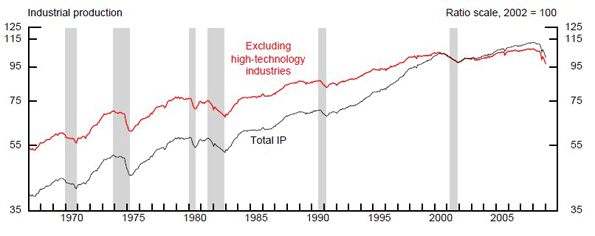
    Beyond this, can we as a country prosper if we don’t actually make things anymore? Some of the fear of manufacturing decline is overblown. Despite large scale job losses in the manufacturing sector, the US has continued to set industrial production records outside of recessions. However, as the chart below from the Federal Reserve shows, industrial production growth flattened significantly in the late 1990s.

    Sadly, manufacturing has been hammered in this Great Recession. There will certainly be a cyclical upturn in output, but restructuring in the automobile industry portends a permanent reduction in domestic output in that sector among others. Unless carefully handled, increasing regulation of carbon emissions, along with the associated energy price rises, will encourage further offshoring to countries with few climate change obligations, such as China, India, Brazil and other developing nations.

    Yet to remain both a prosperous and fair society, the United States must remain a manufacturing power. Manufacturing still provides the traditional route to middle class wages for those without college degrees. It also alone employs 25 percent of scientists and related technicians and 40 percent of engineers and engineering technicians.

    Of course, the next wave of manufacturing will differ greatly from the past. Improvements in productivity and global competition mean a bleak future for large scale, low value-added, routinized production. The era where an assembly plant provided thousands of good jobs at good wages is a thing of the past other than for the lucky few. And where there are new factories, they are often in greenfield locations like the new Honda plant in Greensburg, Indiana – halfway between Indianapolis and Cincinnati – not urban centers. Polluting heavy industry like primary metals and refining really are incompatible with neighborhoods. So what is to be done?

    One answer is to build a new industrial city focusing on small scale craft and specialty manufacturing with high value added. We’re seeing a precursor to this in the rise of organic farming and artisanal products of all kinds. TV shows featuring hip young carpenters renovating homes or gearheads tricking out cars and motorcycles make these professions seem glamorous. Magazines targeted at the global elite like Monocle scour the world in favor of the finest handcrafted products from old school workshops, building demand for these products. The New York Times Magazine recently did an article making the case for working with your hands, and also noted how digitally oriented designers are rediscovering the use of their hands. Perhaps it is no surprise that sociologist Richard Sennett turned his attention to the idea of the craftsman. In short, making things, craftsmanship, and quality are back in fashion.

    The challenge for urban economies is to develop this and put it on a sound industrial and economic footing. One key might be to inspire people to start these craft oriented businesses by tapping into people’s desire to purchase ethical and sustainable products. We increasingly see with foods and other items that people want to understand their provenance, to know who made them, how, with what, and under what conditions. Often today businesses catering to this desire are small scale “Mom and Pop” type operations, but there is no reason they can’t be done at greater scale, or expanded into areas like organic food processing, not just organic farming. American Apparel has done just that by manufacturing low cost, stylish clothing “Made in Downtown Los Angeles. Sweatshop Free.” at scale, for example.

    Beyond craft products, reinvigorating small scale, specialty fabrication and other businesses, to rebuild an American version of Germany’s Mittlesand, creates another, often ignored option for urban economies. Quality, flexibility, responsiveness, and a willingness to do small runs are keys. These businesses can also underpin product companies higher in the value chain. They start building an ecosystem of local companies and expertise that can be useful for related or spin-off businesses. Jane Jacobs, and before her the great French historian Fernand Braudel, noted how cities could incubate many new enterprises because all the diverse products and services they needed were available locally. If you need to scour the globe looking for custom parts and services, it can quickly overwhelm a small business. That’s one reason American Apparel started in Los Angeles, which already had a network of garment producing firms and expertise to draw on. What’s more, these firms might be ideal candidates to take over empty strip mall or other space in decaying inner ring suburbs, helping to solve the “graybox” problem. Even Main St. locations could potentially benefit from businesses beyond traditional boutiques.

    Today these types of specialty firms are often found in America’s largest cities, so they stand to benefit most from this. Smaller cities also need to figure out how to build this ecosystem. The culture needs to change too. Particularly in the Midwest/Rust Belt area, industrial labor has tended towards low skill, repetitive work in larger scale mass production industries. Retraining will be needed for these newer types of businesses, but this is vocational or skill training, not necessarily a college degree. It is a much more tractable problem.

    Not only could this new manufacturing base be a source of urban middle class jobs for the non-college degreed, it would do something arguably more important. It links the fortunes of the new upscale urban residents, the people who are both the customers for many of these products and potentially also the entrepreneurs making them, with that of their less educated neighbors. For many owners, managers, and workers, it might bring into daily contact people who might not otherwise ever interact if one group worked in an office and another in a warehouse. Rebuilding that sense of community and commonwealth, that we are neighbors, fellow citizens, and all in this together, is critical to building a truly sustainable, well-functioning and broadly prosperous society.

    Aaron M. Renn is an independent writer on urban affairs based in the Midwest. His writings appear at The Urbanophile.

  • Downtown Central-Cities as Hubs of Civic Connection

    There’s been a torrent of spirited banter lately about the reemergence of downtown central-cities. Much of this raucous debate is between advocates of urban revitalization, who offer an assortment of anti-sprawl messages as justification for this movement, and those who see suburban growth options as essential to quality of life in America. Adding to the fray are environmentalists who see housing density and alternative forms of transportation as the panacea for confronting our carbon-choked world. Downtown central-cities, they say, will incentivize citizens to relinquish their cars in favor of bikes and walking paths.

    These discussions largely ignore a greater significance to the reemergence of central-cities; namely, the recognition of downtowns as the epicenter of civic and cultural activity. This represents a shift away from the traditional concept – barely a century old and now antiquated – of downtown as predominately an economic and job center hub.

    This primary role for downtowns has been declining since the 1950s. According to Robert Fogelson, professor of urban studies and history at MIT and author of Downtown: Its Rise and Fall, 1880-1950, after World War II, downtowns lost their prominence as places where people “work, shop, do business, and amuse themselves.” As he states in the book, “Downtowns were once thought to be as vital to the well-being of a city as a strong heart was to the well-being of a person.”

    Increasingly the word “downtown” has become associated exclusively with large urban centers, fostering images of traffic, crime, homelessness and other forms of unsavoriness. A closer look, however, reveals a wide range of downtown genres – small and large, central-city and suburban, safe and sketchy, chaotic and peaceful, established and emergent. Some downtowns are situated in major urban regions while others are nestled in small-town communities. The senior demographic is prominent in some, college crowd in others.

    This new assessment of downtown as primarily a center for civic opportunities makes sense and revives the ancient role of the plaza “forum” or “agora” concept–places that H.G. Wells affectionately referred to as ideal for “concourse and rendezvous.” This redefinition may bother some who wish to return to the downtown apex of the 1950s, yet the idea is both viable and sustainable.

    With the traditional town-center model serving as the hub of civic activities, residents and visitors alike are frequenting dining establishments, arts and music venues, and coffeehouses in the spirit of civic connection and community. No longer a phenomenon exclusively associated with young artists, bohemians, and intellectuals, the downtown experience is also drawing unprecedented numbers of older folks who appreciate the history, cultural significance, ambiance and architecture of the old core.

    Downtown planning efforts in many locales are responding to this surge of interest by creating a brand identity for their cities – Austin, Texas, has developed a vibrant music scene, with a number of entertainment venues tucked along its 6th street corridor; Indianapolis promotes itself as a spectator-sports mecca, with its downtown activity infused by a robust fan base frequenting college basketball tournaments, pro and minor league baseball games, and the nation’s largest sporting event: the Indianapolis 500; Chicago touts itself as a tourist destination replete with world-class museums, city and architectural tours, and fine dining in its vast downtown core. Smaller downtowns in cities like Davis, California, Evanston, Illinois, and Iowa City, Iowa, tap into a bustling college crowd from area universities.

    Traverse City, Michigan, with a population of over 15,000 (142,075 in the surrounding metro area) offers another model: the quintessential small-city downtown. Quaintly situated along the Grand Traverse Bay on Lake Michigan, the area is primarily known for boating, kayaking, and sailing, except in July, when the city hosts its annual, week-long Cherry Festival that attracts swarms of people to its historic downtown area.

    According to Rob Bacigalupi, Acting Executive Director of the Traverse City Downtown Development Association, downtown traffic is driven by the office population and events. “Downtown Traverse City has somewhere in the neighborhood of 3,500 office workers. Certainly that’s a small number by any measure, but for a town of 15,000, these workers provide a good base for retailers who otherwise have to rely exclusively on seasonal visitor traffic,” he says.

    In terms of a niche identity for downtown Traverse City, tourism seems to be front and center. The calendar is jammed with events, many of which are designed specifically to attract locals downtown. Other cultural activities, such as the Cherry Festival, Traverse City Film Festival and Horses by the Bay, draw visitors by the tens of thousands. Bacigalupi cites a recent convention and visitor’s bureau survey indicating downtown shopping as one of the main regional attractions. “There’s no doubt,” he says, “that regional tourist traffic is perhaps the largest driver of foot traffic downtown. This says a lot for a region that has a number of other attractions and activities to offer.”

    For many city leaders the potential impact of downtown on regional economics and culture is what’s creating the most buzz. Kansas City (Missouri), Roanoke (Virginia), and Asheville (North Carolina) are among a growing number of cities seeking to capitalize on their unique brand of cultural connection to generate badly needed tax revenues for their downtown areas. Some experts say this is a sound move amid tepid economic times as city and local governments look to draw customers from closer to home.

    This message rings true for economically ravaged Rust Belt cities like Cleveland, Ohio. For years, downtown Cleveland has struggled to survive – beginning in 1960 when manufacturing and heavy industries began their decline and the flight to the suburbs gained momentum. In 1978, Cleveland had the dubious distinction of becoming the first American city to enter into default since the Great Depression. Despite small glimmers of promise, downtown Cleveland has been stuck in neutral, unable to build a cohesive identity and direction.

    There are some successes though: Redevelopment efforts have transformed a downtown corridor along E. Fourth Street into a bustling fine dining and nightlife mecca, demonstrating the appeal that well-constituted areas have on the local populaces and tourists. And the area’s rich ethnic and cultural heritage shows promise as a catalyst for change in the central core. While all of this points to some progress for downtown Cleveland, it still must overcome a heavy stigma associated with crime, poverty, and a declining population base to truly achieve civic vibrancy.

    Many of our nation’s suburban communities are setting the pace for downtown civic connection. Naperville, a Chicago suburb and the fifth largest city in Illinois, has established itself as a model for suburban downtowns. This city of 142,000 residents features a cornucopia of sophisticated shops, restaurants and entertainment venues that attract foot traffic to the town center-oriented central district. Open space has been integrated into the cityscape through well-maintained walking paths along the DuPage River, which flows through downtown. Thoughtful planning for the provision of abundant, free parking, train accessibility, and bike lockups enables convenient accessibility to the area both day and night.

    Folsom, California, is indicative of a suburban community that fosters civic ties and activities through its historic downtown district. With a population of 70,000 this city located in the eastern portion of rapidly growing Sacramento County draws an eclectic crowd to its old town boardwalk setting replete with saloons, outdoor restaurants, and antique stores. The downtown core also serves as a gathering post for legions of bicyclists who have helped shape Folsom into one of the top bicycling communities in the nation.

    During summer, downtown Folsom hums with activity generated by two weekly events: Thursday Night Market, featuring live music, food and shopping, and the Sunday Farmers Market, where frequenters can purchase fresh, locally grown food from area farmers. Plans are afoot for a street-scape improvement and a storefront restoration – projects that are designed to preserve historic elements while enhancing the city’s tourism desirability. Also in the works are mixed-use housing units and a restaurant that incorporates a railroad roundabout. All of this comes on the heels of a new parking structure and ice-skating rink, which debuted last year.

    In the end, downtown central-cities seem poised to reclaim some of their prominence as magnets of culture and social connection. We may not be witnessing the rebirth of the great economic centers of the 1950s, but a revival of our central space represents a positive development for communities both large and small.

    Michael Scott is a researcher and writer focusing on the growth and sustainability of downtown central-cities. He can be reached at michael@vdowntownamerica.com.