Category: Small Cities

  • Salinas Dispatch: A Silver Lining in the Golden State

    From a distance, a crisis often takes on ideological colorings. This is true in California, where the ongoing fiscal meltdown has devolved into a struggle between anti-tax conservatives and free-spending green leftist liberals.

    Yet more nuances surface when you approach a crisis from the context of a specific place. Over the past two years my North Dakota-based consulting partner, Delore Zimmerman, and I have been working in Salinas, a farm community of 150,000, 10 miles inland from the Monterey coast and an hour’s drive south of San Jose. Our work has been funded by a variety of sources, including the city, local business interests and the Chamber of Commerce.

    Our goal has been to find ways to promote upward mobility in the town, which is almost two-thirds Hispanic. Poverty is widespread, and gang problems rank among the worst in California. Unemployment, devastated by the recent recession, hangs at around 15%.

    These conditions are not at all unusual for inland California, and they are particularly prevalent in farm regions. In the Central Valley, over the next range of mountains, conditions are far worse, with some communities losing thousands of acres in production and unemployment rushing upward of 40%.

    One liberal journalist, Rick Wartzman, recently described the vast agricultural region around Fresno as “California’s Detroit.” As environmentalists push to cut back on water supplies and protect fish populations in the San Francisco Bay Delta, Wartzman notes, its local workers and businesspeople “are fast becoming a more endangered species than Chinook salmon or delta smelt.”

    In Salinas, where water comes from local aquifers, wells and the Salinas River, death seems less imminent, but there is a profound sense that things may be deteriorating. Local growers worry about regulatory constraints that will drive up costs to meet new state greenhouse gas standards. They also fear a possible county initiative, promoted by the well-funded local greens, to ban the growing of genetically modified foods.

    The growers’ response to the pressure – as with other businesses in California – is not to quit but to scale down operations. Some are cutting back thousands of acres of lettuce and other green crops that have been the prime business for the area for nearly a century.

    Yet we also see many reasons for hope. Salinas remains a unique place with an amazing richness in what the French call terroir, a combination of climate and soil. The city’s most famous son, John Steinbeck, wrote of the Valley’s unique topography:

    “The high gray-flannel fog of winter closed off the Salinas Valley from the sky and the rest of the world. On every side it sat like a lid on the mountains and made of the great valley a closed pot.”

    Growing conditions in Salinas cannot be easily duplicated elsewhere. Its richness has created a cornucopia responsible for the predominant part of the area’s private-sector employment.

    But it’s not just physical factors that make Salinas – and California – so productive. People matter too. The area is populated by scores of hard-driving agricultural families, people whose forebears transformed the place into the “salad bowl” of a nation. By 1952, when Steinbeck published East of Eden, Salinas produced 70% of the nation’s lettuce and much of its fresh vegetables.

    Salinas’ growers are not hereditary gentry; talk to local farmers and you find people whose roots lay in Italy, Portugal, Ireland, Japan and, increasingly, Mexico. “People, if given opportunity, can accomplish anything,” notes Lorri Kester, CEO of Mann Packing, a leading broccoli producer. “Many of the firms that lead us now were started by ‘Okies’ who worked the land. Now we see the same things with Latinos who started out as hands and now are foremen or managers.”

    What the Salinas growers do best – like their high-tech counterparts up in the Santa Clara Valley – is innovate. Working with the USDA and University of California-Davis scientists, they have led the way in creating new strains of vegetables and new ways of marketing, including the notion of “salad in a bag.”

    But not all the knowledge that makes Salinas such an economic powerhouse comes from entrepreneurs or PhDs. Like many agricultural communities, Salinas has had a sometime brutal labor history, particularly in the 1930s. The worst of this is now thankfully over, but farm labor remains a tough and often unrewarding profession.

    Yet even the hardest-edged growers acknowledge the importance of their labor force. Although education levels remain relatively low, our research revealed an extraordinarily high concentration of people with practical skills that can be applied to growing the agricultural economy. Future mechanization may reduce the overall employee counts but will make growers even more dependent on skilled workers in the fields.

    This proficiency, acquired in the fields and the processing sheds, has helped create another product for the Valley: expertise. Salinas growers, foreman, irrigation workers and marketers now sell their knowledge in other parts of California, as well as to Arizona, Mexico and, increasingly, East Asia. “I am seeing a lot of product and technical products from Salinas go to China and elsewhere,” notes Frank Pierce, a local agricultural consultant.

    Salinas also teaches you to avoid the great distinction made by many pundits between the “knowledge” industry and the productive type that focuses on tangible goods. A successful economy draws on information but also creates real products. There is a relationship between the two that is dynamic and has long been a critical component of California’s economic vitality.

    This is not just true of Salinas. I learned long ago from the founding fathers of Silicon Valley – people like Intel founder Bob Noyce and venture capitalist Don Valentine – that the practical knowledge from making circuits and chips helped create the Valley’s unique engineering terroir. Similarly, the “magic” of Hollywood does not emerge full-blown from the brain storms of stars and moguls. The entertainment complex’s unique abilities grow from the interplay of practical knowledge of less glamorous camera people, grips, editors, caterers and prop-managers servicing what Angelenos invariably refer to as “the industry.”

    Sadly, this insight largely has been lost on California’s political and business leadership. Among the so-called “progressive” community, production of any kind, outside of small artisanal farms or funky software shops, is disdained.

    This anti-development ethos has gained extra traction by claims that large farms and factories might add to the “carbon footprint” of a given place. Among well-funded foundations and some corporate leaders there remains an implicit sense that California can still mine enough riches in cyberspace to support the vast hoi polloi.

    Yet in reality, Californians need hard jobs, even mundane ones. The farm, sound stage or electronics factory provide the employment essential to broad-based prosperity. And when those jobs leave California they usually migrate to a place – whether over the border or abroad – where wages are lower and environmental controls are far weaker.

    This is not to argue that California’s right has the answers either. Lower taxes are generally preferable to higher ones. But in Salinas – and California – sometimes higher taxes might be preferable to cutting services, like the critical training offered by community colleges, which make the economy work and offer hope to the younger generation.

    In Salinas, Mayor Dennis Donahue, a Democrat of the Pat Brown variety, has embraced a call to raise the sales tax in order to maintain basic services. It’s not an ideal solution, but in the real world of running a city, particularly one with a big gang problem, you don’t want to cut back on police and libraries or add to already surging unemployment.

    What California needs most now is what it’s most missing: common sense and a sense of balance. This is what we learned in Salinas. California cannot be saved by ideologies – it needs to be saved from them.

    To be sure, preserving the land and air quality should remain a priority; it is the basis of California’s riches and unique appeal. But sustainability – the great buzzword of our time – needs to apply not only to the environment but also the economy and society. The right-wing solution of lower taxes even at the price of eviscerating the public sector and letting the infrastructure deteriorate does not constitute a program for long-term prosperity.

    We prefer an approach that focuses on practical steps for private and public sectors to collaborate on restoring economic growth. In Salinas, this means establishing – through cooperation with Hartnell, the local community college – a center for the development of agricultural technology. Salinas could use its combination of intellectual and grassroots knowledge to become the Silicon Valley of the “fresh” economy. It would also serve as a center of practical research on E. coli and other diseases that threaten the entire agricultural industry.

    Another step would be to expand the area’s thriving wine corridor to promote the region’s vintages. And there needs to be a plan to restore the historic central core into a bustling business district and to attract the predominately Latino shoppers, now lured to malls and outlet centers outside the city, back into town.

    These steps will take effort and money, but neither free market ideology nor green zealotry alone will get it done. California’s greatness was created not just by entrepreneurs or through its public sector, but in a clever, pragmatic melding of the two. Blessed with resources of topography, climate and human skill, our state should not allow dueling extremes to turn a global paragon into a planetary laughingstock.

    This article originally appeared at Forbes.

    Joel Kotkin is executive editor of NewGeography.com and is a presidential fellow in urban futures at Chapman University. He is author of The City: A Global History. His next book, The Next Hundred Million: America in 2050, will be published by Penguin early next year.

  • Globalization Leads to Civic Leadership Culture Dominated by Real Estate Interests

    Cleveland’s leadership has no apparent theory of change. Overwhelmingly, the strategy is now driven by individual projects. These projects, pushed by the real estate interests that dominate the board of the Greater Cleveland Partnership, confuse real estate development with economic development. This leads to the ‘Big Thing Theory’ of economic development: Prosperity results from building one more big thing.

    Ed Morrison wrote the above about Cleveland, but he could have been describing any number of other cities. Why is it that so many cities have turned to large real estate projects to attempt to restart growth, turning away from strategies that previously made them successful?

    The answer possibly lies in structural economic changes resulting from the nationalization and globalization of industry. Up until the 1990s, many businesses – including retail, utilities, some manufacturing, and especially banking – operated on a regional or local basis. This meant that the civic leadership of a community was heavily dominated by businessmen, again, especially bankers, whose success was dependent on the overall macroeconomic health of the particular city or region they were located in.

    But with banking deregulation, we saw large numbers of hometown banks merged out of existence. Industry after industry was subjected to national or international level roll-ups as changes in the economy and regulatory environment gave increasing returns to scale.

    Why is it that “real estate interests” dominate in a local economy like Cleveland? Because, to a great extent, they are among the only ones left. Consider the local industries that were not as subject to roll-ups. Principal among these are real estate development, construction, and law. This means the local leadership of a community is now made up of executives in those industries, and they bring a very different world view versus the previous generation.

    Consider the difference between a banker and a lawyer. Banks make money on the spread between what they pay for deposits or wholesale funding, and what they charge for loans. This means the CEO of a bank is making money while he plays golf at 3. He’s got a cash register back at the office that never stops ringing.

    By contrast, lawyers get paid by the hour for work on specific matters and transactions. The law partner is only making money on the golf course if he is closing a deal. It’s similar between many other “operational” businesses that were previously prominent in communities, and the “transactional” businesses that are now often dominant.

    Additionally, even where the hometown bank or company did not get bought out, it likely escaped that fate by getting big itself and making large numbers of acquisitions or otherwise expanding. This means those institutions are less dependent on the health of the particular local market they happen to be headquartered in than they are overall macroeconomic conditions. While no doubt they want the headquarters town to be successful, not least of which so they can effectively recruit talent, they can afford to take a portfolio view of local markets.

    Not only has the drying up of local and regional operating businesses led to a business leadership community unbalanced in favor of transactionally oriented firms, the loss of those local and regional operating businesses robbed many of the transactional companies such as law and architecture firms of their principal local client base. Large national businesses employ national firms for advertising, law, architecture, etc. If they use local firms, it is in a subsidiary role. (Or, if a smaller firm is fortunate enough to land a contract, it is servicing a client on a national, not local basis).

    Richard Florida described this in his Atlantic Monthly article on the financial crash. “As the manufacturing industry has shrunk, the local high-end services—finance, law, consulting—that it once supported have diminished as well, absorbed by bigger regional hubs and globally connected cities. In Chicago, for instance, the country’s 50 biggest law firms grew by 2,130 lawyers from 1984 to 2006, according to William Henderson and Arthur Alderson of Indiana University. Throughout the rest of the Midwest, these firms added a total of just 169 attorneys. Jones Day, founded in 1893 and today one of the country’s largest law firms, no longer considers its Cleveland office ‘headquarters’—that’s in Washington, D.C.—but rather its ‘founding office.’”

    Where then is the source of transactions these firms can turn to in order to sustain their business? The public sector, of course.

    I would hypothesize that many local transactionally oriented services companies have seen the public sector take on a greater share of billings than in the past. With the old school bankers and industrialists mostly out of the picture, the leadership in our communities consists increasingly of the political class and a business community dominated by transactional interests.

    When you look at the composition of this group, it should come as no surprise that the publicly subsidized real estate development is the preferred civic strategy. Politicians get to cut ribbons. Cranes always look good on the skyline. Local architects, engineers, developers, and construction companies love it. And there is plenty of legal work to go around.

    This is not to say these people are acting nefariously. And nor were old school bankers and industrialists always acting purely altruistically. Rather, the difference comes from the world view and “theory of change” that people steeped in transactionally oriented businesses bring with them.

    With the current financial crisis, bigness, as a strategy, is out of favor for the moment. Also, the gimmicky financial transactions that underlie much of the crisis are calling the entire transactional model into question. There’s an increasing alarm at the precipitous decline of manufacturing, particularly the auto sector. And people are questioning whether we as a country can survive simply through services, or whether we need to revitalize the concept of the operational business and actually making things. Plus, real estate deals are tougher to get done because of tight credit, and it seems unlikely that the go-go days of recent years are coming back soon.

    We’ll see where this leads. But if we see more local and regional scale operating businesses start to emerge again, then perhaps the urban development pendulum will start swinging the other direction again. In the meantime, large scale real estate development will likely continue to be preferred.

    Aaron M. Renn is an independent writer on urban affairs based in the Midwest. His writings appear at The Urbanophile.

  • The Rich Home on the Range

    Have your home on the range, access to a few thousand acres …without paying for it all!

    By Candace Evans

    Mark Lowham was raised on a ranch in Casper, Wyoming. He got away from roping steers and repairing fences to study at Stanford Business School. Lowham thought he might return to ranching one day, but he never dreamed that instead of roping steers, he’d be marketing ways to rope adults into a herd of conservation-minded land-owners.

    Lowham is senior vice president of WEST*GROUP, where he works with Gerald T. Halpin, a former rocket scientist renowned for having the perfect nose for real estate deals. Halpin’s best to date, according to Lowham, was his 1962 acquisition of two dairy farms, Storm and Ulfelder, in the Washington suburbs. They became a significant part of Tyson’s Corner, now the 12th largest commercial business district in the United States. Tyson’s Corner, says Lowham, is larger than downtown Atlanta or Denver. WEST*GROUP, the company Halpin started in 1962 with partners Thomas F. Nicholson, Col. Rudolph G. Seeley and Charles B. Ewing, Jr. is the largest landowner in Tyson’s with more than thirty three city blocks still under Halpin’s sharp eye.

    Though he launched in the greater Washington area, Halpin had seen the west in his extensive travels, and focused on the natural beauty of the Grand Tetons near Jackson Hole, Wyoming.

    In 1989, WEST*GROUP formed a partnership called Meridian, whose mission was to develop a 1400 acre ranch in Jackson Hole, Wyoming, just minutes from the most perfect snow midway between the town of Jackson Hole and the Jackson Hole ski area.

    The spread was initially zoned and approved for 1160 home sites but Halpin decided to turn what he called Indian Springs Ranch into a hybrid of private land ownership and common space sharing. Owners would hold title to a specific portion of the overall ranch – their homestead – and have access to the rest, much like a country club.

    Those 1400 acres would only house 46 home sites of approximately seven acres each, enough really to be anyone’s Ponderosa. But you’d still get all the perks of ranch ownership: acres of protected ranch land, grazing cattle, horses to ride, barns, pool, tennis courts and a gathering lodge for community. The seven acre parcels of land on the ranch would be separated by several acres between homesteads, on which owners could build in their “envelope”.

    This trend has been growing for a decade. Movies like the 1991 film “City Slickers” projected the romance of ranching into every movie theatre in America. Ted Turner and other significantly high net worth individuals began buying up huge land parcels in the west – Wyoming, Montana, and Colorado, “glamorizing” recreational ranch ownership. Halpin’s first vision for Indian Springs, circa 1989, was to have a small exclusive guest ranch on the order of Lost Creek Ranch & Spa, the exclusive Jackson Hole guest ranch run by Halpin’s son and daughter in law. Lost Creek is one of those places where city slickers can temporarily escape the city and play cowboy outdoors while dining indoors on lobster claw salad, Venison Rosini, and halibut stuffed with crab. Then they get to dunk boot-weary toes in the Jacuzzi after a hard day riding herd and fall asleep beneath the stars on Frette sheets.

    Prominent people bought early sites: Connie Stevens, the actress; Carol and Robin Farkus, he the N.Y.C. Chairman of Alexanders Department Stores, Tom Bolger, chairman of Bell Atlantic. Buyers came from California, New York, the Midwest, the Minneapolis region. They attracted other well-heeled people, which helped sell out the homesites.

    Meridian’s first venture was so profitable, Lowham led the company to develop a Texas Hill Country ranch in 1998; a new ranch in Mesquite, Nevada is currently in the works.

    Though vacation home sales are now slower than they once were, they are not dead. The shared ownership ranch offers owners a shot at full home ownership while splitting the costs of the ranching operation as well as amenities. Some operations even eek out a small profit, but what these buyers are really looking for is a way to pay a fraction of the operating costs while enjoying the whole property. There’s a strong conservationist edge: most shared ownership ranches, like Indian Springs, its Texas Hill Country sibling, The Preserve at Walnut Springs (Ken Starr is an owner, as is yours truly), and Cross Pines Ranch Preserve in East Texas near Mineola, scatter a handful of homes across the vast acreage to create a true sense of isolation, leaving the majority of land to breathe.

    “Ranchers are looking for a way to preserve land and conserve it while not going bankrupt,” says Dallas Addison, developer of Cross Pines, based on a conservation easement where each owner has a one-fortieth interest in the entire property. The conservation concept will soon be crossing the Pacific. Addison has partnered with fellow Texan Alan Friedman, owner of Trisept Inc., to develop Bosque Canyon Ranch at Lake Whitney in the Texas Hill Country, and a 7,000-acre project on Hawaii’s Big Island.

    Other ranches cluster homesteads in one area to preserve as much raw open space as possible; the forever-open range becomes a prime selling point.

    “Clustering is a much better land use process,” says Larry Corson, senior vice president with Dallas-based Hunt Realty Investments. Hunt is the developer of Cornerstone, a 6,000 acre ranch near Telluride, CO. “Our owners actually prefer it, knowing what they have preserved in perpetuity for the environment and wildlife.”

    Cornerstone was once a plain Jane hunting ranch owned by Texans. It was foreclosed and sold at auction to a local investor. Corson literally spotted the site for his employer, Dallas oilman Ray Hunt, off a dirt road. After two years of working with local officials on the development plan, construction began in 2004. The property opened in 2006. Homesteads range from one to one hundred acres, starting prices at $175,000 to seven figures plus an $80,000 club initiation fee and $6,000 a year dues, which are fairly typical.

    Perhaps helped by the relatively vibrant Texas economy, in 2008 the company reported $8 million in sales. The land Corson saw had full potential for a five-star plus ranch: horseback riding, an extensive trail system for hiking, riding or jeeping, fly fishing onsite and private access to the nearby Uncompahgre River, snow mobiles, cross-country skiing, snow shoeing, ice skating, toboggans, and downhill skiing at nearby Telluride in the winter months. But the best selling point of all was the art in every window – breathtaking views of the San Juan Mountain range from every angle.

    It’s City Slickers roughing it on Gulfstreams.

    Corson immediately saw potential for the one thing Telluride was sorely lacking: a high quality, private golf course. The spread held a natural plateau for what has become a world-class, Greg Norman-designed golf course. So there you have it – take a hike, go fish, study the migration patterns of deer and elk, saddle up for a Kamikaze ride, or golf.

    The owners come from all over, but most are from Texas, like investment banker Richard Moses, who was in Telluride for all of 24 hours when he bought not one but two lots. In a tough market, says Corson, if people are going to make a real estate purchase it’s going to be a lifestyle decision: is this the place I really want to be? And of course, are there enough toys to keep me entertained for weeks?

    “At Cornerstone, we once had a little bear cub one morning sitting on our outside barbecue licking the grease off the grill,” he says.

    Just because it’s a ranch, doesn’t mean there must be cattle. At Cornerstone, management discovered that as soon as they stopped running cattle on the property, the songbirds returned – not a bad trade. The grazing killed off the shallow grassland savannah that the bison had once protected.

    Sometimes the city slickers are more conservation conscious than the country folk, and more self-conscious and contentious. Owners at one shared-ownership ranch recently disagreed, albeit briefly, over the herd. Some owners thought keeping methane-producing Longhorns was not worth the massive carbon footprint, or hoof print, for 2,500 lbs of western eye candy. Of course, they were not as concerned over the carbon footprint etched by their private jet flights to the local FBO.

    Shared ownership of course has its downside: you actually have to share – opinions, design, tastes and common areas. You may not have quite everything the way you would if the whole place was yours alone. Strong management, which can sometimes double as a counseling service, is essential.

    “In this market,” says Corson, “buyers are really doing their homework to make sure the developer can deliver on all the promises.”

    Or just keep peace at the ranch.

    Candace Evans is the Editor of DallasDirt, a Dallas-based real estate blog for D Magazine Media Partners.

  • The Next Culture War

    The culture war over religion and values that dominated much of the last quarter of the 20th century has ended, mostly in a rout of the right-wing zealots who waged it.

    Yet even as this old conflict has receded , a new culture war may be beginning. This one is being launched largely by the religious right’s long-time secularist enemies who are now enjoying unprecedented influence over our national politics.

    For all the manifest differences between these two groups, these culture warriors have much in common. Each represents an effort by a highly motivated minority to impose a particular vision of life on a population that does not share either their level of conviction or specific policy preferences.

    The Christian right saw its mission as using government policy to restore family and faith to a country they saw losing adherence to both. Not content with hometown pieties, they wanted to use government power to regulate areas ranging from abortion and gay marriage to stem cell research, in ways reflecting their values and agenda.

    For a while, their agenda also appealed to white ethnics in urban areas, largely Catholics, who recoiled against the crime and disorder in city streets. When they moved en masse to the suburbs, the religious right’s social base narrowed further.

    One critical weakness of the movement stemmed from the fact that many prominent figures like Pat Robertson, Jerry Falwell and Jesse Helms rose from the segregationist South. This limited their appeal outside the white Confederate ethnic enclaves in small towns and some Southern suburbs. They were notably less successful in the fastest-growing, more ethnically and socially diverse communities, where the future of evangelical Christianity now is being shaped.

    Many of the goals espoused by Christian political activists are clearly commendable – promoting charity and respect for human life. In some areas, such as abortion, they have made real inroads on influencing broader society’s attitudes. But overall, their political attempts to impose a narrow religious agenda has fallen into disrepute even among Republicans.

    Today, the locus of the culture war has shifted to the secularist left, whose primary geographic base lies in our densest, most elite cities. This group has evolved into its own version of what the Calvinists would call “the elect” – those chosen to thrive amid a sinful nation. They might also be called “the cognitive elite,” since their self-image comes not from religious worship but from a sense of higher intelligence, greater rationality and even superior healthfulness.

    Perhaps the most honest description of this largely urban grouping was made in the Seattle alternative paper The Stranger shortly after George Bush’s 2004 re-election. Shocked by John Kerry’s defeat, The Stranger defined their preferred constituency as “islands of sanity, liberalism and compassion.” The red regions, they concluded, were the abode of “people [who] are fatter and slower and dumber.”

    At the time, The Stranger’s solution was to secede in spirit from the red states and build a new America hewing to what they considered humane and scientific values. Yet four years later, the self-proclaimed “islands of sanity” now dominate the government in a manner unprecedented in recent American history.

    The rapid ascendancy of the new culture warriors has everything to do with class and caste. The religious right’s base lay predominately in the small towns and lower middle class. They may have had more votes than the sophisticated city-dwellers, but in the end they had little influence among Bush-era policy-makers, whose greater allegiance was to Wall Street, energy and other corporate interests.

    In sharp contrast, the cognitive elites rise straight from the critical bastions of Obama-era power. They draw strength from the mainstream media, the vast “progressive” non-profit community, the universities, and the professional policy elites. University and think-tank denizens, according to a recent National Journal survey, constitute 37 percent of the top 366 appointees by the Obama administration, far more than under the Bush regime.

    One group, not surprisingly far less well-represented, are white Christians, whose number, according to the National Journal, has dropped from 71 percent under Bush to 46 percent. It’s not that the Obamites lack faith, just that they lean less to conservative Christianity and more toward the gospel according to Al Gore.

    Like their Christian right counterparts, the cognitive elite’s agenda does address some important issues. You do not have to embrace the theology of global warming (aka climate change) to favor incentives for reducing energy use and cleaning up pollution. Advocating healthier outcomes through more walking, bike riding and better school lunches also make sense as public goals. And a planning approach that allows for more housing options in suburbs and better access to transit also could be useful.

    The problem here, as with the Christian right, lies with overzealousness and intolerance. Whether environmentalism qualifies as a religion or ideology for legal purposes, it is clearly being embraced in a quasi-theological way. As Bjorn Lomborg and others have pointed out, any objection to the Gorite carbon emissions agenda invites scorn and denunciation for, as Paul Krugman recently suggested, “treason against the planet.” Even mild skeptics can expect to be treated like a strident atheist at a mega-church – although probably with likely far less compassion or politeness.

    Critically, the climate-change zealots likely will be in our faces and wallets far more than the religious fulminators. Although the public is widely skeptical of the whole climate change agenda, they will have to confront a huge new bureaucratic apparatus that could impact millions of businesses and local planning decisions down to the household level.

    This desire to micromanage in the public interest also extends well beyond climate change. There is clear desire now to influence everything from how we live to what we eat. You can see the beginnings in everything from ever-higher cigarette taxes to bans on trans-fats at your local hot dog stand.

    San Francisco, always ground zero for such intrusive lunacy, now has determined to find ways to shove healthy foods on the plates of city residents, preferably from urban gardens. The city is even taking steps to prevent city workers from ordering donuts for meetings. Now bureaucrats must follow guidelines from the Health Department.

    City workers even have to cut bagels into quarters or halves, presumably so that workers may all look as svelte as Mayor Gavin Newsom. “We have an eating and drinking problem in America,” declared Newsom, a candidate for governor with an admitted former alcohol problem of his own.

    But perhaps the most intrusive changes may come in terms of planning and development. The Obama administration has already declared its desire to “coerce” people out of their cars and discourage sprawl in order to promote its health and carbon-cutting agendas.

    This could evolve into a concerted attempt to force more Americans into the high-density housing as opposed to the single family suburban homes they prefer for reasons ranging from cost to privacy and safety. It may be questionable how much these steps will improve health or the environment, but this may not matter much given the current theological consensus.

    What we now see is policy enacted in the name of scientific dogma, even though science’s essence lies in open inquiry and debate. In the process, agendas are often conflated; reports even mildly contrary to the received wisdom of climate change are ridiculed or ignored. For some urbanists, climate change also provides a convenient excuse to reverse the dispersion to suburbs that they have railed against for decades.

    What we need now is not self-interested dogma, but open, wide-ranging debate designed to find the most effective ways to achieve energy efficiency in both cities and suburbs. Amid the worst economic downturn in a half-century, we also might want to weigh the impact of some “green” policies on the employment, income and wealth prospects for middle- and working-class Americans.

    The anointed secular clerisy seems destined to become very unpopular. Americans do not like to be preached to by their political leaders about how to manage the details of their lives, particularly when the preachers often fail to follow their own precepts; this was a core problem with those who aligned with the religious right. Environmental and health activists would do better to focus more on suasion as opposed to coercion and to offer incentives rather than dictates to achieve their goals.

    They should also learn that problems are addressed most effectively at the local, community and familial levels. The wide access to information through the Internet undermines the very logic for relentlessly centralized solutions; the best “green” policies may be those that evolve organically and fit specific local conditions.

    Basically, cultural warfare makes for stupid politics, as the Republicans should have – but likely have not – learned by now. The new culture war now developing could pose similar dangers for the Democrats, if they are not careful.

    This article originally appeared at Forbes.

    Joel Kotkin is executive editor of NewGeography.com and is a presidential fellow in urban futures at Chapman University. He is author of The City: A Global History. His next book, The Next Hundred Million: America in 2050, will be published by Penguin early next year.

  • Housing the Next Generation with Old Shipping Containers

    If the predictions are accurate, America will have to house some 100 million more people by 2040 to mid-century than is now the case. Despite the current round of foreclosures and rising apartment vacancy, over the long term the demand for humane, affordable, sustainable housing is going to escalate dramatically in the coming years.

    In this recessionary time, it may be tempting to ignore the coming boost in housing demand. Yet eventually growth will pick up and the housing market will become re-invigorated. Nonetheless, the problem of meeting the demand for affordable housing will remain. For now, the federal government is trying to help state and local governments acquire, renovate and sell foreclosed properties, and individual homeowners to reduce their mortgage payments to 31 percent of their income. Federal efforts are also being aimed at increasing funds to redevelop public housing and at giving first-time homebuyers an $8,000 tax credit.

    But these are short-term measures. Others, with more lasting impact, may be more effective. One will be the size of houses. Although some may still choose to build large lot homes and McMansions, the longer-term trend will be for somewhat more compact houses. Contrary to the visions of some urban boosters, Americans will continue to favor single family homes over apartments. But these houses seem likely to trend back to the more traditional, modest scale. Between 2006 and 2007, after years of expanding, the size of a median single-family house actually decreased slightly.

    Another critical element of a housing solution lies in building workforce housing close to the workplace. For years, many moderate income Americans have been forced to “drive ‘til they qualify.” Throughout the nation’s metropolitan areas, teachers, police officers, firefighters, salesclerks, municipal workers, and young people, among others, are being elbowed out of the local housing market. In a recent survey conducted by the Urban Land Institute in cooperation with Harris interactive, of the 110 larger firms (over 100 employees) surveyed, fifty-five percent reported a lack of affordable housing nearby, sixty-seven percent of the workers interviewed (who earned less than $50,000 per year) said they would move closer to work if more housing in their price range were available, and fifty-eight percent of the companies reported having lost employees due in part to long commute times.

    For most Americans, particularly between ages 30 and 70, the demand for affordable homes near workplaces will be paramount. In some areas, there may also be greater demand for apartments, even though these too are suffering due to the recession.

    Many zoning and building codes are obsolete and need to be updated, because as written they restrict the construction of low and moderate income housing and segregate residential, retail, and industrial/commercial land uses. Changing zoning to permit and provide incentives for mixed use development, more intense land uses, and higher density development would make workforce housing more affordable.

    The steps above do not apply only to city living. Through good design, suburban living can be made slightly more compact without sacrificing quality of life. Accessory buildings can often be added on a lot, “granny flats” can be built, large old single family homes can be converted into duplexes, empty spaces could be filled in, and other steps can be taken to meet the need for more housing when that need materializes.

    But perhaps the biggest gains can come by using innovative approaches to expanding housing. One novel idea that has begun to emerge is to use old shipping containers that have been transformed into building blocks for home-building materials. Actually, one can hardly call the idea novel, because shipping crates have been used in construction for thousands of years. But today, the old practice is being revived with entrepreneurial, innovative, outside-the-box thinking.

    These reconfigured containers have the advantages of being more economical and durable than conventional materials, speedier to construct, highly customizable, fire-, termite-, water-, and earthquake/hurricane-resistant, strong, safe and green, with a lower carbon footprint. Hence the name of one of the companies working in this field, one with which I am associated, SG Blocks LLC (SG stands for “safe and green”). As the company puts it, “We are in the business of converting instruments of trade into instruments of construction.”

    Shipping containers are big: each weighs 9,000 pounds and measures 8 feet wide by 40 feet long by 9 feet tall. Hundreds and thousands of them are sitting empty in ports around the country. What possible use could they be, one may wonder, in building a new residential or office complex?

    Consider, therefore, that these steel-on-steel containers, when used as re-fabricated “blocks,” are stronger than conventional house framing. They can be cut, fabricated, re-modeled, and turned into a basic home structure for approximately $25-$27 a square foot. Stevan Armstrong, COO of SG Blocks, has pointed out that multi-family mid-rise units built with containers cost 10 to 15 percent less than typical “stick frame” houses. When appropriate coatings are installed, says Dan Rosenthal, a principal with the Lawrence Group, “we have an envelope that reflects about 95 percent of outside radiation, resists the loss of interior heat, provides an excellent air infiltration barrier and does not allow water to migrate in. Because of the superior roof structure, it is easier to incorporate ‘green’ roof systems.”

    Using shipping containers also saves energy on the front end. It takes 6,481 kilowatt-hours to make a ton of steel from virgin materials, 9,000 kilowatt hours of energy to melt down a container, but only 400 kilowatt-hours of energy to convert shipping containers into SG Blocks.

    The possibilities for utilizing this type of construction – infill housing in urban and suburban communities, new construction for residential, commercial, industrial and retail buildings, single- and multi-family homes – are practically limitless. From a design perspective, SG Blocks claims that their modified containers “can be used to build virtually any style of construction, from traditional to modern and all in between…from traditional Main Street to ultra-contemporary.” In short, they can provide people with an opportunity for ownership and economic mobility in a decent community environment.

    To cite a few examples:

    • A continuing care community for seniors on the historic Mission San Luis Rey grounds in Oceanside, CA, 340,000 square feet with 450 SG Blocks, is going up.
    • In Salt Lake City, the first mid-rise container building is being planned for downtown; it will be called City Center Lofts, with eight units and a ground level art gallery.
    • In Ft. Collins, CO, discussions are being held about creating “block” homes for 500 families as part of the city’s Homeless Shelter Program.
    • John Knott, the guiding light in the Noisette Community in North Charleston, SC, wants to build a six- to eight-story “container” building, retail on the first floor with residential units above, topped with a green roof. He proposes using ninety prison re-entry men to do the construction.
    • Work is in process on a three- to four-story student housing and recreational mixed use facility at Lubbock Christian University in Texas.
    • In Panama, “blocks” are being used to build four buildings that will house community and education centers for the U.S. Southern Command.
    • Attached to the top of this article is a photo of a house built with SGBlocks in St. Petersburg, FL.

    Demography is destiny, as has been said so many times. With 100 million more people in the pipeline, we have to find humane, innovative, affordable ways to house them and provide them with opportunity for advancement. Salvaging empty shipping containers to address this problem is only one step, but a most interesting one that is well worth the trying.

    William H. Hudnut III, former Member of Congress and sixteen-year Mayor of Indianapolis, is the principal in his firm, Bill Hudnut Consultants LLC, and an associate of SG Blocks LLC. His email address is: bhudnut3@gmail.com.

  • Lessons from the Left: When Radicals Rule – For Thirty Years

    Contrary to popular notions held even here in southern California, Santa Monica was never really a beach town or bedroom community. It was a blue-collar industrial town, home to the famed Douglas Aircraft from before World War II until the 1970s.

    When I first lived there in the early ’70s, the city was pretty dilapidated, decaying and declining (except for the attractive neighborhoods of large expensive homes in the city’s northern sections). I remember a lot of retirees, students, and like me and my wife, renters of small apartments in old buildings. The tiredness of the place was incongruous with its great location and weather. But then the first of several spectacular rises in real estate values took off. Rents started rising precipitously as well, and in a city where 80% of residents were renters, a political earthquake shook the establishment: in 1979 voters passed rent control and soon after that elected a slate of politicians backed by the SMRR – Santa Monicans for Renter Rights – to a majority on the city council. It has now been 30 years that the city of Santa Monica has been dominated by the politics and politicians of SMRR. What have they wrought?

    There have been some momentous battles. Property owners, denied the full use and fair value of their property, came to calling the place “the People’s Republic of Santa Monica.” As economists would predict, rent control resulted in the loss of rental units (and therefore the number of renters), slowed construction of new units, led to the deterioration of existing units as landlords deferred maintenance, decreased the city’s diversity, and increased its exclusivity. These were all opposite effects the original intentions of the new radical rulers.

    But rent control was not the only “social justice” concern on the SMRR agenda; “homeless friendly” policies led to an explosion of homeless people in the city, which comedian Harry Shearer reminds the nation every week on his NPR radio show is “The Home of the Homeless.”

    Other battles fought over the years have involved traffic issues, a living wage ordinance, preferential parking zones, McMansions, development and redevelopment, planning, zoning, schools, affordable housing requirements, and the height of fences and hedges – a thousand things big and small one would expect in a city of 85,000 residents and an annual budget of over $500 million. At some point in the 1980s, the SMRR-dominated City Council, once anti-development, realized that development could generate millions of dollars for city government necessary for funding its political agenda. Massive rezoning and redevelopment were approved.

    One might think that inconsistent policies often causing opposite effect of their intentions would have weakened the left. But two large factors have come into play over time. First, SMRR does not rule without consent and consensus – many, perhaps more than half, of home owners have supported the progressive politics and policies of the SMRR-controlled city council. Secondly, despite the concerns of some property owners and economists, Santa Monica has prospered. Despite powerful regulation, hotels, arts, jobs, and restaurants continue to flow into the city. Opponents on both sides concede most of the population is content and satisfied with the status quo.

    This has been accomplished with pragmatism and a willingness to change policies that were not working. The worst effects of rent control are in the past due to a state law that allowed vacancy decontrol. Same with homelessness: residents wanted to be “progressive” but realized that being kind to the homeless only increased their numbers. The city still overdoes it on permits, regulations, etc., but homeowners and business want to be “progressive,” so they go along with it (and they like regulation when it benefits their interests).

    The city decided to make itself a tourist destination, and it is, but when it looked like nothing but hotels would be built, voters passed a proposition to halt hotel development. On the other hand, last November voters defeated Prop T, which would have limited most commercial development in the city to 75,000 square feet a year for the next 15 years.

    Santa Monica Place, a huge indoor shopping mall, outlived its usefulness, so now it’s being rebuilt as an outdoor mixed-use development. A living wage law was passed by the City Council, and then repealed by voters.

    SMRR is a political machine that has dominated the city for 30 years, using money, favors, jobs for the connected (and bupkis for those not) to build voting blocs for power and control. It inserts its people onto all the boards and commissions with input into policymaking. Their power ultimately comes from persuading renters, who are still a big majority of the city’s inhabitants, that they need SMRR for protection from “greedy landlords.”

    So SMRR dominates political life in the city of Santa Monica, but it does so with the consent of many homeowners, property and business owners, as well as renters. Santa Monica is green, PC, insufferably “tolerant,” self-satisfied, etc., but still doing well for itself. Taxes, rules, regulations and restrictions are onerous, but people and businesses still want to be there.

    I have lived through and observed the political battles of the last 30 years as a renter, homeowner and briefly as a landlord (never again, thanks). The transformation of Santa Monica reflects an interesting story: left-leaning activists who realize they can bend the establishment by controlling it from the inside. They then become the new establishment, but like in today’s left-leaning academia, work to make sure they themselves are never similarly deposed. And yes, I wonder if it holds lessons for the nation, with President Obama and the Democrats now in control and looking to implement a left-leaning agenda.

    What might those lessons be? One, particularly difficult for conservatives to accept, is that the time-tested machinations of leftist political machines sometimes work. They work for the powerful and the connected (who get to have their cake and eat it too: financial reward with a patina of progressivism), and they are perceived to work for the powerless and unconnected (however deleterious in reality). And that the left can come to power and rule with the consent of the governed, if it doesn’t “push the envelope” beyond a certain point, changes course when warranted, rewards cronies and allies, co-opts opponents where possible (and freezes them out where not). It worked for Tammany Hall, it has worked for Mayor Daley, and it seems to be working for Obama. Saul Alinsky would be proud of his protégé.

    Perhaps at the heart of its success is that like all successful political machines, SMRR “fixes potholes.” Frank Gruber, who writes a weekly column about life and politics in Santa Monica for The Lookout News, calls this “squeaky wheel government.” SMRR council members try to turn every complaining resident – and there are many – into happy SMRR voters. Whatever the aims of SMRR, they have created a popular government.

    Gruber, who considers himself an “old leftie” of the “jobs, housing, education, environment” school, takes SMRR to task for putting the needs of comfortable voters (traffic, for instance) ahead of the needs of the larger community (such as jobs for minority youth). (A collection of Gruber’s columns has recently been published in a book called, fittingly, Urban Worrier: Making Politics Personal.)

    In the 2008 elections, in which Santa Monicans voted overwhelmingly for Barack Obama, all four incumbents of the City Council won easily. SMRR seems as entrenched as always. In at least this paradisiacal portion of Southern California, left-wing government appears to be working – even if sometimes at odds with its own old radical objectives.

    Dr. Roger Selbert is a trend analyst, researcher, writer and speaker. Growth Strategies is his newsletter on economic, social and demographic trends; IntegratedRetailing.com is his web site on retail trends. Roger is US economic analyst for the Institute for Business Cycle Analysis and its US Consumer Demand Index, a monthly survey of American households’ buying intentions.

  • Kauai, Hawaii: Local Merchants Make Waves

    Many have by now heard or read the story of the plucky group of Hawaiians on the island of Kauai who, when faced with the loss of their businesses due to the state government’s inability to open park roads to a popular beach and camping area, took care of it themselves for a fraction of the cost and in a fraction of the time. How very Tocquevellian. Or, better, how very American. The story brings a reflexive smile to everyone who hears it, but the events cast a spotlight on the way governments at all levels interact with their communities, and how, in light of significant budget cutbacks, roles are changing.

    In his magisterial commentary on 19th century democratic culture, Democracy in America, Alexis de Tocqueville compared the initial sources of public action in European countries with the United States: “Everywhere that, at the head of a new undertaking, you see the government in France and a great lord in England, count on it that you will perceive an association in the United States.”

    De Tocqueville was overwhelmed at this penchant of Americans to collaborate in common effort. The Frenchman attributed this unique, awe-inspiring American quality to the absence of a large government or aristocratic structure. “They can do almost nothing by themselves,” he wrote, “and none of them can oblige those like themselves to lend them their cooperation. They therefore all fall into impotence if they do not learn to aid each other freely.”

    After December floods washed out the park roads, bridges, and facilities at the Polihale State Park, Hawaii’s Department of Land and Natural Resources (DLNR) studied the damage and released a statement two months later, declaring, “We know that people are anxious to get to the beach. However, the preliminary cost estimate of repairs is $4 million.” An original timeline for the work was set for late summer, but, commented local resident and surfer, Bruce Pleas, “It would not have been open this summer, and it probably wouldn’t be open next summer.”

    The DLNR’s natural response to this natural disaster was to go inward (look to its own capabilities) and upward (look for more State or Federal funds). The public’s role – if there was to be any – was to leave them alone to do the first task, and help them achieve the second; specifically, the main objective was to grab a fee-generated windfall for the department, ironically entitled the “Recreational Renaissance” fund. In February, DLNR’s Chair, Laura Thielen, pleaded, “We are asking for the public’s patience and cooperation to help protect the park’s resources during this closure, and for their support of the ‘Recreational Renaissance’ so we can better serve them and better care for these important places.” The department convened an “information meeting” in March to discuss… how residents could work with the department to open the roads? No, only to provide information on how to lobby the state for more funding.

    This approach did not sit well with area residents who depend on the park for their livelihood. It was reported that Ivan Slack, owner of Na Pali Kayaks, which operates from the beach in Polihale, summed up the community’s frustration: “We can wait around for the state or federal government to make this move, or we can go out and do our part.” Beginning in late March, business leaders and local residents organized — “associated” — to take the situation into their own hands. From food donated by local restaurants to heavy machinery offered by local construction companies, a project that was originally forecast to cost millions and take months (if not years) was nearly completed in a matter of weeks, all with donated funds, manpower, and equipment. As Troy Martin from Martin Steel, which provided machinery and five tons of steel at no charge, put it, “We shouldn’t have to do this, but when it gets to a state level, it just gets so bureaucratic; something that took us eight days would have taken them years. So we got together — the community — and we got it done.”

    This was not just a park clean-up, but a significant undertaking involving bridge-building, reconstructing rest rooms, and use of heavy equipment to clear miles of flood-damaged roadways.

    While unique in its scope, what is happening on the southwestern coast of Kauai is not completely anomalous. Due to the national budget crisis, states and cities around the country are having to take a hard look at the services they offer and find new ways to involve civil society. The organization I head up, California Common Sense, is working with cities and school districts that have to chart this new course. The failure of several revenue-raising ballot initiatives here in the Golden State has provided even more impetus to practice this outward-focused governance.

    In some respects, governments themselves are to blame for setting the service expectations of the past decades. Beginning in the mid-1980s, the “TQM” (Total Quality Management) craze in private industry found its way into the public sector, and a new language of “service provider” (government) and “customer” (citizen) followed. Government no longer was something to participate in, but something to pay for. Later in this transition, scholars like Northwestern University’s John McKnight could see that the results of this new relationship were heading towards a precipice. In an essay for The Essential Civil Society Reader, McKnight commented on this situation in terms reminiscent of de Tocqueville’s fears almost two centuries earlier: “The service ideology [in governments] will be consummated when citizens believe that they cannot know whether they have a need, cannot know what that remedy is, [and] cannot understand the process that purports to meet the need.” This, thankfully, is not the situation in Kauai.

    But we, as citizens, don’t get off the hook that easily. Certainly, we have too often taken on this role as “customer,” believing our taxes are just the prices we pay for the services we desire, from filling potholes to teaching our children. When government does not perform up to our expectations the usual response is either to decry its wastefulness or to acquiesce to higher taxes. These often unproductive reactions come from both the left and right on the ideological spectrum.

    The story in Kauai, and others bubbling up around the country, demonstrate that there is a “third way”: get some friends and pick up a shovel when the government can’t or won’t. Governments on the other side of this equation need to be open to this kind of direct participation; in fact, they should encourage it. What is happening in Polihale is not a syrupy, Rockwellian portrait. It is doubtful that this dramatic participation would have occurred without the dire financial consequences that loomed for many of the residents and businesses involved. It is a manifestation of de Tocqueville’s “self-interest rightly understood”.

    “All feel themselves to be subject to the same weakness and the same dangers,” De Tocqueville wrote, “and their interest as well as their sympathy makes it a law for them to lend each other mutual assistance when in need.” Ray Ishihara, manager of the local Ishihara Market, which has donated food for the volunteers, puts this in more concrete terms: “I think it’s great. Everybody needs help these days in this economy.”

    It is ironic that this should all be taking place in President Obama’s home state. The usually articulate Obama has sounded uncomfortable when attempting to define how he expects Americans to “sacrifice” during this financial crisis. From a policy perspective, the Administration’s only responses appear to be raising taxes on our wealthiest 5%, and, interestingly, increasing Federal funding for volunteer programs.

    One thing the President could do is travel out Kauai’s Route 50 to Polihale State Park during his next trip to Hawaii. There, he could see and celebrate what everyday Americans do when they gather in common purpose. Thanks to their hard work and sacrifice, surf’s up.

    Pete Peterson is executive director of Common Sense California, a multi-partisan organization that supports citizen participation in policymaking (his views do not necessarily represent those of CSC). He also lectures on State & Local Governance at Pepperdine’s School of Public Policy. An earlier version of this article appeared in City Journal.

  • A New Story for Timeshare

    By Richard Reep

    More employment sectors are increasingly migratory and less fixated on a particular place. Many of us are instead working from home, or from places where we prefer – it might be a coffeeshop, or it might be a vacation condo. Housing’s rigid systems belong to the Old Economy.

    Meanwhile, a new form of housing less than 2 generations old has quickly gained ground as a part of the luxury leisure lifestyle of the middle class: timeshare. Unfortunately, during the real estate boom in the last several years, timeshares have been severely overbuilt, and the market is years, perhaps even decades, away from filling this oversupply. This form of housing is based not on real estate mortgages – although one or two companies still practice this – but based upon points. And the genius of the points-based residence is its transportability, which served the vacation market extremely well.

    By applying a points-based approach to primary housing, a developer will be able to take advantage of the increasing percentage of workers that move frequently for their careers. This unchains workers from their mortgages and lawnmowers, and enables the nomadic nature that has defined several segments of our economy where project-based employment has replaced company-based employment.

    Most timeshare developers privately agree: “The party’s over. It won’t be anything like it was, even if the economy comes back. At least not for a long, long time,” confessed one senior developer for an international timeshare company privately. Meanwhile, many of the communities who assumed a vast market of affluent customers need to start asking big questions.

    One of them is to refocus on the quality of places. Gated condominium developments, with little or no connection to the communities where they reside, are a study in self-absorbed lifestyles. Turning these into real homes and communities will require opening them up, integrating them into the local culture and civic life of their places, and making timeshares something other than…well, simply a commodity.

    It will also require some fundamental changes that are overdue in the timeshare industry itself. The points-based system was originally fabricated as a customer-loyalty system. It will need to be adapted to suit a worker wishing the flexibility to travel from place to place and stay for longer periods of time. Perhaps a more ominous dilemma that the timeshare developers have created for themselves, however, is the crushing maintenance fees, running often $750 to $1000 a week or more.

    The credit-backed future dreams of luxury and leisure remain idle, but the physical properties sit on some pricey and fundamentally attractive real estate at ski area bases, golf courses, desert getaways, and beaches. Few may be in the mood these days to buy a bunch of ephemeral points for a vacation, but the same system would serve well any project-based endeavor that assembles workers for an assignment and disbands these workers when the assignment is completed.

    The movie industry has operated on this model for years, and other industries have begun working in this same manner. In the Old Economy, this was rare, and most pursuits encouraged a young college graduate to put down roots as fast as possible: Start a career, start a family, and buy a house. Increasingly, however, entry-level workers have resisted this, preferring instead to experiment with multiple careers, often moving from place to place, sometimes until well into their thirties. In the technology industry, software developers have tended to work on this model, and especially in digital media, the permanent nature of jobs and companies has given way to temporary alliances and co-ops to get things done – the so-called Digital Nomads.

    Yet even as the workforce and its physical plants adapted, the housing industry instead has trudged along its same path, with mortgages or rental property as the two options. It is time for timeshare to fill the gap in between these two extremes and offer this as a third option. At this point, the timeshare industry has little to lose. Market contraction and the loss of its credit foundation have rendered these companies dormant. There needs to be a paradigm shift to recover at least some of these investments and, over time, create long-term value.

    Timeshare developers built plenty of beach resorts, which are still fairly active, but still can be turned into more semi-permanent communities. Their interior resorts – desert, golf, and ski areas – have an even more urgent need for reinvention. A stronger and more stable sense of community, safety and security, and higher quality of life could draw more workers away from the large metropolitan areas, as baby boomers downshift and global corporations onshore their workers.

    All this adds up to an opportunity for a timeshare developer who wants to fill his units with paying customers. When digital media employment is studied, it might resemble the timeshare model more closely than one thinks. Dominated by no one single old-economy company, digital media assignments are often accomplished by a temporary alliance of multiple small studios that work together, then decamp and move to the next assignment. This is a perfect scenario for a points-based housing system. Freed from the chains of the mortgage banks and from the landlord-lease situation, the points-based system enables free flow of workers who enjoy sampling the tastes of different cities and have no real interest in setting down roots, mowing lawns, and fixing leaky gutters.

    Ski timeshare properties in particular are quite ready for this shift in focus. Ski towns were built upon timber or mining town functions. They already have reinvented themselves and need to do this again. If these towns were to partner with their timeshare properties and incentivize technology and research employers, a new story and a new model could revitalize them.

    Marrying this desire to move to more low-density regions combines what timeshare developers do best – create amenity-laden residential communities – with a free-flow form of ownership. This approach is worth a closer look. We need to thaw the frozen residential concepts and look at new models and new stories that are happening in America and elsewhere. By adapting timeshare to the New Economy at this critical point, an industry can be repurposed and a new sustainable housing option can be born.

    Richard Reep is an Architect and artist living in Winter Park, Florida. His practice has centered around hospitality-driven mixed use, and has contributed in various capacities to urban mixed-use projects, both nationally and internationally, for the last 25 years.

  • Salinas and Self-Governance

    “Man is the only kind of varmint who sets his own trap, baits it, then steps in it.” — John Steinbeck

    Though probably not intended as a political commentary, Steinbeck’s utterance perfectly describes the current California budget crisis. And, given the revenue and service delivery relationship between cities and the state, traps can be set and baited in Sacramento, leaving mayors, city councils and city managers to step in them.

    This is what is happening today in Steinbeck’s hometown of Salinas (his childhood home is pictured), where the city faces a structural deficit of nearly $20 million, out of a $97 million general budget. Given the dramatic scope of the decisions it faces, the city government is taking a unique approach to finding solutions: gathering residents together in a series of facilitated discussions about the budget crisis. I attended one of these workshops in early April, where I watched around a hundred Salinas residents participate in a three-hour dialogue, and learned anew the challenges to self-governance, and its power.

    The first hurdle attendees encountered was informational. From the size of the deficit, to utility users’ tax revenues, to what portion of the budget is spent on cops versus parks, it was evident that most attendees had little understanding about how their city government actually functions. This is not to cast aspersions on Salinas: lack of basic civic knowledge, especially of local government, is a national tragedy, contributing to uninformed discussions that easily turn partisan. Several participants came to the workshop with single-issue views about the police chief’s salary, or the amount spent on maintenance, but when faced with the full budget picture, and other residents with contrary opinions, they soon moderated their judgments.

    Participants were forced to wrestle with the same difficult trade-offs as their elected representatives, and in so doing, learned that governing – even at the local level – is a complex process of moving interlocking levers. Using a program template developed by San Diego’s Viewpoint Learning, participants were presented with a set of three “visions” of Salinas, each with related service and revenue frameworks. A budget cut in a certain area has specific ramifications, as do tax and fee increases, but rarely do any of us participate in conversations where we have to confront such decisions. As Mayor of Salinas Dennis Donohue told me, “The gap between service expectations by the public and the public sector’s inability to deliver those services needs to be bridged.” This can only happen effectively when the public both understands and legitimately weighs its options.

    Finally, as the dialogues reached the final hour, I began to sense a change in the attitude of those hundred or so Salinans gathered in a community college cafeteria. What began as a crash course in local government civics, and moved to the plate-balancing act that is a budget process, concluded with participants taking ownership of their city. A debate at one table about a sales tax increase moved into a discussion of, “What can we do to keep our young people from moving out of Salinas after High School?” When presented to the full group, this thought was echoed, with others extolling “What it is that’s great about Salinas,” wondering how this could be communicated, and what role they might play in improving their community.

    Salinas is one of several cities around California, and around the country, employing this “participatory budgeting” process in response to painful fiscal decisions. Even cities as large as Philadelphia, with its “Tight Times, Tough Choices” project, involved over 4,000 residents in budget deliberations. Each has different elements depending on the size of the city and scope of the budget challenge, but those with the greatest impact do the following: accurately inform the public, engage them in a conversation that involves having to make legitimate trade-offs, and create a space in which residents can not only offer informed opinions, but actually participate in the building of their city.

    It seems that budget deficits are yielding surpluses in local involvement.

    Pete Peterson is Executive Director of Common Sense California, a multi-partisan non-profit organization that supports civic participation around California. He also lectures on civic engagement at Pepperdine’s School of Public Policy.

  • Is Your City Safe From The Tech Bust?

    A decade ago, the path to a successful future seemed sure. Secure a foothold in the emerging information economy, and your city or region was destined to boom.

    That belief, as it turned out, was misguided.

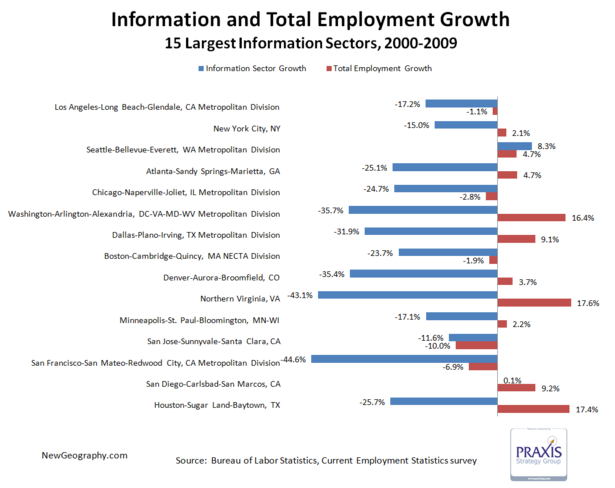
    In the decade between 1997 and 2007, the information sector–which includes jobs in fields from media, publishing and broadcasting to computer programming, data processing, telecommunications and Internet publishing–has barely created a single new net job, while some 16,000,000 were created in other fields.

    The biggest losses have been in the telecommunications sub-field, which has shed 400,000 jobs nationwide since its peak in 2000. Not surprisingly the media and publishing industries have also lost ground, while employment in other arenas such as motion pictures, software and data-processing have remained stagnant for much of the decade.

    Equally critical, it seems clear that simply being a high-tech magnet does not make a region a prodigious job creator. The San Jose metropolitan area, better known as the heart of Silicon Valley, boasted over 960,000 jobs in 1997. Last year, even after the ballyhooed Version 2.0 of the dot-com boom, that number had actually declined–to barely 900,000. According to figures from economic-strategy firm Praxis Strategy Group, other traditionally tech-heavy areas, including San Francisco and Boston, also did poorly in terms of growth through the balance of this decade.

    Perhaps most disturbing, many areas are also losing their share of the information industry. For example, the information-sector job count, notes the Public Policy Institute of New York, has actually been stagnant or in decline in places like New Jersey, Connecticut, Illinois, Massachusetts, Minnesota and New York.

    The same pattern also affects so-called “cool” cities that were supposed to be ideal for high-tech jobs, according to a recent study by my colleagues at Praxis. The biggest declines in information jobs since 2000 have occurred in San Francisco (which lost 31,800 jobs), Northern Virginia (35,200) and Washington, D.C. (40,700).

    Silicon Valley dropped 5,400 positions since 2000, which amounts to 11.6% of all its information-sector jobs. The only bright spot for blue states is in Washington, where growth is driven by big employers Microsoft and Boeing. Los Angeles, buoyed by the relatively stable entertainment sector, has also managed to hold its own.

    Faced with all these cities that are merely struggling not to lose any jobs, just where is the tech-sector growth? It’s in less-celebrated areas of the country, like Idaho, New Mexico, North Carolina, Nevada–and in parts of Florida, South Dakota and South Carolina. By region, the fastest gainers turned out to be places like Orlando, Fla. (with 2,176 new information jobs since 2000), Madison, Wis. (2,400), Boise, Idaho (1,500), Wilmington, N.C. (1,267) and Charleston, S.C. (1,033).

    What distinguish most of these places are factors beyond prominent employers. These could include such prosaic things as tax rates (particularly on incomes), the cost of housing and the overall climate toward business. Information-sector jobs, it turns out, follow the basic rules of economic development seen in other industries.

    Of course, this is not to say tech jobs don’t matter. As the Milken Institute’s Ross DeVol argues in his new study of high-tech centers, technology jobs pay better than most, and their presence can boost other parts of local economies. And although they may not be multiplying fast, in some centers, like Silicon Valley, Boston and Southern California, whatever employment already exists has enough inertia to allow them to remain the largest tech centers in the country.

    Yet the problem is that the information economy, by itself, simply doesn’t reliably spur broader economic growth. That may be due to changes within the sector itself. From the 1980s to the mid-1990s, tech firms largely focused on creating productivity-enhancing products. Many of them also used on-shore manufacturing. Aerospace was a smaller industry, but it was still vital.

    These catalysts helped create dynamic companies that both employed large numbers of people directly and used contractors (whose numbers increased). The Silicon Valley I reported on in the mid-1980s housed an essentially industrial economy with many good jobs for middle- and working-class people. It was both a hotbed for pioneering entrepreneurs and a society that offered and encouraged opportunity.

    Today, however, tech has become increasingly software- and media-oriented. New companies tend to emerge from a small pool, and they are financed by a relative handful of local venture capitalists. Once launched, they may conduct some research and development at home, but marketing and customer service are either off-shored or moved to remote locations like the Great Plains or the “Intermountain West,” between the Cascades and the Rockies.

    As a result, even star companies like Google create a far smaller number of jobs than predecessor firms like Hewlett Packard, Intel or IBM. And even newer companies like venture darling San Francisco-based Twitter may go public, valued at $250 million or more, with only 45 employees.

    This, of course, represents very good news for a select few: investors and a handful of highly educated software engineers. But the Bay region’s broader economy and society isn’t as lucky.

    That’s because most segments of the information sector that do create lots of jobs tend to take place elsewhere. For example, when Intel considers opening a new chip plant, which could open up 7,000 new positions, it won’t build it in the Valley of its birth but rather in farther-flung locales like Oregon, Arizona and New Mexico. California has become too expensive; businesses there are heavily regulated and taxed for most industrial activity.

    So maybe it’s time to unlearn some of the assumptions we developed during the first tech boom. In the 1990s and early 2000s, many held that the information revolution would tame the business cycle, guarantee constant high returns and create widespread prosperity. Now we know better.

    The model of Silicon Valley, as DeVol suggests, cannot be easily duplicated. Another well-promoted formula, linking great universities to up-and-coming hip cities for the so-called “creative class,” has proved very limited when it comes to creating new jobs. And, anyway, trends in tech growth suggest that basic economic conditions like general affordability, taxes and the regulatory environment play an important role.

    Just as troubling may be the class divisions on display in places like Silicon Valley. As manufacturing and middle management jobs have fled, its capital, San Jose, has become more of a backwater. As local blogger Adam Mayer has pointed out, San Jose increasingly serves as a dormitory for the bottom-feeders of the Silicon Valley food chain.

    In contrast, tech power and influence is shifting to those areas that have always been well-to-do and are likely to stay that way–academically-oriented places like Cambridge, Palo Alto and San Francisco. They are becoming ever-more-exclusive reserves for the restless young and those with the greatest talent within the media and software industries. Meanwhile, the service class commutes in from the surrounding periphery to tidy up and run restaurants, while high housing costs and an overall lack of opportunities for other kinds of workers drive away much of the middle class, particularly families.

    In geographic terms, the real losers in this brave new tech world may be the communities on the fringes of those high-end tech areas. Take Lowell, Mass. Lowell, a former mill town widely celebrated for its tech-led revival in the 1980s, has seen little job growth since the late 1990s. But why pick Lowell, when it’s far cheaper and easier to expand in Boise or, even better, Bangalore, India?

    The time has come to let go of vintage fantasies about tech that date from the 1990s. Key regions–and the country as a whole–need to understand that the information sector is best seen not as an end in itself but as an industry that derives its value from how it works with other parts of the economy, such as finance and business services, agriculture, energy, manufacturing, warehousing and engineering. (Manufacturing alone employs 25% of the U.S.’s scientists and 40% of its engineers–and their related technicians.) We have to nurture a broad industrial base so that innovations in this sector do not simply end up boosting off-shore industry.

    Techies won’t save us from the folly of deindustrialization; in essence, we can no longer believe that it’s possible to Google our way to prosperity.

    This article originally appeared at Forbes.

    Joel Kotkin is executive editor of NewGeography.com and is a presidential fellow in urban futures at Chapman University. He is author of The City: A Global History and is finishing a book on the American future.