Category: Small Cities

  • The Changing Landscape of America: The Fate of Detroit

    INTRODUCTION

    During the first ten days of October 2008, the Dow Jones dropped 2399.47 points, losing 22.11% of its value and trillions of investor equity. The Federal Government pushed a $700 billion bail-out through Congress to rescue the beleaguered financial institutions. The collapse of the financial system in the fall of 2008 was likened to an earthquake. In reality, what happened was more like a shift of tectonic plates.

    In 1912 a German scientist, Alfred Wegener, proposed that the continents were once joined together as one giant land mass called Pangea.

    About 200 million years ago the continents began to drift apart as the globe separated into eight distinct tectonic plates. History will record that the financial tectonic plates of our world began to drift apart in the fall of 2008. They have not stopped moving and the outcome of where they will end up remains uncertain.

    PART ONE – THE AUTOMOBILE INDUSTRY

    Edsel, Packer, Studebaker, Hudson, Nash, AMC – the demise of these brands may have seemed tragic at the time, but were actually a sign of industrial health. In contrast, for the last fifty years the American automobile industry has been static. Despite the proliferation of Japanese, Korean and German imports, General Motors, Ford and Chrysler managed to hold on to a majority of the domestic market, with a dizzying stable of makes and models that grew to near 17 million new car sales in 2007. That epoch is now over. The tectonic plates have shifted under the automotive business and a year from now, the industry will bear little resemblance to the static structure of the last fifty years.
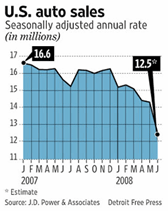
    Fifty years ago General Motors owned more than 50% of the American market and automobile jobs made up one seventh of the US workforce. It was said that when GM sneezed the US economy caught a cold. GM shares now sell for less than a cup of coffee at Starbucks. Now GM is about to enter bankruptcy.

    The brands are dissolving, Oldsmobile was the first casualty. Pontiac and Hummer have been discontinued. When they reorganize, eleven hundred dealers will be terminated. General Motors will close all its plants for three months this summer. Many will never reopen. The New GM, to be known as Government Motors, will be owned by the UAW (20%) and the Federal Government (70%). Twenty billion of tax-payer loans will be converted to ownership to make the UAW pensions liquid. The debt holders will see their senior $27 billion investment converted into just 10% of stock. The shareholders will be wiped out.

    The New GM will become the platform for small fuel efficient cars, hybrids, electric vehicles and experimental technologies mandated by an ever demanding government. Its shareholders vanquished, The New GM will bear no resemblance to the car company that we have known for the last 50 years. Can the Chevy Volt rescue GM? The answer is no.

    GM will continue to shrink as their SAAB and Saturn franchises are sold off to the Chinese. China’s automobile sales are up 10% this year versus declines of 23% in the US and 15% in Europe. Chinese automobile manufacturers are grabbing market share, 30% this year versus 26% in 2008, while their competitors are distracted. Chinese companies unknown to Americans like Geely Motors, Chery Automobiles or BYD Co. will buy SAAB or Saturn for their dealer network. Warren Buffett invested $230 million into BYD, a firm that has been manufacturing cars for just six years. They already provide batteries to Ford and GM and soon will be building the world’s least expensive mass produced hybrid and electric vehicles. Geely plans to triple its domestic sales to 700,000 by 2015 and Chery plans to introduce 36 new models over the next two years.

    Chrysler is in far worse shape and will likely never recover. The Federal Government already forced it into bankruptcy. Seven hundred and eighty nine dealers have been told that their franchises are terminated. Its shotgun marriage to Fiat will look more like a surgical amputation of unnecessary body parts than a marriage. If Fiat remains in the game, they will do so for the Jeep brand and a portion of the dealer network. Like Oldsmobile and Pontiac, Plymouth and Dodge brands are doomed as well as most of the Chrysler line. No one will mourn the demise of the Crossfire, Pacifica, Sebring, or the PT Cruiser. Fiat should keep the new Chrysler 300, a beautiful design that deserves to be built. Chrysler has not produced many stars in the last few decades. The trail blazing design of the 300 brought the full size sedan back from the dead.

    Chrysler will jettison the weakest of its dealers in bankruptcy. Fiat will retain the big dealers in the network. They will bring the stunning and iconic Fiat 500 to America, a fuel efficient small car that will enjoy the same success as Volkswagen’s retro Beetle. Fiat will also use the dealer network to bring the Alfa-Romeo back to America. The Fiat-Jeep-Alfa dealer of the future will bear no resemblance to the staid Chrysler-Dodge-Plymouth dealer of today.

    The surprising winner among the American troika of manufacturers is the Ford Motor Company. Ford and Lincoln will survive because they took no government bail-out money. Mercury may not survive but Ford and Lincoln should make it through the transition. The new Ford-Lincoln will be the refuge for auto enthusiasts who want attractive fast and powerful cars. Ford will become the Apple of the auto business, doing its own thing and flaunting political correctness and conventional wisdom. Ford’s namesake CEO has been an environmentalist for many years so Ford was well into fuel economy and hybrids before the tectonic plates began to move last fall. At just $5.00 per share, Ford is a tantalizing buy for the long term.

    One can no longer call Mercedes, BMW, Toyota and Honda imports as many of their cars are made entirely in the U.S. The Japanese system is different than the American counterpart although we are drifting toward their model. The Japanese government plays a heavy hand in their industry, subsidizing the encroachment into new markets until the brands have stabilized market share. But they are not immune. Toyota lost $7.7 billion in the last quarter – even more than GM.

    True imports like Volkswagen will weather the storm because they were well positioned with small fuel efficient cars long before the tectonic plates began to shift. VW is making a huge bet that oil will top $100/barrel again soon and their fuel efficient and clean diesels will be accepted by American drivers.

    The biggest winner is obviously the UAW and their pensions which have been bailed out with tax payer money by an administration beholden to its labor supporters. Who will be the biggest loser? Clearly, it will be America’s small towns. Our small towns will lose their local dealer and their choice in automobiles. They will be forced to buy the brand that remains in town or drive scores of miles to the next closest dealer for service. Most small town auto dealers were also the most generous members of the community. Charitable giving and support will wither as will local sales tax revenues when the big ticket automobile sales tax revenues disappear. Ironically, as the plates continue to shift, America’s small towns could be decimated by the changes in the automobile industry as they were one hundred years ago when the automobile shifted millions from rural communities to the cities.

    A year from now the landscape of America will be forever changed but the plates will continue to shift. Five years from now, will American ingenuity bring about a renaissance of the American automobile industry? Or, will what is left of this industry be gobbled up by the Chinese and the Korean manufacturers as the Japanese did in the 70s and 80s? The key issue may be what role the government will play. Will Americans buy cars designed by government bureaucrats and built by the unions that own the factories? Will an administration devoted to “coercing” Americans out of their cars be able to simultaneously save the auto industry?

    ***********************************

    This is the first in a series on the Changing Landscape of America. Future articles will discuss real estate, politics, healthcare and other aspects of our economy and our society. Robert J. Cristiano PhD is a successful real estate developer and the Real Estate Professional in Residence at Chapman University in Orange, CA.

  • Let’s Snooker The TARP Babies

    Snook, Texas, a town of less than 600 souls, is best known for being the home of Sodalak’s Country Inn, the originator of country fried bacon. It may seem an odd place to launch a return to financial health, but that’s exactly what Dean Bass has in mind.

    Bass, a veteran banking entrepreneur from Houston, in November bought the tiny First Bank of Snook as part of his plan to build a new financial powerhouse amid the worst economic downturn in a generation. The old bank, which also had a branch 15 miles away in College Station, home to Texas A&M, provided Bass with his charter, as well as access to a strong market on the far periphery of his home town.

    Since buying into Snook’s bank, now renamed the Spirit of Texas Bank, Bass opened a new branch in the Woodlands, northwest of Houston. Over the past six months, the new bank’s assets have doubled to over $70 million, and by the end of the year he expects to break $100 million. Longer-term plans include expanding as well into Austin, Fort Worth and other major Texas markets.

    Bass’ basic strategy: Take advantage of the stumbling TARP-funded banking giants and steal what he calls their “disenfranchised customers.” This approach has implications well beyond the Lone Star State. Like other successful community bankers across the country, Bass believes that the mega-banks have been hopelessly tarred by TARP taxpayer funds. They have been revealed to be, if too big to fail, also too incompetent and poorly run to trust.

    “This is one of the worst banking markets I have ever seen–but the best for people like me,” said Bass, who sold his last venture, Houston-based Royal Oaks Bank, for $38.6 million in 2007. “When else would you see A+ customers fleeing places like Bank of America, Chase and Citi? People can’t even understand their balance sheets and stress tests. Their customers are ready to move on.”

    Over the next few years, the emergence of banks like Spirit of Texas could prove the silver lining in the largely bungled Bush-Obama bail out of the big financial companies. Ironically, the attempt to shore up the mega-dinosaurs has revealed these mega-banks to be creatures of little brain and even less principle. They now seem more akin, as economist Simon Johnson has pointed out, to Third World crony capitalists than paragons of free enterprise.

    In comparison, independent, non-TARP banks like the Spirit of Texas appear like paragons of traditional capitalist virtue and homespun values. For the time being, their rise will be most notable in “the zone of sanity,” the vast range of territory between south Texas to the Great Plains, which largely resisted the housing and stock asset bubbles of the past decade.

    In this region, most homes are well above water and many businesses–in everything from agriculture and energy to manufacturing and high-end business services–remain on solid footing. Of course, notes Randy Newman, president and CEO of Grand Forks, N.D.-based Alerus Financial, many local companies have been slowed by the recession. However, for the most part, places like the Dakotas and Texas enjoy relatively low unemployment and foreclosure rates, making them relatively good places for cultivating new customers.

    Politics and a sense of propriety also may play a role for resurging community banks. In places like the Great Plains, people prefer old-fashioned shots of banking fundamentals to the exotic financial cocktails concocted by the “genius” financiers on the coast. Politicization of banking is even less popular than elsewhere.

    “For the government to come out and stimulate the economy seems OK, but you think, jeepers, this TARP business makes little sense,” says Newman, whose bank enjoys assets of roughly $750 million. “TARP,” he adds, “is simply prolonging or delaying what has to happen. The walking dead will have to die sometime.”

    Uncertainty about the big banks, Newman believes, is leading customers, particularly smaller firms, to rediscover the merits of old-fashioned relationship banking. At banks like his, each loan is scrutinized not only by formula but also by things such as character, markets and a firm’s record of accomplishment.

    “The big banks will tweak their standards system-wide. There are no individuals in their book,” says Newman.” The big banks are geared to mass markets and big customers. But if you are looking at the $1 to $5 million loan a small business wants, the big bank does not look at you as an individual.”

    This up close and personal approach may seem laughably archaic to the once-celebrated “genius” quant jocks and bonus baby M.B.A.s on Wall Street–and perhaps also the brainy financial types running the Obama economic team. Yet if a sustainable private sector economic recovery is to take hold, the key may well lie with smaller bankers who can help small firms survive the recession

    Of course, the administration’s favoritism of the big boys also creates some real problems to community banks. Some fear the mega-banks will use TARP funds to acquire better-run, local institutions. Newman calls this prospect a “travesty.” Given their awful real balance sheets, Newman believes, banks like Citicorp and Bank of America “really shouldn’t be in a position to grow, much less expand.”

    So here’s a better course. Let these giants shrink or even fail. Let their insured depositors seek out new banking relations; with the stronger, well-run community banks. It’s widely believed that some 500 to 1,000 smaller banks may fail in the next year or so, so why not some big boys, too?

    Many economists, both right and left, including Nobel Prize winner Joseph Stiglitz, have urged this course. It would pave the way for well-run banks to expand at the expense of the incompetent and venal. Competition, after all, is supposed to be the basis of capitalism.

    Right now, the zone of sanity probably offers the best chance for this capitalist revolution. However, the shift to smaller banks may prove even more important in reviving the epicenters of lunacy, such as my adopted home state of California. Here, little banks like the privately held Montecito Bank and Trust are quietly expanding as customers leave the TARP babies for an institution a little more personal and grounded in sound banking principles. “Better boring than broke,” jokes Janet Garufis, Montecito’s president and CEO.

    It also helps to be local, she notes, even in a mega-state like California. Much of the damage to the TARP banks came when they bought into sliced and diced mortgages in locations they didn’t know. It turns out that local knowledge counts–not only in real estate, but in deciding about the right business to back.

    “The differences between a big-box bank and community are the difference of night and day,” suggests Garufis, who spent 35 years with Security Pacific, a onetime L.A. area powerhouse. “People like to see the whites of the eyes of the people they are doing business with. We know the community. We are part of it, and we understand what is going on here.”

    Of course, being local, smart and disciplined may not be enough for all these upstart banks. The failures of the mega-banks have increased the costs of things like FDIC insurance for even well-run institutions–in Montecito’s case, from $400,000 to $1.2 million over the past year. Equally challenging, TARP funds are helping the big boys offer slightly higher rates for mass-market products like CDs.

    Rather than focus on saving their Wall Street friends, the administration needs to allow an upsurge in smarter, smaller and better-run banks. Let us give these grassroots capitalists a chance and see what they can do.

    The road to a financial and economic recovery does not run through Wall Street and K Street, which, after all, are the primary originators of our distress. It lies in places that look more like Snook–even if country fried bacon is not to your taste.

    This article originally appeared at Forbes.

    Joel Kotkin is executive editor of NewGeography.com and is a presidential fellow in urban futures at Chapman University. He is author of The City: A Global History and is finishing a book on the American future.
  • Suburbs and Cities: The Unexpected Truth

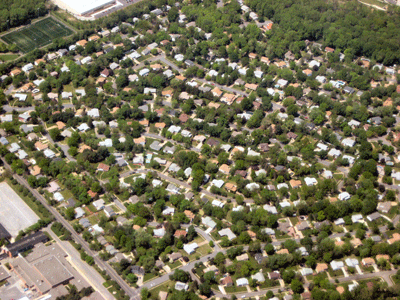
    Much has been written about how suburbs have taken people away from the city and that now suburbanites need to return back to where they came. But in reality most suburbs of large cities have grown not from the migration of local city-dwellers but from migration from small towns and the countryside.

    It is true that suburban areas have been growing strongly, while core cities have tended to grow much more slowly or even to decline. The predominance of suburban growth is not just an American phenomenon, but is fairly universal in the high income world).

    This is true in both auto-oriented and transit oriented environments. Suburbs have accounted for more than 90 percent of growth in Japan’s metropolitan areas with more than 1,000,000 residents, both those with high transit market shares and those with high auto market shares, The same is true in Canada, Australia and New Zealand.

    In Western Europe, where vaunted transit systems carry a far smaller share of travel than cars, all growth and then some has been in the suburbs, as overall core city populations have declined. Indeed, the same trend is well underway in middle and lower income world urban areas. In such places as Mexico City, Sao Paulo, Buenos Aires, Manila, Shanghai, Kolkata, and Jakarta, nearly all population growth has occurred in the suburbs, rather than the core cities.

    As the world faces a more expensive energy future and as efforts are intensified to reduce greenhouse gas (GHG) emissions, it is sometimes suggested that people need to “move back” to the cities. This is a dubious and needless strategy, which reveals a fundamental misunderstanding of the dynamics of metropolitan growth.

    Most suburban growth is not the result of declining core city populations, but is rather a consequence of people moving from rural areas and small towns to the major metropolitan areas. It is the appeal of large metropolitan places that drives suburban growth.

    Larger metropolitan areas have more lucrative employment opportunities and generally have higher incomes than smaller metropolitan areas. This is particularly the case in developing countries. As a result, the big urban areas attract people seeking to escape what are often the stagnant or even declining economies in smaller areas.

    There are, of course, significant individual exceptions. Virtually all of the first world core cities that have achieved a population of more than 400,000 – if they have not expanded their boundaries and did not have substantial empty land for development – experienced losses to 2000. Yet even in most of these cases, the majority of suburban growth was from outside the metropolitan areas, rather than from the core cities. For example:

    • St. Louis is a champion among the ranks of population losers, having lost the greatest percentage of its population of any large municipality in the world, (dropping from nearly 860,000 in 1950 to 350,000 in 2000). Indeed, it may be fair to say that St. Louis has lost more of its population than any city since the Romans sacked Carthage. Yet, even in St. Louis, 60 percent of suburban growth was from outside the metropolitan area, rather than from the city.
    • Few core cities have lost the nearly 1,000,000 residents that have fled Detroit since 1950. Yet, even in Detroit, 65 percent of suburban growth was from outside the metropolitan area, rather than from the city.
    • The city of Chicago lost 725,000 residents between 1950 and 2000, yet 82 percent of the suburban growth was from outside the metropolitan area.
    • The city of Philadelphia lost 550,000 residents between 1950 and 2000, yet 76 percent of the suburban growth was from outside the metropolitan area (See lead picture of Philadelpia downtown).

    • The central city of Paris lost approximately one-quarter of its population from 1965 to 2000 (675,000), while the suburbs gained nearly 3,850,000 residents. More than 80 percent of suburban Paris growth came from outside the region.
    • The central city of Lisbon experienced a 30 percent population decline from 1965 to 2000. Yet suburban Lisbon’s growth was 80 percent from outside.
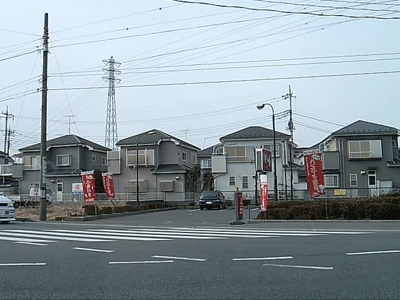
    • Stockholm was another losing core city, yet more than 90 percent of the suburban growth came from smaller towns and cities.
    • Despite Zurich’s nearly one-quarter population loss 83 percent of the suburban gains derived from outside the region.
    • The core city of Tokyo (which really doesn’t exist except as 23 separate subdivisions or kus of a city abolished during World War II) lost more than 700,000 residents from 1965 to 2000. Tokyo’s suburbs, however, attracted more than 90 percent of their growth from region.

    In some metropolitan areas, smaller towns and rural areas contributed less to suburban growth. In Amsterdam, 50 percent of the suburban growth was from outside the metropolitan area. In Copenhagen, the number was 40 percent of the suburban growth while in Birmingham (UK) only 30 percent of the suburban gain was from outside.

    In a few cases, both the core city losses were greater than the suburban gains, such as in Pittsburgh, Liverpool and Manchester. In these cases, it is fair to attribute all of the suburban gains to core city losses.

    Unlike the cases above, however, most core cities gained population. This includes all in Canada, Australia and New Zealand and many in the United States. As a result, none of the suburban growth in the corresponding metropolitan areas can be attributed to an exodus from the city, because there, on balance, was no exodus.

    Suburbanization is often characterized as reducing densities, but in fact it has done just the opposite. Most suburbanites come from smaller places; they may prefer suburbs because they are less dense, safer, or simply more manageable than the core cities. But they are also, almost invariably, more dense than where they lived before. Suburbanization is thus a densifying dynamic, albeit one that is less dramatic than preferred by many planners and architects.

    In this sense, suburbs have to be seen not as the enemies of the city, as just a modern expression of urbanization. They are neither the enemies of the city, nor are their residents likely to move “back” there. You cannot move back to someplace you did not come from.

    Wendell Cox is a Visiting Professor, Conservatoire National des Arts et Metiers, Paris. He was born in Los Angeles and was appointed to three terms on the Los Angeles County Transportation Commission by Mayor Tom Bradley. He is the author of “War on the Dream: How Anti-Sprawl Policy Threatens the Quality of Life.

  • America’s (Sub)Urban Future

    Cities today have more political clout than at any time in a half century. Not only does an urbanite blessed by the Chicago machine sit in the White House, but Congress is now dominated by Democratic politicians hailing from either cities or inner-ring suburbs.

    Perhaps because of this representation, some are calling for the administration and Congress to “bail out” urban America. Yet there’s grave danger in heeding this call. Hope that “the urban president” will solve inner-city problems could end up diverting cities from the kind of radical reforms necessary to thrive in the coming decades.

    Demographics and economics make self-help a necessity. Despite the wishful thinking of urbanophile pundits and policymakers, central cities have little realistic chance to reclaim their pre-1950 role as the dominant arbiters of American life.

    Short of a catastrophic change, the country will remain predominately made up of suburban, exurban and small town residents. Since 2000, more than four-fifths of metropolitan growth has taken place in suburbs and exurbs. Economically, we see a similar pattern. According to a recent Brookings Institution study of 98 large metropolitan areas, only 21% of employees work within three miles of downtown. The report found that only three regions avoided the decentralizing trend.

    The Brookings report and many others decry all these trends as promoting “sprawl,” but name-calling will not assure that urban areas can impose their political hegemony over the long run. The Obama administration may try to boost cities by imposing barriers to suburban growth, but these seem doomed to failure given both the preference of most Americans for lower-density lifestyles and the president’s demonstrated ability to count votes.

    Rather than waiting for Barack, urban boosters should instead take up the New Testament injunction to “heal thyself.” Cities should have a chance to grow based on the roughly 10% to 20% of Americans who tell researchers they would like to live in a dense urban environment. With an extra 100 million Americans coming on line by 2050, cities could look forward to accommodating upwards of 20 million more people in the next few decades. As my grandmother would say, that’s not exactly chopped liver.

    Yet in order to enjoy this repast, cities will need to address three fundamental and inextricably related issues: public safety, business climate and political reform. Of these, public safety is the most critical. From the earliest times, security has represented a critical pre-condition for urban success. The huge surge in urban crime during the 1960s, for example, played an enormous role in the precipitous decline of cities in the ensuing decades.

    Conversely, improvements in public safety after 1990–notably in New York and Los Angeles but also in other large cities–helped slow the out-migration from urban cores and attract new residents, mostly young educated professionals and immigrants. Now urban crime may be on the rise, and could again threaten new growth.

    This is worrying because urban crime rates, notes demographer Wendell Cox, remain still three times higher than those of surrounding suburbs. Almost all the highest crime areas in America can be found in urban settings, while the safest places tend to be in suburban towns.

    Even the president’s much-celebrated hometown of Chicago suffered roughly a murder a day last year. On the city’s MTA trains, robbery soared 77% between 2006 and 2008. Now there’s also more than a stickup a day.

    Hard economic times may exacerbate these problems, with an estimated 250,000 more Chicagoans predicted to fall into poverty by the end of the year. More widely, unemployment among core urban populations–young people, minorities and immigrants–is on the rise, even more than in the general population. Indeed, for the first time since the mid-1990s, the foreign born now suffer a higher rate of joblessness than the native born.

    Yet even in the face of a tough economy, few cities seem to focus on long-term middle-class job creation. Most seem to prefer to indulge in marginally useful taxpayer-subsidized prestige projects like convention centers, arts complexes, ball parks and arenas. Meanwhile, the core issues stifling growth–high taxes, stiff regulatory burdens and sometimes corrupt governments–remain largely ignored.

    Recently while researching the middle class in New York, I met many otherwise committed urbanites considering leaving to less costly, lower-tax and more business-friendly locales. Up until recently, this problem was somewhat obscured by spectacular earnings on Wall Street, which engendered the growth of an extensive “luxury economy” largely insulated from high costs. But even Timothy Geithner won’t be able to bail out this favored segment of the economy ad infinitum.

    Instead cities, including New York, will have to diversify to less gilded industries. Increasingly cities will need to rely on small companies, micro-enterprises and self-employed high-tech artisans to drive their economies. To keep them there, they will need to attend to basic services–education, police and transportation–while managing to curb taxes and regulations.

    This will necessitate confronting the largest source of high city costs: public employee salaries and pensions. This problem is not unique to core cities, but tends to be more severe in urban areas where public employee unions often dominate local politics.

    Finally, cities need to address their educational systems. Despite all the talk of urban educational reform, the urban dropout rate, according to a recent study of the nation’s largest cities by America’s Promise Alliance remains around 50%, roughly 20 points higher than the rate for suburbs. Poor-quality urban schools drive out both the middle class and the most upwardly mobile segment of the working class.

    Even more money from Washington won’t solve this problem. Cleveland, with a 38% graduation rate, spent far more on students per capita than Ohio’s statewide averages. In contrast, the surrounding suburbs enjoyed an 80% graduation rate.

    Are cities capable of changing their governance for the better? In the 1990s, the emergence of tough, reform-minded mayors like New York’s Rudy Giuliani, Indianapolis’ innovative Steven Goldsmith, Richard Riordan in Los Angeles and Houston’s hard-driving Bob Lanier all sparked urban revivals in their cities.

    Today, however, there are few such personages; Houston’s Bill White is one glaring exception. Yet without an infusion of bold new leadership, the future of American cities, although not universally bleak, will not be nearly as bright as it should be. Rather than a constellation of strong, reviving cities, we can envision the emergence of a less promising set of scenarios.

    One archetype will be the Bloombergian “luxury city,” a very expensive urban area dominated by the wealthy and their servants, students and nomadic young workers as well as the poor. The affluent will drive this growth, but only in a relatively few neighborhoods in attractive places like New York, Chicago, Boston, Los Angeles, Seattle, Portland, Denver and Minneapolis.

    San Francisco may presage this urban form. Already middle-class families are becoming scarce in the city by the bay. The place seems increasingly something of a Disneyland for privileged adults, exempting of course the large homeless population. “A cross between Carmel and Calcutta,” jokes California historian and San Francisco native Kevin Starr.

    At the opposite end of the spectrum lie those cities consistently at the bottom of our Worst Cities For Jobs ranking. Despite some zones of gentrification, such once-great cities as Detroit, Cleveland, Memphis, Baltimore and Philadelphia could continue to suffer persistently high rates of poverty, diminished populations and high crime rates.

    Not that this has to be. These areas could stage a real resurgence if their governments determine to throttle criminals, improve basic services and nurture small businesses. Low housing prices, cheap land and, in some cases, strategic locations could attract businesses as well as some of the millions who will be seeking out an urban lifestyle in the coming decades.

    Currently the brightest hopes for America’s urban future lie with newer, “aspirational,” middle-class-oriented cities such as Houston, Dallas, Austin, Phoenix, Raleigh-Durham, Charlotte and Orlando. Although some are now suffering from the recession, these places will benefit from both lower costs and more business-friendly regimes. Primarily suburban in nature, many of these cities have worked to develop attractive dense urban districts, which could expand much further over the next few decades.

    There remains nothing pre-determined about the urban future. Some cities may surprise us by reviving strongly while others may continue to disappoint. Success will depend not on Washington, but on how each city addresses the basics of safety, economics and governance. Grasping this fundamental truth constitutes the first step towards creating a sustainable long-term urban resurgence.

    This article originally appeared at Forbes.

    Joel Kotkin is executive editor of NewGeography.com and is a presidential fellow in urban futures at Chapman University. He is author of The City: A Global History and is finishing a book on the American future.

  • New Towns and New Lives in the Country

    Back in the 1950s when I was growing up, pundits worried a lot about automation and the problem of leisure in a post-industrial society. What were the American people going to do once machinery had relieved them of the daily burden of routine labor? Would they paint pictures and write poetry? Armchair intellectuals found it hard to imagine.

    It was the age of Ozzie and Harriet, when ordinary working and middle-class families could aspire to a house in the suburbs and a full-time Mom who stays at home with the kids. Today, of course, that popular version of the American dream is a thing of the past, especially the part about a full-time Mom who stays at home with the kids.

    Ironically it was washing machines and automatic dishwashers – automation – that brought this idyll to an end. These two labor saving devices made it possible for housewives to go out into the workforce and compete with their husbands. At first they did it because they were bored at home and wanted to earn extra money, if only to help pay for those new household appliances. Gradually, however, it became a matter of necessity as two-paycheck families bid down wages even as they jacked up the price of suburban real estate in areas where the schools were good and the neighborhoods safe. By the time you subtracted the costs of owning a second automobile and using professional child care services, the advantages of that extra paycheck had largely disappeared.

    The biggest surprise – to me as well – was that labor-saving technologies do not automatically redound to the benefit of labor. Other things being equal they reduce the demand for labor and hence its price in the marketplace. We saw this happen in the 19th century when modern agricultural machinery forced three-quarters of the population off their farms and into the cities, where they had to compete with immigrants and each other in the new industrial economy. Not until the Fair Labor Standards Act of 1937, which outlawed child labor and established the 40 hour work week, did the world of Ozzie-and-Harriet become a democratic possibility.

    But of course Modern Marvels never cease. Thanks to a never-ending supply of new labor-saving machinery, today’s industry employs only half as many people as it did in the 1950s when housewives first started entering the job market. Meanwhile medical science has greatly extended the average human lifespan, which has created a much larger pool of able-bodied adults who must either work or be supported by those who do. The Wal-Martization of retail and wholesale trade is yet a third development tending in the same direction.

    Given this trajectory, perhaps it is time to consider a further reduction of the standard work week and the creation of new forms of suburban development. The goal would be for ordinary working families to begin enjoying the fruit of fifty years of economic and technological progress.

    In particular let us consider the advantages of a program to build new towns in the exurban countryside in which people would be employed half-time (18-to-24 hours a week) outside the home, and in their free time would participate in the construction of their own houses, cultivate gardens, cook and eat at home, and look after their own children (and grandchildren) in traditional neighborhood settings close to village greens.

    Once work and leisure are integrated into the fabric of everyday life people will not feel the same need to retire they do today. Instead of retiring in their sixties seniors could take easier jobs as they grow older and continue working for as long as they are able and willing. The Social Security crunch could be relieved without having to raise taxes on the younger generation.

    We might even consider a return to the three-generation form of the family – except under two roofs instead of one, say, at opposite ends of the garden. Grandparents could use their savings to help their children with the initial purchase of their homesteads, while later on their children and grandchildren could help care for them in their old age, providing a more humane (and far more affordable) alternative to nursing homes and assisted-living arrangements.

    And instead of being designed around high-speed automobiles the new towns could be small enough (25,000 to 30,000 inhabitants) and be laid out in such a way that the residents could get around on foot, by bicycle, or in “neighborhood electric vehicles” (souped up golf carts) designed to go 30 mph. In other words, with careful planning the efficiencies of urban density could be realized without forcing people to move back into the dense centers of our cities and surrounding both privacy and space.

    I once hired the Gallup Organization to survey the American public about a lifestyle similar to this. The question asked was the following:

    “As a new way to live in America, it has been suggested that we build our factories in rural areas outside the cities and run them on part-time jobs. Under this arrangement both parents would work six hours a day and three-days a week and in their spare time would build their own houses, cultivate gardens, and pursue other leisure-time activities. How interested would you be in living this way?”

    Forty percent of the population said they would be either “definitely” or “probably” interested in the idea, with another 25 percent expressing possible interest. Included in these figures were two-thirds of those who had attended college, 60 percent of people with incomes in the top quartile, and 80 percent of African Americans.

    Industries might be interested in the idea because part-time workers can work faster and more efficiently than full-time workers, just as in track and field the short-distance runners always run faster than the long-distance runners. When I explained this in a letter to one of America’s leading industrial relocation firms, the executive vice-president flew down to Tennessee the very next day to discuss it with me. He assured me that this was “a doable idea” and not “pie in the sky.”

    Even so building New Towns in the Country is no easy task. It won’t happen spontaneously if for no other reason that people will not move to places where industry does not exist, and industry will not move to places where people do not live. It takes coordination, planning, organization, and investment in infrastructure.

    There is a movement afoot in America for a new nation-wide infrastructure spending program. This proposal could be one part of it. After all, our federal government in the past has done things for the people to create a better way of life: the trans-continental railroad, the Homestead Act, the Interstate Highway System, the Fair Labor Standards Act, and the FHA.

    New Towns in the Country and a much shorter work-week would work well together, even if the two things are impossible to achieve by themselves. We need to reorganize both time and space if we hope to create a healthy, productive way of life for tomorrow’s working families.

    Luke Lea is a retired landscape gardening contractor and one-time professional carpenter. A graduate of Reed College, he lives in the small town of Walden, Tennessee, near Chattanooga where he was born.

  • Main Street Middle America: Don’t Get Mad, Get Ahead

    Like many on Main Street Paul Goodpaster is angry. Paul is my banker friend in Morehead, a retail, medical and education hub on the edge of eastern Kentucky. He observed that his bank was doing quite well – albeit hurt now by rising unemployment and an economy starting to have an impact even on those unglamorous places that had minded their business well.

    “If only some of those ’experts‘ would get out of their inside-the-beltway heads and visit with me here in Morehead, I’d give them ideas on how this October disaster could have been averted. “Too big to fail,” he scoffed. “It should be about too big to have been allowed to do business and thus too big not to fail!”

    So, what can forgotten middle America do about all this mess? Anger won’t get it; and self pity is a waste of time. Only by developing the “swagger” of elbowing our way through the noise can we hope to be heard. We still hear the cacophony of all the blither and blather coming out of the well-connected east coast crowd. Cutting through means learning how we in the “flyover“ zone can position ourselves in the national and global economy.

    The world most assuredly did change – likely in perceptible ways prior to but with an exclamation point in October. In November “we” – with more than a few exceptions in the south and middle country – elected a president that exemplified our hopes and dreams. He was touted as a guy who understands cities and community life better than any in modern history.

    But, all that being said, middle and certainly southern and Appalachian America did not vote for the president. We are a long way – in our economy, our habits and our viewpoints – from Chicago. We are the home of coal and factories and small places far out of the way.

    Our outlook, on the surface, could not be worse. As a community we are out of power and also perhaps out of favor. Yet the world changed for us as well and opportunity abounds for those who are willing and able to fight back. We discovered that (1) we are interdependent with the global community no matter where we are; (2) that the experts don’t all graduate from Harvard and Yale – note the Greenspan bewilderment in October, 2008 and (3) that a new kind of sensibility is emerging.

    As the world grows bewilderingly out of control, people will be seeking places that are affordable and welcome growth. That is where middle America comes in.

    We will have something close to another 100 to 120 million more people in this country by the year 2050. Conventional wisdom would have it that they will all move to glamorous, hip and fast places. But not so fast on that theory. A visit to Owensboro, Kentucky yields a different answer. Set on the Ohio River across from Evansville, Indiana, Owensboro is a town with a unique DNA that has been preserved over the years. With high performing schools and a rich tradition of civic activism, they are planning a major “quality of life” initiative that the Mayor Ron Payne describes as something aimed squarely at children and grandchildren – a statement that bucks the “all about me era.” Owensboro, with a diverse economy that never rode the wave of the “bubble” always minded its Ps and Qs. He is building walking and bike trails and bolstering a downtown that he describes as the living room to the community.

    Owensboro is also home to a world class performing arts center headed up by Zev Buffman, a master producer of over 40 Broadway plays, who made Owensboro his home after visiting the arts center and appreciating its high quality. Zev has convinced Broadway of the wisdom of “staging” plays in Owensboro at a fraction of New York City prices. What is the advantage to Owensboro? Young people can see first hand that life in middle America is not the same as being banished to the boonies. It can also be enriching and connected. As one young man put it: “I can get started earlier in owning a business in a place like Owensboro that would take years or never happen in one of the mega cities where I would just be a cog in the machinery.”

    In middle America, we need to learn that nothing is predictable. But we should have more confidence that we can build expertise at home. People like Mayor Ron Payne and Zev Buffman have taken their entrepreneurial spirit and applied it to an emerging new frontier of America’s battered small- to mid-sized cities in the middle of the country. It’s time for this portion of America to stop getting mad, and start getting ahead.

    Sylvia L. Lovely is the Executive Director/CEO of the Kentucky League of Cities and the founder and president of the NewCities Institute. She currently serves as chair of the Morehead State University Board of Regents. Please send your comments to slovely@klc.org and visit her blog at sylvia.newcities.org.

  • The Worst Cities for Job Growth

    One of the saddest tasks in the annual survey of the best places to do business I conduct with Pepperdine University’s Michael Shires is examining the cities at the bottom of the list. Yet even in these nether regions there exists considerable diversity: Some places are likely to come back soon, while others have little immediate hope of moving up. (Please also see “Best Cities For Job Growth” for further analysis.)

    The study is based on job growth in 336 regions – called Metropolitan Statistical Areas by the Bureau of Labor Statistics, which provided the data – across the U.S. Our analysis looked not only at job growth in the last year but also at how employment figures have changed since 1996. This is because we are wary of overemphasizing recent data and strive to give a more complete picture of the potential a region has for job-seekers. (For the complete methodology, click here.)

    First let’s deal with the perennial losers, the sad sacks of the American economy. Mostly cities in the nation’s industrial heartland, these places have ranked toward the bottom of our list for much of the past five years. Eleven of the bottom 16 regions on our list are in two states, Ohio and Michigan. In fact, the Wolverine State alone accounts for the bottom four cities: Jackson, Detroit, Saginaw and Flint.

    Unfortunately, there’s not much in the way of short-term – or perhaps even medium- or long-term – hope for a strong rebound in those places. President Obama seems determined to give the automakers, for whom Michigan is home base, far rougher treatment than what he meted out to ailing companies in the financial sector.

    In addition, new environmental regulations may not help auto production, since it necessitates some carbon-spewing and therefore perhaps unacceptable levels of greenhouse gas emission.

    However, not all of Michigan’s problems stem from Washington or the marketplace. Many of the locations at the bottom of the list remain inhospitable to business. To be sure, housing is cheap – in Detroit, property values are fast plummeting toward zero – but running a business can be surprisingly expensive in these hard-pressed places.

    In fact, according to a recent survey by the Tax Foundation, Ohio has an average tax burden roughly similar to New York, California, Massachusetts and Connecticut. But while the others are comparatively high-income states, Ohio residents no longer enjoy that level of affluence.

    Can these places come back? It is un-American to abandon hope, but there needs to be a radical shift in strategy to focus on creating new middle-class jobs. Some Midwestern cities, like Kalamazoo and Indianapolis, have made some successful efforts to diversify their economies, encouraging start-ups and trying to be business-friendly.

    But those are exceptions. Cleveland, one of our worst big cities, could spark a renaissance by revamping its port and nearby industrial hinterland. Once the world economy improves, it could re-emerge – building on the existing knowledge and skills of its production- and design-savvy population – as a hub for manufacturing and exports.

    But right now, Cleveland does not seem to be pursuing such opportunities. As Purdue’s Ed Morrison has pointed out, local leaders there seem to “confuse real estate development with economic development.”

    So Cleveland will focus on inanities such as convention business and tourism, believing we all fantasize about a week enjoying the sights along Lake Erie. Yet even high-profile buildings like the Rock and Roll Hall of Fame and Museum, completed in 1986, have not transformed a gritty old industrial town into a beacon for the hip and cool.

    Old industrial cities like Cleveland are better off focusing on their locational advantages – access to roads, train lines and water routes – while offering a safe, inexpensive and friendly venue for ambitious young families, immigrants and entrepreneurs.

    Meanwhile, cities with formerly robust economies – like Reno, Nev., Las Vegas, Orlando, Fla., Tampa, Fla., Fort Lauderdale, Fla., West Palm Beach, Fla., Jacksonville, Fla., and Phoenix – are more likely to rebound. These areas topped our list for much of the 2000s; their success was driven first by surging population and job growth and later by escalating housing prices.

    But the collapse of the housing bubble and a drop in large-scale migration from other regions has weakened, often dramatically, these perennial successes. “We could rely on 1,000 people a week moving into the area,” notes one longtime official in central Florida. “These people needed services, houses and bought stuff. Now the growth is a 10th of that.”

    Instead of waiting for the real estate bubble to return, these areas should choose to focus on boosting employment in fields like medical services, business services and light manufacturing. In much of Florida and Nevada, there’s also a need to shift away from a reliance on tourism, an industry that pays poorly on average and is always subject to changes in consumer tastes.

    We can even be cautiously optimistic about some of these former superstars. After all, observes Phoenix-based economist Elliot Pollack, the existing reasons for moving to Arizona, Nevada or Florida – warm weather, relatively low taxes and generally pro-business governments – have not disappeared. “There’s no change in the fundamentals,” he argues. “It’s a transition. It’s ugly, and there’s pain, but it’s still a cycle that will turn.”

    Once the economy stabilizes, Pollack says he expects the flow of people and companies from the Northeast and California to Phoenix and other former hot spots will resume, once again lured by inexpensive real estate, better conditions for business and a generally more up-to-date infrastructure.

    The Problem with California
    So what about California? The economic well-being of many metropolitan areas in the Golden State has been sinking precipitously since 2006. This year, three California regions – Oakland, Sacramento and San Bernardino-Riverside – have sunk down into the bottom 10 on the large cities list. That’s a phenomenon we’ve never seen before – and never expected to see.

    Like other Sun Belt communities, California suffered disproportionately from the housing bubble’s bust, which has devastated both employment in construction-related industries as well as much of the finance sector. But some, like economist Esmael Adibi, director of the Anderson Center for Economic Research at Chapman University, where I teach, think a real estate turnaround may be imminent.

    Among the first to predict the potential for a real estate bubble back in 2005, these days Adibi is more upbeat, pointing to rising sales of single-family homes, particularly at the lower end of the market. California’s inventory of unsold homes is now down to about six months’ worth, a figure well below the national average of 9.6 months.

    It seems not everyone is ready to abandon the Golden State – but still, recovery in California may prove weaker than in surrounding states. One forecaster, Bill Watkins, even predicts unemployment could reach 15% next year, up from about 11% today. California, most likely, will see only an anemic recovery in 2010 even if growth picks up elsewhere.

    Much of the problem lies with the state’s notoriously inept government. The enormous budget deficit will almost certainly lead to tax increases, which will fall mostly on the state’s vaunted high-income entrepreneurial residents. Stimulus funds won’t do much good either, Adibi notes, since “the state is grabbing all of the federal stimulus money” to keep itself afloat.

    A draconian regulatory environment also could dim California’s prospects for growth. Despite double-digit unemployment, the state seems determined not only to raise taxes but also to tighten its regulatory stranglehold.

    This is a stark contrast to what happened in the 1990s during the last deep recession. At that time, leaders from both political parties pulled together to reform the state’s regulatory and tax environment. Almost everyone recognized the need to improve the economic climate.

    But an even deeper recession, it seems, hardly troubles today’s dominant players – public employees, environmental activists and gentry liberals who largely live along the coast. The state has recently passed a draconian Assembly bill aimed to offset global warming by capping greenhouse gas emissions – a measure that seems designed to discourage productive industry.

    “This is becoming a horrible place to produce anything,” says Watkins, who is executive director of the Economic Forecast Project at the University of California, Santa Barbara.

    California’s lawyers, though, might stay busy. Attorney General Jerry Brown has threatened to sue anyone who grows their business in unapproved, environment-threatening ways. To be sure, this promise may have relatively little impact on the more affluent, aging coastal communities – but it could wreak havoc on younger, less tony areas in the state’s interior. Many of the local economies there still rely on resource-dependent industries like oil, manufacturing and agriculture.

    It’s sad because California has the capacity to recover more quickly than the rest of the country if the state moderates its spending and stops regulating itself into oblivion. This current round of legislation is so dangerous precisely because it could eviscerate the heart of the economy by slowing down entrepreneurial growth, the state’s greatest asset.

    Even in hard times, there are people with innovative ideas trying to bring them to market – and not just in Hollywood- and Silicon Valley-based industries but in a broad range of fields, from garments to agriculture, aerospace and processed foods. The desire to increase regulation reflects a peculiar narcissism and arrogance of the state’s ruling elites, who believe the genius of San Francisco’s venture capitalists and Los Angeles’ image-makers alone are enough to spark a powerful recovery.

    This is delusional. True, California still has a lead in everything from farm products to films to high-tech manufacturers. But it has been slowly losing ground – to both other states and overseas competitors. CEOs and top management might stay in the Golden State, but they increasingly send outside its borders all jobs that don’t require access to the local market, genius scientists or talented entertainers.

    “There’s a feeling in California that we will come back, no matter what, because we are California,” Watkins says. “The leadership is swallowing Panglossian Kool-aid. Some very smart people, a beautiful climate and nice beaches is not enough to guarantee a strong recovery.”

    This article originally appeared at Forbes.

    Joel Kotkin is executive editor of NewGeography.com and is a presidential fellow in urban futures at Chapman University. He is author of The City: A Global History and is finishing a book on the American future.

  • Big Movers – Up and Down the 2009 Best Cities Rankings

    In a year when modest – if not negligible – growth could nudge a city toward the top of the Best Cities for Jobs rankings you would suspect there to be little opportunity for big leaps up the scale. On the other hand, one could easily expect that there would be some places whose economic fortunes would resemble a vertigo-inducing fall.

    A look at the 2009 rankings confirms that there are many cities whose job-creating engines have sputtered.

    Among 336 cities in the rankings 46 cities fell more than 100 places compared to their position in 2008. Below are seven places that took the biggest fall and plummeted more than 200 places compared to 2008.

    Seven Falling Stars: Ranking Fell More than 200 Places 2008-2009
    City 2008 2009 Rank Change
    Port St. Lucie, FL 88 290 -202
    Pensacola-Ferry Pass-Brent, FL 98 302 -204
    Reno-Sparks, NV 104 314 -210
    Myrtle Beach-North Myrtle Beach-Conway, SC 10 230 -220
    Prescott, AZ 26 252 -226
    Winchester, VA-WV 73 299 -226
    Yuma, AZ 33 266 -233


    The Big Downstroke
    Yuma, Arizona’s precipitous decline of 233 places is partly the result of its once envious position among the top ten percent of cities in 2008. It appears they came late to the economic wake that hit some towns with the collapse of the housing bubble in Arizona, Florida and Nevada as early as 2007 . In many communities in these states 2008 reflected things getting worse as commercial and industrial construction activity also dropped off.

    The good news for Yuma, according to Paul Shedal of Yumastats.com is that the “biggest economic pillars,” agriculture and government, have remained relatively unscathed by the recession providing a fallback point that other markets don’t have. This means that our worst case scenario for recession “harm” would be returning to our pre-boom level of economic sustainability rather than some depression abyss.”

    Another falling star, Winchester, Virginia, fell 226 places in the rankings, experiencing what some in northern Virginia have described as a dramatic turnaround. Manufacturing in this part of the Northern Shenandoah Valley is linked to housing and vehicles, two industries hard hit lately. American Woodmark, the third-largest kitchen and cabinetmaker in the U.S. scaled back production as sales to homebuilders continue to fall. The services sector, once a bright spot for the region, has been shedding jobs in the midst of the recession. And major retailers like Linens N’ Things and Circuit City recently closed.

    One bright spot in the Winchester area’s economy is the increase of jobs in the federal government sector, an advantage of its 75 mile proximity to the nation’s capitol. In 2008, the federal government added 400 jobs to the local economy at the Federal Emergency Management Agency offices in Stephenson and the FBI training and recruitment center in Winchester.

    Rising Stars
    Even in a troubled economy one expects that some places will thrive simply through determination and bold leadership moves, the foresight to have done the right things, or the luck of the draw. Everyone shares a hopeful optimism that a meteoric rise can offer a glimpse of things to come and perhaps offer a roadmap to a more prosperous future.

    Rising Stars: Top Five Rankings Climbers 2008-2009
    City 2008 2009 Rank Change
    Lafayette, IN 287 85 202
    Champaign-Urbana, IL 267 83 184
    Sioux City, IA-NE.-SD 253 80 173
    Lubbock, TX 242 74 168
    Wheeling, WV-OH 305 138 167


    This year’s rising star is without doubt Lafayette, Indiana with an astounding – and surprising given its Midwestern location – 202-place charge up the rankings from 2008. Like three of the other top five rising stars Lafayette came from a slightly above average position in 2008 to a respectable position in the top 100. These are by no means this year’s best places but their economies are defying the pervasive decline in the national economy.

    A visit to the Lafayette Commerce website succinctly tells the tale. “Greater Lafayette wrapped up 2008 with a strong showing.” For Lafayette 2008 was a good year with new capital investments of $600 million, new employment in life sciences industries associated with the Purdue Research Park, and a second new hospital on the way as Greater Lafayette expands its regional healthcare base.

    Equally important, Lafayette, like many university and college towns, benefits from the stabilizing presence of Purdue University, the area’s largest employer, which also serves as a force creating new economic opportunities through research, development and access to an educated workforce.

    The annual report from Lafayette Commerce concludes by focusing on two key elements of their success. “In Greater Lafayette, we’re choosing not to participate in the national recession by using this opportunity for workforce development and innovation. That’s not to say we have been immune to the troubles of the national economy, but on the whole our community is growing, it’s thriving and improving every day.”

    The Impending Future of Boom and Gloom

    Science fiction author William Gibson’s famous quip that “the future is already here – it’s just not equally distributed” could have some credence in this year’s rankings –both up and down the scale.

    The fastest rising cities boast stable employers in government and universities. They are leveraging this edge to create new opportunities in manufacturing, production agriculture and advanced producer services serving diverse sectors. Growth in health care services to the mixture, until recently one of the few remaining generators of new jobs, has also played a role.

    Rising stars like Lafayette have made significant investments in infrastructure and advanced infrasystems, enabling them to create jobs in higher-value, innovation-generating economic activities.

    This year’s cities that fell the furthest portend a return to pre-bubble growth patterns. As in the case of Yuma many places will refocus back on their historically strong core industries, like agriculture, and the economic activities that made them viable centers in the first place.

    For all cities the ability to innovate locally and take advantage of demonstrated areas of competence represent two key ingredients of success – for building on existing momentum or hitting the reset button for a more prosperous future.

    Delore Zimmerman is president and CEO of Praxis Strategy Group and publisher of Newgeography.com

  • Planning: A Shout-Out For Local Players

    More than a century ago, Rudyard Kipling, in his American Notes, shared his views on the character of the US. Along with remarks about the American penchant for tobacco spitting, Kipling recounted the near heroic ability of Americans to govern themselves, especially in small cities and towns. Traveling through the town he called “Musquash” (a pseudonym for Beaver, Pennsylvania) in 1889, Kipling described “good citizens” who participated in “settling its own road-making, local cesses [taxes], town-lot arbitrations, and internal government.”

    Today, the pressures from state and federal governments on local planning have increased geometrically. But across America we are seeing a growing trend toward greater civic participation in land use decisions, as local residents seek to define their communities as unique.

    No longer a Deweyan dream, there are several practical reasons why city governments from Starksboro, Vermont to Hercules, California are involving their residents in important land use/planning decisions. Most important is the challenge presented to local governments by the internet, which provides elements that seriously confront even the most legitimate authority: information, and a place to gather. From city and developer websites to Google searches, research into upcoming housing projects or parks is only a few keystrokes away. At the same time, the web’s social networks offer easy and cheap places for residents to communicate with others (usually like-minded) both inside and outside the local community.

    As a result of single-issue local blogs, Facebook networks, and email campaigns, municipalities have had to become proactive in approaching their residents, including them in processes previously limited to a small group of “stakeholders.” Last year, a mid-sized city in the San Francisco Bay Area was considering the residential development of a significant land parcel, which was once commercial property. Not feeling involved in the early stages of the planning process, a localized environmental group used the internet to build a movement within the city, while it also connected with regional and national environmental organizations to find funding in support of an anti-development ballot proposition. After hundreds of thousands of dollars were spent, this “zoning by ballot” measure was defeated in November.

    A second factor that highlights the importance of intentionally involving citizens is the often-enormous financial cost of these projects for small to mid-sized cities. From land to EIRs, the costs of almost any project – especially those with a public purpose, where taxpayer dollars are on the line – have never been greater. Failing to include residents in these processes, while faster and less expensive in the initial stages, can easily end up costing more and adding months, if not years, to a timeline. In 2007, a Los Angeles-area school district had paid almost $5 million in site planning and architectural costs for a middle school building project. Upon learning that the development would demolish a local supermarket, area residents who had not been involved up to that point organized, and elected a representative to the school board on the promise that he would “stop the school.” He won, and he did, turning the multi-million dollar planning element into a sunk cost.

    This pragmatic reasoning behind civic engagement was recently supported in a 2008 study by the National Research Council. On the subject of government agencies that deal with environmental and planning issues, it concluded, “When done well, public participation improves the quality and legitimacy of a decision and builds the capacity of all involved to engage in the policy process. It can lead to better results in terms of environmental quality and other social objectives.”

    Finally, the pressures placed upon communities to grow, while at the same time control growth, have reached crisis levels in many cities. Here in California, even with the recent economic downturn, the state population is forecast to almost double from its current 34 million people by mid-century. Meanwhile, state-mandated land use legislation, like the recently passed SB 375, constricts the space available for residential development by attempting to control growth to major transportation corridors. Even before this bill passed, the battle here between open space advocates, developers and cities has made “putting a shovel in the ground” an excruciating experience. In San Mateo County (just south of San Francisco), less than 20% of the land mass is available for housing; twice that amount is designated for open space. A group of concerned citizens, including business owners, environmentalists and housing advocates, formed “Threshold 2008” to explore options for residential development. Creating a multi-stage process that has involved over 1,000 San Mateans in various online and face-to-face deliberations, leaders from the group are now working with city planners around the county to find solutions to shortages in affordable housing.

    State-level organizations like the one I work with here in the Golden State, Common Sense California, are supporting cities and towns as they try to involve their publics in these local decisions. We have found that the best engagement efforts invite the most diverse and representative group of residents possible, give them information from a variety of perspectives, and facilitate discussions in such a way that forces participants to wrestle with the issues in the same way planners, city managers, and city councils must.

    At their worst, such “participatory planning” campaigns are pre-ordained and, therefore, manipulative. Organizers can hold this control whether they’re inside government, or, like environmental groups and developers, outside of it. Explicit stakeholders, from developers to environmentalists to city officials, are most effectively engaged in the early stages, serving as an “advisory group”, helping to formulate the information packets and option sets that will be presented to the general public. Practitioners like the Orton Family Foundation and Viewpoint Learning are working with cities that are facing tough land use decisions. A growing number of planning and architectural firms are offering these services, but can be predisposed to certain planning outcomes depending on who hires them.

    Restrictions on local planning decisions made at the state level (and, someday, the Federal level?), combined with the homogenizing influences of web-based organizing supported by national organizations, have created a climate in which the challenges to cities seeking their own unique “personalities” have never been greater. Many cities and towns throughout America are discovering that the most creative solutions can be found by legitimately informing and involving local residents in these decisions.

    In this way, may there be more Musquashes.

    Pete Peterson is Executive Director of Common Sense California, a multi-partisan non-profit that consults on and supports civic engagement efforts throughout California. He also lectures on civic engagement at Pepperdine’s School of Public Policy. He can be reached at p.peterson@commonsenseca.org.

  • Where are the Best Cities for Job Growth?

    Over the past five years, Michael Shires, associate professor in public policy at Pepperdine University, and I have been compiling a list of the best places to do business. The list, based on job growth in regions across the U.S. over the long, middle and short term, has changed over the years–but the employment landscape has never looked like this.

    In past iterations, we saw many fast-growing economies–some adding jobs at annual rates of 3% to 5%. Meanwhile, some grew more slowly, and others actually lost jobs. This year, however, you can barely find a fast-growing economy anywhere in this vast, diverse country. In 2008, 2% growth made a city a veritable boom town, and anything approaching 1% growth is, oddly, better than merely respectable.

    So this year perhaps we should call the rankings not the “best” places for jobs, but the “least worst.” But the least worst economies in America today largely mirror those that topped the list last year, even if these regions have recently experienced less growth than in prior years. Our No.1-ranked big city, Austin, for example, enjoyed growth of 1% in 2008–less than a third of its average since 2003.

    The study is based on job growth in 333 regions–called Metropolitan Statistical Areas by the Bureau of Labor Statistics, which provided the data–across the U.S. Our analysis looked not only at job growth in the last year but also at how employment figures have changed since 1996. This is because we are wary of overemphasizing recent data and strive to give a more complete picture of the potential a region has for job-seekers. (For the complete methodology, click here.)

    The top of the complete ranking–which, for ease, we have broken down into the two smaller lists, of the best big and small cities for jobs–is dominated by one state: Texas. The Lone Star State may have lost a powerful advocate in Washington, but it’s home to a remarkable eight of the top 20 cities on our list–including No. 1-ranked Odessa, a small city in the state’s northwestern region. Further, the top five large metropolitan areas for job growth–Austin, Houston, San Antonio, Ft. Worth and Dallas–are all in Texas’ “urban triangle.”

    The reasons for the state’s relative success are varied. A healthy energy industry is certainly one cause. Many Texas high-fliers, including Odessa, Longview, Dallas and Houston, are home to energy companies that employ hordes of people–and usually at fairly high salaries for both blue- and white-collar workers. In some places, these spurts represent a huge reversal from the late 1990s. Take Odessa’s remarkable 5.5% job growth in 2008, which followed a period of growth well under 1% from 1998 to 2002.

    Of course, not all the nation’s energy jobs are located in Texas, even if the state does play host to most of our major oil companies. The surge in energy prices in 2007 also boosted the performance of several other top-ranked locales such as Grand Junction, Colo., Houma-Bayou Cane-Thibodoux, La., Tulsa, Okla., Lafayette, La., and Bismarck, N.D.

    Looking at the energy sector’s hotbeds, however, doesn’t tell the whole story. Another major factor behind a city’s job offerings is how severely it experienced the housing crisis. There’s a “zone of sanity” across the middle of the country, including Kansas City, Mo., that largely avoided the real estate bubble and the subsequent foreclosure crisis.

    Still other factors correlating with job growth–as evidenced by Shires‘ and my current and past studies–are lower costs and taxes. For example, the area around Kennewick, Wash., is far less expensive than coastal communities in that same state, and residents and businesses there also enjoy cheap hydroelectric power. Compared with high-tech centers in California and the Northeast, such as San José and Boston, places like Austin offer both tax and housing-cost bargains, as do Fargo, N.D. and Durham-Chapel Hill, N.C.

    College towns also did well on our list, particularly those in states that are both less expensive and outside the Great Lakes. Although universities–and their endowments–are feeling the recession’s pinch, they continue to attract students. In fact, colleges saw a bumper crop of applicants this year, as members of the huge millennial generation, encompassing those born after 1983, reach that stage of life. More recently, college towns have emerged as incubators for new companies and as attractive places for retirees.

    Specifically, the college town winners include not only well-known places like Austin and Chapel Hill, but also less-hyped places like Athens, Ga., home of the University of Georgia; College Station, Texas, where 48,000-student Texas A&M University is located; Morgantown, W.Va., site of the University of West Virginia; and Fargo, the hub of North Dakota State University.

    Democratic states are glaringly absent from the top of the list. You don’t get to a traditionally blue state–in a departure from past years, Obama won North Carolina–until you get to Olympia, Wash., and Seattle, which ranked No. 6 among the large cities.

    But political changes afoot could affect the trajectory of many of our fast-growing communities–and not always in positive ways. It’s possible that the Obama administration’s new energy policies, which may discourage domestic fossil fuel production,could put a considerable damper on the still-robust parts of Texas and elsewhere where coal, oil and natural gas industries are still cornerstones of economic success.

    By contrast, the wind- and solar-power industries seem to be, as of now, relatively small job generators, and with energy prices low, endeavors in these areas are sustainable only with massive subsidies from Washington. But still, if these sectors grow in size and profitability, other locales that have not typically been seen as energy hubs over the past few decades may benefit–notably parts of California, although Texas and the Great Plains also seem positioned to profit from these developments.

    Another critical concern for some communities is the potential for major cutbacks on big-ticket defense spending. This would be of particular interest to communities in places like Texas, Oklahoma and Georgia where new aircraft are currently assembled. Over the years, blue states like California have seen their defense industry shrivel as the once-potent Texas Congressional delegation and the two Bushes tilted toward Lone Star State contractors.

    These days it’s big-city mayors and big blue-state governors who are looking for financial support from Obama. Northeast boosters are convinced more money on mass transit, inter-city rail lines and scientific research will rev up their economies. Boston–No. 16 on the list of large cities and a leading medical and scientific research center–could be a beneficiary of the new federal spending.

    The most obvious winner from the recent power shift should be Washington, D.C. The Obama-led stimulus, including the massive Treasury bailout, has transformed the town from merely the political capital into the de facto center of regular capital as well. Watch for D.C. and its environs to move up our list over the next year or two. Already the area boasts one of the few strong apartment markets among the big metropolitan areas in the country, which will only improve as job-seekers flock to the new Rome.

    Yet Washington is an anomaly, because most of the places that stand to benefit from this unforgiving economy are ones that are affordable and therefore friendly to business, reinforcing a key trend of the last decade. It also helps regions to have ties to core industries like energy and agriculture, a sector that has remained relatively strong and will strengthen again when global demand for food increases.

    Some areas have attracted new residents readily and continue to do so, albeit at a somewhat slower pace. Over time this migration could be good news for a handful of metropolitan areas like Salt Lake City, which ranks seventh among the big cities for job growth, and Raleigh-Cary, N.C., which was No. 1 among large cities last year and No. 8 this year. Over the last few years, these places have consistently appeared at the top of our rankings and are emerging as preferred sites for cutting-edge technology and manufacturing firms.

    Below these winners are a cluster of other promising places that have already managed to withstand the current downturn in decent shape and seem certain to rebound along with the overall economy. These include the largely suburban area around Kansas City, Kan., perennial high-flyer Coeur d’Alene, Idaho, and Greeley, Colo.–in part due to their ability to attract workers and businesses from bigger metropolitan centers nearby–as well as Huntsville, Ala., which has a strong concentration of workers in the government and high-tech sectors.

    In the end, most of the cities at the top of the lists–whether they are small, medium or large–have shown they have what it takes to survive in tough times. Less-stressed local governments will be able to construct needed infrastructure and attract new investors so that job growth can rise to the levels of past years. If better days are in the offing, these areas seem best positioned to be the next drivers of the economic expansion this nation sorely needs.

    This article originally appeared at Forbes.

    Joel Kotkin is executive editor of NewGeography.com and is a presidential fellow in urban futures at Chapman University. He is author of The City: A Global History and is finishing a book on the American future.