Category: Small Cities

  • College Towns Get High Marks for Quality of Life

    It’s hard to find a quality of life ranking that satisfies the preferences and desires of everyone but Bizjournal’s recent ranking of mid-sized metros does highlight and affirm the presence of colleges and universities as an increasingly common and important thread in quality of life analyses.

    The study compared 124 mid-sized metros in 20 statistical categories, using the latest U.S. Census Bureau data. The highest scores went to well-rounded places with healthy economies, light traffic, moderate costs of living, impressive housing stocks and strong educational systems.

    Mid-size places of 100,000 to 1 million residents have experienced strong growth since 2000, exhibiting some of the strongest domestic migration rates among all metropolitan areas regardless of size.

  • Whatever Happened to “The Vision Thing?”

    When I was in elementary school, I remember reading about the remarkable transformations that the future would bring: Flying cars, manned colonies on the moon, humanoid robotic servants. Almost half a century later, none of these promises of the future – and many, many more – have come to pass. Yet, in many respects, these visions from the future served their purpose in allowing us to imagine a world far more wondrous than the one we were in at the time, to aspire to something greater.

    I am reminded of these early childhood memories not because I lament the loss of my flying car (although it would come in handy every now-and-again in fighting the Washington, D.C. rush hour gridlock) but because, with all of the rhetoric about change and hope, the Obama Administration has failed to articulate a strong, singular vision for what the future of America and the world can and should be. While some would argue that now is not the time for grand visions for the future but, rather, for hunkering down and muddling through these desperate economic travails, the fact of the matter is that at least part of the cause of continuing economic decline in this country, and in many other developed nations as well, is a lack of confidence in the future.

    I was somewhat hopeful during his address to the joint session of Congress in early February – shortly after the passage of the economic stimulus bill – that President Obama was indeed starting down the path of articulating a new vision for America. He recalled in that speech great innovations that had been spurred by prior economic and other exigencies. In that speech he stated:

    “The weight of this crisis will not determine the destiny of this nation. The answers to our problems don’t lie beyond our reach. They exist in our laboratories and universities; in our fields and our factories; in the imaginations of our entrepreneurs and the pride of the hardest-working people on Earth. Those qualities that have made America the greatest force of progress and prosperity in human history we still possess in ample measure. What is required now is for this country to pull together, confront boldly the challenges we face, and take responsibility for our future once more.”

    And again, later in his address:

    “History reminds us that at every moment of economic upheaval and transformation, this nation has responded with bold action and big ideas. In the midst of civil war, we laid railroad tracks from one coast to another that spurred commerce and industry. From the turmoil of the Industrial Revolution came a system of public high schools that prepared our citizens for a new age. In the wake of war and depression, the GI Bill sent a generation to college and created the largest middle-class in history. And a twilight struggle for freedom led to a nation of highways, an American on the moon, and an explosion of technology that still shapes our world.”

    Bold action and big ideas: Yet the focus of all of the Administration’s efforts have been on specific “solutions” to the problem set with which our economy is now faced. Some are well-intentioned but arguably poorly executed by Congress while are others rolled out for public consumption with less than full baking time—without any suggestion about what our “brighter future” might look like and how these various solutions might be woven together to help realize a brighter and different future.

    We may indeed be on the cusp of something big: It may be tragic or triumphant depending upon how and how quickly we find our way out of the country’s current predicament.

    After Hurricane Katrina ravaged New Orleans and the Gulf Coast, some urban planners, architects, emergency management experts, and others were bold enough to suggest that maybe the Ninth Ward shouldn’t be rebuilt; perhaps nature never intended us to put so many homes and so many people below sea level, in harm’s way. Regrettably, that conversation was preempted as soon as it was started by the hundreds of displaced residents who, having been treated with what appeared to be utter disregard by their local, state, and federal government in the face of that tragedy as it unfolded, insisted that at least they deserved to be returned to their homes. Politics and pragmatics trumped bold and broad thinking that could have conjured a different outcome.

    There is so is so little new and dynamic mainstream discourse about where and how we live as individuals and in communities. There is no modern proxy for flying cars and colonies on the moon. And funding billions of dollars in support of “shovel-ready projects” will certainly do nothing to advance the cause of innovative thought about how we would like to see our current communities – urban, suburban, and exurban, and rural – evolve over the next twenty-five or fifty years. What could life be like in America in 2034 or 2059? We should not have to rely upon science fiction writers, futurists, and block-buster sci-fi movie producers to craft all of our visions of the future.

    So here’s an idea for our new President. Now that everyone is relatively comfortable with the notion of spending billions (and even trillions) of dollars, let’s spend a very small portion of that on our future, rather than focusing exclusively on our near-term economic salvation. Make $10 billion available to fund five pilot projects with $2 billion each. Think of is as the “X Prize” for Innovations in Livability. Invite communities throughout the country, without restriction as to size or location, without constraints on the marketplace of ideas, to bring together their best and brightest to craft implementable proposals for how they plan to evolve their community into an exemplar for the future: Then fund the five best proposals. Take the funding decisions out of the hands of elected officials and policy makers, and place it unfettered in the hands of a blue-ribbon panel of experts from a broad range of disciplines.

    Let all Americans and the world marvel at what will replace the flying cars of the 60s.

    Peter Smirniotopoulos, Vice President – Development of UniDev, LLC, is based in the company’s headquarters in Bethesda, Maryland, and works throughout the U.S. He is on the faculty of the Masters in Science in Real Estate program at Johns Hopkins University. The views expressed herein are solely his own.

  • SPECIAL REPORT – Domestic Migration Bubble and Widening Dispersion: New Metropolitan Area Estimates

    Returning to Normalcy

    The Bureau of the Census has just released metropolitan and county population estimates for 2008, with estimates of the components of population change, including domestic migration. Consistent with the “mantra” of a perceived return to cities from the suburbs, some analysts have virtually declared the new data as indicating the trend that has been forecast for more than one-half a century. In fact, the new population and domestic migration data merely indicates the end of a domestic migration bubble, coinciding with the end of the housing bubble.

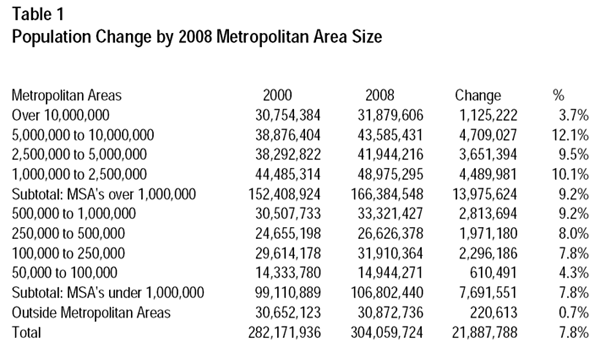
    Metropolitan Area Growth: As usual, the metropolitan areas with more than 1,000,000 population increased above the national rate of 7.8 percent, at 9.2 percent from 2000 to 2008. Smaller metropolitan areas (between 50,000 and 1,000,000 population) grew at the national rate of 7.8 percent. Also continuing a long-standing pattern, areas outside metropolitan areas (including rural areas) grew slower, at only 0.7 percent (Table 1).

    The overall trends, however, mask significant variations. The nation’s two metropolitan areas with more than 10,000,000 population are experiencing growth rates less than one-half the national average. New York grew only 3.6 percent, while Los Angeles – which for decades experienced above average growth, could manage only one-half the national average rate, at 3.8 percent. Indeed, Chicago grew faster, at 5.0 percent. If 2000s growth rates were to continue to 2050, Dallas-Fort Worth, Atlanta and Phoenix would exceed Los Angeles in population, while Houston would pass Los Angeles shortly thereafter. This is not a prediction – population growth in these fast growing areas will likely slow as they get larger – but is merely offered to show how moribund the Los Angeles growth rate has become.

    The strongest growth was among metropolitan areas with between 5,000,000 and 10,000,000 population, which added 12.1 percent to their populations. This was driven by gains of more than 1,000,000 in Dallas-Fort Worth and Atlanta, nearly 1,000,000 in Houston and over 500,000 in Washington (DC). Philadelphia’s growth rate, however, was even less than that of New York or Los Angeles, at 2.7 percent.

    There was also strong growth (9.5%) among the metropolitan areas with between 2,500,000 and 5,000,000 population. This was driven by an increase of more than 1,000,000 in Phoenix and more than 800,000 in Riverside-San Bernardino. San Francisco (3.3 percent) and Boston (2.7 percent) grew at less than one-half the national rate, while Detroit lost population.

    The metropolitan areas with between 1,000,000 and 2,500,000 population also grew more than the national average, at 10.5 percent. The strongest growth was in Las Vegas, which added nearly 475,000 residents. Charlotte, Sacramento and Austin also added more than 300,000. Providence, Milwaukee and Hartford all experienced growth at less than one-half the national rate; while Cleveland, Pittsburgh, Buffalo and Katrina ravaged New Orleans all lost population. Tucson became the nation’s 52nd metropolitan area with more than 1,000,000 population in 2008, having added nearly 20 percent to its population since 2000.

    The largest percentage growth (35.4%) among metropolitan areas over 1,000,000 population was in Raleigh, which added 284,000 new residents (This is not Raleigh-Durham, which the Bureau of the Census calls a combined statistical area, consisting of the Raleigh metropolitan area and the Durham metropolitan area). Raleigh displaced recent perennial growth leader Las Vegas, which experienced slower growth due to the collapse of the housing bubble.

    Domestic Migration

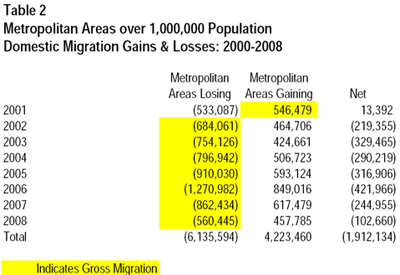
    Much has been made of the apparent recent slow-down in domestic migration (residents moving from one county to another) as indicated in the new data. In fact, however, domestic migration was greater in 2008 than it was in 2001. The slow-down should be more appropriately viewed as a return to more normal conditions.

    This can be illustrated by examining the gross domestic migration between metropolitan areas over 1,000,000 population. In 2008, gross migration in the metropolitan areas of more than 1,000,000 was 560,000. This is slightly more than the 546,000 in 2001. Gross migration increased after 2001, peaking at 1,270,000 in 2006. This fell to 862,000 in 2007 and then to 560,000 in 2008 (Table 2).

    The Domestic Migration Bubble

    The domestic migration bubble that developed from 2000 through 2007 coincided with the domestic housing bubble. This is not surprising, because housing consumes a major part of household expenditures. The differences in housing costs are much greater between metropolitan areas than any other major category of personal expenditure. For example, transportation, clothing and food have similar costs among the nation’s metropolitan areas. During the bubble, however house prices doubled and tripled in some metropolitan areas relative to incomes. The housing bubble appears to have sparked its own domestic migration bubble, as people moved from less affordable areas to more affordable areas.

    This is illustrated by examining domestic migration trends by housing affordability. The more affordable metropolitan areas had Median Multiples at the peak of the housing bubble of 4.0 or less (The “affordable” and “moderately unaffordable” categories from the Demographia International Housing Affordability Survey) and the less affordable metropolitan areas had Median Multiples of 4.1 or above (the “seriously unaffordable” and “severely unaffordable” categories from the Demographia International Housing Affordability Survey).

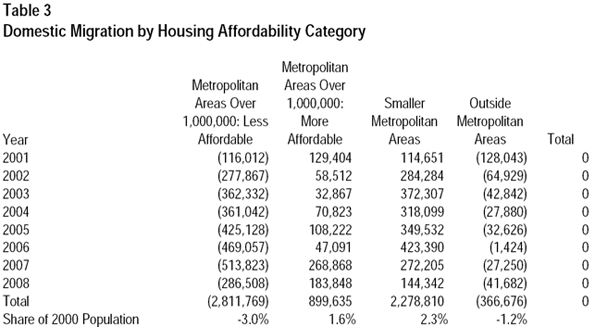
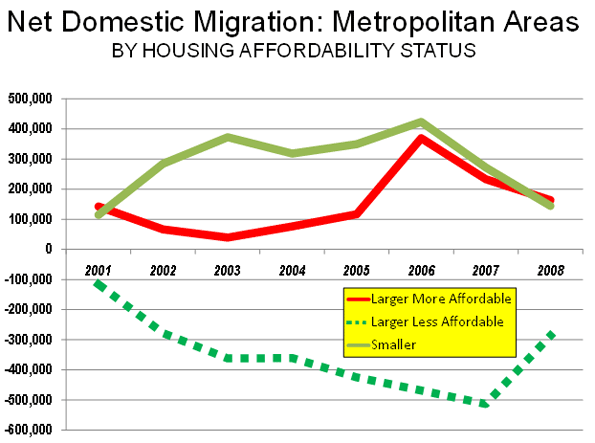
    The less affordable (higher cost) metropolitan areas experienced both the largest house price increases and a spike in net domestic migration losses. Overall, the less affordable metropolitan areas lost 2.8 million domestic migrants from 2000 to 2008 (Table 3 and Figure). This started in 2001 with a modest loss of 116,000, which ballooned to 514,000 by 2007. The loss dropped to 287,000 in 2008, a figure more than 2.5 times the 2001 net domestic migration loss.

    At the same time, the affordable metropolitan areas experienced substantially lower house price escalation, while gaining nearly 900,000 domestic migrants from 2000 to 2008. In 2001, the more affordable metropolitan areas experienced a net domestic migration gain of nearly 129,000. Domestic migration gains peaked in 2007, at 269,000. Domestic migration gains fell to 184,000 in 2008 in the more affordable metropolitan areas. However, this figure was still far higher than the numbers at the beginning of the decade.

    Suburbs Continue to Gain

    The data also shows that people continue to move to the suburbs and move away from core areas. This can be shown from the county data, which is generally the smallest geographic area for which migration data is produced. One caveat: because many core counties contain suburban areas as well as the historic core cities, a county based migration analysis usually understates the extent of both core losses and suburban gains.

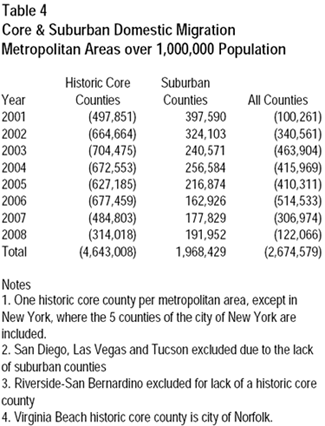
    The core counties improved their domestic migration performance in 2008, but continue to suffer losses. In 2008, the net domestic migration loss in core counties was 314,000, which compares to the 498,000 loss in 2001 and an annual average loss of 580,000 over the decade. Losses of this magnitude can hardly be characterized as a “turnaround.”

    Net domestic migration gains were down to 192,000 in the suburban counties from a 398,000 gain in 2001 and an average gain of 246,000 over the period. However, net suburban migration gains were up in 2008 from 2007 and 2006 (Table 4). Out of the 48 metropolitan areas, suburban counties performed better than core counties in net domestic migration in 42 cases, matching the figure for 2000-2008, the same as in 2007 and up from 38 in 2006. Among the six metropolitan areas where core net migration was greater than in the suburbs, core counties lost fewer domestic migrants than the suburbs (Washington and Virginia Beach), three were areas where the core county typically experiences higher net migration because of its population dominance (Phoenix, Raleigh and San Antonio) and the last was New Orleans, where the core county was much harder hit than the suburban counties by Hurricane Katrina related losses leading to greater gains in domestic migrants as it recovers (Orleans Parish, which is also the city of New Orleans). It is more than “a stretch” to interpret the new data to suggest any move to core areas from suburban areas.

    The 2008 domestic migration data does indicate a slow down or even a reversal in some more distant suburban and exurban areas. This was also to be expected because these areas had experienced a large increase in home ownership and a high volume of high risk sub-prime lending.

    As a result, exurban metropolitan areas like Riverside-San Bernardino, Stockton, Modesto and Merced experienced domestic migration reversals, while distant counties within metropolitan areas (such as Stafford County, Virginia in the Washington area and Pike County, Pennsylvania in the New York area) saw declines in their domestic migration. Much of the growth in such more distant areas occurred because of planning regulations in closer in areas made new development impossible or impossibly expensive. Thus, new housing construction was forced to “leap frog” over developable land, which also imposed higher transportation costs and longer commuting distances on the new home owners.

    At the same time, the better domestic migration performance in some core counties and “closer-in” counties occurred in large part because households no longer had a financial incentive to “cash-out” and move to lower cost areas, since they were often facing negative equity. This removed much of the incentive to move from San Francisco or Los Angeles to Las Vegas, Reno, Phoenix, Tucson or Portland, where prices were considerably lower (though still much higher than before).

    The Real Story: Widening Dispersion

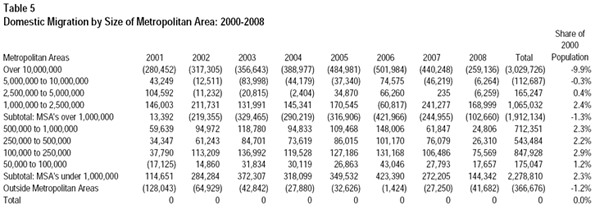
    Not only are people continuing to move from core areas to more suburban areas, but they are also moving from larger metropolitan areas to smaller metropolitan areas (Table 5). Since 2000, approximately 2,275,000 people have moved from large metropolitan areas and non-metropolitan areas to smaller metropolitan areas – those with populations of between 50,000 and 1,000,000. In 2001, the smaller metropolitan areas gained 115,000 domestic migrants. These net migration gains peaked in 2006, at 423,000. Following the national trend, net domestic migration to smaller metropolitan areas fell to 144,000 in 2008, still in excess of the 2001 number. Net domestic migration in the smaller metropolitan areas exceeded that of the larger less affordable metropolitan areas by 5.1 million over the period and exceeded that of the larger more affordable metropolitan areas by 1.4 million.

    Despite these trends, most metropolitan areas continue to add population. The domestic migration losses are more often than not made up by the natural increase in population (births minus deaths) and net international migration gains.

    However, households who already live here continue to exhibit a pattern of dispersion. Both within the same metropolitan area and between metropolitan areas, the latest Bureau of the Census data continues to show a clear trend of wider dispersal – from core counties to suburban counties and from larger metropolitan areas to smaller.

    References:Major Metropolitan Area Population & Domestic Migration 2000-2008: http://www.demographia.com/db-2008met.pdf

    Wendell Cox is a Visiting Professor, Conservatoire National des Arts et Metiers, Paris. He was born in Los Angeles and was appointed to three terms on the Los Angeles County Transportation Commission by Mayor Tom Bradley. He is the author of “War on the Dream: How Anti-Sprawl Policy Threatens the Quality of Life.

  • Are Farms the Suburban Future?

    More than fifty years ago, Frances Montgomery and Philip O’Bryan Williams bought a 500-acre stretch of prairie north of Dallas as a horse farm. It was designed to be a place for their children to run wild on weekends, ride horses, a family escape light years from the Frette-linen, Viking-kitchen and fully staffed second and third home palaces enjoyed by today’s junior high net worth set. The main residence was a recycled World War II barracks; the one bathroom was the only luxury.

    In those days Dallas was an upstart city just taking control of the Trinity River that flooded neighborhoods to the south, one reason why everyone moved north. As the post World War II building boom spread the population further north, the Montgomery family knew it would only be a matter of time before the family farm was surrounded by development, if not swallowed.

    Yet now what is left of places like Montgomery Farms could become a major testing ground in the future of suburban development. In the urban development world, there are two camps, says Williams’ son, Philip Jr., a former CPA who spends his days nurturing the changes that have come to his family’s land. If development had to come, Williams sought intellectual control and the lightest load. One group wants to re-populate the cities with higher density condos and more urban living – the Congress of New Urbanism (CNU). The other camp looks towards the Conservation Subdivision Development (CSD), integrating farming and urbanism to add vitality to a community. A recent New Urban News story quoted Miami architect Andres Duany as saying that agriculture is looming large for new urbanism:

    “Agriculture,” he said, “is the new golf.”

    In fact, studies show that property viewing or abutting agricultural lands is as valuable as those overlooking the golf-course, maybe more so if residents can grow fresh, pesticide-free foods and reduce long-distance trucking. (Fresh cow’s milk, children feeding baby goats not on field trips but recess.) Organic farms, says Missouri developer Greg Whittaker, could also be a revenue-generating business with sales of bedding plants, pumpkins and Christmas trees. Unless, of course, you live in Connecticut, where state Representative Rosa DeLauro wants to make growing your own food against the law and punishable by a fine of up to $1,000,000.

    At Montgomery Farm, CNU and CSD have met in the middle, says Williams, blending agriculture with sub urbanism – with an added artistic touch.

    As Philip, his sister, and the Montgomery farm team were masterminding their agricultural suburban development, they laid out firm ground rules. Art and conservation would trump development profits. Builders would not erect cookie cutter, “they-all-look-alike” homes or McMansions. The city was to put a road through the farm from Highway 75, slicing one of the more heavily wooded cross-sections of the acreage. A road is not a road in the Williams’ world. Seeking a highway that would be as unique as the lifestyle they were offering, the team gathered a group of Connemara Conservancy artists who, along with civil engineers, sponsored a road design contest in 1996.

    “It was a road with no intersections, which meant no idling cars and pollution,” says Williams. Signage was kept to a minimum and international Dark Sky requirements reduced light pollution. This was a farm, where you wanted to find stars at night, not spotlights. Berms were added along the side to mask the homes and muffle noise, and the street was curved, not a straight-arrow shot with stoplights. The City of Allen provided a variance and footed thirty percent of the cost for Bethany Road.

    What’s wrong with suburbia, asks Williams? Driving. Look at the new Honda Minivans: every seat has a TV, 3 plugs for a microwave, more than one giant cup-holder and even eating trays. It’s as if automakers were trying to put a kitchen and laundry room in the car – why not get a Winnebago? Montgomery Farm was designed for walking and biking: the 52 acre mixed-use Watters Creek development – a creek really runs through it – is within walking distance of the home developments. Kids can walk to school, and everyone can walk to the subway station that can whisk them to the heart of downtown Dallas.

    Further up Highway 75, the Southern Land Company is building a development some Texans might consider sac-religious. Southern aims to bypass 25 years of traditional suburbia and build the way communities were designed and built one hundred years ago: porch and street-centered neighborhood, not just sprawl. Streets are old-fashioned boulevards lined with huge trees sporting medians and open spaces.

    About the time developers were drooling to slice and dice Montgomery Farm’s Allen terrain, Tim Downey, founder and CEO of Southern, had a vision in Chattanooga, Tennessee. In 1988 he saw that few developers were looking into the future and considering lifestyle and design components, the way residents might be faring ten years after the developers finished their job. Entire neighborhoods were cropping up without conscious design, architectural or horticultural input. Production building was everywhere, it seemed, a mass of rooflines that all looked the same.

    “If we are going to design and build neighborhoods, let’s look at what they did 100 years ago,” says Jim Cheney, Vice President of Communications, Southern Land Company. “Not what they did 25 years ago.”

    In 1996, Southern flew its architecture department from Franklin, Tennessee to one of Dallas’s old, historic neighborhoods with cameras and notebooks, challenged them to find the most charming and enduring architectural styles and re-create them for Tucker Hill, an 800-acre master-planned community about 20 miles north of those homes. The architects were told to design the way their grandparents might have lived, not re-create McMansions.

    They banned repeated elevations and offered expensive landscape packages with each home. And if builders didn’t want to spend $10,000 on trees, they could build elsewhere. It was almost a foreign process to both builders and buyers. Southern had developed three Tennessee communities before Westhaven, outside Nashville, and the Texas property called Tucker Hill.

    “People just have this mindset,” says Cheney. “6000 square feet, large back-yards so I can hide – not be a part of the neighborhood.”

    But if half the Nashville population thought Downey was insane for Westhaven, Tucker Hill was an even gutsier move to pull off in ranch-mentality Texas. Southern puts a tremendous emphasis on the front of the home and its relation to the street. No front-loading garages; backyards are small and made up for by numerous parks and water features designed to get people out and together – think Hank Hill shooting the breeze with his buddies by the lake, not over the barbecue.

    The concept is similar to the Park Cities, home of Southern Methodist University and one of the most solid communities in the country. Property values in Highland Park and University Park have held strong – even risen – through repeated recessions, thanks in part to the community’s strong school system, low crime, walkability, and perception as a family community with numerous parks and fountains.

    For those who find the lots too small, the houses too congested, Southern’s projects may not be a good fit. But for those who truly want to commune, it’s home. In Nashville, the Westhaven community was barely a year old but 700 people turned out for a block party. The diverse age mix ranges from young families to empty-nest baby boomers to retirees who want to live near their children, but not under the same roof.

    Retirees in the suburbs? Urbanites may cringe, but many Baby Boomers grew up in the suburbs and, when given a choice, do not want to live in the gritty city, says Cheney. Now they can enjoy the ‘burbs and live green. Developers such as Phillip Williams and Tim Downey are offering innovative lifestyles that may help re-define suburban development as living light on the land.

    “America’s land is less than six percent developed,” says Philip Williams. “We are developing without regard for what we left behind, constructing 40 year life homes from trees that take 80 years to grow.”

    Almost like a financial world living on credit, and we’ve now seen where that has led us. But perhaps we can also change our suburbs, and our lives, for the better.

    Candace Evans is the Editor of DallasDirt, a Dallas-based real estate blog for D Magazine Media Partners.

  • Is Obama’s Urban Focus Bad News for the Rest of the Countryside?

    To much of the media, Barack Obama is the ultimate dream president, a sophisticated urbanite whose roots lie in top-tier academia and big-city politics. This asset could also become a glaring weakness, blinding him to the fundamental aspirations for smaller places and self-government that have long animated the American experience.

    It has been a half-century since have we seen a presidential inner circle so identified with our densest urban centers. The three most recent Democratic presidents — Lyndon Johnson, Jimmy Carter and Bill Clinton — all had substantial roots in small-town America that also helped them understand the aspirations of middle-class suburban and exurban voters.

    In contrast, this is an administration steeped in the mystique of big cities. Chief of staff Rahm Emanuel is a tough-guy player from the variously effective and consistently corrupt Chicago city machine. The members of the Cabinet and top-tier apparatus are longtime residents of such large cities as New York, Los Angeles, San Francisco and Boston and, of course, Chicago.

    As the continuing Roland Burris saga reveals, the Chicago connection, in particular, seems likely to wreak continued damage. Chicago’s corruption could run like a sore through this administration, much like Arkansas with the Clintons. But rather than deal with almost laughable hillbillies, we may witness the exposure of some of the toughest, and brazen, baddies in American politics.

    Yet for the most part, the big media have been too captivated by the president’s urbane mystique to delve too deeply into the Chicago morass. Largely denizens of big cities, the top media generally embrace the notion that dense urban places are inherently better, more efficient, culturally and environmentally sound than less glamorous, more spread-out places.

    You can see this worldview almost daily in The New York Times or, more substantially, in the pages of The Atlantic Monthly and The New Republic, where writers often like to envision an American future bright for top-tier cities and pretty bleak for everyone else.

    Given the composition of the president’s inner circle, one can imagine such views are widely accepted at the highest levels. Over the coming years, this could precipitate a policy agenda that, though perhaps well intentioned, could work to the disadvantage in the suburbs, exurbs and small towns where most Americans live. Their policies — particularly the new taxes on the so-called $250K-a-year rich — may not even work so much to the advantage of middle-class urbanites; but this may take time to unfold.

    More important, Obama’s urban policy also marks a critical shift from the traditional American preference for decentralization of power — including at the city level — to one that embraces ever greater concentration. It could also mark a public embrace of hierarchy every bit as serious — and perhaps less reversible — than has occurred in the relatively unregulated marketplace environment of the past quarter century.

    The most recent Pew study confirms that some 77 percent of Americans prefer to live in suburbs, small towns or the countryside. But this prevailing preference for deconcentration disturbs many urban planners and policymakers, including some close to the Obama team. A key transition adviser of urban policy, the Brookings Institution’s Bruce Katz, has been pushing the notion of “regionalism” under which there would be a major shift of power away from individual towns, counties and even urban neighborhoods to mega-regional agencies.

    Katz, like many regionalists, seeks to diminish such local interests — which they fear as too parochial and insufficiently enlightened. His views about small-town politics are scathing as evidenced in an anti-Sarah Palin screed, published in The New Republic last October, revealingly titled “Village Idiocy.”

    To be sure, regional agencies sometimes are useful, for example, in the management of air and water basins. But almost automatically regionalism favors more powerful entrenched interests over smaller communities and businesses. For example, in Southern California, the vast majority of the population lives in suburban cities, but power at the mega-regional agencies — such as the Southern California Association of Governments — usually reliably reflects the interests of large developers, public employee unions, big architects and planners.

    Speaking in Florida recently, the president denounced “sprawl,” saying its days were now “over.” Although hardly a declaration of war on suburbia per se, his comments thrilled those offended by low-density suburbs and who want government to promote ever denser urban development — even if often opposed by grass-roots urbanites.

    The emerging centralizing impulse can be seen in the stimulus, with unprecedented funds for light-rail projects and high-speed rail. Although such projects may seem logical in a few concentrated cities like Washington or New York, they seem poorly suited for most American cities and the vast majority of suburbs. In such places, a more practical, market-friendly way to curb greenhouse gases would be to promote decentralization of work, the creation of flexible low-cost transit and providing incentives for home-based business.

    Over time, such tendencies could present potential dangers for the president. Despite the preferences of most people around the president, and perhaps he himself, nearly 80 percent of Americans consistently report they favor living in less dense places and overwhelmingly prefer single-family homes. They may also be reluctant to surrender ever more control over their daily lives to either distant regional authorities or the federal apparatus. Ultimately, the administration may be forced to choose between acting on its urban mystique and maintaining its political majority.

    This article originally appeared at Politico.

    Joel Kotkin is executive editor of NewGeography.com and is a presidential fellow in urban futures at Chapman University. He is author of The City: A Global History and is finishing a book on the American future.

  • NEW GEOGRAPHY SPECIAL REPORT: America’s Ever Changing Demography

    America’s demography tells not one story, but many. People concerned with looking at long-term trends need to familiarize themselves with these realities – and also consider whether these will continue in the coming decades.

    Losers and Winners

    It’s common to read about rapidly growing places, but what about those that are losing? Perhaps it’s fitting in this time of economic decline first to tell the story of areas of loss of population, of out-migration and of natural decrease, more deaths than births. Such areas are not of course necessarily “losers.” They may be prosperous, with a high quality of life; they are just not “growing.”

    The map below shows the 40 percent of counties which lost population, 2000-2007. 216 lost more than 10 percent, and 1139 lost up to 10 percent. These contrast the 33 counties which grew more than 40 percent in these seven years. So overall, well over half the territory of the country lost population. The largest population losses, by far, were in and around New Orleans (Katrina), followed by the metropolitan cores of the Rust Belt axis from Pittsburgh, through Cleveland to Detroit, and extending west into Indiana, and east through Pennsylvania and western New York.
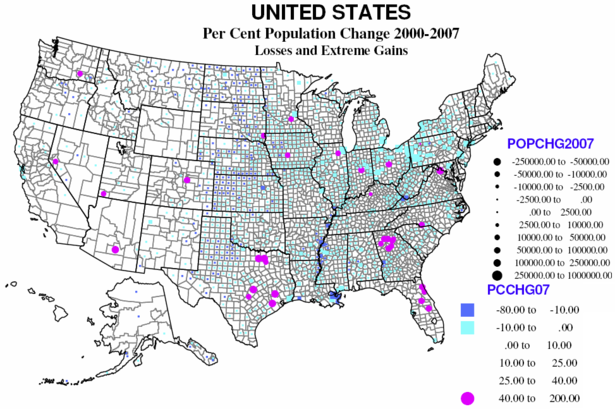
    The largest contiguous area of counties with losses remains the same as it was in the 1970s, 1980s and 1990s: the “high plains” from Mexico to Canada (actually continuing in Canada). Probably 90 percent of counties lost population, especially in Kansas, Nebraska and North Dakota, and extending into the Midwest agricultural heartland of Iowa, northern Missouri, southern Minnesota and western Illinois.

    Other traditional areas of losses which continue from the 1970s through 1990s include the coal counties of Appalachia (Kentucky, West Virginia), and the “Black Belt” from Arkansas and Louisiana through the Mississippi Delta and on through parts of Alabama, Georgia, South and North Carolina into Virginia.

    Again repeating past patterns are losses in some of the large core counties of Megalopolis, as Philadelphia and Baltimore, and elsewhere (St. Louis, Chicago, Minneapolis and even San Francisco). The highest rates of loss were again in and around New Orleans, small counties in Mississippi and Nevada, and Montana, North and South Dakota.

    The 33 rapidly growing counties are ALL suburban except for the new metropolitan area of St. George, Utah. Suburban Atlanta dominates, followed by northeastern Florida, and selected suburbs of Columbus, OH, Indianapolis, Charlotte, Chicago, Minneapolis, Washington, DC, Des Moines, Denver, Reno, Houston, Dallas, and Austin. The largest absolute gains (many areas are now hurting economically) were Maricopa (Phoenix), Harris (Houston), Riverside and San Bernardino, Clark (Las Vegas), Los Angeles, and suburbs of Dallas and San Antonio.

    Migration

    Immigration dominates the news, but there is also emigration, and the difference between these is ‘net’ international migration. Data on immigration and emigration are not very certain or reliable, as people leaving don’t have to tell anyone, and many entering are equally reticent. Yet there is a clear pattern from the map of the 416 counties. Overall the areas of net loss tend to be the same as for losses in overall population.
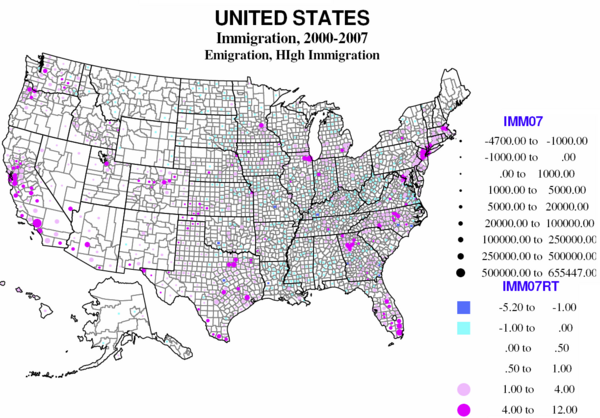
    Counties where immigrants greatly exceed emigrants are both the core counties of the largest metropolitan areas and their largest suburban counties, but especially in the west, Texas, Florida, and the Atlantic coast metropolitan cores from Atlanta to Boston, California, Texas, Florida, and metropolitan New York city. Mexican immigration is the largest, but there is significant immigration from the rest of Latin America, from Asia and from Eastern Europe. Most of the immigrant destinations are metropolitan, but include some rural small town areas, typically with food processing, an industry dependent on low wage immigrants (TX, AR, OK, KS, NE, IA).

    Largest absolute gains are to Los Angeles, Cook, New York City, Miami, Houston, Dallas, Orange County, Phoenix and Santa Clara, with a bias to the southwest, Florida and New York City. The highest immigration rates are in part the same, Miami, Queens, Hudson NJ, Santa Clara, but high rates also characterize Washington DC suburbs, two Kansas counties (food processing), and a Colorado county (workers for ski resorts).

    Significant numbers of non-immigrants also move, and as many as a third probably crossed county lines since 2000. In much of America the balance between in and out migration is close, but for many regions, “net” migration is the most important component of change.
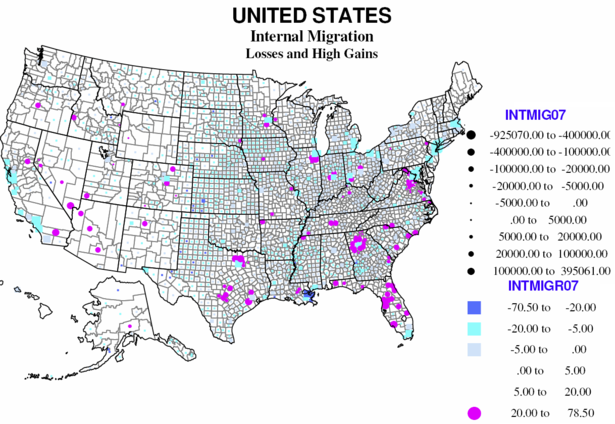
    Overall two thirds of American counties reported a net loss from internal migration, 29 at a level more than 20 percent of the base population. Only 118 have high rates of net in-migration (over 20 percent). Large absolute losses characterize most large metropolitan core counties, including coastal California, Dallas, Miami, New Orleans, megalopolis core counties (from Maryland to Massachusetts), and the Great Lakes and Midwest. Smaller absolute net out-migration prevails over most rural small-town America, especially the Great Plains, and agricultural Midwest and Great Lakes, the Black Belt across the south, and includes much of the southwest.

    Internal domestic migration represents a distinctive geography. In the west many were inland smaller metropolises, as well as many rural small town environmentally attractive counties that received many of the out-migrants from the large coastal metropolises. In the Midwest and northeast gains were strongly suburban (often local flows from the core counties). In the south rapid gains continued to dominate much of Florida, and metropolitan suburbs, especially around Washington DC, Atlanta, Dallas, and Austin-San Antonio, fueled both by continuing in-region rural to urban flows and by migration from the north to the south.

    The losses include the usual suspects, the core counties of the largest metro areas, including Dallas, Miami, and Orange counties, with the native-born displaced to the suburbs and beyond. The largest absolute gains include some central counties, like Maricopa and Clark (but which are also themselves suburban), major suburban counties of Los Angeles, Dallas, Houston, Phoenix, Chicago, and a newcomer, Wake county NC (Raleigh). The highest rates of net in-migration are mostly suburban, Atlanta, Dallas, Washington DC, Denver, Chicago, but also a few smaller counties, as in Pennsylvania and South Dakota.

    The Role of Natural Increase

    One of the indicators of diversity in America is the remarkable variation in the role of natural increase (or decrease) – that is the difference between births and deaths in an area – in the story of population change.

    Almost 30 percent of US counties experience natural decrease, and only a little over 10 percent (337) have high rates of natural increase (6% or more growth in 7 years). Natural decrease is mainly a function of age structure, where the young of child-raising age have left, OR where unusual numbers of the elderly have moved in, dominating the population.
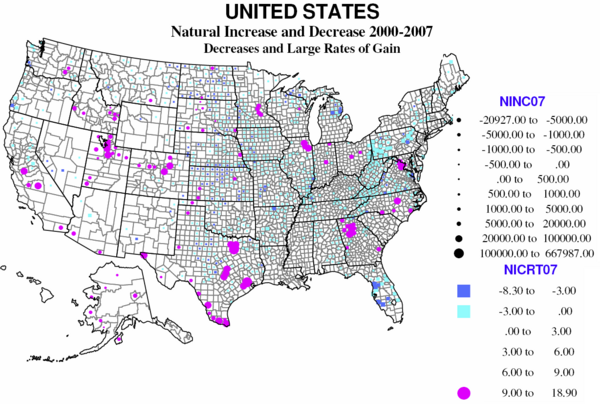
    There are four distinct regions of natural decrease. The largest, absolutely and relatively, is Appalachia, from extreme northern Georgia, through smaller parts of Tennessee and North Carolina, western Virginia, most of West Virginia, and both the greater Pittsburgh and the Scranton-Wilkes Barre region of northeastern Pennsylvania. Much is a historic region of coal (and steel) production, and often poor transport links to the rest of country. The region has suffered loss of the young, often for 40 years or more.

    The second large region of natural decrease is entirely different in character, namely mid-Florida, centered on Tampa-St, Petersburg and Sarasota, as a result of the aging in place of massive numbers of retirees from the north moving to Florida over the last 50 years.

    The third region is much more extensive, covering most of the Great Plains and rural Midwest, from Texas and Arkansas to the Dakotas, Minnesota and Montana, regions again suffering long-term loss of the young population to greater opportunities in the city.

    The last smaller region is the Michigan-Wisconsin upper peninsula, where losses can be traced to the result of declining mining and forestry. Counties in New Mexico, Arizona, and northern California are somewhat like Florida with large numbers of retirees, while those in coastal Oregon and Washington are in part like upper Michigan, but with many retirees as well.

    The 112 counties where births greatly exceed deaths, not surprisingly, reflect a very different geography. They do represent, as is often pointed out, a shift to metropolitan areas but importantly not to the core cities but the suburban hinterlands. Most prominent areas of high natural increase are primarily suburban areas around metropolitan Houston, Dallas, San Antonio, Atlanta, Washington DC, Chicago, Minneapolis and Raleigh, NC. Many of these areas are also affected by in-migration of Hispanic families.

    The other reason for high natural increase is higher fertility – families with above replacement numbers of children, often for reasons of religion or ethnicity, and also reinforced by in-migration of young adults. On the map, Native American Indian reservations stand out, as in North and South Dakota, Wisconsin, Montana, and Alaska, although these numbers are still slow. Mormon Utah and Idaho demonstrate high fertility, family size and shares of births, in rural as well as urban counties. But the dominant area of high natural increase is clearly the extensive southwestern region of Mexican heritage and in-migration over recent decades, in Texas, California, Colorado, New Mexico, Arizona, and eastern Washington, plus selected counties in the high plains, e.g., Kansas and Oklahoma. The final bastions for young families and higher natural increase are military dominated counties, as in Georgia, North Carolina and Kansas.

    In absolute losses, parts of Florida and Pennsylvania and the northern Great Plains stand out. Relative gains are highest in Hispanic, Native American Indian and Mormon counties. These are impressive numbers – the surplus of births over deaths as a share of the total population.

    Why the Differences?

    What makes counties lose or gain people? The US has a diverse and restless population. Counties vary greatly in attractiveness to immigrants from abroad or migrants from other states, broadly because of real or perceived “opportunities,” characteristics of jobs or amenities which may lure migrants from less competitive or attractive areas.

    The map divides the counties into nine sets, based on the relative importance of natural increase or decrease, emigration and immigration and in-migration and out-migration. The 1439 counties which lost population include 165 for which the main reason for loss is from natural decrease; of these one subgroup lost overall despite net immigration, the other’s loss was aggravated by net out-migration as well. The larger set of counties with population losses, 1184, are those for which the loss is mainly attributable to net out-migration, with two subgroups, one with loss despite natural increase, the other with loss magnified by natural decrease.
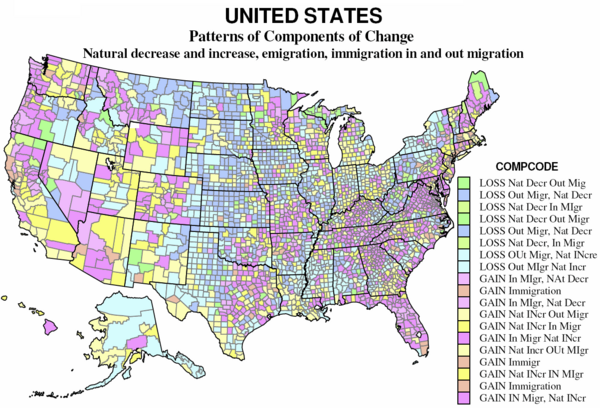
    On the map the “darker” green counties (89) had a large natural decrease and a smaller net out-migration; the “lighter” green (76) had natural decrease, exceeding a smaller net in-migration. These counties for which natural decrease dominates are scattered across the Great Plains from Texas to Canada, together with clusters from Appalachia (VA, WV, PA, and NY), northern MI-WI, and a few declining natural resource areas in the west.

    The “darker” blue counties (486) are dominated by net out-migration, but also had natural decrease. The “lighter” blue counties (698) had natural increases but these were much exceeded by net out-migration. These counties are often interspersed with the “green” counties, dominated by natural decrease. These 1184 counties – over one-third of counties and of US territory – constitute a large swath of the Plains and Midwest, large parts of New York and Pennsylvania, the coal counties of Kentucky and West Virginia, and the “Black Belt” across the south from Louisiana and Arkansas to southern Virginia. Finally they include sparsely populated resource counties in Alaska and parts of the west. Overall, the counties losing population tend to be non-metropolitan and interior, except for the declining industrial metropolitan counties of the “Rust Belt”.

    Gainers

    The gaining counties consist of three broad groups — 755 for which natural increase is the main contributor to growth, with subsets of 420 growing despite net out-migration, and 335 with net in-migration as well. The second consists of 104 counties for which immigration is the predominant basis for growth. Finally there are 933 counties for which net in-migration is the main contributor to growth, with subsets with natural decrease with natural increase.
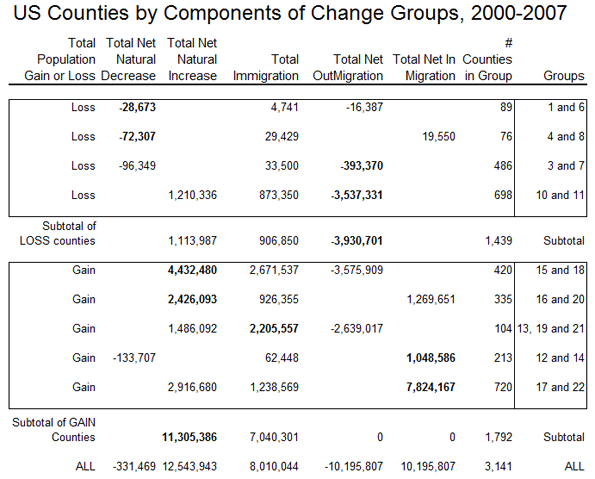
    The “yellow” counties (755) gained population mainly because of natural increase; the light yellow counties (420) grew despite often substantial net out-migration; the darker yellow counties (335) also had a smaller net in-migration, and are thus among the more ”successful” more rapidly growing US counties. The former are especially prevalent in cities of the west – e.g. Los Angeles, San Diego, Houston, Dallas – with sizable immigrant populations (see the table) and higher fertility and displacement of the native-born, but yellow counties are also common in non-metropolitan and small metropolitan and suburban areas of the Great Lakes states, the outer Megalopolis, and urban industrializing parts of the south. The “dark” yellow areas are in the same regions, and are very often the areas gaining migrants from the “light” yellow areas, as can be seen in California, Arizona, Utah, Washington and Colorado.

    The “orange” counties, only 104, are those where immigration is the main source of growth. These are somewhat scattered, but especially common in New England and Middle Atlantic states, selected counties of the Plains (often with food processing plant growth) and northern Pacific Coast metropolitan regions, as the San Francisco bay region, Portland and Seattle.

    The “magenta” counties (933) are those for which net in-migration dominates growth. The lighter magenta for those with natural decrease (213), the darker magenta for those with natural increase as well. All these tend to be the most rapidly growing counties in the country, and tend to occur together. The main difference with counties with natural decrease are those with an older age structure, but which are nevertheless attractive to in-migrants. From the map these occur in two main settings: traditional areas of amenity migration, most obviously covering much of Florida, but also widespread in northern New England, northern Michigan, Wisconsin and Minnesota, the Ozarks, parts of the Tennessee valley, and across much of the west, with particular swaths in western Montana, coastal Oregon and Washington and northern California. The second setting is the exurban environs of major metropolitan areas, where new growth is invading formerly rural areas.

    The final, largest set of counties with natural increase as well as high in-migration (720 counties), are the stereotypical winners in the contemporary “growth races” – based on a combination of employment growth and metropolitan or environmental amenities. These tend especially to be southern and western metropolitan areas, small as well as large. The most dominant regions are greater Washington DC, greater Atlanta, Dallas and Houston, Portland, Denver, Phoenix, most of Florida, and – perhaps surprisingly – substantial parts of the north-south borderlands, including Tennessee, Kentucky, Arkansas, Oklahoma, and Missouri.

    What about the recession? It’s hard to judge the relative effects of the current severe recession on likely near- or longer-term growth. Clearly, the collapse of housing markets are slowing the growth of such rapidly growing places as Phoenix and Las Vegas, but this does not mean they won’t regain their general attractiveness and economic viability. The particularly severe job losses in the already hurting western Rust Belt will likely aggravate the recent pattern of decline which predated the recession and could get much worse.

    Richard Morrill is Professor Emeritus of Geography and Environmental Studies, University of Washington. His research interests include: political geography (voting behavior, redistricting, local governance), population/demography/settlement/migration, urban geography and planning, urban transportation (i.e., old fashioned generalist)
  • Housing Downturn Moves Into Phase II

    The great housing turndown, which started as early as 2007, has entered a second and more difficult phase. We can trace this to Monday, September 15, 2008 just as October 29, 1929 – “Black Tuesday” – marked the start of the Great Depression. September 15 does not yet have a name and the name “Black Monday” has already been taken by the 1987 stock market crash. The 1987 crash looks in historical perspective like a slight downturn compared to what the world faces today.

    On September 15 – let’s call it “Meltdown Monday” – the housing downturn ended its Phase I and burst into financial markets leading to the most serious global recession since the Great Depression. Indeed, International Monetary Fund head Dominique Strauss-Kahn now classifies it a depression.

    Phase I claimed its own share of victims; Phase II seems likely to hit many more.

    Phase I of the Housing Downturn

    Whether in depression or recession, parts of the United States housing market were already in a deep downturn well before September 15. Phase I of the housing downturn started when house prices reached an unprecedented peak in some markets and began fell into decline. By September of 2008, house prices in the “ground zero” markets of California, Florida Las Vegas, Phoenix and Washington, DC had dropped from 25 percent to 45 percent from their peaks. These markets represented 75 percent of the overall lost value among the major metropolitan areas (those with more than 1,000,000 population).

    The Varieties of House Price Escalation Experience: In Phase I, the house price escalation and subsequent losses were far less severe in other major metropolitan areas. This depended in large part to the degree of land use controls – such as land rationing (urban growth boundaries and urban service limits), building moratoria, large lot zoning and other restrictions on building routinely – that helped drive prices up to unsustainable levels. This effect, cited by a number of the world’s most respected economists, was exacerbated by the easy money policies adopted by mortgage lenders.

    On the other hand, in the “responsive” land use regulation areas, the market (people’s preferences) was allowed to determine where and what kind of housing could be built. In these areas housing prices rose far less during the housing bubble and fell far less during Phase I of the housing downturn.

    Leading to the International Financial Crisis: These radically differing house price trends set up world financial markets for ”Meltdown Monday.” The easy money led to a strong increase in foreclosure rates, an inevitable consequence of households having sought or been enticed into mortgage loans that they simply could not afford. Yet it was not foreclosure rates that doomed the market. It was rather the unprecedented intensity of those losses in particular markets.

    Foreclosures were not the problem: Foreclosures happened all over. Foreclosure rates rose drastically in California and the prescriptive markets, but had relatively less impact in the responsive markets of the South and Midwest, where house prices changed little relative to incomes.

    Intensity of the losses was the problem. The problem lay largely in the scale of house value losses in some markets, particularly the most prescriptive ones. Lenders faced foreclosure and short sales losses on houses that had lost an average of $170,000 in value in the ground zero markets. In the responsive markets, on the other hand, average house value losses were less than one-tenth that, at $12,000 per house (http://www.demographia.com/db-hloss.pdf).

    By the end of Phase I of the housing downturn, house value losses in the prescriptive markets had reached nearly $2.3 trillion, accounting for 94 percent of the total losses in major metropolitan markets (those with more than 1,000,000 population). If the market had been allowed to operate in these markets, the losses in the prescriptive markets could easily have been one-fifth this amount. Most likely the mortgage industry and the international economy might have been able to handle such losses, sparing the world the current deep financial crisis.

    True, the housing bust would not have happened without the easy money. Neither easy money nor prescriptive land use regulation were sufficient in themselves to send the world economy into a tailspin. But together they conspired to create the conditions for “Meltdown Monday”.

    Phase II of the Housing Downturn

    The Panic of 2008: By September 15, the “die had been cast.” The holders of mortgage debt could no longer sustain the losses that were occurring in the ground zero markets. This led to the Lehman Brothers bankruptcy and then to a financial sector that seems to be accelerating faster than the taxpayers can pick up the pieces. The ensuing “panic” – a 19th century synonym for a severe economic downturn – has led to millions of layoffs, decreases in demand across the economy and taxpayer financed bailouts around the world. Many have seen their retirement funds wiped out. Others have lost their jobs. American icons, such as General Motors and Bank of America have been relegated to begging on Washington’s K Street.

    Housing Downturn Broadens and Deepens: The panic has now brought about a new phase in the housing downturn – what I label Phase II. In Phase II, a deteriorating economy starts to kick the bottom out of the rest of the housing market. With evaporating confidence in the economy and the drying up of demand, house prices have begun a free-fall in virtually all markets, regardless of the extent to which their prices had bloated.

    Our analysis of National Association of Realtors data shows this. In almost all markets house price declines accelerated during the fourth quarter of 2008 (the first quarter following Meltdown Monday). In just three months, median house prices fell an average of more than 12 percent in the major metropolitan markets. In the ground zero markets, house prices dropped 14 percent, with the average loss from the peak exceeding 40 percent. In the responsive markets, prices fell 11 percent, approximately double the previous reduction from the peak (See Table).

    Thus, the difference is that in Phase I, house price declines were in proportion to the previous price escalation. In Phase II, the percentage declines are generally similar without regard to the house price increases.

    House Price Deflation from Peak
    By Phase of the Housing Downturn
    PRESCRIPTIVE LAND USE MARKETS
    RESPONSIVE LAND USE MARKETS
    Factor
    Ground Zero
    Other
    All
    ALL MARKETS
       
    Prices: To Phase I
    -31.70%
    -11.10%
    -20.80%
    -5.90%
    -17.90%
    Prices: To Phase II
    -41.40%
    -21.40%
    -30.80%
    -16.60%
    -28.00%
     
    Prices in Phase II
    -14.20%
    -11.60%
    -12.60%
    -12.40%
    -14.20%
     
    Loss per House: To Phase I
    ($193,800)
    ($42,400)
    ($96,300)
    ($12,200)
    ($66,900)
    Loss per House: To Phase II
    ($253,000)
    ($81,800)
    ($142,700)
    ($34,200)
    ($104,800)
     
    Loss per House in Phase II
    ($59,200)
    ($39,400)
    ($46,400)
    ($37,900)
    ($59,200)
     
    Gross Losses (Trillions): To Phase I
    ($1.82)
    ($0.46)
    ($2.29)
    ($0.16)
    ($2.44)
    Gross Losses (Trillions): To Phase II
    ($2.40)
    ($0.99)
    ($3.39)
    ($0.44)
    ($3.82)
     
    Gross Losses (Trillions): in Phase II
    ($0.58)
    ($0.52)
    ($1.10)
    ($0.28)
    ($1.38)
       
    Phase I: To September 2008          
    Phase II: To December 2008          
    Major Metropolitan Markets (over 1,000,000 population)      
    For markets by classification see: http://www.demographia.com/db-hloss.pdf    

    Recession or Depression?

    It’s critical to note that the decline is by no means as deep as in the 1930s. On the other hand, there is no indication that conditions are going to improve markedly in the short run. Millions of households who saw their retirement accounts devastated are likely to curb consumption for years to come. The key question is whether we are in the equivalent of 1933, in the pit of the downturn, or in the equivalent of the late 1930s, soon to begin a long, slow climb out.

    For housing though, this is a depression. Never before over the last half-century have house prices fallen as they have in the prescriptive markets during Phase I of the housing downturn. And since the bust, during Phase II, overall price declines are on a par with the worst years of the Great Depression. “Meltdown Monday” has incited a downward spiral whose course will be the topic of future commentaries on this site.

    The classifications of the major metropolitan markets and price declines for each market are shown in http://www.demographia.com/db-hloss.pdf.

    Also see: Mortgage Meltdown Graphic: http://www.demographia.com/db-meltdowngraphic.pdf

    Wendell Cox is a Visiting Professor, Conservatoire National des Arts et Metiers, Paris. He was born in Los Angeles and was appointed to three terms on the Los Angeles County Transportation Commission by Mayor Tom Bradley. He is the author of “War on the Dream: How Anti-Sprawl Policy Threatens the Quality of Life.

  • Oregon Fail: With Hard Times Ahead for Business and Real Estate, It’s Time to Look Small

    There is something about Oregon that ignites something close to poetic inspiration, even among the most level-headed types. When I asked Hank Hoell recently about the state, he waxed on about hiking the spectacular Cascades, the dreamy coastal towns and the rich farmlands of the green Willamette Valley.

    “Oregon,” enthused Hoell, president of LibertyBank, the state’s largest privately owned bank, from his office in Eugene, “is America’s best-kept secret. If quality of life matters at all, Oregon has it in spades. It is as good as it gets. It’s just superb.”

    As developer Shelly Klapper, a rare skeptic in the Beaver State, reminded me: “This is a state that buys its own hype.”

    Hype or not, however, Oregon is hurting – something that’s clear to even the most self-respecting narcissist. Over the past year, Oregon’s economy has fallen off a cliff just about as fast as any state in the union.

    A year ago, things seemed very different. Sunbelt boom states like California, Arizona and Nevada were already heading into deep recession, but green Oregon seemed oddly golden. Both its small cites and one big town, Portland, were outperforming the national norms. Oregonians saw their state as better – not only in terms of green and good, but also in terms of basic job growth.

    But since last winter, Oregon’s unemployment rate has soared from barely 5.5% to well over 8%, the sixth worst in the nation. Indeed, according to a recent projection by the University of California at Santa Barbara (UCSB), Oregon’s jobless rate could reach close to 10% by the end of the year.

    Well into 2010, Oregon’s overall economy will shrink more rapidly than the nation’s as a whole, notes UCSB forecaster Bill Watkins. He traces a sharp downturn there to many factors, including one of the toughest regulatory regimes in North America.

    In tough times, companies generally expand in localities that are friendly to commerce – say, states like Texas or nearby Idaho. Few would rate Oregon highly in that regard.

    “Oregon is mostly a place that focuses on the enjoyment of its space, and that makes [it] very vulnerable in these conditions,” Watkins says.

    The other big problem has to do with a lack of economic diversity. Oregon has been through tough times before. For much of its history, the state’s economy depended largely on harvesting its vast forests. Then, in the 1980s, the state developed a green bug, and decided it shouldn’t chop down Mother Nature for a living.

    In the ensuing decade, Oregon pioneered tough land-use regulations, curbing industries that relied on forest products and declaring war on suburban sprawl. Its main city, Portland, became the poster child of the “smart growth” movement by forcing up density, building an extensive light-rail system and restoring its urban core.

    Although widely praised, these stringent regulations also drove up land prices and, ironically, prompted many middle-class residents to move away, including across the border into Washington. Businesses, rather than cluster in the state’s core, continued to migrate to the outer rings; in the relatively healthy year of 2005, for example, barely 10% of Portland’s office space growth took place in the central district.

    “We give lip service to the economy here,” admits Klapper, a longtime Portland entrepreneur and a former official with the Port of Portland. “But, really, business is not a priority here.”

    For a while, Klapper notes, the tech sector seemed to offer the solution. In the ’80s and ’90s, chip makers fleeing even higher costs in California flooded into Oregon, which was proudly dubbed the “Silicon Forest.” In an unusual move, the state provided tax breaks to the chip makers, which helped. The state’s suburbs also proved attractive to tech workers who could afford a far better quality of life there, in terms of schools and housing, than they could in the Golden State.

    But as regulations tightened and costs to businesses and families increased, even the high-tech industry began to fade. Always a political bellwether state, Oregon has moved inexorably left, increasingly dominated by both its public sector and the particularly strong green movement. Semiconductor expansion soon started to go south – or in this case, further east (to Idaho) or across the Pacific to Asia.

    Only one thing remained to drive the economy: housing. A torrent of Californians were heading north – cashing out of the overpriced Bay Area, Sacramento and Los Angeles – and buying new homes in Oregon. Some sophistos sashayed their way into trendy places like Portland’s Pearl District, but many others looked to the charming smaller towns of the Willamette Valley and central Oregon.

    “When all else failed, it was people moving here that kept us going,” says Klapper, who was a major investor in the Pearl District renaissance. “California became our biggest industry.”

    This dependence turned into a debilitating addiction. When in 2007, the great California housing bubble collapsed, the inflow of people and dollars dropped off. Meanwhile, the remnants of lumber industry fell victim to the housing bust.

    Nowhere are the effects of this clearer than in Bend, a spectacular town of 75,000 located amid volcanic peaks in the center of the state. Californians had considered Bend a favorite spot for second homes and relocation. About a year ago, notes real estate appraiser Steve Pistole, prices were rising 2% a month, while those in Portland were “only” rising 8% a year.

    But to visit Bend now is to be in the eye of the housing hurricane, with nearly deserted housing tracts, woefully empty hotels and residential second-home developments. Unemployment in the housing arena, according to the UCSB, could reach 15% next year.

    We can also expect a further slide in housing prices. Oregon’s bubble, notes analyst Wendell Cox, inflated later than California’s, so prices, which have dropped more than 10% in the last year, could fall by that much or more in the next.

    Yet despite all these problems, many Oregonians remain optimistic. Some of this seems, at least fundamentally, a reflection of ideology. The inevitable huge surge of “green jobs” promised by the Obama administration has long been an article of faith in the state; it seems something like a story we’d tell our children to put them to sleep. State officials, for example, speak wistfully of replacing a recently shuttered Korean-owned Hynix chip plant with a facility to make solar panels.

    The bad news is this: 49 other states – some of which don’t pose such strong regulatory challenges – also hope to bring home some of these green jobs. So if business logic applies, the new factories that manufacture wind turbines, propellers or solar panels will end up in states like North Dakota or Texas, which have been the most successful, thus far, at attracting other manufacturing jobs.

    So what trail should Oregon blaze now? Pistole, the real estate appraiser, says it may be time to think small. Places like Bend, he notes, already attract former Silicon Valley veterans who like living close to trout streams, hiking trails and golf courses.

    “There is no magic bullet for Oregon,” says Pistole, who himself moved from California just three years ago. “But there could be lots of onesies, twosies, mom-and-pops. People still want to live here. We have to make it synergistic to live where you want and still make money. That’s the way we need to go.”

    Some entrepreneurs, like 38-year-old Michael Taus, are already setting up such small shops, some of them in their homes. A recent arrival from Los Angeles, Taus made it big as one of the founders of Rent.com, which was sold to eBay in 2005. He’s only lived in Bend for a few months, but he has already launched his own start-up and consults for several other local firms.

    Taus believes others of his generation will want to establish businesses in Oregon, lured by both its lifestyle and affordability. Some of the new business may be in software, Taus says, but others could sprout in specialty agriculture, wood products and other industries.

    “People are here for a reason. There’s a good amount of talent, and you can get more here,” he says earnestly. “There’s a great potential. We just have to get down to business.”

    This article originally appeared at Forbes.

    Joel Kotkin is executive editor of NewGeography.com and is a presidential fellow in urban futures at Chapman University. He is author of The City: A Global History and is finishing a book on the American future.

  • Public Pension Troubles Loom for State and Local Governments

    We have watched with trepidation as the stock market declines and along with it the value of our retirement accounts. Yet with our personal accounts, it’s our own problem. When it comes to public pensions, it’s the taxpayer’s problem. Underfunded pensions could cut two ways, leading to much higher taxes and/or cuts in government spending.

    This is a particularly big issue here in my home state of Illinois. The Chicago Sun-Times just reported the Land of Obama has earned the dubious honor of having the most underfunded public pension plan in America.

    According to Professor Jeremy Siegel, the above-average returns of the stock market in the recent past have attracted the attention of public pension fund managers.

    The prospect of bigger returns has led managers to pour billions in public pensions into stock. Finance Professors Deborah Lucas and Stephen Zeldes report that the share of state and local (S&L) plan assets held in equities has greatly increased over time from an average of about 40 percent in the late 1980s to about 70 percent in 2007.

    In the current market environment, this exposure led to a loss of an estimated $1 trillion dollars over the past year. Are stocks likely to average annual returns of 10% for the next 20 years? Not likely, and that’s a big problem for both public pension funds, and for the poor taxpayer.

    Equity investing will see many challenges in the coming years. Here are some issues to consider. The reaction to Enron’s bankruptcy was much tighter regulation on corporate accounting. This led to the infamous Sarbanes-Oxley law which has made it far less desirable to run public investment funds and slowed the development of new IPOs. The result, as Joe Weisenthal reported in February of 2007, was a spectacular rise in private equity funds, such as the infamous hedge funds, which contributed mightily to the recent financial meltdown.

    Successful IPOs eventually join the major indexes which help the long run drive equity returns. Fewer IPOs mean less opportunity for investing in listed equities. This will make it harder for pension funds to enjoy higher returns.

    And then there are some demographic concerns. In 2008 the first cohort of baby boomers retired. Many more will follow. This will put increasing strains on all equity investors. Eventually, pension fund managers will have to be net sellers of equities to raise cash for the retiring boomers. No one can say with certitude when this trend will hit critical mass, but when pension funds become net sellers stocks are almost certain to go down.

    The giant bull market of 1982-2000 was driven not only by favorable demographics but also lower marginal income tax rates, cuts in capital gains taxes, and lower inflation. All three conditions could very likely be much higher in the next 20 years. President Obama has openly talked about higher capital gains taxes and the rich being obligated to fund expanded government programs. Recent increases in the money supply by the Federal Reserve Board point to potentially much higher rates of inflation and interest rates. Equities will perform poorly in such an environment.

    American equity investors are in a new era with the federal government making direct investments in private companies. What are the likely results of the federal government controlling an industry? Not good. The TARP program quickly expanded to taxpayers funding car companies that under normal market conditions would have been forced into bankruptcy. What other industries does the federal government have in mind for taking over? Is the medical industry next? Drug companies? Until recently these scenarios were unimaginable.

    All this uncertainty, at very least, is quite bad for equity investing.

    The TARP program is likely to have profound long-term affects on capital markets. With the government having a big stake in major banks, future business loans could potentially be influenced by politicians who regulate the banks. This will lead to a massive misallocation of resources. Will the federal government encourage more homeownership when the housing market has a huge supply? Only time will tell. Will a bank branch be allowed to close in a powerful Congressman’s district?

    As equities lose their attractiveness, public pensions may have to look to corporate bonds and real estate to get investment returns. Are these investments likely to produce historical rates of return that equities have? It’s very unlikely. Governments may be forced to conduct fire sales of their properties just to raise cash to meet their pension obligations.

    Something will have to change. Without a restored boom in stock prices, public pension funds will have a very hard time meeting their obligations. Either governments will have to increase taxes – perhaps dramatically – or force public employees to endure the same risks and potentially anemic returns the rest of us may be up against. Given the size of these funds, and the enormous political power of government workers, this may create one of the major political conflicts of the coming decade.

    Steve Bartin is a resident of Cook County and native who blogs regularly about urban affairs at http://nalert.blogspot.com. He works in Internet sales.

  • Oregon’s Immigration Question: Addressing the Surge in the Face of Recession

    The men huddle outside the trailer, eyeing the passing traffic. Handmade signs stapled to telephone posts speak for them: “Hire a Day Worker!” The site, a fenced-in lot at Northeast MLK and Everett Street, was launched in 2007, a testament both to Oregon’s recent immigration boom and lack of federal reform.

    Since then, Obama’s historic campaign, several wars and a global recession have pushed the immigration question from the national headlines. But in Oregon – where the surging migrant population is on a crash course with a withering economy – the issue is bound to reignite.

    Oregon’s economic boom, which started later than that in the rest of country, has ended. Unemployment has risen considerably. Oregon’s 9.0 percent unemployment rate was the nation’s 6th worst in December 2008 according to the Bureau of Labor Statistics.

    At the eye of the storm have been losses in the construction industry, a major employer of immigrants. The hard times there will put new pressure on local legislators and law officials to “clean out immigrants”. Oregonians should not give in to such misguided temptations. Oregon’s immigrants have played a historic role in enriching the state’s economy and can continue to do so if given the opportunity.

    Oregon’s immigration explosion is relatively new. The state’s foreign-born make up 9.5 percent of the population, with more than 60 percent of the immigrant population arriving after 1990, according to 2005 census data.

    The influx of Latinos to the state is even more recent. Estimates place 75 percent of Latinos coming between 1995 and 2005. Unlike other immigrants who tend to concentrate to urban and suburban areas, Latinos are dispersing across Oregon. Between 1990 and 2000, the Latino population doubled in 21 of Oregon’s 36 mostly-rural counties. Agriculture employment, cheap housing, and existing Latino communities attract the rural migration.

    Within the Portland metro area, the largest concentrations of foreign-born population live in Southeast Portland (Ukrainians, Russians, Romanians), Northeast Portland (Vietnamese, Africans), and Central Portland (Asians, Eastern Europeans), according to a study by the Urban Institute. Notably, more Russians and Ukrainians moved to Oregon’s suburbs between 2000 and 2005 than to any other region in the nation, according to a recent University of Oregon study.

    Currently, immigrants total over 11 percent of the state’s labor force, up from 5.4 percent in 1990. Yet native unemployment did not increase during this time period.

    One reason for this, argues MIT’s Tamar Jacoby in a recent Foreign Affairs article, is that the immigrant workforce should be viewed as complementary rather than competitive to the native workforce. For example, the business owner who can hire housekeepers and landscapers can devote more time to growing his business, and to leisurely expenditures that support other local businesses.

    Oregon’s diverse agricultural industries – ranking third nationally for labor-intensive crops – offer a more concrete example of the complimentary nature of immigrants.

    The state is home to a $325 million dairy and cattle milk production industry, a $778 million nursery and greenhouse industry, a $380 million fruit and nut industry, and a $200 million wine industry. All are primarily staffed by immigrants. In this case, immigrant labor allows Oregon’s agricultural sectors to thrive in the face of fierce import competition.

    Immigrants have historically had a strong entrepreneurial spirit. Nationwide, 25.3 percent of technology and engineering companies had at least one foreign born key founder, based on a Duke University study. Often with few resources or formal education, immigrant entrepreneurship can foster new kinds of services. The abundance of landscaping businesses and nail salons is a testament to such ingenuity. In 2005, over 6,000 Latino and 400 Slavic entrepreneurs operated throughout the Portland metro area, according to one University of Oregon study.

    Beyond providing jobs and fueling local economies, immigrant entrepreneurs bring the benefits of globalization to places like Oregon. They encourage trade and investment from their connections abroad.

    Immigrants pay taxes, buy houses, food, cars, and clothes just like native residents. Even illegal immigrants – which many immigration-demagogues label as the real problem – have taxes withheld from their paychecks. They also otherwise bring money to the state through sales taxes on local purchases. A study by the Oregon Center for Public Policy found that undocumented immigrants contribute between $134 million and $187 million in taxes annually to Oregon’s economy. These numbers represent only those coming from undocumented workers and exclude the significant investments made through entrepreneurship, agricultural support and the continual purchase of goods and services.

    Yet serious immigration reform is needed. A large portion of immigrants spends only stints working in the states, frequently sending money back home. The consequences of this go beyond the obvious fiscal drain. The stint worker will invest minimally in learning English, will often share rent in decrepit neighborhoods, and spend as little as possible in order to maximize savings for abroad.

    The problem facing Oregonians is not immigration per se – or even illegal immigration, which constitutes only 10 percent of the migration to the state. The real problem is stint immigrants, who invest little in the long-term health of their new communities and the economy of the state.

    The curious delusion about this point is that current federal legislation includes temporary-worker permits as key to reform. By giving only temporary permits to immigrants who might otherwise be coaxed into permanent stay, Washington is explicitly discouraging acculturation and encouraging capital drains.

    In large part, the real solution to the downsides of immigration lies in the permanent integration of Oregon’s new residents. When these residents feel they may be here permanently – without constant threat of deportation – they will be more likely to invest in their new communities and futures.

    Even the state’s recent job-shedding should not derail Oregonians’ historic acceptance of foreign residents. Oregon’s immigrants will stabilize agriculture and other service industries by providing cheap labor through hard times.

    If the incoming administration manages the recession correctly, Oregon’s economy will soon recover. To rebound quickly, the state will need to employ thousands – natives and immigrants – in the infrastructure and Green packages coming from Washington. Oregon’s post-recession economy, like its pre-recession economy, will depend on immigrant labor.

    A comprehensive understanding of Oregon’s immigration question must go beyond viewing the huddle of men on MLK and Everett every morning as mere numbers, bodies for pay.

    A true understanding of the issue will surface only by looking beyond the numbers to recognize these men’s potential, resourcefulness and culture as indispensable components that once shaped our nation’s identity and will continue to mold its future.

    Ilie Mitaru is the founder and director of WebRoots Campaigns, based in Portland, OR, the company offers web and New Media strategy solutions to non-profits, political campaigns and market-driven clients.