Category: Small Cities

  • Deindustrialization, Depopulation, and the Refugee Crisis

    The refugee crisis facing Western nations has begun to peak both demographically and politically.  The United Nations has reported that more than 6.5 million Syrians have fled to neighboring countries and Europe, and even nations that until recently welcomed refugees are frantically trying to change immigration policy or protect borders. In contrast, as migration has swelled the population in some places, in others, like the Rust Belt of the United States, depopulation undermines future economic development.  Some have begun to ask whether population trends can or should determine policy. The answer is yes.

    To understand the significance of depopulation in the Rust Belt, imagine that a plague hit the Midwest and four million people had vanished. What would be the economic consequences for the region, its institutions and for individuals?  Deindustrialization has operated much like a plague, and just as with a plague, the long term social and economic costs are substantial. The region can’t “just get over it.”  Deindustrialization, and the depopulation associated with it, continues to be a drag on the region both economically and socially.

    For example, in Youngstown, Ohio, steel mills began closing almost 40 years ago.  The city’s population is now around 62,000, a decline of more than 50 percent since the 1970s.  A community once known at the “City of Homes” now has more than 4000 vacant properties. Youngstown’s economic redevelopment program has largely failed. Attempts at economic redevelopment around prisons, fracking, 3-D printing and casinos have had only limited success, at best. They seem more like examples of the economics of desperation than serious efforts to revitalize the local economy. Appeals by business and government leaders to redefine this as a  “shrinking city” and exhortations for the community to exhibit “adaptive resilience” have proven shallow.  With little economic growth, such approaches feel too much like cruel optimism.

    Youngstown mayor John McNally has said that his most important task is to stop the depopulation.  A city like Youngstown needs to stop the hemorrhaging and get an infusion of energy.  Would the city gain by encouraging refugees to move to Youngstown? Other communities have tried this approach, encouraging immigrants to move to depopulated areas and gaining new economic activity in the process. Weather-challenged Winnipeg, the capital of Manitoba, has taken advantage of the Manitoba Provincial Nominee Program, which “selects applicants who demonstrate they have the potential and the desire to immigrate and settle themselves and their families in the Canadian province of Manitoba.” Immigrants may apply through different categories such as General, Family Support, International Student, Employer, Strategic Initiative, or Business Immigration. An Economic Development study reports that Winnipeg’s metropolitan population has grown to 780,000, 100,000 higher than earlier projections. The population increase includes about 85,000 immigrants. Between 2009-2014, the local economy stabilized with unemployment below the national average and higher labor force participation and wage growth. In 2014, the city was touted by KPMG as the No. 1 low cost manufacturing location in aerospace, chemical, electronics assembly, pharmaceuticals and telecommunications equipment in North America.

    On a smaller scale, some locations have also stemmed depopulation through the employment of existing ethnic enclaves as portal communities. Even in places like deindustrialized metro Detroit, depopulation was offset by an influx of Mexican and Middle Eastern immigrants into existing enclaves, transforming areas that were thought of as ghost towns. While traditional immigrant/refugee communities, like those in the Detroit Metro region were quite large, much of the new resettlement has been more geographically diverse and dispersed than it once was. For example, over 70,000 Bosnian refugees have resettled in St. Louis within the region over the last 20 years.

    The New York Times reported in 2014 that new immigrants are more often to be found in midsize cities, like Dayton, Ohio than in New York, Chicago, and other large cities.   Like Youngstown, Dayton had lost over 40% of its population.  But city officials embraced immigration by establishing a “Welcoming Dayton” plan in 2011. The plan encouraged new immigrants and refugees to relocate in this Southwestern Ohio community and developed support groups to help newcomers adjust to their new community.  Most of the new growth in Dayton has been the result of the relocations and the city is in the process of accelerating the plan.

    Another example is Utica, New York. In 2002, this deindustrialized city established the Mohawk Valley Resource Center for Refugees (MVRCR). Over 10,000 immigrants, largely from Bosnia and Vietnam, relocated to the Utica Area.  The 2012 U.S. census reports that 17.6 percent of Utica’s population was foreign born and 26.6 could speak a language other than English. NPR reported that the resettlement succeeded in part because Utica had low housing costs and many low-skilled jobs that were unfilled as result of depopulation. Refugees found jobs as meat cutters, greenhouse workers, and nursing home attendants. Some saved enough money to go into business themselves. They bought low-priced homes and rehabbed them, began to pay taxes, and purchased goods and services. No doubt, the refugees initially generated costs to taxpayers in terms of housing subsidies, Medicaid, Welfare, and education, but over time, repopulation stemmed depopulation and provided a glimmer of hope for economic revitalization.

    Winnipeg, Dayton, and Utica are examples of small-scale attempts at repopulation using relatively small-scale government initiatives and ethnic portal communities. But the scale of today’s refugee crisis suggests the need for larger scale efforts, including, perhaps, a national program.  For example, the German government has developed an administrative formula that distributes refugees and asylum seekers among the 16 German states.  According to Thomas Greven, a political scientist at the Free University of Berlin, the distribution plan is based primarily on population and economic data, with the most refugees assigned to the depopulated parts of East Germany. The hope is that these new arrivals will develop their own micro-economies that will contribute to the revitalization of the region.

    No doubt, the surge in refugees in Germany has caused resentment toward the policy and government in the short term.  Yet the German government has announced its willingness to accept 800,000 new refugees largely from the Syrian war, promised greater economic aid to state and local communities, and enlisted German companies to cope with the influx of refugees. While the German efforts reflect ethical and moral commitment, there is more to the story. The German population has been dropping for some time. Its population has become older and new birth rates are among the lowest in the world.  The German government and business leaders understand that “demographics are destiny,” and if it is to be a leader in economic growth it needs not only more people but also younger people – like the refugees.

    Will any large immigration/refugee repopulation policy be considered in the US? It does not appear so given some recent attempts – by localities, states, and even the U.S. Congress — to discourage immigration and refugees. But the Federal government has final authority over immigration policy matters. If the US were to follow Germany’s approach and offer relocation incentives, Rust Belt communities have the infrastructure and housing to accommodate many refugees. In turn, the new immigrants could establish microeconomic communities, compliment established markets, invest earnings and consume in the local economy and become a source for new tax revenue.

    No doubt, this will be a political challenge given the current zeitgeist. But such a policy would be moral and ethical and in the best traditions of America. It could also help boost the economies of cities that are still struggling to recover from deindustrialization.  One thing that is for certain, if St. Louis can resettle 70,000 Bosnians in a15 year period, the US can certainly accommodate more than the 10,000 Syrian refugees currently slated for resettlement, especially in the deindustrialized and depopulated in the Rust Belt.

    John Russo is a visiting fellow at Kalmanovitz Initiative for Labor and Working Poor at Georgetown University and at the Metropolitan Institute at Virginia Tech. He is the co-author with Sherry Linkon of Steeltown U.S.A.: Work and Memory in Youngstown (8th printing).

  • Low Hanging Fruit

    As a San Franciscan I get a lot of raised eyebrows when I mention that I recently bought property in Cincinnati. “Huh?” Then I walk them through it. Here’s the mom and pop business district along Hamilton Avenue in the Northside neighborhood during a recent Summer Streets event. This is a classic 1890’s Norman Rockwell Main Street with a hardware store, a Carnegie library, barbers, cafes, bars, funky little shops, and seriously good architectural bones.

    Screen Shot 2015-08-27 at 1.05.03 AMTravis Estell UrbanCincy

    Screen Shot 2015-08-27 at 1.04.38 AMTravis Estell UrbanCincy

    Screen Shot 2015-08-27 at 1.04.25 AMTravis Estell UrbanCincy

    It’s the perfect human scaled neighborhood. Kids walk to school. Older people make their way to shops and the farmers market on foot. Riding a bicycle to work is a normal natural activity that doesn’t involve spandex and Tour de France levels of endurance. Bus service to the university and downtown is frequent and convenient. And you can hop on the highway and be anywhere in Cincinnati in minutes.

    Screen Shot 2015-08-28 at 1.39.24 AM

    Screen Shot 2015-08-28 at 1.50.14 AM

    Screen Shot 2015-08-28 at 1.47.48 AM

    Screen Shot 2015-08-28 at 1.49.25 AM

    I tell folks around here that Northside is the kind of neighborhood where you can buy a quality home next door to great neighbors like these and thisand enjoy public events like this for less than the cost of a really good parking space in California. No one builds homes or neighborhoods like these anymore. We no longer have the culture that created these places.

    Screen Shot 2015-08-28 at 4.12.27 AMGoogle

    Screen Shot 2015-09-05 at 4.00.34 AM

    Screen Shot 2015-09-05 at 3.59.17 AM

    Screen Shot 2015-09-05 at 4.00.13 AM

    Screen Shot 2015-09-05 at 3.21.11 AM

    Screen Shot 2015-09-05 at 3.20.05 AM

    Screen Shot 2015-09-05 at 3.20.45 AM

    On the one hand Northside is a compact walkable neighborhood with a distinctive urban feeling at its center. But on the other it’s surrounded by forested hills, a vast historic cemetery, and productive small scale agriculture with farm houses that date back to the 1840’s. It’s a true suburb in the best sense of the word. It offers a good balance of urban convenience and vitality at your front door with the countryside at your back.

    Screen Shot 2015-08-28 at 2.16.43 AMGoogle

    Screen Shot 2015-08-27 at 9.17.59 PM

    Screen Shot 2015-09-05 at 4.55.02 AM

    Screen Shot 2015-09-05 at 4.55.23 AM

    I spend a lot of time talking to people who long for a particular kind of urban living environment. It’s not Manhattan or Hong Kong exactly. It’s smaller and more intimate. It’s more like a friendly small town with ready access to big city opportunity and culture. The old street car suburbs of the 1880’s to 1940’s like Northside are pretty much spot on. But we just haven’t built great urban places like these for three or four generations. As a society we don’t seem able to do it any more.

    Screen Shot 2014-10-27 at 12.16.25 PM

    Screen Shot 2014-10-27 at 11.03.26 AM

    Screen Shot 2014-10-27 at 12.08.29 PM

    Screen Shot 2014-10-27 at 12.17.27 PM

    Screen Shot 2014-10-27 at 11.05.22 AM

    In most places built after about 1950 you can live in a French Provincial tract house on a cul-de-sac near the strip malls and office parks, or… you can live in a Spanish colonial tract house on a cul-de-sac near the strip malls and the office parks. Those are your modern choices. The best you can hope for is an enlightened city planner or civil engineer who stripes a few bike lanes on the sides of the high speed eight lane arterials. Big whoopee.

    New Urbanists and the Smart Growth crowd are up against a massive wall of cultural resistance and institutional barriers. Trying to build new towns in the historical pattern or retrofit post war suburbs is not for the faint of heart. Personally I don’t have the desire to chip away at that mountain. Life’s too short. But there’s so much low hanging fruit out there. Neighborhoods like Northside exist all over the country. They’re already fabulous. They’re already filled with great people. They’re often very reasonably priced. And the best part is that all the obstructionist people who hate walkable urban places and obsess about how to accommodate all the cars have self-selected out. They live an hour away in the distant suburbs and want nothing to do with the city.

    John Sanphillippo lives in San Francisco and blogs about urbanism, adaptation, and resilience at granolashotgun.com. He’s a member of the Congress for New Urbanism, films videos for faircompanies.com, and is a regular contributor to Strongtowns.org. He earns his living by buying, renovating, and renting undervalued properties in places that have good long term prospects. He is a graduate of Rutgers University.

    Lead photo by Travis Estell UrbanCincy

  • More Local Decisions Usurped by Ideological Regulators

    In hip, and even not-so-hip, circles, markets, restaurants and cultural festivals across the country, local is in. Many embrace this ideal as an economic development tool, an environmental win and a form of resistance to ever-greater centralized big business control.

    Yet when it comes to areas being able to choose their urban form and for people to cluster naturally – localism is now being constantly undermined by planners and their ideological allies, including some who superficially embrace the notion of localism.

    In order to pursue their social and perceived environmental objectives, they have placed particular onus on middle- and upper-class suburbs, whose great crime appears to be that they tend to be the places people settle if they have the means to do so.

    Central planning

    Nothing is more basic to the American identity than leaving basic control of daily life to local communities and, as much as is practical, to individuals. The rising new regulatory regime seeks decisively to change that equation. To be sure, there is a need for some degree of regulation, notably for basic health and public safety, as well as maintaining and expanding schools, parks, bikeways and tree-planting, things done best when supported by local voters.

    Read the entire piece at The Orange County Register.

    Joel Kotkin is executive editor of NewGeography.com and Roger Hobbs Distinguished Fellow in Urban Studies at Chapman University, and a member of the editorial board of the Orange County Register. He is also executive director of the Houston-based Center for Opportunity Urbanism. His newest book, The New Class Conflict is now available at Amazon and Telos Press. He is also author of The City: A Global History and The Next Hundred Million: America in 2050. He lives in Orange County, CA.

    City Hall photo by Flickr user OZinOH.

  • Historic Districts: The Past or The Future?

    Preservation seems like an easy idea to support. Who would be against it? History, character, and a sense of place are what great communities are all about. They generate tourism and makes us all culturally richer. Landowners in historic districts even enjoy higher land values than nearby landowners in newer, usually blander developments. What’s not to like?

    Apparently, a lot. Cities unilaterally impose ordinances from time to time, regulating building size, shape and use, and rarely are there complaints, although the changes affect everyone in the city. Here in Florida, building codes were recently stiffened, causing buildings in the entire state to become more expensive, and there were no complaints to speak of. But in the small community of Winter Park, when a proposal was floated to make obtaining historic district status less onerous, indignant protesters with cries of “property rights” were voiced. Protesters who were shy about fighting the State and the City may have finally found, in individual neighborhoods, a small enough foe to bully.

    Protesters claim that they fear restraint of trade, and they’re hoping to cash in on rising land values, particularly where they have been historically low. A historic designation might make an owner think twice before knocking a house down.

    There’s mirth in Cyria Underwood’s eyes as she tells us about coming here to Winter Park from Louisville, Kentucky. A tall, elegant African American woman, Underwood works at the Hannibal Square Heritage Center, and observes Winter Park’s preservation battles like this: “Black people have an oral history tradition, and it’s a good thing we do. We don’t expect our own buildings to get preserved. So here on the West Side, we hand down our oral history from mother to child, father to son. It’d be nice to see preservation taken seriously,” she muses, her eyes still smiling, “but African Americans have learned to make do without it.”

    Interest rates remain low. In neighborhoods like the West Side, where Cyria works, owners feel the pressure to sell. Hannibal Square, built originally for blacks in the 1880s, today houses a mix of families, some of whom go back to the town’s early days. Walkability, playgrounds and parks make this a dream community for urbanists; many residents ride the buses that travel up and down Denning Avenue, and Sunrail’s Winter Park Station is a couple of blocks away. Finally, it seems, this area has come into its own and become a hip, urban community at long last.

    “However,” murmurs Cyria, her eyes twinkling, “the wolf is at the door.” She’s referring to developers who buy small houses on small lots and replace them with much larger homes, townhomes, and even multifamily clusters. West-siders have been clinging on by the skin of their teeth. Service jobs with modest incomes and part-time work (much of it a long bus ride away) have kept this neighborhood afloat. While land values all around have skyrocketed, the West Side — historically African-American — has not been rewarded with such good fortune. Property values are, to put it politely, stable.

    Fairolyn Livingston moved out of the West Side in the ’70s, but comes back frequently. She explains that when a West Side homeowner sells, he or she walks off counting the cash. But Livingston cites more than one seller who couldn’t replace the Winter Park lifestyle with the proceeds from his or her home, and ended up moving into poorer and even less upwardly mobile parts of town. So goes gentrification: the new buyer, often white, unwittingly banishes an African American family to a lower stratum, hardening class divisions.

    Livingston is candid about the younger newcomers. Asked whether they join the neighborhood churches, she chuckles. “Oh, no. There’s no interaction with our community.” The new buyers, however, benefit from the short walk to Park Avenue’s chic restaurants and shops, and can Sunrail to happy hour downtown. The West Side’s character, meanwhile, dissolves under the homogenous new face of urban America, where everywhere resembles everywhere else.

    Cyria Underwood, Fairolyn Livingston and many others are unworried about the preservation battles being waged in Winter Park right now. This is not surprising: preservation of the West Side has not been high on the City’s agenda. The same development pressures are being fought all over.

    Locally, Friends of Casa Feliz, a Winter Park preservation organization, will be co-hosting a West Side History panel discussion this autumn to help keep what is left of the architecture.

    It’s part of keeping a conversation going about the local urban future. Historic districts come into being in most places with a simple majority, but Winter Park’s requirement of a supermajority makes them difficult and rare. Protesters against preservation see this as just fine, and do not want property rights to change.

    While he isn’t a vocal protester, realtor Mark Squires is a realist. With a Clark Gable smile and wink, he is a true denizen of Winter Park real estate. “Everyone wants historic character,” Squires offers, “but nobody wants to pay for it.” Smaller, older homes have tiny kitchens and bathrooms, and are often hard to maintain. Squires and his colleagues find that, for many young couples with kids, Winter Park’s lifestyle is in high demand. The last thing on their busy agendas is fixing cast iron pipes or repainting wood trim. Many buyers want new, as the developers, builders, realtors and lenders are well aware. Every home becomes a potential knockdown, if the price fits the formula.

    Squires’ local reality is that historic preservation, while it might make everyone a little better off, makes home sales harder. Our local economy is geared towards short-term private profit, and the notion that preservation can also be profitable is rarely considered. While developers in Boston, Chicago, and elsewhere have proven that historic preservation can make money, it has yet to be seen as a both/and proposition in Central Florida. City Hall dithers over the proposed historic district ordinance while the bulldozers roll.

    Underwood is philosophical about it. “Willing seller, willing buyer, you know? You can’t control what someone does after you go.” Rich or poor, the same argument applies. The individual decides whether to push the easy button and go for new, or save a little bit of quality for future generations.

    The current wave of transactions, fueled by low interest rates and demand for in-town living, is recasting the character of her neighborhood, as well as of the more affluent areas of the East Side. If the City Commission votes to ease historic district formation, perhaps there will be more than just oral history to remember Old Winter Park by. If not, and more bungalows succumb to the McMansion, we’ll all just have to huddle up around her chair and ask for stories about the buildings that used to be here, and the people who lived within them.

    Richard Reep is an architect with VOA Associates, Inc. who has designed award-winning urban mixed-use and hospitality projects. His work has been featured domestically and internationally for the last thirty years. An Adjunct Professor for the Environmental and Growth Studies Department at Rollins College, he teaches urban design and sustainable development; he is also president of the Orlando Foundation for Architecture. Reep resides in Winter Park, Florida with his family.

    Photo of Cyria Underwood by the author

  • The Cities Winning The Battle For Information Jobs 2015

    We are supposed to be moving rapidly into the “information era,” but the future, as science fiction author William Gibson suggested, is not “evenly distributed.” For most of the U.S., the boomlet in software, Internet publishing, search and other “disruptive” cyber companies has hardly been a windfall in terms of employment. As jobs in those areas have been created, employment has shriveled in old media like newspaper, magazine and book publishing (these industries lost a net 172,000 jobs from 2009 through 2014). In the 52 largest metropolitan areas that we studied, information employment declined for roughly half from 2009 through 2014. Overall, in information industries (a sprawling sector that also includes movie and TV production, radio and another big job loser, telecom) employment has shrunken 4.2% since 2009 to 2.7 million jobs, while total nonfarm employment in the U.S. grew by 5.1%.

    Yet looking at the information sector give us an important picture of how these changes have shifted jobs to certain regions and away from others. Our rankings are based on employment growth in the sector over the short-, medium- and long-term, going back to 2003, and factor in momentum — whether growth is slowing or accelerating. (For a detailed description of our methodology, click here.)

    By far the biggest winners in the information sweepstakes are areas that developed a strong engineering base before the rise of the Internet. This has provided the platform for the rapid growth of web-based businesses, including in fields such as entertainment, media, hospitality and transportation (like Uber). It’s not surprising then that the metro areas that have posted the strongest information job growth over the past 11 years are San Jose-Sunnyvale-Santa Clara and San Francisco-Redwood City-South San Francisco.

    The growth in these hot spots has been nothing short of spectacular: information employment rose 60.2% from 2009 through 2014 in the San Jose area to 70,900 jobs, 6.9% of total employment in the metro area, while the San Francisco area has seen a 51.3% surge over the same time span to 55,800 jobs, representing 5.4% of the total workforce there.

    After the dot-com bubble burst, Silicon Valley tech employment declined consistently until 2010, since which the rebound has been dramatic. While San Francisco and areas in the northern end of Silicon Valley have not yet reached the peak employment levels seen during the bubble era, the southern end centered in San Jose and Santa Clara has easily outstripped its peaks of the early 2000s. And with information employment continuing to surge, it’s too early to say these areas have hit their “information” peak. Last year, the number of information jobs jumped 16.0% in San Jose while San Francisco experienced an 8.3% jump.

    Other traditional tech centers that have thrived in the new era include No. 9 Seattle-Bellevue-Everett, Wash., where information employment has grown a healthy 9.2% since 2009 and No. 14 Boston, where employment is up 5.1% since 2009. Compared to the Bay Area, these regions appear less at the center of the web-based media and services industries, but their overall tech economies remain very strong.

    The Rise Of Sun Belt Information Hubs

    Some of the most rapid growth in information, however, is taking place not in the older established tech hotbeds but in the lower-cost metropolitan areas of the Sun Belt. Five of our top 10 ranked metropolitan areas are located in the belt that stretches from the Atlantic coast to Arizona, led by No. 3 Austin-Round Rock, Texas, where information employment has risen 30.8% since 2009 to 25,800 positions.

    Some of this reflects a gradual movement of companies, notably from Silicon Valley, to the Texas capital. Smaller Bay Area firms such as digital advertising firm Marin Software have expanded there while Apple is expected to add 3,600 jobs there over the next few years.

    Several other Sun Belt tech hubs also are high on our list. In fourth place is Raleigh, N.C., on the strength of a 13.8% jump in information employment since 2009. It’s followed in fifth place by No. 5 Charlotte-Concord-Gastonia, N.C., which boasts significant sources of venture capital, and No. 8 San Antonio-New Braunfels, Texas, which has seen the rise of locally based companies such as Execupay as well as large scale expansion of Bay Area firms such as Oracle that are flocking to the region.

    One big advantage these economies have compared to the ultra-pricey Bay Area is lower home costs, something that matters to tech workers as they enter their 30s. But the biggest challenge for some of these up and coming areas, such as Phoenix, is the dearth of large locally headquartered companies that can help create a management talent base and some tech street cred.

    The Battle Of The Bigs

    One key battleground for information supremacy is in the country’s media centers. The clear winner has been No. 7 New York, which has recorded a 13.0% jump in information jobs since 2009 to 185,200 jobs – second most in the country behind the Los Angeles metro area. That came amid an 11.8% decline over the same timespan in all publishing jobs not involving the Internet (note that we don’t have the level of detail at the local level to separate out software publishing from that figure, but it’s safe to assume the bulk of the decline was in newspapers and book and magazine publishing). The 13% jump reflects strength in new media as well as motion pictures, TV and radio, more so than technology, a field in which New York remains very much an also ran, right in the middle of the pack in terms of creating STEM and tech employment. But boosters claim this is changing, pointing out that there are now 7,000 tech firms employing 100,000 people in the area.

    Although New York is well behind the Bay Area in pace of growth, it is clearly outperforming its traditional media rivals in the rush towards digital media. Its growth dwarfs that of No. 29 Chicago, where information employment has ticked up 0.4% since 2009. The Los Angeles-Long Beach-Glendale metro area, still home to the largest number of information workers, has managed lackluster growth of 3.5% since 2009, including a 2.0% decline last year, which puts it 28th place on our list. For all the talk about L.A.’s emergence as a new media rival to the Bay Area, the numbers suggest this is more hope than reality. Over the past five years motion picture and television employment has not been hard-hit like traditional publishing but is only experiencing slow growth. No Facebook, Google or Apple equivalent has emerged in Southern California, although some hold out hope for L.A.-based Snapchat.

    A decade or two ago there was talk about the nation’s capital challenging New York’s media dominance. But as has become evident over the past year, the Beltway’s appeal is dropping, even when it comes to producing sound-bites and punditry. The core Washington D.C.-Arlington-Alexandria metropolitan division places a mediocre 43rd, with a 3.9% decline in information employment since 2009. Other areas around the capital did poorly also, including 41st-ranked Northern Virginia and 46th-place Silver Spring-Frederick-Rockville Md. which also have lost information jobs since 2009.

    Surprises And Up And Comers

    Generally speaking manufacturing, energy and logistics-oriented economies do not do well in terms of information jobs. As of now there’s no Rust Belt version of Facebook or Google, and most factory towns do very poorly. But there’s one outstanding exception to this rule: Warren-Troy-Farmington Hills, Mich., which places 10th on our list. This area, sometimes referred to “automation alley,” is Michigan’s premier tech region. It is where software meets heavy metal, with a plethora of companies focusing on factory software and new computer-controlled systems for automobiles. It is home to engineering software firms like Altair, which has been expanding rapidly, and also where General Motors recently announced plans for a $1 billion tech center, employing 2,600 salaried workers.

    If we are looking for future information hubs, one place to look would be our small and mid-sized metro area lists. Here the top ranks are dominated by college towns, including Baton Rouge, La., home to Louisiana State University, where information employment has surged 28.6% since 2009. It places third on our mid-size cities list, which also features such high-flying college towns as fourth place Provo-Orem, Utah (Brigham Young), No. 5 Durham-Chapel Hill (Duke, University of North Carolina), No. 6 Madison (University of Wisconsin), and No. 7 Ann Arbor (University of Michigan).

    The information sector may not be a big job generator, but it does play a critical role in several of our most important economies, including the San Francisco, New York, Los Angeles and Austin metro areas. The clear shift we are seeing towards consolidation of media with tech – a la Apple, Netflix and Google — will likely underpin a movement of these coveted jobs from traditional media centers to the Bay. But  given the unfriendly business atmosphere in California, and the super-high prices for houses, it also makes sense to look at secondary information centers, both in the Sun Belt and among college towns, which may attract even more of these jobs in the years ahead.

    Joel Kotkin is executive editor of NewGeography.com and Roger Hobbs Distinguished Fellow in Urban Studies at Chapman University, and a member of the editorial board of the Orange County Register. He is also executive director of the Houston-based Center for Opportunity Urbanism. His newest book, The New Class Conflict is now available at Amazon and Telos Press. He is also author of The City: A Global History and The Next Hundred Million: America in 2050.  He lives in Los Angeles, CA.

    Michael Shires, Ph.D. is a professor at Pepperdine University School of Public Policy.

  • Small Regions Rising

    In the last 25 years there has been a huge change in the level of competitiveness of smaller urban areas – by which I mean the small end of the major urban scale, or metro areas of about one to three million people – that has put them in the game for people in residents in way they never were before.

    I recently gave the morning keynote at the Mayor’s Development Roundtable in Oklahoma City and talked a bit about this phenomenon, as well as how these generally younger and sprawling areas ought to be thinking about their future.

    If the video doesn’t display for you, click over to watch on You Tube (my segment starts at 4:36).


    Aaron M. Renn is a senior fellow at the Manhattan Institute and a Contributing Editor at City Journal. He writes at The Urbanophile, where this piece first appeared.

  • Smaller Stars: The Best Small And Medium-Size Cities For Jobs 2015

    A look at job growth in America’s small and medium-size cities provides a very different, perhaps more intimate portrait of the ground-level economy across a wider swathe of the country than our survey last week of The Best Big Cities For Jobs. It takes us to many states that lack large cities, particularly in the Midwest and South. In contrast to our big city list, information technology is a driving factor in only a handful of smaller metro areas – grittier sectors like energy and manufacturing are the livelihood of a good many, as well as tourism for a surprisingly large number of thriving places that have become vacation meccas for the increasing number of affluent residents of major urban areas.

    The 421 metropolitan statistical areas we evaluated in our rankings, ranging from large to small, account for 87.6% of all U.S. nonfarm employment.  Of them, the country’s small MSAs (those with less than 150,000 nonfarm jobs) and medium-sized ones (between 150,000 and 450,000 nonfarm jobs) account for just over a third of U.S. urban employment.  Job creation in these communities since 2000 has been roughly comparable to the nation’s larger metro areas — total nonfarm employment has increased 7.5% in small and medium-size MSAs compared to 7.8% for large ones.

    Our rankings are based on employment growth over the short-, medium- and long-term, going back to 2003, and factor in momentum — whether growth is slowing or accelerating. (For a detailed description of our methodology, click here.)

    The Slipstream Economies

    A good number of our top-ranked smaller cities are posting strong job growth in the slipstream of larger economies. This is clearly the case with our top-ranked medium-size metro area, Provo-Orem, and its northern Utah neighbor, No. 7 Ogden-Clearfield. Both are located along the Wasatch Front not far from the somewhat bright lights of Salt Lake City (and more importantly its airport) and are heavily Mormon. Provo is home to Brigham Young University, the academic center of the Mormon universe with over 29,000 students. That group’s social cohesion, which translates into a high percentage of families with children, as well as emphasis on education and enterprise, underlay the success of these areas.

    But what is most striking about these two metro areas is the diversity of their economic growth. Since 2009, for example, employment in the Provo-Orem area is up 23.5%, with gains in virtually every sector, paced by increases in construction and natural resources (60%), information (30.1%), business services (46.5%) and even manufacturing (16.4%). With the exception of information jobs, Ogden has showed a similar, albeit less spectacular pattern of widespread economic growth over the same time period.

    Other slipstream economies that are thriving include our second-ranked small city. Greeley, Colo., slightly over an hour’s drive from the Denver airport. Greeley rose seven places from last year, powered largely by 114% employment growth since 2009 in construction and natural resources (oil and gas mostly) as well as solid expansions in business services (up 29.8%) and manufacturing (up 17.2%). As in the case of Provo and Ogden, Greeley benefits from being close to a dynamic large metro area, but can couple that with prized small town attributes like less traffic, good schools, relatively low housing prices and safe streets.

    Energy Hot Spots: Not All Cold Yet

    Until the recent tumble in energy prices, big oil towns reliably dominated our list. For all sorts of reasons, including fierce local opposition, big metro areas don’t tend to produce oil and natural gas, though the technical and business aspects are dominated by a few, notably Houston. The price plunge had not yet translated into heavy job losses in many energy towns by January 2015, which is as far as our data goes, although some clearly were already hurting.

    Take our top-ranked small city, Midland, and nearby No. 3-ranked Odessa, which are in the oil-rich Permian Basin of West Texas. Employment grew 9.1% in Midland last year, the fastest pace of any metro area in the country. Since 2009 the west Texas town has logged almost insane 45.8% expansion in its job base, with a large boost not only in natural resources and construction (108.4% growth), but also manufacturing (up 72.2%), wholesale trade (80.6%) , professional business services (up 40%) as well as leisure and hospitality (likely rooms for the roughnecks). Odessa boasts similar, albeit somewhat less gaudy numbers.

    But you don’t have to be in Texas to be an energy boomtown. Bakersfield, Calif., No. 6 on the medium-size list, has managed to retain a strong energy economy in a state that has all but declared war on fossil fuels. Bakersfield has been described as “little Texas,” and it has enjoyed strong, very un-Californian employment growth in such areas as manufacturing, up 17.8% since 2009, trade (19.8%) and natural resources and construction (40.8%). Blue collar employment may be suffering in much of California, but not down in this metro area, best known for country stars like Merle Haggard and highly resistant to the San Francisco-style economic post-industrial model that dominates the state.

    Yet there’s no question that there are problems in the oil patch. Some of the biggest decliners on our list from last year are big energy towns, such as Lafayette, La., which slid 43 places to 48th on the mid-size cities list, and Anchorage, Alaska, down 25 places to 63rd. On our small city list, Bismarck, N.D., a major hub for that state’s shale boom, dropped from second last year to 19th this year, and Houma-Thibodaux, La., tumbled 61 places to 81st.

    Playground Towns

    Looking across the country, however, many of the small cities doing the best are not those that produce anything tangible like energy or cars. There’s been a strong resurgence in what may be considered playgrounds for the expanding ranks of the affluent residents of major urban areas, particularly on the West Coast, where Silicon Valley is minting many millionaires along with its famous billionaires, as well as along the East Coast, where second home and retirement-oriented communities are booming. Last year, vacation home sales broke the national record.

    Among the playground areas that are prospering on our small cities are No. 4 Naples-Immokalee-Marco Island, Fla., where employment expanded 5.4% last year to 136,200 jobs, Napa, Calif. (eighth, with 15.6% job growth since 2009), and Redmond-Bend, Ore. (12th). On our mid-size list, Santa Rosa, Calif., (Sonoma County) ranks 12th and Santa Barbara- Santa Maria, Calif., 17th.

    In some of these places, not surprisingly, leisure and hospitality are the largest industry — 19.6% of the workforce in Naples is employed in this sector. Economist Bill Watkins, who has studied these trends in California and Oregon, suggests that the growth of the playground cities reflects the emergence of America’s haute bourgeoisie. “The well-to-do go to these places,” he notes, fueling both their growth and, in hard times, their sometimes sharp declines. “They have second homes and can spend a lot of money.” Watkins’ analysis of Bend, Ore.’s economy, for example, shows that upwards of 80% of the volatility in its economy can be traced to what is occurring in California, notably the Bay Area.

    Industrial Cities:Some Up, Some Down

    For generations manufacturing in the U.S. has been moving to smaller cities, largely in the South, while Midwestern and northeastern industrial cities have been taking it on the chin. With a modest growth in manufacturing, some small and mid-size cities have done surprisingly well, although many continue to lag, and even fall further in the rankings.

    Columbus, Ind., a manufacturing hub that is home to diesel engine maker Cummins, epitomizes the up and down nature of industrial economies. Right now Columbus, riding a new wave of investment from Cummins and other manufacturers, has risen to fifth on our small city list, and is at record high employment. Since 2009 the Indiana metro area’s job count has expanded 23.4% to 51,800, paced by an impressive 43.2% jump in manufacturing.

    Sadly, this is not the case for many manufacturing towns. As with the large city list, many of the bottom dwellers are old industrial centers. On the mid-size list, take  91st place Youngstown-Warren-Boardman, Ohio-Pa., where employment is down 6.6% from 2003, or No. 85 Toledo, Ohio, off 5.4% from 2003. Among small cities furniture manufacturing center Rocky Mount, N.C., fell to 255th, down 4.4% since 2009, while old steel center Weirton-Steubenville, W.V.-Ohio, dropped to 254th place, with employment down 12.7% since 2003.

    College Towns And The Future For Small Cities

    The future of small city America depends heavily on how these areas adjust to changing economic times. Given that manufacturing and agriculture are becoming less labor intensive, to stay competitive, smaller cities will need to move more aggressively into knowledge-based fields like software, medical services and higher-end business services. Mid-sized college towns like No. 1 Provo, Boulder, Colo. (14th), Lexington, Ky. (19th), and Madison, Wisc. (20th), have experienced steady growth.

    Diversification of the economy may be the best guide to future smaller city growth. Madison, for example, has a strong government and education employment base but also is home to growing number of technology firms, with information employment up an impressive 36.1% since 2009. Medical software maker Epic employs 6,800 at its sprawling campus in nearby Verona.

    But perhaps the best example of successful small city growth may be Fargo, N.D., a long time butt of sophisto jokes, which ranks sixth on our small metro area list. Fargo, which is also home to North Dakota State University, may not have the cool factor of San Francisco or even Madison, but its economy is extraordinarily balanced, and not nearly as energy-dependent as other North Dakotan cities like Bismarck or Williston. It has posted double-digit employment growth since 2009 in everything from construction and manufacturing to business services and hospitality.

    As many of America’s most prosperous metro areas become ever more expensive and highly regulated, notably in California and the Northeast, small-city America could enjoy a renaissance in coming years. But it will take determination on the part of local leaders and residents to begin expanding their economic strategy beyond any one niche, and instead develop a growth economy that can insulate themselves from the downturns that affect any single industry over time.

    Joel Kotkin is executive editor of NewGeography.com and Roger Hobbs Distinguished Fellow in Urban Studies at Chapman University, and a member of the editorial board of the Orange County Register. He is also executive director of the Houston-based Center for Opportunity Urbanism. His newest book, The New Class Conflict is now available at Amazon and Telos Press. He is also author of The City: A Global History and The Next Hundred Million: America in 2050.  He lives in Los Angeles, CA.

    Michael Shires, Ph.D. is a professor at Pepperdine University School of Public Policy.

    Photo: “Provo Downtown Historic District” by Tricia SimpsonOwn work. Licensed under CC BY-SA 3.0 via Wikimedia Commons.

  • The Uncelebrated Places Where America’s Farm Economy Is Thriving

    We consume their products every day but economists give them little attention, and perhaps not enough respect. Yet America’s agriculture sector is not only the country’s oldest economic pillar but still a vital one, accounting for some 3.75 million jobs — not only in the fields, but in factories, laboratories and distribution. That compares to about 4.3 million jobs in the tech sector (which we analyzed last month here). Net farm income totaled $108 billion in 2014, according to preliminary figures from the USDA, up 24% from 2004.

    This growth may not be impressive by Silicon Valley standards, but most farms and agribusinesses are likely to be with us longer than the latest social media darlings. Online crazes like FarmVille may come and go, but people always have to eat, and in the rest of world, many of them are eating more, and, as the old saying goes, “higher on the hog.” As the world’s leading exporter of agricultural products, the U.S. farm sector is capitalizing on that. The dollar value of U.S. agricultural exports rose to a record $152.5 billion in 2014, making up about 9% of total U.S. goods exports for the year. It’s one of a short list of sectors in which the United States has continued to consistently post a trade surplus — $42 billion last year.

    For 2013, the USDA estimated that agricultural exports supported about 1.1 million full-time private-sector jobs, which included 793,900 off the farm (in the food processing industry, the trade and transportation sector and in other supporting industries).

    There are many communities in America where agriculture is still a primary industry — even the dominant one. Working with Mark Schill, head of research at the Grand Forks, N.D.-based Praxis Strategy Group, we analyzed the performance of the nation’s largest 124 agriculture economies and put together a list of the strongest ones. We ranked the 124 metropolitan statistical areas based on short- and long-term job growth (2004-14 and 2012-14) in 68 agriculture-related industries (including food processing and manufacturing, wholesaling and farm equipment), average earnings in these communities, earnings growth, and the share of agribusiness in the local workforce.

    Short On Water, But Still In The Lead

    California may be struggling with a terrible drought, but its agricultural economy still thrives in the domestic and international markets. Six of our top 10 U.S. agricultural economies are in California, including No. 1 Madera, No. 3 Merced and No. 6 Bakersfield. These California regions have a similar profile: an outsized concentration in agribusiness, roughly 10 times the national average, reasonable growth, and low but rising wages.

    All these areas did poorly during the recession, and some, notably Merced, have served as exemplars of what The New York Times described as the “ruins of the American dream.” Many California farm communities, particularly those closer to the ultra-pricey Bay Area, hoped that lower land prices would bring skilled workers, and maybe jobs, to their towns from places like Silicon Valley.

    But if this aspiration to become a high-tech exurb has floundered in many places, the traditional agricultural economy has continued to roll along. Since 2004, agribusiness employment in our top-ranked agricultural economy, Madera, has surged 36.6%, which is impressive given that nationwide over the same time span, agribusiness employment has remained pretty much unchanged. Although pay for local agriculture-related jobs remains relatively low, wages have risen 15.7% over the past decade to $26,557 for the 14,700 people in this sector. (Note that farm owners on the whole are doing quite well. In 2013, the average farm household income was $118,373, according to the Congressional Research Service, 63% higher than the average U.S. household income of $72,641.)

    The key to California farming is dominance in specialized, high-value sectors. California accounts for a remarkable 80% of the world’s almonds, and that lucrative cash crop has been key to Madera’s prosperity — the county produced $623 million worth of almonds in 2013. The area is a big producer of milk and grapes as well, and has a thriving organic farm sector.

    Most of the other California leaders share a similar profile, but with sometimes different specializations. Grapes dominate No. 3 Bakersfield’s agricultural production, while Salinas (eighth), where we have both worked as consultants, describes itself as “the salad bowl of the world,” growing 70% of the nation’s lettuce. The area’s specialization in “fresh” has also made it a center of agricultural research and marketing, which provide higher-income opportunities than more traditional farm-based activities. The Salinas area  has also developed a thriving winery scene along the nearby Santa Lucia Mountains as well as a burgeoning number of organic farms production sector in recent years.

    Heartland Hotspots

    The other hot spot for the agriculture economy is the nation’s breadbasket. Our second-ranked agriculture hub, Decatur, Ill., grows the cash crops that built Middle America — corn and soybeans cover 80% of the area’s land. Due largely to the more mechanized nature of the area’s wet corn milling industry, and the large related industries, notably Archer Daniels Midland, the average local agribusiness worker makes $85,900 a year, almost three times the wages in Madera and other California farm areas.

    In fourth place is St. Joseph, a metropolitan statistical area that straddles the Missouri and Kansas border. The area has become a major center for food processing companies – particularly meat — as well as animal pharmaceuticals. It’s a major hub along the Kansas City Animal Health Corridor, where nearly a third of the $19 billion global animal health industry is concentrated.

    Other heartland growth areas include No. 11 Grand Island, Neb., No. 12 Evansville, Ind., and No. 14 Waterloo-Cedar Falls, Iowa. All these areas specialize in the agribusinesses that have long defined agriculture in the Midwest: cattle, grains and corn.

    Just two areas in our top 10 are outside California and the heartland. Yakima, Wash., markets itself as the “fruit bowl of the nation,” and accounts for roughly 60% of the nation’s apple production, as well as a major share of cherries and pears. About 30% of the local workforce is employed in agriculture or related businesses. Perhaps the most surprising entrant on our list is the only large metro area in the top 10: ninth place Atlanta-Sandy Springs-Roswell. While agribusiness is not dominant in Atlanta, it makes the list due to high rankings in agribusiness wages ($74,932, 2nd) and wage growth (up 24.5% since 2004). This is driven by high-value sectors such as flavoring syrups and concentrates for the beverage industry (Coca-Cola is based in the city), farm machinery manufacturing, coffee and tea, and breweries. Its high ranking also reflects the vast sprawl of the area, which still also includes many large poultry producers, as well growers of rye, peanuts and pecans.

    The Agricultural Future

    Even as population growth slows in the United States and other developed nations, higher birth rates in emerging markets mean the world will require a 70% increase in food production by 2050. The shift of China alone from self-sufficiency in grains such as wheat, corn and soybeans to import dependence all but guarantees growth opportunities for American producers.

    To be sure, agricultural producers and the areas they are concentrated in face many challenges. Climate change is expected to impact the growing of certain crops. Severe water shortages, like the one California is experiencing, could threaten many agricultural areas throughout the traditionally arid West.

    These challenges will force food producers and processors to adapt. But what kind of farms will meet the challenge? It seems likely that most of the demand will be filled by large, often family-controlled concerns, as has been the trend for decades. As of 2012, some 66% of U.S. farm production by dollar value was accounted for by just 4% of the country’s farms. The century-long process of mechanization that has steadily reduced the numbers of farm workers has moderated in recent decades. The farms of the future are increasingly high-tech and run by highly skilled professionals and technicians.

    Simply put, large producers tend to be better suited to adapt to change, and particularly at marketing abroad. But at the same time, we can expect growth in more specialized fields, such as organic fruits, vegetables and meat as well as wine and specialty products, like olive oil. In fact two California areas known for artisanal production have logged considerable growth in recent years and placed highly on our list: Napa (13th) and Santa Maria-Santa Barbara (16th). In future years, we can expect that many other areas, even in the heartland, may look to these niches for profits.

    The notion of a stable peasantry, so important in a country like France, and the romantic attachment to farming among many urbanities, does not apply to most of rural America.

    As de Tocqueville noted in the first half of the 19th century, agriculture in America is a business. “Almost all farmers of the United States,” he observed,” combine industry with agriculture; most of them make agriculture a trade.”

    The idea of living on the land may impress old hippies, urban exiles and hipsters, but for most U.S. agricultural communities, the attachment comes from producing jobs, incomes and opportunities for local residents. This may not be as utopian an approach as some might like, but it has brought more food to more tables than any farming economy in the world.

    Rank Region (MSA) Score 2004 – 2014 %  Job Change 2012 – 2014 % Job Change 2014 Wages, Salaries, & Proprietor Earnings 2004-2014 Earnings Change 2014 Location Quotient 2014 Sector Jobs
    1 Madera, CA 63.3 36.6% 9.2%  $ 26,557 15.7% 11.5   14,730
    2 Decatur, IL 59.7 7.7% 1.8%  $ 85,907 13.8% 4.4     5,768
    3 Merced, CA 58.8 14.9% 10.2%  $ 33,383 3.9% 11.2   22,770
    4 St. Joseph, MO-KS 58.4 159.9% -0.1%  $ 44,800 11.9% 3.5     5,333
    5 Yakima, WA 56.9 27.9% 2.3%  $ 27,075 14.2% 12.0   34,537
    6 Bakersfield, CA 55.2 44.6% 10.7%  $ 26,594 3.2% 8.3   70,559
    7 Visalia-Porterville, CA 54.7 14.2% 2.9%  $ 30,536 12.0% 11.1   44,799
    8 Salinas, CA 53.8 17.2% 5.8%  $ 32,509 -0.9% 11.7   57,221
    9 Atlanta-Sandy Springs-Roswell, GA 53.0 2.8% 1.0%  $ 74,932 24.5% 0.5   30,758
    10 Hanford-Corcoran, CA 52.3 0.7% 1.3%  $ 38,676 14.1% 9.3   11,559
    11 Grand Island, NE 51.4 32.3% -0.2%  $ 41,632 14.5% 7.0     8,158
    12 Evansville, IN-KY 50.6 21.2% 10.3%  $ 46,548 12.5% 1.3     5,041
    13 Napa, CA 50.0 15.5% 4.2%  $ 51,483 -4.8% 7.7   15,008
    14 Waterloo-Cedar Falls, IA 47.0 6.9% -0.9%  $ 62,298 5.1% 4.7   11,155
    15 Modesto, CA 46.6 -2.9% 1.7%  $ 42,215 10.3% 6.2   28,978
    16 Santa Maria-Santa Barbara, CA 46.1 23.2% 8.0%  $ 29,722 5.3% 4.5   24,148
    17 Chico, CA 46.0 19.6% 8.0%  $ 37,430 7.6% 2.6     5,485
    18 Yuma, AZ 45.6 -18.7% -1.6%  $ 27,921 22.7% 7.9   14,062
    19 Santa Rosa, CA 45.3 7.9% 7.6%  $ 41,952 3.5% 3.3   17,864
    20 Kennewick-Richland, WA 44.9 29.8% 1.2%  $ 29,603 8.2% 6.3   19,308
    21 Wenatchee, WA 44.4 10.2% 0.0%  $ 21,851 4.8% 10.1   14,404
    22 Gettysburg, PA 44.4 16.9% 2.2%  $ 37,146 2.9% 6.1     6,032
    23 Davenport-Moline-Rock Island, IA-IL 44.4 10.4% 0.8%  $ 61,311 3.5% 2.6   12,469
    24 Walla Walla, WA 43.9 2.5% -1.4%  $ 32,919 6.3% 8.6     6,907
    25 Boston-Cambridge-Newton, MA-NH 43.6 27.1% 8.2%  $ 46,168 2.2% 0.4   27,025
    26 Grand Rapids-Wyoming, MI 43.3 16.8% 6.7%  $ 37,050 9.5% 1.6   20,959
    27 Sioux Falls, SD 43.2 0.4% 4.2%  $ 43,743 11.9% 1.9     7,326
    28 Louisville/Jefferson County, KY-IN 43.0 -15.2% -1.1%  $ 53,691 24.1% 0.7   11,775
    29 New Orleans-Metairie, LA 42.8 -8.0% 1.4%  $ 59,275 13.3% 0.5     6,968
    30 Omaha-Council Bluffs, NE-IA 42.0 5.4% 3.9%  $ 46,590 7.3% 1.6   20,208
    31 Santa Cruz-Watsonville, CA 41.9 2.0% 2.9%  $ 33,401 10.8% 3.9   11,167
    32 Canton-Massillon, OH 41.7 25.1% 8.6%  $ 40,484 -2.6% 1.4     6,009
    33 Fresno, CA 41.5 4.0% -0.3%  $ 29,168 7.6% 6.8   66,982
    34 Amarillo, TX 41.5 14.7% 4.2%  $ 38,692 6.1% 2.4     7,411
    35 Des Moines-West Des Moines, IA 41.4 5.4% 0.1%  $ 59,584 4.8% 1.5   13,798
    36 Cincinnati, OH-KY-IN 41.3 3.6% 7.8%  $ 49,291 -0.2% 0.6   16,821
    37 Kalamazoo-Portage, MI 41.1 6.4% 5.0%  $ 32,065 12.5% 1.9     7,031
    38 Minneapolis-St. Paul-Bloomington, MN-WI 40.9 -1.5% 3.3%  $ 49,930 8.6% 0.8   39,300
    39 Houston-The Woodlands-Sugar Land, TX 40.8 -7.3% 6.5%  $ 51,866 3.5% 0.3   21,060
    40 Birmingham-Hoover, AL 40.5 1.3% 10.9%  $ 38,714 0.3% 0.5     6,401
    41 San Diego-Carlsbad, CA 39.9 4.6% 10.1%  $ 33,886 3.3% 0.5   19,359
    42 Bellingham, WA 39.7 19.8% 4.5%  $ 30,171 6.5% 2.3     5,441
    43 Oxnard-Thousand Oaks-Ventura, CA 39.4 26.2% 0.2%  $ 31,156 7.8% 3.5   30,982
    44 Appleton, WI 39.3 7.6% 0.5%  $ 43,222 5.0% 2.9     9,032
    45 Cedar Rapids, IA 39.1 7.1% 1.2%  $ 60,098 -4.5% 1.6     5,922
    46 Gainesville, GA 39.1 19.7% 4.2%  $ 34,848 -9.1% 5.1   10,420
    47 Columbus, OH 39.1 -15.7% 0.0%  $ 60,747 7.4% 0.6   14,524
    48 Peoria, IL 39.0 -5.6% -4.0%  $ 48,075 20.9% 1.1     5,132
    49 San Jose-Sunnyvale-Santa Clara, CA 39.0 -5.0% 9.2%  $ 38,179 2.5% 0.4   11,750
    50 Grand Forks, ND-MN 38.9 -10.8% -4.2%  $ 39,268 19.3% 3.5     5,303
    51 Phoenix-Mesa-Scottsdale, AZ 38.8 -2.2% 6.5%  $ 37,495 7.5% 0.4   22,154
    52 San Luis Obispo-Paso Robles-Arroyo Grande, CA 38.6 26.0% -0.7%  $ 32,695 11.1% 2.5     7,682
    53 Portland-Vancouver-Hillsboro, OR-WA 38.6 2.6% 7.1%  $ 34,455 4.8% 1.0   29,146
    54 Sioux City, IA-NE-SD 38.5 -4.7% -1.0%  $ 42,084 -1.9% 5.8   13,565
    55 Greeley, CO 37.6 11.8% 2.1%  $ 32,324 -3.4% 4.8   12,935
    56 Reading, PA 37.5 5.0% 5.8%  $ 38,675 -2.7% 1.9     8,553
    57 Fargo, ND-MN 37.5 3.9% -3.3%  $ 53,253 6.0% 1.9     6,805
    58 Joplin, MO 37.4 -21.2% -1.4%  $ 40,138 15.9% 2.4     5,003
    59 Yuba City, CA 37.2 -14.0% -3.1%  $ 32,690 13.9% 4.6     6,050
    60 Green Bay, WI 37.1 20.6% 3.3%  $ 36,437 -4.0% 2.8   12,150
    61 Stockton-Lodi, CA 37.1 -2.4% -2.4%  $ 35,861 8.1% 4.3   25,296
    62 Salem, OR 36.7 3.2% 3.2%  $ 26,949 1.6% 4.0   17,217
    63 Chicago-Naperville-Elgin, IL-IN-WI 36.7 -7.5% 2.2%  $ 51,126 2.0% 0.6   67,224
    64 Seattle-Tacoma-Bellevue, WA 36.7 0.6% 5.6%  $ 39,415 2.7% 0.3   16,642
    65 Wichita, KS 36.5 7.1% 3.1%  $ 51,114 -5.5% 0.9     7,260
    66 St. Cloud, MN 36.3 13.1% 3.6%  $ 34,545 -0.8% 2.2     5,877
    67 Richmond, VA 36.2 -5.2% 8.2%  $ 38,672 -2.3% 0.4     5,900
    68 Hartford-West Hartford-East Hartford, CT 35.7 12.0% 4.8%  $ 37,100 0.6% 0.4     6,376
    69 Rochester, NY 35.3 5.7% 5.6%  $ 36,398 -3.1% 1.1   14,768
    70 Charlotte-Concord-Gastonia, NC-SC 35.2 -0.2% 3.3%  $ 40,743 2.3% 0.5   15,328
    71 Baltimore-Columbia-Towson, MD 35.1 13.4% 2.8%  $ 46,016 -3.7% 0.4   13,801
    72 Vineland-Bridgeton, NJ 34.8 34.2% -2.9%  $ 36,070 -4.2% 3.9     6,008
    73 El Centro, CA 34.6 -5.7% -9.0%  $ 27,952 10.9% 7.3   12,420
    74 Ogden-Clearfield, UT 34.5 33.6% 2.7%  $ 33,771 -2.4% 0.8     5,185
    75 Jackson, MS 34.4 -14.0% -1.2%  $ 36,223 16.1% 0.8     5,237
    76 Kansas City, MO-KS 33.8 -9.3% -0.9%  $ 50,538 2.8% 0.5   14,001
    77 Harrisonburg, VA 33.6 -10.4% 0.0%  $ 34,844 -4.3% 4.6     7,585
    78 Indianapolis-Carmel-Anderson, IN 33.5 12.4% -0.9%  $ 51,997 -4.9% 0.6   16,132
    79 Memphis, TN-MS-AR 33.5 -17.5% -2.3%  $ 55,272 3.0% 0.6     9,734
    80 Boise City, ID 33.3 -5.1% -1.8%  $ 36,627 8.3% 1.7   12,560
    81 San Francisco-Oakland-Hayward, CA 32.9 -2.1% 2.8%  $ 44,038 -3.7% 0.4   21,369
    82 Fort Smith, AR-OK 32.6 -22.2% -2.3%  $ 34,447 8.0% 3.0     8,706
    83 Rochester, MN 32.5 9.2% -0.4%  $ 36,864 -1.1% 1.8     5,470
    84 San Antonio-New Braunfels, TX 32.5 10.4% -4.9%  $ 39,201 12.2% 0.5   11,860
    85 Las Cruces, NM 32.4 -12.9% -1.1%  $ 23,719 12.3% 2.7     5,506
    86 Salt Lake City, UT 32.3 -1.1% -0.1%  $ 39,698 4.4% 0.3     6,090
    87 Harrisburg-Carlisle, PA 32.2 -19.9% -2.2%  $ 47,083 5.2% 0.9     7,431
    88 Denver-Aurora-Lakewood, CO 31.8 -2.2% 2.6%  $ 48,162 -9.4% 0.4   14,651
    89 Sacramento–Roseville–Arden-Arcade, CA 31.6 9.9% 1.0%  $ 38,510 -3.0% 0.7   16,298
    90 Lancaster, PA 31.2 -18.0% -2.3%  $ 45,489 -2.5% 2.4   15,195
    91 Goldsboro, NC 30.9 -6.0% -0.2%  $ 31,551 -6.1% 3.9     5,053
    92 Knoxville, TN 30.8 1.2% -0.9%  $ 36,956 2.9% 0.6     5,745
    93 Fayetteville-Springdale-Rogers, AR-MO 30.7 -14.2% -2.8%  $ 33,593 3.0% 3.0   17,130
    94 Milwaukee-Waukesha-West Allis, WI 30.7 -13.6% 3.3%  $ 43,829 -8.4% 0.6   14,113
    95 Detroit-Warren-Dearborn, MI 30.0 -7.5% 4.3%  $ 33,166 -3.8% 0.2   10,978
    96 Providence-Warwick, RI-MA 30.0 -5.5% 0.7%  $ 33,580 2.7% 0.3     6,187
    97 Columbia, SC 29.5 0.0% 0.8%  $ 32,795 -1.6% 0.9     8,184
    98 Urban Honolulu, HI 29.5 -6.3% 2.8%  $ 29,767 -1.1% 0.6     7,576
    99 York-Hanover, PA 29.5 -1.9% -2.3%  $ 43,359 -4.7% 1.4     6,338
    100 St. Louis, MO-IL 29.3 -19.6% -7.4%  $ 55,033 4.5% 0.6   20,054
    101 New York-Newark-Jersey City, NY-NJ-PA 29.3 0.9% 2.0%  $ 42,074 -9.8% 0.3   63,059
    102 Miami-Fort Lauderdale-West Palm Beach, FL 29.1 -0.7% 1.0%  $ 32,275 -1.1% 0.5   31,740
    103 Virginia Beach-Norfolk-Newport News, VA-NC 29.0 -26.5% -4.2%  $ 45,284 6.8% 0.4     8,457
    104 Cleveland-Elyria, OH 28.7 -7.1% 2.1%  $ 35,946 -5.8% 0.5   13,914
    105 Nashville-Davidson–Murfreesboro–Franklin, TN 27.4 3.0% -3.8%  $ 39,609 -1.3% 0.5   10,847
    106 Lexington-Fayette, KY 27.3 -15.2% -6.2%  $ 32,557 9.7% 1.4     9,763
    107 Riverside-San Bernardino-Ontario, CA 27.3 -15.0% -0.8%  $ 32,745 0.5% 0.7   26,357
    108 Philadelphia-Camden-Wilmington, PA-NJ-DE-MD 26.9 -6.9% 0.2%  $ 40,376 -9.6% 0.5   38,965
    109 Pittsburgh, PA 26.7 -20.2% 0.1%  $ 34,121 -0.5% 0.3     7,765
    110 Raleigh, NC 26.4 -17.6% 1.0%  $ 40,219 -9.4% 0.4     6,022
    111 Oklahoma City, OK 26.3 -12.3% -5.2%  $ 37,948 4.6% 0.4     6,099
    112 Lakeland-Winter Haven, FL 25.6 -14.9% -8.7%  $ 43,105 -0.4% 2.2   11,733
    113 Orlando-Kissimmee-Sanford, FL 25.2 -4.8% -0.2%  $ 33,141 -7.5% 0.4   12,851
    114 Buffalo-Cheektowaga-Niagara Falls, NY 25.1 -21.6% -1.4%  $ 41,848 -8.4% 0.6     7,851
    115 Naples-Immokalee-Marco Island, FL 24.9 -22.9% -8.2%  $ 25,014 13.7% 1.9     6,572
    116 Dallas-Fort Worth-Arlington, TX 24.7 -9.1% 0.0%  $ 47,118 -18.2% 0.3   28,697
    117 Los Angeles-Long Beach-Anaheim, CA 24.6 -19.1% -3.7%  $ 43,853 -5.8% 0.4   59,217
    118 Tampa-St. Petersburg-Clearwater, FL 23.6 -14.5% 1.3%  $ 26,027 -7.7% 0.6   20,043
    119 Chattanooga, TN-GA 22.8 -18.2% -8.1%  $ 42,812 -2.2% 0.9     5,466
    120 Salisbury, MD-DE 22.3 -13.6% -9.3%  $ 32,913 -2.2% 2.7   10,914
    121 McAllen-Edinburg-Mission, TX 22.0 -38.2% -11.7%  $ 26,476 20.1% 1.1     7,330
    122 North Port-Sarasota-Bradenton, FL 20.7 -5.3% -4.6%  $ 32,039 -11.5% 1.3     9,269
    123 Washington-Arlington-Alexandria, DC-VA-MD-WV 18.9 -19.7% -3.8%  $ 31,162 -8.9% 0.1   10,945
    124 Allentown-Bethlehem-Easton, PA-NJ 13.2 -16.4% -10.8%  $ 49,598 -24.4% 0.6     5,176


    To determine the top regions for agribusiness, Mark Schill of Praxis Strategy Group, mark@praxissg.com, examined employment data in 68 ag- and food production-related industries, including crop and animal production. Only metropolitan areas with at least 5,000 total jobs in the 68 industries are included in the analysis. The five measures are equally-weighted. Location quotient is the local share of jobs in agribusiness divided by the national share in the same industry group. Data is from Economic Modeling Specialists, Intl (EMSI).

    Joel Kotkin is executive editor of NewGeography.com and Roger Hobbs Distinguished Fellow in Urban Studies at Chapman University, and a member of the editorial board of the Orange County Register. He is also executive director of the Houston-based Center for Opportunity Urbanism. His newest book, The New Class Conflict is now available at Amazon and Telos Press. He is also author of The City: A Global History and The Next Hundred Million: America in 2050.  He lives in Los Angeles, CA.

    Mark Schill is a community process consultant, economic strategist, and public policy researcher with Praxis Strategy Group.

  • The Simulated City Vs The Urban Downtown

    While the city’s star is rising in popular literature, it has fallen in popular usage. Where have our sidewalks gone—and why is sidewalk activity disappearing? Sidewalk life has declined in urbanized areas, while population has swelled. Here in Florida, the third most populated state in the country, the average town’s sidewalks should be teeming with colorful crowds of businessmen, shoppers, and people on errands going to and fro. We should see sidewalks full of people happy to be out in the sunshine, and even happier to have escaped the gray cold and the snow. Instead, on weekdays, a trickle of lunch-goers emerges from towers. On weekends, there’s a brief crush of crowds before events. This seems to be all that our downtowns can manage anymore.

    The simulated city is the new place to be. It’s a manufactured copy of our downtowns, and can be found in theme parks and places where throngs congregate to experience the sidewalk in its current incarnation.

    The simulated city carries none of urbanity’s institutional hardware: no visible governmental facilities, religious institutions, schools or civic centers clutter the street wall. The simulated city eschews manufacturing and offices, instead making itself the chief enterprise: a mecca of retail, dining, and entertainment. It has cherry-picked the good stuff from the old urban form, presenting a cosmetically perfect face without blemish or quirk, redolent in its synthetic beauty.

    In Florida, with few natural resources and scant manufacturing, the simulated city takes advantage of tourism and growth. With the number of annual visitors approximately four and a half times its permanent population, Florida is a natural place for simulated cities to sprout. The earliest was the Magic Kingdom’s Main Street at Walt Disney World. This ancestor of the simulated city engendered replicants in other theme parks, each one topping the other in surprise and delight.

    This spring, Orlando’s Downtown Disney reopened as Disney Springs, a retail, dining, and entertainment district that is themed to resemble a lost small town. Nearby, Universal’s Citywalk incrementally reinvents itself, restaurant by restaurant. Further south, Miami’s South Beach has enjoyed an upsurge as well. With some of the highest real estate prices in Florida, South Beach has jumped species to become a simulated city too, enjoying a sidewalk life that is the envy of downtown Miami and, frankly, of the rest of Florida’s beach communities. There is magic on Ocean Boulevard’s pavement that is not found anywhere else in the state.

    What groups these together is simple: sidewalks full of people. Unlike the shadow-world of Florida’s urban downtowns, riverwalks, boardwalks, and Main Streets, throngs of people crowd these places every day and every night. For all the hoopla about the reinvigorated city, Florida’s urban scene fails to deliver even a fraction of the sidewalk life that these places have. The simulated city is the powerhouse of the future.

    Once going out meant heading to Main Street, and then, briefly, it was to the mall. Today, in the simulated cities one must carefully navigate between families, stepping between neon sneakers and wheeled strollers, flip-flops and brogans. This delicate ballet occurs while eye contact flickers between faces and facades; the traffic and the sky. The sum of such casual contact gives people a feeling for their public identity, and the simulated city is a tool to deliver this identity in the best possible light. The simulated city has become the choice for people to display their social selves.

    Dry cleaners, dentists, and others who provide services that imply an unclean recipient are banished completely from the synthetic city. In South Beach, the providers are in the less expensive real estate many blocks from the beach. The city is an unabashed celebration of sybaritic pleasure, the frosting on the urban experience without any of the cake.

    It is a city where your expectations as an urban connoisseur are completely fulfilled; decrepitude, blight, and eyesores are disallowed. Even better, a simulated city’s employees are rigorously trained to be cheerful and bright. No homeless people lounge on park benches, and there’s no visible crime, since there is no apparent indigence, want, or fear. Although it would not be turned away, the riskiest tranche of society seems to shun the simulated city. Its design reflects mainstream success, and discourages subversion, by having no alleys, no trashy areas, and no low income community adjacent to it.

    South Beach was able to jump species from being a regular city and evolve into a simulated city partly because of this last feature, what with being an island. No low-income edge rankles its visitors, or exposes them to a broad cross section of society. It is unique among Florida’s simulated cities because it does have housing (upscale, of course) in its mix.

    Urban boosters vaunt the ancient metropolitan core as if it still mattered. While urbanists are still fighting against the influences of the car, under their noses a new mobility trend threatens, one that will dwarf the damage done by the automobile.

    This, of course, is the internet, that global marketplace of goods and services that makes nearly everything but a haircut available online. Downtowns and suburban commercial clusters alike are fighting for their lives, and between telecommuting, online shopping, and social media, fewer and fewer folk find reasons to step out onto the sidewalk. Soon, if we go online to vote, even our civic duty can be done without stepping on pavement.

    Disney Springs presents a heady abundance of experiences to visitors along a lakeside walkway near Orlando. Families cluster together, friends walk in groups or split apart for different adventures. No obligation exists for greater social contact, since you are a visitor among visitors, and your anonymous bubble is preserved. This is a different state of mind than when you are in your own city where you may run into an acquaintance. As in a theme park, you are unlikely to run into someone you know.

    And because people are in a place that is made especially for pleasure, the sense of self tends to magnify, as evidenced by ubiquitous and annoying selfie sticks. Without the glowering facades of authoritarian institutions like churches, police stations, or city halls, the sense of place is completely recreational and mildly celebratory, inducing a temporary state of pleasant expansiveness.

    To see solid evidence for the simulated city’s high desirability, look at its twin conditions: Huge crowds coupled with high barriers to entry. South Beach requires visitors to take a slow crawl over a traffic-choked bridge onto the island, and pay stiff parking fees. Theme parks also charge parking fees, and entry requires a long, hot trudge through a parking lot. Driving, paying for parking, and then walking? Simulated cities must deliver high perceived value in exchange for this effort.

    As the twenty-first century lifestyle migrates from the urban-centric past into the online and suburbanized future, the sidewalk seems destined to become a playground. Florida’s three or four simulated cities, enormously successful places, tell us that people will overcome hurdles to seek out urban experiences, including light social contact as a recreational activity, while shunning their own urban core back home. This paradox, particularly easy to see here in Florida, may point to a future where people prefer to sip the urban water, rather than swim in it.

    Richard Reep is an architect with VOA Associates, Inc. who has designed award-winning urban mixed-use and hospitality projects. His work has been featured domestically and internationally for the last thirty years. An Adjunct Professor for the Environmental and Growth Studies Department at Rollins College, he teaches urban design and sustainable development; he is also president of the Orlando Foundation for Architecture. Reep resides in Winter Park, Florida with his family.

    Photograph by the author: Downtown Disney, a simulated small town, around lunchtime on a recent Sunday.

  • Florida’s Everglades: A Vernacular Far From Miami

    South Florida connotes a certain lifestyle in media and popular culture. Miami’s bright, tall energy has always been intertwined with the Florida Everglades’ quiet, flat landscape – low, grassy plains soaked with swamp water and edged by dense jungle. The seam where these two opposites meet is neither active nor passive; it is, instead, a third thing, where man’s activity has subtly modified the landscape, and nature has slowed man’s pace closer to its own. The edge of the Everglades has an almost off-kilter Caribbean or Central American sense of place that feels exotic and familiar at the same time. Its pleasant tension reassures me there is still an edge to Florida, when the scratchy blanket of protective regulation is thrown off to reveal informal, naturalized structures that blend beautifully into the natural environment.

    Southwest of Miami lies the city of Homestead, Florida, famous for being the front door through which Hurricane Andrew entered Florida in 1992. Today, Homestead is an exurb of Miami, with a relentless street grid extending west and south. Homestead’s housing, schools, and commercial strips grew after Andrew’s devastation, ending only at the hard edge of the Everglades National Park.

    Along this line, the housing and farmland stops, and is taken over by the wide ‘River of Grass’ –the term of the writer Marjory Stoneman Douglas, which has come to be synonymous with the Everglades’ ecosystems of marshes, swamps, mangrove forests, rocky land, and marine environments. Douglas, as well as local writers Patrick Smith and Carl Hiassen, has brought this unique place to life, with vivid descriptions of the colorful, offbeat character of the people who seem attracted to its vastness, and the freshwater river under it that flows down to the Caribbean Sea.

    Homestead’s western frontier is a jagged edge, a squared-off, pixilated curve defined by a patchwork of rear property lines and rural roads. On one side, houses pop up in between rows of beans; on the other, there grows a green a jumble of ficus and palmetto. At more than one location abandoned asphalt strips crumble into the jungle’s interior, a subdivision extended a little too far. Here, no one ever built a home, and the empty lots pass into a suburban archeology of rusted street signs and vine-choked fire hydrants, a developer’s dream faded away.

    In the agricultural areas, open fields with crops alternate with tropical fruit groves. Mango, papaya, banana, and coconut bloom in the spring, their fragrant scents wafting in the early morning air. Workers in the field are dwarfed by the flat landscape, a world away from the America’s eighth largest metropolitan area.

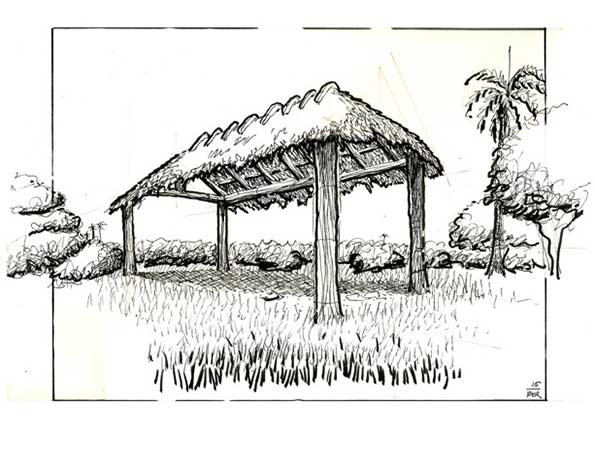
    Here, the vernacular building style is a colorful, deliciously un-Miami-like mix of shipping containers and barn tin. The traditional Seminole chickee —a rough, open hut with a raised floor, on a log frame — lends a tropical, exotic flair to this spotty rim of human inhabitation, pressed against nature’s vast size. The chickee’s thatched palm fronds create a natural insulation barrier that blocks the sun’s heat, and the fully open sides allow the tiniest of breezes to move air through the space underneath. This native response to the land is more appropriate than the thick-walled, stucco-buttered architecture imported from arid Spain and grafted onto Florida’s humid, wet character. The Seminole answer was to work with nature, have a light touch, and when a hurricane blows it all away, build it again. The classic Florida Chickee is an informal structure that the Seminole tribe builds. Some still use as living quarters in a way similar to camping (for those who prefer air conditioning, power, and plumbing, a more modern house is used).This zen approach to fulfilling the human need for shelter is decidedly un-modern and soft, and the chickee presence at the edge of the Everglades lends a certain amount of respect to the power of nature just beyond.

    Civilized life is stripped away, layer by layer, on the margin of the city. Abandoned subdivisions and Native American chickees coexist together, creating a sense of place that overlays the premodern chickee onto the failed subdivisions of modernity. This sense of place tends to mark man’s over-reach into the wilderness. Yet another marker can be found on buildings constructed by modern means, where layers of veneer have not been added: raw materials, unpainted and unadorned, stand crude and timeless against the trees and the sky. The edge’s presence can be sensed where structures start to dissolve into informality.

    Everglades National Park is a hard, urban boundary on the map, but on the ground it is a blurred zone where the slow-moving river of grass influences human activities. The nuanced edge continues into the Everglades themselves, where Florida’s subtle water-nature is uninterrupted. Water flows in a gentle, slow sheet across Florida’s flat limestone bed, coated with organic material barely thick enough for life to cling to. Where the limestone base dips a few inches, grass fails to grow; where a nub rises a few inches above this hard plain, unique tree islands gather. These islands are too densely vegetated to admit any human. Their edges are wrapped in a thick tangle of branches and leaves, a sort of bonsai-forest in miniature. Insects, birds, and other small creatures inhabit these infrastructures, forming their own natural urban civilizations of city-states, out of man’s reach.

    In between approaching jets and the distant rumble of airboats, a larger silence takes over. Penetrating the membrane between inside and outside gives us a new perspective. To confine our efforts to areas that are already strongly modified by human activities suddenly makes philosophical sense. Boundaries, once created, harden over time, and the softness of the western edge of humanity against the eastern boundary of the Everglades seems destined to harden. In its current state, this snapshot of the feathered, nuanced edge of civilization seems to be delicately balanced between the rural and the natural. Agricultural industry on the periphery of the great conurbation of Miami moves at a pace that is in between the seasonal flow of the Everglades and the nanosecond street culture of contemporary western civilization.

    Florida’s ubiquitous industry, tourism, mixes with agriculture even here at the edge of the wetlands, with the airboat rides, fruit stands, and alligator wrestling shows that pepper it. The vernacular architecture of the Everglades is not quite agricultural, yet not quite contemporary Florida either. Its flavor is connected to the Caribbean tropicalism one finds on islands like Puerto Rico, Barbados, and Hispañola. Endlessly adaptable shipping containers sit cheek-by-jowl with chicken coops and thatch awnings to create an ad hoc pedestrian space under palm trees. All is a little too clean and, well, ‘inspected,’ to be really offshore. But it’s also a little more relaxed than the uptight, postmodern built environment we’ve come to expect in America.

    Heading east out of the Everglades is a somewhat wistful journey forward in time. Rural roads lined with mango trees abruptly give way to fruit processing plants, which back up to grocery store strips, and the standard parade of global brand names enters the windshield, a gateway back into contemporary America. Stoplights take longer, the traffic pace quickens, and today’s Florida, like a hair shirt, envelops you in a cocoon of highly regulated infrastructure, put there for your own protection.

    Richard Reep is an architect with VOA Associates, Inc. who has designed award-winning urban mixed-use and hospitality projects. His work has been featured domestically and internationally for the last thirty years. An Adjunct Professor for the Environmental and Growth Studies Department at Rollins College, he teaches urban design and sustainable development; he is also president of the Orlando Foundation for Architecture. Reep resides in Winter Park, Florida with his family.

    Photos by the author: (top) vernacular building style on the edge of the Everglades; early morning workers arrive in Homestead by bus; protypical Chickee hut; unpainted structure, common on the edge of the Everglades.