Category: Small Cities

  • ‘Lone Eagle’ Cities: Where The Most People Work From Home

    In an era of high unemployment and limited opportunity, more Americans are taking matters into their own hands and going to work for themselves out of their homes.

    Normally small businesses have led the way during economic recoveries, but this time around they’re not creating many jobs. Instead much of the growth we are now seeing is in “lone eagle” businesses, to borrow a phrase from Phil Burgess, often operating out of the worker’s residence. This reverses the trend from 1960 to 1980, when there were steady reductions in the number of people who worked at home. Indeed, despite all the talk of increased mass transit usage, the percentage of Americans working at home has grown 1.5 times faster over the past decade; there are now more telecommuters than people who take mass transit to work in 38 out of the 52 U.S. metropolitan areas with more than 1,000,000 residents.

    One clear driver of this trend is technology, particularly the growing ubiquity of high-speed Internet. A consultant in New York can now serve customers in Fargo, and vice versa, greatly expanding the range of places where people can live. This is particularly true for aging boomers, as well as younger workers having problems finding a full-time job in this tough economy.

    Not surprisingly, of America’s 52 largest metro areas, the ones with the highest proportions of home-based workers are generally those with high-tech, information-based economies. Tops is San Diego, a major center for digital and biomedical businesses, where 6.6% of workers are based at home.

    The next five metro areas, which have home worker concentrations ranging from 6.1% to 6.4%, all boast a high number of STEM workers and tech firms: Austin, Portland, Denver, Raleigh and San Francisco-Oakland. They all also have another thing in common: They tend to be popular destinations for millennials, who seem far more comfortable with unconventional work arrangements than older generations.

    High real estate costs may be accelerating the trend in San Francisco, San Diego and Portland —  if office space isn’t affordable, why not stay at home? All are also plagued by traffic congestion, most notably the Bay Area, which has among the longest commute times in the country. Rather than drive down snarled freeways, or take slow mass transit, individuals may do better working from home and heading into the traffic maelstrom only when absolutely necessary.

    College Towns, Suburbs And Exurbs

    Many metro areas, of course, are huge, and have many different kinds of geographies. But when we looked at the percentage of home-based workers in all municipalities with populations above 25,000, two types dominated the top of the table: college towns and tech-oriented exurbs. Boulder, Colo., for example, has the third highest proportion of people who work at home, at 11.6%, almost three times the national average. Other college towns with large proportions of telecommuters and one-person businesses include Berkeley, Calf. (tied for fifth, 10.6%), and Columbia, S.C. (12th, 9.9%), home to the University of South Carolina.

    But the bulk of our leading work-at-home locales are tech-oriented suburbs or exurbs. These include several communities around the often traffic-clogged greater Atlanta area, including No. 2 John’s Creek (13.1%) and No. 6 Alpharetta (10.6%).

    There are even more in the sprawl of Southern California. As many  longtime Southland residents can attest, the best workday is one that does not involve either driving or taking transit. The top municipalities on our list in the region tend to be more affluent communities, including two suburbs of our top-ranked metro area, San Diego: Carlsbad (16th, 9.4%) and Encinitas (fourth, 10.7%).

    The Codger Economy

    Yet it would be a mistake to think cities with large home-based workforces are necessarily youthful ones. Nor are they all in large metropolitan areas. Although still slightly below the average for metropolitan areas, the pace of new telecommuter growth is now much faster outside the major metro areas.

    More than 5 million Americans aged 55 or older run their own businesses or are otherwise self-employed, according to the Small Business Administration, and their numbers soared 52% from 2000 to 2007. As research from the Kauffmann Foundation suggests, many of these aging workers are not ready to hang up their workboots.

    This entrepreneurial push could correlate with  the movement of aging boomers to more rural communities, and sleepier outer suburbs. Contrary to the much-hyped notion of a “back to the city” movement among boomers, Census research suggests that if they move at all, most head further to the periphery. At the top of our list of communities over 25,000 is the coastal North Carolina city of Jacksonville, home to the Marine Corps’ Camp Lejeune and a good number of military retirees. A remarkable 13.8% of the people in this highly affordable, scenic community of 70,000 work out of their homes, roughly three times the national average. The median home price in Jacksonville: $141,000.

    Other retirement hot spots with high telecommuter shares include Boca Raton, Fla. (9.8%), Scottsdale, Ariz. (9.8%), and Bend, Ore. (9.0%). These communities tend to attract well-educated boomers, many of whom have kept their business connections and work as consultants. In many cases, telecommuting allows people to continue their careers, but in an atmosphere of comfort, without the burden of commuting and, in many cases, sans the high income taxes of places like California and New York.

    We can expect the wired economy to expand to other smaller communities. Already numerous smaller towns in the Midwest, such as Albert Lea, an hour and a half from Minneapolis, Brainerd, Minn., and Hastings Neb., all have home worker shares well above the national average. Many of the areas with the fastest growth in the number of self-employed people, notes EMSI is in small, somewhat isolated communities.

    Many analysts who follow these trends expect stay-at-home workers to become more common in the future. According to research by Kate Lister and Tom Harnish of the Telework Research Network, the typical teleworker is a 49-year-old, college-educated, salaried, non-union employee in a management or professional role, earning $58,000 a year at a company with more than 100 employees.

    This suggests that, as more workers enter their 50s, the telework population will expand further.  These numbers will continue to be buttressed by both economic and social factors. The shift towards outsourcing by companies seems unlikely to slow in the years ahead, with more work going to subcontractors who can often work at home. At the same time more boomers, particularly those with skills and connections, will continue to move to places that offer more attractive lifestyles — a process that Joel Garreau has labeled “the Santa Fe-ization of the world,” which he links to people with enough money to have choices.

    In the future, however, less well-heeled workers can also be expected to increasingly shift to affordable locales that appeal to them. This can be almost anywhere — a beach community, a rural hamlet, an exurb or even a dense urban location, as we can see by the geographic diversity in these rankings. As USC grad student Jeff Khau writes, this should encourage the development of wired coffee shops and casual restaurants in smaller communities and exurbs.

    Finally, there are both familial and environmental reasons for this trend to expand. With more two-worker households, it has become more attractive to have at least one person working from home, part-time or full-time. And then there is the environmental desire to reduce carbon admissions. Compared to being forced to live in dense cities, or taking mass transit, the best way by far to reduce energy use – not to mention stress – is to not leave home at all.

    Top Places Where Residents Work at Home

    No. 1: Jacksonville, NC – 13.8%

    No. 2. Johns Creek, GA – 13.1%

    No. 3: Boulder, CO – 11.6%

    No. 4: Encinitas, CA – 10.7%

    No. 5 (tie): Berkeley, CA – 10.6%

    No. 5 (tie): Alpharetta, GA -10.6%

    No. 5 (tie): Santa Monica, CA -10.6%

    No. 8: Frisco, TX – 10.2%

    No. 9 (tie): San Clemente, CA – 10.1%

    No. 9 (tie): Columbus, GA – 10.1%

    No. 11: Bethesda CDP, MD – 10.0%

    No. 12: Columbia, SC – 9.9%

    No. 13 (tie): Boca Raton, FL – 9.8%

    No. 13 (tie): Scottsdale, AZ – 9.8%

    No. 15: Newport Beach, CA – 9.5%

    Journey to Work Market Share by Mode (2012 ACS.1 & Year)
      Total Drive Alone Car Pool Transit Cycle Walk Other  @ Home
    United States 100% 76.3% 9.7% 5.0% 0.6% 2.8% 1.2% 4.4%
    Outside Major Metropolitan Areas 100% 79.9% 10.2% 1.2% 0.6% 2.8% 1.2% 4.1%
    Major Metropolitan Areas (52) 100% 73.5% 9.3% 7.9% 0.7% 2.8% 1.2% 4.6%
                     
    Atlanta, GA 100% 78.0% 10.5% 2.9% 0.1% 1.4% 1.1% 5.9%
    Austin, TX 100% 76.0% 11.0% 2.3% 0.9% 2.0% 1.4% 6.4%
    Baltimore, MD 100% 76.5% 8.9% 6.5% 0.3% 2.7% 1.0% 4.1%
    Birmingham, AL 100% 85.7% 9.1% 0.6% 0.1% 1.0% 0.5% 2.9%
    Boston, MA-NH 100% 68.6% 7.5% 12.2% 1.0% 5.4% 1.0% 4.4%
    Buffalo, NY 100% 82.9% 7.5% 3.0% 0.5% 2.9% 0.8% 2.3%
    Charlotte, NC-SC 100% 78.8% 10.3% 2.1% 0.2% 1.6% 1.2% 5.9%
    Chicago, IL-IN-WI 100% 70.9% 8.8% 11.1% 0.7% 3.2% 1.1% 4.2%
    Cincinnati, OH-KY-IN 100% 83.5% 8.3% 1.8% 0.1% 2.0% 0.7% 3.5%
    Cleveland, OH 100% 82.3% 7.4% 3.2% 0.3% 2.3% 0.9% 3.6%
    Columbus, OH 100% 82.1% 8.4% 1.6% 0.5% 2.0% 1.1% 4.3%
    Dallas-Fort Worth, TX 100% 80.9% 10.2% 1.5% 0.2% 1.2% 1.5% 4.6%
    Denver, CO 100% 75.6% 9.1% 4.4% 1.1% 2.4% 1.1% 6.3%
    Detroit,  MI 100% 83.7% 8.9% 1.6% 0.3% 1.3% 0.8% 3.4%
    Grand Rapids, MI 100% 82.7% 9.2% 1.2% 0.5% 1.8% 0.6% 4.0%
    Hartford, CT 100% 81.4% 7.6% 3.4% 0.2% 2.7% 0.9% 3.7%
    Houston, TX 100% 79.6% 11.1% 2.6% 0.3% 1.4% 1.5% 3.5%
    Indianapolis. IN 100% 82.6% 9.4% 1.2% 0.3% 1.6% 0.9% 4.0%
    Jacksonville, FL 100% 80.7% 9.9% 1.3% 0.7% 1.3% 1.3% 4.7%
    Kansas City, MO-KS 100% 83.2% 8.9% 1.1% 0.2% 1.3% 1.1% 4.2%
    Las Vegas, NV 100% 78.5% 10.7% 3.8% 0.3% 2.0% 1.6% 2.9%
    Los Angeles, CA 100% 74.1% 10.1% 6.0% 0.9% 2.6% 1.2% 5.1%
    Louisville, KY-IN 100% 82.9% 9.3% 1.8% 0.2% 1.8% 0.8% 3.2%
    Memphis, TN-MS-AR 100% 83.0% 10.5% 1.2% 0.1% 1.2% 0.9% 3.0%
    Miami, FL 100% 77.6% 9.5% 4.2% 0.6% 1.8% 1.3% 5.0%
    Milwaukee,WI 100% 80.2% 8.6% 3.7% 0.6% 2.9% 0.7% 3.2%
    Minneapolis-St. Paul, MN-WI 100% 78.2% 8.6% 4.3% 1.0% 2.2% 0.7% 5.0%
    Nashville, TN 100% 82.4% 9.6% 1.1% 0.1% 1.2% 1.0% 4.7%
    New Orleans. LA 100% 79.2% 10.4% 2.7% 1.0% 2.5% 1.6% 2.6%
    New York, NY-NJ-PA 100% 49.8% 6.7% 31.0% 0.6% 6.1% 1.6% 4.1%
    Oklahoma City, OK 100% 82.9% 10.2% 0.4% 0.3% 1.7% 1.2% 3.3%
    Orlando, FL 100% 80.8% 9.2% 2.0% 0.6% 1.2% 1.7% 4.6%
    Philadelphia, PA-NJ-DE-MD 100% 73.3% 7.9% 9.4% 0.7% 3.8% 0.7% 4.2%
    Phoenix, AZ 100% 77.3% 11.0% 2.1% 0.8% 1.4% 1.8% 5.6%
    Pittsburgh, PA 100% 77.3% 9.0% 5.5% 0.3% 3.4% 0.9% 3.6%
    Portland, OR-WA 100% 70.8% 9.7% 6.0% 2.3% 3.8% 1.0% 6.4%
    Providence, RI-MA 100% 80.4% 8.8% 2.9% 0.3% 3.2% 1.1% 3.2%
    Raleigh, NC 100% 80.3% 9.8% 1.0% 0.4% 1.1% 1.2% 6.2%
    Richmond, VA 100% 81.5% 9.3% 1.6% 0.5% 1.5% 0.9% 4.7%
    Riverside-San Bernardino, CA 100% 77.7% 13.4% 1.5% 0.4% 1.6% 1.0% 4.4%
    Rochester, NY 100% 82.4% 7.9% 1.9% 0.3% 3.6% 0.7% 3.2%
    Sacramento, CA 100% 75.5% 11.2% 2.3% 1.9% 2.2% 0.9% 6.0%
    Salt Lake City, UT 100% 75.0% 12.1% 3.9% 0.9% 2.0% 1.3% 4.7%
    San Antonio, TX 100% 79.7% 11.1% 2.3% 0.1% 1.7% 1.0% 4.1%
    San Diego, CA 100% 76.2% 9.9% 2.8% 0.7% 2.7% 1.2% 6.6%
    San Francisco-Oakland, CA 100% 60.4% 10.1% 15.6% 1.8% 4.3% 1.6% 6.1%
    San Jose, CA 100% 76.5% 10.6% 3.4% 1.9% 1.6% 1.4% 4.6%
    Seattle, WA 100% 69.6% 10.5% 8.5% 1.2% 3.6% 1.1% 5.5%
    St. Louis,, MO-IL 100% 82.4% 8.1% 2.3% 0.3% 1.7% 0.9% 4.2%
    Tampa-St. Petersburg, FL 100% 80.0% 9.6% 1.2% 0.8% 1.7% 1.3% 5.4%
    Virginia Beach-Norfolk, VA-NC 100% 80.9% 8.9% 1.9% 0.4% 2.7% 0.9% 4.3%
    Washington, DC-VA-MD-WV 100% 65.8% 10.2% 14.1% 0.8% 3.2% 0.9% 5.0%

    This story originally appeared at Forbes.com.

    Joel Kotkin is executive editor of NewGeography.com and Distinguished Presidential Fellow in Urban Futures at Chapman University, and a member of the editorial board of the Orange County Register. He is author of The City: A Global History and The Next Hundred Million: America in 2050. His most recent study, The Rise of Postfamilialism, has been widely discussed and distributed internationally. He lives in Los Angeles, CA.

    Wendell Cox is a Visiting Professor, Conservatoire National des Arts et Metiers, Paris and the author of “War on the Dream: How Anti-Sprawl Policy Threatens the Quality of Life.

    Photo by By Rae Allen, “My portable home office on the back deck”

  • What America’s Fastest-Growing Economies Have in Common

    Midland and Odessa in West Texas. Pascagoula, a port town on the Mississippi Gulf Coast. Fargo and Bismarck, the two largest cities in North Dakota. These were among the USA’s 10 fastest-growing metro economies in 2013, as ranked by growth in real gross metropolitan product (GMP), and they have a few things in common.

    For one thing, none are huge population magnets. They’re also either at the center of the energy boom or indirectly benefiting from the advances in fracking technology. And they share another common trait, too: along with Columbus, Ind., also in the top 10, most of these metro areas depend on one major, export-oriented industry sector to bring in outside income and drive growth.

    In Columbus’ case, it’s manufacturing. In Odessa and Midland’s, it’s oil and gas extraction. Fargo and Bismarck have diversified economies, but they’ve a seen surge in economic activity because of North Dakota’s oil and gas boom. And in Pascagoula, it’s shipbuilding (and shipments of liquefied natural gas through the Port of Pascagoula).

    USA TODAY had a good rundown from 24/7 Wall St. of the top 10 (and bottom 10) economies, which were based on a Conference of Mayors report released in January. The authors of the piece touched on the reliance most of these metros have on one industry, and the ups and downs that can come with that. In the case of Columbus, they pointed to EMSI’s recent analysis:

    The area is highly dependent on manufacturing, and according to a 2012 report from Economic Modeling Specialists Intl., it highly “exemplifies the intriguing potential, and inherent risks, that come with relying on the manufacturing sector.” Engine and motor vehicle parts makers are a huge part of the area’s economy, where manufacturing jobs accounted for nearly 20,000 of the 53,000 total jobs as of November.

    Columbus, Ind., which was No. 9 on the fastest-growing economy list, is home to engine-maker Cummins. The central Indiana metro has a remarkable concentration of manufacturing jobs — more than a third of jobs in Columbus are manufacturing-based, and it has the highest share of mechanical engineers in the U.S. (just ahead of Peoria and Bloomington-Normal, Ill.). In recent years, employment growth in Columbus has sizzled, while Cummins continues to prosper.

    When a regional economy relies on a single basic industry like manufacturing or energy for much of its employment and exports, it can mean lots of prosperity — and a big jump in gross metro product, as USA TODAY’s list indicates. But it’s also a risky proposition. For every spike in manufacturing production, there are pullbacks and plant shutdowns. Energy booms don’t (usually) last for decades.

    “If you’re a small metro area depending on a vulnerable export sector, once that industry goes, you’re in big trouble,” Alec Friedhoff of the Brookings Institution told 24/7 Wall St.

    For metros like Midland and Odessa, the natural multiplier effects that come with energy booms will lead to more jobs in business services, retail, and especially transportation. Public-sector infrastructure jobs also usually follow. But the end goal is to spur innovation and sustainable job creation elsewhere in the economy.

    With that in mind, which of these 10 fastest-growing metros based on GMP growth is the most diversified already? The following table shows the largest contributor to gross regional product (as shown EMSI’s Analyst), as well as the sector with the largest share of jobs in each metro. The table is ranked by how the 10 metros fared in 2010-2013 job growth.

    Fastest-Growing MSAs (Based on 2013 GMP Growth) 2013 Jobs 2010-2013 % Job Growth Largest Sector Largest Contributor to 2012 GRP (Private)
    Source: QCEW Employees, Non-QCEW Employees & Self-Employed – EMSI 2013.4 Class of Worker; EMSI Social Accounting Matrix model (2012)
    Midland, TX 92,857 23% Mining/Oil & Gas Extraction (22% of jobs) Mining/Oil & Gas Extraction (55% of total)
    Odessa, TX 80,360 23% Mining/Oil & Gas Extraction (15% of jobs) Mining/Oil & Gas Extraction (28% of total)
    Columbus, IN 52,014 18% Manufacturing (36% of jobs) Manufacturing (50% of total)
    Bismarck, ND 75,090 10% Government (19% of jobs) Health Care (13% of total)
    Fargo, ND-MN 143,563 9% Health Care (13% of jobs) Manufacturing, Wholesale Trade, Finance/Insurance, and Health Care (each 10% of total)
    Sioux Falls, SD 153,358 6% Health Care (17% of jobs) Finance/Insurance (18% of total)
    Cheyenne, WY 53,917 6% Government (32% of jobs) Manufacturing and Real Estate (each 10% of total)
    Trenton-Ewing, NJ 253,751 4% Government (27% of jobs) Professional, Scientific, and Technical Services (13% of total)
    St. Joseph, MO-KS 60,643 2% Manufacturing (17% of jobs) Manufacturing (25% of total)
    Pascagoula, MS 60,214 -3% Manufacturing (22% of jobs) Manufacturing (46% of total)

    Manufacturing in Columbus makes up the highest percentage of jobs (36%), and mining and oil and gas extraction in Midland is the most dominant GRP force (55% of the total in 2012). Fargo and Bismarck, despite getting lumped in with other North Dakota oil hubs, are fairly spread out in both employment and contributors to GRP. And Pascagoula, where manufacturing accounted for 46% of GRP in 2012, is the only one of the fastest-growing metros to see an employment decline (-3% since 2010).

    Sioux Falls, however, stands out in terms of industry mix and GRP — finance and health care are strong industries, and the metro has seen seen steady job growth.

    SiouxFalls_2003-2013

    Employment has increased 17% since 2003, and the gains have been broad-based. Nine major sectors, including health care, retail trade, finance, government, and professional, scientific, and technical services, have added at least 1,000 jobs in the last decade.

    That’s a diversified economy, all right. But most of the other less-diversified economies on this list are doing just fine, too.

    Joshua Wright is an editor at EMSI, an Idaho-based economics firm that provides data and analysis to workforce boards, economic development agencies, higher education institutions, and the private sector. He manages the EMSI blog and is a freelance journalist. Contact him here.

  • The Evolving Urban Form: The San Francisco Bay Area

    Despite planning efforts to restrict it, the Bay Area  continues to disperse. For decades, nearly all population and employment growth in the San Jose-San Francisco Combined Statistical Area has been in the suburbs, rather than in the core cities of San Francisco and Oakland. The CSA (Note) is composed of seven adjacent metropolitan areas (San Francisco, San Jose, Santa Cruz, Santa Rosa, Vallejo, Napa, and Stockton). A similar expansion also occurred in the New York CSA.

    The San Francisco Bay Area is home to two of the three most dense built-up urban areas in the United States, the San Francisco urban area, (6,266 residents per square mile or 2,419 per square kilometer) with the core cities of San Francisco and Oakland and the all-suburban San Jose urban area (5,820 residents per square mile or 2,247 per square kilometer), according to US Census 2010 data. Only the Los Angeles urban area is denser (6,999 per square mile or 2.702 per square kilometer). The more spread out New York urban area trails at 5,319 per square mile (2,054 per square kilometer).

    The San Francisco Bay & Central Valley Area

    The continuing dispersion was reflected in commuting patterns that developed between 2000 and 2010, with the addition of the Stockton metropolitan area, which is composed of San Joaquin County, with more than 700,000 residents. San Joaquin County is located in the Central Valley and is so far removed from San Francisco Bay that it may be appropriate in the long run to think of the area as the "San Francisco Bay & Central Valley Area." The distance from Stockton to the closest point shore of San Francisco Bay is 60 miles, and it is nearly another 25 miles to the city of San Francisco.

    Ironically, this continued dispersion of jobs and residences is, at least in part, driven by the San Francisco Bay Area’s urban containment land use policies designed to prevent it. What the planners have ignored is the impact on house prices associated with highly restrictive land use planning. The San Francisco metropolitan area and the San Jose metropolitan area are the third and fourth most unaffordable major housing markets out of 85 rated in the recent 10th Annual Demographia International Housing Affordability Survey, trailing only Hong Kong and Vancouver.

    Historical Core Cities: San Francisco and Oakland

    The historical core municipalities (cities) of the San Francisco Bay Area, San Francisco and Oakland have held their population very well. Each essentially retains it 1950 borders. Among the 40 US cities with more than 250,000 residents in 1950, only San Francisco and Oakland managed population increases by 2000 without substantial annexations and substantial non-urban (rural) territory within their city limits. For example, New York and Los Angeles, both of which have grown, have nearly the same city limits as in 1950 and 2000, yet much of New York’s Staten Island was rural in 1950 as was much of the San Fernando Valley in Los Angeles.

    Yet both San Francisco and Oakland have had difficult times. Between 1950 and 1980, both San Francisco and Oakland suffered 12 percent population losses, which were followed by recoveries. The losses were modest compared to the emptying out of municipalities like St. Louis. Detroit, Chicago, Copenhagen, and Paris, which remain one quarter to nearly two-thirds below their 1950s figures. Further, population gains from annexations masked losses within the 1950 boundaries of many cities, such as Portland, Seattle, and Indianapolis, etc.

    San Jose: Now the Largest City

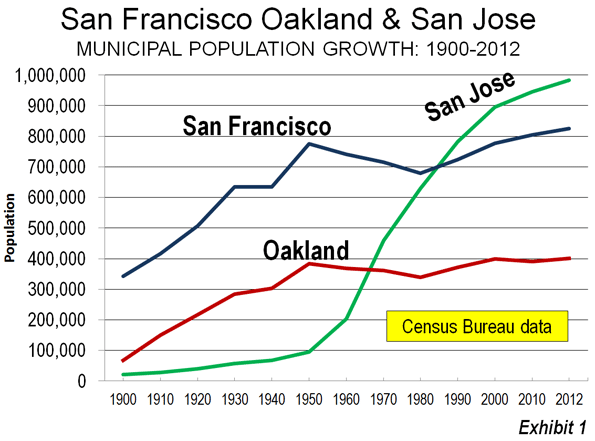
    San Jose is now the Bay Area’s largest city. San Jose has grown spectacularly, from a population of 95,000 in 1950 to nearly 1,000,000 today. San Jose passed San Francisco by the 1990 census and Oakland by the 1970 census (Figure 1). Virtually all of San Jose’s population growth has occurred during the postwar period of automobile suburbanization. The pre-automobile urban form familiar in San Francisco and central Oakland simply does not exist in San Jose. Even attempts to pretend the pre-war urban form has returned have been famously unsuccessful. Even after building an extensive light rail system, San Jose’s transit work trip market share is barely one quarter that of the adjacent San Francisco metropolitan area.

    Nonetheless, suburban San Jose has become a dominant force in the "Silicon Valley", which stretches through San Mateo County in the San Francisco metropolitan area and into Santa Clara County, which includes San Jose. The Silicon Valley has been the capital of the international information technology business for at least a half century. The highly suburbanized region has done more than its share to elevate the San Francisco Bay Area to its high standard of living (According to Brookings Institution data), a phenomenon that has spread also the urban core of San Francisco. At the same time, San Jose is the second most affluent major metropolitan in the world and San Francisco ranks seventh. The Silicon Valley, which includes much of San Mateo County (adjacent to Santa Clara County in the San Francisco metropolitan area), is clearly the economic engine of the region with twice as many jobs as San Francisco (which is both a city and a county).

    Metropolitan Growth

    Overall, the San Francisco Bay Area has grown approximately 180 percent since 1950, considerably more than the national average from 1950 to 2012 of 107 percent. The Bay Area’s growth was strong, but well behind the 280 percent growth achieved in the Los Angeles CSA (Los Angeles, Riverside-San Bernardino, and Oxnard MSAs).

    However, growth has since moderated substantially. Between 1950 and 2000, the Bay Area grew at an annual rate of 1.9 percent but since 2000, the annual growth rate has dropped to 0.7 percent annually. Even so, in recent years, the Bay Area has nearly equaled the much slowed growth of the Los Angeles CSA, adding 23.6 percent to its population since 1990, compared to 25.5 percent in Los Angeles. Both areas, however, grew at less than the national population increase rate (25.8 percent), and slowing, in the 2000s to the slowest growth rates since California became a state in 1850.

    Suburban Growth

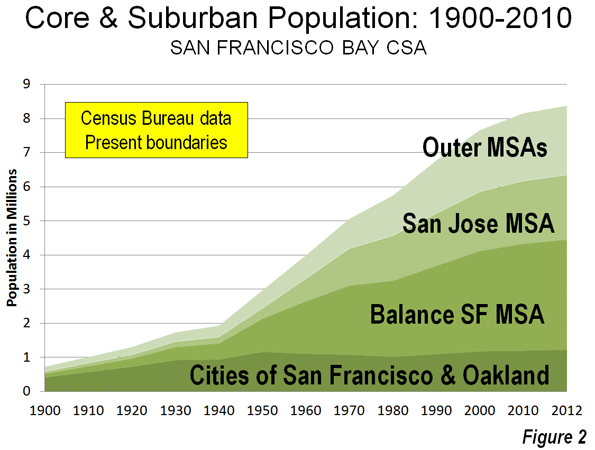
    Despite the decent demographic performance of the cities of San Francisco and Oakland since 1950, nearly all Bay Area growth occurred in the suburbs. Between 1950 and 2012, only one percent of population growth in the CSA occurred in the two historical core municipalities and 99 percent in suburban areas. Things have been somewhat better for the two cities since 2000, with seven percent of the growth in the historical core municipalities and 93 percent of the growth in suburban areas (Figure 2).

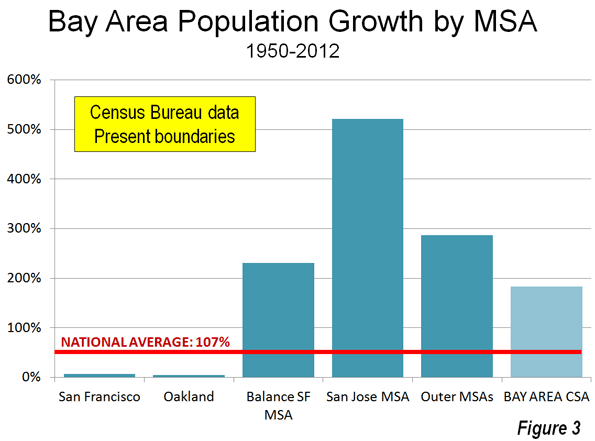
    Since 1950, the San Jose metropolitan area has grown by far the fastest in the CSA, with the more than 500 percent increase in population. The outer metropolitan areas (Santa Cruz, Santa Rosa, Vallejo, Napa, and Stockton) have grown nearly 300 percent, while the parts of the San Francisco metropolitan area outside the two core cities grew more than 200 percent. San Francisco and Oakland grew approximately 5 percent (Figure 3).

    Domestic Migration

    As house prices increased before the subprime crisis, the Bay Area lost more than 600,000 domestic migrants, a rate of more than 85,000 per year. Since 2008, however, with substantially lower house prices, and a renewed tech boom, there has been an annual gain of approximately 4,000 to the Bay Area in domestic migration. However, if the substantial house price increases since 2012 continue, the area could again become a net exporter of people.

    Future Urban Evolution

    Like much of California, San Francisco Bay CSA exhibits much slower population growth than before. How much of this is tied to the regional and state policies constricting suburban housing remains an open question, but it seems much growth that might have occurred in the original San Francisco metropolitan area or the later developing San Jose metropolitan area will instead occur in the Vallejo or Stockton metropolitan areas, where housing prices  tend to be much lower, particularly for larger homes that are increasingly unaffordable closer to the urban core. Indeed, it is not impossible that Modesto (Stanislaus County) could be added  to the San Francisco Bay CSA by 2020, which is even farther away from the historical core than the Stockton metropolitan area.

    At the same time, many potential new residents may find either the high prices near the core nor the long commutes associated with Central Valley residence unappealing. Many households may instead seek their aspirations in Utah, Colorado, Texas, and even Oklahoma, not least because the "California Dream" has been made affordable.

    Wendell Cox is a Visiting Professor, Conservatoire National des Arts et Metiers, Paris and the author of “War on the Dream: How Anti-Sprawl Policy Threatens the Quality of Life.

    —–

    Note: Metropolitan areas are labor markets. Their building blocks in the United States are complete counties. Metropolitan statistical areas are organized around built up urban areas with counties reaching a threshold of the urban area population being considered central counties and included in the metropolitan area. In addition, any county with an employment interchange of 25 percent or more with the core counties is also included in the metropolitan area. Adjacent metropolitan areas are added together to form Combined Statistical Areas if there is a 15 percent or more employment interchange. This is a simplified definition. Complete details are available from the US Office of Management and the Budget.

    Photo: Market Street, San Francisco (by author)

  • Rich, Poor, and Unequal Zip Codes

    Income inequality is an increasingly dominant theme in American culture and politics. Data from the IRS covering mean and median income of filing households for 2012 by zipcode allow us to map and interpret the fascinating geography of income differences. Where are the richest areas, the poorest and the most unequal?

    The IRS data do not give us the distributions of incomes, so this report does not tell us where the largest numbers of rich or poor populations will be found; this can be done from the American Community Survey for large enough units of geography. With the IRS data, the median is the income of the household halfway between poorest to richest after all are ranked by income. The mean, or average income, is the aggregate income of all households divided by the number of households filing a return. 

    Most of the over 44,000 US zip codes have a sufficient mix of lower to higher income households that they do not stand out as extremely rich or poor. Even many zips with very low mean or median incomes are not so extreme since most of the poor population actually lives in more mixed income areas. Very unequal areas are defined here as having a far higher mean than median income, indicating an imbalance of incomes, e.g. a few very high income households inflate the average over the more typical, median income.

    The Richest Zip Codes

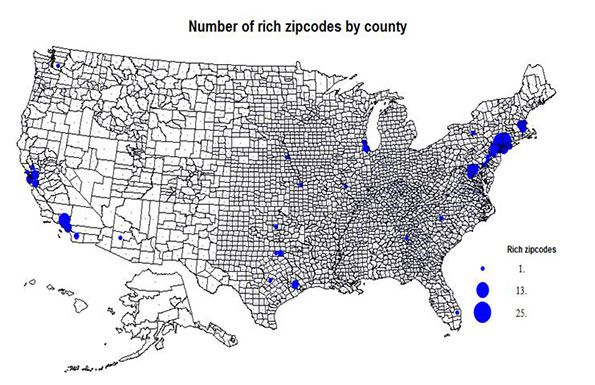
    Figure 1 maps the 170 zip codes with more than 1000 people and median incomes over $150,000 or mean incomes over $200,000. The most astounding thing about the map (which shows the number of rich zip codes by the county they are part of) is their  concentration  in a few areas, led by the country’s premier global city, greater New York city, with 75 of the 170. New York is followed by Washington DC with 23, another sign of the growing wealth of the national capital.  Boston follows with 10, Los Angeles, 18, San Francisco (14), and Chicago (6) and then a scattering in other leading metropolitan areas. There is no such concentration of the super-rich in any rural or small town area. But many are quasi-rural suburban and exurban.

    Richest Zip Codes
    State County Place Zipcode Mean (thousands)
    NY Westchester Purchase 10577 363
    NY Nassau Westbury 11568 351
    IL Cook Kenilworth 60043 342
    NY Westchester Pound Ridge 10576 338
    CA San Mateo Atherton 94027 337
    PA Montgomery Gladwyne 19035 333
    CA Los Angeles Bel Air 90077 327
    NJ Essex Short Hills 07078 322
    NY Nassau Glen Head 11548 316
    CT Fairfield Weston 06883 286
    CT Fairfield New Canaan 06840 308
    IL Cook Glencoe 60022 297


    But, the reader will protest, there are huge numbers of rich folk in Texas, Florida, Ohio, Pennsylvania, and other states. The reason is that these many rich households are “diluted” in impact because the zip codes are more variable in income. There really is something remarkable about the overwhelming affluence of the key suburban areas of Westchester and Nassau, New York; Fairfield, CT; Fairfax, VA; and Howard and Montgomery, MD. But I believe the map is telling and accurate at highlighting the utter dominance of the economic power of New York and then Washington. Boston retains power beyond its size, while Los Angeles, Chicago, San Francisco, and upstarts in the South scramble for a place.

    The Richest Areas

    The zip code with the highest and the 4th highest incomes are in Westchester County, close to the Connecticut border. The second richest, Westbury, is in Nassau county, New York, which also has the 9th richest. Also in the NYC suburbs are the 8th, in New Jersey just 20 miles west of New York, while 10th and 11th richest are both located  in Fairfield County, CT.

    Chicago’s north Cook county has the 3rd (Kenilworth) and 12th (Glencoe) richest areas.  Los Angeles is home to the 7th richest, Bel Air (northwest of Beverly Hills), Atherton, in San Mateo county, is the 5th richest, and Gladwyne in Montgomery County, PA is the 6th richest.  Greater New York then is home to 7 of the 12 richest, followed by Chicago with 2.  Quite a concentration. 

    The Poorest Zip Codes

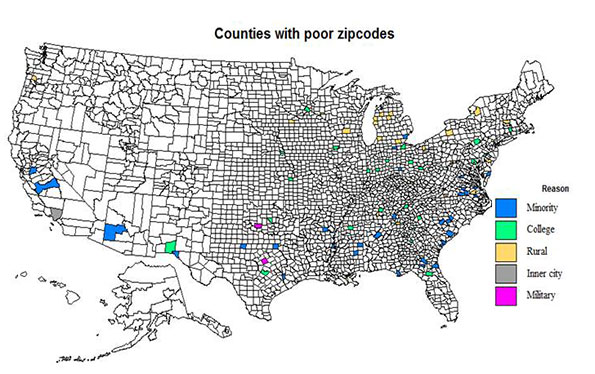
    The list and map (Figure 2) of counties with poor zip codes may surprise the reader more. I divide the 94 poorest areas into five types:

    • minority population domination, 35 areas,
    • college or university student majorities, with 25 places,
    • rural (in the sense of small communities in these counties having been left behind or declined) some 25 areas,
    • five inner city areas dominated by single men, 5, and
    • two areas dominated by a large military base.

    The poor college areas are zip codes for student dormitory housing, people who are temporarily poor; some military base areas are similarly poor because of barrack housing of single people.

    The poorest minority dominated areas are mainly Black and in the rural to small city South, except for a few Hispanic dominated areas in the west. The college poor areas are scattered across the country, especially in the East, the military base communities in Texas and Oklahoma. The rural set is surprisingly concentrated mainly in the north, especially in Michigan. The few inner city poor areas are in Los Angeles, Waterbury, CT: Portland, OR; Youngstown and Canton, OH; an odd set. A few of the rural areas also have correctional institutions.

    Poorest Zip Codes
    State County Place Zipcode Median
    NE Douglas Omaha 68178 $2,499
    KY Elliott Burke 41171 $3,494
    GA Clinch Cogdell 31634 $3,886
    FL Gulf Wawahitchka 32465 $4,481
    CT Tolland Storrs 06269 $6,124
    WI Dane Madison 53706 $6,359
    VA Nottoway Blackstone 23824 $6,421
    MI Clare LeRoy 49665 $6,639
    TN Rutherford Murfreesboro 37132 $7,125
    IN Delaware Muncie 47306 $6,750
    NY Cattaraugus Salamanca 14779 $7,395


    If I had relaxed limit by including more smaller population areas, or not quite such low incomes, many more college, military base, minority majority counties would appear on the map. But as noted up front, virtually none of these poorest zip codes are in big cities or their metropolitan areas, where millions of poor households live, simply because these metro zip codes tend to be large and more heterogeneous. This also does not factor in the cost of living, which can be high in some regions, particularly on the east and west coasts.

    The Poorest Areas

    The 12 poorest zip codes are different and quite varied in character. Five of the zip codes are essentially college or university student housing, and thus not indicative of an adult working population. Three areas are in part poor because of the presence of correctional institutions or adult care institutions. Two of these also have a significant minority (Black) population. Two rural areas, in GA and VA have high Black shares. This leaves two northern rural areas in Michigan (high seasonal dependency) and in New York, Salamanca, also a seasonal resort, as well as an Indian reservation.

    Unequal Zip Code

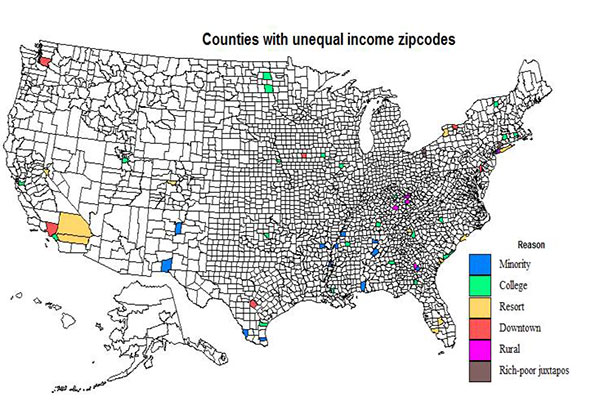
    The unequal zip codes (67) are mainly areas where the mean is at least twice the median, showing the disproportionate effect of a few very wealthy households. One critical area for high inequality are primarily beach or mountain communities with richer retirees serviced by lower-paid workers; these include 13 areas in California, South Carolina, Florida, New York, Nevada, North Carolina, and Colorado. Downtowns (8 areas) include a few actual downtown CBD zip codes with an older poor population and newer rich folk. Rural here identifies mainly small Kentucky zip codes with a very imbalanced income pattern (7 areas). Finally I note a few zip codes in exurban areas where there appears to be a juxtaposition of an older resident population, and newer wealthier households (3 areas). This pattern may become more common in both exurban and rural small-town environmental amenity areas.

    Most Unequal Zip Codes
    State County Place Zipcode Median Mean
    CA Alameda Berkeley 94720 $16,192 $79,238
    SC Pickens Clemson 29634 $12,159 $51,444
    LA E Carroll Transylvania 71286 $28,961 $96,377
    TX Starr 3 zips 78536etc $29,722 $98,048
    KY Elliott Ezel 41425 $29,980 $65,676
    TN Rutherford Murfreesboro 37132 $7,125 $21,863
    MA Suffolk Boston 02111 $31,442 $62,087
    VA Radford Radford 24142 $15,931 $46,860
    ND Cass Fargo 58105 $24,750 $70,633
    DC DC WashingtonDC 20006 $12,103 $32,155
    TX Bexar San Antonio 78205 $25,779 $69,628
    NC New Hanover WrightsvilleBch 28480 $70,375 $184,658
    NV Douglas Glenbrook 89413 $68,512 $172,004


    The Most Unequal Areas

    Of the 13 most unequal areas, 6 are college or university zip codes, areas with poor students and much higher income professionals. Two are downtown zip codes, Boston and San Antonio, two are minority population areas, Louisiana and Texas. Two are resort areas, in Nevada and North Carolina, but several similar areas are not far down on the list. One Kentucky area is classed as just rural, but again other similar counties are on the fuller list.

    Several zip codes are on both the poorest and the unequal zip code lists, most commonly the college and the minority-dominated areas. Rich suburban and exurban areas tend to be fairly consistently rich, resort areas tend to be more unequal.

    Conclusion

    The zip code data provide a partial, highly localized look at the geography of inequality. If American society continues to accept extreme income, the geography of inequality will only become not only more extreme, but more pronounced in a diverse set of locations.

    Richard Morrill is Professor Emeritus of Geography and Environmental Studies, University of Washington. His research interests include: political geography (voting behavior, redistricting, local governance), population/demography/settlement/migration, urban geography and planning, urban transportation (i.e., old fashioned generalist).

  • NewGeography’s Top Stories of 2013

    A new year is upon us, here’s a look back at a handful of the most popular pieces on NewGeography from 2013. Thanks for reading, and happy New Year.

    12. Gentrification as an End Game, and the Rise of “Sub-Urbanity” In January Richey Piiparinen points out that gentrification driven by affluent young people moving back to the city might be creating “a ‘sub-urbanity’ that is emerging when the generalization of gentrification meets the gentrification of the mind.”

    11. The Cities Winning the Battle for the Biggest Growth Sector in the U.S. Joel and I put this index together to measure growth and concentration of the professional, technical, and scientific services sector among the nation’s largest metropolitan areas. As high-end services become easier to export, this sector is becoming a critical region-sustaining sector in many parts of the country. This piece also ran at Forbes.com.

    10. A Map of America’s Future: Where Growth will be Over the Next Decade Working with Forbes Magazine in September, Joel and I laid out seven regions and three city-states across the nation. Regional economic diversity is one of America’s most critical attributes.

    9.  The Dutch Rethink the Welfare State Nima Sanandaji outlines the trajectory of the social services culture in the Netherlands.

    8.  Suburb Hating is Anti-Child In this provocative, widely-discussed piece, Mike Lanza takes it to politicians and commentators who advocate against suburbs, pointing out that “we need to fix suburbs and the way families utilize them,” but “what we shouldn’t do is try to force families to live in dense city centers.”

    7.  Fixing California: The Green Gentry’s Class Warfare Joel Kotkin points out that many green policies are pro-gentry and anti-middle class, particularly in California. This piece originally appeared at U-T San Diego.

    6.  How Can We Be So Dense? Anti-Sprawl Policies Threaten America’s Future In this piece from Forbes, Joel Kotkin argues that high-density housing advocates should be open to a broader range of housing options because policies pushing high density often favor real estate investors over the middle class and the concept of upward mobility.

    5.  Class Warfare for Republicans Joel takes the Republican Party to task for ignoring the issue of class and small business growth in favor of rhetoric about social conservatism, gun control, and free market idealism. This piece originally ran in the Orange County Register.

    4.  Houston Rising: Why the Next Great American Cities Aren’t What you Think In this piece from The Daily Beast, Joel argues that a city’s most important quality is its ability to foster upward mobility and to sustain a middle class, not its urban form.

    3.  The New Power Class Who Will Profit from Obama’s Second Term Who stands to benefit most from the second Obama administration? Joel argues that it’s the plutocrats of Silicon Valley and new media industries and the clerisy of academia. This piece originally appeared at Forbes.com.

    2.  Why are there so Many Murders in Chicago? Aaron Renn lays out seven possible reasons contributing to violent crime in Chicago and calls for an adjustment in strategy to fight it.

    1.  Gentrification and its Discontents: Notes from New Orleans The most read piece of the year is this excellent expose of gentrification and its impact on the culture and age demographics of New Orleans by local geographer Richard Campanella.

    Mark Schill is a community strategist and analyst with Praxis Strategy Group and New Geography’s Managing Editor.

  • The Evolving Urban Form: Greater New York Expands

    The term “Greater New York” was applied, unofficially, to the 1898 consolidation that produced the present city of New York, which brought together the present five boroughs (counties). The term “Greater” did not stick, at least for the city. When consolidated, much of the city of New York was agricultural. As time went on, the term "Greater" came to apply to virtually any large city and its environs, not just New York and implied a metropolitan area or an urban area extending beyond city limits. By 2010, Greater New York had expanded to somewhere between 19 million and 23 million residents, depending on the definition.

    Greater New York’s population growth has been impressive. Just after consolidation, in 1900, the city and its environs had 4.2 million residents, according to Census historian Tertius Chandler. Well before all of the city’s farmland had been developed, New York, including its environs, had become the world’s largest urban area by the 1920s, displacing London from its 100 year predominance. Yet, even when Tokyo displaced New York in the early 1960s, there was still farmland on Staten Island. 

    New York became even larger in two dimensions, as a result of geographic redefinitions arising from the 2010 census.

    The Expanding New York Metropolitan Area

    The New York metropolitan area grew by enough land area to add more than 700,000 residents between 2000 and 2010, even after the decentralization reported upon in the metropolitan area as defined in 2000. The expansion of the metropolitan area occurred because the employment interchange between the central counties and counties outside the metropolitan area in 2000 became sufficient to expand the boundaries by more than 1,000 square miles (2,500 square kilometers).

    Summarized, metropolitan areas are developed by identifying the largest urban area (area of continuous urban development with 50,000 or more population) and then designating the counties that contain this urban area as “central counties.” Additional (“outlying”) counties are included in a metropolitan area if 25 percent or more of their resident workers have jobs in the central counties, or if 25 percent or more of the employees in the outlying county live in the central counties (There are additional criteria, which can be reviewed at 2010 Office of Management and Budget metropolitan area standards). In addition, adjacent metropolitan areas can be merged into a combined statistical area at a lower level of employment interchange (see below).

    For example, one of the counties added to the New York metropolitan area in the 2010 redefinition was Dutchess (home of the Franklin Delano Roosevelt Presidential Library). A resident of Dutchess County who works across the county line in Putnam County (a central county) would count toward the 25 percent employment interchange with the central counties of the New York metropolitan area. Contrary to some perceptions, metropolitan areas do not denote an employment interchange between suburban areas and a central city, even as major an employment destination as the city of New York.

    The OMB concept of “central” counties is in contrast to the more popular view that would consider the central counties to be Manhattan (New York County) or the five boroughs of New York City. In fact, out of the New York metropolitan area’s 25 counties, all but three (Dutchess and Orange in New York and Pike in Pennsylvania) are central counties. Sufficient parts of the urban area are in the other 22 counties, which makes them central.

    The Expanding New York Combined Statistical Area

    OMB has a larger metropolitan concept called the "combined statistical area." The combined statistical area is composed of metropolitan and micropolitan areas that have a high degree of economic integration with the larger metropolitan area. Essentially, adjacent areas are merged into a combined statistical area if there is an employment interchange of 15 percent. This occurs where the sum of the following two factors is 15 percent or more: (1) The percentage of resident workers in the smaller area employed in the larger area (not just central counties) and (2) The percentage of workers employed in the smaller area who reside in the larger area.

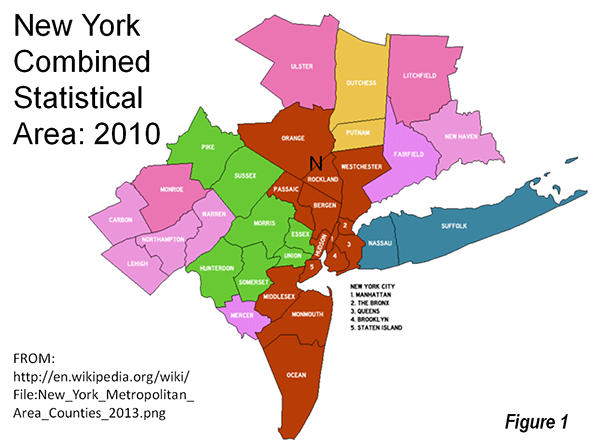
    On this measure, New York became greater by more 1 million residents as a result of the changes in commuting patterns. The addition of Allentown (Pennsylvania – New Jersey) and the East Stroudsburg, Pennsylvania metropolitan areas expanded the New York combined statistical area by another 2,700 square miles (7,000 square miles), bringing the population to 23.1 million. Altogether, the metropolitan area and combined area land area increases added up to 3,700 square miles (9,700 square kilometers). The 35 county New York combined statistical area is illustrated in the map (Figure 1).

    Organized Around the World’s Largest Urban Area (in Land Area)

    The New York combined statistical area is very large. It covers approximately 14,500 square miles (37,600 square kilometers). From north to south, it measures 235 miles (375 kilometers) from the Massachusetts border of Litchfield County, Connecticut to Beach Haven, in Ocean County, New Jersey. It is an even further east to west, at more than 250 miles (400 kilometers) from Montauk State Park in Suffolk County, New York to the western border of Carbon County in Pennsylvania (Note 2). Despite containing the largest urban area  in the world, at 4,500 square miles (11,600 square kilometers), more than 60 percent of the combined statistical area is rural (see Rural Character in America’s Metropolitan Areas).

    Dispersion of Jobs and Residences

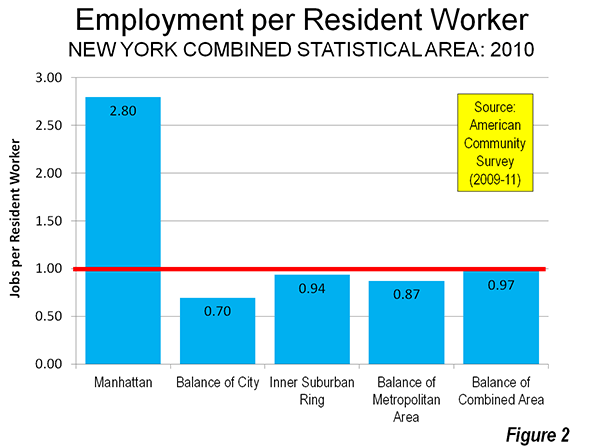
    The dispersion characteristic of modern metropolitan regions is illustrated by the extent to which jobs have followed the population in the New York combined statistical area. In all “rings” outside the city of New York, there is near parity between resident workers and jobs. The greatest employment to worker parity (0.97) is in the metropolitan and micropolitan areas outside the New York metropolitan area (Allentown, PA-NY; Bridgeport, CT; East Stroudsburg, PA; New Haven, CT; Torrington, CT; and Trenton, NJ). There is 0.94 parity in the inner ring suburban counties, which include Nassau and Westchester in New York as well as Bergen, Essex, Hudson, Middlesex, Passaic and Union in New Jersey. The outer balance of the New York metropolitan area has slightly lower employment to worker parity, at 0.87 (Figure 2).

    The lowest employment to worker parity in the New York combined statistical area is in the four boroughs of New York City outside Manhattan, at 0.70. The greatest disparity is in Manhattan, where there are 2.80 jobs for every resident worker. Combining all of New York’s five boroughs yields a much more balanced 1.17 jobs per resident worker.

    Example: Commuting from Hunterdon County

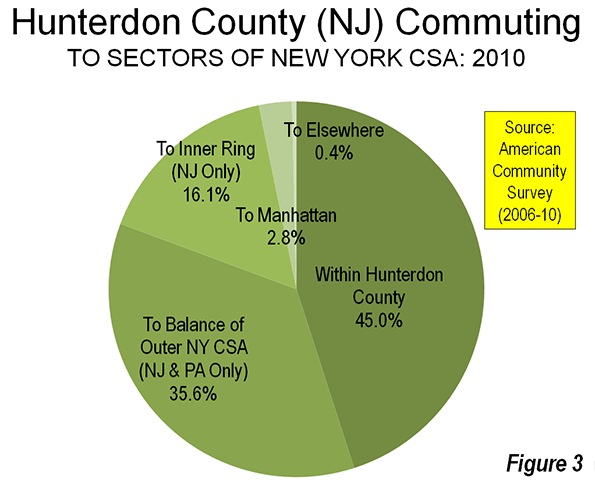
    Hunterdon County, New Jersey provides an example of the dispersion of employment in the New York area. Hunterdon County is located at the edge of the New York metropolitan area. It is well served by the commuter rail services of New Jersey Transit. With a line that reaches Penn Station in New York City, approximately 55 miles (35 kilometers) away. Yet, the world’s second largest employment center (after Tokyo’s Yamanote Loop), Manhattan south of 59th Street, draws relatively few from Hunterdon County to fill its jobs.

    Among resident workers, 45 percent have jobs in Hunterdon County. Another 36 percent work in other outer counties of the combined statistical area. This leaves only 19 percent of workers who commute to the rest of the combined statistical area. The New Jersey inner suburban counties attract 16 percent of Hunterdon’s commuters and Manhattan employs just three percent of Hunterdon’s resident workers (Figure 3). Fewer than 0.5 percent of Hunterdon’s commuters work in the balance of the CSA, including the outer boroughs of New York, the other New York counties and Connecticut). The detailed area definitions are included in the Table.

    DISTRIBUTION OF COMMUTING FROM HUNTERDON COUNTY, NEW JERSEY
    To Locations in the New York Combined Statistical Area (2006-2010)
    NY CSA Sector Commuting from Hunterdon County Areas Included
    Hunterdon County 45.0% Hunterdon County, NJ
    Outer Combined Statistical Area 35.6% Monmouth County, NJ
    Morris County, NJ
    Ocean County, NJ
    Pike County, PA
    Somerset County, NJ
    Sussex County, NJ
    Allentown metropolitan area, PA-NJ
    East Stroundsburg metropolitan area, PA
    Trenton metropolitan area, NJ
    Inner Ring (New Jersey only) 16.1% Bergen County, NJ
    Essex County, NJ
    Hudson County, NJ
    Middlesex County, NJ
    Passaic County, NJ
    Union County, NJ
    Manhattan 2.8% New York County, NY
    Elsewhere 0.4% Bronx
    Brooklyn
    Queens
    Staten Island
    Dutchess County, NY
    Nassua County, NY
    Orange County, NY
    Putnam County, NY
    Rockland County, NY
    Suffolk County, NY
    Westchester County, NY
    Bridgeport metropolitan area, CT
    Kingston metropolitan area, NY
    New Haven metropolitan area, CT
    Torrington metropolitan area, CT


    From Commuter Belts and Concentricity to Dispersion

    Metropolitan areas are labor markets, as OMB reminds in its 2010 metropolitan standards, which refer to metropolitan areas, micropolitan areas, and combined statistical areas as geographic entities associated with at least one core plus “adjacent territory that has a high degree of social and economic integration with the core as measured by commuting ties. ”

    Yet metropolitan areas have changed a great deal. Through the middle of the last century, metropolitan areas were perceived as monocentric with core cities and a surrounding “commuter belt” from which the city drew workers to fill its jobs. However, metropolitan areas have become more polycentric, as Joel Garreau showed in his book Edge City: Life on the New Frontier. In more recent years, metropolitan areas have become even more dispersed, with most employment located in areas that are hardly centers at all. Of course, some people still commute to downtown and edge cities. Others work even further away, but most find their employment much closer to home. That is the story of New York and, which has just become greater, and other metropolitan areas as well.

    ——

    Note 1: OMB revised its metropolitan terms in 2000. The term “core based statistical area” (CBSA) is used to denote metropolitan areas (organized about urban areas of 50,000 population or more) and micropolitan areas (organized around urban areas of 10,000 to 50,000 population). The former “consolidated metropolitan statistical area,” was replaced by the combined statistical area, which is a combination of core based statistical areas. OMB also notes that the term “urban area” includes “urbanized areas” (50,000 population or more) and “urban clusters (10,000 to 50,000 population).

    Note 2: Part of the reason for this large geographic expanse is the use of counties as building blocks of core based statistical areas. If the smaller geographic units were used (such as census blocks, as in the delineation of urban areas), the geographies would be smaller, though populations would be similar.

    ——-

    Wendell Cox is a Visiting Professor, Conservatoire National des Arts et Metiers, Paris and the author of “War on the Dream: How Anti-Sprawl Policy Threatens the Quality of Life.

    Photograph: 59th Street, Manhattan (by author).

  • Suburban End Games

    Are America’s suburbs facing end times? That’s what a host of recent authors would have you believe.  The declaration comes in variety of guises, from Alan Ehrenhalt’s The Great Inversion (2012), to “the peaking of sprawl” pronounced by urban planner  Christopher Leinberger to, most recently, to Leigh Gallagher’s The End of Suburbs(2013).  Suburbs and sprawl have joined the ranks of “history” and “nature” as fixtures of our lives that teeter on the verge of demise—if we’re to lend credence to this latest clamor from journalists, planners, and academics. 

    When you declare the “ending” of a place where you acknowledge over half of Americans now live, just what does that mean?  One sure bet is that their demise won’t prove nearly as definitive or thorough-going as advertised. Looking around the Long Island neighborhood and town where I’ve lived for the last twenty years, I don’t see them vanishing any time soon. Moreover, from my own perspective as a long-time resident as well as historian of such places, the particulars grounding this narrative point to something very different: the rise of conditions, as yet only starting to be realized, for a new suburban progressivism. 

    This media wave of talk about suburbs or sprawl “ending” mirrors an earlier one in the decades after World War II, which fleshed out a rise of “mass suburbia.” That earlier wave turned out to be well-nigh mythological in its selectivity, its choice of emphases and its silences.  Embellishing the idea of suburbs as more than just a place, as an entire, distinctive way of life, it built upon age-old notions of suburbs as simply the edges of cities, also a change commencing over two hundred years ago among cities in the industrial West.  Cities began to grow less through the spread of a discrete and distinct rim than via a widening transition zone between city and countryside.  But only after World War II did the idea of “suburbia” congeal into a solid stereotype: those subdivisions of lawns and single family homes occupied by a white middle class.    

    Among the earliest discoverers was 1950s Fortune correspondent William Whyte, who found in the suburbs an entire generation of upwardly mobile, affluent, younger families, in search of the American dream.  Journalists concentrated mainly on places that fit this story line, the very largest and newest housing developments around the very largest of cities.   Early coverage celebrating these suburbs classless-ness was quickly followed by more critical accounts.  Commentators such as Whyte and Frederick L. Allen distinguished this “new suburbia” from an older one they preferred, quieter and smaller and more securely elitist.  Sociologists taking a more even-handed approach, such as Herbert Gans and Bennett Berger, also questioned the “myth” of these places’ classlessness, by highlighting more working class homeowners and communities.  The great majority of those moving into such places had also been white, and as the racial imagery of a white “donut” surrounding a black core consolidated with the urban and busing crises over the 1960s and 70s, an ambivalent imagery of postwar “suburbia” stuck.  At once affluent, middle class, and white, but also vaguely declassé, suburbs were self-satisfied and reactionary places that deserved the progressive city-dweller’s disdain. 

    As current-day Fortune correspondent and professed “city girl” Leigh Gallagher, makes clear, such attitudes are alive and well, for instance, at cocktail parties where those hearing her book title offer “high fives and hurrahs.”   Today’s literature on suburbia’s end has the distinct ring of wish fulfillment for a long tradition of city-bound suburb-bashers, of a piece with their eagerness finally to declare downtowns “resurgent [as] centers of wealth and culture.”  But just as most characterizations of “suburbia” in the 1950s ignored the pockets of poverty and minority enclaves in its midst, so even the most balanced of today’s expositors of suburbs’ end can be quite selective.  For instance, even though the Charlotte metro area’s 42% growth between 2000 and 2013 came through a momentous build-out of subdivisions and malls, even though the city itself has eagerly annexed nearly 25% more suburban land since 2000, Ehrenhalt dwells solely upon its reconstruction of the downtown.  We hear nothing about how, even with its expanded limits, this city still contains only 31% of the population of this urban region.

    While these authors do leaven their arguments with a lot more demographic yeast than their 1950s predecessors, they still leap to generalizations that, in an era of soaring income inequality, bear more scrutiny than they get.   When Gallagher refers to how “we rebuild once or twice a century in this country,” just who is this “we” she means? It is not hard to draw some unsettling answers. As an editor at Fortune, as avowed resident of Greenwich Village, whose one-bedroom rentals are the most expensive in Manhattan, she seems heavily identified with affluent, especially the movers and shakers in the development community.  Whether singling out recent failures of building projects in outer suburbs or exurbs, concentrating on suburban malls that have been abandoned or are being retrofitted, or homing in on downtown reconstructions, “end of suburbs” authors often tacitly adopt a financial standard for future promise: where the most real-estate money is to be made. 

    By the same token, this literature of suburbia’s end offers astonishing little reflection on the implications of its favored trends for the ways in which our cities divide the wealthy from the rest.   Today’s declarations of an “end of suburbs” come just as rents in places like Manhattan are hiking out of reach of the merely middle class, generating anxieties tilled, most recently, by Bill de Blasio’s successful campaign for mayor. Yet when Gallagher sweepingly contends that “millenials hate the suburbs,” she doesn’t even ask how many young people are actually going to be able to afford living in cities. And at this point, as well, her definition of “suburbs” itself suddenly narrows: just the subdivisions and malls, not the new “planned community” or the “urbanized small town or suburb” that may lie nearby.

    The trend of urbanizing suburbs offers the most compelling angle of this reputed “end” for us actual suburbanites. For a good while in suburbs like my own Long Island, proponents of smart growth and the New Urbanism have pushed for multiuse, for bringing apartments into old town centers, for recreating walkability there.  Having watched and participated in the political rows stirred by such projects, like Avalon Bay’s plan to build an apartment complex near the Huntington train station, I can say this: those people most likely to see these projects as an “end of suburbs” are their opponents.  For the rest of us, their supporters, they look more like diversifying: taking us away from the old “suburbia” stereotypes, but not by leaving subdivisions behind.  All those stores, restaurants, and events available in walkable downtowns have the virtue of enhancing the suburban experience for those of us who remain homeowners, even as they furnish living quarters for renters who might otherwise leave: twenty-somethings, singles, and the elderly.  

    That suburbs are also becoming societal repositories for newly arriving immigrants, blacks and other minorities, as well as poverty, does undermine that old “suburbia” imagery, but in ways that stir hopes for suburbs’ future. Largely because of these trends, indexes measuring metropolitan segregation have been gradually declining—and that’s a good thing.  Of course, suburbanites’ reputation for racial animosity is still plenty justified:  just look at Atlanta’s Gwinnett County as depicted by Ehrenhalt, or the hostility found on Long Island to undocumented immigrants. But there’s an as yet little-told story of how suburban opposition to these attitudes has also emerged. When a homeless camp of mostly immigrant workers was discovered in Huntington Station in the early 2000s, a remarkable coalition of social service agencies and churches cobbled together a program for housing and feeding them over the winter that involved over a thousand volunteers. This outpouring crossed lines of class and race, drawing many from the suburban church I attend, which itself is pretty evenly split between blacks and whites.  I don’t think my fellow travelers there, or in pro-immigrant groups like Long Island Wins, would surmise as Gallagher does that ours is some “suburban experiment” that has “failed.”

    “The end of suburbs”—it’s a dramatic claim, and as mythological as that old “myth of suburbia,” especially for those of us living in the places that are supposed to be ending. I prefer another narrative, with a more positive spin. The demographic and other changes underway in our suburbs may well wind up breaking the old stereotype in another way, by building the basis for a newly inclusive and forward-looking politics in the suburbs. 

    Christopher Sellers is a Professor of History at Stony Brook University and author of Crabgrass Crucible; Suburban Nature and the Rise of Environmentalism in Twentieth-Century America (2012), He is now writing on, among other things, the historical relationship between suburbanizing, race, and environmentalism around Atlanta. 

    Home illustration by Bigstock.

  • Fighting the Vacant Property Plague

    The term ‘walking away from the property’ usually refers to owners who leave a home when they can’t make the mortgage payments. In Youngstown, Ohio, it may gain a new meaning: to describe banks that abandon a vacant property in foreclosure, and leave neighbors to cope with the blight. Now banks that walk away from their properties are being reigned in by a local community organization. This year, thanks to the efforts of the Mahoning Valley Organizing Collaborative (MVOC), Youngstown, Ohio became the first city in the nation to require banks to pay a $10,000 cash bond to the city when a house is both vacant and foreclosed.

    As a result of the code’s passage in January, the city now has a bond fund of over $870,000. Youngstown can use the funds for upkeep of the vacant properties.

    MVOC organizer Gary Davenport has said of the code, “It’s preventative and not punitive…the goal is to make banks recognize that it’s their responsibility to maintain vacant properties in foreclosure.” More strongly, Claudia Sturtz, a member of the Rocky Ridge Neighborhood Association commented, “I spent over 20 hours a month fighting an imminent foreclosure that boiled down to Chase being irresponsible, losing paperwork, and being inflexible. Big banks abuse foreclosure and destroy lives and communities. We need accountability and education for foreclosure.”

    The innovative move by a shrinking city to help keep neighborhoods livable may end up serving as a model for industrial cities across the nation that are faced with smaller populations and high foreclosure and vacancy rates. In Ohio, nearby Warren is now following a similar path.

    Because of the increased number of abandoned properties across the country, many cities are now seeing widespread demolitions. One result has been a vacant property movement by community organizations to build political pressure and stabilize neighborhoods, especially in shrinking cities.

    In the deindustrialized Youngstown-Warren area, vacant and foreclosed housing is now an MVOC priority. For MVOC Executive Director Heather McMahon, this was a no-brainer. “It’s almost anti-American to say our city is shrinking. But with 62,000 residents living in a city built for 250,000, a declining tax base, and approximately 5,000 blighted vacant structures in need of demolition, we were in desperate need of serious, proactive remediation that addresses vacancy before it begins. If Youngstown is going to survive as a city and not go bankrupt like Detroit, we’re going to have to figure something out.”

    The MVOC developed a “listening campaign,” and started walking the neighborhoods to identify vacant properties. MVOC also began working with the Youngstown State University Center for Urban and Regional Studies to develop surveys and analyze and map results. The new data and new public involvement made visible how bad the situation had become. Since 2004, 5,186 properties have been foreclosed on in Youngstown.

    The community group also pressured Youngstown to hire a city official to oversee the largely independent and dysfunctional municipal departments concerned with vacant properties. It pushed the city to set up plans, timelines, and commitments for implementation of new legislation through a series of “public engagements” with a new mayor.

    To assure city accountability, it created a “Demolition Team” composed of local residents that demanded demolition contractors post start and stop dates at job sites. The transparency helped residents to understand demolition workflow and code enforcement more clearly. Because of these efforts, thousands of rental and vacant properties have been inspected and registered, a property maintenance appeals board has been created, and the city prosecutor has held appeal hearings.

    On a state level, vacant property campaigns have pressured the Ohio Attorney General Michael DeWine to develop Moving Ohio Forward, which established a demolition grant program to remove blighted residential structures. DeWine became the only Attorney General in the country to set aside funding ($75 million) from the banks’ robo-signing settlement for needed demolition in disinvested communities.

    Most recently, the MVOC is now trying to introduce statewide legislation that would protect neighbors who seek access to vacant properties without fear of trespass. It is also working with local legislators to introduce a new statewide homeowner’s Bill of Rights. Although neither of these initiatives will easily pass in the Republican-dominated Ohio legislature, they may end up providing a model for communities elsewhere.

    As Joseph Schilling, Director of the Metropolitan Institute and founder of the Vacant Properties Research Network at Virginia Tech says, “Recent case study research by the VPRN shows that community based organizations, such as MVOC in Youngstown, NPI in Cleveland or PACDC in Philadelphia, are often the major catalysts in making vacant property reclamation a top policy priority for local communities.”

    John Russo is a visiting research fellow at the Metropolitan Institute of Virginia Tech, a former co-director of the Center for Working-Class Studies, and professor (emeritus) in the Williamson College of Business Administration at Youngstown State University. He is a board member of the Mahoning Valley Organizing Collaborative (MVOC) (Youngstown-Warren), and the co-author, with Sherry Linkon, of Steeltown U.S.A.: Work and Memory in Youngstown.

    Flickr photo by Jinjian Liang of a vacant house near Columbus, Ohio.

  • Are Millennials Turning Their Backs on the American Dream?

    In his classic 1893 essay, “The Significance of the Frontier in American History,” historian Frederick Jackson Turner spoke of “the expansive character of American life.” Even though the frontier was closing, Turner argued, the fundamental nature of Americans was still defined by their incessant probing for “a new field of opportunity.” Turner’s claim held true for at least a century—during that time, the American spirit generated relentless technological improvement, the gradual creation of a mass middle class, and the integration of ever more diverse immigrants into the national narrative.

    Yet today, many consider this modern period of “expansiveness” to be as doomed as the prairie frontier culture whose denouement Turner portrayed. Nothing makes this clearer than the perception of a majority of middle class Americans that their children will not do better than them, with as many as pessimistic about the future as are optimistic. Almost one-third of the public, according to Pew, consider themselves “lower” class , as opposed to middle class, up from barely one quarter in 2008.

    Are Young Americans Becoming Herbivores?

    To some, this dismal outlook is either inevitable, or even positive, as Americans shift from their historically “expansive” view and embrace a more modest déclassé future. Rather than seek new worlds to conquer, or even hope to retain the accomplishments of prior generations, contemporary young Americans seem destined to confront a world stamped by ever narrowing opportunity, class distinction, and societal stagnation. Once a nation of competitive omnivores and carnivores, America could be turning more docile—a country of content, grazing herbivores.

    Just such a diminished world view has already taken root in Japan, particularly among that country’s younger males. Growing up in a period of tepid economic growth, a declining labor market, and a loss of overall competitiveness, Japan’s male “herbivores” are more interested in comics, computer games, and Internet socializing than building a career or even the opposite sex. Marriage and family have increasingly little appeal to them, sentiments they share with most women their age.

    This devolved future is widely embraced by both left and right. Libertarian-leaning economist Tyler Cowen identifies a permanent upper class, essentially those who command machines and particularly the software that runs them, while the masses, something like 85 percent of the population, need to adjust to lower living standards, and a diet made up largely of beans and rice.

    This approach has appeal to the grandees of finance, who see in a diminishing American dream not only higher relative status for themselves but an opportunity to turn prospective property owners into rental serfs. Large equity funds have been particularly aggressive about buying foreclosed homes and renting them out, often at high rates, to economically distressed families.

    This “rentership” society, as first suggested by Morgan Stanley’s Oliver Chang, reflects, in this sense, an almost Marxian dialectic that sees ownership of property concentrating in ever fewer hands. Conservative theorists have little problem with this, since they naturally defend class privileges and are less committed to upward mobility than assuring the relentless triumph of market capitalism.

    But the most potent apologists for shrinking the American dream come from the very left which, in the past, once championed broad-based economic growth and upward mobility. Instead, progressives increasingly favor their own version of a “rentership society,” albeit one more regulated than the conservative version, but also accepting , and even encouraging, the proletarianization of the American middle class. (Turning them, in the process, into good, reliable clients of the Democratic Party). Goodbye Levittown, with its promise of property ownership and privacy, and back to the tenements of Brownsville, now dressed up as “hip and cool.”

    Some even have suggested getting rid of “middle class norms of decency” governing housing and bringing back the boarding house of the 19th and early 20th Century. The goal, of course, is to facilitate ever more densification of urban areas and to rein in the dreaded suburban “sprawl.”

    This tendency to force densification and downgrade ownership is deeply pronounced among urbanists and the green lobby, two groups with ample power in most blue states and regions. “Progressive” theorists such as Richard Florida see wealth transferring to a handful of “spiky” American cities, places such as San Francisco and Manhattan, where even the prospect of home ownership is inconceivable to the vast majority of the population.

    There are many others, farther out on the green urbanist track, who believe that the entire notion of middle class upward mobility is too consumption-oriented and, well, sort of in bad taste. They maintain that millennials will not only eschew home ownership but the ownership of automobiles and practically anything else bigger than their beloved electronic gadgets.

    Indeed, this transformation would be greeted with enthusiasm by many greens and traditional urbanists. The environmental magazine Grist even envisions “a hero generation” that will escape the material trap of suburban living and work that engulfed their parents. “We know the financial odds are stacked against us, and instead of trying to beat them, we’d rather give the finger to the whole rigged system,” the millennial author concludes.

    Are Americans Millennials Victims of Circumstance?

    Are young Americans ready to move off the competitive playing field and onto the herbivore pastureland? The economic stagnation certainly seems to have had a negative effect on everything from marriage to fertility rates, which are at their lowest levels in a quarter century. Much like their Japanese counterparts, young Americans increasingly avoid both marriage and having children, according to a recent Pew Foundation study. Despite a total rise in population of 27 million (PDF), there were actually fewer births in 2010 than there were ten years earlier.

    Is this a matter of preference or a reaction to hard times?  Hemmed in by college debt and a persistently weak economy, almost 40 percent of the unemployed are between 20 and 34. A smaller percentage of American males between 25 and 34—the key age for prospective families—are in the workforce than at any time since 1948.

    One reason some celebrate the rejection of marriage and family is that it undermines the suburban environments that overwhelmingly attract most families. Urban theorists such as Peter Katz maintain that millennials (the generation born after 1983) show little interest in “returning to the cul-de-sacs of their teenage years.” Manhattanite Leigh Gallagher, author of the predictable anti-burbs broadside The Death of Suburbs, asserts with certitude that that “millennials hate the suburbs” and prefer more eco-friendly, singleton-dominated urban environments.

    Another apparent casualty here may be entrepreneurship, the very thing that characterized both boomers and their successors, Generation X.  Entrepreneurship rates remain strong among older Americans , but start-up rates among young people look far weaker. Millennials’ experience with the economy makes them, according to generational chroniclers Morley Winograd and Mike Hais, “very risk averse,” particularly in comparison with previous generations.

    Can millennials recreate the “Expansive” culture in their own image?

    Winograd and Hais see millennial timidity as a mostly temporary phenomena. Far from rejecting suburbia, homeownership, and the American dream, millennials are simply seeking to recreate it in their own image. Contrary to the notions promoted by the Wall Street financiers, urban land speculators, and greens, most millennials, particularly those entering their 30s, express a strong desire to own a home, with three times as many eyeing the suburbs as the inner core.

    The recession, according to a recent Wilson Center study (PDF), did not kill the desire to own a home among younger people: more than 90 percent of those under 45 said they wanted to own their own residence.    Another survey by TD Bank found that 84 percent of renters aged 18 to 34 intend to purchase a home in the future. And a Better Homes and Gardenssurvey found that three in four sawhomeownership as “a key indicator of success.”

    Survey data also suggests that millennials are highly focused on getting married and being good parents. Nearly four in five millennials express a desire to have children. This will become more significant as millennials reach their 30s and early 40s, the prime age for family formation. Over the next decade, at least six million people will be entering their 30s, and that number is expected to keep expanding through 2050.

    None of this suggests that, as some social conservatives might hope, that the Ozzie and Harriet family is about to make a major comeback. For one thing, millennials will likely get hitched and have children later than previous generations. Their marriages also will probably be less traditional and male-centered. Hais and Winograd assert that millennials are a “female dominated” generation and have a less traditional view of sex roles—or for that matter, what constitutes a family, since they tend to be highly supportive of same sex marriage.

    But if they differ from past generations, most millennials clearly do not aspire to the ideal of singleness and childlessness embraced by more radical boomer enthusiasts. That said, they will not recreate the family or their residence in their parents’ image. They may, for example, be more willing to customize their residences for their own unique needs or for greater energy efficiency, and place greater emphasis on “technology capabilities” than on a larger kitchen, or some more traditional suburbanaccoutrements.

    As they get on with life, they will also make new demands on their bosses, warn Hais and Winograd. Companies will need to accommodate as well the new familial arrangements that Millennials are likely to seek out. This means firms will need to adopt policies that favor telecommuting, flexible hours, and maternity and paternity leave that will allow for a better balance between work and personal life.

    But in the long run, millennials, if given a chance, are likely to maintain the national ethos of aspiration despite the powerful headwinds they now face. As Turner suggested at the end of his famous essay, it would be “a rash prophet who would assert that the expansive character of American life has now entirely ceased.”

    The real issue here is not the declining validity of American aspiration, but overcoming the economic, political and social factors that threaten to suffocate it. Similar challenges—the concentration of wealth of the Gilded Age, the Great Depression, war, and environmental angst—have periodically appeared and were eventually addressed through technological innovation, and critical political and social changes. Rather than accept the shrinkage of the American prospect, we should seek ways to restore it for those who will inherit this republic.

    This story originally appeared at The Daily Beast.

    Joel Kotkin is executive editor of NewGeography.com and Distinguished Presidential Fellow in Urban Futures at Chapman University, and a member of the editorial board of the Orange County Register. He is author of The City: A Global History and The Next Hundred Million: America in 2050. His most recent study, The Rise of Postfamilialism, has been widely discussed and distributed internationally. He lives in Los Angeles, CA.

  • The Tough Realities Facing Smaller Post-Industrial Cities

    A couple weeks ago the Economist ran a leader and an article on the plight of smaller post-industrial cities, noting that these days the worst urban decay is found not in big cities but in small ones. They observe:

    Partly, this reflects the extraordinary success of London and continuing deindustrialisation in the north of England. Areas such as Teesside have been struggling, on and off, since the first world war. But whereas over the past two decades England’s big cities have developed strong service-sector economies, its smaller industrial towns have continued their relative decline. Hartlepool is typical of Britain’s rust belt in that it has grown far more slowly than the region it is in. So too is Wolverhampton, a small city west of Birmingham, and Hull, a city in east Yorkshire.

    And even with growth, the most ambitious and best-educated people will still tend to leave places like Hull. Their size, location and demographics means that they will never offer the sorts of restaurants or shops that the middle classes like.

    Their editorial forthrightly embraces a policy of triage, saying “The fate of these once-confident places is sad. That so many well-intentioned people are trying so hard to save them suggests how much affection they still claim. The coalition is trying to help in its own way, by setting up ‘enterprise zones’ where taxes are low and broadband fast. But these kindly efforts are misguided. Governments should not try to rescue failing towns. Instead, they should support the people who live in them.”

    This same dynamic is clearly evident in the United States as well. Bigger cities have tended to weather industrial decline far better than smaller ones. There seems to be some threshold size below which it is difficult to support the infrastructure, the amenities, and the thick labor markets that attract the people and businesses in 21st century growth industries. My “Urbanophile Conjecture” heuristic suggests that you need to be a state capital with a population greater than 500,000 to be thriving. But even larger places that aren’t capitals and conventionally viewed as failures like Detroit retain powerful metro area economies and large concentrations of educated workers, especially in the suburbs. Conversely, smaller places like Youngstown, Ohio and Flint, Michigan face much bleaker circumstances.

    There are exceptions to the rule, including many delightful college towns or the occasional oddball like Columbus, Indiana, but for the most part smaller post-industrial cities have really struggled to reinvent themselves.

    In part this is because a rising tide hasn’t lifted all boats, only some of them. As economist Michael Hicks noted, “Almost all our local economic policies target business investment, and masquerade as job creation efforts. We abate taxes, apply TIF’s and woo businesses all over the state, but then the employees who receive middle class wages (say $18 an hour or more) choose the nicest place to live within a 40-mile radius. So, we bring a nice factory to Muncie, and the employees all commute from Noblesville.”

    In short, growth actually fuels divergence because a) the growth disproportionately accrues to the places that are doing well in the first place and b) even when struggling cities can attract jobs, people earning middle class wages frequently live elsewhere. Doug Masson likened this to Jesus’ statement that “For he that hath, to him shall be given: and he that hath not, from him shall be taken even that which he hath.” I think there’s a lot of evidence that for bigger cities a lot of activity is exhibiting a convergent or flattening effect. That’s why so many places today have decent startup scenes, quality food, agglomerations of talent, etc. But for smaller cities my observation is that it’s still a divergent world.

    You see this on full display in central Illinois, where the town of Danville (population 33,000) and Champaign-Urbana (combined population 124,000) are only about half an hour’s drive apart on I-74. Danville is one of the bleakest towns I’ve ever visited in the Rust Belt. When your Main Street is a STROAD, you know you’re in trouble. Champaign-Urbana by contrast, is a fairly healthy community. It’s home to the main campus of the University of Illinois, seems to be reasonably thriving, has many high quality residential streets, a direct rail connection to Chicago, etc. As a college town, it’s one of those “exception” smaller places.

    Anyone within reasonable driving distance with a choice would almost undoubtedly choose to live in Champaign over Danville, unless they had a family or personal connection to the latter. It’s an easy slam dunk decision. In effect, proximity to Champaign acts as kryptonite to Danville’s revitalization. Again, a rising tide only fuels this divergence.

    This sort of divide between communities mirrors the divide in society as well. The question is, what approach should be taken to address these disparities? One approach is to focus on the people, and leave the places to rot. Jim Russell has noted that “people develop, not places” thus most place based economic strategies are destined to fail. This approach has also been advocated by economist Ed Glaeser, who in an article title, “Can Buffalo Ever Come Back?” answered his own question by saying, “probably not—and government should stop bribing people to stay there.”

    This is obviously unpalatable to policy makers of either the left or the right, as no one has yet embraced it openly. How then have the left and right responded? The response of the left seems to be what Walter Russell Mead has labeled the “blue model” solution. His basic view is that the post-war economy was based around a policy consensus he labeled the blue social model (and which Urbanophile contributor Robert Munson has simply labeled the New Deal). This involved large corporations, powerful unions, extensive industrial regulation, and an expanding safety net. Those who wish to retain the model suggest allowing divergence to continue, but raising taxes on the wealthy and successful in order to redistribute them to sustain those at the bottom of the ladder (via an expanded welfare state), who are in effect seen as lost causes in the modern global knowledge economy, though few of them will openly say it. So the idea is to invest in success, and redistribute the harvest aggressively. That’s why you see lots of left advocacy in favor of tax increases on higher income earners and against food stamp and other benefit cuts, but a paucity of ideas for how to provide the left behinds with jobs and opportunity.

    Mead suggests there’s no such thing as the red social model, and perhaps he’s right in that there’s never been a national policy consensus we could label as such, but there’s certainly a red model response to current conditions and it’s called the Tea Party, or what Mead has labeled a “Red Dawn” in many places like KansasNorth Carolina, and New Mexico. This is a type of single factor determinism model. In these kinds of models, a single factor like education, transportation infrastructure, climate, etc is treated as overwhelmingly determinant in driving the economic structure and outcomes. The factor posited by the Red Dawn model is government, therefore the red model response is to slash and burn government (with the potential exception of highway spending) to lower costs, taxes, and regulatory barriers that are perceived to be holding the economy back. In other words, government is the base, and the economy and everything else is the superstructure. Fix the base and the superstructure will correct itself. That’s the theory.

    Broadly speaking, these are the paths that Illinois and Indiana have followed. Chicago’s size enables it and its values to political dominate the state in the modern era. With only a rump of a Republican Party, the Democrats are free to do what they like. Conversely, in Southern influenced Indiana it is the outstate areas that are numerically superior to the successful urban regions, thus the state follows their policy preference, and Republicans overwhelmingly dominate the state so there’s little real opposition to red model policies.

    What have the results been? Most obviously, Illinois is nearly bankrupt while Indiana is sitting on a AAA credit rating and a $2 billion surplus in the bank. (It has a pension deficit, but it’s manageable and there’s a funding strategy in place). Clearly Indiana has a more functional political system than Illinois, which somehow manages to remain gridlocked despite a “four horseman” style legislative system and overwhelming Democratic dominance. So score two for Indiana.

    Finances aside, what have the results been? Illinois has poured massive quantities of cash into building on success, with items like the O’Hare Modernization Program and Millennium Park. The successful side of the economy, epitomized by the global city portion of Chicago, has soared to incredible heights. This is a city that earned at seat at the table of the global elite. On the other hand, the overlooked areas like much of the south and west sides of Chicago and places like Danville, are in horrific shape. The goal of allowing divergence clearly worked. However, with the state’s finances in abysmal shape, the redistribution portion did not happen. Indeed, the social safety net and basic services depended on by the rest of Illinois are being shredded. Even if you believe that it’s viable to simply support a large lumpenproletariat in perpetuity on welfare – which is doubtful – financial extremis means Illinois isn’t even able to try.

    Meanwhile in Indiana, pretty much the entire state policy has been reoriented towards making the left behind areas attractive to lower wage businesses. Policies that would cater to higher end businesses in successful urban areas have been less popular. That’s not to say there’s been nothing. Gov. Pence recently agreed to subsidize a non-stop flight between Indianapolis and San Francisco to help the local tech industry, for example. And he’s supported efforts to boost the life sciences sector. But I think think it’s fair to say low costs and low taxes are the watchword, with right to work, light touch environmental regulation, mass transit skepticism, etc.

    However, most of Indiana’s left behind type places have not recovered. Overall the state has retained a stubbornly high unemployment rate significantly above the US average, and, even more worrying, incomes have been declining relative to the US. Metropolitan Indianapolis, Lafayette, Bloomington, and Columbus have done reasonably well. Much of the rest of the state has continued to struggle, particularly in adding jobs with middle class wages. As the recent commentary by Brian Howey, Michael Hicks, and Doug Masson shows, Indiana retains its “Noblesville-Muncie” divides mirroring Illinois’ “Champaign-Danville” ones.

    In short, the blue and the red model produced some success, albeit in different modes (think San Francisco vs. Houston, Chicago vs. Indianapolis), for the “haves” side of the equation but haven’t yet proven equal to the “have nots.” The Economist makes it clear the totaly different policy configurations of the UK haven’t made a dent in it either. Post-industrial blight in much of Europe tells a similar tale. This suggests that there are powerful macro forces at work that are extremely difficult if not impossible to overcome. It’s no surprise then that the Economist suggests giving up.

    Again, that’s not likely, so what should we do? I won’t pretend to have all the answers to a very difficult question. However, I’ll suggest a few possibilities:

    • Seek to stop the civic death spiral. This means getting ahead of the decline curve by seeking to halt the cycle of people and businesses leaving, leading to revenue declines and degraded quality of place, leading in turn to to service cuts and tax increases and disinvestment, which leads to more people and businesses leaving. This involves getting ahead of decline and restructuring government to a place where you can hold a defensible position on services and taxes from which you can seek to rebuild.
    • Integrate with metropolitan economies. Rather than Muncie trying to hold Noblesville/Metro Indy at bay, or Danville the same to Champaign, closer connectivity is the key. I’ve written on this before regarding Indiana. In the short term losing the highly paid employees to a nearby municipality is a good thing. Without those living options for the managers, etc. you’d never be in play for the plant in the first place. That connection expands your labor pool, provides trade opportunities, etc. Just the property taxes from the plant is valuable, and can be used in rebuilding. Fostering these connections would require decisions that seem counter-intuitive on the short run. For example, Ball State University in Muncie should clearly expand its downtown Indianapolis presence. That isn’t necessarily taking away from Muncie. It’s building new connections and opportunities for Muncie where they don’t exist today.
    • Find a claim to fame around which to rebuild. Carl Wohlt says that every commercial district needs to be known for at least one sure thing. Similarly, what’s Danville’s sure thing? Some towns like Warsaw or Elkhart already have it and need to build on it. Others need to find one. That’s not to say one thing is the only thing you’ll ever need or that you aren’t opportunistic around potentials deals that come your way. But you have to start somewhere. Where do you put your limited available civic funds?

    I’m not so naive as to think this it the complete answer. But if there’s to be a genuine attempt to rescue places, then new thinking is needed and a turnaround will take a long time. In the meantime in parallel, clearly people-centric solutions also need to be pursued, to give people the best opportunity to realize their potential and dreams in life, where ever that may take them. No city is a failure that does this for its citizens.

    Aaron M. Renn is an independent writer on urban affairs and the founder of Telestrian, a data analysis and mapping tool. He writes at The Urbanophile, where this piece originally appeared.

    Photo by Randy von Liski