Category: Suburbs

  • Suburban Corporate Wasteland

    I was a guest on the show “Where We Live” on WNPR radio in Connecticut this week. The theme was “Suburban Corporate Wasteland” – the increasing numbers of white elephant office campuses in suburbs. Apparently Connecticut has several of these and some buildings are actually being demolished because there’s no demand for them.

    The entire program is worth a listen, particularly if you are someone trying to figure out how to redevelop one of these things. Several local officials join to talk about efforts to do that in their towns. If you want to just hear Yours Truly, I’m on for about 10 minutes starting at 38:30. Follow this link to listen to the show.

    There are a number of challenges converging to put pressure on suburban office campuses in some places:

    1. Decentralization has run its course. There was a massive wave of suburbanization in the post-War era that has finished. That’s not to say things are going to be re-centralizing. Rather, the massive move from the core to the periphery is largely complete. The development pattern of the United States will continue to be decentralized, but it will largely be driven by organic growth rather than relocations. I think something similar happened with driving. The factors driving VMT growth above the rate of inflation – more cars per household, women entering the workforce, and such – are pretty much played out in terms of driving huge additional travel miles.

    2. Corporate M&A and industry restructurings have dampened demand in some areas. In Connecticut specifically, a number of the complexes in question were from pharmaceutical and insurance companies. There has been a lot of consolidation in the pharma industry, for example. And with a challenging environment for new drug development, pharma companies are now really focusing on cost cutting and reducing overhead, not building massive new office parks.

    3. The nature of work is changing. There was a popular trend for a while towards massive suburban office HQ campuses. For example, Sears moved from its namesake tower in downtown Chicago to a big campus in Hoffman Estates. These campuses had tons of free parking and lots of onsite amenities like gyms, dry cleaners, cafeterias, day care, etc. They also offered an idyllic, almost pastoral setting in some respects. Workers could spend their days cocooned inside the campus. Today’s firms are less vertical integrated and more networked. They are heavily globalized and collaborative. They’ve also figured out that people who don’t get out and engage with the world around them end up cut off from information flows, leaving them a step behind. Workers are also demanding more flexible working conditions. And of course there’s cost cutting pressures. This leads to things like hoteling, co-working, and telecommuting – no massive suburban office park needed.

    4. In select industries and cities, there has been a resurgence in the fortunes of downtown offices. This has particularly been the case in high tech. Google’s second largest office is in Manhattan. Salesforce.com’s Exact Target unit employs a thousand people in downtown Indianapolis. Amazon is building a large urban campus is Seattle. Many companies in Chicago have relocated downtown from the suburbs. I’ve probably seen more announcement of these types of moves in Chicago than anywhere else. I’d caution that in most downtowns the trends in private sector employment have remained negative. But in select locales and industries, things have been looking up. In industries where there’s a need for proximity to high end business services or where there are unique clustering or labor force issues, downtowns will retain an appeal.

    Put it all together and it’s clear office space demand is weaker than it used to be. Joel Kotkin recently surveyed the same trends and suggests that the US may have hit “peak office”. The idea is not that office space will actually decline, rather that it won’t be growing at the same rates as in the past. This will affect both urban and suburban markets.

    It’s easy to see how these trends combined to pound a place like Connecticut. It’s next to NYC, the premier central business district zone in America. But it is also far enough to make commuting to most of it a pain (even the express train to Stamford takes about an hour). And it’s an expensive and business hostile environment to boot. Large scale employers who want a suburban footprint can find many better places.

    We are in fact seeing this happen in finance. Goldman Sachs is booming in Manhattan, but has what I believe is their second largest US office in Salt Lake City, presumably housing back office functions. Deutsche Bank is building a big facility in Jacksonville. JP Morgan Chase has a huge presence in Columbus, Ohio, where its former Bank One unit was based. A place like Connecticut is the odd man out. Suburban Chicago is probably set to be another loser. But in smaller cities the suburbs will do much better.

    Also, don’t be too quick to write the eulogy for the suburban office campus, even in the tech industry. A recent article in Der Spiegel featured Silicon Valley’s new “monuments to digital domination” – including Apple’s $5 billion Norman Foster designed campus, Frank Gehry’s campus for Facebook, and others for Google, NVidia, and Samsung. In Houston, Exxon Mobil is putting the finishing touches on a three million square foot campus that will employ 10,000 people. But unlike Google moving 2,500 people to downtown Chicago, projects like that don’t make national headlines.

    I don’t think there will be a massive back to downtown wave, and the suburban office park is not dead. But there are headwinds facing suburban office space, particularly in expensive, mature markets.

    Aaron M. Renn is an independent writer on urban affairs and the founder of Telestrian, a data analysis and mapping tool. He writes at The Urbanophile, where this piece originally appeared.
  • Suburban End Games

    Are America’s suburbs facing end times? That’s what a host of recent authors would have you believe.  The declaration comes in variety of guises, from Alan Ehrenhalt’s The Great Inversion (2012), to “the peaking of sprawl” pronounced by urban planner  Christopher Leinberger to, most recently, to Leigh Gallagher’s The End of Suburbs(2013).  Suburbs and sprawl have joined the ranks of “history” and “nature” as fixtures of our lives that teeter on the verge of demise—if we’re to lend credence to this latest clamor from journalists, planners, and academics. 

    When you declare the “ending” of a place where you acknowledge over half of Americans now live, just what does that mean?  One sure bet is that their demise won’t prove nearly as definitive or thorough-going as advertised. Looking around the Long Island neighborhood and town where I’ve lived for the last twenty years, I don’t see them vanishing any time soon. Moreover, from my own perspective as a long-time resident as well as historian of such places, the particulars grounding this narrative point to something very different: the rise of conditions, as yet only starting to be realized, for a new suburban progressivism. 

    This media wave of talk about suburbs or sprawl “ending” mirrors an earlier one in the decades after World War II, which fleshed out a rise of “mass suburbia.” That earlier wave turned out to be well-nigh mythological in its selectivity, its choice of emphases and its silences.  Embellishing the idea of suburbs as more than just a place, as an entire, distinctive way of life, it built upon age-old notions of suburbs as simply the edges of cities, also a change commencing over two hundred years ago among cities in the industrial West.  Cities began to grow less through the spread of a discrete and distinct rim than via a widening transition zone between city and countryside.  But only after World War II did the idea of “suburbia” congeal into a solid stereotype: those subdivisions of lawns and single family homes occupied by a white middle class.    

    Among the earliest discoverers was 1950s Fortune correspondent William Whyte, who found in the suburbs an entire generation of upwardly mobile, affluent, younger families, in search of the American dream.  Journalists concentrated mainly on places that fit this story line, the very largest and newest housing developments around the very largest of cities.   Early coverage celebrating these suburbs classless-ness was quickly followed by more critical accounts.  Commentators such as Whyte and Frederick L. Allen distinguished this “new suburbia” from an older one they preferred, quieter and smaller and more securely elitist.  Sociologists taking a more even-handed approach, such as Herbert Gans and Bennett Berger, also questioned the “myth” of these places’ classlessness, by highlighting more working class homeowners and communities.  The great majority of those moving into such places had also been white, and as the racial imagery of a white “donut” surrounding a black core consolidated with the urban and busing crises over the 1960s and 70s, an ambivalent imagery of postwar “suburbia” stuck.  At once affluent, middle class, and white, but also vaguely declassé, suburbs were self-satisfied and reactionary places that deserved the progressive city-dweller’s disdain. 

    As current-day Fortune correspondent and professed “city girl” Leigh Gallagher, makes clear, such attitudes are alive and well, for instance, at cocktail parties where those hearing her book title offer “high fives and hurrahs.”   Today’s literature on suburbia’s end has the distinct ring of wish fulfillment for a long tradition of city-bound suburb-bashers, of a piece with their eagerness finally to declare downtowns “resurgent [as] centers of wealth and culture.”  But just as most characterizations of “suburbia” in the 1950s ignored the pockets of poverty and minority enclaves in its midst, so even the most balanced of today’s expositors of suburbs’ end can be quite selective.  For instance, even though the Charlotte metro area’s 42% growth between 2000 and 2013 came through a momentous build-out of subdivisions and malls, even though the city itself has eagerly annexed nearly 25% more suburban land since 2000, Ehrenhalt dwells solely upon its reconstruction of the downtown.  We hear nothing about how, even with its expanded limits, this city still contains only 31% of the population of this urban region.

    While these authors do leaven their arguments with a lot more demographic yeast than their 1950s predecessors, they still leap to generalizations that, in an era of soaring income inequality, bear more scrutiny than they get.   When Gallagher refers to how “we rebuild once or twice a century in this country,” just who is this “we” she means? It is not hard to draw some unsettling answers. As an editor at Fortune, as avowed resident of Greenwich Village, whose one-bedroom rentals are the most expensive in Manhattan, she seems heavily identified with affluent, especially the movers and shakers in the development community.  Whether singling out recent failures of building projects in outer suburbs or exurbs, concentrating on suburban malls that have been abandoned or are being retrofitted, or homing in on downtown reconstructions, “end of suburbs” authors often tacitly adopt a financial standard for future promise: where the most real-estate money is to be made. 

    By the same token, this literature of suburbia’s end offers astonishing little reflection on the implications of its favored trends for the ways in which our cities divide the wealthy from the rest.   Today’s declarations of an “end of suburbs” come just as rents in places like Manhattan are hiking out of reach of the merely middle class, generating anxieties tilled, most recently, by Bill de Blasio’s successful campaign for mayor. Yet when Gallagher sweepingly contends that “millenials hate the suburbs,” she doesn’t even ask how many young people are actually going to be able to afford living in cities. And at this point, as well, her definition of “suburbs” itself suddenly narrows: just the subdivisions and malls, not the new “planned community” or the “urbanized small town or suburb” that may lie nearby.

    The trend of urbanizing suburbs offers the most compelling angle of this reputed “end” for us actual suburbanites. For a good while in suburbs like my own Long Island, proponents of smart growth and the New Urbanism have pushed for multiuse, for bringing apartments into old town centers, for recreating walkability there.  Having watched and participated in the political rows stirred by such projects, like Avalon Bay’s plan to build an apartment complex near the Huntington train station, I can say this: those people most likely to see these projects as an “end of suburbs” are their opponents.  For the rest of us, their supporters, they look more like diversifying: taking us away from the old “suburbia” stereotypes, but not by leaving subdivisions behind.  All those stores, restaurants, and events available in walkable downtowns have the virtue of enhancing the suburban experience for those of us who remain homeowners, even as they furnish living quarters for renters who might otherwise leave: twenty-somethings, singles, and the elderly.  

    That suburbs are also becoming societal repositories for newly arriving immigrants, blacks and other minorities, as well as poverty, does undermine that old “suburbia” imagery, but in ways that stir hopes for suburbs’ future. Largely because of these trends, indexes measuring metropolitan segregation have been gradually declining—and that’s a good thing.  Of course, suburbanites’ reputation for racial animosity is still plenty justified:  just look at Atlanta’s Gwinnett County as depicted by Ehrenhalt, or the hostility found on Long Island to undocumented immigrants. But there’s an as yet little-told story of how suburban opposition to these attitudes has also emerged. When a homeless camp of mostly immigrant workers was discovered in Huntington Station in the early 2000s, a remarkable coalition of social service agencies and churches cobbled together a program for housing and feeding them over the winter that involved over a thousand volunteers. This outpouring crossed lines of class and race, drawing many from the suburban church I attend, which itself is pretty evenly split between blacks and whites.  I don’t think my fellow travelers there, or in pro-immigrant groups like Long Island Wins, would surmise as Gallagher does that ours is some “suburban experiment” that has “failed.”

    “The end of suburbs”—it’s a dramatic claim, and as mythological as that old “myth of suburbia,” especially for those of us living in the places that are supposed to be ending. I prefer another narrative, with a more positive spin. The demographic and other changes underway in our suburbs may well wind up breaking the old stereotype in another way, by building the basis for a newly inclusive and forward-looking politics in the suburbs. 

    Christopher Sellers is a Professor of History at Stony Brook University and author of Crabgrass Crucible; Suburban Nature and the Rise of Environmentalism in Twentieth-Century America (2012), He is now writing on, among other things, the historical relationship between suburbanizing, race, and environmentalism around Atlanta. 

    Home illustration by Bigstock.

  • The Geography Of Aging: Why Millennials Are Headed To The Suburbs

    One supposed trend, much celebrated in the media, is that younger people are moving back to the city, and plan to stay there for the rest of their lives. Retirees are reportedly following suit.

    Urban theorists such as Peter Katz have maintained that millennials (the generation born after 1983) show little interest in “returning to the cul-de-sacs of their teenage years.” Manhattanite Leigh Gallagher, author of the dismally predictable book The Death of Suburbs, asserts with certitude that “millennials hate the suburbs” and prefer more eco-friendly, singleton-dominated urban environments.

    Green activists hope this parting of the ways between the new generation and the preferences of their parents will prove permanent. The environmental magazine Grist even envisions “a hero generation” that will escape the material trap of suburban living and work that engulfed their parents.

    Less idealistic types, notably on Wall Street, see profit in this new order, hoping to capitalize on what Morgan Stanley’s Oliver Chang dubs a “rentership society”; in this scenario millennials remain serfs paying rent permanently to the investor class.

    But a close look at migration data reveals that the reality is much more complex. The millennial “flight” from suburbia has not only been vastly overexaggerated, it fails to deal with what may best be seen as differences in preferences correlated with life stages.

    We can tell this because we can follow the first group of millennials who are now entering their 30s, and it turns out that they are beginning, like preceding generations, to move to the suburbs.

    We asked demographer Wendell Cox to crunch the latest demographic data for us to determine where people have moved by age cohort from 2007 to 2012. The data reveals the obvious: People do not maintain the same preferences all their lives; their needs change as they get older, have children and, finally, retire. Each stage leads them toward somewhat different geographies.

    As it turns out, the vast majority of young people in their late teens and 20s – over 80 percent — live outside core cities. Roughly 38 percent of young Americans live in suburban areas, while another 45 percent live outside the largest metropolitan areas, mostly in smaller metro areas.

    To be sure, core urban areas do attract the young more than other age cohorts. Among people aged 15 to 29 in 2007, there is a clear movement to the core cities five years later in 2012 — roughly a net gain of 2 million. However, that’s only 3 percent of the more than 60 million people in this age group.

    Surprisingly, most of this movement to the urban centers comes not from suburbs, but from outside the largest metro areas, reflecting the movement of people from areas with perhaps lower economic opportunity. It also is likely reflective of the intrinsic appeal of metro areas to younger, single people, as well as the presence of many major universities and colleges in older “legacy cities.”

    Here’s how the geography of aging works. People are most likely to move to the core cities in their early 20s, but this migration peters out as people enter the end of that often tumultuous decade. By their 30s, they move increasingly to the suburbs, as well as outside the major metropolitan areas (the 52 metropolitan areas with a population over 1,000,000 in 2010).

    This pattern breaks with the conventional wisdom but dovetails with research conducted by Frank Magid and Associates that finds that millennials prefer suburbs long-term as “their ideal place to live” by a margin of 2 to 1 over cities.

    Based on past patterns, by the time people enter their 50s, the entire gain to the core cities that builds up in the 20s all but dissipates, as more people move to suburbs and to outside the largest metropolitan areas.

    Similarly millennials have not, as some hope, given up on home ownership, something closely associated with suburbia. Magid’s surveys of older, married millennials found their desire to own a home was actually stronger than in previous generations. Another survey by the online banking company TD Bank found that 84 percent of renters aged 18 to 34 intend to purchase a home in the future, while another, by Better Homes and Gardens, found that three in four identified homeownership as “a key indicator of success.”

    These attitudes, particularly among the older edge of the millennials, is particularly critical, as these are the first of this largest generation in American history to enter full adulthood. Indeed the peak of the millennial generation is already in their mid-20s, and by the end of the decade, the vast majority of the roughly 42 million millennials will be entering their 30s, with some approaching their 40s. This group of mature millennials (adding in the 20-24 cohort) is expected to expand by 22.5 million in the next 10 years. They are likely to prove wrong the argument that, with boomers entering their sunset years, there will be no one to buy their houses.

    In contrast, the next wave of young people — now under 10 — will be about 1.7 million less numerous. These “plurals” are likely to stay in the suburbs for the next five to 10 years, and some wil start moving into core cities as they enter their 20s, but in decidedly fewer numbers.

    Perhaps the most salient fact driving these migratory patterns is family formation. Our analyses of cities around the world have shown definitively that people with children tend to avoid urban cores, even in the most gentrified environments. Manhattan, Washington, D.C., San Francisco and Seattle tend to have the lowest numbers of children per capita.

    These trends can be seen on a nationwide basis. Among the cohort of children under 10 in 2007, the number who lived in core cities as of 2012, when they were 5 to 14 years of age, was down by 550,000. Families are the group most likely to move either to the suburbs or smaller towns. This movement, plus the high degree of childlessness in large urban cores, suggests that many of those who are leaving the core cities in their early 30s are parents with young children.

    And what about the older cohorts, notably the baby boomers, who, along with millennials, dominate the nation’s demography? The shift out to the suburbs and to outside the larger metropolitan areas does not stop with the child-bearing years but gains more traction with age, peaking in the early 60s. At this stage, only half as many seniors, on a percentage basis, live in core cities compared to people in their early 20s. Overall, the core cities are home to approximately 15% of the U.S. population, but that falls to under 12% of the population in the 64- to 79-year-old demographic.

    This is not to say that most older people leave the suburbs. Almost 40 percent of seniors remain in suburban areas. Nevertheless there is some movement among the senior population, and among aging boomers, not “back to the city” as common alleged but actually towards the non-metropolitan areas, where costs are often lower and the pace of life slower. Among those now in their 60s, nearly half live outside the major metropolitan areas, four times as many as live in the urban core.

    What do these finding suggest about the geography of aging? First, it makes clear that many people’s preferences change as they age: In aggregate there is a slight tendency toward core cities in the late teens and 20s, and then, to suburbs and outside the major metropolitan after that. Second, it seems clear that older Americans leave core cities all the way to their 70s rather than cluster there, as is often maintained in the media.

    The demographic picture that emerges is complex, but suggests the best way for metropolitan areas to “lure” people — and companies — may be to encourage a wide range of housing lifestyles, ranging from inner city to suburban and exurban/rural. The urban pundit class may never change their preferences or abandon their claims of a secular “back to the city” trend, but in aggregate, people, it appears, do tend to change preferences as they age, something rarely acknowledged but certain to shape our geography for decades to come.

    This story originally appeared at The Orange County Register.

    Joel Kotkin is executive editor of NewGeography.com and Distinguished Presidential Fellow in Urban Futures at Chapman University, and a member of the editorial board of the Orange County Register. He is author of The City: A Global History and The Next Hundred Million: America in 2050. His most recent study, The Rise of Postfamilialism, has been widely discussed and distributed internationally. He lives in Los Angeles, CA.

  • Affordable Housing in Suburbia

    Like many older suburbs in high priced regions, Long Island faces two great crises: a loss of younger residents and a lack of affordable housing for the local workforce, including those employed as nurses, teachers and other professionals.

    Often, proposed developments on Long Island are tailored to be geared towards “luxury” or are age-restricted for residents 55 or older. These proposals serve to almost completely ignore the middle class or the region’s young professionals. While the depth of the "Brain Drain", or flight of the young from Nassau and Suffolk Counties is debatable, the fact remains that housing stock for the area’s younger families is woefully deficient. Thanks to limited job opportunities and affordable housing, Long Island isn’t the attractive bedroom to Manhattan that it once was.  

    Long Island’s housing woes have been in the public eye for the last few months and it’s critical for residents and policymakers alike to understand the issues. The Town of Huntington recently issued a press release announcing that applications are being accepted for 43 affordable rental apartments that are part of the 379-unit Avalon at Huntington Station development. The rents range from $932 a month for a one-bedroom to $1,148 for a two-bedroom to $1,646 for a three-bedroom.

    “Affordable” vs. “Attainable”

    For once, the rents being billed as “affordable” seem aligned with the term. Hypothetically, a Young Islander making $45,000 and renting the single-bedroom option would pay roughly 24.8 percent of his or her salary toward housing, far less than the 35 percent threshold that is considered by the Long Island Index as a “high housing cost burden.”

    Compare these rents to the “attainable” 300- to 400-square-foot micro-unit options that were presented by a group recently, which, when rented at $1,400 a month, would account for about 37 percent of someone’s $45,000 salary (both examples are calculated without utilities, Internet, cable, etc.).

    The Avalon project contains a total of 303 rentals and 76 for-sale townhouses. Forty-three apartments and 11 townhouses will be affordable, while the remaining 260 apartments and 65 townhouses will be market-rate. The project site is a 26.6-acre parcel roughly half a mile from the Huntington Long Island Rail Road station.

    A drop in the bucket

    The Avalon Huntington Station project has rents that seem affordable, but the total amount of units are a drop in the larger bucket when it comes to addressing the Long Island’s greater affordable housing need of 41,429 units. After Avalon is constructed, there will be 41,375 units to go. Is that progress?

    Compare both projects: The microunit approach is “attainable” at $1,400 a month, while Avalon is “affordable” at $932-$1,646 a month. Both terms lack the standardization and definite boundaries necessary to legitimize them in the minds of the public. Is attainable really worth $500 more than the term affordable? Where does “workforce” fall into this ever-sliding scale?

    Our patchwork approach to affordable housing needs to change. For every press release issued touting two affordable units here or 11 workforce homes shoehorned there, the elephant in the room is tackling the monumental demand in the face of our paltry, undefined supply.

    Some big questions

    The issue of overall demand is a very big question that our region has faced for the last 50 years and will continue to face in the immediate future. What Long Islanders must move toward is first quantifying the issue. How many truly affordable units do we have? How many can we reasonably build? What is the true market demand for housing in Nassau and Suffolk counties? Are municipalities able to successfully increase density while preserving land elsewhere?

    Countless times, important planning terms like “sustainable,” “smart growth,” “walkable,” “green” and now “affordable” and “attainable” are cheapened by misuse. These terms once represented important and innovative planning techniques that were once progressive tools in crafting a better community. When the terms are misused by stakeholders and industry insiders the result is a volatile cocktail of higher density suburban sprawl and poor urban design that further leads to suburban blight, and the public’s broken faith in the system.

    A democracy gets the policy it deserves. Currently, Long Islanders are disengaged with the land-use process, and have allowed it to become dominated by biased stakeholders who have much to gain by allowing those important terms to become shallow. It’s easy to sell a project as “green” or “smart” when few, if any, people know what the term means.

    The beauty of it all is that a democracy also can create the policy it needs. This is why it’s so important to take the time to give these critical issues the attention they deserve, and work towards a better Long Island.

    Why do we issue press releases celebrating the creation of 54 affordable units, or 0.13 percent of our regional need? It is because, at this point, not much else is or can be done to tackle this massive problem until we fully understand it.

    Richard Murdocco is a digital marketing analyst for Teachers Federal Credit Union, although the views expressed in this post are Murdocco’s alone and not shared by TFCU. Follow him on Twitter @TheFoggiestIdea, visit thefoggiestidea.org or email him at Rich@TheFoggiestIdea.org.

    Photo from Avalon Communities

  • Los Angeles: Will The City Of The Future Make It There?

    When I arrived in Los Angeles almost 40 years ago, there was a palpable sense that here, for better or worse, lay the future of America, and even the world. Los Angeles dominated so many areas — film, international trade, fashion, manufacturing, aerospace — that its ascendency seemed assured. Even in terms of the urban form, L.A.’s car-dominated, multipolar configuration was being imitated almost everywhere; it was becoming, as one writer noted, “the original in the Xerox” machine.

    Yet today the nation’s second-largest city seems to have fallen off the map of ascendant urban areas. Today’s dynamic cities in terms of job and population growth are the “new Los Angeleses,” such as Houston, Dallas, Phoenix or Charlotte; at the same time L.A. lags many more traditional “legacy” cities in job creation and growth, notably New York, Boston and Seattle. Worst of all, L.A. has lost its status as the dominant city on the West Coast; that title, in terms of both economic and political power, has shifted to the tech-heavy Bay Area.

    With a weak economy and little media outside Hollywood, the city has lost much of its cachet. A Businessweek survey last year ranked San Francisco asAmerica’s best city to live in. Los Angeles was 50th, behind such unlikely competitors as Cleveland, Omaha, Tulsa, Indianapolis and Phoenix. In another survey that purported to identify the top 10 cities for millennials, Seattle ranked first, followed by Houston, Minneapolis, Dallas, Washington, Boston and New York. Neither L.A. nor Orange County made the cut.

    L.A.’s relative decline reflects a collective inability to readjust to changing economic conditions. Some of this has to do with the end of the Cold War, but also with the loss of the headquarters of many of the area’s top defense contractors, such as Lockheed and, most recently, Northrop Grumman. In 1990, the county had 130,100 aerospace workers. A decade later, that number dropped by more than half to 52,400. By 2010, the county’s aerospace jobs numbered 39,100.

    With the exception of drone technology, the region’s aerospace industry, as one analyst put it, has become “dormant,” a victim of a talent drain and a difficult business environment. This decline has weakened the metro area’s standing as an industrial center — L.A. has lost almost 20% of its manufacturing jobs since 2007. Meanwhile STEM employment in the Los Angeles-Santa Ana area is still stuck below its 2002 levels; once arguably the world’s largest agglomeration of scientists and engineers, the region has now dipped below the national average in the proportion of STEM jobs in the local economy.

    In contrast to the Bay Area, whose tech community also was largely nurtured by defense contracts and NASA, L.A.’s defense and aerospace industries never pivoted into the vast civilian market. Capital, too, has played a role. The L.A. area has lots of rich people, but a relatively weak venture capital community. For example, the Bay Area was a recipient of roughly 45% of U.S. venture capital investment in the third quarter of 2013, while far more populous Los Angeles-Orange County took in under 6.5%.

    The growth of VC-financed companies is one reason why L.A. has been less able to produce high wage jobs than its northern rival. According to a recent projection by Economic Modeling Specialists Inc., high-wage jobs will account for only 28% of L.A.’s job growth from 2013 through 2017 compared to 45% in the Bay Area.

    Far greater problems can be seen further down the economic food chain. The state’s heavy industry — traditionally the source of higher-paid blue-collar employment — entirely missed the nation’s broad manufacturing resurgence. In the first decade of the 2000s, according to an analysis by the Praxis Strategy Group, L.A. lagged all but 10 of the nation’s 51 large metro areas in creating manufacturing jobs.

    Two other once-unassailable economic niches in L.A., its port and entertainment, also are under assault. The expansion of the Panama Canal has increased the appeal of the Gulf ports, as do plans for expanded port facilities in Baja, California.  These shifts threaten many of the roughly 500,000 generally well-paid blue-collar jobs in the local logistics industry.

    Then there’s the slow but steady erosion of L.A.’s dominance in its signature industry, entertainment. Motion picture employment is down 11,000 since 2001. In the same period New York has notched modest gains alongside growth in New Orleans and Toronto. New announcements of industry expansions and an uptick in production in L.A. show that Tinseltown is far from dead, but challenges continue to mount from overseas and domestic competitors.

    Perhaps most shocking has been the tepid response to this relative decline among L.A.’s business and political leaders. Once local entrepreneurs imagined great things, like massive water and port systems, dominated the race for space and planned out the suburban dreamscapes of Lakewood, Valencia and the Irvine Ranch.

    Arguably the signature achievement of this past decade, and the one getting the most attention in the media, has been the revival of downtown as a residential and cultural hub. Having essentially abandoned the model of a multipolar city, L.A. has poured billions in infrastructure and subsidies into a half-baked attempt to turn Los Angeles into a faux New York. This is something of a fool’s errand since barely 3% of area residents work downtown, and most cultural consumers live far away on the westside or in the San Fernando Valley.

    New Mayor Eric Garcetti is also a density advocate, and is placing huge bets on the massive building of high-end high-rise housing, all this despite weak job and population growth. In his campaign he emerged as the candidate of developers who want to densify the city, including Hollywood, over sometimes fierce grassroots opposition.

    Compared to his inept and economically clueless predecessor, Antonio Villaraigosa, Garcetti represents something of an upgrade. He at least knows jobs matter at least as much as development deals for contributors. Yet he remains pretty much a creature of the failed leadership culture of L.A., which is dominated by public employee unions, subsidy-seeking developers and greens, largely from the city’s affluent westside.

    Can L.A. turn itself around? The essential ingredients that drove the city’s ascendency remain: its location on the Pacific, its near-perfect climate and spectacular topography. The key now is for the region to build an economic strategy that allows it to use its assets, and build around its increasingly immigrant-dominated grassroots economy. Innovation in music, fashion and food continue at the grassroots level, with much of the inspiration coming from the city’s increasingly racially diverse mestizo culture.

    What L.A. needs now is not a slick media campaign, but a concerted effort to tap this neighborhood-centered energy. The city of the future needs to reinvent itself quickly, before it fades further behind its competitors on the coasts and in Texas. Successful cities such as  Boston, San Francisco, Seattle  and Houston all managed to find ways to nurture new industries to supplement their traditional ones. Los Angeles should be able to do the same, but only if it seizes on its fundamental assets can it again become a city with a future.

    This story originally appeared at Forbes.com.

    Joel Kotkin is executive editor of NewGeography.com and Distinguished Presidential Fellow in Urban Futures at Chapman University, and a member of the editorial board of the Orange County Register. He is author of The City: A Global History and The Next Hundred Million: America in 2050. His most recent study, The Rise of Postfamilialism, has been widely discussed and distributed internationally. He lives in Los Angeles, CA.

  • The Undead Suburban Office Market

    The restoration of central city living and working environments has been one of the more important developments in the nation’s metropolitan areas over the past two decades. Regrettably, a good story has been exaggerated out of all proportion in the print, electronic and online media.  

    Exaggerating Core Population Increases: The rise of population in urban cores has been important, but it has too often been used to suggest the apparent, but fallacious opposite, suburban decline. In fact, the suburbs are hardly in decline, with 93.5 percent of major metropolitan area growth outside a 10 mile radius from city hall between the 2000 and 2010 censuses (See: Flocking Elsewhere: The Downtown Growth Story).

    Exaggerating CBD Office Space Gains: Similar misinformation had been circulating about office space outside the nation’s CBDs (central business districts, or “downtowns”). Commercial real estate information company Costar’s Randyl Drummer recently described suburbia’s improving fortunes (See: Once Left for Dead, Suburban Office Making a Comeback).

    “Some analysts wrote the obituary of the suburban office campus as downsizing companies shed millions of square feet, in many cases consolidating into buildings closer to public transit in urban centers.” 

    It’s just not happening, according to Costar research:

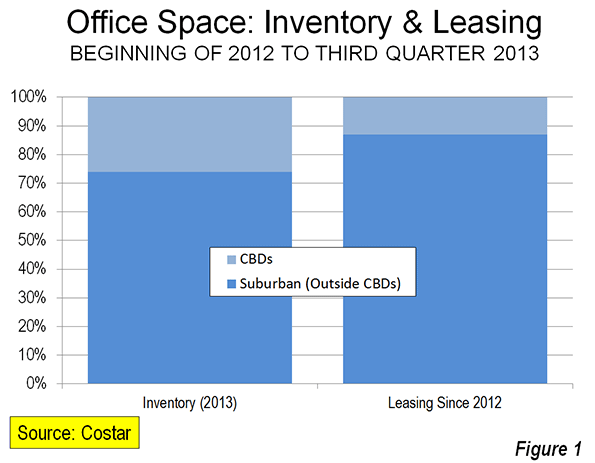
    “Overall, the suburbs have garnered more than their usual share of leasing demand over the past two years, according to an analysis by CoStar real estate economists. Since the beginning of 2012, suburban markets have accounted for a whopping 87% of office demand — which is 13% more than their ‘fair share’ based on the total market size compared with CBD office markets, according to data presented at CoStar’s recent third-quarter office review and forecast.” 

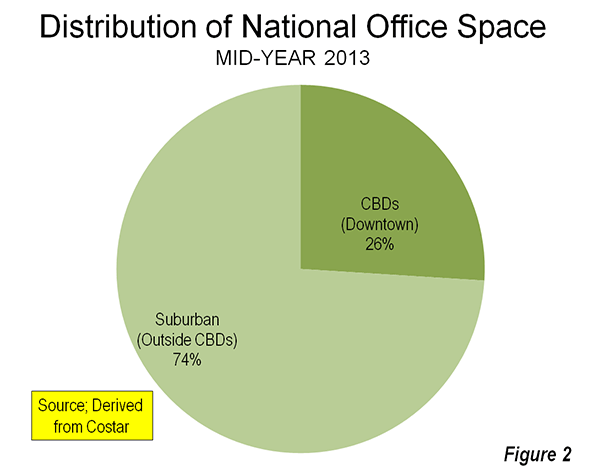
    Indeed, CBD leasing, at 13 percent of the total, is a full 50 percent below their current share of inventory (Figure 1). As of mid-2013, the suburbs accounted for nearly three quarters of the nation’s office inventory (Figure 2).

    Costar cites strong suburban development in Raleigh’s Research Triangle, and further notes that:

    A diverse set of markets that include Sacramento, San Jose, Austin, Kansas City and Charlotte have posted some of the strongest net office absorption among suburban markets.

    This is despite the glowing publicity being given to core area development, especially in places like Charlotte and Austin.

    The reality is that the monumental CBD towers dominating metropolitan skylines do not indicate downtown dominance. In fact, throughout the high income world, most metropolitan employment is outside CBDs. In the United States, typically 90 percent of employment is outside the CBDs. The suburban employment (outside the CBD) share is a bit smaller in Western Europe, Canada and Australia, but still averages approximately 80 percent or more.

    The good news is that neither suburbia nor downtown is dead.

  • Are Millennials Turning Their Backs on the American Dream?

    In his classic 1893 essay, “The Significance of the Frontier in American History,” historian Frederick Jackson Turner spoke of “the expansive character of American life.” Even though the frontier was closing, Turner argued, the fundamental nature of Americans was still defined by their incessant probing for “a new field of opportunity.” Turner’s claim held true for at least a century—during that time, the American spirit generated relentless technological improvement, the gradual creation of a mass middle class, and the integration of ever more diverse immigrants into the national narrative.

    Yet today, many consider this modern period of “expansiveness” to be as doomed as the prairie frontier culture whose denouement Turner portrayed. Nothing makes this clearer than the perception of a majority of middle class Americans that their children will not do better than them, with as many as pessimistic about the future as are optimistic. Almost one-third of the public, according to Pew, consider themselves “lower” class , as opposed to middle class, up from barely one quarter in 2008.

    Are Young Americans Becoming Herbivores?

    To some, this dismal outlook is either inevitable, or even positive, as Americans shift from their historically “expansive” view and embrace a more modest déclassé future. Rather than seek new worlds to conquer, or even hope to retain the accomplishments of prior generations, contemporary young Americans seem destined to confront a world stamped by ever narrowing opportunity, class distinction, and societal stagnation. Once a nation of competitive omnivores and carnivores, America could be turning more docile—a country of content, grazing herbivores.

    Just such a diminished world view has already taken root in Japan, particularly among that country’s younger males. Growing up in a period of tepid economic growth, a declining labor market, and a loss of overall competitiveness, Japan’s male “herbivores” are more interested in comics, computer games, and Internet socializing than building a career or even the opposite sex. Marriage and family have increasingly little appeal to them, sentiments they share with most women their age.

    This devolved future is widely embraced by both left and right. Libertarian-leaning economist Tyler Cowen identifies a permanent upper class, essentially those who command machines and particularly the software that runs them, while the masses, something like 85 percent of the population, need to adjust to lower living standards, and a diet made up largely of beans and rice.

    This approach has appeal to the grandees of finance, who see in a diminishing American dream not only higher relative status for themselves but an opportunity to turn prospective property owners into rental serfs. Large equity funds have been particularly aggressive about buying foreclosed homes and renting them out, often at high rates, to economically distressed families.

    This “rentership” society, as first suggested by Morgan Stanley’s Oliver Chang, reflects, in this sense, an almost Marxian dialectic that sees ownership of property concentrating in ever fewer hands. Conservative theorists have little problem with this, since they naturally defend class privileges and are less committed to upward mobility than assuring the relentless triumph of market capitalism.

    But the most potent apologists for shrinking the American dream come from the very left which, in the past, once championed broad-based economic growth and upward mobility. Instead, progressives increasingly favor their own version of a “rentership society,” albeit one more regulated than the conservative version, but also accepting , and even encouraging, the proletarianization of the American middle class. (Turning them, in the process, into good, reliable clients of the Democratic Party). Goodbye Levittown, with its promise of property ownership and privacy, and back to the tenements of Brownsville, now dressed up as “hip and cool.”

    Some even have suggested getting rid of “middle class norms of decency” governing housing and bringing back the boarding house of the 19th and early 20th Century. The goal, of course, is to facilitate ever more densification of urban areas and to rein in the dreaded suburban “sprawl.”

    This tendency to force densification and downgrade ownership is deeply pronounced among urbanists and the green lobby, two groups with ample power in most blue states and regions. “Progressive” theorists such as Richard Florida see wealth transferring to a handful of “spiky” American cities, places such as San Francisco and Manhattan, where even the prospect of home ownership is inconceivable to the vast majority of the population.

    There are many others, farther out on the green urbanist track, who believe that the entire notion of middle class upward mobility is too consumption-oriented and, well, sort of in bad taste. They maintain that millennials will not only eschew home ownership but the ownership of automobiles and practically anything else bigger than their beloved electronic gadgets.

    Indeed, this transformation would be greeted with enthusiasm by many greens and traditional urbanists. The environmental magazine Grist even envisions “a hero generation” that will escape the material trap of suburban living and work that engulfed their parents. “We know the financial odds are stacked against us, and instead of trying to beat them, we’d rather give the finger to the whole rigged system,” the millennial author concludes.

    Are Americans Millennials Victims of Circumstance?

    Are young Americans ready to move off the competitive playing field and onto the herbivore pastureland? The economic stagnation certainly seems to have had a negative effect on everything from marriage to fertility rates, which are at their lowest levels in a quarter century. Much like their Japanese counterparts, young Americans increasingly avoid both marriage and having children, according to a recent Pew Foundation study. Despite a total rise in population of 27 million (PDF), there were actually fewer births in 2010 than there were ten years earlier.

    Is this a matter of preference or a reaction to hard times?  Hemmed in by college debt and a persistently weak economy, almost 40 percent of the unemployed are between 20 and 34. A smaller percentage of American males between 25 and 34—the key age for prospective families—are in the workforce than at any time since 1948.

    One reason some celebrate the rejection of marriage and family is that it undermines the suburban environments that overwhelmingly attract most families. Urban theorists such as Peter Katz maintain that millennials (the generation born after 1983) show little interest in “returning to the cul-de-sacs of their teenage years.” Manhattanite Leigh Gallagher, author of the predictable anti-burbs broadside The Death of Suburbs, asserts with certitude that that “millennials hate the suburbs” and prefer more eco-friendly, singleton-dominated urban environments.

    Another apparent casualty here may be entrepreneurship, the very thing that characterized both boomers and their successors, Generation X.  Entrepreneurship rates remain strong among older Americans , but start-up rates among young people look far weaker. Millennials’ experience with the economy makes them, according to generational chroniclers Morley Winograd and Mike Hais, “very risk averse,” particularly in comparison with previous generations.

    Can millennials recreate the “Expansive” culture in their own image?

    Winograd and Hais see millennial timidity as a mostly temporary phenomena. Far from rejecting suburbia, homeownership, and the American dream, millennials are simply seeking to recreate it in their own image. Contrary to the notions promoted by the Wall Street financiers, urban land speculators, and greens, most millennials, particularly those entering their 30s, express a strong desire to own a home, with three times as many eyeing the suburbs as the inner core.

    The recession, according to a recent Wilson Center study (PDF), did not kill the desire to own a home among younger people: more than 90 percent of those under 45 said they wanted to own their own residence.    Another survey by TD Bank found that 84 percent of renters aged 18 to 34 intend to purchase a home in the future. And a Better Homes and Gardenssurvey found that three in four sawhomeownership as “a key indicator of success.”

    Survey data also suggests that millennials are highly focused on getting married and being good parents. Nearly four in five millennials express a desire to have children. This will become more significant as millennials reach their 30s and early 40s, the prime age for family formation. Over the next decade, at least six million people will be entering their 30s, and that number is expected to keep expanding through 2050.

    None of this suggests that, as some social conservatives might hope, that the Ozzie and Harriet family is about to make a major comeback. For one thing, millennials will likely get hitched and have children later than previous generations. Their marriages also will probably be less traditional and male-centered. Hais and Winograd assert that millennials are a “female dominated” generation and have a less traditional view of sex roles—or for that matter, what constitutes a family, since they tend to be highly supportive of same sex marriage.

    But if they differ from past generations, most millennials clearly do not aspire to the ideal of singleness and childlessness embraced by more radical boomer enthusiasts. That said, they will not recreate the family or their residence in their parents’ image. They may, for example, be more willing to customize their residences for their own unique needs or for greater energy efficiency, and place greater emphasis on “technology capabilities” than on a larger kitchen, or some more traditional suburbanaccoutrements.

    As they get on with life, they will also make new demands on their bosses, warn Hais and Winograd. Companies will need to accommodate as well the new familial arrangements that Millennials are likely to seek out. This means firms will need to adopt policies that favor telecommuting, flexible hours, and maternity and paternity leave that will allow for a better balance between work and personal life.

    But in the long run, millennials, if given a chance, are likely to maintain the national ethos of aspiration despite the powerful headwinds they now face. As Turner suggested at the end of his famous essay, it would be “a rash prophet who would assert that the expansive character of American life has now entirely ceased.”

    The real issue here is not the declining validity of American aspiration, but overcoming the economic, political and social factors that threaten to suffocate it. Similar challenges—the concentration of wealth of the Gilded Age, the Great Depression, war, and environmental angst—have periodically appeared and were eventually addressed through technological innovation, and critical political and social changes. Rather than accept the shrinkage of the American prospect, we should seek ways to restore it for those who will inherit this republic.

    This story originally appeared at The Daily Beast.

    Joel Kotkin is executive editor of NewGeography.com and Distinguished Presidential Fellow in Urban Futures at Chapman University, and a member of the editorial board of the Orange County Register. He is author of The City: A Global History and The Next Hundred Million: America in 2050. His most recent study, The Rise of Postfamilialism, has been widely discussed and distributed internationally. He lives in Los Angeles, CA.

  • American Cities May Have Hit ‘Peak Office’

    Despite some hype and a few regional exceptions, the construction of office towers and suburban office parks has not made a significant resurgence in the current recovery. After a century in which office space expanded nationally with every uptick in the economy, we may have reached something close to “peak office” in most markets.

    The amount of new office space in development is extraordinarily low by historical standards, outside of a handful of markets. Back in the mid-1980s, according to the commercial real-estate research firm CoStar, upward of 200 million square feet of office space was built annually. After dropping precipitously in the early 1990s, construction rose again to 200 million square feet a year in the early 2000s before dropping well under 150 million square feet in 2006, and lower after that. This year, in what is purported to be the middle of an economic recovery,  we will add barely 30 million square feet,according to Reis Inc.

    Even with this paltry construction, vacancy rates nationwide have barely moved, hovering around 17%. This is nowhere near low enough to justify much more construction in the vast majority of markets, where office rents remain well below 2007 levels.

    Indeed, the trend in real estate remains to convert office spaces to other uses,particularly residential. Large-scale office construction is happening in just a handful of markets; New York and Houston are the only ones with 10 million square feet being built, with smaller amounts in the works in Boston, Washington, Dallas-Ft. Worth and the San Francisco Bay Area.

    Most of the current anemic growth is happening outside downtown areas. Silicon Valley, which is essentially a sprawling suburb, currently has about as much construction as San Francisco. In Houston, another big metro area with robust job growth, there is a new 47-story high-rise being developed downtown, but much of the action is taking place on the periphery, notably in the Energy Corridor. ExxonMobil’s massive new campus, at 3 million square feet, ranks with One World Trade Center in Manhattan as the nation’s largest new office projects.

    Through the third quarter this year, the amount of new office space under construction in suburban areas was roughly double the amount being built in central business districts, by CoStar’s count. Furthermore, only 7.1 million square feet of office space was absorbed downtown in the first nine months of 2013, compared to 51.5 million in suburban areas, CoStar says. But overall there is still 100 million square feet less space being used today than in 2007, and at current absorption rates, it could take six or seven years just to get back to where we were before the recession.

    The Weak Economy

    The key question here is not the geography of office space but why so little is being built. As long as economic growth is modest, don’t expect much change in the skyline in most downtowns, or suburbs. Job growth has been mediocre at best, and much of that has been in the low-wage and part-time category. McJobs and part-time workers do not generally fill office towers.

    The dirty little secret of this recovery is that labor participation rates are at the lowest level since 1978. Underemployment is rife, at around 18% to 20%, and much of that likely includes large numbers of people who used to work in offices.

    This is true even in New York City, where the rate of “office-using employment” has been dropping since the late 1960s and even in the recovery, has yet to rebound to the levels of 2000.

    Changing Use of Space

    Just as we have gotten used to more fuel-efficient cars, companies now utilize space more efficiently than before, largely through information technology. This is a trend many companies plan to accelerate. In the past, for example, your average mid-level executive had his own secretary; now it’s more common to have perhaps one aide for several managers. Historically office developers assumed that each worker would require 250 square feet of space; by the end of the decade this could drop to 100 to 125 square feet.

    Even the most notoriously bureaucratic of professions, law, is scaling back. A recent Cushman and Wakefield survey  found that most firms — many already downsizing — were working to reduce their office footprint per attorney from 800 to 500 square feet. Almost two out of five expect to use “hoteling,” or the sharing of offices among attorneys, something very rare a decade ago.

    At the same time, some of the sectors that are the best bets for expansion, such as information technology and media, are increasingly seeking out unconventional office space. Mayor Mike Bloomberg’s drive to upzone large parts of Midtown Manhattan to create ever-taller towers works operates on the assumption that new users will be much like the old ones. But some experts, such as New York-based architect Robert Stern, suggest that ultra high-rise development does not appeal to either creative businesses and tourists, while preserving older districts, with already developed buildings, does.

    Self-Employment and Home-Based Businesses

    Perhaps the biggest long-term threat lies in the shift from corporate to self-employment. From 2001 to 2012, the number of self-employed workers grew by 14%, according to a recent study by Economic Modeling Specialists. This is occurring not only in the metro areas that suffered the worst during the recession, such as Phoenix, Los Angeles and Riverside-San Bernardino, but also in the healthiest economies such as Houston and Seattle.

    Some of these now self-employed workers may end up in small offices, but many don’t leave home at all. Working at home is growing far faster than commuting by either car or transit, and in most U.S. metro areas, far exceeds those who get to work by public conveyance, most often to downtown areas. Over the past decade the number of U.S. telecommuters expanded 41% to some 1.7 million, almost double the much-ballyhooed increase of 900,000 transit riders.

    Are We Blowing Another Bubble?

    In some specialized, fast-growing markets, new office construction may well be justified. Raleigh is seeing some new construction in its small downtown, as are hot job markets such as Austin and oil-rich Midland, Texas, where a proposed 53-story office tower would be the tallest building between Dallas and Los Angeles.

    But in New York, plans for massive new office tower construction seem to contradict an unemployment rate considerably above the national average. Financial services, the primary driver of the Manhattan market, is showing signs of economic distress, with firms moving middle-management jobs to more affordable places such as Richmond, Va.; Pittsburgh; St. Louis; and Jacksonville, Fla.

    Perhaps even more worrisome, less than half of the space in new buildings in Manhattan is preleased, compared to over 70% in both Houston and Boston, and a remarkable 92% in San Jose/Silicon Valley. This reflects an apparent dearth of large employers in New York who could conceivably afford and fill ultra-expensive office space in the coming years, a recent article in Crain’s New York points out. Tech companies might be expected to help fill the gap, but we have to remember that after the last boomlet Silicon Alley suffered asteep contraction; it has since recovered, but could be hit hard again if the current bubble pops.

    San Francisco, the other current darling of office developers, is even more dependent on the current dot-com boom. The IPOs of Frisco-based firms such as Twitter appear to suggest the prospect of a whole new generation of office occupants. By one account, there is as much as 12 million square feet of new office space in the pipeline in the city, enough to satisfy historical demand for the next 16 years.

    Yet past experience shows many of these companies will likely dissolve or merge in the next few years. They may be fewer in numbers and longer established than last time around, as some local boosters eagerly suggest, but most are still unprofitable and many may never be truly viable. Following the 2000 dot-com crash, San Francisco office occupancy dropped roughly 10 million square feet, while tech employment crashed from a high of 34,000 in 2000 to barely 18,000 four years later.  As one real-estate executive put it at the time, “The office-space market here ”reminds me of the Road Runner cartoon where the Coyote runs into the wall.”

    Observers also point out that more traditional businesses, such as banks, continue to ship jobs elsewhere, in large part due to extraordinarily high costs. The fact that pre-leasing for SF’s new office buildings is barely 33% should add to the caution.

    None of this suggests there are not some good opportunities for new construction, but the office building’s role as a key indicator of the strength of the U.S. economy has faded. In great cities, rather than a ballyhooed era of new office skyscrapers we will see more conversions and the construction of residential high-rises, as well as medical buildings. The secular trend is for the dispersion of business service employment to smaller markets, and into people’s homes. The glory days of the American office tower are over, and not likely to return soon, given technological trends and a persistently tepid economy.

    This story originally appeared at Forbes.

    Joel Kotkin is executive editor of NewGeography.com and Distinguished Presidential Fellow in Urban Futures at Chapman University, and a member of the editorial board of the Orange County Register. He is author of The City: A Global History and The Next Hundred Million: America in 2050. His most recent study, The Rise of Postfamilialism, has been widely discussed and distributed internationally. He lives in Los Angeles, CA.

    Photo by Mark Lyon — Full Floor For Rent.

  • Density, Unpacked: Is Creative Class Theory a Front for Real Estate Greed?

    “The heresy of heresies was common sense”—George Orwell

    The stories we tell affect the lives we lead. I do not mean to be abstract here. I mean, literally, the stories that are told make up a kind of meta-reality that soaks in us to form a “truth”. This “truth” affects policy, which affects investment, which affects bricks and mortar, pocketbooks, and power. Eventually, the “truth” trickles down into a more real reality that defines the lives of the powerless.

    The story du jour in urban policy is one of density. The arc of the story is that cities are places where “ideas come to have sex”. The lovechild is innovation. The mood lighting is creative placemaking.

    The Kama Sutra of density reads this way: creative people cluster in cities that are good at lifestyle manufacturing. The more people that are sardined the higher likelihood there will be “serendipitous” encounters. The more serendipity in a city the better chance the next “big thing” will occur. The next “big thing” will lead to a good start-up, which will lead to an agglomeration of start-ups, termed an “Innovation District”. Detroit becomes Detroit 2.0 then.

    The story of density is a seductive story. Society-making is sobering and full of harsh realities. The story of density is seamless, velvety. It is no wonder the story gets sold, implemented, and then told and re-told, despite the validity and logic of the story being pretty awful.

    Take the recent New York Times piece entitled “What It Takes to Create a Start-up Community”. In it, the writer interviews urbanist Richard Florida. “Population density, [Florida] said, allows for the serendipitous encounters that inspire creativity, innovation and collaboration,” reads one key passage in the piece.

    The story goes on to highlight the emerging tech hub of Boulder as the exemplar of the story of density. One problem: Boulder, a city of less than 100,000, isn’t dense, with a population per square mile of 3,948. The writer moves the goal posts a bit and says the city “is an unusual case of density”, before going on to question whether a start-up community can be created in a city like Detroit that “lacks density”. Yet Detroit, despite being a land mass comprised of one-third vacant land, is denser than Boulder, at 5,144 people per square mile. In all, Aristotle would have a field day with the piece.

    Such illogic peppers the story of density, particularly as it relates to the correlation—to say nothing of the causation—between household clustering and tech growth. For instance, in a recent analysis of America’s top “high tech hot spots” by the Progressive Policy Institute, the top 25 counties experiencing the highest percentage of tech job growth reads like a “Where’s Waldo” list, if Waldo was Thoreau-like. There’s Madison County in Alabama (417 people per sq. mile). Utah County in Utah (258 people per sq. mile). Denton County in Texas (754 people per sq. mile). Fayette County in Kentucky (1,043 people per sq. mile). Snohomish County in Washington (342 people per sq. mile).

    To be fair, also on the list are San Francisco, Boston, and New York. In the case of Boston and San Fran, the tech clustering is a legacy asset—including large venture capital funds — from decades prior, not the result of the story of density. New York, under Mayor Bloomberg, has supposedly gone whole hog on the “idea-sex in the city” script, yet tech is but a speck on the universe that is New York City’s economy.

    For example, Kings County, home to Brooklyn, numbers 25 on the list of places with highest percent of tech job growth, yet Brooklyn’s Job Index—calculated as new tech/information jobs between 2007 and 2012, as a share of 2007 total private sector employment—is just 0.4, meaning the number of new tech jobs in Brooklyn represents less than half a percent of total private employment. Given the information sector as a whole is hemorrhaging jobs according to a recent Harvard Business Review, the scaling of fledgling tech towns is unlikely. This is especially true for cities like New York that—while enriched with the chattering class buzz stoking the story of density—simply lacks the engineering talent of Boston, Silicon Valley, Houston and yes, Detroit , to make the “scene” something than just that: a scene.

    But let’s play along anyway, as that’s the power of the story of density: reality doesn’t bite. So, say Brooklyn can become the next Silicon Valley. This likelihood depends on two assumptions that define the story of density: “cooling” a city will draw top tech talent, and then packing them in to luxury condo towers and mixed use districts will form creativity incubators.

    First, the idea that manufacturing cool spurs a start-up scene is spurious at best. I mean, has this ever worked? Please don’t say Austin, or any number of college towns or state capitals or places with boutique streets that depend largely on transfers from taxpayers — and parents! — to their privileged burgs. Many of these place, like Austin and Raleigh, are themselves far from dense urban nodes, but are exceptionally spread out.

    What about Boulder? In the piece “How Boulder Grew Into a Hub for Start-Ups”, the writer questions venture capitalist Brad Feld, a huge player in the Boulder tech scene, about what brings entrepreneurs to communities like Boulder. Feld throws his hands in the air:

    “People want to live where they want to live. You should figure out where you want to be and build a life around it. Different geographies attract different people.”

    Why did Feld move to Boulder?

    Actually, I moved here in 1995 because Amy said "I’m moving to Boulder – you can come with me if you want." And I did.

    There are things that do appeal to innovators, however. Affordability is an appeal, so says a recent survey of London techies who are decamping from the capital, if only because outrageous rents prevent a “start-up” of anything.

    Over in Berlin, the tech scene is struggling despite the “Berlin geek chic” culture that unfolded. The city’s tech leaders think Berlin needs to be more conventional than cool. “[T]he jury is still out on whether [Berlin’s] a great place to truly grow that company into a mature startup," notes Marc Strigel, head of SoundCloud. "Both the authorities and startups could do much more in promoting Berlin for families, for these world-class talents we definitely need."

    The second assumption relates to the idea that sardining people will ultimately lead to serendipity and innovation. I smell underpants gnomes. Specifically, in an episode of South Park, creators Trey Parker and Matt Stone expose the blind loyalty attached to the façade of “expertise”. The episode goes like this: the characters need a presentation for class. One of the boys talks about a group of gnomes that inexplicably sneak into his house to steal underpants. There’s got to be a reason, right? They confront the gnomes who, claiming to be business experts, explain their business plan as thus: Step 1: Collect Underpants. Step 2: ?. Step 3: Profit.

    The story of density has the same logic gap. Step 1: Population density. Step 2: ?. Step 3: Innovation. Density gurus will claim Step 2 relates to serendipity. But serendipity is chance. How do you plan for chance? Even if you could, creative classification is largely a process of homogenization by class, age, and profession, which, according Rita King of Science House, erodes the possibility of meaningful chance encounters. “Artists bumping into other artists or business people bumping into other business people or Mormons bumping into other Mormons, etc., isn’t real serendipity,” notes King. San Francisco in many ways is more a monoculture than the highly diverse suburbs that surround it.

    Okay, so if the story of density really isn’t about innovation then what is it about? The answer can be found in a recent article entitled “Urban Prophet” in the real estate trade mag Property Week. The piece quotes Albert Ratner, chairman of US real estate firm Forest City Enterprises, on his reading of Florida’s The Rise of the Creative Classes, the first book in the story of density. “You have given real estate developers the playbook,” notes Ratner.

    Put simply, the point of sardining is to make as much money as possible for those who already  have the most . This is the raw truth that fuels the hype, and of course pays for it as well. But it’s a tough sell to neighborhoods and cities increasingly experiencing the negative effects of real estate wealth jamming, and more broadly wealth inequality. Enter the story of density to make another “truth”.

    In reality, the story of density is a fiction and it’s high time we start rewriting the book.

    Richey Piiparinen is a writer and policy researcher based in Cleveland. He is co-editor of Rust Belt Chic: The Cleveland Anthology. Read more from him at his blog and at Rust Belt Chic.

  • Suburban & Urban Core Poverty: 2012: Special Report

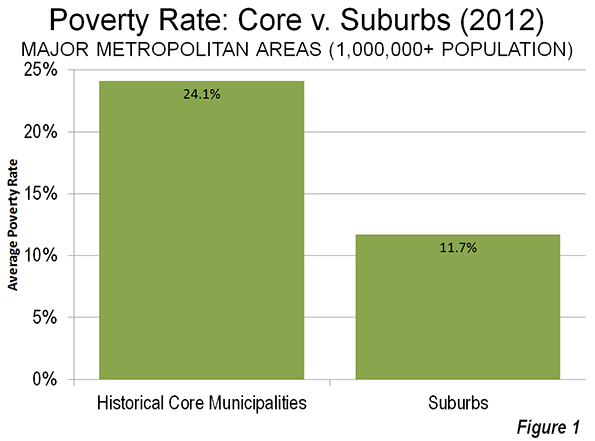
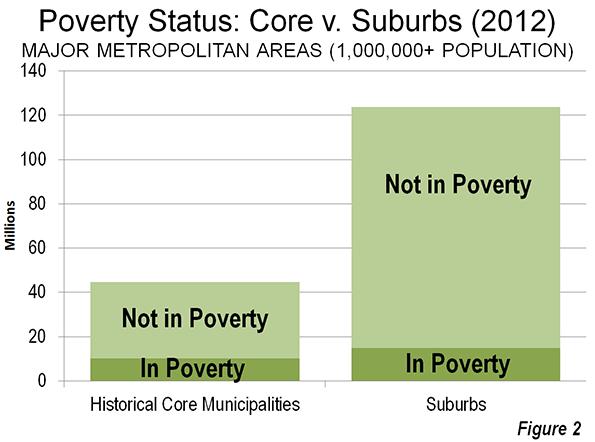
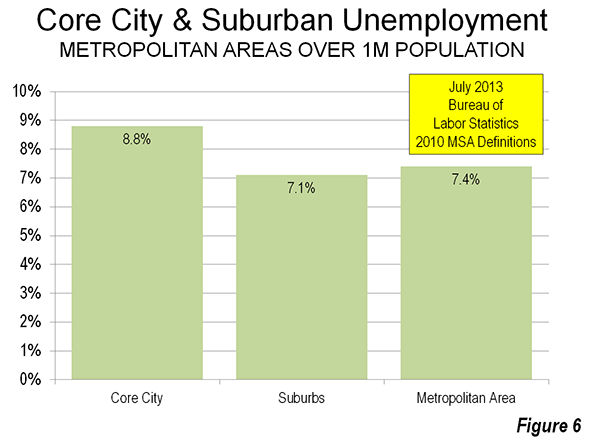
    The US Census Bureau recently released poverty rate data by state, county and metropolitan area for 2012. As has been the case for decades, urban core poverty rates dwarf those of suburban areas in the nation’s 52 major metropolitan areas (those with more than 1 million population).

    Urban Core & Suburban Poverty Rates

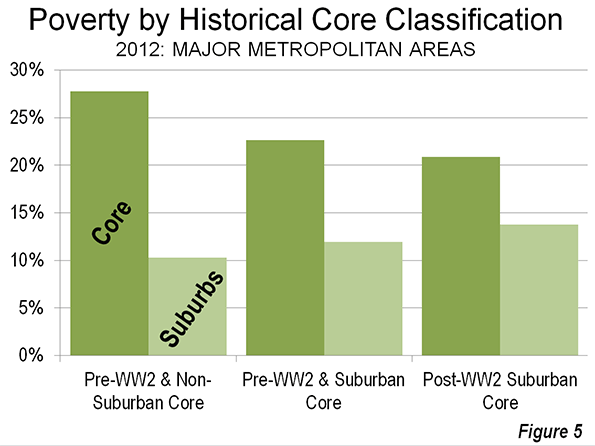
    The average poverty rate in the 52 urban cores – the historical core municipalities – was 24.1 percent, more than double the 11.7 percent rate in suburban areas (Figure 1). These high poverty rates have continued despite the best decade in more than one-half century for the urban cores which have experienced net population increases in the neighborhoods within two miles of downtown. The heavy urban core losses of the 1960s through the 1980s are generally no longer occurring. Yet, between 2000 and 2010, more than 80 percent of the population growth in the urban cores was below the poverty line (See City Growth Mainly Below Poverty Line). By contrast, less than one third of the suburban population increase was below the poverty line.

    Table 1
    Major Metropolitan Areas: Summary of Poverty Status: 2012
      Historical Core Municipalities (HCM) Suburbs Metropolitan Area
    Population (Poverty Status Determined)     44,730,920    123,763,495   168,494,415
    Above Poverty Level     34,613,515    108,917,367   143,530,882
    Below Poverty Level     10,117,405      14,846,128     24,963,533
    Major Metropolitan Areas 22.6% 12.0% 14.8%
    Data from American Community Survey, 2012


    Detailed Metropolitan Data

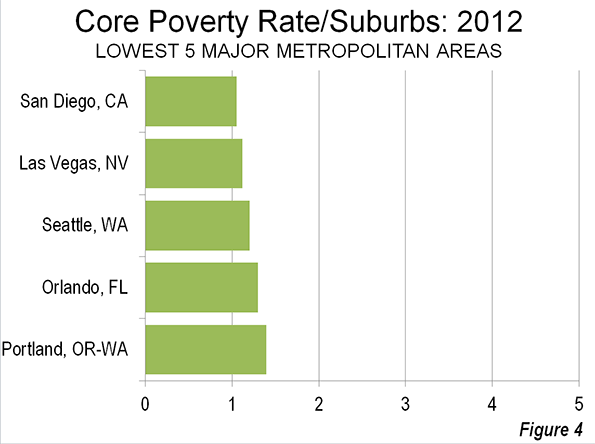
    The lowest historical core municipality poverty rate was in San Jose, at 13.0 percent. Seattle, San Diego, Raleigh and San Francisco rounded out the five urban cores with the lowest poverty rates. The highest urban core poverty rate was in Detroit, at 42.8 percent, followed by Hartford, Cleveland, Cincinnati and Miami.

    The lowest suburban poverty rate was in the Washington metropolitan area at 7.2 percent. Milwaukee, Baltimore, Indianapolis and Minneapolis-St. Paul followed. The highest suburban poverty rate was in the Riverside San Bernardino, 18.4 percent, followed by Orlando, Miami, Las Vegas and Atlanta. Only 15 of the major metropolitan areas had suburban poverty rates that were higher than the best historical core municipality rate of 13.0 percent (San Jose).

    Taking a look over the regions of the country, the five lowest major metropolitan poverty rates were in Washington (8.4 percent), Boston, Minneapolis-St. Paul, San Jose, and Hartford. The highest major metropolitan area poverty rates were in Memphis (19.9 percent), New Orleans, Riverside San Bernardino, Los Angeles, and Miami (Table 2).

    A caveat is in order, however. The official poverty rate does not take into consideration the cost of living differences between states and metropolitan areas. These differences can be large. According to the latest Bureau of Economic Analysis (US Department of Commerce) data, there can be an up to 35 percent difference in the cost of living between major metropolitan areas (the high being San Francisco and the lowest being St. Louis). The new Census Bureau supplemental poverty measure takes housing costs into consideration, but provides only state data. The differences can be substantial. For example, California’s supplemental poverty rate is the highest in the nation, and nearly one-half higher than its unadjusted poverty rate. California’s housing adjusted poverty rate is approximately double that of West Virginia, which is normally considered to be one of the nation’s highest poverty states.

    Table 2
    Major Metropolitan Areas: Poverty Status: 2012
    Metropolitan Area Historical Core Municipalities (HCM) Rank Suburbs Rank Metropolitan Area Rank Core Rate/ Suburban Ratio Rank
    Atlanta, GA 25.8%          35 15.8%        48 16.6%        41 1.63         14
    Austin, TX 20.3%          14 11.5%        28 15.5%        31 1.77         19
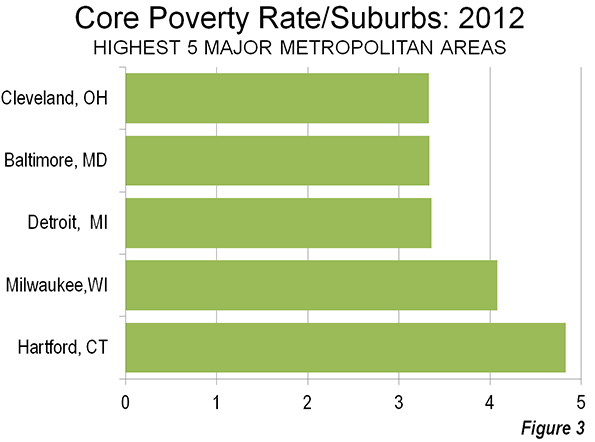
    Baltimore, MD 24.8%          34 7.4%          3 11.3%          6 3.34         49
    Birmingham, AL 31.2%          46 13.5%        41 16.8%        42 2.31         34
    Boston, MA-NH 21.6%          21 9.0%          9 10.7%          2 2.40         38
    Buffalo, NY 30.9%          44 9.4%        11 14.2%        19 3.30         47
    Charlotte, NC-SC 21.8%          23 9.9%        14 15.1%        30 2.22         33
    Chicago, IL-IN-WI 23.9%          30 10.8%        22 14.5%        24 2.20         32
    Cincinnati, OH-KY-IN 34.1%          49 11.9%        32 14.9%        26 2.86         41
    Cleveland, OH 36.1%          50 10.8%        21 15.6%        32 3.33         48
    Columbus, OH 21.8%          23 9.9%        15 15.1%        29 2.20         31
    Dallas-Fort Worth, TX 23.9%          31 13.0%        38 15.0%        27 1.85         22
    Denver, CO 19.2%          10 10.7%        19 12.7%        12 1.80         21
    Detroit,  MI 42.3%          52 12.6%        35 17.4%        47 3.36         50
    Grand Rapids 29.4%          42 12.4%        34 16.5%        40 2.37         36
    Hartford, CT 38.0%          51 7.9%          6 10.9%          5 4.83         52
    Houston, TX 23.5%          29 12.6%        36 16.4%        39 1.87         24
    Indianapolis. IN 22.2%          25 7.6%          4 14.4%        22 2.92         43
    Jacksonville, FL 18.5%            9 11.4%        27 15.7%        33 1.61         13
    Kansas City, MO-KS 20.7%          15 10.6%        18 12.9%        14 1.94         28
    Las Vegas, NV 17.6%            6 15.8%        49 16.4%        37 1.11           2
    Los Angeles, CA 23.3%          27 15.3%        45 17.6%        49 1.53           9
    Louisville, KY-IN 19.5%          12 13.1%        40 16.1%        35 1.49           6
    Memphis, TN-MS-AR 28.3%          38 11.8%        31 19.9%        52 2.39         37
    Miami, FL 31.7%          48 16.4%        50 17.5%        48 1.94         27
    Milwaukee,WI 29.9%          43 7.3%          2 15.9%        34 4.08         51
    Minneapolis-St. Paul, MN-WI 22.6%          26 7.7%          5 10.7%          3 2.94         44
    Nashville, TN 19.4%          11 11.2%        25 14.3%        20 1.73         16
    New Orleans. LA 28.7%          40 15.4%        47 19.4%        51 1.87         23
    New York, NY-NJ-PA 21.2%          19 9.8%        12 14.8%        25 2.17         30
    Oklahoma City, OK 19.7%          13 13.1%        39 16.2%        36 1.50           7
    Orlando, FL 21.2%          20 16.4%        51 16.9%        44 1.30           4
    Philadelphia, PA-NJ-DE-MD 26.9%          37 8.7%          8 13.4%        16 3.08         45
    Phoenix, AZ 24.1%          32 13.9%        42 17.4%        46 1.74         17
    Pittsburgh, PA 21.1%          16 10.9%        23 12.1%        10 1.94         26
    Portland, OR-WA 17.7%            7 12.7%        37 14.0%        18 1.39           5
    Providence, RI-MA 28.7%          39 11.7%        29 13.6%        17 2.44         39
    Raleigh, NC 16.4%            4 10.7%        20 12.7%        11 1.53         10
    Richmond, VA 26.3%          36 9.1%        10 11.9%          9 2.88         42
    Riverside-San Bernardino, CA 31.1%          45 18.4%        52 19.0%        50 1.68         15
    Rochester, NY 31.6%          47 10.2%        17 14.4%        23 3.10         46
    Sacramento, CA 23.4%          28 15.1%        44 16.9%        43 1.55         11
    St. Louis,, MO-IL 29.2%          41 12.4%        33 14.3%        21 2.35         35
    Salt Lake City, UT 21.2%          17 11.1%        24 12.7%        13 1.91         25
    San Antonio, TX 21.7%          22 10.0%        16 17.3%        45 2.17         29
    San Diego, CA 15.5%            3 14.7%        43 15.0%        28 1.05           1
    San Francisco-Oakland, CA 17.3%            5 9.8%        13 11.9%          8 1.75         18
    San Jose, CA 13.0%            1 8.5%          7 10.8%          4 1.52           8
    Seattle, WA 13.6%            2 11.3%        26 11.7%          7 1.20           3
    Tampa-St. Petersburg, FL 24.5%          33 15.3%        46 16.4%        38 1.61         12
    Virginia Beach-Norfolk, VA-NC 21.2%          18 11.8%        30 13.1%        15 1.80         20
    Washington, DC-VA-MD-WV 18.2%            8 7.2%          1 8.4%          1 2.52         40
    Average of Metropolitan Areas 24.1% 11.7% 14.7% 2.07


    Suburban Poverty

    The majority of the major metropolitan area poverty population now lives in the suburbs, by virtue of their population dominance; overall suburban populations are now 2.7 times as large as those of all core cities. In fact, rather than being a new phenomenon, suburban areas passed the urban cores in poverty population before 2000. The 2000 Census indicated that approximately 53 percent of the poverty population was in suburban areas of the 52 metropolitan areas. The share of poverty rose to 59 percent in the suburbs, largely as a consequence of their having dominated growth between 2000 and 2012. While there were nearly 5 million more people below the poverty line in the suburbs than in the historical core municipalities, the suburbs contained more than three times the above-poverty line population – some 109 million – as the urban cores (Figure 2).

    In 2012, suburban poverty rates were below those of the urban cores in all 52 major metropolitan areas (Table 2). The urban core poverty rates ranged from 5 percent above the suburban rates, in San Diego to nearly 5 times the suburban rate in Hartford. San Diego, Las Vegas, Seattle, Orlando and Portland had the lowest urban poverty rates relative to the suburbs of the same metropolitan areas (Figure 3). The urban cores of Hartford, Milwaukee, Detroit, Baltimore and Cleveland had the highest poverty rates relative to the suburbs of the same metropolitan areas (Figure 4).

    Poverty by Historical Core Municipality Category

    When the new poverty data was announced, Milwaukee Mayor Tom Barrett bemoaned the fact that the city’s poverty rate was the highest in the nation relative to that of the suburbs. The Milwaukee Journal-Sentinel’s “Politifact” pointed out that the mayors’ contention was based on 2010 data rather than the new 2012 data. As is noted above, Hartford had displaced Milwaukee with the highest urban core poverty rate relative to the suburbs by 2012.

    However, Mayor Barrett’s concern is well founded. The city of Milwaukee’s high poverty rate relative to the suburbs is surprising. Among the five urban cores with the highest poverty rates relative to the corresponding suburbs, only Milwaukee includes substantial areas of suburban land use development. The city of Milwaukee is categorized as a Pre-World War II core with substantial suburbanization, by virtue of having more than doubled its land area by annexing lower density (suburban) areas. Each of the four other urban cores with the highest ratios relative to suburban poverty rates are classified as pre-World War II cores with little suburbanization. None of these municipalities (Hartford, Detroit, Baltimore, and Cleveland) has annexed significant suburban territory since before World War II.

    Since poverty tends to be more concentrated in urban cores in the United States, it is to be expected that pre-World War II historical core municipalities would have higher poverty rates relative to the suburbs.

    The smallest differences between urban core and suburban poverty rates are found in the metropolitan areas with heavily suburban core cities and lack major pre-World War II cores (Figure 5). San Jose, Phoenix, Orlando, and Las Vegas are examples of metropolitan areas in this category.

    From Poverty to Prosperity

    The continuing high rates of poverty in the urban cores and the higher than previous poverty rates in suburban areas is cause for primary concern. At the heart of the problem is the lingering high unemployment rate, which averages nearly a quarter higher in the urban cores than in the suburbs (Figure 6).

    The principal purpose of cities (from the urban core to the exurban periphery) is to facilitate a better standard of living for all income segments. This has, of course, been made difficult by the Great Recession and could be lengthened should grudging growth nurture a long-term Great Malaise. Obviously, the answer is stronger economic growth, which will require a better investment climate

    Wendell Cox is a Visiting Professor, Conservatoire National des Arts et Metiers, Paris and the author of “War on the Dream: How Anti-Sprawl Policy Threatens the Quality of Life.

    —–

    Note: These data vary from those reported by the Brookings Institution, which classifies “cities” and “suburbs” differently. For example, the Brookings Institution classifies suburbs such as Arlington, Texas in the Dallas-Fort Worth metropolitan area, Aurora, Colorado in Denver (see photo above),  Mesa, Arizona in Phoenix, Bellevue , Washington in Seattle and  Paradise, Nevada in Las Vegas as “cities.” The net effect is generally higher suburban poverty rate in the Brookings Institution analysis than in this “urban core” versus suburban analysis.

    —–

    Photo: Suburban Denver (Aurora), by author