Category: Suburbs

  • A Suburban Economic Future?

    The basic, often unappreciated, fact  about economic life in Australia’s  metropolitan regions are that most of the jobs are in suburban locations. Our central business districts (CBDs) – prominent though they are – account for only around 10% of all metro wide jobs. That rises to maybe 15% if you include inner city areas. But still, 85% of everyone else who calls Brisbane, Sydney, or Melbourne home works somewhere other than the CBD or inner city.

    Not only that, but the share of jobs in the suburbs versus the city has been rising, at least marginally. This doesn’t mean that CBD job markets are shrinking (in the main, they’re not) just that suburban employment markets are growing faster. So CBDs are becoming, perhaps inexorably, less dominant.

    The evidence also shows that suburban employment isn’t distributed evenly but in various concentrations. Some of these areas add to very large numbers – rivalling the totals found in CBDs – but they do so at much lower densities  of employment. Concentrations of 2,000 to 4,000 jobs per square kilometre are dense by suburban standards but still only a fraction of CBD concentrations, which can closer to 100,000 per square kilometre. For many suburban employment areas, concentrations are even lower at maybe 500 to 1000 jobs per square kilometre. While CBD office workers measure their space in square metres (roughly 15 to 20 per person) some suburban workers might measure theirs in acres.

    The income profiles of CBD and suburban workers vary. Across the three major centres of Brisbane, Sydney and Melbourne, the research shows that suburban workers, on average, earn considerably less than CBD workers. The top ten income areas city wide are nearly all inner city areas, and these workers earn more than double the average of the bottom 10 areas (which are invariably suburban). The average CBD worker, according to the census, pockets between A$80,000 and A$90,000 per annum. The average suburban worker pockets around $50,000 per annum. Given that suburban jobs account for around 85% of all jobs, the CBD is indeed a privileged centre of income earning ability.

    Having said that, there are still interesting pockets of suburban employment where above average incomes are to be found. The Brisbane airport and port region, for example, features in the top 10 income earning locations along with inner city locations, even though the majority of jobs (62% to 74% according to the Census) are blue collar.

    CBDs and suburbs vary widely as well in transit choice. For suburban workers, the private car is the overwhelming mode of transport (above 80% to 90%), not by choice or because of some “love affair” with the car, but of necessity. The very nature of dispersed suburban employment makes public transport uneconomic, which is why only around 5% of suburban workers use it. For CBD workers though, public transport is more widely used because it’s more available and convenient: more than 50% (and more than 60% in Sydney’s case) of CBD workers make use of it.

    The evidence also shows that the closer you live to the city, the more likely you are to use public transport to get to your CBD workplace. The proportion of people with CBD jobs falls the further you live from the CBD: meaning outer suburban residents are highly unlikely to have CBD jobs and hence only around 3% to 5% use public transport. Ironically, given CBD jobs earn the highest incomes and are also more likely to use public transport to get to work, we have a situation where those with the highest paying jobs are enjoying the biggest benefit of heavily subsidised public transport. You could argue on this evidence that those on lower suburban incomes are subsiding the train and bus fares of their higher paid CBD workforce cousins.

    Now for the future

    The evidence is one thing but where it all leads can provoke any number of alternative scenarios. Just for the sake of discussion, here’s one possibility: that cost and convenience factors will increasingly work against CBDs and inner cities and more and more businesses will establish, grow, or relocate to, suburban employment locations.

    It’s possible this shift is already underway. The evidence shows a slow diminution of CBD prominence. Technology is increasingly reducing the person to person immediacy and co-location advantages of a highly concentrated CBD environment. We communicate more and more through electronic means, which also means physical location is less and less essential to daily business contact.

    Costs are another factor. CBD offices and retail space are expensive relative to suburban locations. They are worth it in terms of prestige where this matters (leading legal or accounting firms for example), or where central location is important. But as costs via rents rise, the equation is constantly recalculated. Is it worth headquartering large numbers of staff in CBD offices when these staff have limited need for face to face business dealings outside the business? The cost/benefit analysis is an ongoing exercise and the business press contains plenty of evidence of companies who increasingly decide the suburban alternative is attractive. Rising car parking costs – for business visitors and clients along with staff – are just another factor in the falling competitive advantage for CBDs.

    Employee costs could also be a factor. Even basic administrative roles in CBD locations command higher pay packets than similar roles in suburban locations, for whatever reason. If it is possible for administrative functions to be located in a suburban location where total employee costs are less, will this become a factor in the trade-off between CBD and alternative suburban locations?

    Congestion may be another. As urban densities rise, especially around CBDs and inner city areas, congestion of all forms (private and public transport) will increase. Density is after all almost a synonym for congestion. Will businesses in increasingly congested CBD or inner city environments opt for suburban alternatives where congestion is less of an issue?  We can not yet say.

    On the other hand, because CBDs and inner cities feature such a concentration of social amenities through public infrastructure (entertainment, cultural and recreational facilities) they may continue to appeal as residential addresses. Is it possible that as CBDs and inner cities develop their residential stock, we may find significant numbers of people who live in CBD locations for the inner city amenity, but who work in suburban locations? Time will tell.

    Planning schemes would have to adapt to any of the above scenarios. Existing suburban economic areas may need their development density  under city plans increased to meet demand. TODs may become places where people travel to a suburban workplace centred on a train station or bus interchange, as opposed the current thinking which is that people will live near suburban transit nodes in order to work in inner city locations.

    Any number of other scenarios are possible. My research has attempted to present the statistical evidence on the suburban nature of employment in our metropolitan regions, and make some observations about the public policy and future development implications. Given the extent of commentary, research and public policy concentration around the CBDs and inner city, the research suggests that some equally intense efforts to improve our suburban economic environment would yield significant community wide results.

    Ross Elliott has more than 20 years experience in property and public policy. His past roles have included stints in urban economics, national and state roles with the Property Council, and in destination marketing. He has written extensively on a range of public policy issues centering around urban issues, and continues to maintain his recreational interest in public policy through ongoing contributions such as this or via his monthly blog The Pulse.
  • Metropolitan Dispersion: 1950-2012

    America has become much more metropolitan since 1950, when the Office of Management and Budget released the first modern criteria for determining the boundaries of metropolitan areas. Metropolitan areas are the economic or functional definition of the "city." They are otherwise known as labor markets and include the physical "urban area" (the area of continuous development) as well as economically connected rural territory from which people commute into the urban area. A previous article examined the development of the “physical” form of the city (urban areas) in the United States, from 1920 to 2010 (See Observations on Urbanization: 1920-2010).

    Major Metropolitan Areas in 1950

    In 1950, there were 14 major metropolitan areas in the United States (over 1,000,000 population). Their combined population was 44.5 million. By 2010, there were 52 major metropolitan areas, with a total population of 169.5 million. This increase, 124 million, is approximately equal to the population of France and the United Kingdom combined. While major metropolitan areas were increasing their population by 281 percent, the rest of the nation grew only 106 percent (Note 1).

    Dispersion to Smaller Metropolitan Areas

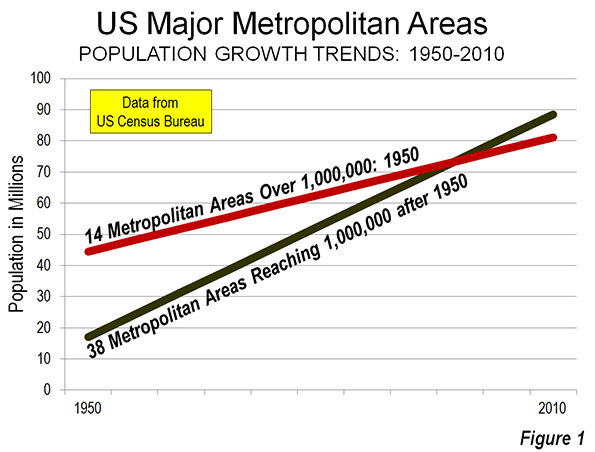
    As the nation was moving to major metropolitan areas, much of the growth was in the 38 smaller metropolitan areas that passed the 1,000,000 mark after 1950. These areas had 17.7 million residents in 1950. By 2010 they had added more than 70 million new residents, for a total population of 88.5 million. In contrast, the 14 metropolitan areas that had more than 1,000,000 population in 1950 grew only 36.5 million, to 81.1 million (Figure 1).

    Among the metropolitan areas that had reached 1,000,000 population by 2010, the fastest growing were all in the Sun Belt. Las Vegas, which was too small to be a metropolitan area in 1950, grew 39 times (3,941 percent) compared to the 1950 population for the area constituting the 2010 metropolitan definition (Clark County). Orlando grew 17.6 times (1,757 percent), while Riverside-San Bernardino grew 14 times (1,400 percent). Three other metropolitan areas grew 10 times or more, including Phoenix at 11.6 times (1,164 percent), Charlotte at 10.3 times (1,025 percent) and Miami at 10.2 times (1,017 percent).

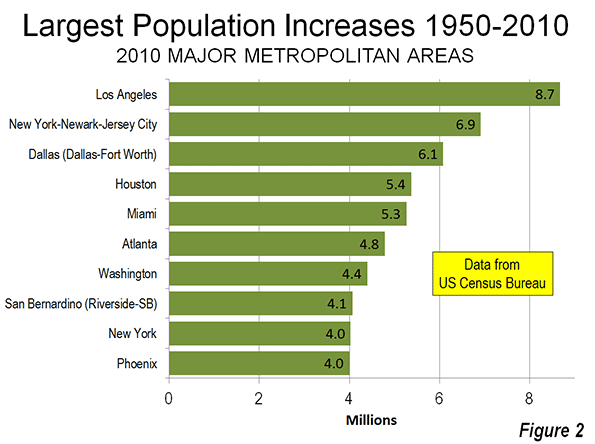
    Los Angeles added the most to its population, at 8.7 million residents from 1950 to 2010. Perhaps surprisingly, however, New York also grew strongly, adding 6.9 million residents. Los Angeles, which grew quickly until recently, managed to reduce New York’s 8.5 million 1950 lead by only one-fifth by 2010. Dallas-Fort Worth added the third greatest number of new residents (6.1 million), partially by absorbing the former (and smaller) Fort Worth metropolitan area during the period. Houston added 5.4 million residents. Miami added 5.4 million residents, also incorporating smaller metropolitan areas, Fort Lauderdale and West Palm Beach. Chicago ranked surprisingly high, adding 4.0 million residents, the result of comparatively strong growth in the early decades (Figure 2). The strong population growth evident in New York and Chicago is largely attributable to much faster growth rates between 1950 and 1970 period.

    The ascendancy of Texas is illustrated by the fact that its two largest metropolitan areas, Dallas-Fort Worth and Houston added more residents (Note 2) than the two largest metropolitan areas in California, Los Angeles, and San Francisco (11.5 million compared to 10.9 million). However, stronger long term California growth was indicated by the 4.1 million addition to the Riverside-San Bernardino metropolitan area (the “Inland Empire”), which is adjacent to the Los Angeles metropolitan area and has emerged as the dominant growth center of the state in recent decades.

    Similar Regions, Big Differences

    There were substantial contrasts in growth between similarly sized metropolitan areas in 1950 over the period.

    Atlanta and nearby Birmingham were similar in population in 1950. Atlanta had a population of 672,000 (ranked 23) and Birmingham had 559,000 (ranked 27). By 2010, Atlanta had risen to a population of 5.3 million and a rank of 9th, compared to Birmingham’s 1.1 million and a rank of 49th.

    A somewhat smaller, but significant difference is evident between Seattle and nearby Portland, which were nearly the same size in 1950 (733,000 and 705,000 respectively) ranking 20th and 21st respectively. Over the next 60 years, Seattle grew 2.8 million (some of it from absorbing the former Tacoma metropolitan area). By 2010, Seattle was the 15th largest metropolitan area in the nation, while Portland had fallen to 23rd, adding a smaller 1.5 million residents. Portland and San Francisco were the only major metropolitan areas in the West to fall in the national rankings between 1950 and 2010.

    Slower Growth Major Metropolitan Areas

    The slowest growing major metropolitan areas were Buffalo (4 percent), Pittsburgh (6 percent), Cleveland (41.7 percent), Detroit 42.4 percent and New York (52 percent (Table 1).

    Table 1
    Major Metropolitan Areas: 2010, Change from 1950
    Population Rank
    Metropolitan Area 1950 2010 Change 2012 1950 2010
    Atlanta, GA         671,797     5,286,732 687%     5,457,831 23 9
    Austin, TX         160,980     1,716,286 966%     1,834,303 107 35
    Baltimore, MD     1,337,373     2,710,489 103%     2,753,149 12 20
    Birmingham, AL         558,928     1,128,050 102%     1,136,650 27 49
    Boston, MA-NH     2,389,986     4,552,402 90%     4,640,802 6 10
    Buffalo, NY     1,089,230     1,135,511 4%     1,134,210 14 47
    Charlotte, NC-SC         197,052     2,217,035 1025%     2,296,569 91 24
    Chicago, IL-IN-WI     5,495,364     9,461,105 72%     9,522,434 2 3
    Cincinnati, OH-KY-IN         904,402     2,114,580 134%     2,128,603 15 28
    Cleveland, OH     1,465,511     2,077,240 42%     2,063,535 10 29
    Columbus, OH         503,410     1,901,965 278%     1,944,002 32 32
    Dallas-Fort Worth, TX         614,799     6,426,210 945%     6,700,991 24 4
    Denver, CO         563,832     2,543,478 351%     2,645,209 26 21
    Detroit,  MI     3,016,197     4,296,247 42%     4,292,060 5 12
    Grand Rapids, MI         288,292         988,938 243%     1,005,648 60 52
    Hartford, CT         358,081     1,212,384 239%     1,214,400 47 44
    Houston, TX         806,701     5,920,456 634%     6,177,035 18 6
    Indianapolis. IN         551,777     1,887,877 242%     1,928,982 29 33
    Jacksonville, FL         304,029     1,345,596 343%     1,377,850 56 40
    Kansas City, MO-KS         814,357     2,009,338 147%     2,038,724 17 30
    Las Vegas, NV           48,289     1,951,269 3941%     2,000,759 NA 31
    Los Angeles, CA     4,367,911   12,828,842 194%   13,052,921 3 2
    Louisville, KY-IN         576,900     1,235,708 114%     1,251,351 25 43
    Memphis, TN-MS-AR         482,393     1,324,829 175%     1,341,690 36 41
    Miami, FL         498,084     5,564,657 1017%     5,762,717 34 8
    Milwaukee,WI         871,047     1,555,908 79%     1,566,981 16 39
    Minneapolis-St. Paul, MN-WI     1,116,509     3,348,859 200%     3,422,264 13 16
    Nashville, TN         321,758     1,670,890 419%     1,726,693 55 37
    New Orleans. LA         685,405     1,189,863 74%     1,227,096 22 46
    New York, NY-NJ-PA   12,911,944   19,567,407 52%   19,831,858 1 1
    Oklahoma City, OK         325,352     1,252,992 285%     1,296,565 53 42
    Orlando, FL         114,950     2,134,411 1757%     2,223,674 138 27
    Philadelphia, PA-NJ-DE-MD     3,671,048     5,965,341 62%     6,018,800 4 5
    Phoenix, AZ         331,770     4,192,887 1164%     4,329,534 51 14
    Pittsburgh, PA     2,213,236     2,356,285 6%     2,360,733 8 22
    Portland, OR-WA         704,829     2,226,009 216%     2,289,800 21 23
    Providence, RI-MA         737,203     1,600,852 117%     1,601,374 19 38
    Raleigh, NC         136,450     1,130,490 729%     1,188,564 125 48
    Richmond, VA         328,050     1,208,101 268%     1,231,980 52 45
    Riverside-San Bernardino, CA         281,642     4,224,851 1400%     4,350,096 63 13
    Rochester, NY         487,632     1,079,671 121%     1,082,284 35 51
    Sacramento, CA         277,140     2,149,127 675%     2,196,482 64 25
    Salt Lake City, UT         274,895     1,087,873 296%     1,123,712 68 50
    San Antonio, TX         500,450     2,142,508 328%     2,234,003 33 26
    San Diego, CA         556,808     3,095,308 456%     3,177,063 28 17
    San Francisco-Oakland, CA     2,240,767     4,335,391 93%     4,455,560 7 11
    San Jose, CA         290,457     1,836,911 532%     1,894,388 59 34
    Seattle, WA         732,992     3,439,809 369%     3,552,157 20 15
    St. Louis,, MO-IL     1,681,281     2,787,695 66%     2,795,794 9 18
    Tampa-St. Petersburg, FL         409,143     2,783,243 580%     2,842,878 41 19
    Virginia Beach-Norfolk, VA-NC         446,200     1,676,820 276%     1,699,925 38 36
    Washington, DC-VA-MD-WV     1,464,089     5,636,232 285%     5,860,342 11 7
    Notes on changes from 1950
    All first named municipalities were the central cites per OMB in 1950 except:
    Norfolk was the central city of Virginia Beach
    San Bernardino was the central city of Riverside-San Bernardino
    Jersey City and Newark were also central cities of New York
    Las Vegas 1950 is for Clark County (was not a metropolitan area)


    Meanwhile, 11 metropolitan areas fell from the top 50 in 1950. All were in the Northeast or Midwest, except for Knoxville, TN. Youngstown has been beset by economic difficulties throughout most of the period. In 1950, Youngstown was the nation’s 30th largest metropolitan area, larger than Atlanta, Phoenix and Las Vegas. However, Youngstown added only seven percent to its population over the 60 years, and fell to 93rd place. Wheeling-Steubenville (WV-OH) is one of the nation’s few genuine “shrinking cities,” that is a metropolitan area or an urban area that is losing population. Wheeling-Steubenville was ranked 48th in 1950. Since that time, the economic influence of Wheeling has deteriorated so much that OMB has split the metropolitan area into two parts, removing Weirton, WV (which includes Steubenville, OH). The Wheeling metropolitan area is approximately 60 percent smaller than in 1950 (Table 2).

    Table 2
    Metropolitan Areas No Longer in Top 50
    Population Rank
      1950 2010 Change 1950 2010
    Youngstown, OH-PA   528,498   565,773 7% 30 93
    Albany, NY   514,490   870,718 69% 31 60
    Dayton, OH   457,333   799,232 75% 37 70
    Allentown, PA   437,824   821,173 88% 39 67
    Akron, OH   410,022   703,205 72% 40 74
    Springfield, MA   407,255   621,570 53% 42 83
    Toledo, OH   395,551   610,001 54% 43 86
    Wilkes-Barre, PA   392,241   563,630 44% 44 95
    Omaha, NE-IA   368,395   868,116 136% 45 61
    Wheeling, WV-OH   354,092   147,950 -58% 48 273
    Syracuse, NY   341,719   662,578 94% 49 79
    Knoxville, TN   337,105   837,571 148% 50 64


    Cities: From Monocentric to Polycentric to Edgeless

    The changes that occurred in cities of the United States and elsewhere around the world have extended well beyond the population increases. The former monocentric model of the city, organized around a dense core has been recent placed by the polycentric city (with the new suburban employment centers documented by Joel Garreau as “edge cities”). In its revisions of the metropolitan area criteria for the 2000 census (Note 2), the Office of Management and Budget began defining core (as used in the encompassing metropolitan area term “Core Based Statistical Area”) as the urban area (urbanized area), rather than the former “central cities.” OMB has designated many suburban employment centers as "principal cities," and in consequence no longer has any suburban designation.

    Robert Lang of the University of Nevada Las Vegas has shown that the evolution of metropolitan areas has been extending beyond the “edge cities” and has heralded the “edgeless city.” The dispersion continues.

    Wendell Cox is a Visiting Professor, Conservatoire National des Arts et Metiers, Paris and the author of “War on the Dream: How Anti-Sprawl Policy Threatens the Quality of Life.

    —————-

    Note 1: Some of the metropolitan growth occurred as residents in counties that were not metropolitan in 1950 were added to metropolitan areas as their borders were defined outward. The current boundaries of the major metropolitan areas would have increased their 1950 population by 17 percent.

    Note 2: The OMB final notice for 2010 defines “core” as “A densely settled concentration of population, comprising either an urbanized area (of 50,000 or more population) or an urban cluster (of 10,000 to 49,999 population) delineated by the Census Bureau, around which a Core Based Statistical Area is delineated. According to the OMB definition, the core is now an entire urban area, not a central city. The “building blocks” of urban areas are census blocks (smaller than census tracts), rather than municipalities, as had been the case before 2000.

    Photo: Crystal City Employment Center: Virginia suburbs of Washington (by author)

  • Eastvale, CA: Suburban Charm Trumps Urban Convenience

    Eastvale, a new community just over the Riverside County line from Orange County, is a place that most urbanists would naturally detest. City Hall is no architectural masterpiece, occupying a small office inside the area’s largest shopping mall. The streets are wide, and the houses tend to be over 2,500 square feet. There’s nothing close to a walking district and little in the way of restaurants besides fast-food outlets and chain eateries.

    Yet Eastvale, which incorporated in 2010 , is also among the fastest-growing places within California. Located in an area once known as Dairy Valley, it was settled by Dutch farmers and for years was known as "Fly Valley" because of the insect infestations associated with herds of cattle. Houses began to go up in the early 2000s, as families leaving congested and high-cost coastal Southern California began to move into the area.

    Although hit by the housing bust, like much of Riverside County, Eastvale’s home sales have been on the upswing, and real estate agents suggest that the biggest problem is finding properties to sell. Land prices, $5 an acre in 1974, rose to $525,000 at the peak of the boom, then collapsed, but are now back to over $300,000. The median price of a single-family home, $433,000, is just around the state average. In contrast, prices in coastal Orange County average $556,000 and, along the coast, closer to $1 million for a comparatively newer home.

    With prices escalating again in Southern California, affordability is once again dropping, particularly for new buyers. Today, according to the California Board of Realtors, affordability of new housing in Orange County for first-time buyers has already dipped below 50 percent for the first time since 2008. It could be headed back to the 20 percent – or lower – rates experienced during the housing bubble.

    Los Angeles, San Diego and other coastal cities are experiencing similar upticks, but with no appreciable likelihood of new home construction, which statewide is now running at one-third of annual demand. This is particularly true for single-family detached homes, the housing preferred by most consumers but most detested by the state’s planning hierarchy.

    In the short run, this shortfall benefits what historian Bob Bruegmann calls "the incumbent’s club," current owners of single-family homes. But it also fundamentally functions as a tax on future generations. The costs of housing inflation are imposed on the offspring of the coastal cities, not to mention immigrants and new migrants, who still need someplace to live a basic middle-class lifestyle without draining all their financial resources.

    Although people on the coast tend to look down on the "909s", the fact remains that, to retain a large, growing and vibrant middle class, the coast needs an outlet, particularly for the workers to staff its industries. Roughly a third of the Inland Empire’s workforce labors in either Los Angeles or Orange County. Without the outlet represented by the area, companies in Orange and Los Angeles will increasingly be forced to relocate or expand further out of the region and the state.

    Rather than being dismissed as second-rate, the oft-maligned Inland Empire remains a critical component for the future of Southern California. The media obsesses over the disasters that accompanied the housing bust but, in places where schools and parks are strong, like Eastvale, things have improved as foreclosures have plummeted.

    In fact, after a long hiatus, local developers are beginning to put up more new houses to meet the demand. With over 50,000 residents, Eastvale already has more people than downtown Los Angeles, and the mayor, Ike Bootsma, seventh of nine children of a Dutch immigrant farming family, projects this population to swell to 76,000 by 2020.

    Eastvale largely attracts upwardly mobile (average household income is around $100,000) families, many of them minorities. These are people who, a decade or two ago, might have settled closer to the coast, but can no longer afford to do so.

    Kids are a big deal in Eastvale, at a time when coastal California, including both Orange and Los Angeles are becoming older, and dominated by childless households. One-third of Eastvale’s population is made up of children under 18, well above the one in four average for California. The number of persons per household is over four, compared to less than three for the state as a whole.

    The dream people are chasing is a traditional one, yet many of the new families are diverse. Located roughly an hour from downtown Los Angeles, almost half the city’s households speak a language other than English at home. Asians account for close to a quarter of the population, Latinos roughly 40 percent.

    "There’s no way you can live this life in Mumbai," notes Indian immigrant Nibha Kothari, who moved to Eastvale with her husband and young daughter earlier this year. "There’s a balance here between city and town here. In Mumbai, everything is so crowded and congested and there’s so much stress. It’s the little things, the quality of life for our family, that got us here."

    Residents like Kothari admit it’s not the aesthetics of the urban design that brings them to Eastvale. Instead, as in Irvine, it’s the things urban pundits barely address, like good schools, a well-developed park system , low crime rates and, perhaps most importantly, larger house footprints. After all, family is the main reason people move to Eastvale, and many locals talk about having relatives living in the same community.

    Andrea Hove, the wife of an Orange County sheriff’s deputy with whom she has four kids, has several relatives in the neighborhood and a network of friends who also have extended families. "I wanted to stay home with the kids," she explains. "In Orange County, we’d be stuck with 1,800 square feet and send the kids to private school. Here, I have great schools, 3,000 square feet for less, and my walk-in closet is bigger than most people’s bedrooms. It’s a great family community in terms of schools and parks. I can’t go anywhere without seeing someone I know."

    Finally, she says, there’s also an excitement from being in somewhere new that is still developing its sense of place and urban traditions. "This is a place where we can shape the community for our kids," she suggests. "We can make it the way we want it, not just live the way some politician says we should."

    These kind of aspirations are rarely discussed among planners, academics or even many developers but they constitute much of what people actually want and reflects their most cherished priorities. It may seem mundane to urban aesthetes, but crucial in the locational decisions of many people.

    "Everyday life," observed the great French historian Fernand Braudel, "consists of the little things one hardly notices in time and space."

    Most people live ordinary lives, start businesses, raise families, go to church, play in little leagues and local softball tournaments. Concert halls, hip restaurants and striking architecture may thrill our media and design communities, but perhaps more critical to the long-term future may be places, like Eastvale, where Southern California’s middle-class families still can comfortably thrive.

    Joel Kotkin is executive editor of NewGeography.com and R.C. Hobbs Professor of Urban Studies at Chapman University, and a member of the editorial board of the Orange County Register. He is author of The City: A Global History and The Next Hundred Million: America in 2050. His most recent study, The Rise of Postfamilialism, has been widely discussed and distributed internationally. He lives in Los Angeles, CA.

    This piece originally appeared at The Orange County Register.

  • A Million New Housing Units: The Limits of Good Intentions

    In May 2013, the district of Husby in suburban Stockholm, Sweden was shaken by “angry young men” engaging in destructive behavior for about 72 hours,1 including the burning of automobiles and other properties and attacks on police officers (over 30 officers were injured). The violence spread to the nearby districts of Rinkeby and Tensta as well as to other parts of Sweden.

    Husby, Rinkeby, and Tensta are located within the corporate limits of Sweden’s capital city,2 but a considerable distance from the waterfront and medieval beauty of downtown Stockholm frequented by visitors and tourists. All three communities were planned in the 1960s and completed in the mid-1970s as part of the Swedish Million Programme.  According to official Stockholm municipal statistics, resident populations in 2012 were 12,203, 15,968, and 18,494 respectively.3

    This ambitious program was approved by Sweden’s Parliament in 1965 to remedy what was then considered an acute shortage of housing. Its goal was to rapidly produce a large number of affordable housing units for the Swedish middle class while preserving nearby open space, improving traffic safety and encouraging residents to walk, ride bicycles and use transit. Planners and architects felt that in order to achieve the desired suburban “new town” environment, development and densities were to be as concentrated as possible, and all units were to be within 500 meters of the transit station.4

    The first new homes in Tensta were delivered to their initial residents in 1967, only two years after the program was approved, but the subway line, so important to the design and development of these communities, was not to be opened to traffic until 1975.

    By the 1970s, the Swedish economy had slowed considerably from its 1960s boom, and as the economy cooled, some areas outside of Stockholm where new Million Programme communities had been built suddenly had a surplus of housing. In Stockholm, production of the Million Programme units continued well into the 1970s until all planned units were completed, even though the population of Stockholm was to decline from 787,182 in 1965 to a modern low of 647,115 in 1981.

    Yet in the end, most of the residents who ended up in these units were neither middle class or of Swedish descent. In part because the Million Programme had eliminated Sweden’s shortage of housing and many of its communities were considered unsightly and undesirable by Swedes, the newly constructed units became places where waves of new immigrants to the country found a place to live. Over time these communities have become suburban ghettos for newly-arrived families and individuals, with persons of an “immigrant background” (either immigrants or the child of immigrants making up between 85% and 90% of resident population in these districts according to official statistics for 2012).  

    These areas soon became isolated from the mainstream of Swedish society. The new communities were designed to make open space accessible to their residents (ordinarily a desirable goal), but this by design disconnected from nearby older (and lower-density) subdivisions. Planners and architects for the Million Programme apparently never anticipated that their creations would become segregated to such an extent that a member of Parliament and government minister would call for some of them to be razed. Sweden’s Minister of Integration, Nyamko Sabuni, did just that in a 2009 op-ed column, when she charged that they led to “exclusion” of their residents and since many of them are badly in need of thorough renovation, some should be torn down instead.5 Indeed some Million Programme complexes outside of Stockholm have met their demise with the use of a wrecking ball.6

    Swedish planners and elected officials did learn from these mistakes. The new high-tech employment center of Kista, located adjacent to Husby, has a base of employment that never developed in the Million Programme districts, and a significantly lower percentage of immigrants (though still higher than 50%). 

    Planners and elected officials in other nations (including North America) should take notice of the Million Programme – and more-recent Smart Growth proposals – as an example of what can go badly wrong.

    The aftermath of Million Programme demonstrates the inability of elected officials and the planners and architects on their staffs to anticipate the future needs and even the demographic makeup of their constituent populations, even in a democratic nation such as Sweden. Though it was approved with wide agreement by the Parliament in 1965, it is unlikely that members of that body anticipated that Swedish middle-class families would reject the densely-developed large-scale apartment developments that the effort produced, nor that much of the wave of immigration that was to arrive on Swedish shores starting in the late 1960s and continuing for many years would end up seemingly confined and segregated in the newly-constructed communities. The problems resulting from the cheap construction methods used and a resulting need for extensive and expensive renovations in order to bring the units up to contemporary standards will require large amounts of money. The source of that funding to make those repairs has not been identified.

    Finally, the role of rail transit in these projects deserves a mention. The construction of the Stockholm subway’s Blue Line (a radial line linking all three communities with downtown Stockholm) was significantly delayed, and did not open for traffic until 1975, well after most of the new homes were occupied, even though a transit station was always intended as an integral part of each of them (prior to 1975, residents had to take buses to get downtown, or get themselves to regional rail stations some distance away).  While the subway system in general (and the Blue Line in particular) are rightly called the “world’s longest art exhibit” because of the extraordinary and diverse beauty of its underground stations, it has not prevented the isolation and economic disadvantage that the minorities living along the line have always experienced. 

    C. P. Zilliacus is a transportation engineer residing in the eastern United States.

    Translations from Swedish by the author.

    Tensta housing photo by Wikimedia Commons user Holger.Ellgaard.

    ——————–

    1           Dagens Nyheter, 2013-05-22, ”Det har blivit värre I Husby de senaste åren” (translates to “It Has Gotten Worse in Husby in Recent Years”)  http://www.dn.se/sthlm/det-har-blivit-varre-i-husby-de-senaste-aren/
    Dagens Nyheter (“The Daily News”) is the largest daily newspaper in Sweden.

    2           Like some U.S. cities, including Houston and Los Angeles, Stockholm annexed significant areas of mostly vacant land during the 20th Century that are now generally considered suburban due to distance from downtown and land use characteristics. 

    3           Municipal statistics for Stockholm obtained online from http://www.statistikomstockholm.se.

    4           A Swedish-language overview of the Million Programme was written by Michael Lindqvist, 2000-05-15 “Miljonprogrammet – planeringen och uppförandet” (“Million Programme – Planning and Construction”), available online http://www.micral.se/miljonprogrammet/Miljonprogrammet.pdf

    5           Dagens Nyheter, 2009-03-20, "Riv i miljonprogrammen för integrationens skull" (translates to "Tear Down the Million Programme Units for the Sake of Integration") http://www.dn.se/debatt/riv-i-miljonprogrammen-for-integrationens-skull/

    6           For an example, see Jan Jörnmark’s photo essay of abandoned Million Programme apartment buildings in the municipality of Laxå, located about 240 kilometers (150 miles) by highway west of Husby: http://www.jornmark.se/places_photo.aspx?placeid=29&Photonumber=001&lang=

  • Suburbia’s Sacred Spaces

    From the earliest times, cities have revolved around three basic concepts – security, the marketplace and what I call "the sacred space." In contemporary America, everyone wants safe streets and a thriving economy, but what about the ethereal side, the places that makes us take note of a place and feel, in some way, a connection with its history?

    What makes up sacred space in our time is debatable. Certainly, the great churches of Europe and the mosques in the Islamic world are the most obvious symbols. In America, we have relatively few such places, but there’s also the sanctity of a war memorial, a monument to a revered leader, concert hall, cherished parks or a sports facility.

    For its part, suburbia is not good at being venerable. It’s not just a matter of age, notes urban analyst Aaron Renn, but also "a lack of transcendent scale." Ceremonial locations, such as New York’s Times Square or Indianapolis’ War Memorial, make "a statement of the permanence of this community, its people, and their values" for an entire region or even state, he notes. Such spaces tend almost always to be built in core cities.

    There is also another factor impinging on the sanctity of suburbia: its lack of permanent establishments. In most suburbs, even the most iconic businesses, notes Renn, tend to go in and out of business. Visit the suburban town that you grew up in, and many of the most cherished spots have gone. This happens in cities, too, but the presence of historic buildings, including old churches, does lend them a greater sense of permanence.

    The very notion of sacred space in suburbia has long seemed absurd to urban theorists, who have regarded suburbia as a hellish place with little in the way of permanency or transcendence. In 1921, Lewis Mumford described the emerging suburbia around New York as a "dissolute landscape … a no-man’s land which was neither town or country." Decades later, architect Peter Blake intemperately declared in "God’s Own Junkyard" that the suburban pattern developing in the United States is "making life there only slightly less tolerable than on tenement streets."

    Yet, ironically, if the greatest "sacred spaces" are in the core cities, those who seek the transcendent are increasingly found far from the dense urban centers, particularly on the East Coast. The most religious cities, according to one recent study, are lower-density areas such as Salt Lake City, Birmingham, Ala., Memphis, Tenn., and Oklahoma City.

    Overall, suburbs tend to be not only where the megachurches are, but increasingly also where the new mosques, Hindu temples and ethnic Christian churches tend to cluster. In contrast, many urban churches in cities such as Philadelphia, New York and Minneapolis often are empty, or even abandoned.

    One trend-setter here is San Francisco – perhaps the ultimate mecca of the secularized "creative class" – where a large former Catholic church, now shuttered, is being turned into an art academy. In many cities, such as ultra-secular Seattle, religious structures are being routinely refashioned into high-end condos and loft spaces.

    So, if religious folks cluster in suburbs, where there is insufficient "sacred space," urbanites live amidst spiritual and symbolic splendor, but feel very little attachment to the religions that inspired them. Indeed, the places idolized as pillars of successful urbanism – think of places like Seattle, Boston, San Francisco or Manhattan – tend to be less religious, while cities with more of a strong spiritual commitment, such as many in the South, are seen as somewhat backward.

    As the urban booster Richard Florida puts it, the shift from religious to secular values is “one part of the transition to more economically advanced societies.”

    Whether one accepts this thesis, it’s pretty clear that most urbanists today have little or no use for religion. This even has crept into discussion of the urban past. Britain’s Peter Hall, for example, wrote a thousand-page history, “Cities in Civilization,” with hardly any reference to religion. Religious institutions rarely appear in the writings of new urbanists, smart-growth advocates and others who tend to also disdain suburbs.

    So perhaps we need to look elsewhere than even grand church buildings or old synagogues for “sacred space.” Emphasis on historic and grand places should be supplanted with greater attention on the activities of those who worship and perform charity, even operating out of more prosaic places. When I worked in Houston after the Hurricane Katrina disaster, the leading institutions helping the evacuees were not the established mainline churches, but the often vast evangelical ones, many of them housed in uninspiring barn-like structures on the suburban frontier.

    In other words, rather than focus on buildings, perhaps we should look at function. What is the most sacred thing in our lives? This could easily be a place where children can play; the parks in places like Irvine or the new Riverside County community of Eastvale, outside Ontario, serve as a kind of sacred space amidst prosaic buildings, malls and strip shopping centers. Perhaps we need to redefine continuity to be less about stylish brick and mortar and more about what animates peoples’ feelings about place and their connections to it.

    This may be, in particular, the essence of suburban “sacred space.” Suburban community has its own unique iconography of recreation centers, parks and smaller religious bodies; yet, these places also constitute the connective tissue of suburbia. When UC Irvine’s Jan Brueckner and Ann Largey conducted 15,000 interviews across the country, they found that, for every 10 percent drop in population density, the likelihood of people talking to their neighbors once a week goes up 10 percent, regardless of race, income, education, marital status or age.

    This is something I see every day in my own San Fernando Valley suburban community. Not only are there strong ties here among neighbors, but many belong to various faith communities, ranging from African-American evangelical churches, to Armenian orthodox as well as every variety of Judaism, from reform to the ultra-religious “black hats.” For many of us, the “holy places” include the trees, which grow luxuriously here, and the many birds, small mammals and variety of insects that share space with us.

    In the end, I would argue that “sacred space” in the current context is basically about home – those places where one has lived, children have played, pets have lived out their lives and where holidays, religious or not, are shared with neighbors. Suburbia not only does not negate this kind of sacred space but, in a surprising way, nurtures it.

    In his brilliant book, “Holyland: A Suburban Memoir,” author D.J. Waldie writes about growing up in the Orange County-adjacent, suburban tract development of Lakewood. He still lives there, and believes that, for millions of Americans – like his parents – these modest communities represented something very inspiring, a place to raise children, go to church, know the neighbors.

    “I actually believe that the place where I live is, in the words of the Californian philosopher Josiah Royce, a ‘beloved community,’” Waldie said last week. “The strength of that regard, Royce thought, might be enough to form what he called an ‘intentional community’ – a community of shared loyalties – even if the community is as synthetic as a tract-house suburb.”

    Lakewood, he notes, is a place that urban planners would like to have seen “bulldozed away years ago to make room for something better,” yet the people there, increasingly Latino and Asian, do not feel their suburb is the invidious thing reviled in urban-studies program or criticized by advocates of forced densification. These are places that people adhere to, Waldie says, even if the appeal is difficult for outsiders to appreciate.

    “I believe that places acquire their sacredness through this giving and taking. And with that ever-returning touch, we acquire something sacred from the place where we live. What we acquire, of course, is a home,” he suggests. “It’s a question of falling in love … falling in love with the place where you are; even a place like mine … so ordinary, so commonplace, and my home.”

    Joel Kotkin is executive editor of NewGeography.com and a distinguished presidential fellow in urban futures at Chapman University, and a member of the editorial board of the Orange County Register. He is author of The City: A Global History and The Next Hundred Million: America in 2050. His most recent study, The Rise of Postfamilialism, has been widely discussed and distributed internationally. He lives in Los Angeles, CA.

    This piece originally appeared at The Orange County Register.

    Suburbs photo by Bigstock.

  • Crime Down in Urban Cores and Suburbs

    The latest data (2011) from the Federal Bureau of Investigation (FBI) Uniform Crime Reports (UCR) indicates that violent crime continued to decline in both the suburbs and historical cores of major metropolitan areas (over 1,000,000 residents). Since 2001, the rates of decline have been similar, but contrary to media reports, the decline has been slightly greater in the suburbs than in the historical cores. Moreover, despite the preliminary report of a slight increase in the violent crime rate at the national level in 2012, substantial progress has been made in making the nation safer over the past 20 years.

    Major Metropolitan Area Trends

    The FBI website includes complete data on 48 of the 51 major metropolitan areas for 2011 (2012 data are not yet available for metropolitan areas). The FBI notes that the data collection methodology for the city of Chicago and the suburbs of Minneapolis-St. Paul is inconsistent with UCR guidelines and as a result, the FBI does not include information for these jurisdictions. No data is reported for Providence.

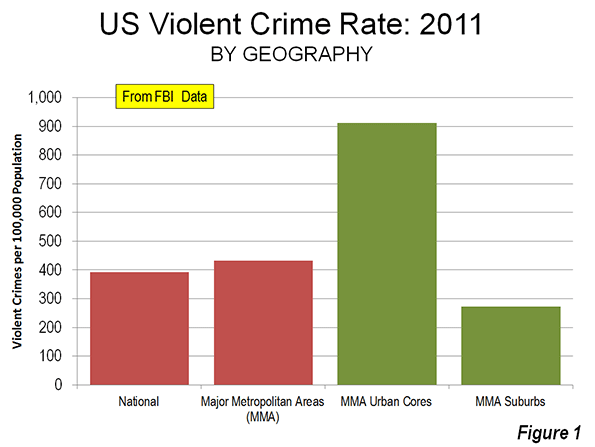
    Among these 48 major metropolitan areas, the violent crime rate was 433 (offenses per 100,000 population known to the police), approximately 10% above the national rate of 392 in 2011. The violent crime rate in the historical core municipalities, or urban core (See Suburbanized Core Cities) was 911 offenses per 100,000 population. In the suburbs, which consist of all municipalities not comprising the historical cores, the violent rate was 272 offenses per 100,000 population. Thus, the urban core violent crime rate was 3.3 times the suburban violent crime rate (Figure 1).

    A comparison of the urban core and suburban crime rates by historical core municipality classification further illustrates the lower crime rates generally associated with more suburban areas. The violent crime rates in the more suburban urban cores are generally lower (Table 1). 

    • Among metropolitan areas with “Post-War & Suburban Core Cities,” the urban core violent crime rate in 2011 was 2.2 times that of the suburbs. This would include core cities such as Phoenix, San Jose, Austin and others that became large metropolitan areas only after World War II and the broad expansion of automobile ownership and detached, low density housing.
    • In the metropolitan areas with “Pre-War & Suburban Core Cities,” the urban core violent crime rate was 3.1 times that of the suburbs. These would include core cities such as Los Angeles, Seattle, and Milwaukee, which combine a denser pre-war inner city with large swaths of post-World War II suburban development within their borders.
    • The greatest difference was in the metropolitan areas with “Pre-War & Non Suburban Core Cities,” where the urban core violent crime rate was 4.4 times that of the suburbs. These would include such core cities as New York, Philadelphia, Boston and others, which had large areas of high density and significant central business districts before World War II, and which, even today, have little post-World War II suburban development within their borders.
    Table
    VIOLENT CRIME RATES: HISTORICAL CORE MUNICIPALITIES AND SUBURBS: 2011
    Violent Crimes Reported per 100,000 Population In Major Metropolitan Areas
    Historcial Core Municipality Classification Metropolitan Area Urban Core Suburbs Urban Core Times Suburbs Crime Rate
    Pre-War Core & Non-Suburban 436 1,181 273 4.3
    Pre-War Core & Suburban 443 821 265 3.1
    Post War Suburban Core 398 642 294 2.2
    48 Major Metropolitan Areas 433 911 272 3.3
    No data for Chicago, Minneapolis-St. Paul and Providence


    Suburban and Urban Core Trends: 10 Years

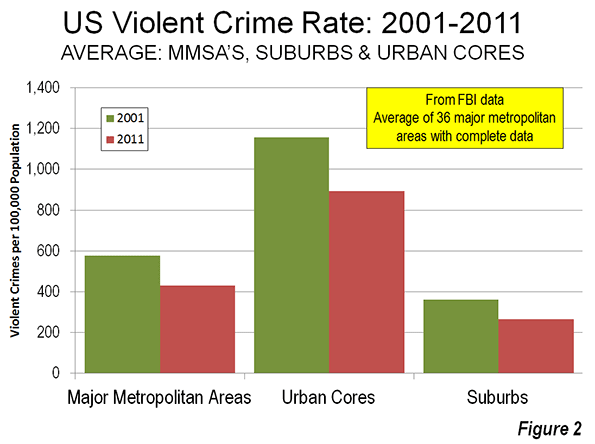
    Over the past decade, violent crime fell both in the suburbs and the urban cores. Among the 36 major metropolitan areas for which complete and comparable data is provided on the FBI website, the violent crime rate fell an average of 25.8 percent between 2001 and 2011. Urban core violent crime rates were down 22.7 percent, while suburb violent crime rates were down a slightly less 26.7 percent (Figure 2).

    Reconciling Differences with Other Analyses

    Other analyses have noted that urban core crime rates are declining faster than in the suburbs. The differences between this and other analyses are due to the use of different time periods, different metropolitan area sets, and most importantly, profoundly more limited definitions of the suburbs.

    An article in The Wall Street Journal raising concerns about suburban crime rates was based on an FBI analysis of all metropolitan areas, not just major metropolitan areas and covered 2001 to 2010. Crucially, the FBI classifies much of suburbia as not being suburbs. The FBI defines suburbs generally as any municipality in a metropolitan area with fewer than 50,000 residents as well as areas patrolled by county law enforcements agencies. Non-core municipalities with their own law enforcement that have 50,000 or more residents are not considered suburbs, regardless of their location in the metropolitan area. This would mean, for example, that Pomona would not be considered a suburb, despite its location 30 miles from Los Angeles City Hall, on the very edge of the metropolitan area, simply because it has more than 50,000 residents. As a result, the crime rates in “cities” versus suburbs cannot be determined by simply comparing FBI geographical classifications.

    A Brookings Institution report reported suburban violent crime rates to be dropping more slowly than in “primary cities,” which are a subset of the “principal cities” defined by the Office of Management and Budget (OMB). Many of these primary cities are virtually all post-World War II suburban in form. These include, for example, Mesa, Arizona, Arlington, Texas and Aurora, Colorado, each of which had fewer than 10,000 residents in 1950 and are virtually exclusively the low-density, automobile oriented suburban development forms that would be found in nearby Tempe, Grand Prairie, and Centennial, which are defined as “suburban” in the Brookings classification. The Brookings report looked at major metropolitan areas as well as smaller metropolitan areas and covered a longer period (1990 to 2008).

    OMB, which defines metropolitan areas, does not designate any geography as suburban. OMB specifically excluded “suburban” terminology from its 2000 metropolitan area criteria. Instead, in recognition of the increasing polycentricity of metropolitan areas, OMB began designating “principal cities.” Except for the largest city in a metropolitan area, principal cities are defined by the strength of their employment markets, and are generally suburban employment centers, not urban cores. In defining its metropolitan area criteria for the 2000 census, OMB recognized  that the monocentric city (metropolitan area) had given way to an urban form with multiple employment centers, located throughout the metropolitan area.

    OMB’s principal cities may be located anywhere in the area, without any relationship to the urban core. Rather than a single core city in a metropolitan area, OMB has designated up to 25 principal cities in a single metropolitan area.

    The National Trend

    The metropolitan area crime reductions are consistent with a now two-decade trend of substantially improving crime rates. This is despite preliminary data recently released by the FBI in June indicating a reversal of the trend for 2012. The FBI reported violent that violent crime increased 1.2 percent. With a 0.7 population increase from 2011 to 2012, the US violent crime rate would increase to 394 per 100,000 residents, from 392 in 2011. Metropolitan area data for 2012 is not yet available.

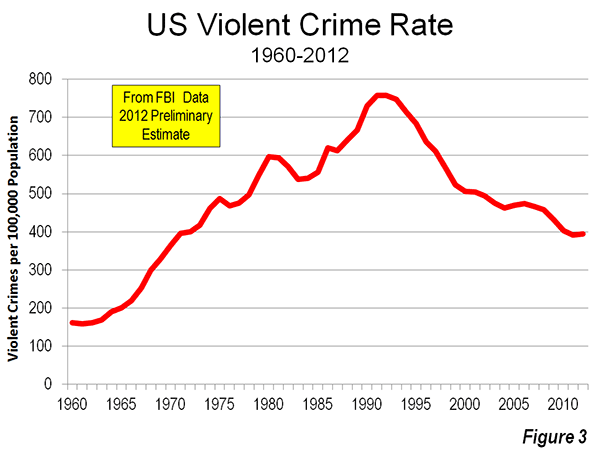
    This increase in crime rates should be a matter of concern. The 2012 violent crime rate increase is, hopefully, only a blip in a decline that will soon resume. The violent crime rate has declined eighteen of the last 21 years. Since 1991, the violent crime rate has dropped by nearly half (48.3%).

    This is in stark contrast with the previous 30 years, during which the violent crime rate increased in all but five years. By 1991, the violent crime rate had increased 3.7 times from 1961. By 2012, the national violent crime rate had fallen to the lowest level since 1970 (Figure 3).

    Why Has the Crime Rate Declined?

    There are multiple theories about the causes of the crime rate reduction. The late James Q. Wilson, who with George Kelling advanced the “broken windows” theory of crime prevention, offered a number of additional reasons for the fact that crime rates remained much lower, even during the Great Recession, in a Wall Street Journal commentary. The earliest and best publicized improvements in crime rates occurred under New York Mayor Rudolph Giuliani in the 1990s. Kelling and others (such as Hope Corman of Rider University and Naci Mocan of Louisiana State University) attribute much of the crime rate improvement in New York City to the “broken windows” deterrence strategies.

    The substantial decline in violent crime rates, in the nation, metropolitan areas, suburbs and urban cores, are an important success story. Yet, crime rates can never be too low. It can only be hoped that future years will see even greater reductions.

    Wendell Cox is a Visiting Professor, Conservatoire National des Arts et Metiers, Paris and the author of “War on the Dream: How Anti-Sprawl Policy Threatens the Quality of Life.

    Crime scene photo by Alan Cleaver.

  • Kid-Friendly Neighborhoods: Takin’ It To The Streets

    Planners and parents have been concerned about two widely reported, and most likely related, trends: the increasing percentage of overweight children, and the growing number of hours that kids spend looking at a screen, be it a television or a laptop. These two activities take up most of the free time kids have after school. Add on the tendency for kids to be driven or bussed to school, and the result is what has been called a “nature deficit” — a disconnect to natural surroundings. Over the long run, the outcome could be a generation of physically unfit and socially maladjusted young adults. The warning statistics are all around us. Is there a way out of this unhealthy cycle? One answer may rest with our planning decisions. Can neighbourhoods be laid out so as to avoid these unwelcome results?

    Evidence from research pronounces an unequivocal ‘yes’. Many pieces shape the puzzle that forms the complete answer. The first element of a community friendly to outdoor childhood activity is its ability to draw people — adults as well as kids — out of their houses and prompt them to socialize with neighbours. Since 1980, several studies have shown that the great inhibitor to socializing on a street is traffic. The heavier the traffic, the less the socializing. When there’s not much socializing, adults and kids make fewer the friends, and the motivation to get out of the house goes down. A 2008 study on this showed that people who lived on cul-de-sacs had four times as many friends and two times the number of acquaintances as residents on through streets with heavy traffic did. It seems intuitive, and research confirms it.

    A second clue can be found by looking at the kinds of streets young kids play on most often. You may have guessed that research shows it’s the cul-de-sac. Kids on cul-de-sacs spent 50 percent more time playing actively than kids on other streets. Importantly, the benefits to kids who play on the street continue. Other studies have shown that play and exercise in the early years build an affinity for activity that can last a lifetime, and that, through friendships, these kids also develop the spirit of a beehive at work.

    The third puzzle piece needed to create a kid-friendly place is the presence of magnets in the surroundings. These are factors that pull kids out of their homes and send them walking to school, the corner store and other destinations. And one study found that of all the elements that would attract kids of all ages, the strongest common force was the presence of open space.

    How parents feel about letting kids play on the street, walk to school, or ride their bicycles plays into the result, too. Justified or not, parental fear and unease limits the range of activities that kids engage in, and builds unhealthy habits.

    This knowledge from the field provides a sketch of the essential elements of a kid-friendly neighbourhood and, beyond that, a child-friendly district. Which elements are most essential?

    There shouldn’t be any through streets in an area about the size of about ten city blocks. That feature gives kids plenty of room to move around in a low-traffic, low-speed environment. Parents socialize and kids play; parental insecurity fades. The easiest way to create this is by using connected cul-de-sacs and crescents.

    Every kid-friendly neighbourhood area should have at least one open space, whatever its size. That grants a safe haven for play — a magnet. Its land value will be recovered through higher values for the homes around it. Real estate research shows that homes near cul-de-sacs and open spaces command higher prices. And where there are bike and foot paths separated from the road, with few road crossings, parents are more likely to let their kids walk or bike ride.

    Can all this be achieved with a layout? Yes, by selectively fusing well known elements of available community plans. A number of examples of this fusion exist, and plenty of advice is accessible; check out, for example, Taking the Guesswork Out of Designing for Walkability.

    These techniques are not just for planning new neighbourhoods. Existing places can also be transformed to create child-friendly environments. Initiatives in many cities have changed neighbourhoods with positive results.

    How can you know when a neighbourhood has succeeded at incorporating these creative elements? One of the sure tell signs is chalk hopscotch marks left on the pavement! It signals that the kids have taken possession of a street, and are having fun. Every new family that moves into the neighbourhood will be heir to its physical and social benefits.

    Fanis Grammenos is the founder of Urban Pattern Associates (UPA), and was a Senior Researcher at Canada Mortgage and Housing Corporation for over 20 years, focused on housing affordability, building adaptability, municipal regulations and sustainable planning. Research on street network patterns produced the innovative Fused Grid. He holds a degree in Architecture from the U of Waterloo. For additional references on the studies mentioned here, please e-mail the author at fanis.grammenos@gmail.com.

    Flickr Photo by Joe Duty, Little Kid Down the Road chalking the sidewalk.

  • America’s Fastest-Growing Cities Since The Recession

    It was widely reported that the Great Recession and subsequent economic malaise changed the geography of America. Suburbs, particularly in the Sun Belt, were becoming the “new slums” as people flocked back to dense core cities.

    Yet an analysis of post-2007 population trends by demographer Wendell Cox in the 111 U.S. metro areas with more than 200,000 residents reveals something both very different from the conventional wisdom and at the same time very familiar. Virtually all of the 20 that have added the most residents from 2007 to 2012 are in the Old Confederacy, the Intermountain West and suburbs of larger cities, notably in California. The lone exception to this pattern is No. 15 Portland. The bottom line: growth is still fastest in the Sun Belt, in suburban cities and lower-density, spread out municipalities.

    The No. 1 city on our list, New Orleans, fits this picture to a degree as a quintessentially Southern city, but it’s a bit of an anomaly. Its fast growth is partially a rebound effect from its massive population loss after Katrina, but is also a function of a striking economic revival that I have seen firsthand as a consultant in the area.

    Since 2007 New Orleans’ population has grown 28% to 370,000. Many are newcomers who came, at least initially, to rebuild the city.  But the city is still way below the 2002 population of 472,000, much less its high of 628,000 in 1960.

    New Orleans is one of six cities where the population of the core has grown more in total numbers than the surrounding suburbs. (The other five are New York; San Jose, Calif.; Providence, R.I.; Columbus, Ohio; and San Antonio.) This is also a product of the fact that, when the Greater New Orleans region began to recover, the return to the suburban regions, for the most part, came before that to the city.

    Nothing in the data, however suggests a revival of the older, dense “legacy” cities that were typical of the late 19th century and pre-war era. Most of the fastest-growing big cities since 2007 are of the sprawling post-1945 Sun Belt variety, including Charlotte, N.C. (No. 4); Ft. Worth, Texas (No.  6); Austin, Texas, (10th); El Paso, Texas (11th); Raleigh, N.C. (12th); and Oklahoma City (18th). Some of the fastest-growers are also outside the major metropolitan areas,  such as No. 5 Bakersfield in California’s Central Valley, the North Carolina cities of Greensboro and Durham, (9th and 14th, respectively), and  Corpus Christi, Texas (16th).

    Among the big Northeast cities, the best performer is Washington (27th with 7.8% population growth) followed by Boston (71st, 2.2%). New York has managed only 0.3% population growth since 2007 (88th). Among other leading U.S. cities San Francisco’s population is up 3.3%, Los Angeles has grown 2.1%, and Chicago’s population has dropped 3.4%.

    The other somewhat surprising result is the strong performance of more purely suburban cities, that is, ones that have grown up since car ownership became nearly universal. They are not the historic cores of their regions but have developed into major employment centers with housing primarily made up of single-family residences. These include the city that has grown the second most in the U.S. since 2007: Chula Vista, a San Diego suburb close to the Mexican border, whose population expanded 17.7%. It’s followed in third place by the Los Angeles suburb of Irvine (16.3%); No. 7 Irving, Texas; and the California cities of Fremont (13th) , located just east of San Jose-Silicon Valley, and Oxnard (17th), north of Los Angeles.

    What do these results tell us? First, that Americans continue to move decisively to both lower-density, job-creating cities and to those less dense areas of major metropolitan areas particularly where single-family houses, good schools and jobs are plentiful.

    Irvine, a planned postwar city of some 230,000 which ranks as the country’s seventh-wealthiest municipality, has three jobs for every resident; roughly two in five residents work in the city. Irvine’s 16.3% growth rate since 2007 has been bolstered by a strong inflow of Asians. Once overwhelmingly white, Irvine’s population is now roughly 40% Asian and 9% Hispanic.

    Similarly, Irving, Texas, also thrived through the recession. Like Irvine this Dallas-area suburb is a major job center. Headquarters for Nokia , NEC Corporation of America, Blackberry, and Exxon Mobil, Irving’s population has soared over 13% over the past five years to 225,000.

    This contrasts with some similarly sized suburbs that boomed in the first part of the decade. North Las Vegas added 80,000 people between 2002 and 2007 but its growth slowed down considerably as the Nevada economy cratered. This extension of Las Vegas has added a relatively paltry 12,000 people since 2007. With Phoenix losing 3.2% of its population since ’07, the nearby former boomtowns of Mesa and Scottsdale have also seen net outflows of residents.

    Migration numbers for 2010 to 2012 alone hammer home that suburban areas are continuing to attract people, and that the more dense core areas do not generally perform as well. Although their growth has slowed compared to the last decade, suburban locales, with roughly three-quarters of all residents of metropolitan areas, have added many more people than their core counterparts.

    Where do we go from here? The urban future will continue to evolve in directions that contradict the prevailing conventional wisdom of a shift toward more crowded living. The continued dispersion of America’s population is evidenced by the persistent, and surprising, strength of suburban towns, as well as the low-density cities of Texas and the Plains. The key to growth in the next decade may depend largely on whether these rising municipalities can continue to create the jobs, favorable educational environment and amenities necessary to attract more newcomers in the future.

    MUNICIPALITIES OVER 200,000 IN 2012
    25 Fastest Growing 2007-2012
    POPULATION CHANGE
    RANK MUNICIPALITY 2002 2007 2012 2007-2012
    1 New Orleans, Louisiana     472,744     288,113     369,250 28.2%
    2 Chula Vista, California     194,167     214,506     252,422 17.7%
    3 Irvine, California     162,205     197,714     229,985 16.3%
    4 Charlotte, North Carolina     590,857     669,690     775,202 15.8%
    5 Bakersfield, California     259,146     312,454     358,597 14.8%
    6 Fort Worth, Texas     570,808     680,433     777,992 14.3%
    7 Irving, Texas     195,764     198,119     225,427 13.8%
    8 Laredo, Texas     189,954     215,789     244,731 13.4%
    9 Greensboro, North Carolina     231,415     245,767     277,080 12.7%
    10 Austin, Texas     684,634     749,120     842,592 12.5%
    11 El Paso, Texas     570,336     600,402     672,538 12.0%
    12 Raleigh, North Carolina     313,829     379,106     423,179 11.6%
    13 Fremont, California     205,034     199,187     221,986 11.4%
    14 Durham, North Carolina     196,432     216,943     239,358 10.3%
    15 Portland, Oregon     538,803     546,747     603,106 10.3%
    16 Corpus Christi, Texas     276,877     283,445     312,195 10.1%
    17 Oxnard, California     176,594     183,235     201,555 10.0%
    18 Oklahoma, Oklahoma     519,100     545,910     599,199 9.8%
    19 Aurora, Colorado     282,707     309,007     339,030 9.7%
    20 Denver, Colorado     561,072     578,789     634,265 9.6%
    21 Fontana, California     158,916     184,814     201,812 9.2%
    22 Fresno, California     442,987     465,669     505,882 8.6%
    23 Orlando, Florida     199,358     230,239     249,562 8.4%
    24 Colorado Springs, Colorado     376,341     399,751     431,834 8.0%
    25 Riverside, California     272,814     290,601     313,673 7.9%


    Joel Kotkin is executive editor of NewGeography.com and a distinguished presidential fellow in urban futures at Chapman University, and a member of the editorial board of the Orange County Register. He is author of The City: A Global History and The Next Hundred Million: America in 2050. His most recent study, The Rise of Postfamilialism, has been widely discussed and distributed internationally. He lives in Los Angeles, CA.

    This piece originally appeared at Forbes.com.

    New Orleans photo by Bigstock.

  • The Evolving Urban Form: The Rhine-Ruhr (Essen-Düsseldorf)

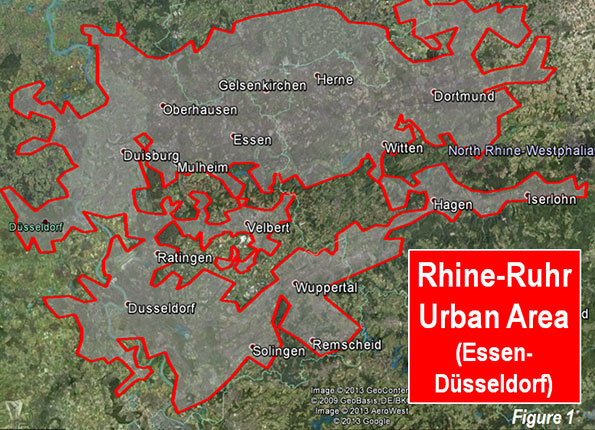
    Rhine-Ruhr, or Essen-Düsseldorf, is among the world’s least recognized larger urban areas (Figure 1).  Germany does not designate urban areas according to the international standard, and for that reason the Rhine-Ruhr does not appear on the United Nations list of largest urban areas. Yet, in reality this contiguous urban area is Germany’s largest urban area, a position as it has held since at least the end of World War II. The Rhine-Ruhr is the third largest urban area in Western Europe, trailing only Paris and London. The area was one of the strongest early urban industrial areas in the 18th century and continued as a major manufacturing and coal mining center through the first half of the 20th century.

    An Early Polycentric Urban Area

    The Rhine Ruhr is unusual in not having evolved around a single core municipality. The Rhine Ruhr has multiple core municipalities, which have grown together to form a conurbation, the second largest in the world following Osaka –Kobe – Kyoto. But the Rhine Ruhr is probably the most polycentric urban region in the world, with a minimum of eight older, large municipalities now linked by urbanization. These include Essen and Düsseldorf, which were until recently the two largest municipalities. In addition there are Dortmund, Duisburg, Bochum, Wuppertal, Gelsenkirchen and Oberhausen. Each of these eight municipalities reached a population of 250,000 or more by 1961.

    Like nearly all prewar municipalities in the high income world that had not expanded their boundaries, each of these has lost population since 1961. By 2011, the combined population of these eight municipalities was under 3.4 million, a reduction of 700,000 (Table) from their 1961 total (a 17% loss).

    Table
    Larger Rhine-Ruhr Municipalities: Population 1961-2011
      1961 2011 Change %
    Bochum      441,000      362,000     (79,000) -17.9%
    Dortmund      645,000      571,000     (74,000) -11.5%
    Duisburg      504,000      488,000     (16,000) -3.2%
    Dusseldorf      705,000      586,000   (119,000) -16.9%
    Essen      730,000      566,000   (164,000) -22.5%
    Gelsenkirchen      384,000      259,000   (125,000) -32.6%
    Oberhausen      258,000      210,000     (48,000) -18.6%
    Wuppertal      422,000      343,000     (79,000) -18.7%
    Total   4,089,000   3,385,000   (704,000) -17.2%


    Data for the balance of the urban area and the broader Rhine-Ruhr region (Note 1) is not readily available for 1961. As a result, this analysis considers the Rhine-Ruhr region to consist of the Dusseldorf, Arnsberg and Münster subregions of the state (lander) of North Rhine-Westphalia, which had a combined population of 11.22 million in 2011, up only modestly from 11.06 million in 1987. The urban area has a population of approximately 6.5 million residents, covering a land area of approximate 950 square miles (2,450 square kilometers). The urban density is approximately 6,800 per square mile (2,650 per square kilometers), less than that of Los Angeles (7,000 per square mile or 2,700 per square kilometer) or Toronto (7,600 per square mile or 2,900 per square kilometer).

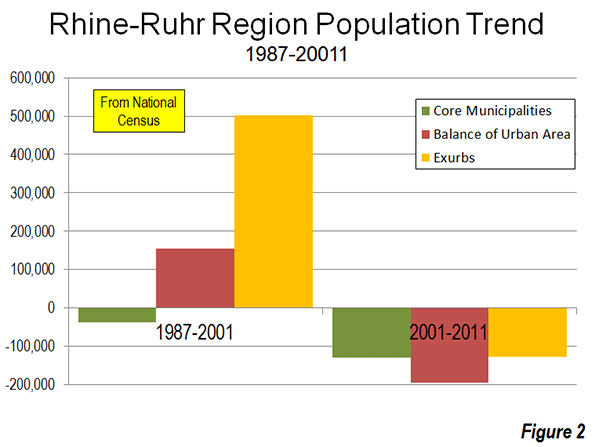
    Since 1987, the Rhine-Ruhr has added 161,000 residents, having gained 617,000 residents between 1987 and 2001, and losing 456,000 from 2001 to 2011. The eight older cities lost 170,000 residents from 1987 to 2011, while the balance of the urban area lost 42,000. The exurbs, outside the urban area have added 373,000 residents, and account for more than all of the modest growth since 1987. All three sectors lost population after 2001 (Figure 2).

    Slow Growth, Even for Germany

    The Rhine-Ruhr is located in the lander of North Rhine-Westphalia, which has the largest population in Germany. Its growth, however, has been glacial. Since 1961, the average annual growth rate of the lander was 0.2%. This is one third the growth rate of the other lander that constituted the former Federal Republic of Germany (West Germany).

    North Rhine-Westphalia’s performance is stellar compared to the lander of the former Democratic Republic of Germany (East Germany), which have fallen back to their 1961 population, having lost 10% of their residents since 1990. Germany itself lost more than 2 million people in the last decade, reflecting its well-below replacement fertility rate. Based upon this rate, Germany could lose more than the 5 million more residents projected by United Nations projectionsto 2050 (to 75 million).

    But even within the slow growth environment of North Rhine Westphalia, the  Rhine Ruhr region is falling behind as nearly all the growth has shifted elsewhere to the regions of the lander that surround other urban areas, Cologne (Köln), which includes the former West German capital of Bonn, and Aachen (which stretches into the Netherlands). Local authorities in the Ruhr Valley are forecasting a population loss of approximately 8 percent by 2030.

    The Setting

    The Rhine-Ruhr conurbation is organized around confluences of two rivers with the Rhine. The northern part of the urban area stretches from the west bank of the Rhine eastward along the Ruhr River Valley with the large municipality of Duisburg anchoring the West and Dortmund the East. The southern part of the urban area stretches along the Wupper River Valley starting at Düsseldorf and continuing eastward to south of Dortmund. The elevation at the two river junctions is less than 100 feet (40 meters). A transverse, low mountain range (Rhenish Massif) separates the northern and southern parts of the urban area (maximum elevation 800 feet or 300 meters), though much of the hilly area is urban.

    Transport

    Without a dominant, large center, the Rhine-Ruhr has a lower transit work trip market share – 18 percent – than would be expected for a European urban area of its size. This is well below the 30 percent share of Berlin and the approximately 35 percent shares of Madrid, Lisbon, and Stockholm, which are all smaller than the Rhine-Ruhr. Wuppertal is home to one of the icons of mass transit, the Wuppertal Monorail, which opened in 1901. The Monorail is suspended for much of its route above the Wupper River, with supports straddling the river (such a configuration would probably not be permitted to be constructed today in any high-income world metropolitan area because of environmental regulations).

    The Rhine-Ruhr’s polycentricity requires substantial reliance on its road system. The region is well served by an extensive freeway (autobahn) system consisting of at least four east-west routes and five north-south routes. Traffic congestion is worse than in most US urban areas, but the Rhine-Ruhr’s traffic flows better than in any metropolitan area of similar size in Europe, according to 2012 data from the INRIX Traffic Scorecard. The average peak hour delay is 14.8 percent compared to “free flow.” This is less than one-half the average delay in smaller Milan (30.2 percent) and well below Paris (27.8 percent) and London (26.1 percent). In 2005, the Rhine-Ruhr had the fifth highest rated freeway access among 30 surveyed international urban areas.

    Shrinking City

    Shrinking cities (where cities are defined as metropolitan areas or urban areas) have been unusual in the high income world (Pittsburgh and Liverpool are exceptions). Even as core municipalities have lost population, such as in Atlanta and Copenhagen, metropolitan areas have continued to grow. This is likely to change because of the severe national population declines forecast in a number of countries. The Rhine-Ruhr, and other similarly situated cities, will face serious challenges in retaining dynamic economies and delivering public services in the years to come for an aging population supported by a smaller work force.

    Wendell Cox is a Visiting Professor, Conservatoire National des Arts et Metiers, Paris and the author of “War on the Dream: How Anti-Sprawl Policy Threatens the Quality of Life.

    ———–

    Note 1: The entire Rhine-Ruhr and Cologne areas are considered by Germany to be the Rhine-Ruhr metropolitan area (ballungsräume). This article is limited to an area roughly conforming to the northern part of the ballungsräume. Eurostat defines a much smaller Düsseldorf-Ruhrgebiet metropolitan area that includes the Rhine-Ruhr urban area and most of the exurban area in this analysis. There is no international standard for the designation of metropolitan areas (labor markets).

    Note 2: INRIX classifies the Rhine-Ruhr as two areas (north and south). This is the population weighted congestion delay.

    Photo: Wuppertal Monorail

  • The Mad Drive to Subvert Democracy in Toronto

    Let me stipulate that I think Toronto’s Rob Ford is a terrible mayor. In fact, while I might not go so far as Richard Florida, who labeled Ford “the worst mayor in the modern history of cities, an avatar for all that is small-bore and destructive of the urban fabric, and the most anti-urban mayor ever to preside over a big city,” I’m willing to say he’s probably in the running for the title.

    The roots of Rob Ford lie in “amalgamation,” the forcible merging of the city of Toronto government with various of its suburbs by the Ontario provincial government. The idea was cost savings, but of course costs went up. Also, it created a Mars-Venus situation that ultimately led to Ford, a former city councilor in Etobicoke, being elected mayor. This would be like a consolidation of Chicago with Cook County in which a member of the Schaumburg city council ended up mayor. Not good. The urban intelligentsia that despises Ford now find themselves in the embarrassing position of having to explain to their friends that they are in total agreement with Wendell Cox, an implacable foe of government consolidations, who predicted these results.

    But there’s a big difference between Florida’s bashing of Ford, which falls within the principles of democratic discourse as we’ve come to know it, and what appears to be an effort by some to subvert democracy by finding any pretext to run Rob Ford out of office.

    I’m not sure where the idea that the loser in an election tries to undermine the legitimacy of the government of the winner came from. But in the modern era it could be the Republican impeachment of Bill Clinton that launched it. This quickly proved to be standard fare. There was the brouhaha over the “selected not elected” George W. Bush as well as the more passionate strain of “birthers” when it comes to President Obama. Given that, especially in the big leagues, there is always some dirtiness in politics, it’s easy to find things to seize upon to claim someone’s holding of an office is invalid. After all, it appears that Clinton really did commit perjury and there was shall we say some murkiness down in Florida. However, these aren’t truly what the people raising a ruckus cared about. What they cared about was the man in office they didn’t like – and getting him out of it.

    Canada has a reputation as a kinder, gentler nation, but they now appear to have imported from America what Clinton labeled “the politics of personal destruction.” Rob Ford has been the target of a series of vicious attacks, generally aided and abetted (if not outright instigated) by the old city Toronto media that clearly don’t like him, designed to drive him out of office.

    One was a lawsuit that claimed he should be tossed out of office because of events related to his using official letterhead and such to raise $3,500 for a charity. Believe it or not, the trial judge actually agreed with this and ordered him removed from office. If that’s the threshold for getting someone kicked out of office, I dare say every major politician in America would be gone. Yes, politicians do often use affiliated charities as a, shall we say, lubricating mechanism. Yes, there’s the appearance or even the reality of some impropriety in these things. But this is such small fry stuff that to throw the mayor of the biggest city in the country out of office over it defies belief. If you think this is removal worthy, I’m confident I can find something just as bad in almost any politician that you actually like. Fortunately, saner heads at the appeals level prevailed and the ruling was overturned.

    Recently we’ve also seen reports originating from, I kid you not, Gawker, in which some shady Somalis supposedly showed a reporter a cell phone video of Rob Ford smoking crack. Shortly thereafter the Toronto Star got in on the act, saying their reporters had seen the video in the back seat of the car, though with the CYA proviso that they had “no way to verify the authenticity of the video.” Other media that may not have directly originated such a story have piled on and thus there’s a firestorm awhirl.

    Where is the video, you might ask? Good question. Supposedly it’s for sale for $200K but oddly no one snapped it up, not even one of the extremely wealthy Ford haters that Toronto has in abundance. So you want to buy it? Oh, Gawker now tell us it might be “gone.” Hmmm…..

    I’m not saying there’s no video. Rob Ford has certainly acted like he’s guilty of something. But it seems amazing to me that in this era in which all types of tapes and documents spontaneously get loose, this one is no where to be found. Also, the idea of the mayor of Toronto smoking crack with a bunch of Somalis while they film him falls into the “extraordinary claims require extraordinary proof” category. The still photo is interesting, but I’ve seen many compromising photos of mayors, who are routinely snapped with all sorts of random people who they may find out later are unsavory characters. I can’t imagine this sort of media feeding frenzy over say, similar allegations against Michael Bloomberg or Rahm Emanuel.

    The Toronto Globe and Mail is a serious newspaper that’s roughly Canada’s New York Times. Though they didn’t break the video story, they did follow-up with a rather tabloidesque article about the history of Rob Ford’s family with drugs. Ford’s brother Doug, the focus of the piece, is on the city council himself, so is a legitimate investigative target so to speak, but the piece also digs into other family members.

    Not only is the Globe and Mail digging up dirt on Rob Ford’s family, this piece did it entirely with anonymous sources. They claimed to talk to no fewer than ten people who called Doug Ford a drug-dealer, but curiously none of them were willing to talk on the record. That didn’t stop the Globe and Mail from reporting:

    Ten people who grew up with Doug Ford – a group that includes two former hashish suppliers, three street-level drug dealers and a number of casual users of hash – have described in a series of interviews how for several years Mr. Ford was a go-to dealer of hash. These sources had varying degrees of knowledge of his activities: Some said they purchased hash directly from him, some said they supplied him, while others said they observed him handling large quantities of the drug.

    The events they described took place years ago, but as mayor, Rob Ford has surrounded himself with people from his past. Most recently he hired someone for his office whose long history with the Fords, the sources said, includes selling hashish with the mayor’s brother.

    There’s nothing on the public record that The Globe has accessed that shows Doug Ford has ever been criminally charged for illegal drug possession or trafficking. But some of the sources said that, in the affluent pocket of Etobicoke where the Fords grew up, he was someone who sold not only to users and street-level dealers, but to dealers one rung higher than those on the street. His tenure as a dealer, many of the sources say, lasted about seven years until 1986, the year he turned 22. “That was his heyday,” said “Robert,” one of the former drug dealers who agreed to an interview on the condition he not be identified by name.

    Upon being approached, the sources declined to speak if identified, saying they feared the consequences of outing themselves as former users and sellers of illegal drugs.

    The Globe also tried to contact retired police officers who investigated drugs in the area at the time. One said he had no recollection of encountering the Fords.

    The article is full of innuendo about the Ford’s such as the idea that Rob Ford recently hired a drug dealing associate of Doug’s from the old days (highlighted above), along with curious mentions and links to beatings, killings, and white supremacy/KKK. (Rob Ford is a white supremacist who likes to smoke crack with Somalis???) It’s capped off by having various anonymous sources given pseudonyms so that they appear to be actual people on the record. As this excerpt notes, the police record and police contacts don’t back up the story, which just adds to the general notion of dubiosity and suggests this is a very exaggerated piece that tries to throw things to the wall to see what sticks.

    All it all, given the extreme reactions to financial dealings that, even if they were proven, would have been a non-issue almost anywhere else, along with a firestorm of allegations about smoking crack and so much more with no actual proof, the Rob Ford affair has thus far generated much more smoke than fire.

    Rob Ford is the price Toronto is paying for the foolishness of the provincial government and the failure of an urban candidate to offer a compelling vision for the entire amalgamated city. But it strikes me very much that a group of old Toronto city partisans, who are incensed a guy like Ford had the temerity to win an election, are determined to use any means necessary to correct what they see is that injustice. But just as with what happened in America and its politics in the wake of the Clinton impeachment, Canada may come to rue the day a group of its citizens decided to try to overturn an election by destroying the winner rather than waiting for their next opportunity at the ballot box.

    Aaron M. Renn is an independent writer on urban affairs and the founder of Telestrian, a data analysis and mapping tool. He writes at The Urbanophile, where this piece originally appeared.

    Photo by Wiki Commons user MTLskyline.