Category: Suburbs

  • Gentrification as an End Game, and the Rise of “Sub-Urbanity”

    “It took a bit of wind out of my sails, watching what happened in this neighborhood, watching how it happened…I don’t know how to beat this [gentrification]. I don’t know how anyone can beat this machine.”—From the article The Ins and Outs

    The Generalization of Gentrification

    The forces of gentrification are taking hold in America’s alpha cities. You can check the numbers or see the maps, but to get a good idea of its unprecedented rapidity, I’d suggest the blog Vanishing New York. There, you will see nearly each day the announcement of yet another old-school establishment losing the rent battle: Lenox Lounge in Harlem, Suzies Chinese Restaurant on Bleeker St., the Central Iron and Metal scrap yard below the High Line. And with the small-business soul of the city goes the regulars that gave places like New York City its identity before its global city branding.

    For instance, speaking about the closing of the Big Apple meat market in Hell’s Kitchen, writer Jeremiah Moss vents on the city’s whitewashing:

    The [Big Apple] exterior is wonderfully dreary, covered in graffiti and pigeon shit. Standing here, you could dream yourself into a lost New York. But not for long. It’s all coming down for more glass, more chain stores.

    A couple of years ago, the Times did a piece on Big Apple. The article includes a wonderful slideshow of photos, featuring the sort of person who shops at Big Apple, the sort of person that is also vanishing from New York, replaced by the svelte and distracted, the hollow men and women, tapping away at iPhones in sterilized Whole Foods aisles.


    Courtesy of The New York Times

    This is not a localized thing, as cities everywhere are grappling with the abruptness and consequences of such change. And while gentrification has been occurring here and there for decades, with community capital unwound on a street-by-street basis for higher returns and bigger tax receipts, the sheer push from above, like meat through a grinder, is now so systematic—and no longer personified by the Robert Moses’s of the world but by a kind of faceless force blowing a current of yield and tidiness in—that it has just become what is, with the late scholar Neil Smith referring to this latest iteration as the “generalization of gentrification”.

    In his article “New Globalism, New Urbanism: Gentrification as Global Urban Strategy”, Smith examines how gentrification has morphed from an unfortunate effect to an outright aim. One explanation for this relates to the ever-morphing private-public partnership in cities in which elected officials have forgone governing for investing, with policy no longer aspiring to guide economic growth but rather being crafted to “fit in the grooves” of market forces, particularly in the realm of real estate.

    Why real estate?

    Part of the reason is that economic leaders now primarily see Americans as consumers as opposed to producers, and so cities—particularly alpha dog global cities—have shifted their focus from payrolls to price per square feet, making real estate an increasingly important productive engine of cities as opposed to the productive capacity of the citizen. Enter, then, the volitional push of attracting as many creative class gentry as possible into the confines of a place, with real estate gimmicks—such as Mayor Bloomberg’s recent microapartment push—aimed at further squeezing blood from areas with far more density than available space.

    Does such wealth-packing inject capital into a given space? Yes. Is it a viable economic growth model? Wrote Aaron Renn in a recent New Geography piece:

    Indeed, all too much urbanism amounts to a sort of trickle down economics of the left, in which a “favored quarter” of artists, high end businesses, and the intelligentsia are plied with favors and subsidies while precious little ever makes it to those at the bottom rungs of society.

    This is not to disown the fact that global cities are economic engines in their own right. They are. It is only to state that their long-term economic growth prospects are being sold down the river at an exorbitant price. After all, people develop, not places.

    Gentrification of the Mind

    Allocating supply is one thing, but stoking the psychogeography of the creative class to want and squeeze into high-priced real estate is another. Historically, the common desire to move to an alpha dog city is to be where the action is. Moreover, NYC, Chicago and the like can graduate you. They can defang your limits while toiling the mind to the experiencing of new people and ideas. Said John Lennon:

    I regret profoundly that I was not an American and not born in Greenwich Village. It might be dying, and there might be a lot of dirt in the air you breathe, but this is where it’s happening.

    Yet this “if you can make it here you can make it anywhere” pull is arguably not what’s driving the generalization of gentrification. Rather, it is the idea of big city suburbanization, or more exactly: the hybridization of city “vitality” with the comforts of suburbanization, creating for a kind of third place called “sub-urbanity”.

    In many respects, this is not surprising, as the most recent “return-to-city” movement is largely fueled by younger suburbanites who are tired of missing out on big city action. Not the action per se of Charles Bukowski’s L.A. or Patti Smith’s New York, but the action of, well, Chandler, Kramer, and Carrie. Said Alan Ehrenhalt, author of The Great Inversion and the Future of American Cities:

    This is the generation, don’t forget, that watched Seinfeld and Sex and the City and Friends – usually from sofas safe in the confines of the suburbs. I think they find suburban life less exciting than urban life. While they are in a single or childless situation, they’re particularly eager to try it.

    And try it they should: varied experiences make varied lives make more richly contextualized societies. But the rub here is that the mentality sewn from “the confines of the suburbs” is not being sacrificed for the beautifully unnerving experience that is “the real” of city life, but rather that creative class enclaves are increasingly being appropriated into the domesticated lifestyle embodied by traditional suburbia.

    Of course John Lennon’s Greenwich Village this is not. And this bodes ill for alpha dog cities in that vanilla-ing a people and a place is a death knell to collective urgency, if only because comfort puts to sleep the burn that has traditionally sparked the next generation of ideas. Writes Sarah Schulman, author of The Gentrification of the Mind: Witness to a Lost Imagination:

    Gentrification is a replacement process. So it is where diversity is replaced by homogeneity, and this, I believe, undermines urbanity and changes the way we think because we have much less access to a wide variety of points of view. We are diminished by it. So literally, the range of our mind’s reach is much more limited because of gentrification.

    But again: lest we think this is all a mistake, or simply the byproducts of shifting demographics or economic and cultural change. Rather, it is the point. It is today’s path toward urban renaissance. And it’s a path creating for a “sub-urbanity” that is emerging when the generalization of gentrification meets the gentrification of the mind.

    So, what does this mean for the future of urban development? My guess is that there will be a growing unhappiness with sub-urbanity that’s going to create for a lot of people left wanting, be they young suburbanites longing for urban authenticity or indigenous urbanites who are tired of the schtick. As such, cities would do well to prepare for the “return-of-the-city movement”, which means prioritizing urban integrity and community capital against the temptations of the gentrifying machine.

    Richey Piiparinen is a writer and policy researcher based in Cleveland. He is co-editor of Rust Belt Chic: The Cleveland Anthology. Read more from him at his blog and at Rust Belt Chic.

    Lead photo by Liz Ferla, flickr user lism.
  • The Evolving Urban Form: Rio de Janeiro

    Rio de Janeiro was the capital of Brazil from before independence from Portugal was declared in 1822. That all changed in 1960, when the capital moved to the modern planned city of Brasilia, more than 500 miles (800 kilometers) inland. The move, however, did nothing to slow Rio de Janeiro’s growth, as the metropolitan area (as designated by Brazil’s census agency, the Instituto Brasileiro de Geografia e Estatística),  added 7 million people – a 150 percent increase in population – over the ensuing 60 years

    The placement of the federal government in Brasilia has had positive economic impacts on the interior, but it did not make Rio de Janeiro less crowded (factor Indonesian officials should note as they consider moving the capital from Jakarta,).

    The Urban Area

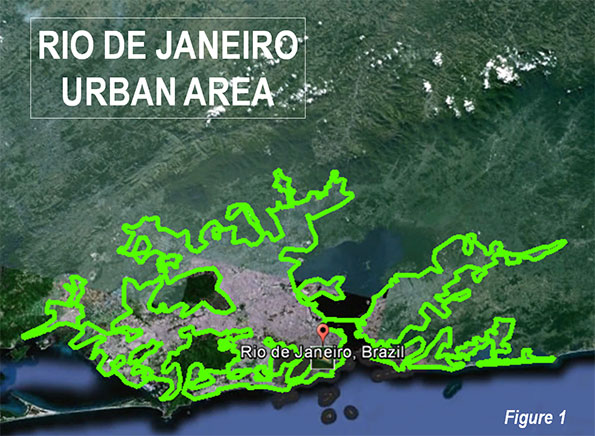
    However, it is clear that Rio de Janeiro has fallen behind even faster growing Sao Paulo, which has become one of the world’s 10 largest urban areas (with a population of approximately 20.5 million in 2013). Nonetheless, as an urban area with a 2013 population of 11.6 million (Figure 1) Rio de Janeiro still ranks among the world’s megacities (urban areas over 10 million).

    The urban area covers 720 square miles (1,870 square kilometers),   a population density of 16,100 per square mile (6,200 per square kilometer). This is similar to the density of Sao Paulo, 20 percent above that of Buenos Aires, but 35 percent less dense than the western hemisphere’s most dense megacity, Mexico City. In contrast, Rio is more than twice as dense as the most dense Canadian and US urban areas, Toronto and Los Angeles, but less than 1/6th the density of Dhaka, the world’s most dense megacity.

    Metropolitan Dispersion

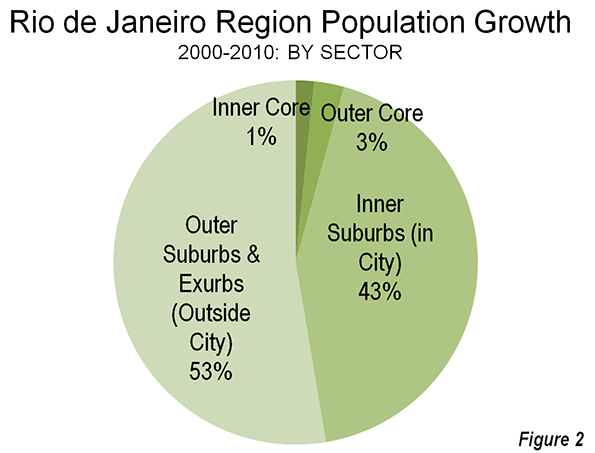
    As this series on world urbanization has shown, cities tend to become less dense as they grow (at least until they reach predominantly automobile oriented densities). This can be seen in Rio de Janeiro as well. Since the 2000 census, virtually all of the population growth has been in less dense areas. The inner core (the districts or bairros of Zona Centro), for example, accounted for two percent of the urban area’s growth over the past decade. The larger, inner core (around the urban core) accounted for three percent of the growth (principally the Zona Sul and some additional bairros adjacent to Zona Cento and Zona Sul).

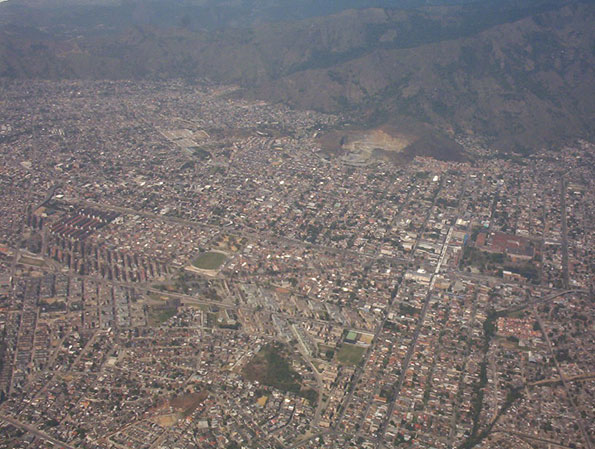
    A Suburbanized Core City: Like many core municipalities around the world, Rio de Janeiro contains large expanses of suburbanization (Photo: Rio’s In-City Suburbs). The suburban portions of the municipality accounted for 43 percent of the growth, while the outside-the-municipality suburbs and exurbs (inside the metropolitan area, but outside the urban area) represented 53 percent of the growth (Figure 2). Most of the growth outside the municipality of Rio de Janeiro has been across Guanabara Bay, with the large suburbs of Niteroi and São Gonçalo, and to the north, where there are a number of large municipalities (such as Duque de Caxias and Nova Iguaçu).


    Photo: Rio’s In-City Suburbs

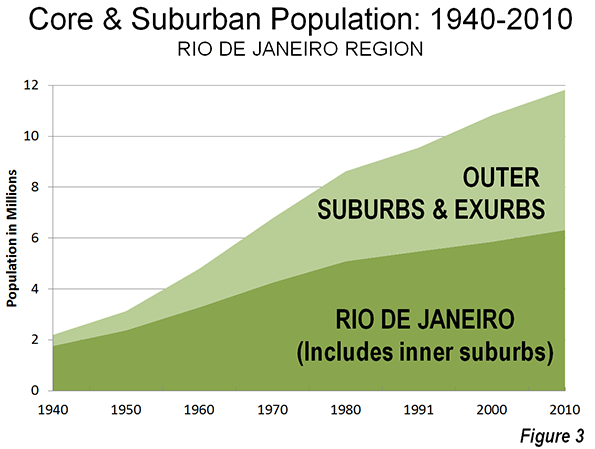
    This preponderance of growth outside the dense core has been developing since 1950. The municipality of Rio de Janeiro has added 3.9 million residents since 1950, while the suburbs and exurbs have added 4.8 million. The municipality continues to have more than half of the population (53 percent), down from 76 percent in 1950 (Figure 3). However, the retention of this strong share of the population has been made possible only by the large amount of land available for suburban development within the municipality (this is similar to the experience of other suburbanized core cities, such as San Jose, Edmonton, Phoenix, Denver, and Kansas City).

    The Physical Setting

    Rio de Janeiro sits on the Atlantic Coast and is one of the world’s leading tourist beach areas (Copacabana and Ipanema). The urban area straddles Guanabara Bay, with the municipality of Rio de Janeiro on the west side. A bridge leads to Niteroi, on the east side. The municipality of Rio de Janeiro covers virtually the same land area as the city of Los Angeles and like its American counterpart also includes mountainous areas. The mountains include Sugar Loaf and Corcovado, site of the world famous "Cristo Redentor" statue ("Christ the Redeemer") and others.  North and West of the mountains are the broad plains that contain most of the suburbanization (both within and outside the municipality).

    Favelas

    Favelas, also called shantytowns or informal housing proliferate throughout much of Latin America. It is estimated that 20 percent of new municipality’s population lives in favelas. The largest of these is Rocinha, which accounted for a full one third of the inner and outer core growth over the last 10 years, despite having less than 5% of the population. Rocinha is located on a steep hill adjacent to affluent São Conrado, which provides employment for many residents. This is typical for shantytowns around the world, which are located near principally domestic labor opportunities, since residents generally have only limited mobility options to employment in the rest of the urban area. The favela to affluent neighborhood model represents an effective example of a "jobs – housing balance," though   rooted in poverty and gaping class distinctions. (Photo: Rocinha Favela & São Conrado, top).

    Transport

    Mass transit is very important in Rio de Janeiro. More than one half of all travel is on the Metro, commuter railways, buses and informal vans. In recent decades, the rail share of travel has been falling substantially, while the van share of travel has increased substantially. Vans have also made serious inroads into mass transit ridership in other urban areas of Brazil.

    This dependence on transit does not mean that the roads are uncongested. For example, Avenida Brasil, the main arterial leading to Centro from the North carries more than 200,000 vehicles each day, a figure that exceeds that of many US urban freeways. A new peripheral freeway is under construction arcing around the urban area from west to east.

    Gross Domestic Product

    According to the Brookings Institution Global Metro Monitor, Rio de Janeiro had a gross domestic product per capita of approximately $16,300 in 2012. This would rank Rio de Janeiro 100th out of the 300 top metropolitan area economies in the world (Note 1). This is below Latin American leaders Buenos Aires ($26,100) and Sao Paulo ($23,700). It is also below the more affluent Chinese metropolitan areas, such as Shenzhen ($28,000) and Shanghai ($21,400). Rio, however, ranked above Cape Town ($15,700) and Cairo ($10,000).

    Life After the Capital Leaves

    The growth of Rio de Janeiro shows that there is, indeed, life after the national capital leaves. Rio has experienced strong economic growth in recent years and remains a dynamic urban region.

    Wendell Cox is a Visiting Professor, Conservatoire National des Arts et Metiers, Paris and the author of “War on the Dream: How Anti-Sprawl Policy Threatens the Quality of Life.”

    —-

    Note: These rankings are based on the 300 metropolitan areas with the largest total gross domestic product (not per capita gross domestic product). As a result, many metropolitan areas that are more affluent per capita are not included because their total gross domestic product is not rank in the top 300. This would include a large number of metropolitan areas in the United States, Europe Canada and elsewhere. The ranking of metropolitan areas in China is adjusted for the 2010 census, which includes migrant workers. Additional details are provided in Endnote 19 in the Brookings Global Metro Monitor.

    Top Photo: Rocinha Favela & São Conrado (photos by author)

  • The Evolving Urban Form: Kuala Lumpur

    The Kuala Lumpur region of Malaysia is generally defined by the state of Selangor and two geographical enclaves (the federal territories of Kuala Lumpur and Putrajaya), carved from the state. These enclaves are the two seats of the federal government. Kuala Lumpur houses the national parliament and Putrajaya the executive and judicial branches.

    Population Growth in the Kuala Lumpur Region

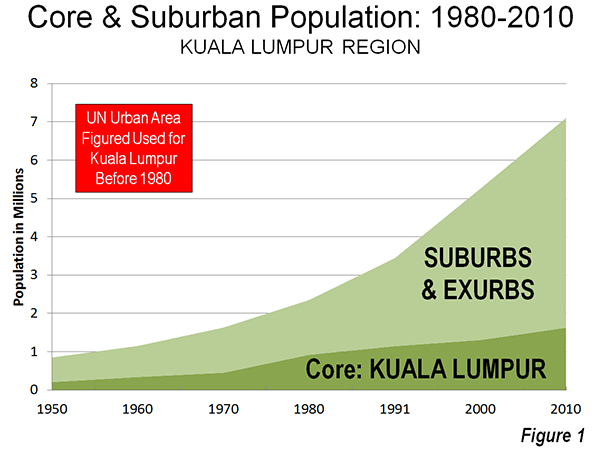
    The Kuala Lumpur region had a population of approximately 7.1 million, according to the 2010 census. This includes 1.6 million in the federal territory (core city) of Kuala Lumpur and 5.5 million in the suburbs (which include Putrajaya). The region has experienced strong growth since modern Malaysia evolved between 1957 and 1963. In 1950, the region had only 900,000 residents. By 1980, the population had more than doubled to nearly 2.4 million and by 2010, the population had tripled from its 1980 level.

    Unlike many urban cores, the city of Kuala Lumpur continues to experience strong population growth. Since 1980 (the first census after the creation of the new territory), the city has experienced a population increase of 77 percent.

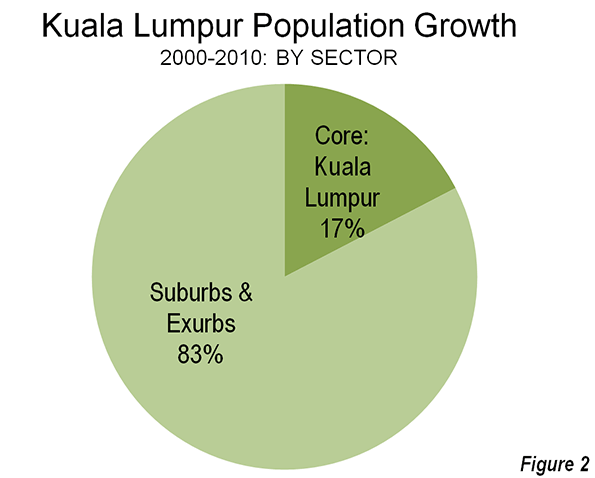
    Yet, the suburbs and exurbs (Note 1) have grown far more rapidly. The suburbs and exurbs have grown 280 percent and have added nearly six times the population increase of the city (Figure 1).  This general distribution of growth continued over the past decade, with the suburbs attracting 83 percent of the new population, while the city of Kuala Lumpur received 17 percent of the growth (Figure 2).


    The region continues to grow faster than the nation and at the current growth rate, the Kuala Lumpur region could approach a population of 10 million by 2025.

    The Urban Area

    The Kuala Lumpur urban area (area of continuous urban development) has an estimated population of 6.6 million (2013). Kuala Lumpur ranks as the 49th largest urban area in the world (Note 2). The urban area covers an estimated 750 square miles (1,940 square kilometers), ranking it 42nd largest in the world. The population density is 8,800 per square mile (3,400 per square kilometer). Among the 70 world urban areas with more than 5,000,000 population, Kuala Lumpur ranks 56th in population density, with approximately the same density as Western European urban areas in the same size classification (Figure 3).

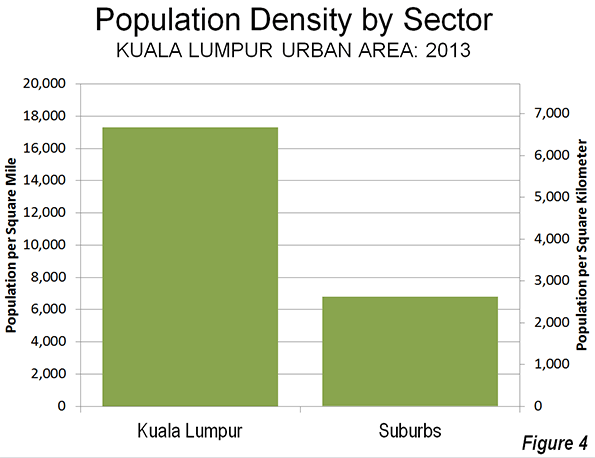
    The highest population densities are in the city of Kuala Lumpur, at 17,300 per square mile (6,700 per square kilometer), approximately the density of the city of San Francisco. The suburban areas have a population density of 6,800 per square mile (2,600 per square kilometer), approximately five percent higher than the suburbs of Los Angeles (Figure 4).

    The Economy

    Kuala Lumpur is a prosperous region by developing world standards. Only high-income Singapore is more prosperous in Southeast Asia. According to the most recent Brookings Global Metro Monitor, Kuala Lumpur has gross domestic product per capita of $23,900 annually (based on purchasing power). This is higher than all metropolitan economies in Latin America other than Brasilia, Monterrey and Buenos Aires. If Kuala Lumpur were in China, it would rank in the top quarter of the richest per capita metropolitan economies (Note 3).

    The Setting

    The urban area stretches from the core of Kuala Lumpur more than 20 miles (32 kilometers) westward to Port Klang on the Strait of Malacca, with similar expanses to the north and south. The urban area stretches less than 10 miles into the Titiwangsa Mountains, which forms the central cordillera of the Malay Peninsula.

    Physical Description

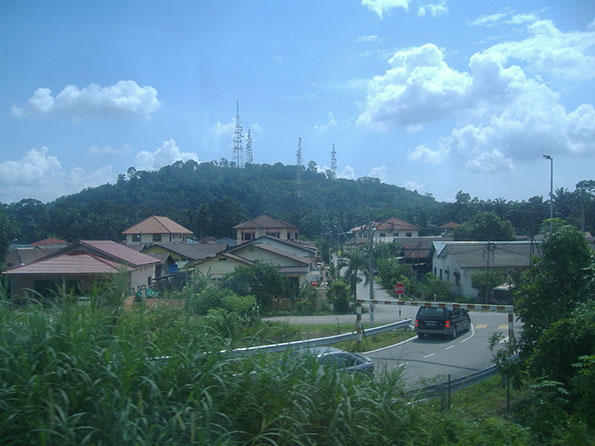
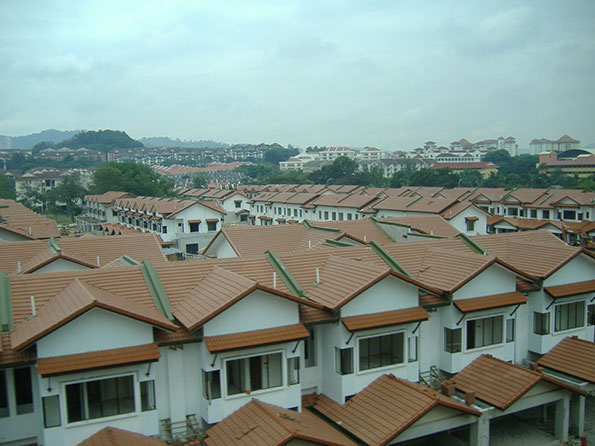
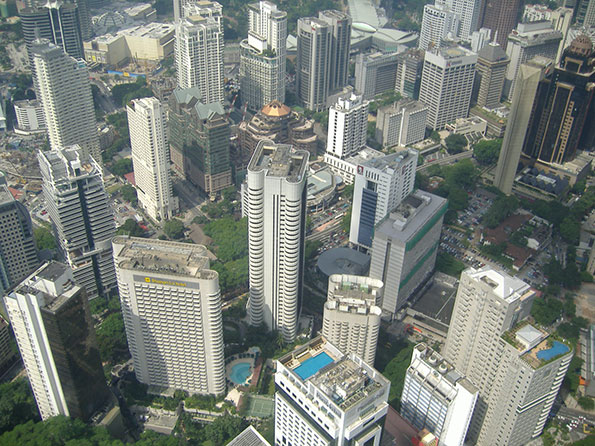
    The Kuala Lumpur urban area is located in a densely forested tropical region. The urban areas somewhat low density has permitted retention of substantial greenery. As a result, Kuala Lumpur appears to be among the "greenest" urban environments in East Asia, and for that matter, in the world. The greenery is especially evident in residential areas, where most housing is either detached or row house (Photos).


    Detached housing

    Row Houses

    However, the greenery also extends to the central business district (Photo: Kuala Lumpur’s Green Central Business District), where the largest buildings are much less densely packed than in most large world cities. Kuala Lumpur’s central business district is home to the Petronas Towers (Photograph above), twin towers that became the tallest buildings in the world upon completion in 1998, displacing Chicago’s Sear’s Tower (now Willis Tower). The title was lost to Taipei’s Tower 101 in 2004.


    Photo: Kuala Lumpur’s Green Central Business District

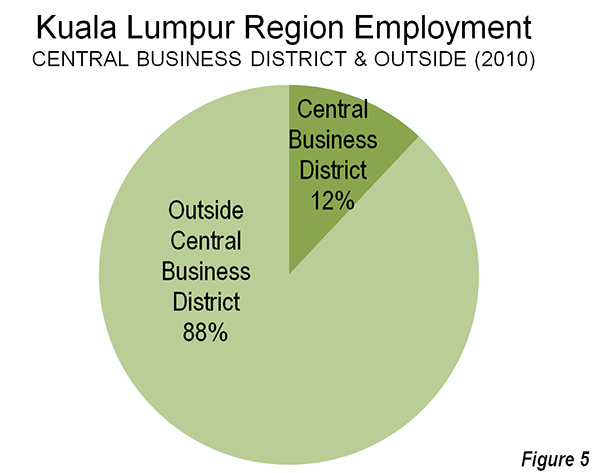
    Kuala Lumpur is not monocentric. The central business district accounts for only 12 percent of regional employment, a figure that is projected to decline (Figure 5). The central business district share is slightly more than the United States average (10 percent) and less than the Western European average (18 percent).

    Transport

    The Kuala Lumpur region principally relies on personal mobility (cars and motorcycles) for its transportation. As late as 1985, 35 percent of travel in the Kuala Lumpur was by mass transit. By 2010, this had fallen to between 10 and 12 percent. This is after opening three metro lines, a monorail and three commuter rail lines, with the metro and monorail lines having opened since 1995. Kuala Lumpur’s mass transit market share is more reflective of a high-income nation region than a middle income nation, comparable to Sydney, Toronto or New York and one-third below that of Western Europe. However, Kuala Lumpur is much more transit dependent than most US metropolitan areas, at five to 10 times that of Los Angeles, Portland, Seattle, Dallas-Fort Worth and Phoenix.

    The Kuala Lumpur region is served by an extensive network of expressways. One segment includes the "SMART" tunnel, which is a 6 mile (10 kilometer) long tunnel that serves both vehicles and storm water. While the tunnel has levels dedicated to both vehicles and storm water, the entire tunnel can be converted to storm water usage when there is serious flooding.

    Prospects

    Kuala Lumpur seems well positioned for the future. As the urban area has expanded in population and land area, its populace has achieved a level of affluence toward which much of the world strives.

    Wendell Cox is a Visiting Professor, Conservatoire National des Arts et Metiers, Paris and the author of “War on the Dream: How Anti-Sprawl Policy Threatens the Quality of Life.”

    ——————

    Note 1: See "Definition of Terms used in The Evolving Urban Form"

    Note 2: The comprehensive Demographia World Urban Areas is published at least annually, with the next (9th) annual edition due in the Spring of 2013.

    Note 3: The ranking for Chinese metropolitan areas is adjusted, using the population figures from the 2010 census (which included the urban migrant population). The issue is described in Endnote 19 in the Brookings Global Metro Monitor.

    ——————-

    Photograph: Petronas Towers (all photos by author)

  • Demography as Destiny: The Vital American Family

    Recent reports of America’s sagging birthrate ‑ the lowest since the 1920s, by some measures ‑ have sparked a much-needed debate about the future of the American family. Unfortunately, this discussion, like so much else in our society, is devolving into yet another political squabble between conservatives and progressives.

    Conservatives, including the Weekly Standard’s Jonathan Last, regularly cite declining birth and marriage rates as one result of expanding government ‑ and a threat to the right’s political survival. Progressives, meanwhile, have labeled attempts to commend a committed couple with children as inherently prejudicial and needlessly judgmental.

    Yet family size is far more than just another political wedge issue. It is an existential one – essentially determining whether a society wants to replace itself or fall into oblivion, as my colleagues and I recently demonstrated in a report done in conjunction with Singapore’s Civil Service College. No nation has thrived when its birthrate falls below replacement level and stays there – the very level the United States are at now. Examples from history extend from the late Roman Empire to Venice and the Netherlands in the last millennium.

    Falling birthrates and declining family formation clearly effect national economies. One major United States’  advantage has long been high birthrates, akin to a developing nation’s, as well as a vibrant family-oriented culture. This was largely because of immigrants and their children, striving first- and second-generation Americans. The United States, according to the U.S. Census Bureau, is expected to have a roughly 40 percent growth in its workforce in the first half of this century, largely thanks to immigration.

    In contrast, the Census Bureau predicts that leading U.S. competitors, notably Japan, Europe and South Korea, will likely suffer a decline of 25 percent or more over that time. Even China, whose birthrate has dropped precipitously under its one-child policy and rapid urbanization, is expected to see a sharp drop in its labor force over the next decade.

    Perhaps the greatest threat from collapsing fertility is the aging of society. Consider “the dependency ratio,” which measures the number of people in the workforce compared to retirees, in effect, how many working people are needed to support those over age 65. In 1960, before the decline in birthrates, that ratio was 9 percent in the 23 most developed countries. Today, it is 16 percent across these advanced countries. By 2030 it could reach as high as 25 percent.

    Countries with the longest history of declines in fertility face the biggest fiscal crises. By 2050, for example, Germany and Singapore  are predicted to have roughly 57 people above age 65 for every 100 workers. In the United States, this ratio will rise by 50 percent, to roughly 35 per 100 workers, even if the current decline is eventually reversed.

    If birthrates continue to decline, Western nations may devolve into impoverished and enervated nursing homes. And without strong families, children are likely to be more troubled and less productive as adults.

    You don’t need a crystal ball to see what this future could look like. Consider Japan. By 2050, there are expected to be three people above age 65 for every person in Japan under 15. In fact, more people are expected to be over 80 than under 15.

    This demographic shift signals a kind of death sentence for that once thriving, but now declining, nation. Not only are Japanese couples having far fewer children, sociologist Mike Toyota notes, roughly one-third of Japanese women in their 30s are not getting married ‑ which, in that conservative society, essentially means they are unlikely to have children. Even teenagers, according to a recent government-commissioned study by the Family Planning Association, seem oddly indifferent to dating and sex.

    Given the stakes, Americans must forgo political squabbles and focus on practical ways to remove barriers to marriage and child-rearing. One crucial component for strong birthrates is steady economic growth. Before the 2008 economic collapse, the U.S. fertility rate  was 2.12, the highest in 40 years. But the tumultuous economic problems since then have helped drive the fertility rate to 1.9 per woman, the lowest since the economic malaise era under President Jimmy Carter in the late 1970s.

    Even amid increasing awareness of the country’s demographic problems, however, political extremes focus on their own ideological spin. Conservatives set their arguments in neo-traditionalist terms, embracing right-wing tropes against gay marriage and abortion while blaming expansive government and rampant individualism. Others on the extreme right link declining fertility rates, particularly among Caucasians, to what Pat Buchanan calls “the end of white America.”

    Yet conservatives must recognize that fertility is not just a white or high-income Asian issue. Fertility and even marriage rates are, for example, declining throughout much of the Muslim Middle East, in some cases below our own levels, as my colleague Ali Modarres has shown.

    Nor is “white America” likely to be demographically overwhelmed by the current dramatic influx of Latino immigrants, particularly Mexicans, as many on the far right insist. Within a generation, Mexican-Americans immigrants’ fertility rates decline to that of native-born U.S. citizens. In fact, as Mexico modernizes, its fertility rates are falling to U.S. levels.

    Conservatives also seem to have a hard time admitting that one major culprit ‑ particularly in the United States and East Asian countries such as Singapore ‑ is modern capitalism. Young workers building their careers can face consuming demands for long work hours and substantial amounts of travel. Many confront a choice between a career and family.

    “In Singapore,” Austrian demographer Wolfgang Lutz observes, “women work an average of 53 hours a week. Of course they are not going to have children. They don’t have time.”

    For hard-pressed low-wage workers, raising children can be even harder. Indeed, much of the decline in child-rearing in the U.S. can be traced to a fall-off among immigrants, particularly Latinos, who fared particularly poorly in the long recession.

    On the other side, many Democrats praise the rise of “singlism” ‑ demonstrated by  the women in their 40s who never had offspring. This cohort has more than doubled since 1976. Pollsters like Stan Greenberg hail single women as “the largest progressive voting bloc in the country,” and Ruy Texeira, a leading political scientist, asserts that singletons are critical to the “emerging Democratic majority.”

    Progressives also embrace urban density ‑ a residential pattern that discourages child-rearing. Unlike the wave of immigrants or rural migrants who flooded the American metropolises of the early 20th century, urbanites today are not raising large families in cramped spaces. Instead, in virtually all high-income societies, high density today almost always translates into low marriage rates and fertility rates.

    The causes of this radical change are diverse. But crucial reasons include decline of extended family support networks; erosion of traditional, often religiously based values; and a culture that celebrates individualism.

    We no longer see family-centered urban neighborhoods like those depicted in the Chicago of Saul Bellow’s novel The Adventures of Augie March. Instead, many urban centers today are among the most “child free” ‑ whether in Manhattan, San Francisco, inner London or Paris, Singapore, Hong Kong or Tokyo.

    In contrast, America’s nurseries are in the suburbs, exurbs and lower-density greater-metropolitan areas. The metropolitan regions of Atlanta, Dallas-Fort Worth, Houston and Salt Lake City have above-average numbers of children. The percentage of children, according to the census, under age 15 in these cities is almost twice that of Manhattan or San Francisco.

    Many progressives don’t seem to care much if the birthrate falls. Some green activists seem to actually prefer it –  perhaps viewing offspring, particularly in wealthy countries, as unwanted carbon emitters. They seem to have taken up the century-old Malthusian concerns about overpopulation and environmental ruin. “A whole lot of people don’t have kids BECAUSE they’re worried about the future,” explains one critic of our report, suggesting that concern for the environment may justify the decision not to have children.

    Before signing on to a low-fertility agenda, American progressives as well as conservatives might want to consider the long-term consequences. The long fertility-rate declines in Europe and Japan occurred as economic growth flagged. Diminishing expectations of the future, painfully evident in countries such as Spain, Italy and Greece, are now further depressing marriage and childbirth.

    As to the culture wars between religious social conservatives and progressives, let’s declare a truce. Spiritual values and traditional families are precious resources to be nurtured. Mormons, evangelicals, practicing Catholics and highly self-identified Jews, all of whom largely favor big families, help make up for the almost certain continued expansion of single, and often childless, people.

    Social conservatives also need to champion more than the narrowly defined “natural family.” Many children, whether because of divorce or diverse family circumstances, must look to someone other than their birth parents for nurturing. Adoptive parents, grandmothers, uncles or aunts or other sorts of extended-family units also need to be cherished as committed caregivers.

    Popular TV shows like Modern Family show the wide range of family types today. The crucial element is that family obligation often extends well beyond “likes” and ties exist over generations. This can be true for gay couples or “blended families” in a way that can rarely be said of people who are dating, or friends, both of the real and Facebook variety.

    Fortunately, the long-term prognosis is not all bad. Pew Research Center reports that the emerging millennial generation rank being good parents, owning a home and having a good marriage as their top three priorities. Generational chroniclers Morley Winograd and Mike Hais, in their book Millennial Momentum: How a New Generation is Remaking America, suggest that the younger generation is as family-oriented as their elders, albeit with a greater emphasis on shared responsibilities and more flexible gender roles.

    “No matter how many communes people invent,” the anthropologist Margaret Mead once remarked, “the family always creeps back.” Let’s hope she’s right, not only about the past but the future as well.

    Joel Kotkin is executive editor of NewGeography.com and is a distinguished presidential fellow in urban futures at Chapman University, and contributing editor to the City Journal in New York. He is author of The City: A Global History. His newest book is The Next Hundred Million: America in 2050, released in February, 2010.

    This piece originally appeared at Reuters.

    Baby photo by Bigstock.

  • Exodus to Suburbs Continues Through 2012

    The latest US Census Bureau migration data shows that people continue to move from principal cities (which include core cities) in metropolitan areas to what the Census Bureau characterizes as "suburbs" (Note). Between 2011 and 2012, a net 1.5 million people moved from principal cities to suburbs (principal cities lost 1.5 million people to the suburbs). The movement to the suburbs was pervasive. In each of the age categories, there was a net migration from the principal cities to the suburbs. There was also net migration to the "suburbs" in all categories of educational attainment.

    These data are in contrast to claims that people are moving from a suburbs to central cities. Virtually none of the migration data has shown any such movement. Moreover, the city population estimates produced for 2011 by the Census Bureau, which indicated stronger central city growth have been shown to be simply allocations of growth within counties, rather than genuine estimates of population increase.

    —-

    Note on Census Bureau "Suburbs:"

    The movement to the suburbs is undoubtedly understated in the Census Bureau estimates, because many jurisdictions included in the "principal city" classification are in fact suburbs. The Real State of Metropolitan America showed that virtually all population growth in principal cities was either in suburban jurisdictions classified as principal cities, or in cities with substantial expenses of post-World War II automobile oriented (or suburban) land-use patterns. The remaining core cities that are largely only urban core in land use accounted for only 2% of principal city growth from 2000 to 2008.

    For a decade, the Census Bureau has used a "principal city" designation instead of the former "central city" term. All former "central cities" are "principal cities." The Census Bureau characterizes all other areas of metropolitan areas as "suburbs." In fact, many of the principal cities are functionally suburbs, having barely existed or not existed at all at the beginning of the great automobile oriented suburban exodus following World War II.

    Examples of such suburban principal cities, with their metropolitan areas in parentheses, are Hoffman Estates (Chicago), Arlington (Dallas-Fort Worth), Aurora (Denver), Fountain Valley (Los Angeles), Eden Prairie (Minneapolis-St. Paul), Mesa (Phoenix), Hillsboro (Portland), San Marcos (San Diego), Pleasanton (San Francisco), Kent (Seattle), Virginia Beach (Virginia Beach-Norfolk) and many others.

  • What Stifles Good Housing Development?

    We can’t afford outmoded attitudes in housing development anymore – not as businesses, not as citizens, and certainly not as development professionals. As development consultants, we’re often asked to provide detailed input on project design and the marketing of developments throughout the United States and Canada. We usually work with a local team of engineering consultants that provides construction drawings and serves as an intermediary for the project with local governments. We have concluded that the choice of selecting the engineering consultant is one of the pivotal issues for the success of a development. The developer has to be the one to hold the engineers accountable. Otherwise, all design will continue to be done to minimum standards instead of excellence.

    Problems with the consulting engineer generally fall into two broad groups: complacency and undisclosed conflicts of interest. To illustrate, we’ll look at two recent examples from projects owned by clients of Rick Harrison Site Design Studio.

    The first involves a small proposed neighborhood in Texas. The initial design was drafted before either the site boundaries or floodplain were accurately surveyed, and yielded a total of 35 lots of 0.6 acres or more. Rick prepared an initial revision of the original design, resulting in a more aesthetically pleasing and efficient neighborhood, while maintaining the 0.6 acre minimum lot size. Accurate boundary lines, contours and floodplain were eventually furnished to create a precision plat for submittal. The developer requested that Rick update the revised design, and indicated that he was willing to sacrifice one of the lots in order to allow a more spacious entrance.

    While preparing the precision plat Rick realized that he didn’t know why the lots were at least 0.6 acres instead of the more common 0.5 acres on lots without city sewer. In two rounds of questioning, the consulting engineer indicated that the minimum lot size was 0.6 acres, or 26,000 ft². The area of 6/10th of an acre is actually 26,136 ft², so Rick questioned the engineer again. This time, the engineer explained that the minimum lot size was actually 0.5 acres, but his firm had developed a “rule of thumb” that 26,000 ft² was the 0.5 acre lot net of easement areas. However, in the specific case of this development the only easement required was a 12’-wide utility easement along the front lot line. The extra 0.1 acres per lot was a “fudge factor,” developed over time to compensate for the well-known difficulty in computing precise lot sizing using existing CAD software.

    The “land surface based” technology Rick used to create the revised design requires no additional time to obtain precision areas, so he was able to easily design each lot to meet the actual 21,780 ft² (half acre) minimum exclusive of the 12’ easement. The new design eliminated the fudge factor, and yielded 37 lots, including the more open entrance area (three more than expected). Furthermore, reductions were made to the length of street..

    “Fudge factors” are rules of thumb intended to make the engineer’s work easier, and to provide enough margin in the plans to account for omissions or miscalculations. The problem with fudge factors is that they adversely impact the profitability of their clients’ projects. The chart below demonstrates the differences:


    Initial Plan

    Revised Plan

    Difference

    Lot size

    0.6 acres (minimum)

    0.5 acres

    At least 4,356 ft.² per lot

    Number of lots

    34

    37

    3

    Lot value

    $75,000

    $75,000


    Gross sales

    $2,550,000

    $2,775,000

    $225,000

    Pavement area

    89,479 ft²

    81,509 ft²

    7,970 ft²

    Estimated cost

    $447,400

    $407,550

    $39,850

    Eliminating an imprecise fudge factor would yield a $225,000 increase in gross sales. Since the only increase in costs were per lot consulting fees, almost all of the gross revenue would drop straight to the bottom line. In addition, the community would benefit from a more attractive neighborhood with substantially less street pavement maintained in perpetuity, and a higher property tax base. If the developer was unwilling to sacrifice profits, the cost of each lot would have had to increase by $6,600 to the consumer.

    The second example concerns another proposed residential development, this one in North Dakota, in a city prone to severe flooding. As most people know, paved areas do not absorb rainfall, so it would seem logical that the more pavement area in a new development here, the bigger the potential for runoff, which leads to more flooding. In addition, the wider the streets, the more surface area the city has to snowplow and maintain. All these issues – the snowplowing, the road maintenance and the increased water runoff – are burdens to current and future taxpayers, with no discernible benefits to offset the burden. So imagine Rick’s surprise when the consulting engineer refused to even submit a plan for 50-foot-wide rights-of-way with 28-foot-wide street sections, instead of the 66-foot-wide rights-of-way with 37-foot-wide street sections, as specified by existing city regulations.

    To understand the issue, look at the origin of the standard street width requirement. Centuries ago, roads were unpaved, and were built with wide ditches to handle drainage alongside them. The 66 foot length reflected a land surveyor’s chain, developed in the year 1620 by a British clergyman interested in developing a system that would use easily available tools to survey land in the British countryside. His system caught on, and was brought to the New World by British immigrants and used for hundreds of years. Perhaps as recently as 100 years ago it made sense to use a single surveyors’ chain as the width of community streets, and so many towns did so. Today, most cities have eliminated drainage ditches in modern subdivisions, replacing them with storm sewers and more efficient design. These changes have allowed narrower street and pavement widths, with positive cost and environmental impacts.

    So — the minimum street right-of-way in this modern North Dakota city is the result of a decision to make roads 66 feet wide, due to the fact that 400 years ago an English clergyman connected a hundred links that were 6 1/2 inch long to make a convenient, 66 foot long “chain”. To our knowledge, there is no other reason.

    Given that surrounding cities have adopted modern standards, and that the logic behind narrower streets is solid, Rick could have presented a compelling case. But the engineer refused to even make the proposal. Why not propose a common sense solution? Complacency? Perhaps. The desire to comply with every regulation to avoid conflict? More likely. Are the engineers fees based upon the percentage of construction cost, with wider streets guaranteeing higher fees? Also likely.

    Unsustainable? Absolutely.

    In the first example, outmoded rules of thumb related to inadequate CAD technology would have cost Rick’s client at least $250,000, and would have burdened the local county government with a significantly diminished potential property tax base. In the second example, the engineer’s lack of concern for the long-term benefit of his client (with whom he has a contractual or fiduciary relationship), and to the public (to whom he has a professional responsibility), has burdened the community with exaggerated flooding problems and approximately 33% more pavement to be snow plowed and maintained for as long as the community exists.

    We can’t keep fudging to hide poor practices. If we are ever to achieve a more sustainable world and create better communities and housing products, we simply cannot accept mediocre design, technology and attitude.

    Rick Harrison is President of Rick Harrison Site Design Studio and Neighborhood Innovations, LLC. He is author of Prefurbia: Reinventing The Suburbs From Disdainable To Sustainable and creator of Performance Planning System. His websites are rhsdplanning.com and pps-vr.com. Skip Preble, MAI, CCIM is a real estate analyst and land development consultant specializing in market analysis, feasibility studies, project value optimization and market value opinions. He can be reached through his website, landanlytics.com.

    Flickr Photo by Billy Hunt: “This is from my photo essay observing the course of development in Charlottesville, Virginia“.

  • The Evolving Urban Form: Addis Abeba

    Addis Abeba is the capital of Ethiopia and calls itself the "diplomatic capital" of Africa, by virtue of the fact that the African Union is located here. Yet Ethiopia is still one of the most rural nations in both Africa and the world. Ethiopia also appears to be among the most tolerant. Various forms of Christianity claim account for approximately 65 percent of the population, with the Ethiopian Orthodox Church (Coptic) holding the dominant share. At the same time there is a sizable Muslim minority, at more than 30 percent of the population. Ethiopia has been spared the interfaith violence that has occurred in some other countries where there are large religious minorities.

    Growing Urban Area

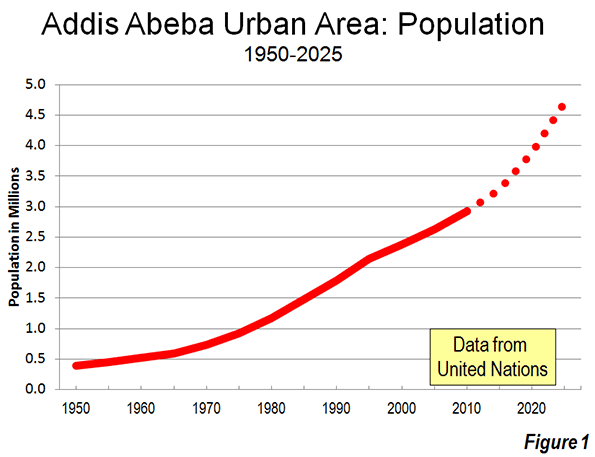
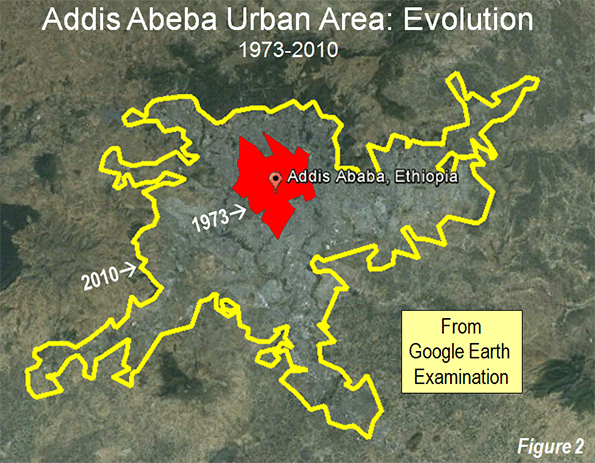
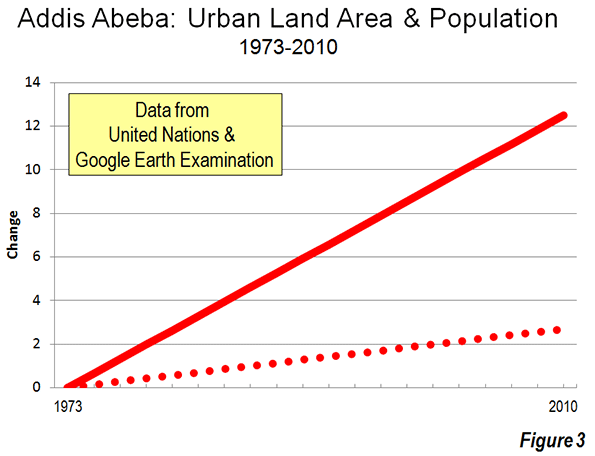
    Addis Abeba is among the fastest growing urban areas in the world. Since 1970, the population has increased by nearly three times (Figure 1). However, the spatial expansion of the urban area has been much greater. The earliest available Google Earth satellite photos (1973) indicate that the urban land area (continuous urban development) has expanded over 12 times. Thus, the urban spatial expansion has been at least four times that of the population over the since the early 1970s (Figures 2 and 3).

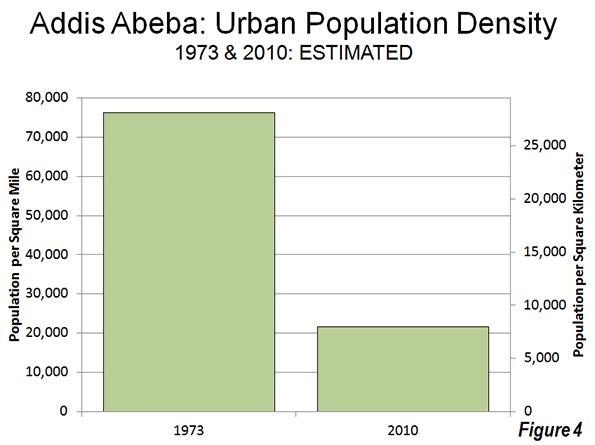
    Since 1973, the urban population density of Addis Abeba has declined almost three quarters, from approximately 75,000 per square mile or 29,000 per square kilometer to 20,000 per square mile or 8,000 per square kilometer. Addis Abeba represents yet another example of the counter-intuitive reality of growing urban areas simultaneously becoming less dense, because population growth occurs the generally less  dense periphery in an organic city. It is not unusual for urban analysts to (wrongly) assume the opposite.

    One of the results of the spatial expansion is a significantly better lifestyle for residents of Addis Abeba, consistent with the view of Professor Shlomo Angel, who decries attempts to constrain cities within artificial boundaries (compact city policies) because they can deny people both a adequate housing and a decent standard of living.

    The Economy

    Ethiopia is one of the poorest nations on earth, with a 2010 gross domestic product-purchasing power parity (GDP-PPP) per capita of just above $1,000. This places it 170th out of 183 geographical areas according to the International Monetary Fund. By comparison, the GDP-PPP of the United States was $47,000 and Singapore $57,000.

    Ethiopia’s low income reflects  Ethiopia’s relativey low rate of urbanization. With 17 percent of the population in rural areas (outside urban areas), urbanization is concentrated in Addis Abeba (3.1 million), which is the only urban area in the nation with more than 300,000 population. Ethiopia can expect to experience a strong rate of urbanization in the decades to come, as people flock to the cities to seek better standards of living. By 2030, the total number of urban residents is projected by the United Nations to rise to 28.4 million from 13.9 million in 2010.

    Urbanization has its problems, but also economic advantages. The GDP-PPP in Addis Abeba, according to a Price-Waterhouse-Coopers estimate, is up to six times higher than that of the rest of the nation. Assuming that this ratio held to 2010, The GDP-PPP per capita of Addis Abeba would be $6,000 or more.

    Moreover, Price-Waterhouse-Coopers predicted that Addis Abeba would experience the 5th greatest economic growth to 2025, out of 151 urban areas. This would result in growth greater than that of Shanghai and Beijing. The four predicted to grow faster are the two large Viet Nam urban areas (Hanoi and Ho Chi Minh) and two in China (Guangzhou in the Pearl River Delta and Changchun in Manchuria).

    The Urban Core

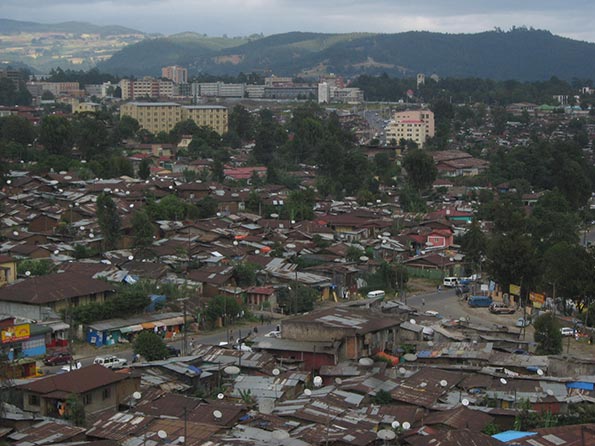
    As would be expected in a developing world urban area, there is a large urban core with mixture of government and private buildings, literally surrounded by lower income, principally informal housing. With this predominant informal housing, the population density of the urban core is by far the highest in Addis Abeba (See Photo: Informal Housing in the Urban Core: Parliament and Holy Trinity Dome in the Distance).


    Photo: Informal Housing in the Urban Core: Parliament and Holy Trinity Dome in Distance

    Major government offices and cultural facilities are in this area, such as the Parliament, the prime minister’s residence, museums, the residence of the primate of the Ethiopian Orthodox Church (Coptic), the most important cathedral, Holy Trinity, in which former Ethiopian leader Haile Selassie  is buried, as well as the Catholic Cathedral and the largest Mosques.

    The New Addis Abeba

    There’s been a huge expansion of the periphery around Addis Abeba. Extensive tours around the urban area provide evidence of relative prosperity. It appears that Addis Abeba is rebuilding itself around its urban core. There is major construction in three directions from the urban core.

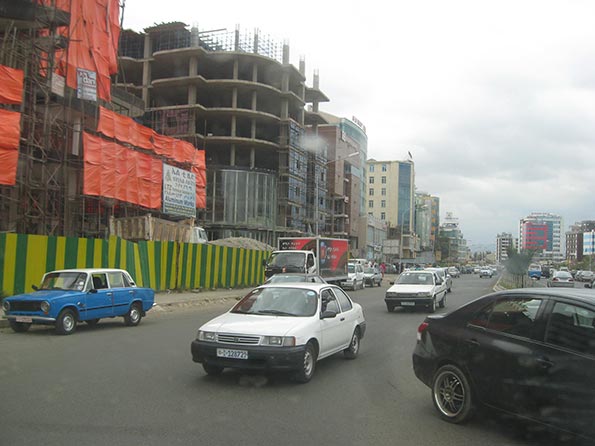
    The greatest activity is in the Bole District, which includes Bole International Airport, to the south of the urban core. There is a substantial amount of new commercial high-rise construction within a few kilometers to the north of the airport, along two major arterials and in between (Photo: Bole Corridor Development). There are also a large number of large, private condominium buildings. The Bole Corridor represents an edge city, in the sense defined by Joel Garreau in his seminal book Edge Cities  two decades ago. This is also the location of the largest Ethiopian Orthodox Church (see top photo) in the country.


    Photo: Bole Corridor Development

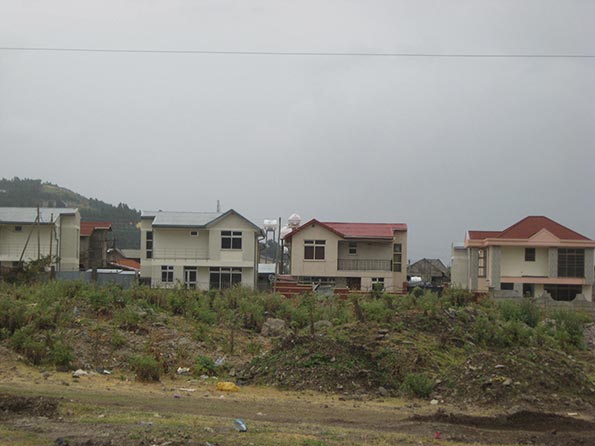
    An eastern corridor stretches for 6 miles/10 kilometers from what is locally called the "Chinese Road," a ring road built largely with the support of the Chinese government. There are many new commercial buildings, government buildings, public and private condominiums, and at the edges, large new detached houses (See photo: Detached Housing in the Eastern Corridor).


    Photo: Detached Housing in the Eastern Corridor

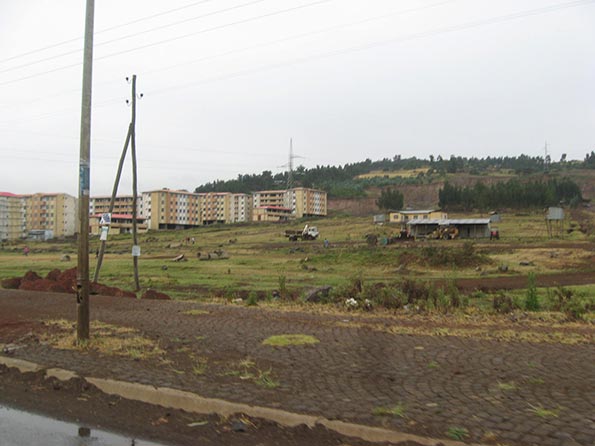
    To the west, principally, the southwest, is a new residential neighborhood composed principally of condominiums, generally up to five floors (Photo: Southwest Residential Area).


    Photo: Southwest Residential Area

    China in Africa

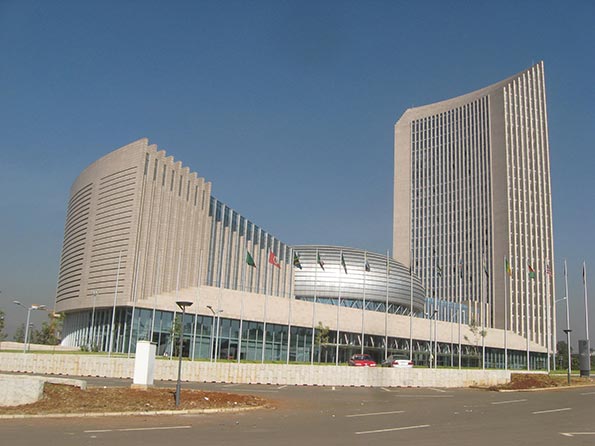
    Chinese financial assistance is not limited to the ring road. Much of the funding for the impressive new African Union headquarters (photo) was provided by the Chinese government. Further, a new light rail line will be largely financed by China. At the same time, the massive construction evident in the newer, outlying districts of Addis Abeba resemble (at least in a modest way) the urban development that has occurred in China over the past few decades.


    Photo: African Union Headquarters

    Conclusion

    The economic progress evident in Addis Abeba is encouraging. The government policies  are allowing the city to expand naturally as it grows, which facilitates  better lives for its citizens. It can only be hoped that the day will come that people in developing world urban areas, such as Addis Abeba, will enjoy the high standards of living that have been achieved in the developed world.

    Photo: Holy of Holies, Bole Mehani Alem Church (Ethiopian Orthodox Churches all have a replica of the “Ark of the Covenant,” behind a screen, which is referred to as the “holy of holies”). According to the Ethiopian Coptic tradition, the Ark of the Covenant, which tradition indicates, contained the tablets on which the Ten Commandments were written. The Ark was maintained in the holy of holies in the Jewish temple. The Ethiopian tradition holds that the Ark was taken to Ethiopia and is now kept at a chapel at a church in Axum, which is 600 miles/1,000 kilometers north of Addis Abeba.

    Wendell Cox is a Visiting Professor, Conservatoire National des Arts et Metiers, Paris and the author of “War on the Dream: How Anti-Sprawl Policy Threatens the Quality of Life.”

  • The Suburbs Could Save President Obama From Defeat

    President Obama’s disdain for suburban America has been well-documented. Yet, ironically, the current revival in housing, largely in those same suburbs, might be the one thing that could rescue his floundering campaign. Unlike the Democrat-dominated central cities and the rock-red Republican countryside, the suburbs remain the country’s primary contestable territory.

    With manufacturing facing global headwinds and Wall Street stagnating, the housing recovery is helping keep the still weak economy moving forward. Housing starts are at the highest level in four and a half years. Sales and prices are on the rise, and the vast majority of the action — despite the media’s focus on multi-family developments — is taking place among single-family homes that predominate in the suburban rings of our metropolitan area. Over the past two years, 76% of the new privately owned housing units completed were single-family homes, according to Census Bureau figures. In existing home sales, last year over 4.3 million single-family homes were purchased, compared to 520,000 condos.

    This trend is being driven by such factors as rental costs, which rose with the recession, a decline in foreclosures, low interest rates and, particularly in some markets such as Phoenix, investors who see long-run demand in single-family markets. Demand has sparked a nascent revival of homebuilding, now at the highest level since the Great Recession, although still half its historic rate.

    The housing recovery could make a particularly important difference in the election in key swing state suburban communities on the outskirts of Cleveland, Detroit, Pittsburgh, Philadelphia and Denver, and in the northern Virginia suburbs of the capital. In these areas, homes — not stocks and other financial assets — are the primary measure of wealth, and the most critical weathervane of economic wellbeing. Single-family home sales also spur other sectors of the economy, such as financial services, construction and the home furnishing industries in ways far greater than denser developments. The good feelings about the auto recovery have helped the president in industrial states; similarly the improved housing market gives him a lift in these critical suburban areas.

    Some Clinton-era Democrats, like former U.S. Deputy Treasury Secretary Robert Altman, recognize that expanding housing markets makes for stronger, broader-based economic growth. This is why historically Democrats favored single-family housing, from Roosevelt and Truman to Bill Clinton. Altman predicts a full-scale housing boom by 2015; if he’s right, and Democrats are in power, and on board, this could propel their ascendency for another generation.

    Of course from an ideological point of view, this emerging boom may not be much welcomed in the current administration. Most Obama backers in places like the Department of Housing and Urban Development, including Secretary Shaun Donovan, have long predicted that suburbs are entering their death throes, predicting a massive movement of people from the suburbs to inner city areas. Where possible, HUD has tried to encourage “smart growth” by providing grants for projects aimed at greater densification.

    Yet these widely lauded efforts are swimming against the fundamentals of market demand, and at a cost to both the budget and longer-run economic growth. Despite misleading press reports, inspired in part by Census Bureau epistles focusing on increasing downtown populations, the vast majority of population growth has continued to take place far away from the urban core.

    Indeed over the last decade, while some downtowns have grown, they accounted for 1.3% of the overall population increase in the country’s largest metropolitan areas. At the same time, areas two to five miles from the central cores lost population while areas beyond 10 miles out grew by more than 20% and accounted for more than 60% of growth. Overall Americans have continued to vote with their feet for suburbs — overwhelmingly.

    Some urbanists, including some close to the current administration, claim that the realities of the last decade are now passé, a permanent victim of the housing bust. Yet in reality these claims appear largely off the mark. Recent Census estimates for last year, for example, were widely reported to show greater growth in core cities than suburbs, but turned out to be based on unsupported assumptions that all county growth occurred equally across geographies, making it impossible to judge the widespread claims of a massive movement “back to the cities.”

    At the same time, a new analysis by Trulia.com chief economist Jed Kolko, based on postal data, shows that growth rates were about the same. But in an attempt to discover actual preferences, Kolko then analyzed the growth rates by densities. Much of the “urban” growth, particularly in Sunbelt cities like Phoenix and throughout the Midwest, actually takes place in largely suburbanized, relatively low-density areas.

    Kolko found that the populations of “more suburban” neighborhoods grew 0.73% in the past year, more than twice as fast as the “more urban” neighborhoods, where growth was 0.35%. In fact, urban neighborhoods grew faster than suburban neighborhoods in only five of the 50 largest metro areas — Memphis, New York, Chicago, San Jose and Pittsburgh — and often by a really small margin. In the other 45 large metros, the suburbs grew faster than the more urban neighborhoods. Overall, Kolko concludes, household growth in most metropolitan areas was greatest the further from the core, and less closer to it.

    The movement of people into lower-density areas jibes with one of the biggest reasons for the current nascent housing recovery: the preference by roughly four in five Americans for a single-family house — usually but not always found in the suburbs — over an urban apartment. In a sense, then, the hostility to suburbs among the administration and the Democratic Party is both profoundly anti-democratic and anti-growth.

    Recovering housing prices provide a lifeline for our beleaguered middle class. A recovery provides greater employment to the very people — construction workers, manufacturers of home furnishings and real estate agents — who were among the biggest victims of the Great Recession. Some progressives might celebrate the diminishment of such jobs and prefer they now service the post-industrial uberclass, but it’s hard to see how a large part of our middle and working classes can maintain, much less ascend, without a strong housing sector.

    Signs of recovery, of course, extend beyond housing. Even malls, also long suffering, and under digital assault, are beginning to recover. Meanwhile rental apartments, once the darling of the speculative class, have begun to lose their momentum, in part due to improving home affordability. Massive overbuilding in some markets could lead to a new gusher of real estate tears. Something is happening here.

    Contrary to conventional wisdom, if the economy strengthens, the suburban and single-family market will do likewise in the years to come. First-time homebuyers will provide a strong source of demand for an increasingly scarce product. Rather than rejecting the ideal of owning a home, 84% of today’s renters still intend eventually to purchase their residence, according to a recent study by TD Bank.

    Homeownership and the white picket fence might be out of fashion among the cognoscenti, but not among new Asian immigrants, who are heading to the suburbs, or the rising number of 30-somethings, three quarters of whom, according to a recent Better Homes and Gardens survey, see homeownership as a “key indicator of success.”

    Although still in its early phases, President Obama would be wise to use the suburban housing recovery to help portray himself as the savior of the middle class. The most notable gains made by Romney in the polls recently have been in the suburbs. It may be too late for the president to make better strategic use of the incipient recovery for this election, but if he is victorious and can swallow his anti-suburban mindset and embrace what most Americans regard as their preferred emblem of success, he could help consolidate a strong Democratic hold on the suburbs that could play a deciding role in our politics for the decades ahead.

  • Local Government in Ohio: More Accessible and More Efficient

    There is general agreement that smaller units of government are more responsive and accountable to their electorates. However, proponents of larger governments often claim that this advantage also creates   higher spending and tax levels. On this basis, bigger-is-better proponents often suggest consolidating local governments to save money. Such calls have increased in recent years, with the unprecedented fiscal difficulties faced by governments from the federal to local level. However, more often than not, nothing more underlies consolidation proposals more than an interest in reducing the number (count) of local governments. It is largely taken as an article of faith that larger governments save money relative to smaller governments.

    Ohio has had more than its share of local government consolidation proposals. The Ohio Township Association asked us to review local government financial performance in the state. We were able to confirm that Ohio’s smaller governments are, on the whole, more responsive and accountable. However, the analysis clearly showed that smaller local governments have materially better financial performance.

    We analyzed per capita financial measures for all reporting local general purpose governments in the state, using Auditor of State data (Note). Ohio has three types of general purpose governments. Cities are incorporated municipalities with 5,000 or more population in the last federal census. Villages are incorporated municipalities with less than 5,000 population. The balance of the state is made of townships, which have virtually the same powers as municipalities.

    The Efficiency of Smaller Local Government

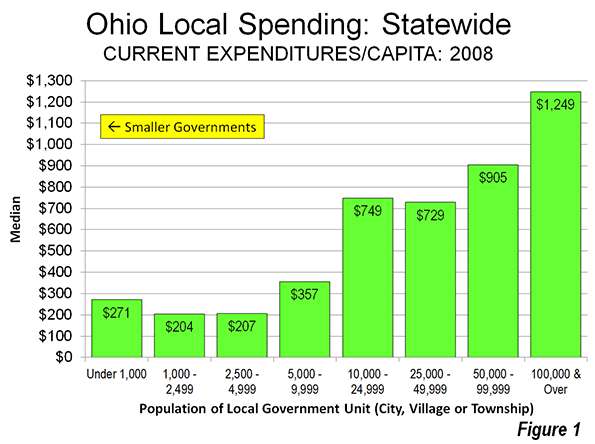
    The data indicates that smaller units of local government have median spending per capita that is less than larger local governments. Local governments with more than 10,000 population spent an average of at least twice that of smaller governments. The lowest per capita spending was in local governments with between 1,000 and 4,999 population (Figure 1).

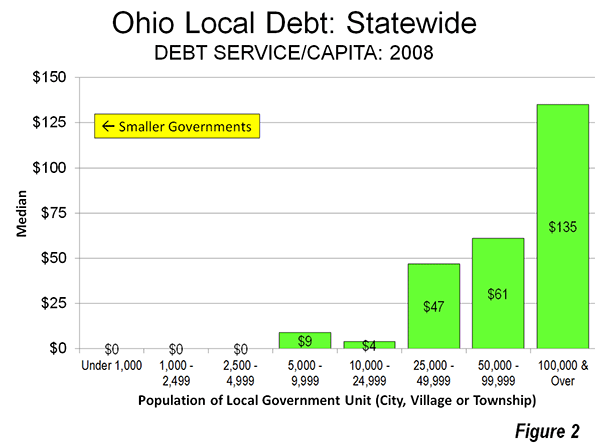
    The smaller government advantage extended to debt. The median debt service per capita for local governments with fewer than 5,000 population was zero, while the median debt service per capita for local governments with 10,000 to 25,000 population was under $10 annually (Figure 2).

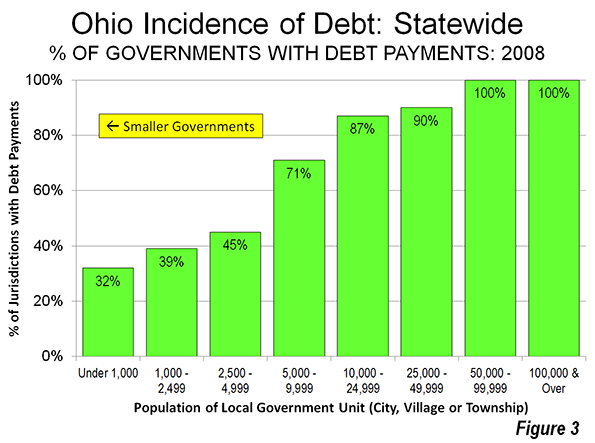
    The incidence of debt was also less among smaller local governments. Fewer than one-half of the local governments under 5,000 population had any debt. In contrast, all of the local governments with 50,000 or more population had debt (Figure 3).

    Smaller Governments Excel in Metropolitan Areas

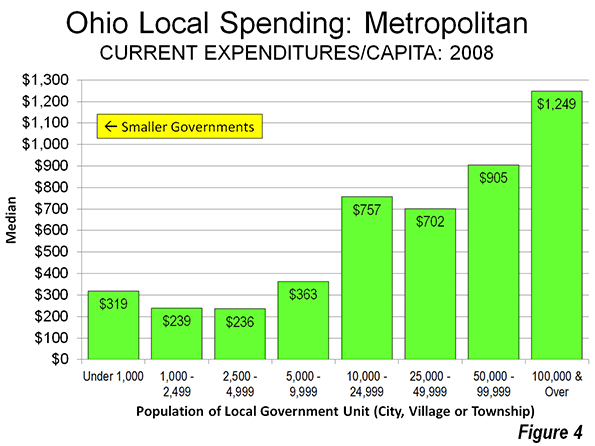
    It might be thought that this smaller-is-better relationship stems from the more rural setting of some smaller local governments. However, an analysis of local government spending and debt per capita within metropolitan areas indicates the same conclusion:  smaller governments spend less and borrow less per capita (Figure 4).

    Townships: Even Less Costly

    Townships have been a particular target of "bigger-is-better" consolidation proposals, perhaps because of their smaller average population. Yet, despite their much larger average service areas (in square miles), townships represent a far smaller share of local government spending than their population share. Townships account for 11 percent of local general purpose government spending (excluding counties), yet have 35 percent of the state’s population.

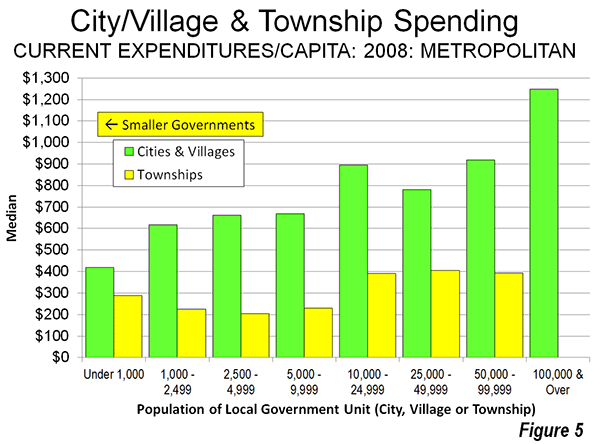
    Townships have lower current expenditures per capita than villages and cities in all but one population category. In metropolitan areas, townships spend less per capita in all population categories (Figure 5). In addition, townships have lower per capita debt service payments than cities and villages
    The lower per capita spending of townships is attributable, at least in part, to lower administrative costs and lower labor costs per capita. Further, as with smaller municipalities, taxpayers often do not often demand the same level of service that is provided in the larger cities.

    Small Government: Less Likely to Enter Fiscal Distress

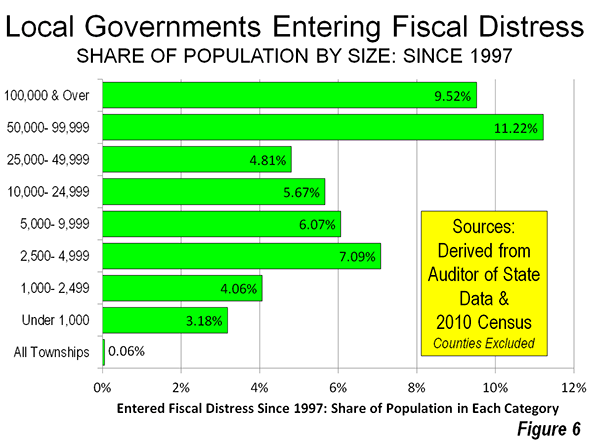
    Smaller local governments have experienced financial distress less. After the city of Cleveland bankruptcy in the 1970s, the state established the Local Government Fiscal Distress, which identifies local governments in serious distress and aids them in returning to normal fiscal health. The smallest cities and villages entered the Fiscal Distress program at a rate less than one-half that of the largest governments. The townships did even better. Only two of the state’s more than 1,300 townships were placed in the Local Government Distress Program (Figure 6).

    Why Larger Local Governments are Less Efficient

    One of the reasons that larger governments spend and borrow more is that they are less accessible to taxpayers and more accessible to interests which benefit from higher spending. This can lead to a vicious cycle that drives taxes so high that governments borrow more, followed by proposals to consolidate when the borrowing capacity becomes more constrained. Further, the very size of some larger governments can make them "too big to fail," like large financial institutions in the Great Financial Crisis. This can lead to "bailouts" by state taxpayers. Ohio’s Local Government Distress Program is an attempt to avoid these difficulties, by providing technical assistance and guidance.

    Smaller governments that consolidate face two critical challenges likely to increase costs. The first is that labor costs tend to be "leveled up" to the compensation levels in the higher cost jurisdiction. The other problem is that services and service levels also tend to be "leveled up."

    Proponents of consolidation sometimes assume that a large number of governments results in duplication of services. However, each of the local governments have exclusive service areas. For example, garbage is not collected by multiple jurisdictions to the same addresses. Smaller jurisdictions also tend to employ more part time staff, and even volunteers, especially in fire departments. Another advantage of smaller governments is that their elected officials are able to more directly manage the business of a smaller jurisdiction, because they do not have to rely more on intermediate staff.

    The performance of Ohio’s smaller governments shows that there is no need to choose between accessible government and efficient government. Ohio’s smaller local governments deliver both.

    Wendell Cox is a Visiting Professor, Conservatoire National des Arts et Metiers, Paris and the author of “War on the Dream: How Anti-Sprawl Policy Threatens the Quality of Life.”

    —–

    Note: These do not include counties, school districts or special districts.

    Illustration: Great Seal of the State of Ohio (from http://www.netstate.com/states/symb/seals/images/seal_ohio2.jpg)

  • The Rise of the Great Plains: Regional Opportunity in the 21st Century

    This is the introduction to a new report on the future of the American Great Plains released today by Texas Tech University (TTU). The report was authored by Joel Kotkin; Delore Zimmerman, Mark Schill, and Matthew Leiphon of Praxis Strategy Group; and Kevin Mulligan of TTU. Visit TTU’s page to download the full report, read the online version, or to check out the interactive online atlas of the region containing economic, demographic, and geographic data.

    For much of the past century, the vast expanse known as the Great Plains has been largely written off as a bit player on the American stage. As the nation has urbanized, and turned increasingly into a service and technology-based economy, the semi-arid area between the Mississippi Valley and the Rockies has been described as little more than a mistaken misadventure best left undone.

    Much of the media portray the Great Plains as a desiccated, lost world of emptying towns, meth labs, and Native Americans about to reclaim a place best left to the forces of nature. “Much of North Dakota has a ghostly feel to it," wrote Tim Egan in the New York Times in 2006. This picture of the region has been a consistent theme in media coverage for much of the past few decades.

    In a call for a reversal of national policy that had for two centuries promoted growth, two New Jersey academics, Frank J. Popper and Deborah Popper, proposed that Washington accelerate the depopulation of the Plains and create “the ultimate national park.” They suggested the government return the land and communities to a “buffalo commons,” claiming that development of The Plains constitutes, “the largest, longest-running agricultural and environmental miscalculation in American history.” They predicted the region will “become almost totally depopulated.”

    Our research shows that the Great Plains, far from dying, is in the midst of a historic recovery. While the area we have studied encompasses portions of thirteen states, our focus here is on ten core locations: North Dakota, South Dakota, Nebraska, Kansas, Oklahoma, Texas, New Mexico, Colorado, Wyoming, and Montana.

    Rather than decline, over the past decade the area has surpassed the national norms in everything from population increase to income and job growth. After generations of net out-migration, the entire region now enjoys a net in-migration from other states, as well as increased immigration from around the world. Remarkably, for an area long suffering from aging, the bulk of this new migration consists largely of younger families and their offspring.

    No less striking has been a rapid improvement in the region’s economy. Paced by strong growth in agriculture, manufacturing and energy — as well as a growing tech sector — the Great Plains now boasts the lowest unemployment rate of any region. North Dakota, South Dakota and Nebraska are the only states with a jobless rate of around 4 percent; Kansas, Montana, Oklahoma and Texas all have unemployment rates below the national average.

    A map of areas with the most rapid job growth over the past decade and through the Great Recession would show a swath of prosperity extending across the high plains of Texas to the Canada/North Dakota border. Rises in wage income during the past ten years follow a similar pattern. The Plains now boasts some of the healthiest economies in terms of job growth and unemployment on the North American continent.

    Of course, this tide of prosperity has not lifted all boats. Large areas have been left behind — rural small towns, deserted mining settlements, Native American reservations — and continue to suffer widespread poverty, low wages and, in many cases, demographic decline.

    In addition, the region faces formidable environmental and infrastructural challenges. Most prominent is the continuing issue of adequate water supplies, particularly in the southern plains. The large-scale increase in both farming and fossil fuel production, particularly the use of hydraulic fracking, could, if not approached carefully, exacerbate this situation in the not so distant future.

    Inadequate infrastructure, particularly air connections, still leaves much of the area distressingly cut off from the larger urban economy. The area’s industrial economy and rich resources are subject to a lack of sufficient road, rail and port connections to markets around the world. Yet despite these challenges, we believe that three critical factors will propel the region’s future.

    First, with its vast resources, the Great Plains is in an excellent position to take advantage of worldwide increases in demand for food, fiber and fuel. This growth is driven primarily by markets overseas, particularly in the developing countries of east and south Asia, and Latin America.

    As these countries have added hundreds of millions of middle class consumers, the price and value of commodities has continued to rise and seem likely to remain strong, with some short-term market corrections, over time.

    Second, the rapid evolution and adoption of new technologies has enhanced the development of resources, notably oil and gas previously considered impractical to tap. At the same time, the internet and advanced communications have reduced many of the traditional barriers — economic, cultural and social — that have cut off rural regions from the rest of country and the world.

    Third, and perhaps most important, are demographic changes. The late Soichiro Honda once noted that “more important than gold or diamonds are people.” The reversal of outmigration in the region suggests that it is once again becoming attractive to people with ambition and talent. This is particularly true of the region’s leading cities — Omaha, Oklahoma City, Tulsa, Kansas City, Sioux Falls, Greeley, Wichita, Lubbock, and Dallas-Fort Worth — many of which now enjoy positive net migration not only from their own hinterlands, but from leading metropolitan areas such as Los Angeles, the San Francisco Bay Area, New York and Chicago. Of the 40 metropolitan areas in the region, 32 show positive average net domestic migration since 2008.

    Together these factors — resources, information technology and changing demographics — augur well for the future of the Great Plains. Once forlorn and seemingly soon-to-be abandoned, the Great Plains enters the 21st century with a prairie wind at its back.

    Visit TTU’s page to download the full report, read the online version, or to check out the interactive online atlas of the region containing economic, demographic, and geographic data.

    Praxis Strategy Group is an economic research, analysis, and strategic planning firm. Joel Kotkin is executive editor of NewGeography.com and author of The Next Hundred Million: America in 2050. Kevin Mulligan is Associate Professor of Geography at Texas Tech University and Director of TTU’s Center for Geospatial Technology.