Category: Suburbs

  • The Republican Party’s Fatal Attraction To Rural America

    Rick Santorum’s big wins in Alabama and Mississippi place the Republican Party in ever greater danger of becoming hostage to what has become its predominate geographic base: rural and small town America. This base, not so much conservatives per se, has kept Santorum’s unlikely campaign alive, from his early win in Iowa to triumphs in predominately rural and small-town dominated Kansas, Mississippi, North Dakota and Oklahoma. The small towns and rural communities of states such as Michigan and Ohio also sheltered the former Pennsylvania senator from total wipeouts in races he would otherwise have lost in a blowout.

    If America was an exclusively urban or metropolitan country, Mitt Romney would be already ensconced as the GOP nominee and perhaps on his way towards a real shot at the White House. In virtually every major urban region — which means predominately suburbs — Romney has generally won easily. Mike Barone, arguably America’s most knowledgeable political analyst, observes that the cool, collected, educated Mitt does very well in affluent suburbs, confronting President Obama with a serious challenge in one of his electoral sweet spots.

    Outside the Mormon belt from Arizona to Wyoming, however, sophisticated Mitt has been a consistent loser in the countryside. This divergence between rural and suburban/metro America, poses a fundamental challenge to the modern Republican Party. Rural America constitutes barely 16 percent of the country, down from 72 percent a century ago, but still constitutes the party’s most reliable geographic base. It resembles the small-town America of the 19th century, particularly in the South and West, that propelled Democratic Party of Nebraska’s William Jennings Bryan to three presidential nominations.

    Yet like Bryan, who also lost all three times, what makes Santorum so appealing in the hinterlands may prove disastrous in the metropolitan regions which now dominate the country. Much of this is not so much particular positions beyond abortion, gay rights, women’s issues, now de rigueur in the GOP, but a kind of generalized sanctimoniousness that does not play well with the national electorate.

    We can see this in the extraordinary difference in the religiosity between more rural states, particularly in the South, and the rest of country. Roughly half of all Protestants in Mississippi, Alabama and Oklahoma, according to the Pew Center on Religion and Public Life, are evangelicals, not including historically black churches. In contrast, evangelicals make up a quarter or less of Protestants nationally and less still in key upcoming primary states such as Pennsylvania, New York, California and Connecticut, where the percentages average closer to 10 percent.

    Let me be clear: Urbanity is not the key issue here. Cities have become so lock-step Democratic as to be essentially irrelevant to the Republican Party. Instead it’s the suburbs — home to a record 51 percent of the population and growing overall more than 10 times as fast as urban areas — that matter the most. Much of the recent suburban growth has taken place in exurbs, where many formerly rural counties have been swallowed, essentially metropolitanizing the countryside.

    What accounts for the divergence between the suburban areas and rural areas? A lot may turn on culture. Small towns and villages may be far from the isolated “idiocy of rural life” that Marx referred to, but rural areas still remain someone more isolated and still somewhat less “wired” in terms of broadband use than the rest of the country.

    Despite the popularity of country music, rural residents do not have much influence on mainstream culture. Most Hollywood executives and many in New York still commute from leafy ‘burbs. Few of our cultural shapers and pundits actually live predominately in the countryside, even if they spend time in bucolic retreats such as Napa, Aspen or Jackson Hole.

    Until the recent commodity boom, much of rural America was suffering. And even today, poverty tends to be higher overall in rural areas than in urban and especially suburban countries. Some areas, notably in North Dakota and much of the Plains, are doing very well, but rural poverty remains entrenched in a belt from Appalachia and the deep South to parts of west Texas, New Mexico and California’s Central Valley.

    Rural areas generally do not have strong ties to the high-tech economy now leading much of metro growth. This remains a largely suburban phenomenon, urban only if you allow core cities to include their hinterlands. All the nation’s strongest tech clusters — Silicon Valley, Route 128, Austin, north Dallas, Redmond/Bellevue in Washington, Raleigh-Durham — are primarily suburban in form. High tech tends to nurture a consciousness among conservatives more libertarian than socially conservative and populist. Not surprisingly, libertarian Ron Paul often does best in these areas and among younger Republican voters.

    Another key difference: a lack of ethnic diversity. There are now many Hispanics living in rural areas, but they are largely not citizens and most are recent arrivals, attracted by jobs in the oil fields, slaughterhouses and farms. Many small towns, unlike suburbs, remain more homogeneous than suburbs, emerging as the most heterogeneous of all American geographies. Ethnic cultural cross-pollination occurs regularly in metropolitan suburbs; this is not so common in rural America.

    Equally important, environmental issues spin differently in rural areas than in suburbs. Energy development and agriculture drive many rural economies. In some areas, like Ohio and western Pennsylvania, shale oil and gas is bringing long moribund regions back to life. In the Dakotas, parts of Louisiana, Texas and Wyoming, it is ushering in a potentially long-term boom. In contrast, there aren’t many oil and gas wells located next to malls and big housing tracks.

    This does not mean that suburban voters share the anti-fossil fuel green faith of the urban core. But for them “drill baby drill” represents more a matter of price at the pump than a life and death issue for the local economy. Suburbanites feel the energy issue, but do not live it the way more rural communities do. One of the great ironies of American life is that those who live closest to nature are often less ideologically “green” than those, particularly urbanites, residing in an environment of concrete, glass and steel.

    Rural America, of course, is changing, with many areas, particularly in the Plains, getting richer and better educated. These areas are growing faster than the national average and attracting immigrants from abroad and people from other U.S. regions. Yet the influence of newcomers, new wealth and new technology is still nascent. The political pace in rural America today still is being set by an aging, overwhelmingly white and modestly educated demographic.

    Until the Republican nomination fight is settled, the party’s pandering to the sensibilities of such conservatives in rural areas could prove fatal to its long-term prospects. A Santorum nomination almost guarantees a replay of the Bryan phenomena; no matter how many times he runs, he will prove unlikely to win, even against a vulnerable opponent. Even in losing, his preachy, divisive tone — on contraception, prayer, the separation of church and state — has opened a gap among suburban voters that Obama will no doubt exploit.

    The suburbs, with its preponderance of white, middle income independent voters, gave the 2008 election to Obama, and that’s where the next contest will be decided. The countryside will rally to a GOP standard bearer like Romney, albeit somewhat reluctantly, for both economic and social reasons. The battle will then shift to the suburbs, including those urban areas, common in the vast cities of the South and West, that are predominately suburban in form.

    Most of the urban core, meanwhile, will vote lockstep for Obama. But the president, as thoroughly a creature of urban tastes and prejudice as to ever sit in the White House, could prove vulnerable in the suburbs, if the Republicans can deliver a message that is palatable to that geography’s denizens.

    This piece originally appeared in Forbes.com.

    Joel Kotkin is executive editor of NewGeography.com and is a distinguished presidential fellow in urban futures at Chapman University, and contributing editor to the City Journal in New York. He is author of The City: A Global History. His newest book is The Next Hundred Million: America in 2050, released in February, 2010.

    Rick Santorum Image by Bigstockphoto.com.
  • Don’t Bet Against The (Single-Family) House

    Nothing more characterizes the current conventional wisdom than the demise of the single-family house. From pundits like Richard Florida to Wall Street investors, the thinking is that the future of America will be characterized increasingly by renters huddling together in small apartments, living the lifestyle of the hip and cool — just like they do in New York, San Francisco and other enlightened places.

    Many advising the housing industry now envisage a “radically different and high-rise” future, even though the volume of new multi-unit construction permits remains less than half the level of 2006. Yet with new permits at historically low levels as well for single-family houses, real estate investors, like the lemmings they so often resemble, are traipsing into the multi-family market with sometimes reckless abandon.

    Today the argument about the future of housing reminds me of the immortal line from Groucho Marx:Who are you going to believe, me or your lyin’ eyes? Start with the strong preference of the vast majority of Americans to live in detached houses rather than crowd into apartments. “Many things — government policies, tax structures, financing methods, home-ownership patterns, and availability of land — account for how people choose to live, but the most important factor is culture,” notes urban historian Witold Rybczynski.

    Homeownership and the single-family house, Rybczynski notes, rests on many fairly mundane things — desire for privacy, need to accommodate children and increasingly the needs of aging parents and underemployed adult children. Such considerations rarely enter the consciousness of urban planning professors, “smart growth” advocates and architectural aesthetes swooning over a high-density rental future.

    Just look at the numbers. Over the last decade— even as urban density has been embraced breathlessly by a largely uncritical media — close to 80% of all new households, according to the American Community Survey, chose to settle in single-family houses.

    Now, of course, we are told, it’s different. Yet over the past decade, vacancy rates rose the most in multi-unit housing, with an increase of 61%, rising from 10.7% in 2000 to 17.1% in 2010. The vacancy rate in detached housing also rose but at a slower rate, from 7.3% in 2000 to 10.7% in 2010, an increase of 48%. Attached housing  – such as townhouses –  posted the slightest increase in vacancies, from 8.4% in 2000 to 11.0% in 2010, an increase of 32%.

    The attractiveness of rental apartments may soon be peaking just in time for late investors to take a nice haircut. Rising rents, a byproduct of speculative buying of apartments, already are making mortgage payments a more affordable option in such key markets as Atlanta, Chicago, Miami, Phoenix and Las Vegas.

    Urbanist pundits often insist the rush to rental apartments will be sustained by demographic trends. One tired cliché suggest that empty nesters are chafing to leave their suburban homes to move into urban apartments. Yet, notes longtime senior housing consultant Joe Verdoon, both market analysis and the Census tells us the opposite: most older folks are either staying put, or, if they relocate, are moving further out from the urban core.

    The two other major drivers of demographic change — the millennial generation and immigrants — also seem to prefer suburban, single-family houses. Immigrants have been heading to the suburbs for a generation, so much so that the most diverse neighborhoods in the country now tend to be not in the urban core but the periphery. This is particularly true in Sunbelt cities, where immigrant enclaves tend to be in suburban areas away from the core.

    Millennials, the generation born between 1983 and 2003, are often described by urban boosters as unwilling to live in their parent’s suburban “McMansions.” Yet according to a survey by Frank Magid and Associates, a large plurality define their “ideal place to live” when they get older to be in the suburbs, even more than their boomer parents.

    Ninety-five million millennials will be entering the housing market in the next decade, and they will do much to shape the contours of the future housing market. Right now many millennials lack the wherewithal to either buy a house or pay the rent. But that doesn’t mean they will be anxious to stay tenants in small places as they gain some income, marry, start a family and simply begin to yearn for a somewhat more private, less harried life.

    In the meantime, many across the demographic spectrum are moving not away from but back to the house. One driver here is the shifting nature of households, which, for the first time in a century are actually getting larger. This is reflected in part by the growth of multi-generational households.

    This is widely believed to be a temporary blip caused by the recession, which clearly is contributing to the trend. But the move toward multigenerational housing has been going on for almost three decades. After having fallen from 24 percent in 1940 to barely 12 percent in 1980, the percentage topped over 16 percent before the 2008 recession took hold. In 2009, according to Pew Research Center, a record 51.4 million Americans live in this kind of household.

    Instead of fading into irrelevance, the single-family house seems to be accommodating more people than before. It is becoming, if you will, the modern equivalent of the farm homestead for the extended family, particularly in expensive markets such as California. This may be one of the reasons why suburbs — where more than half of owner-occupied homes are locatedactually increased their share of growth in almost all American metropolitan areas through the last decade.

    Some companies, such as Pulte Homes and Lennar, are betting that the multi-generational home — not the rental apartment — may well be the next big thing in housing. These firms report that demand for this kind of product is particularly strong among immigrants and their children.

    Lennar  has already developed models — complete with separate entrances and kitchens for kids or grandparents — in Phoenix, Bakersfield, the Inland Empire area east of Los Angeles and San Diego, and is planning to extend the concept to other markets. “This kind of housing solves a lot of problems,” suggests Jeff Roos, Lennar’s regional president for the western U.S. “People are looking at ways to pool their resources, provide independent living for seniors and keeping the family together.”

    But much of the growth for multigenerational homes will come from an already aging base of over 130 million existing homes. An increasing number of these appear to being expanded to accommodate additional family members as well as home offices. Home improvement companies like Lowe’s and Home Depot already report a surge of sales servicing this market.

    A top Home Depot manager in California traced the rising sales in part to the decision of people to invest their money in an asset that at least they and their family members can live in. “We are having a great year ,” said the executive, who didn’t have permission to speak for attribution. “ I think people have decided that they cannot move so let’s fix up what we have.”

    These trends suggest that the widely predicted demise of the American single family home may be widely overstated. Instead, particularly as the economy improves, we may be witnessing its resurgence, albeit in a somewhat different form. Rather than listen to the pundits, perhaps it would be better to follow what’s before your eyes. Don’t give up the house.

    This piece originally appeared in Forbes.com.

    Joel Kotkin is executive editor of NewGeography.com and is a distinguished presidential fellow in urban futures at Chapman University, and contributing editor to the City Journal in New York. He is author of The City: A Global History. His newest book is The Next Hundred Million: America in 2050, released in February, 2010.

    Photo by Bigstockphoto.com.

  • Housing Affordability: St. Louis’ Competitive Advantage

    Things are looking better in St. Louis. For decades, St. Louis has been one of the slowest-growing metropolitan areas of the United States. Its historical core city has lost more than 60 percent of its population since 1950, a greater loss than any other major core municipality in the modern era.  Nonetheless, the metropolitan area, including the city, added nearly 50 percent to its population from 1950. The fate of St. Louis has been similar to that of Rust Belt metropolitan areas in the Midwest and East, as the nation has moved steadily West and South since World War II (Note).

    Expensive Housing and Driving People Away: During the past decade, high house prices have driven residents away from areas with better amenities, especially California’s coastal metropolitan areas and metropolitan New York. Between 2000 and 2009, Los Angeles exported 1.4 million domestic migrants, the San Francisco Bay Area 600,000 (San Francisco and San Jose) and San Diego 125,000. New York lost nearly 2,000,000. St. Louis did much better, losing less than 45,000 domestic migrants. On a per capita basis, St. Louis also performed better, losing 1.6 domestic residents per capita to migration, compared to 4.5 in San Diego, 10 in the San Francisco Bay Area and 11 in New York.   This may not sound like an accomplishment, but the St. Louis area has probably not outperformed California in terms of migration since it entered the Union in 1850.

    The big change between the 2000s and previous decades lies in housing price. It is in this period that America became effectively two nations in housing affordability. The major metropolitan areas that experienced that largest housing bubble lost 3.2 million domestic migrants, while those with lesser or no bubble gained 1.5 million. Demonstrating the preference of people for more dispersed surroundings, even more (1.7 million) moved to smaller metropolitan areas. Housing affordability has emerged as a principal competitive factor among metropolitan areas.

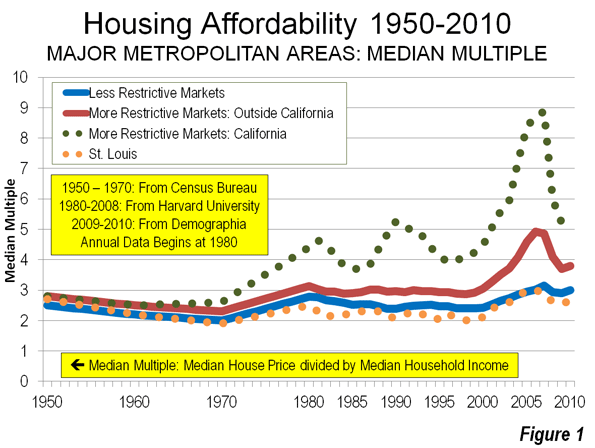
    Superior Housing Affordability: This is where St. Louis excels. As of the third quarter of 2011, the median house price was 2.6 times the median household income in St. Louis, according to the 8th Annual Demographia International Housing Affordability Survey, which covered seven nations (the United States, United Kingdom, Canada, Australia, Ireland, New Zealand and Hong Kong, in China). Dividing the median house price by the median household income gives St. Louis an affordability rating (Median Multiple) of 2.6. By comparison the Median Multiple was 4.2 in Portland (60 percent more expensive ), 4.5 in Seattle (75 percent more),  6.1 in San Diego (135 percent more) and 6.9 in San Jose (175 percent more. While other metropolitan areas were reeling from house price increases that still have not returned to normal, St. Louis (and other metropolitan areas, like Dallas-Fort Worth, Houston and Indianapolis) have continued to experience affordable and far more steady house prices (Figure 1).

    Lowest Cost of Living: Affordable house prices are associated with a lower cost of living. St. Louis does very well here. According to the latest data from the US Bureau of Economic Analysis regional price parity program, the cost of living in St. Louis is the lowest among major metropolitan areas (those with more than 1,000,000 population). In St. Louis, the cost of living is:

    • 29 percent less than in New York.
    • 31 percent less than in San Jose.
    • 23 percent less than in San Diego.
    • 19 percent less than in Seattle.
    • 12 percent less than in Portland.

    Things Could Get Better for St. Louis: Moreover, the gap could become larger, especially as governments in California try to outlaw new detached housing, under Senate Bill 375. None of this is good for young households or less affluent households who will have to leave to find housing that meets their desires. Many will need to leave to fulfill their dreams.

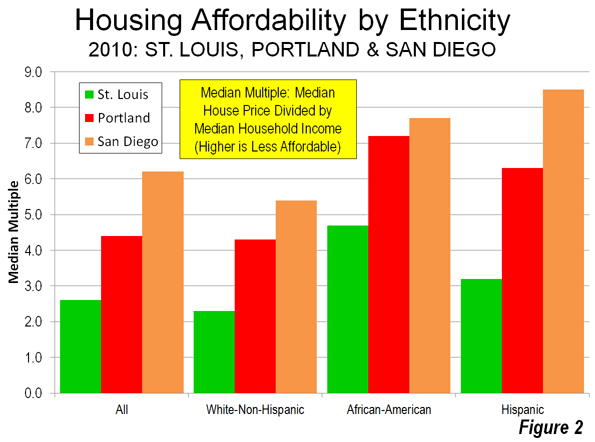
    Inevitably, the higher housing costs associated with these policies (called by various names, such as "livability," "smart growth" and "growth management") fall hardest on lower income households (often minorities), who have less to spend, are forced to move away or cannot afford to move in. The consequences were articulated by California’s Hispanic oriented Tomas Rivera Policy Institute (Figure 2):

    While there is little agreement on the magnitude of the effect of growth controls on home prices, an increase is always the result.

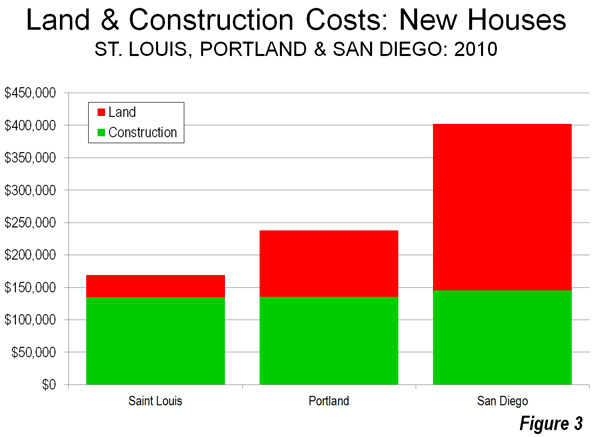
    The Secret: Just what did the St. Louis leadership do to improve its competitiveness so much? Nothing. They just stayed out of the way. Unlike their counterparts where house prices exploded, St. Louis officials did not prohibit people from living where they wanted on the urban fringe and they did not force new houses to be built on postage stamp lots. Nor did they adopt land use regulations that drive up the price of land (Figure 3) and, in consequence housing), just as an OPEC embargo would raise the price of gasoline. When the easy money came and lenders were begging households with insufficient resources to take mortgages, the planning embargoes drove up house prices and invited undue participation by speculators who know the difference between a competitive and a rigged market.

    There are positive signs as a result of this affordability advantage. St. Louis has been attracting more young residents. Recent data indicates that St. Louis ranked 15th in high tech job growth out of the 51 metropolitan areas with more than 1,000,000 over the past decade. It would be expected that St. Louis would trail fast growing Seattle, Raleigh and Charlotte and perennial tax consumer Washington. However, St. Louis can be placed better than perennial leaders San Jose, Boston, Portland, Austin and New York. Budding local efforts are aimed at encouraging entrepreneurship, even as California and New York search for new ways to say "no."

    Succeeding by Being St. Louis: The improving prospects of St. Louis are not the result of a taxpayer financed marketing campaign or a payoff from the usual "let’s copy Portland" strategies (or even Cleveland, as one analyst put it a couple of decades ago). St. Louis cannot compete with the weather in the Bay Area, does not have San Diego’s beaches, the mountains near Denver nor the natural beauty surrounding Seattle. But it does have an affordable life style.

    St. Louis can succeed only by being St. Louis. It is a metropolitan area with a great past, and many fine civic institutions, including great parks, sports teams and a world class orchestra. This long laggard Midwestern metropolitan area may face its best competitive prospects since Chicago passed it in population in 1870. Local and state leaders need to stay away from the policies that would dilute St. Louis’ principal competitive advantage, a low cost of living, due to a housing market left to operate without destructive distortion.

    Wendell Cox is a Visiting Professor, Conservatoire National des Arts et Metiers, Paris and the author of “War on the Dream: How Anti-Sprawl Policy Threatens the Quality of Life

    —-

    Photo: Cathedral Basilica of St. Louis (by author)

    Note: This is adapted from a policy study by the author for the Show Me Institute: Housing Affordability The St. Louis Competitive Advantage

  • The Evolving Urban Form: Moscow’s Auto-Oriented Expansion

    Moscow is bursting at the seams. The core city covers more than 420 square miles (1,090 kilometers), and has a population of approximately 11.5 million people. With 27,300 residents per square mile (10,500 per square kilometer), Moscow is one percent more dense than the city of New York, though Moscow covers 30 percent more land. The 23 ward area of Tokyo (see Note) is at least a third more dense, though Moscow’s land area is at least half again as large as Tokyo.

    All three core areas rely significantly on transit. Muscovites use the Metro at about the same rate as New Yorkers use the subway, taking about 200 trips each year. Tokyo citizens use their two Metro systems at nearly 1.5 times the rate used in Moscow.

    But there are important differences. Moscow officials indicate that approximately two-thirds of Moscow’s employment is in the central area. This is a much higher figure than in the world’s two largest central business districts — Tokyo’s Yamanote Loop and Manhattan — each with quarter or less of their metropolitan employment. Both New York City and Tokyo’s 23 wards have extensive freeway lengths in their cores, which help to make their traffic congestion more tolerable.

    Moscow’s arterial street pattern was clearly designed with the assumption that the dominant travel pattern would be into the core. Major streets either radiate from the core, or form circles or partial circles at varying distances from it. In New York City and Tokyo’s  23 wards there are radial arterials, but,the major streets generally form a grid, which is more conducive to the cross-town traffic and the more random trip patterns that have emerged in the automobile age.

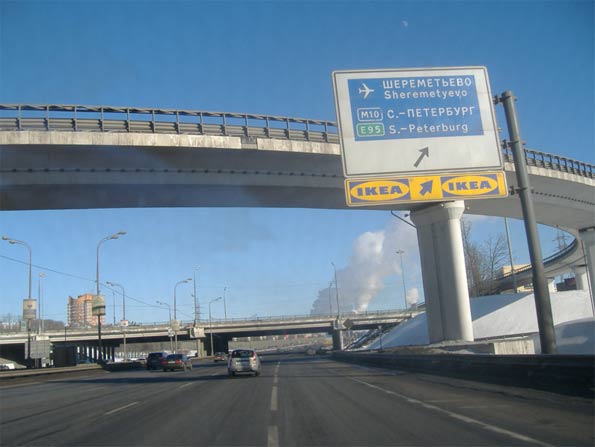
    Moscow has become much, more reliant on cars,  following the examples of metropolitan areas across Europe. The old outer circular road, which encloses nearly all of the central municipality, was long ago upgraded to the MKAD, a 10 lane freeway as long as Washington’s I-495 Capital Beltway (65 miles or 110 kilometers). The MKAD has become a primary commercial corridor, with large shopping centers and three nearby IKEAs.

    It is not surprising, therefore, that traffic congestion and air pollution became serious problems in Moscow. The road system that had been adequate when only the rich had cars was no longer sufficient. The "cookie-cutter" apartment blocks, which had served Iron Curtain poverty, had become obsolete. The continued densification of an already very dense core city led to an inevitable intensification of intensification of traffic congestion and air pollution.

    Transit-oriented Moscow was not working, nor could "walkability" make much difference. In such a large urban area, it is inevitable that average travel distances, especially to work, will be long. Geographically large employment markets are the very foundation of major metropolitan areas. If too many jobs are concentrated in one area, then the traffic becomes unbearable, as many become able to afford cars and use them. Traffic congestion was poised to make Moscow dysfunctional.

    Expanding Moscow

    The leadership of both the Russian Federation and the city of Moscow chose an unusual path, in light of currently fashionable urban planning dogma. Rather than making promises they could not keep about how higher densities or more transit could make the unworkable city more livable, they chose the practical, though in urban planning circles, the "politically incorrect" solution:  deconcentrating the city and its traffic.

    Last year, Russian President Dmitry Medvedev proposed that Moscow be expanded to a land area 2.3 times as large. Local officials and parliament were quickly brought on board. The expanded land area is nearly double that of New York’s suburban Nassau County, and is largely rural (Note 2). Virtually all of the expansion will be south of the MKAD.

    The plan is to create a much larger, automobile-oriented municipality, with large portions of the Russian government to be moved to the expanded area. Employment will be decentralized, given the hardening of the transport arterials that makes the monocentric employment pattern unsustainable. Early plans call for commercial construction more than four times that of Chicago’s loop.

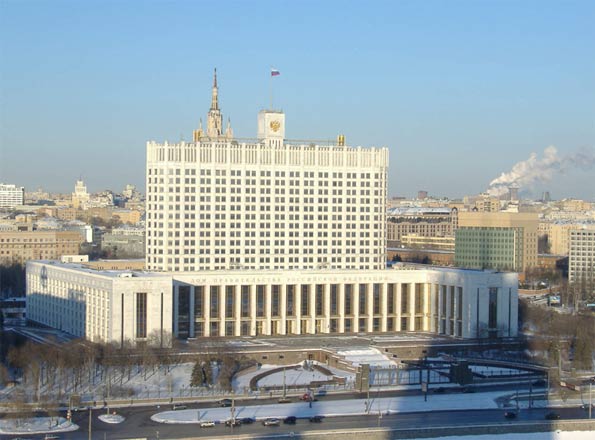
    At the same time, the leadership does not intend to abandon the older, transit-oriented part of the municipality. Mayor Sergei Sobyanin has voiced plans to convert central area government buildings into residences and hotels, adding that there will be the opportunity to build underground parking facilities as refurbishments proceed. Moscow appears to be preparing to offer its citizens both an automobile-oriented lifestyle and a transit-oriented one. The reduced commercial traffic should also make central Moscow a more attractive environment for tourists, who spend too much time traveling between their hotels and historic sites, such as the Kremlin and St. Basil’s.

    Expanding the Family?

    As Moscow expands, the national leadership also wants the Russian family to expand. Russia has been losing population for more than 20 years. Since 1989, the population of the Russian Federation has dropped by 4.5 million residents. When the increase of 3.0 million in the Moscow area is considered, the rest of the nation has lost approximately 7.5 million since 1989. Between the 2002 and the 2010 censuses, Russia lost 2.2 million people and dropped into a population of 142.9 million. Russia’s population losses are pervasive. Out of the 83 federal regions, 66 lost population during the last census.

    Continued population losses could significantly impair national economic growth. The projected smaller number of working age residents will produce less income, while a growing elderly population will need more financial support. This is not just a Russian problem, but Russia is the first of the world’s largest nations to face the issue while undergoing a significant population loss.

    The government is planning strong measures to counter the demographic decline, increase the birth rate, and create a home ownership-based "Russian Dream". Families having three or more children will be granted land for building single-family houses across the nation., including plots of up to nearly one-third of an acre (1,500 square meters).  Many of these houses could be built in Moscow’s new automobile- oriented two-thirds, as well as in the extensive suburbs on the other three sides of the core municipality.

    Expanding Outside the Core

    While population decline is the rule across the Russian Federation, the Moscow urban area has experienced strong growth. Between 2002 and 2010, the Moscow urban area grew from 14.6 million to 16.1 million residents (Note 3). This 1.3 percent annual rate of increase  exceeds the recently the recently announced growth in Canada (1.2 percent). This rate of increase exceeds that of all but 8 of the 51 major metropolitan areas (Note 4) in the United States between 2000 and 2010.

    While the core district grew 6 percent  and added 41,000 residents, growth was strongest outside the core, which accommodated 97 percent of the new residents (See Table). Moscow’s outer districts grew by nearly 1.1 million residents, an 11 percent increase, and its suburbs continued to expand, adding 400,000 residents, an increase of 10  percent. These areas have much lower densities than the city, with many single-family houses.

    Table
    Moscow Urban Area Population
    2002 2010 Change % Change Share of Growth
    Inner Moscow 701,000 743,000 41,000 5.9% 2.7%
    Outer Moscow 9,681,000 10,772,000 1,090,000 11.3% 70.3%
    Suburban 4,198,000 4,617,000 420,000 10.0% 27.0%
    Total 14,581,000 16,132,000 1,551,000 10.6% 100.0%
    Note: Suburban population includes the total population of each district and city that is at least partially in the urban area.


    Moscow, like other international urban areas, is decentralizing, despite considerable barriers. The expansion will lead to even more decentralization, which is likely to lead to less time "stuck in traffic" and more comfortable lifestyles. Let’s hope that Russia’s urban development policies, along with its plans to restore population growth, will lead to higher household incomes and much improved economic performance.

    Wendell Cox is a Visiting Professor, Conservatoire National des Arts et Metiers, Paris and the author of “War on the Dream: How Anti-Sprawl Policy Threatens the Quality of Life

    —–

    Note 1: The 23 ward (ku) area of Tokyo is the geography of the former city of Tokyo, which was abolished in the 1940s. There is considerable confusion about the geography of Tokyo. For example, the 23 ward area is a part of the prefecture of Tokyo, which is also called the Tokyo Metropolis, which has led some analysts to think of it as the Tokyo metropolitan area (labor market area). In fact, the Tokyo metropolitan area, variously defined, includes, at a minimum the prefectures of Tokyo, Kanagawa, Chiba and Saitama with some municipalities in Gunma, Ibaraki and Tochigi. The metropolitan area contains nearly three times the population of the "Tokyo Metropolis."

    Note 2: The expansion area (556 square miles or 1,440 square kilometers) has a current population of 250,000.

    Note 3: Includes all residents in suburban districts with at least part of their population in the urban area.

    Note 4: Urban area data not yet available.

    Photo: St. Basil’s Cathedral (all photos by author)

  • Unintended Consequences of the Neo-Traditional City Planning Model

    Since the early 20th century, the almost universal adoption of the automobile by US residents has had a profound impact on how we plan and design communities. The widespread use of the auto not only spurred development outside of traditional urban centers, it minimized the need to blend multiple land uses into compact areas.

    In contrast, traditional neighborhood design, especially in the northern Midwest and Northeast, accommodated a microcosm of commerce including grocery, butcher, hardware, tavern, cafe and dining establishments to serve relatively small markets living and working within walking distance of the neighborhood.

    The advent of the automotive age has spurred the development of suburbs outside the urban core that are characterized by carefully separated land uses, especially between residential and non-residential uses. Most cities developed zoning ordinances which created barriers to ‘protect’ residential sanctity. In contrast to this style of development, a new school of thought began to evolve in the early 90s, which followed the principles used to guide urban development prior to the dominance of the automobile.

    Neo-traditional is the favored label for this new school of planning thought; however, the terms Transit Oriented Design (TOD), New Urbanism, Walkable Communities, Smart Growth and Sustainable Communities are also used to identify subcomponents of this form of urban growth. The basic principles behind the neo-traditional movement include:

    • enhanced walkability
    • mixed land uses
    • ease of access to public transit
    • sustainability
    • high density residential
    • defined town/commerce center
    • mixture of housing types

    Each of these principles has merit and plays a valid role in the development decision making process. However, in the dash to adopt the neo-traditional model for suburban development, planners have attempted to create a formula of inflexible planning techniques that establishes a one-size-fits-all model with the goal of curing all of the ills attributed to suburban growth.

    This tactical criteria of the Neo-traditional model, however, can create unintended negative consequences. The criteria to which I refer includes:

    • grid street patterns
    • connectivity to adjacent neighborhoods
    • mixed, non-residential land uses
    • alley access/rear loaded house

    The inflexible application of these tactical criteria enhances opportunities for criminal activities to occur.

    Predictable Criminal Behavior
    To understand how a space can facilitate criminal activity, it is important to understand the relative opportunities and risks perceived in the criminal mind. 

    There are many factors which contribute to criminal activity; however there are four factors a “thinking” criminal evaluates prior to engaging in crimes against property, especially home burglary. The first factor is anonymity; more specifically the ability to engage in a criminal act without being easily identified by potential witnesses. The second factor is the ability to study and evaluate a potential target prior to initiating the specific act. By integrating themselves and their vehicles into a neighborhood’s daily routine, criminals can identify potential targets by determining the occupancy of residences or operating patterns of commercial establishments. The third factor is the ability for a quick, inconspicuous departure which is enhanced by the ability to easily flee the scene via multiple exit routes. The fourth factor is accessibility by car. Certainly some crimes are committed on foot, however a vehicle is predominately used to facilitate a hasty retreat and remove stolen goods from a burglary site.

    Grid Street Patterns
    As early as the 12th century urban design was used to discourage patterns of criminal activity in London. In the 1970s, studies began to document criminal activities and how they were facilitated by the design decisions that shape our everyday environment. The practice of utilizing design decisions to minimize criminal activity became known as “Crime Prevention through Environmental Design” (CPTED).  The CPTED Guidelines were developed through extensive study of criminal activities. I want to stress that environmental design decisions do not cause the criminal activity, but they can facilitate a more accommodating environment for it to occur. Oscar Newman explains in Design Guidelines for Creating Defensible Space how thoughtful design of the places in which we live, work, play and learn as well as the routes which connects them can significantly reduce the occurrence of crime against property. Google lists over 13 million sites on the topic “street design and crime”. Simply stated, communities with greater street complexity (fewer exit routes) and fewer common destinations (land uses which attract non-residents) have lower rates of crime as noted in a study by Daniel Beaverton for the School of Criminology at Simon Fraser University. The grid street pattern combined with high level of connection to adjacent neighborhoods provides maximum opportunities for non-residents to enter and leave a neighborhood with minimal notice.

    Advocates for highly connected neighborhoods contend that dispersing driving patterns over a greater number of neighborhood streets minimizes traffic congestion. However, it also creates a means for non-residents to traverse neighborhoods without undue notice. These dispersed travel patterns also allow potential criminals easy access and familiarization with neighborhoods in which they have little first hand knowledge.

    In Newman’s study for the U.S. Department of Housing and Urban Development, Defensible Space – Crime Prevention Through Urban Design, he notes that criminals seldom conduct their activity in areas not familiar to them.  Newman’s theory concurs with the study prepared by C. Bevis and J. B. Nutter, Changing Street Layouts to Reduce Residential Burglary that burglars tend to victimize areas with which they are familiar.

    Simply put, increased criminal activity is enhanced in communities where transient traffic is encouraged and increased street connectivity allows for ease of access, observation and escape. The practice of merging homes and businesses into a single community to reduce the reliance on the automobile has validity.  However, it also provides anonymity for criminals as they become cloaked within the community. The neo-traditional design relies on straight streets, rectangular blocks and interlinking grids to connect adjacent neighborhoods and provide numerous access and departure points for residents and non-residents. The grid system also provides criminals a means to anonymously cruise their target without detection.

    The consequences of the neo-traditional community design are underscored by the National Crime Prevention Council’s research that shows a correlation between the increase in accessibility for any street segment and the increase in the crime rate. 

    To better illustrate the point, the Los Angeles Metropolitan Area is generally designed on the grid system. The network of streets allows traffic to leave congested roadways and traverse neighborhoods as an alternate route of movement. In 1996, the Los Angeles Police Department studied the effects of roadways on criminal activity, establishing barricades to stop thru traffic in high crime areas. The study concluded “closing thru streets makes offenders escape more problematic”. For the two years after the barriers were put in place drug activity, residential break-ins, drive-by shootings and homicides were reduced by 65%. Many other inner cities’ designs are based on grid patterns, New York City, Denver, Phoenix, Chicago, et al. This design increases the susceptibility to criminal activities in areas where poor maintenance, vacant buildings and low street traffic compound the pattern of crime.

    Common Destinations Attracting Non-Residents
    The principle of multi-use communities may provide a reduction of vehicular traffic, however multi-family and commercial uses draw non-residents into the neighborhood. Convenience stores, clubs and taverns operating well into the night provide a convenient venue for potential criminals to congregate and hang out.

    Land uses which attract individuals from outside the community provide a neutral location to observe the adjacent neighborhoods as well as a cloak of activity for criminals to remain unnoticed.

    Alley Access
    Many neo-traditional communities require alley access behind all single-family dwellings. Although this creates a more aesthetically pleasing streetscape and enhances walkability, it also increases the street permeability and opportunity to observe all sides of the house as a potential target for burglary. Alleys also provide an additional means of escape as well as a venue for criminal activity as its utilitarian design discourages social interaction providing a welcome area to foster and avoid detection for criminal enterprise.

    The current status of neo-traditional community planning is entering a crucial stage. The imposition of planning techniques to shape our future communities is forcing suburban growth into a dictated one-size-fits-all planning model endorsed and promoted at the federal level and enthusiastically supported by many states, local governments and most of academia. Without the flexibility to incorporate factors such as local values, market preferences and geographic character; future communities may result in higher housing costs, limit the selection of housing types while simultaneously enhancing the opportunity for criminal activity.

    Obviously, the negative consequences identified can be mitigated.  However, the key here lies in planning flexibility. Many communities enamored with neo-traditional concepts seek to impose absolute formulaic solutions which offer little flexibility in compliance with the technical standards rather than focusing on achieving the guiding principles which form the basis of the neo-traditional movement.

    Joe Verdoorn, a Principal at SEC Planning, LLC, has over 40 years land planning and development experience working with clients such as Pulte/Del Webb, Motorola, Apple and Hunt Investments.  He is a pioneer in the field of active adult community design who continues to research the retiree market to understand their evolving wants and needs. 

    Photo courtesy of BigStockPhoto.com.

  • Why Downtowns Fail and How They Can Come Back

    To many Florida developers in the last decade, downtown condo towers seemed to make a lot of sense. They were sold as the logical locale for active seniors and millennials, great affordable starter homes, and best of all, investments.  Reinvigorating downtowns became fashionable currency in many of Florida’s second and third tier cities. 

    Sadly, many of these new structures have turned into hulking shadows today in places such as Delray Beach, Tampa, and Orlando. Many of Florida’s core urban districts suffer the dark windows, unoccupied balconies, vacant storefronts and wide open sidewalks that signify the opposite of thriving urbanity.  Repairing this false renaissance in downtowns requires city leaders to see the central business district for what it really is: just another suburb needing attention to stay healthy, safe, and productive.

    Suburbs are heavily marketed by their developers with product launches, public relations campaigns and lavish sales centers.  Downtowns, on the other hand, produce websites, but rarely have more, relying instead on the desirability of a downtown address to fill up space.  Rental apartments in former condominiums are competing with the slickly marketed suburbs for people.

    In terms of buying, the suburbs are winning, with the more desirable single-family detached dwelling now suddenly affordable.  Suburbs are comfortable, safe, and familiar to most buyers.  Downtowns are seen as edgy, transitional, and alien to many people, but they are attracting adventurous renters and a few buyers here and there who want to create a new scene.  A scene is one thing; a stable social network and a feeling of safety and security is entirely another.

    What downtowns lack is the sense of neighborhood that many inner-ring suburbs have, and the outer-ring suburbs are effectively gaining.  Until downtowns start reinventing their identity, they will have a difficult time selling a sense of place among the empty lots and decaying infrastructure.  Touring the downtown residential properties today is like touring a movie set, with new developer inventory garishly contrasting with the older, grown-in building stock. Few dare to tread past the end of the fresh concrete sidewalk, and the urban infill efforts are sporadic and unconnected. But, unfortunately, this has always been the case.

    Central Florida’s downtowns have languished for years, raising the question of their reason for existence.  Competing with, and often losing to, suburban fringe developments like Westshore in Tampa, the decline of these downtowns began years ago.  Sanborn maps (fire insurance documents from the early 20th century) reveal that neither Orlando nor Tampa ever really had fully built-out downtowns.  Warehouses, garages, residences and small hotels have coexisted with empty lots forever in these cities.  While their potential has always been high, they have never realized it.

    Perhaps we ask too much from the current form of our cities.  Our urban core regulatory structure and property values are geared towards a level of development that never occurred, and might never occur, while the suburban fringe has no such constraint put upon it.  It is past time to think of our downtowns a bit differently, put aside our emotional ties to them as “centers”, and begin to look at them as neighborhoods.

    Compared to suburban tracts, Florida’s downtowns have a stiffer regulatory environment, with downtown development boards and aesthetic police to prevent all but the most deep-pocketed players from entering the game.  These citizen-led authorities may be emboldened with pure intentions, but they tend to focus on nitpicky, hair-splitting trivia.  Arguments about the size of a fence or the color of a stucco band seem absurd to most people who wonder when an empty lot might eventually boast thriving businesses once again.  Downtowns, with their guardians of taste, may be preventing the horror of chain link fence in the district, but are unconsciously slowing the growth of any real soul as well.

    Tampa’s “Channelside” expanded this city’s downtown eastward towards the Latin Quarter, Ybor City.  With one of Florida’s tiniest Central Business Districts at 1 square mile, Tampa saw grand marble bank lobbies go dark, repurposed to host blueprinters serving the local design and construction industry.  It was a post-apocalyptic experience to see industrial-size copy machines busy at work where a once proud bank traded money.  But such has been the fate of Tampa’s downtown, left behind by edge cities like Westshore and eastern fringe suburban development.

    The hard work of downtown redevelopment, however, took second priority to the easier work of condemning empty industrial warehouse tracts between Tampa’s downtown and its port.  Selling off large chunks to developers, Tampa created a new Channelside district, where a lovely two bedroom condominium can be had for $157,000 .

    Orlando’s downtown has no natural boundaries, but blends into 1920s historic neighborhoods, and it saw many condominium towers rise up as well.  Mostly rental units today, many of these have suffered through a phase when recent college graduates roomed together in granite countertop heaven, turning the luxury towers into post-college dormitories complete with drunken pool parties, busted drywall, and beer bottles littering the hallways.  Such behavior is characteristic of transitional residents, who have little investment in their surroundings and are for the most part barely past adolescence.  The downtown model isn’t working too well for adults, but it isn’t working too well for these post-adolescents, either.

    Downtowns would do well to reconsider their model, relax the beauty boards, and allow a greater variety of development, mixing in affordable residential ownership.  People who come to stay downtown for the longer term will be the ones who can turn them into neighborhoods. Currently, the downtowns of Central Florida only have business or commercial interactions, with a few still going to church downtown. The idea of a network of social interactions easily fits into a suburban neighborhood, where neighbors see each other, their kids play together, and they casually meet and converse. This model does not fit a downtown in Central Florida at the present moment.

    This function has to be transplanted into downtowns if they are to keep their relevance.  Rather than imagine the resurgence of the downtown as urban center – which never really took hold in much of Florida – cities need to realize that their next step is to start aggressively turning downtown into an alternative form of suburb.  Suburbs have consumer necessities like grocery and drug stores, conveniently accessible by driving; maybe in downtowns a bit of walking is OK.  Suburbs have consistent identities; maybe in downtowns a new set of sidewalks is in order.  Neighborhoods with loyal residents also have spontaneity and variety; maybe in downtowns the beauty police could give it a rest.  Suburbs have relative safety and security; in downtowns this must be provided also, and is non-negotiable.

    Such an idea may be anathema to many of Florida’s urban designers.  Yet, what downtowns need is what makes the suburbs so successful: safety, continuity, and ease of contact with neighbors.  Recasting a downtown as a suburb simply acknowledges the sense of neighborhood that most people now can only find on the suburban frontier.

    The exciting prospect of turning downtowns into neighborhoods may be the hard work of the next generation of urban residents. Achieving true neighborhoods again in the once-thriving cores of Florida’s cities means that the older building stock, mixed with the new, will begin to have meaning once again.   The heritage of these places and the stories these buildings tell is rich and vibrant. The ability to sustain them into the 21st century means that their contribution will not be lost.  Reintegrating our older centers with the rest of the city will make them some of the most interesting and varied places of all.

    Richard Reep is an Architect and artist living in Winter Park, Florida. His practice has centered around hospitality-driven mixed use, and has contributed in various capacities to urban mixed-use projects, both nationally and internationally, for the last 25 years.

    Photo courtesy of BigStockPhoto.com.

  • Time to Rethink This Experiment? Delusion Down Under

    The famous physicist, Albert Einstein, was noted for his powers of observation and rigorous observance of the scientific method. It was insanity, he once wrote, to repeat the same experiment over and over again, and to expect a different outcome. With that in mind, I wonder what Einstein would make of the last decade and a bit of experimentation in Queensland’s urban planning and development assessment? 

    Fortunately, we don’t need Einstein’s help on this one because even the most casual of observers would conclude that after more than a decade of ‘reform’ and ‘innovation’ in the fields of town planning and the regulatory assessment of development, it now costs a great deal more and takes a great deal longer to do the same thing for no measureable benefit. As experiments go, this is one we might think about abandoning or at the very least trying something different.

    First, let’s quickly review the last decade or so of change in urban planning and development assessment. Up until the late 1990s, development assessment was relatively more straightforward under the Local Government (Planning and Environment) Act of 1990. Land already zoned for industrial use required only building consent to develop an industrial building. Land zoned for housing likewise required compliance with building approvals for housing. These were usually granted within a matter of weeks or (at the outset) months. 

    There were small head works charges, which essentially related to connection costs of services to the particular development. Town planning departments in local and state governments were fairly small in size and focussed mainly on strategic planning and land use zoning. It was the building departments that did most of the approving. Land not zoned for its intended use was subject to a process of development application (for rezoning), but here again the approach was much less convoluted that today. NIMBY’s and hard left greenies were around back then, but they weren’t in charge. Things happened, and they happened far more quickly, at lower cost to the community, than now.

    In the intervening decade and a bit, we’ve seen the delivery and implementation of an avalanche of regulatory and legislative intervention. It started with the Integrated Planning Act (1997), which sought to integrate disparate approval agencies into one ‘fast track’ simplified system. It immediately slowed everything down.  It promised greater freedom under an alleged ‘performance based’ assessment system, but in reality provoked local councils to invoke the ‘precautionary principle’ by submitting virtually everything to detailed development assessment. The Integrated Planning Act was followed, with much fanfare, by the Sustainable Planning Act (2009). Cynics, including some in the government at the time, dryly noted that a key performance measure of the Sustainable Planning Act was that it used the word ‘sustainable’ on almost every page. 

    Overlaying these regulations have been a constant flow of land use regulations in the form of regional plans, environmental plans, acid sulphate soil plans, global warming, sky-is-falling, seas-are-rising plans – plans for just about everything which also affect what can and can’t be done with individual pieces of private property.
    But it wasn’t just the steady withdrawal of private property rights as state and local government agencies gradually assumed more control over permissible development on other people’s land. There was also a philosophical change on two essential fronts.

    First, there was the notion that we were rapidly running out of land and desperately needed to avoid becoming a 200 kilometre wide city. Fear mongers warned of ‘LA type sprawl’ and argued the need for densification, based largely on innocuous sounding planning notions like ‘Smart Growth’ imported from places like California (population 36 million, more than 1.5 times all of Australia, and Los Angeles, population 10 million, roughly three times the population of south east Queensland).  The first ‘South east Queensland Regional Plan 2005-2026’ was born with these philosophical changes in mind, setting an urban growth boundary around the region and mandating a change to higher density living (despite broad community disinterest in density). It was revisited by the South East Queensland Regional Plan 2009-2031 which formally announced that 50% of all new dwellings should be delivered via infill and density models (without much thought, clearly, for how this was to be achieved and whether anyone particularly wanted it). Then there was the South East Queensland Regional Infrastructure Plan 2010-2031 which promised $134 billion in infrastructure spending to make this all possible (without much thought to where the money might come from) and a host of state planning policies to fill in any gaps which particular interest groups or social engineers may have identified as needing to be filled.

    The significant philosophical change, enforced by the regional plan, was that land for growth instantly became scarcer because planning permission would be denied in areas outside the artificially imposed land boundary. Scarcity of any product, particularly during a time of rising demand (as it was back then, when south east Queensland had a strong economy to speak of) results in rising prices. That is just what happened to any land capable of gaining development permission within the land boundary: raw land rose in price, much faster than house construction costs or wages. 

    The other significant philosophical change that took root was the notion of ‘user pays’ – which became a byword for buck passing the infrastructure challenge from the community at large, to new entrants, via developer levies. Local governments state-wide took to the notion of ‘developer levies’ with unseemly greed and haste. ‘Greedy developers’ could afford to pay (they argued) plus the notion of ‘user pays’ gave them some (albeit shaky) grounds for ideological justification. Soon, developers weren’t just being levied for the immediate cost of infrastructure associated with their particular development, but were being charged with the costs of community-wide infrastructure upgrades well beyond the impact of their proposal or its occupants. 

    Levies rose faster than Poseidon shares in the ‘70s. Soon enough, upfront per lot levies went past the $50,000 per lot mark and although recent moves to cap these per lot levies to $28,000 per dwelling have been introduced, many observers seem to think that councils are now so addicted that they’ll find alternate ways to get around the caps.

    So the triple whammy of ‘reform’ in just over a decade was that regulations and complexity exploded, supply became artificially constrained to meet some deterministic view of how and where us mere citizens might be permitted to live, and costs and charges levied on new housing (and new development generally) exploded.

    At no point during this period, and this has to be emphasised, can anyone honestly claim that this has achieved anything positive. It has made housing prohibitively expensive, and less responsive to market signals. Simply put, it takes longer, costs more, and is vastly more complicated than it was before, for no measureable gain.

    An indication of this was given to me recently in the form of the Sunshine Coast Council’s budget for its development assessment ‘directorate.’ (How apropos is that term? It would be just as much at home in a Soviet planning bureau).  Their budget (the documents had to be FOI’d) for 2009-10 financial year included a total employee costs budget of $17.4 million.  For the sake of argument, let’s assume the average directorate comrade was paid $80,000 per annum. That would mean something like more than 200 staff in total. Now they might all be very busy, but it surely says something about how complexity and costs have poisoned our assessment system if the Sunshine Coast Council needs to spend over $17 million of its ratepayer’s money just to employ people to assess development applications in a down market.

    If there had been any meaningful measures attached to these changes in approach over the last decade, we’d be better placed to assess how they’ve performed. But there weren’t, so let’s instead retrospectively apply some:

    Is there now more certainty? No. Ask anyone. Developers are confused. The community is confused. Even regulators are confused and frequently resort to planning lawyers, which often leads to more confusion. The simple question of ‘what can be done on this piece of land’ is now much harder to answer.

    Is there more efficiency? No. Any process which now takes so much longer and costs so much more cannot be argued to be efficient.

    Is the system more market responsive? No. Indeed the opposite could be argued – that the system is less responsive to market signals or consumer preference. Urban planning and market preference have become gradually divorced to the point that some planners actively view the market preferences of homebuyers with contempt.

    Are we getting better quality product? Many developers will argue that even on this criteria, the system has dumbed down innovation such that aesthetic, environmental or design initiatives have to fight so much harder to get through that they’re simply not worth doing.

    Is infrastructure delivery more closely aligned with demand? One of the great promises of a decade of ‘reform’ was that infrastructure deficits would be addressed if urban expansion and infrastructure delivery were aligned. Well it’s been done in theory via countless reports and press releases but it’s hardly been delivered in execution. And when the volumes of infrastructure levies collected by various agencies has been examined, it’s often been found that the money’s been hoarded and not even being spent on the very things it was collected for.

    Is the community better served? Maybe elements of the green movement would say so, but for young families trying to enter the housing market, the answer is an emphatic (and expensive) no. How can prohibitively expensive new housing costs be good for the community? For communities in established urban areas, there is more confusion about the impact of density planning, which has made NIMBY’s even more hostile than before.

    Has it been good for the economy? South east Queensland’s economy was once driven by strong population growth – the very reason all this extra planning was considered necessary. But growth has stalled, arguably due to the very regulatory systems and pricing regimes that were designed around it. We now have some of the slowest rates of population growth in recent history and our interstate competitiveness – in terms of land prices and the costs of development – is at an all time low. That’s hardly what you’d call a positive outcome.

    Is the environment better served? If you believe that the only way the environment can be better served is by choking off growth under the weight of regulation and taxation, you might say yes. But then again, studies repeatedly show that the density models proposed under current planning philosophies promote less environmentally efficient forms of housing, and can cause more congestion, than the alternate. So even if the heroic assumptions for the scale of infill and high density development contained in regional plans was actually by some miracle achieved, the environment might be worse off, not better, for it. 

    All up, it’s a pretty damming assessment of what’s been achieved in just over a decade. Of course the proponents of the current approach might warn that – without all this complexity, cost and frustration – Queensland would be subject to ‘runaway growth’ and a ‘return to the policies of sprawl.’ The answer to that, surely, is that everything prior to the late 1990s was delivered – successfully – without all this baggage. Life was affordable, the economy strong, growth was a positive and things were getting done. Queensland, and south east Queensland in particular, was regarded as a place with a strong future and a magnet for talent and capital. Now, that’s been lost.

    Einstein would tell us to stop this experiment and try something else if we aren’t happy with the results. To persist with the current frameworks and philosophies can only mean the advocates of the status quo consider these outcomes to be acceptable.  Is anyone prepared to put up their hand and say that they are?

    Ross Elliott has more than 20 years experience in property and public policy. His past roles have included stints in urban economics, national and state roles with the Property Council, and in destination marketing. He has written extensively on a range of public policy issues centering around urban issues, and continues to maintain his recreational interest in public policy through ongoing contributions such as this or via his monthly blog The Pulse.

    Photo by Flickr user Mansionwb

  • New Urbanism vs. Dispersionism

    The Florida real estate developer, unburdened of state regulatory agencies, may now focus his efforts on pleasing the investment community and the local market.  I recently played the role of real estate developer interviewing two consultant teams vying to help me create a new fictional community.  Fortified with readings in both the New Urbanist camp and the Dispersionist camp, each team of students pitched their method of community building to me. 

    The actual debate was very lively, with many rebuttals and some serious emotional engagement.  The premise:  I have a multi-acre greenfield property.   I have shortlisted my planning candidates down to two:  a New Urbanist team, and a Dispersionist team.  Each team must pitch their philosophy, and I will select one team to design it.

    Question 1:  Since I am only able to afford Phase 1, future phases will be left to future developers.  In your approach, can future generations be trusted to keep focus on high-quality development?  How would you guarantee that the property rises in value?  I asked the New Urbanists to go first.

    The New Urbanist team was ready:  As Master Planners, they will create the entire form-based vision for the property and design it around a smart code so that the future developers will obey a plan to keep property values rising.  No future developer will get to ‘cheap out’.  For this team, the Master Plan will guarantee a quality of life for all residents.

    The Dispersionists will plan Phase 1, not as a rigid image of a town, but rather as a response to the natural landscape.  This team said the community would grow organically, from its functional needs, guaranteeing  the freedom of future generations to plan their own destiny. They  scoffed at a Master Plan that determined the urban form.  What good is a guarantee of a quality of life, they asked, if future generations want something different than the Master Planner intended?

    This round, in my mind, went to the Dispersionists.  Their argument that future generations should have the freedom to plan based on their functional needs outweighed the seductive beauty of a Master Plan.  Too many Master Plans are implemented poorly, or abandoned due to their disutility based on changing needs and markets.

    Question 2:  How does your viewpoint deal with the car?  How will residents and visitors get around your community?  I asked the Dispersionists to go first this time.

    “Well,” replied the Dispersionists, “Americans love their cars, and we love the car too.  We’ll plan for sidewalks and bikes, but we know that the car is a necessity.  We know that a 5-minute walk isn’t so realistic in Florida’s hot, humid climate.”  The Dispersionists have a hearty regard for cars, and they spoke of long, sweeping curves and scenic drives.  They pointed out that most residents will need to drive to other parts of the city as well.

    The New Urbanists shuddered.  “We will plan for car-free living,” they stated.  With very clever planning, they intended to keep driving to a minimum, and will design walking trails.  One New Urbanist ventured 4-story parking garages, crowing that their proposal would not be littered with gas stations.  The New Urbanists pointed out the ugly commercial strips dominating our current city, and how little they want that to intrude into the new development.

    I liked this, and challenged the Dispersionists.  Isn’t it better health, and less use of oil, to reduce vehicle dependency?  The Dispersionists asked me why, in this ten-acre community, I thought I could attract residents with 4-story parking garages?  Good point, I thought.

    Both sides had good answers, and the question did not fully go to one side or the other.  Cars do tend to  generate a lot of aesthetic horror.  On the other hand, they are not going away anytime soon, so learning how to deal with them seems like an important task for a developer looking to the future.

    Question 3:  How would you distribute density in your development?  One center, multiple centers, and centered around what?  This time the New Urbanists went first.

    The core, they stated, will be in the center of town, and could go to 8-10 stories, leaving the perimeter a green zone.  In the center will be the government and institutional buildings, carefully matched with proper style.  The point, they said, is predictability. They pledged to learn from the failures of the past, and their Master Plan will account for the full scope of development.

    The Dispersionists suggested multiple centers.  “Phase 1 will be our first density cluster,” they said, “and we’ll see how it goes.”  Unlike the New Urbanists, they didn’t want to introduce all their product at once, in case the market changes.  “We believe in New England-style green space,” they said, and wanted to evolve the community around these.  They saw the vitality of the community coming from diversity.

    I asked the New Urbanists what they would do if the market changes .  When pressed, they insisted their Master Plan had plenty of contingency plans in case the original plan wasn’t workable, but it sounded like they were winging it.

    This is what  the Dispersionists saw as their own strong suit.  “We don’t have all the answers,” they said.  Their first phase would gently nudge the community in a certain direction, but it would leave future developers the choice whether to reinforce the first phase, or strike out and build another phase better suited to a unique need.

    I felt that this round went to the Dispersionists. 

    Question 4:  Do you think your development scheme can promote or discourage social values?  Why or why not?  This time the Dispersionists went first.

    The Dispersionists believed that one cannot engineer social values through urban design.  However, they can be influenced.  Conservation, for example, is a value that they would promote in their plan to conserve open space and not overtake the land with development.  A sense of community, they said, was another, giving people a loyalty to their community out of good design.  These, they felt, led to a sustainable plan.

    The New Urbanists guaranteed that conservation land would always be there, and pointed out the Dispersionists’ flexibility as a negative . The New Urbanists insisted that their sense of place would be stronger, because it would be designed.  People want predictability.  New Urbanists would engage people by walking and having front porches.

    The Dispersionists speculated that neighbors will get to know one another in a cul-de-sac just as well as they would if they all had front porches.  They also felt that the shared experiences of a community would transcend the particular style or form that community took.

    Although I gave this one to the New Urbanists, I was skeptical about  the New Urbanists’ implication that well-behaved buildings produce well-behaved people.  The Dispersionists’ view that a cul-de-sac breeds any neighborly closeness also seemed a bit disingenuous.  It was near the end of class.

    Question 5:  Give me your arguments why your strategy is sustainable.  I let the New Urbanists go first.

    For one thing, they said, they will have more efficient transportation. Vertical buildings save land, they argued, and people who choose this community will value open space more highly and be willing to live densely.  They believed that they will have less gridlock by de-emphasizing the car and will be more stable and socially cohesive.  All this will come from a well-designed Master Plan.

    The Dispersionists said  their community would start small and then grow.  Failures won’t cause dead zones, they claimed, because they are not sentimental about form and want a community that works.  So if a building in their development begets a failed business, the building will need to be reinvented to make it successful.

    “Yes, but,” countered the New Urbanists, “for every successful community like yours, there are 10 that have failed and ultimately decline in value.  What guarantee do you give that you will be the one out of ten?”  They went on to cite their successes – Seaside, Celebration, and so on.

    The Dispersionists noted that Seaside was a resort town and Celebration was heavily subsidized by a local employer, so those weren’t exactly good models.  In any case, they said, their community will appeal to a much broader segment of the population than the New Urbanists, and therefore more likely to sustain growth in the future.

    With that, the debate was concluded.  What lingers, however, are some truths that show both sides need to do some more work.

    The New Urbanists, fresh on the scene, seem overly evangelical in their approach, and demand a great deal of faith in the Master (Planner).  The slow, organically grown towns of which they are so fond were largely planned before the car.  While many of these towns, like Charleston, South Carolina, are sentimental favorites, their practical replication in today’s transportation-intensive, constantly changing real estate market is questionable.

    The Dispersionists, on the other hand, have been around for quite a long time, and are the modus operandi for much of the earth’s population.  They seem uninvolved in the aesthetics of the built environment, preferring to leave this up to individual taste, and the result is a rather shabby, cluttered contemporary American scene.  Some cleaning up is certainly in order.

    While the New Urbanists have a hopeful approach in this regard, they are overreacting to the vast consumer-oriented real estate development world that operated up until 2007, and are missing the fundamentals of how a real community works.  None are built around employers or economic producers in any significant way. None admit the lowest socioeconomic groups.  Content, perhaps, to dabble with shopping districts and farmer’s markets, New Urbanists have yet to offer what contemporary employers need – space, flexibility, and room to grow.  They therefore seem doomed to create peripheral urban designs rather than communities integrated with 21st century employers.

    Dispersionists would do well to pay a bit more attention to the natural environment, for the general public is quite aware of the toll that this strategy has taken.  Developers, having overbuilt in so many markets recently, will face tough opposition to bulldozing another woodland, given the empty real estate that exists in our cities today.

    It seems inevitable that dispersionist strategies will continue; they largely dominate our real estate development world and will continue to do so.  They make the most economic sense, they leave the future choices to the future generations, and they respond to people’s natural density tendencies.  One hopes that the New Urbanists will nudge the market a bit more towards aesthetic continuity and environmental stewardship as the next wave of growth inevitably begins again, and that the debate remains healthy, productive, and positive as citizens get re-engaged about the future of their cities.

    Richard Reep is an Architect and artist living in Winter Park, Florida. His practice has centered around hospitality-driven mixed use, and has contributed in various capacities to urban mixed-use projects, both nationally and internationally, for the last 25 years.

    Photo courtesy of BigStockPhoto.com.

  • The Evolving Urban Form: Guangzhou-Foshan

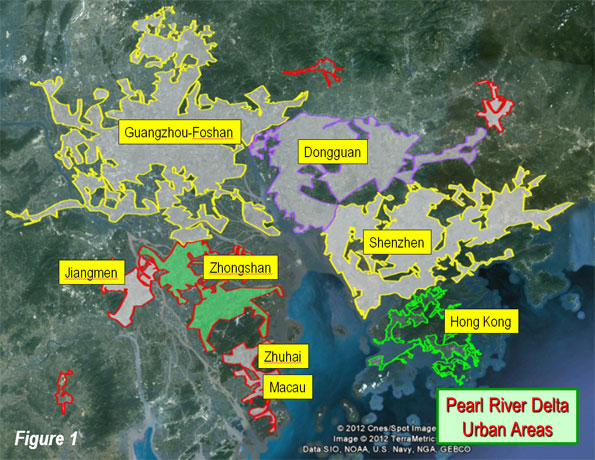
    The Pearl River Delta of China is home to the largest extent of continuous urbanization in the world. The Pearl River Delta has 55 million people in the jurisdictions of Hong Kong, Shenzhen, Dongguan, Guangzhou, Foshan, Zhongshan, Jiangmen, Zhuhai and Macau. Moreover, the urban population is confined to barely 10 percent of the land area. These urban areas are the largest export engine of China and reflect the successful legacy of Deng Xiaoping’s reforms which had their start with the special economic zone in Shenzhen and spread to the rest of the Delta and then much of the nation.

    Adjacent Metropolitan Areas: However, the Pearl River Delta today is not a metropolitan area, as is often asserted. Instead it is rather a collection of adjacent metropolitan areas or labor markets (Figure 1). Metropolitan areas are not created by a large number of people living close to one another. Metropolitan areas are labor markets, crudely delineating the geography of the jobs-housing balance. There is little commuting between the Pearl River jurisdictions. Moreover, as labor markets, metropolitan areas cannot be international unless there is virtual free movement of labor (Note). In the case of Hong Kong and Macau, commuting between the neighboring jurisdictions of Shenzhen and Zhuhai requires crossing the equivalent of an international border.


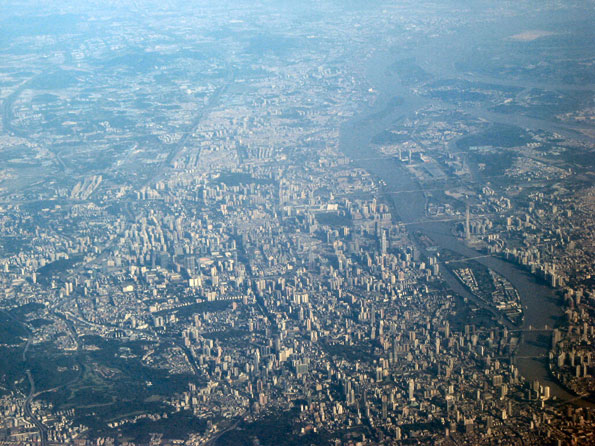
    Integrating Guangzhou and Foshan: Transportation integration has already come to two of the jurisdictions, Guangzhou and Foshan. The adjacent prefectures (confusingly interpreted into English as "cities") are now linked by a subway and unlike the other Pearl River Delta jurisdictions, the continuous urbanization does not narrow at the border (Figure 1). There are even proposals to merge the adjacent prefectures.

    Guangzhou and Foshan are separated by a tributary of the Pearl River, with a number of bridges that provide similar crossing capacity as exists in cross-river metropolitan areas like Portland (Willamette River), Cincinnati (Ohio River) and St. Louis (Mississippi River).

    Guangzhou itself is the capital of Guangdong, the largest province of China, with approximately 105 million people. Guangdong is the third largest state or province (sub-national jurisdiction) in the world, trailing the states of Uttar Pradesh (contains the eastern suburbs of Delhi) and Maharashtra (capital Mumbai) in India.

    Guangzhou is larger than Foshan. It is better known to many Westerners as Canton, and for many years served as China’s “window” on the west. Even in China, the alternative name is still used, for example in the annual Canton Fair, one of the largest trade fairs in the world.

    Canton was also a principal flashpoint of 19th century hostilities between the British and Chinese. The First Opium War (1839-42) began at Canton and led to the cession of Hong Kong to Great Britain and the establishment of British treaty ports at Fuzhou, Xiamen, Ningbo, Shanghai and Canton (Guangzhou). After the Second Opium War (1856-60), other treat ports were established and France, the United States, Russia, Germany, Japan and others gained similar rights to the British from a weakened Chinese government.

    In 2010, the metropolitan area county and district level jurisdictions of Guangzhou-Foshan had 18.3 million people. This is an increase of 4.4 million from 2000 and 11.6 million from 1982. This is surely a rapid rate of growth, but Shanghai and Beijing grew even faster over the last decade, each adding more than 6 million people.

    Distribution of Population Growth: In contrast to Shanghai and Beijing, where virtually all of the growth has been outside the core, the Guangzhou-Foshan core is growing robustly. From 2000 to 2010, the core districts increased from a population of 4,040,000 to 5,050,000. With a land area of 107 square miles (279 square kilometers), the core is similar in size to the city (municipality) of Sacramento, which has less than one-tenth the population. The core density is 46,800 per square mile (18,100 per square kilometer), up from 37,500 per square mile (14,500 per square kilometer) in 2000. This is about one-third less dense than Manhattan or the ville de Paris (the central city).

    However, as is typical for metropolitan areas around the world, Guangzhou-Foshan’s growth has been most concentrated in suburban areas. The core accounted for 23% of the population growth over the past decade, while the suburbs accounted for 77%.

    The inner suburbs grew from a population of 6,670,000 to 8,400,000. The density rose from 5,000 to 6,300 per square mile (1,900 to 2,500 per square kilometer), similar to that of the San Francisco urban area. The inner suburbs accounted for 39% of the growth and grew 26%.

    The outer suburbs grew from a population of 3,150,000 to 8,200,000 over the past decade. The population density rose from 2,000 to 3,100 per square mile (800 to 1,200 per square kilometer), slightly more dense than the Philadelphia urban area and slightly less dense than the Portland urban area. The outer suburbs accounted for 38% of the growth and grew at the greatest rate, 53% (Figures 2 & 3, Table).


    Guangzhou-Foshan Metropolitan Area & Urban Area
    2000 & 2010 Census
    Metropolitan Area Core Inner Suburbs Outer Suburbs Total
    2000         4,040,000        6,670,000            3,150,000         13,860,000
    2010         5,050,000        8,400,000            4,820,000         18,270,000
    Change         1,010,000        1,730,000            1,670,000           4,410,000
    % 25% 26% 53% 32%
    Share of Growth 23% 39% 38% 100%
    Area (KM2)                   279               3,429                   4,003                  7,711
    Area (Square Miles)                   108               1,324                   1,546                  2,977
    Density (KM2)              18,100               2,400                   1,200                  2,400
    Density (Square Miles)              46,800               6,300                   3,100                  6,100
    Urban Area  Core   Suburbs   Total 
    2010         5,050,000          11,225,000         16,275,000
    Area (KM2)                   279                   2,894                  3,173
    Area (Square Miles)                   108                   1,117                  1,225
    Density (KM2)              18,100                   3,900                  5,100
    Density (Square Miles)              46,800                 10,000                13,300
    Notes
    Boundary changes render district area data incomplete.
    Core: Yuexiu, Liwan, Haizhu, Tianhe 
    Inner Suburbs: Baiyun, Huangpu, Panyu, Nansha, Nanhai, Changcheng
    Outer Suburbs: Huadu, Luogang, Gaoming, Shunde, Shanshi 
    Nansha is in the inner suburbs because 2000 data is combined with Panyu (should be in the outer suburbs)

    Earlier data shows this suburban pattern has been a long term trend.  Between 1982 and 2010, the suburbs accounted for 57% of the growth outside the city of Guangzhou as then defined (Figure 4). District boundary changes limit a more precise analysis based upon a core that did not include large areas without development.

    The Guangzhou-Foshan Urban Area: The soon to be released 8th Annual Demographia World Urban Areas will show the Guangzhou urban area (area of continuous development within the metropolitan area) to have a population of approximately 16.275 million, with a land area of approximately 1,225 square miles (3,173 square kilometers). Barring later data from the multiple national censuses that will soon be reporting data, Guangzhou-Foshan is likely to be ranked the 14th largest urban area in the world. The population density is approximately 13,300 per square mile (5,100 per square kilometer), roughly comparable to the London or Barcelona urban areas. The suburbs of the urban area have a density of approximately 10,000 per square mile (3,900 per square kilometer). Most of the new residential development is multi-unit, such as high rise condominium buildings and work related housing, including dormitories. However, there is some detached housing, which is very expensive.

    A Larger Metropolitan Area: In the longer run a much larger metropolitan (and urban) area could result, if Chinese residents begin traveling to work over much longer distances between these jurisdictions and should the border restrictions at Hong Kong and Macau be eliminated. To achieve this end, there will need to be important local transportation improvements between the jurisdictions, such as more urban railways (which are planned) and wider automobile ownership, to use the already comprehensive (toll) freeway system.

    Wendell Cox is a Visiting Professor, Conservatoire National des Arts et Metiers, Paris and the author of “War on the Dream: How Anti-Sprawl Policy Threatens the Quality of Life

    ——

    Note: International metropolitan areas can now exist in the European Union, where there is free movement of labor across national borders. For example, the Lille metropolitan area is located in both France and Belgium. France and Switzerland (not a member of the European Union) provide another example, where treaty provisions permit international movement of labor with little difficulty in the resulting international metropolitan areas of Geneva (Switzerland-France) and Basel (Switzerland-France).

    Photo (top): Pagoda: Temple of the Six Banyan Trees, Guangzhou (all photos by author)

  • How Libraries and Bookstores Became the New Community Centers

    Bookstores and libraries have long played a central role in fostering a deeper appreciation of knowledge, and in lifelong learning. Increasingly, these places are also filling another critical need in our communities, by providing a haven for those seeking a communal connection in an ever-more isolated world.

    Ray Oldenburg, author of The Great Good Place, coined the term “third place” to describe any environment outside of the home and the workplace (first and second places, respectively) where people gather for deeper interpersonal connection. Third places include, for example, places of worship, community centers, and even diners or pubs frequented by the “locals.”

    Third places, according to Oldenburg, are vitally important to the social fabric of communities because they facilitate the healthy exchange of ideas and provide a public venue for civil debate and community engagement.

    Libraries and bookstores clearly are long-time ‘third places’ That shouldn’t be a surprise, given that books serve as the lingua franca of new ideas. Notice, though, that these establishments frequently provide coffee bars, meeting rooms, Wi-Fi access, public computer terminals, and other amenities. They serve as accessible retreats for community groups and clubs, offices for transitioning job-seekers or home-based business owners, logical meeting places for children’s literacy organizations, havens for latchkey kids, and bases of operation for homeless men and women as they try to reintegrate into the community. These are the features, probably more so than the rows of books and racks of periodicals, which grant libraries and bookstores their ‘third places’ status.

    Libraries have been hit hard by the proliferation of home-based Internet access and digitized material. The impact is exacerbated by state and local budget cuts that place some libraries in a vicious downward spiral — reduced foot traffic from those with other options often is held out as “evidence” of library irrelevance, leading to more budget and staff cuts and further reduced access for those who need it.

    Large libraries in major urban centers are particularly vulnerable, with their cavernous buildings and row upon row of books that are rarely touched. If libraries are to survive, city leaders and library boards must continue to explore creative solutions for the changing needs of their patrons. As economists would put it, they must “drive demand” for expanded library services.

    A great example of success with this approach is the Martin Luther King, Jr. Library (www.sjlibrary.org) in San Jose, California. It purports to be the only institution of its kind: It serves as the primary library for both a major university and a major city. This joint partnership between the city of San Jose and San Jose State University was announced in 1997, and the primary building opened in 2003. It boasts over 7 floors and 1.6 million books. There are also dedicated rooms for quiet study sessions, teen activities and multimedia access. In effect, SJSU students have access to all the popular features of a typical public library, while the public has access to all the academic resources of a university library. The entire community is well served by this far-sighted collaboration.

    It represents the convergence that is taking place between the traditional role that libraries have long played and the virtual world. According to a study funded by the American Library Association in conjunction with the Bill and Melinda Gates Foundation, the number of U.S. libraries nationwide offering public Internet access has ballooned from under 13% in 1994 to nearly 100% today. What this suggests is that the role of libraries as technology hubs is increasingly supplanting their function as simply a repository of books.

    The use of community space in libraries to access technology is particularly vital for low-income residents and for individuals in small towns where the library may be the only connection point for free Wi-Fi access.

    Bookstores are confronting the dual challenge of staying both vital and profitable. The most successful brick and mortar bookstores have evolved into third places. Once just exclusively retail outlets, they now are quasi-library/community gathering spots with onsite coffee shops and free Wi-Fi access. While bookstores have always attracted those who wish to browse and kill time, they now also draw others, laden with backpacks, to research, write, and study. Bookstore-based reading groups abound.

    But even when a bookstore embraces its role as a third place institution, its viability is not guaranteed. The bankruptcy and closure of more than 600 outlets of Borders Books nationwide is evidence of a shakeout in the retail book industry, amid the proliferation of electronic book portals such as Amazon, Apple and Google. Independent bookstores especially have struggled to maintain their niche in the marketplace (although they may have more flexibility to quickly embrace third place-related amenities).

    The lesson in this case is that capitalism can be harsh. For example, Amazon’s controversial price comparison tool allows shoppers to scan bar codes to check prices at rival brick and mortar and online stores. But capitalism also encourages differentiation. As every good business owner knows, becoming a commodity dealer and competing only on price usually is a recipe for failure.

    Rather, libraries should be more like bookstores, creating an inviting, leisurely environment. Bookstores should be more like libraries, providing community rooms and programs.

    Both should think creatively about how to provide the things that online sellers cannot. That includes, of course, the pleasures of shelf browsing as opposed to web-based browsing. But beyond that, the most successful libraries and bookstores will embrace the opportunities for relevance that their special third place status enables.


    Michael Scott is a speaker and co-host of the Internet radio show Bookmark Radio. He can be reached at michael@bookmarkradio.com. Photo by the author of the Tattered Cover bookstore in Denver, Colorado.