Category: Suburbs

  • Florida’s Quick Rebound

    Adding nearly 119,000 people in 2011, Florida has capped a decade of steady population increase  to see the state grow 19% since 2000.  Despite 2009, an historic year where more people left than arrived, the overall net growth of Florida has yielded two additional congressional seats, moving the state well on its way towards the becoming third most populous state in the nation.  This ascendancy brings new responsibility to the shoulders of the state’s leaders, and the direction this state takes in the coming years will depend upon how Florida reacts to this influx of new population.  It is time for true leadership to find appropriate voice for our state on the national scene.

    Contrary to the predictions of many within the urbanist intelligentsia, Florida’s farm counties grew the fastest. Osceola County, just south of bustling Orlando, grew by 55%; sleepy Sumter County, northwest of Orlando, grew by 75%; and Flagler County, home to historic St. Augustine, nearly doubled in population. Tampa, Orlando, and Miami have each seen their healthy share of immigration, but Florida’s rural areas have dramatically increased their appeal over a decade ago.

    At first this trend might be puzzling.  Lacking urban amenities such as museums, transit, and Starbucks, parts of rural Florida seem almost timeless.  Wildwood and Leesburg, nestled in the center of Florida, lack both beaches and theme parks.  They have one thing, however, that the urban areas do not have:  affordable housing.  And this is the elusive reality that must be turned around by Florida’s leadership if the state is to grow in a responsible manner.

    The Miami-Dade market has plenty of supply, but the average home lists for $509,000 .  Up in Wildwood, the home lists for $175,000, and you get a lot more house for your money.  People are voting with their feet for affordability.

    It’s not the price alone that seems to be putting people off, however.  Naples, which lists homes even higher than Miami, saw growth over the past ten years at a pace two and a half times that of Miami, and is expected to continue to grow at the same pace through 2015.  Anecdotally, it seems that newcomers have relocated to their vacation homes after selling off their other high-priced property, usually in the north. They sometimes reduced their expectations of what they can receive for their old houses and then permanently located where they prefer to live. If the buyers are older, they still likely made a nice profit over the past few decades.

    In Orange County, meanwhile, relieved realtors are finally starting to say goodbye to distressed properties.  Appraiser Lee Barnes commented that “foreclosures and short sales are 40% fewer, compared to this time last year,” and in an economy fueled by growth, the welcome sight of occupied rooftops means that commercial real estate is beginning to come back.  In fact, Orlando is near the top of the list in expected home price gains for 2012, a dramatic turnaround for the region.

    Florida’s comeback is timed with some key changes in regulating real estate development.  With state oversight all but vanquished by the governor, starving local counties welcome the property tax dollars associated with new growth.  No other revenue, apart from a sales tax, provides much cash to operate government in the Sunshine State. This makes growth a priority.

    But economic activity occurs in two forms:  growth (making more stuff) and development (making stuff better).  Quietly, in the past decade, Florida has added biomedical research clusters to its twin engines of growth and tourism, and this promises to increase greater resilience to the state economy.

    Some signs, however, point to Florida abandoning this strategy and continuing its boom-bust mentality.  The Governor, already warning the legislature of budget cuts in 2012, has expressed disappointment that the job creation return is poor on the State’s venture capital invested in bringing Scripps, Nemours, and other cutting-edge research organizations. He claims that are simply not adding jobs fast enough for his taste.  Abandoning these investments could mean that the organizations reduce their presence or even abandon the state.

    At the same time, Florida’s cities seem to be uncertain about how to tackle the problem of adding density without reducing affordability.  Land prices haven’t wavered much in the recession, with stubborn property owners holding on to assets that won’t sell, and they may benefit from this land-banking strategy in the long run.  Many who escape the Rust Belt and come to Florida express shock at the cost of living in the Sunshine State and are further dismayed over the quality of schools and surprising amount of congestion.  This mismatch between cost of living and quality of life may be part of the reason why Florida’s five largest cities were listed among the nation’s “saddest” in a recent Time poll .

    Casino gambling, a typical 1990s way to boost revenue, is being entertained by the Legislature, but other ideas should be considered as well.  For one thing, investment in the future means a better education system, perhaps a higher priority than ostrich food subsidies (currently exempt from state sales tax ).  Closing tax loopholes and fixing some long-broken parts of Florida’s tax code will help gain some badly-needed revenue.

    Very large infrastructure projects are also important to make Florida competitive.  On the east coast, NASA’s 60-year-old facilities need a major overhaul to continue providing America a spaceport for the 21st century and to pave the way for private space exploration.  This will maintain the deep investment in human capital of which Floridians were once justly proud.  The spaceport has a great deal of synergy with the National Simulation Center, located in Orlando, which is currently the country’s premier provider of military simulation and training.

    In more than one region, the Florida Venture Capital Act has brought world-class biomedical research laboratories, making dramatic advancements in cancer, diabetes, children’s health, and other key areas.  Already surging ahead and competing with area like Boston’s Research Center and the Silicon Valley, Florida must keep its edge in this field by continuing investment in the Venture Capital Fund.

    On the west coast, the Tampa Port Authority is already preparing for the widening of the Panama Canal, working in collaboration with ports of Mobile and Houston to partner with ocean carriers.  Continuing this investment and modernizing the logistics of truck and railroad traffic into the port is critical to make this economic engine prevail in the 21st century.

    Such infrastructure investment will improve Florida’s already existing assets, allowing for prosperity and upward mobility to occur within the state.  Competing with Texas will be difficult, given Florida’s lack of petrochemical resources, but the state’s native industry, tourism, has already made it a world-class destination. Florida’s leadership has already entered the national stage by saying “no” to high speed rail, but it has yet to define what it will say “yes” to.  Without intelligent citizen input, the state will likely fall back on its traditional pattern of being a passive receiver of investment and people, but not a creator of great new enterprises. 

    In contrast to states like California and Texas, Florida has been willing to be eternally passive; Disney World is a classic example.  Florida, a grateful recipient of this California enterprise, has benefitted secondarily, but the real power of this company still resides in Burbank.  This story is played out over and over again, with real estate developers from Dallas and Atlanta continuing to define the face of the state, aided and abetted by Wall Street investors who see Florida primarily as a waterfront real estate asset with some moderate margins available in between coasts.

    It is time for Florida to start doing, instead of being done to.  With investment in real infrastructure, good education and intelligent leadership, Florida can assume its responsibility as one of America’s new high-profile states, capable of exporting science, technology, and culture.  Our population growth contains within it the seeds of a bright future once we fix what is broken about our beautiful state.

    Richard Reep is an Architect and artist living in Winter Park, Florida. His practice has centered around hospitality-driven mixed use, and has contributed in various capacities to urban mixed-use projects, both nationally and internationally, for the last 25 years.

    Photo courtesy of BigStockPhoto.com.
  • Three Cheers for Urban Sprawl

    “Hands off Our Land!” screams the Daily Telegraph, like some shotgun-toting red-faced farmer.  The newspaper, on behalf of the reactionary toffs who form the least pleasant section of its readership, has launched a campaign directed against ‘urban sprawl’ (ie. the rest of us).

    On a good day, the Telegraph serves up enlightened articles by progressive liberals like Janet Daley and Simon Heffer and Jeff Randal (I’m talking about real liberals here, not American Trotskyites).  But then it disappears under the desk, drinks some devilish, bubbling potion and emerges looking like Mr Hyde, all wonky teeth and messy hair.  “Hands off Our Land” is the Telegraph at its worst – a campaign to thwart the government’s all-too-modest suggestions to reform Britain’s vicious planning laws.  

    NIMBY (Not In My Back-Yard) is a misnomer.  As James Heartfield observes in his brilliant book Let’s Build! if it was their back-yard there wouldn’t be a problem.  By “Our Land”, the Telegraph’s Colonel Blimps do not mean “land owned by us”.  They mean “other people’s land”, over which they wish to continue to exercise control via the State. 

    The battle against suburbanisation (which the Greens these days clothe in the jargon of ‘sustainability’) has been going on for decades, and the success of the NIMBYs in keeping the bulk of Britain’s population locked inside towns and cities, has disfigured Britain and blighted the lives of millions of people.  As a result of State planning restrictions, Britons are stuffed into towns and cities like battery-farmed chickens.  We are among the most densely packed people in the world.  In Britain, 90 percent of people live in urban areas.  In Germany (which has a similar population density) only 75 percent of people live in urban areas, while only 68 percent of Italians live in urban areas, and only 62 percent of the Irish (is the Italian or Irish countryside so awful?).  In India only 30 percent of the people live in urban areas. 

    And to make matters much worse for the Brits, our urban areas constitute a mere 9 percent of total land use.  That’s right – 90 percent of the people crammed into 9 percent of Britain.  Compare that to the 13 percent of land devoted to ‘Green Belt’ (the stuff holding us in).  Even in the South East of England, by far the most densely crowded bit of the UK, woodland and farmland, absurdly, accounts for more than three quarters of land use. 

    Britain is not a crowded island – contrary to the frothing rants from the misanthropes at the Telegraph.  Viewers wrote in to express their incredulity when the BBC broadcast a series called ‘Britain from Above’.  The BBC helicopters filmed hour after hour of vast, unending tracts of flat, rectangular fields and giant swathes of green nothingness.  It was astonishing to the naïve urbanites watching to see how empty the place was.  (Just take a look on Google satellite images).  The reason why Britain feels, to most of us, like an overcrowded island, is because all most of us ever see are congested towns and cities (or a fleeting glimpse of industrial farmland out of a car window as we travel along ‘urban corridors’ between towns). 

    Hemming people into towns and cities with ‘Green Belts’, has acted like a pressure-cooker on property prices.  The planning system, by limiting the amount of land available to build on, has created an artificial shortage of living space, forcing up the prices of houses and flats to such astronomical heights that many young couples can only dream of affording one.  The less affluent dare not get a job for fear of losing housing benefit.  There are families in London where the children sleep three and four to a room – a tiny room in a dingy flat.  Children who have outgrown their cots are forced to stay in them, sleeping with their legs bent (I have direct knowledge of such cases).  It is impossible to document the sheer bloody misery caused by the planning system – countless examples of diminished lives.  Even well paid professional couples in London now struggle to afford dark, crumbling Victorian houses, in rough parts of town.  Houses built for costermongers and chimney sweeps in the late 19th Century.

    But it goes far beyond property prices. Soaring urban land values have a knock-on effect, raising the cost of everything, from cinema tickets to shoes.  The land and property shortage (artificially created remember) has pushed all prices up, reducing our quality of lives in a myriad of unseen ways.  Meanwhile, the few remaining patches of green in our towns and cities are fast shrinking and disappearing. Gardens are designated ‘brown-field’ sites to allow more flats and houses to be built.  Houses are horribly divided into tiny disfigured flats.  School fields, parks and squares are shrinking and disappearing at an alarming rate, extra blocks of flats spring up everywhere, like weeds in the cracks.  The shocking effect of Green Belts has been to empty our urban areas of green spaces, and yet, as State planners know fine well, these are the most cherished bits of green in Britain, giving far more people, far more pleasure than ‘the countryside’ (to which so few of us go).  Worryingly, the London Planning Advisory Committee has decided that London has room for 570,000 extra homes.  As James Heartfield pleads, ‘Do we really want every inch of London packed with houses, instead of parks, squares, playgrounds and other amenities?’  And of course transport in our congested urban areas has become a living hell.  They cram us in then prohibit us from parking anywhere and charge us for causing ‘congestion’.

    Nor is the misery confined to the towns. Green Belts have killed the countryside.  Although a gigantic amount of Britain’s land mass is reserved for agriculture, farming accounts for less than one percent of Britain’s economic activity (and even this is massively subsidised).  In the countryside itself, only 3 percent of people actually work in agriculture.  It is argued the countryside must be preserved in order to protect traditional communities and ways of life.  But there is nothing traditional about our countryside.  The vast, boring fields you see today bear no resemblance to the small, labour-intensive agriculture of old.  The landscape has changed, the ‘communities’ have changed, the economics has changed.  Nor should we idealise what went before … grovelling, impoverished tenant small-holders and agricultural labourers (and before them serfs) breaking their backs to maintain the idle gentry.   Life for the rural masses was poor, hard, dull and servile. 

    The NIMBYism of the new gentry (organised, for example, in the Council for the Protection of Rural England) has stunted and thwarted genuine economic development in the countryside.  The vast bulk of Britain is now a wasteland, a poorly attended heritage theme-park, fit for well-heeled second-homers to live out their naff rural fantasy every third weekend.  Ordinary folk in the countryside are reduced to working in National Trust postcard shops, and with their meagre wages, they struggle to afford small nasty-looking houses which face directly onto busy A-roads.  No wonder the young want to get the hell out. 

    But the battle over planning laws has nothing to do with the giant wide open spaces in Northumbria and wherever else, because no-one in their right mind wants to go and live there.   The land in dispute is in truth much smaller.  The desire for planning restrictions is really an expression of upper class disdain for suburbs, and the people who live in them and like them.  Peter Hall, the professor of planning at the Bartlett School of Architecture, in his book Cities of Tomorrow, exposes the motives behind ‘sustainable development’, which in effect means ‘pulling up the drawbridge to stop anyone else entering their well-healed enclaves (save a few select people like themselves, whom it would be quite fun to invite for drinks on Sundays) … pulling up the drawbridge against newcomers, especially if they lack the right income or right accent.’ 

    The snobbery and hatred of the suburbs dates back to the end of the 19th Century.  The railways allowed the first suburbs to flourish as the working and lower-middle-class ‘clerk’ class, experiencing prosperity for the first time, sought to escape the urban slums, to have a little house and a little garden.  The suburbs were considered vile because of the people who inhabited them. In a book called The Suburbans, written in 1905, the poet T.W.H. Crossland launched a vitriolic attack on the ‘low and inferior species’, the ‘soulless’ class of ‘clerks’ who were spreading into the new comfortable houses in the suburbs, eating tinned salmon.  He was disgusted by them, their aspiration to self improvement, offensively self-made and self-assured.

    Professor John Carey, in his magnificent book The Intellectuals and the Masses, describes the widespread upper class loathing of the newly enriched masses and their suburban ways.  In Evelyn Waugh’s Vile Bodies, two characters are leaving England in an airplane. They recall Shakespeare’s description of England, ‘This precious stone set in a silver sea’, but then they look out the window.  They see the ‘straggling’ suburbs, the hills sown with bungalows, the wireless masts and overhead power cables, and ‘men and women, indiscernible except as tiny spots’ who were ‘marrying and shopping and making money and having children.’  Then one of Waugh’s characters says, ‘I think I’m going to be sick.’

    HG Wells contemptuously describes suburbs as a ‘tumorous growth’ … ‘ignoble’ Croydon and ‘tragic’ West Ham.  Betjeman of course pleaded to the Nazis, ‘Come friendly bombs and land on Slough, it isn’t fit for humans now’.  The suburbs were “Bathed in the yellow vomit” of sodium lamps.  Carey describes Betjeman’s horror of the suburbs, ‘harbouring the mixed bag of atrocities with which Betjeman associates with progress – radios, cars, advertisements, labour-saving homes, peroxide blondes, crooked businessmen, litter, painted toenails and people who wear public-school ties to which they are not entitled.’

    The vile lower orders had to be stopped.  It is no accident that one of the key figures in post-war planning was Sir Patrick Abercrombie, founder and head of the Council for the Protection of Rural England.  Planners like Abercrombie knew that ordinary folk were itching to escape the grimy crowded towns.  But instead of the semi-detached houses with nice back gardens, which they craved, they would have to be stacked high in tower blocks.  The planners knew that it wasn’t what people wanted.  They knew that people wanted a little space of their own, with a little back lawn where they could keep an eye on their three-year old playing.  A fairly modest, basic human desire in this day and age, you might think, and yet one they would be deprived of.

    A system of Green Belts was devised to keep the proles locked in.  Professor Hall refers to Green Belts, correctly, as ‘the polite English version of apartheid’ … ‘a system of controlling and regulating the suburban tide to a degree that would have been unthinkable in the United States’.  The Town and Country Planning Act of 1947 effectively nationalised the right to develop land.  Hall describes how the containment of the lower orders in increasingly crowded urban areas, and the resulting inflation of land and property prices, led to distress on a vast scale.  Since land was so scarce and pricey, to build houses which people could actually afford, private builders were forced to build smaller and smaller homes, reducing the quality to make them less expensive.

    As the private housing market was strangled, it was decided that instead the State would build inner-city accommodation for the masses.  They were to be confined to urban areas, forced to live in high densities in high-rise blocks.  Rather than chose their own home in a free market, ordinary people had to apply to the State to be housed and would be allocated one (a very nasty State produced home).  By the 1970s around a third of the British population lived in State housing.  The State thus determined how and where we should live.  Over the years, it has become suffocating.  Green spaces inside towns have shrunk or disappeared as more and more nasty council blocks have been crammed in.  Early ‘leafy suburbs’ like Ealing have become more and more crowded and less and less leafy.  Now, they feel like part of the towns, only without the attractions of the bright lights.  In Britain, the dream of better living stopped in 1947.

    We have had enough of all this crap about ‘protecting the countryside’.  Planning (let us call it what it is: authoritarian State control of our lives) has always been primarily a tool of social prejudice.  Behind the cult of the British countryside, from Wordsworth and Ruskin onwards, has always been contempt for the masses.   Who are we protecting the ‘countryside’ for?   And from whom are we protecting it? 

    Let us be honest about ‘the countryside’.   These days it is largely made up of very big, very flat rectangular fields used for (largely pointless, subsidised) industrial farming … not at all beautiful and frankly the last place you would want to have a picnic. (Ironically most of the green rural fantasists in our midst tend to hang out in relatively crowded places like Southwold and Alderburgh (to enjoy the music festivals) and the ‘Wordsworth-country’ bit of the Lake District where Beatrix Potter lived.)

    Very few bits of the countryside look like it does in Postman Pat, and these bits are enjoyed by very few people indeed.   Let’s have more of them.  Wonderfully landscaped areas – big ones – not far from towns and suburbs, accessible to lots of people, with adjacent toilets and cafes and car-parks.  We do not want Green Belts, we want Green Patches – big parks and broad, lovely town squares, and large chunks of beautifully landscaped green spaces, close to where people live.  We want green everyone can enjoy.  And in between the green bits, we demand the freedom to build what we want, where we want. Three cheers for ‘Urban Sprawl’, the motor car, roads, supermarkets, golf courses and service stations.

    It’s time to get angry with the angry-brigade at the Telegraph.  To get angry with the organic, home-grown TV chefs and their agro-hobbyist friends, with the grungy middle class road protesters (imaging themselves to be radical), with the suburb-hating, supermarket-opposing, free-range chicken loving reactionaries, the metropolitan elite who can afford second-homes, yet who would deny first-homes to others, the heritage bores and bearded ramblers and people who drink cloudy expensive beer from local breweries and write bad guide books and erect plaques everywhere and think Ruskin had a point.  It’s time to get angry with Prince Charles – the Dark Lord, and his toady friend Richard Rogers, who thinks we should all live in shoe-boxes.  This collection of bigots are trying to keep us in our place.  They have damaged the lives of millions of people.  Now they must be stopped.

    Martin Durkin is a documentary film director and TV producer based in the UK.

    Photo from Bigstockphoto.com.

  • Urban Development: Playing Twister With The California Environmental Quality Act

    When it comes to environmental issues, emotions often trump reasoned argument or sensible reform, especially in California. In Sacramento at our state capitol, real world impacts are abstracted into barbed soundbites. It’s the dialogue of the deaf as environmental advocates rally around our landmark California Environmental Quality Act (CEQA) — and economic interests decry it as “a job killer.” Perhaps the polarization can be put aside to ask about a specific example in the real world. Why does an old K-Mart sit vacant on Ventura’s busiest boulevard despite initial City approval for a Walmart store? All the thunder and lightning surrounding whether a Walmart belongs in Ventura is behind us. A vigorous and contentious debate (and a failed citizen initiative) have rendered the verdict that filling an empty discount retail space with a different discount retailer is a function of the market, not government regulation.

    Nor can we directly blame the stalemate directly on the California Environmental Quality Act (CEQA). What keeps the store empty is not the controversial law itself, but the way it has been twisted like a pretzel into a tool to stop urban developments opposed by well-funded interests. Recently, the Los Angeles Times exposed the ironic way it has even been adapted by developers and big corporations to fend off their competition.

    The California Environmental Quality Act is the toughest state environmental protection statute in the nation. Passed more than 40 years ago in the wake of the first Earth Day (and signed by Governor Ronald Reagan), CEQA has spawned an industry of specialist consultants, attorneys and planners. Its original laudable goals for managing natural resources have been obscured by the hard ball tactics of litigators in our state.

    The vast majority of Californians support sensible environmental protections and are suspicious when business interests lobby to weaken them. They remember oil spills and toxic dumps and slash and burn hillside developments. Yet the case law that has grown up around CEQA is so burdensome that virtually any public or private project can be slowed or killed on bogus grounds that really have nothing whatever to do with protecting our natural environment.

    Yes, the law has protected stands of redwood trees from clear-cutting and sensitive habitat from suburban sprawl. And there are David and Goliath stories: a little band of neighbors stop a mega-developer from flooding their neighborhood with traffic (although this is a long stretch from protecting “natural resources”.) But it is now routine for special interests to hire high-powered law firms to exploit the law for their own economic interests.

    Here in Ventura, lawyers for construction unions combed over the Environmental Impact Report done for the new Community Memorial Hospital project with the goal of seizing on any technical errors or ambiguities. They fired off a thirty page “comment letter” which lays the groundwork for a lawsuit. The goal was certainly not “protecting the environment” — it was to pressure the hospital to use union labor for the construction. They were successful.

    The proposed Walmart at the old K-Mart site is stalled after initial city approval because the company knows that even something as simple as changing the facade on the building could trigger a lawsuit alleging inadequate “environmental review.” So the project sits in limbo while Walmart analyzes its legal options. What Walmart fears is exactly what happened to WinnCo grocery, which did see its proposed new signage and facade challenged by a CEQA lawsuit.

    There are lots of things not to like about development in a city. But that’s why we have planning commissions, public hearings and appeals to elected City Councils, along with detailed rules that must meet stringent legal guidelines for adoption and enforcement. But why have an elaborate land use entitlement and permit review process if it can be superseded by anyone with the resources to file a CEQA lawsuit? Democratic due process goes out the window, replaced by months or years of costly legal maneuvering.

    No sensible person advocates repealing CEQA. But after forty years, it is past time to return to its original, laudable purpose and intent: to protect our natural environment and sustainably manage our natural resources.

    Understandably, environmental advocates are skittish about tinkering with the law. There is precedent, however, for consensus reform. When the League of Conservation Voters pushed a bill to curb greenhouse gas emissions and promote sustainable regional planning, they won the support of both the League of California Cities and the Building Industry Association by incorporating a modest relaxation of onerous CEQA burdens on “infill development.” There’s lots more room for common sense consensus to separate environmental protection from a racket for special interest litigation.

    One of the worst ways to proceed is to pick out individual projects for favorable CEQA treatment. That’s what’s happened on a couple of controversial stadium projects that won legislative relief from the typical CEQA procedural hurdles. Having to lobby Sacramento to pass a special law is a brutally stark example of special interest litigation. Football stadiums are not the only or even the most important projects held hostage by CEQA abuse. Comprehensive reform is long overdue.

    In these economic times, the jobs lost to CEQA abuse aren’t offset by the ones created for CEQA experts and CEQA attorneys. California led the nation in protecting our state’s environment. If we can look past the symbolism that CEQA has assumed to both advocates and detractors, we’ll see that it’s urgent to restore the law’s original purpose and keep it from being hijacked for other agendas. That may be unlikely in today’s polarized political climate. That’s why it is crucial to bypass the soundbites and the symbolic posturing, and remember the real world fallout of failing to reform the way CEQA is administered in the Golden State.

    Rick Cole is city manager of Ventura, California, and recipient of the Municipal Management Association of Southern California’s Excellence in Government Award. He can be reached at RCole@ci.ventura.ca.us

    Photo: The vacant K-Mart in Ventura, California

  • The Evolving Urban Form: Kolkata: 50 Mile City

    More than a decade ago, the Sierra Club and I crossed keyboards over urban density. The Sierra Club had just posted a new "neighborhood consumption calculator," that gave visitors the opportunity to look at the purported impacts of various density levels. The Sierra Club designated 500 dwelling units per acre as "efficient urban." Independently, Randal O’Toole and I quickly were on the Internet pointing out the absurdity of such high density. I noted that the so-called "efficient urban" density was far higher than that of the "black hole" of Calcutta, and high enough for all US residents to live in the Portland urban area.

    Within 24 hours of our responses, the "neighborhood consumption calendar" had been taken off the Internet. It was later to reappear with "efficient urban" density being discounted a full 80 percent, to 100 housing units per acre. This is still far more dense than nearly all of the world except for low income world shantytowns.

    The Kolkata Municipal Corporation (KMC): The central city of Calcutta, now called Kolkata, remains one of the densest on earth. Its population density is 63,000 per square mile (24,000 per square kilometer)  is nearly the same density as in Manhattan or the Ville de Paris. More accurately, it resembles the entire urban area densities of Mumbai and Hong Kong. The expanding suburbs of Kolkata have a population density of 25,000 per square mile (9,000 per square kilometer). The next edition of Demographia World Urban Areas (due out in the spring) will estimate the population density of the Kolkata urban area at 30,000 per square mile (12,000 per square kilometer).

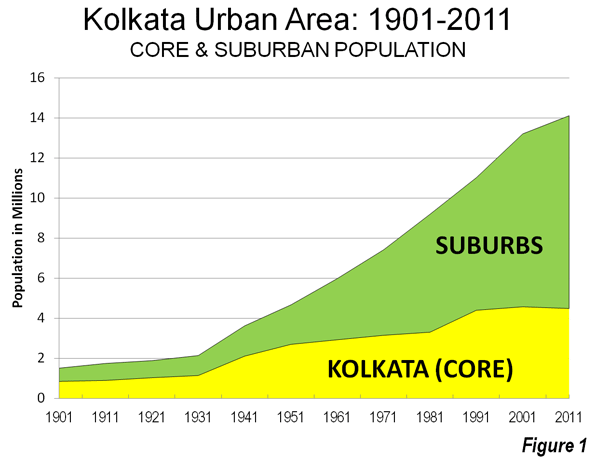
    Kolkata’s spreading urbanization, however, has been going on for at least a half century. Since the 1951 Census, the central city of Kolkata has accounted for only 19% of the urban area population growth. The central city has added nearly 1,800,000 people while the suburbs have added approximately 7,650,000 (Figure 1).

    Over the past two decades, the central city’s growth has been minimal, adding 87,000 people from 1991 to 2011, while the suburbs added more than 3 million new residents. This intensifies the pattern of the last half-century where most growth clustered close to the city core.

    Between 1901 and 1951, 59% of the growth in the Kolkata urban area was in the central city (Kolkata lost the British capital to Delhi in 1911).


    Photo: Victoria Memorial, KMC

    Slower Growth in the Urban Area: Kolkata is an unusually shaped urban area, nearly 50 miles (80 kilometers) long and stretched along the Hooghly River, one of the many mouths of the Ganges. Dhaka, the megacity capital of Bangladesh used to be on a mouth, until the river’s course changed. The urban area averages little more than 10 miles (16 kilometers) in width. The municipality of Kolkata is in the south, on the east bank of the Hooghly, with most of the suburbs to the north or just across the river.

    Like a number of major urban areas around the world, Kolkata has seen its population growth slow markedly. The peak population growth decade was the 1930s, when there was an increase of 69%. Growth dropped to 29% during the 1940s but continued at 20% or more until 2001. However, between 2001 and 2011, the urban area growth rate dropped to 7%, as the area added only 900,000 new residents. Despite its earlier, smaller size, the Kolkata urban area had not added this few people since the 1921 to 1931 decade.

    In reality, Kolkata is getting less dense by the day. The results of the 2011 Census of India showed that every new resident of the Kolkata urban area was added in the suburbs (Note 1). Yes, the central city of Kolkata remains very dense but its population fell from 4,573,000 people in 2001 to 4,487,000 people in 2011. At the same time, the population of suburban Kolkata grew by nearly 1,000,000 people, and accounted for 110% of the population growth.


    Photo: Howra Bridge, Hooghly River (Howra)

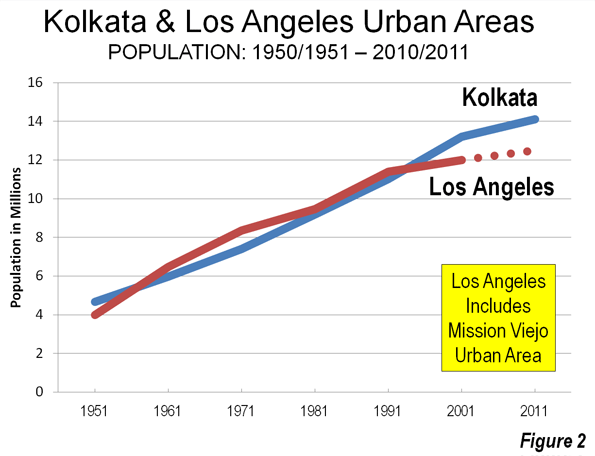
    Kolkata, Los Angeles and China: It also may seem strange that despite its huge typically third world growth since 1951, the Kolkata urban area grew at a rate similar to that of the Los Angeles urban area (Note 2). Los Angeles was larger from the 1960s to 1990, while Kolkata was larger in the 1950s and has been larger the last two decades (Figure 2). Still, Kolkata’s growth has fallen to high income world rates. Other Asian megacities (over ten million)  including Delhi, Shanghai, Beijing, Mumbai, Shenzhen, Manila, Jakarta, Dhaka and Guangzhou) have all experienced much faster growth over the past decade (Note 2). Shanghai and Beijing combined added nearly the same number of people as live in Kolkata.

    Hyper-Densities: Nonetheless, Kolkata continues to have some of the highest densities in the world. In 2001, one third of the central city population (1.49 million) live in slums and shantytowns (photo). They are crammed into just 2 square miles (5 square miles). This would be like all the population of the San Fernando Valley living within a radius 0.6 miles (1 kilometer) of Los Angeles City Hall or all the population of the city of Dallas in the space covered by the passenger terminals at Dallas-Fort Worth International Airport. This is more than 725,000 people per square mile (280,000 per square kilometer), and would nearly equal the "efficient density" definition that the Sierra Club wisely discarded. It can only be hoped that when the 2011 Census slum data is available, it will show that all of the city of Kolkata’s  population loss will have been from the slums.

    Kolkata, like that of other large urban areas around the world described in The Evolving Urban Form series, shows that, given a chance, people reveal their preferences by moving to more space, to construct a better life for themselves and their households.


    Photo: KMC Slum

    Wendell Cox is a Visiting Professor, Conservatoire National des Arts et Metiers, Paris and the author of “War on the Dream: How Anti-Sprawl Policy Threatens the Quality of Life

    Kolkata Urban Area: Population 1901-2011
    Year Kolkata Municipal Corporation (KMC) Suburbs Kolkata Urban Area (Urban Aggolmeration) KMC Share of Growth KMC Growth Suburban Growth
    1901         848,000         662,000          1,510,000 56.2%
    1911         896,000         849,000          1,745,000 51.3% 5.7% 28.2%
    1921      1,031,000         854,000          1,885,000 54.7% 15.1% 0.6%
    1931      1,141,000         998,000          2,139,000 53.3% 10.7% 16.9%
    1941      2,109,000      1,512,000          3,621,000 58.2% 84.8% 51.5%
    1951      2,698,000      1,972,000          4,670,000 57.8% 27.9% 30.4%
    1961      2,927,000      3,057,000          5,984,000 48.9% 8.5% 55.0%
    1971      3,149,000      4,271,000          7,420,000 42.4% 7.6% 39.7%
    1981      3,305,006      5,888,994          9,194,000 35.9% 5.0% 37.9%
    1991      4,400,000      6,622,000        11,022,000 39.9% 33.1% 12.4%
    2001      4,573,000      8,633,000        13,206,000 34.6% 3.9% 30.4%
    2011      4,487,000      9,626,000        14,113,000 31.8% -1.9% 11.5%


    —–

    (Lead Photo: Mahatma Gandhi Road, KMC.

    —–

    Note 1: This is the Kolkata "urban agglomeration," which is the term the Census of India uses to denote urban areas, or areas of continuous urban development. The Census of India, however, applies to criteria to its urban area definitions that make them difficult to compare to urban areas in other parts of the world. The Census of India does not, for example, allow an urban agglomeration to be defined across state lines. Thus, the Delhi urban area continues to be shown as smaller then the Mumbai urban area. This is despite the fact that the immediately adjacent urbanization of Delhi includes millions of additional people in the states of Haryana and Uttar Pradesh and is by international definition by far the largest urban areas in India. The other difficulty is that the Census of India includes the entire land area of any municipality in the urban area. Thus, where municipalities are particularly large in area, as in the case of Mumbai, considerably more land area is reported that he is truly urban. This can lower urban area densities by the inclusion of large areas that are rural. In the case of the call, urban area, the municipalities are generally much smaller, and the geographical definition of the Census of India is much closer to a genuine definition of an urban area or urban agglomeration.

    Note 2: The Mission Viejo urban area is included in the 2000 Los Angeles urban area population in this comparison. Much of this urban area was included in Los Angeles before the 2000 census and it seems likely that it will be reunited with Los Angeles in 2010. The 2010 US urban area geographical definitions have not yet been released. Based upon the change in the Los Angeles metropolitan area population, it is assumed that the Census Bureau’s urban area will show a population of approximately 12.5 million.

    Note 3: Chongqing is sometimes incorrectly characterized as a megacity, because of its status of a "provincial level municipality" in China. However, the Chongqing provincial municipality is largely rural, and covers a land area similar to that of Austria or Indiana. The Chongqing urban area has a population of approximately 7 million.

  • California’s Deficit: The Jerry Brown and ‘Think Long’ Debate

    California has three major problems: persistent high unemployment, persistent deficits, and persistently volatile state revenues. Unfortunately, the only one of these that gets any attention is the persistent deficit. It is even more unfortunate that many of the proposals to reduce the deficits are likely to make all three of the problems worse over the long run.

    Two major proposals to deal with the deficit will shape the coming debate. One is from the newly formed Think Long for California Committee; the other from the governor.

    Governor Jerry Brown’s plan would increase sales taxes, and would increase the tax rate on the portion of anyone’s income that is over $250,000 (the marginal rate). It is a general rule of tax analysis that if you want there to be less of something, tax it. Indeed, this proposal would result in some wealthier people leaving California, and it would accelerate the trend of substituting internet retail purchases for local retail purchases.

    It would also increase California’s tax receipt volatility. California’s tax base is dependent on the income of a relatively small group of wealthy people. It turns out that this income is more volatile than the economy. Increasing top marginal tax rates would only increase the volatility of the state’s revenue.

    So, why would the governor make such a silly proposal? I’ve heard a few reasons.

    • The government is starving and it needs the income now.

    This is nonsense. Combined national, state, and local government spending is now over 35 percent of gross product. This is highest it has ever been, including the peak spending years of World War II.

    We can disagree on the optimal size of government, but to argue that this is a time of scarce government spending is absurd.

    • The wealthy have too much money. We must increase the progressivity of California’s tax code.

    The governor’s proposal will do that. If implemented, the plan will give California the highest marginal tax rates in the United States. The problem is that people with high incomes often have more choices than most of us. They can move. They can reallocate earnings to other states or into less-taxed activities. They can just forego earnings if the return is too low.

    Most analysts agree that California’s tax structure should be broader based. The only way to do that is to make the system less progressive, not more progressive. Increasing taxes on the wealthy may feel good when the law is implemented, but it will eventually lead to lower tax revenues, increased revenue volatility, and slower economic growth.

    • There is nothing else we can do. The political situation does not allow a better fix.

    It never will be easy to implement comprehensive tax reform in California. There are too many groups with too much at stake. However, it is senseless to argue that we should therefore increase the distortions in an already distorted tax code. California has been doing this for years, and it just keeps making things worse. California’s governance is a mess precisely because it is the result of hundreds of ad-hoc decisions.

    California desperately needs comprehensive tax reform, “if not now, when?”

    Which brings us to the proposal by the Think Long for California Committee . The Think Long committee is a subset of California’s political elite. You will recognize many of the names; for a start: Nicolas Berggruen, Eli Broad, Willie Brown, Gray Davis, Condoleeza Rice, Bob Hertzberg, Eric Schmidt, Terry Semel, Laura Tyson, and George Schultz. The proposal has three components:

    Empowering Local Governments and Regions: Here’s what it says about decentralizing decision-making: “While the committee embraces the principles of de-centralization, devolution and realignment of revenues and responsibilities, we have not endeavored to propose precisely how that should be accomplished.”

    That’s a bit like endorsing Mom and apple pie, isn’t it? The committee has not earned itself any honor or credibility by failing to have a proposal for one of the three major components of its plan, the first that it enunciates.

    Improving Accountability: “The Citizens Council For Government Accountability – an independent, impartial and non-partisan body – would be established to develop a vision encompassing long-term goals for California’s future.”

    Only, it is not a citizens group at all. It would be funded by the state, and it would have access to state agencies for support. Nine of the committee’s thirteen members would be appointed by the governor, two of whom could not be registered in either party. The Senate Rules Committee and the Speaker of the Assembly would each appoint two members, one from each major party. The committee would have four non-voting ex-officio members: the director of finance, the state treasurer, the state controller, and the attorney general.

    That sounds to me a lot like just another government agency. Not exactly; this would be a super-committee with broad powers. It would soon be involved in almost every aspect of California’s government. The committee would have subpoena power, and the ability to publish on the election ballot its comments and positions on proposed ballot initiatives and referendums, as well as to place initiatives directly on the ballot.

    Giving the committee the ability to place initiatives directly on the ballot is a nice touch in a document that elsewhere tries to make it more difficult for others to place initiatives on the ballot.

    Restructuring the Tax Code: California’s tax code needs restructuring, no doubt about that. This proposal doesn’t get us to where we need to be, though. It reduces sales tax rates, top marginal income and business tax rates, and deductions from personal income taxes, except for education and health care, and for taxing services.

    In general, these are steps in the right direction. However, exempting education and healthcare is a serious, perhaps fatal, flaw. It amounts to a huge subsidy for those industries, and places an extraordinary burden on the remaining service providers. The exempted industries are big, and exempting them means higher taxes on other service providers.

    Who would actually bear the tax burden? That depends on the elasticities of supply and demand. In general, when demand is less elastic than supply (when the consumer is relatively indifferent to price changes), the consumer bears the tax burden, which is what is desired. However, for many services, it would appear that demand is not that inelastic.

    Consumers can easily reduce the frequency of services such as haircuts, lawn maintenance, and the like. This would shift the burden of the tax from the consumer to the provider, that is, the hairdresser or landscape worker. In many cases, these are very low-income workers, making the tax extraordinarily regressive. California’s tax code needs to be less progressive, but this could be a huge regressive swing, one that would create extreme hardships for some of our least advantaged citizens.

    Economic theory is clear that there are fewer distortions in consumption taxes than in income and capital taxes. However, these models assume that the tax burden is squarely placed on the consumer. It appears that for many services this may be impossible. Perhaps that is why we don’t observe many service taxes.

    It is also the case that, in many services, taxes are avoided by the use of cash transactions. Estimates of the size of the “underground economy” vary, but most economists believe it is significant. A tax on services would likely increase its size dramatically.

    The Think Long proposal is not the solution to California’s challenges. It does, however, represent far more thought than went into the governor’s proposal. It provides a service, in that it provides a starting point for a conversation that California desperately needs.

    Photo by Randy Bayne; California Governor Jerry Brown

    Bill Watkins is a professor at California Lutheran University and runs the Center for Economic Research and Forecasting, which can be found at clucerf.org

  • The Driving Decline: Not a “Sea Change”

    The latest figures from the United States Department of Transportation indicate that driving volumes remain depressed. In the 12 months ended in September 2011, driving was 1.1 percent below the same  period five years ago. Since 2006, the year that employment peaked, driving has remained fairly steady, rising in two years (the peak was 2007) and falling in three years. At the same time, the population has grown by approximately four percent. As a result, the driving per household has fallen by approximately five percent.

    There are likely a number of reasons for the driving decline, some of which are described below.

    Democratization of Mobility: The leveling off of driving is something analysts have expected for some time. More than ten years ago, Alan Pisarski noted that drivers licenses and automobility had saturated the market among the While-non-Hispanic population. For decades, driving had been increasing at a substantially faster rate than the population, as driving rates for women and minorities converged  upon the rate of White-non-Hispanic males.

    Clearly, the continued, extraordinary increase in driving of recent decades could not be expected to continue, since nearly all were already driving. Pisarski called this the "democratization of mobility" in a 1999 paper. At that time only African-Americans and Hispanics were still behind the curve. The recent economic difficulties have slowed the progress toward equal automobility for minorities. In 2009, American Community Survey data indicates that the share of Hispanic households without access to a car remained 40 percent above White-non-Hispanic Whites. The rate of African-American no-car households was 20 percent above that of White-non-Hispanics. The driving decline reflects in large part the failure of the economy to produce equal mobility opportunities for minority households.

    Higher Gasoline Prices and the Middle Class Squeeze: One of the most important factors has to be the unprecedented increase in gasoline prices. Over the past decade, gasoline prices have doubled (adjusted for inflation) and have remained persistently high. It has worsened in the last five years, with prices having risen more rapidly than in any period relative to the previous decade in the 80 years for which there are records. This has taken a huge toll on households. At average driving rates, budgets have increased by nearly $1,800 annually to pay for the higher gasoline prices. In a time (2000-2010) that median household incomes declined $3,700 (inflation adjusted), it is not surprising that people are driving less.

    Unemployment: Not Driving to Work: Today’s higher unemployment means that fewer people are driving to work. Employment peaked in 2006. Assuming average work trip travel distances, the smaller number of people working now would reduce travel per household by more than one percent (one-fifth of the household reduction).

    Shopping Less Frequently due to Higher Gasoline Prices: According to the Nationwide Household and Transportation Survey (2009), the average household makes 468 shopping trips annually. If shopping trips were reduced by one quarter in response to higher gasoline prices, the reduction in travel per household would be enough, along with the work trip reductions, to account for all of the decline over the past five years.

    Information Technology: Not Driving and Telecommuting Instead: Again, advances in information technology appear to have also added to the decline. Even while employment was falling, working at home (mainly telecommuting) increased almost 10 percent between 2006 and 2010 (latest data available) and telecommuting added six times as many commuters as transit. Working at home eliminates the work trip and is thus the most sustainable mode of access to employment. In just four years, in working at home removed as much automobile travel to work as occurs every day in the Salt Lake City metropolitan area.

    More Information Technology: Not Driving and Texting Instead? Adie Tomer at the Brookings Institution notes a decline in the share of people 19 years and under who have drivers licenses as potentially contributing to the trend. She cites University of Michigan research by Michael Sivak and Brandon Schoettle, who documented the decline. Sivak told The Michigan Daily that "a major reason for the trend is the shift toward electronic communication among America’s youth, reducing the need for ‘actual contact among young people.’"

    Still More Information Technology: Not Driving and Shopping On-Line Instead? And, as with electronic communication and telecommuting, there is also an information technology angle to shopping. The substantial increase in on-line shopping could be reducing shopping trips.

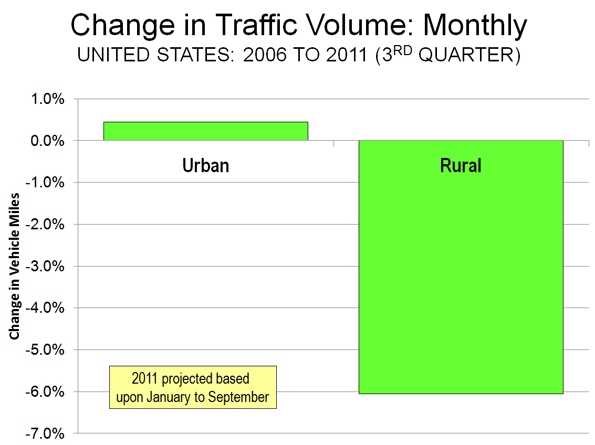
    Not Making Intercity Trips? All of the loss in driving has been in rural areas, rather than urban areas. Since the employment peak in 2006, urban driving has increased 0.4 percent (though driving per household has decreased). By comparison, rural driving has declined 6.0 percent (Note). This much larger rural driving decline could be an indication that people have reduced discretionary travel, such as longer trips that extend beyond the fringes of urban areas (Figure). As with transit, however, it would be a mistake to characterize Amtrak as having attracted much of the reduced rural travel (or for that matter from airlines, see If Wishes were Iron Horses: Amtrak Gaining Airline Riders?). Over the period, Amtrak’s gain (passenger mile) has been approximately one percent of the rural loss.

    Not Driving and not Transferring to Transit: Transit ridership trends have been generally positive over the past decade. Since 2006, transit ridership has risen 3.4 percent. This compares to the 1.1 percent decline in automobile use. However, it would be incorrect to assume attraction to transit as contributing materially to the decline in driving. Because transit has such a small market, even this healthy increase has budged its urban market share (now approximately 1.7 percent) up by barely 0.5 percentage points.

    Besides scale, there is another reason transit has not been the beneficiary of the driving reduction. Automobile competitive transit service is simply not accessible for most trips. For example, it is estimated that less than four percent of metropolitan jobs can be reached in 30 minutes by transit for the average metropolitan area resident. This compares to the more than 65 percent of automobile commuters who do reach their jobs in 30 minutes or less. In short, transit is not an alternative to the car for the vast majority of urban trips.

    It does no good to suggest this can be materially improved by increasing transit service. The most lucrative transit markets are already served, and new ones would be more expensive. This is illustrated by the exorbitant cost of adding ridership. Over the most recent decade, transit ridership increased 21 percent, which required an expenditure increase of 59 percent, nearly three times as much.

    Decentralization of Jobs and Residences: The 2010 census indicated that the American households continue to decentralize, increasingly choosing to live in single-family detached houses in the suburbs. The same trend has been occurring in employment locations, as Brookings Institution research indicates. Between 1998 and 2006, less than one percent of new employment was located within three miles of urban cores. Nearly 70 percent of the new jobs decentralized to outer suburban rings.

    The continuing dispersion of jobs and residences could dampen the increase rate of driving in the years to come, as households have greater opportunities to live in the suburban surroundings they prefer, while also commuting to the more proximate jobs that have moved to the suburbs.

    The Decline in Context: Among the potential causes, certainly the most important is the economic situation,with steeply declining household incomes and the worst economic situation since the 1930s. The longer term driving trends will be more apparent when (and if) prosperity restores healthy growth in employment. Moreover, with only a small part of travel being attracted to transit, a more significant shift could involve substitution of access by information technology (on-line). Even with the decline, however, there has been nothing like a "sea change" in how the nation travels.

    Note: The data on driving is estimated from Federal Highway Administration (FHWA) reports. FHWA produces monthly preliminary estimates, which are subsequently adjusted in annual reports.

    Wendell Cox is a Visiting Professor, Conservatoire National des Arts et Metiers, Paris and the author of “War on the Dream: How Anti-Sprawl Policy Threatens the Quality of Life

    Photograph: Harbor Freeway, Los Angeles

  • Public Pensions: Reform, Repair, Reboot

    Ill-informed chatter continues to dominate the airwaves when it comes to California public pensions. It’s a big, complex and critical issue for government at all levels in the Golden State. What makes debate so distorted is that public pensions actually differ from agency to agency — and advocates on the issue often talk past each other. Pension critics often point to outrageous abuses as if they were typical. On the other hand, pension defenders often cite current averages that understate long-term costs. All this fuels the typical partisan gridlock that Californians lament yet seem powerless to change in our state.

    Credit Governor Jerry Brown for trying to overcome the polarization. That’s what most California voters want him to do, according to a new Field Poll, one of the leading opinion research firms in California. His 12-point pension package (unveiled in October) is successfully framing the debate — and enjoys encouraging support from voters. I agree with them. While Brown’s plan is far from perfect (as he acknowledged in presenting it as a way to build consensus) it sensibly tackles some of the most challenging areas where reform is needed. Among the key reforms he’s proposed:

    • Increasing the retirement age from 55 to 67 (with a lower age to be spelled out for public safety workers).
    • Replacing the current “defined benefit” pensions with a hybrid program that includes a defined benefit component, but also a 401(k)-like defined contribution component
    • Prohibiting retroactive pension increases.
    • Requiring all employees to contribute at least 50 percent of the cost of their pensions

    These generally follow the surprisingly strong stand taken by the League of California Cities, which was based on recommendations from a committee of City Managers that I served on. Our work was grounded in four core principles:

    1. Public retirement systems are useful in attracting and retaining high-performing public employees to design and deliver vital public services to local communities;
    2. Sustainable and dependable employer-provided defined benefits plans for career employees, supplemented with other retirement options including personal savings, have proven successful over many decades in California;
    3. Public pension costs should be shared by employees and employers (taxpayers) alike; and
    4. Such programs should be portable across all public agencies to sustain a competent cadre of California public servants.

    Our goal was to ensure the public pension system is reformed, instead of destroyed. Our reform package mirrors Brown’s calls for a hybrid system, raising retirement ages and increasing the portion of pension costs borne by employees. We also backed his bid to base retirements on the top three highest years of pay, curbing the abuses that often artificially raise final year salaries to “spike” pension pay-outs.

    Typical of California’s other challenges, the issue faces long odds in the Legislature and uncertain fate at the ballot box. Partisan Democrats are leery of crossing unions by embracing Brown’s package. Partisan Republicans are demanding more far-reaching changes. Brown hopes to bridge the differences to win majority support by drawing on moderates in both parties. “He hasn’t riled up one side or the other,” noted Field Poll director Mark DiCamillo. “He’s managed to strike the middle ground on a very polarizing issue.” Unfortunately, moderates are hard to find in Sacramento.

    That leaves the roll of the dice that comes with ballot initiatives. Since it takes millions to bankroll a successful ballot measure, few sensible measures get far without support from well-heeled interests.

    In the eternal game of chicken that goes on in Sacramento, the Legislature keeps one eye on those special interests. About the only hope for reform is if a majority is worried that failure to act might spur an expensive ballot box war and an even worse outcome.

    This issue might be the exception, however. Public outrage is real. So is the need for reform. In Ventura, we took an early lead on this issue, first with our Compensation Policies Task Force, then union contracts that established a lower benefit and later retirement age for new hires and increased contributions from all employees of at least 4.5% of their pay. But real reform to level the playing field can only come at the State level.

    Before this issue devolves into another ballot box catastrophe that radically oversimplifies the issues to a “yes” or “no” choice on an initiative bankrolled by special interests, legislators in both parties need to come together on sensible reform. The Governor has put such a program on their desks. Reasonable people can differ on the details. But only unreasonable people want all-or-nothing victories. This is an issue that both sides should be willing to compromise on. The only way that will happen is if voters push both parties toward sensible compromise in the year ahead!

    Photo by Randy Bayne

    Rick Cole is city manager of Ventura, California, and recipient of the Municipal Management Association of Southern California’s Excellence in Government Award. He can be reached at RCole@ci.ventura.ca.us

  • California in 2011: Suburbs Up, Exurbs Down?

    I had the fortune recently to stumble on the California Department of Finance’s estimates of population change in California during the period July 1, 2010 – July 1- 2011. This is distinct from the Federal census, which tried to establish the number of people in all localities as of April 1, 2010. These California statistics are for a short period of only one year; they are not as reliable, of course, as a real census.  

    Percentagewise, the county that grew fastest was a Sacramento suburban county called Placer, which grew by 1.45 per cent (or, I suppose, what financial people would call 145 basis points) during that one year. It was also only one of two California counties where more people moved to from within the United States than from outside the United States (the other being Riverside County). It was also  one of three where the number of people moving in over that moving out was greater than the excess of births over deaths, the other two being Napa County, which is suburban in its southern reaches before the grapes begin, and San Francisco County, which is known for, well, for not being big on baby-making. (Nevertheless San Francisco County did have a natural increase of 3,138 persons, whereas, as we shall see later, some rural counties had more deaths than births.)

    But what came as a surprise  was that Placer’s sister county, El Dorado, also a Sacramento suburban county running up into the mountains, gained a mere 26 basis points; and the other foothill counties of the Gold Country actually lost population during the year! This came as a surprise to me, for I have a house in Calaveras County and in the past I had spent time there; the Gold Country seemed to be a haven for the semi-retired and the part-time worker and even the long distance commuter; and Grass Valley had the beginnings of a high tech industry spilling over from Silicon Valley.

    I don’t know what the terms “suburb” and “exurb” mean to New Geography readers, but I have my own definition which seems handy enough to me. A “suburb” has subdivisions and planned communities; developers buy land, subdivide, and build homes or sell lots often with covenants of various kinds.  People still prefer suburbs – even ones quite distant from the urban cores – over the city, in part due to factors like cheaper housing, better schools, and newer amenities.

    Exurbs are different. In an exurb, people split parcels into smaller lots, sell the lots, and then people build custom houses on them with no covenants (except maybe a few easements) and any architectural style the government will allow and perhaps a few they don’t. A good place to see the contrast is in the area just north of Cajon Pass. Victorville, Adelanto, and parts of Hesperia and Apple Valley abound with subdivisions, like the Orange County of my youth. But if you go a little bit to the southwest, around Pinnon Hills and Phelan, there is not a “subdivision” to be seen, and yet houses and, on the road, commercial establishments get thicker and thicker every year. (I have, on occasion for the past 25 years, taken the road to the monastery at Valyermo from Orange County, and I have seen these changes.)

    Overall, it looks like the “suburbs” are growing – far more than the cities –  while the “exurbs” are not. Placer County is an explosion of subdivided suburbs and “planned communities” as far as Newcastle and Lincoln.

    In contrast, El Dorado has some of these in its west end, but they are not expanding much. And the other Gold Country Counties, Nevada, Amador, Calaveras, Tuolumne, and Mariposa, all of which shrank slightly in population, fit my definition of “exurban” – they have exurbs, and they are not very agricultural unless you count backyard wine and marijuana patches.  These areas had been much sought out since the inflationary “survivalist” days of the 1970s. Now, it seems, the economy and gasoline prices are not affecting the prosperity and desirability of organized suburbia, but they are making the areas beyond organized suburbia less desirable than they used to be. I wonder if this is a nationwide trend.

    Another discovery may point to the age of residents in various counties. Of the counties that actually lost population over the year the three on the Redwood Coast  – Del Norte, Humboldt, and Mendocino – did so in spite of having an excess of births over deaths. So did the two in the far northeast, Modoc and Lassen. To read that a county in California lost population is in the “this I have lived to see” category.

    Oddly, did one county in the Central Valley also declined. Kings, which is metropolitan Hanford, declined despite the fact that next door Tulare County was a big gainer; and Inyo County – home of Bishop, Lone Pine, and Death Valley – had an identical number of births and deaths. On the other hand, the Gold Country counties I mentioned – plus Sierra, Plumas, Siskiyou, Trinity, and Lake, outside the Sacramento Valley – had an excess of deaths over births. Perhaps these particular counties, more than the others, had been settled by retirees or empty nesters, who were no longer having children.

    For its part, the rain-drenched Redwood Coast and the far northeast were less attractive, apparently, to retirees. In the counties not attractive to retirees, natural increase exceeded even immigration from outside the United States, which was positive in every county except Alpine, where it was exactly zero. Also, only in the aforementioned Placer and Napa Counties, and the City of San Francisco, did inward migration of any kind – from the U.S. or outside – exceed the “natural increase.”

    The “native Californian,” once a slightly exotic phenomenon, seems to be becoming the norm. The days of what Carey McWilliams called, in his book title of 70 years ago, California: The Great Exception, seem to be at an end. We have entered a world we never knew before. California may become, at long less, less exceptional, still sprawling but in a more organized fashion.

    Howard Ahmanson of Fieldstead and Company, a private management firm, has been interested in these issues for many years.

    Photo courtesy of Bigstockphoto.com

  • California: Codes, Corruption And Consensus

    We Californians like collaboration. Before we do things here, we consult all of the “stakeholders.” We have hearings, studies, reviews, conferences, charrettes, neighborhood meetings, town halls, and who knows what else. Development in some California cities has become such a maze that some people make a fine living guiding developers through the process, helping them through the minefields and identifying the rings that need kissing.

    Here’s an example. This is a (partial?) list of the groups who will have a say on any proposed project in my city, Ventura:

    • City agencies (Planning, Engineering, Flood Control, Traffic, Building & Safety, Utilities, Police, Fire)
    • Historic Preservation Committee
    • Parks and Recreation Committee
    • Design Review Committee
    • Planning Commission
    • City Council
    • School District
    • Neighborhood and Community Councils
    • No-Growth Citizen Groups
    • Chamber of Commerce
    • Ventura Citizens for Hillside Preservation
    • California Department of Fish and Game
    • United States Department of Fish and Wildlife
    • Ventura County Local Agency Formation Committee (discretionary authority regarding annexations)
    • Los Angeles Regional Water Quality Control Board (new MS4 Stormwater Permit issues)
    • Ventura County Environmental Health
    • California Coastal Commission (for some projects within the Coastal Zone)
    • California Native American Heritage Commission and Designated Most Likely Descendant of local tribe
    • United States Army Corps of Engineers
    • Natural Resources Defense Council, Surfrider Foundation, Heal the Bay, other environmental groups
    • And all parties who have requested to be on notice, as well as the general public and other agencies, will be informed of any California Environmental Quality Act (CEQA) document.

    I didn’t pick Ventura because it is the most difficult. It’s not. I think Ventura is pretty typical for a coastal California city, actually.

    The result of having all these stakeholders is that, in many California communities, particularly those in coastal and upscale locations, everyone has a veto on everything. At the beginning of a project the developer faces a huge amount of uncertainty about what the project will look like once it gets past the gauntlet and about the cost of the development process. Add to that uncertainty about who will demand what, how long the approval process will take, market conditions and the regulatory environment when the project is completed, if it is completed.

    This is where the corruption connection comes in.

    In economics, we teach that there are two types of corruption, centralized and decentralized. Decentralized corruption is the more pernicious of the two.

    Think of a city where organized crime has a successful protection racket. This would be centralized corruption. The mob is going to collect from everyone, but it has an incentive not to collect too much. It doesn’t want to draw too much attention to itself or chase the business out of town.

    By contrast, decentralized corruption consists of a bunch of independent gangs, each trying to collect all they can before the next group of thugs comes along. Each gang of thugs will demand and collect too much, and chase the business out of town.

    Of course, if you want to develop a property in California no one will hold a gun to your head and demand money, and everyone is way too polite to call it extortion. Certainly, no group thinks of itself as a mob of corrupt gangsters. Instead, the members think of themselves as stakeholders, and they hold delays, lawsuits, or project denial to your head. The results are the same.

    First, you have to meet everyone, and everyone wants something in return for support, or for refraining from opposition. Groups will demand “mitigation fees,” delays, studies and more studies, and changes in the project. You will meet their demands, or you will be sued, or the project will be denied.

    Time spent on meetings, studies, and negotiations is expensive. The cost of the local “guide,” necessary to get through the local maze, is expensive. The “mitigation fees” are expensive. Delays are expensive. Studies are expensive. Changes in the project are expensive. Lawsuits are expensive. And risk is expensive.

    Eventually, the project is no longer profitable. No wonder California’s unemployment rate is 30 percent above the United States unemployment rate.

    The current climate provides California’s local governments with their best economic development opportunity: Eliminate the legal extortion by guaranteeing a project’s prompt approval if it meets existing general plans, specific plans, zoning, building codes, and adopted design criteria. Any community that did this would see immediate increased economic activity. To steal a phrase from a famous economist, it is the closest thing to a free lunch.

    A city does outreach before it develops its zoning and community design plans. It only adds to the cost of development to require builders to go through the entire process again, fighting the same battles, every time a project is proposed.

    The best thing about this idea is that it has been tried, and it works. The City of San Diego has seen an amazing-for-California energy since its redevelopment agency implemented such a plan several years ago. In the worst economy in 50 years, San Diego has been building and providing commercial and housing projects for all economic levels in its downtown area. It is time for the rest of California to get on with it.

    Bill Watkins is a professor at California Lutheran University and runs the Center for Economic Research and Forecasting, which can be found at clucerf.org

    Photo: Two Tree Hill, Ventura California by Joseph Liao (Chowee).

  • Durban, Reducing Emissions and the Dimensions of Sustainability

    The Durban climate change conference has come to an end, with the nations of the world approving the "Durban Platform," (Note 1) an agreement to agree later on binding greenhouse gas (GHG) reduction targets by 2020. The New York Times reported: "Observers and delegates said that the actions taken at the meeting, while sufficient to keep the negotiating process alive, would not have a significant impact on climate change."

    Not surprisingly, not all are pleased by the largely toothless agreement. Nnimmo Bassey, chair of Friends of the Earth international, told The Guardian:"Delaying real action till 2020 is a crime of global proportions." Todd Stern, the United States representative, signed on to the deal but noted that "there is plenty the US is not thrilled about."

    There is general agreement that any program to reduce GHG emissions must do so in the most efficient (least expensive) manner. The United Nations Intergovernmental Panel on Climate Change (IPCC) has concluded that sufficient emissions reductions can be achieved for between $20 and $50 per ton. Any cost above that must be considered wasteful and likely to reduce economic growth, while increasing poverty.

    Yet, researchers often leap from identifying a strategy to reduce GHG emissions to recommending its implementation, without ever examining the cost.

    Often  missed for instance, is that reductions in some sectors may prove less expensive than in others. The European Conference of Ministers of Transport has noted that "It is important to achieve the required emissions reductions at the lowest overall cost to avoid damaging welfare and economic growth." Across-the-board targets would misallocate resources, unnecessarily reducing economic growth and increasing poverty. This is particularly important in transport, because IPCC data indicates the potential for cost effectively reducing GHG emissions from this sector is considerably less than its contribution to emissions.

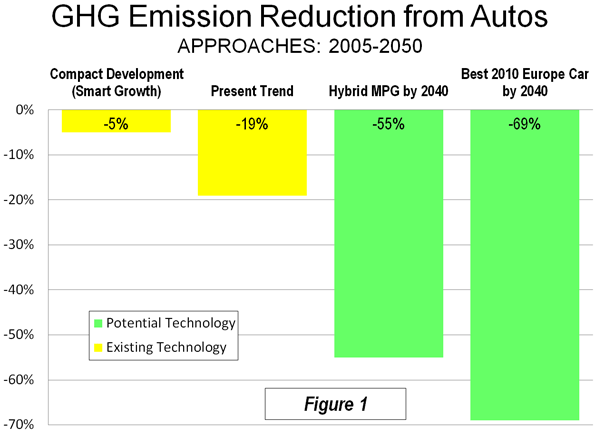
    GHG Emissions from Automobiles: In the United States and other high income nations, however, mandates are being pursued that would impose far higher costs. Our new report, published by the Reason Foundation, Reducing Greenhouse Gas Emissions from Automobiles reviews two general approaches. The first is behavioral approaches, the favorite of policymakers, that would force people to leave the suburbs to live in higher densities ("compact city" or "smart growth" policies) and discourage personal mobility. The second is facilitative approaches, which would reduce GHG emissions through technological advances, minimizing the necessity for command and control mandates over people’s lives.

    Behavioral Approaches: In what passes for the conventional wisdom, current thinking would require densification for virtually all new development, while trying to force people out of cars to travel by transit, bicycle or walking, all characterized as "sustainable" transport modes. Further, these strategies would seriously impede personal mobility by increasing travel times and reducing access to employment. This reduction in accessibility to jobs would be a backward step for any nation interesting in longer term economic growth (Note 2).

    The behavioral strategies are described in two principal US reports: Driving and the Built Environment which was produced by the National Research Council and Moving Cooler, by a consortium of organizations led by the Urban Land Institute and Cambridge Systematics. Each of these reports provides detailed estimates of the GHG emission reductions to be expected from land-use and mass transit strategies by 2050 in the United States.

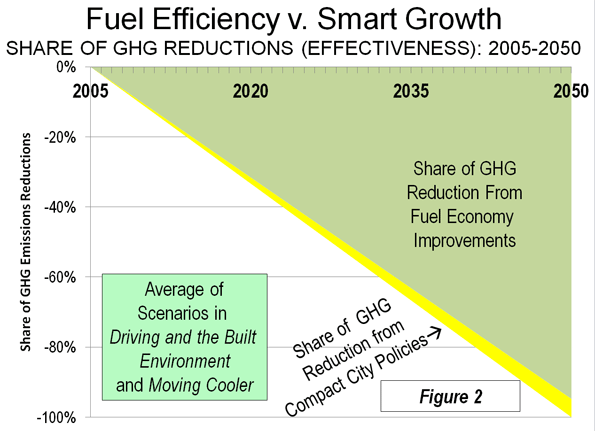
    The reductions are relatively modest, averaging less than 5% from the early 2000s to 2050 .  Driving and the Built Environment indicates that the drafters did not agree its most aggressive scenario was achievable. Moving Cooler was soundly criticized by the American Association of State Highway and Transportation Officials and on these pages by leading transport consultant Alan E. Pisarski (see: ULI Moving Cooler Report: Greenhouse Gases, Exaggerations and Misdirections).

    These proscriptive policies focus on housing and land use even thought nearly all of the improvement in GHG emissions would result from automobile fuel economy improvements, not compact city policies. Depending upon the scenario, between 89% and 99% of the reduction in GHG emissions from cars by 2050 (Figure 1) would be the result of fuel economy improvements, rather than from compact city policies (based on comparison base year, early 2000s, fuel economy).

    Moreover, even the modest 1% to 11% reduction (5% average) in GHG emissions due to compact city policies are likely high because of greater traffic congestion, which neither report considers. Higher density urban areas, such as compact city policies would require, would spark greater traffic congestion. This means that cars travel slower and in more erratic traffic conditions. This, ironically, increases fuel consumption and GHG emissions per mile or kilometer. Thus, as noted here before, under these policies, GHG emissions from cars could actually increase.

    Neither Driving and the Built Environment nor Moving Cooler report considers the economic impact of compact city land rationing, which drives up housing prices and could thus be expected to impose higher costs on households. The economic literature is virtually unanimous in associating higher land and thus house prices with smart growth type land rationing policies. The increased costs could be many times the IPCC $20 to $50 per ton of GHG emissions removed.

    Even the popular assumption that suburban housing produces materially greater GHG emissions is questionable. Most US research fails to capture the common GHG emissions from elevators, heating, air conditioning, lighting, etc. in larger multi-unit housing, which are costs attributed to the building itself (landlord or condominium building) as opposed to  household energy bills (simply because there are no data). Yet, research in Australia indicates that common GHG emissions render higher density multifamily housing more GHG intensive than either townhouses or detached housing. Also escaping many researchers is the fact that carbon neutral housing is being developed, which could remove any GHG emissions differences between housing types.

    Compact city or smart growth policies have little potential to reduce GHG emissions and would do so at exorbitant costs that are well beyond those identified by the IPCC. This is not surprising, since compact city and smart growth policies have been widely touted long before the general concern over climate change. Denser cities have been pushed as a means to improve “community,” spur economic efficiency,   reduce air pollution and deal with such ephemeral – given recent massive energy finds – notions of “peak oil”.

    Facilitative Approaches: Any achievable program to reduce GHG emissions must be multi-dimensional and focus primarily on achieving that goal in the most economically and socially beneficial manner and not be based upon tired policies designed long ago to serve other agendas. There is no need for expensive and draconian compact city approaches. A report by McKinsey and the Conference Board concluded that substantial and cost effective GHG emission reductions were possible, “while maintaining comparable levels of consumer utility,” which was defined as “no change in thermostat settings or appliance use, no downsizing of vehicles, home or commercial space and traveling the same mileage.” In other words, there is no need to interfere with people’s lives or preferences (Note 3).

    The most promising approaches involve improvements in fuel economy. For example, Volkswagen has developed a two-seater car that achieves 235 miles per gallon (US) of gasoline or petrol (1 liter per 100 kilometers). With current fuel economy averaging little over 20 miles per gallon (12 liters per 100 kilometers) in the United States, the frontiers of fuel economy improvement have barely been approached.

    Moreover, substantial GHG emissions reductions can be achieved at levels far below 235 miles per gallon. The United States Department of Energy, Energy Information Administration (EIA) forecasts that even if driving increases 29% from 2005 to 2025, GHG emissions from cars would be reduced by 7% (Note 4). If, as is demonstrably possible, the EIA forecast fuel efficiency improvements were to continue to 2050, the reduction would be 19%, despite an increase in driving of more than 60%. At a slower driving growth rate more consistent with more recent trends, the reduction could be 33% (Figure 2).

    Further, if the US light vehicle fleet (cars and sport utility vehicles) were to achieve the current fuel economy performance of the best hybrid vehicles, the reduction in GHG emissions would be between 55% and 64% by 2050. Matching European performance forecasts would reduce GHG emissions even more.

    A substantial increase in the fastest growing sector of commuting, working at home (often telecommuting), could also help. Nothing can cut emissions more thoroughly than working at home, which produces zero GHG emissions. Yet, this innovation – which already surpasses transit use in most American metropolitan areas – inexplicably receives little or no attention from planners intent on herding people into higher densities and travel modes that take longer.

    The great advantage of facilitative approaches is that, as the McKinsey-Conference Board report indicates, people are permitted to live their lives as they prefer even as emissions are reduced.

    The Dimensions of Sustainability: Perhaps the greatest problem with behavioral approaches is that they may not be sustainable at all. Sustainability is multi-dimensional. Compact city and smart growth policies lack financial sustainability because they spend far too much per ton of GHG emissions. They lack economic sustainability because they would impose substantially higher costs, especially on housing prices. Ultimately, unless humans radically change their demonstrated preferences, compact city and smart growth policies may not be politically sustainable because people are likely to resist them either at the ballot box, or by moving – as demonstrated in the latest census – even further out from the urban core or to smaller, less regulated and less dense regions. All three dimensions of sustainability, financial, economic and political, must be prerequisites to material GHG emissions reductions.

    Notes:

    (1) Reuters provides an early summary of the Durban Platform.

    (2) The strong connection between economic growth and minimizing urban travel times is identified in research such as by Prud’homme and Lee at the University of Paris and Hartgen and Fields at the University of North Carolina, Charlotte.

    (3) The McKinsey-Conference Board report was co-sponsored by Shell, National Grid, DTE Energy and Honeywell, as well as environmental advocacy organizations, the Environmental Defense Fund, the Natural Resources Defense Council (NRDC),

    (4) Proponents of compact city policies sometimes claim that fuel efficiency improvements cannot reduce GHG emissions because the increase in driving neutralizes their impact. EIA projections indicate otherwise, as is shown here.

    Wendell Cox is a Visiting Professor, Conservatoire National des Arts et Metiers, Paris and the author of “War on the Dream: How Anti-Sprawl Policy Threatens the Quality of Life

    Photograph from BigStockPhoto.com