Category: Suburbs

  • Home Sweet McMansion

    Is the new American house, with three-car garages and laundry chutes like Olympic ski runs, an improvement over the old ones that were limited to a cozy dining room, a den, and a kitchen that held a small round table on which was kept a toaster?

    The size of the American house tracks the evolution of the budget deficit and national debt. Think of McMansions as you would the Federal Reserve Bank—an imposing edifice with the contents of the garage pledged to Household Finance, if not the Chinese.

    Many neighborhoods have become the United States of Gatsby.

    Because I live in Europe but travel across America to visit family and friends, I will start my appraisal in the guest room.

    In my wanderings, I have slept on bunk beds, fold-out sofas (one called “the rack of pain”), camping mats oozing air, and luxury, king-sized mattresses, suitable for a sultan. This summer, I woke up in the middle of the night to find two dogs nestled against my feet. My only objection was when they chose to growl at each other at 3:00 a.m.

    What makes a great guest room? My tastes are idiosyncratic, but I like a room that has bookshelves, a good reading light, a clock that works, a large desk, Wi-Fi, windows that open onto cool air, the distant sounds of trains in the night, hooks instead of closet hangers, and a cat that buys into guests.

    Instead of television, I prefer a radio beamed up to the BBC World Service and a side table of magazines (ones devoted to gardens, yachts, and celebrity divorces are the best) that I would never buy or read, unless I were a guest. I like coming down in the morning with up-to-date information on Jody Foster’s career. (She’s loyal to Mel Gibson, despite his crazy rants.)

    Having been recently in Pennsylvania, North Carolina, and New Jersey, I can report that the American guest room is alive and well. As for the rest of the new American home, the jury is out, or least meeting with the architect to design several thousand more square feet of pool rooms, wet bars, conversation pits, walk-in closets, and fireplaces that ignite with jet propulsion.

    When I last lived in the United States in the 1990s, our kitchen was the size of a pantry. If I held my arms outstretched, I could almost touch both walls, and the length was less than that of a stretch limo (literally and figuratively, imagine the oven in the trunk).

    Nevertheless, that kitchen was a perfect place to feed a family of four, prepare a dinner party, and hold a conversation. The cost to renovate the kitchen was about $900, but that’s because we went with a “custom” linoleum countertop that fit around the stove top. The overhead light came from a closed New York City school. A neighbor, whose services we won at a charity auction, repainted the cupboards.

    Now the American kitchen is the size of Polynesia and comes with archipelagos of “islands,” a nearby “family room,” television screens that could track a lunar launch, machines that dispense coffee and boiling water on demand, hidden drawers that contain freezers, enough marble to impress the Emperor Aurelian, and appliances that give the room the air of an operating theater.

    The “new” kitchen is designed to celebrate the diversity of American families—imagine Thanksgiving with the Brady Bunch, maybe over at Bill Cosby’s house—although best as I can judge from my travels, these tribal nations rarely eat together, in the kitchen or anywhere else.

    Like nomads, children and adults wander through the new American kitchen as if it were the Serengeti, collecting food and drink until the grazing land is stripped, and then they head off to a cave, to surf the web, text, or watch movies.

    I would say that the herd goes to the living room, but I haven’t seen anyone in an American living room since “Gunsmoke” was aired during the Eisenhower administration.

    Part of the reason that living rooms are now as forlorn as a safe house is because the television is elsewhere and because there are few formal occasions to sit in the American living room, which often looks as though it could be hired out to a funeral parlor.

    As a guest, I am sometimes granted a living-room audience. As a rule of thumb, however, Americans prefer to talk to their guests when standing up in the kitchen or sitting outside on the porch.

    Porches are one of the few areas of the house that modern architecture has improved. Screened porches used to be small and cramped, with patches on the screen where the bugs had drilled holes in the night.

    In places like Florida, there are now screened porches that are the size of the backyard; in fact, they are the backyard, and the netting and enclosed jungle trees give the terrace the air of a film location on “Survivor.” But I admire anything that allows me to sit outside, beyond the reach of mosquitoes. I also like the practical evolution of the outdoor kitchen, even though the idea seems better suited to the Roman senate.

    Part of the reason that many new American houses lack a central focus (think of the courtyard in a Spanish hacienda or an English fireplace) is because television is the high alter of fleeting attention, and screens pop up in all sorts of diverse places, as though part of a billboard campaign.

    I have seen televisions in the basement, in small dens, in exercise rooms, on kitchen and living room walls, and on small robotic arms that shift the blue haze around the bathroom as if it were yet another jet spray coming out of the shower or Jacuzzi.

    Nevertheless, television watching is a solitary endeavor and programs could be beamed into headsets, for all they foster family or community. Its effect on house layout is put up electronic walls that the architects have spent thousands of dollars to remove, in the spirit of open design.

    In my experience, happy houses are those that work in spite of their obvious flaws, like all those New York City apartments that used to have a bath tub in the kitchen or farmhouses with large wood stoves just inside the kitchen door.

    In the 1970s, I loved visiting a house in Maryland that instead of a front hall had an indoor rock garden. The meals were cooked outdoors on an open flame, but no one left the dinner table before midnight, unless it was to go for beer (kept outdoors).

    The house in which I grew up had claw-footed tubs and one shower. Between 1961 and 1994, when my parents lived there, home improvements consisted of cosmetics and painting (sometimes carried out by one Larry W. Jones, who was a family legend for his ability to paint windows shut).

    For years, my parents resisted “improving” the kitchen, because the walls had hand-painted fruit trees and it reminded them of a European café. Nor did they touch the wallpaper in the hall, which had similar scenes of the French revolution.

    When they sold the house, the new owners, no doubt in counterrevolutionary horror, tore it down and put up a McMansion, although I have a hard time imagining that they were able completely get rid of all the “fraternité” that would have been lodged in the walls.

  • Love and the City

    It has been said that the modern city is soulless, that it is heartless, and that it is brutal. The modern city represents in its scale and complexity one of the most extraordinary of human inventions, but there is also no doubt that everywhere in the world it is also one of our biggest failures.

    The dysfunction of a city in the past was an inconvenience. The dysfunction of a city in the future will be a profound disaster for that city and, ironically, a profound opportunity for another city, of a smarter city. It will be an opportunity for a city that has found out how to position itself better in the world of cities, but more importantly in the eyes and hearts of its citizens.

    All over the world, there is a growing recognition that this brutality must stop; we have to imagine a different kind of city which addresses human needs and that puts the soul back into the city. This is essential to the survival of the city. Put another way, there is a growing understanding that it is actually “love” that will be the prime force in the future economy of successful 21st century cities.

    Who would have thought in the last generation that “love” might become a meaningful topic in a discussion about urban economies, much less a prime force of those economies?

    One important reason for creating a love-based city grows from the struggle today among cities for hegemony. We read all the time about “alpha-cities” and “delta-cities”: the “alphas” enjoy the fruits of labour and the “deltas” just do the labour – they just exist. And why is this?

    Well, it’s because the dynamics of urban growth and competition have fundamentally changed in the last quarter century. The world has become footloose, with people and capital moving at will: business can be done anywhere. Other aspects of life are more important than one’s livelihood and where people choose to settle is not tied down the way it used to be. We can do and be almost anything anywhere.

    The result is a new kind of economic base for our cities, augmenting the traditional economic activities holding our cities together. This is the ideas and service economy and it opens up the imperative to create a city of beauty and quality liveability and style. This is an economy driven by people, their direct needs, their preferences and their day-to-day experiences.

    This ideas and service economy quickly becomes an economy involving almost everyone. If you live in a core city, have you ever tried to get a gardener or a plumber? But, even beyond that, you have to think about all of the professions and vocations that can now demand an enjoyable as well as functioning city.

    We’re not just talking about the service sector or the ‘creatives’, we’re talking about almost everybody. We have to focus the discussion on a city that is liveable for a broad array of its population.

    I worry that in all our creative thinking about sustainable technologies and sustainable urban forms, there may be some strong denial going on about people and their inclinations, denial that will block the way towards sustainability.

    Take the fashion that insists on the primacy of density and mixed use and diversity and sustainable transportation. Sadly, most consumers in the English speaking world, except in a very few of our older gracious places, have shown very little interest in being a part of that kind of city. In my country, two-thirds of Canadians live in auto-dominated suburbs that boast none of these qualities – and that proportion is even higher in America.

    Let’s be blunt: most people hate density because most of it has been so bad; they think of mixed use as probably hitting them negatively and transit is not even in most people’s vocabulary. The ideal of most people is some sort of rural “garden of Eden” that they want to escape to from the city – even if that ends up being an illusory goal.

    I sympathize. The cities we have been building since the War have very seldom offered anything very appealing at almost any density. Who can really fall in love with brutal concrete canyons or anonymous strip malls or wind-swept roads?

    If cities want to offer an alternative, they must change and bring back the human touch – we have to bring placemaking to the very heart of the civic agenda. We have to stop trading away the urban qualities we care about for the urgencies of the moment of modern life.

    We must start to build places that truly appeal to people – yes, places that are sustainable, but also places that are so good that people will choose them. These cities have to have all the human services and they have to have beauty and they have to be gentle. Only then will they become attractive to a wide range of people.

    I call this “Experiential Planning” – learning about and then carefully making the city deliver the experiences people tell us they want in their lives for their families and children.

    Experiential planning looks beyond land-use and transportation patterns to things like character and comfort and health and convenience and the visceral response of the senses and caprice: things that simply make people happy. Happiness is the applied side of love.

    People want all of the efficiencies and choices but they also want more. They want to feel the unique, special spirit of a place as a real thing, not a marketing gimmick. They want their habitat to have a “buzz” that makes them feel good. They want their day-to-day living environment to foster social engagement and neighbourliness not isolation. That is what the contemporary city has often been missing.

    For as long as anyone can remember, modern cities, with very few exceptions, have been shaped by economic activity and politics and the shifting of social groups: the city exploited as a commodity. But that doesn’t have to be the case. We can actually design our cities as an explicit act of creation – grand civic design with the whole city as a canvas. And every city has to find its own way: they should not accept cookie-cutter replications of what’s being done everywhere else.

    To start, every city needs to perform a ritual burning of these outdated and single-purpose rules. Now I am not talking about de-regulation. The city of the future will have to have strong regulations because the possibilities out there for development are just too diverse and the private interests in development too strong. There must be a clear expression of the public interest and public needs to match that of the private sector.

    Also, I want to be clear that this is not a “top-down” agenda. Experiential planning requires an aggressive and diverse engagement of the public at every step along the way to articulate the public perspective and to insure public buy-in and ownership. The general public needs to discuss and debate an overall civic vision and all aspects of urban design.

    In this experiential-based city there will be an alignment of profitability and community building. We will also see people coming back to live in the core city and to suburbs transformed through natural choice and preference. There will be an alignment of consumer selection and sustainable practice. This will include all kinds of people but especially families with children.

    But none of this will happen by accident. We have to make it happen and bring along individual values through a careful process of reconciliation.

    Tomorrow’s city must meet the environmental test and the economic test but it must also meet the experiential test; and that is the test of love; that is the test of soul. It must be beautiful and joyful and sociable and humane and offer a complete rich community life – with all the subtleties of human occupation. That is the real power of an urban love affair.

    Larry Beasley is the retired Director of Planning for the City of Vancouver in Canada. He is now the “Distinguished Practice Professor of Planning” at the University of British Columbia and the founding principal of Beasley and Associates, an international planning consultancy. He chairs the ‘National Advisory Committee on Planning, Design and Realty’ of Ottawa’s National Capital Commission; he is the Chief Advisor on Urban Design for the City of Dallas, Texas; he is on the International Economic Development Advisory Board of Rotterdam in The Netherlands; and he is the Special Advisor on City Planning to the Government of Abu Dhabi in the United Arab Emirates.

    Photo by ecstaticist

  • The Rise of the Efficient City

    Smaller, more nimble urban regions promise a better life than the congested megalopolis.

    Most of the world’s population now lives in cities. To many academics, planners and developers, that means that the future will be dominated by what urban theorist Saskia Sassen calls “new geographies of centrality.” According to this view, dense, urban centers with populations in excess of 20 million—such as metropolitan Tokyo, New Delhi, Sao Paolo and New York—are best suited to control the commanding heights of global economics and culture in the coming epoch.

    In fact, the era of bigger-is-better is passing as smaller, more nimble urban regions are emerging. These efficient cities, as I call them, provide the amenities of megacities—airports, mass communication, reservoirs of talent—without their grinding congestion, severe social conflicts and other diseconomies of scale.

    Megacities such as New Delhi, Mumbai, Sao Paolo and Mexico City have become almost unspeakably congested leviathans. They may be seen as “colorful” by those engaging what writer Kennedy Odede calls “Slumdog tourism.” They may also be exciting for those working within the confines of “glamour zones” with high-rise office towers, elegant malls, art galleries and fancy restaurants. But most denizens eke out a meager existence, attractive only compared to even more dismal prospects in the countryside.

    Consider Mumbai, with a population just under 20 million. Over the past 40 years, the proportion of its citizens living in slums has grown from one in six to more than half. Mumbai’s brutal traffic stems from a population density of more than 64,000 per square mile, fourth-highest of any city in the world, according to the website Demographia.

    Many businesses and skilled workers already are moving to smaller, less congested, often better run cities such as Bangalore, where density is less than half that of Mumbai. Much of this new growth takes place in campus-like settings on the edge of town that take advantage of newer roads, better sanitation systems and sometimes easier access to airports. Companies like Alcatel-Lucent and Infosys offer their employees facilities more similar to those of Silicon Valley or suburban Austin than to Mumbai or Kolkata (formerly Calcutta).

    Consider also Singapore and Tel Aviv, which are among the best models for the efficient cities of the future. At its founding in 1965 after independence from Malaysia, Singapore’s per capita GDP was about that of Guatemala and well below that of Venezuela and Iraq. Today it equals, on a purchasing power basis, that of most Western cities including London, Sydney and Miami.

    The city-state bears no resemblance to the typical unsanitary and disorderly tropical metropolis. Singapore’s roughly five million citizens live under efficient (if heavy handed) government. With its modern port, airport and excellent transport network, Singapore consistently ranks as the No. 1 locale for ease of doing business by the World Bank. Over 6,000 multinational corporations including Seagate, IBM and Microsoft have a large presence in Singapore.

    Tel Aviv represents a decidedly different approach to building the efficient city. With roughly two million people in its metropolitan area, this little dynamo produces the vast majority of Israel’s soaring high-tech exports, is home to a preponderance of the country’s financial institutions and has established itself as the global center of the diamond industry. Incomes in the region are as much as 50% above Israel’s national average.

    Tel Aviv’s pleasure-loving denizens may differ markedly from more controlled Singaporeans—or the usually more religious citizens of Jerusalem—but they employ many of the key efficient city advantages: a sharp focus on business, a well-developed sense of place and a first-class communications infrastructure. The city’s tech industry includes firms such as Microsoft, Cisco, Google and IBM. It is home to Israel’s only stock exchange and most of the country’s resident billionaires.

    The U.S. is also embracing the efficient city. Between 2000 and 2008, notes demographer Wendell Cox, metropolitan areas of more than 10 million suffered a 10% rate of net outmigration. The big gainers were generally cities with 100,000 to 2.5 million residents. The winners included business-friendly Texas cities and other Southern locales like Raleigh-Durham, now the nation’s fastest-growing metro area with over one million people. You can add rising heartland cities like Columbus, Indianapolis, Des Moines, Omaha, Sioux Falls, Oklahoma City and Fargo.

    Some of these—such as Austin, Columbus, Raleigh-Durham and Fargo—thrive in part by being college towns. Others like Houston, Charlotte and Dallas have evolved into major corporate centers with burgeoning immigrant populations. But they thrive because they are better places for most to live and do business.

    Take the critical issue of getting to work. According to the American Community Survey, the average New Yorker’s daily trip to work takes 35 minutes; the average resident of the Kansas City or Indianapolis region gets to the office in less than 13 minutes. That adds up in time and energy saved, and frustration avoided.

    The largest American cities—notably New York, Los Angeles and Chicago—also show the most rapid decline in middle-class jobs and neighborhoods, with a growing bifurcation between the affluent and poor. In these megacities, high property prices tend to drive out employers and middle-income residents. By contrast, efficient cities are where most middle- and working-class Americans, and their counterparts around the world, will find the best places to achieve their aspirations.

    This article originally appeared at the Wall Street Journal.

    Joel Kotkin is executive editor of NewGeography.com and is a distinguished presidential fellow in urban futures at Chapman University. He is author of The City: A Global History. His newest book is The Next Hundred Million: America in 2050, released in February, 2010.

    Photo by wili_hybrid

  • Toronto Election Highlights Failure of Amalgamation

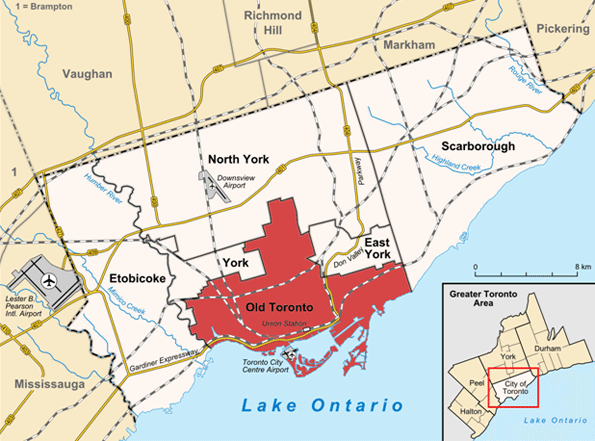
    In my pre-election piece on the Toronto election, I discussed the city’s lingering malaise. It developed slowly but its roots can be traced to the 1998 amalgamation that swallowed up five suburban municipalities. This led to a six folds expansion of city boundaries and a tripling the population base. This amalgamation was initiated by the province of Ontario as a cost saving measure and faced major local opposition. Citizens and politicians were concerned that the benefits of the alleged efficiency saving would be outweighed by the negative impact of losing local decision making powers. The recent Toronto municipal election bore out this concern.

    In the October 25th election, Torontonians were presented with two dramatically different visions. The first vision was presented by former Liberal Ontario cabinet minister George Smitherman. A self-described progressive, Smitherman appealed mainly to voters in the downtown core of Old Toronto. He stood for issues such as improved bicycle lanes, renewal of the downtown waterfront, and improving social housing conditions. The second version was presented by maverick councilor Rob Ford, who represented a ward in the former City of Etobicoke. Ford’s message was simple: it’s time to stop the “gravy train” at City Hall. While he had elaborate platforms on many issues, cutting waste at City Hall was his ubiquitous message.

    Despite Toronto’s social democratic image, Rob Ford won a crushing victory. Ford earned 47% of the vote, while Smitherman ended up with 35%. Far left candidate Joe Pantalone (known primarily for attempting to stop businesses from opening in his own ward) managed to capture 12% of the vote.

    Aside from the shock that a partisan conservative won in Toronto, there are two other significant developments. Both front runners were significantly more fiscally conservative than the current administration. Ford and Smitherman represented constituencies desperately seeking change. Smitherman’s base was frustrated with the inability of the city to provide the services that they want efficiently. Ford’s base was angry that the city is providing many of these services in the first place.

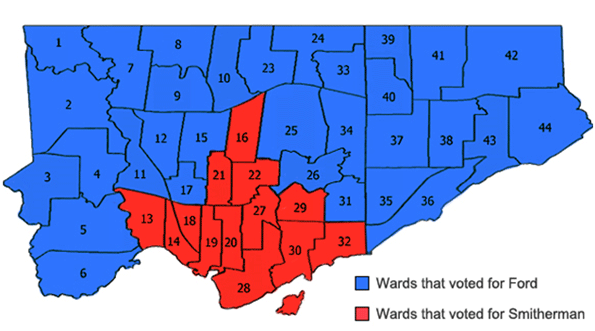
    Not surprisingly the results broke down along specific geographic lines. Ford won an outright majority of votes in every single ward outside of Old Toronto. Within the old boundaries, Smitherman won 13 of the 16 wards. The three Old Toronto wards Ford won are all on the fringes of the Old City.

    In 1997, the newly amalgamated city went to the polls for the first time. Conservative former North York Mayor Mel Lastman narrowly defeated social democratic former Old Toronto Mayor Barbara Hall. Since then, downtown oriented social democrats have controlled the city ever since.

    Clearly this result shows that the concerns expressed by the opponents of amalgamation were largely valid. Amalgamation failed to create cost savings, and has created a dysfunctional megacity. Rather than having six municipalities where voters are focusing on solving local problems, we have one gigantic city with the core and the suburbs fighting for their share of the public purse. This leads to the schizophrenic policy decisions we see today.

    Before amalgamation, there were six different versions of Toronto life that one could choose from. If you didn’t like living in high tax Toronto, you could live in Etobicoke. If Etobicoke’s bylaws and business taxes were hurting your business, you could move to North York. Now all people in the Toronto area can do is vote the bums out on election day, or get out of the area altogether. This isn’t a viable long-term solution.

    The problems are systemic, and cannot be solved so long as the megacity exists. This extends beyond the fact of the impossibility of satisfying the core and the suburbs at the same time. The megacity allows public sector unions to literally hold 2.5 million people hostage whenever they feel like it. A notorious strike last summer lead to a month without garbage collection in the entire city. The 24,000 strikers also shut down parks and recreation services, daycare, provision of municipal licenses, health inspections, animal services, and forced a 25% reduction in ambulance services. In 2008, the transit union called a last minute strike at midnight on a Friday night, grinding the city to a halt. These are just two examples of how powerful Toronto public sector unions have become. The only reason strikes aren’t more frequent is that the city typically gives them whatever they want in order to avoid chaotic strikes. De-amalgamation would not only allow more local control over policy, but would help fray the noose that the unions have tied around the city’s neck.

    Downtown progressives gripe over how Rob Ford is going to destroy their city, but they should take a minute to think about what some of their policies have been doing to suburbanites for years. They have imposed high taxes, and burdensome regulations on the amalgamated cities, as well as a myriad of new bylaws. Some of these policies make sense in Old Toronto. For instance, dissuading automobile usage in the congested core makes sense. Doing so in the suburbs does not. It might make sense to regulate trees on private property in a crowded downtown neighborhood. Not so much in a new subdivision. One-size-fits-all policies don’t work across a city as large and diverse as Metropolitan Toronto.

    Now that the suburbs have wrought their revenge on the old city, progressives need to recognize that de-amalgamation is not just a fantasy of libertarians and angry suburbanites. It is a prerequisite to restoring sound public policy reflecting the preferences of individual communities. Railing against Rob Ford won’t fix the problem. Rob Ford is what the suburbs want. As long as the megacity lives, Toronto will elect a Rob Ford type every now and then.

    The only way to stop this pattern of alternating, divergent visions is by de-amalgamation. Critics will use metaphors such as ‘unscrambling an egg’ to illustrate the difficulties of de-amalgamation. No one should believe that de-amalgamation would be easy. But there will never be a better time than now to take the necessary step of de-amalgamation. A few years of chaotic governance would be worth the long run benefit of restoring local control.

    Downtown Toronto photo by Astro Guy

    Steve Lafleur is a public policy analyst and political consultant based out of Calgary, Alberta. For more detail, see his blog.

  • Amtrak Fails To Weather The Storms

    Why do I persist in riding Amtrak, the short name for the National Railroad Passenger Corporation, a company originally owned by the freight railways, but now subsidized by Congress and run like a Russian bureaucracy, complete with late trains, sullen employees, myriad petty regulations, budget deficits, cold coffee, feather bedding, broken seats, clogged toilets, rail cars that feel like buses, and a schedule that serves the interests of congressmen, lobbyists, unions, budget stimulators, and small-town mayors, but rarely passengers?

    Isn’t it time to let Amtrak go the way of such failed railroads as the Nickel Plate, Erie Lackawanna, Chicago & Alton, Rock Island, Maine Central, Wabash, Missouri Pacific, or the New York Central, lines that outlived their corporate incarnations and were either wound up or merged into larger entities?

    Amtrak was set up in 1971 to replace the passenger rail network that was killed off by government regulations, the Interstate Commerce Commission, subsidized air and road travel, and urban blight. The new entity went to work hauling passengers on a route system better adapted to 1921 than 1971. The earlier trains were faster.

    It’s hard to imagine Leland Stanford or E.H. Harriman buying into the Amtrak business model. Forty years after Amtrak’s creation, little of its plan has changed. It offers corridor services on the East and West coasts and, in between, a meandering schedule of trains that account for less than one percent of all intercity travel.

    Buyers could easily be found for the Northeast Corridor service between Boston and Washington. Better yet, allow competition on the line, and auction off the franchise rights, using the proceeds to pay down national debt.

    England had the dreadful network that operated as BritRail. After it was privatized, Britain’s rail service became competitive, passenger friendly, faster, and more comfortable.

    Compare the new British private train system with the Amtrak experience (“Enjoy the journey”). Think about New York’s Pennsylvania Station, a subterranean strip mall with dank corners, uncomfortable chairs in cheerless waiting rooms, confusing destination boards and dreary platforms that have seen few improvements since I first used them in the early 1960s.

    Passengers buying Amtrak tickets in Penn Station stand in a line that feels like Ceauşescu’s Romania. Only one or two agents are on duty, the tickets are expensive, you need you an identity card to buy one, and getting on the train has the feel of descending into a Chilean mine.

    At the cost of billions, there’s a plan for a new “Moynihan Station” across the street, although much of what’s wrong with Penn Station could be fixed if Amtrak outsourced the operation to Hyatt.

    Its shoddy service explains the rise of discount bus lines that are now digging into core Amtrak passenger revenue between Boston, New York, and Washington. Companies such as Bolt Bus charge $15 or $20 to get from New York to Boston, while Amtrak costs $67 to $95, depending on the day and time.

    Bolt leaves from West 34th Street, and departures are punctually on the hour. The seats are cramped, but the buses are clean and have Wi-Fi. The trip takes less time than many trains, when you add in inevitable Amtrak delays. Nor is there a surly Amtrak conductor reading the riot act at each station.

    To get a flavor of Amtrak’s attitude toward its passengers, read the cheerful words of its CEO in the on-board magazine: “Our identification policy, random screenings in stations, random on-board ticket verification process and more interactive police efforts—including our K-9 teams—are some of the visible activities we have been working on.” Trains used to advertise comfortable berths with sleeping kittens.

    Killing off Amtrak would mean the end of long-haul passenger service, the sleepers that are the heirs to trains like the Twentieth Century Limited. I would deeply regret the absence of long-distance train travel in the United States. But, were Amtrak spun off, its overpriced and indifferent service might be replaced by a network of private operators that would compete to take Americans around a glorious country that longs to be seen by rail.

    Even today, Amtrak trains run near full capacity, and the potential to tap into a travel-happy country of 300 million ought to interest a few hedge funds and stock jobbers, not to mention flourishing overseas rail companies.

    Already there are nascent private companies and sleeping car owners that offer rail trips to national parks, art museums, jazz festivals, baseball games, and the homes of famous writers. Deregulate the passenger industry, and companies like these will flourish. Railroads are in America’s entrepreneurial DNA.

    Recently, for $325, less than the cost of a cramped night in an Amtrak “Slumberette” (emphasis on the “ette”), I rode round-trip in a private rail car, New York Central 3, owned by Lovett Smith III, from New York to Pittsburgh.

    Along the way, I sat on the open, rear platform from which presidential candidates whistle-stopped across America, and took in the sweep of the Philadelphia skyline, the majesty of Amish country (I loved the teams of horses pulling plows), the arched bridge across the Susquehanna, the engineering marvel that is the Horseshoe Curve, the path of the Johnstown Flood, and the remnants of the steel industry around Greensburg. Inside the car, I chatted with my fellow passengers, ate elegant meals, and sampled Italian wines (a group on board had organized a tasting). Were Amtrak a service company, not a protection racket set up to bleed government money into padded contracts, it would have the imagination to operate similar excursions.

    Instead, Amtrak wants to position itself as the paymaster for a national rail plan. The Department of Transportation recently issued a strategic plan called Moving Forward: A Progress Report. (If Amtrak were to issue a report to its passengers, it could be entitled, “Sorry for the Inconvenience: Due to a Track Incident, We’re Being Held in Baltimore.”)

    Amtrak imagines itself as the federal agency that should be hired to spend $117 billion, over thirty years, to build a segregated high-speed rail system between Boston and Washington, and for additional billions, to operate Core Express Corridors between cities less than 500 miles apart.

    Such visions of grandeur come from a company that needs nine hours and fifteen minutes to run a train the 444 miles from New York to Pittsburgh; that’s an average speed of 48 m.p.h.

    To be fair, not all of Amtrak’s failings are its fault. Most of the tracks on which it operates are owned by freight companies that find passengers a nuisance, and think nothing of shunting aside “the varnish” to send through more coal and containers.

    Amtrak, however, is responsible for a corporate culture that makes a mockery of “customer service.” In many ways, it is the perfect metaphor for everything that is wrong with letting Washington have a heavy hand in the economy, or for imagining that an economic revival can be built around companies with federal guarantees.

    Amtrak lacks direction, lives off subsidies and stimulating money, and now wants $117 billion to operate high-speed rail that, for the cost differential, would be only marginally better than the private bus companies now competing up and down the East Coast, with fares of one third or less than what Amtrak charges.

    Americans would happily pay for low-speed rail, if the food was good, the seats spacious, the broadband fast, and if, on the rails, they could surf, shop, eat tacos, and watch movies.

    At the moment, I am riding an Amtrak train that is four hours behind schedule on its way into North Carolina. So far, to use a phrase from railroading legend, the services have not been worth a “plated nickel.”

    Photo By Kyle Gradinger, Amtrak Keystone Snowstorm I. Amtrak AEM-7 locomotive 904 leads a Keystone Corridor train through the snow in Rebel Hill, King of Prussia, PA.

    Matthew Stevenson is the author of Remembering the Twentieth Century Limited, winner of Foreword’s bronze award for best travel essays at this year’s BEA. Growing up, he was a “Central” man, but loved the majesty of the old Pennsylvania Station. Together with his father, now 91, he recently has waded through a 1969 edition of the ‘Official Guide to the Railways’. He lives in Switzerland.
  • Car Wars: Should Autos Rule The Road? Part II

    We have a severe drug problem, we’ve been told, that mostly affects suburbanites. The dangerous drug is not taken by mouth, nor by injection, yet it is used daily by every family member and must be stopped before we, as a nation, are utterly destroyed. According to many experts, our “dependence” on cars must stop.

    Internet rumors abound that we are about to be legislated out of our stupor, and be taxed into high density, inner core cities. Should this rumor become fact, let’s look at what effect it will have on our economy, and, quite frankly, on the American Dream of home ownership.

    Today, the housing market is still dealing with the disaster of plummeted prices. Since 80% of the new home market this past decade has been suburban, it would be safe to say that 80% of Americans that bought in this century are the hardest hit, because these new homes have dropped to pre-boom pricing. It has been young families, generally, that have driven out to the suburbs to find new homes, the promise of lower density, and newer safe schools. In addition, many (most) of these families believed that their homes were a source of income; after all, values were increasing 10% or more annually, and that equity could be tapped in loans, (both suburban and urban).

    While many think of the suburbs as pure white, that is no longer true. The suburbs today, in general, are intermixed with all races. But the new race being ridiculed by many is the “suburbanite”. The suburbanite yearning for his or her daily fix of the car, consuming our fuel, and spewing carbon into our atmosphere must be eradicated at all costs.

    So how do we eradicate this vermin? There are rumors of a carbon tax that will place a financial burden on those vehicular junkies. Who cares that this major portion of America’s population is under the most financial pressure since the depression. If we tax these infidels, that will surely bring them to their senses , and we can cure their dependence on Chevys, Fords, and Mini-vans. Let’s break their backs once and for all, so that these families will abandon what is left of the suburbs and be forced back to the inner core. If reason does not work, we can just legislate it.

    Let’s imagine this new future filled with promise of a new America. In this fantasy, we visit the Smith family, who moved from their 10,000 foot suburban lot into the urban core. Adam Smith, the father, now must take the bus to the train station for the new light rail line that goes to Edenville, his job out in the suburb as a plant manager (it seems that his place of employment did not make the move). With connections, he can make it to work within an hour, whereas his 10 mile commute from suburb to suburb took 20 minutes.

    Lilly Smith (his new wife, as the old one refused to move into a 20 story inner city high-rise) works at Bester Buy on the edge of the city. She needs two bus connections to get there Having a car is not an option, since parking costs are prohibitive in the city. Luckily, the kids are old enough to be left alone; Josh is 8 years old, Jane is 12, and Joey, who is 15, watches over the siblings. Today is a holiday and they are home from school, but the cold rainy day keeps them inside, along with hundreds of other kids who play in the vast corridors.

    Lilly arrives at work, only to remember that Jane had a dentist appointment which she forgot about. She shivers, thinking about the old days, and the warm comfort of the Mini-van she once relied on to take her kids to appointments. She breaks out into a sweat and falls into a stupor. Her fellow workers recognize the symptoms, as they too have been weaned of their dependence upon personal vehicles. Her manager, Ralph, lets her take a week of sick leave to get help.

    Ralph is lucky. He lives in a single family neighborhood on the edge of the city. He has his own large lot, a spacious 35 feet wide and 90 feet long. He and his wife each posses a car. His luxury two story home, setback five feet from the sidewalk, is 25 feet wide and 50 feet deep; the house itself is a massive 2,500 square feet, over twice as large as the Smiths inner city apartment. He also has three children who enjoy the privacy of their back yard. The garage adjacent to the 12 foot wide alley consumes 440 square feet of their remaining 1,200 square foot rear yard. Still, with 760 square feet of green space, the kids are lucky.

    Ralph and his wife, Mary, both drive electric cars. Mary has the larger vehicle, with a 50 mile range per charge on a warm day. Their daughter wants to play with a cousin who still lives in the suburbs, 20 miles away. This is a cold day, which reduces the range of the vehicle to 35 miles, and their cousins do not have a charging station, so their 11 years old daughter is driven to the Light Rail station, a mile away.

    A week later, back at the Smith apartment, an argument starts between Adam and Lilly about her desire to get out of the city. Even if they did move out to near Adam’s plant, they would need Lilly’s paycheck to make ends meet, so she would need the light rail and two bus connections to get to work. Lilly begins to sweat and shake again… When Josh asks what is wrong with Mommy, Adam explains about the days when Americans were drugged out on their cars, the days when people were free to go when and where they wanted. As he describes those terrible times, he too yearns for those days. Adam and Lilly dream of moving out to a place with space, if only the carbon tax on moving out of the city could allow it, but alas, it’s only a dream that only the wealthy can now afford.

    A fantasy? Here is what I’m experiencing as a planner. When I met with a city official a few weeks ago I was admonished for a proposal that included attached garages. I explained that attaching the garage reduces 40 feet of exterior wall to be built, and here in Minnesota, an attached garage means you do not have to shovel snow between the home and the garage, nor slip on the ice. Why would I detach a garage, I asked? The city official explained that according to his planning staff, the space between the garage and the home is a social gathering spot where neighbors can stop and talk about their day. I had thought that’s what that large front porch we are proposing on the homes was for.

    There is a movement to prevent the toxic drug — the car — from infecting our lives. For me, no way you are taking me off my ERPT — Extremely Rapid Personal Transport — dependence.

    This is the second of a two-part series in which different authors examined the centrality of the autombile in urban and suburban life.

    Photo by Rick Harrison of the author’s ERPT — his Porsche.

    Rick Harrison is President of Rick Harrison Site Design Studio and Neighborhood Innovations, LLC. He is author of Prefurbia: Reinventing The Suburbs From Disdainable To Sustainable and creator of Performance Planning System. His websites are rhsdplanning.com and performanceplanningsystem.com.

  • Car Wars: Should Autos Rule The Road? Part I

    We’ve decided to become a one car family. Denver has proven to be the ideal locale for this experiment, of sorts. The “Mile High City,” and particularly our new neighborhood, provide a range of mobility options beyond the four-wheel variety for trekking from place to place.

    The metropolitan area is naturally blessed with a mobility-favorable landscape. It is approximately 10 miles by 10 miles. More importantly, our neighborhood possesses what I affectionately refer to as “accessible proximity” to local amenities such as grocery stores, coffee houses, parks, and specialty shopping centers. The immediate area is not only safe, it’s engaging in its physical and social makeup, with stately homes and troves of dog-walkers along suburban style streets.

    Recently, our daughter, who is eight, remarked “Ya know, at our old home it seemed like we always needed a car to go places, while here in Denver, we can actually walk places and enjoy the clean air.”

    The website Walkscore, an online index, which ranks communities nationwide based on access by foot to restaurants, coffee houses, schools, businesses and other frequent destinations. Denver’s score provides tangible evidence of my daughter’s contention: According to the site’s analytics, our Denver address registers a whopping 88 out of 100, defined as ‘very walkable,’ meaning that “one is able to accomplish most errands by foot. Our residence in Folsom, California — from which we recently relocated — stumbled in at a paltry 48 out of 100, defined by Walkscore as ‘car dependent’.

    Why is this such a big deal to us, as well as to growing numbers of Americans? I would contend that it is affordability. As Americans continue to struggle financially amid the worst economic times since the great depression, the argument could be made that location efficient neighborhoods offer a cost effective alternative to those that are exclusively auto-centric. In an era where expenses associated with automobile ownership, maintenance and fuel represent a significant slice of our household budgets, policy makers would be wise to expand options that encourage alternative forms of mobility.

    Automobiles are still the transportation mode of choice for most working commuters, and for good reason, as most Americans still live a reasonable distance from where they work. But alternative forms of transportation are gaining momentum, as many struggle with insurance and other automotive related expenses.

    According to the U.S. Census Bureau’s recently released American Community Survey (ACS), bicycling is becoming a viable option for Americans willing to pump the pedal on their way to work. Portland leads the U.S. in terms of the most bike commuters, with almost six percent of its residents using a bicycle as their primary mode of transportation to work in 2009. Minneapolis (3.86%), Seattle (2.99%), San Francisco (2.98%), and Oakland (2.53%) round out the top five.

    Denver is one of a handful of cities that is actively promoting the use of bicycles as a viable short-run commute option. This year, the city introduced the first large-scale bike-sharing program in the U.S. A partnership between Humana, Trek Bicycle and the advertising agency Crispin Porter + Bogusky, this initiative flows from the shared belief that bicycles should serve as vehicles for positive health and environmental change, as well as important parts of a community’s transportation ecosystem. It’s this latter point that has gained the attention of Denver hotels and the convention center, which are seeking to provide visitors with mobility tools that compliment the downtown’s free bus system and walkable grid.

    The dilemma continues to be how to efficiently travel short distances that are too far to walk. Like Pavlovian dogs, many of us are conditioned to reach for the car keys, even for the shortest of trips. This behavior is deeply embedded in our consciousness;, an auto-centric mindset that has been nurtured in us for years.

    Chris Wiggins of the Folsom, California based Glide Electric Cruiser believes that a huge demand exists for short-range transportation options. His invention is ideal for short commutes and has virtually no impact on the environment. What is it? A series of motorized electric scooters with top speeds of up to 38 miles per hour. Currently in a first production run stage, these “cruisers” have attracted a wide swath of interest, from law enforcement agencies to senior groups. “I personally believe they have the potential to revolutionize short-range commuting in the U.S. and beyond,” says Wiggins. “My greatest hope in developing them is that they will have a meaningful impact on the quality of life, as well as improve the environment.”

    Recognizing that car-based travel will continue to be a reality for most Americans, innovative companies like Zip Car and Car2Go have adroitly positioned themselves for where I believe the auto market is headed: Short-term, just-in-time rentals that eliminate the expense of owning a car. And since my family has only one car, I personally am exploring these and other options to assist with those commutes beyond my immediate, local area.

    There are many factors affect the viability of a mobility option. Density currently receives the greatest amount of air-time. I’m often reminded of a business trip several years ago to the wonderful island community of Bermuda. I was intrigued to discover that because of its dense configuration and its size, cars weren’t allowed on the island until 1946. Today, only residents are permitted to drive cars on the island, and only one car is allowed per household. As Bermuda is a heavily trafficked tourist destination, I wondered what forms of transportation were available. An amused hotel bellman directed me to a lot full of mopeds and scooters.I discovered that these low-power transporters were the predominant form of transportation for residents as well as visitors to the island.

    While it could be argued that population density is the raison d’etre for alternative mobility options, there are other factors that should be taken into consideration. Much talk of late has centered around a concept called “intersection density,” which refers to the number of intersections in an area. The greater the intersection density, the shorter the blocks, and it is these short blocks that are the main contributing factor to neighborhood walkability. In Travel and the Built Environment: A Meta Analysis, which appeared in the summer 2010 issue of the Journal of the American Planning Association, Reid Ewing and Robert Cervero, urban planning academics at University of Utah and U.C. Berkeley respectively, found that of all the built environment measurements, intersection density has the largest effect on walking — more than population density, or distance to a store or to a transit stop, or jobs within one mile. According to the authors, it’s this ease of accessibility that spurs walkable foot-traffic to high destination nodes such as shopping and recreation.

    Density, unfortunately, is often associated exclusively with large urban environments that possess tightly packed, downtown center-cities. This undermines the enormous advantages of many suburban style cities such as Naperville, Illinois; Traverse City, Michigan; and Glenwood Springs, Colorado, all of which offer a plethora of local amenities within walking distance of their adjacent neighborhoods.

    Our deeply ingrained auto-centric habit makes it hard to say if any of these lessons in metropolitan mobility will gain traction, and if so, where they are likely to lead us. But one thing is for certain: A new narrative for how to approach short-distance trips is fostering a debate that is, at the very least, a carbon footprint in the right direction.

    This is the first of a two-part series in which different writers examine the centrality of the automobile in urban and suburban life. Tomorrow, read a very different viewpoint in Part Two.

    Photo by Michael Scott of the author’s Denver neighborhood.

    Michael P. Scott is an associate with Centro, Inc, a Denver-based consulting firm focused on the future of our city centers. He can be reached at michael@becentro.com

  • Livability and All That

    Livability is one of those once innocuous words, like sustainability, that now receive almost unquestioned acceptance in the bureaucracy, academia and the media. After all, words like sustainability and livability have no acceptable negative form. Who could be in favor of anything unlivable, insensitive, unhealthy or unsustainable?

    Back in the late seventies, when I served as Special Assistant for Information Policy in the Office of the Secretary, our shibboleth was “balanced”. Can anyone be in favor of unbalanced transportation? It didn’t matter that the word had no meaning and we couldn’t explain it to others, it still became standard in the rhetoric of secretarial officers. In an unkind moment a reporter asked the present DOT Secretary Ray LaHood what he meant by livable, given that the department had just added it to its criteria for giving away money. He replied vaguely it was something about being able to walk to work and the park and a restaurant, to a doctor and a few more things.

    Well it turns out I was living the livable life style when I was growing up in Queens, New York in the fifties and didn’t know it. Here all along I just thought we were poor.

    Aside from seeking to have the same modal shares of America in 1910, or Tajikistan today, this idea fails on both theoretical and practical grounds. Theoretically, whatever merit the idea might have, livability means very different things in a tenement in Brooklyn, or a place in Billings, Des Moines, or Peoria. I can recall being sent to the store for milk or lettuce by my Mom after school. If I didn’t get there in time the four heads of iceberg lettuce (I was 16 before I found out that there were other kinds) were gone. The milk was “milk”. Today in a supermarket the milk section is bigger than the grocery store I went to as a kid. There’s skim, 1%, 2%, whole, lactaid, acidophilus in quarts, half-gallons, and gallons and 86 kinds of lettuce. The typical market today has above 50,000 items. That means that the market shed for such stores is far broader than it was back in the day.

    We were three generations of the family in the same household and we all had the same doctor who lived two blocks away. Today I don’t have a doctor – I have half a dozen – none of them selected on the basis of distance. When one selects doctors, best, not closest, matters. Hospitals are growing in size but declining in the number of facilities per thousand population. All of this is simply representative of the immense trend towards specialization in our society – an increasing division of labor in all activities and an accompanying division of tastes and preferences in an increasingly affluent society. If you want a loaf of wonder bread there’s a 7-11 down the street; if its ciabatta with sun-dried tomatoes there’s this really great place I know a few miles off of exit 29 on the freeway.

    In today’s job market don’t we expect that people will be willing to go farther to find the job they want or can get? If the average travel time is about 25 minutes and a half-hour commute is acceptable, how long is one unemployed before the acceptable becomes 45 minutes or an hour? In this period of housing constraint in which people are even more locked into their homes by underwater mortgages, the commute will grow as people get desperate.

    In my town of College Point, Queens when the factory whistle blew a few thousand walked in the gate and out again when the whistle blew in the evening. People don’t live outside the factory gate anymore and haven’t for awhile. Again, specialization and division of labor are the main factor. Job groupings are far smaller today, and the rate of job turnover means more people won’t/can’t move every time they change jobs. Moreover, about 70% of workers live in a household with other workers – whose job will they live next to?

    More importantly, the great competitive strength of America lies in access to skilled workers. Employers will be reaching out farther and farther to find the specializations and skills they require. We should expect work trip lengths to grow not become walking trips. It won’t be inner city oriented either. The metropolis of today is of immense size because many employers need a market of hundreds of thousands of potential workers to reach the ones they need. The Atlanta region with 26 counties is not a great economic engine because it is 26 charming adjacent hamlets, but rather because the market reach of employers, suppliers, customers and job seekers spreads over several million residents.

    In this environment it takes massive transportation capability to assure that market shed. The questions are how many potential employees can I reach in half an hour; how many suppliers, how many customers? In the future more of us will be free to live where we want and work where we want. Most will not be willing to trade living floor space for a close-by sidewalk café. Americans will drive to where they want to walk.

    There remains, of course, lots of room now within the existing land use distribution to make it easier for those who wish to live closer to shops, jobs or entertainment. People also are free to go to the nearest store or nearest doctor. The fact that so few do so reflects the oft-forgotten fact that people have their own notions of what is most important. Trying to coerce them to live the way government – particularly the upper bureaucracy – thinks they should live holds many perils. The American people have no obligation to live in ways that make it convenient for government to serve them. Government isn’t smart enough to know how people should live or to order their lives in more “convenient” arrangements.

    On the practical side:

    It’s on the practical side that the concepts of livability really fail. The central failure inheres in what the Europeans call subsidiarity, proposes that any necessary activity of an authority should be conducted by that level of governance closest to the problem that can effectively address it. Having livability rise to become central principle of federal transportation investment planning is an egregious failure in our historical system of decentralized government. If sidewalks and bike paths are federal then everything is federal.

    The mayors of our cities love it. Why not? It is the closest they have come to being able to lay claim to direct federal funding, getting those pesky states and suburban communities where the majority of Americans live out of the way. They see it as finally being their turn at the money from Washington. In these times, when every government level is broke, livability and sustainability can prove a potential lifeline, and a bonanza as well to developers – often themselves subsidized – who focus on the inner city.

    The livability criterion is ultimately centralist: fed-centric. It is not up to local people if they want to densify or not, but real power will rest with a really “smart” guy behind a desk in Washington. Proposals for federal “performance measurement” degenerate into a charade that produces pre-ordained results. Now I can fund my friends, who are as right-thinking as I am!

    The problem here is a total disconnect between what people in a diverse democracy want, and what the central bureaucracy, and their academic allies, wish to impose. The livability agenda may be popular in the press and among pundits, but for most communities and people it’s neither popular nor remotely democratic.

    Alan E. Pisarski is the author of the long running Commuting in America series. A consultant in travel behavior issues and public policy, he frequently testifies before the Houses of the Congress and advises States on their investment and policy requirements.

    Photo by Mastery of Maps

  • The Two Worlds of Buenos Aires

    Central Buenos Aires is undoubtedly one of the world’s great tourist destinations. Days could be spent walking among its narrow streets admiring the plentiful art noveau, art-deco, beaux-arts and other architectural styles. The triumphal Avenida 9 de Julio is one of the world’s widest boulevards with two interior roadways of up to seven lanes and two service roads of two lanes, with a Washington Monument type obelisk at Avenida Corrientes (Top photo). Avenida 9 de Julio is bordered by buildings that are both ordinary and impressive, such as the Colon Opera House.

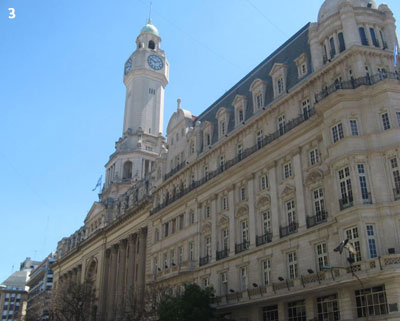
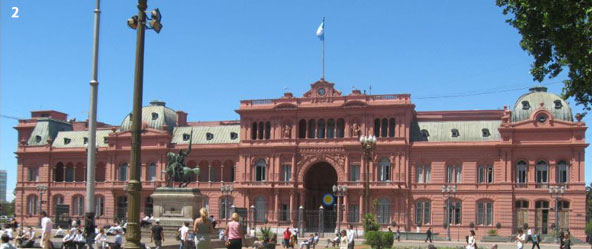
    There is also an attractive area of redevelopment adjacent to the core in the former dock area, Puerto Madero. The old port buildings have been converted to commercial uses, especially restaurants. A number of high-rise condominium buildings have been constructed beyond the old port basins. Government buildings more than match the commercial architecture, with the National Congress and the Casa Rosada, or “Pink House,” with its balconies from which President Peron and his wife Eva used to address the public (Photo 2). Not more than two weeks ago, former President Nestor Kirchner lay in state to be visited by in an emotional outpouring by hundreds of thousands of Argentineans. The city of Buenos Aires also has a distinctive legislative building (Photo 3).

    These older romantic styles make Buenos Aires a wonderful walking environment. Most were erected in the first three decades of the 20th century. This was Buenos Aires at its zenith. Then, Buenos Aires was capital of one of the world’s acknowledged economic powers. Argentina generally ranked around10th in gross domestic product (GDP) per capita during that period (Note 1). Thus, today, the tourist can enjoy the product of that prosperous time.

    Economic Stagnation: More recent years have not been good to the Buenos Aires area and Argentina. The nation has seen decades of ups and downs – but mostly downs. The nation has been buffeted between constitutional governments and military dictatorships. Too often, even the constitutional governments have placed too little emphasis on creating wealth and too much on redistributing it. A failed currency policy in the 1990s destroyed the savings of millions. All of this has led to Argentina’s migration from the top 10 economies to near the bottom of the top 100, now ranked at 82nd in the world in GDP per capita. No top ten nation from early in the 20th century has fallen so far. New Zealand managed to drop from 1st in the world in 1920 to 51st now, but still has a GDP per capita double that of Argentina.

    Argentina suffered the largest sovereign debt default in world history, at $100 billion in 2002. The nation’s former colonial master, Spain, trailed Argentina in GDP per capita throughout the 20th century to the 1980s, yet is now more than twice as prosperous (Figure 1)

    This economic decline is not so evident in the autonomous city of Buenos Aires, which is also called Capital Federal, analogous to the District of Columbia (DC) in the United States. This is the Buenos Aires of tourists, an area only slightly larger than Washington, DC, but with five times the population. The municipality of Buenos Aires is by far the most affluent urbanization in the nation. Even so, there are informal settlements within the city, such as Villa 31. Overall, approximately three percent of the city’s population is in these kinds of informal settlements.
    BA3-bencich
    Population and Distribution: According to the last census (2001), the city of Buenos Aires had fewer people than in 1947, having fallen from 3.0 million residents to 2.8 million. The city is also very dense, at 35,600 persons per square mile (13,700 per square kilometer), which is about one-half the density of Manhattan or the ville de Paris and double the density of the city of San Francisco.
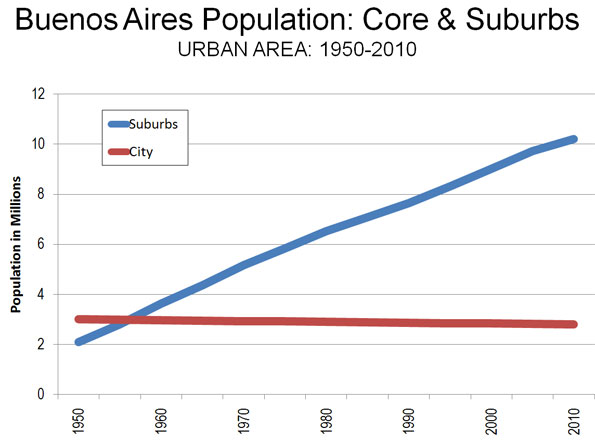
    Most of the population lives in peripheral areas. This dominant suburban growth pattern is typical of world urbanization, as can be seen in such high-income nation capitals as London, Washington, Brussels, Copenhagen has been in the suburbs. Indeed, all growth in Paris has been in the suburbs since 1881. Like the ville de Paris, the city of Buenos Aires now accounts for less than 25 percent of its metropolitan area population (Figure 2).

    Overall, the urban area (area of continuous development) has nearly 13 million people and covers more than 1,000 square miles (2,600 square kilometers) for a population density of 12,100 per square mile (4,700 per square kilometer). This is 70 percent more dense than Los Angeles and one-third more than Paris but less than one-eighth that of Dhaka (Bangladesh).

    Suburban Buenos Aires: The suburbs of Buenos Aires differ from those in high-income national capitals. Generally, the suburbs are far poorer than the city and reflect the more recently less affluent Argentina that has emerged in recent decades just as the central area testified to the nation’s former relative wealth. All of suburban Buenos Aires is in the adjacent Buenos Aires province, which has the largest population in the nation.

    Some of the suburbs are affluent, especially to the northwest, where suburban municipalities like Pilar and Tigre contain housing that could easily fit in upper middle income suburbs of the United States or Europe. However, even in these areas, there are close-by developments of low-quality and even informal housing, mostly housing domestic employees to the higher income population.

    The suburban poverty is far more pervasive to the southwest and the southeast. Many neighborhoods look similar to modest suburbs in Mexico City, though without the pervasive informal settlements. More people live in informal settlements in the suburbs than in the city, with estimates putting the number at above 500,000.

    More than the Core: Any thought, however, of Buenos Aires being a “compact city” is dispelled by the vast sea of lights visible on an evening flight out of Ezeiza International Airport. The urbanization stretches 30 to 40 miles in all possible directions, to the northwest, southwest and southeast (with the Rio de la Plata being to the northeast).

    However, probably no urban area illustrates the general rule that urban cores tend to be substantially different from their suburbs. Not only is suburban Buenos Aires far less dense, but it is far less affluent. Any who visits the city alone will have missed more than three-quarters of the reality.

    ————

    Note: GDP per Capita data based upon Angus Maddison’s work for the Organization for Economic Cooperation and Development.

    Photos (by the author):
    Top: Avenida 9 de Julio
    2: Casa Rosada
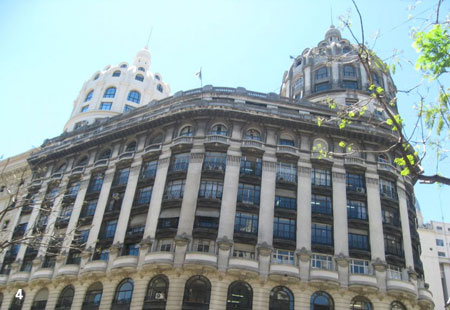
    3: City of Buenos Aires Legislative & Office Buildings
    4: Bencich Building
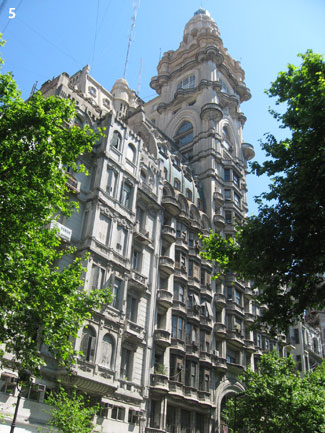
    5: Casa Borolo

    ————

    Wendell Cox is a Visiting Professor, Conservatoire National des Arts et Metiers, Paris and the author of “War on the Dream: How Anti-Sprawl Policy Threatens the Quality of Life

  • Geography of the Election: The Philadelphia Collar Counties – A Splash of Red

    The Obama coalition of 2008 has begun to fracture with independents, women and college educated voters bolting to Republicans and the youth vote seemingly uninterested in this election. But perhaps the most critical change took place in suburbia. This was particularly evident last week in southeastern Pennsylvania, especially in the suburban Philadelphia counties.

    Historically in Pennsylvania statewide Democratic candidates won big in Philadelphia only to see their margin decimated in the traditionally heavily Republican suburban counties of Bucks, Chester, Delaware and Montgomery, known as the Philadelphia “Collar Counties.” This trend began to shift in the 1990s due in large measure to the GOP stance on abortion and other social issues.

    During the 1990s, Democratic candidates were able to claim the mantel of moderation by positioning themselves as fiscally conservative and socially moderate. Affluent, college educated, women, and younger voters from traditionally staunch Republican families joined with established Democratic constituencies including the Jewish community, working class voters from old suburban mill towns, and minority voters to form winning coalitions throughout the collar counties.

    During the 2000s, Democrats would be elected to fill Congressional seats in three of the four collar counties. Not surprisingly, no Republican at the top of the ticket would win Pennsylvania over the next 10 years. The main reason was the collar counties were voting more Democratic with each election. The table below shows the percentage of the vote won by the Republican candidate at the top of the ticket from 2000 – 2008:

    Top of Ticket

    Chester

    Bucks

    Delaware

    Montgomery

    Phila.

    Bush/Gore 2000

    53.4%

    46.3%

    42.7%

    43.8%

    18.0%

    Fisher/Rendell 2002

    41.1%

    43.6%

    33.1%

    31.4%

    14.7%

    Bush/Kerry 2004

    52.0%

    48.3%

    42.3%

    44.0%

    19.3%

    Santorum/Casey 2006

    45.0%

    41.5%

    38.3%

    38.1%

    15.9%

    McCain/Obama 2008

    45.0%

    45.1%

    38.8%

    39.2%

    16.3%


    In 2010, the trend began to favor Republicans again. The GOP picked up a net five Congressional seats including two in the southeast region. It also propelled State House Republicans to a huge victory moving from 99 seats to a projected 111 – 92 majority. Republican Tom Corbett won the governorship by 10 percentage points with 55 percent of the vote. Conservative Pat Toomey outpaced Joe Sestak for the U. S. Senate by two percentage points.

    A look at the trends shows that both statewide Republican candidates ran stronger in the collar counties than did Senator John McCain in 2008 in his bid for President:

    2010 Numbers

    Chester

    Bucks

    Delaware

    Montco

    Phila

    Toomey/Sestak

    53.4%

    53.2%

    43.6%

    45.9%

    16%

    Corbett/Ontorato

    55.9%

    55.4%

    47.0%

    48.3%

    17.1%

    McCain 2008

    45.0%

    45.1%

    38.8%

    39.2%

    16.30%

    Tom Corbett ran nearly 10 percentage points ahead of McCain in the collar counties. In fact, Corbett carried these counties by 22,370 votes as he reversed the top of the ticket trend of the past decade. Although this was not enough to offset the 274,373 he lost by in Philadelphia at least he won enough elsewhere, including in the collar countries, to win a fairly impressive victory statewide.

    Pat Toomey, a clear conservative, ran well ahead of the vote former Senator, and social conservative, Rick Santorum was able to win four years earlier, but he did not perform as well as Corbett did against McCain. This can be explained in part by the fact that his opponent, Joe Sestak, was an elected Congressman from Delaware County.

    2010 Numbers

    Chester

    Bucks

    Delaware

    Montco

    Phila

    Toomey/Sestak

    53.4%

    53.2%

    43.6%

    45.9%

    16%

    Santorum/Casey 2006

    45.0%

    41.5%

    38.3%

    38.1%

    15.9%

    Toomey would lose the collar counties by 27,195 votes. This gave him a much steeper hill to climb in the other 61 counties of Pennsylvania, but at least he was not out of the game as had been McCain, Santorum, and Fisher over the past 10 years.

    Will this change in voting pattern continue? It could if Republicans can hold Independent voters by delivering solid results at both the Federal and State levels. Republicans will now control redistricting in Pennsylvania. This should allow them to consolidate the gains made this year in Congress, but does not change the fact that the Philadelphia collar counties will continue to determine the fate of statewide candidates in Pennsylvania into the foreseeable future.

    The fight in Washington over the next two years will likely be the traditional “heart vs. head” fight of the past where Democrats push for more social programs and Republicans position on the costs of these programs.

    The 2010 election in southeastern Pennsylvania seemed to prove that a bad economy and fears of continuing increases in taxes and debt will add a splash of red to the collar counties “light blue” voters.

    Dennis M. Powell is president and CEO of Massey Powell, an issues management consulting company located in Plymouth Meeting, PA.