Category: Suburbs

  • Satellite Cities for Beijing? Yes, But….

    China Daily ran an article on the continuing urbanization of Beijing. In Build upward or outward: City’s growth dilemma, Daniel Garst notes that Beijing is not as centralized as other urban areas, with its multiple business districts and comparatively low density in its inner areas. He indicates a preference for the urbanization of Shanghai, with its stronger center (both Pudong and Puxi), but suggests that it would be a mistake to replace the historic low density development with the high rises that would be necessary to change Beijing’s urban form.

    Actually, Beijing’s form is not that unusual for Asian urban areas. Tokyo has multiple office centers rather than a single dominant center and has comparatively low residential densities, even within the Yamanote Loop. Bangkok, Manila and Jakarta are similarly multi-centric. Chinese urban areas like Shenyang, Xi’an, Wuhan, Suzhou and Changsha are closer (but smaller) replicas of Beijing than Shanghai. Garst also misunderstands the dynamics of traffic congestion in his belief that roads and metros (subways) would be less congested with a more centralized form. In fact, higher densities routinely produce more intense congestion, not only on the roads but also on the rails and buses, a point recently made by Michael Matusik on this site.

    However, Garst may be onto something with respect to a suggestion that Beijing’s growth should be directed to new satellite towns, in which residents work rather than commuting to Beijing. This is good theory, but there is an important caveat, which we outlined in a comment at China Daily on the article.

    Satellite cities are not a reasonable answer unless they are so far from the Beijing urban area that commuting to Beijing is not possible. The idea of self-contained satellite cities, where people live and work in them has not worked anywhere. There are good examples of failure in London, Cairo, Stockholm, etc. So long as the large urban area can be reached, people will commute there.

    Cairo provides a useful example. Egyptian planners have long decried the continuing commute pattern into the urban area from the new towns of 6th of October and 10th of Ramadan, which are within commuting distance. On the other hand, the new town of Anwar Sadat, more remote from the urban area, has been more successful in keeping its residents in its labor market.

    Locating new satellite towns far enough to make commuting infeasible will be a real problem for Beijing. There just is not enough territory in the provincial level municipality. That means the new towns would have to be in the province Hebei, which along with the province level municipality of Tianjin surrounds Beijing.

    Short of remote new towns and forcing population and economic growth away from Beijing, the key to minimizing traffic congestion will be to minimize work trip distances by achieving a dispersion of comparatively lower density employment to match the lower density suburban dispersion. Economists Peter Gordon and Harry W. Richardson have found that “suburbanization has been the dominant and successful mechanism for reducing congestion.” in the United States. This applies no less to Beijing.

    Photograph: Forbidden City, Beijing (by author)

  • Aussie Urban Myths

    Urban planning in Australia is lost in a dense fog of presumption and theory. What’s needed is to toss out the hype and to illuminate some of the common planning myths for what they really are: impediments to progress.

    An example of planning hype occurred not long ago when ten urban academics loudly criticised the Victorian government’s decision to develop about 40,000 hectares of new land on Melbourne’s fringe, calling the decision short-sighted and unsustainable.

    The best way to development Melbourne, they said, is to intensify redevelopment along tram and train lines and around existing activity centres, with such developments being more dense than the surrounding suburbs, but not necessarily high-rise. Their modelling suggests that the 600,000 new dwellings required by 2030 could be accommodated under four stories within the existing built-up area.

    They did confess that not everyone wants or needs to live in an activity centre or on a rail/tramline, but were adamant that a sustainable city is “one where you can get there without a car”. The future, according to them, will be “fitter rather than fatter”; where we will “live with more amenity” and have more “choice of housing type”.

    They concluded that this is a national issue because when we finally commit to a low-carbon economy, we will have these extra 40,000 undeveloped hectares which, one assumes, will act as some form of carbon sink.

    Under normal circumstances, one might be tempted to dismiss the more extreme machinations of latte-left academia, but unfortunately, some serious decision makers are starting to listen to this type of questionable commentary.

    Without doubt, a key challenge facing Australia’s major capitals is how to redevelop the middle-ring suburbs, but placing all of one’s development eggs in this basket is lunacy and is based on misguided presumptions and poor theory. In this light, it is pertinent to consider several urban myths.

    But before our myth busting, it is worth stating that infill development is more expensive than many realise, in terms of site acquisition, approval processes, infrastructure provision, and combating NIMBYism. This is reflected in the high end prices of infill stock which, in short, costs more than twice as much as broadhectare product.

    For example, the cost of a new infill dwelling (which is two bedroom/two bathroom and one car space) within five kilometres of the Brisbane CBD is $650,000. But a new detached house (around 20 kilometres from the GPO, comprises three bedrooms, study, two bathrooms, double garage and on a 500 sqm allotment) can cost $325,000. On a rate per square metre basis the infill product (including any land) is $8,000, the detached house (again including land) is around $2,000, sometimes less depending on who the builder is.

    Low affordability makes the sale of infill product often slow, even in stronger economic times. In addition, there is often a large mismatch between the product type (and size) offered in infill locations and household demographics and, importantly, the market’s aspirations.

    Our urban academics were somewhat correct on one point – not everyone wants to live in an infill development. Our experience is that demand for such product – and assuming the dwellings can be delivered at an economic price point – varies between 25% and 40% of overall demand, depending on the urban location in question. Under current conditions, the real demand, however, is around 15% at best. So from the get-go, delivering such an ambitious infill development target is extremely unlikely. In fact, it is impossible.

    Myth – higher densities will mean less traffic
    The theory is that higher densities around existing public transport networks will see a lift in public transport use and fewer cars on the road. Public transport accounts for about 10% of total trips in our major cities. Most urban metropolitan strategies aim to increase this to 20%. So, four-fifths of the trips will, at best, still be via private vehicle. Why? Because the car is much more convenient.

    Without serious infrastructure commitments to repair and upgrade the public transport networks in our cities, cars will continue to dominate. In fact, under current conditions, and somewhat ironically, infill development would lead to more traffic congestion.

    Most infill product built within Australian cities will not sell without a car space. The quality of our public infrastructure, especially outside of Melbourne, is not good enough for infill owners (or their tenants) to forgo the security of their cars. So, new infill development is increasing the number of cars on the road and often in areas which are already congested and are hard to improve from a traffic management perspective.

    One could argue that it would be better to further decentralise employment and settlement around the edges of the metropolitan area, and most obviously upgrade the existing road network.

    Academia, obviously, have never tried to sell a dwelling without a dedicated car parking space.

    Myth – urban consolidation is better for the environment
    This implicit assumption is now widespread among the media, the planning community, government agencies and in political circles. Yet the available evidence suggests the opposite.

    • Comparison between suburban houses and infill product often overlooks the number of persons per household, which is much higher in the traditional suburban detached house.
    • In traditional suburban detached homes, larger household numbers share various facilities – the refrigerator; television; washing machine; dishwasher etc., and even the lighting needed to light a room. The per capita energy, and even water consumption, is more efficient in suburbia than in more central urban locations. The “average” household size within an infill development across Australia is around 1.6 people, in detached housing it is 3.2. In most cases infill product have as many appliances as are in a detached house, yet the number of occupants living in infill product is about half that living in detached suburban homes.
    • The nature of infill housing is, in itself, prejudicial to positive environmental outcomes due to things like clothes driers (lack of outdoor drying areas), air conditioners, lifts and the need to service (lights and air-conditioning) common areas. Also, suburban development allows for wider footpaths and private yards, which in turn provide space for trees to grow. There is less opportunity for greenery – a key producer of carbon offsets – in higher density urban development.

    Not withstanding anything about the actual built form, the greatest correlation between energy and water use (and hence, environmental impact) is based on per capita income. Wealthy people consume more energy/water and thus have a bigger environmental impact. The better off are the only ones who can afford to live in infill housing.

    Research in 2007 by the Australian Conservation Foundation found that in almost all Australian cities, higher-density, infill housing produced higher per capita greenhouse emissions and had larger eco footprints than outer suburbs, notwithstanding the greater access to public transport.

    Myth – most jobs are downtown
    There is also a widespread presumption that central business districts and their immediate fringes contain the majority of jobs in a city’s economy, and are therefore the major generators of traffic. Developing housing further from the downtown area, the argument goes will only mean more congestion as commuters try to get into and out off the downtown area.

    It is easy to understand how this myth developed: the CBD/fringe holds the tallest buildings; the seat of government is often located there; so, too, are many cultural facilities; they are the hub of train/tram networks and the focus of much of our angst about traffic congestion.

    But downtown is home to around 20% of all jobs in a city’s metropolitan area (just 10%, when looking at the CBD alone. According to the latest Australian census (2006) the proportion of employment in our major CBDs (Sydney, Melbourne, Brisbane, Perth and Adelaide) ranges from 9% to 11% – thus 10% is pretty consistent). So 80% of our jobs are actually outside of the downtown area. The implications of this are profound. Our ten friends from academia are proposing a policy based on a myth: that urban dispersal of housing will mean longer commutes to work.

    The facts are that most commutes (over 90%) within a city are across suburbs and not downtown. Unfortunately, this type of travel (and the nature of the work involved) makes it impossible to service efficiently via public transport.

    So in truth, more housing on the urban fringe will not in itself lead to more inner-city congestion, but will produce more suburb-to-suburb work trips. Perhaps as a priority (and in concert with more decentralisation and suburban development), we should build better ring-road systems (and more river crossings in a city like Brisbane, for example), rather than advocating mostly infill redevelopment and heavy urban infrastructure spending.

    Michael Matusik is a qualified town planner and director of independent residential development advisory firm, Matusik Property Insights, based in the Brisbane region in Australia.

    Photo by Onlygoneanddoneit – Suziflooze & Stuart

  • Religious Freedom or A Tax-Free Ride?

    The furor over a mosque in Manhattan has swirled around issues of personal freedom and collective tolerance. But very little of the discussion has focused on the pros and cons of construction of places of worship in our cities and suburbs, or on their tax status. In a country that displays high rates of worship and has a growing population, it’s to be expected that religious spaces would be on the increase. Yet, like all things that are added to the built environment, churches, synagogues, temples and even meeting halls can have a negative impact on those who live in the area. Economists term this a ‘negative externality’.

    Parks are a simple analogy, in that it is nice to have somewhere to walk your dog if you live nearby, but it is not so pleasant if dogs are shipped in by their owners from other neighborhoods to use the space, especially if they have little incentive to clean up after themselves [that would be the owners, not the pets]. Places of worship are the same, insofar as it might be convenient to have a temple next door, but only if it is for a compatible religion. If not, it is just another source of traffic and noise for the neighborhood, and if it is a religion that is presently controversial, then there is even more likelihood of unhappiness.

    One of the reasons that so many congregations can afford to build new spaces for themselves is that religious enterprises are not taxed. A glance at the chat rooms across the Internet suggests that this is a warm-button topic — not of major importance, but ready to become so at a moment’s notice. Those who patrol these issues have developed a rather neat logic for this tax exemption, namely, that payment of income or property taxes by religious institutions would violate the separation of church and state. Indeed, the Supreme Court seems to have fostered this logic, arguing in 1970 in Walz vs. Tax Commission of the City of New York, that a tax exemption for churches “restricts the fiscal relationship between church and state, and tends to complement and reinforce the desired separation insulating each from the other”.

    Logically then, payment of taxes by religious groups should indeed be considered unconstitutional. But what if we were to separate the payment of taxes on income from the payment of property taxes? It’s reasonable enough to argue that the former should be exempt, especially if you are comfortable with the reality that plenty of corporations and many affluent individuals pay little or nothing in income tax.

    However, the non-payment of property taxes is quite different, as it has a large impact on the way in which cities operate. Religious enterprises can afford to outbid their competitors when purchasing land as they buy at a discount, namely, the dollars saved on non-payment of property taxes. Put another way, they can afford to purchase marginally larger properties, as they are able to fold the putative taxes into their bids for land.

    Congregations can often afford to buy prime locations at urban intersections; in the suburbs, they can afford to buy larger lots and build mega-churches with vast parking lots. The scale of these developments can be remarkable. A new LDS temple that is planned for Gilbert, Arizona will cater to tens of thousands of worshipers on a 21 acre site.

    Now, I would rather that the urban fabric be maintained than be left idle, especially at present, while the construction industry is in poor shape. It makes little sense, though, to encourage market distortions. Churches can break up the land-use in a city, inserting a structure that is used intermittently among, say, office spaces for which there can be high demand. Building any kind of religious structure in Manhattan, where land can fetch $100 million per acre, serves to drive up the costs of real estate yet further. In the suburbs and exurbs, where land is of course infinitely cheaper, the distortion is less, but the impacts are potentially higher. Vast mega-churches have all the impact of a Wal-Mart but none of the tax benefits, and of course none of the jobs.

    How much are we talking here in hard cash? My simplistic calculations and equally non-rigorous research suggest that there are approximately 350,000 religious spaces in the US. If we assume that each occupies 10,000 square feet [and many are five to ten times larger], then that would be approximately 80,000 acres of land on which taxes are not being paid. Clearly, few of those acres are as expensive as those in Manhattan, but even in suburban Phoenix, raw land reached $300,000 per acre before the 2008 correction. My arithmetic suggests that $20 billion of land is being used without tax payment, which would amount to tens of millions annually.

    Places of worship are in general highly inefficient uses of space if you simply take into account the number of hours per week they are used. This notwithstanding, they place a burden on the public purse in terms of water and sewerage links, road maintenance, and fire and police protection—the fact that they are unoccupied may actually increase the cost of surveillance. These services, plus the opportunity costs of lost taxes, come at a moment when nearly all municipalities and most States are looking for ways to replace contracting revenues. Law professor Evelyn Brody has done a fabulous job in documenting the ways in which non-payment is hurting the public sector, and the innovative ways in which some jurisdictions are using PILOTS (payments in lieu of taxes) to make up the losses.

    As we know, religion is a touchy subject. Asking congregations to pay their property taxes will be taken by many as an assault on religious freedom. But if we also look at the larger class of charitable and non-profit organizations, we find many small charities that could not and thus should not pay property taxes. Small churches, mosques and temples would be in this category. But there are also non-profit organizations that are wealthy; Harvard University should pay millions of dollars on its holdings in Boston, and the same is true of large, wealthy religious organizations with land holdings throughout the country’s urban areas.

    Why single out what many regard as ‘the good guys’? The answer is that welfare subsidies distort the market, wherever and whenever they occur. That’s true of mega-churches, and it’s equally true of new shopping malls that receive tax incentives to locate in one jurisdiction rather than another. Taxes are of course anathema to many in our society, but then so is welfare. So let’s be consistent and get rid of property tax subsidies for developers and large charities, regardless. If that includes large churches, then so be it. The new revenues will be a boon for municipalities, so that they can provide services for those who need them most. Some organizations will claim they cannot pay, but even there the news is not bad: There is evidence that when land-uses change, redevelopment can have a multiplier effect. This was true of plenty of military sites, and it has been documented for churches being re-purposed in inner city redevelopment areas.

    In its 1970 decision, the Supreme Court observed that “the power to tax involves the power to destroy.” Yet it is also the case that the power to provide exemptions is a powerful distortion of the ways that cities organize themselves as efficient providers of goods and services. To the extent that we can have a sensible discussion of religion or taxation, let’s explore just which interests are served by subsiding worship.

    Photo by rauchdickson of Solid Rock megachurch, Monroe, Ohio

    Andrew Kirby is an urbanist based in Phoenix. For several years he lived next door to the 12th century church in Cholsey in the UK, where Agatha Christie is buried.
    .

  • Portland Metro’s Competitiveness Problem

    Portland Metro’s president, David Bragdon, recently resigned to take a position with New York’s Bloomberg administration. Bragdon was nearing the end of his second elected term and ineligible for another term. Metro is the three county (Clackamas, Multnomah and Washington counties) planning agency that oversees Portland’s land use planning and transportation policies, among the most stringent and pro-transit in the nation.

    Metro’s jurisdiction includes most of the bi-state (Washington and Oregon) Portland area metropolitan area, which also includes the core municipality of Portland and the core Multnomah County.

    Local television station KGW (Channel 8) featured Bragdon in its Straight Talk program before he left Portland. Some of his comments may have been surprising, such as his strong criticism of the two state (Washington and Oregon) planning effort to replace the aging Interstate Bridge (I-5) and even more so, his comments on job creation in Portland. He noted “alarming trends below the surface,” including the failure to create jobs in the core of Portland “for a long time.”

    Bragdon was on to something. Metro’s three county area suffers growing competitive difficulties, even in contrast to the larger metropolitan area (which includes Clark and Skamania counties in Washington, along with Yamhill and Columbia counties in Oregon). This is despite the fact that one of the most important objectives of Metro’s land use and transportation policies is to strengthen the urban core and to discourage suburbanization (a phenomenon urban planning theologians call “sprawl”).

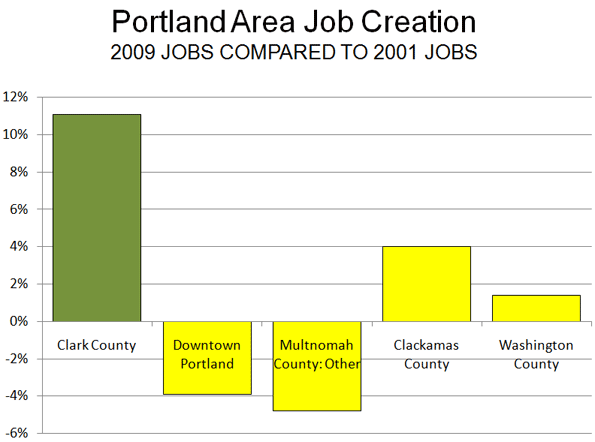
    Anemic Job Creation: Jobs have simply not been created in Portland’s core. Since 2001, downtown employment has declined by 3,000 jobs, according to the Portland Business Alliance. In Multnomah County, Portland’s urban core and close-by surrounding communities, 20,000 jobs were lost between 2001 and 2009. Even during the prosperous years of 2000 to 2006, Multnomah County lost jobs. Suburban Washington and Clackamas counties gained jobs, but their contribution fell 12,000 jobs short of making up for Multnomah County’s loss. The real story has been Clark County (the county seat is Vancouver), across the I-5 Interstate Bridge in neighboring Washington and outside Metro’s jurisdiction. Clark County generated 13,000 net new jobs between 2001 and 2009 (Figure 1).

    Domestic Migration: Not only are companies not creating jobs in the three county area, but people are choosing to locate in other parts of the metropolitan area.

    Between 2000 and 2009, the three counties – roughly 75% of the region’s total population in 2000 – attracted just one-half of net domestic migration into the metropolitan area. Washington’s suburban Clark County, across the Interstate Bridge, added a net 48,000 by domestic migration and has accounted for 40% of the metropolitan area’s figure all by itself.

    Core Multnomah County, which had nearly double Clark County’s 2000 population, added only 4,000 net domestic migrants, at a rate less than 1/20th that of Clark County. Suburban Clackamas and Washington counties did better, but between them achieved barely one-half of the Clark County rate.

    Exurban Columbia and Yamhill counties, outside the jurisdiction of Metro but inside the metropolitan area, added nearly 13,000 domestic migrants, more than three times that of Multnomah County, despite their combined population less than one-fifth that of Multnomah’s in 2000.

    Effects of Pro-Transit Policies: Portland’s unintended decentralization has even damaged the much promoted, and subsidized, public transit agencies. Despite Portland’s pro-transit policies, the three county transit work trip market share fell from 9.7% in 1980, before the first light rail line was opened, to 7.4% in 2000, after two light rail lines had opened. Two more light rail lines and 9 years later, (2009) the three county transit work trip market share had fallen to 7.4%, despite the boost of higher gasoline prices. The three county transit work trip market share loss from 9.7% in 1980 to 7.4% in 2009 calculates to a near one-quarter market share loss. By contrast, Seattle’s three county metropolitan area, without light rail until 2009, experienced a 5% increase in transit work trip market share from 1980 to 2009 (8.3% to 8.7%).

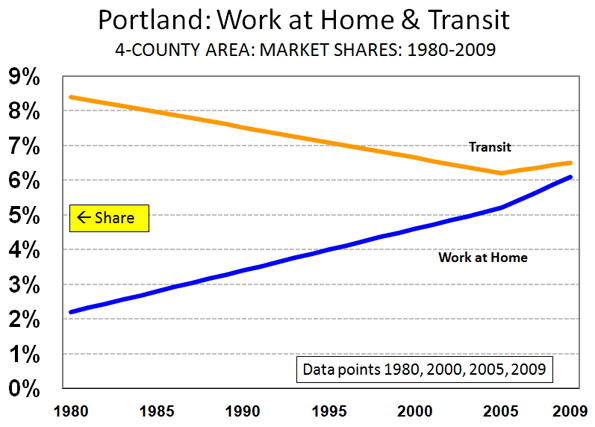
    While taxpayer funded transit was attracting less than its share of new commuters out of cars, one mode –unsupported by public funds – was doing very well. Between 1980 and 2009, working at home rose from 2.2% of employment to 6.2%. in the four county area (including Clark County). Thus, nearly as many people worked at home as rode transit to work in 2009 (Note). Already, working at home accounts for a larger share of employment than transit in the larger 7 county metropolitan area. All of this is despite Portland’s having spent an extra $5 billion on transit in the last 25 years on light rail expansions and more bus service. (Figure 2).

    Why is the Three County Area Doing Less Well? Why have Portland’s policies that are designed to help the core failed to draw jobs and people? People who move to the Portland area from other parts of the nation are probably drawn by the lower house prices in Clark County, where less stringent land use regulation has kept houses more affordable. New housing in Clark County is also built on average sized lots, rather than the much smaller lots that have been required by Metro’s land use policies. House prices are also lower in the exurban counties outside Metro’s jurisdiction.

    As Metro has forced urban densities up in the three county area and failed to provide sufficient new roadway capacity, traffic congestion has become much worse. A long segment of Interstate 5 in north Portland seems in a perpetual peak hour gridlock unusual for a medium sized metropolitan area, which is obvious from Google traffic maps that show average conditions by time and day of week. Even more unusual is the gridlock on a long stretch of the US-26 Sunset Highway that serves the suburban Silicon Forest of Washington County. A long overdue expansion will soon provide some relief on US-26. However transportation officials seem in no hurry to provide the additional capacity necessary to reduce both greenhouse gas emissions and excessive travel delays on Interstate 5 in north Portland. People who move to Clark or the exurban counties can avoid these bottlenecks by working closer to home or even in the periphery of the three county area.

    Portland has important competitive advantages, such as a temperate climate and marvelous scenery. It also helps to be close to hyper- uncompetitive California, which keeps exporting households to neighboring states. But a higher cost of living driven by policies that have kept prices 40% higher than before the housing bubble (adjusted for household incomes), and increasing traffic congestion make Portland’s three county area less competitive and nearby alternatives more attractive.

    This is not surprising. More intense regulation deters business attraction and expansion. An economic study by Raven Saks of the Federal Reserve Board concluded that … metropolitan areas with stringent development regulations generate less employment growth. At least part of the reason the Metro region’s diminished competitiveness lies with a failed strategy that appears to be having the exact opposite effect to what has been advertised – and widely celebrated – among planners from coast to coast.

    Note: 1980 three county data not available on-line.

    Wendell Cox is a Visiting Professor, Conservatoire National des Arts et Metiers, Paris and the author of “War on the Dream: How Anti-Sprawl Policy Threatens the Quality of Life

    Photograph: South Waterfront Condominiums, Portland. Photo by author

  • Why We Have to Learn to Love the Subdivision – Again

    When did anyone last hear officials and professionals talking enthusiastically about the social and economic benefits resulting from the subdivision of land to create secure, clean and tradable title?

    Indeed, any planning document is likely to include a long list of potential problems caused by the subdivision, but will mention few, if any, of the benefits. Maybe it’s time to rethink this conventional planning wisdom. In Peru, during the eighties, Hernando De Soto and the Institute for Liberty and Democracy promoted land reforms that led to more than 1.2 million rural families being given titles to the land they worked. One major grant of titles to a whole village was celebrated on television. When the reporter asked a woman “Why is having title important for your family?” she replied “Having secure title means I can now go out to work.” She went on to explain that the family’s past “customary settlement” required continual occupancy and eternal vigilance. Some member of the family had to be on the property at all times, or else someone else could move in.

    During a recent BBC television news bulletin on the floods in Pakistan, reporter Orla Guerin said “Many here are bound to their land and their livestock, and will live or die with them. We spotted one young boy, clinging to the top of an electricity pylon. He climbed down to collect a bag food aid, but refused to be removed from the waters.”

    I suspect he was also concerned with the need to help maintain his family’s right to occupy.

    City officials and urban planners in particular are always claiming that their cities are “running out of land”. Of course they are not running out of land. They are surrounded with it, as any air traveler knows, just from looking out the window.

    However, they are short of land with a certificate of title that allows the landowner to develop the property for housing or anything else. One reason for this shortage lies with the costs and often onerous conditions of compliance are simply too high. The French Revolutionaries learned that when they fixed the price of bread at less than it cost to bake a loaf, the bakers simply stopped baking bread. When it costs more to gain a title than the lot can be sold for, we should not be surprised if people stop creating lots.

    Suburban residential development creates many jobs and the residents who move continue to create new employment opportunities for decades. Every home owner becomes a property developer as they add rooms, sleepouts, new decks and swimming pools and upgrade their kitchens, and so on. I should have emphasized that it’s the land around the dwelling that enables so many of these projects to take place over the decades and to create so many jobs.

    If Smart Growth policies force people to live in apartments, their opportunities to improve their dwellings become seriously limited.

    City governments appear to overlook the economic and employment impact of rejecting large-scale developments, but the cumulative effect of a multitude of prohibitions of smaller proposals is equally serious – especially in a small economy like New Zealand or a relatively unpopulated place like Montana.

    During the nineteenth century the key function of governments in the New World was to churn out titles as quickly as possible.

    Surveyors served as the true frontiersmen, enabling the migrants to arrive, put down their roots, and build. The post-war suburban boom repeated this experience, supported by an equal enthusiasm for creating a property owning democracy.

    Then during the 1990s, “The Age of Environmentalism” arrived and activists persuaded decision-makers in the developed world that the creation of titles enabled polluting humans to possess the Earth Mother and must be stopped, or be made as difficult as possible. These constraints on land supply created the short-term property boom, and the inevitable bust that led to the greatest financial crisis in recent history.

    The developing nations and their economists continue to recognize the value of title. The works of Hernando de Soto, the Peruvian economist, emphasize that the major problem facing people in poor countries has been their lack of secure title to land, which constrains their ability to borrow significant sums of money and put down secure roots. As he says, the family with title builds a dwelling; the family that squats invests in furniture. This has led to his founding leadership of The Institute for Liberty and Democracy in Peru.

    At the recent conference of international surveyors in Sydney it was quite exhilarating to hear surveyors and officials from Peru talking of targets of 150,000 new titles per year. They knew full well that titles generate wealth. Maybe it’s time for New World cities to set similar targets and share de Soto’s enthusiasm for the contribution of subdivision to ongoing liberty and the pursuit of happiness.

    Bankers have long recognized that many families’ main means of saving is paying off their mortgage. Equally, many aging citizens fund their retirement by subdividing their large lots to create a nest egg for the future. Most university-indoctrinated central planners regard this as an “inappropriate” activity.

    Unexpected Super Large-Lot zoning in rural areas can suddenly deprive thousands of people of a secure and active retirement. Of course the planners claim the landowners are still able to subdivide, but just have to go through an approval process. Then the same planners make sure the costs and uncertainties render the exercise prohibitive. Their environmental cost benefit analysis ignores this destruction of individual wealth – and dreams.

    I wonder if any advanced developed country planning school has Hernando de Soto on its reading list?

    Instead of encouraging the creation of titles, as history suggests we should, the Smart Growth central planners have persuaded our governments to penalise the creation of new lots by imposing highly expensive and highly regressive fines called “development contributions” – which are actually anti-development levies.

    We tax cigarette smokers to discourage smoking, and we fine speedsters to discourage speeding. Should we be fining the creators of legal title if our aim is to encourage development, promote employment growth, increase savings and promote personal well-being?

    Some politicians, like Maurice Williamson, New Zealand’s Minister for Building and Construction ARE determined to reduce the costs of building consents and inspections. But these are trivial compared to the costs of subdivision and land use consents.

    And there is something of an international movement away from rule based management of development and a return towards broader concerns of society and the people who inhabit it.

    But before any legislative reforms can be effective we need to learn to once again celebrate secure, tradable, private title. This remains one of Western Civilisation’s greatest contributions to our wealth, health and general well-being.

    Owen McShane is Director of the Centre for Resource Management Studies, New Zealand.

    Photo by Brenda Anderson

  • Suburbia Evolved: Glendale Then and Now

    The classic picture of suburbia is that of white picket fences, the family Chevy in the driveway, and Mom in an apron beckoning her children to abandon the baseball and glove for a home-cooked dinner. Of course, there is nothing wrong with this picture, per se. Nothing wrong except for the fact that it is now becoming more of the exception than the rule among American suburban communities, memorialized best in cultural artifacts like reruns of “Leave It to Beaver.”

    Over the past sixty years, the idealization of this traditional, Rockwell-esque habitat has slowly eroded, leaving only structural-skeletal remains of that old community – the single-family houses, the neighborhood streets, the shopping malls.

    In southern California these remains exist where one might least expect them: eight miles from downtown Los Angeles. The town is Glendale, California, and it’s not what you would imagine, both currently and throughout its history. It is here where you see the fusion of the new suburbia; a new blended reality, part suburb, part city.

    Glendale started out as a farming community, much like the rest of Los Angeles, writes Juliet M. Arroyo in her book Early Glendale. However, it experienced an economic boom in the ’20s with neighboring LA, becoming a bedroom community in the utmost sense of the term. Yet as the town grew, more people lived but also worked in Glendale, creating a relatively independent suburb.
    This independence differentiated it from its neighbors in both lifestyle and demographics. By the time the Civil Rights Movement was beginning its upswing in the late ’50s and early ’60s, some strong and distasteful local reaction resulted. “I heard legends of Nazi factions camped out on the streets leading into [Glendale], oh yes. They made their presence known on Colorado Boulevard, where they had a sort of pseudo-headquarters across from the landmark Bob’s Big Boy restaurant, ” recalls a forty-seven year resident. This intimidation created a de facto boundary between the urban and suburban.

    Over time such extreme behaviors diminished here as they did in much of the rest of the country. Yet even until the early 1990s, Glendale remained a predominantly WASP middle class community, a Republican stronghold in the House of Representatives, maintaining a picture of that comfortable American lifestyle, complete with 75 year-old camphor trees lining side streets.

    Demographic changes in the ’90s played a substantial role in transforming this traditional town that had remained static for so long. A major increase in Hispanics and Asians, but chiefly peoples of the former Soviet Union – Armenians in particular – have risen to take central stage in Glendale’s recent history.

    After the dissolution of the USSR, many Armenians sought refuge in the United States, and a prominent section of their population made their way to Glendale. With three foreign cultures now robustly represented (Armenians, Russian-Armenians, and Iranian-Armenians), the city was transformed. The city’s Armenian population surged, noted the Daily News, by 65 percent between 1990 and 2000, with more than one in four of Glendale’s residents now claiming Armenian descent.

    A new set of challenges emerged with this change. The immigrant groups impacted the community economically, as lower incomes and more people per housing unit (apartments, houses) lowered tax revenues, while increasing demands on public services like the school district. During this time, many of the older residents began to move to Orange County and the Santa Clarita Valley, northwest of the city, following children and grandchildren to areas offering a lower price per square foot. In many cases, they were replaced a third type of resident: the urban commuter.

    Los Angeles had always been nearby, of course, but remained a somewhat distant, urbanized neighbor. Glendale saw low turnover rates in its housing market as original owners held onto their properties. “They liked the community, and didn’t want to leave,” claims longtime Glendale real estate agent Phyllis Cotton. She recalls that the mid-1990s saw a boom in home sales and prices. An attractive feature unique to this market is the existence of “character homes” as opposed to the “cookie-cutters” found in housing tracts in the suburbs further removed from LA. The intrinsic value of these unique homes built in the ’30s is due to the fact that they were usually well-maintained (often sold by the original owner), and situated just minutes from the job markets of Los Angeles and Burbank.

    The local market’s boom attracted a more affluent resident. The neighborhoods where these character homes existed now had three primary types of residents: the remaining original owners or their offspring, immigrant families making their way up the economic ladder, and young(er) professionals looking for a slower paced, more suburban quality of life.

    Yet as the town comes into its own in the 21st century, it offers a lifestyle that is almost anything but quiet and relaxed. Today, Glendale is becoming increasingly reminiscent of an urban center itself than the tranquil suburb it once was. Brand Boulevard, one of its main streets, is lined with local hotspots such as the historic Alex Theater, Porto’s Bakery with its patio chock-full of patrons from all over Los Angeles, as well as the newly minted Americana at Brand. This development is a multi-use property of trendy stores, upscale restaurants, and luxury apartment and condominium residences. With dancing fountains similar to those at the Bellagio in Las Vegas (though admittedly on a much smaller scale), the Americana relates more to the more diverse, younger, affluent population than the profile of Glendale’s original residents.

    Today there is room for just about every type of person in the new Glendale – those seeking both a more urban experience and the more traditional suburban one. “Buyers and sellers are still confident in this market,” asserts Phyllis Cotton, previously introduced above. Homes are retaining their values better than those in other suburbs of Los Angeles. Also, the city’s website reports higher test scores, higher per capita incomes, and lower crime rates than all of its closest neighbors – Burbank, Pasadena, and Los Angeles proper.

    Still, recent growth and its proximity to Los Angeles leads to one important question: when will the line between urban and suburban become so blurred that the two become indistinguishable? If Glendale is the case study, it may be impossible to tell. What we are seeing is something new: an urbanized suburb that offers the diversity and tempo of the big city alongside good schools, safe streets, and single-family homes on relatively large lots. But this transformation may not yet be complete. The challenge for the future may be maintaining Glendale’s character despite the growing urban influence.

    Laura Jean Berger is a senior at Chapman University studying Political Science and Communication Studies. A lifelong resident of Glendale, she is an avid classical pianist and a self-diagnosed political junkie.

    Photo by Renee Silverman

  • Why Housing Will Come Back

    Few icons of the American way of life have suffered more in recent years than  homeownership. Since the bursting of the housing bubble, there has been a steady drumbeat from the factories of futurist punditry that the notion of owning a home will, and, more importantly, should become out of reach for most Americans.

    Before jumping on this bandwagon, perhaps we would do well to understand the role that homeownership and the diffusion of property plays in a democracy. From Madison and Jefferson through Lincoln’s Homestead Act, the most enduring and radical notion of American political economy has been the diffusion of property.

    Like small farmers in the 19th century, homeowners–and equally important, aspiring homeowners–now represent the core of our economy without which a strong recovery is likely impossible.  Houses remain as a financial bulwark for a large percentage of families, the anchor of communities, and, increasingly, home-based businesses.

    The reasons given for abandoning the homeownership ideal are diverse.  Conservatives rightfully look to diminish the outsized role of government in promoting homeownership.  Some suggest  that Americans would be better off  putting their money into things like the stock market or boosting consumer purchases.

    New-urbanist intellectuals like the University of Utah’s  Chris Nelson predict  aging demographics will lead masses to abandon their homes for retiree communities and nursing homes.   The respected futurist Paul Saffo predicts that as skilled laborers move from Singapore to San Francisco to New York and London, there is little need to “own” a permanent place. In the brave new future, he suggests, we will prefer time-sharing residences  as we flit from job to job across the global economy.

    Some of the greatest hostility towards homeownership increasingly comes from the progressive left, some of whom are calling for the total elimination of the homeowner mortgage interest deduction.  “The Case Against Homeownership,” recently published in Time,  encapsulates the current establishment’s  conventional wisdom: that homeownership is by nature exclusionist, “sprawl” promoting and responsible for “America’s overuse of energy and oil.”

    Yet for all the problems facing the housing market, homeownership–not exclusively single-family houses–is not likely to fade dramatically for the foreseeable future. The most compelling reason has to do with continued public preference for single-family homes, suburbs and the notion of owning a “piece” of the American dream.   This is why that four out of every five homes built in America over the past few decades, notes urban historian Witold Rybczynski, have less to do with government policy than “with buyers’ preferences, that is, What People Want.”

    What we are going through now is not a sea change but a correction from insane government and business practices.   The rise in homeownership from 44% in 1944 to nearly 70% at the height of the bubble reflected a great social democratic achievement. But by the mid-2000s government attempts to expand ownership–eagerly embraced by Wall Street speculators–brought in buyers who would have historically been disqualified.

    In some markets, prices exploded as people moved up too quickly into ever more expensive housing. Housing inflation was further exacerbated by “smart growth” policies, which limited new home construction in suburban areas and instead promoted dense, “transit oriented” housing with limited market appeal and economic logic.

    Rather than artificially constraining supply and protecting irresponsible borrowers,   we should let nature take its course. Home values need to readjust historic balance between incomes and prices. Over the past 60 years, notes demographer Wendell Cox, it took two to three years or less of median household income to purchase a median-priced home. At the peak of the boom, that ratio had ballooned to 4.6.

    The disequilibrium was the worst in regions like Los Angeles, Las Vegas, San Bernardino-Riverside and Miami. At the peak of the bubble, between 2006 and 2008, according to the National Homebuilders Association- Wells Fargo “Housing Opportunity Index,” barely 2% of families with a median income households in Los Angeles could afford to buy a median priced home; even in the traditionally affordable Riverside area, the number was roughly 7%. In Miami, barely 10% could afford such a purchase; in Las Vegas, often seen as one of the cheaper markets, only 15%.

    What a difference a market correction makes. The affordability number for Los Angeles is now 34%, 17 times better than two years ago, while Riverside is now near 70%. Miami’s affordability picture has improved to over 60% while in Las Vegas, it’s back over 80%.

    These lower prices–not Wall Street or federal gimmickry–will lure new buyers to the places that some new urbanists   have predicted will be “the next slums.” Already there’s evidence in places like Miami of a renewed interest in now-affordable suburban single-family homes while condos stay empty  or become rentals.

    Of course without a return to robust job growth, particularly in the private sector, the home market– and pretty much all mainstream consumer purchases–will remain weak. No matter how low prices get, people worried about losing employment do not constitute a promising new market for homes.

    But over the longer run most Americans will seek to purchase homes –whatever the geography. Increasingly this will be less a casino gamble, and more  a long-term lifestyle choice.  As America adds upwards of 100 million more Americans by 2050, the demand will stare us in the face.

    As boomers age, the two big groups that will drive housing will be the young Millenial generation born after 1983 as well as immigrants and their offspring. Sixty million strong, the millenials are just now entering their late 20s. They are just beginning to start hunting for houses and places to establish roots. Generational chroniclers  Morley Winograd and Mike Hais, describe millenials in their surveys as family-oriented young people who value homeownership even more than their boomer parents. They also are somewhat more likely to choose suburbia as their “ideal place to live” than the previous generation.

    These tendencies are even more marked among immigrants and their children. Already a majority of immigrants live in suburbia, up from 40% in the 1970s. They are attracted in many cases by both jobs and the opportunity to buy a single-family home. For an immigrant from Mumbai, Hong Kong or Mexico City, the “American dream” is rarely living in high density surrounded by concrete; if they wanted that, they could have stayed home.

    Over coming generations, changes in family and work life will make single-family homes, townhouses and other moderate-to-low density housing more attractive.  Contrary to the anonymity predicted by most futurists, your chosen place is becoming more important, as evidenced by numerous suburban and small town downtown revivals as well as growing local volunteerism.

    Equally important, multi-generational households are on the rise back to 1950s levels–in part due to immigrant lifestyle preferences. People are staying put; even before the bubble burst, mobility had dropped to the lowest level in over a half century. With the rise of new technologies allowing for dispersed work, the single family home increasingly houses not only residents, but part and full-time offices.

    Barring a long-term permanent recession or a national planning regime aimed at curbing single-family home construction, these factors should lead to a new surge in home buying starting later this decade. It may be too late to save many who overextended themselves in the bubble, but this resurgence could do much to propel our anemic economy, restoring the home to its rightful place one of the cornerstone not only of the American dream, but of our democracy.

    This article originally appeared at Forbes.com.

    Joel Kotkin is executive editor of NewGeography.com and is a distinguished presidential fellow in urban futures at Chapman University. He is author of The City: A Global History. His newest book is The Next Hundred Million: America in 2050, released in February, 2010.

    Photo by Wootang01

  • Urban Plight: Vanishing Upward Mobility

    Since the beginnings of civilization, cities have been crucibles of progress both for societies and individuals. A great city, wrote Rene Descartes in the seventeenth century, represented “an inventory of the possible,” a place where people could create their own futures and lift up their families.

    What characterized great cities such as Amsterdam—and, later, places such as London, New York , Chicago, and Tokyo—was the size of their property-owning middle class. This was a class whose roots, for the most part, lay in the peasantry or artisan class, and later among industrial workers. Their ascension into the ranks of the bourgeoisie, petit or haute, epitomized the opportunities for social advancement created uniquely by cities.

    In the twenty-first century—the first in which the majority of people will live in cities—this unique link between urbanism and upward mobility is under threat. Urban boosters still maintain that big cities remain unique centers for social uplift, but evidence suggests this is increasingly no longer the case.

    This process reflects a shift in economic and social realities over the past few decades. For example, according to a recent Brookings Institution study, New York and Los Angeles have, among all U.S. cities, the smallest share of middle-income neighborhoods. In 1980, Manhattan ranked 17th among the nation’s counties for social inequality; by 2007 it ranked first, with the top fifth earning 52 times that of the lowest fifth, a disparity roughly comparable to that of Namibia.

    President Obama’s hometown of Chicago shows much the same pattern, according to a recent survey by Crain’s Chicago Business. Conditions have improved for a relative handful of neighborhoods close to the highly globalized central businesses. But for many neighborhoods things have not improved, and in some cases have deteriorated. Even before the recession there were fewer jobs than in 1989 and fewer opportunities for the middle class, many of whom—including more than 100,000 African-Americans—have left the city over the past decade.

    This pattern does not reflect perverse conditions unique to the United States, as many academics and progressive pundits often suggest. Between 1970 and 2001, the percentage of middle-income neighborhoods in Toronto dropped from two-thirds to one-third, while poor districts had more than doubled to 41 percent. According to the University of Toronto, by 2020, middle-class neighborhoods could account for barely less than 10 percent of the population, with the balance made up of both affluent and poor residents.

    Similarly, Tokyo, once widely seen as an exemplar of egalitarianism, is transforming. The city’s post–World War II boom yielded a thriving middle class and remarkable social mobility. That is now giving way to a society where wealth is increasingly concentrated. The poverty rate, including some 15,000 homeless people, has risen steadily to the highest level in decades.

    Much the same process can be seen in great social democratic havens of Europe. In Berlin, Germany’s largest city, unemployment has remained far higher than the national average, with rates at around 15 percent. Some 36 percent of children are poor; many of them are from other countries. The city, notes one left-wing activist, has emerged as “the capital of poverty and the working poor in Germany.”

    To a large extent, urban poverty in Berlin and other European megacities is concentrated among Muslim immigrants. Muslims constitute at least 25 percent of the population of Marseilles and Rotterdam, 20 percent of Malmo, 15 percent of Birmingham, and 10 percent or more of London, Paris, and Copenhagen. Over the next few decades, according to a recent Pew Research Center study, Muslims will constitute a majority of the population in several of these European cities.

    The Case of London

    Perhaps nowhere is the growing class divide more evident than in London, perhaps the world’s most important megacity. Despite a massive expansion of Britain’s huge welfare state, the ladder for upward mobility seems broken, especially in London. This represents a dramatic shift from the period after World War II. In the ensuing decades, incomes for most Londoners grew, access to education expanded, and the sharply drawn and notorious class lines began to blur.

    But contemporary London’s emergence as the headquarters of globalization has had widely differentiated impacts on class. On the one hand, it has paced the emergence of the West End. Many once hardscrabble neighborhoods—including Shoreditch, Islington, and Putney—have gentrified. Yet walk a bare half mile or less from the Thames River, particularly to the south, and you encounter many marginal, and often dismal, districts. These areas have not much benefited from the global economy and are inhabited largely by those who survive at the expanding bottom of the wage profile.

    Equally troubling, globalization’s benefits have disproportionately accrued to those already possessing considerable means; the ranks of top professionals, according to a 2009 report by the British government’s social mobility task force, have been increasingly dominated by the children of the wealthiest families.

    Even less noted has been London’s deepening concentration of poverty. Today more than one-third of the children in inner London are living in poverty, as are one in five in the outer ring communities. London has the highest incidence of child poverty in Great Britain, even more than the beleaguered Northeast.

    Poverty also affects 30 percent of working-age adults, more than one-third of pensioners in inner London, and roughly one in five in outer London. The inner London rates are the worst in Britain. More than 1 million Londoners were on public support in 2002. These figures are certain to become worse as a result of the recession that began in 2008.

    The conditions are certainly not as extreme as those recorded in Friedrich Engels’s searing 1844 tome, The Condition of the Working Class in England, but there remains a macabre relationship between mortality and geography. Steve Norris, a former Conservative Party chairman and onetime head of London Transport, notes that public health data published by the King’s Fund demonstrates that life expectancy in the poorer parts of east London is 4.5 years lower than in West London. That’s six months for every station east of Waterloo on the Jubilee Line. This poverty, Norris adds, extends to many white Londoners. They often live cheek to jowl with immigrants, and feel themselves competing for housing, jobs, and government services. The rich, Norris adds, “Buy their way out of poor quality education and healthcare” while the working and middle classes “queue for public housing for themselves and their children.”

    Of note is the rise of the phenomena among the white working class described as “yobbism.” Large parts of Britain—including less fashionable corners of London—suffer among the highest rates of alcohol consumption in the advanced industrial world. London School of Economics scholar Dick Hobbs, who grew up in a hardscrabble section of east London, traces this largely to the decline of the blue-collar economy in London. Over the past decade, job gains in Britain, like those in the United States, have been concentrated at the top and bottom of the wage profile. The growth in real earnings for blue-collar professions—in industry, warehousing, and construction—generally has lagged those of white-collar workers.

    One other thing is clear: the welfare state has not reversed the growing class divide. Despite its proletarian roots, New Labour, as London Mayor Boris Johnson acidly notes, has presided over what has become the most socially immobile society in Europe.

    The Role of Housing and ‘the Green Factor’

    Housing costs have exacerbated these conditions. Due largely to restrictions on new housing on the periphery, London now ranks, next to Vancouver, as the most expensive city to buy a house in the English-speaking world. Estimates by the Centre for Social Justice finds that unaffordability for first-time buyers doubled between 1997 and 2007. This has led to a surge in waiting lists for government-funded “social housing”; by mid-2008, some 2 million households (5 million people) were on the waiting list for such housing. In London, this number reached one in ten in 2008.

    Broad-based economic growth might seem the most logical solution to this dilemma. In the past, socialists, liberals, and conservatives might vigorously have debated various approaches, but generally agreed about the desired end result: shrinking slums and expanding opportunity for the middle or working class. Today, however, many urban “progressives” do not trouble themselves overmuch about the hoi polloi. Instead, they are more likely to devise policies to lure the much-ballyhooed “creative class” of well-educated, often childless, high-end workers to their cities. This goes along as well with an increased focus on aesthetic and “green” issues.

    In many ways, these approaches actually work at cross-purposes with upward mobility. Green-oriented policies are often hostile to “carbon intensive” industries such as manufacturing, warehousing, or construction that employ middle-income workers. Green policies implicitly tilt towards industries such as media, entertainment, and finance that employ the best-situated social classes.

    Indeed, some climate change enthusiasts, such as The Guardian’s George Monbiot, see their cause in quasi-religious terms. In Monbiot’s words, he is waging “a battle to redefine humanity.” In his view, we must terminate the economic “age of heroism,” supplanting the “expanders” with anti-growth “restrainers.”

    This is not just the latest edition of British “loony Left” thinking. President Obama’s own science advisor, John Holdren, long has embraced the notion of what he calls “de-development” of Western economies to a lower level of affluence. Such approaches impose enormous costs on both the middle and working classes in European and North American cities, particularly given the unlikelihood of similar restrictions on competitors in China, India, Russia, and other countries. A huge shift to renewable fuels, for example, could quadruple the cost of energy in Britain, forcing a large percentage of the population into “fuel poverty.”

    Key Focus: Economic Growth

    The emerging class conflict in the great global cities ultimately could have many ill effects. Persistently high unemployment and underemployment in British metropolitan areas, for example, has spurred nativist sentiment and intolerance towards immigrants. This is true in America today as well. But views towards immigrants generally soften as an economy improves. Broad-based prosperity is a good antidote for intolerance.

    Attacking the class gap requires a redefinition of current views about the overused term “sustainability.” This concept needs to be expanded beyond its conventional environmental definition to reflect broader social and economic values as well. It is one thing to consider how, in an era dominated by dispersed work, core cities might still attract those elite workers needing direct “face-to-face contact.” It is quite another to develop strategies so that the vast majority will be able to find work doing anything other than servicing the needs of the upper echelons.

    In turning away from the fundamental issues of economic growth and upward mobility, these cities are in danger of permanently undermining the very thing that has made great cities so attractive over the centuries. The ultimate worth of urbanity lies in its ability to deliver a better life, not only to the established affluent and the most skilled, but to that broader population who, like others over the millennia, come to a big city to create a better life.

    This article originally appeared at The American.

    Joel Kotkin is executive editor of NewGeography.com and is a distinguished presidential fellow in urban futures at Chapman University. He is author of The City: A Global History. His newest book is The Next Hundred Million: America in 2050, released in February, 2010.

    Photo by ecstaticist

  • Time to Hate Those HOAs (again).

    The foreclosure crisis has been devastating for millions of Americans, but it has also impacted many still working as before and holding on to their homes. Even a couple of empty dwellings on a street can very quickly deteriorate and become a negative presence in the neighborhood, at the least driving down prices further, sometimes attracting crime. Untended pools can allow pests to breed. Many animals have been abandoned and shelters report overflowing traffic. The resulting impacts on local governments have been particularly visible, as property tax assessments have fallen and revenues have also gone south.

    Less obvious is the impacts on home owner associations [HOAs], whose revenues have also taken a hit, albeit for rather different reasons. For the most part, HOA dues are not a function of the value of the home but rather the need to cover the costs of maintaining the common interests of the association: landscaping, security and so forth. These tend to be fixed, even if the values of the homes collapse, and may even rise if dwellings are empty and untended.

    Many HOAs, especially in the newer metropolitan areas like Phoenix and Las Vegas where foreclosures have been most concentrated, have taken a beating because the number of households paying into the association has been depleted, quite badly in some instances. The problem seems, from press reports, to cover the economic spectrum. Low-income first-time buyers may stop paying their dues as an economy measure, while more affluent owners are more likely to have pulled cash from their home and are walking away from their debts. There are also thousands of empty homes that were purchased as investments at the height of the boom and may have never even been occupied.

    The foreclosure debacle is now old news, but the HOA situation is receiving attention because association boards are now aggressively trying to recoup their debts, even from those who have walked away from their mortgages. The debt, they argue, is attached to the individual, not to the dwelling, and is being turned over to collection agencies. Now, this is hardly a novelty. Municipalities have been turning household utility debts over to third parties for years, often with some success, and without a murmur of protest. So why is it different if HOAs do it?

    The answer is that HOAs are extremely unpopular with two vocal constituencies. The first is the academic community, and its hostility is part of the professional opprobrium that is heaped on gated communities, privatization and pretty much anything connected with suburban development. Interestingly, while the design aspects of gated communities have caught the attention of planners and urbanists, relatively few have focused on the dimension of governance. Those that have written on the topic have tended to be critical of private clubs that are seen to exist at the expense of the municipal collective. For what its worth, I don’t think I’ve ever known of an academic colleague who lived in an HOA, in contrast to the bulk of my students, who live in one or grew up there.

    The second constituency is more rowdy. Academics just disdain HOAs, but this group is committed to exposing them as a vast conspiracy to subvert the American way of life. This may sound like another version of contemporary “Teamania” but it is has been around for at least the past decade, during which time I’ve been monitoring Internet posts and the like. To this group, any restriction on personal freedom — from the color of one’s drapes or exterior paintwork through the display of the national flag — is clearly anathema.

    Early this year, my research on neighborliness in HOAs was covered in the local paper, and by the end of the day there were dozens of online posts. In response to the basic finding — that there is little fundamental difference between HOA and traditional neighborhoods — we received a torrent of angry responses. With a single exception, they all dismissed the findings out of hand, using an example of someone’s experience (rarely their own) to prove the point, at least to their satisfaction. One reader even tracked down my email address in order to demand an assurance that no public funds were used to promote this nonsense.

    Like much in contemporary American politics, this leaves me confused. I don’t understand why an exclusive residential association, freely entered into, with explicit rules that are presented at the outset, offering services-for-cash, is un-American. After all, this is in contrast to a municipality that levies taxes for services from which one cannot opt out (if one has no children in the schools, for instance) and which may not be available to all (such as public transport), and which could easily be seen as a redistributive institution, an example of that socialism we keep hearing so much about.

    For the record, I am happy to pay my property taxes for services I don’t receive — its just part of the social contract. Nor do I live in an HOA. But I can understand why our research indicates that most people who live in them do prefer them (and, for example, often move from one HOA to another). Rather than displaying the angst of those who seem to get nervous if anyone tries to step on their toes, these residents embrace belonging to a small polity in which they have a voice. And we should remember that rules, like fences, make good neighbors. As these neighborhoods become more diverse, traditional and non-traditional households alike can find reassurance in the behavioral conformity demanded of neighbors by an HOA.

    This brings us back to the recent stories about management boards ‘hounding’ those who have not paid their dues. Similar accounts have shown up for years, and the thrust is always the same: punitive, out-of-control boards attack those already in financial distress. There is clearly a lot of the latter to go round, but it’s hard to see why HOAs are much different than any other organization that is looking at a handful of bad debts. Are the HOAs the victims here? Absolutely not. Many embraced the housing bubble, and permitted speculators to buy in, even though they had no intention of living in the properties. At the height of the madness, up to one third of all housing transactions in Phoenix were initiated by out-of-state buyers who drove up home prices precipitately, and eventually caused the median house price to double. This has since corrected. All CC&Rs (the rules of the HOA) that I have seen dictate however that the purchaser must live in the property and that rental units are not permissible. So, like all the other players, the HOA boards liked the price increases so much that they ignored their own rules and looked the other way, a lapse for which they are now paying the price.

    Still, it would be a mistake compounding a mistake to climb on the anti-HOA bandwagon, now joined by the ACLU, which has recently joined the fray over a fight about a homeowner’s right to fly the Gadsden flag (motto: “Don’t step on me”). Libertarians should recognize that no-one has ever been forced to live in an association and that whipping up the wrath of state legislatures to control HOAs is a bad idea: it encourages even more government intervention, and it messes with the neighborhood, a form of governance that the vast majority rightly supports, even in HOAs.

    Andrew Kirby has written about HOAs on several occasions, including the 2003 edited volume “Spaces of Hate”. He most recently wrote about ‘The Suburban Question’ on this site in February.

    Photo by monkiemag

  • The Livable Communities Act: A Report Card

    With much fanfare, the Banking Committee of the United States Senate approved the Livable Communities Act (S. 1619, introduced by Democratic Senator Dodd of Connecticut). A purpose of the act is expressed as:

    …to make the combined costs of housing and transportation more affordable to families.

    The Livable Communities Act would provide financial incentives for metropolitan areas to adopt “livability” policies, which are otherwise known as “smart growth,” “growth management” or “compact city” polices.

    “Livability” is the latest rallying cry for planners who want to draw lines around urban areas and force people out of their cars and into denser housing. Secretary of Transportation Ray LaHood has defined livability as “if you don’t want an automobile, you don’t have to have one.” This meaningless slogan presumes that people are forced to have cars. If you are rich enough, you can live without a car on the Upper East Side of Manhattan or Chicago’s Gold Coast. If you are poor enough, you cannot afford a car, which means fewer job prospects and higher retail prices from merchants serving a captive market.

    Perhaps someday we will be beamed from place to place as in Star Trek. However, in the interim, a serious alternative to the car – hopefully a far cleaner, more efficient version – does not loom on the horizon. For all but a privileged few, cars and the quality of life and cars will remain “joined at the hip”. This is why research shows a strong correlation between the automobile access in an urban area and economic growth.

    The Report Card

    It is not premature to issue a report card on the Livable Communities Act, since the effect of its favored policy prescriptions are already well known. Metropolitan areas more inclined toward the act’s menu of livability policies (such as Los Angeles, San Francisco, Portland, Washington and others) are compared to other metropolitan areas (such as Dallas-Fort Worth, Atlanta, Indianapolis, Kansas City and others). Our analysis shows that, for most people, livability policies produce less livability, in terms of higher costs and a lesser quality of life, especially in greater traffic congestion, longer travel times and more exposure to air pollution (Note 1). They will therefore be referred to as “so-called” livability policies.

    Housing Affordability: The Livable Communities Act seeks to make housing more affordable. Sadly, the record associated with such policies in terms of affordability is nothing short of dismal.


    The Livable Communities Act receives an “F” for home ownership affordability


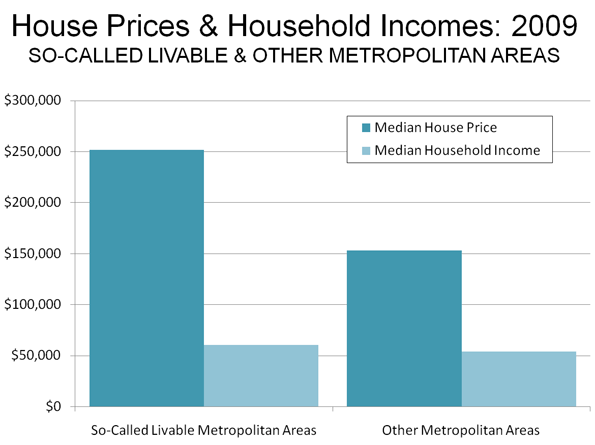
    House prices are considerably higher in the metropolitan areas more inclined toward so-called livability policies. The so-called livable metropolitan areas have nearly 50% higher house prices, after adjustment for incomes (Figure 1). If house prices were at the same level relative to incomes as in the other metropolitan areas, the median price would be $80,000 less. This would mean about $5,000 less in annual mortgage payments. In the least affordable so-called livable metropolitan areas, fewer than 40% of households can afford the median priced house (Los Angeles, New York and San Jose). In all the other metropolitan areas, more than 70% of households can afford the median priced house (Note 2). It takes a lot of gasoline to equal that difference.

    The Livable Communities Act receives an “F” for rental affordability.

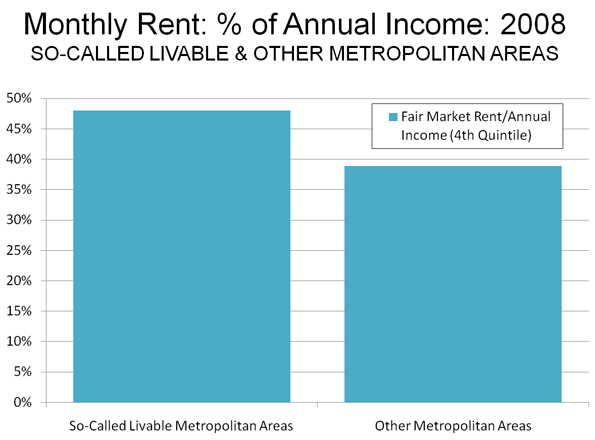
    Rents are also higher in the so-called livable metropolitan areas (Figure 2). The US Department of Housing and Urban Development “fair market rents,” (estimated at the 40th percentile of the rental market, including utilities) for a two bedroom apartment was 25% higher in the so-called livable metropolitan areas in relation to the fourth household income quintile (top of the bottom 25%).

    Why Housing is More Expensive in Livable Metropolitan Areas: The land use regulations typical of the so-called livable metropolitan areas force house prices up by prohibiting development on most available land (urban growth boundaries), imposing building moratoria or, in some cases, by requiring excessively large suburban lot sizes, making it impossible to build housing that is affordable to middle income households. All things being equal, prices increase where supply is restricted, as indicated by a broad economic literature.

    Transportation

    According to the findings in the Livable Communities Act the nation wastes 4.2 billion hours in traffic congestion and loses $87 billion annually from the costs of congestion. The congestion cost is principally the cost of time.

    Transportation Costs: Since commuting by transit nearly always takes longer than commuting by car (twice as long in 2007), any switch to transit is likely to increase costs (lost time is lost time, whether in a train or in a car). The balance of congestion costs are in excess fuel consumption, which would likely also increase under the so-called livability policies, because higher densities produce greater traffic intensities (this from Sierra Club based research), which means more congestion and slower travel speeds, which reduces fuel economy.

    The Livable Communities Act receives an “F” for transportation affordability

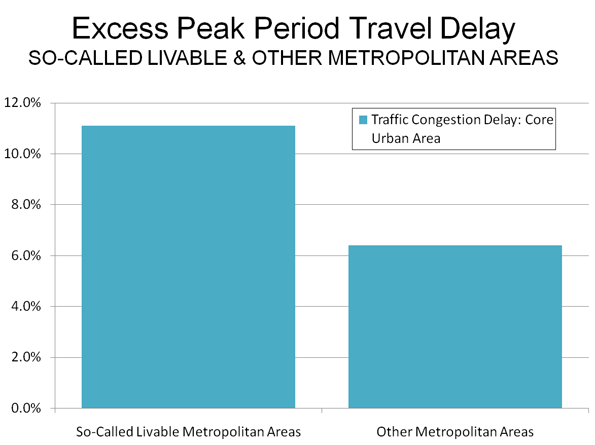
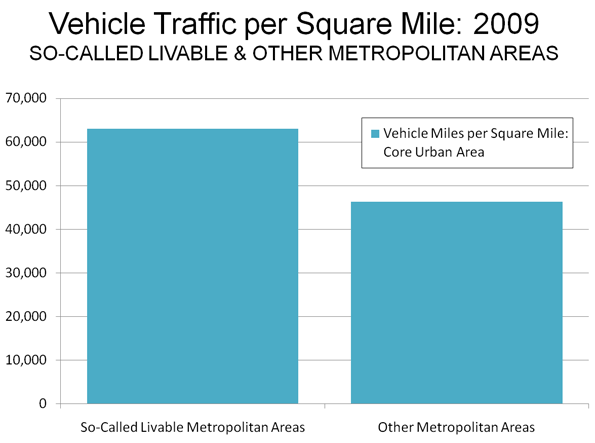
    Transportation Quality of Life: So-called livability policies worsen traffic congestion and air pollution. This is indicated by the latest INRIX traffic scorecard showing that average travel delays during peak travel periods are nearly 75% greater in the so-called livable metropolitan areas (Figure 3). Federal Highway Administration data indicates that the intensity of traffic is more than one-third higher in the so-called livable metropolitan areas (Figure 4)


    The greater traffic intensity also has negative health impacts. The American Heart Association noted that being close to congested roadways increases the likelihood of heart attack and stroke. The American Heart Association cites a study indicating that “a person’s exposure to toxic components of air pollution may vary as much within one city as across different cities.” Obviously, such exposure will be greater where traffic densities are higher.

    The Livable Communities Act receives an “F” on transportation related quality of life issues.

    Consumer Preferences

    In its findings, the Livable Communities Act says that the demand of new housing in dense, walkable (so-called “livable”) areas is 15 times the supply. This misses the extensive overbuilding of dense, walkable communities that ended in the huge condominium bust in Portland, Seattle, Los Angeles, Miami, Atlanta, Chicago and elsewhere. The supply of such housing exceeds the demand, particularly at the current price points.

    Consumer preferences are not revealed by planners’ delusions from surveys people answer in the abstract. For example, most people want shorter commutes, but they vastly prefer single family houses to apartments. In the real context of issues like costs, living space, or schools, people express their priorities.

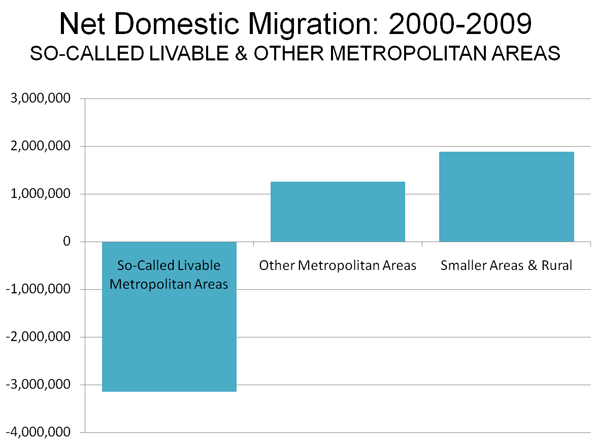
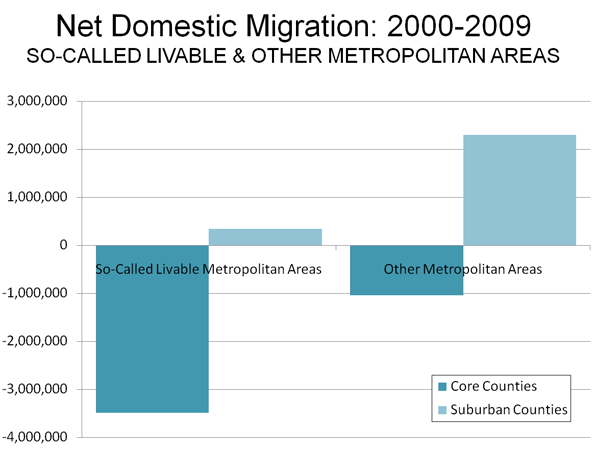
    The “litmus” test of so-called livability is what people do, not what they say they might do. Households continue to vote with their cars and are moving away from so-called “livable” areas. According to 2009 domestic migration data compiled by the Bureau of the Census:

    • The so-called livable metropolitan areas lost more than a net 3,140,000 residents to other areas of the nation, while other metropolitan areas gained more than 1,000,000 and smaller areas gained nearly 2,000,000 (Figure 5).
    • Nearly 3,500,000 residents left the core counties of the so-called livable metropolitan areas for other parts of the nation, while the suburbs gained 340,000 residents.
    • In the other metropolitan areas, more than 1,000,000 residents left the denser core counties, while the suburbs gained 2,300,000 (Figure 6).


    The Livable Communities Act receives an “F” for consistency with consumer preferences

    The Report Card: Not Livable at All

    The Livable Communities Act report card is shown below. In other words, if enacted, it is likely to produce a failing grade for families even if it wins straights A’s with planners, academics and inner city developers.

                                     Report Card

    Livable Communities Act

    Subject

    Grade

    Home Ownership Affordability

    F

    Rental Affordability

    F

    Transportation Affordability

    F

    Transportation Quality of Life

    F

    Consistency with Consumer Preferences

    F

    Overall Grade

    F

    Additional Comments: The favored policies would reduce mobility to major parts of the metropolitan area, which would reduce access to potential employment opportunities and retail establishments with lower prices.

    Note 1: The analysis covers metropolitan areas with more than 1,000,000 population. The “so-called” livable metropolitan areas are classified as those with “more restrictive” land use regulation by Demographia. The other metropolitan areas have less restrictive land use regulation. See note 7 of http://www.demographia.com/db-overhang.pdf.

    Note 2: Calculated from the National Association of Homebuilders-Wells Fargo Housing Opportunity Index.

    Wendell Cox is a Visiting Professor, Conservatoire National des Arts et Metiers, Paris and the author of “War on the Dream: How Anti-Sprawl Policy Threatens the Quality of Life

    Photo: Overbuilding Dense Walkability in Miami (photograph by author)