Category: Suburbs

  • What’s Behind China’s Big Traffic Jam

    The world press has been fixated on the “Beijing” traffic jam that lasted for nearly two weeks. There is a potential lesson here for the United States, which is that if traffic is allowed to far exceed roadway capacity, unprecedented traffic jams can occur.

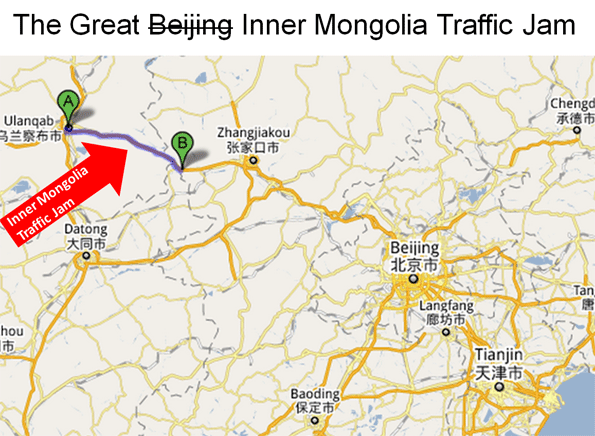
    The Inner Mongolia Traffic Jam: First we need to understand that this was not a “Beijing” traffic jam at all,or even on the outskirts of Beijing. The traffic jam came no closer to Beijing than 150 miles (250 kilometers) away, beyond the border of the city/province of Beijing, through the province of Hebei and nearly to the border of Inner Mongolia. The traffic jam then extended for more than 60 miles (100 kilometers) from near the Inner Mongolia border to Jingxi, in the region/city of Ulanqab. In reality this would be like calling a New York City traffic jam something that originated from Springfield, Massachusetts to Boston’s I-495 beltway (Figure 1).

    However, even the New York City example understates the complexity of the Chinese traffic jam. Beijing, China’s national capital, is one of the world’s largest urban areas (with a population of nearly 14 million). The city is situated at the northwestern limit of the densely populated part of China (which is called “China Proper”) that runs from Manchuria in the north to Yunnan in the south.

    Beijing’s urbanization ends at the mountains less than 30 miles from the Forbidden City, Beijing’s core. The area beyond the mountains, through which the Great Wall runs, possesses only intermittent and generally minor urbanization. The area is dominated by grassland, and some rice farming. In this environment, it is not surprising that there were few alternatives for traffic to the G-110 Expressway (freeway), just as there would be few alternatives for traveling between Casper and Cheyenne, Wyoming on Interstate 25.

    Continuing the I-25 comparison, the Inner Mongolian traffic jam more closely resembled traffic destined for Denver, with the congestion stretching from north of Cheyenne for another 60 miles, not far from the south end of the Powder River Basin, America’s largest coal producing region. This is a particularly appropriate comparison, because the type of traffic that caused the Inner Mongolian jam, coal trucks, would similarly jam I-25, were it not for the high-capacity freight rail system that moves most of the coal from the Powder River Basin to the nation’s electricity generation plants in the Midwest, East and South.

    Like Interstate 25, the G-110 Expressway is a high quality divided and grade separated four lane road. As with Wyoming’s I-25, Inner Mongolia has an old 2-lane road (National Route 110) that parallels the G-110 for much of the way. This is not a viable alternative for the truck traffic volumes that are needed to supply the megacity of Beijing with its electric power.

    Beijing’s First World Traffic: The Beijing city commission has announced that traffic flows continue to slow in Beijing. In the first half of 2010, the average speed dropped to 14 miles per hour (24 kilometers per hour). This is despite the fact that the urban area has a world class expressway system, with a fifth ring expressway (beltway) mostly completed (Note 1) and radial expressways feeding the inner areas. The surface arterial system in the inner area consists of a dense network of wide streets, providing capacity that certainly exceeds that of the city of Chicago or the four highly urbanized boroughs of New York, Manhattan, Brooklyn, the Bronx, and Queens (Note 2).

    Beijing’s inner area traffic congestion is like that of New York City. The population density is 30,000 people per square mile (the approximate density also of the four New York boroughs), too high to move the volume of traffic over a freeway and expressway system. Higher population densities are associated with greater traffic congestion, slower speeds, stop and go traffic and more intense pollution. Beijing and New York share all of these conditions.

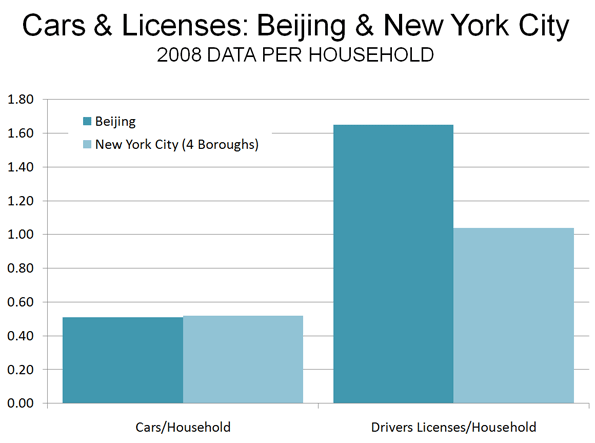
    There is a perception that the traffic situation could become substantially worse in Beijing, and that could well be the case. However, it is surprising that the Bejing (the city/province) is already well along in private vehicle ownership and use. Beijing has achieved a car ownership rate almost equal to that of New York City’s dense boroughs. In 2008, the dense boroughs of New York City had 0.52 cars per household, while Beijing had achieved a 0.51 rate. One report now places Beijing’s car ownership one third higher than in 2008, which would place Beijing’s car ownership rate 20% above that of New York City.

    By 2008, Beijing already had 1.5 times as many drivers per household as New York City’s dense boroughs (Figure 2). The difference appears to be in commercial drivers licenses, which account for nearly one-half of Beijing’s 9.4 million driver’s licenses. With the coal truck traffic and heavy truck traffic to the port of Tianjin, little more than 100 miles (160 kilometers) away, it is possible that trucks comprise a higher share of the traffic volume in Beijing than in New York City (Note 3).

    Local authorities are seeking to reduce the traffic congestion problem by building one of the world’s largest Metro (subway) systems. By the middle of the decade, nearly 350 miles (561 kilometers) should be open. Some lines will extend to outside of the fifth ring road, where much of the population growth is occurring. The Beijing Metro, like that of Mexico City, has been designed to better serve the contemporary urban area. Both are characterized by a concentration of grid routes and less by radial routes. Beijing also has ring routes. This design is especially appropriate for Beijing, which as is typical for many large Asian urban areas and unlike New York, Chicago or Hong Kong, has a decentralized core. Large office buildings in the center are more sparsely spread around a larger area, larger than these concentrated central business districts. Yet, even with this appropriate route design, the decentralization of retail and office activity necessitates time-consuming transfers that can make cars faster, even in Beijing’s traffic.

    China is also encouraging the use of electric cars, subsidizing buyers willing to switch from cars powered by fossil fuels. This will not ease traffic congestion, but it will reduce air pollution.

    At the same time, a period review of traffic conditions on the Internet will show Beijing’s worst traffic congestion to be concentrated in the high density core while in the much less dense expanding suburbs, traffic conditions are considerably better. Additionally, there is discussion of a seventh ring road and Beijing officials continue to improve their roadway network. As in US urban areas, Beijing’s continued decentralization could allow traffic to eventually be managed. Economists Peter Gordon and Harry W. Richardson have found that “suburbanization has been the dominant and successful mechanism for reducing congestion.”

    Clearing the Traffic: Meanwhile, there are reports that authorities have eased the traffic jam in Inner Mongolia. A longer term solution might be to add a couple of additional lanes in each direction. This should not be too difficult in a nation that by the end of the year will have nearly as many miles of freeway (43,000 or 70,000 kilometers) as the original US interstate system and will probably lead the world early in the next decade. This is a key to improving the competitiveness of Chinese urban areas. Sufficient roadway investment to handle growing travel demand will be just as important to maintain the competitiveness of US urban areas.

    —-

    Note 1: Beijing has six ring roads, however the first is the arterial road surrounding the Forbidden City, which is not an expressway.

    Note 2: Staten Island is excluded because its urban form is principally that of a post-war suburb, with a much lower population density.

    Note 3: This assumes comparability of data, which may not be fully reliable due to incomplete information.

    —-

    Wendell Cox is a Visiting Professor, Conservatoire National des Arts et Metiers, Paris and the author of “War on the Dream: How Anti-Sprawl Policy Threatens the Quality of Life

    Photo of Beijing Fourth Ring Road by archlife

  • Australia 2010: Unstable Politics in a Prosperous Country

    2010 has been something of an annus mirabilis in Australian politics. On 24 June a prime minister was dumped before facing the voters a second time. This was the first time ever for such an early exit. Then the election on 22 August produced a “hung parliament”, an outcome not seen since the 1940s. Having fallen short of enough seats to form government, the major parties are scrambling for the support of four independents and one Green in the House of Representatives.

    If this looks like the politics of a nation mired in economic upheaval, the reality is far different. Australia was one of a handful of advanced countries to avoid recession during the financial crisis. The unemployment rate never rose much above 5 per cent. For some economists, Australia is “the wonder from down under”.

    So why did the Labor government, elected in 2007, fall apart? There was certainly a lack of governing experience after eleven years in opposition. But in a broader sense, the political class is struggling to cope with Australia’s increasingly regionalised economy, and the divergent sources of its new-found prosperity.

    Like many industrialised countries, Australia passed through a seemingly intractable malaise in the 1970s. The country’s predicament appeared worse than that of more diverse and innovative economies like the United States. Relying on agricultural and mineral exports, legacies of a colonial past, Australia’s manufacturing base was inward-looking, outmoded and sclerotic. Disparaging assessments like that of former Singapore Prime Minister Lee Kwan Yew – Australians were destined to be “the poor white trash of Asia” – were common. Some fretted about “the Argentine route”, a country failing to diversify its economy and sliding down world rankings of GDP per capita. As transformed manufactures and high-tech products gobbled up an increasing share of world trade, Australia seemed stuck in the slow lane of commodity exports.

    And then came the 1980s. Protective barriers were slashed, the currency was floated, the financial system was opened up to foreign banks and state-owned agencies were sold off or treated to radical micro-economic reform. By the mid-2000s, the contours of the economy had changed. Activities such as business and property services rose from 10 to almost 15 per cent of GDP over the decade to 2006. Meanwhile manufacturing declined from 15 to 12 per cent. The new economy was dominated by services, now accounting for 68 per cent of GDP. Rather than drag down the economy, however, mining enjoyed parallel growth, from 4.5 to 8 per cent in the same period. China’s explosive arrival on the world scene shifted commodity exports into a very fast lane. These developments set Australia on a growth path that few could have foreseen in the 1970s. A small economy in relative terms to countries like China and the United States, it has evolved into a series of distinct geographic regions.

    The booming commodities export sector, dominated by mining, is concentrated in the northern and western states of Queensland and Western Australia, which account for 74 per cent of onshore mining production. Business and property services are concentrated in the south-eastern states of New South Wales and Victoria, specifically the inner precincts of Sydney and Melbourne, the nation’s emerging global cities. Together, these cities host around 50 per cent of Australia’s finance industry jobs. Public sector services, mostly in health and education, figure prominently in the populous south-east, again skewed towards long-established inner-city localities, where the most prestigious institutions are found. Construction, consumer services, including retail, and light manufacturing, fuelled by demand for household goods and building supplies, thrive in the larger metropolitan regions with high rates of immigration and population growth, like outer Sydney and Melbourne, and increasingly south-east Queensland.

    At the end the true driver of the economy lies with commodities. Today mineral resources make up just under 80 per cent of Australia’s commodity trade and around half of all exports (including services). Australia is the world’s leading exporter of coal and iron ore and ranks high other minerals like zinc and aluminium.

    Reaping the China bounty, former Prime Minister John Howard kept the federal budget in surplus and reduced government debt to zero, while handing out tax cuts and family income supplements. This winning combination delivered Howard eleven years in power. Towards the end of his rule, however, strains in the boom economy began to manifest themselves. Skilled labour shortages and the heated property market began to put pressure on inflation and interest rates, contributing to a sense of policy exhaustion in Howard’s later years.

    By 2007, there was a widespread view that the benefits of the resources boom were not being distributed fairly. The service sector professionals of the south-east, especially in the public sector who dominate the national media, began to shift to Labor as did outer suburban workers, who saw the dream of home ownership slipping beyond their reach. Forced to compete for investment in the open economy, south-eastern state governments, controlled by Labor, were constrained to keep taxes low. An ever larger proportion of their budgets was channelled into health and education services, partly due to close links with powerful public sector unions. There was little left to pay for urban infrastructure on the booming fringes.

    In response, infrastructure costs were shifted onto developers and local government, along with a new set of regulations, and urban consolidation (“smart growth”) was enforced as planning policy, ostensibly to reduce the need for extra resources. These choices reflected the green ideology taking hold in the planning profession, as well as among the professional classes.

    The impact of these measures on housing affordability were disastrous. When the low interest rates of the Howard years began to creep up, the problem turned into a crisis, as the Demographia survey has shown. The property market slowed down, depriving the south-eastern states of even more funds, since property taxes are a significant share of their revenues. This contrasted with conditions in the mining states, prompting the Federal Treasury Secretary to declare Australia a “two speed economy”.

    At the 2007 election, Labor leader Kevin Rudd claimed to have the solutions. Paying lip service to Howard’s fiscal conservatism, he signalled plans to divert mining boom proceeds towards infrastructure and services, including a new deal on health funding and an “education revolution“. Much of this was wrapped up in the rhetoric of climate change, talked up by Rudd as “the greatest moral challenge of our time”. His environmental centrepiece was an Emissions Trading Scheme (cap and trade), a massive revenue raising device for the federal government. In essence it was a mechanism for transferring wealth from the mining states, and their fossil-fuelled economies, to the populous south-east.

    Rudd’s electoral success, and apparent public support for climate action, drove the agenda forward until the crash at Copenhagen. This precipitated a revolt in the opposition Coalition, which replaced ETS supporter Malcolm Turnbull with climate-sceptic Tony Abbott. When Abbott labelled the ETS “a great big new tax on everything“, and blocked its passage in the Senate, public interest in the scheme melted away, particularly in the mining regions. Rudd lost his nerve and shelved it until 2012. For many Australians, he was exposed as a weak leader without the courage of his convictions.

    Rudd refused to give up his dream of redistribution though, turning to Plan B. Having commissioned a review of Australia’s taxation system, he announced a Resource Super Profits Tax, a complex device confiscating up to 40 per cent of mining profits above a threshold. Adopted without consulting the resources industry, it attracted furious opposition from the global mining companies, which launched a powerful advertising campaign against it. Opposition leader Abbott labelled the measure ”a great big new tax on mining”. Opinion polls showed strong opposition to the tax in mining states, and mild support in the south-east. Rudd’s poll ratings fell through the floor. He was soon deposed by his Labor Party colleagues.

    Julia Gillard, the new prime minister, substantially modified the proposal after negotiations with the large miners, but smaller operators remained opposed, along with most of Queensland and Western Australia. Gillard quickly called an election to capitalise on her status as the country’s first female leader. But the legacy of Rudd’s undelivered promises shaped the outcome. Australia’s regional divisions were clearly evident in the voting patterns. Western Australia and Queensland swung to the Coalition, and Queensland proved to be a killing ground, depriving Labor of nine seats. New South Wales also swung to the Coalition, reflecting dissatisfaction with the long-serving state Labor government’s failure to address the infrastructure and housing needs of suburban western Sydney. In contrast, the southern states of Victoria, Tasmania and South Australia swung towards Labor.

    Well over half of Labor’s lost votes moved left to the Greens, who more than doubled their share of the vote, rather than right to the Coalition. Increasing numbers of south-eastern professionals consider the Greens their preferred agent of redistribution. Handing the Greens the balance of power in the Senate, and possibly the House of Representatives (only one seat this time), may prove a better strategy than sticking with a fractured Labor Party. Inevitably though, regional and outer-suburban voters, with their divergent priorities, will react to a green-dominated agenda, which tends to dismiss suburban interests. Over time, and perhaps after the next election, this may mean a shift back to the right and a clear Coalition victory.

    John Muscat is a Sydney lawyer and co-editor of The New City (www.thenewcityjournal.net), a web journal of urban and political affairs.

    Photo by webmink

  • Year 1959

    Get a glass of wine. Then click on this link, which plays a video called Community Growth, created in 1959.

    Once you’ve seen the video, read on…

    You’re probably sitting with a puzzled look – 1959? Aren’t these the exact same issues that are plaguing us today? Don’t those 1959 developments look like many of today’s latest developments? Even the way they bulldozed through the land and stick-built the homes looks just like the methods used today!

    When I was 7 year old, my mother bought a new white 1959 Chevrolet Impala convertible with a red vinyl interior. This was one of the best designs with those wonderful curved wing-like fins and oblong tail lights. I remember sitting in the front when my mother slammed on the brakes as a child ran in front of the car. Since they did not have seat belts back then, my head flew into the steel dashboard (your probably thinking; ah ha! so that’s why he writes for New Geography). That beautiful Chevy was a coffin in a crash, as witnessed by the following video showing 50 years of safety advances between the 1959 Chevy vs. 2009 Chevy.

    Back then, a 1959 Chevy with 50,000 miles on it was on its last legs, just about broken down, whereas today, a 2009 Chevy with 50,000 miles would be considered just about broken in.

    If a 1959 land development subdivision layout were to crash into (OK, be overlayed upon) a 2009 land development subdivision layout there would be little difference.

    We have written about this in the past, but it bears repeating: Designers look to the ordinances for guidance, and these regulations have been stagnant for about 5 decades (1959. Developers hire designers assuming they will get the best possible layout. Designers look to the six decade old ordinances and assume the minimum dimensions are the optimum ones to maximize density (their clients profits). The layout by minimums will result in cookie cutter monotonous designs. The council and planning commissions admonish the developer for submitting plans that lack character and imagination, yet the developer just followed the regulations that promote such development. And the cycle repeats, and repeats, and repeats for generations upon generations.

    You are reading this article on a computer that is more powerful than any that existed in 1959, or 1969, or possibly even in 1979. If you are older than 60 years old, chances are if this was 1959, you would be dead by now. Advances in health as well as an awareness of what we eat and how we live allow us to live longer happier and more productive lives.

    Technological advancements have touched virtually every product and aspect of our lives – except the neighborhoods we live, work and play within.

    There is something very wrong with this situation, and solving these problems through over densification and forcing a nation into public transportation is taking giant leaps backwards, not towards 1959, but more towards 1859. We posses innovation and technology for the design and building of sustainable future cities without sacrificing the desire for space and personal transportation freedom. This however takes more effort. But isn’t about time we leave 1959 behind?

  • Urban Legends: Why Suburbs, Not Dense Cities, are the Future

    The human world is fast becoming an urban world — and according to many, the faster that happens and the bigger the cities get, the better off we all will be. The old suburban model, with families enjoying their own space in detached houses, is increasingly behind us; we’re heading toward heavier reliance on public transit, greater density, and far less personal space. Global cities, even colossal ones like Mumbai and Mexico City, represent our cosmopolitan future, we’re now told; they will be nerve centers of international commerce and technological innovation just like the great metropolises of the past — only with the Internet and smart phones.

    According to Columbia University’s Saskia Sassen, megacities will inevitably occupy what Vladimir Lenin called the “commanding heights” of the global economy, though instead of making things they’ll apparently be specializing in high-end “producer services” — advertising, law, accounting, and so forth — for worldwide clients. Other scholars, such as Harvard University’s Edward Glaeser, envision universities helping to power the new “skilled city,” where high wages and social amenities attract enough talent to enable even higher-cost urban meccas to compete.

    The theory goes beyond established Western cities. A recent World Bank report on global megacities insists that when it comes to spurring economic growth, denser is better: “To try to spread out economic activity,” the report argues, is to snuff it. Historian Peter Hall seems to be speaking for a whole generation of urbanists when he argues that we are on the cusp of a “coming golden age” of great cities.

    The only problem is, these predictions may not be accurate. Yes, the percentage of people living in cities is clearly growing. In 1975, Tokyo was the largest city in the world, with over 26 million residents, and there were only two other cities worldwide with more than 10 million residents. By 2025, the U.N. projects that there may be 27 cities of that size. The proportion of the world’s population living in cities, which has already shot up from 14 percent in 1900 to about 50 percent in 2008, could be 70 percent by 2050. But here’s what the boosters don’t tell you: It’s far less clear whether the extreme centralization and concentration advocated by these new urban utopians is inevitable — and it’s not at all clear that it’s desirable.

    Not all Global Cities are created equal. We can hope the developing-world metropolises of the future will look a lot like the developed-world cities of today, just much, much larger — but that’s not likely to be the case. Today’s Third World megacities face basic challenges in feeding their people, getting them to and from work, and maintaining a minimum level of health. In some, like Mumbai, life expectancy is now at least seven years less than the country as a whole. And many of the world’s largest advanced cities are nestled in relatively declining economies — London, Los Angeles, New York, Tokyo. All suffer growing income inequality and outward migration of middle-class families. Even in the best of circumstances, the new age of the megacity might well be an era of unparalleled human congestion and gross inequality.

    Perhaps we need to consider another approach. As unfashionable as it might sound, what if we thought less about the benefits of urban density and more about the many possibilities for proliferating more human-scaled urban centers; what if healthy growth turns out to be best achieved through dispersion, not concentration? Instead of overcrowded cities rimmed by hellish new slums, imagine a world filled with vibrant smaller cities, suburbs, and towns: Which do you think is likelier to produce a higher quality of life, a cleaner environment, and a lifestyle conducive to creative thinking?

    So how do we get there? First, we need to dismantle some common urban legends.

    Perhaps the most damaging misconception of all is the idea that concentration by its very nature creates wealth. Many writers, led by popular theorist Richard Florida, argue that centralized urban areas provide broader cultural opportunities and better access to technology, attracting more innovative, plugged-in people (Florida’s “creative class“) who will in the long term produce greater economic vibrancy. The hipper the city, the mantra goes, the richer and more successful it will be — and a number of declining American industrial hubs have tried to rebrand themselves as “creative class” hot spots accordingly.

    But this argument, or at least many applications of it, gets things backward. Arts and culture generally do not fuel economic growth by themselves; rather, economic growth tends to create the preconditions for their development. Ancient Athens and Rome didn’t start out as undiscovered artist neighborhoods. They were metropolises built on imperial wealth — largely collected by force from their colonies — that funded a new class of patrons and consumers of the arts. Renaissance Florence and Amsterdam established themselves as trade centers first and only then began to nurture great artists from their own middle classes and the surrounding regions.

    Even modern Los Angeles owes its initial ascendancy as much to agriculture and oil as to Hollywood. Today, its port and related industries employ far more people than the entertainment business does. (In any case, the men who built Hollywood were hardly cultured aesthetes by middle-class American standards; they were furriers, butchers, and petty traders, mostly from hardscrabble backgrounds in the czarist shtetls and back streets of America’s tough ethnic ghettos.) New York, now arguably the world’s cultural capital, was once dismissed as a boorish, money-obsessed town, much like the contemporary urban critique of Dallas, Houston, or Phoenix.

    Sadly, cities desperate to reverse their slides have been quick to buy into the simplistic idea that by merely branding themselves “creative” they can renew their dying economies; think of Cleveland’s Rock and Roll Hall of Fame, Michigan’s bid to market Detroit as a “cool city,” and similar efforts in the washed-up industrial towns of the British north. Being told you live in a “European Capital of Culture,” as Liverpool was in 2008, means little when your city has no jobs and people are leaving by the busload.

    Even legitimate cultural meccas aren’t insulated from economic turmoil. Berlin — beloved by writers, artists, tourists, and romantic expatriates — has cultural institutions that would put any wannabe European Capital of Culture to shame, as well as a thriving underground art and music scene. Yet for all its bohemian spirit, Berlin is also deeply in debt and suffers from unemployment far higher than Germany’s national average, with rates reaching 14 percent. A full quarter of its workers, many of them living in wretched immigrant ghettos, earn less than 900 euros a month; compare that with Frankfurt, a smaller city more known for its skyscrapers and airport terminals than for any major cultural output, but which boasts one of Germany’s lowest unemployment rates and by some estimates the highest per capita income of any European city. No wonder Berlin Mayor Klaus Wowereit once described his city as “poor but sexy.”

    Culture, media, and other “creative” industries, important as they are for a city’s continued prosperity, simply do not spark an economy on their own. It turns out to be the comparatively boring, old-fashioned industries, such as trade in goods, manufacturing, energy, and agriculture, that drive the world’s fastest-rising cities. In the 1960s and 1970s, the industrial capitals of Seoul and Tokyo developed their economies far faster than Cairo and Jakarta, which never created advanced industrial bases. China’s great coastal urban centers, notably Guangzhou, Shanghai, and Shenzhen, are replicating this pattern with big business in steel, textiles, garments, and electronics, and the country’s vast interior is now poised to repeat it once again. Fossil fuels — not art galleries — have powered the growth of several of the world’s fastest-rising urban areas, including Abu Dhabi, Houston, Moscow, and Perth.

    It’s only after urban centers achieve economic success that they tend to look toward the higher-end amenities the creative-classers love. When Abu Dhabi decided to import its fancy Guggenheim and Louvre satellite museums, it was already, according to Fortune magazine, the world’s richest city. Beijing, Houston, Shanghai, and Singapore are opening or expanding schools for the arts, museums, and gallery districts. But they paid for them the old-fashioned way.

    Nor is the much-vaunted “urban core” the only game in town. Innovators of all kinds seek to avoid the high property prices, overcrowding, and often harsh anti-business climates of the city center. Britain’s recent strides in technology and design-led manufacturing have been concentrated not in London, but along the outer reaches of the Thames Valley and the areas around Cambridge. It’s the same story in continental Europe, from the exurban Grand-Couronne outside of Paris to the “edge cities” that have sprung up around Amsterdam and Rotterdam. In India, the bulk of new tech companies cluster in campus-like developments around — but not necessarily in — Bangalore, Hyderabad, and New Delhi. And let’s not forget that Silicon Valley, the granddaddy of global tech centers and still home to the world’s largest concentration of high-tech workers, remains essentially a vast suburb. Apple, Google, and Intel don’t seem to mind. Those relative few who choose to live in San Francisco can always take the company-provided bus.

    In fact, the suburbs are not as terrible as urban boosters frequently insist.

    Consider the environment. We tend to associate suburbia with carbon dioxide-producing sprawl and urban areas with sustainability and green living. But though it’s true that urban residents use less gas to get to work than their suburban or rural counterparts, when it comes to overall energy use the picture gets more complicated. Studies in Australia and Spain have found that when you factor in apartment common areas, second residences, consumption, and air travel, urban residents can easily use more energy than their less densely packed neighbors. Moreover, studies around the world — from Beijing and Rome to London and Vancouver — have found that packed concentrations of concrete, asphalt, steel, and glass produce what are known as “heat islands,” generating 6 to 10 degrees Celsius more heat than surrounding areas and extending as far as twice a city’s political boundaries.

    When it comes to inequality, cities might even be the problem. In the West, the largest cities today also tend to suffer the most extreme polarization of incomes. In 1980, Manhattan ranked 17th among U.S. counties for income disparity; by 2007 it was first, with the top fifth of wage earners earning 52 times what the bottom fifth earned. In Toronto between 1970 and 2001, according to one recent study, middle-income neighborhoods shrank by half, dropping from two-thirds of the city to one-third, while poor districts more than doubled to 40 percent. By 2020, middle-class neighborhoods could fall to about 10 percent.

    Cities often offer a raw deal for the working class, which ends up squeezed by a lethal combination of chronically high housing costs and chronically low opportunity in economies dominated by finance and other elite industries. Once the cost of living is factored in, more than half the children in inner London live in poverty, the highest level in Britain, according to a Greater London Authority study. More than 1 million Londoners were on public support in 2002, in a city of roughly 8 million.

    The disparities are even starker in Asia. Shenzhen and Hong Kong, for instance, have among the most skewed income distributions in the region. A relatively small number of skilled professionals and investors are doing very well, yet millions are migrating to urban slums in places like Mumbai not because they’ve all suddenly become “knowledge workers,” but because of the changing economics of farming. And by the way, Mumbai’s slums are still expanding as a proportion of the city’s overall population — even as India’s nationwide poverty rate has fallen from one in three Indians to one in five over the last two decades. Forty years ago, slum dwellers accounted for one in six Mumbaikars. Now they are a majority.

    To their credit, talented new urbanists have had moderate success in turning smaller cities like Chattanooga and Hamburg into marginally more pleasant places to live. But grandiose theorists, with their focus on footloose elites and telecommuting technogeniuses, have no practical answers for the real problems that plague places like Mumbai, let alone Cairo, Jakarta, Manila, Nairobi, or any other 21st-century megacity: rampant crime, crushing poverty, choking pollution. It’s time for a completely different approach, one that abandons the long-held assumption that scale and growth go hand in hand.

    Throughout the long history of urban development, the size of a city roughly correlated with its wealth, standard of living, and political strength. The greatest and most powerful cities were almost always the largest in population: Babylon, Rome, Alexandria, Baghdad, Delhi, London, or New York.

    But bigger might no longer mean better. The most advantaged city of the future could well turn out to be a much smaller one. Cities today are expanding at an unparalleled rate when it comes to size, but wealth, power, and general well-being lag behind. With the exception of Los Angeles, New York, and Tokyo, most cities of 10 million or more are relatively poor, with a low standard of living and little strategic influence. The cities that do have influence, modern infrastructure, and relatively high per capita income, by contrast, are often wealthy small cities like Abu Dhabi or hard-charging up-and-comers such as Singapore. Their efficient, agile economies can outpace lumbering megacities financially, while also maintaining a high quality of life. With almost 5 million residents, for example, Singapore isn’t at the top of the list in terms of population. But its GDP is much higher than that of larger cities like Cairo, Lagos, and Manila. Singapore boasts a per capita income of almost $50,000, one of the highest in the world, roughly the same as America’s or Norway’s. With one of the world’s three largest ports, a zippy and safe subway system, and an impressive skyline, Singapore is easily the cleanest, most efficient big city in all of Asia. Other smaller-scaled cities like Austin, Monterrey, and Tel Aviv have enjoyed similar success.

    It turns out that the rise of the megacity is by no means inevitable — and it might not even be happening. Shlomo Angel, an adjunct professor at New York University’s Wagner School, has demonstrated that as the world’s urban population exploded from 1960 to 2000, the percentage living in the 100 largest megacities actually declined from nearly 30 percent to closer to 25 percent. Even the widely cited 2009 World Bank report on megacities, a staunchly pro-urban document, acknowledges that as societies become wealthier, they inevitably begin to deconcentrate, with the middle classes moving to the periphery. Urban population densities have been on the decline since the 19th century, Angel notes, as people have sought out cheaper and more appealing homes beyond city limits. In fact, despite all the “back to the city” hype of the past decade, more than 80 percent of new metropolitan growth in the United States since 2000 has been in suburbs.

    And that’s not such a bad thing. Ultimately, dispersion — both city to suburb and megacity to small city — holds out some intriguing solutions to current urban problems. The idea took hold during the initial golden age of industrial growth — the English 19th century — when suburban “garden cities” were established around London’s borders. The great early 20th-century visionary Ebenezer Howard saw this as a means to create a “new civilization” superior to the crowded, dirty, and congested cities of his day. It was an ideal that attracted a wide range of thinkers, including Friedrich Engels and H.G. Wells.

    More recently, a network of smaller cities in the Netherlands has helped create a smartly distributed national economy. Amsterdam, for example, has low-density areas between its core and its corporate centers. It has kept the great Dutch city both livable and competitive. American urbanists are trying to bring the same thinking to the United States. Delore Zimmerman, of the North Dakota-based Praxis Strategy Group, has helped foster high-tech-oriented development in small towns and cities from the Red River Valley in North Dakota and Minnesota to the Wenatchee region in Washington State. The outcome has been promising: Both areas are reviving from periods of economic and demographic decline.

    But the dispersion model holds out even more hope for the developing world, where an alternative to megacities is an even more urgent necessity. Ashok R. Datar, chairman of the Mumbai Environmental Social Network and a longtime advisor to the Ambani corporate group, suggests that slowing migration to urban slums represents the most practical strategy for relieving Mumbai’s relentless poverty. His plan is similar to Zimmerman’s: By bolstering local industries, you can stanch the flow of job seekers to major city centers, maintaining a greater balance between rural areas and cities and avoiding the severe overcrowding that plagues Mumbai right now.

    Between the 19th century, when Charles Dickens described London as a “sooty spectre” that haunted and deformed its inhabitants, and the present, something has been lost from our discussion of cities: the human element. The goal of urban planners should not be to fulfill their own grandiose visions of megacities on a hill, but to meet the needs of the people living in them, particularly those people suffering from overcrowding, environmental misery, and social inequality. When it comes to exporting our notions to the rest of the globe, we must be aware of our own susceptibility to fashionable theories in urban design — because while the West may be able to live with its mistakes, the developing world doesn’t enjoy that luxury.

    This article originally appeared at Foreign Policy

    Joel Kotkin is executive editor of NewGeography.com and is a distinguished presidential fellow in urban futures at Chapman University. He is author of The City: A Global History. His newest book is The Next Hundred Million: America in 2050, released in February, 2010.

    Photo: Mugley
  • Misunderstanding the Bubble and Burst in Sacramento

    An opinion piece in the Sacramento Bee by Sean Wirth of the Environmental Council of Sacramento could not have been more wrong in its characterization of the causes of the housing bubble in Sacramento.

    The article starts out promisingly, correctly noting that:

    • The housing bubble spawned the Great Recession
    • Demand exceeded the inventory of houses in the Sacramento area
    • Sacramento prices “soared sky high”


    But it is all downhill from there, with the suggestion that the extraordinary price increases in Sacramento were the result of too much suburbanization (the theological term in urban planning circles is “sprawl”). In fact, all things being equal, house prices tend to escalate where the supply is more constrained, not less. Where suburbanization is allowed, the market can supply enough housing to avoid inordinate house price increases. Where suburbanization is severely constrained, a legion of evidence indicates that house prices are prone to rise. It is all a matter of basic economics. George Mason University economist Daniel Klein puts it this way:

    Basic economics acknowledges that whatever redeeming features a restriction may have, it increases the cost of production and exchange, making goods and services less affordable. There may be exceptions to the general case, but they would be atypical.

    Housing is not atypical and Sacramento house prices soared in response to the tough use regulations. By the peak of the bubble, the Median Multiple (median house price divided by median household income) had risen to 6.8, well above the historic norm of 3.0. Many houses were built, but not enough to satisfy the demand, as Mr. Wirth indicates. Building many houses is not enough. There need to be enough houses to supply the demand, otherwise land prices soar, driving up house prices.

    Unless a sufficient supply is allowed, speculators and flippers will “smell the blood” of windfall profits, which are there for the taking in excessively regulated markets.

    During the housing bubble, house prices rose well above the historic Median Multiple norm only in metropolitan areas that had severe constraints land use constraints (called “smart growth” or “growth management”). This included Sacramento, other California markets, Miami, Portland, and Seattle and other markets around the country.

    At the same time, more liberal development regulations allowed a sufficient inventory of housing to meet the demand in high growth areas like Atlanta, Dallas-Fort Worth, Houston and Austin. In each of these places (and many others), the Median Multiple remained near or below the historic norm of 3.0, even with the heightened demand generated by a finance sector that had lost interest in credit-worthiness. As would be expected, speculators and flippers avoided the traditionally regulated markets, where an adequate supply of affordably priced housing continued to be produced.

    Wirth expresses understandable concern about the house price losses since the bust. From the peak to the trough, the drop in Sacramento median house prices was more than 55%. However, this is to be expected once a serious economic decline is precipitated, especially in the sector that precipitated the crash (in this case housing). Economists Ed Glaeser of Harvard and Joseph Gyourko of Wharton have shown that not only (1) are house prices higher in more restricted markets but also that (2) there is greater price volatility in more highly regulated markets. Indeed, it is likely that the housing bust would have been much less severe or even avoided altogether if constraints on land had not driven the prices and subsequent mortgage losses so high in California and a few other states that they could not be absorbed by financial institutions. At the time of the Lehman Brothers collapse, 11 “ground zero” markets (including Sacramento), all highly regulated, accounted for 75% of the mortgage losses in the nation, with a per house loss rate of 15 times that of traditionally regulated markets.

    Wirth’s article expresses opposition to a Sacramento County decision to allow more development to occur on the urban fringe. He would prefer to force development into the existing urban footprint. The economic consequences of such folly are well known. In Australia, such policies have driven led to a doubling or tripling of house costs relative to incomes. The annual mortgage cost of the median priced house has risen to 50% of the median pre-tax household income, in a country that defines mortgage stress at the 35% level. Before the adoption of smart growth policies, Australia’s housing affordability was similar to that of liberally regulated markets in the United States.

    Avoiding the next housing bubble requires not repeating the mistakes that led to the last. Sacramento’s young and lower income households can only hope that the additional land approved by the Board of Supervisors will be enough of a safety valve to keep housing affordable so that they can become owners rather than renters.

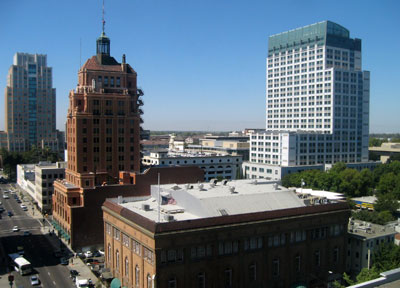
    Photograph: Sacramento (author)

  • Vancouver: Moving to the Suburbs

    A few weeks ago, The New York Times touted purported savings that a household would save by living in the core city of New York (in Brooklyn) instead of the suburbs (South Orange, New Jersey). The article downplayed the 1,000 fewer square feet the money bought in Brooklyn and did not consider the 40% higher cost of living.

    The Province in Vancouver has now followed with a near identical story, except that the urban household in will make do with even less space. The city of Vancouver household will live in 800 square feet, or 1,200 fewer square feet in the high rise condominium than in a suburban Coquitlam detached house used in the comparison. Like The Times, The Province is little concerned with the smaller size of the house and misses the fact that the cost of living is from 10% to 20% less in the suburbs and exurbs than it is in the city of Vancouver.

    Nonetheless, according to Tsur Somerville, director of the University of British Columbia UBC Centre for Urban Economics and Real Estate, who assisted in developing the figures for The Province, “If all they cared about were the dollars, they wanted to have $600,000 worth of real estate and then minimize their out-of-pocket costs, all else being considered, then being in the city is better,” A commenter appropriately notes the volatility of strata (condominium association) fees, which suggests that out-of-pocket costs could rise significantly.

    Canadians are not listening to “their betters” any more than Americans. US Census data indicates a continuing strong migration of people from the central cities and strong migration to the suburbs, despite heroic efforts on the part of the media and others to mask the reality.

    “Being in the city” may be preferable to some in the Vancouver area, however not to the majority of the age group (25 to 44 years) most likely to move is voting for the suburbs, according to a recent Statistics Canada report. According to the report:

    “… there continues to be a migration of many young adults and families from central municipalities to surrounding municipalities, while few move in the opposite direction.”

    For every one person who moved from the suburbs to the city of Vancouver between 2001 and 2006 (in the age group):

    • Among all in the age group, 1.8 people moved to the suburbs from the city for every person moving to city from the suburbs.
    • Among those in the age group with advanced degrees, 1.7 people moved to the suburbs for every person moving to the city.
    • Among those earning $100,000 to $150,000, 3.4 people moved to the suburbs for every person moving to the city. The ratio fell to 2.0 times for those making over $150,000.
    • More than 25% of the age group population who had their first children between 2001 and 2006 moved to the suburbs from the city, more than five times as many as moved to the city from the suburbs.

    A table in the Statistics Canada report shows people in “creative class” occupations moving in greater numbers to the suburbs than to the city.

    However, not everyone is moving in larger numbers to the suburbs.

    • More of the lowest income people are moving to the city than to the suburbs.
    • Artists have moved in greater numbers to the city than to the suburbs.
    • University professors and other university personnel have moved in greater numbers to the city than to the suburbs, perhaps explaining why so many in these groups misunderstand the direction of the migration.

    The Statistics Canada report provided a similar analysis for Canada’s two larger metropolitan areas, Toronto and Montreal. In Toronto, moves to the suburbs were 3.5 times moves to the city, while in Montreal 2.7 central city dwellers moved to the suburbs for every suburbanite moving to the city. This does not, however, necessarily indicate that the exodus to the suburbs is stronger in Toronto and Montreal. It is rather an indication of the fact that these two central cities represent a larger share of their metropolitan population than Vancouver. This means that more of the core out-migration is captured in Toronto and Montreal.

    So, the media continues the “drumbeat” and the people keep marching — in the opposite direction.

  • Health Care Development in Central Florida

    By Richard Reep

    In this still cooling economy, Florida seems to be continually buffeted by a perfect storm of unemployment, record foreclosures, and stagnant population growth. As the state continues to suffer, the health care industry has unfolded two planning efforts aimed at building some economic momentum.

    Florida Hospital’s Health Village, an urban revitalization of one of Orlando’s older core neighborhoods, is one planning effort to watch. The other, Lake Nona, is a classic suburban mixed-use campus planned around R&D facilities gilded with stellar names like Scripps and Nemours, occurring in the southeast periphery of Orlando. The vastly different values of their developers underscore the striking contrasts between the development strategies of Health Village and Lake Nona.

    Lake Nona, a small lake just east of Orlando’s airport, is a new development centered around six major research facilities, four of which are under construction. Financing came from a 2006 program, the Florida Capital Formation Act, that has contributed millions to start up biomedical research in the state. Florida’s state venture capital fund lured Scripps, Nemours, Burnham, and M. D. Anderson. Two state universities are also participating, as well as the Veterans Administration with a new facility. This taxpayer investment was supplemented by Tavistock, the master developer of Isleworth fame, and smaller contributions by city, county, and other private investors all creating the impetus to develop this campus.

    Lake Nona’s Robert Adams described his “model” as San Diego’s biomedical cluster, which combines commercial, clinical, research, and educational facilities forming. Employment, in the form of the research facilities, was preceded by a country club and an indistinct mix of Florida residential building types – estate homes, smaller single family homes, and multifamily clusters that are sprinkled amongst golf courses, pretty lakes, and remnant pockets of old Florida wilderness. It’s obvious upon visiting the campus that this is first and foremost a real estate development scheme. Like most developers, Tavistock programmed the uses and zones as if all the land, being flat, were relatively equal in nature except for the slightly more lucrative edges of lakes and the even more lucrative engineered waterways. Currently, the Town Center is an open, flat D-shaped parcel conveniently accessed from Orlando’s beltway, the 417. A comfortable, safe land development scheme with all the usual regulatory battles is underway, and eventually Orlando will find a new, attractive community themed around medical research competing with other new developments for market share.

    In contrast, Florida Hospital selected, among its multiple sites in the state, about 96 acres squeezed between two close, parallel roads (Orange Avenue and Interstate 4) in a dense part of the city where the Adventist Health System quietly bought up dozens of individual parcels of 1930s era Orlando. Like most neighborhoods still suffering in the shadow of Eisenhower’s grand interstate system, this one has languished, and Florida Hospital intends to convert this neighborhood into a Health Village campus anchored by its adjacent hospital campus in a slow, organically grown and financed process.

    Orange Avenue bisects this Health Village, with towering hospital facilities on one side and an aged, mostly 2-story commercial neighborhood on the other. Much of the older residential stock is past its useful life, and owners, grateful for a buyer to release them from the ragged edge of Interstate 4, quickly sold out and left. Inserting the Burnham Institute’s Clinical Research Institute for Diabetes will be the latest revitalization project, and the interior land is intended for residential development catering to hospital professionals and staff within walking distance.

    With 17 hospital locations in Florida alone (the Adventist Health System operates medical facilities throughout the South and Midwest), the choice to locate a health village in a congested urban site is an interesting one. The city deal-making involved in such a move is reminiscent of the negotiations for New York’s Lincoln Center near Columbus Circle in the 1960s, and is rare in Florida where land is cheap. At first glance, it seems like Florida Hospital willingly hamstrung itself with this strategy, as compared to the huge blank slate being developed by Tavistock in Lake Nona.

    Tavistock also has eyes firmly watching the global health care market, and hopes to compete with San Diego, Research Triangle, Dubai’s Medical City, Singapore’s Biopolis, and other stellar research clusters. Lake Nona’s growth potential is relatively large, assuming a smooth flow of funding and continuation of markets. The science-themed real estate development brochures for Lake Nona exude a breezy, hip confidence, putting biomedical research in the background and projecting an alluring lifestyle in the foreground.

    Instead of amping up its marketing campaign to overcome its vastly smaller size, Florida Hospital’s Health Village eschews marketing altogether, as if it is too busy developing it to talk about it. The Adventist Health System is not visibly interested in the temporal nature of global markets, and its stated position as a Christian health care institution quietly suggests that reviving a struggling neighborhood – an exercise most developers would shy away from – is worth the effort. Florida Hospital’s ultimate end appears to be planned on a much longer timescale.

    Both projects are refreshing pathways for Florida, as they represent an attempt to develop future jobs away from the dependence on tourism and second home development. Of the two, right now Lake
    Nona seems much more poised for growth. With a vision for 16,000 jobs at maturity, Lake Nona hopes to capture a substantial portion of the real estate growth attached to those jobs, which is the tried-and-true Old Florida model. Shopping areas, recreational activities, and lifestyle creation will add one more new neighborhood cluster to a multipolar, decentralized region at the expense of 7,000 acres of Florida’s natural environment.

    In contrast, Florida Hospital’s urban build out will benefit existing neighborhoods, certainly a new concept for Floridians. In this respect, Florida Hospital’s tiny contribution to growth (some 800 new residential units are proposed to replace the 150 existing homes) is more than offset by its larger contribution to Orlando’s development as a city. And it delivers this at no expense to Florida’s natural environment.

    Each model offers something to a revived Florida. Florida Hospital’s campus in congested Orlando is instructive as a model for economic activity in the urban future. Religious institutions may become a more important force in the community, given the lack of wealth creation by the standard players in Wall Street and real estate speculation.

    Tavistock could contribute as well, particularly as a move towards a new modality of wealth creation that transcends the traditional Florida focus on consumption activities: shopping malls, hotels, and theme parks. Placing the region on the world stage as a contender in health research can move Florida away from its failed model and towards a future shaped by important diversifications of its employment base.

    Richard Reep is an Architect and artist living in Winter Park, Florida. His practice has centered around hospitality-driven mixed use, and has contributed in various capacities to urban mixed-use projects, both nationally and internationally, for the last 25 years.

    Photo pf Lake Nona development by saikofish

  • Going Underground in Australia

    Just over a decade ago, governments in Australia were immune to calls for accelerated infrastructure investment in our major urban centres. Plans for strategic reinvestment were rare. Much has changed in that time, maybe too much. It seems that enthusiasm for major urban infrastructure now runs ahead of impartial assessment of the cost, versus the claimed benefits. A proposed $8.2 billion underground rail loop for Brisbane, along with a new underground station for its busy downtown, provides one example of an over exuberant propensity to spend.

    The idea of new underground heavy rail lines to connect with the commuter rail system of southeast Queensland isn’t new. I can recall some 15 years ago proposing just that in a policy paper for the Property Council. The paper identified new stations in the CBD as a critical element in making use of rail transit more user friendly. The existing downtown stations, we argued, were barely downtown anymore, because the modern downtown (of close to 2 million square metres of office space, major retail, and entertainment hubs) had shifted toward the river and away from the stations.

    This large concentration of office workers should prove prime candidates for public transit, since they typically work regular hours (which helps with service schedules) and are concentrated at the centre of a hub and spoke system. But the walk from their workplace to the nearest stations, in summer heat or rain, represents (among other things) a disincentive to rail transit. So logically a new underground station (or even two) which brings the convenience of commuter rail closer to the workplace should encourage more people to make use public transport. Clearly, if you owned office buildings anywhere along the river edge of the ‘Golden Triangle’, you’d welcome this initiative with open arms and beg the Government to fast track the proposal.

    So it could indeed be a great idea. But first there are few unanswered questions about the economics of heavy rail commuter transport. The latest State Government figures show that every trip, by each and every commuter on the City Train network, is now subsidized to the tune of $10. That’s per trip, so for every daily return trip, the taxpayer is forking over $20 per commuter. And that’s after commuters have paid their fare – remember it’s only the subsidy. Even worse, the numbers of patrons are falling, from 60.7 million to 57 million in a year. (Worth reading the article “Taxpayers’ share of rail fares increases, while CityTrain passengers continue to decline” in The Courier Mail, June 15, 2010).

    The concern here is that under this failed pricing model, more commuters may also mean more subsidies and a greater tax burden on the taxpayer. In short, there doesn’t seem to be an economy of scale: if more people caught the train under the present system, it could cost more in subsidies, not less.

    Ironically, an online poll taken in connection with the above story revealed that 79% of respondents (out of 824) claimed that train fares are already too high. This is especially ironic for two reasons: commuters with jobs in the CBD market are, on average, paid more than their suburban counterparts and commuters who use the rail service are increasingly drawn from more affluent inner city and middle ring suburbs. The proportion of public transport users who begin their journey in lower income, outer suburbs, is relatively small.

    The evidence for this is found in papers by people such as Dr Paul Rees, School of Global Studies, Social Science & Planning at RMIT, and others. Various studies increasingly point to a rising correlation between rail (and tram in the case of Melbourne) use and proximity to central city workplaces. Put crudely, big chunks of that $10 each way subsidy are being paid for by low and middle income taxpayers in the outer suburbs (far from convenient train stations) so higher paid central city workers can have access to a convenient form of transport from their inner city or middle ring home, to work.
    As for the mooted new underground rail network, according to the Queensland Premier Anna Bligh, the network will service “Toowong, West End, the city, Newstead, Bowen Hills, Bulimba and Hamilton North Shore.” In Brisbane’s case, these are inner city areas which enjoy some of the highest real estate prices in the region. In short, this is where the rich people live and will also be subsidized.

    A further question needs to be raised about the potential growth in commuter rail traffic, notwithstanding the convenience of a new CBD station. With the exception of the new line to Springfield, there are no new lines being laid and no new stations proposed. The catchment populations around the various train stations that form the City Train network are variously touted as ‘TOD’ (transit oriented development) zones but … there’s been precious little development activity to show for a decade of discussion.

    In the end, simply building more housing around train stations won’t mean more commuters to the CBD because most of the jobs are in the suburbs in the first place, and getting more so. I am unaware of any State Planning Policy which aims to concentrate more office and retail workers in the CBD (indeed the pressure is on to decentralize). And without more workers in the CBD, there are simply not going to be more commuters wanting to go there. So you can have more housing around train stations but this won’t mean more people working in the city – unless there’s also going to be more jobs in the city (or the mode share rises).

    An additional brake on increasing patronage of the heavy rail network is the inability to get to a suburban train station in order to easily catch the train. If you live more than a kilometre from a train station (the overwhelmingly majority of all residents), you would need to drive your car to a station to ride. But stations have precious little in the way of parking for these commuters, and nearby residents justifiably object to having their streets turned into kerbside carparks for daily rail commuters. This is one of many practical realities holding back increases in mode share of rail as a percentage of all commuter trips. That proportion has remained stubbornly fixed at under 10% of all trips for Brisbane (rail and bus and ferry combined) while for the CBD the mode share sits at some 45% of all commuter trips (bus, rail and ferry combined).

    So while the notion of a new underground rail line with a new CBD station sounds like a terrific idea, you’d hope that those who are responsible for spending our money will be running some hard numbers on the feasibility. This cross river rail project is mooted to cost something like $8.2 billion dollars in today’s terms. By the time they get around to building it, it will no doubt cost more.

    Even if the cross river rail and new station managed to achieve the result of 100,000 new rail commuters, that still works out to $82,000 per extra commuter. And if those commuters are to continue to be further subsidised to the tune of $10 per trip, each way, every day, this could be the sort of infrastructure initiative which ends up costing the community a great deal.

    You’d hope the numbers are being compiled rationally, dispassionately and independently, and the proper questions asked. Quality, strategic infrastructure investment in our urban areas is an economic necessity. But irrationally conceived projects of dubious economic merit are not the way forward.

    Ross Elliott is a 20 year veteran of property and real estate in Australia, and has held leading roles with national advocacy organizations. He was written and spoken extensively on housing and urban growth issues in Australia and maintains a blog devoted to public policy discussion: The Pulse.

    Photo by monkeyc.net

  • The Decline and Revival of an American Suburb

    In 1952, a white Protestant couple from Pasadena, California along with their newly born first child, moved 22 miles east to a small town called Covina. There, among acres of open space and endless rows of orange, lemon, and avocado trees, the young family was able to purchase a plot of land and build a brand-new home with swimming pool for a total of $20,000.

    Not far away, in an unincorporated area of Los Angeles County straddled by the towns of La Puente, Baldwin Park and West Covina, a Mexican-American Catholic couple from central Los Angeles with two small daughters purchased a newly built 3-bedroom, 2-bath home with a large backyard for $15,000. The young husband had served in the Navy during World War II, allowing the couple to buy their home with the help of the G.I. Bill. The year was 1956.

    The two couples featured are my paternal and maternal grandparents. Both were young families of the prosperous post-war years claiming their stake on the middle class American Dream. My paternal grandfather worked as a sales representative for Drackett Products (the creators of Drano and Windex- now part of S.C. Johnson & Son) while my maternal grandfather worked as unionized welder at an aerospace plant in Burbank. Both grandmothers were career stay-at-home moms.

    The place they chose to call home is the San Gabriel Valley- a sprawling expanse east of Los Angeles comprised of 47 independent municipalities and unincorporated areas. Today, the region is a demographically diverse melting pot of more than 2 million residents. To a casual visitor heading east towards the Inland Empire on one of the Valley’s three main east-west arteries (the 210, 10 and 60 freeways), the separate municipalities-with names like Glendora, Rosemead, and Duarte-are virtually indistinguishable. Aside from Pasadena, the oldest city in the Valley and famous for its Rose Parade and accompanying Rose Bowl Game, most San Gabriel Valley cities are largely forgettable in terms of architecture or town planning.

    Such failings in the built environment were not a consideration back in the 50s and 60s. My father describes his childhood setting as ‘heaven on earth’ where he could ride his bike with friends for miles from his home exploring rolling hills, untouched rivers and endless citrus groves.

    My mother describes her childhood neighborhood as what Life magazine once dubbed ‘kidsville. She recalls the neighborhood kids playing a variety of games outside in the street after school. Most often, she would not even be allowed inside the house until 5 pm when dinner was promptly served. On special occasions, her parents would take her and her siblings, my aunt and uncle, to a new fast-food joint called In-N-Out Burger. The now iconic chain had their first location literally just around the corner from their home.

    By the mid 1970s, both of my parents had left the San Gabriel Valley for another valley in Northern California where they met and later got married. My younger sister and I were raised in the Bay Area’s Silicon Valley, but we would still make the drive down to Southern California at least once a year to visit relatives.

    This trip always prompted mixed feelings from my parents.

    My father later explained to me that over the course of 25 years the San Gabriel Valley had devolved from an idyllic bedroom community to a crowded and polluted assortment of endless strip-malls. The year he left, 1973, had one of the worst air-pollution levels on record. Most days it was impossible to even see the majestic San Gabriel Mountains towering over the Valley. Sometimes, my father tells me, his high school football practices had to be canceled due to the inability of the players to catch their breath.

    Today the air-quality is significantly improved (thanks in large part to the introduction of catalytic converters to automobiles).

    The demographic make-up is also drastically different. My mother’s childhood street, which was about 50-50 split between Mexican-Americans and white Americans is now predominately populated by Central American immigrants. Long gone are the children playing on the street and neighbors socializing with each other. Now, most homes have unkempt front lawns surrounded by chain-link fences and windows and doors with security bars on them. On commercial streets nearby, strip malls are dominated by small restaurants and grocery stores with signs in Spanish catering to the local Latino community.

    In the neighboring city of West Covina, the present demographics are markedly more mixed. About half of the population is of Hispanic origin while the remainder is split between white and Asian. The Asian influx to West Covina is a recent phenomenon, taking place over the past two decades. This is physically visible in several strip malls throughout the city catering to Chinese immigrants and Chinese Americans.

    The growing Asian population is part of a larger trend in the greater San Gabriel Valley region. Already, cities in the western part of the Valley, including Alhambra, Monterey Park, San Gabriel, and even the upscale enclave of San Marino, are majority Asian. Die-hard foodies of Southern California claim this area has the most authentic Chinese food in North America.

    I can’t blame my parents for wondering what happened to the suburban utopia of their youth. Many other Baby Boomers across the U.S. probably share similar sentiments about the communities where they grew up.

    Yet if the dream seems endangered, or even delusional, to many sophisticated Americans, many other people, particularly immigrants from outside of America’s borders, want a piece of it.

    Ultimately these newcomers may be the ones to save suburbs like those in the San Gabriel Valley. They are the ones now starting businesses, improving their houses, and building the new cultural institutions. This may not be the suburbia of my parent’s childhood but it is not the doomed dystopia imagined by many urbane observers.

    These newly energized suburbs will also not depend as much on the center city. More residents now work closer to home, and fewer commute to the core of Los Angeles, which has lost hundreds of thousands of jobs over the past decade.

    Instead these towns are reviving along the lines of ‘suburb as village’, building on now underutilized downtown areas with charming mid-century structures that once served as commercial hubs for their respective towns. A growing emphasis on locality, as well as a renewed interest in civic identity, may help these places find their individual character once again – even if the signs of revival may be in Mandarin or Spanish as well as English.

    Adam Nathaniel Mayer is a native of California. Raised in Silicon Valley, he developed a keen interest in the importance of place within the framework of a highly globalized economy. Adam attended the University of Southern California in Los Angeles where he earned a Bachelor of Architecture degree. He currently lives in China where he works in the architecture profession. His blog can be read at http://adamnathanielmayer.blogspot.com/

    Photo by BurlyInTheBay

  • We Trust Family First

    Americans, with good reason, increasingly distrust the big, impersonal forces that loom over their lives: Wall Street, federal bureaucracy, Congress and big corporations. But the one thing they still trust is that most basic expression of our mammalian essence: the family.

    Family ties dominate our economic life far more than commonly believed. Despite the power of public companies, family businesses control roughly 50% of the country’s gross domestic product, according to the research firm Gaebler.com. Some 35% of the Fortune 500 are family businesses, but so too are the vast majority of smaller firms. Family companies represent 60% of the nation’s employment and almost 80% of all new jobs.

    And despite the glowering about impersonal corporate agriculture and the overall decline in the number of farms since the 1950s, almost 96% of the 2.2 million remaining farms are family-owned. Even among the largest 2% of farms, 84% are family-owned. The recent surge in smaller, specialized farming may actually increase this percentage in the future.

    Family life also often determines the economic success of individuals–something widely understood since the controversial 1965 Moynihan Report linked poverty among African-Americans to the decline of intact family units. Today more than half of black children live in households with a single mother, a number that has doubled since the 1960s, and they are much more likely to live in poverty than non-blacks. When you consider intact African-American families the so-called “racial gap” diminishes markedly.

    The confluence between upward mobility and strong family networks remains extraordinary not only among African-Americans but among all groups. Only 6% of married-couple families live in poverty, and most of them, like previous generations of newcomers, are likely to climb out of that state. “Families,” suggests Nobel Prize-winning economist James Heckman, “are the major source of inequality in American social and economic life.”

    The critical importance of family runs against the mindset of pundits, corporate marketers and planners. Starting with Vance Packard’s 1972 bestseller A Nation of Strangers, Americans have been sold the notion of a more atomized, highly individualized future. Similar alarms have been issued both on the left, from the late Jane Jacobs, and by conservative observers, like Francis Fukuyama and William Bennett.

    Yet despite these predictions, our mammalian instinct to trust family first has remained very strong. Some 90% of Americans, notes social historian Stephanie Coontz, consider their parental relations close.

    This back-to-family trend has been building for at least a decade. For example, over the past 30 years the percentage of households with more than one generation of adults has grown and now stands at the highest levels since the mid-1950s. Meanwhile the once irrepressible growth of single-family households has begun to slow down, and has even dropped among those over 65. Meanwhile the numbers of adults aged 25 to 39 living with their parents jumped 32% between 2000 and 2008, before the full impact of the recession; the increase in single-centric Manhattan, notes The New York Times’ Sam Roberts, was nearly 40%.

    Unlike the typically “nuclear” families of the mid-20th century, the current crop, much like earlier generations of American families, tend to be more “blended.” In its contemporary form this includes same-sex partners, uncles, aunts, grandparents and stepparents.

    Today childrearing extends beyond the biological parents and is often shared by divorced parents, their new spouses and other family members. Grandparents and other relatives help provide care for roughly half of all preschoolers, something that has not changed significantly over time and is unlikely to do so in the future. This is even true in the Obama White House, where Marian Robinson, the First Lady’s mother, has moved in to help raise the couple’s two children.

    Of course, some still celebrate the purported demise of the family unit to support various feminist, green or dense urbanist agendas. They point out with enthusiasm that barely one in five households consists of a married couple with children living at home, even though these households account for more than one-third of the total population ,according to the Census. Yet they miss one critical point: Parents usually continue to care for and be deeply involved with their offspring even after they leave the nest.

    When people move somewhere, for instance, they tend not to do so because it is closer to their favorite jazz club or a Starbucks or even because they would get a better job–instead, their main motivation for moving is to be closer to kin. Family, as one Pew researcher notes, “trumps money when people make decisions about where to live.”

    These nesting patterns are being further buttressed by hard times. People who might have struck out on their own are staying close to home–if not at home.

    Last year Pew reported that some 10% of people under 35 moved back in with their parents. Pressed by the bad economy, the number of adults 18 to 29 who lived alone dropped from nearly 8% in 2007 to 7.3%. People are less likely to form new households in tough times.

    Similarly if people are looking to start a business, they are more likely to do so within the family. In a time of constricted credit from banks, Pew also reports a growing dependence on family members for loan. In bad times, who else can you trust besides your kin?

    Of course, the very affluent can afford to have it all–easy credit, a country house and ease of travel between their “places.” But for the middle and working classes, family ties often trump all other considerations. Real estate agent Judy Markowitz, once explained to me that being close to parents remained the primary motivation for young people staying in neighborhoods like Bayside or Middle Village in Queens, N.Y. “In Manhattan they have nannies,” she explained. “In Queens we have grandparents.”

    These basic trends are not likely to be reversed once the economy recovers. For one thing, our increasingly non-white populations remain very committed to inter-generational living; over 20% of African-Americans, Asians and Latino households–compared with 13% of whites–live in such households. Many minorities, particularly immigrants, also often tend to own small family businesses, which rely on credit and labor from extended family networks.

    And then we have to consider the new generation. The millennials, note researchers Morley Winograd and Michael Hais, are very family-oriented. Indeed three-quarters of 13-to-24-year-olds, according to one 2007 survey, consider time spent with family the greatest source of their own happiness, rating it even higher than time spent with friends or a significant other. More than 80% think getting married will make them happy, and some 77% say they definitely or probably will want children.

    Anyone looking into the future of the country’s economy cannot do so without considering the continued importance of the family. Americans’ most important decisions–where to move, what to buy, whether to have children–will continue to revolve largely around the one institution most can still trust: the family.

    This article originally appeared in Forbes.com.

    Joel Kotkin is executive editor of NewGeography.com and is a distinguished presidential fellow in urban futures at Chapman University. He is author of The City: A Global History. His newest book is The Next Hundred Million: America in 2050, released in February, 2010.

    Photo: driki