Category: Suburbs

  • How Texas Avoided the Great Recession

    Lately, Texas has been noted frequently for its superior economic performance. The most recent example is the CNBC ratings, which designated the Lone Star state as the top state for business in the nation. Moreover, Texas performed far better than its principal competitor states during the Great Recession as is indicated in our How Texas Averted the Great Recession report, authored for Houstonians for Responsible Growth.

    Introduction: How Texas averted the Great Recession:

    One reason that Texas did so well is that it fully escaped the “housing bubble” that did so much damage in California, Florida, Arizona, Nevada and other states. One key factor was the state’s liberal, market oriented land use policies. This served to help keep the price of land low while profligate lending increased demand. More importantly, still sufficient new housing was built, and affordably. By contrast, places with highly restrictive land use policies (California, Florida and other places, saw prices rise to unprecedented heights), making it impossible for builders to supply sufficient new housing at affordable prices (overall, median house prices have been 3.0 times or less median household incomes where there are liberal land use policies).

    The Great Recession: The world-wide Great Recession was the deepest economic decline since the Great Depression: This downturn hit average households very hard. According to Federal Reserve Board “flow of funds” data, gross housing values declined 9 quarters in a row through the first quarter of 2009. The previous modern record is a single quarter. From the peak to the trough, household net worth was reduced a quarter, which is more than 1.5 times the previous record decline.

    Texas Largely Avoided the Great Recession. Texas has largely escaped the economic distress experienced around the nation, and especially that of its principal competitors, California and Florida. By virtually all measures, Texas has performed better in growth of gross domestic product, employment, unemployment, personal income, state tax collections, and consumer spending This is in part due to much less mortgage distress in Texas. At the bottom of the economic trough, the Brookings Institution Metropolitan Monitor ranked the performance of the 6 largest Texas metropolitan areas among the top 10 in the nation. The latest Metropolitan Monitor ranked each of the 6 metropolitan areas in the highest performance category.

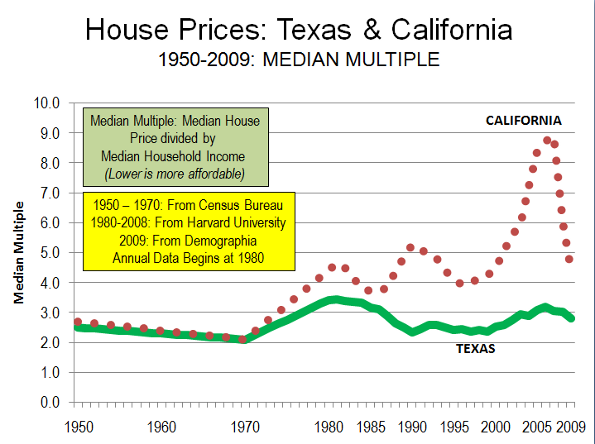
    Throughout the past decade, Texas has experienced far smaller house price increases than in California, Florida and many other states. During the bubble, California house prices increased at a rate 16 times those of Texas, while Florida house prices increased 7 times those of Texas. As a result, after the bubble burst, subsequent house price declines were far less severe or even non-existent in Texas. Texas had experienced its own housing bubble in the 1980s, however even then overall prices did not exceed the Median Multiple of 3.0 (The Median Multiple is the median house price divided by the median household income).

    Unlike Texas, all of the markets with steep house price escalation had more restrictive land use regulations. This association between more restrictive use regulation and higher house prices has been noted by a wide range economists, from left-leaning Nobel Laureate Paul Krugman to the conservative Hoover Institution’s Thomas Sowell. It is even conceded in The Costs of Sprawl —2000, the leading academic advocacy piece on more restrictive land use controls, which indicates the potential for higher house or land prices in 7 of its 10 recommended strategies.

    Comparing Texas and California: Unlike California, housing remained affordable in Texas. California’s housing affordability – in relation to income – largely tracked that of Texas (and the nation) until the early 1970s (Figure). After more restrictive land use regulations were adopted prices started to escalate. This relationship has been well demonstrated by William Fischel of Dartmouth University. Other factors have had little impact. Construction cost increases have been near the national average in California. Other factors, like underlying demand as measured by domestic migration, have been lower in California than in Texas..

    Comparing Texas and Florida: The contrast with Florida is similar. Housing affordability in Florida was comparable to that of Texas as late as the 1990s. However, with strict planning control of land for development in Florida, land prices rose substantially when profligate lending increased demand.

    Comparing Texas and Portland: Further, the Texas housing market avoided the huge price increases that have occurred in Portland (Oregon), which relies on extensive restrictive land use regulation. In 1990, Portland house prices relative to incomes were similar to those of the large Texas metropolitan areas. At the recent peak, the median Portland house price soared to approximately 80% above Texas prices. Portland did not experience the price collapses of California, but due to the greater price volatility associated with smart growth price declines in relation to incomes that were five times those of Texas.

    How the Speculators Missed Texas: Speculation is often blamed as having contributed to the higher house prices that developed in California and Florida. This is correct. Moreover, with some of the strongest demand in the United States, Texas would seem to have been a candidate for rampant speculation. After all, it happened back in the 1970s when a huge oversupply of housing, industrial, retail and office space collapsed in the face of falling energy prices.

    But it did not happen this time, despite solid population growth. During the housing bubble, Dallas-Fort Worth and Houston ranked second and third to Atlanta in population increases among metropolitan areas with more than 5 million population. Austin is the nation’s second fastest growing metropolitan area with more than 1 million population. Each of these metropolitan areas had strong underlying demand, as indicated by domestic migration data.

    Yet the speculators were not drawn to the metropolitan areas of Texas. This is because speculators or “flippers” are not drawn by plenty, but by perceived scarcity. In housing, a sure road to scarcity is to limit the supply of buildable land by outlawing development on much that might otherwise be available.

    However, the speculators did not miss California and Florida. Nor did they miss Las Vegas or Phoenix, where the price of land for new housing rose between five and 10 times as the housing bubble developed. Despite their near limitless expanse of land, much of it was off limits to building, and the exorbitant price increases were thus to be expected.

    The Threat: Yet, despite the success of the less restrictive land use policies in Texas, there are strong efforts there to impose more smart growth policies. The impact could be devastating, especially from strategies that ration land that would raise land and house prices, as has occurred in California and Florida. In 2009, Governor Perry vetoed a bill that would have required the state to promote smart growth. Federal initiatives, under proposed climate change and transportation acts could do much to destroy not only the affordability of Texas metropolitan markets, but could also make Texas less competitive in the decades ahead.

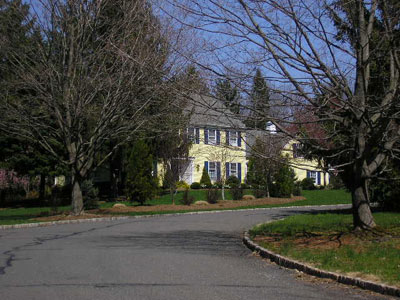
    Photograph: Suburban San Antonio (by the author)

    Wendell Cox is a Visiting Professor, Conservatoire National des Arts et Metiers, Paris. He was born in Los Angeles and was appointed to three terms on the Los Angeles County Transportation Commission by Mayor Tom Bradley. He is the author of “War on the Dream: How Anti-Sprawl Policy Threatens the Quality of Life.

  • The Democrats’ Middle-Class Problem

    Class, the Industrial Revolution’s great political dividing line, is enjoying Information Age resurgence. It now threatens the political future of presidents, prime ministers and even Politburo chiefs.

    As in the Industrial Age, new technology is displacing whole groups of people — blue- and white-collar workers — as it boosts productivity and creates opportunities for others. Inequality is on the rise — from the developing world to historically egalitarian Scandinavia and Britain.

    Divisions are evident here in the United States. Throughout the 2008 presidential campaign, Barack Obama lagged in appealing to white middle- and working-class voters who supported Hillary — and former President Bill — Clinton.

    Now, these voters, according to recent polls, are increasingly alienated from the Obama administration. Reasons include slow economic growth, high unemployment among blue- and white-collar workers and a persistent credit crunch for small businesses. These factors could cause serious losses for Democrats this fall — and beyond.

    This discontent reflects long-term trends. Since 1973, for example, the rate of growth of the “typical family’s income” in the United States has slowed dramatically. For men, it has actually gone backward when adjusted for inflation.

    The past few years have been particularly rough. About two in five Americans report household incomes between $35,000 and $100,000 a year. Right now, almost three in five are deeply worried about their financial situation, according to an ABC poll from March.

    This should give Democrats an issue, theoretically. But to date, Obama and his party seem incapable of harnessing the growing middle- and working-class unrest.

    In fact, according to recent polls, these have been the voters that Democrats and the president have been losing over the past year as the economic stimulus failed to make a major dent in unemployment.

    Part of this problem lies with the party’s base, which the urban historian Fred Siegel once labeled “the coalition of the overeducated and the undereducated.” Major urban centers like New York, Chicago and San Francisco might advertise themselves as enlightened, but they have lost much of their middle class and suffer the highest levels of income inequality.

    Representatives from these areas now dominate the party and reflect their bifurcated districts. They often stress the concerns of the educated affluent on issues like climate change and gay marriage, while their economic policies focus on the public-sector workers, “green” industries and maintaining the social welfare net.

    Not surprisingly, this agenda does little for the middle-class — mostly suburban — voters.

    Sen. Scott Brown (R-Mass.), for example, won his margin of victory in largely middle- and working-class suburbs, where many voters had backed Obama in 2008, according to demographer Wendell Cox. Brown lost by almost 2-to-1 among poor voters — and also among those earning more than $85,000 a year.

    Given the danger revealed by these numbers, Democrats and other center-left parties around the world should refocus their policies on issues — such as taxes, private-sector job creation and small business — that affect such voters.

    For this growing class divide can be found globally: In China, for example, technological change and globalization have produced a new proletariat that, unlike in the past, is disinterested in warmed-over Maoist ideology.

    Perhaps nothing demonstrates this more clearly than the unrest at the Foxconn Technology Group. Workers produce cool products — for companies like Apple, Dell and Nintendo — but under such oppressive conditions that some have been driven to suicide.

    Mounting protests about Foxconn’s employment practices, and a recent rash of strikes in China’s Honda plants, reveal the disruptive potential of this class conflict.

    Even as China’s corporations and government become richer, inequality is widening. Indeed, over the past 20 years, China has shifted from an income-distribution pattern like that of Sweden or Germany to one closer to Argentina’s or Mexico’s. By 2006, China’s level of inequality was greater than that of the United States or India.

    Not surprisingly, class anger has reached alarming proportions. Almost 96 percent of respondents, according to one recent survey, agreed that they “resent the rich.”

    China’s class divides may be extreme, but similar patterns can be found almost everywhere. From India to Mexico, economic growth has led to a striking increase in the percentage of urbanites living in slum conditions.

    In 1971, for example, slum dwellers accounted for one in six Mumbaikars. Today, they are an absolute majority.

    This almost guarantees greater class conflict in the future, even as India’s economy booms.

    “The boom that is happening is giving more to the wealthy,” said R.N. Sharma of Mumbai’s Tata Institute of Social Sciences. “This is the ‘shining India’ people talk about. But the other part of it is very shocking — all the families where there is not even food security.We must ask: ‘The “shining India” is for whom?’”

    This growing inequality in the developing world is already shaping global politics. The failure of the Copenhagen climate change conference can be largely ascribed to the unwillingness of China, India, Brazil and other developing countries to sacrifice wealth creation opportunities for ecological reasons.

    Like their counterparts in New Delhi and Beijing, politicians in wealthier countries also face class conflict.

    In Britain, for example, even a massive expansion of the welfare state has done little to stop the U.K. from becoming the most unequal among the advanced European democracies.

    Alienation among white working-class voters — particularly those in the public sector or with modest small businesses — may have contributed to the Labour Party’s poor showing in the recent elections, according to Liam Byrne, the former Labour treasury secretary.

    A similar phenomenon appears in Australia. Labor Prime Minister Kevin Rudd, an icon among upper-class liberals, resigned in large part because of a precipitous decline in the polls among middle- and working-class suburban voters.

    What is not clear is whether conservative parties can abandon their often slavish devotion to big corporate interests to take advantage of these new dynamics. For years, these parties have relied on divisive social issues, like immigration, to win working- and middle-class voters. But it’s possible that a focus on profligate government spending might yet increase the right’s appeal among mid-income voters.

    As this current shift to greater inequality continues, the self-styled “popular” parties’ tendency to ignore class issues could prove disastrous.

    Unless they start addressing class issues in effective ways, they may lose not just their historical base but the political future.

    This article originally appeared in Politico.

    Joel Kotkin is executive editor of NewGeography.com and is a distinguished presidential fellow in urban futures at Chapman University. He is author of The City: A Global History. His newest book is The Next Hundred Million: America in 2050, released in Febuary, 2010.

    Official White House Photo by Pete Souza

  • SPECIAL REPORT: Move to Suburbs (and Beyond) Continues

    Anyone who challenges the notion that the long predicted exodus of people from the suburbs to the city has been wildly overstated is sure to generate some backlash from urban boosters. Alan Berube of the Brookings Institution contends in a New Republic column that “head counts” better reveal city trends than property trends or the massive condo bust. He points to a Brookings Institution analysis by Bill Frey, entitled “Texas Gains, Suburbs Lose in 2010 Census Review,” which compares trends in major cities and suburbs, but offers not a sentence demonstrating any actual population “loss” in suburbs (his point is that their growth rates have declined).

    However, Berube has a point. Head counts are the issue. The annual Bureau of the Census “head count” of domestic migration reveals that the suburban to urban core exodus is as elusive as it has ever been. Gross population totals reveal nothing with respect to movements between the suburbs and the core. There is no doubt that core city population trends have improved, and this is a good thing. However, there is not a shred of evidence that suburbanites are picking up and moving to the cores.

    Domestic Migration: This is indicated by a “head count” of migration trends during the decade and during the last year. Each year, the Bureau of the Census estimates the number of people who move between counties (domestic migration) and the number of people who move into metropolitan areas from outside the nation (international migration). The data is estimated at the county (equivalent) level, which means that, except where cities are counties (such as Baltimore, San Francisco and others), individual core city data is not available. Thus, the analysis has to rely on core versus suburban counties in metropolitan areas (Note 1).

    In short, the nation’s urban cores continue to lose domestic migrants with a vengeance, however are doing quite well at attracting international migration. Thus, core growth is not resulting from migration from suburbs or any other part of the nation, but is driven by international migration.

    The following analysis covers all but four (48) metropolitan areas with more than 1,000,000 population as of 2009. San Diego, Las Vegas and Tucson are excluded because they include only one county, so there is only a core county and no suburban county. New Orleans is excluded due to the special circumstances of the huge population losses from Hurricane Katrina.

    Generally, domestic migrants are leaving the nation’s largest metropolitan areas. Between 2000 and 2009, a net 1,900,000 domestic migrants moved to areas of the nation outside the largest metropolitan areas (Table 1). Domestic migration losses occurred 24 of the 48 metropolitan areas. In the last year (2008-2009), the net domestic out-migration for all 48 regions in total was 22,000, 90% below the 2000-2008 annual rate. A somewhat smaller number of metropolitan areas, 22, experienced domestic migration losses in the last year. Most observers, including Berube, trace this diminishing loss to the recession, which has made movement in any direction more difficult over the past two years.

    Table 1
    Domestic Migration: Major Metropolitan Areas
    2000-2009
    2008-2009
    Core County Classification
    Metropolitan Area
    Metropolitan Area
    Core
    Suburban
    Metropolitan Area
    Core
    Suburban
    1
    New York   (1,920,745)   (1,222,290)     (698,455)       (110,278)     (77,381)    (32,897)
    3
    Los Angeles   (1,337,522)   (1,102,202)     (235,320)         (79,900)     (76,674)      (3,226)
    2
    Chicago       (547,430)      (705,403)      157,973         (40,389)     (31,114)      (9,275)
    4
    Dallas-Fort Worth        307,907      (262,982)      570,889           45,241       (7,494)      52,735
    1
    Philadelphia       (112,071)      (154,338)         42,267           (7,577)       (5,496)      (2,081)
    4
    Houston        242,573        (69,736)      312,309           49,662       19,002      30,660
    4
    Miami-West Palm Beach       (284,860)      (297,637)         12,777         (29,321)     (25,142)      (4,179)
    1
    Washington       (110,775)        (39,814)       (70,961)           18,189         4,454      13,735
    3
    Atlanta        412,832            3,243      409,589           17,479         7,579        9,900
    1
    Boston       (232,984)      (100,485)     (132,499)             6,813             (32)        6,845
    2
    Detroit       (361,632)      (306,467)       (55,165)         (45,488)     (34,794)    (10,694)
    4
    Phoenix        530,579        404,840      125,739           12,441         4,651        7,790
    2
    San Francisco-Oakland       (343,834)      (245,796)       (98,038)             7,977           (207)        8,184
    4
    Riverside-San Bernardino        457,430        375,055         82,375               (616)       13,174    (13,790)
    3
    Seattle           42,424        (27,407)         69,831           17,035       11,053        5,982
    2
    Minneapolis-St. Paul         (22,865)      (138,395)      115,530           (2,503)       (1,989)          (514)
    1
    St. Louis         (42,151)        (62,990)         20,839           (4,532)       (3,197)      (1,335)
    4
    Tampa-St. Petersburg        254,650          89,385      165,265             4,663         2,630        2,033
    1
    Baltimore         (35,938)        (74,328)         38,390           (3,687)       (4,883)        1,196
    2
    Denver           61,108        (44,839)      105,947           19,831         6,369      13,462
    2
    Pittsburgh         (49,438)        (57,532)           8,094             1,144            401           743
    2
    Portland        120,437            3,811      116,626           16,320         7,053        9,267
    2
    Cincinnati         (18,313)        (87,976)         69,663               (384)       (2,833)        2,449
    4
    Sacramento        135,038          32,369      102,669             4,733       (1,185)        5,918
    2
    Cleveland       (133,679)      (151,448)         17,769         (10,191)     (10,875)           684
    4
    Orlando        218,108          46,341      171,767           (4,279)       (6,275)        1,996
    4
    San Antonio        175,552          96,856         78,696           18,984       10,797        8,187
    3
    Kansas City           30,181        (33,910)         64,091             3,929           (417)        4,346
    4
    San Jose       (233,133)      (226,545)         (6,588)           (5,361)       (4,829)          (532)
    3
    Columbus           32,087        (36,024)         68,111             5,018         1,907        3,111
    4
    Charlotte        243,399        104,402      138,997           19,211         8,299      10,912
    3
    Indianapolis           70,271        (53,039)      123,310             7,034       (1,209)        8,243
    4
    Austin        224,227          52,842      171,385           25,654       10,484      15,170
    2
    Norfolk-Virginia Beach         (19,172)        (19,391)              219           (8,052)       (3,559)      (4,493)
    2
    Providence         (50,151)        (38,129)       (12,022)           (6,736)       (4,939)      (1,797)
    3
    Nashville        120,684        (20,101)      140,785           10,826            128      10,698
    2
    Milwaukee         (72,668)        (89,476)         16,808           (2,336)       (3,585)        1,249
    4
    Jacksonville        125,881          17,866      108,015             1,758       (3,415)        5,173
    4
    Memphis           (8,834)        (61,325)         52,491           (5,276)       (7,867)        2,591
    3
    Louisville           33,700           (7,692)         41,392             2,122            262        1,860
    2
    Richmond           74,650           (4,839)         79,489             2,751                 3        2,748
    3
    Oklahoma City           41,523           (8,164)         49,687             8,798         3,236        5,562
    3
    Hartford           (9,385)        (22,089)         12,704           (1,847)       (1,949)           102
    3
    Birmingham           26,420        (26,550)         52,970             2,418       (1,424)        3,842
    3
    Salt Lake City         (32,760)        (43,779)         11,019               (164)           (911)           747
    4
    Raleigh        190,438        150,583         39,855           20,095       16,070        4,025
    2
    Buffalo         (53,191)        (47,780)         (5,411)           (1,711)       (1,806)              95
    2
    Rochester         (42,163)        (35,354)         (6,809)           (1,937)       (1,224)          (713)
    Total   (1,903,595)   (4,548,659)   2,645,064         (22,439)   (199,153)   176,714
    Major metropolitan areas: Population over 1,000,000 in 2009
    Core county classifications: See Table 2

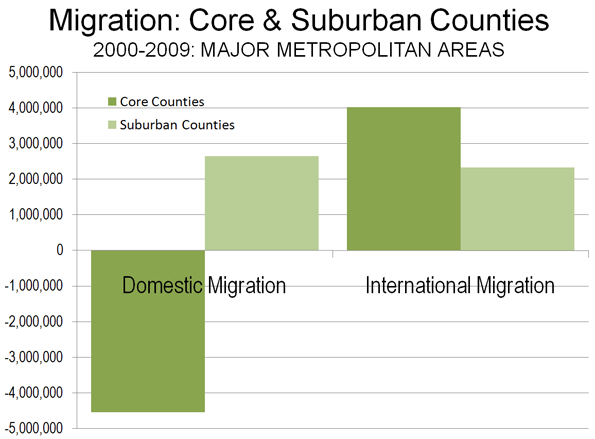
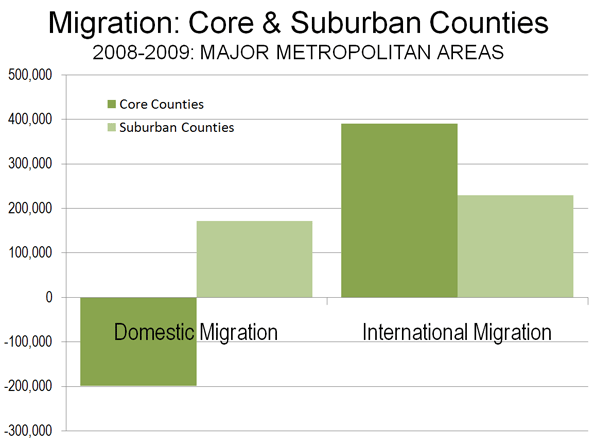
    The core counties lost domestic migrants, often at very high rates. Between 2000 and 2009, more than 4,500,000 people moved out of the core counties. This is more people than live in the cities of Los Angeles and Washington, DC combined. The suburban counties did substantially better gaining more than 2,600,000 domestic migrants (nearly as many people as live in the city of Chicago), but not enough to negate the core losses. Over the past year, the core counties lost 200,000 domestic migrants, an annual rate approximately two-thirds less than the rate from 2000 to 2008. Suburban counties gained 175,000, a more than 40% reduction from the 2000-2008 annual rate. All of these rate changes are consistent with expectations in a recession, as fewer people move.

    If anything, the trends of the past decade indicate a further dispersal of America’s metropolitan population, with an additional 200,000 domestic migrants moving to the exurban counties adjacent to and beyond the major metropolitan areas (Note 2). Reflecting the effects of the recession, exurban areas lost 4,000 domestic migrants in the last year. This one year loss rate is less than 1/10th of the core county domestic migration loss rate over the same period. Another nearly 1.7 million domestic migrants left the major metropolitan areas and their exurbs altogether, moving to smaller metropolitan areas, smaller urban areas and rural areas.

    Between 2000 and 2008, 36 cores experienced domestic migration losses, compared to 10 suburban areas. The cores did better in the last year, with 29 losing domestic migrants, while 13 suburban areas lost domestic migrants. Further, more people moved into (or fewer moved out of) the suburbs from other parts of the country than to the cores in 42 of the 48 metropolitan areas between 2000 and 2009 and in 2008-2009.

    Moreover, not all urban cores are the same. Some, including most of the fast growing areas, are far more suburban than others. This is illustrated by a classification of core counties (Table 2) based upon the share of owner occupant housing built after 1949 (For for statistical purposes the beginning of automobile oriented suburbanization was with the census of 1950).

    Table 2
    Core County Classifications (Extent of Suburbanization)
    Core County Classification
    Share of Owner-Occupied Houses Built After 1949
      Dominant Urban Cores
    Less than 50%
      Moderately Suburban
    50% = <75%
      Substantially Suburban
    70% = <85%
      Predominantly Suburban
    85% & Over
    Data from 2000 US Census

    For example, in the core counties of the St. Louis and Boston metropolitan areas, there is little suburbanization, with more than 70% of houses having been built before 1950. Their growth truly reflects the attractiveness of traditional, relatively dense urban living. On the other hand, in the core county of the Austin metropolitan area, less than 10% of the houses were built before 1950, while in Phoenix, the figure is 3%. In these and other core counties that encompass large suburban areas, the vast majority of “urban” growth follows a highly suburbanized, auto-oriented model.

    The domestic migration results by core county classification are as follows:

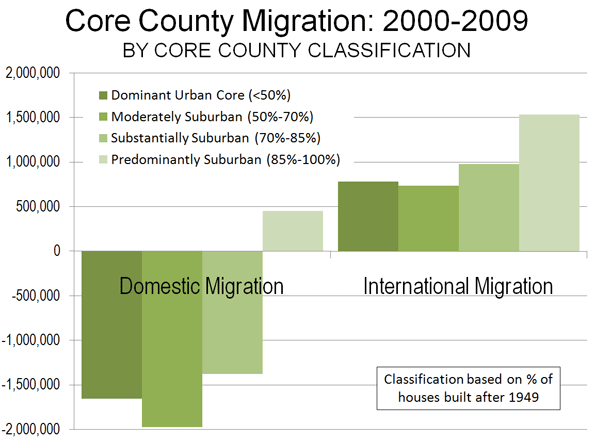
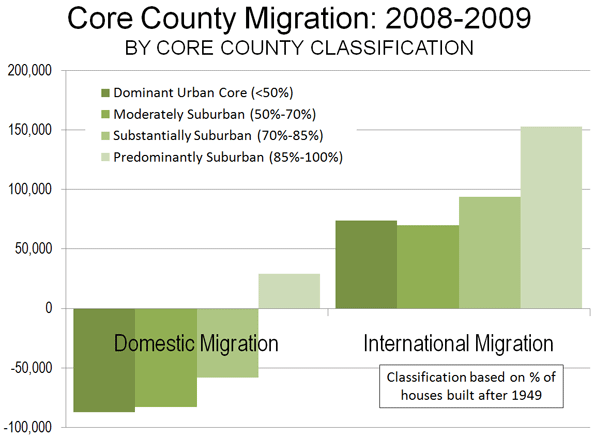
    • Dominant Urban Core Central Counties (less than 50% of the housing stock built after 1949) lost 1.650 million domestic migrants, or 14.0% of their 2000 population. In the last year, the loss was 87,000.
    • Moderately Suburban Core Central Counties (50% to 69% of the housing stock built after 1949) lost 1.970 million domestic migrants, or 10.0% of their 2000 population. In the last year, the loss was 83,000.
    • Substantially Suburban Core Central Counties (70% to 84% of the housing stock built after 1949) lost 1.380 million domestic migrants, or 7.2% of their 2000 population. In the last year, the loss was 58,000.
    • Predominantly Suburban Core Central Counties (85% and more of the housing stock built after 1949) gained 450 thousand domestic migrants, or 2.0% of their 2000 population. In the last year, the gain was 29,000.

    By no stretch of the imagination, then, can it be validly claimed that the overall trend is people moving from the suburbs to the core. The evidence suggests that the more urban the core county, the greater are the domestic migration losses.


    International Migration: The real story with respect to core growth is international migration. The 48 metropolitan areas gained 6.4 million international migrants from 2000 to 2009 and 620,000 in 2008-2009. International migration, also impacted by recession, dropped by nearly a 15% drop from the 2000-2008 annual rate (Table 3).

    Table 3
    International Migration: Major Metropolitan Areas
    2000-2009
    2008-2009
    Core County Classification
    Metropolitan Area
    Metropolitan Area
    Core
    Suburban
    Metropolitan Area
    Core
    Suburban
    1
    New York     1,075,016      622,538      452,478        100,669     57,674      42,995
    3
    Los Angeles        803,614      628,303      175,311           75,062     58,557      16,505
    2
    Chicago        363,134      265,156         97,978           33,363     24,236        9,127
    4
    Dallas-Fort Worth        323,941      203,732      120,209           31,571     19,785      11,786
    1
    Philadelphia        122,733         50,761         71,972           12,944        5,560        7,384
    4
    Houston        289,648      252,098         37,550           27,996     24,371        3,625
    4
    Miami-West Palm Beach        506,423      318,888      187,535           51,548     32,380      19,168
    1
    Washington        310,222         23,112      287,110           31,904        2,096      29,808
    3
    Atlanta        207,238         42,082      165,156           20,288        4,093      16,195
    1
    Boston        191,014         64,359      126,655           19,250        6,522      12,728
    2
    Detroit           93,625         44,177         49,448             8,723        4,132        4,591
    4
    Phoenix        214,067      209,326           4,741           21,833     21,364           469
    2
    San Francisco-Oakland        257,318      161,324         95,994           24,376     15,373        9,003
    4
    Riverside-San Bernardino           90,652         46,829         43,823             8,464        4,313        4,151
    3
    Seattle        126,973         98,983         27,990           12,919        9,971        2,948
    2
    Minneapolis-St. Paul           84,440         69,262         15,178             8,234        6,756        1,478
    1
    St. Louis           29,782         11,794         17,988             2,928        1,112        1,816
    4
    Tampa-St. Petersburg           74,173         42,568         31,605             8,045        4,762        3,283
    1
    Baltimore           43,949         10,852         33,097             4,604        1,125        3,479
    2
    Denver           93,916         45,338         48,578             8,738        4,251        4,487
    2
    Pittsburgh           19,225         16,326           2,899             1,901        1,596           305
    2
    Portland           70,901         28,755         42,146             6,680        2,677        4,003
    2
    Cincinnati           22,364         12,754           9,610             2,245        1,260           985
    4
    Sacramento           64,275         47,169         17,106             6,056        4,420        1,636
    2
    Cleveland           28,002         20,168           7,834             2,826        1,987           839
    4
    Orlando           95,500         61,171         34,329           11,720        7,381        4,339
    4
    San Antonio           31,595         28,157           3,438             3,303        2,940           363
    3
    Kansas City           34,339         12,613         21,726             3,404        1,262        2,142
    4
    San Jose        170,452      168,009           2,443           16,347     16,116           231
    3
    Columbus           39,755         38,261           1,494             4,063        3,915           148
    4
    Charlotte           48,176         34,522         13,654             4,678        3,332        1,346
    3
    Indianapolis           27,676         22,058           5,618             2,809        2,239           570
    4
    Austin           65,958         56,828           9,130             6,406        5,516           890
    2
    Norfolk-Virginia Beach                421         (1,546)           1,967                867             81           786
    2
    Providence           34,926         25,547           9,379             3,753        2,741        1,012
    3
    Nashville           36,570         26,208         10,362             3,850        2,760        1,090
    2
    Milwaukee           26,814         22,612           4,202             2,706        2,292           414
    4
    Jacksonville           15,066         12,046           3,020             1,760        1,397           363
    4
    Memphis           19,845         17,801           2,044             2,093        1,874           219
    3
    Louisville           16,437         12,778           3,659             1,685        1,291           394
    2
    Richmond           17,061           4,161         12,900             1,805           440        1,365
    3
    Oklahoma City           23,717         18,698           5,019             2,394        1,878           516
    3
    Hartford           30,266         25,871           4,395             3,230        2,784           446
    3
    Birmingham           14,485         10,644           3,841             1,557        1,151           406
    3
    Salt Lake City           41,216         39,416           1,800             3,855        3,684           171
    4
    Raleigh           36,923         32,141           4,782             3,560        3,103           457
    2
    Buffalo             9,671           8,387           1,284                940           814           126
    2
    Rochester           12,796         11,657           1,139             1,243        1,123           120
    Total     6,356,310   4,024,694   2,331,616        621,195   390,487   230,708
    Major metropolitan areas: Population over 1,000,000 in 2009
    Core county classifications: See Table 2

    The core counties gained 4.0 million net international migrants between 2000 and 2009. The international migration gains in the dominant urban and moderately suburban core counties were not sufficient to compensate for the domestic migration losses (Figure 3). Surprisingly, the strongest gain in international migration from 2000 to 2009 was not in the more urban core counties, but rather was in the predominantly suburban core counties, at a 6.8% rate compared to 2000 populations.

    In 2008-2009, the core county gain was 390,000, approximately 15% below the 2000-2008 annual rate (Figure 4). The suburban counties gained international migrants, though fewer than the cores, adding a net 2.3 million between 2000 and 2009. Between 2008 and 2009, the suburbs added a net 230,000 international migrants, a 12% decline from the 2000-2008 annual rate.

    This of course measures only initial international migration. Over time many immigrants likely will head for the suburbs, which now are home to a majority. Core cities may be playing more of a “revolving door” role where they take in immigrants (and young people) for several years, then lose them, but replace the loss with newcomers.

    The Exodus: Elusive as Ever: The much ballyhooed suburban hegira has not begun, despite it having been announced repeatedly (Table 4). There is no doubt that the cores are doing better than in recent decades, particularly since the deep recession began. But the relative better urban performance may have more to do with stagnation than anything endlessly alluring about inner city life.

    Table 4
    Domestic, International & Total Migration: Major Metropolitan Areas
    PERSONS
    Net Domestic Migration: 2000-2009
    Net Domestic Migration: 2008-2009
    Net International Migration: 2000-2009
    Net International Migration: 2008-2009
    Net Total Migration: 2000-2009
    Net Total Migration: 2008-2009
    Core Counties (Share of Post-1949 Housing)   (4,548,659)     (199,153)      4,024,694         390,487        (523,965)     191,334
      Dominant Urban Core (Less than 50%)  (1,654,245)      (86,535)        783,416          74,089       (870,829)     (12,446)
      Moderately Suburban (50%-69%  (1,969,014)      (83,099)        734,078          69,759    (1,234,936)     (13,340)
      Substantially Suburban (70%-84%)  (1,377,714)      (58,419)        975,915          93,585       (401,799)       35,166
      Predominantly Suburban (85% & Over)       452,314        28,900     1,531,285        153,054     1,983,599    181,954
    Suburban Counties     2,645,064       176,714      2,331,616         230,708      4,976,680     407,422
    48 Major Metropolitan Areas   (1,903,595)       (22,439)      6,356,310         621,195      4,452,715     598,756
    Exurban Counties        198,294          (4,053)         364,498           36,740          562,792        32,687
    48 Metropolitan Areas & All Exurban Counties   (1,705,301)       (26,492)      6,720,808         657,935      5,015,507     631,443
    4 Excluded Metropolitan Areas          19,958         14,553         225,767           23,400          245,725        37,953
    All (52) Major Metropolitan Areas & Exurban Counties   (1,685,343)       (11,939)      6,946,575         681,335      5,261,232     669,396
    Smaller Metropolitan & Rural     1,685,343         11,939      1,678,369         173,570      3,363,712     185,509
    United States 0 0      8,624,944         854,905      8,624,944     854,905
    Major metropolitan areas: Population over 1,000,000 in 2009
    Excluded metropolitan areas: San Diego, Las Vegas & Tucson (no suburban county) and New Orleans (due to Hurricane Katrina)
    Exurban counties of excluded metropolitan areas are included (Las Vegas and New Orleans)

    As in Europe, people are moving to the urban cores. But also, as in Europe, they are moving there from across national borders, rather than from the suburbs (Figures 3 & 4). This will surprise urbanites who cannot imagine meaningful lives in the suburbs, but will not shock the many millions more suburban residents content enough not to move. The exodus from the suburbs to the core will not have begun until more moving vans head away from the suburbs than to them. To this point, this is simply not occurring. And when the economy recovers, history suggests that the gap between suburban and core growth rates may begin expanding again.


    Note: There is one core county in each metropolitan area, which is the county containing the first named city, except for in New York, where all five counties (boroughs) are included, in San Francisco-Oakland, where Alameda County (Oakland) is also included and in Minneapolis-St. Paul, where Ramsey County (St. Paul) is also included.

    Note: The exurban counties are those included in combined statistical areas (as designated by the Bureau of the Census), which have major metropolitan areas as their core.

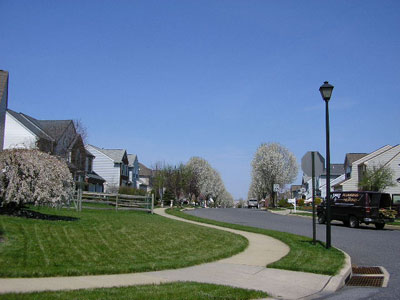
    Photo: Suburban Minneapolis-St. Paul

    Wendell Cox is a Visiting Professor, Conservatoire National des Arts et Metiers, Paris. He was born in Los Angeles and was appointed to three terms on the Los Angeles County Transportation Commission by Mayor Tom Bradley. He is the author of “War on the Dream: How Anti-Sprawl Policy Threatens the Quality of Life.

  • The Need to Expand Personal Mobility

    Few books in recent memory have started from as optimistic or solid a foundation as Reinventing the Automobile: Personal Urban Mobility for the 21st Century. Reinventing the Automobile conveys a strong message that improved personal mobility is necessary and desirable:

    “Have we reached the point where we now must seriously consider trading off the personal mobility and economic prosperity enabled by automobile transportation to mitigate its negative side effects? Or, can we take advantage of converging 21st century technologies and fresh design approaches to diminish those side effects sufficiently while preserving and enhancing our freedom to move about and interact? This book concludes the latter.”

    The authors include William J. Mitchell, Professor of Architecture, and Media Arts and Sciences at the Massachusetts Institute of Technology directs the Smart Cities research group at the MIT Media Lab, Christopher Boroni-Bird, Director of Advance technology Vehicle Concepts at General Motors and Lawrence D. Burns, who consults on transportation, energy and communications systems and technology. The book is published by the MIT Press.

    Getting Urban Economics Right

    The authors start with getting the urban economics right. They recognize that the “freedom and prosperity benefits” of the automobile “have been substantial.” They note that the automobile industry “set the stage for the growth of the middle class,” something that has been labeled the “democratization of prosperity.” The authors say that the car “enabled modern suburbia” and “powered a century of economic prosperity.” This refreshing treatment is consistent with the overwhelming economic evidence that links personal mobility with prosperity, such as by Remy Prud’homme and Chang-Wong Lee, David Hartgen and M. Gregory Fields and others. It is also at considerable odds with the widely accepted, somewhat nostalgic planning orthodoxy that rejects private automotive transport as “unsustainable”, unaesthetic and anti-social. This ideology embraces the illusion that forcing people to travel longer, with less personal flexibility somehow will improve the economy and raise the standard of living.

    The Future of the Automobile?

    The authors envision a automobile characterized by a new “DNA.” It starts with smaller cars, fueled by electricity and hydrogen (fuel cell technology). It also begins with an understanding that the cars used in many mundane urban operations today – for example getting to the market or pick up the kids at school – are over-engineered. They are far larger than is needed for most trips, their capacity for speed exceeds urban requirements and their range between refueling is also more than needed.

    The authors would re-engineer urban vehicle to the needs of metropolitan dwellers, an “ultra-small vehicle” (USV). The designs proposed include far lighter cars that can be easily “folded” up to minimize parking space requirements. Cars would be connected to one another by wireless technology, all but eliminating the possibility of collisions. The cars would be small enough that they could be assigned special dedicated lanes on current freeways and streets. Travel would be less congested because the dedicated lanes would have a far higher vehicle capacity, while the interconnectedness would allow cars to safely operate closer to one another.

    The combination of electricity, hydrogen, wireless technology and the USV would bring additional benefits. This would permit improved vehicle routing, as drivers would be advised take alternate less congested routes. This would also, in time, lead to self-drive cars, about which Randal O’Toole has recently written, made possible by the use of wireless technology and that dedicated lanes would make possible.

    Empowering Transit Riders through Car Sharing

    Car sharing is an important part of this future, for dwellers of dense urban cores, according to Reinventing the Automobile. The author’s note that car sharing can solve the “first mile-last mile” problem making it possible for transit users to speed up their trips by not having to walk long distances to and from transit stops. Indeed, car sharing programs are set to be adopted in urban cores with some of the world’s best transit systems, such as Paris, and London. Privately operated car sharing systems have been established in a number of US metropolitan areas, such as Atlanta, Denver and San Francisco.

    Progress with Conventional Strategies

    The longer term vision of the MIT Press authors may take a while to unfold, but we can already see potential for progress. Just this week, “super-car” developer Gordon Murray announced development of an urban car (the T25), smaller than the “Smart,” which would achieve nearly 60 miles per gallon, with plans for marketing within two years. Volkswagen has developed a “1-litre” car, which would achieve 235 miles per gallon on diesel fuel. All of this makes the 51 mile per gallon Toyota Prius seem gluttonous by comparison

    These developments and the Reinventing the Automobile vision show that it is unnecessary to tell people in America (or Europe or the developiung world) that they must give up their automobiles. That is good news. The social engineering approaches requiring people to move from the suburbs to dense urban cores and travel by slower, less frequent transit are incapable of achieving serious environmental gains (see below) and can not seriously be considered progress or desirable by most people in advanced countries.

    The Superiority of Technology

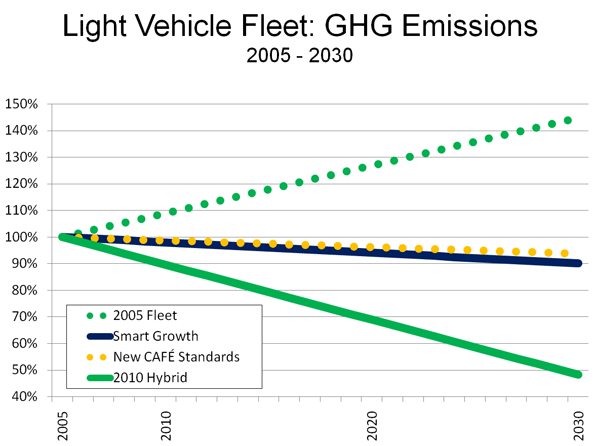
    This is illustrated by recent developments in automobile technology and research (Figure).

    • Before the adoption of the new 2020 and 2016 new car fuel economy standards, the US light vehicle fleet was on track to increase its greenhouse gas (GHG) emissions nearly 50% from 2005 to 2030 (the green dotted line in the figure).
    • As a result of the new fuel economy standards, Department of Energy projections indicate that greenhouse gas emissions from light vehicles will be one-third less by 2030 compared to the 2005 fleet (the yellow dotted line), and this is at the standard projected driving increase rates that could well be high.
    • The smart growth strategies of land rationing, densification and discouraging driving would produce, at best, a marginal reduction in GHG emissions, using the mid-point of the recent proponent research (Moving Cooler), indicated by the solid blue line. Actually, this overstates the impact of smart growth, since it discounts the substantial GHG emissions gains that result from higher fuel consumption in more congested traffic produced by densification.
    • The potential for technological advance is illustrated by the green solid line, which estimates the GHG emissions from light vehicles in 2030 if the average fuel economy were equal to today’s best hybrid technology.

    Overall auto-centered technology-based strategies – such as the improved fuel economy standards and the hybrid fuel economy – would each produce about 15 times as much benefit as the smart growth strategies proposed by such studies as Moving Cooler. This approach would not only be far more productive in terms of environmental improvement but would not require interfering with people’s lives in ways that would require longer trips times, less convenience, seriously retarded job access and, inevitably, fewer jobs and lower levels of economic growth.

    Technology: The Only Way

    It would be a mistake – and likely political folly – to force a re-engineering our way of life in order to enact strategies with dubious environmental benefits. In the final analysis, personal mobility must be retained and expanded, because there is no alternative that is acceptable to people, whatever system of government they happen to live under. Reinventing the Automobile paints the most optimistic picture to date and, if given due serious treatment, could prove a debate changer.

    Photograph: Manila suburbs

    Wendell Cox is a Visiting Professor, Conservatoire National des Arts et Metiers, Paris. He was born in Los Angeles and was appointed to three terms on the Los Angeles County Transportation Commission by Mayor Tom Bradley. He is the author of “War on the Dream: How Anti-Sprawl Policy Threatens the Quality of Life.

  • Phantom Exodus Driven by Phony Cost Comparisons

    If Tara Siegel Bernard of The New York Times is right, (city of) New Yorkers must be among the most irrational people in the world. In “High-Rise or House with Yard,” she describes the purported financial advantages of living in a co-op apartment in Brooklyn versus suburban South Orange, New Jersey.

    The irrationality is that, despite the money that households can save by staying in the city, a net more than 350,000 left for the suburbs between 2000 and 2007, as E. J. McMahon and I found in Empire State Exodus, which summarized IRS inter-county migration data. Indeed, each of the city’s five boroughs lost domestic migrants to the suburbs during the period. An analysis by The New York Times itself found that the city had lost net domestic migrants to every suburban county in the metropolitan area as well as to every county in newly exurban northeastern Pennsylvania. This includes Allentown-Bethlehem and Scranton-Wilkes Barre, toward which New Jersey land use regulations have driven new development.

    “High Rise or House with Yard” stands alone in claiming that New York City is less costly than its suburbs. The most recent (and authoritative) ACCRA cost of living index for Brooklyn is a full 40% higher than in the South Orange (the Newark-Elizabeth area). This is before considering the fact that the Brooklyn home is a 1,000 square foot coop apartment with two bedrooms and one bath, while the suburban home is a 2,000 square foot house in South Orange with four bedrooms and 2.5 baths. Smaller apples may well be less expensive than bigger oranges. The Times also assumes that the suburban resident will commute by train to Manhattan, at more than $400 per month. It is also possible that, like 80% of South Orange commuters, the new suburbanite may choose to work in the New Jersey suburbs. Maybe New Yorkers are not all that irrational after all.
    Moreover, people are moving even further than the suburbs and exurbs, with almost as many people moving from New York City even further away. The latest Bureau of the Census data indicates that every borough experienced a net domestic migration loss between 2000 and 2009. More than 1.2 million residents left New York City, nearly as many people as live in the cities of Washington and Boston combined.

    • Manhattan lost more than a 140,000 net domestic migrants, more people than live in the city of Hartford.
    • Brooklyn lost nearly 450,000 net domestic migrants, more people than live in the city of Miami.
    • Queens lost a 420,000 net domestic migrants, nearly as many people as live in the city of Cleveland.
    • The Bronx more than 200,000 net domestic migrants, more people than live in the city of Providence, Rhode Island.
    • Staten Island did much better, losing only 5,000 net domestic migrants. But then, much of Staten Island looks more like suburban New Jersey than New York City

    In the face of these losses of which at least some at The New York Times are aware, the article notes that “Many empty-nesters are giving up the high-maintenance house in the suburbs in exchange for the attractions of city life.” Not that many.

    Photo: New Jersey Suburbs

  • Follow The Money On Development Deals

    “Follow the money” became a household phrase after the 1976 movie that told the story of Watergate, All the Presidents Men. Personal experiences over four decades in the consulting industry, working to create sustainable developments, often bring the phrase to mind.

    In a meeting a few weeks ago concerning a potential collaboration between our planning company and large engineering consulting firm, I was coached to tone down the fact that the design methods we invented and utilize reduce infrastructure. You might ask, why would reduced infrastructure (one key to a more sustainable world) be a negative condition for an engineering firm whose main purpose is to design the infrastructure that society must rely upon?

    Follow the money… Large engineering projects, as well as many architectural structures, are often quoted as a percentage of construction costs. The incentive is to increase, not decrease construction costs. We have the ability today to reduce the world’s infrastructure possibly up to 30%, which would be a major step towards reducing initial costs of commercial building and residential housing. It would have massive environmental benefits, and reduce the continual maintenance costs to the governmental authorities (forever) up to 30%.

    Follow the money… If the income of consulting firms is based upon construction costs, the consultants’ gross dollar billings would also be reduced by 30%. Firms that supply concrete, steel, pipes, etc would also have their gross income slashed by 30%. Does our world have a chance of becoming sustainable? Dream on!

    Follow the money… A decade ago I met with the president of one of the largest engineering firms in Minnesota. He wanted to know how our firm can produce so much work with so few people (I personally design all of the developments and had a drafting staff of two people). In ten minutes I designed a development of about 15 lots that showed homes, driveways, and all the final geometry, using the commercially available technology we had developed. “Oh my,” he said, and paused. I thought he would say, “We could reduce our staff by half,” but instead said , “You must put the plans on the shelf a few weeks, to justify the billing hours”. Then the enlightenment came to me. I had developed a software technology used in my own consulting business to produce engineering-accurate layouts in a fraction of the time of a CAD (Computer Aided Drafting)-based technology, but started to understand that this might be a hard sell.

    Follow the money… Large consultants often look at the floor of employees as a multiplier, meaning that each workstation will bring some multiple of profit. Suppose a technician costs $50,000 a year, and the multiplier is 3.5. After overhead, that technician represents $100,000 in potential profit. At a 150 person company, replacing one third of the staff by using more efficient technology and methods in the above example reduces the potential consulting income by five million dollars!

    Follow the money… Liability is another roadblock to sustainability. Why try something new when the old tried and true has worked for decades or centuries? In the consulting industry, licensed professionals risk their careers if a new concept causes a major failure, so they’re more likely to discourage anything without a proven history. The loss of a license to certify plans would have a devastating effect on a consultant’s personal finances. It is far safer to claim that the new method cannot work and talk the developer or municipality out of the idea.

    Follow the money… Today, few consultants are making any. Most are either hanging on (barely) or have shut their doors. The unemployment rate among architects, engineers, draftsmen, technicians, planners, and related occupations is very high. The exceptions are those lucky few that have won lucrative government contracts and are holding their own, or even thriving.

    Follow the money… The market reacts to design, innovation and value. The first Toyota Prius was an ugly miniscule car based upon the Echo, but it was highly efficient. Gas was cheap when it was first introduced, and sales were dismal. The first generation Prius had innovation, but lacked design. The next generation Prius came out as gas prices soared. When an attractive interior and exterior design was combined with innovation, it quickly became a symbol for a new era of green thinkers. Rising fuel prices turned the hybrid technology into an increasing value which fueled — so to speak — its success. Before the I-Pod there were many digital music players that were innovative. When players were combined with an attractive package design and the ability to download from the same vendor, the overall value created its success. Like the Prius and the I-Pod, land development itself is a “product”.

    Follow the money… The housing market crashed and many believe the commercial real estate crash to come will also be devastating. Funding for infrastructure keeps many consultants employed when the private development and building industry flounder.

    Those of us in the consulting industry must make some significant foundational changes if we are going to have a sustainable future, and claiming “Sustainability!” on the corporate web site is not enough. Unlike building construction, where being “green” typically increases costs, in land development, environmentally sound design and construction can cost significantly less if done right. That said, it does require more design effort with a greater attention to detail. It is possible to decrease both construction costs and environmental impacts say, 30%, but it could mean the consultant doubling his or her design efforts to do so. Not only does the firm lose 30% of its gross income if billing is based upon a percentage of construction costs, it must make a huge increase in effort to do so.

    Follow the money… In this new age of engineering and designing sustainable development, it is no longer possible to get the best result by simply using an off-the-shelf software to calculate the hydrology of the site (the drainage) within sewer pipes. Using surface flow along with natural materials that can filter pollutants from the run-off before drainage leaves the site requires a botanical engineering solution that blends knowledge of natural and manmade engineering. This requires a specialist, and the complexity that’s required to successfully design these systems with fail-safe methods goes far beyond pressing a software button. Small errors could have devastating results, and the consultant will be liable.

    For example, I installed a no-mow – low watering – fescue lawn, instead of sod, when my home was built last year. This landscaping worked great during the first year, giving us the look of a lawn look without having to mow it. We were told to water twice daily to get it established by the landscaping firm that claimed to be experts on this exciting new low impact landscaping. Well, watering fescue twice daily, it turns out, is the worst thing you can do, according to the prairie restoration consultants. We inadvertently turned our lawn into a fast growing prairie that needs more mowing than sod! But this is just one example of what can go wrong in this new era of sustainability. I was willing to invest, and I believe mistakes can be corrected and documented to reduce future errors. My landscape contractor installed something quite new in the industry, and took on a risk compared to suggesting safe sod. After the bugs are worked out the company will have a market edge and an example to show (but maybe not this year).

    So how can we force an industry to change?

    Lead with Money… Cities and developers hire firms assuming that they are going to use the latest techniques available to get the most efficient design possible. If the bidding process changed from seeking the lowest bidder to looking for the most advanced and efficient bidder, the industry would be rewarding innovation, competition, great design, and risk. Give priority to solutions that exceed the specifications. Contractors and consultants could be rewarded for coming up with revolutionary solutions.

    Lead with Money… The reward could be in the form of a bonus for innovation: For example if a plan saves 100 million in right-of-way purchasing, give half of the savings to the winning contractor and consultant. If the consultant is being paid a percentage of the construction costs (lets use 5% as an example) on a 100 million dollar project, then he or she would gross five million dollars. If they could win the consulting (engineering) contract by demonstrating the most efficient design instead of being the lowest bidder (or the most politically connected), and be paid a percentage of the demonstrated benefit, they would be making more for providing a higher degree of effort and perhaps taking on more risk. In the above example, if 30 million dollars is demonstrated to be a savings or increase in functionality, and 20% of the savings is rewarded back to the consultant, then the consultant would make 5% on the 70 million dollars (3.5 million dollars) and 20% on the 30 million in savings (6 million dollars). The gross revenue to the consultant would almost double.

    Lead with Money… Our military often awards bids for those projects that exceed the specifications. Vendors should compete not just on price, but to demonstrate how they exceeded the specifications. Governments as well as private developers could pick and choose based upon innovation, design, and value. Those taking the extra effort would flourish, and eventually the new higher standards would become the norm.

    How about forcing change through regulations? Regulations can only control minimum standards, pretty much guaranteeing monotony and stagnation. Instead, follow the money: To create a sustainable world, we need to exceed minimums, and foster innovation by rewarding risk, effort, and investment.

    Flickr photo, “George Is Keeping An Eye On You,” by We Love Costa Rica

    Rick Harrison is President of Rick Harrison Site Design Studio and Neighborhood Innovations, LLC. He is author of Prefurbia: Reinventing The Suburbs From Disdainable To Sustainable and creator of Performance Planning System. His websites are rhsdplanning.com and performanceplanningsystem.com.

  • Surprise, Frisco and Beaumont Among Fastest Growing

    The Bureau of the Census has updated its city (municipality or local government area) population estimates for 2009. Predictably, anti-suburban interests saw more indication of the elusive (read non-existent) exodus from the suburbs to the central cities. One analyst even suggested that a “high quality” of life in one central city (Washington, DC) might have kept people from moving to the suburbs. In fact, since 2000, nearly 40,000 people (domestic migrants) have moved out of the city of Washington and in the last year, the city gained 4,500 residents while the suburbs gained 13,700.

    In contrast, Buffalo News reporter Jack Ray looked at the data and noted that some cities in that metropolitan area were growing rather quickly, while others were losing population. Generally, he found that outer suburban communities were growing more quickly. Ray’s analysis was reflective of trends around the nation.

    There are nearly 20,000 incorporated cities, towns and villages in the United States. Population trends in these cities show that urban areas are growing most strongly on their suburban fringes or even in their exurbs. For example, two-thirds of the fastest growing 100 municipalities in the nation were suburbs or exurbs in the nation’s major metropolitan areas (those with more than 1,000,000 population). The other third were all municipalities in smaller metropolitan areas or outside metropolitan areas.

    The extent of this growth on the edge is illustrated by an examination of the nation’s municipalities of 25,000 or greater population that grew more than 25% between 2000 and 2009.

    • Among the 89 municipalities that grew 50% or more, 59 were in major metropolitan areas and all were suburbs (nearly all near the urban fringe) or exurbs. The total population growth among these suburbs and exurbs was 2.2 million from 2000 to 2009, for an average growth rate of 91%. These major metropolitan suburbs and exurbs grew 1.8 million, while the municipalities outside the major metropolitan areas added 400,000.
    • Among the 119 municipalities that grew between 25% and 50%, 69 were in major metropolitan areas. This included 67 suburbs and exurbs. It also included 2 central cities, Raleigh (39%) and Atlanta (28%). These major metropolitan area suburbs and exurbs gained 1.7 million residents, while the two central cities gained a total of 200,000. The municipalities outside the major metropolitan areas grew 1,000,000.

    Combined, the fastest growing suburbs and exurbs with more than 25,000 population grew more than 3.5 million, while the municipalities outside the major metropolitan areas grew 1.5 million, for a combined growth of more than 5.0 million. The smaller high growth municipalities (under 25,000), nearly 1,200 of them, both major metropolitan and outside, grew another 2.5 million.

    The fastest growing municipalities, excluding the two central cities of Raleigh and Atlanta, accounted for nearly one-third of the nation’s growth between 2000 and 20009.

    Most of the fast growing suburbs and exurbs have names that are simply not recognizable. Yet, a half-dozen added nearly as many or more new residents than all of the 20-plus central cities combined in the major metropolitan areas that do not have large swaths of suburbanization inside their borders. These include such places as Phoenix suburb, Surprise, Dallas-Fort Worth suburb Frisco and Riverside-San Bernardino suburb Beaumont.

    In Crabgrass Frontier: The Suburbanization of the United States, Kenneth Jackson noted that central Philadelphia began losing population in the early 19th century. The dispersion of America continues.

    Photograph: Exurbs of New York: Pike County, Pennsylvania

  • Salt Lake City’s Sacred Space

    Amid a devastating condo crash and high office vacancies across the U.S., one of the country’s largest downtown development projects is taking shape in Salt Lake City. The city’s center displays a landscape of cranes, cement-mixers and hard-hats–something all too rare in these tough times.

    Over the next few years, with an investment estimated locally at $2 billion, developers hope to transform a 20-acre swath of the city’s now-uninspired central core. By 2012 they hope to create a model downtown district with a whole new array of retail shops and residential towers accommodating some 700 units.

    On the surface, Salt Lake City , America’s 38th largest central business district , would seem an unlikely place for such an ambitious development. The city’s population growth–it is home to fewer than 200,000 of the region’s 1.2 million people–has been meager, particularly compared with the surrounding suburbs. The central business district represents less than ten percent of the region’s total employment.

    The driving force here is not economics, but the desire of Salt Lake’s most powerful institution, the Church of Jesus Christ of Latter Day Saints, to salvage its immediate neighborhoods. “The church’s primary notion is to protect the Temple Square and the headquarters of the Church,” explains Mark Gibbons, president of City Creek Reserve, the church’s development arm. “That’s first and foremost. This development would not have been done just on a financial basis, I can tell you that.”

    This motivation deviates from what we see now in most cities. For one thing, this does not reflect rent-seeking by real estate interests–there are no public subsidies, for example. Instead the City Creek project represents the ultimate in back-to-the-future city planning, a reversion to the ancient ideal of building a city around its essential “sacred space.”

    It’s all the more remarkable at a time when churches being converted into yuppie housing, discos or carpet stores is celebrated by the decidedly secular caste of urbanists. Of course, not everyone loves this approach. One former Salt Lake City planning official, a non-Mormon, has expressed fears about the “Vaticanization” of the area.

    Yet to date the traditional urban approach–museums, light rail development, downtown malls–has been far from a shining success. Salt Lake’s greatest remaining asset remains the Church, its great central Temple and the surrounding infrastructure of office, museums and genealogical agencies .

    Mormonism, in a sense, has to be thought of as a growth industry for downtown. Since 1960, church membership has surged from 2 million worldwide to nearly 14 million. Although Utah remains the church’s central base–over 70% of the state population is Mormon–the biggest increase has been outside the U.S., predominately in Latin America and parts of east Asia. This reality is reflected in Salt Lake itself; once overwhelmingly white, its population is now some 30% minority, much of it Latino.

    As an anchor tenant, the Church provides the ultimate raison d’etre for the surrounding area. The Temple Square remains the state’s largest tourist attraction. Church members from around the world come to the city for conferences and to consult with church records and officials.

    Of course, the fundamentally ecclesiastical logic diverges wildly from urbanist conventional wisdom. In most cities, planners embrace the idea of building the city core around singles, or “empty nesters.” The nurturing of a “bohemian” culture–hopefully of the free-spending bourgeois variety–is seen as providing a spur to art galleries, bars, clubs and high-end restaurants.

    Salt Lake’s developers wish to improve the amenity structure too, but in ways that would appeal to the middle-class families who dominate the region. Mormons, who make up half of the city population and the vast majority of those in the surrounding suburbs, average three to four children per family. Overall, the area has one of the youngest populations of any metropolitan region in the country.

    “The idea of having a sacred center is to create a space–like a campus–that’s decent, clean and upscale in a design sense, but accessible to families, ” observes Joe Cannon, editor of the church-owned local paper, The Deseret News. Without drawing in people from the predominately family-oriented suburbs, he says, the downtown would lack the base to rebound from a generation of neglect and decline.

    The church focus also makes sense, Cannon notes, when you take into account the unique history of the place. Unlike most American cities, Salt Lake was born primarily through the religious vision of the Mormon Church and in particular its great visionary leader, Brigham Young.

    The Mormons came to Salt Lake as part of their search for a sacred space. Such ideas led some to regard the Mormon as cult-like sect, dangerous to the nation. They came to Salt Lake only after attempting to settle down in Ohio, Illinois and Missouri–an action that often led. They often were booted out courtesy of bloodshed inflicted on them by more-traditional Christians.

    Although successful in a capitalist sense, Salt Lake’s urban culture reflected what Mormon historian Leonard Arrington describes as “Jacksonian communalism.” For many years, the Church controlled Zion’s Bank, the largest in the region, and promoted commercial development. Critically, Mormon charities and organizations brought in new settlers, mostly from England and Scandinavia.

    By the 1960s the downtown began to decay as Mormons, as well as non-Mormon “Gentiles,” moved en masse to the suburbs. The area around the Temple became increasingly seedy and rundown. This has led to the current effort to revive the city through the efforts of the Church–the institution with the greatest stake in the central core.

    Over the next decade, the Church’s effort could represent something unique in an urban America increasingly obsessed with the ephemeral. “We are not trying to build a ‘faux city,’” notes Mark Gibbons. “We are trying to build something that will last a hundred years or more.”

    In following that strategy, Salt Lake is trying to recover some of the very things that have sustained cities over time. It will be fascinating to see how their approach–based on the most ancient of city-building strategies–fares compared with those applied by their more decidedly secular rivals.

    This article originally appeared in Forbes.com.

    Joel Kotkin is executive editor of NewGeography.com and is a distinguished presidential fellow in urban futures at Chapman University. He is author of The City: A Global History. His newest book is The Next Hundred Million: America in 2050, released in Febuary, 2010.

    Photo by Edgar Zuniga Jr.

  • The Urbanist’s Guide to Kevin Rudd’s Downfall

    The political execution of Prime Minister Kevin Rudd by his own Australian Labor Party colleagues was extraordinary, the first time a prime minister has been denied a second chance to face the voters.

    According to the consensus in Australia’s mostly progressive media establishment, Rudd fell victim to his “poor communication skills”, a somewhat Orwellian take since until recently he was hailed as a brilliant communicator. What went wrong?

    Certainly, Rudd’s style of communication was a factor. Yet the media’s disjointed interpretations avoid what, for them, is an inconvenient truth. As much as any defects in the man himself, Rudd’s linguistic meltdown can be traced to deep socio-economic divisions wracking today’s Australian Labor Party.

    Australia has its own version of the American red and blue state dichotomy. But with a much smaller, highly urbanised population, and only six states, the social fault line runs through major metropolitan regions rather than state boundaries. Left with a fractured support base, federal Labor often struggles to hold onto majority support. Rudd clearly underestimated the persisting social divide, and his obsession with a media driven solution was disastrous.

    In Australia, post-war suburbanisation and gentrification played out differently than in the US. Since in the 1970s, Australian cities have experienced a broad geographic sorting along class lines. On the one hand, rising land values and car ownership dispersed the old industrial core, and its working class population, to the middle and outer suburbs. On the other, a booming generation of university graduates, many immersed in the counter-culture, and employed in expanding government agencies, flooded into inner-city tenements.

    Lacking the racial frictions of some American cities, and typically adjacent to attractive harbour foreshores (Australia’s major cities are all coastal), these nineteenth century streetscapes were ripe for gentrification. Before long, all remnants of the old working class gave way to restaurants, upscale bars, coffee shops, cinemas, bookshops, art galleries and other favourite amenities of a new upper middle class.

    Over time, urban polarisation has far-reaching political consequences. While the new professional class voted Labor, and transformed the Labor Party in their own image, they dominated only a handful of electorates (electoral districts). Most of these are in the inner precincts of Sydney and Melbourne. The overwhelming majority of electorates are suburban or regional, populated by blue-collar, routine white-collar and self-employed private sector workers. Whether former inner-city residents, or newly arrived migrants, they embraced the suburban ideal of reward for work, free-standing homes on a quarter acre block and the prospect of upward mobility, particularly for their children. Later, social commentators labelled them “aspirationals”.

    Increasingly, inner-city elites and suburban aspirationals inhabited different worlds. By 1996, many aspirationals felt Labor had lost touch with their priorities. Apart from his poor record on inflation and interest rates, sensitive issues in the mortgage-belt, then Prime Minister Paul Keating became a champion of the elite’s obsession with race and gender. Having infiltrated Labor’s apparatus, progressives now seized control of the party’s policy agenda.

    Ultimately, Labor’s historic bond with working people was severed at the 1996 election, when masses of aspirational voters defected to the conservative John Howard. Howard retained their support over four terms in office. During this time they acquired another label – “Howard Battlers” (an antipodean variant of Reagan Democrats).

    Labor spent these years wavering between elite and aspirational programs, failing to reconcile their deep-seated differences. Successive leadership changes were a flop. Not until 2006, when Howard showed signs of running out of steam, was victory finally in sight. Leaving nothing to chance, the popular Rudd was installed as leader, and handed the task of herding both progressive and aspirational voters into Labor’s camp. Rudd’s strategy may have won him the election, but it bore the seeds of his destruction.

    On sensitive issues, Rudd resorted to an elaborate form of doublespeak: headline rhetoric crafted for aspirationals with policy small print pitched at progressives. He was confident enough in his mastery over the media cycle to pull this off. And he assumed aspirationals were too unsophisticated to catch on. He was proved wrong on both counts, but only after winning office.

    Take his handling of housing, transport and urban development. Housing affordability and traffic congestion loomed as hot topics in the 2007 election. Before the late 1990s, Australian cities had generally liberal approaches to land release and suburbanisation, and the motor vehicle was supreme. Urban planning was the province of state governments, which had long considered motorways the wave of the future, given the country’s increasingly dispersed patterns of residential, commercial and industrial development.

    As the century drew to a close, however, sentiment in the planning profession, including state officials, many now religiously green, shifted from growth to consolidation (“smart growth“) and the revival of rail transport. More recently, the climate panic accelerated this trend. On the whole, state governments, mostly Labor in the decade to 2007, proved compliant. Considering that Australian cities were experiencing high rates of population growth, in part due to very high levels of immigration, land values and house prices soared and roads, particularly in the middle to outer suburbs, couldn’t cope with traffic volumes. These problems were especially bad in Sydney. For the first time, many Australians feared that their children would never achieve the dream of home ownership.

    Leading up to the election, Rudd took to calling housing affordability “the ultimate barbeque stopper”, a subject on everyone’s lips. He convened a Housing Affordability Summit, and released a strategy paper. His campaign launch speech, weeks out from polling day, reminded voters that Labor had “put forward a national housing affordability strategy – so that we can keep alive the great Australian dream of one day owning your own home”. Rudd’s rhetoric on “infrastructure bottlenecks” was just as high-blown. “For 11 years”, he said repeatedly, “Mr Howard’s government has failed to provide leadership in developing our nation’s infrastructure”. References to traffic congestion were made in this context.

    But the policies didn’t match the rhetoric. Since elite sentiment was, by this stage, in the grip of climate alarmism, there was little way Rudd would address the root causes of these problems. Restricted land supply and urban growth boundaries, to contain Australia’s “ecological footprint”, combined with population growth, were driving up land values and inducing developers to bank their land holdings rather than release them. Rudd’s plan just tinkered around the edges. There were to be tax breaks on capped home saver bank accounts, subsidised rental accommodation for low income earners, and a massive boost in social housing stock. Conceived by activists who saw housing as a welfare issue, these measures did little for the mass of aspirationals or their children. A later boost to the existing “first home buyer grant” probably inflated prices further. Far from saving the great Australian dream, Rudd cast it into the dustbin.

    After the election, the small number of infrastructure projects selected for funding had limited potential to ease traffic congestion. In his landmark October 2009 speech on urban policy, Rudd had more to say on shifting motorists out of cars and onto trains than upgrading roads to improve traffic flows. For Sydney’s long-suffering commuters, there was no sign that “missing links” in the Orbital Motorway Network ring road would be completed.

    Well into 2010, house prices had been escalating for over a year, and mortgage interest rates began to creep up again, having been slashed during the financial crisis. More and more Australians thought Rudd’s performance, on a broad range of policy fronts, was falling short of his elevated rhetoric. He was “all talk and no action”. When his opinion poll ratings plummeted, with no revival in sight, Labor Party power-brokers feared their government would be thrown out after just one term, a first since 1932. Either Rudd or the Labor government had to go. They chose Rudd.

    John Muscat is a Sydney lawyer and co-editor of The New City (www.thenewcityjournal.net), a web journal of urban and political affairs.

    Photo by London Summit

  • The Changing Demographics of America

    Estimates of the United states population at the middle of the 21st century vary, from the U.N.’s 404 million to the U.S. Census Bureau’s 422 to 458 million. To develop a snapshot of the nation at 2050, particularly its astonishing diversity and youthfulness, I use the nice round number of 400 million people, or roughly 100 million more than we have today.

    The United States is also expected to grow somewhat older. The portion of the population that is currently at least 65 years old—13 percent—is expected to reach about 20 percent by 2050. This “graying of America” has helped convince some commentators of the nation’s declining eminence. For example, an essay by international relations expert Parag Khanna envisions a “shrunken America” lucky to eke out a meager existence between a “triumphant China” and a “retooled Europe.” Morris Berman, a cultural historian, says America “is running on empty.”

    But even as the baby boomers age, the population of working and young people is also expected to keep rising, in contrast to most other advanced nations. America’s relatively high fertility rate—the number of children a woman is expected to have in her lifetime—hit 2.1 in 2006, with 4.3 million total births, the highest levels in 45 years, thanks largely to recent immigrants, who tend to have more children than residents whose families have been in the United States for several generations. Moreover, the nation is on the verge of a baby boomlet, when the children of the original boomers have children of their own.

    Between 2000 and 2050, census data suggest, the U.S. 15-to-64 age group is expected to grow 42 percent. In contrast, because of falling fertility rates, the number of young and working-age people is expected to decline elsewhere: by 10 percent in China, 25 percent in Europe, 30 percent in South Korea and more than 40 percent in Japan.

    Within the next four decades most of the developed countries in Europe and East Asia will become veritable old-age homes: a third or more of their populations will be over 65. By then, the United States is likely to have more than 350 million people under 65.

    The prospect of an additional 100 million Americans by 2050 worries some environmentalists. A few have joined traditionally conservative xenophobes and anti-immigration activists in calling for a national policy to slow population growth by severely limiting immigration. The U.S. fertility rate—50 percent higher than that of Russia, Germany and Japan and well above that of China, Italy, Singapore, South Korea and virtually all the rest of Europe—has also prompted criticism.

    Colleen Heenan, a feminist author and environmental activist, says Americans who favor larger families are not taking responsibility for “their detrimental contribution” to population growth and “resource shortages.” Similarly, Peter Kareiva, the chief scientist at the Nature Conservancy, compared different conservation measures and concluded that not having a child is the most effective way of reducing carbon emissions and becoming an “eco hero.”

    Such critiques don’t seem to take into account that a falling population and a dearth of young people may pose a greater threat to the nation’s well-being than population growth. A rapidly declining population could create a society that doesn’t have the work force to support the elderly and, overall, is less concerned with the nation’s long-term future.

    The next surge in growth may be delayed if tough economic times continue, but over time the rise in births, producing a generation slightly larger than the boomers, will add to the work force, boost consumer spending and generate new entrepreneurial businesses. And even with 100 million more people, the United States will be only one-sixth as crowded as Germany is today.

    Immigration will continue to be a major force in U.S. life. The United Nations estimates that two million people a year will move from poorer to developed nations over the next 40 years, and more than half of those will come to the United States, the world’s preferred destination for educated, skilled migrants. In 2000, according to the Organisation for Economic Co-operation and Development, an association of 30 democratic, free-market countries, the United States was home to 12.5 million skilled immigrants, equaling the combined total for Germany, France, the United Kingdom, Australia, Canada and Japan.

    If recent trends continue, immigrants will play a leading role in our future economy. Between 1990 and 2005, immigrants started one out of four venture-backed public companies. Large American firms are also increasingly led by people with roots in foreign countries, including 15 of the Fortune 100 CEOs in 2007.

    For all these reasons, the United States of 2050 will look different from that of today: whites will no longer be in the majority. The U.S. minority population, currently 30 percent, is expected to exceed 50 percent before 2050. No other advanced, populous country will see such diversity.

    In fact, most of America’s net population growth will be among its minorities, as well as in a growing mixed-race population. Latino and Asian populations are expected to nearly triple, and the children of immigrants will become more prominent. Today in the United States, 25 percent of children under age 5 are Hispanic; by 2050, that percentage will be almost 40 percent.

    Growth places the United States in a radically different position from that of Russia, Japan and Europe. Russia’s low birth and high mortality rates suggest its overall population will drop by 30 percent by 2050, to less than a third of the United States’. No wonder Prime Minister Vladimir Putin has spoken of “the serious threat of turning into a decaying nation.” While China’s population will continue to grow for a while, it may begin to experience decline as early as 2035, first in work force and then in actual population, mostly because of the government’s one-child mandate, instituted in 1979 and still in effect. By 2050, 31 percent of China’s population will be older than 60. More than 41 percent of Japanese will be that old.

    Political prognosticators say China and India pose the greatest challenges to American predominance. But China, like Russia, lacks the basic environmental protections, reliable legal structures, favorable demographics and social resilience of the United States. India, for its part, still has an overwhelmingly impoverished population and suffers from ethnic, religious and regional divisions. The vast majority of the Indian population remains semiliterate and lives in poor rural villages. The United States still produces far more engineers per capita than India or China.

    Suburbia will continue to be a mainstay of American life. Despite criticisms that suburbs are culturally barren and energy-inefficient, most U.S. metropolitan population growth has taken place in suburbia, confounding oft-repeated predictions of its decline.

    Some aspects of suburban life—notably long-distance commuting and heavy reliance on fossil fuels—will have to change. The new suburbia will be far more environmentally friendly—what I call “greenurbia.” The Internet, wireless phones, video conferencing and other communication technologies will allow more people to work from home: at least one in four or five will do so full time or part time, up from roughly one in six or seven today. Also, the greater use of trees for cooling, more sustainable architecture and less wasteful appliances will make the suburban home of the future far less of a danger to ecological health than in the past. Houses may be smaller—lot sizes are already shrinking as a result of land prices—but they will remain, for the most part, single-family dwellings.

    A new landscape may emerge, one that resembles the network of smaller towns characteristic of 19th-century America. The nation’s landmass is large enough—about 3 percent is currently urbanized—to accommodate this growth, while still husbanding critical farmland and open space.

    In other advanced nations where housing has become both expensive and dense—Japan, Germany, South Korea and Singapore—birthrates have fallen, partly because of the high cost of living, particularly for homes large enough to comfortably raise children. Preserving suburbs may therefore be critical for U.S. demographic vitality.

    A 2009 study by the Brookings Institution found that between 1998 and 2006, jobs shifted away from the center and to the periphery in 95 out of 98 leading metropolitan regions—from Dallas and Los Angeles to Chicago and Seattle. Walter Siembab, a planning consultant, calls the process of creating sustainable work environments on the urban periphery “smart sprawl.” Super-fuel-efficient cars of the future are likely to spur smart sprawl. They may be a more reasonable way to meet environmental needs than shifting back to the mass-transit-based models of the industrial age; just 5 percent of the U.S. population uses mass transit on a daily basis.

    One of the urban legends of the 20th century—espoused by city planners and pundits (and a staple of Hollywood)—is that suburbanites are alienated, autonomous individuals, while city dwellers have a deep connection to their neighborhoods. As the 2001 book Suburban Nation puts it, once suburbanites leave the “refuge” of their homes they are reduced to “motorist[s] competing for asphalt.”

    But suburban residents express a stronger sense of identity and civic involvement than city dwellers. A recent study by Jan Brueckner, a University of California at Irvine economist, found that density does not, as is often assumed, increase social contact between neighbors or raise overall social involvement; compared with residents of high-density urban cores, people in low-density suburbs were 7 percent more likely to talk to their neighbors and 24 percent more likely to belong to a local club.

    Suburbs epitomize much of what constitutes the American dream for many people. Minorities, once largely associated with cities, tend to live in the suburbs; in 2008 they were a majority of residents in Texas, New Mexico, California and Hawaii. Nationwide, about 25 percent of suburbanites are minorities; by 2050 immigrants, their children and native-born minorities will become an even more dominant force in shaping suburbia.

    The baby boom generation is poised for a large-scale “back to the city” movement, according to many news reports. But Sandra Rosenbloom, a University of Arizona gerontology professor, says roughly three-quarters of retirees in the first bloc of boomers appear to be sticking close to the suburbs, where the vast majority reside. “Everybody in this business wants to talk about the odd person who moves downtown,” Rosenbloom observes. “[But] most people retire in place. When they move, they don’t move downtown, they move to the fringes.”

    To be sure, there will be 15 million to 20 million new urban dwellers by 2050. Many will live in what Wharton business professor Joseph Gyourko calls “superstar cities,” such as San Francisco, Boston, Manhattan and western Los Angeles—places adapted to business and recreation for the elite and those who work for them. By 2050, Seattle, Portland and Austin could join their ranks.

    But because these elite cities are becoming too expensive for the middle class, the focus of urban life will shift to cities that are more spread out and, by some standards, less attractive. They’re what I call “cities of aspiration,” such as Phoenix, Houston, Dallas, Atlanta and Charlotte. They’ll facilitate upward mobility, as New York and other great industrial cities once did, and begin to compete with the superstar cities for finance, culture and media industries, and the amenities that typically go along with them. The Wall Street Journal noted that commercial success has already turned Houston, once considered a backwater, into “an art mecca.”

    One of the least anticipated developments in the nation’s 21st-century geography will be the resurgence of the region often dismissed by coastal dwellers as “flyover country.” For the better part of the 20th century, rural and small-town communities declined in percentage of population and in economic importance. In 1940, 43 percent of Americans lived in rural areas; today it’s less than 20 percent. But population and cost pressures are destined to resurrect the hinterlands. The Internet has broken the traditional isolation of rural communities, and as mass communication improves, the migration of technology companies, business services and manufacturing firms to the heartland is likely to accelerate.

    Small Midwestern cities such as Fargo, North Dakota, have experienced higher than average population and job growth over the past decade. These communities, once depopulating, now boast complex economies based on energy, technology and agriculture. (You can even find good restaurants, boutique hotels and coffeehouses in some towns.) Gary Warren heads Hamilton Telecommunications, a call center and telecommunications-services firm that employs 250 people in Aurora, Nebraska. “There is no sense of dying here,” Warren says. “Aurora is all about the future.”

    Concerns about energy sources and hydrocarbon emissions will also bolster America’s interior. The region will be pivotal to the century’s most important environmental challenge: the shift to renewable fuels. Recent estimates suggest the United States has the capacity to produce annually more than 1.3 billion dry tons of biomass, or fuels derived from plant materials—enough to displace 30 percent of the current national demand for petroleum fuels. That amount could be produced with only modest changes in land use, agricultural and forest-management practices.

    Not since the 19th century, when the heartland was a major source of America’s economic, social and cultural supremacy, has the vast continental expanse been set to play so powerful a role in shaping the nation’s future.

    What the United States does with its demographic dividend—its relatively young working-age population—is critical. Simply to keep pace with the growing U.S. population, the nation needs to add 125,000 jobs a month, the New America Foundation estimates. Without robust economic growth but with an expanding population, the country will face a massive decline in living standards.

    Entrepreneurs, small businesses and self-employed workers will become more common. Between 1980 and 2000 the number of self-employed individuals expanded, to about 15 percent of the work force. More workers will live in an economic environment like that of Hollywood or Silicon Valley, with constant job hopping and changes in alliances among companies.

    For much of American history, race has been the greatest barrier to a common vision of community. Race still remains all too synonymous with poverty: considerably higher poverty rates for blacks and Hispanics persist. But the future will most likely see a dimming of economic distinctions based on ethnic origins.

    Since 1960, the proportion of African-American households at or below the poverty line ($22,000 annually for a family of four in 2008 dollars) has dropped from 55 to 25 percent, while the black middle class has grown from 15 to 39 percent. From 1980 to 2008, the proportion who are considered prosperous—households making more than $100,000 a year in 2008 dollars—grew by half, to 10.3 percent. Roughly 50 percent more African-Americans live in suburbs now than in 1980; most of those households are middle class, and some are affluent.

    The most pressing social problem facing mid-21st-century America will be fulfilling the historic promise of upward mobility. In recent decades certain high-end occupation incomes grew rapidly, while wages for lower-income and middle-class workers stagnated. Even after the 2008 economic downturn, largely brought on by Wall Street, it was primarily middle-class homeowners and jobholders who bore the brunt, sometimes losing their residences. Most disturbingly, the rate of upward mobility has stagnated overall, as wages have largely failed to keep up with the cost of living. It is no easier for poor and working-class people to move up the socio-economic ladder today than it was in the 1970s; in some ways, it’s more difficult. The income of college-educated younger people, adjusted for inflation, has been in decline since 2000.

    To reverse these trends, I think Americans will need to attend to the nation’s basic investments and industries, including manufacturing, energy and agriculture. This runs counter to the fashionable assertion that the American future can be built around a handful of high-end creative jobs and will not require reviving the old industrial economy.

    A more competitive and environmentally sustainable America will rely on technology. Fortunately, no nation has been more prodigious in its ability to apply new methods and techniques to solve fundamental problems; the term “technology” was invented in America in 1829. New energy finds, unconventional fuel sources and advanced technology are likely to ameliorate the long-prophesied energy catastrophe. And technology can ease or even reverse the environmental costs of growth. With a population of 300 million, the United States has cleaner air and water now than 40 years ago, when the population was 200 million.

    The America of 2050 will most likely remain the one truly transcendent superpower in terms of society, technology and culture. It will rely on what has been called America’s “civil religion”—its ability to forge a unique common national culture amid great diversity of people and place. We have no reason to lose faith in the possibilities of the future.

    This article originally appeared in Smithsonian Magazine

    Joel Kotkin is executive editor of NewGeography.com and is a distinguished presidential fellow in urban futures at Chapman University. He is author of The City: A Global History. His newest book is The Next Hundred Million: America in 2050, released in Febuary, 2010.

    Photo by clevercupcakes