Category: Suburbs

  • Santa Fe-ing of the World

    This is part one of a two-part piece. Read Part two.

    Human settlements are always shaped by whatever is the state of the art transportation device of the time. Shoe-leather and donkeys enabled the Jerusalem known by Jesus. Sixteen centuries later, when critical transportation has become horse-drawn wagons and ocean-going sail, you get places like Boston. Railroads yield Chicago – both the area around the “L” (intraurban rail) and the area that processed wealth from the hinterlands (the stockyards). The automobile results in places with multiple urban cores like Los Angeles. The jet passenger plane allows more places with such “edge cities” to rise in such hitherto inconvenient locations as Dallas, Houston, Seattle and Atlanta and now Sydney, Lagos, Cairo, Bangkok, Djakarta, and Kuala Lumpur.

    The dominant forms of transportation today are the automobile, the jet plane, and the networked computer. What does adding the networked computer get you? I think the answer is “the Santa-Fe-ing of the World.” This means the rise of places where the entire point of which is face-to-face contact. These places are concentrated and walkable, like villages. Some are embedded in the old downtowns – such as Adams Morgan in Washington, or The Left Bank of Paris, or the charming portions of what in London is referred to, somewhat narcissistically, as “The City.” Some are part of what have traditionally been regarded as suburbs or edge cities, such as Reston, Virginia, or Emeryville/Berkeley, California.

    Santa Fe, New Mexico, is a remarkable example of this trend. Home to a world-renowned opera, charming architecture, distinguished restaurants, great places to buy used boots, quirky bookstores, sensational desert and mountain vistas and major diversity, it is also little more than a village of 62,000, far from the nearest major metropolis.

    This “Santa-Fe-ing” means urbane well beyond the current definition of urban. It means aggregation and dispersal. As with all innovation, its impact is first seen among people with enough money to have choices.

    The logic of this hypothesis starts with the question: “In the 21st century, is there any future for cities of any kind?”

    After all, some would have us believe that with enough bandwidth, each of us can wind up on his or her own personal mountaintop in Montana, being lured down into the flatlands only to breed.

    That’s a preposterous view of human nature, of course. There’s a reason solitary confinement is a punishment. We are social animals. But still, many of the historic reasons for human concentration are gone. It’s been a century since you’ve had to live within walking distance of your factory. Today, you often don’t even need be within driving distance of your office – as anyone with a cell phone knows. You certainly don’t need a metropolis to acquire anything a dot-com is willing to sell – which is a very big deal now and growing exponentially.

    Absent a cataclysm of biblical proportions, I think this means the one and only reason for congregation in the near future is face-to-face contact. Period. Full stop. The places that are good at providing this will thrive – think Oxford, England. The ones that are not will die. Cities are not forever. You have not heard much lately from the Babylon chamber of commerce.

    There are nearly 100 classes of real estate out of which you build cities, according to William J. Mitchell, the former head of the architecture and planning department at MIT. They are all being transfigured. The classic example is bookstores. If all you want to do is exchange money for a commodity, the path with least friction is often Amazon. In backwaters where, just ten years ago, buying or even borrowing a non-best-seller was a chore that took weeks, hundreds of thousands of titles are now within one click. Does this mean bookstores have disappeared? Of course not. The half of them that have survived and even grown since the ‘90s, however, have morphed. The critical elements are no longer the shelves. They are the couches, cappuccino machines, and cafes. Bookstores have become places to loiter, face-to-face, among like-minded people.

    What about grocery stores? What happens when it becomes cheaper for the supermarket to deliver your toilet paper to you than it is to heat, light and pay rent and taxes on its store? Under what circumstances would you ever again get in your car to drive to market again? For me, the answer is that I want to have face-to-face contact with my tomatoes – or anything else you might find in a social setting like a farmers’ market. I’m not sure I’d trust the kid at the dot com to pick out my spare ribs. If the grocer wants to ship me my barbecue sauce, however, I won’t mind. Ninety-five percent of everything one finds in a supermarket is flash-frozen, shrink-wrapped, and nationally advertised. We are in the midst of a burgeoning freight revolution, in which the stuff is coming to us, rather than us going to the stuff – as anybody who has Christmas shopped lately may have noted. In fact, I can’t think of anything in an entire Wal-Mart that I would regret having delivered to me in a big brown van. Visiting a Wal-Mart doesn’t give me enough of a psychic boost to justify a drive now. Of course, if big-box retail migrates into the digital ether tomorrow, we’ll have an enormous challenge figuring out the adaptive re-use of their buildings. What will we make of them? Roller skating rinks? Greenhouses? Non-denominational evangelical churches? Artists lofts? Whatever the answer, I doubt their passing will be mourned.

    What about college campuses? Is there any future for those? After all, the University of Phoenix, the online learning establishment, became one of the hottest growth stocks of the early 21st century. Internet MBAs abound from some of the world’s most distinguished schools. Why bother ever getting out of your pajamas to learn?

    Again, the answer is face-to-face contact. After all, distance learning is nothing new. Benjamin Franklin engaged in correspondence classes. The United States military is awash in senior officers with advanced degrees from the University of Maryland, which has pioneered its outreach programs to people in remote locations.

    However, distance learning will always be everyone’s second choice. It works best for people who do not have the time or money for the conventional academic experience. First choice remains the traditional universities. Getting into them has become insanely competitive and expensive. Why are they so desirable? Because sitting in class absorbing information from a lecturer is only a tiny part of the college experience. College is where many people meet their first spouse. It’s where they develop a network of friends that they’ll likely maintain for life. It’s an entertainment center and an athletic center. Oh, and as for learning – most of the stuff that has stuck with me came out of dorm sessions at one in the morning, engaging in face-to-face contact with smart people.

    As we shall see, the impact of face-to-face on urban calculations includes office space, and even home locations. But why is this transformation occurring now?

    It all starts with Moore’s Law, first stated by Intel co-founder Gordon Moore As the core faith of the entire global computer industry, it has come to be stated this way: The power of a dollar’s worth of information technology will double every 18 months, for as far as the eye can see. Sure enough, in 2002, with a billion-transistor chip, the 27th doubling occurred right on schedule. The 30 consecutive doublings of anything man-made that we have achieved at this writing – an increase of well over 500 million times in so short a time — is unprecedented in human history. This is exponential change. It’s a curve that goes straight up.

    For sure, railroads also changed everything they touched. They transformed Europe. North America was converted from being a struggling, backward, rural civilization mostly hugging the East Coast into a continent-spanning, world-challenging, urban behemoth. New York went from a collection of villages to a world capital. Chicago went from a frontier outpost to a brawny goliath. The trip to San Francisco went from four months to six days. Distance was marked in minutes. Suddenly, every farm boy needed a pocket watch. For many of them, catching the train meant riding the crest of a new era that was mobile and national. A voyage to a new life cost 25 cents.

    Of course, as railroad expansion ran out of critical fuel – including money and demand for the services – things leveled off, and society tried to adjust to the astounding changes seen during the rise of this curve. The last transcontinental railroad completed in the United States was the Milwaukee Road in 1909. In part, that was because of the rise of a new transformative technology: The one millionth Model T rolled off the assembly line in 1915.

    In contrast, the curve predicted by Moore’s Law did not stop. The computer industry still regularly beats its clockwork-like 18-month schedule for price-performance doubling.

    The effect of Moore’s Law on the built environment is and will become ever more profound.

    For example, will we ever need offices outside our homes? After all, haven’t we all heard plenty about telecommuting?

    Sure, but how many of us have discovered with some chagrin that the most productive five minutes of our work day has occurred around the shared printer? Somebody asks what we’re working on. Conversations ensue. “Oh really? Did you know that Jane was working on something like that?” “There’s this guy you’ve got to talk to; I’ll send you his phone number as soon as I get back to my desk.” “I was just reading about that very subject; I’ll ship you the name of the book.”

    This kind of casual face-to-face contact is irreplaceable no matter how cheap or immersive video technology gets. Humans always default to the highest available bandwidth that does the job, and face-to-face is the gold standard. Some tasks require maximum connection to all senses. When you’re trying to build trust, or engage in high-stress, high-value negotiation, or determine intent, or fall in love, or even have fun, face-to-face is hard to beat.

    This would seem to argue that some old patterns endure, and that’s true. But think of the twists suggested by this new premium on human basics. Suppose you decided that you could get all the face-to-face you needed two days a week. Would that influence where you lived? Would the mountains or the shore start looking good to you? Suppose you decided that you could get all the face-to-face you needed three days a month. Would the Caribbean start looking good to you?

    Residential real estate is being transformed for these reasons. In the U.S., the explosive growth is in places far beyond any metropolitan area, like the Big Sky Country of Montana, the Gold Country of the California Sierras, the Piedmont of Virginia and the mountains and coasts of New England. For eons, when we’ve visited a nice place on vacation, we’ve asked ourselves, “Why am I going back?” Now, however, we have a new question: “Why am I going back?” Santa Fe is more than 800 miles from Los Angeles, yet it is only semi-jokingly referred to as L.A.’s easternmost suburb. To find out why, check out the nearest airport – in this case Albuquerque – any Monday morning.

    Joel Garreau is Lincoln Professor of Law, Culture and Values at the Sandra Day O’Connor College of Law and the Lincoln Center for Applied Ethics at Arizona State University. He is a fellow at The New America Foundation in Washington, D.C., and author of several best-selling books including Radical Evolution, Edge City and The Nine Nations of North America.

  • Livable Communities and the DOT

    “Fostering livable communities…is a transformative policy shift for U.S. DOT,” announced grandiloquently the Draft U.S. DOT Strategic Plan released for public comment on April 15, 2010. But what exactly does the Administration mean by “livability” and how does it intend to translate this vague rhetorical abstraction into a practical reality?

    To get an understanding of the Administration’s intentions one must delve into the stilted language and bureaucratic jargon of its policy pronouncements, notably the “HUD-DOT-EPA Interagency Partnership for Sustainable Communities” and the above-mentioned Draft Strategic Plan. “Livable Communities,” says the latter, are “places where transportation, housing and commercial development investments have been coordinated so that people have access to adequate, affordable and environmentally sustainable travel options.” The Interagency Partnership Agreement speaks in similar vague generalities. It defines livability principles as including “more transportation choices,” “equitable, affordable housing” and “reliable access to employment centers, educational opportunities and services.” Give credit to Transportation Secretary Ray LaHood to reduce these abstract concepts to plain language. “Livability,” he said, “ means being able to take your kids to school, go to work, see a doctor, drop by the grocery or post office, go out to dinner and a movie, and play with your kids in a park, all without having to get in your car.” In other words, “livability” in the Secretary’s mind means living in a dense urban environment where walking, biking and transit are realistic alternatives to using the car.

    But this definition is too narrow for most Americans whose notion of “livability” may include living in suburban communities and enjoy such obvious amenities as a safe neighborhood, access to good schools, the privacy of one’s own backyard and the freedom, comfort, convenience and flexibility of personal transportation. If “livability” becomes a euphemism for a federal policy of favoring high density, transit-dependent living, then we are moving closely to “newspeak” when words mean whatever Big Brother intends them to mean.

    How does the Administration intend to promote its vision of “livable communities?” Again, we must turn to the dense prose of its official policy statements. “To achieve our Livable Communities agenda,” states the Draft DOT Strategic Plan, “DOT will (1) Establish an office…to promote coordination and sustainability in Federal infrastructure policy; (2) Give communities the tools and technical assistance they need so that they can develop the capacity to assess their transportation systems…; (3) Work through the Partnership for Sustainable Communities to develop broad, universal performance measures that can be used to track livability across the Nation…; and (4) Advocate for more robust state and local planning efforts and create incentives for investments that demonstrate the greatest enhancement of community livability…”

    Note that all the intended actions are process-oriented. Nowhere in the Strategic Plan can one find any indication of programmatic objectives or implementation strategies. And no wonder. The power to shape local communities (and thus enhance their livability) resides not in the hands of federal agencies but those of local citizens and their elected officials. To assume that the federal government, despite the growing concentration of power in Washington, could coerce or persuade people across this vast land to abandon their preference for suburban amenities and the convenience of personal transportation for the “livability” norms preferred by federal officials is a notion that even the most dedicated progressives of our acquaintance find unpalatable and politically unrealistic.

    A portent of the political winds affecting the future of the Administration’s “livability” initiative may be gleaned from the recent Senate appropriations committee hearing on the U.S. DOT’s Fiscal Year 2011 budget. The Administration’s request for $527 million to support the Livable Communities Program – of which $200 million is proposed to be funded from the Highway Account of the Highway Trust Fund– met with skepticism from committee members of both parties. Committee Chairman Patty Murray (D-WA) said in her opening statement that she has “serious concerns” with the $200 million coming out of the highway program. Her Republican counterpart, Sen. Kit Bond (R-MO) challenged Secretary LaHood on the Administration’s ability or propriety to influence local development patterns. “I am not confident that trusting federal decision-makers in Washington to lead the process, to tell the communities how they should grow, is the right way to go,” Bond said. He observed that livability means different things to different communities: some communities may benefit from improved transit service, while others would benefit from improved roads and increased highway capacity.

    More criticism came from the House side. Said Rep. Adrian Smith (R-NE) ranking member of the House Subcommittee on Technology and Innovation at a hearing to examine the Administration’s R&D program: “At a minimum “livability” represents a concept difficult to define and measure progress toward. More troubling, however, key aspects of the livability agenda appear to involve significant Federal government intrusion into the manner in which Americans travel and live in general.” Rep. Tom Latham (R-IO), ranking Republican on the House Transportation Appropriations Subcommittee, expressed concern over the Transportation Department’s proposal to “skim off highway dollars…and take those dollars from cities and states to fund a boutique program.”

    The transportation community has been equally critical. The American Association of State Highway and Transportation Officials (AASHTO) has gently pointed out in its new report, The Road to Livability that “While some would suggest ‘livability’ means a life without cars, this definition really doesn’t work for the millions of Americans who have chosen the lifestyles that an automobile affords. … Equating ‘livability’ only to riding transit, walking and biking, limits its relevance and excludes a wide range of improvements and community needs.”

    Blunter criticism came from the blogosphere. “At a time of unprecedented global competition, the United States DOT is overwhelmingly focused on the neighborhood level,” wrote one respected transportation professional in commenting on the Draft Strategic Plan. “This vague term [“livability”] has become the new code word for ‘smart growth’ and diverting highway funds to transit,” wrote another. “Local elected officials are best equipped to decide how best to enhance their communities’ livability. A federally-imposed standard of livability, colored by some officials’ bias against the automobile would not do justice to the diversity of our suburban nation,” wrote yet another blogger. “An astounding claim accompanied by zero evidence,” wrote Robert Poole in commenting on the Strategic Plan’s claim that a “livability” strategy that promotes reduced demand for auto travel will lower the long-run costs of transportation for the taxpayers.

    At a May 11 Brookings symposium on the “State of Metropolitan America,” Brookings researchers noted the wide and growing disparities in demographic, cultural, transportation and educational attainment characteristics of America’s metropolitan areas, disparities that defy one-size-fits-all solutions. Increasingly, policy responses will have to be tailored to the needs of individual urban areas, the researchers concluded. The Brookings report reinforced the conclusions of many other urban observers, including some on this site. The Administration’s desire to impose its own vision of how Americans should live and travel represents an anachronistic and in the end a futile gesture. The gesture is futile for, as generations of political appointees before them have discovered, policies that do not resonate with the majority of Americans seldom survive after their authors have left office.

    Flckr Photo of the US Department of Transportation after dark from
    takomabibelot: http://www.flickr.com/photos/takomabibelot/3916809758/in/set-72157622361478452/

    Ken Orski has worked professionally in the field of transportation for over 30 years.

  • Houston: Model City

    Do cities have a future? Pessimists point to industrial-era holdovers like Detroit and Cleveland. Urban boosters point to dense, expensive cities like New York, Boston and San Francisco. Yet if you want to see successful 21st-century urbanism, hop on down to Houston and the Lone Star State.

    You won’t be alone: Last year Houston added 141,000 residents, more than any region in the U.S. save the city’s similarly sprawling rival, Dallas-Fort Worth. Over the past decade Houston’s population has grown by 24%–five times the rate of San Francisco, Boston and New York. In that time it has attracted 244,000 new residents from other parts of the U.S., while older cities experienced high rates of out-migration. It is even catching up on foreign immigration, enjoying a rate comparable with New York’s and roughly 50% higher than that of Boston or Chicago.

    So what does Houston have that these other cities lack? Opportunity. Between 2000 and 2009 Houston’s employment grew by 260,000. Greater New York City–with nearly three times the population of Houston–has added only 96,000 jobs. The Chicago area has lost 258,000 jobs, San Francisco 217,000, Los Angeles 168,000 and Boston 100,004.

    Politicians in big cities talk about jobs, but by keeping taxes, fees and regulatory barriers high they discourage the creation of jobs, at least in the private sector. A business in San Francisco or Los Angeles never knows what bizarre new cost will be imposed by city hall. In New York or Boston you can thrive as a nonprofit executive, high-end consultant or financier, but if you are the owner of a business that wants to grow you’re out of luck.

    Houston, however, has kept the cost of government low while investing in ports, airports, roads, transit and schools. A person or business moving there gets an immediate raise through lower taxes and cheaper real estate. Houston just works better at nurturing jobs.

    It’s not just smug coastal places getting smoked by Texas. Since the collapse of the housing bubble Houston has outperformed Sunbelt counterparts like Phoenix, Las Vegas and Los Angeles. A big factor has been that manufacturing, professional services, international trade and technology industries have been the primary drivers of the city’s economic growth–rather than construction and speculation. Ironically, this has increased home values. Since 2007 prices of homes in Houston have ticked slightly higher, while those in Las Vegas, Phoenix, Los Angeles and the Bay Area each are down by more than 35%.

    Some traditional urbanists will concede these facts but then try to shift the focus to “qualitative” factors: the best-educated residents, the highest salaries, the most expensive real estate. Although it also attracts a large number of low-skill migrants, Houston has considerably expanded its white-collar workforce. According to the Praxis Strategy Group, Houston’s ranks of college-educated residents grew 13% between 2005 and 2008. That’s about on par with “creative class” capital Portland, Ore. and well more than twice the rate for New York, San Francisco or Los Angeles.

    But Houston’s biggest advantage cannot be reduced to numbers. Ultimately it is ambition, not style, that sets Houston apart. Texas urbanites are busy constructing new suburban town centers, reviving inner-city neighborhoods and expanding museums, recreational areas and other amenities. In contrast with recession-battered places like Phoenix, Houston remains remarkably open to migrants from the rest of America and abroad.

    Houston, perhaps more than any city in the advanced industrial world, epitomizes the René Descartes ideal–applied to the 17th-century entrepreneurial hotbed of Amsterdam–of a great city offering “an inventory of the possible” to longtime residents and newcomers alike. This, more than anything, promises to give Houstonians the future.

    This article originally appeared in Forbes.com.

    Joel Kotkin is executive editor of NewGeography.com and is a distinguished presidential fellow in urban futures at Chapman University. He is author of The City: A Global History. His newest book is The Next Hundred Million: America in 2050, released in Febuary, 2010.

    Photo by telwink

  • Is It Game Over for Atlanta?

    With growth slowing, a lack of infrastructure investment catching up with it, and rising competition in the neighborhood, the Capital of the New South is looking vulnerable.

    Atlanta is arguably the greatest American urban growth story of the 20th century. In 1950, it was a sleepy state capital in a region of about a million people, not much different from Indianapolis or Columbus, Ohio. Today, it’s a teeming region of 5.5 million, the 9th largest in America, home to the world’s busiest airport, a major subway system, and numerous corporations. Critically, it also has established itself as the country’s premier African American hub at a time of black empowerment.

    Though famous for its sprawl, Atlanta has also quietly become one of America’s top urban success stories. The city of Atlanta has added nearly 120,000 new residents since 2000, a population increase of 28% representing fully 10% of the region’s growth during that period. None of America’s traditional premier urban centers can make that claim. As a Chicago city-dweller who did multiple consulting stints in Atlanta, I can tell you the city is much better than its reputation in urbanists circles suggests, and it is a place I could happily live.

    Yet the Great Recession has exposed some troubling cracks in the foundations of Atlanta’s success. Though perhaps it is too early to declare “game over” for Atlanta, converging trends point to a possible plateauing of Atlanta remarkable rise, and the end of its great growth phase.

    Growth Is Slowing

    As with many other boomtowns, in Atlanta growth itself has been among the biggest industries. Construction particularly played a big role in its economy. The housing crisis cut the legs from under Atlanta’s real estate machine. Though prices didn’t collapse, new home building did. From 2005 to 2009 Atlanta’s number of annual building permits fell by 66,352, the biggest decline of any metro area.

    Atlanta grew strongly in the 2000s, with growth of over 1.2 million people, a 29% rise that beat peer cities like Dallas and Houston. But look at the recent past and see a very different dynamic. Domestic in-migration has cratered, only reaching 17,479 last year, or 0.32%. While migration did slow nationally last year due to the economy, Dallas and Houston continued to power ahead. Dallas added 45,241 people (0.72%) and Houston added 49,662 (0.87%). Even Indianapolis added 7,034, but that’s 0.42% on a smaller base, meaning Atlanta is actually getting beat on net migration by a Midwest city; its in-migration rate is about on par with Columbus, Ohio, another healthy Midwest metropolis..

    The collapse in in-migration should be very worrying to Atlanta’s leadership. No new people, no new housing demand, thus no construction jobs. It should come as no surprise that Atlanta’s 10.8% unemployment rate is well ahead of the 9.7% national rate.

    The Infrastructure Brick Wall

    Last July, Judge Paul Magnuson ruled that Atlanta had been illegally taking water from Lake Lanier, the principal source of the region’s water supply. The ruling may not stick but it nevertheless has brought into focus the long term insufficiency of the water supply for Atlanta. Lake Lanier almost ran dry during a recent drought, but has since recovered in the recent wet years. The problem is more political than environmental. Atlanta has not appreciably expanded its water sources in 50 years despite all that growth.

    Atlanta has a myriad of infrastructure problems. It suffers some of the highest water and sewer rates in the nation, double those of New York City. And these are only going to get worse as the city embarks on a multi-billion dollar Clean Water Act Compliance program. This is an ominous sign for a city whose attractiveness is in large part due to its low costs. As Councilwoman Clair Muller put it, “I’m not sure being No. 1 in the country for water and sewer rates is a good selling feature for Atlanta.”

    But the biggest infrastructure issue for Atlanta is transportation. Atlanta is famous for its bad traffic and attendant pollution. Its freeways are among the world’s widest, but this disguises the extent to which the roadway infrastructure is woefully insufficient. Atlanta has a simple beltway and spoke system similar akin to Indianapolis and Columbus, much smaller cities. Other big cities like Houston, Dallas, Minneapolis, and Detroit have much more elaborate systems. In particular, rather than relying on a single ring road, these cities have webs of freeway with multiple “crosstown” routes.

    But Atlanta’s greatest road problem lies in the lack of arterial street capacity. Atlanta’s suburban arterial network is mostly former winding country roads, many of which have never been upgraded to handle the traffic demands on them. Most upgraded streets are radial routes, not crosstown ones, which forces even more traffic onto the overloaded freeway network.

    For those who prefer transit, Atlanta hasn’t invested there either. It built the MARTA heavy rail system as an extremely forward looking transportation investment, mostly in the 1970s and early 80s. This was built before Portland’s system and is far better than light rail to boot. But there has been almost no expansion of the network. The state of public transport has been largely frozen for some time. Meanwhile, Dallas, Houston, Phoenix, and others have invested billions.

    Competition Is Here

    Bad traffic congestion and other infrastructure ills didn’t matter much when Atlanta was the only game in town. For a long time, anyone who needed a presence in the Southeast found Atlanta the easy default answer. In many cases it was the only real possibility.

    That’s no longer true. Atlanta is now surrounded by upstart, much faster growing cities such as Charlotte and Raleigh-Durham in North Carolina, Nashville, Tennessee and Charleston, South Carolina – all in many ways now have the ambitions once characteristic of Atlanta.

    Atlanta’s problem lies in its insufficient differentiation from these other places. Other than the airport, a clear major asset to Atlanta, what do you actually lose by moving to Charlotte or Nashville? Your commute is likely to be less. Except for certain groups – African Americans or gays – the city seems to be losing allure.

    These other cities also have the talent to compete for a lot of the business Atlanta used to pick up without working for it. The new head of the Atlanta Regional Commission declared Atlanta’s love affair with the edge city high rises all but over. Planners always talk like this, but it is still a startling sentiment to hear in Atlanta, formerly the most boosterish of cities. That’s the sound of a city losing its mojo. Meanwhile, Charlotte chamber of commerce chief Bob Morgan says, “To understand Charlotte, you have to understand our ambition. We have a serious chip on our shoulder. We don’t want to be No. 2 to anybody.” That’s the way Atlanta used to talk.

    Caught in the Middle

    Atlanta does seem to realize it’s in a different competitive world. It must elevate its game and upgrade its product. Like Chicago and other growth stories before it, as Atlanta got big and rich, it decided it needed to get classier as well. To go for quality, not just quantity. And to embrace a more urban future for its core.

    But it might be too little, too late. Atlanta is urbanizing, but despite the huge influx of people into the city, it’s not there yet. Atlantic Station got built and attracted lots of press, but numerous other mixed use projects were killed by the poor economy. Ambitious projects like the Beltline park and transit project lack funding.

    Atlanta is left as a sort of “quarter way house” caught between its traditional sprawling self and a more upscale urban metropolis. It offers neither the low traffic quality of life of its upstart competition, nor the sophisticated urban living of a Chicago or Boston.

    Here too, Dallas and Houston continue to power ahead of Atlanta. Both are seeing significant urban infill and are also making major investments in cultural infrastructure that far outstrip those of Atlanta. For example, Dallas just opened a showplace performing arts complex, with buildings by the likes of Norman Foster and Rem Koolhaas. Houston has emerged as a dynamic multi-cultural city. Both have a long way to go, but are in a much stronger growth position to pull it off.

    Atlanta at Maturity

    Cities, like companies, go through a life cycle. There’s the youthful founding, the explosive growth phase, then maturity and, for some, decline. Chicago and Detroit were two of the huge growth stories of the industrial era, for example. Atlanta, Houston, and Dallas have been three of the boomtowns of the current age. Like other cities before them, that growth will come to an end one day. It is then that we’ll see if, like Chicago and New York, they will succeed as mature regions and truly take their place in the pantheon of great American cities, or, like Detroit or to a lesser extent Philadelphia, will decline or stagnate.

    Atlanta is far from dead, but it may be facing the beginning of the end of its growth cycle. If so, this will be the true test and measure of the greatness of that city. Will Atlanta make the grade? And how?

    Aaron M. Renn is an independent writer on urban affairs based in the Midwest. His writings appear at The Urbanophile.

    Photo by james.rintamaki

  • The Real State of Metropolitan America

    The week opened with an important report on metropolitan demographics by the Brookings Institution, only to be followed by the Census Bureau’s annual report on migration, which contained a different message than the Brookings report. We offer yet a third analysis, since both the Brookings and the Census Bureau reports classify up to one-sixth of suburban population as not being in the suburbs.

    Brookings: The new Brookings State of Metropolitan America report examined trends in the 100 largest metropolitan areas using Census Bureau data between 2000 and 2008 (the census and the American Community Survey). Brookings highlighted findings that some “primary cities” were experiencing an increase in white population, while the rest of the metropolitan area (which it called suburbs) was becoming more diverse. Not uncharacteristically, the core city oriented press took the bait and embellished a bit on the findings. MSNBC characterized the report as indicating that “many younger, educated whites move to cities for jobs and shorter commutes.” Brookings, which largely shares and encourages the urbanist media spin, calls this movement of young, educated whites from suburbs to the cities “bright flight.”

    Brookings also expanded is previous finding that the majority of people in poverty live in suburbs to note that a majority of Hispanic and African-Americans now live in the suburbs. This is really not all that surprising, since suburban areas continue to grow faster and comprise the overwhelming share of metropolitan population.

    Census Bureau: Just a day or two later, the Census Bureau published its annual analysis of migration in the nation. The basis of this report is the Current Population Survey, which like the American Community Survey is conducted by the Census Bureau. The Census Bureau report received considerably less press attention than the Brookings report, perhaps it would be hard to characterize any of its findings as being consistent with the favored “death of the suburbs” line. The previous annual editions back to the beginning of the decade indicate little difference from the 2008-2009 migration trends in the current report.

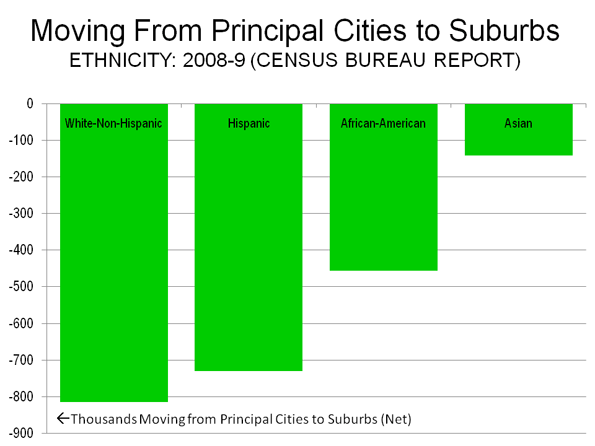
    The Census Bureau analysis indicates that, almost regardless of the category, many more people are moving from “principal cities” to what it refers to as “suburbs.”

    • Every ethnic group is moving to the suburbs in greater numbers than to principal cities. Three times as many Hispanics are moving from principal cities to the suburbs as from the suburbs to principal cities. The same is true for twice as many African-Americans and Asians. Whites are moving to the suburbs at 1.5 times the rate of their moving to principal cities (Figure 1).
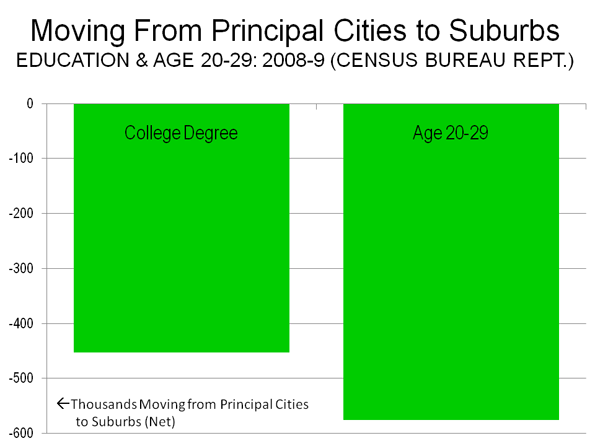
    • Every age group but one is moving to the suburbs at substantially above the rate of movement to the principal cities. There is strong movement among people aged from 20 to 25 to the suburbs rather than the principal cities (Figure 2). The one exception was that among people over 85 years of age, not exactly the epitome of the “bright flight” cited by Brookings and the media.
    • The overwhelming migration from principal cities to the suburbs, rather than from suburbs to principal cities was characteristic across all income categories.
    • There is, in reality, little “bright flight” to report. Among people with college and graduate degrees, nearly twice as many moved from principal cities to suburbs as moved from suburbs to principal cities (Figure 2). While the Census report does not provide mobility information on educational attainment by age, there was strong movement of young adults to the suburbs (noted above).


    The trends in the Census report are consistent with the domestic migration trends that we have previously reported.

    What is a Suburb? There are significant problems with definition of the term “suburb in each of the reports.

    The Office of Management and Budget (OMB), which establishes metropolitan area criteria switched to the “principal city” terminology for the 2000 census, partly to make it clear that principal cities were not inner cities or central cities. The criteria designates as principal cities, the largest in each metropolitan area, any city over 250,000 and any city with more than 50,000 population in which total employment exceeds the workforce.

    Among the 52 major metropolitan areas (those with more than 1,000,000 population), OMB designates 230 principal cities. The Census Bureau report calls everything outside a principal city a suburb. In fact, most of the principal cities are themselves suburbs, developed since World War II as urban areas and expanded outward from their cores.

    For example, principal city Schaumburg, Illinois is located well outside the core city of Chicago and contains a large suburban employment center (“edge city”). Bellevue, the large suburban employment center in the Seattle area is a principal city and not called a suburb by the Census Bureau. Cerritos, California is one of the 25 principal cities of the Los Angeles metropolitan area. Cerritos used to be called Dairy Valley, since it consisted largely of dairy farms until the middle 1950s.

    The Brookings report, in recognition of this problem, calls its non-suburbs primary cities and limits them to no more than three for any metropolitan area. Still, many suburbs are designated as primary cities and not counted in the suburban data, such as Mesa, Arizona (Phoenix), Arlington, Texas (Dallas-Fort Worth), and Cary, North Carolina (Raleigh).

    Suburban versus core analysis needs to be considerably more precise to be meaningful. It would be best to define the characteristics of the core and analyze metropolitan areas at the census tract level, rather than at the city level. However, the data at the city level is far more accessible and is thus predominantly used.

    What is a Core City? Even so, it is important to recognize that there are substantial differences among core cities (which are, broadly speaking, the only parts of urban areas that are not suburbs). Core cities may be divided into three broad categories:

    Pre-World War II Core Cities: These are core cities that have essentially the same boundaries as in 1950. There are 21 Pre-World War II Core Cities in the major metropolitan areas (See Table 2 below). These were largely built before the automobile became dominant, and once were predominately walking and transit cities. New York, Chicago, Boston, Philadelphia and San Francisco are probably the best examples.

    Pre-World War II Core Cities with Suburbs: Many pre-World War II core cities either included wide swaths of vacant developable land in 1950 or annexed substantial amounts of vacant or suburban land after 1950. These cities have cores that are similar to the Pre-World War II Core Cities, but also include suburbs that are little different than the inner suburbs outside the city. For example, in 1950, Los Angeles contained substantial amounts of non-urban land in the San Fernando Valley, which was eventually covered with suburban development. Other cities, such as Milwaukee, Portland, Seattle, Austin and Houston annexed considerable suburban land after 1950. These annexations did not always result in increased population. For example, Salt Lake City doubled its land area between 1950 and 2000, yet retained essentially the same population. Milwaukee nearly doubled its land area, yet lost 40,000 residents.

    Suburban Core Cities: A number of core cities developed predominantly after World War II and as a result, have little, if any pre-World War II core. The largest of these is Phoenix, which recently passed Philadelphia to become the nation’s 6th largest city. San Jose, Charlotte, Orlando and Las Vegas are also examples of Suburban Core Cities.

    Another Perspective: The following analysis (expanded version available here) is offered to indicate general trends in suburbs when non-suburban areas are defined to exclude demonstrably suburban areas. (This may sound circular, but both Brookings and the Census Bureau define some suburban areas as non-suburban.)

    Table 1
    Population Trends: Metropolitan Areas Over 1,000,000: 2000-2008 by Geography
    2000
    2008
    Change
    %
    Metropolitan Areas   152,382,483      166,564,617     14,182,134 9.3%
      Core Cities     43,818,674        45,922,606        2,103,932 4.8%
         Pre-WW2 Core Cities      20,172,850       20,219,342            46,492 0.2%
         Pre-WW2 Core Cities with Suburbs     18,472,298       19,723,295       1,250,997 6.8%
         Suburban Core Cities (Post WW2)        5,173,526          5,979,969          806,443 15.6%
      Suburbs   108,563,809      120,642,011     12,078,202 11.1%
        Suburbs Classified by OMB as Principal Cities    17,968,287       19,334,689       1,366,402 7.6%
        Suburbs Not Classified as Principal Cities    90,595,522     101,307,322    10,711,800 11.8%
    Calculated from US Bureau of the Census Data
    For classification of core cities, see Table 3
    2008 Population of "Suburbs Classified as Principal Cities" is slightly understated because there are no late official estimates for 7 "census designated places." (which are not cities): 2000 estimates used.

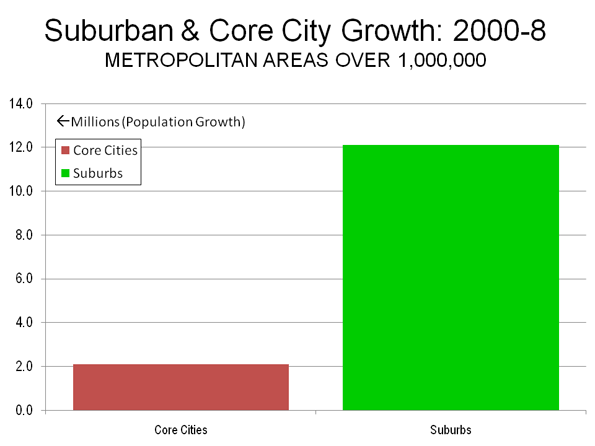
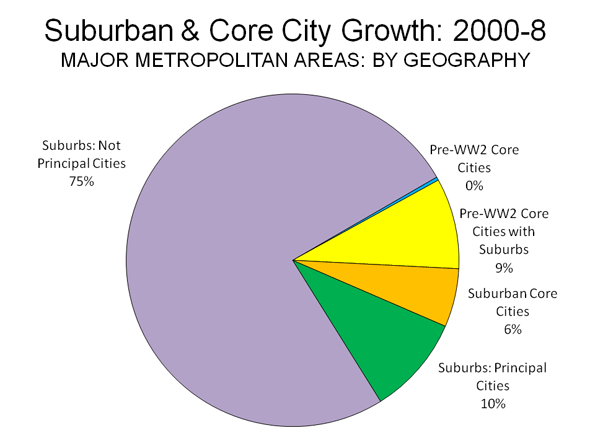
    Generally, suburbs continue to grow much faster than the core cities (Table 1 and Figure 3). Between 2000 and 2008:

    • Suburbs added 12.1 million residents, growing 11.1%.
    • Core cities added 2.1 million residents, growing 4.8%. The greatest growth was in the Post War (Suburban) Core Cities, at 15.6%. The Pre-War Core Cities with Suburbs grew 6.8% and the Pre-War Cities grew 0.2% (Figure 4).


    Virtually all of the core city growth was in the more suburban core cities, which is another indication that suburbanization is continuing. Further, the principal cities that are really suburban grew at a rate of 7.6%, more than double that of the core cities. This would seem to indicate that the migration data from the Census Bureau indicating a continued migration to the suburbs is, if anything, materially understated (by classification of some suburbs as principal cities).

    At the same time, the demographic trends and prospects in the nation’s core cities are better than in the past. The rampant lawlessness that drove so many out of the cities in the 1970s has been replaced by law enforcement strategies developed under former New York mayor Rudi Giuliani. Core cities would become more attractive to future residents with serious reform of school performance and business regulation. Until that occurs, however, it seems unlikely that the movement from the cities to the suburbs will be reversed.

    The city-centric media, with its faith-based demographics, continue to announce the demise of the suburbs. However, until migration data shows a net movement from the suburbs to the core cities, it will remain little more than disingenuous hype. At this point, it is not even close. From 2000 to 2008, suburban counties in major metropolitan areas gained 2,000,000 domestic migrants, while the core counties lost 4,600,000 domestic migrants (Note).


    Note: Domestic migration data is reported at the county level and is thus not available for core cities, except where they are coterminous with counties (Such as New York, San Francisco, Baltimore and Washington).

    Table 2
    Metropolitan Areas and Core Cities
    Metropolitan Area Core City (ies) Type of Core City
    Atlanta-Sandy Springs-Marietta, GA  Atlanta Pre-WW2 Core City with Suburbs
    Austin-Round Rock, TX  Austin Pre-WW2 Core City with Suburbs
    Baltimore-Towson, MD  Baltimore Pre-WW2 Core City
    Birmingham-Hoover, AL  Birmingham Pre-WW2 Core City with Suburbs
    Boston-Cambridge-Quincy, MA-NH  Boston Pre-WW2 Core City
    Buffalo-Niagara Falls, NY  Buffalo Pre-WW2 Core City
    Charlotte-Gastonia-Concord, NC-SC  Charlotte Pre-WW2 Core City with Suburbs
    Chicago-Naperville-Joliet, IL-IN-WI  Chicago Pre-WW2 Core City
    Cincinnati-Middletown, OH-KY-IN  Cincinnati Pre-WW2 Core City
    Cleveland-Elyria-Mentor, OH  Cleveland Pre-WW2 Core City
    Columbus, OH  Columbus Pre-WW2 Core City with Suburbs
    Dallas-Fort Worth-Arlington, TX  Dallas Pre-WW2 Core City with Suburbs
    Denver-Aurora-Broomfield, CO  Denver Pre-WW2 Core City with Suburbs
    Detroit-Warren-Livonia, MI  Detroit Pre-WW2 Core City
    Hartford-West Hartford-East Hartford, CT  Hartford Pre-WW2 Core City
    Houston-Sugar Land-Baytown, TX  Houston Pre-WW2 Core City with Suburbs
    Indianapolis-Carmel, IN  Indianapolis Pre-WW2 Core City with Suburbs
    Jacksonville, FL  Jacksonville Pre-WW2 Core City with Suburbs
    Kansas City, MO-KS  Kansas City Pre-WW2 Core City with Suburbs
    Las Vegas-Paradise, NV  Las Vegas Suburban Core City (Post -WW2)
    Los Angeles-Long Beach-Santa Ana, CA  Los Angeles Pre-WW2 Core City with Suburbs
    Louisville/Jefferson County, KY-IN  Louisville Pre-WW2 Core City with Suburbs
    Memphis, TN-MS-AR  Memphis Pre-WW2 Core City with Suburbs
    Miami-Fort Lauderdale-Pompano Beach, FL  Miami Pre-WW2 Core City
    Milwaukee-Waukesha-West Allis, WI  Milwaukee Pre-WW2 Core City with Suburbs
    Minneapolis-St. Paul-Bloomington, MN-WI  Minneapolis Pre-WW2 Core City
    Minneapolis-St. Paul-Bloomington, MN-WI  St. Paul Pre-WW2 Core City
    Nashville-Davidson–Murfreesboro–Franklin, TN  Nashville Pre-WW2 Core City with Suburbs
    New Orleans-Metairie-Kenner, LA  New Orleans Pre-WW2 Core City
    New York-Northern New Jersey-Long Island, NY-NJ-PA  New York Pre-WW2 Core City
    Oklahoma City, OK  Oklahoma City Pre-WW2 Core City with Suburbs
    Orlando-Kissimmee, FL  Orlando Suburban Core City (Post -WW2)
    Philadelphia-Camden-Wilmington, PA-NJ-DE-MD Philadelphia Pre-WW2 Core City
    Phoenix-Mesa-Scottsdale, AZ  Phoenix Suburban Core City (Post -WW2)
    Pittsburgh, PA  Pittsburgh Pre-WW2 Core City
    Portland-Vancouver-Beaverton, OR-WA  Portland Pre-WW2 Core City with Suburbs
    Providence-New Bedford-Fall River, RI-MA  Providence Pre-WW2 Core City
    Raleigh-Cary, NC  Raleigh Suburban Core City (Post -WW2)
    Richmond, VA  Richmond Pre-WW2 Core City with Suburbs
    Riverside-San Bernardino-Ontario, CA  Riverside Suburban Core City (Post -WW2)
    Rochester, NY  Rochester Pre-WW2 Core City
    Sacramento–Arden-Arcade–Roseville, CA  Sacramento Pre-WW2 Core City with Suburbs
    Salt Lake City, UT  Salt Lake City Pre-WW2 Core City with Suburbs
    San Antonio, TX  San Antonio Pre-WW2 Core City with Suburbs
    San Diego-Carlsbad-San Marcos, CA  San Diego Pre-WW2 Core City with Suburbs
    San Francisco-Oakland-Fremont, CA  San Francisco Pre-WW2 Core City
    San Francisco-Oakland-Fremont, CA  Oakland Pre-WW2 Core City
    San Jose-Sunnyvale-Santa Clara, CA  San Jose Suburban Core City (Post -WW2)
    Seattle-Tacoma-Bellevue, WA  Seattle Pre-WW2 Core City with Suburbs
    St. Louis, MO-IL  St. Louis Pre-WW2 Core City
    Tampa-St. Petersburg-Clearwater, FL  Tampa Pre-WW2 Core City with Suburbs
    Tucson, AZ  Tucson Suburban Core City (Post -WW2)
    Virginia Beach-Norfolk-Newport News, VA-NC  Norfolk Pre-WW2 Core City with Suburbs
    Washington-Arlington-Alexandria, DC-VA-MD-WV Washington Pre-WW2 Core City
    See: Core City Classification Definitions

    Wendell Cox is a Visiting Professor, Conservatoire National des Arts et Metiers, Paris. He was born in Los Angeles and was appointed to three terms on the Los Angeles County Transportation Commission by Mayor Tom Bradley. He is the author of “War on the Dream: How Anti-Sprawl Policy Threatens the Quality of Life.

    Photograph: Suburban core city: Phoenix

  • Australia: Housing Soars Down Under

    Finally, an important turning point has been reached for Australians in the housing market: on 22 April 2010 the Council of Australian Governments endorsed a new housing supply and affordability agenda.

    The shift in attitude is long overdue. The population of Australia has passed the 22 million mark and is growing at 2.1 per cent per annum. Until now, planning policies based on higher densities have been seen as the solution for this population increase. Such policies are variously euphemistically termed “smart growth”, “urban consolidation” or, more recently, “urban renewal”.

    The deleterious results of high-density policies on both people and the environment are becoming more and more apparent. Australian cities, especially Sydney, are starting to exhibit the downside effects of what might be the most aggressive high-density policies in the world. The general public has not yet comprehended how tight the link is between these restrictive planning policies and the increasing prevalence of community problems.

    The Australian strategy of high-density has had two components. The first has been to artificially strangle the land supply. Residential land release in Sydney has been reduced from a historic average of 10,000 lots per year to less than 2,000, thereby radically reducing the number of dwellings available from greenfield sites.

    The second component of the high-density strategy has required each municipal council to submit a rezoning plan that increases population density to government satisfaction; otherwise, that municipality is adversely impacted. These tactics force high-density onto communities originally designed for low densities.

    Smart-growthers claim a plethora of benefits resulting from high-densities. But any clear-headed examination shows that high-density is detrimental to the public good. Greenhouse gas emissions per person are greater in high-density. The policy overloads infrastructure; choking traffic congestion and longer travel times result. Sewers overflow, electricity supply reaches a breaking point, and there are chronic water shortages. Concrete, tiles and bitumen replace trees, gardens and public open space. Sustainability is adversely affected.

    And, of course, high-density policies create land shortages that result in unaffordable housing. This is the darkest side to the impetus for Smart Growth. The resulting increase in the overall cost of housing is sobering. Even the global financial crisis had very little effect on house prices in Australia. Prices continue to rise, and the Australian Federal Government has become concerned about the impact of increasing housing costs on the economy. The Governor of the Australian Reserve Bank has said that the price of a marginal block of land is too high for a time when interest rates are low and credit is available , and similar sentiments have been expressed by other officials.

    Time series data for Australian cities shows a strong correlation between inadequate land release and excessive housing cost. The land component of the price of a dwelling in Sydney has increased from 30% to 70%. It is apparent that strangling the release of land on the outskirts in order to force high-density has resulted in a shortage and, in the face of ever-increasing demand, the price of land has risen dramatically.

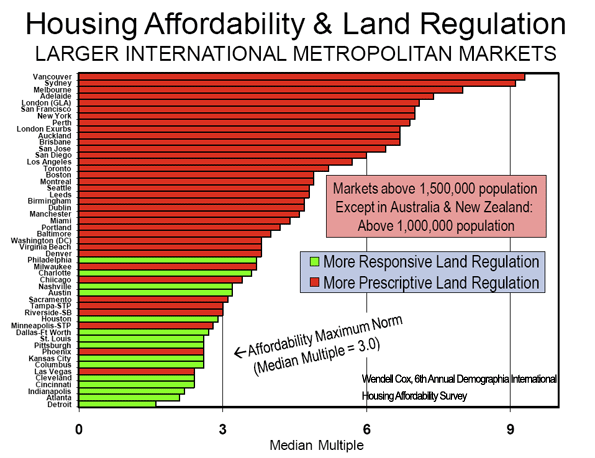
    The 6th Annual Demographia Housing Affordability Survey of six countries portrays a widespread relationship between high housing cost and overly restrictive planning. In the chart below, housing cost is measured as years of family income needed to purchase a house. This year the picture is somewhat complicated by the collapse of the housing bubble in some prescriptive jurisdictions resulting in a substantial reduction of previous high prices.


    Median house price divided by gross annual median household income.

    Only about seven per cent of Australians wish to live in apartments. In spite of this, smart growth policies have resulted in apartments being the only type of housing available to most new entrants to the housing market. These apartments command higher prices than otherwise would be the case, due to an inadequate supply of competing single-residential housing resulting from the scarcity of available sites. This provides the potential for apartment developers to make large profits. Such profits provide the resources for developers to make large donations to the political parties.

    Over the previous five years, the ruling New South Wales Labor Party received donations from the development industry of $9 million, while the Liberal opposition party netted $5 million. These donations exceeded the total contributions to all political parties over the same period from the gambling, tobacco, alcohol, hotel, pharmaceutical and armaments industries combined.

    Numerous documented cases show a large donation being made shortly before permission is granted for a particular development. In response to long-term escalating public anger, the New South Wales Government in December 2009 passed legislation to prohibit donations from property developers. However, the public cynically consider this will not solve the problem and that “donations” will be given in other ways.

    In the face of criticism, state governments maintain that recent land releases have been sufficient. The New South Wales Minister of Housing has stated that land for 131,000 homes has been released in Sydney. Yet the shortage continues to get worse. One reason is the tortoise-like progression of the rezoning process.

    Another is market manipulation. As the Demographia survey points out, governments flag well in advance which greenfield areas will be zoned for developments. Sellers then realise they are cushioned from competition and can command higher prices for their land. Purchasers – developers — know they can pay substantial premiums compared to what would be the case if land release were not so predictable.

    It appears that developers (both government and private) then carefully control the rate at which these greenfield sites are made available to home buyers. It has been reported that the Melbourne government development agency is sitting on a stockpile of 25,000 house blocks that have been zoned for residential approval, but is selling just 700 per year. Private developers and landholders currently hold almost 70,000 house blocks, yet only 1400 of these are available to the market . In the current situation of high demand, it is evident that housing land is being drip fed onto the market, thus keeping prices high.

    The Council of Australian Governments seems to have taken cognisance of this situation, as the review will examine large parcels of land “to assess the scope for increasing competition and bringing land quickly to the market”.

    The Council’s review indicates a welcome change in thinking. Up to now it has not been generally recognised that planning policies are a significant factor in excessive housing cost. Other adverse effects of these policies still need to be acknowledged. One hopes that this review will represent the beginning of a broader appreciation of the downside of high-density policies.

    Photo: A strip of ‘Sydney Lace’in Balmain, Sydney, New South Wales

    (Dr) Tony Recsei has a background in chemistry and is an environmental consultant. Since retiring he has taken an interest in community affairs and is president of the Save Our Suburbs community group which opposes over-development forced onto communities by the New South Wales State Government.

  • When Saving 90% is Not Enough: The Transit Savings Report

    The American Public Transportation Association (APTA) is publishing monthly Transit Savings Report to illustrate the purportedly great savings that can be achieved by giving up the car and traveling by transit instead. APTA compares the average cost of buying a monthly transit pass to replace a car, which is assumed to travel 15,000 miles annually.

    The latest edition was made public on April 6 and reveals astounding savings, as was reported by The Wall Street Journal and other press-release echoing press outlets. The APTA release indicates that households could save from $8,174 to $13,784 annually by giving up a car for transit in the 20 urban areas with the highest transit ridership. Overall, the APTA figures calculate to an average savings of $10,183. The APTA press release does not say how much the monthly bus pass would cost. However, our own quick survey of 17 major transit systems indicates that a monthly pass averages approximately $90 per month, or $1,080 per year. This means that getting rid of the car and riding transit instead saves approximately 90%, ($10,183 divided by [$1,080 + $10,183]) at least according to APTA (Note).

    With savings such as these, a visitor from Mars to APTA’s Fantasyland might expect that nearly all urban travel should logically be by transit rather than by cars. But, alas, no. Nothing could be further from the truth. In fact, cars, which APTA tells us cost nearly 10 times transit, account for more than 98% of motorized travel in US urban areas.

    Profligate Americans? What could possibly explain this paradox? Surely, there is plenty of evidence that Americans would much rather spend less than more on products of equal value. This has been painfully evident to “legacy” airlines that have had to lower their prices to compete with discount carriers like Southwest Airlines. Traditional supermarkets have lost hoards of customers stores like Wal-Mart or Costco over amounts that pale by comparison to the savings that APTA would have us believe are so readily available by rejecting our “love affair” with the automobile.

    Of course, the choice is not that simple. Americans no more have a love affair with the automobile than with flush toilets or refrigerators. The American (and Canadian, Australian, European and Asian) love affair is not with products, but rather with the better life style that the products make possible. People have refrigerators because they keep food fresh and prevent spoiling. Under certain circumstances, however, refrigerators are not practical, such as when one uses a cooler instead at a picnic. Transit is like that. It makes sense for some trips, but not a large share in the overall scheme of things.

    The Largest Downtowns: Where Transit Works Best: For the overwhelming majority of trips, the automobile provides much faster and generally more comfortable travel than can be made available by transit. There are times, however, when transit is superior. For example, the car is particularly impractical for commuting into crowded Manhattan, which is served by an enormous subway, commuter rail and bus system that extends to the further reaches of the metropolitan area.

    This is evident in data from the latest US Bureau of the Census American Community Survey, which indicates that transit accounts for 80% of the motorized commuter travel to Manhattan. Manhattan’s business district has nearly 2,000,000 jobs in a relatively small area, and riding transit and the average transit commute is only slightly longer than the average car commute. With Manhattan’s world class traffic, transit is a demonstrably superior competitor to the car.

    This, in reality, simply demonstrates that transit is “about downtown.” Consumer preferences demonstrate that commuting to some of the nation’s largest downtown areas is better by transit. The impressive skyscrapers can leave the impression that downtowns are dominant in metropolitan employment. However, downtowns represent only 10% of metropolitan employment. The largest downtowns are well situated for transit service, by virtue of their high employment densities and the fact that transit systems focus on them.

    These include central business districts, including New York’s Manhattan and Brooklyn, Chicago, Boston, Philadelphia and San Francisco. All of these downtown areas where transit is dominant were added together, they would cover barely one-third of the expanse Orlando’s Walt Disney World. But consumer preferences also show that the car provides superior mobility to virtually all other destinations. Our already heavily indebted public sector could not begin to provide a level of service to replicate transit’s downtown access throughout the urban area.

    Transit even has difficulty competing in the dense outer boroughs of New York City. While slightly more people commute to Brooklyn jobs by transit than by car, the reverse is true in the Bronx. Twice as many people commute to jobs in Queens by car than transit, despite the borough’s having a population density greater than that of San Francisco, the nation’s second most dense large municipality.

    Transit’s share falls off even more sharply in the suburbs of New York. Nine times as many people commuting to jobs in inner suburban Nassau County use cars as use transit. Commuters to outer suburban Suffolk County use cars 40 times as much as transit.

    Consumers make these choices not because cars are inherently superior to transit or vice versa. A commuter who lives in New Brunswick, New Jersey and works in Manhattan, usually takes a New Jersey Transit train or bus to work, because the car competes poorly for such a trip. The neighbor, however, who works in the suburban I-287 corridor takes the car, because transit cannot compete for that trip.

    It remains true that for the overwhelming majority of trips cars meet the needs of consumers far better than transit. Cars are faster and deliver people within walking distance of their destinations.

    Even the ultimate — making transit free — makes little difference. In 1990, Austin, Texas eliminated fares. Yet the share of travel in the Austin area by car declined about a quarter of one percent. For most urban travel, transit is so uncompetitive that you can’t even give it away.


    Note: None of the above should be interpreted to be an acceptance of the APTA figures. APTA assumes annual parking costs of $1,850, yet most parking outside downtowns. Some might object that there is a cost to this free parking, but to ignore its costs is quite appropriate, given that APTA’s figures do not include subsidies to transit, which would quadruple its cost. Further, APTA uses especially high costs for automobile use, which assume that everyone purchases a new car every five years. This substantially overstates the cost of cars relative to transit.

    Wendell Cox is a Visiting Professor, Conservatoire National des Arts et Metiers, Paris. He was born in Los Angeles and was appointed to three terms on the Los Angeles County Transportation Commission by Mayor Tom Bradley. He is the author of “War on the Dream: How Anti-Sprawl Policy Threatens the Quality of Life.

    Photo: New Jersey Turnpike

  • The New E.D. — Environmental Density

    Developers often have an E.D. problem and are not even aware of it. No, not the type of E.D. temporarily cured with Viagra. Environmental Density — E.D. — is the measurement of the impact of man made construction on a site. In simple terms, E.D. is the average per acre volume of impervious surface due to land development construction. It has two very important impacts, one environmental, and one financial. One acre of land is 43,560 square feet. The lower the E.D. — square foot of impervious surface area divided by 43,560 — the lower the surface area of manmade structures that divert rain run-off, and the less environmental damage.

    Some municipalities have impervious surface limitations in their regulations. These limitations can be counter to human benefits. For example, a developer faced with the limits of allowed impervious surface area would rather not propose a walking system; the regulations could mean a choice between walkways and homes. E.D., on the other hand, is not an imposed limit, but a way to measure the efficiency of the neighborhood design.

    Don’t bother searching the internet for opposing articles on E.D., because we invented the term’s use in relationship to modern land development right here at www.newgeography.com.

    From a financial perspective, the lower the volume of manmade stuff, the lower the development cost. The savings translate into more money that can be spent on higher quality development and/or a drop in the cost of housing and commercial construction. In other words higher quality development at more affordable prices. This affects everyone, worldwide.

    It doesn’t matter if the site is a New Urban “Smart Growth” design, a subdivision in “Garage Grove Acres”, or a Prefurbia neighborhood. E.D. is the number that can easily indicate the direct environmental impact of land development. The E.D. is essentially the Efficiency of Development.

    Assuming that New Geography readers are not all engineers, I’ll use some simple examples of E.D.:

    If the design is wasteful (eliminating waste in design is NOT a subject taught in land planning schools – but it should be), then costs and environmental impacts increase. Nobody but the paving and earthwork contractors being paid to build excessive infrastructure gain from wasteful development. The developer’s profit decreases and the city’s maintenance cost escalates from having to maintain excessive infrastructure… forever. We all pay for this!

    In an urban high density development which has a very large ratio of hard surface area to organic ground (sometimes the E.D. reaches 100%), there are often opportunities to lower the inorganic percentage. Green roofs (landscaped rooftops) have an impact on E.D. because, in theory, the rainfall is held in soils that water landscaping. However, this assumes existing building structures can handle the additional weight and can be modified to properly maintain an organic area. Organic space on ground level benefits 100% of the population, as opposed to a green roof many stories above the pedestrian ways. So for the purposes of this article we will define all rooftops (urban or suburban) as negative impact square footage. Walks, streets, and driveways are all hard surface areas that divert rain. Organic areas absorb rain. Run-off from hard surface area negatively affects the environment.

    Velocity is another problem. Run-off travels on hard surfaces at a much higher rate than it does on landscaped ground. The worst rates are found where there are long runs of straight street with rain traveling along gutters; curved design slows it a bit . Velocity builds momentum as more rain collects in gutters, inlets and sewer pipes. Eventually this wall of water reaches the end of developed land and spills into a natural system, carrying pollutants into major bodies of water. That oil slick on your driveway can be carried to environmentally sensitive areas hundreds or thousands of miles away in a heavy downpour.

    Lower the E.D. ratio and some magnificent things happen.

    A gain in organic space can reduce the disruption of the earth — the moving of dirt — which can significantly lower development costs, as well as provide surface run-off conduits which cost much less than sewer pipe. The designer must learn how to identify waste, and then take the steps to reduce it. This adds an additional element in the initial planning stages, but an extra day or two in design could reduce development costs by hundreds of thousands of dollars.
    Rooftop surface can be reduced by building up, not out. The trend to build single level housing for the empty-nester market results in sprawling homes with terrible E.D. ratios, and it adds to the costs of the structures; roofs and foundations certainly are not cheap. Sprawling homes require longer streets to be reached, another increase in costs and environmental damage. A residential elevator is about $14,000 (installed) for a two story home, and $22,000 for three floors . By using them, builders can construct compact structures and plummet the E.D. ratio.

    Paved areas can be reduced by changing regulations to allow vast, commercial parking areas, shared. by users that have different peak times. Some cities use progressive thinking, and allow this simple technique to lower the E.D. ratio of a region. Paved areas built to municipal standards are incredibly expensive, making the E.D. ratio even more critical.

    When we developed Performance Planning Systems we wanted to create the tools to easily determine E.D. while still in the initial design phases, as well as to provide the education to recognize waste and teach how it can be reduced. E.D. relies on this new technology; tracing accurate space for the calculations would have been too tedious and time consuming in the past. Environmental Density, unlike impervious surface limits, does not impede efforts to create great neighborhoods. It’s not a restriction on what can be built, but a measure of a design’s efficiency that can benefit builders, developers, and environmentalists.

    Rick Harrison is President of Rick Harrison Site Design Studio and Neighborhood Innovations, LLC. He is author of Prefurbia: Reinventing The Suburbs From Disdainable To Sustainable and creator of Performance Planning System. His websites are rhsdplanning.com and performanceplanningsystem.com.

  • Growing America: Demographics and Destiny

    Over the next four decades, American governments will oversee a much larger and far more diverse population. As we gain upward of 100 million people, America will inevitably become a more complex, crowded and competitive place, but it will continue to remain highly dependent on its people’s innovative and entrepreneurial spirit.

    In 2050, the U.S. will look very different from the country in 2000, at the dawn of the new millennium. By mid-century, the U.S. will no longer be a “white country,” but rather a staggering amalgam of racial, ethnic and religious groups, all participants in the construction of a new civilization whose roots lie not in any one country or continent, but across the entirety of human cultures and racial types. No other advanced, populous country will enjoy such ethnic diversity.

    The implications of this change will be profound for governments-perhaps in ways not now commonly anticipated. Many “progressives” believe a more diverse, populous nation will need more guidance from Washington, D.C., but a more complex and varied country will increasingly not fit well into a one-size-fits-all approach.

    Although the economic crisis of 2008 led to a rapid rise of federal power, there has been a stunning and largely unexpected push-back reflected, in part, by the tea party movement. Some states have passed laws that seek to restrict federal prerogatives on a host of issues. More importantly, public opinion, measured in numerous surveys, seems to be drifting away from major expansions of government power.

    Of course, most Americans would accede to the federal government an important role in developing public works, national defense and regulations for health and safety. But generally speaking, they also tend to believe that local communities, neighborhoods and parents should possess the power to craft appropriate solutions on many other problems.

    This also reflects our historical experience. From its origins, American democracy has been largely self-created and fostered a dispersion of power; in many European countries, and more recently in parts of Asia, democracy was forged by central authorities.

    Other periods of massive government intervention, most notably after the New Deal and the Great Society, also elicited reactions against centralization. But the current push-back’s speed and ferocity has been remarkable. Yet the often polarizing debate about the scope of federal power largely has ignored the longer-term trends that will promote the efficacy of an increasingly decentralized approach to governance.

    Perhaps the most important factor here is the trajectory of greater growth and increasing diversity of who we are and how we live. Not only are Americans becoming more racially diverse, but they inhabit a host of different environments, ranging from dense cities to urbanized suburbs, to smaller cities and towns, that have different needs and aspirations.

    Americans also are more settled than any time in our history-partially a function of an aging population-and thus more concerned with local developments. As recently as the 1970s, one in five Americans moved annually; in 2004 that number was 14 percent, the lowest rate since 1950. In 2008, barely one in 10 moved, a fraction of the rate in the 1960s. Workers are increasingly unwilling to move even for a promotion due to family and other concerns. The recession accelerated this process, but the pattern appears likely to persist even in good times.

    Americans also prefer to live in decentralized environments. There are more than 65,000 general-purpose governments; the average local jurisdiction population in the United States is 6,200-small enough that nonprofessional politicians can have a serious impact on local issues. This contrasts with the vast preference among academic planners, policy gurus and the national media for larger government units as the best way to regulate and plan for the future.

    Short of a draconian expansion of federal power, this dispersion is likely to continue. Roughly 80 to 90 percent of all metropolitan growth in the last decade took place on the periphery; at the same time, the patterns of domestic migration have seen a shift away from the biggest cities and toward smaller ones. As Joel Garreau noted in his classic Edge City, “planners drool” over high-density development, but most residents in suburbia “hate a lot of this stuff.” They might enjoy a town center, a paseo or a walking district, but they usually resent the proliferation of high-rises or condo complexes. If they wanted to live in buildings like them, they would have stayed in the city.

    Attempts to force major densification in these areas will be fiercely resisted, even in the most liberal communities. Some of the strongest anti-growth hotbeds in the nation are areas like Fairfax County, Va., with high concentrations of progressives-well educated people who might seem amenable to environmentally correct “smart growth”-advocating denser development along transit corridors. As one planning director in a well-to-do suburban Maryland county put it, “Smart growth is something people want. They just don’t want it in their own neighborhood.”

    The great long-term spur to successful dispersion will come from technology, as James Martin first saw in his pioneering 1978 book, The Wired Society. A former software designer for IBM, Martin foresaw the emergence of mass telecommunications that would allow a massive reduction in commuting, greater deconcentration of workplaces and a “localization of physical activities … centered in local communities.”

    Technology would allow skilled people to congregate in communities of their choice or at home. Today not only knowledge workers but also those in construction trades, agriculture and other professions are home-based, conducting their operations out of trucks, vans or home offices.

    Many leading-edge companies now recognize this trend. As much as 40 percent of IBM’s work force operates full time at home or remotely at clients’ businesses. Siemens, Hewlett-Packard, Cisco, Merrill Lynch and American Express have expanded their use of telecommuting, with noted increases in productivity.

    At the same time, employment is shifting away from mega-corporations to smaller units and individuals; between 1980 and 2000, self-employed individuals expanded tenfold to include 16 percent of the work force. The smallest businesses, the microenterprises, have enjoyed the fastest rate of growth, far more than any other business category. By 2006 there were some 20 million such businesses, one for every six private-sector workers.

    Hard economic times could slow this trend, but recessions have historically served as incubators of innovation and entrepreneurship. Many individuals starting new firms will have recently left or been laid off by bigger companies, particularly during a severe economic downturn. Whether they form a new bank, energy company or design firm, they will do it more efficiently-with less overhead, more efficient Internet use and less emphasis on pretentious office settings. In addition, they will do it primarily in places that can scale themselves to economic realities.

    Simultaneously the Internet’s rise allows every business-indeed every family-unprecedented access to information, something that militates against centralized power. Given Internet access, many lay people aren’t easily intimidated into accepting the ability of “experts” to dictate solutions based on exclusive knowledge since the hoi polloi now possess the ability to gather and analyze information. Even the powerful media companies are rapidly losing their ability to define agendas; there are too many sources of information to mobilize mass opinion. The widespread breakdown of support for climate change is a recent example of this phenomenon.

    Once the current drive for centralization falters, support for decentralization will grow, including progressive communities that now favor a heavy-handed expansion of federal power. Attempts to impose solutions from a central point will be increasingly regarded as obtrusive and oppressive to them, just as they would to many more conservative places like South Dakota. In the coming era, in many cases, only locally based solutions-agreed to at the community, municipal or state level-can possibly gather strong support.

    This drive toward dispersing power will prove critical if we hope to meet the needs of an unprecedentedly diverse and complex nation of 400 million. New forms of association-from local electronic newsletters to a proliferation of local farmers markets, festivals and a host of ad hoc social service groups-are already growing. Indeed, after a generation-long decline, volunteerism has spiked among Millennials and seems likely to surge among downshifting baby boomers. In 2008, some 61 million Americans volunteered, representing more than one-quarter of the population older than 16.

    It’s these more intimate units-the family, the neighborhood association, the church or local farmers market-that constitute what Thomas Jefferson called our “little republics,” which are most critical to helping mid-21st-century America. Here, our nation of 400 million souls will find its fundamental sustenance and its best hope for the brightest future.

    This article originally appeared in GOVERNING Magazine.

    Joel Kotkin is executive editor of NewGeography.com and is a distinguished presidential fellow in urban futures at Chapman University. He is author of The City: A Global History. His newest book is The Next Hundred Million: America in 2050, released in Febuary, 2010.

    Photo by slynkycat

  • Can David Cameron Close the Deal?

    With the Labour Government exhausted and its supporters dismayed, why isn’t the Conservative Party leader David Cameron sailing home to victory?

    Under the leadership of Prime Minister Gordon Brown, all the weaknesses of the Labour Party have been painfully exposed. British Prime Ministers are elected by the House of Commons, and the Members of that Parliament by the people; so when Brown’s predecessor Tony Blair resigned, his replacement as Labour Party leader became Prime Minister without a general election. In the country, Brown had been a popular figure – if only because he seemed to be the more trustworthy next to the mercurial Blair. But once he took office, Brown’s weaknesses were on view.

    Just as much as Blair, Brown was the architect of the ‘New Labour’ project that shed the party’s welfare state socialist image for a ‘Third Way’. Modelled on Bill Clinton’s revamp of the Democratic Party, the programme demanded that Labour stop using government to provide for its urban poor and trade union constituencies – supporters who would frighten away more aspiring middle class voters.

    But clearing the old-school socialists out of Labour’s policy-making bodies left an ideological vacuum that was filled by environmentalists, the culturati and NGO-enthusiasts for action over the third world. New Labour had freed itself of its traditional socialism only to become beholden to the enthusiasms of the educated political classes. Attention-grabbing ‘humanitarian interventions’ into third world countries were avowedly not in Britain’s national interests, but in pursuit of an ethical foreign policy. Money was directed into subsidising arts centres and other cultural projects.

    Government took on policies that protected the environment, but damaged industry: ‘traffic-calming’ measures – bus and cycle lanes, speed restrictions, congestion charge zones – were put in place with the express purpose of dissuading people from using the roads. Meanwhile road building was put on hold; licenses for new power stations were withheld, so that the country is facing blackouts in six years’ time; bans were put in place on use of GM crops.

    Labour did listen to the City of London’s financial lobby – Goldman Sachs’ Gavyn Davies was a close advisor, as was ‘Shrieky’ Shriti Vadera of UBS Warburg. Labour kept the Conservatives’ banking deregulation but retained Britain’s extraordinary legal controls on land development, so that credit to buy homes was readily available, but very few were built. Anyone sentient could have predicted the result: prices went sky-high putting home ownership beyond the reach of working class people.

    Given his subservience to the City, it was not surprising that when British banks over-extended position led to collapse in late 2008, Brown bailed them pushing public debt into the trillions. Labour’s traditional working class supporters were asking why their party was subsidising million pound bailouts to banks, while their own jobs were disappearing. Most Britons are proud of their armed services, but they had to ask why they were losing their lives in Afghanistan and Iraq. And they wondered how it was that the income gap between rich and poor was getting so much worse under Labour.

    Public disaffection with the political class reached fever pitch when newspapers published details of the Members of Parliament’s own expense claims. MPs were seen to have lied about their addresses to get the taxpayer to pay the mortgage, just as they put their relatives down as researchers and assistants.

    David Cameron ought to have been in the best possible place to take advantage of the government’s difficulties. But Cameron has proven for too much in the same mould as Gordon Brown, and Tony Blair.

    Cameron got to be Tory Party leader after three successive general election defeats. The lesson that the party drew from its experiences in 1997, 2001 and 2005 was that it was the Tory Party’s core brand that was at fault. Cameron was chosen largely by saying that the party should imitate Blair’s ideology-lite, environmentally-conscious, caring, dash for the ‘middle ground’. The Conservatives had to get over their ‘nasty party’ image.

    Cameron dropped a lot of the party’s traditional MPs, and invited people who were not mainstream Tories on board. Cameron’s remodelling of the Conservative Party followed the Brown-Blair model of pushing the core constituency aside to let in new faces. But the new faces that rushed in had the same gentry-liberal preoccupations as those that had taken over the Labour Party in 1997.

    Here’s an example of the new Conservative. As well as running an organic hobby farm, Zac Goldsmith is Cameron’s dashing prospective Tory Party candidate for Richmond Upon Thames. For the last ten years he has been proprietor and editor of The Ecologist magazine, Britain’s foremost green media voice. Zac inherited £300 million from his father, asset-stripping financier Sir James Goldsmith, using the proceeds to finance his pet causes through his own grant-making bodies, the JMG Foundation and the Isvara Foundation. He gives money to his own small-farmers groups FARM, which is committed to stopping private housing developments, has underwritten the Ecologist’s debts of £864,675. He has financed his own web-site SpinWatch to ‘expose’ corporate lobbying – though as Private Eye pointed out, its attack on the nuclear industry was curiously selective, mentioning no Tories, only Labour-backing investors (26 May 2006).

    Well-heeled voters in Richmond might not be too bothered that Zac has written a book The Constant Economy saying we need an end to growth, because they are already enjoying theirs.

    Another key Cameron supporter is advisor Philip Blond whose manifesto Red Tory bemoans the loss of England’s traditional charm under the twin evils of state socialism and the free market ideologies he blames upon the (conveniently foreign-sounding) Milton Friedman. Blond’s traditionalist fantasy of Merrie England is drawn from the backward-looking dreams of G.K. Chesterton and Hilaire Belloc, who railed against modernity back in the early twentieth century.

    Blond’s call for people to rely less on the state is well-made, but his anti-capitalism must have alarmed the party’s core supporters: ‘economic liberalism has often been a cover for monopoly capitalism and is therefore just as socially damaging as left-wing statism.’ Blond’s solution, though, is some state-enforced localism, with legal controls to redirect investment into municipal authorities – what he calls a ‘distributist state’. If this is David Cameron’s big idea, redistributing wealth through local government, it is not surprising that he has not made a great deal of headway in the polls given that everyone understands the real issue is the penurious state of the country’s finances.

    Throughout the election, Cameron has led in the opinion polls, but not by enough to guarantee a majority in parliament. When the country held its first ever televised leaders debate, something that the Tory leader had demanded, he was up-staged by Nick Clegg, leader of Britain’s third party, the Liberal Democrats. In truth Clegg’s appeal is not programmatic – he is pretty much more of the same as the other two. But what he did very effectively was to position himself as the outsider, not a part of the old two party system, a kind of younger, more attractive Ross Perot.

    Clegg’s appeal to the politically disaffected ought to have worked for David Cameron. But Cameron’s failing lies in the fact that he simply has replicated the New Labour project, just as the public were falling out of love with it. Environmentalism, stopping urban sprawl, and ‘restoring communities’ are the preoccupations of a narrow strand of British society: the kind of people who occupy the lower rungs of government service. It is not that most Britons want to trash the environment, or concrete over the countryide, nor indeed support community breakdown. It is just that they do not understand why their own self-betterment always has to give way to those concerns.

    Tragically, the only party that has made an issue of Britain’s chronic housing shortage is the far-right British National Party. Neither the Tories, nor Labour, less still the Liberal Democrats, have the courage to face down the NIMBY opponents of new building. The Tories’ own supporters (like the Lib Dems) have made it to the suburbs and do not want to share or expand them. Labour cannot give up its grip on government planning laws. With no-one willing to free up land for development, the BNP’s call to drive immigrants out is the loathsome conclusion of anti-growth sentiment.

    When they look at the Eton-educated front bench team that Cameron is putting up, voters see the kind of people who have made (or inherited) their stash, and now are pulling up a drawbridge behind them. All of the pious talk about looking after the poor sounds like parish charity, not giving people a chance to help themselves.

    David Cameron’s Conservatives are still the favourite to win the General Election, the only puzzle is why are they finding it so hard to close the deal – a puzzle until you look at their policies, that is.

    James Heartfield works for the Audacity.org think tank, and most recently wrote Green Capitalism: Manufacturing Scarcity in an Age of Abundance (Mute, 2009). His website is at www.heartfield.org

    Photo by: conservativeparty