Category: Suburbs

  • The Worst Cities For Jobs

    In this least good year in decades, someone has to sit at the bottom. For the most part, the denizens are made up of “usual suspects” from the long-devastated rust belt region around the Great Lakes. But as in last year’s survey, there’s also a fair-sized contingent of former hot spots that now seem to resemble something closer to black holes.

    Two sectors have particularly suffered worst from the recession, according to a recent study by the New America Foundation: construction, where employment has dropped by nearly 25%, and manufacturing, which has suffered a 15% decline. The decline in construction jobs has hit the Sunbelt states hardest; the manufacturing rollback has pummeled industrial areas such as the Great Lakes as well as large swaths of the more recently industrialized parts of the Southeast.

    Then there is California, a state that should be doing much better given its natural advantages and vast human capital but whose regions–with the exception of government-rich Hanford–share various degrees of distress. The bursting of the real estate bubble has hit the Golden State hard, but seeing so many poor performances in my adopted home state is distressing and points to much deeper problems. Rankings author Michael Shires, pointing to the looming prospect of high taxes and expanding regulation, notes that “While California’s economy has come roaring back many times before, a resurgence this time will be slowed by the state’s increasing willingness to aggressively tax and regulate those who will make it happen.”

    Rust Belt Ruins

    The traditional manufacturing heartland long has suffered, and in this recession industrial jobs have declined rapidly and only now seem to be slowly expanding. Ever since we started these surveys back in the early 2000s, cities and towns along the rust belt have inhabited the bottom rungs.

    Starting up from the last place finisher, No. 397 Warren-Troy, Mich., these old industrial cities dominate the nether regions; of the bottom ten finishers overall, six come from the Wolverine State, including long-suffering Detroit, which ranks 394th overall and 65th on the list of large metros (next to its neighbor, Flint, in last place). Other rust belt bottom-dwellers include No. 395 Elkhart and No. 392 Kokomo in nearby Indiana.

    Perhaps more disturbingly, many of those at the bottom come from what used to be called “the new South,” cities that industrialized late and often benefited from the flow of jobs from the old rust belt. Places such as No. 396 Morristown, Tenn., No. 390 Dalton, Ga., and No. 389 Hickory-Lenoir-Morganton, N.C., have suffered from a recession that has either forced companies to shut down or move overseas.

    Sun Belt Busts

    Ever since the collapse of the housing bubble in 2007, we have seen a remarkable turnaround in many Sunbelt regions. Traditionally, these led the list as emerging boomtowns. Now many appear more like bust-towns.

    Take a look at the rapid decline of such hot spots as Las Vegas, which now ranks 57th out of the 66 largest metros in the country; Phoenix, now lurking at No. 51; and No. 61 West Palm Beach, No. 56 Fort Lauderdale, No. 54 Tampa and No. 45 Miami, all in Florida. Many of these cities stood proudly near the top of the list as recently as three years ago. Perhaps nothing illustrates the reversal of fortunes than the fall of Reno, once our fastest-growing mid-size region, now No. 92 in the same category.

    California: The Great Disaster

    No state has suffered a greater reversal of fortunes than California. Five or six years ago California regions generally inhabited the top half or third of our lists. Today they generally have fallen even faster than the other Sunbelt states, even though the state’s economy boasts many assets beyond merely real estate speculation.

    California now accounts for a remarkable 7 of the bottom 20 regions on our big metro list. The diversity of the disaster spans both the urban centers and the exurbs–witness exurban Riverside-San Bernardino at No. 63 and the city of Oakland at No. 62. Historic high-flyers No. 59 Los Angeles and neighboring Santa Ana-Anaheim Irvine, which checks in at an abysmal No. 60, didn’t fare much better.

    Perhaps more shocking is the poor performance handed in by the state capital, Sacramento, a former high-flyer now mired at No. 54, and San Diego, a high-tech haven with a near-perfect climate, that resides at No. 48. Even No. 47 San Jose/Silicon Valley has done poorly, despite all the consistent hype about the world class tech center. The likes of Steve Jobs of Apple and Eric Schmidt at Google may be minting money, but the region, paced by declines in construction, manufacturing and business services, now has 130,000 fewer jobs than a decade ago. San Francisco does not do much better, clocking in No. 42, just ahead of its equally celebrated alter-ego Portland, Ore.

    Prognosis From the Emergency Room

    If this list tells us the current occupants of intensive care, what then are the prognoses for recovery? It seems the story differs for each of our three basic categories. For the rust belt cities, relief will only come when the country decides to reprioritize industry, while allowing for the restructuring of firms and contracts. On the bright side is the recovery of Ford and the potential for a second life for a greatly reduced General Motors and even Chrysler. A modest surge in production of these firms and related industries, such as steel and electronics, could help some selected regions rise up from the bottom.

    The recovery of the Sunbelt economies seems likely to take hold first. Despite the giddy predictions of East Coast pundits that places like Las Vegas, Phoenix, Orlando and Tampa are doomed to what Leon Trotsky allegedly described as the “dustbin of history,” this is not the first time these areas have suffered a setback. They have still not shown much life yet, but I would not count them out for the long term. There is a lot to be said for a sunny climate, greatly enhanced affordability and what many see as a high quality of life.

    Ultimately, notes Rob Lang, director of Brookings Mountain West and professor of sociology at the University of Nevada-Las Vegas, the assets of these regions have either not changed–pro-business administrations and warm weather–or, in the case of housing affordability, have become more attractive. “Phoenix and Las Vegas will be fine,” Lang predicts, noting that Las Vegas is working to reinvent itself beyond gaming to becoming a “convening capital” for the world economy. Similar dynamics could also boost cities in Florida, particularly if they begin focusing beyond tourism and housing.

    And then there is California, which by all rights should be leading, not lagging, the current recovery. Statewide unemployment, already 12.6%, has been rising while most states have experienced a slight drop. Silicon Valley companies, Hollywood and the basic agricultural base of the state remain world-beaters. But the problem lies largely in an extremely complex regulatory regime that leads companies to shift much of their new production and staffing to other states as well as foreign countries. The constant prospect of a state bankruptcy, in large part due to soaring public employee pension obligations, does not do much to inspire confidence among either local entrepreneurs or investors.

    Hopefully this will be the year when Californians decide that it needs an economy that provides opportunities to people other than software billionaires, movie moguls and their servants. It will have to include much more than the endlessly hyped, highly subsidized “green jobs.” More than anything, it will take rolling back some of the draconian regulations–particularly around climate-change legislation–that force companies, and jobs, to go to places that, while not as intrinsically attractive, are friendlier to job-creating businesses.

    This article originally appeared at Forbes.com.

    Joel Kotkin is executive editor of NewGeography.com and is a distinguished presidential fellow in urban futures at Chapman University. He is author of The City: A Global History. His newest book is The Next Hundred Million: America in 2050, released in Febuary, 2010.

    Photo: JSFauxtaugraphy

  • The New Look of the American Suburb

    If you want an easy demonstration of the unsustainability of the classic American suburb, just take a drive around the inner ring suburbs of almost any city, starting with the ones that have a classic branching, winding streets, not traditional grids or those that grew up along transit lines. It is easy to find untold miles of decay, of “dead malls”, “grayboxes”, and subdivisions that have seen better days. If most of today’s new suburbs think they’ll fare any better, they are going to be in for a rude shock in 30 years or so.

    Some have argued that what we need are “suburban retrofits,” where older areas are redeveloped along new urbanist lines. While this is certainly an attractive option in some places, particularly in town center areas, the sheer quantity of decaying older suburbs means this isn’t a viable option across the board at the moment. Retrofits are hard to pull off and expensive to boot. There simply isn’t enough planner/political bandwidth or TIF dollars to make it happen on a wholesale basis. So we have to find some method to renew most of these areas in place.

    Enter immigrants. In older cities, immigrants were historically crammed into near downtown ghettos like the various “Chinatowns” and the like we see. Today, in cities that have them, those districts might still have a cultural role, but they are no longer the demographic core of their communities. Also, for cities without longstanding histories of immigration, these ghettos never developed. Instead, today immigrants disperse throughout metro areas. You find them everywhere from inner city neighborhoods to the most posh suburbs. One of the places along that spectrum you can find them are these inner ring suburbs.

    I want to share some pictures of immigrant driven revitalization of inner ring suburbs through some facts and photos from Indianapolis. But I think you’d find similar things in many cities across the nation.

    Indianapolis was traditionally one of America’s least diverse cities, featuring only the classic black-white split. But it has seen a large influx of immigrants in the last decade. Its metro foreign born population is only 5.19%, which is small, but the Indianapolis Star reported last year that this represented a 70% population increase since 2000. Unlike some towns which have seen immigration driven almost entirely from Mexico, Indianapolis has seen a very diverse set of immigrants, that come from all over the globe, including 26,000 Asians and 10,500 Africans. The Indian population has doubled to 6,000, the Pakistani and Nigerian populations have tripled to 1,000 each. There are 5,600 Chinese and 1,500 Burmese. These aren’t huge numbers today, but given the network effects of international immigration and the lead time to build a large community (remember the example of the large community from Tala, Mexico, which has its roots in the 1970’s), this represents a potential future tsunami of immigration, provided the economy stays strong, the local climate welcoming, and a bit of pro-active marketing takes place. Again, I’m sure we’d see similar diversity of immigrants in other cities, ranging from Detroit’s Arab community to Bosnians in St. Louis to Somalis in Columbus, Ohio.

    The most diverse area in Indianapolis is Pike Township on the northwest side. Though technically part of the city today, it is originally an inner ring suburban area. Its schools have children from 63 different countries speaking 74 different languages. The Lafayette Square area on the southeast boundary of Pike Township is a classic struggling inner ring commercial zone, complete with a dying mall.

    Yet the presence of all of those immigrants has led to a spontaneous renewal of parts of this struggling area in the form of businesses catering to local ethnic populations.

    One of them is a 62,000 square feet international supermarket called Saraga:


    Saraga is run by Korean brothers Jong Sung and Bong Jae Sung and features hundreds of spices and 40,000 products from around the world, ranging from house made kimchi to a halal meat department. Lest I stir up too much suspicion I didn’t take many photos inside the store, but wanted to share one shot of some of the contents from a Middle Eastern aisle:


    The owners are planning to open a second location on the South Side. They are facing a lot of competition from an array of new specialty markets in their current location, and also want to be positioned closer to the burgeoning immigrant community on the South Side and south suburbs. Not long ago the South Side of Indianapolis was stereotyped as the “redneck” side of town, but as American Dirt chronicled, this has changed a lot. While not part of the favored quarter, the South Side has increasing diversity both ethnically and in terms of incomes. Notably the South Side has become epicenter of the Indianapolis Sikh community.


    Saraga should be careful. There are already two Indian groceries and a Mexican grocery in Greenwood. Here is part of the competition in Lafayette Square:


    This, and many of the other establishments, might not look like much. But imagine what it would look like if they weren’t there.

    Here’s one of my favorite signs from a nearby strip center, showing the diversity of establishments rubbing elbows:


    The facade of Cairo Cafe shows a typical Indianapolis pattern, where an ethnic restaurant does double duty as a small scale specialty grocery.


    It’s the same thing at the Vietnamese restaurant Saigon and Guatelinda. Saigon is beloved of hipsters, but I’ve got to confess I don’t think it is very good.


    Another nearby strip mall always blows my mind for the diversity of restaurants and stores it contains. You might need to enlarge this one to see, but it’s a Peruvian restaurant next to a Mexican restaurant next to an Ethiopian restaurant:


    A pastry shop next to another oriental market:


    Some type of Latino shop:


    A Cuban sandwich shop:


    Hopefully this gives you a flavor for how immigrants can be a force of renewal for older, struggling suburban area. I’ll admit I focused on food establishments, since that’s what’s most interesting to me, but there are plenty of others. This also shows the increasingly multi-cultural face of America, even in an interior city in the middle of Midwest corn country. If I were a city with lots of these struggling areas – and let’s face it, that’s most cities – I’d sure want to get me a lot more immigrants pronto.

    In the interest of completeness, I should also note that the Lafayette Square area has also become home to large number of independent black-owned businesses. In addition to being Indy’s immigrant heart, Pike Township has also emerged as a key hub for the region’s black middle class. That will have to be the topic of a future post, alas.

    Aaron M. Renn is an independent writer on urban affairs based in the Midwest. His writings appear at The Urbanophile.

    This article is re-posted from The Urbanophile.

  • The Muddled CNT Housing and Transportation Index

    The Center for Neighborhood Technology (CNT) has produced a housing and transportation index (the “H&T Index”), something that has been advocated by Secretary of Housing and Urban Development (HUD) Shaun Donovan and Secretary of Transportation Ray LaHood. The concept is certainly worth support. Affordable housing and mobility are crucial to the well-being of everyone, which translates into a better quality of life, more jobs and economic growth. Surely, much of the internationally comparatively high standard of living enjoyed by so many middle and lower income households in the United States has resulted from inexpensive housing (often on the urban fringe) and the ability to access virtually all of the urban area by quick and affordable personal transportation.

    CNT has developed an impressive website, with “tons” of data and maps that are both impressive and attractive. Maps can be adjusted to look at approximately 40 demographic indictors for “block groups” in the nation’s metropolitan areas. Block groups are neighborhoods (smaller than census tracts) defined by the Bureau of the Census and have an average population of approximately 1,500.

    CNT uses the HUD “housing burden” at 30% of household income as a maximum for affordability and further says that housing and transportation should not exceed 45%. The maps show neighborhoods that CNT finds to be affordable and not affordable by these criteria.

    But for all of its superficial impressiveness, the H&T Index is subject to serious misinterpretation and suffers from methodological flaws that neutralize the usefulness of its affordability indices.

    The H&T Index: Potential for Misinterpretation

    The H&T Index: Not a Neighborhood Index: The H&T Index is particularly susceptible to misinterpretation by ideological interests contemptuous of America’s suburban lifestyle, who would use public policy to force people to live in higher densities. While the H&T Index reports data at the neighborhood level, it is not a neighborhood index. However, the H&T Index does not compare neighborhood housing and transportation costs with neighborhood incomes. Rather, the H&T Index uses the metropolitan median household income.

    As a result, low income neighborhoods appear to be affordable, because their less costly housing is compared to the higher metropolitan area median income. Higher income neighborhoods appear unaffordable, because their higher housing costs are compared to the lower metropolitan area median income.

    Press reports, such as in the Washington Post have failed to clearly describe this issue. Without clear reporting, the H&T Index is could play into the popular fiction that suburbs are filled with households unable to cannot afford their housing and transportation. In fact, the vast majority of suburban homeowners can afford their transportation and housing and an appropriate portrayal of neighborhood data (with the corrections noted below) would illustrate this. The high level of recent foreclosures that have occurred in some suburbs are simply a reflection of the fact that “easy money” enticed some people to take on obligations that were beyond their means (just as central city developers built condominium towers that have been foreclosed upon or offered as rentals, with unit prices discounted 50% and more).

    The potential for misinterpretation is illustrated by examining three neighborhoods in Dallas County (Table 1), one low income, one middle income and one high income (2000 data).

    • The H&T Index indicates that housing costs are 8% of incomes in the low-income West Dallas neighborhood when compared to median metropolitan income. However, when the neighborhood income is used, the share of income required for housing is 57%, nearly twice the HUD maximum standard.

    It might be thought that people should move to West Dallas from the suburbs to take advantage of the low housing prices. However, any such migration would quickly escalate land prices up to eliminate any advantage (and to force the low income residents to move, as happens in “gentrifying” neighborhoods).

    • In the middle income (Garland) neighborhood, housing costs as a share of income are 24%, whether measured by the metropolitan or neighborhood income, both within the HUD 30% maximum
    • In the high income (University Park) neighborhood, CNT finds housing costs to be 102% of median metropolitan incomes. When neighborhood income is used instead, housing costs drop to 25% of incomes, well within the HUD 30% maximum.
    Metropolitan & Neighborhood Housing & Transportation Indices: 2000
    Factor Low Income Neighborhood: West Dallas Middle Income Neighborhood: Garland High Income Neighborhood: University Park
    Median Household Income: Metropolitan (PMSA) $48,364 $48,364 $48,364
    Housing Cost Share 8% 24% 102%
    Median Household Income: Neighborhood $6,989 $48,594 $200,001
    Housing Cost Share 57% 24% 25%
    Base data from H&T Index

    The H&T Index: Criticisms of the Methodology

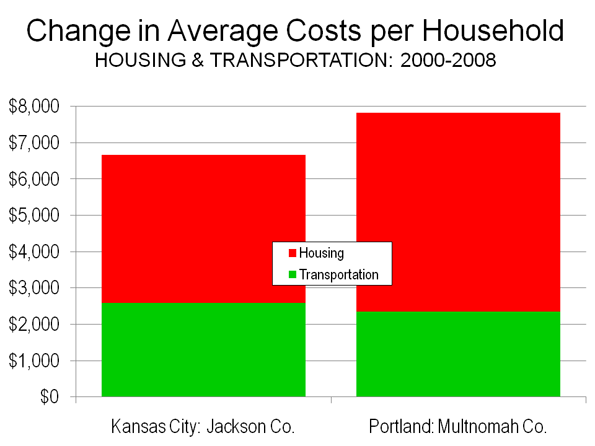
    (1) Missing the Housing Bubble? CNT places more emphasis on transportation costs than on housing costs. This is evident in the H&T Index attention to rising transportation costs from 2000 to 2008. The housing bubble and its impact on household costs appears nowhere among the 40 indicators (Note).

    Yet, there is every indication that housing costs have risen substantially more than transportation costs since 2000. For example, in Kansas City’s core Jackson County, the Census Bureau’s American Community Survey data indicates that the increase in average housing costs was nearly 60% greater than CNT’s transportation cost increase. In Portland’s core Multnomah County, the increase in average housing costs was more 125% greater than CNT’s estimated increase in transportation costs (Figure).

    (2) Exaggerating by Mixing Averages and Medians: The H&T Index compares average housing and transportation costs with the median household income. Averages and means are not the same things. Median income data is “middle” score, with one half of households having incomes above the median and one-half having incomes below the median. On the other hand, “average” housing costs and transportation costs are the total housing and transportation costs divided by the total number of households. High incomes and high priced housing skews averages up. Mixing medians and averages is inherently invalid. For example, in 2008, average housing costs were 19% higher than median housing costs. This means that, on average, where the H&T Index reports a 30% housing affordability figure, it is really substantially lower, at 25% (30% reduced by 19%).

    Thus, the net effect of comparing average housing costs to median incomes makes the housing element of the H&T Index worse than it really is.

    (3) Exaggerating by Leaving Some Households Out: The H&T Index excludes home owning households without a mortgage. The average housing expenditures of households without mortgages are smaller than those of households with mortgages. However, this is a material omission, since housing costs include utility payments. In Multnomah County, excluding households without mortgages raises average housing expenditures by nearly 10% (in 2008). Households without mortgages are households too. The net effect of excluding households without mortgages is to increase housing costs, making the housing portion of the index higher than it would otherwise be.

    (4) Exaggerating by Mixing Data from Different Years: The H&T Index provides 2008 estimates for neighborhood transportation costs, using modeled data. Transportation costs have surely increased since 2000, reaching their peak in 2008 due to the highest ever gasoline prices. CNT again compares these average costs to median household income, but not for 2008. CNT uses 2000 income data. In Jackson County and Multnomah counties, the use of 2000 instead of 2008 data exaggerates transportation’s share of household income between 20% and 25%.

    Each of the above methodological issues is sufficient to render H&T Index outputs to be unreliable.

    Housing’s Role in Housing & Transportation Affordability

    While both transportation and housing costs are important, housing costs have dented household budgets far more than the increase in transportation costs. Even after the house price declines of the last few years, house prices remain well above their historic ratio to household incomes. This will only get worse, if, as many expect, mortgage interest rates rise from their present lows and as rents rise to follow higher house prices.

    In contrast, transportation costs are more susceptible to reduction than housing costs. Once the mortgage is signed, the cost of the house will not be reduced. Once the lease is signed, there is little chance that the rent will be lowered. But transportation costs will be reduced in the future by the far more fuel efficient vehicles being required by Washington. Some people can work at home part of the time. People also change cars more frequently than they change houses. If costs become an issue, perhaps the next car is a compact rather than an SUV.

    CNT’s focus on trends in transportation costs rather than housing costs is consistent with its related study, Penny Wise Pound Fuelish, which advocates expansion of prescriptive land use (smart growth) policies to encourage core urban development and make much suburban development illegal. Yet, these very policies played a dominant role in driving house prices up three times as fast relative to incomes as in metropolitan areas that did not adopt them.

    Genuine advocacy for affordability requires addressing both transportation and housing costs. It also requires recognition of the significant damage done to affordability by prescriptive land use policies. An extra dollar that a household must pay for housing is just as valuable as one spent on transportation.

    All of which leaves us where we started. The nation could still use a reliable housing and transportation index.


    Note: CNT provides no 2008 data for housing costs. Such costs will not be available at the neighborhood level from the American Community Survey until 2012 or 2013. However, it would likely have been no more difficult for CNT to model updated housing data by neighborhood than it was to model 2008 data for transportation costs at the neighborhood level.

    Wendell Cox is a Visiting Professor, Conservatoire National des Arts et Metiers, Paris. He was born in Los Angeles and was appointed to three terms on the Los Angeles County Transportation Commission by Mayor Tom Bradley. He is the author of “War on the Dream: How Anti-Sprawl Policy Threatens the Quality of Life.

    Photograph: Hartford Suburbs

  • Leading a Los Angeles Renaissance

    Surprisingly, despite the real challenges Los Angeles faces today, the city is out in front of many of its urban competitors in transforming its capacity to provide a safe place to raise and properly educate children, exactly the criteria Millennials use in deciding where to settle down and start a family. It is the kind of challenge that cities around the country must meet if they wish to thrive in the coming decade.

    LA’s biggest win in this respect derives from the political courage of former Mayor James Hahn. It was Hahn who appointed Bill Bratton as police chief, who then deployed his COMPSTAT process for continuously reducing crime. During his tenure as the city’s Police Commissioner under both Mayor Hahn and his successor, Antonio Villaraigosa, Bratton achieved the same improvement in LA as he did previously in New York,– in a city with many of the same societal problems but about one-fourth the police resources and a much larger area to patrol. Even as unemployment soared in 2009 during the Great Recession to 12.3 percent in Los Angeles County, the city saw a 17 percent drop in homicides, an 8 percent reduction in property crime and a 10 percent drop in violent crime. This is a first great step in restoring Los Angeles, once the destination for families, back to its historic promise. Today, Angelinos feel safer than they have in decades.

    COMPSTAT is above all a vehicle for changing bureaucratic cultures. In his initial dialogue with the brass of the New York Police Department (NYPD) Bratton told his management team that he planned on holding them accountable for the crime reductions he had promised Mayor Rudy Giuliani.

    Citing the FBI’s national crime reports, they responded by telling Bratton that since crime “is largely a societal problem which is beyond the control of the police,” it was completely unfair to hold them accountable for reducing it. Since the police department was not responsible for the city’s economic vitality, its housing stock, its school system, and certainly not its racial and ethnic tensions, all of which were the root causes of crime, the managers felt it was unreasonable to expect them to actually reduce crime.

    When Bratton asked them what they could be held accountable for, the leadership replied that they were prepared to accept responsibility for the “perception of crime in New York City” and that their existing tactics of high profile drug busts, neighborhood sweeps, and the like were effective ways to manage that perception. Bratton adamantly refused to accept this definition of accountability from his team and went about creating a system that placed accountability for crime reduction on the NYPD’s leadership, something that also worked its way down through the ranks of every precinct in the city and into the fabric of the department’s culture.

    This fully captures the type of cultural change that every part of any city’s bureaucracy must undergo to become a Millennial city.

    During Mayor Hahn’s tenure in Los Angeles, for example, he expanded the COMPSTAT process to all departments in order to hold General Managers accountable for their performance under a program called “CITISTATS.” Some departments, such as Street Services, Sanitation, and Street Lighting, are still using the lessons learned in that experience to continuously improve the cost and quality of their services.

    But Los Angeles’s recovery has often been blocked by the City Council which has proven reluctant to cede its traditional right to intervene in department operations and to direct resources to specific projects or programs in their Councilmanic districts regardless of the overall city’s needs. When Villaraigosa ascended to the Mayor’s office he removed the potential irritant to his relationship with the Council by disbanding CITISTATS. That decision has deprived Los Angeles of key insights that could have been used to help deal with its current budget challenges.

    It also removed one of the more promising vehicles for Neighborhood Councils to hold city bureaucrats accountable for the services they deliver. The Councils, although far from perfect, remain one of the city’s best hopes for fulfilling Millennials’ desire for direct, locally-oriented involvement.

    In contrast, Mayor Villaraigosa’s determination to hold the Los Angeles Unified School District (LAUSD) accountable for the performance of its students has begun to pay dividends. Recently the board voted 6-1 to adopt a policy mandating competitive bids eventually be issued for the management of all 250 “demonstrably failing schools” as defined by federal education law. The parent revolution that spurred this new approach would not have been successful without the support of LAUSD board members that the Mayor had helped to elect.

    Including parents armed with new information on student performance in the process of reforming LAUSD’s schools promises to produce schools that deliver superior results at lower costs and to create a new, decentralized, parent-controlled, educational decision-making system that will be especially attractive to Millennials and their parents.

    Now that the Great Recession has brought single family housing back to affordable levels in many parts of Los Angeles, the building blocks of safer streets and better schools give the metropolitan area an opportunity to establish an environment that can attract large numbers of Millennials just as they enter young adulthood. To take advantage of this opportunity, however, all members of the city’s leadership will need to learn one more Millennial lesson.

    Unlike the Baby Boomers running the Los Angeles City Hall today, Millennials aren’t interested in confrontation and debilitating debates focused on making sure one side wins and the other loses. They want what business people term “win-win” solutions that take into account everyone’s needs and produce outcomes that benefit the group or community as a whole. Los Angeles, a city built on the expectations of the last civic GI Generation that came to LA in the 1940s, must realign itself to the tastes of the emerging next civic generation, the Millennials.

    Finding such solutions, given the many challenges LA faces, will not be easy. LA continues to be run by Boomer politicians, like those in Congress, who know how to play up divisive issues, but haven’t demonstrated an ability to get results.

    But if today’s leaders in cities like Los Angeles aren’t up to the task, it won’t be long before a new generation of leaders who have grown up believing in such an approach will emerge to take their place. As Ryan Munoz, a politically active high school senior put it, “With all the technology at our disposal, our approach is different. We can be less partisan, less confrontational and work better together.”

    Rachel Lester, who at 15 years old just won election as the youngest member of any Los Angeles Neighborhood Council by campaigning with her Facebook friends, captured the potential power of the generation. “When a few teenagers do something, a lot of teenagers do something.” When cities develop leaders as great as America’s newest civic generation, the Millennials, those cities will once again take their rightful place in the pantheon of America’s most desired places to live. Los Angeles would be an ideal place to start that movement.

    Morley Winograd and Michael D. Hais are fellows of the New Democrat Network and the New Policy Institute and co-authors of Millennial Makeover: MySpace, YouTube, and the Future of American Politics (Rutgers University Press: 2008), named one of the 10 favorite books by the New York Times in 2008. Morley Winograd served as a consultant to Mayor Hahn on the implementation of the CITISTAT process.
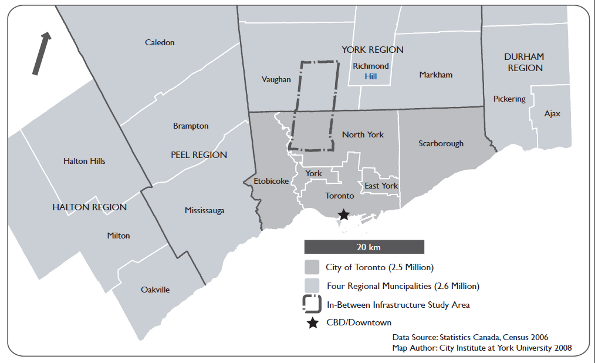
    Photo by Lucas Janin

  • The Downtown Seattle Jobs Rush to the Suburbs

    There are few downtown areas in the nation that are more attractive than Seattle. Downtown Seattle is a dream of spontaneous order and a fascinating place well worth exploring. It is one of the nation’s great walkable downtown areas, with a mixture of older and newer buildings, hills, Ivars Acres of Clams and the Chief Seattle fire boat on Elliot Bay, Pioneer Square, the Pike Place Market (itself the home of the first Starbuck’s coffee) and a hyper-dense 100,000 jobs per square mile.

    Downtown boasts the L. C. Smith Tower, which from 1914 to 1966 was the tallest office tower in the west, at 42 floors and nearly 500 feet. Now Smith Tower ranks no better than 35th tallest downtown. Seattle has built so aggressively that a visitor to the observation deck would see more looking up than down. Smith Tower is dwarfed by a skyline containing some of the nation’s most impressive office architecture, such as Columbia Center and the Washington Mutual Building, which was named for the subprime mortgage lending champion.

    Downtown has many more historic landmarks, such as the Olympic Hotel and the Washington Athletic Club. The art-deco Northern Life Tower was the second tallest until the building boom of the 1960s and would have been the pride of more downtown areas than not. The 1970s Henry M. (Scoop) Jackson federal building is a rare gem of its age, while the Rainier Bank Building is perched on a tapered base that begs the question as to whether it will collapse before the Alaskan Way Viaduct in the great Cascadian subduction zone earthquake (which is due to strike sometime between now and the end of time).

    The Condominium Bust: Downtown Seattle has experienced one of the nation’s strongest central city condominium booms, though its success (and that of others) has long been drowned out by the high pitched chorus of the Portland missionary society. As in Portland, Atlanta, San Diego, Los Angeles and other newly resurgent downtown areas, Seattle’s condominium boom is now a bust as resembling that of a subprime-baby remote desert exurb halfway between San Bernardino and Las Vegas. Even so, the condominium neighborhoods of downtown Seattle are more attractive than what they replaced. Eventually, the large inventory of empty units will be sold or converted into rental units.

    The Office Bust: Downtown’s condominium bust has spread to its office market as well. The vacancy rate is now over 20%.

    The Employment Bust: Data from the Puget Sound Regional Council of Governments (PSRG) indicates the depth of the problem. From 2000 to 2009, employment in the downtown core declined more than 12%, with a loss of 20,000 jobs. But it would be a mistake to conclude that downtown Seattle’s employment decline stems from the Great Recession. The losses occurred before. In 2007, the last year before the recession, employment had fallen nearly 18,000 from 2000.

    Downtown Seattle’s employment decline mirrors trends around the nation and around the world. Now, downtown Seattle accounts for only 8.4% of employment in the four county area, something that would surprise an airline passenger looking at its verticalness from above.

    The balance of the city of Seattle has done somewhat better, having lost 3% of its employment since 2000.

    Suburban Job Ascendancy: All of the employment growth in the Seattle area has been in the suburbs. While the city, including downtown, was losing nearly 30,000 jobs, the suburbs of King, Pierce, Snohomish and Kitsap counties added 90,000 jobs (Table). Suburban Redmond, home of Microsoft, added 19,000 jobs all by itself. Even Tacoma, the old second central city and long since defeated challenger to Seattle added a modest number of jobs between 2000 and 2009.

    EMPLOYMENT IN THE SEATTLE AREA: 2000-2009
    Area 2000 2009 Change % Change
    Downtown         164,255         143,952       (20,303) -12.4%
    Balance: Downtown         338,580         329,182        (9,398) -2.8%
    Balance: King County         646,807         662,470        15,663 2.4%
    Kitsap County           70,854           81,617        10,763 15.2%
    Pierce County         234,619         264,402        29,783 12.7%
    Snohomish County         207,764         241,569        33,805 16.3%
    4-County Area       1,662,879       1,723,192        60,313 3.6%
    Compiled from Puget Sound Regional Council of Governments data.

    If You Built it, They Must be Going: With these trends, it might be expected that local transportation agencies would be rushing to provide sufficient infrastructure to the growing suburbs. Not so. Planners are scurrying about to build one of the nation’s most expensive light rail systems with lines converging on downtown, to feed 20,000 fewer jobs today and perhaps 30,000 or 40,000 fewer in the future. Perhaps this is the train “got a whole city moving again” as the television commercials put it?

    What about growing Redmond? It’s on the map. The line is scheduled to reach Redmond sometime between now and the end of time.

  • The Best Cities For Jobs

    This year’s “best places for jobs” list is easily the most depressing since we began compiling our annual rankings almost a decade ago. In the past–even in bad years–there were always stalwart areas creating lots of new jobs. In 2007’s survey 283 out of 393 metros areas showed job growth, and those at the top were often growing employment by at least 5% to 6%. Last year the number dropped to 63. This year’s survey, measuring growth from January 2009 to January 2010, found only 13 metros with any growth.

    Mike Shires at the Pepperdine School of Public Policy, who develops the survey, calls it “an awful year.” Making it even worse, the source of new jobs in almost all areas were either government employment or highly tax payer-funded sectors like education and health. This year’s best-performing regions were those that suffered the smallest losses in the private economy while bulking up on government steroids.

    So far the recovery has favored the government-dominated apparat and those places where public workers congregate.After all, besides Wall Street, public-financed workers have been the big beneficiaries of the stimulus, with state and local governments receiving more than one-third of all funds. Public employment grew by nearly 2% over the past three years, while private employment has dropped by 7%.

    Private sector workers have also seen their wages decline, while those working for the various levels of government have held their own. Federal workers now enjoy an average salary roughly 10% higher than their private sector counterparts, while their health, pension and other benefits are as much as four times higher.

    Not surprisingly government workers, according to a recent survey, are more likely to see the economy improving than those engaged in the private sector. It’s not so pretty a picture on Main Street; personal bankruptcy filings rose 23% in the year ending in March.

    Small Is Still Beautiful

    Despite these differences, some patterns from previous years still persist. The most prominent is the almost total domination of the top overall rankings by smaller communities. With the exception of Austin, Texas, all the top 10 growers–and all the net gainers–were small communities. Americans have been moving to smaller towns and cities for much of the past decade, as well as jobs, and this recession may end up accelerating the trend.

    At the top of the list stands No. 1 Jacksonville, N.C., whose economy grew 1.4%, paced by 3.3% growth in government jobs. Fast growth, however, is not a stranger to this Southern community, whose employment base has grown 22.8% since 1998. The area includes the massive Marine Base at Camp Lejeune, a beehive of activity since the U.S. started waging two wars in Afghanistan and Iraq. Fort Hood-Temple-Fort Hood in Texas came in fourth place overall with Fayetteville, N.C., home to the Army’s Fort Bragg, placing sixth and Lawton, Okla., home of Fort Sill, close behind at No. 7. Similar explanations can apply to war economy hot spots Fort Stewart (No. 20 overall) and Warner Robbins (No. 26), both in Georgia.

    But perhaps nothing captures the current zeitgeist more than the presence, at No. 23, of Hanford-Corcoran, Calif. A large Air Force base and a state prison have bolstered Hanford-Corcoran’s economy, which shows that even in the Golden State–an economic basket case whose unemployment keeps rising–a large concentration of government jobs still guarantees some degree of growth.

    Not all our top-ranked small stars got their stimulus from Uncle Sam. Energy-related growth explains strong performances from Bismarck and ag-rich Fargo, N.D., at Nos. 2 and 8, respectively. You can also credit some energy-related growth to the high standing of Morgantown, W.Va., (No. 17) and Anchorage, Alaska, (No. 18), which have benefited from consistently high prices of oil and other sources of energy.

    Texas at the Top of Big Cities

    Our list of best places among big cities is dominated this year, as last, by Texas, with the Lone Star State producing fully half of our top 10. This year, like last, the No. 1 big city (those with a more than 450,000 non-farm jobs) was Austin, Texas, which enjoys the benefits of being both the state capital and the home to the University of Texas, as well as a large, and growing, tech sector.

    But the Texas story also includes places that do not enjoy Austin’s often overwrought “hip and cool” image. Broad-based economies, partly in energy, have paced the growth of No. 2 San Antonio, No. 3 Houston, No. 5 Dallas and No. 7 Fort Worth. Other consistent big-city Southern performers include No. 8 big metro Raleigh-Cary, N.C., as well as two ascendant Great Plains metropolises, No. 9 Omaha and No. 11 Oklahoma City. None of these places were too hard-hit by the mortgage meltdown, and they all have retained reputations as business-friendly areas.

    The other big winner among the large areas is an obvious one: No. 6 ranked greater Washington, D.C. While most American communities suffer, our putative Moscow on the Potomac has emerged as the big winner under Barack Obama and the congressional centralizers. Remarkably, federal employment in the area has grown at a smart pace throughout the recession. One partial result: Washington office space is now–for the first time ever–more expensive than that in Manhattan. Northern Virginia, home to many beltway bandit companies, ranks No. 4 on our list.

    The Eds and Meds Economy

    With the productive economy outside energy only now getting its footing, the biggest relative winners have been what could be called the “eds and meds” economies. This includes de-industrialized places such as Pittsburgh (ranked a surprising No. 13), Rochester, N.Y., (ranked No. 17) and Buffalo, N.Y. (No. 20). If you have few more factory jobs to lose, little in-migration and a huge collection of institutions relatively immune to the economic turndown, you have a better chance to look good in bad times. The stimulus tilted more toward education and health than to construction and infrastructure, something that has worked to the favor of these cities.

    We can see this in New York City, whose huge and growing concentration of colleges and hospitals helped propel it to No. 10 among the big regions, its best ranking ever, despite losing almost 130,000 jobs. This is all the more remarkable since the Big Apple was the epicenter of the financial collapse, although that also made it the prime beneficiary of the federal bailout and Wall Street’s boom. Soaring salaries for hedge fund managers and new hires at financial firms could be pacing new growth in the city’s elaborate service industry, from toenail painters, restaurateurs and psychologists to dog walkers and yoga instructors.

    The health of the eds and meds economy, however, has even been enough to lift some traditional bottom-dwelling sad sacks, such as No. 14’s Philadelphia, to unfamiliar, if rather relative, heights. With private-sector growth weak everywhere, cities with lots of big hospitals, universities and nonprofit foundations look better for the time being than they have in a generation.

    The Road Ahead

    We expect our list to change next year, but how it will do so will depend as much on politics as economics. The current policy approaches–with healthy increases in government employment and strong support for education–have worked relatively well for taxpayer-financed economies including those with a strong “eds and meds” sectors. State universities, now confronted with the real pain of the recession felt by state taxpayers, are already crying for heavy increases in federal support.

    But if Congress takes a turn to the center, or even right, after November, the advantageous position of the favored government-supported sectors may erode. Particularly vulnerable will be state workers, whose current federally sanctioned reprieve could be terminated if voters force legislators to start addressing concerns over the huge governmental deficits both locally and nationally. Given D.C.’s unique ability to print money, Washington and its environs will likely continue to expand, as they did under the spendthrift Bush regime, but many state and local governments may be forced onto a stringent diet.

    On the other hand, a welcome return to basic growth in overall economy would further boost those relatively low-cost areas–notably in Texas, the Great Plains and the Intermountain West–that have in recent years enjoyed the strongest trajectory in the non-government related sectors, including natural resource-based industries . These places have pro-business regulatory and tax regimes, lots of available land and affordable housing, which will attract new businesses and workers to their areas.

    This change could also benefit some places, such as Silicon Valley, parts of Southern California and the Pacific Northwest, which despite high costs still retain globally competitive, tech-related sectors. A resurgent job market in these areas would erase the current apparent advantage enjoyed by “eds and meds” based economies in favor of those places that will serve as the real incubators for a revived private sector economy. With the resumption growth, hopefully, our economy next year will begin resembling the more capitalist, competitive one we have enjoyed in the past.

    This article originally appeared at Forbes.com.

    Joel Kotkin is executive editor of NewGeography.com and is a distinguished presidential fellow in urban futures at Chapman University. He is author of The City: A Global History. His newest book is The Next Hundred Million: America in 2050, released in Febuary, 2010.

    Photo: kiril106

  • The Millennial Metropolis

    Back in the 1950s and 60s when Baby Boomers were young, places like Los Angeles led the nation’s explosive growth in suburban living that has defined the American Dream ever since. As Kevin Roderick observed, the San Fernando Valley became, by extension, “America’s suburb” – a model which would be repeated in virtually every community across the country.

    These suburbs – perfectly suited to the sun-washed car culture of Southern California – have remained the ideal for most Americans. And they remain so for the children of Boomer and Generation X parents, Millennials,(born 1982-2003), who express the same strong interest in raising their families in suburban settings.

    According to the most recent generational survey research, done for Washington-based think tank, NDN, by Frank N. Magid Associates, 43 percent of Millennials describe suburbs as their “ideal place to live,” compared to just 31 percent of older generations. In the same survey, a majority of older generations (56%) expressed a preference for either small town or rural living. This may reflect the roots of many older Americans, who are more likely to have grown up outside of a major metropolis, or it may indicate a desire of older people for a presumably simpler lifestyle.

    By contrast, these locations were cited by only 34 percent of Millennials as their
    preferred place to live. A majority (54%) of Millennials live in suburban America and most of those who do express a preference for raising their own families in similar settings. Even though big cities are often thought of as the place where young people prefer to live and work, only 17 percent of Millennials say they want to live in one, less than a third of those expressing a preference for suburban living. Nor are they particularly anxious to spend their lives as renters in dense, urban locations. A full 64 percent of Millennials surveyed, said it was “very important” to have an opportunity to own their own home. Twenty percent of adult Millennials named owning a home as one of their most important priorities in life, right behind being a good parent and having a successful marriage.

    This suggests that some of the greatest opportunities in housing will be in those metropolitan areas that can provide the same amenities of suburban life that Los Angeles did sixty years ago. In this Millennials are just like their parents who moved to the suburbs in order to buy their own home, with a front and back yard, however small, in a safe neighborhood with good schools.

    Given the fact that nearly four in five Millennials express a desire to have children, cities that wish to attract Millennials for the long-term will have to offer these same benefits. These Millennial metropolises also will need to be built with the active participation of their citizens, using the most modern communication technologies, to create a community that reflects this generation’s community-oriented values and beliefs. Metropolises that wish to attract Millennials, will also need to include them in their governing institutions. Such cities will have a leg up on those run by closed, good old boy networks that don’t reflect the tolerance and transparency Millennials believe in.

    The passion of Millennials for social networking and smart phones reflects their need to stay in touch with their wide circle of friends every moment of the day and night. In fact, 83 percent of this generation say that they go to sleep with their cell phone. This group-oriented behavior is reflected in the efforts of Millennials to find win-win solutions to any problem and their strong desire to strengthen civic institutions. Seventy percent of college age Millennials have performed some sort of community service and virtually every member of the generation (94%) considers volunteer service as an effective way to deal with challenges in their local community.

    The other key characteristic of the Millenial metropolis will be how it carves out a safe place for children. The Boomer parents of Millennials took intense interest in every aspect of their children’s lives, earning them the sobriquet “helicopter parents” because of their constant hovering. Now the Generation X “stealth fighter parents” of younger Millennials are turning the Boomer desire to hover and talk into a push for action and better bottom line results.

    This can already be seen in cities like Los Angeles where a parent revolution is successfully challenging the entrenched interests in the Los Angeles Unified School District (LAUSD).

    The idea began with a website, www.parentrevolution.org, that offered a bargain to parents willing to participate in a grass roots effort to improve individual schools. The organizers, led by Ben Austin, a long time advocate on behalf of Los Angeles’s kids, promised that if half of the parents in a school attendance district signed an online petition indicating their willingness to participate in improving their local school, they would “give you a great school for your child to attend.”

    This process has worked both in working class areas like East Los Angeles’ Garfield High School and the Mark Twain Middle School in affluent West LA. With the backing of the parents, Austin went to the Los Angeles school district and demanded that they either put the management of the school “out to bid,” or his organization would be forced to respond to the parent’s demands by starting a charter school in competition with the LAUSD school. Since each child has seven thousand dollars of potential state funding in their back pack, a newly enlightened LAUSD agreed to these demands. When 3000 parents showed up to demonstrate their support of the concept, the school district voted 6-1 to adopt a policy mandating competitive bids eventually be issued for the management of all 250 “demonstrably failing schools” as defined by federal education law.

    The key to building the Millenial metropolis will be to accommodate such changes. Places like Dallas, Houston, Austin, or Raleigh-Durham that have survived the Great Recession reasonably well now are focusing on producing open, accessible communities with good schools and safe streets. These communities appear best positioned to take advantage of the next bloom of urban growth. Of course the ability to provide America’s next great generation with good jobs and a growing economy will also be required if any metropolis wants to attract Millennials. But with the right leadership and a sustained effort to focus on the basics of family living, almost any city has the opportunity to become a leader in the rebirth of America’s Millennial Era metropolises.

    Morley Winograd and Michael D. Hais are fellows of the New Democrat Network and the New Policy Institute and co-authors of Millennial Makeover: MySpace, YouTube, and the Future of American Politics (Rutgers University Press: 2008), named one of the 10 favorite books by the New York Times in 2008.

    Photo: Papalars

  • Telecommute Taxes On The Table

    The Obama Administration has recently been shining a spotlight on the need to eliminate barriers to telework and its growth. Now Congress has legislation before it that would abolish one of telework’s greatest obstacles, the risk of double taxation Americans face if they telecommute across state lines. The Telecommuter Tax Fairness Act (H.R. 2600)would remove the double tax risk.

    H.R. 2600 can and should be enacted as a stand-alone measure. However, Washington is also currently developing or considering a variety of other legislative packages, any one of which would be significantly strengthened if the provisions of H.R. 2600 were added to it. These packages include energy/climate legislation (expected to be unveiled later this month), transportation legislation and small business legislation. Each of these packages, we have been told, would double as a jobs bill.

    Telework is a critical component of any plan to create jobs, as well as any plan to improve our energy security, slow climate change, ease traffic congestion, reduce transportation infrastructure costs and boost small businesses. Congress must not miss the important opportunity that H.R. 2600 and these emerging packages provide to get rid of the tax barrier to telework.

    The Obama Administration’s Focus on Removing Obstacles
    On March 31, the White House hosted a first-of-its kind forum on workplace flexibility, bringing together businesses, employees, advocates, labor leaders and experts to talk about the importance of expanding the use of telework and other practices that enable workers to meet the competing demands of job and family. Obama identified workplace flexibility as an issue that affects “the success of our businesses [and] the strength of our economy – whether we’ll create the workplaces and jobs of the future we need to compete in today’s global economy.” Discussing a new effort within the federal government to increase the number of federal teleworkers, the President said,

    “…this isn’t just about providing a better work experience for our employees, it’s about providing better, more efficient service for the American people – even in the face of snowstorms and other crises that keep folks from getting to the office…. It’s about attracting and retaining top talent in the federal workforce and empowering them to do their jobs, and judging their success by the results that they get – not by how many meetings they attend, or how much face-time they log, or how many hours are spent on airplanes. It’s about creating a culture where, as [the Administrator of the General Services Administration] puts it, “Work is what you do, not where you are.”

    The Federal Communications Commission (FCC) is also urging greater reliance on telework. In the National Broadband Plan delivered to Congress on March 16, the FCC reported that “[m]aking telework a more widespread option would potentially open up opportunities for 17.5 million individuals.” For example, the FCC said, telework can spur job growth among Americans living in rural areas, disabled Americans and retirees. To make the telework option more available, the FCC recommended that Congress “consider eliminating tax and regulatory barriers to telework.”

    What regulatory barrier did the FCC target? The “convenience of the employer” rule – the state tax doctrine that subjects interstate telecommuters to the risk of double taxation. Specifically, a state with a “convenience of the employer” rule can tax nonresidents who telecommute part-time to an employer within that state on the wages they earn at home, even though their home states can tax the same income.

    For many people, the threat of owing taxes to two states can put a long-distance job out of reach. By making telework unaffordable for workers, the tax penalty also thwarts businesses and government agencies trying to tap the cost-saving and other economic benefits telework offers.

    The Telecommuter Tax Fairness Act would bar states from taxing the income nonresidents earn in their home states, and it would prohibit them from applying a “convenience of the employer” rule. Congress should follow the FCC’s counsel to “consider addressing this double taxation issue that is preventing telework from becoming more widespread.”

    Congressional Opportunities to Remove the Tax Barrier
    As noted above, H.R. 2600 can and should be passed as a stand-alone bill. However, Congress could also seize the opportunity to include the provisions of H.R. 2600 in the energy/climate package, the transportation package, or the small business package that lawmakers are working on, and, in the process, make that package more effective.

    How would telecommuter tax fairness strengthen energy and climate legislation? By substituting the use of broadband for the use of cars and mass transit, telecommuters conserve fuel and reduce greenhouse gas emissions. The National Broadband Plan reported that “[e]very additional teleworker reduces annual CO2 emissions by an estimated 2.6-3.6 metric tons per year. [Further, replacing] 10% of business air travel with videoconferencing would reduce carbon emissions by an estimated 36.3 million tons annually.” How can Congress enact an energy bill that does not include such savings?

    The same kind of fairness is a necessary addition to any transportation bill, because broader use of telework can slash transportation costs. By decreasing the demand for roads and rails, telework minimizes wear and tear on existing infrastructure and reduces the need to build more. As a result, telework limits the expense of repairs, maintenance and expansion. The new transportation funding bill should focus more on creating jobs laying broadband conduits and less on jobs laying asphalt. The transportation bill would also benefit from the addition of telecommuter tax fairness, because, by decreasing traffic congestion, telework decreases the hobbling cost of lost productivity.

    Small business legislation? Telework can help small firms hire new people at lower cost: Employers can increase staff without increasing real estate, energy and other overhead expenses. They can also select the most qualified applicants from the broadest geographic area while spending less on recruitment. Telework can increase company efficiency and, as President Obama noted at the workplace flexibility forum, help employers assure continuity of operations when emergencies arise. These are bottom line benefits Washington can offer small businesses without adding to the federal deficit.

    Finally, the success of any legislation designed to jumpstart hiring should include telecommuter tax fairness. It would enable the unemployed — especially those who cannot relocate because their homes are unsalable — to widen the area where they can look for work.

    The Telecommuter Tax Fairness Act was introduced by Representatives Jim Himes (D-CT) and Frank Wolf (R-VA). It has bi-partisan support from lawmakers all around the country. Stakeholders endorsing it include the Telework Coalition, the National Taxpayers Union, the American Homeowners Grassroots Alliance and the Small Business & Entrepreneurship Council, along with the Association for Commuter Transportation and Take Back Your Time. Workplace Flexibility 2010, a public policy initiative at Georgetown University Law Center, has also recommended the elimination of the telecommuter tax penalty.

    Telework is an important part of the solution to the nation’s most urgent problems, including unemployment, foreign oil dependence, climate change, clogged and crumbling travel arteries and the struggle workers face to meet their responsibilities as employees, family members and members of their communities. As federal lawmakers tackle these challenges, they should consider the Administration’s focus on getting rid of regulatory roadblocks to telework. They should heed the FCC’s call to take up the issue of the telework tax penalty, and they should finally enact the Himes-Wolf bill.

    Photo: Representative Jim Himes (D-CT)

    Nicole Belson Goluboff is a lawyer in New York who writes extensively on the legal consequences of telework. She is the author of The Law of Telecommuting (ALI-ABA 2001 with 2004 Supplement), Telecommuting for Lawyers (ABA 1998) and numerous articles on telework. She is also an Advisory Board member of the Telework Coalition.

  • All In The Family

    For over a generation pundits, policymakers and futurists have predicted the decline of the American family. Yet in reality, the family, although changing rapidly, is becoming not less but more important.

    This can be traced to demographic shifts, including immigration and extended life spans, as well as to changes of attitudes among our increasingly diverse population. Furthermore, severe economic pressures are transforming the family–as they have throughout much of history–into the ultimate “safety net” for millions of people.

    Those who argue the family is less important note that barely one in five households–although more than one-third of the total population–consists of a married couple with children living at home. Yet family relations are more complex than that; people remain tied to one another well after they first move away. My mother, at 87, is still my mother, after all, as well as the grandmother to my daughters. Those ties still dominate her actions and attitudes.

    Critically, marriage, the basis of the family, is also far from a dying institution. Sociologist Andrew Cherlin notes that over 80% of Americans eventually get married, often after a period of cohabitation. Later marriages are also reflected in later childrearing. Younger women today may be less likely to have children, but far more older women are giving birth; since 1982 the number of those over 35 who give birth has more than tripled. This trend has accelerated and will continue to do so given advances in natal science.

    More important, people continue to value the stability and cohesion that only families can provide. According to social historian Stephanie Coontz, Americans today are more likely to be in regular contact with their parents than in the past. Some 90% consider their parental relations close, and far more children are likely to live with at least one parent now than they were as recently as the 1940s.

    To be sure, as Coontz makes clear, the 21st-century family will not reprise the Ozzie-and-Harriet norms of the 1950s. Everything from divorce to immigration and gay marriage is reshaping family relations. While Americans may “swing back” to a more family-oriented society, social historian Alan Wolfe notes, “it will be with a difference.”

    But family will remain the central force that informs our communities and economy. For example, when people move, a 2008 Pew study reveals, they tend to go to areas where they have relatives. Family, as one Pew researcher notes, “trumps money when people make decisions about where to live.”

    Perhaps nothing better illustrates this trend than the increase in multigenerational households. As people live longer and produce offspring later, family ties are strengthening. A recent Pew survey reveals that the number of households accommodating at least two adult generations has grown in recent years. Today the percentage of such multigenerational households–some 16%–is higher than any time since the 1950s and swelled by some 7 million since 2000. At the same time, the once rapid growth of single-person households, which nearly tripled since the 1950s, has begun to slow and, among those over 65, has declined in recent years.

    Rather than be hived off in isolation, grandparents are playing a larger role in family life, both as financial supporters and as sources of reliable child care. Living with or being close to grandparents is particularly important for younger Americans, many of whom are struggling to raise families in expensive regions such as New York or Los Angeles. As Queens resident and real estate agent Judy Markowitz puts it, “In Manhattan, people with kids have nannies. In Queens, we have grandparents.”

    As these caregivers age, in turn, they will require help for themselves. One welcome change, already evolving, is the number of older adults moving in with their children. Institutionalized care for people over 75, once seen as inevitable, has dropped since the mid-1980s, as more families hire part-time help or have aging parents move in with them.

    Today as many as 6 million grandparents live with their offspring, allowing, by one estimate, as many as half a million people to avoid nursing homes. Between 2000 and 2007, according to the Census Bureau, the number of people over 65 living with adult children increased by more than 50%. One California builder reports that one third of new home buyers want a “granny flat,” an addition to accommodate an aging parent. Roughly one third of American homes have the potential to create such units. In the coming decades homes that can be adapted to the changing needs of families will become an increasingly desirable commodity.

    Arguably the strongest force for continued importance of family comes from the two groups, ethnic minorities and millennials, who will shape the next few decades. Immigrants, particularly Latinos and Asians, are also far more likely to live in married households with children than are other Americans. They are also more than twice as likely, according to Pew, to live in households with at least two adult generations.

    The other key group will be the millennials, those Americans born since 1982. As noted generational researchers Morley Winograd and Mike Hais suggest in their landmark book Millennial Makeover, the rising “millennial” or “echo boom” generation–those born after 1983–enjoy more favorable relations with their parents: Half stay in daily touch, and almost all are in weekly contact.

    The millennials, Winograd and Hais suggest, generally do not share the generational angst that defined many boomers. Indeed three-quarters of 13-to-24-year-olds, according to one 2007 survey, consider time spent with family the greatest source of happiness, rating it even higher than time spent with friends or a significant other. And they seem determined to start families of their own: More than 80% think getting married will make them happy, and some 77% say they definitely or probably will want children, while less than 12% say they likely will not.

    The current tough economic conditions may be slowing family formation but is clearly bolstering close, long-term ties between children and parents. One quarter of Gen Xers, for example, still receive financial help from their parents, as do nearly a third of those under 25.This trend has been mounting since well before the recession. Ten percent of all adults younger than 35 told Pew researchers last year that they had moved in with their parents over the past year.

    Higher college debts, high home prices and a less-than-vibrant job market could all extend this virtual adolescence in which children maintain strong ties of dependence into adulthood. Although these conditions may increase support for more governmental assistance among some, young people are finding out there’s one institution that, despite political shifts, really can be counted on: the family.

    This article originally appeared at Forbes.com.

    Joel Kotkin is executive editor of NewGeography.com and is a distinguished presidential fellow in urban futures at Chapman University. He is author of The City: A Global History. His newest book is The Next Hundred Million: America in 2050, released in Febuary, 2010.

    Photo: driki

  • Reconnecting the In-between City

    The socio-spatial landscape of what we call the “in-between city,” includes that part of the urban region that is perceived as not quite traditional city and not quite traditional suburb (Sieverts, 2003). This landscape trepresents a the remarkable new urban form where a large part of metropolitan populations live, work and play. While much attention has been focused on the winning economic clusters of the world economy and the devastated industrial structures of the loser regions, little light has been shed on the urban zones in-between.

    We view this new landscape with a particular view towards urban Canada. Applying these concepts to a North American city, Toronto, Canada, we look specifically at the 85 square kilometers around York University, an area that straddles the line between the traditional suburb and the inner city.

    A politics of infrastructure
    When we speak of a “politics of infrastructure”, we refer to a growing awareness that involves political acts that produce the infrastructure policy for urban regions. We therefore follow Colin McFarlane and Jonathan Rutherford’s advice to open up “the ‘black box’ of urban infrastructure to explore the ways in which infrastructures, cities and nation states are produced and transformed together”. This “politicization of infrastructure” involves the understanding of how infrastructure policies and planning are linked to “the co-evolution of cities and technical networks in a global context” (McFarlane and Rutherford 2008: 365). The politics that produced the (public) modern infrastructural ideal for the centres and the (privatized) modern infrastructural ideals for the peripheries, largely marginalized the role of d the in-between cities of our metropolitan regions. They were left as residual spaces filled by thruways and bypasses.

    But the increased significance of these spaces today commands our attention in new and inevitable ways. In this sense, the politics of the in-between city suggests the need for a de-colonization from the forces that built the glamour zones at both ends of its existence: the urban core and the classical suburb or exurb.

    The newest – 2006 – census figures in Canada reveal that 70 percent of the population live in metropolitan areas (see note). However, within those urban areas they increasingly live outside of urban cores in a new kind of urban landscape. Interestingly, more Canadians also work in the suburban parts of metropolitan areas. The number of people working in central municipalities increased by 5.9 percent from 2001 to 2006 whereas the number of people who worked in suburban municipalities increased by 12.2 percent.

    Of course the growth of the traditional suburban kind continues, and while inner cities experience densification of office and condominium developments, much of the most dynamic growth areas are literally in-between. But the picture in the old suburbs and the enclaves is a distinctly mixed one. There are areas of aggressive expansion, for example around suburban York University in Toronto, where a New Urbanist-styled “Village at York” has added one thousand units of residential space. Yet just one block away, the Jane-Finch district continues to lose both in economic standing and demographically and remains one of the designated “priority neighbourhoods” where the City of Toronto sees much room for socio-economic improvement.

    Yet even as these in-between areas experience fast paced socio-spatial change, the realities of political and administrative power leave them marginalized. The Steeles Avenue corridor at the northern edge of the York University campus, for example, is a major east-west thoroughfare at the border of two municipalities – Toronto and Vaughan – that has enjoyed little attention from the cities’ investors and resident communities. Planners in the two municipalities have only recently begun to think about redevelopment possibilities in the corridor, but their policy-making is largely in isolation from each other. Just where the need for articulated urban infrastructure development is greatest, the capacity to act is least.

    At the same time, the linear nature of public transit and other networked infrastructure which favour either mass concentration of jobs or housing or wealthy suburban enclaves – leaves many places that lie between designated destinations in a fallow land of unsatisfactory access. This bias is corroborated by the political decision making processes.

    No politician, planner or bureaucrat will champion public expenditure in the in-between zone, particularly if they are inhabited by or provide jobs to socially less powerful groups. As a consequence, infrastructure built to connect centres actually disconnect those non-central spaces that lie in-between. While highways link smart centres and movieplexes around the urban region, blue collar workers in the widespread facilities of the sprawling suburban Toronto industrial districts rely on irregular buses or van service to get them to and from work.

    Empirically, our 85 sq km study area – partly in the City of Toronto and partly in the City of Vaughan – is home to about 150,000 people. It is a place that is rich in social and physical complexities and contradictions. Uneven access to different infrastructure is particularly visible in the poorly understood and under-recognized “in-between city.” Casting light on the infrastructure problems of the “in-between city” is a necessary precondition for creating more sustainable and socially just urban regions, and for designing a system of social and cultural infrastructure that meets community needs.

    How can renewal come to the politics of infrastructure in the in-between city? The question is how our respones to the global economic recession can effect these oft-neglected regions. Will they reinforce the ways in which the in-between areas and their dependent populations have been marginalized or will they participate in the renewal?


    Note: Census Metropolitan Areas are defined as having a population of at least 100,000.

    References
    McFarlane, Colin and Jonathan Rutherford (2008) Political Infrastructures: Governing and Experiencing the Fabric of the City, International Journal of Urban and Regional Research 32,2; 363-74.

    Sieverts, Tom (2003) Cities Without Cities. Between Place and World, Space and Time, Town and Country. London and New York: Routledge.

    Roger Keil (Dr.Phil, Frankfurt) is the Director of the City Institute at York University, the Director of the Canadian Centre for German and European Studies, and Professor at the Faculty of Environmental Studies at York University, Toronto. Keil’s current research is on the global suburbanism, infrastructure in the Zwischenstadt, on cities and infectious disease, and regional governance. Keil is the co-editor of the International Journal of Urban and Regional Research (IJURR) and a co-founder of the International Network for Urban Research and Action (INURA).

    Douglas Young is Assistant Professor of Social Science at York University where he teaches in the Urban Studies Program. He is a former architect, municipal planner and developer of non-profit housing cooperatives. He is co-author of a book about politics in Toronto, “Changing Toronto: Governing Urban Neoliberalism,” which was published in 2009 by University of Toronto Press, and co-editor of a forthcoming book, “In-between Infrastructure: Urban Connectivity in an Age of Vulnerability,” which will be published by Praxis (e) Press. His current research interests include infrastructure in the in-between city, suburban renewal, and urban legacies of socialism and modernism.