Category: Suburbs

  • New Urbanism, Smart Growth, & Andres Duany: A Critique From Suburbia

    In 1998 Hollywood introduced us to a new star when it released The Truman Show, shot on location at Seaside in Florida. No I’m not talking about Jim Carrey, Laura Linney or Ed Harris. I’m talking about none other than Andres Duany.

    A few months ago, I stayed at the magnificent WaterColor Inn, which is in the neighborhood adjacent to Seaside. Watercolor is closer in feel to a suburban development’s sense of space (more open), but WaterColor’s Town Center doesn’t offer a large choice of restaurants, so Seaside serves as a destination. Other than a sign marking the border, one does not immediately feel as if Seaside and WaterColor are two very different developments.

    While both Duany and Peter Calthorpe seem to make claims to be the founders of the New Urbanism, Duany gets more attention. I’ve only met him once, at a conference. I was impressed with his presentation as honest and straightforward, even though I’m not a New Urbanist — quite the opposite, in fact. He spoke of his disdain for the suburbs, but agreed that 80% of the housing market preferred them, and then went on to speak of the benefits of New Urbanism.
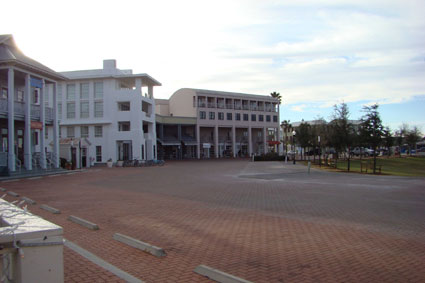
    What I experienced in Seaside was much different than what I expected from watching The Truman Show. When the film was released, the main feature of a typical cookie-cutter suburban home was… well, uh, hmm… I guess you could describe it as quite featureless. But some developers and builders ventured forth into New Urbanism, or an emulation of the look. The home buyer was now faced with a choice: the requisite aluminum, white, three car garage door with the home hidden somewhere behind it, or a home with a front porch instead. Buyers became smitten. They may have still bought the garage snout home, but the writing was on the wall. The days of the vinyl clad / garage forward / featureless home were numbered, and if builders were smart, then they had to increase their architectural character. Many suburban homes gained a porch, some architectural detail, and a somewhat less prominent garage. Buyers started demanding walks and other amenities… and builders and developers responded until the housing market crashed.

    This evolution can be attributed more to the efforts of Duany than of anyone else. The Duany developments stand apart from some other New Urbanist development partly because of their detail and character, and partly because of their high price point. I’ve been to the Kentlands, I’on, Celebration, and now Seaside. The architectural and landscape detailing is outstanding. When I went to Kentlands, a decade ago, I got lost; it breaks from the Smart Growth grid theory. There was nobody sitting on the porches, and I saw only one person walking. To be fair it was during the workday. I was really looking forward to a stroll to the local coffee shop, but instead, the K-Mart strip center defined the entrance with no apparent internal commercial development. I understand that today there are more walkable services.

    On my I’on visit (on a nice weekend) I saw very large homes with only single car garages or no garages at all. Again, nobody was sitting on any of the porches (which were spacious and beautiful), but there were people strolling. I’on is a very large development, and the only one I visited that seemed to be planned on a grid. The only local businesses (at the time) were a chocolate shop, a hair stylist, and the I’on sales office. For anything else you would probably need to drive.

    Upon entering Celebration we were greeted by massive, majestic homes that align the main street. Very cool. This gives a feeling of arrival, as opposed to a suburban development that would typically showcase the highest density and cheapest product at the front entrance (blame Levittown transitional zoning for that). On a Sunday morning my wife and I had a coffee in the Celebration town center. We were alone, other than one other table where a real estate salesman was trying to sell one of the homes. The stores were open, but either people aren’t shopping before 11:00AM on Sunday mornings, or they simply get tired of frequenting that same shop that sells all items with “Celebration” logos. Again, not a soul on the front porches, and only a few on the walks.
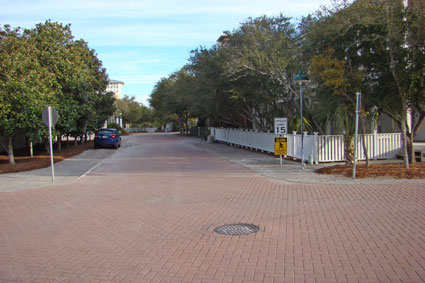
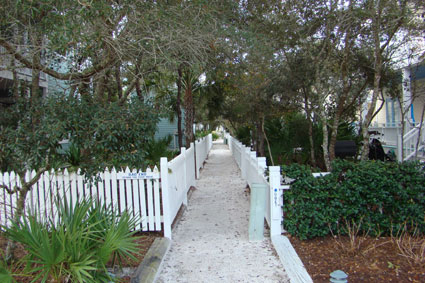
    I distinctly remember Seaside from The Truman Show as well coiffed and manicured. Homes all behind picket fences. When we strolled the streets, the landscaping between each home and white picket fence was overgrown, making it difficult to see the homes and closing up space along the streets. There were no walks along the streets. There were natural trails in a straight pedestrian system behind each home along the rear yards, with paths so narrow (about 4’ between picket fences) that I needed to follow behind my wife as we strolled through the blocks (these paths were not in the movie).
    Many of the homes had observation towers hovering over the rooftops, cool architectural features that would allow a view of the shoreline. A decade after the development’s premiere, that open view was closed up by a wall of very large ocean view homes, blocking all those great views that the towers would have provided. There’s now little tie from the community to the shore other than a single bar elevated above the shops allowing a good view.
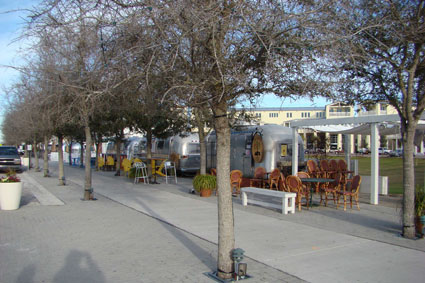
    In general, much of Seaside is overgrown with landscape that blocks the feeling of space. We were told by a few sources that only about twenty residences have full time owners, with the rest rented. There were a few restaurants and bars, and the same grocery store that was in The Truman Show, but the feel of the development was much different than what I expected after seeing the movie. The main street has rows of Airstream trailers with street vendors selling various food items, something I found distracting from the image of New Urbansim; very touristy. The general pattern of Seaside is quite maze-like, requiring us to carry a map as we took a stroll.

    By contrast, WaterColor has similar architectural character, but is much more diverse in its open spaces and provides the look of Seaside with a more suburban sense of space. Seaside homes generally lacked vehicle storage or protection from the elements; WaterColor homes had the convenience of garages — mostly, but not all, in alleys — and some carports. Garages are an indication of permanent residence, not a weekend jaunt. They keep many of the cars off the street and out of sight. Unlike a standard New Urbanism design that separates the garage from the home (as if a car contained some negative aura that could take control of our lives), the WaterColor homes had the garages attached. WaterColor is a place you can live in, not just rent for a week.

    If the nation’s suburban architectural character has improved, I think much of it is due to the effort that Duany has taken to showcase New Urbanism, which has had a positive influence in the overall character of land development. Whether New Urbanism thrives or it fails, he has left us this lasting gift. Duany developments I’ve visited are beautiful, even with their flaws and their high priced entry.

    But architecture and landscaping are NOT planning. And here lies the problem. You can take the worst planned neighborhood and showcase it with the Duany style of high quality elements —- his eye for architecture and landscaping —- and it will look great. In a well-planned suburban neighborhood, on the other hand, the display of repetitive garage-grove facades with plain vinyl siding, void of landscaping other than the requisite sod, will look awful. As people drive or stroll through the Duany development, they will naturally say it’s well planned, even if it’s dysfunctional, inefficient, and has a high environmental impact. This is not to say that it necessarily is, but you can’t feel those things from street level. The plain subdivision will be identified as terribly planned, even if the plan is functional and efficient with low environmental impacts.

    I’m not a follower of Duany and disagree with much of his ideology. But I do thank him for making the real world, suburban and urban —- not just the make-believe world of The Truman Show —- a better place.

    Rick Harrison is President of Rick Harrison Site Design Studio and Neighborhood Innovations, LLC. He is author of Prefurbia: Reinventing The Suburbs From Disdainable To Sustainable and creator of Performance Planning System. His websites are rhsdplanning.com and performanceplanningsystem.com.

    Photo: Seaside, Florida’s Post Office — Where they filmed ‘The Truman Show’

  • Queensland, We’ve Got a Problem

    Queensland Premier Anna Bligh MP has a problem. Reacting to sensationalized media reports of runaway population growth as well as an infrastructure lag revealing itself in everything from mounting congestion to a lack of hospital beds, Queensland residents are starting to say ‘enough.’ The prospects of continuing population growth at around 2.5% or 100,000 people per annum, despite the economic benefits this brings, are increasingly unpopular, something that gets the attention of most politicians.

    In many ways it’s ironic for Premier Bligh to find herself in this position. She follows a succession of Premiers who managed to get away with weekly media boasts of “1500 people every week” moving into the State, drawn – it was alleged – by our climate and lifestyle. In the past, any Premier who questioned this growth would have felt the result at the ballot box.

    Bligh’s response has been (in a time honoured tradition) to convene a ‘summit of experts’ and community representatives (you can read it all here), designed to thrash out a policy accord for the future. No politician worth their salt holds an inquiry unless they have a fair idea of the outcome in advance, so it’s a fair bet the outcomes will include even more regulatory controls on urban growth, in the name of ‘sustainability’ to appease the anti-growth coalition of greens and neo-Malthusians. Pro-growth lobbies on the other hand will be promised a ‘business as usual’ attitude to economic expansion, only under more ‘responsible’ oversight.

    But the biggest irony is that attempts to contain or control growth may be too late. It is just possible that the unthinkable will happen: growth will stall, and in coming years, a future Premier will be wondering what went wrong.

    How could this happen?

    First, a bit of history. Queensland’s growth status in the Australian context has been driven over the past 30 years almost entirely from interstate migration. Low state taxes, relatively cheap housing, aggressively pro business governments (including one which famously went too far) and a ‘Florida-like’ allure of lifestyle and warm climate all combined to make the state a population magnet. “The Sunshine State” – just like Florida – was how tourism promoters labeled it. “The low tax state” was the label peddled by business promoters. Both became interchangeable.

    In contrast, international migration to Australia was largely focused on Sydney and Melbourne. The rate of natural births over deaths was barely in the positive, resurrected recently by a Federal Government baby bonus of questionable long lasting effect. This left interstate migration as Queensland’s growth driver.

    Arrivals from Victoria or Sydney could famously relocate to the south east corner of Queensland and find themselves in a better quality home, in a more convenient location, and with cash left over. They were faced with shorter commute times, lower taxes and overall a better quality of life than the one they left behind.

    But in the late 1990s this all started to change. Increasing land use controls appeared as planners sought to ‘manage’ the growth of the state better. “We can’t destroy what you came to enjoy” became a new mantra, and an urban growth boundary for the popular south east was introduced under ‘smart growth’ principles. In the 1995-2000 period, three statutory plans appeared for the south east, followed by a 10 year regional planning program in 2000 (SEQ 2021) followed by an Office of Urban Management in 2004, a South East Queensland Regional Plan in 2005 and then an updated version in 2009.

    It’s become an industry joke that we now produce more plans than houses. But the inevitable consequence of this explosion of planning regulation – matched at the same time by the surreptitious introduction of exorbitant per lot housing levies under the guise of ‘user pays’ – was to drive up housing costs rapidly while drying up new supply.

    Queensland housing construction is now at a 20 year low. The median house price, which in 1999 was half that of Sydney’s, is now 80% of Sydney prices and roughly at 8 times average incomes. A thirty year or more tradition of relatively lower cost housing in Queensland has been smashed in the space of six or seven years.

    Also over the same period, the state’s tax advantage has been eroded. Once Queensland boasted some of the lowest vehicle registration fees in the country; now it has the highest. Electricity prices, also once amongst the cheapest of any state, are now just as expensive. Land and other property taxes have rapidly caught up with other states and overshot others. According to the Institute of Public Affairs IPA, state business taxes in just one year went from being the second lowest in the country in 2008 to mid field by 2009. Roads and other infrastructure which were once enjoyed as part of the general tax contribution are separately tolled, water is priced and charged separately from council rates to residents. Overall, the general cost of living advantage compared to interstate rivals has evaporated.

    The rapid erosion of Queensland’s relative tax and cost of living advantage prompted a writer for The Australian newspaper to lament in late 2009 that: “Queensland has squandered its low-tax edge and become a public-sector spendthrift, putting at risk its long-term growth potential and ability to attract investment.”

    In fairness, maintaining low taxes and funding a generational catch up in infrastructure might be mutually exclusive. The state is now undergoing a record level of infrastructure investment, in response to the growth it has witnessed. The timing for Premier Bligh though is not good: the benefits of this new wave of infrastructure might not be felt for some years. In the meantime, residents are growing increasingly impatient and the prospects of adding to population numbers are being met with increasing hostility. Some of the more alarmist messages of green and ‘no growth’ advocates are finding traction. Even leading Australian business figure like entrepreneur Dick Smith is warning that we will soon run out of food. This in a state larger than Texas with a population of just 4 million, and in a country with five times the amount of arable land per capita than the USA.

    Faced with funding a much larger public sector plus a big infrastructure program, the state is whetting its tax appetite. Plus, the popular sentiment now turning against population growth suggests that relief from excessive land use controls on housing supply or a meaningful reduction in the level of upfront per lot levies is remote at best.

    The results are already apparent. Interstate migration – once the single biggest driver of growth in Queensland – has collapsed and now accounts for just half the level of births over deaths and only one third the level of international migration. The sun still shines in the Sunshine State but Queensland is now longer the low tax (and low cost of living) state. With lower average incomes than other states, the sums no longer add up for many people. And as birth rates slow, without the international migration tap, Queensland’s population growth overall could hit the brakes. The risk here is compounded by the increasing pressure on Prime Minister Kevin Rudd to slow down international migration to Australia (for an example, see here). If that happened, growth could fall to record low levels almost overnight.

    So while Premier Bligh prepares for the population summit and its aftermath, it could prove the ultimate irony that measures to control the rate of population growth in Queensland become quickly redundant and the very least of our worries.

    Ross Elliott is a 20 year veteran of property and real estate in Australia, and has held leading roles with national advocacy organizations. He was written and spoken extensively on housing and urban growth issues in Australia and maintains a blog devoted to public policy discussion: The Pulse.

  • EPA Joins the Green Building Party

    By Richard Reep

    Well into the last decade, green design and smart growth operated as two separate and distinct reform movements. Both were widely celebrated in media, academic and planning circles, seeing themselves as noble causes albeit underdogs in the struggle against the mighty capitalistic enterprise of real estate development. Starting in 2009, the frozen credit market has kept private development moribund, and these two movements are somewhat moot as development takes a cease-fire.

    Yet now the two movements appear to be joined at the hip, a move encouraged by a federal bureaucracy and an Administration that embraces both groups’ agenda. In the process, what was once seen as an alternative to conventional development appears to be well on the way to becoming federally-mandated regulatory policy. The EPA, DOT, and HUD recently signed a memorandum of understanding to start making policy around green design and smart growth, turning these choices into federal standards.

    The standard bearer for green building, LEED certification, is the U. S. Green Building Council’s definition of energy efficiency and green design. A reform-focused movement, LEED established criteria by which a building’s energy and water use could be measured against a baseline, and the USGBC awards credits to the building when energy efficiency measures are achieved. LEED increases a building’s construction cost but reduces the building’s life cycle cost – monthly electric bills – and real estate developers, who gain nothing from lower energy costs, were slow to become interested in this choice. LEED was the domain of owner-operators like governments, who have a vested interest in keeping their future costs as low as possible, and was adopted as a criterion for capital expenditures by the GSA as well as many cities and counties by the close of the last millennium.

    Smart growth’s official champion is the Congress of the New Urbanism, which offers a design style choice for real estate developers. Developers, being profit oriented, historically have been loathe to tinker with what sells, and thus only in a few areas has New Urbanism gained a foothold. At its best, new urbanism represents a choice for homeowners who prefer dense, mixed-use communities that resemble traditional American towns, accentuating walkability and reducing residents’ dependence upon the car. In this key feature, Smart Growth advocates lobbied the U. S. Green Building Council to create a special category of LEED for Neighborhoods.

    Both movements promised reform. Both movements increased cost. Neither program was particularly effective at penetrating the real estate development market as long as the investment community favored large, formula-driven, profit-oriented real estate developers, and innovation consisted of product cost-cutting. The cost premium associated with each movement left them largely the playthings of boutique, niche-oriented developers aspiring to nobility while protecting their bottom line.

    Changes afoot in the last several months, however, are combining these two movements into one powerful force that turns these laudable movements away from choice and towards a prescriptive, and ultimately restrictive policy. Beginning in 2006, the Environmental Protection Agency encouraged communities to build walkable, energy-efficient growth within their boundaries, rather than continue spreading out – a surprising focus for an agency created to reduce pollution. Little else happened until late 2009, when suddenly the EPA began linking Energy Star (a Department of Energy program) to New Urbanist values such as walkability and mixed-use development. The EPA, which regulates pollution, has suddenly moved front-and-center into regulating growth, as if it were another type of pollution.

    At the same time, the U. S. Green Building Council yielded to heavy lobbying by the New Urbanist movement to create a new criterion, LEED Neighborhood Development. A developer may now submit a new land plan for certification to this LEED standard, and “smart growth” is being codified and standardized into a checklist and formula to be measured against a baseline. Like LEED for New Construction, these standards will also increase the cost for the developer desiring to build to these standards.

    Investors and developers may, on the surface, appear to have lost these dramatic battles. In the bigger picture, however, while the economy retools itself, it is not unusual to see regulation increase. If anyone remembers the S&L crisis of 1990-92, one of the biggest regulatory acts to affect real estate in modern times hit developers right between the eyes: The Americans with Disabilities Act. This reform removed physical barriers for all citizens with disabilities, but as a cost burden to developers it pales in comparison to the premiums that will be paid to meet the smart/green regulations currently being formulated by the Feds.

    Banks – hardly institutions with widely popular standing – stand to gain the most, because a developer who borrowed $10 million for a project in 2006 will probably need to borrow $11 or $12 million for the same project by the time bankers get around to discussing credit again. Developers also stand to gain, because as the cost goes up, so does the price. Coming out of the Millenial Depression, new construction will be faced with higher energy performance requirements, the higher costs associated with urban development, and a longer regulatory review process than ever before seen.

    The losers, of course, will be the vast majority of Americans who work hard and earn modest incomes. New home prices will increase, and renters will have to pay their landlords more to cover the increased costs of politically sanctioned development. While the affluent will be able to enjoy the benefits of a green, urbane lifestyle, the grocery store cashiers, dry cleaner clerks, housekeepers and artists who make up so much of our community will be forced out by the sheer cost of this movement – out to the suburbs, out to the exurbs, and out to the trailer parks beyond them. No green for you: your commute time just got much longer.

    Technology, of course, will eventually decrease in price and become more affordable; like VCRs and DVD players, the early adopters pay the freight until the appliance becomes a commodity. The same is likely true for exotic solutions like photovoltaics or low-voltage lighting as the marketplace sorts out what works from what doesn’t. So the impetus to go green will impose a crushing cost burden on new construction, which may gradually, over time, be absorbed into the mix.

    An affordable starter home in a low-cost subdivision, however, may be as doomed as leaded gasoline, and the American Dream will likely shift away from the landowner-based society once vaunted by Thomas Jefferson. The walkable lifestyle, now being exercised by free will, is well on its way to becoming federal government policy in a grand effort to incorporate reform and regulation into our lives from above.

    Whether or not this achieves the EPA’s mission to reduce pollution will only be discovered in the decades ahead as we incorporate the next hundred million Americans into the urban boundaries we have already set upon the land. It may be entirely possible to reach some of these goals without prescriptive overly burdensome regulation, yet this may only occur if political realities begin to reign in the current regulatory onslaught.

    Richard Reep is an Architect and artist living in Winter Park, Florida. His practice has centered around hospitality-driven mixed use, and has contributed in various capacities to urban mixed-use projects, both nationally and internationally, for the last 25 years.

    Photo by eng1ne

  • Don’t Mess With Texas

    One of the most ironic aspects of our putative “Age of Obama” is how little impact it has had on the nation’s urban geography. Although the administration remains dominated by boosters from traditional blue state cities–particularly the president’s political base of Chicago–the nation’s metropolitan growth continues to shift mostly toward a handful of Sunbelt red state metropolitan areas.

    Our Urbanist in Chief may sit in the Oval Office, but Americans continue to vote with their feet for the adopted hometown of widely disdained former President George W. Bush. According to the most recent Census estimates, the Dallas and Ft. Worth, Texas, region added 146,000 people between 2008 and 2009–the most of any region in the country–a healthy 2.3% increase.

    Other Texas cities also did well. Longtime rival Houston sat in second, with an additional 140,000 residents. Smaller Austin added 50,000–representing a remarkable 3% growth–while San Antonio grew by some 41,000 people.

    In contrast, most blue state mega cities–with the exception of Washington, D.C.–grew much more slowly. The New York City region’s rate of growth was just one-fifth that of Dallas or Houston, while Los Angeles barely reached one-third the level of the Texas cities.

    These trends should continue: According to Moody’s Economy.com, Texas’ big cities are entering economic recovery mode well ahead of almost all the major centers along the East or West Coasts. This represents a continuation of longer-term trends, both before and after the economic crisis. Between 2000 and 2009 New York gained 95,000 jobs while Chicago lost 257,000, Los Angeles over 167,000 and San Francisco some 216,000. Meanwhile, Dallas added nearly 150,000 positions and Houston a hefty 250,000.

    This leads me to believe that the most dynamic future for America urbanism–and I believe there is one–lies in Texas’ growing urban centers. To reshape a city in a sustainable way, you need to have a growing population, a solid and expanding job base and a relatively efficient city administration.

    None of these characteristics apply to places like President Obama’s hometown of Chicago, which continues to suffer from the downturn–but you would never know it based on media coverage of the Windy City.

    The New Yorker, for example, recently published a lavish tribute to the city and its mayor, Richard Daley. But as long-time Chicago observer Steve Bartin points out, the story missed–or simply ignored–many critical facts. Mistaking Daley’s multi-term tenure as proof of effectiveness, it failed to recognize the region’s continued loss of jobs, decaying infrastructure, rampant corruption and continued out-migration of the area’s beleaguered middle class.

    Generally speaking, as Urbanophile blogger Aaron Renn points out, the repeated reports of an urban renaissance in older northern cities should be viewed with skepticism. In the Midwest region over the past year the share of population growth enjoyed in core counties–an area usually much larger than the city boundary–actually declined in most major Midwestern metros, including Chicago.

    Yet urbanists generally have not embraced the remarkable growth in the major Texas metropolitan areas. Only Austin gets some recognition, since, with its hip music scene and more liberal leanings, it’s the kind of place high-end journalists might actually find tolerable. The three other big Texas cities have become the Rodney Dangerfields of urban America–largely disdained despite their prodigious growth and increasingly vibrant urban cores.

    Part of the problem stems from the fact that all Texas cities are sprawling, multi-polar regions, with many thriving employment centers. This seems to offend the tender sensibilities of urbanists who crave for the downtown-centric cities of yesteryear and reject the more dispersed model that has emerged in the past few decades.

    Yet despite planners’ prejudices, places like Houston and Dallas are more than collections of pesky suburban infestations. They are expanding their footprints to the periphery and densifying at the same time.

    Of course, like virtually all other regions, Houston and Dallas suffer excess capacity in both office buildings and urban lofts. But the real estate slowdown has not depressed Texans’ passion for inner city development. Indeed, over the past decade the central core of Houston–inside the boundaries of the 610 freeway loop–has experienced arguably the widest and most sustained densification in the country.

    An analysis of building permit trends by Houston blogger Tory Gattis, for example, found that before the real estate crash, the Texas city was producing more high-density projects on a per-capita basis than the urbanist mecca of Portland. Significantly, as Gattis points out, the impetus for this growth has largely resulted not from planning but from infrastructure investment, job growth and entrepreneurial venturing.

    This process is also evident in the Dallas area, which has experienced a surge in condo construction near its urban core and some very intriguing “town center” developments, such as the Legacy project in suburban Plano. In Big D, developers generally view densification not as an alternative to suburbia but another critical option needed in a growing region.

    It’s widely understood there that many people move to places like Dallas, whether in closer areas or exurbs, largely to purchase affordable single-family homes. But as the population grows, there remains a strong and growing niche for an intensifying urban core as well.

    Dallas and other Texas cities substitute the narrow notion of “or”–that is cities can grow only if the suburbs are sufficiently strangled–with a more inclusive notion of “and.” A bigger, wealthier, more important region will have room for all sorts of grand projects that will provide more density and urban amenities.

    This approach can be seen in remarkable plans for developing “an urban forest” along the Trinity River, which runs through much of Dallas. The extent of the project–which includes reforestation, white water rafting and restorations of large natural areas–would provide the Dallas region with 10,000 acres of parkland right in the heart of the region. In comparison, New York City’s Central Park, arguably the country’s most iconic urban reserve, covers some 800 acres.

    If it is completed within 10 years, as now planned, the Trinity River project will not only spawn a great recreational asset, but could revitalize many parts of the city that have languished over the past few decades. It could become a signature landmark in the urban development of 21st-century America.

    As we look at the coming decades, this Texan vision may help define a new urban future for a nation that will grow by roughly 100 million people by 2050. To get a glimpse of that future, urbanists and planners need to get beyond their nostalgic quest to recreate the highly centralized 19th-century city. Instead they should hop a plane down to Dallas or Houston, where the outlines of the 21st-century American city are already being created and exuberantly imagined.

    This article originally appeared at Forbes.com.

    Joel Kotkin is executive editor of NewGeography.com and is a distinguished presidential fellow in urban futures at Chapman University. He is author of The City: A Global History. His newest book is The Next Hundred Million: America in 2050, released in Febuary, 2010.

    Photo by Stuck in Customs

  • Ruining our Cities to Save Them

    Latching onto Kevin Rudd’s call for “a big Australia” and forecasts that our population will grow by 60 per cent to 35 million in 2050, urban planners are ramping up their war against suburbia. In paper after paper, academics across the country have been pushing the same line. Climate change, peak oil and the financial crisis mean we can’t go on driving and borrowing for low-density housing. Choices must be narrowed to buying or renting compact homes in high-density, multi-unit developments along public transport corridors, preferably rail lines.

    Underlying it all is a radical vision of suburban doom. “That is one of my themes”, said Professor Peter Newman, anti-car activist and head of Curtin University‘s Sustainable Policy Institute, “that we stop cities developing into eco enclaves surrounded byMad Max suburbs”.

    The alarming truth is that planners are blasé about prosperity, living standards and choice because they see them as second-rate issues. The point is to save us from eco-apocalypse.

    And their voice grows louder by the day. The mantra of green urbanism has long been heard on ABC radio programs like Background Briefing and Future Tense, but matters reached a crescendo in January when ABC TV’s 7:30 Report rounded up the usual suspects for a four-part series on preparing our cities for the population boom. Framed by scary graphics and a menacing soundtrack, the series delivered a stream of breathless dialogue from talking heads like Newman, who declared that “if we just roll out those suburbs one after the other, making a more and more carbon intensive world in our cities, then we’re stuffed.”

    This current of thought has always lurked beneath the Rudd Government’s “nation building” agenda. But last October it burst open when the prime minister announced his plans to wrest control of urban policy from the states.

    Rattling off tenets of the planning ideology, Mr Rudd said “we must ensure that communities are not separated from jobs and services”, that “increasing density in cities is part of the solution to urban growth”, that “forms of development need to be fully integrated with current and future transport networks”, that “climate change requires a whole of government response”, and that “we must make long-term investments in transport networks that minimise carbon emissions.” It’s all a question of government action, if he is to be believed.

    That too was the message from infrastructure minister Anthony Albanese at the recent launch of State of Australian Cities 2010. Little wonder that he appointed Newman to the board of Infrastructure Australia.

    Defying urban laws of gravity

    “Cities are an immense laboratory of trial and error, failure and success” said the great urbanist Jane Jacobs, but today’s planners seem to think they’re as pliable as dough. Just tweak a couple of variables, say transport modes and population densities, and everything falls into place.

    As a discipline, urban planning never emerged from behind Berlin Wall of command economics, albeit with a green face. Early hopes that the financial crisis would shift public sentiment in this direction have faded, and climate change hasn’t registered as an issue for commuters and home buyers.

    Despite this, planners show no sign of losing confidence in their power to abolish fundamental laws of supply and demand. They’re still apt to dream up grand schemes for zoning, development and infrastructure controls with barely a thought about the impact on land values and bid-rents, two price inputs with far-reaching implications for urban commerce.

    Nor have they managed to repeal the law of unintended consequences. Year after year, the Demographia housing affordability survey confirms the link between “more prescriptive land use regulation” and high median house prices. This is elementary economics. Restricting the supply of land for development, a starting point for all green planning, combined with rising demand from population growth, will ratchet up values, with knock-on effects for the whole economy. The survey continues to rank all of our capital cities, and some of our regional centres, in the “severely unaffordable” category. No amount of “cutting-edge design” or “more imaginative” planning can counter this effect.

    The claim that concentrating development in dense “activity centres”, “urban villages” or “transport corridors” will ease the problem is a sham. Development controls will always drive up the price of land. When planners talk about affordability in this context, they really mean inferior housing in terms of space, amenity and title, even if it’s dressed-up as “design innovation” or “green rated building”.

    But inferior quality may not be enough to compensate for escalating land values, so consumers get less housing for higher prices. And more are stuck renting instead of buying. Large numbers of low to middle income earners will be shut out of the housing market

    Interestingly, Perth appears in Demographia’s “severely unaffordable” category along with Sydney and Melbourne, despite having only around a quarter of the population. Newman neglected this detail while praising the city’s rail network on the 7:30 Report.

    Though Perth can fall back on the resources boom, south-eastern cities aren’t so lucky. They are service-based regions with very dispersed patterns of employment, even by world standards.

    Writing in a publication of the 2008 9th World Congress of Metropolis, Sydney University’s John Black observed that “apart from some noticeable peaks, employment density is quite uniform across the [Sydney metropolitan] region”. According to the NSW Department of Transport, only 12 per cent of Sydney’s jobs are in the CBD and second tier centres like North Sydney, Chatswood, Parramatta, Hurstville and Penrith have less than 2 per cent each. David McCloskey, Bob Birrell and Rose Yip of Monash University (demographers, not urban planners) report the same about Melbourne. The CBD hosts around 20 per cent of jobs and the rest are scattered all over the metropolitan region.

    Platitudes like “we must locate people close to where they work”, or “we must locate jobs close to where people live”, have little basis in reality. They infringe another immovable law of economics, relating to economic rents or bid-rents. This mechanism determines how industries and firms are distributed. Put simply, a parcel of land will go to whichever use delivers the highest profits. Centrally located land (near major transport or infrastructure hubs) commands high prices, and goes to the most profitable uses. Peripheral land goes to less profitable or marginal activities.

    Over the last thirty years, economic deregulation, flexible transport, advanced communications and population growth have raised up a sector in the latter category, extracting value from cheap outer-metropolitan land and low rents. It includes industries like transport and distribution, building and construction, food, consumer products, personal services, wholesale and retail. They depend on favourable location costs and proximity to urban markets and labour pools. According to the Greater Western Sydney Economic Development Board, “prime industrial land with direct access to transport infrastructure is 75% cheaper [in GWS] than other areas of Sydney”.

    Ultimately, green planning will phase out cheap urban land, undermining this sector and destroying jobs in the process. Breakthroughs in automotive and energy technologies offer the prospect of adaptation to a distant future of expensive oil. There’s no way to adapt to rising land values.

    Green rated chaos

    Many are in denial about this, recycling visions of the “concentric ring model” of urban form. This relic of pre-war sociology allocated industry to the core, or cores, and residences to the periphery. Take the Sydney Morning Herald sponsored Long Term Public Transport Plan, recently released with great fanfare. Authored by a committee of green-tinged experts and academics, the plan proclaims, according to a Herald feature, that “Sydney retains a strong centre-based structure, with nearly 40 per cent of the city’s jobs and most of its major retail, educational and entertainment facilities located within 26 key centres”. This is an essential precondition for the proposed network of denser rail infrastructure.

    But the plan’s own figures don’t add up to Sydney having a “strong centre-based structure”. A hefty 60 per cent of jobs aren’t centralised and the plan actually cites 33 “centres” flung all over the Sydney region, from Norwest Business Park in the north, to Penrith in the west and Hurstville in the south. Apart from the CBD with 12 per cent, none of the centres have more than 1.8 per cent of Sydney’s jobs.

    Concentrating housing in a city of dispersed jobs means horrendous traffic congestion, the costs of which loom large in State of Australian Cities 2010. Currently, around 72.3 per cent of Sydney’s people drive to work. No configuration of public transport will be efficient, leaving motorists to converge on dense localities. This is a city projected to explode from today’s 4.2 million people to 7 million in 2050. In Melbourne’s case, McCloskey, Birrell and Yip state plainly that raising densities along tram and train lines will end in chaos. Of the 1.4 million people who work outside central Melbourne, only 4.4 per cent use public transport.

    On the other hand, attempts to concentrate jobs will throw thousands onto the dole queues. At least this is a type of solution: the unemployed don’t commute.

    Ironically, some thriving “centres” in the Herald plan wouldn’t exist without the expansion of Sydney’s arterial road network. Examining the “edge city” phenomenon in Sydney, Peter Murphy and Robert Freestone conceded, way back in 1994, that the jobs-rich “global arc corridor” owed a lot to strategic road junctions like the intersection of Lane Cove Road with Epping Road in North Ryde and with the Pacific Highway in Gordon.

    “The most prestigious development has overwhelmingly favoured the middle-ring northern and north-western parts of Sydney in centres easily accessible by car …” say Murphy and Freestone, having explained that “there are now diversified employment centres in the suburbs which have grown up almost despite, rather than because of, traditional land-use planning policies”. These days the NSW Government bows to green intimidation, failing in its new Metropolitan Transport Plan to complete the highly successful Orbital Motorway Network, leaving M4 West, the F3 link and duplication of the M5 tunnel in limbo.

    Demands that at we reshape our cities to fight climate change are illogical. Let’s assume, for argument’s sake, that there’s a case to cut Australia’s 1.4 per cent contribution to global carbon. Even the Australian Conservation Foundation’s Consumption Atlas ranks urban settlement patterns well below the general level of consumption as a factor in emissions. And general consumption is a function of living standards, not urban form. Since the world is far from putting constraints on consumption, calls for a transformation of settlement patterns are baseless.

    But it’s worse. The Consumption Atlas and an analysis by Demographia’s Wendell Cox disclose that emissions across affluent inner-urban areas exceed those on the fringe. By focusing on settlement patterns rather than consumption levels, green planners engage in a form of class discrimination. The costs of climate change are heaped on outer-suburban working people, who lose jobs, mobility and housing amenity, while the affluent emerge unscathed.

    This article first apeared at The New City Journal

    Photo by Amit (Sydney)

  • America in 2050 — Where and How We’ll Live

    The presence of 100 million more Americans by 2050 will reshape the nation’s geography. Scores of new communities will have to be built to accommodate them, creating a massive demand for new housing, as well as industrial and commercial space.

    This growth will include everything from the widespread “infilling” of once-desolate inner cities to the creation of new suburban and exurban towns to the resettling of the American heartland — the vast, still sparsely populated regions that constitute the majority of the U.S. landmass.

    In order to accommodate the next 100 million Americans, new environmentally friendly technologies and infrastructure will be required to reduce commutes by bringing work closer to — or even into — the home and to find more energy-efficient means of transportation.

    Suburbs Rule

    Suburbia — the predominant form of American life — will probably remain the focal point of innovations in development. Despite criticisms that suburbs are culturally barren, energy inefficient or suitable only for young families, 80 percent or more of the total U.S. metropolitan population growth has taken place in suburbia, confounding oft-repeated predictions of its inevitable decline.

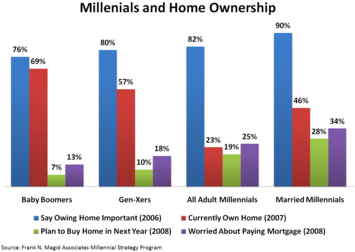
    This pattern will continue to the mid-21st century. The reasons are not hard to identify: Suburbs experience faster job and income growth, far lower crime rates (roughly one-third) and much higher rates of home ownership. While cities will always exercise a strong draw for younger people, the appeal often proves to be short-lived; as people enter their 30s and beyond, they generally prefer suburbs. This pattern will become more pronounced as the huge millennial generation — those born after 1983 — enters this age cohort.

    Over the next few decades, however, suburban communities will evolve beyond the conventional 1950s-style “production suburbs” of vast housing tracts constructed far from existing commercial and industrial centers. The suburbs of the 21st century will increasingly incorporate aspects of preindustrial villages. They will be more compact and self-sufficient, providing office space as well as a surging home-based workforce. Well before 2050 as many one in four or five people will work full or part time from home.

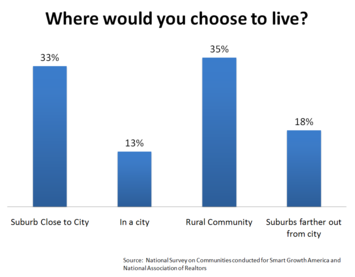
    Surveys of housing preferences consistently show that if given the choice, most Americans, particularly families, will still opt for a place with a spot of land and a little breathing room. And despite the coming population growth, most Americans will probably continue to resist being forced into density, and even with 100 million more people, the country will still be only one-sixth as crowded as Germany.

    The Rise of ‘Cities of Aspiration’

    The continuing appeal of suburbia does not mean that America’s urban centers are doomed. On the contrary, the United States will remain a nation of great cities. Throughout the history of civilization, cities have been engines for social, cultural and economic activity. The market for dense urban existence is likely to remain small compared with suburbs, but there will still be massive opportunities to provide for the roughly 15 million to 20 million new urban dwellers by 2050.

    Some urban areas such as San Francisco, Boston, Manhattan and the western edge of Los Angeles will remain highly attractive to the young, the affluent and the highly skilled, as well as some recent immigrants. After all, these cities contain many of the nation’s most vibrant cultural institutions, research centers, colleges and universities, and much of its most attractive architecture.

    These cities will sit atop the urban economic food chain, somewhat aloof from the rest of country, and will experience modest growth. But for most Americans, the focus of urban life will shift to cities that are more spread out and, by some standards, less intrinsically attractive.

    These new “cities of aspiration” — Phoenix, Houston, Dallas, Atlanta and Charlotte, N.C. — will perform many of the functions as centers for upward mobility that New York and other great industrial cities once did.

    Filling America’s Heartland

    Perhaps the least anticipated development in the nation’s 21st century geography will be the resurgence of the American heartland, often dismissed by coastal dwellers as “flyover country.” But as the nation gains 100 million people, population and cost pressures are destined to resurrect the nation’s vast hinterlands.

    Americans will head out to the hinterlands because they will find opportunities and perhaps a better quality of life. According to recent surveys, as many as one in three American adults would prefer to live in a rural area — compared with the 20-odd percent who actually do. Most Americans perceive rural America as epitomizing traditional values of family, religion and self-sufficiency and as being more attractive, friendly and safe, particularly for children.

    One critical factor in the heartland’s growing relevance is the advent of the Internet, which has broken the traditional isolation of rural communities. As the technology of mass communications improves, the movement of technology companies, business services and manufacturers into the hinterland is likely to accelerate. This will be not so much a movement to remote hamlets, but to the growing number of dynamic small cities and towns spread throughout the heartland.

    The heartland, consigned to the fringes of American society and economy in the 20th century, is poised to enjoy a significant renaissance in the early 21st. Not since the 19th century, when it was a major source of America’s economic, social and cultural supremacy, has the vast continental expanse been set to play so powerful a role in shaping the nation’s future.

    This article originally appeared at AOLNews.com.

    Joel Kotkin is executive editor of NewGeography.com and is a distinguished presidential fellow in urban futures at Chapman University. He is author of The City: A Global History. His newest book is The Next Hundred Million: America in 2050, released in Febuary, 2010.

    Photo: sparktography

  • Forced March To The Cities

    California is in trouble: Unemployment is over 13%, the state is broke and hundreds of thousands of people, many of them middle-class families, are streaming for the exits. But to some politicians, like Sen. Alan Lowenthal, the real challenge for California “progressives” is not to fix the economy but to reengineer the way people live.

    In Lowenthal’s case the clarion call is to take steps to ban free parking. This way, the Long Beach Democrat reasons, Californians would have to give up their cars and either take the bus or walk to their local shops. “Free parking has significant social, economic and environmental costs,” Lowenthal told the Los Angeles Times. “It increases congestion and greenhouse gas emissions.”

    Scarily, his proposal actually passed the State Senate.

    One would hope that the mania for changing how people live and work could be dismissed as just local Californian lunacy. Yet across the country, and within the Obama Administration, there is a growing predilection to endorse policies that steer the bulk of new development into our already most-crowded urban areas.

    One influential document called “Moving Cooler”, cooked up by the Environmental Protection Agency, the Urban Land Institute, the Environmental Defense Fund, Natural Resources Defense Council, the Environmental Protection Agency and others, lays out a strategy that would essentially force the vast majority of new development into dense city cores.

    Over the next 40 years this could result in something like 60 million to 80 million people being crammed into existing central cities. These policies work hard to make suburban life as miserable as possible by shifting infrastructure spending to dense areas. One proposal, “Moving Cooler,” outdoes even Lowenthal by calling for charges of upwards of $400 for people to park in front of their own houses.

    The ostensible justification for this policy lies in the dynamics of slowing climate change. Forcing people to live in dense cities, the reasoning goes, would make people give up all those free parking opportunities and and even their private vehicles, which would reduce their dreaded “carbon imprint.”

    Yet there are a few little problems with this “cramming” policy. Its environmental implications are far from assured. According to some recent studies in Australia, the carbon footprint of high-rise urban residents is higher than that of medium- and low-density suburban homes, due to such things as the cost of heating common areas, including parking garages, and the highly consumptive lifestyles of more affluent urbanites.

    Moreover, it appears that even those who live in dense places may be loath to give up their cars. Over 90% of all jobs in American metropolitan regions are located outside the central business districts, which tend to be the only places well suited for mass transit.

    Indeed, despite the massive expansion of transit systems in the past 30 years, the percentage of people taking public transportation in major metropolitan regions has dropped from roughly 8% to closer to 5%. Even in Portland, Ore.–the mecca for new wave transit consciousness–the share of people using transit to get to work is now considerably less than it was in 1980. In recent months overall transit ridership nationwide has actually dropped.

    These realities suggest that densification of most cities–with the exceptions of New York, Washington and perhaps a few others–cannot be supported by transit. Furthermore, drivers in dense cities will be confronted with not less congestion, but more, which will likely also boost pollution. The most congested cities in the country tend to be the densest, such as Los Angeles, Sen. Lowenthal’s bailiwick, which is in an unenviable first place.

    Then there is the little issue of people’s preferences. Urban boosters have been correct in saying that until recently there have been too few opportunities for middle-class residents to live in and around city cores. But over the past decade many cities have gone for broke with dense condo and rental housing and have produced far more product, often at very high cost, than the market can reasonably bear.

    Initially, when the mortgage crisis broke, the density advocates built much of their case on the fact that the biggest hits took place in suburban areas, particularly on the fringe. Yet as suburban construction ended, cities continued building high-density urban housing–sometimes encouraged by city subsidies. As a result, in the last two years massive foreclosures have plagued many cities, and many condominiums have been converted to rentals. This is true in bubble towns like Las Vegas and Miami; “smart-growth” bastions like Portland and Seattle; and even relatively sane places such as Kansas City, Mo. All these places have a massive amount of high-density condos that are either vacant or converted into lower-cost rentals.

    Take Portland. The city’s condo prices are down 30% from their original list price. The 177-unit Encore, one of the fanciest new towers, has closed sales on 12 of its units as of March, while another goes to auction. Meanwhile in New York half-completed structures dot Brooklyn’s once-thriving Williamsburg neighborhood, while the massive Stuyvesant Town apartment complex in Manhattan teeters at the edge of bankruptcy.

    Finally, it is unlikely that cities would be able to accommodate the massive growth promoted by urban boosters, land speculators and policy mavens. Aaron Renn, who writes the influential Urbanophile blog, says that most American cities today struggle to maintain their current infrastructure. They also have limited options to zone land for high-density construction, due in part to grassroots opposition to existing residential neighborhoods. Overall they would be hard-pressed to accommodate much more than 10% of their region’s growth, much less 50% or 60%.

    Given these realities, and the depth of the current recession, one might think that governments would focus more on basics like jobs and fixing the infrastructure–in suburbs as well as cities–than reengineering how people live. Yet it is increasingly clear that for many “progressives” the real agenda is not enabling people to achieve their dreams–especially in the form of a suburban single-family house. It is, instead, forcing them to live in what is viewed as more ecologically and socially preferable density.

    In the next few months we may see more of the kind of hyperregulation proposed by the likes of Sen. Lowenthal. It is entirely possible that a hoary coalition of HUD, Department of Transportation and EPA bureaucrats could start trying to restrict future housing development along the lines suggested in “Moving Cooler.”

    Yet over time one has to wonder about the political efficacy of this approach. Right now Americans are focused primarily on simply economic growth–and perhaps a touch less on the intellectual niceties of the “smart” form. In addition they are increasingly skeptical about climate change, which serves as the primary raison d’etre behind the new regulatory schema.

    Given the zealousness of the density advocates, perhaps the only thing that will slow, and even reverse, this process will be the political equivalent of a sharp slap across the face. Unless the ruling party begins to reacquaint itself with the preferences and aspirations of the vast majority of Americans, they may find themselves experiencing repeats of their recent humiliating defeat–manufactured largely in the Boston suburbs–in true-blue Massachusetts.

    Americans–suburban or urban–may resist a return to unbridled and extreme Republicanism, whether on social issues or in economic policy. But forced to choose between Neanderthals, who at least might leave them alone in their daily lives, and higher-order intellects determined to reengineer their lives, they might end up supporting bipeds lower down the evolutionary chain, at least until the progressive vanguard regains a grip on common sense.

    This article originally appeared at Forbes.com.

    Joel Kotkin is executive editor of NewGeography.com and is a distinguished presidential fellow in urban futures at Chapman University. He is author of The City: A Global History. His newest book is The Next Hundred Million: America in 2050, released in Febuary, 2010.

    Photo: Creativity+ Timothy K Hamilton

  • The Myth of the Strong Center

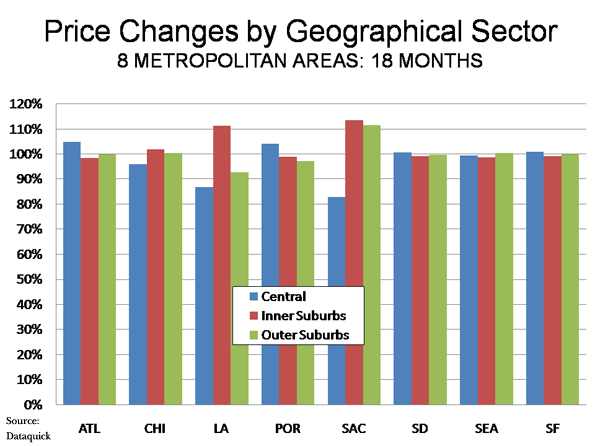
    At the height of the foreclosure crisis the problems experienced by some so-called “sprawl” markets, like Phoenix and San-Bernardino-Riverside, led some observers to see the largest price declines as largely confined to outer ring suburbs. Some analysts who had long been predicting (even hoping for) the demise of the suburbs skipped right over analysis to concoct theories not supported by the data. The mythology was further enhanced by the notion – never proved – that high gas prices were forcing home buyers closer to the urban core.

    Yet a summary of the trends over the past 18 months show only minor disparities between geographies within leading urban regions. Overall house prices escalated similarly in virtually all areas within the same metropolitan areas and the price drops appear to have also been similar. This is in contrast to a theory that suggests that huge price drops occurred in the outer suburbs while central city prices held up well.

    Summary of 18 Month Subarea Price Declines: This is indicated by a review of 8 metropolitan areas: Los Angeles, the San Francisco Bay Area, San Diego, Sacramento, Atlanta, Chicago, Portland and Seattle (see end note), for which subarea data is readily available (see table). On average, central area median house prices (all houses, including condominiums), fell 3% in relation to the overall metropolitan area average. Inner suburban areas experienced a 3% gain relative to metropolitan area prices, while outer suburban areas changed at the metropolitan area average. In actual price reduction terms, core areas declined 28.8%, inner suburban areas declined 25.7%, and outer suburban areas declined 27.1%. The overall average metropolitan area decline was 27.2%. There was, however, considerable variation in the figures by metropolitan area (see figure below).

    MEDIAN HOUSE PRICE CHANGES BY GEOGRAPHICAL SECTOR
    8 Metroplitan Areas
    CALIFORNIA MARKETS Central Inner Suburbs Outer Suburbs Overall
    Los Angeles -45.3% -30.0% -41.5% -37.1%
    San Francisco Bay -38.0% -39.1% -38.6% -38.6%
    San Diego -36.5% -37.4% -37.0% -36.9%
    Sacramento -53.6% -36.3% -37.5% -44.0%
    OTHER MARKETS
    Atlanta -11.6% -17.0% -15.8% -15.8%
    Chicago -21.0% -16.3% -17.5% -17.8%
    Portland -10.0% -14.5% -15.7% -13.5%
    Seattle -14.2% -14.7% -13.2% -13.7%
    AVERAGE -28.8% -25.7% -27.1% -27.2%
    Estimated from Data Quick information
    California Markets: July 2008 to January 2010
    Other Markets: 2008-2nd Quarter to 2009-4th Quarter

    Where Central Area Losses were Greatest: Over the past 18 months, central areas posted the largest losses in three of the areas. Further, in each of these areas, the smallest price drops were experienced in the inner suburbs.

    • Sacramento had the steepest central area relative price decline. Central area prices declined 37% relative to inner suburban prices, where the smallest losses occurred. The central area price loss averaged 53.6%, compared to the overall metropolitan area loss of 44.0%. The inner suburbs experienced the smallest loss, at 36.3%.
    • Los Angeles also had a steep central area relative price decline. Central area prices declined 45.3%, compared to the overall metropolitan area loss of 37.1%. The inner suburbs experienced the smallest loss, at 30.0% while outer suburbs lost 41.5%.
    • Chicago’s greatest losses also occurred in the central area, but were of a much smaller magnitude. Central area prices declined 21.0%, compared to the overall metropolitan area loss of 17.8%. The inner suburbs experienced the smallest loss, at 16.3%. The outer suburbs lost 17.5%.

    Where Suburban Losses were the Greatest: In two areas, the central area price losses were the least, Atlanta and Portland. Yet, the magnitude of these losses was modest. It is interesting to note that the metropolitan areas with the smallest relative losses in the central areas pursued radically different policies with respect to development. Portland’s “smart growth” policies favor central development at the expense of suburban development, while Atlanta’s more liberal policies do not attempt to steer development to the core.

    • Atlanta’s greatest price declines occurred in the inner suburbs, which experienced a loss of 17.0%, slightly more than that of the outer suburbs (15.8%). In comparison, the central area price drop was the least, at 11.6%, The metropolitan area loss was 15.8%.
    • Portland’s greatest price declines occurred in the outer suburbs which experienced a 15.7% loss, compared to the inner suburbs, at 14.5. The lowest decline was in the central area at 10.0%. The metropolitan area loss was 13.5%.

    Little Difference in Some Markets: There was little difference in the price declines among geographic sectors in three of the metropolitan areas. In the San Francisco Bay area, San Diego and Seattle, the differences between central, inner suburban and outer suburban price declines were all within a 2% range.

    Core Condominium Market Crisis

    However, core area markets where condominiums predominate indicate substantial difficulties in some of the metropolitan areas. These markets are generally only a small part of central cities, principally around downtown areas or major centers. For example, in the Portland area, the core condominium areas ring the downtown area and include the Pearl District and the South Waterfront District. The central area, which encompasses the entire city of Portland, however, is much larger and has a much larger share of detached housing.

    Demand has been so weak in the core condominium markets that substantial price reductions have occurred and a number of buildings have been forced to sell units at auction. Other buildings have given up altogether on selling and have rented condominiums. Some of the price drops, especially in Atlanta, Portland and Seattle are far greater than occurred overall in the respective metropolitan markets. The condominium implosion has not received nearly the level of attention in the national or local media that was accorded the housing bubble and collapse itself.

    Portland: A local television station video indicates that Portland’s condominium market is in crisis. A report in The Oregonian indicates that the downtown area has a “glut” of condominiums and that February sales prices averaged 30% below list. A luxury new 15-story building in the Pearl District (The Wyatt) is now being leased instead. Units at The Atwater in the South Waterfront district were auctioned, with minimum bid prices more than 50% lower than list. The John Ross, also in the South Waterfront District, is Portland’s largest condominium project and will be auctioning its units. Minimum bid prices average 70% below the previous top list prices. The smallest units have a minimum bid price of $110,000. By comparison, over the past year, the median house price in the Portland metropolitan area has dropped approximately 10%.

    Atlanta: Atlanta has a “vast oversupply” of condominiums. The uptown (including Atlantic Station) and Buckhead markets of Atlanta appear to be experiencing some of the worst market conditions in the nation. The prestigious Mansion on Peachtree, a combination hotel and condominium development, was unable to sell 75% of its residences and was recently sold in foreclosure at approximately $0.30 on the dollar. The winning auction bids at The Aqua condominium in Uptown averaged 50% below the last asking price. In Atlantic Station, units at The Element were auctioned at substantial discounts. Among conventional sales, condominium price reductions of up to 40% have been reported. One building has offered discounts of $100,000 per bedroom. Some new buildings have been converted to rentals, while planned projects have been placed upon hold.

    Seattle: Things are little better in Seattle. The overbuilt downtown area condominium market has experienced a median price decline of 35% over the past year. Units at The Gallery in tony Belltown were auctioned off at minimum prices 50% below the last list prices (which had already been discounted). Units at The Brix, on Capitol Hill, attracted bids at auction averaging 30% below previous list prices. Later this month, unsold units at 5th & Madison will be auctioned, at minimum prices below 50% of previous list. For comparison, median house prices in the Seattle metropolitan area declined 6% over the past year.

    Chicago: The downtown area of Chicago has been among the most vibrant condominium markets for more than a decade. However, in 2009, condominium sales fell to the lowest level since 1997. At current sales rates, the downtown area has a supply of more than five years, with annual sales of less than 600 and more than 3,000 units available or under construction.

    Los Angeles: Few markets have seen as many condominium buildings planned as downtown Los Angeles, and few have seen so many put on hold. A recent issue of the Los Angeles Downtown News lists approximately 50 downtown condominium projects. More than three-quarters of the projects have been scaled back, have had construction slowed or are on “hold.” The market has been so weak that a number of developers have taken losses by auctioning condominium units that they have not been able to sell conventionally.

    San Diego: The downtown San Diego condominium is substantially overbuilt. Developers have leased units that were to have been sold and there is virtually no construction of new units.

    Rental Conversions: Even these grim reports, however, may mask an even bigger problem. It is estimated that more than 20,000 condominiums units are completed or nearly completed, but are not listed for sale in Miami. In what is by far the nation’s strongest condominium market, Manhattan, more than 6,000 condominium units are completed or nearly completed, but not listed for sale.

    In core cities, few issues have been as divisive as the conversion of rental units to condominiums. But, now the opposite is now occurring – condominiums are being converted into apartments for rent: This is trend that undermines markets in a way that cannot be measured by median prices, since it replaces generally high-paying condo owners for generally less flush renters. This puts those who bought at higher prices in these markets at a particular disadvantage.

    Conclusion: Overall, contrary to the mythology developed early in the bubble, suburbs and even exurbs have generally performed about as well as closer in markets. The big imponderable will be the future of the core condominium market, which is experiencing significant financial reverses largely ignored by the national media.


    Note: As used in this article, the Los Angeles metropolitan area is the Los Angeles-Riverside Combined Statistical Area, the San Francisco area is the San Francisco-San Jose Combined Statistical Area and all other metropolitan areas are the corresponding metropolitan statistical areas. http://demographia.com/db-prdistr2010.pdf>Subareas defined.

    Photograph: Condominium construction, Atlanta, weekend of the Lehman Brothers collapse.

    Wendell Cox is a Visiting Professor, Conservatoire National des Arts et Metiers, Paris. He was born in Los Angeles and was appointed to three terms on the Los Angeles County Transportation Commission by Mayor Tom Bradley. He is the author of “War on the Dream: How Anti-Sprawl Policy Threatens the Quality of Life.

  • Green Wash: The Church of Sustainability

    The term green-wash is used to describe something that has been promoted as ‘green’, but is not. Has the term ‘sustainability’ worn out its welcome as well?

    I am a long time adviser to the board of Sustainable Land Development International. Like many other organizations, they market themselves as producing sustainable land developments through new technologies and methods in design. We often use the term “sustainable” in relation to a concept called the “Triple Bottom Line”: People, Planet, and Profit, endorsed by the United Nations in 2007 for urban and community accounting.

    On March 11th, I will have the honor to be the keynote speaker at the California League of Cities conference in Anaheim. When I speak, it is typically on the topic of sustainable solutions. This time, I was astonished to learn that the term sustainability had become green-wash and that I should avoid using it!

    Individual perspectives (or goals or agendas) can easily color the meaning of sustainability. For example, an environmental engineer might want to promote elements of land development that makes his or her career more important and personally satisfying. All of us have personal agendas that make our brief existence on this planet more meaningful, sometimes at the expense of others or even the very thing we are trying to promote. Often we unwittingly become our own worst enemy.

    At one time our firm began a relationship with one of the largest environmental engineering firms. When we spoke to their engineers about reducing pollutants from rain run-off caused by development it became clear that their only agenda was to eliminate, not to reduce, pollutants. Eliminating pollutants on a land development certainly is possible, but would not be in any way financially feasible. This firm had built a reputation and won over some very large non-profit organizations that fueled their success. Surely the engineers had their self-esteem (egos) inflated. If the developments they designed had to be financially viable without huge non-profit subsidies, they surely would have failed — spectacularly. They were artificially sustainable. Our goal was to use their expertise to create methods that would not add a penny to land development costs compared to conventional construction. We believed pollutants could have been reduced somewhere between 10% and 30%, which would have a significant international impact. As we began to work together it became quite apparent that our agendas were much different, and the relationship withered. Their all-or- nothing approach was not a balanced one, nor was it sustainable.

    Nearly two decades ago when I developed “Coving” as a method to design projects, my own ego got in the way of progress. At the time, the New Urban momentum had begun to grow. I aggressively compared the advantages of Coving to the grid form of traditional development as well as to conventional subdivision design. Reducing streets — “Coving” — by 20% to 50% without reducing density in comparison to a traditional grid certainly had benefits, but the attempt to push an agenda by reducing the importance of others agendas does not win friends, and New Urbanism had already won many converts.

    Coving by itself is only a streetscape design method, nothing else. The efficiency of coving opened up new opportunities to create more functional and financially viable development. . Both coving and the traditional grid pattern rely solely on the performance of the developer and builders to construct to a high level of architectural and landscape standards. The New Urbanism expanded upon the traditional grid to include a strict standard that included many details. Coving remained only a streetscape design method, void of these details. In the hands of a substandard developer with builders who cut corners, both Coving and New Urbanism have resulted in some embarrassingly awful land developments, tarnishing both movements reputations. Coving, particularly because of its financial advantages, seemed to attract some of the worst culprits. Unfortunately, in land development the time from concept plan to enough of a built environment to see the “finished” product can be between two and five years. We had become our own worst enemy by focusing too much on the financial benefits of a design method and not enough on other aspects.

    There were still some spectacular developments that resulted, but there was no mechanism in place to assure great neighborhoods. By the end of the 1990’s it was clear that “our agenda” needed to be modified. In an attempt to achieve a more sustainable world, we had concentrated on a singular goal, not a balanced approach. This meant we needed to step back and look at all the elements of land development to create a balanced approach where no one agenda held the others hostage. Ultimately this led to the creation of a comprehensive approach to land development we coined as Prefurbia.

    Land planning today has become like a religion that requires unwavering devotion. But those who embrace only one approach as the ultimate utopian mega-metropolis design to solve all social ills are fools: There is no singular solution for land development. Not the New Urbanism, not Smart Growth, not Prefurbia. Good planning is not about pointing fingers. It is easy to blame the automobile, blame developers, and blame government. But it is up to those people responsible for growth — stakeholders such as the developer, builders, city staff and council — to determine the best possible path that will result in a legacy for future generations instead of a blighted project that served to fill the bank account of the developer.

    It is also up to the stakeholders to investigate and learn the various options available for growth. If a city planning commission or council member does not have the time to learn the different land development options available today, well, they should step down and be replaced by someone who cares.

    All of this brings us back to the term ‘sustainability’. The dictionary defines it as ‘Capable of being continued with minimal long-term effect on the environment’. Here is the problem: The dictionary does not include the long term affect on economics (affordability) and living standards. Did we create something great for the ducks, but an eventual blighted neighborhood, or a gentrified one exclusively for the wealthy?

    My view of how to be sustainable is simple: Do our best to create places that will still be wonderful, livable, affordable, and environmentally responsible for future generations. If we do, we will have created places that will be sustainable, no matter what planning religion we worship.

    Rick Harrison is President of Rick Harrison Site Design Studio and Neighborhood Innovations, LLC. He is author of Prefurbia: Reinventing The Suburbs From Disdainable To Sustainable and creator of Performance Planning System. His websites are rhsdplanning.com and performanceplanningsystem.com.

  • Suburban Design: Square Peg In A Round Hole

    Remember that Fisher Price toy – “Baby’s First Blocks”? It was supposed to teach us one of life’s first lessons: Place a square shape in a square hole, and a round shape in a round hole. We’re supposed to understand this idea before we learn to say our first words, or to walk. Yet in the development of our neighborhoods, we have put that square shape into every hole, no matter what the shape of that hole.

    In past centuries land was primarily developed with one pattern – the grid — because it was simple to calculate the geometry and stake out in the field. No matter what you have read about the “town square” and the advantages of the “grid pattern”, the reason for the grid was simply that it sidestepped the painstaking task of manually calculating the land development plat when curves were involved. Forested areas were routinely clear-cut, and swamps (today’s wetlands) were filled in. Those were the days during which development was straight-forward and simple: develop land while destroying what nature provided on the soil. Natural topography, which is certainly not based upon the grid, was bulldozed into oblivion.

    In the 1960’s, newer forms of site design became commonplace, primarily in the exploding suburban landscape that rose after urban-core riots fueled what was then known as “White Flight”. This newer form of design introduced more curved patterns. Unlike the grid, the occasional curve broke up the monotony, and submitted site plans began to look more interesting. These new patterns were the start of a desire to follow the natural shape of the terrain.

    But in the 1960s we did not have an awareness of the environmental damage of development that we posses today. As automation in computations, drafting, and land surveying technology began to reduce the workload of non-gridded designs, the curved pattern became more commonplace. This transition is easily seen by visiting any city’s land records and looking at the changes in land development patterns of recorded plats since World War II.

    For decades, the curved patterns were designed by individuals who concentrated on density goals by squeezing every hundredth of a foot allowed by ordinance. Curved streets conform to the random contours of nature much better than the grid, and the curved pattern, if correctly designed, can be extremely efficient while delivering connectivity for vehicles and pedestrians. That is, if the land planner knows how to design these systems. But patterns that would harness any delivered vehicular and pedestrian connectivity were not part of the plan. Without concentrating on harnessing the curved patterns to create functional traffic systems, so-called “land planners” — and anyone can still become a land planner simply by adding the term ‘land planning’ to their business card — provided plenty of ammunition to the New Urbanism movement’s attacks on curved design.

    In any case, with the use of curved patterns land development broke away from sole use of the monolithic square shape, and introduced two new primary shapes: An inner pie shaped lot and an outer pie shaped lot. For more than a half century, these three basic shapes have defined the majority of the growth pattern for American development.

    These three basic shapes have been the foundation on which we have built millions upon millions of new homes. We have been placing that square shaped home in the triangular hole as if one of the first lessons we were taught was meaningless. Those toy blocks were supposed to teach us to take advantage of the shapes in life that we are offered. Apparently the architectural community, as well as the building industry, ignored this opportunity, until now.

    Home builders large and small have used the same basic shape, as if all lots were only rectangular. Even homes that have garage snouts and are often anything but rectangular in shape are set by civil engineers with a house “pad” that is based on the square. I’m pretty sure most of these engineers were brought up with the Baby’s First Blocks, or something similar. Forcing a square shape into a triangle shape results in a bigger triangle than need be, or making the square much smaller than necessary. In other words, we have built a quite inefficient world for over half a century.

    In an effort to create a more sustainable world, we are developing new methods to design neighborhoods. Part of the effort to eliminate the tremendous waste in land development has been to reassess architecture as part of the overall function of the neighborhood. This became much more critical as we developed Performance Planning System, which was created to teach sustainable development design methods. It quickly became apparent that there was a tremendous void in the opportunities to incorporate new forms of architecture, especially in developments with curved patterns.

    The square home that fits on the square lot does not offer much real opportunity for change. But the other two basic shapes invite new efficiency and value to the home buyer, critical in this down housing market. Homes that are shaped to fit on the inside of the curve can be wider in the front…much wider. This results in a home that does not have to be as deep, essentially making the rear area useable as well because of extra rear yard depth, while providing the same useable square footage. The extra width makes the garage less prominent, and creates much more viewable area from within the home that looks out on the larger rear yard and the streetscape. The home that’s wider in the front allows a bigger porch area and greater opportunity to tie living areas to the street. Less of the side of the home is exposed, and the streetscape becomes more attractive, enhancing that all-important curb appeal.

    The outer side of a curved shape is the opposite pie shape. In this case we can create a stronger tie to the larger rear yard (the outer curves have larger rear yards than a rectangular lot). Like the inner pie, there is more width opportunity to create a home that maintains a target square footage, yet is less deep, again creating an ever larger useable rear yard.

    Perhaps even more important is that we can use these new patterns either to make larger homes, to create larger, more useable yards, or to create non-rectangular pad shapes that adhere to the letter of the law (ordinance regulations) while gaining density and reducing neighborhood sprawl. Actually we can easily accomplish all three!

    So what do the home builders think? In this down economy there is little opportunity to for trends to develop, but in almost all cases where we have promoted this idea builders have embraced it. These developers have included one of the largest home builders in North America, and one of the most respected in Texas.

    The amount of waste we can eliminate by using the lessons that were supposed to be taught with our First Blocks is enormous. And it comes just in time to give builders that extra edge in today’s tough market.

    Rick Harrison is President of Rick Harrison Site Design Studio and Neighborhood Innovations, LLC. He is author of Prefurbia: Reinventing The Suburbs From Disdainable To Sustainable and creator of Performance Planning System. His websites are rhsdplanning.com and performanceplanningsystem.com.