Category: Suburbs

  • Decentralize The Government

    From health care reform and transportation to education to the environment, the Obama administration has–from the beginning–sought to expand the power of the central state. The president’s newest initiative to wrest environment, wage and benefit concessions from private companies is the latest example. But this trend of centralizing power to the federal government puts the political future of the ruling party–as well as the very nature of our federal system–in jeopardy.

    Of course, certain times do call for increased federal activity–legitimate threats to national security or economic emergencies, such as the Great Depression or the recent financial crisis, for example.

    Other functions essential to interstate commerce–basic research, science education, the guarantee of civil rights, transportation infrastructure, as well as basic environmental health and safety standards–also call for federal oversight. Virtually every modern president, from Roosevelt and Eisenhower to Reagan and Clinton, has endorsed these uses of centralized government.

    But what is happening now goes well beyond the previously defined perimeters of the federal government’s powers. Obama seems to possess a desire not so much to fix the basic infrastructure of the country but to re-engineer our entire society into the model championed by liberal academia.

    There also seems to be a conscious design to recreate the country as a European-style super-state. Forged by an understandable urge to minimize chaos after a century of conflict, the super-state generally favors risk management through centralization of authority. This has traditionally been accomplished by ceding regulatory powers to national capitals, though lately more and more powers have been ceded to the European Union.

    Initially the administration had hopes of imposing similar controls through acts of Congress. However, with the shifting political mood, this seems less and less possible. With its latest action the administration sends the message that it will now impose the desired results through the bureaucracy. Under the proposal, private firms that do not raise wages will be bullied into doing so through the manipulation of federal contract awards.

    This marks a departure from our basic traditions. For most of our history the burden of expanding opportunity has rested with the private economy, albeit in conjunction with often necessary protections for workers and consumers. Now the overall control of the economy is shifting to Washington–from government contracts to ownership shares in companies like General Motors and much of the financial sector.

    This new order would transform the very nature of American capitalism. Now the economic winners will not be those working for the most agile or profitable companies, but those who gain the blessings of the federal overlords. In some senses this extends the corrupt, largely failed political economy of Chicago politics to a bastard American form of French dirigisme.

    Climate change provides another critical and necessary rationale for the expansive federal role. With the “cap and trade” system all but dead, the administration now wants to regulate energy and land use through the gentle graces of a largely unaccountable EPA apparat. As a result, we may see energy use, land use and transportation–as is increasingly the case in California–controlled by the whims of the unelected bureaucracy.


    Such command and control approaches have their advantages in making people do what the mandarins demand. This is one reason there are so many admirers of Chinese autocracy now. In that regime, unlike our messy democracy, you can be forced to be green in precisely the way they tell you. There are always firing squads for those who go off the program.

    Of course, even the most passionate centralists don’t advocate adopting the Chinese model. But the notion of an enlightened super-state has long appealed to those disgusted with American-style muddling through. In some ways, the current fashion recalls Americans’ attraction for the Soviet Union or even fascist Italy during the troubled 1930s.

    Fortunately, most Americans do not appear ready for unbounded autocracy. This is particularly true outside the coastal urban centers. The Tea Party may have some cranky–even ill-advised–ideas, but they reflect a genuine–and broader–American preference for solving problems at the state or local level.

    Indeed, Americans, including some on the left, are instinctive decentralists. We express this tendency physically, first in our decades-old movement to the suburbs, and increasingly to smaller towns and cities as well as rural areas. Even in cities like New York or Los Angeles, local neighborhood identity trumps ties to more grandiose visions of City Halls or regional bodies. The rise of the Internet and social networks has enhanced this decentralizing trend by providing instant linkages and helping ad hoc organization among neighbors.

    Economic evolution mirrors this trend. Over the past few decades U.S. employment has shifted not to mega corporations but to smaller units and individuals; between 1980 and 2000 the number of self-employed individuals expanded 10-fold to include 16% of the workforce. The smallest businesses–the so-called micro enterprises–have enjoyed the fastest rate of growth, far more than any other business category. By 2006 there were some 20 million such businesses, one for every six private sector workers.

    America’s entrepreneurial urge, in contrast to developments elsewhere, has actually strengthened. In 2008 28% of Americans said they had considered starting a business–more than twice the rate for French or Germans. Self-employment, particularly among younger workers, has been growing at twice the rate of the mid-1990s.

    The remarkable volatility within even the largest companies has exacerbated this trend. Firms enter and leave the Fortune 500 with increasing speed. More and more workers will live in an economic environment like that of Hollywood or Silicon Valley, with constant job shifts, changes in alliances between companies and the growth of job-hopping “gypsies.” Although hard times could slow new business formation, historically recessions have served as incubators of innovation and entrepreneurship.

    Much of the most dynamic and meaningful change takes place under the radar of both big business and government. The shift to greater localism can be seen in the growth of local, unaffiliated community churches, regional festivals and farmers markets. Bowling clubs and old men’s clubs may be fading, but volunteerism has spiked among millennials and seems likely to surge among baby boomers. In 2008 some 61 million Americans volunteered, representing over a quarter of the population over 16.

    No other major country exhibits this kind of localized, undirected activism. Such vital grassroots may become even more important as the country becomes more diverse. In the coming decades we will have to accommodate an expanding range of locally preferred lifestyles, environments, ethnic populations and politics. One size determined by mandarins in Washington increasingly will not fit all. South Dakotans and San Franciscans will prefer to address similar problems in different ways. Within the limits of constitutional rights, we should let them try their hand and let everyone else learn from their success (or failure).

    Ultimately, we do not want to recreate the expansive mandarin state so evident in many foreign countries. Instead, we should focus more on family, community, neighborhoods, local jurisdictions and voluntary associations–what Thomas Jefferson called our “little republics”–as the most effective engines driving toward a better future.

    This article originally appeared at Forbes.com.

    Joel Kotkin is executive editor of NewGeography.com and is a distinguished presidential fellow in urban futures at Chapman University. He is author of The City: A Global History. His newest book is The Next Hundred Million: America in 2050, released in Febuary, 2010.

  • What is the Answer to the Suburban Question?

    We have recently assembled a special issue of the journal Cities with the title “The Suburban Question”, and we assume that many readers will assume the answer is “who cares”? The term ‘sub-urbs’ connotes a lesser form of urban life, and for decades it has been used dismissively to denote anything plastic, even hypocritical. Novelist Anthony Powell described one of his unsympathetic characters possessing a ‘‘face like Hampstead Garden Suburb”; the New York Times recently described architect Robert Stern as ‘‘a suede-loafered sultan of suburban retrotecture”. In the old days, record stores had ‘urban’ bins full of gangsta, but nothing marked ‘suburban’, although it is always easy to use the suburbs as a backdrop for duplicity, as in American Beauty, or the first series of Weeds (set in a gated community, a double score!).

    There has been some academic attention—Dick Walker, David Harvey, and of course Kenneth Jackson all wrote lasting pieces about the suburbs. But in these, they always appear as objects of inquiry, rather than subjects in their own right; and if academics live amongst the ‘little boxes of tickytacky’, they rarely write about them. This is more than unfortunate, for many reasons—the most obvious is that by most definitions, most of us are indeed suburbanites. But while there are endless dissertations on public housing, the decline of the inner city, and the much discussed revitalization of the inner city, there is precious little on their further-flung counterparts.

    It’s hardly the case, to answer the unspoken question, that there is nothing interesting to research ‘out there’. What about updating research on the ‘growth machine’? No one has really done any detailed work on the complexities of the home building industry, with its rigid design aspirations and complex financial connections. There is the gated community, which is still portrayed as ‘Fortress America’ even though there are significant proportions of Hispanic households living in gated communities, and many of these are rental properties and not the upscale compounds portrayed in textbooks. And there is the Home Owner Association. Despite the fact that millions of Americans live in them, relatively little research has been done on this important aspect of governance since the term ‘Privatopia’ was coined nearly two decades ago.

    A few authors have tried to push back against this indifference, arguing that suburbs appear to be ‘good places for most people’. Yet the reality that affordable homes-and-gardens are unquestionably popular does not seem to matter. In almost any manner imaginable, the suburban lifestyle has been savaged. Sprawl causes obesity; it destroys downtowns; it causes global warming. In Metroburbia, Paul Knox argues that the suburbs have turned us into monsters of capitalist consumerism, the sagging SUVs necessary to carry the wobbling masses from mall to McMansion.

    It is easy to argue that American suburbs are unsustainable, but to echo Peter Marcuse’s famous rhetorical question—‘sustainable for whom?’ Vibrant cities—New York, San Francisco, Boston—are expensive cities, and while that fabled creature, the Creative Worker (homo Floridian) is willing and, more importantly, able to pay large sums to live in very small spaces, most of us are not. Suburbs have attracted paying customers precisely because housing costs are low and conditions are attractive. Not many cool public spaces, but that’s less important to most people past their college years.

    This is the backdrop to the papers that we have collected in our special issue. Its aim is to present work that asks ‘what is happening in the suburbs, in terms of the built form, the economy and social relations’. They are not necessarily written ‘in defense of suburbs,’ but engage suburbs as if they matter. Nick Phelps leads off by emphasizing the contribution that suburbs make to our local and national economies. He reminds us of the transfers there of jobs and the growing importance of suburbs to the urban region and the economic health of our nations. He closes with an urgent reminder that the “economic centrality of suburbs within the contemporary economy should, perhaps more than anything else, signal the need for a re-balancing of urban studies to be more fully suburban in academic and policy focus.”

    A perfect example of this appears in a study of Phoenix by Carol Atkinson Palombo and Pat Gober. Their analysis of new housing construction in the prior two decades indicates trends that span different types of multi-family housing in suburban locations. They note, “densification no longer equates to urban infill but takes many forms and occurs all over the metropolitan region”. A complementary article by Roger Keil and Douglas Young focuses on their empirical work in Toronto, and especially what they have termed ‘the in-between city’. These places are “not quite traditional city and not quite traditional suburban”, forgotten geographies where many live and where their infrastructure reminds us that the placing of ‘urban versus suburban’ neglects the many shades of in-between urban places that require planning and policy attention.

    Toronto is the focus of another paper, in which Susan Moore explores the tenets of New Urbanism. In four case studies, she explores sub/urban forms, showing that the general edicts of the “densification-is-good” movement are contextualized in different settings, and reveals endless rounds of compromises between developers, planners, politicians and residents. In the end, this design imperative is unable to transcend the “urbanization of the suburbs or the suburbanization of the urban,” and once more we are challenged by the need to confront the assumed distinction between urban and suburban developments, or even cities and suburbs themselves.

    This theme is given additional attention in a further paper, by noted Turkish urbanist Feyzan Erkip, whose work explores, and contrasts, the new manifestations of Westernization in Ankara—malls and gated communities—with more traditional neighborhoods. She finds little difference between the views of the populations in the old and new, but the meanings that these new design features take on are very much conditioned by their context. For instance, the malls have a liberating veneer for Turkish women, who feel socially threatened in the streets but not in the private shopping districts. Conversely, gated communities adopt familiar design features but unlike their Western counterparts, these are essentially up-scale squatter settlements; this indeterminate legal status is attractive for some residents because it makes their homes less open to search by law enforcement or tax officials.

    We conclude our collection, and this piece, with a simple response: the answer to the suburban question is that they possess a rich history and a dynamic present and therefore demand more attention and a serious research agenda. We call for more academic attention to be given to places where a majority of Americans, many Europeans, and a growing number of Asians, Africans, and Latin Americans live. Urban studies should either become inclusive of all parts of the city—from edge to center—or the field of Suburban Studies, spearheaded by the New Suburbanism, is long overdue.

    Andrew Kirby is the editor of the interdisciplinary Elsevier journal “Cities.”This is his 20th year as a resident of Arizona. Ali Modarres is an urban geographer in Los Angeles and co-author of City and Environment.

    Photo: urbanfeel @ flickr

  • Land Planning: Put Tech and Team on The Same Page

    Technological advances allow Civil Engineering and Land Surveying professionals to perform, in minutes, tasks that would have taken days or weeks before computer usage became widespread. I have been fortunate to have been part of the technology industry from its humble beginnings. In the 1960s, working for a Land Planning firm, I began inventing devices to reduce the time it took to draft plans. These contraptions would hang on the wall, jokingly labeled Rickometer1, Rickometer2, etc. My systems allowed me to get the plans out faster, but the designs were no better because of these devices.

    Fast forward four decades and nothing has changed.

    For all the technological advances in the land development design industry, not a single design solution has evolved beyond today’s prevalent cookie-cutter planning patterns. We can knock out plans ever faster, but rarely better.

    Why Has Technology Failed To Improve Planning?
    This is something I’ve wrestled with over the past several years as I developed my latest industry offering: Performance Planning System (PPS). Originally I had thought the problem of moving the development industry forward was lack of communication, understanding, and in some ways respect between consultants in surveying, engineering, planning & architecture.

    For example the numbers pros(civil engineers and land surveyors) fear working with the vague and terribly inaccurate freehand work of the artist pros (planners, architects, landscape designers, etc). The artists mistakenly think that if their work goes into a Computer Assisted Design (CAD) system, it somehow magically becomes accurate. To stereotype for a moment, these different consultants often have very different personalities. The artists and numbers people are not likely to be found in a friendly chat at the corner coffee stand, unless forced together by a business meeting.

    The land development related software industry is competitive, but mostly controlled by the big three companies: Autodesk, ESRI and Bentley. All three offer land development design “add-ons,” but none offer a true “land planning” system expanding beyond the cookie-cutter recipe. Another problem is that software terminology is specific to the particular industry it serves. As such, the planning terminology typical of, say, a Geographic Information Systems (GIS) package would not be part of a civil engineering software package. Land surveying-specific terminology would never show up in an architectural package. All of these software giants have done a glorious job of allowing their “users” to get the job out faster. But we need to create wonderful neighborhoods, not faster subdivisions.

    Civil engineers and land surveyors must be extremely accurate, because the plans they produce are legal documents. The basis of their plans is coordinate geometry, which tracks points tied to a numbering system. This “point numbering” system, introduced in the 1970s, introduces complexity; it’s an instance where automation increases tediousness.

    Changing The Course Of Land Development
    Putting technology aside, a host of other factors have prevented land planning from moving forward in the right direction. In the past two decades our land planning firm developed new methods to design neighborhoods that would significantly reduce the infrastructure and environmental impacts of development, while maintaining the density of conventional and Smart Growth design alternatives. This evolved into providing exciting neighborhoods with lower housing costs.

    In other words we developed a higher level of land development practices through methodology that was not device dependent, but instead, knowledge driven. To teach this knowledge, we worked with Sustainable Land Development International (SLDI.org) to produce the book Prefurbia-Reinventing the Suburbs from Disdainable to Sustainable. The book sets a foundation for a new way to think about land development design and regulations.

    When we wrote Prefurbia we retained Rickard Kronick, an author who specializes in the history of architecture, to investigate the various college courses in planning offered in the USA. All offered Urban Design courses. None were specific to suburban design. Suburban development represents 80% of the growth in the USA. Did you ever wonder why suburban planning and design has stagnated? Wonder no more!

    Next, we developed an advanced coordinate geometry design software that eliminated the tediousness of point number management. This new software would blend common terminology of the various land development consultants, in an effort to break down communication barriers between designers and engineers.

    Finally, we planned to expand the platform to a series of college level courses for low-impact suburban design. I approached a multitude of urban planning professors to seek help with this project. None were interested.

    It was time to re-evaluate. Reality check: There will never be software functions that will create wonderful, vibrant neighborhoods that are environmentally sound and economically feasible. A software function only automates complex tasks into less keystrokes. This guarantees monotony if everybody uses the same package. In order to advance planning we must improve that other software… you know that stuff that lies between your ears!

    Creating a New End User
    So we decided to create a system that would create a better end user. This meant teaching those number pros design methods that create character and value, and giving the artist pros a foundation in engineering and surveying. Teach how to recognize the tremendous waste in design to create more efficient development. Teach the importance that architecture plays in every development, not just from a façade (front porch) perspective. Teach how to integrate the interior floor plan as a component of the overall neighborhood functionality. The world is designed using ordinance minimum requirements that result in minimal projects. Teach how to design beyond the minimums.

    In other words, teach low impact design that embraces the environment as well as the developers profitability. We teach what can go terribly wrong when attempting “green” goals. We estimated that the entire cost to us to expand the product into something that educates is less than $10 a package (per student). We also intend for this system to be a portal inviting others to contribute to the educational material.

    Make no mistake – this does not mean we have made anything “easier” for the land development industry. Just the opposite. The knowledge base is extensive, and each new element adds a layer of thought to the planning process. In time we will know if this experiment in a new approach to design will yield the intended results, and create a more sustainable world.

    Rick Harrison is President of Rick Harrison Site Design Studio and Neighborhood Innovations, LLC. He is author of Prefurbia: Reinventing The Suburbs From Disdainable To Sustainable and creator of Performance Planning System. His websites are rhsdplanning.com and performanceplanningsystem.com.

  • How the new Apple iPad (and other mobile tech) changes the commuting equation

    Apple’s much anticipated iPad tablet computer was announced today, albeit to some mixed reviews. While the iPad itself may or may not succeed, the overall technology trend line is clear: increasingly rich mobile access to the Internet and email. Oddly, this Business Week columnist thinks the iPad may lead to more telecommuting, when what it really favors is tipping the balance for commuters from driving to transit, where the usually “dead” commuting time can become really productive. Most people are already spending more than two hours a day on email and the Internet – why not put those hours at the beginning and end of the day while commuting so you can spend less time in the office and more time with your family?

    A decade ago, the workplace was much more call and voice-mail driven, which matched up just fine with long driving commutes and cell phones. But the shift has moved strongly towards email and other data-driven communications (texting, Twitter, Facebook, collaboration applications, etc.). Most messages have multiple recipients and can expect to have a string of replies – something voice mail simply can’t handle. People are trying to do this data-driven communication while driving, with very bad effects that are leading rapidly to a comprehensive legal ban.

    As more people realize the productivity advantage of a transit commute, I think there could be a substantial shift. But it might not be quite what you’d expect. Mobile productivity favors one long ride in a comfortable seat – no transfers, no standing ‘strap-hanging’ (like on a subway or full light rail or local bus), and minimal walking (which is not only incompatible with mobile productivity, but also has weather risk and is especially hard on women in heels). That argues for express buses over trains. I recently met with a friend that lives in Manhattan but works in Connecticut. Does he take the subway and then ride the train? Nope – a luxury shuttle bus with wi-fi picks him (and the other Manhattan employees) up right near his apartment and drops him at the front door of work. Point-to-point express buses are the future of commuting. All you need are a couple dozen people that need to get from the same neighborhood to the same job cluster on roughly a similar schedule to justify a daily round trip – and they can all be productive the whole way, whether through individual 3G data connections on their devices or wi-fi on the bus (by far the cheapest option).

    While the climate-concerned may cheer increased transit use, an ironic side effect may actually be increased sprawl. When commuting is truly unproductive time, as driving is, people really hesitate for it to be more than an hour a day, which puts a pretty hard limit on how far home can be from work. But if you can be productive on a bus doing work you’d have to do anyway, you might consider two or more hours a day commuting (as my Manhattan friend does) and look at exurban communities you wouldn’t have even considered before, especially if they have more affordable or newer houses with better amenities and public schools.

    This is the commute of the future, and cities that offer it conveniently, affordably, and comprehensively (all neighborhoods to all job centers) through some combination of public transit, private buses, and HOT lanes will continue to grow and thrive in the coming decades, while those that don’t, won’t.

    This piece is a cross-post from HoustonStrategies.com

  • Housing Unaffordability as Public Policy: The New Demographia International Housing Affordability Survey

    The just released 6th Annual Demographia International Housing Affordability Survey shows some improvement in housing affordability, especially in the United States and Ireland but a continuing loss of housing affordability, especially in Australia.

    The Survey, co-authored by Hugh Pavletich of Performance Urban Planning, covers 272 metropolitan markets in 6 nations (the United States, the United Kingdom, Canada, Australia, Ireland and New Zealand). The Survey estimates housing affordability using the “Median Multiple,” which is the median house price divided by the median household income. As recently as the late 1980s, the Median Multiple virtually everywhere was 3.0 or below. Over the past 10 to 20 years, however, the Median Multiple has risen worryingly in all major markets of the United Kingdom, Australia, New Zealand and Ireland and in some markets in the United States and Canada.

    Housing affordability is rated on a four category scale, from “affordable” to “severely unaffordable” (Table 1).

    Table 1
    Demographia Housing Affordability Rating Categories

    Housing Affordability Rating

    Median Multiple

    Severely Unaffordable

    5.1 & Over

    Seriously Unaffordable

    4.1 to 5.0

    Moderately Unaffordable

    3.1 to 4.0

    Affordable

    3.0 or Less

    Affordable Markets: The Survey found affordable markets in both the United States and Canada. This included fast-growing markets, such as Atlanta, Dallas-Fort Worth and Houston, which have had the highest underlying demand of any metropolitan areas with more than 5,000,000 population in the high-income world. It also includes the “Rust Belt” metropolitan areas, such as Detroit, which has experienced severe declines in demand in the Great Recession. There were also a number of additional metropolitan areas that are neither fast growing nor in dire economic straits, such as Indianapolis, Kansas City and Cincinnati (Table 2).

    Table 2
    Affordable Major Markets: 2009: Third Quarter
    Affordability Rank Nation Market Median Multiple
    1 United States Detroit, MI 1.6
    2 United States Atlanta, GA 2.1
    3 United States Indianapolis, IN 2.2
    4 United States Rochester, NY 2.3
    5 United States Cincinnati, OH-KY-IN 2.4
    5 United States Cleveland, OH 2.4
    5 United States Las Vegas, NV 2.4
    8 United States Buffalo, NY 2.5
    9 United States Columbus, OH 2.6
    9 United States Kansas City, MO-KS 2.6
    9 United States Phoenix, AZ 2.6
    9 United States Pittsburgh, PA 2.6
    9 United States St. Louis, MO-IL 2.6
    14 United States Dallas-Fort Worth, TX 2.7
    14 United States Jacksonville, FL 2.7
    16 United States Memphis, TN-AR-MS 2.8
    16 United States Minneapolis-St. Paul, MN-WI 2.8
    16 United States Louisville, KY-IN 2.8
    19 United States Houston, TX 2.9
    20 United States Oklahoma City, OK 3.0
    20 United States Riverside-San Bernardino, CA 3.0
    20 United States Tampa-St. Petersburg, FL 3.0

    Severely Unaffordable Markets: There were also 18 severely unaffordable markets, in five nations. The least unaffordable market was Vancouver (Canada), with a Median Multiple of 9.3. Sydney (Australia) was the second least affordable market (9.1), followed by Melbourne (8.0) and Adelaide (7.4). The most unaffordable markets also London (GLA or inside the greenbelt), with a Median Multiple of 7.1, San Francisco (7.0), New York (7.0), Perth, Australia (6.9), Brisbane, Australia (6.7), Auckland, New Zealand (6.7) and the London Exurbs (outside the greenbelt), at 6.7. Los Angeles-Orange County, which was the most unaffordable metropolitan area in the first four Surveys, remained severely unaffordable, at 5.7 (Table 3).

    Table 3
    Severely Unffordable Major Markets: Third Quarter: 2009
    Unaffordability Rank Nation Market Median Multiple
    1 Canada Vancouver 9.3
    2 Australia Sydney 9.1
    3 Australia Melbourne 8.0
    4 Australia Adelaide 7.4
    5 United Kingdom London (GLA) 7.1
    6 United States New York, NY-NJ,-CT-PA 7.0
    6 United States San Francisco, CA 7.0
    8 Australia Perth 6.9
    9 Australia Brisbane 6.7
    9 New Zealand Auckland 6.7
    9 United Kingdom London Exurbs 6.7
    12 United States San Jose, CA 6.4
    13 United Kingdom Bristol-Bath 6.1
    14 United States San Diego, CA 6.0
    15 United States Los Angeles-Orange County, CA 5.7
    16 United Kingdom Stoke on Trent & Staffordshire 5.3
    17 Canada Toronto 5.2
    18 United Kingdom Newcastle & Tyneside 5.1

    Severely Unaffordable Markets: There were also 18 severely unaffordable markets, in five nations. The least unaffordable market was Vancouver (Canada), with a Median Multiple of 9.3. Sydney (Australia) was the second least affordable market (9.1), followed by Melbourne (8.0) and Adelaide (7.4). The most unaffordable markets also London (GLA or inside the greenbelt), with a Median Multiple of 7.1, San Francisco (7.0), New York (7.0), Perth, Australia (6.9), Brisbane, Australia (6.7), Auckland, New Zealand (6.7) and the London Exurbs (outside the greenbelt), at 6.7. Los Angeles-Orange County, which was the most unaffordable metropolitan area in the first four Surveys, remained severely unaffordable, at 5.7 (Table 3).

    Summary by Nation: As in the five previous Surveys, there is a close relationship between housing unaffordability and categories of land use regulation. Virtually all severely unaffordable markets are characterized by “more prescriptive” land use regulation policies (also called “compact city,” “urban consolidation,” “growth management,” or “smart growth”). At the same time, the affordable markets overwhelmingly have “more responsive” land use regulation, in which new residential development is demand driven.

    Australia: The most extreme housing unaffordability has evolved in Australia. Australia’s overall Median Multiple was 6.8, with a housing affordability rating of severely unaffordable. A recent Bank West report also noted the deteriorating housing affordability and indicated housing affordability was a thing of the past for “key workers.” This is a dramatic turnaround; housing had been affordable widely in Australia in the late 1980s, with a Median Multiple of under 3.0 and remained under 3.5 until the late 1990s. All but one of Australia’s 23 markets were severely unaffordable, with one being seriously unaffordable. All of Australia’s major markets (over 1,000,000 population) have strong “urban consolidation” policies that have resulted in unaffordable land on the urban fringe and a substantial decline in house construction, despite the highest national population growth rate among the surveyed nations.

    Canada: Canada has an overall Median Multiple of 3.7 and is thus rated moderately unaffordable. Housing had been affordable in Canada in the late 1990s, with a Median Multiple of 3.0. Canada has 5 affordable markets and 4 severely unaffordable markets. Thirteen markets were rated moderately unaffordable, while 6 were rated seriously unaffordable. Like the United States, land use regulation is under the control of sub-national governments and thus ranges from demand driven to plan driven regimes.

    Ireland: Ireland has experienced a substantial improvement in its housing affordability. Ireland has a Median Multiple of 3.7, and is rated moderately unaffordable. Housing had been affordable as late as the middle 1990s, with a Median Multiple below 3.0.

    New Zealand: New Zealand’s overall Median Multiple was 5.7, for a severely unaffordable rating. Housing had been affordable in the early 1990s, with a Median Multiple of under 3.0. Five of the 8 markets were rated severely unaffordable, while 3 markets were seriously unaffordable. As in Australia, more prescriptive land use regulation is pervasive.

    United Kingdom: The overall Median Multiple in the United Kingdom was 5.1, for a severely unaffordable rating. Housing had been affordable in the late 1990s, with a Median Multiple of under 3.0. Despite the recent house price declines, 19 of the 33 surveyed markets were rated severely unaffordable and 14 were rated seriously unaffordable. The connection between the UK’s housing unaffordability and its plan-driven regulation has been documented in Labour government commissioned report by Kate Barker, a member of the Monetary Policy Committee of the Bank of England.

    United States: The United States is the first nation in Survey history to have achieved an overall affordable rating, with a Median Multiple of 2.9. The recent house price declines have restored national housing affordability to the below 3.0 historic norm (last achieved in the early 2000s), as the price bubble burst in many markets. There were 98 affordable markets, most of which experienced an increase in demand. There were also 58 moderately affordable markets. Even with the price decreases, however, house prices remain far above historic norms in some markets. Eight of the markets were seriously unaffordable, while 11 were severely unaffordable. Plan-driven land use regulation is in place in all of the major markets with severely unaffordable housing affordability.

    Comparing Sydney, Melbourne, Dallas-Fort Worth and Atlanta

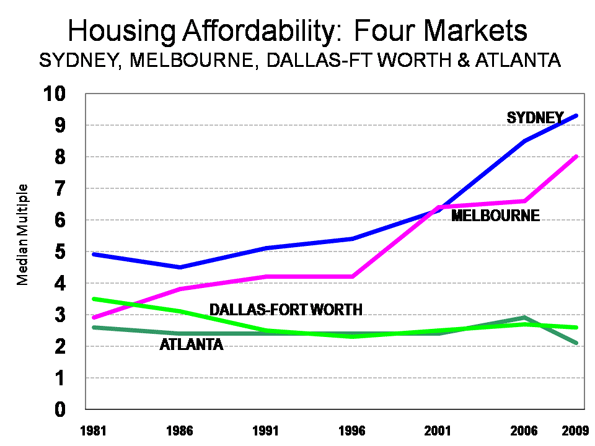
    Australia: A Nation in Mortgage Stress: The Survey includes a comparison of four similar markets, Sydney and Melbourne in Australia to Dallas-Fort Worth and Atlanta in the United States. In the early 1980s, Sydney had a higher population than Dallas-Fort Worth and Melbourne had a higher population than Atlanta. Since that time, the two US metropolitan areas have passed the Australian metropolitan areas in population, having added more people than Australia’s five largest metropolitan areas combined (Sydney, Melbourne, Brisbane, Perth and Adelaide). At the same time, despite their far higher demand, housing affordability has improved in Dallas-Fort Worth and Atlanta, while it has deteriorated markedly in Sydney and Melbourne (Figure 1). During this period, “plan driven” or more prescriptive land use policies were strongly enforced in Sydney and Melbourne in contrast to the “demand driven” land use policies in place in both Atlanta and Dallas-Fort Worth.

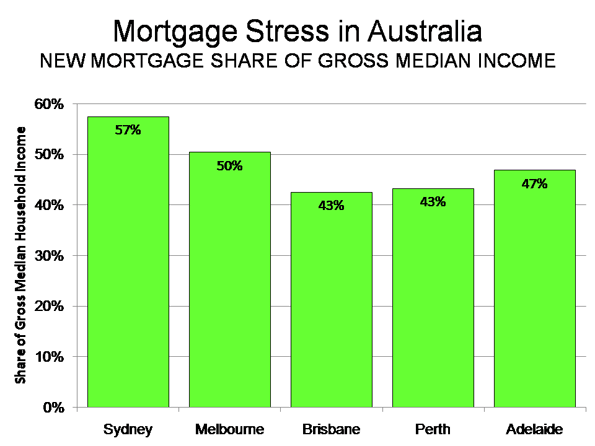
    Australian government agencies consider any household paying more than 30% of its gross income for housing to be in “housing stress.” At this point, a median income household in Sydney or Melbourne would pay more 50% or more of its gross income annually for a new mortgage on a median priced house. In Brisbane, Perth and Adelaide, the figure is above 40%. (Figure 2). By comparison, in Dallas-Fort Worth and Atlanta, however, the median income household would pay less than 20% of its income for the mortgage. Not surprising then is the huge loss in housing affordability in Australia, and a decline in home ownership rates from 72% to 68% between 1995 and 2008.

    Unaffordable Housing as Public Policy: It is clear that much of the cause for the differences in affordability lies with contrasting public policy approaches. The strong intervention in land markets under plan-driven regulation raises the price of land inordinately. Governments appear to have, however unwittingly, established unaffordable housing as an objective of public policy. Yet despite this, there is pressure – including from the US Obama administration, to adopt plan-driven regulation throughout the United States, despite the substantial economic disruption that such policies produced in the US bubble markets. Besides making houses unaffordable for many households, this could set the stage for even more housing bubbles in the future.

    If this trend continues, future generations will pay far more for their housing than did their parents. This seems likely to stunt economic growth and job creation, while facilitating higher levels of poverty and class stratification throughout the English speaking world.

    Wendell Cox is a Visiting Professor, Conservatoire National des Arts et Metiers, Paris. He was born in Los Angeles and was appointed to three terms on the Los Angeles County Transportation Commission by Mayor Tom Bradley. He is the author of “War on the Dream: How Anti-Sprawl Policy Threatens the Quality of Life.

  • Phoenix, Put Aside Dreams of Gotham

    Now that Phoenix’s ascendancy has been at least momentarily suspended, its residents are no doubt wondering what comes next. One tendency is to say the city needs to grow up and become more like East Coast cities or Portland, Ore., with dense urban cores and well-developed rail transit. The other ready option is always inertia – a tendency to wait for things to come back the way they were.

    Neither approach will work in the long run. Over the coming decade, Phoenix has to recalibrate its economy into something based on more than being a second option for Californians and speculative real-estate investment. Instead, it needs to focus laserlike on economic diversity and creating good jobs.

    The model here for Phoenix is not New York or San Francisco. Phoenix can’t rival these cities for their 19th-century charm or early 20th-century infrastructure. As we would say back in New York (my hometown): fuggedaboutit.

    Instead of dreaming about Gotham, Phoenix should think more about Houston. Like the Texas megacity, Phoenix is the ultimate late 20th-century town, dependent on air-conditioning, ample freeway space and a wide-open business culture.

    A century away from becoming “quaint,” Phoenix needs to follow Houston’s example of relentless economic diversification: in Phoenix’s case, away from dependence on tourism and construction. Houston has done this by focusing beyond its core energy sector to fields like international trade, manufacturing and medical services.

    Phoenix’s opportunities may lie elsewhere but may include some of these same industries. The idea is that the region needs to heal its job problem. Only then can the real-estate market rebound on a solid basis.

    This employment focus must replace the current obsession with changing the city’s urban form. Despite the current problems, Phoenix has performed pretty well over the past decade, creating more new jobs than most Sun Belt cities, not to mention job losers like San Francisco, Chicago, Los Angeles and New York. Equally important, it still leads the nation over the past decade in net in-migration among the largest cities

    Unfortunately, some in Phoenix still suffer horribly from Manhattan envy. One prominent Phoenix consultant describes the downtown as “the glorious goose that’s laying the gilded egg” that will turn the city into a dynamic trend-setter of a new urban paradigm. Phoenix, he opined, “won’t be a place of renown till it has the Big It.” In other words, Phoenix will not be a true metropolis until it has its own Times Square, Eiffel Tower, Space Needle or other grand attraction.

    Yet in newer cities like Phoenix, the quest for the “Big It” is often delusional. In Phoenix, the vast majority of the population moved in decades after the original downtown lost its primacy. People have their own notion of what “it” is, and many times, “it” could be in a different center or in more than one center – think Scottsdale, Tempe, Mesa, the Camelback Corridor, or a host of other communities.

    The Valley’s $1.4 billion transit system carries barely 15,000 round trips daily – a microscopic proportion of the region’s trips – with the biggest traffic on weekends. Sounds more like Disneyland than New York.

    Nor does the high-end condo, art-museum, convention-center thing seem to be working so well. Too bad the extra $1.5 billion spent sprucing up the area could not have been spent more usefully for less critical things, like police and fire, or better roads and schools.

    Rather than focus on emulating the urban father figures from the past, Phoenix’s best bet lies with its best assets: being reasonably priced, professionally managed and, well, warm and lovely in December. Shedding its real-estate-obsessed cocoon, Phoenix should focus on creating jobs for both present and future residents. That’s how you can grow up and find your own way.

    This article first appeared at The Arizona Republic.

    Joel Kotkin is executive editor of NewGeography.com and is a distinguished presidential fellow in urban futures at Chapman University. He is author of The City: A Global History. His next book, The Next Hundred Million: America in 2050, will be published by Penguin Press February 4th.

    Photo: robotography

  • Suburbs & Cul-de-Sacs: Is The Romance Over?

    The Virginia Department of Transportation does not like cul-de-sacs. You know, those little circles that suburban home dwellers worship so much and pay a premium to be located on? Under its regulations, all new subdivisions must have only through streets. Essentially, no more cul-de-sacs. Getting rid of these desirable dead-ends, according to the DOT, will improve safety and accessibility for emergency vehicles.

    The new set of rules regarding street regulations is called Secondary Street Acceptance Requirements (SSAR). It requires a set of closed, interconnected street segments designed under specific formulae to make sure the streets are well situated for pedestrians and bicycles. The SSAR is also designed to better distribute traffic in local suburban settings, specifically subdivisions.

    I’m here to defend the cul-de-sac, but not as it is typically built and designed.

    What makes a cul-de-sac lot premium? Homeowners fall in love with the quiet courts and the sense of built-in neighborliness. The words “quiet cul-de-sac location” can spur more sales than the words “new granite counters.” The homes have huge rear yards, because of the extreme pie shape. The paved dead end areas guarantee no traffic will be speeding through, making parents and kids feel safe.

    The wide angles between the adjacent home sides create some useable side yard space, as well as added privacy. Quiet, serene, and safe – what’s not to love?

    Who Determines The Best Street Pattern? One of the biggest problems of suburban street design is that those who typically plan subdivisions don’t focus on vehicular or pedestrian flow, nor are they required to do so. The vast majority of subdivisions (and even of master planned developments) in the US are designed by engineering and land surveying companies that focus on density and meeting the ‘minimums’. A developer will typically hire the same company that engineers and surveys their site to plan the subdivision layout.

    Very little information is available on how to create suburban street patterns with connectivity. These areas may have significant topographic variations, making a traditional urban grid pattern undesirable. Suburban regulations don’t offer much help or guidance, either. Planning commissions and city councils that do not have an understanding of traffic engineering end up giving a yes vote to site plans they do not understand. The result is a conglomeration of people involved in the approval processes that produce a traffic system based more on familiarity than on functionality.

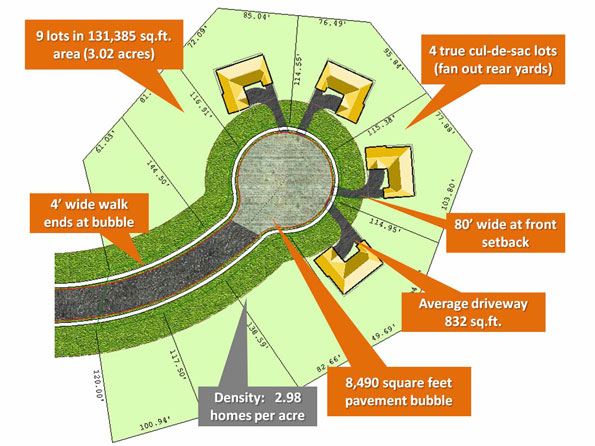
    Cul-de-Sac Design Guidelines: To make matters worse, existing design guidelines for cul-de-sacs create the most waste with the least benefit. Here in the upper Midwest, a cul-de-sac will have a 120 foot diameter right-of-way with a 110 foot circle of asphalt. Why? Because fire departments say they need that radius to turn around a fire truck. Go a bit south and that dimension reduces to a 100 foot diameter right-of-way with a 90 foot diameter circle. I’m not sure why northern firemen don’t turn the steering wheel as tight as those in the South, but according to these regulations, they apparently can’t. So up North the typical cul-de-sac will consume 8,500 square feet of paving, and in the South just under 6,000.

    This means that at a typical 25 foot setback from the right-of-way to the home front, an 80 foot wide suburban lot in the north will result in four or so premium lots. In the South, with a typical 20 foot setback and narrower 60 foot wide lot, there might be five or so premium lots.

    An 8,500 square foot volume of cul-de-sac paving for four Northern-sized lots comes out to 40 percent more square feet of paving per house compared to the same lot on a straight street. This means the home will cost the city 40 percent more for snow removal, resurfacing, etc., forever. It also cost the developer 40 percent more, but that is recouped because the lots on the cul-de-sac can be sold at a huge premium.

    A street leading to a cul-de-sac will have standard size lots fronting it. Depending upon the length of the street, there may be a few lots or dozens of them leading to the premium ones along the circle. These “street” lots might have a slightly higher value because of the low traffic approaching a closed end street, but they will certainly not equal the value of the lots around the circle.

    From an efficiency perspective, it seems like only a fool would defend the use of cul-de-sacs. Here are some facts from that fool. In planning, everyone assumes that the minimum dimension is the most efficient. In cul-de-sacs, the minimum dimensions are typically very inefficient. Making cul-de-sacs larger than the minimum fire engine turning radius makes them more efficient.

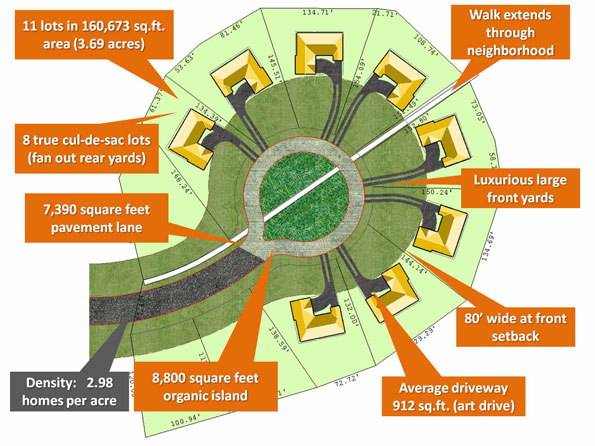
    Impossible? Take a look at the typical suburban design above, and compare it to to this re-designed cul-de-sac:

    By making a typical northern cul-de-sac larger, say 160 feet in diameter, and using a one-way narrow lane with an island in the center, the amount of total paved area plummets. Instead of a solid sea of asphalt, the new cul-de-sac uses 10% less paving and has room for a central park that will be approximately 8,800 square feet of organic surface.

    Now place the homes at a deeper setback. Yes, pulling the homes farther from the right-of-way to a 40 or 50 foot setback (instead of 25) accomplishes two things. It stretches the length of the setback line and makes the lots much less pie-shaped. The new, deeper setback should double the number of lots…with much less paving. Instead of being 40 percent less efficient, the new cul-de-sac is approximately 20 per cent more efficient than a rectangular lot on a straight street.

    And while the new cul-de-sac lot is less pie shaped, it will still have a significantly larger rear yard. The lots overlooking an 8,800 square foot park will have a much higher value than if they were overlooking 8,500 square feet of asphalt or concrete. The park can be used in a variety of ways, but a combination of rain gardens and recreation seems natural. By draining into the center, we eliminate curbing on one side, making them even more efficient. Since the number of premium cul-de-sac lots is at least doubled and uses less paving and less overall land area, there would be fewer cul-de-sacs.

    The Dead End Issue: But what of pedestrian and bicycle circulation? Well, that’s simple, as these non-vehicular designs can extend beyond the cul-de-sac as well as through them, making the central park areas destination places. Emergency vehicular access? Interconnecting walks could be made wide enough at certain locations to provide emergency access that would rival tight grid patterns.

    If these arguments favoring the efficient new cul-de-sacs aren’t enough, God likes them! How do I know? What scripture did I study to make this claim? Well, if God did not want cul-de-sacs, then why vary the natural contours of the land? Not every site is perfectly flat or a perfect square shape. In many cases, contours form peaks and valleys in which cul-de-sacs may be the only way to design a development; anything else would be unnatural.

    Hold your hand in front of you and then spread your fingers wide. When rain falls on the land and runs off it forms peaks and valleys similar to your jutting fingers. Where this happens, using the natural contour for the location of cul-de-sacs makes much more sense than trying to place a circulation pattern between the finger nails. Property configurations also often require a cul-de-sac or two (three, four or more).

    Of course a big bull-dozer could reconfigure any land to implement SSAR, but then…wouldn’t that be a sin?

    Rick Harrison is President of Rick Harrison Site Design Studio and Neighborhood Innovations, LLC. He is author of Prefurbia: Reinventing The Suburbs From Disdainable To Sustainable and creator of Performance Planning System. His websites are rhsdplanning.com and performanceplanningsystem.com.

    Photo:

  • The War Against Suburbia

    A year into the Obama administration, America’s dominant geography, suburbia, is now in open revolt against an urban-centric regime that many perceive threatens their way of life, values, and economic future. Scott Brown’s huge upset victory by 5 percent in Massachusetts, which supported Obama by 26 percentage points in 2008, largely was propelled by a wave of support from middle-income suburbs all around Boston. The contrast with 2008 could not be plainer.

    Browns’s triumph followed similar wins by Republican gubernatorial contenders last November in Virginia and New Jersey. In those races suburban voters in places like Middlesex County, New Jersey and Loudoun County, Virginia—which had supported President Obama just a year earlier—deserted the Democats in droves. Also in November, voters in Nassau County, New York upset Nassau County Executive Thomas Suozzi, an attractive Democrat who had carefully cultivated suburban voters.

    The lesson here is that political movements ignore suburbanites at their peril. For the better part of a century, Americans have been voting with their feet, moving inexorably away from the central cities and towards the suburban periphery. Today a solid majority of Americans live in suburbs and exurbs, more than countryside residents and urbanites combined.

    As a result, suburban voters have become the critical determinants of our national politics, culture, and economy. The rise of the Republican majority after 1966 was largely a suburban phenomenon. When Democrats have resurged—as they did under Bill Clinton and again in 2006 and 2008—it was when they came close to splitting the suburban vote.

    But now, once again, things have changed. For the first time in memory, the suburbs are under a conscious and sustained attack from Washington. Little that the administration has pushed—from the Wall Street bailouts to the proposed “cap and trade” policies—offers much to predominately middle-income oriented suburbanites and instead appears to have worked to alienate them.

    And then there are the policies that seem targeted against suburbs. In everything from land use and transportation to “green” energy policy, the Obama administration has been pushing an agenda that seeks to move Americans out of their preferred suburban locales and into the dense, transit-dependent locales they have eschewed for generations.

    As in so many areas, this stance reflects the surprising power of the party’s urban core and the “green” lobby associated with it. Yet, from a political point of view, the anti-suburban stance seems odd given that Democrats’ recent electoral ascendency stemmed in great part from gains among suburbanites. Certainly this is an overt stance that neither Bill nor Hillary Clinton would likely have countenanced.

    Whenever possible, the Clintons expressed empathy with suburban and small-town voters. In contrast, the Obama administration seems almost willfully city-centric. Few top appointees have come from either red states or suburbs; the top echelons of the administration draw almost completely on big city urbanites—most notably from Chicago, New York, Los Angeles, and San Francisco. They sometimes don’t even seem to understand why people move to suburbs.

    Many Obama appointees—such as at the Departments of Transportation and of Housing and Urban Development (HUD) and at the Environmental Protection Agency (EPA)—favor a policy agenda that would drive more Americans to live in central cities. And the president himself seems to embrace this approach, declaring in February that “the days of building sprawl” were, in his words, “over.”

    Not surprisingly, belief in “smart growth,” a policy that seeks to force densification of communities and returning people to core cities, animates many top administration officials. This includes both HUD Secretary Shaun Donovan and Undersecretary Ron Sims, Transportation undersecretary for policy Roy Kienitz, and the EPA’s John Frece.

    Transportation Secretary Ray LaHood revealed the new ideology when he famously declared the administration’s intention to “coerce” Americans out of their cars and into transit. In Congress, the president’s allies, including Minnesota Congressman James Oberstar, have advocated shifting a larger chunk of gas tax funds collected from drivers to rail and other transit.

    In addition, the president’s stimulus—with its $8 billion allocation for high-speed rail and proposed giant increases in mass transit—offers little to anyone who lives outside a handful of large metropolitan cores. Economics writer Robert Samuelson, among others, has denounced the high-speed rail idea as “a boondoggle” not well-suited to a huge, multi-centered country like the United States. Green job schemes also seem more suited to boost employment for university researchers and inner-city residents than middle-income suburbanites.

    Suburbanites may not yet be conscious of the anti-suburban stance of the Obama team, but perhaps they can read the body language. Administration officials have also started handing out $300 million stimulus-funded grants to cities that follow “smart growth principles.” Grants for cities to adopt “sustainability” oriented development will reward those communities with the proper planning orientation. There is precious little that will benefit suburbanites, such as improved roads or investment in other basic infrastructure.

    But ultimately it will be sticks and not carrots that planners hope to use to drive de-suburbanization. Perhaps the most significant will be new draconian controls over land use. Administration officials, particularly from the EPA, participated in the drafting of the recent “Moving Cooler” report, which suggested such policies as charging tolls on the Interstate Highway System, charging people to park in front of their homes, and steering some 90 percent of all future development into the most dense portions of already existing urban development.

    Of course, such policies have little or no chance of being passed by Congress. Too many representatives come from suburban or rural districts to back policies that would penalize a population that uses automobiles for upwards of 98 percent of their transportation and account for 95 percent of all work trips.

    But the president’s cadres may find other ways to impose their agenda. New controls, for example, may be enacted through the courts and regulatory action. There is already precedence for this: As EPA director under Clinton, current climate czar Carole Browner threatened to block federal funds for the Atlanta region due to their lack of compliance with clear air rules.

    Such threats will become more commonplace as regulating greenhouse gases fall under administrative scrutiny. As can already be seen in California, regulators can use the threat of climate change as a rationale to stop funding—and permitting—for even well-conceived residential, commercial, or industrial projects construed as likely to generate excess greenhouse gases.

    These efforts will be supported by an elaborate coalition of new urbanist and environmental groups. At the same time, a powerful urban land interest, including many close to the Democratic Party, would also support steps that thwart suburban growth and give them a near monopoly on future development over the coming decades.

    Glimpse the Future

    One can glimpse this future by observing what takes place in most European countries, including the United Kingdom, where land use is controlled from the center. For decades options for new development have been sharply circumscribed, with mandates for ever-smaller lots and smaller homes more the norm for single-family residences.

    In Britain the dominant planning model is widely known as “cramming,” meaning forced densification into smaller geographic areas. Over the past generation, this has spurred a rapid shrinking of house sizes. Today the average new British “hobbit” house, although quite expensive, covers barely 800 square feet, roughly one-third that of the average American residence. Even in quite distant suburbia many of the features widely enjoyed here—sizable backyards, spare bedrooms, home office space—are disappearing.

    But these suburban hobbits will be living large compared to the sardines who would be forced to move into inner cities. In London, already a densely packed city, planners are calling for denser apartment blocks and congested neighborhoods.

    This top-driven scenario may be playing soon in America. Following the proposed edicts of “Moving Cooler,” the urban option increasingly would become almost the only choice other than the countryside. Unlike their baby boomer parents, the next generation would have few affordable choices in comfortable, low- and medium-density suburbs and single-family homes.

    Ownership of a single-family home would become increasingly the province only of the highly affluent or those living on the fringes of second-tier American cities. Due to the very high costs of construction for multi-family apartments in inner cities, most prospective homeowners would also be forced to remain renters. Although widely hailed as “progressive,” these policies would herald a return to the kind of crowded renter-dominated metropolis that existed prior to the Second World War.

    Are Suburbs Doomed?

    The anti-suburban impulse is nothing new. Suburbs have rarely been popular among academics, planners, and the punditry. The suburbanite displeased “the professional planner and the intellectual defender of cosmopolitan culture,” noted sociologist Herbert Gans. The 1960s counterculture expanded this critique, viewing suburbia as one of many “tasteless travesties of mass society,” along with fast and processed food, plastics, and large cars. Suburban life represented the opposite of the cosmopolitan urban scene; one critic termed it “vulgaria.”

    Liberals also castigated suburbs as the racist spawn of “white flight.” But more recently, environmental causes—particularly greenhouse gas emissions as well as dire warning about the prospects for “peak oil”—now drive much of the argument against suburbanization.

    The housing crash that began in 2007 added grist to the contention that the age of suburban growth has come to an end. To be sure, the early phases of the subprime mortgage bust were heavily concentrated in newer developments in the outer fringes. In part due to rising home prices, a disproportionate number of new buyers were forced to resort to sub-prime and other unconventional mortgages.

    The outer suburban distress attracted much media attention and delighted many who had long detested suburbs. One leading new urbanist, Chris Leinberger, actually described suburban sprawl as “the root cause of the financial crisis.” Leinberger and other critics have described suburbia as the home of the nation’s future “slums.” The favorite images have included McMansions being taken over by impoverished gang-bangers and other undesirables once associated with the now pristine inner city.

    Others portray future suburbs as serving at best as backwaters in a society dominated by urbanites. In contrast to a brave new era for “the gospel of urbanism,” the suburbs are expected to contract and even wither away. According to planner Arthur C. Nelson’s estimate, by 2025 the United States will have a “likely surplus of 22 million large lot homes”—that is, residences on more than one sixth of an acre.

    City boosters, however, largely ignore the real-estate crisis impact on urban condo markets throughout the country. Like the new developments on the fringe, the much hyped apartment complexes in central cities such as New York, Miami, Los Angeles, Chicago, and Denver came on line precisely as the housing market crashed, with similar devastating effects. Many remain unoccupied and others have been converted from high-end condos to more modest rentals.

    Yet fundamentally the attack on suburbia has less to do with market trends or the environment than with a deep-seated desire to change the way Americans live. For years urban boosters have proposed that more Americans should reside in what they deemed “more livable,” denser, transit-oriented communities for their own good. One recent example, David Owens’ Green Metropolis, supports the notion that Americans should be encouraged to embrace “extreme compactness”—using Manhattan as the model.

    Convinced Manhattanization is our future, some “progressives” are already postulating what to do with the remnants of our future abandoned. Grist, for example, recently held a competition about what to do with dying suburbs that included ideas such as turning them into farms, bio-fuel generators, and water treatment plants.

    What Do the Suburbanites Want?

    In their assessments, few density advocates bother to consider whether most suburbanites would like to give up their leafy backyards for dense apartment blocks. Many urban boosters simply could not believe that, once given an urban option, anyone would choose to live in suburbia.

    Jane Jacobs, for example, believed that “suburbs must be a difficult place to raise children.” Yet had Jacobs paid as much attention to suburbs as she did to her beloved Greenwich Village, she would have discovered that they possess their own considerable appeal, most particularly for people with children. “If suburban life is undesirable,” noted Gans in 1969, “the suburbanites themselves seem blissfully unaware of it.”

    Contrary to much of the current media hype, most Americans continue to prefer suburban living. Indeed for four decades, according to numerous surveys, the portion of the population that prefers to live in a big city has consistently been in the 10 to 20 percent range, while roughly 50 percent or more opt for suburbs or exurbs. The reasons? The simple desire for privacy, quiet, safety, good schools, and closer-knit communities. The single-family house, detested by many urbanists, also exercises a considerable pull. Surveys by the National Association of Realtors and the National Association of Home Builders find that some 83 percent of potential buyers prefer this kind of dwelling over a townhouse or apartment.

    In other words, suburbs have expanded because people like them. A 2008 Pew study revealed that suburbanites displayed the highest degree of satisfaction with where they lived compared to those who lived in cities, small towns, and the countryside. This contradicts another of the great urban legends of the 20th century—espoused by urbanists, planning professors, and pundits and portrayed in Hollywood movies—that suburbanites are alienated, autonomous individuals, while city dwellers have a deep sense of belonging and connection to their neighborhoods.

    Indeed on virtually every measurement—from jobs and environment to families—suburban residents express a stronger sense of identity and civic involvement with their communities than those living in cities. One recent University of California at Irvine study found that density does not, as is often assumed, increase social contact between neighbors or raise overall social involvement. For every 10 percent reduction in density, the chances of people talking to their neighbors increases by 10 percent, and their likelihood of belonging to a local club by 15 percent.

    These preferences have helped make suburbanization the predominant trend in virtually every region of the country. Even in Portland, Oregon, a city renowned for its urban-oriented policy, barely 10 percent of all population growth this decade has occurred within the city limits, while more than 90 percent has taken place in the suburbs over the past decade. Ironically, one contributing factor has been the demands of urbanites themselves, who want to preserve historic structures and maintain relatively modest densities in their neighborhoods.

    Multicultural Flight

    Perhaps nothing reflects the universal appeal of suburban lifestyles more than its growing ethnic diversity. In 1970 nearly 95 percent of suburbanites were white. Today many of these same communities have emerged as the new melting pots of American society. Along with immigrants, African-Americans have moved to the suburbs in huge numbers: between 1970 and 2009, the proportion of African-Americans living in the periphery grew from less than one-sixth to 40 percent.

    Today minorities constitute over 27 percent of the nation’s suburbanites. In fast-growing Gwinett County outside Atlanta, minorities made up less than 10 percent of the population in 1980; by 2006 the county was on the verge of becoming “majority minority.” In greater Washington, D.C., the Northeast’s most dynamic region in economic and demographic terms, 87 percent of foreign migrants live in the suburbs, while less than 13 percent live in the district, according to a 2001 Brookings Institution study.

    Perhaps most intriguingly, this diversity is itself diverse, including not only African-Americans but also Latinos and Asians. Suburban areas such as Fort Bend county, Texas, and the city of Walnut, in the San Gabriel Valley east of Los Angeles, already have among the most diverse populations in the nation. And this is not merely a California phenomenon: Aurora (outside Denver), Bellevue (the Seattle suburb), and Blaine (outside Minneapolis) are becoming ever-more diverse even as the nearby city centers become less so. By 2000 well over half of mixed-race households were in the suburbs, a percentage that continues to grow.

    Today the most likely locale for America’s new ethnic shopping centers, Hindu temples, and new mosques are not in the teeming cities but in the outer suburbs of Los Angeles, New York, and Houston. “If a multiethnic society is working out in America,” suggests California demographer James Allen, “it will be worked out in [these] places  . . . The future of America is in the suburbs.”

    A War Not Worth Fighting

    If most Americans clearly prefer suburbs then why would our elected representatives choose to pick a fight with them? Perhaps the most widely used explanation lies with densification as a means of reducing greenhouse gases. But this rationale itself seems flawed, and could reflect more long-standing prejudice than proven science.

    For example, a recent study by the National Academy of Sciences found that a nationally imposed densification policy would at best cut greenhouse gas emissions between less than 1 and 11 percent by 2050. Other research suggests that, by some measurements, low-density development can use less energy than denser urban forms.

    Although automobile commuting now consumes more energy resources than well-traveled traditional urban rail systems, the future generation of low-mileage cars may prove more efficient than often underutilized rail systems that are now seen as critical elements of fighting climate change. A public system running at low capacity—commonplace in many regions—may actually produce more emissions than the coming generation of personal vehicles.

    Moreover, tall buildings may not be as green as some advocates suggest. Recent studies out of Australia show that townhouses, small condos, and even single-family homes generate far less heat per capita than the supposedly environmentally superior residential towers, particularly when one takes into account the cost of heating common areas and the highly consumptive lifestyle of affluent urbanites (with their country homes, vacations, and frequent flying). In terms of energy conservation, the easiest and least expensive option may be to retrofit single-family houses and wood-shaded townhouses.

    Two- or three-story homes or townhouses often require only double-paned windows and natural shading to reduce their energy consumption; one Los Angeles study found that white roofs and shade trees can reduce suburban air conditioning by 18 percent. Such structures are particularly ideal for using the heat- and water-saving elements of landscaping: after all, a nice maple can cool a two-story house more efficiently than it can a ten-story apartment.

    Of course, density advocates can and do produce their own studies to justify their agenda. But there seems enough reasonable doubt to focus on more efficient, and less intrusive, ways to create greener communities by improving energy efficiency of automobiles and changing the way suburbs fit into metropolitan systems.

    Turning Deadwood into Greenurbia

    The “green” assault on suburbia also largely ignores changes already taking place across the suburban landscape. In a historical context, the latest suburban “sprawl” may be compared to Deadwood. That rough-and-ready mining town on the Dakota frontier was developed quickly for the narrow purpose of being close to a vein of gold. But over time these towns developed respectable shopping streets, theaters, and other community institutions.

    One change already evident can be seen in commuting patterns. Density advocates and the media often characterize suburbanites as people who generally take long commutes to work compared to the shorter rides enjoyed by city-dwellers. But with the continuing dispersion of work to the suburbs over the past two decades, suburban work locations actually enjoyed shorter commutes than their inner city counterparts in virtually all the largest metropolitan areas.

    This is true even in New York. Although Manhattanites enjoy short commutes and can even walk to work, most people who live in New York City and work in Manhattan suffer among the longest commutes in the nation. In fact, residents of Queens and Staten Island spend the most time getting to work of all metropolitan counties. Residents in suburbs and particularly exurbs actually endure generally shorter commutes, in large part because of less congestion and closer proximity to employment.

    Such pairing of jobs and housing will shape the suburban future and represents among the easiest ways to cut transportation-related emissions. Even more promising has been the continuing rise in home-based employment. According to Forrester Research, roughly 34 million Americans now commute at least part time from home; by 2016 these numbers are predicted to swell upwards to 63 million.

    Oddly, despite these tremendous potential environmental benefits, the shift toward cyberspace has elicited little support from smart-growth advocates. Indeed most reports on density and greenhouse gases virtually ignore the consideration of telecommuting and dispersed work.

    One reason may be that telecommuting breaks with the prevailing planning and green narratives by making dispersion more feasible. The ability to work full time or part time from home, notes one planning expert, expands metropolitan “commuter sheds” to areas well outside their traditional limits. In exchange for a rural or exurban lifestyle, this new commuter—who may go in to “work” only one or two days a week—will endure the periodic extra long trip to the office.

    Yet although it may offend planning sensibilities, the potential energy savings—particularly in vehicle miles traveled—could be enormous. Telecommuters drive less, naturally; on telecommuting days, average vehicle miles are between 53 percent and 77 percent lower. Overall a 10 percent increase in telecommuting over the next decade will reduce 45 million tons of greenhouse gases, while also dramatically cutting office construction and energy use. Only an almost impossibly large shift to mass transit could produce comparable savings.

    Ultimately, technology will undermine much of the green case against suburbia. If we really want to bring about a greener era, focusing attention on low-density enclaves would bring change that conforms to the preferences of the vast majority of people.

    Think Twice Before You Act

    Ultimately, the war against suburbia reflects a radical new vision of American life which, in the name of community and green values, would reverse the democratizing of the landscape that has characterized much of the past 50 years. It would replace a political economy based on individual aspiration and association in small communities, with a more highly organized, bureaucratic, and hierarchical form of social organization.

    In some ways we could say forced densification could augur in a kind of new feudalism, where questions of land ownership and decision making would be shifted away from citizens, neighbors, or markets, and left in the hands of self-appointed “betters.” This seems strange for an administration—and a party—whose raison d’être ostensibly has been to widen opportunities rather than constrict them.

    Indeed it is one of the oddest aspects of contemporary “progressive” thought that it seeks to undermine even modest middle class aspirations such as living in a quiet neighborhood or a single-family house. This does not seem a winning way to build political support across a broad spectrum of the populace.

    Of course suburbia is not and will not be the option for everyone. There will continue to be a significant, perhaps even growing, segment of the population which opts for a dense urban lifestyle or, for that matter, to live further in the countryside. But unless we see a radical change in human behavior and social organization, the majority will likely settle for a suburban or exurban existence.

    Given these realities, it seems more practical not to work against such aspirations but instead to evolve intelligent policies that would reconcile them with our long-term environmental needs. Suburbanites like their suburbs but would also like to find a way to make them greener as well as more economically and socially viable. Right now neither party has developed such an agenda, and so the suburbs, now clearly leaning right, remain up for grabs. To win suburbanites over, politicians first have to respect the basic preferences while offering a realistic program for improvement. This remains a key to building a sustainable electoral majority, not just for the next election, but for the decades to come.

    This article first appeared at The American.

    Joel Kotkin is executive editor of NewGeography.com and is a distinguished presidential fellow in urban futures at Chapman University. He is author of The City: A Global History. His newest book is The Next Hundred Million: America in 2050, released in Febuary, 2010.

  • Reducing Traffic Congestion and Improving Travel Options in Los Angeles

    While traffic congestion plagues many cities, Los Angeles stands apart. The Texas Transportation Institute tracks congestion statistics for U.S. metropolitan areas on an annual basis, and Los Angeles routinely ranks first for both total and per-capita congestion delays. Considering the value of wasted time and fuel, TTI estimates the annual cost of traffic congestion in greater Los Angeles at close to $10 billion.

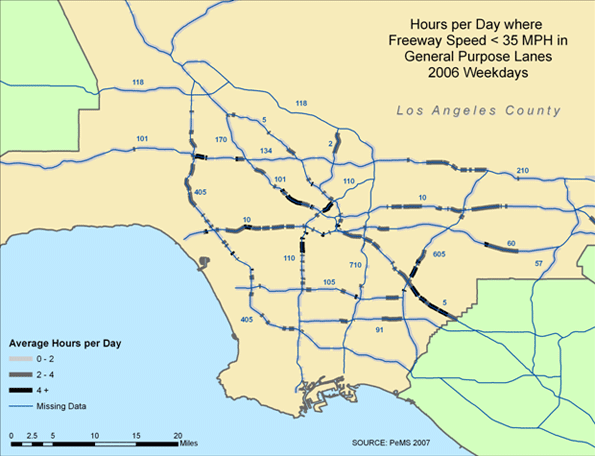
    The map in Figure 1, based on 2006 Caltrans sensor data, illustrates the weekday pattern of traffic congestion on the LA freeway network. Congestion is pervasive throughout much of the county; most freeways have segments on which traffic averages less than 35 mph at least two hours per day, and many bottlenecks are congested at least four hours per day.

    Figure 1. Traffic Conditions on the LA Freeway Network

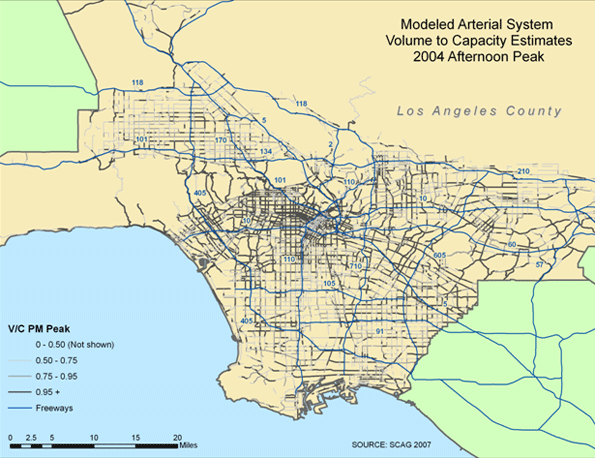
    Conditions on the surface streets are not much better. The map in Figure 2, based on 2004 volume-to-capacity (V/C) estimates from SCAG, depicts the pattern of afternoon traffic congestion on the county’s largest arterials. Here again it is evident that traffic congestion is broadly dispersed, yet the pattern is particularly intense between downtown Los Angeles and the Westside.

    Figure 2. Traffic Conditions on LA Surface Streets

    With the recent run-up in fuel prices followed by a severe recession, total travel in Los Angeles has declined over the past two years, and congestion has correspondingly eased. Yet if past trends hold, this reprieve is likely to be fleeting. Should the region’s economy and population grow in the coming decades, as some forecasts predict, the probable outcome is even more vehicle travel and in turn more intense congestion.

    Controversial Solutions for a Daunting Problem
    Researchers at the RAND Corporation were asked to recommend strategies capable of reducing LA traffic within five years or less (the short timeframe rules out land-use reforms along with major infrastructure investments). The resulting report, Moving Los Angeles: Short-Term Policy Options for Improving Transportation, offers recommendations at once controversial and likely inescapable. To achieve lasting traffic relief, it will be necessary to manage the demand for travel through pricing reforms (e.g., congestion tolls) that increase the cost of driving and parking in the busiest corridors and areas during peak travel hours. Other measures—better transit service, ridesharing programs, traffic signal synchronization, and the like—can complement pricing, but are not on their own sufficient to stem current and projected future traffic congestion.

    Few Strategies Offer Much Promise
    Just why should this be so? Consider, first, that traffic congestion results from an imbalance between the supply of roads and peak-hour automotive travel. In fact, congestion can be viewed as a solution (though an unpleasant one) to this imbalance; when demand exceeds supply, congestion makes us wait our turn for available road space to balance the equation. Over the past several decades, the gap between supply and demand has widened considerably; population growth, economic expansion, and rising incomes have fueled the demand for more vehicle travel, while road construction has stagnated. We have therefore been relying, more and more, on congestion to resolve this imbalance.

    One response would be to build or expand more roads to accommodate additional vehicle travel. Setting aside policy concerns related to greenhouse gas emissions and energy security, the prospects for “building our way out of congestion” are limited. To begin with, there simply isn’t much space to build new roads in Los Angeles, particularly in the most densely developed urban areas. As shown in Figure 3, the density of the road network in the greater Los Angeles region, measured in lane miles per square mile, is already far greater than in any other large metropolitan area in the country.

    Figure 3. Road Network Density in Major Metropolitan Areas

    We also lack the resources to engage in an extensive road building spree. In recent decades, federal and state elected officials have failed to increase fuel taxes enough to offset the effects of inflation and improved fuel economy, thus hobbling the major source of funding for road construction and repairs.

    Even if we could expand the road network, though, the benefits would be limited by a phenomenon described as “triple convergence.” Congestion has been a problem for years, and many individuals deliberately alter their travel patterns to avoid severe traffic. When an investment in road capacity reduces peak-hour congestion, many will conclude that they no longer need to go out of their way to avoid congestion delays and will thus “converge” on the improvement from (a) other times, (b) other routes, or (c) other modes of travel. The net effect is that the initial traffic-reduction benefits will usually not last over time. This is why we often see, for instance, that the improved traffic flow resulting from a new freeway lane does not last for more than a couple of years.

    If supply-side remedies do not create sustainable reductions in traffic, it becomes necessary to examine ways of reducing peak-hour travel demand. Commonly employed options include improved transit service, voluntary ridesharing programs, flexible work hours, and telecommuting. Unfortunately, the congestion-reduction benefits of these strategies are likewise undermined by triple convergence. If a new subway line induces some peak-hour drivers to switch to transit, other drivers will soon converge on more freely flowing roads to take their place. Indeed, the effects of triple convergence explain why traffic congestion has grown steadily worse despite considerable state and local investment in a broad range of congestion-reduction strategies.

    Only Pricing Strategies Promise Sustainable Reductions in Traffic Congestion
    This brings us to the rationale for pricing strategies. Among the many possible options for reducing traffic congestion, only pricing resist the effects of triple convergence. By increasing the cost of driving or parking in the busiest areas or corridors during the busiest times of day, pricing measures manage the demand for peak-hour travel, in turn reducing congestion. Once traffic flow improves, the prices remain in place, thus deterring excessive convergence on the newly freed capacity.

    Pricing strategies offer two additional benefits. First, pricing generates revenue to support needed transportation investments. And in comparison to sales taxes, a common option for raising local transportation revenue, pricing has been shown to reduce the relative tax burden on lower income groups (though wealthier individuals consume more taxable goods than their less-affluent counterparts, to an even greater extent they (a) drive more, (b) are more likely to travel during peak hours, and (c) are more likely to pay peak-hour tolls rather than alter their travel choices). Second, pricing enables more efficient use of the road capacity that we already have, because roads on which traffic flows smoothly (at roughly 40 mph or higher) can carry far more vehicles per lane per hour than roads snarled in stop-and-go congestion. Paradoxically, then, we see that the introduction of pricing enables roads to accommodate more peak-hour trips. It is therefore useful to think of pricing as a means of managing peak-hour travel demand rather than reducing it.

    Pricing Strategies Will Be Particularly Valuable in Los Angeles
    Pricing holds promise for most major cities, but the case in Los Angeles is especially compelling. To understand why, it is necessary to consider the interactions between population density and travel behavior, factors that help to explain the severity of LA traffic.

    Contrary to its reputation for sprawl, Los Angeles is quite densely populated when viewed at the regional scale. Downtown Los Angeles isn’t as dense as, say, Manhattan or central Chicago, but the suburbs surrounding Los Angeles are much denser than the typical suburb, leading to high aggregate density on a regional basis.

    As population density increases, individuals tend to drive less on a per-capita basis. Trip origins and destinations are closer together, leading to shorter car trips, and in dense neighborhoods people can rely on alternatives such as walking, biking, or transit for a larger share of trips. Yet this can be overwhelmed by the fact that there are also more drivers competing for the same road space within a given area, thus intensifying traffic congestion. The net effect is that greater population density tends to exacerbate congestion—think downtown Manhattan.

    LA traffic congestion is further exacerbated by the fact that Angelinos do not curtail their driving as much as one would expect in response to higher population density. Figure 4 compares per-capita vehicle miles of travel (VMT) and population density for the 14 largest metropolitan regions in the country.

    Figure 4. Population Density vs. Per-Capita VMT for the 14 Largest U.S. Metropolitan Regions

    Looking across the different regions, there is a fairly consistent relationship in which per-capita VMT declines with regional density. Los Angeles, though, bucks this trend. The only other metropolitan regions with higher per-capita VMT (Atlanta, Dallas, Houston, and Detroit) are all much less dense than Los Angeles. For regions in which the level of density approaches that of Los Angeles (San Francisco, Washington D.C., and New York), per-capita VMT is much lower.

    In short, we see a confluence of three density-related factors that combine to explain the severity of congestion in Los Angeles: (1) congestion is likely to rise with increased population density; (2) Los Angeles is much denser than its peers at the regional level; and (3) Los Angeles exhibits a surprisingly high level of per-capita VMT relative to its density. The third of these underscores the importance of pricing strategies as a means of managing the demand for automotive travel in Los Angeles.

    In the end only pricing strategies promise sustainable reductions in traffic congestion. Other measures – including improvements in alternative transportation modes – can be beneficial, but none will be nearly as effective as pricing. This recommendation will no doubt stir controversy, but pricing offers the only realistic prospects for managing peak-hour travel demand in the most traffic-choked of American metropolises.

    Dr. Paul Sorensen is an operations researcher at the RAND Corporation, wherehe serves as Associate Director of the Transportation, Space, and Technology program. Dr. Sorensen has published peer-reviewed studies in the areas of geographic information analysis, location optimization modeling, emergency response logistics, and transportation finance policy, and he also holds aU.S. patent on a methodology for forecasting the demand for ambulance services. Dr. Sorensen received a BA in computer science from Dartmouth College, an MA in urban planning from UCLA, and a PhD in geography from UCSB.

  • Housing: Density & Desire

    Density — the number of units per acre on a proposed site plan — is at the heart of the developer’s mantra: More density, more profit. Meanwhile, environmentalists and many planners preach high density as the promise for a better future. The compression of families is an attempt to curb sprawl and reduce transportation energy consumption. For these reasons, many Green programs demand a minimum density to qualify for certification. Those who sit on suburban city councils and planning commissions fear over-densification, and typical suburban ordinances are written to oppose density.

    Who’s right? Nobody. There is no ideal density number in planning or development. Forget the search for a numerical value. Instead, concentrate on livability.

    Ordinances throughout the world state minimal dimension requirements. Some suburban ordinances, but not most, specify density maximums. But density alone cannot determine the most important issue in any development: Is it a great place to live? If both environmental impact and affordability were added to the mix, then you could equate livability with sustainability.

    Suburban Settings: The term ‘sprawl’ is recklessly used to describe all new suburban development, as if every new suburb was composed of massive lots with McMansions. Want proof that it’s not so? Take a tour of a suburb near a major city that was developed this past decade. In most, you will find smaller lots with homes compressed close together, often with less open space than older, large lot developments. Many of the new suburban developments that are close to major cities approach New Urbanism in density. There are some large lot developments for large residential estates, which are frowned upon as if achievement has become evil.

    The opponents of suburbia often don’t factor in the changes that have come about in environmental regulations. When urban areas of the past were built, wetlands (previously known as “swamps”) were simply filled in for development. Wooded areas were clear cut for the new city to be built. Today, we cannot fill in wetlands that in some places constitute vast areas within suburban communities. Many suburban cities have tree preservation and slope restrictions that also result in large open spaces. Because land that developers in the past simply built over is now set aside for preservation, today’s suburbs are going to naturally appear much less “dense” than existing suburban areas. Should a new “urban” city sprout today, as a result of these same protections it too may appear far less dense.

    Higher density can drive up raw land value. Developers who can place four homes on each acre are willing to pay much more than they would have a decade ago for the same land, when each acre could yield only two homes or less. The consumer ultimately pays the same (or more) for a much smaller lot, so density does not deliver affordability.

    Ordinances typically do not deliver livability. When we provide amenities that are not required in ordinances such as an architectural theme, or parks, walks, trails, destination places, and then add sustainability elements such as low impact storm drainage, green building, engineering, and landscaping…what keeps all of this affordable? Increased density helps when the original plan is for large lots. But we can only push density increases to a limit that preserves the sense of space that suburban home buyers expect. Cities that have already reduced minimum lots from, say, 10,000 square feet to 5,000 gave up all of their spare space long ago. Reducing lot size on an already small space can destroy livability. When lots were larger, there was negotiating power: Want smaller lots and more density? Then we’ll build a sustainable neighborhood, not a subdivision. With a small lot that negotiating power vanishes.

    Livability results from a balance of the hundreds of elements that must be taken into consideration when planning, engineering and constructing a neighborhood. A density goal can easily tip that balance in the wrong direction.

    I was trained on how to abuse the regulatory system. In the early 1970s, I was on top of the planning game as a master at manipulating regulations. I was able to find holes in the regulations to legally justify cramming units together. I felt victorious when I gained density. After driving through many of the neighborhoods that were eventually built, pride turned into shame. They were nothing special. I created developments that would do nothing to enhance the living standards of the residents; instead, they made the developer (who was now long gone) more profit. I vowed to never again use increased density as a goal, but rather to use balanced design practices as the driving force of all my neighborhood plans.

    Urban Settings: It is expected that density will be higher in urban areas. We recently did a proposal on a four acre infill site in Minneapolis. We pushed the density on one proposal to 111 units. Our goal was to produce an affordable (i.e. low income), environmentally sound development that would provide a sense of space and accomplishment (pride) for the residents. In low income neighborhoods it is important to hide parked cars as they can be an eyesore that can have a negative visual impact. All parked cars were to be hidden in underground parking areas or in the rear of a home.
    Utilizing new architectural design practice, we provided panoramic views of landscaped spaces using the kitchen as the focal spot for every unit. In this new era, which we call Prefurbia, one goal is to make the interior floor plan an integral component of the overall neighborhood design; we break up the architecture to create that all important curb appeal and eliminate the monotony so common in urban settings, especially lower-income ones. Density was also limited because we wanted to keep each unit at a minimum of 900 square feet. Every home was tied to a meandering walk system leading to a central aquatic garden in a 0.7 acre park. A truly wonderful place to live, at any income level.

    Yet when we presented the development plan we were told that the density goal was 120 units. When we asked where that number came from, we were told it was the minimum that was needed for LEED-ND standards. Jamming another 10% of density would bring the proposal out of balance – something would need to be sacrificed. We could eliminate the central park focus, or perhaps throw the parked cars in the open, or make the small units even smaller. We could eliminate the tie between the floor plans and the neighborhood. Going up another floor would just make the parking situation worse, as we would then have no room to hide the cars underneath the apartments. Demanding a minimum density does nothing to assure good development. If anything, it provides another target that detracts from creating a well balanced neighborhood that is a pleasure to live within.

    Density Instead of Profitability: When I began to plan developments for a nationally recognized firm, we achieved the density goals, but had no clue as to the actual costs of constructing a neighborhood. We would cross a creek to reach isolated corners of a site and gain a few lots, never realizing that a bridge costs much more than the profits gained in those few units. Using geometry instead of smart design practices, we stretched the length of streets, never realizing that streets cost about $300 (today’s dollars) for each extra foot. In the end we did get to the desired density ratio, but at what cost? Smarter design would have been to balance the infrastructure needs against the density goals. That was 40 years ago. Unfortunately those regulating and planning many of today’s new developments and redevelopments still look only to density, not to other costs.

    Density And The Environment: Planners assume that if we increase density in one place then we will not need to build somewhere else, and the end result will be that we will be left with vast, natural open spaces. This fantasy can only become a reality if the additional density achieved on a site corresponds with the dedication of a permanent preserve of open space elsewhere in the same city.

    Want to make this a better world to live in? Forget trying to justify a particular number of units per acre. I was guilty of this approach at one time. There is actually a term for the attitude: it’s defined as “difficult to understand or follow because of being closely packed with ideas or complexities of style”…and that word is “Dense”!

    Rick Harrison is President of Rick Harrison Site Design Studio and author of Prefurbia: Reinventing The Suburbs From Disdainable To Sustainable. His website is rhsdplanning.com.