Category: Suburbs

  • Urbanity Drives Gay Rights Victory in Washington

    If anyone were to doubt that there really are two Washingtons, that the Seattle metropolitan core (and its playgrounds) are another world from most rural to small city Washington (especially east of the Cascade crest), a look at the maps for the vote on Referendum 71 last November should be persuasive. These are not subtle, marginal differences, but indisputable polarization in what political and cultural researchers may call the modernist-traditional divide.

    Referendum 71 passed by a 53 to 47 percent vote, and revealing the power of the King County electorate, which alone provided a margin of 204,000, compared to a statewide margin of 113,000! To overcome the problem of variable size of precincts, and the need to suppress too small numbers, I aggregated precincts to census tracts, which have the added advantage of permitting comparison of electoral results with social and economic data from the census.

    Looking at the statewide map, about 85 percent of the territory of the state (95 % in Eastern WA, 70 % in western WA) voted NO. But the strong no vote came from overwhelmingly rural areas and small towns. The only core metropolitan census tracts that voted a majority no were in Richland-Kennewick area, Yakima and Longview. The heart of traditionalist, and arguably, of anti-gay sentiment lies in the farm country of eastern Washington, especially wheat and ranching areas in Adams, Douglas, Garfield, Lincoln, Walla Walla and Whitman counties, but extending also to the rich irrigated farmlands of Grant, Franklin, Benton and Yakima counties. The highest no votes in western Washington were far rural stretches, and most interesting, Lynden, home to many Dutch descendants, members of the conservative Christian Reformed Church. Not surprisingly the census tracts in eastern Washington which supported Referendum 71 were the tracts dominated by Washington State University in Pullman, around Central Washington university in Ellensburg, the mountain resorts tracts in western Okanogan (Mazama, Twisp), and a few tracts in the core of the city of Spokane.

    Across western Washington majorities against Ref 71 prevailed over a sizeable contiguous southeastern area, from northern Clark and Skamania through urban as well as rural Lewis county (reinforcing the county’s reputation of being the anti-Seattle!) into much of southeastern Pierce county. A lesser vote against 71 occurred in the rest of rural small town western Washington, including most of rural Snohomish county.

    The zone of strong support, voting over 60 percent in favor, flowed largely from Seattle and its inner commuting zone, its spillover playgrounds and retirement areas of Port Townsend and the San Juans, and college and university dominated tracts around Western Washington in Bellingham, the Evergreen State College, Olympia, plus the downtown cores of Vancouver, Tacoma and Everett. Weaker but still supportive were rural spillover, retirement and resort tracts, often in coastal or mountain areas of Pacific, Grays Harbor, Jefferson, Clallam, Skagit and Whatcom counties.

    Looking at the detailed map of central Puget Sound, we can see revealing contrasts between the two camps. Support levels of over 75 percent almost coincides with the city of Seattle boundaries (not quite so high in the far south end), and its professional commuting outliers of Bainbridge and Vashon, plus the downtown government core of Olympia and tracts around the University of Puget Sound and the UW Tacoma.

    Moderately high support (60 to 75 percent) surrounds the core area of highest support, most dominantly in the more affluent and professional areas north of Seattle through Edmonds and east to Redmond, Issaquah and Sammamish (Microsoft land). Weak but still positive votes occurred in the next tier of tracts, around Olympia, north and west of inner Tacoma, most of urban southwest Snohomish county and much of exurban and rural King county (quite unlike most rural areas). But on the contrary, the shift to opposition is remarkably quick and strong in southeastern King and especially in Pierce county, in northern and eastern Snohomish county, and, not surprisingly, in military dominated parts of Kitsap county (e.g., Bangor) and Pierce (Fort Lewis).

    The temptation to compare the voting levels of census tracts with social and economic conditions of those tracts is too great to resist. Here are the strongest correlations (statewide).

    Washington State Correlations with voting in favor of Ref 71
    % Use transit 0.75 %  Drive SOV -0.54
    % Non-family HH 0.65 % HW families -0.45
    % Single 0.48 Average HH size -0.53
    % Same sex HH 0.57
    % aged 20—39 0.43 %  under 20 -0.55
    % foreign born 0.28 % Born in Wash. -0.4
    % College grad 0.65 % HS only -0.62
    % Black 0.27 % white -0.13
    % Asian 0.42 % Hispanic -0.22
    Manager-Profess 0.53 % Craft occup -0.46
    % in FIRE 0.34 % laboring occup -0.47

    These statistics reflect the profound Red-Blue division of the American electorate, in both the geographic differences (large metropolitan versus rural and small town), as well as the modern versus traditional dimension (socially liberal or conservative). The strongest single variable is not behavioral, but transit use is a surrogate for the metropolitan/non-metropolitan split. The critical social characteristic lies in the nature of households: the traditional family versus non-families (partners, roommates, singles). This is a powerful tendency, and useful to describe differences in areas, but of course many in families – often more educated and professional – support Ref 71, and many singles – often elderly, or opposite sex partners – opposed it, especially in more conservative parts of the state.

    The next strongest set of variables, clearly visual from the maps, lay in the strong split of the electorate according to the predominant educational level of the tracts. The tendency of the more educated to support 71 represents the key statistic of the “modern” vs “Traditional” dimension, and is closely related to the differences by occupation and industry. Managers and professionals, and those working in finance, and information sectors tended to be supportive of 71, while those in laboring and craft occupations, and in manufacturing, transport and utilities, tended to oppose. (South King county and much of Pierce county have high shares of blue collar jobs).

    Finally differences by race exist, but are not so strong as, say, in the presidential election in 2008 (although the correlation of the percent for Ref 71 and for Obama was .90).

    Yes, greater Seattle is indeed very different than the rest of Washington and much of America as well.

    Richard Morrill is Professor Emeritus of Geography and Environmental Studies, University of Washington. His research interests include: political geography (voting behavior, redistricting, local governance), population/demography/settlement/migration, urban geography and planning, urban transportation (i.e., old fashioned generalist).

  • The Suburbs are Sexy

    The Administration’s Anti-Suburban Agenda: Nearly since inauguration, the Administration has embarked upon a campaign against suburban development, seeking to force most future urban development into far more dense areas. The President set the stage early, telling a Florida town hall meeting that the days of building “sprawl” (pejorative for “suburbanization”) forever were over. Further, a number of bills have been introduced in the Congress that would attempt to discourage suburban development, some under the moniker of “livability,” which promises to improve people’s lives by enforcing planner-preferred density. The war against the suburbs is by no means new, but the Administration and some members of Congress have proposed their own “surge” in hopes of suppressing them permanently.

    The Mythical “Demise” of the Suburbs: Nearly since the pace of suburbanization increased, following World War II, critics have been foretelling the demise of the suburbs. During the 1950s and 1960s, some planning “visionaries” such as Peter Blake were predicting widespread municipal bankruptcies in the suburbs and for residents. This was occurring even as other urban planners were tearing up cities with urban renewal projects and freeways, setting the stage for “block-busting” and an ever-widening racial divide. The early criticisms have been repeated through the years, justifying a paraphrase of the old saw about Brazil (“Brazil is the country of the future and always will be”): “The suburbs are the wasteland of tomorrow and always will be.”
    The Real Decline of the Cities: In fact, it has more generally been the central cities that nearly went bankrupt, not the suburbs. Examples include New York, Philadelphia, Pittsburgh, Cleveland and that jewel of municipal consolidation, Indianapolis, rescued last year by $1 billion in state taxpayer funds. There are hopeful signs of a renaissance in most central cities, however their financial difficulties remain intractable and large swaths of their land area remain desolate. Meanwhile, the lawns were mowed in the suburbs, the houses painted and a strong sense of community developed among residents that was far too subtle for the prophets of suburban doom to perceive.

    Greenhouse Gas Emissions: More recently, the effort to reduce greenhouse gas (GHG) emissions has given suburban critics new ammunition. A simple mantra was dictated by “planning common sense.” Cars produce greenhouse gases, therefore people must get out of cars and live in more dense conditions, where they will not need to drive as much. Further, they will live in smaller, multi-family dwellings, which planning common sense teaches are more GHG friendly than the despised – except by those who choose to live in them – detached housing in the suburbs.

    But a funny thing happened on the way toward GHG inspired desurburbanization. Some academics actually began looking at data. The reality of the suburbs turned out to be rather different from that portrayed by the conventional wisdom of the planners. The most comprehensive research comes from Australia, some of which has been previously covered here.

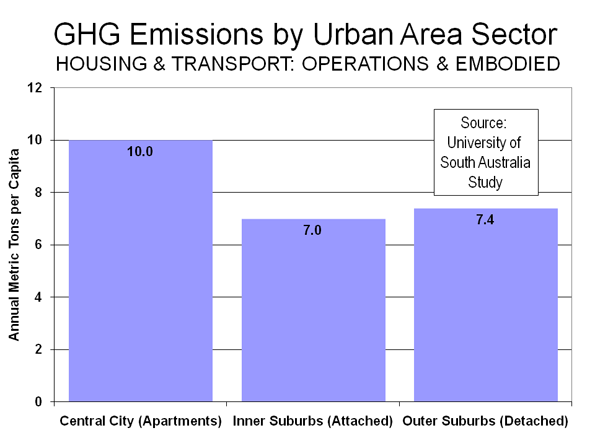
    University of South Australia: The most recent (and new) offering comes from a University of South Australia report thatallocates transportation and residential energy produced GHGs by location and housing type in the Adelaide area. The researchers found that the most GHG friendly sector of the urban area was the inner suburbs, which are dominated by single-family attached housing. GHG emissions per capita from housing and transportation were estimated at 7.0 metric tons of GHG emissions per capita annually.

    However, the outer suburbs, principally with detached housing, were not far behind at 7.4 tons GHG emissions per capita. The highest GHG emissions per capita, by far, were in the central area, with its predominance of multi-unit housing. There the annual GHG emissions were estimated at 10.0 tons per capita (See Figure). The University of South Australia study includes an element missing from virtually all other examinations of transportation and residential GHG emissions: “embodied emissions.” Embodied emissions are the GHGs from construction or manufacturing materials, and from building cars, transit vehicles and buildings. Embodied GHG emissions are ignored by much research, but are a significant factor in GHG emissions. For example, multi-unit housing, with higher use of concrete and more complex construction methods, tends to be substantially more GHG intensive than building detached housing or townhouses.

    GHGs from Common Energy: Previous work by Sydney researchers reached similar results – townhouse development was the most GHG friendly, followed closely by detached housing. Both were substantially less GHG intensive than high-rise condominium development. A principal reason for this conclusion stems in part from the fact that this research included GHGs from common energy, such as the electricity used to power elevators, parking lot and common area lighting, building-provided heating, air conditioning and water heating. American and Canadian research attempting to quantify GHG emissions by residential building type generally has not accounted for common energy and its GHG emission. Yet a gram of GHG from a residential elevator has the same impact as one produced by driving to the local Target store.

    GHG Friendly Suburbs: The most comprehensive research was conducted by the Australian Conservation Foundation. This was not the typical, incomplete or theoretical study of greenhouse gas emissions. The study included virtually every gram of greenhouse gas emissions in Australia and allocated them to consuming households in small residential zones within urban areas and around the nation. Suburban locations, with their greater use of cars and higher percentage of low density detached housing, had lower GHG emissions per capita than the core areas, with their greater use of transit and walking and their high-rise multi-unit housing.

    Compact Development: These findings provided the impetus to review the potential impact of compact development policies. Compact development policies (also called “smart growth” or “growth management”) generally seek to densify urban areas, by drawing urban growth boundaries, outside of which development is prohibited, and by trying to force people to drive less and to use transit more. Again, “planning common sense” clearly indicated to planners that compact development would yield substantial benefits in GHG emissions, principally because people would drive less.

    Yet the more recent research on compact development finds something much different. Densification scenarios from two recent reports, the congressionally mandated Driving and the Built Environment and a smart growth coalition’s Moving Cooler, showed that by 2050, compact development could reduce GHG emissions from driving by only 1% to 9%. At the high end of the range, the most new development would be directed to only a small part of present urban footprints, a policy outcome less believable than a balanced federal budget next year.

    Moreover, these projections have to be considered overly optimistic, because they make no allowance for the higher GHG emissions that occur as traffic slows and stops more in higher density conditions.

    The President Discovers the Suburbs? Meanwhile, on December 15, President Obama took the opportunity to visit a suburban Washington Home Depot, a chain that is a very symbol of American suburbanization. The President could have taken the opportunity to orate further against the suburbs in the insulation aisle, urging households to abandon the suburbs and move to high rise condominiums in the city.

    That was not to be. The President instead proposed providing incentives to people to make their houses more energy efficient, which would reduce greenhouse gas emissions and save money on consumer energy bills. In particular, he cited insulation, saying that “insulation is sexy”. It is worth noting that the Home Depot’s insulation is principally sold to suburban homeowners who can readily arrange for its installation. Residents of high-rise condominiums must rely on their building managers, who tend to purchase their insulation from wholesalers, rather than retailers like Home Depot and Lowes.

    The President explained why insulation was sexy, noting that saving money is sexy. Indeed, saving money is what the suburbs are about. The economic research is clear that housing costs are far less where suburban development is not limited by the compact development strategies that artificially create land scarcity. That’s why places like Dallas-Fort Worth, Atlanta and Houston, without compact development, had little, if any housing bubble, while housing bubbles of economy-wrecking proportions occurred in California and Florida, with their compact development.

    Yes, Mr. President, insulation is sexy. Saving money is sexy. And, the suburbs are sexy.

    Wendell Cox is a Visiting Professor, Conservatoire National des Arts et Metiers, Paris. He was born in Los Angeles and was appointed to three terms on the Los Angeles County Transportation Commission by Mayor Tom Bradley. He is the author of “War on the Dream: How Anti-Sprawl Policy Threatens the Quality of Life.

  • The Green Movement’s People Problem

    The once unstoppable green machine lost its mojo at the Climate Change Conference in Copenhagen. After all its laboring and cajoling, the movement at the end resembled not a powerful juggernaut but a forlorn lover wondering why his date never showed up.

    One problem is that the people of earth and their representatives don’t much fancy the notion of a centrally dictated, slow-growth world. They proved unwilling to abandon either national interest or material aspirations for promises of a greener world.

    The other problem is that divisions are now developing within the green camp. There are members, like Michael Shellenger and Ted Nordhaus, who recognize the serious fall out from the “Climategate” scandal, while others, including large parts of the media claque, dismiss any such possibility. There are the corporatists aligned with big business–who will live with any agreement that allows them to exact monopoly profits–and the zealots–like Greenpeace, Friends of the Earth and Bill McKibben–who see Copenhagen as an affront to themselves and to our endangered planet.

    But the main, fundamental problem facing the movement after Copenhagen–which none of the green factions have yet addressed–is its people problem. The movement needs to break with the deep-seated misanthropy that dominates green politics and has brought it to this woeful state. Its leaders have defined our species as everything from a “cancer” to the “AIDs of the earth.” They wail in horror at the thought that by the year 2050 there will likely be another 2 or 3 billion of these inconvenient bipeds. Leading green figures such as Britain’s Jonathan Porritt, Richard Attenborough and Lester Brown even consider baby-making a grievous carbon crime–especially, notes Australian activist Robert Short, in those “highly consumptive, greenhouse-producing nations.”

    Yet a slower population growth–while beneficial for poor, developing countries–can lead to a dismal, geriatric future in already low-birthrate nations like Germany, Italy, Spain, Japan, South Korea and Russia. And although birth rates are dropping in most developing countries, particularly those experiencing rapid economic growth, it will likely be decades before population stops increasing in most of the developing world.

    Besides, people in developing countries have much more important things to worry about–such as earning a living and getting ahead. Fighting climate change ranks low on the list of Third World priorities. The sprawling slums of Mumbai need more energy, not less; they want better roads, not fewer. More economic development would produce the money to help clean the now foul water and air, but also provide access to better education, one of the best ways to assure more manageable birth rates.

    Instead of looking to make developing countries even more dependent on Western largesse, greens should focus on ways to help improve the day-to-day lives of their people. Rather than prattle on about the coming apocalypse, they could work to replace treeless, dense slums with shaded low-lying clean houses that are easier to heat or cool. Those interested in nature might purchase land and rebuild natural areas. The children of cities like Mumbai should have the opportunity to experience wildlife other than crows, pigeons and rats.

    The environmental movement also might as well forget fighting the aspirations of the burgeoning middle class in India, or other developing countries. No developing world politician, whether from democratic India or Brazil or authoritarian China will embrace an agenda that stifles such aspirations.

    Post-Copenhagen greens need to reassess their relations with people in the developed countries as well. The popular call to transfer hundreds of billions of dollars from the so-called “rich” countries to combat the potential effects of climate change will not be very popular with the vast majority of the middle or working classes in these places.

    Much of the problem revolves around the loaded term “rich.” To be sure, many top climate-change scolds–Richard Branson, Al Gore, Arnold Schwarzenegger, Michael Bloomberg and, of course, his royal highness, Prince Charles–qualify easily. After all, no sweat off their well-massaged backs. The rock stars of the green millennium can buy their environmental indulgences so they can gorge good conscience on their carbon-rich world of private jets and lush estates.

    For them, going green means minimal sacrifice.

    Instead, the “rich” who will suffer the most will be the middle and working class of the developed countries. For them, carbon “sacrifice” may mean more than giving up needless luxuries like gas-guzzlers or monster plasma televisions. A green regime of enforced slow growth and ever greater regulation over carbon could threaten whole industries while environmental-planning policies will make purchasing a decent suburban house even more difficult.

    Such calls for sacrifice seem particularly ill-timed when 4 in 10 U.S. residents fear they could lose their jobs, with many rightly worried about holding onto their homes. With unemployment at 10%, few may be willing to wait around until the promised “green jobs” miraculously appear to save both them and the planet.

    But there’s an obvious way out of this dilemma: Start shifting away from fear-mongering and look to ways to achieve green goals without catastrophic economic losses. One clear way to start this process is through land-use policy. Right now many activists and their allies in the climate-industrial complex–which includes urban land interests–want to force suburban home dwellers into dense urban areas. They also want to coerce people to give up their individual mobility for trains, even if this means longer commutes and less convenience.

    Proposing a radical re-engineering of society does not constitute a winning political program. Environmentalists would do better to embrace a vision of “greenurbia,” allowing for dispersed living but in a environmentally responsible way. This could be done with practical steps–increased telecommuting, more tree-planting and flexible work arrangements–that would enhance not only the environment but also day-to-day life for hundreds of millions of people.

    Similarly, environmentalists should redouble their efforts to provide more access to open space for millions of people through expanded purchases of land throughout the country. America’s highly productive agricultural sector has jettisoned millions of acres of land from cultivation, providing an excellent opportunity for purchases for public use. In some areas, abandoned industrial or mining properties could be rehabilitated as natural areas.

    Such changes, however, require a re-evaluation of the values that now drive the green movement. Whether in California or Calcutta, it boils down to the existential question: Do humans matter?

    Frederick Law Olmsted explained his plan for New York’s Central as an attempt “to supply to the hundreds of thousands of tired workers … a specimen of God’s handiwork.” This represents the kind of sensibility that could transform the green movement from an obstacle to people’s aspiration to a force for greater human happiness.

    This article originally appeared at Forbes.com.

    Joel Kotkin is executive editor of NewGeography.com and is a distinguished presidential fellow in urban futures at Chapman University. He is author of The City: A Global History. His next book, The Next Hundred Million: America in 2050, will be published by Penguin Press early next year.
  • Personal Rapid Transit: Twenty-First Century Transport?

    Recently I had the chance to visit Taxi 2000. This Personal Rapid Transit (PRT) company is based just minutes from my office in Minneapolis. I’m no expert on rail systems, but I’ve always believed that an elevated system that can run freely over existing right-of-ways makes more sense than an antiquated system based on nearly 200 hundred year old technology.

    Since we plan new neighborhoods and cities, I saw a great opportunity to design a new town with an elevated PRT system as a major design influence, not as an afterthought. A perfect combination: a new age city based upon the latest methods, with a convenient way to access most of the region, based on a 21st century design, not an 18th century one.

    I typically investigate the products and companies that I’m about to meet. I’d heard about PRT solutions for well over a decade and assumed there were many examples of installations. After searching the internet I found not a single installed PRT system serving a city.

    I’ve never been a fan of light rail for a variety of reasons. Human beings are smart enough to explore space, extend life spans for decades, and remodel genetics. Yet all we can come up with is a slow (and often unsightly) train that runs on tracks conceived in the 1800s that now cost billions of dollars to implement? We are told that building a light rail line spurs economic growth. Even if true, typically only a minor portion of a town benefits because the system is linear. Most are designed to be functional, not beautiful, and most light rail trains are not inspiring.

    I used to drive in Minneapolis, but now train tracks intermix with the driving lanes in some areas of town. I avoid those sections, and now do my spending in the suburbs. I’m sure I’m not the only one. This brings me to my final opposition to light rail: Because it’s typically ground-based, it’s obstructive to implement, and often requires the demolition of buildings and the acquisition of right-of-ways. All of this costs plenty.

    On top of this, many businesses suffer during the construction of light rail, while it interferes with their access. Sure, they might ultimately get additional business, but first they must survive a period with reduced access.

    Mike Lester, CEO of Taxi 2000 demonstrated the prototype of SkyWeb Express along with its technologies to us. Over a period of three hours, Mike proudly showed us what they have accomplished.

    First, this is an on-call system. This means that you do not have to wait for the next train. Cars located only a minute or so away await your command. No more missed connections while waiting an hour for the next ride.

    It is elevated far above ground — 5 meters — using existing right-of-way on posts spread far apart. In an urban area such as Minneapolis which already has a skyway system, this could coincide with existing access points on the second or third floors. It’s non-linear, and able to easily turn corners and access much of a city, not just points along a single route.

    It maintains a constant rate of speed; no stops needed until you reach the destination. About 30+ miles per hour might not seem fast, but a mile every two minutes in an urban environment is indeed impressive. It’s limited to 3 persons per vehicle with plenty of extra space for luggage, boxes, or even a bicycle. No more crowding. It goes where you want, not only on a preset route. In theory it’s safer because you can access it alone, not with strangers. And one car needing maintenance does not shut down the system.

    The big issue that all transit needs to address is the cost. The light rail transit in Minneapolis costs somewhere around a billion dollars. PRT cost studies show a savings of 60 to 70 percent could have been realized along the same line. Even if the estimates are wrong by double, that’s over $200 million that could have been spent elsewhere, or to make a quite comprehensive PRT system for the same dollars.

    I’m not easily convinced when someone tries to “sell” me on new technologies, but that common sense meter in my brain was at 100% as I learned about the PRT possibilities. I was not sold that this will get everyone out of their cars, but it’s a solution that would be more effective than a rail system.

    So why no installations?

    PRT companies have been around for a while, continually upgrading and perfecting their systems. While I’m not sure how they get funded, I can tell you that cities have a hard time spending hundreds of million dollars on systems developed by small firms. As a software developer of Geographic Information Systems in the 1990’s we constantly lost sales to larger companies, even though our product was superior. It appeared that cities were more comfortable buying from companies with hundreds of employees working in tall impressive buildings than from smaller firms. It was natural to think a firm that appeared quite large had staying power compared to small companies with a handful of employees. But in the dot-com bust we learned that size does not guarantee longevity.

    I’ve written this before, but it bears repeating: On August 1st, 2009 President Obama addressed the nation with: “Future economic prosperity depends on building a new, stronger foundation and recapturing the spirit of innovation …. Innovation has been essential to our prosperity in the past, and it will be essential to our prosperity in the future”.

    Small PRT firms have risked everything, adhering to a belief that it is a viable solution for urban transportation problems today and in the future. How have we rewarded these innovators who certainly have the spirit? We continually invest in the most non-innovative, obtrusive, and expensive solution: Light Rail. We reward large corporations who take no risk… What happened to us? Let’s see if this new Administration can stand by the President’s words and invest in the pioneers who can create that strong American foundation.

    Rick Harrison is President of Rick Harrison Site Design Studio and author of Prefurbia: Reinventing The Suburbs From Disdainable To Sustainable. His website is rhsdplanning.com.

  • Detroit Needs a Bolder Plan

    The Brookings Institution recently unveiled “The Detroit Project”, a plan to revive Detroit, in the New Republic. Brookings’ plan has good elements and recognizes some important realities, but also has key gaps. It relies excessively on industrial policy and conventional approaches that are unlikely to drive a real turnaround in America’s most troubled big city.

    On the plus side, Brookings does a great job stating why Detroit’s fortunes will take a long time to reverse, possibly a generation or more. As they note, “Detroit’s leaders must manage expectations. It took half a century for the city to get this low. It won’t turn around in a four-year political cycle.” Authors as prescient as Jane Jacobs and as conventional as Time were talking about Detroit’s decline as far back as the early 60s. Turnaround won’t happen in six months or even six years. Given the political preference for election-cycle results, this means strong and courageous leadership will be needed, a point they also stress. Sadly, that’s a commodity that has long been in short supply in Detroit.

    Brookings is known for their promotion of regionalism, and this plan predictably follows that prescription. Clearly, rationalization of investment policy on a regional basis is needed. The Detroit region is losing population, yet the long range transportation plan calls for huge amounts of spending to widen roads on the fringes. That makes no sense. People and businesses in Detroit keep moving out as the cities and suburbs they once inhabited fall into ruin under a regime of failed stewardship and the endless search for new greenfields to exploit. It’s like prospectors skipping from one clapped out mining town to the next. If they want to do that, they shouldn’t expect the rest of us to pay for it via federal funds – either to build the new or to clean up the mess in the ghost towns they leave behind.

    They also recognize the need for improved governance, including potentially state receivership for failed institutions. (They did not, however, give due credit to new Mayor Bing for the change and new leadership attitude he has already brought to the table). Suggestions like a focus on brownfield remediation and managed shrinkage were on point, as was the recognition that significant federal assistance will be required. Given the depths of the problems in Detroit and Michigan, the city and state are not going to be able to do it alone.

    The plan also rightly notes that “Detroit will have to become a different kind of city, one that challenges our idea of what a city is supposed to look like, and what happens within its boundaries.” Very true. Unfortunately, much of the rest of the Brookings prescription failed to meet that challenge.

    Brookings’ plan relies heavily on analogy to other post-industrial cities, especially in Europe, which makes it difficult to be sure exactly what they are recommending at times. Even to casual observers, these cities are far different from Detroit. For one thing, Detroit is huge. The region, if one includes Ann Arbor and Windsor, Canada, is over five million in population – more than double the size of Brookings comparison areas.

    Places like Turin and Bilbao also have radically different built forms, history, culture, and are virtually racially and ethnically homogeneous compared to Detroit. Even the measurements of European success need to be redone. Neither Italy nor Spain represent role models since both have fared worse than America in the current downturn. These countries (and cities) are aging rapidly, with some of the world’s lowest birthrates.

    Their US examples of Toledo and Akron (i.e., greater Cleveland) are hardly bright and shining lights of economic or demographic success. Since 2000, Akron has lost nearly 10,000 people and Toledo over 20,000. Toledo’s 11.4% unemployment rate exceeds the nation’s. These aren’t even Ohio’s biggest cities, much less dominating the state’s economy the way Detroit does Michigan.

    Brookings also all but ignores a lot of the root issues of Detroit’s problem. Firstly, they fail to make a point about healing America’s most poisoned race relations, arguably the signature issue of Detroit. Racial tensions and inequity have perpetually bedeviled America. Making progress in Detroit won’t be easy, but is an absolute prerequisite to progress. Perhaps shared economic struggles will finally provide a common interest around which to build some form of racial rapprochement.

    Most glaringly, Brookings has nothing at all to say about Detroit and Michigan’s tax and regulatory regime, its failed management and labor cultures, or its dysfunctional state politics. Brookings’ desire to stay on good terms with the establishment might inhibit their ability to speak freely, but these problems must be confronted.

    It is impossible to ignore this witch’s brew of policies and attitudes that is totally toxic to economic development. It’s a classic case of ignoring the elephant in the room. Until these blocking and tackling matters are addressed, Detroit is going to remain kryptonite to business expansion. In Forbes 2009 list of the best states for business, Michigan ranked 49th.

    Instead of improving the terrible business climate, Brookings proposes a top-down industrial policy, explicitly stating “local government (or NGOs, even) can play the role of industrial planner. That is, they can look across the map and find instances where research institutions and manufacturers should collaborate on new ventures.” And they say “public money” is needed to retool old industries and advance new ones. The government in Detroit can’t even manage the delivery of basic city services. None of the region’s levels of government have performed well on their core competency, so why would we believe these entities would be effective venture capitalists or industrial planners? This is a recipe for epic rent seeking and an economic Waterloo on a grand scale.

    Their suggested industries for Detroit are a tired looking roster of the same ones everyplace else is chasing: green industry, life sciences, advanced manufacturing, and university technology spin-offs. With such a crowded playing field – 49 out of 50 states are chasing life sciences, for example – it is hard to discern the Detroit region’s distinctive capabilities in any of these areas apart from automotive related R&D and manufacturing. Sure, they’ll get some slice of the pie in these growing markets, but unlikely enough to turn the ship around or create a true innovation cluster.

    Public-private partnerships do have a strong role to play in Detroit’s economic development. This includes looking for sectors where it can realistically compete and win, and looking to create the infrastructure and conditions necessary for them to flourish in terms of facilities, talent attraction, legal and regulatory frameworks, regional business culture and practices, and more. It’s about creating fertile soil, not picking winners.

    However, assistance to the restructuring auto industry was clearly required. Without federal aid, GM and Chrysler would have been liquidated. They still might, but given the importance of that industry to our economy, it is probably worth doing what we have to do for now. But we should recognize that getting in was a lot easier than getting out will be, and that the end result might still be failure or Soviet style zombie companies that survive only as wards of the state.

    Lastly, the praise of rail transit by Brookings – the cook book solution du jour for cities – is puzzling. Again, Detroit is shrinking and needs to shrink more. Trains work best when people are commuting to a central point, but jobs have been disappearing from the core of Detroit for generations. Today barely 4.5 percent of area employment takes place in the urban core, among the lowest percentages among the nation’s top 50 cities.

    As with fringe highway expansion, the last thing Detroit needs is even more infrastructure. It has too much already that it can’t afford to maintain. Taking on a costly new rail transit system with both high capital expenditures and significant ongoing operations and maintenance costs is a dubious proposition – particularly when the existing bus network is on the verge of a near shutdown. The biggest game changer from an infrastructure perspective – new highway crossings to Canada to strengthen Detroit as the premier gateway to Canadian international trade – is not mentioned.

    So while Brookings gets a few key pieces of the puzzle right, ultimately their solution is too standard issue and lacks the boldness and innovative thinking needed to tackle the core problems and create a realistic prospect for renewal.

    In the next installment tomorrow: a better plan for Detroit.

    Aaron M. Renn is an independent writer on urban affairs based in the Midwest. His writings appear at The Urbanophile.

  • What To Look For In Healthcare Reform: Location, Location, Location

    A Reuters article that was widely picked up around the globe recently raised the question, Are Doctors What Ails US Healthcare? Comparing the New York suburb of White Plains to Bakersfield, California, the article uses the evergreen two-Americas paradigm to discuss disparities in health care. Drawing heavily on the Dartmouth Atlas of Healthcare, it highlights a sad but inescapable fact: doctors want to live in some places and not in others, giving the “have” populations more intensive medical care which they might or might not need, while have-nots, who tend to be older, sicker and poorer, get health care to match. The article asserts that there’s nothing in current health care reform legislation that will do anything to address the disparities.

    I agree. But then, what should we expect? The legislation, which I find marginally more desirable than doing nothing at all, is largely about insurance, not about health care. This is what happens when we emphasize how we pay for something, rather than what we are paying for. Are doctors what ails U.S. health care? Only in the sense that they are operating on the same basis as everyone else in the health care market: every man for himself.

    You don’t have to make bi-coastal comparisons to find the disparities highlighted in the Reuters article. My own Hudson Valley not-for-profit insurance company faces them every day. We cover the Medicaid populations from the aforementioned White Plains, NY, to the South, to the blighted economies of the Catskills to the North and West. The distance involved is only about 150 miles, but day in, day out it might as well be 1500. And socially, it might as well be 150 years. Sullivan County is still organized geographically the way it developed in the eighteenth and nineteenth centuries — farms, woods, and mills, only without the mill jobs.

    There was a brief shining moment (well, half a century) when urban Jews and other vacationers formed the basis of a thriving tourist trade in the “Borscht Belt” resorts of Monticello, Sullivan County’s hot spot. When they closed, they provided ideal settings for residential drug and alcohol rehab for poor people from New York City, but those aren’t exactly the foundation for high-quality community health care. When we initially started offering state-sponsored insurance to the poor of Sullivan County, the historical dearth of specialists made it a laboratory for what a free market looks like when there’s no competition. (Do I hear the words “strong public option”?) Because New York State requires us to have a decent network of contracted doctors for our enrollees, the sole cosmetic surgeon – for example – could extract pretty much any fee he wanted from us in exchange for seeing a patient who needed emergency reconstructive surgery.

    Your tax dollars meet supply and demand and a mandate to pay within a private market.

    I don’t blame the specialists. They are highly trained and skilled, and have paid their dues. If I blame anyone, it’s the system that sets the dues so high, in the form of college and medical school loans and years of fellowships that leave well-meaning doctors feeling that they deserve all that money, just like corporate farmers and hedge fund managers.

    It’s also not the doctors’ fault that they want good schools and cultural amenities. I haven’t seen much of Bakersfield, but I know that schools in and around White Plains have good reputations and are just twenty miles from Broadway and the Metropolitan Museum (and ten miles from my Tarrytown office). Maybe we can fix schools and reinvigorate the National Endowment for the Arts to make every remote locale more like Westchester, but that would be socialism.

    Dartmouth Atlas data is easily available online, and well worth spending some time with. You can use it to create all kinds of two-America scenarios that provide instant object lessons in our health care inequities. My personal favorite is that health care spending in Miami, Florida for Medicare patients in the last two years of life (highest in the nation) is exactly twice that in Portland, Oregon (lowest of the regions studied), with commensurate volumes of appointments, referrals, tests and hospitalizations, and no better outcomes. Here we see the same dynamics that make pawnshops spring up around gambling casinos and candy stores near public schools. Doctors go where the customers are, and once they arrive they maximize their revenues and measure success by volume, not outcomes.

    Why should we expect anything different, when reform legislation is captive to the same kind of have/have not dichotomy that shapes health care delivery itself? Senators Max Baucus of Montana and Kent Conrad of North Dakota are two of the pillars of the anti-public option caucus. They come from states with small populations, and both take barrels of money from the health insurance industry because they can’t raise it locally. If they play their cards right, who knows? They could leave Congress and become haves themselves, like Billy Tauzin, who is now Big Pharma’s man in Washington, having engineered the passage of Medicare Part D, or Tom Daschle, once a champion of single payer, who now plays both sides of the street with special interest money.

    Are Doctors What Ails US Healthcare? quotes David Goodman, Director of Health Policy Research at the Dartmouth Institute for Health Policy and Clinical Practice, who says there’s an “irrational distribution” of the most valuable and expensive U.S. health care resources. I would say that the distribution is entirely rational given the insanity of the larger situation.

    If we’re ever going to find our way out of this mess, we’re going to have to do for these health care backwaters, both rural and urban, what we used to do when private capital wouldn’t do the job. Set goals and build the infrastructure to serve them, because the market won’t do it. Want to electrify Appalachia? You need the TVA. Want to make the desert bloom? Build dams and aqueducts. Want to open up the interior of the country? Build an Interstate Highway system. Want doctors to practice in unattractive markets? Create an MD Bill for doctors like the old GI Bill for veterans, so that doctors emerge from training feeling more like public servants and less like indentured servants.

    I attended a discussion of health care reform not long ago at the Yale School of Public Health. The representative of the private health insurance industry put the issues in a compelling perspective, although not, perhaps, for the reasons he cited.

    His arguments were three: First, we require automobile owners to carry insurance, so requiring everyone to carry health insurance shouldn’t be a problem (I know that President Obama made this point, too, and I hated him for it). Second, do you want a health care system that runs like the Post Office, or one that runs like Federal Express? And third, the health insurance industry is really a jobs program, and do we really want to put all those people out of work?

    These are shallow arguments. Car insurance? There’s no law that says you have to own a car, but everyone needs health care. A health insurance mandate is more like forcing every American to buy a new car and giving them a choice between Ford or GM. Post Office and FedEx? A company that can’t send a package overnight from suburban Tarrytown into New York City without round-trip flights to Memphis and back is no model for health care delivery, and besides, I’d like to see what FedEx can do for the price of first class postage. Jobs? A dynamic economy finds ways of redeploying redundant workers in more significant jobs. Wouldn’t those actuaries make good math teachers?

    The arguments were so hollow that no one bothered to argue, and the insurance rep was undoubtedly relieved. A fellow panelist who practices medicine in Cambridge, Dr. David Himmelstein of Harvard, said simply, “My practice would have no trouble making money on Medicare, single-payer reimbursement rates if we didn’t have to pay so many people to argue with insurance companies.”

    Unfortunately, the larger discussion is still stuck on insurance, and as long as it is, the two health care Americas will never become one.

    Georganne Chapin is President and CEO of Hudson Health Plan, a not-for-profit Medicaid managed care organization, and the Hudson Center for Health Equity & Quality, an independent not-for-profit that promotes universal access and quality in health care through streamlining. Both organizations are based in Tarrytown, New York.

  • Demographics May Be Destiny, but Mind the Assumptions

    Demographic projections have become an essential tool of national, state and local governments, international agencies, and private businesses. The first step in planning for the future is to get a picture of what the terrain is going to look like when you get there. That’s mainly what I do for clients, audiences and subscribers, and demographics provide the frame (like assembling all the straight-edge pieces of a jigsaw puzzle first). But here’s the thing about projections: a small change at an inflection point, or the inclusion (or exclusion) of salient variables, can result in big changes to the future you are trying to describe. So like all treatments of the future, everything depends on the underlying assumptions, and the salience of the variables chosen for inclusion.

    Demographics and Depression?
    For example, a couple of recent essays on demographic trends start with different assumptions, consider different variables, and come to wildly divergent conclusions. David Goldman, associate editor at First Things, says the housing market has collapsed, and will remain in depression, because of the dearth of two-parent families with children.

    Goldman asserts that only a a policy to restore the traditional family to a central position in American life can work to save the housing market. Without this, he says, ”we cannot expect to return to the kind of wealth accumulation that characterized the 1980s and 1990s.“

    Goldman’s argument centers on the idea that the US housing market is driven by one variable: two-parent families with children. And since that variable has not been growing, neither can housing demand. Yet, obviously, other household types besides two-parent families with children desire, can afford, and live in detached houses. Indeed, 55.2% of all single-person households owned homes in 2007, up from 49% in 1990.

    There is also a large population of empty-nest households (people who have already raised their kids), but who choose to continue to live in houses. Other demographic trends that will contribute to the continued preference for detached houses: increased longevity, better health, later childbearing, more home-based businesses, the presence of “delayed launch” kids (or those who boomerang to live at home before “final launch”), or a desire to have room for grandkids to visit. There is also the reality that many people will not want to move because of proximity of neighbors, churches, clubs and work.

    One must also note that foreign immigration and domestic migration, even under lowest-variable projections, will still be substantial in coming decades, fueling housing demand.

    In addition, other demographic trends suggest family and household formations will, once employment and income conditions improve, again provide a demand for houses. For example, there are more people entering their 20s now than in any time since the 1960s and early 1970s. True, we have just passed through a period of slow growth in family-age household formation, but once this Millennial generation start making money in an improving economy, they will start forming families and households, and will start buying houses.

    The World’s New Numbers
    Another recent essay on demographic projections starts with different assumptions, looks at different variables, and comes to different conclusions. Martin Walker, writing in The Wilson Quarterly, notes that something dramatic has happened to the world’s birthrates: they are up in developed countries, and down in developing countries (the opposite of what most dire forecasts project).

    Walker starts by debunking the assumption that mass migration and low birthrates are transforming the ethnic, cultural and religious identity of Europe. He notes the decline of Muslim birthrates across the globe, and rising birth rates in Western Europe – albeit from very low levels – and consistently higher rates in the United States. He then explains that aging populations in Europe and the US will not place intolerable demands on governments’ pension and health systems, if we are willing and able to both raise the retirement age and increase the workforce participation rate.

    These two steps (not easily achieved, but simple in conception) will result in a very manageable dependency ratio, similar to those of the 1960s, writes Walker. In the United States, the most onerous year for dependency was 1965, when there were 95 dependents for every 100 adults between the ages of 20 and 64 (“dependents” include people both younger and older than working age). By 2002, there were only 49 dependents for every 100 working-age Americans. By 2025 there are projected to be 80, still well below the peak of 1965. The difference is that while most dependents in the 1960s were young, most of the dependents of 2009 and beyond are older. But the point is that there is nothing outlandish about having almost as many dependents as working adults.

    The assumption underlying this more favorable scenario is that given freedom and information, that is to say, given the choice, the continuum of progress and development is uniform and universal: people in all places and of all backgrounds desire middle-class lifestyles (which include single-family detached houses, by the way). And while the planet’s population is expected to grow by about one billion people by 2020, the global middle class will swell by as many as 1.8 billion, with a third of this number residing in China. The global economic recession will retard but not halt the expansion of the middle class.

    The economic transition that development brings is accompanied by the demographic transition to lower birth and death rates (social, cultural and political transitions then occur too). Industrialization, urbanization, suburbanization: that is the pattern of how middle-classes grow. First-world countries have traversed this path, and now emerging countries are following.

    Trends can and do change. In fact, it may even be said that every trend sows the seeds of its own reversal. But it has always been my goal to identify the constants across history, as a way to establish a baseline for evaluating the likelihood of future scenarios (again, the straight-edged pieces). I believe the “aspirational model” to be one of these constants.

    Dr. Roger Selbert is a trend analyst, researcher, writer and speaker. Growth Strategies is his newsletter on economic, social and demographic trends. Roger is economic analyst, North American representative and Principal for the US Consumer Demand Index, a monthly survey of American households’ buying intentions.

  • There is no “Free Market” Housing Solution

    The common line used by advocates of housing affordability has been that the solution lies in “free markets”. Yet this “free market” solution does not address the fundamental problem which is really a political one.

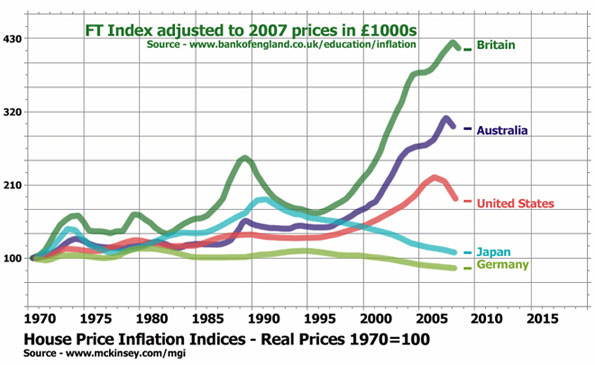
    This true fundamental problem is particularly evident here in Britain, the leader in house price inflation and housing financial bubbles since the 1970s. In their recent report Global capital markets, the McKinsey Global Institute has confirmed what has been shown in recent Demographia surveys.

    The root of this problem lies with an elite agenda that is highly ideological. The ideology at work is environmentalism, making a moral virtue of the retreat of political and commercial elites from the industrial production of housing.

    The preference is for interest payments on a fund of mortgage debt rather than the effort of turning a profit from development, let alone construction. Professionals like estate agents, planners, architects, and bankers are certainly in collusion with that elite ideology.

    That is not to say there is a conspiracy to plan a housing bubble. That is too crude. There is clearly regulation and legislation. On 24 November 2009 the Housing Minister John Healey confirmed that Britain will be the first country in the world to require zero carbon homes as a matter of law from 2016. Britain is the world leader in green ideology.

    John Healey
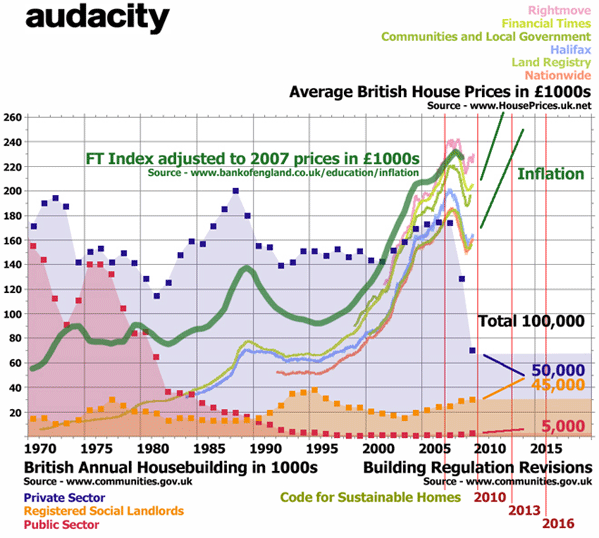
    All of the newly built British housing will have much better insulated walls, windows, roofs and floors. The clear aim of the government is to keep reducing the energy consumption of all new homes to be measured in kilowatt-hours per square metre of floor area per year. New Labour hope to make it law that total energy consumption is no more than 46 kWh/m2/year for semi-detached and detached homes, and then no more than 39 kWh/m2/year for all other homes. The energy efficiency standards will be applied from 2016, subject to yet another consultation on the Code for Sustainable Homes, announced at the end of 2006, and technically published for use on a voluntary basis in 2007. The building regulations get revised in 2010, 2013, and 2016 leading to this legal requirement for maximum energy consumption in all new homes.

    Healey says that “zero carbon” is a concept that will apply to a new home at the “point of build”. ‘We are not going to regulate through this policy how occupants live in them,’ he says. However the Code for Sustainable Homes assumes patterns of behaviour. Environmentalists within and without government will argue that behaviour needs to change. They will be suggesting all sorts of intrusions into daily life.

    British environmentalism couldn’t be more ideological, and more of a barrier to the production of affordable housing. The planning system has been “greened”. The mood is against development, and planning approvals for new land for new housing are hard to obtain. The zero carbon requirement will only apply to around the 100,000 new homes that will be built annually, while the existing stock is around 26 million homes. Healey is also going to regulate existing housing, and is not just looking at the residential sector.

    I am sure politicians like Healey don’t want their pursuit of “zero carbon” buildings to mean that fewer buildings are built. I am sure there are some environmentalists who will be pleased that building activity is in decline. The logic of green thinking entails that the most energy efficient thing to do is not to build more buildings at all.

    It is green not to build new homes to meet demographic demand. Let people modify their behaviour, say the environmentalists, and live together in as much of the existing stock as can be refurbished. It also happens that the existing stock is highly mortgaged, and the vast majority doesn’t want their homes to fall in value. An indefinite policy of green refurbishment of the homes that already exist and a future of house price inflation are highly compatible. That suits the mortgage lenders and the government. The commitment to “zero carbon” allows government to appear virtuous in its legislation for the new build sector.

    This suits the financial markets as well, since it guarantees house price inflation by making it difficult to meet the demographic demand for homes. Environmentalism offers more and more reasons not to build. Green thinking ensures that house price inflation can be sustained through a bubble, and projected beyond the bursting of that period of financialisation into the next.

    As capitalism ”greens” itself, capitalists continue to profit, while not meeting the fundamental demands of the people for housing. But simply restoring “the free market” will not solve the problem. In an old industrial country like Britain, there are ever more people who don’t earn enough to buy a home even at the “affordable” price of two and a half times their gross annual household income, which is the Demographia measure of affordability.

    This reality has a great appeal to what Robert Bruegmann refers to as “the incumbents club” – established homeowners, increasingly older, and those with inherited money. That majority want homes to be an appreciating asset, not a depreciating utility, like a pair of trousers, or a car. They want their home to appreciate in value, and they want to be green. Most people want to be greener and better off.

    Being anti-development for green reasons allows the incumbents to preserve their wealth, while making mundane opposition to new house building, or the attempt to constrain “sprawl”, seem virtuous. People don’t wake up thinking that they will inflate the value of their home by resisting sprawl in principle. Instead they oppose new development in the mistaken belief that Climate Change is caused by sprawling development. It is common for people to think that sprawl is bad for the planet, even while living, mostly with a mistaken sense of guilt, in the sprawl.

    By hoping for a “free market” solution to the problem of unaffordability, Hugh Pavletich of Demographia assumes that it is politicians, businessmen, and professionals who have distorted the market for reasons of narrow and immediate self-interest. Yet that is not how people think: they believe their environmentalism is morally above self-interest. They are saving the planet in their minds by blocking new building, and by their opposition to sprawl. The incumbents’ club members can feel virtuous at little cost to themselves and don’t worry too much about house price inflation. Of course there is no actual Club. There is no conspiracy. Homeowners simply share a self-interest in raising the value of their home, and tend to also want to show how selflessly green they are.

    This all has had the effect of making the lending of mortgages on inflated land values a much larger business than the construction of homes. No-one planned to cause a sequence of bubbles, but Britain’s desperate social dependence on sustained house price inflation can’t be brought to an end easily.

    The only way to stop national or regional housing bubbles recurring is the establishment of the freedom for everyone to build a home on cheap agricultural land without any government or professional hindrance except in matters of technical building regulations. Fire should not spread, and buildings should not fall down. But even building regulations can become ideological rather than technical. The British building regulations, as Healey has made clear, will also push energy efficiency standards to illogical extremes of peak performance in an attempt to address Climate Change. Even while the supply of new homes reduces

    The political freedom to build wouldn’t be a “free market” because not everyone is able to raise the finance to buy cheap land and pay for construction. The idea of a “free market” is a long running ideological myth. But the universal freedom to build would mean people are free to attempt to raise the finance to buy land and build.

    More importantly, the freedom to build would undermine the financialisation of the housing market. If everyone was free to build on cheap land the incumbents’ club would have to compare the value of their existing home to the cost of building a new one. Mortgage lenders would not be able to lend over the cost of construction unless they felt secure in doing so. The security of the 1947 Town and Country Planning Act would be removed for financiers. Government, the finance system, planners, or the incumbents’ club will be ideologically opposed to that for a host of environmental reasons. Britains mostly want to be greener but with renewed house price inflation, while no-one wants to make an argument explicitly for un-affordability. This may be confused and deluded, but it is an ideology promoted by the British government.

    However, ideas can be challenged and changed. One step is to understand that there is no “free market” housing solution. Getting rid of the 1947 denial of the freedom to build doesn’t mean an end to planning. Homes will still need to be planned, just as they were before 1947. But planners will not have the power to stop people from building. There is a need to politically end the environmentalist denial of the freedom to build in an industrial democracy. With a population free to build the finance system would be more interested in cheapening new construction on lower cost land, and not preoccupied with securing the financialisation of periodic but persistent house price inflation. A freedom to build is very much not a right to a home. It is a freedom from the obstructions of planners, with the weight of government legislation behind them. A freedom that is denied to protect the environment, a denial that sustains house price inflation.

    The market is not capable of being a “free market”. Capitalism is a system of control by political and commercial elites, and their professional employees. British capitalists tend to be less interested in industry, which is held to have caused Climate Change, and more interested in finance these days. What is precisely missing in the face of the morally selfless capitalist ideology of environmentalism is an ideology in favour of raising the productive capacity of the construction industry based on a universal sense of immediate and material self-interest. Getting rid of the 1947 planning legislation is a limited attempt to reconnect house building with the cost of construction and household incomes by removing the means by which house price inflation is sustained. Homes would be more of a utility than an investment in Britain, and we would cease to be world leaders in housing based financial bubbles.

    To do that requires us to oppose those who would be world leaders in the environmental ideology that industrial production is a problem for the planet. In Britain we need to set people free to build housing to the best of their abilities within a capitalist planning system stripped of the legal powers it gained in 1947. Innovative in their day, British planning now only sustains housing bubbles and restricts people’s opportunity for decent housing.

    Ian Abley, Project Manager for audacity, an experienced site Architect, and a Research Engineer at the Centre for Innovative and Collaborative Engineering, Loughborough University. He is co-author of Why is construction so backward? (2004) and co-editor of Manmade Modular Megastructures. (2006) He is planning 250 new British towns.

  • Capping Emissions, Trading On The Future

    Whatever the results of the Copenhagen conference on climate change, one thing is for sure: Draconian reductions on carbon emissions will be tacitly accepted by the most developed economies and sloughed off by many developing ones. In essence, emerging economies get to cut their “carbon” intensity–a natural product of their economic evolution–while we get to cut our throats.

    The logic behind this prediction goes something like this. Since the West created the industrial revolution and the greenhouse gases that supposedly caused this “crisis,” it’s our obligation to take much of the burden for cleaning them up.

    Plagued by self-doubt and even self-loathing, many in the West will no doubt consider this an appropriate mea culpa. Our leaders will dutifully accept cuts in our carbon emissions–up to 80% by 2050–while developing countries increase theirs, albeit at a lower rate. Oh, we also pledge to send billions in aid to help them achieve this goal.

    The media shills, scientists, bureaucrats and corporate rent-seekers gathered at Copenhagen won’t give much thought to what this means to the industrialized world’s middle and working class. For many of them the new carbon regime means a gradual decline in living standards. Huge increases in energy costs, taxes and a spate of regulatory mandates will restrict their access to everything from single-family housing and personal mobility to employment in carbon-intensive industries like construction, manufacturing, warehousing and agriculture.

    You can get a glimpse of this future in high-unemployment California. Here a burgeoning regulatory regime tied to global warming threatens to turn the state into a total “no go” economic development zone. Not only do companies have to deal with high taxes, cascading energy prices and regulations, they now face audits of their impact on global warming. Far easier to move your project to Texas–or if necessary, China.

    The notion that the hoi polloi must be sacrificed to save the earth is not a new one. Paul Ehrlich, who was the mentor of President Obama’s science advisor, John Holdren, laid out the defining logic in his 1968 best-seller, The Population Bomb. In this influential work, Ehrlich predicted mass starvation by the 1970s and “an age of scarcity” in key metals by the mid-1980s. Similar views were echoed by a 1972 “Limits to Growth” report issued by the Club of Rome, a global confab that enjoyed a cache similar to that of the United Nations’ Intergovernmental Panel on Climate Change.

    To deal with this looming crisis, Holdren in the 1977 book Ecoscience (co-authored with Anne and Paul Ehrlich) developed the notion of “de-development.” According to Holdren, poorer countries like India and China could not be expected to work their way out of poverty since they were “foredoomed by enormous if not insurmountable economic and environmental obstacles.” The only way to close “the prosperity gap” was to lower the living standards of what he labeled “over-developed” nations.

    These predictions were less than accurate. World-wide systemic mass starvation did not take place as population escalated. Rather those many millions wallowing in poverty in the developing world, particularly in Asia, lifted themselves into the global middle class. Far more efficient ways to use energy have been developed, and unexpected caches of new resources continue to be discovered all over the planet.

    Yet however wrong-headed, Holdren’s world view now has jumped from the dustbin of history into the craniums of presidents and prime ministers. President Obama’s pledge to “restore science to its rightful place” has morphed into state-sponsored scientific ideology.

    The blind acceptance of this agenda threatens the credibility of Obama and other Western leaders. For one, if the crisis is by its nature global why should we allow massive increases in carbon emissions in developing countries–China will soon surpass us in greenhouse gas emissions, if it hasn’t already–while we draconically cut ours? Does the planet really care if it’s turned to toast by American- vs. Chinese-made gas?

    Then there’s the specious historical narrative that insists we pay for creating the industrial revolution since it brought on global warming. Should the West pay for the sins of the British who brought electricity and railroads to India? Does America owe carbon penance for making the technology transfers critical to East Asia’s remarkable rise? Maybe we should start by making Wal-Mart cancel its China orders. That might help de-carbonize the planet a bit.

    There’s also growing skepticism about the whole warmist narrative. Climate change now ranks last among 20 top issues in a recent Pew report. There’s been a similar rise in skepticism in the U.K., once a hot bed of warmist sentiment.

    The reasons for the shift may vary. First, there’s a controversy over the temperatures of the past decade, with even some concerned about climate change admitting that there has not been the expected warming. Or perhaps a deep recession has made many “rich” countries feel a trifle less “overdeveloped.”

    And now we have Climate-gate–where leading warmist pedagogues are trying to suppress unsuitably conformist scientists and perhaps even cook the numbers a bit. Although you won’t see too much tough coverage in the mainstream press, the tawdry details have poured out over the Internet and diminished the aura of scientific objectivity of some leading global warming researchers. One recent poll shows that a large majority of Americans believe scientists may have indeed falsified their research data. By well over 4 to 1, they also believe stimulating the economy is a bigger priority than stopping global warming.

    Clearly the political risks of giving first priority to the carbon agenda are on the rise. Australia’s Senate just voted down that country’s proposed cap and trade scheme. The Western center-right, once intimidated by the well-financed greens and their media claque, has become bolder in challenging climate change alarmism.

    There’s also something of a rebellion brewing, at least toward emissions trading schemes, among some liberals from the South and Midwest, notably Wisconsin’s Russ Feingold and North Dakota’s Byron Dorgan. As analyst Aaron Renn has pointed out, these areas are most likely to be negatively affected by the current climate change legislation. Feingold recently stated that he was “not signing onto any bill that rips off Wisconsin.”

    So why do leaders like Barack Obama and British Prime Minister Gordon Brown continue identifying themselves with the climate change agenda and policies like cap and trade? Perhaps it’s best to see this as a clash of classes. Today’s environmental movement reflects the values of a large portion of the post-industrial upper class. The big money behind the warming industry includes many powerful corporate interests that would benefit from a super-regulated environment that would all but eliminate potential upstarts.

    These people generally also do not fear the loss of millions of factory, truck, construction and agriculture-related jobs slated to be “de-developed.” These tasks can shift to China, India or Vietnam–where the net emissions would no doubt be higher–at little immediate cost to tenured professors, nonprofit executives or investment bankers. The endowments and the investment funds can just as happily mint their profits in Chongqing as in Chicago.

    Global warming-driven land-use legislation possesses a similarly pro-gentry slant. Suburban single family homes need to be sacrificed in the name of climate change, but this will not threaten the large Park Avenue apartments and private retreats of media superstars, financial tycoons and the scions of former carbon-spewing fortunes. After all, you can always pay for your pleasure with “carbon offsets.”

    So who benefits from this collective ritual seppuku? Hegemony-seeking communist capitalists in China might fancy seeing America and the West decline to the point that they can no longer compete or fund their militaries. A weakened European Union or U.S. also won’t be able provide a model of a more democratic version of capitalism to counter China’s ultra-authoritarian version.

    The Chinese may win a victory in Copenhagen greater than anything accomplished so far in the marketplace–and our leaders will likely thank them for it. Forget bowing to the emperor in Tokyo; like vassal states at the height of the old Middle Kingdom, the new requisite diplomatic skill for Westerners will be kow-towing to Beijing.

    Yet most people in the developing world will not benefit from the suicide of the West. The warmists’ vision is not one of growing prosperity, but of capping wealth at a comparatively low level. De-industrialization means the West falls back while emerging economies grow a bit. The “prosperity gap” may close, but ultimately everyone is left with less prosperity.

    In the long run developing countries gain less from harvesting guilt than enjoying a bounty of customers, capital and expertise. The West’s experience and technology can assist developing nations in improving their far more greatly threatened environment. Turning the West into a spent force will leave the world poorer, dirtier and ultimately less hopeful.

    This article originally appeared at Forbes.com.

    Joel Kotkin is executive editor of NewGeography.com and is a distinguished presidential fellow in urban futures at Chapman University. He is author of The City: A Global History. His next book, The Next Hundred Million: America in 2050, will be published by Penguin Press early next year.

  • When Granny Comes Marching Home Again… Multi-Generational Housing

    During the first ten days of October 2008, the Dow Jones dropped 2,399.47 points, losing 22.11% of its value and trillions of investor equity. The Federal Government pushed a $700 billion bail-out through Congress to rescue the beleaguered financial institutions. The collapse of the financial system in the fall of 2008 was likened to an earthquake. In reality, what happened was more like a shift of tectonic plates.

    *******************************************

    The driveway tells the story. The traditional two-story 2,200 square foot suburban home has a two-car attached garage. Today’s multi-generational families fill the garage, the driveway and often also occupy the curb in front of the home. The economic crisis that is transforming America is also changing the way we live. The outcome will change the way America views its housing needs for the balance of the 21st Century.

    As is often the case, we can more clearly see the future by looking into our past. That is because time and time again America has reverted to its roots when confronted with a challenge. The root of the American family is the home. A century ago, America was an agrarian nation. Most Americans grew up on the farm or in a small town often tied to agriculture. A century ago, our census was 92,000,000, less than one-third of today’s population. Los Angeles was a city of 319,000. Cleveland was the fifth largest city with 560,000. The tenth largest city in 1910 was Buffalo NY with 423,000 souls.

    A century ago, parents, children, grown children, and grandparents lived together in America’s homes. In 1910, the vast majority of kids did not go off to college. They stayed home and worked the farm. Mom certainly did not drive and usually she did not work outside the home. Grandma – who then as now usually outlived grandpa – did not go off to an active senior housing project or nursing home at age 55. With the average life expectancy at just 49 years, there was little market for such facilities. A young Grandma lived in the family home and helped with the cooking, the sewing and the child rearing.

    Along the way, we fought in two world wars, America industrialized and the great Middle Class exploded. Our children went off to college and did not return. Our cities exploded. By the end of the century, Los Angeles grew to 3,700,000. The tenth largest city was Detroit with 1,000,000. Children were expected to leave the home shortly after high school and never come back, except to visit.

    Big changes occurred on the other end of the demographic curve. As life expectancy grew to 75. Grandma had her choice of active senior living, congregate care or a skilled nursing facility when she hit 70 and slowed down.

    The expectations of greater family dispersion – with young people leaving home early and grandparents on their own – drove much of real estate thinking at the end of the 20th Century. With empty-nesters and young people both heading back to the city, urban planners were focusing on high-rise apartments and condominiums in dense urban areas. Many eagerly anticipated the death of the suburbs since the number of young families declined. Across the country, and even in suburban areas like the City of Irvine, CA brilliant urban planners began rezoning industrial land into high density housing. The face of America was thought to be changing in predictable ways.

    Then, along came 2008 and the economic crisis. The plates under our feet began to shift. The mass migration to dense urban living evaporated as people stayed put and speculating in condos lost all economic logic. The shiny new urban corridor in Irvine now lined with high rise housing sits empty, with many units vacant and foreclosed. In nearby Santa Ana, twin 25-story residential towers sit eerily vacant with not a single unit sold or occupied. Central Park, a giant new urban project in Irvine that boasted dense high-rise, townhouse and mid-rise units, sits vacant behind green security fences.

    Where did the buyers go? Many young people moved back home with their parents when their high paying jobs in real estate or mortgage brokerage disappeared. With their jobs and income gone, they sought refuge in the safety of their childhood homes. Their parents ended any speculation of selling and down-sizing when their children returned. With job creation non-existent, they do not plan on leaving anytime soon. In one recent Pew study, 13 percent of parents with grown children reported one of their adult offspring had moved back home in the past year. Roughly half of the population 18 to 24 still lives with their parents.

    This stay-at-home trend predates even the recession. According to the U.S. Census Bureau, the national relocation rate in 2008 was the lowest since the agency started tracking the data in 1948. The rate was 11.9 percent in 2008, a decline from 13.2 percent in 2007. The 2008 figure represents 35.2 million people, which is the smallest number of residents to move since 1962. The number was 38.7 million in 2007.

    What about Grandma and, increasingly, even Grandpa? Our parents, thanks to the miracle of modern medicine, are living longer than ever. If she has reached age 65, she can expect to live another 20 years. Unfortunately, her retirement account and savings plan may not. Many Americans are living well into their 90s and we will see the first wave of centurions in our lifetime. No one expected this to happen and we are unprepared for it. Grandma will not be able to afford the $3,000 to $4,000 a month expense of a quality retirement facility – for 20 years.

    This changing dynamic will alter movement of Americans, which has now been slowing down for a generation. In 1970, nearly 20 percent of Americans changed their place of residence every year. But by 2004, that figure had dropped to 14 percent, the lowest level since 1950. The tough economy and aging demographics will slow migration down even more. Mom and Dad will not find it easy to take that new position in another city with the kids at home and now Grandma, and even Grandpa, too.

    This will have profound impact on the kind of housing Americans will want. Homebuilders may find lower demand for single family houses as America doubles up but it will be the much ballyhooed drive to urbanize America with dense high-rise units that is most in danger.

    Extended families will want larger – not smaller – houses. They may not be able to afford McMansions, but conventional suburban houses will be changed to meet the demands of extended families. Granny flats, consisting of self contained ground floor units, will be in demand as the baby boomer generation moves into retirement. Smaller single floor homes called Casitas will need to be mixed into planned developments so that the Grandparents can live closer to the children.

    City staff and urban planners, already grappling with a mandate to accommodate global warming and carbon footprints, will have to rethink existing zoning rules which have not yet responded to the new reality. This reality will be driven by aging demographics, diminished capital and the shifting plates of our economy. The baby boomer “bubble” that is now beginning to retire is a well established fact. Lesser known is the impact of the financial crisis on young workers who simply have been priced out of the housing market. Along the pricier coasts and Northeastern cities, they will need the down payment from their parents – who in exchange will live with their kids – to purchase their own home.

    The kids have already come home. Like the financial downturn, they will not be leaving anytime soon. Grandma is next in line. When she comes home, the circle will be complete, with consequences few in the real estate industry have yet to contemplate seriously.

    **********************************
    This is the sixth in a series on The Changing Landscape of America. Future articles will discuss real estate, politics, and other aspects of our economy and our society.

    Robert J. Cristiano PhD is a successful real estate developer and the Real Estate Professional in Residence at Chapman University in Orange, CA.

    PART ONE – THE AUTOMOBILE INDUSTRY (May 2009)
    PART TWO – THE HOME BUILDING INDUSTRY (June 2009)
    PART THREE – THE ENERGY INDUSTRY (July 2009)
    PART FOUR – THE ROLLER COASTER RECESSION (September 2009)
    PART FIVE – THE STATE OF COMMERCIAL REAL ESTATE (October 2009)